EP2031019A2 - Flammwidrige Polyestercompounds - Google Patents
Flammwidrige Polyestercompounds Download PDFInfo
- Publication number
- EP2031019A2 EP2031019A2 EP08014947A EP08014947A EP2031019A2 EP 2031019 A2 EP2031019 A2 EP 2031019A2 EP 08014947 A EP08014947 A EP 08014947A EP 08014947 A EP08014947 A EP 08014947A EP 2031019 A2 EP2031019 A2 EP 2031019A2
- Authority
- EP
- European Patent Office
- Prior art keywords
- flame
- component
- resistant polyester
- polyester compounds
- compounds according
- Prior art date
- Legal status (The legal status is an assumption and is not a legal conclusion. Google has not performed a legal analysis and makes no representation as to the accuracy of the status listed.)
- Withdrawn
Links
- 229920000728 polyester Polymers 0.000 title claims abstract description 40
- 150000001875 compounds Chemical class 0.000 title claims abstract description 28
- 229920000642 polymer Polymers 0.000 claims abstract description 22
- 239000003063 flame retardant Substances 0.000 claims abstract description 20
- 150000003839 salts Chemical class 0.000 claims abstract description 17
- RNFJDJUURJAICM-UHFFFAOYSA-N 2,2,4,4,6,6-hexaphenoxy-1,3,5-triaza-2$l^{5},4$l^{5},6$l^{5}-triphosphacyclohexa-1,3,5-triene Chemical compound N=1P(OC=2C=CC=CC=2)(OC=2C=CC=CC=2)=NP(OC=2C=CC=CC=2)(OC=2C=CC=CC=2)=NP=1(OC=1C=CC=CC=1)OC1=CC=CC=C1 RNFJDJUURJAICM-UHFFFAOYSA-N 0.000 claims abstract description 15
- 239000004417 polycarbonate Substances 0.000 claims abstract description 13
- 229920000877 Melamine resin Polymers 0.000 claims abstract description 12
- 239000002253 acid Substances 0.000 claims abstract description 12
- 239000000654 additive Substances 0.000 claims abstract description 12
- JDSHMPZPIAZGSV-UHFFFAOYSA-N melamine Chemical compound NC1=NC(N)=NC(N)=N1 JDSHMPZPIAZGSV-UHFFFAOYSA-N 0.000 claims abstract description 12
- 229920000515 polycarbonate Polymers 0.000 claims abstract description 12
- 229920001169 thermoplastic Polymers 0.000 claims abstract description 8
- 239000004416 thermosoftening plastic Substances 0.000 claims abstract description 8
- 229910052791 calcium Inorganic materials 0.000 claims abstract description 7
- 229910052782 aluminium Inorganic materials 0.000 claims abstract description 6
- 229910052749 magnesium Inorganic materials 0.000 claims abstract description 5
- 229910052708 sodium Inorganic materials 0.000 claims abstract description 5
- 229910052719 titanium Inorganic materials 0.000 claims abstract description 5
- 229910052787 antimony Inorganic materials 0.000 claims abstract description 4
- 125000003118 aryl group Chemical group 0.000 claims abstract description 4
- 229910052732 germanium Inorganic materials 0.000 claims abstract description 4
- 229910052742 iron Inorganic materials 0.000 claims abstract description 4
- 229910052744 lithium Inorganic materials 0.000 claims abstract description 4
- 229910052748 manganese Inorganic materials 0.000 claims abstract description 4
- 229910052700 potassium Inorganic materials 0.000 claims abstract description 4
- 229910052712 strontium Inorganic materials 0.000 claims abstract description 4
- 229910052718 tin Inorganic materials 0.000 claims abstract description 4
- 229910052726 zirconium Inorganic materials 0.000 claims abstract description 4
- 150000002829 nitrogen Chemical class 0.000 claims abstract description 3
- 238000002360 preparation method Methods 0.000 claims abstract description 3
- -1 n-propylene Chemical group 0.000 claims description 40
- 238000000465 moulding Methods 0.000 claims description 18
- 239000003365 glass fiber Substances 0.000 claims description 11
- 239000000835 fiber Substances 0.000 claims description 10
- 239000000314 lubricant Substances 0.000 claims description 10
- 238000000034 method Methods 0.000 claims description 8
- ACVYVLVWPXVTIT-UHFFFAOYSA-N phosphinic acid Chemical class O[PH2]=O ACVYVLVWPXVTIT-UHFFFAOYSA-N 0.000 claims description 8
- 239000000945 filler Substances 0.000 claims description 7
- GWEVSGVZZGPLCZ-UHFFFAOYSA-N Titan oxide Chemical compound O=[Ti]=O GWEVSGVZZGPLCZ-UHFFFAOYSA-N 0.000 claims description 6
- 239000006082 mold release agent Substances 0.000 claims description 6
- 239000004698 Polyethylene Substances 0.000 claims description 5
- 229920000388 Polyphosphate Polymers 0.000 claims description 5
- 150000002148 esters Chemical class 0.000 claims description 5
- 229910052500 inorganic mineral Inorganic materials 0.000 claims description 5
- 239000011707 mineral Substances 0.000 claims description 5
- 229920000573 polyethylene Polymers 0.000 claims description 5
- 239000001205 polyphosphate Substances 0.000 claims description 5
- 235000011176 polyphosphates Nutrition 0.000 claims description 5
- 239000000454 talc Substances 0.000 claims description 5
- 229910052623 talc Inorganic materials 0.000 claims description 5
- 239000005995 Aluminium silicate Substances 0.000 claims description 4
- 235000012211 aluminium silicate Nutrition 0.000 claims description 4
- TZCXTZWJZNENPQ-UHFFFAOYSA-L barium sulfate Chemical compound [Ba+2].[O-]S([O-])(=O)=O TZCXTZWJZNENPQ-UHFFFAOYSA-L 0.000 claims description 4
- NLYAJNPCOHFWQQ-UHFFFAOYSA-N kaolin Chemical compound O.O.O=[Al]O[Si](=O)O[Si](=O)O[Al]=O NLYAJNPCOHFWQQ-UHFFFAOYSA-N 0.000 claims description 4
- 239000011777 magnesium Substances 0.000 claims description 4
- 239000012170 montan wax Substances 0.000 claims description 4
- VYPSYNLAJGMNEJ-UHFFFAOYSA-N silicon dioxide Inorganic materials O=[Si]=O VYPSYNLAJGMNEJ-UHFFFAOYSA-N 0.000 claims description 4
- 239000010936 titanium Substances 0.000 claims description 4
- 239000001993 wax Substances 0.000 claims description 4
- 239000010456 wollastonite Substances 0.000 claims description 4
- 229910052882 wollastonite Inorganic materials 0.000 claims description 4
- 239000004743 Polypropylene Substances 0.000 claims description 3
- 150000001408 amides Chemical class 0.000 claims description 3
- 150000004668 long chain fatty acids Chemical class 0.000 claims description 3
- 229920001155 polypropylene Polymers 0.000 claims description 3
- 239000004408 titanium dioxide Substances 0.000 claims description 3
- 125000006832 (C1-C10) alkylene group Chemical group 0.000 claims description 2
- VXNZUUAINFGPBY-UHFFFAOYSA-N 1-Butene Chemical group CCC=C VXNZUUAINFGPBY-UHFFFAOYSA-N 0.000 claims description 2
- BPQQTUXANYXVAA-UHFFFAOYSA-N Orthosilicate Chemical compound [O-][Si]([O-])([O-])[O-] BPQQTUXANYXVAA-UHFFFAOYSA-N 0.000 claims description 2
- IYABWNGZIDDRAK-UHFFFAOYSA-N allene Chemical group C=C=C IYABWNGZIDDRAK-UHFFFAOYSA-N 0.000 claims description 2
- 150000001718 carbodiimides Chemical class 0.000 claims description 2
- 229910052799 carbon Inorganic materials 0.000 claims description 2
- 239000003814 drug Substances 0.000 claims description 2
- 125000001495 ethyl group Chemical group [H]C([H])([H])C([H])([H])* 0.000 claims description 2
- 239000010433 feldspar Substances 0.000 claims description 2
- 125000001449 isopropyl group Chemical group [H]C([H])([H])C([H])(*)C([H])([H])[H] 0.000 claims description 2
- ZLNQQNXFFQJAID-UHFFFAOYSA-L magnesium carbonate Chemical compound [Mg+2].[O-]C([O-])=O ZLNQQNXFFQJAID-UHFFFAOYSA-L 0.000 claims description 2
- 239000001095 magnesium carbonate Substances 0.000 claims description 2
- 229910000021 magnesium carbonate Inorganic materials 0.000 claims description 2
- 125000002496 methyl group Chemical group [H]C([H])([H])* 0.000 claims description 2
- 239000010445 mica Substances 0.000 claims description 2
- 229910052618 mica group Inorganic materials 0.000 claims description 2
- 125000004108 n-butyl group Chemical group [H]C([H])([H])C([H])([H])C([H])([H])C([H])([H])* 0.000 claims description 2
- 125000000740 n-pentyl group Chemical group [H]C([H])([H])C([H])([H])C([H])([H])C([H])([H])C([H])([H])* 0.000 claims description 2
- 125000004123 n-propyl group Chemical group [H]C([H])([H])C([H])([H])C([H])([H])* 0.000 claims description 2
- 125000004957 naphthylene group Chemical group 0.000 claims description 2
- 125000001997 phenyl group Chemical group [H]C1=C([H])C([H])=C(*)C([H])=C1[H] 0.000 claims description 2
- 125000000843 phenylene group Chemical group C1(=C(C=CC=C1)*)* 0.000 claims description 2
- 125000004805 propylene group Chemical group [H]C([H])([H])C([H])([*:1])C([H])([H])[*:2] 0.000 claims description 2
- 239000010453 quartz Substances 0.000 claims description 2
- 239000012744 reinforcing agent Substances 0.000 claims description 2
- 125000000999 tert-butyl group Chemical group [H]C([H])([H])C(*)(C([H])([H])[H])C([H])([H])[H] 0.000 claims description 2
- 235000012239 silicon dioxide Nutrition 0.000 claims 2
- 125000005624 silicic acid group Chemical class 0.000 claims 1
- 239000000203 mixture Substances 0.000 abstract description 18
- NBIIXXVUZAFLBC-UHFFFAOYSA-N Phosphoric acid Chemical compound OP(O)(O)=O NBIIXXVUZAFLBC-UHFFFAOYSA-N 0.000 abstract description 14
- 229910000147 aluminium phosphate Inorganic materials 0.000 abstract description 7
- 239000000463 material Substances 0.000 abstract description 5
- QJGQUHMNIGDVPM-UHFFFAOYSA-N nitrogen group Chemical group [N] QJGQUHMNIGDVPM-UHFFFAOYSA-N 0.000 abstract description 4
- 238000001125 extrusion Methods 0.000 abstract description 2
- 239000012084 conversion product Substances 0.000 abstract 4
- 239000007859 condensation product Substances 0.000 abstract 2
- 239000000047 product Substances 0.000 abstract 2
- 238000005728 strengthening Methods 0.000 abstract 2
- 210000003298 dental enamel Anatomy 0.000 abstract 1
- 229920001707 polybutylene terephthalate Polymers 0.000 description 12
- 125000004432 carbon atom Chemical group C* 0.000 description 10
- 229920001283 Polyalkylene terephthalate Polymers 0.000 description 9
- KKEYFWRCBNTPAC-UHFFFAOYSA-N Terephthalic acid Chemical compound OC(=O)C1=CC=C(C(O)=O)C=C1 KKEYFWRCBNTPAC-UHFFFAOYSA-N 0.000 description 8
- IISBACLAFKSPIT-UHFFFAOYSA-N bisphenol A Chemical compound C=1C=C(O)C=CC=1C(C)(C)C1=CC=C(O)C=C1 IISBACLAFKSPIT-UHFFFAOYSA-N 0.000 description 8
- WERYXYBDKMZEQL-UHFFFAOYSA-N butane-1,4-diol Chemical compound OCCCCO WERYXYBDKMZEQL-UHFFFAOYSA-N 0.000 description 8
- 238000012360 testing method Methods 0.000 description 7
- LYCAIKOWRPUZTN-UHFFFAOYSA-N Ethylene glycol Chemical compound OCCO LYCAIKOWRPUZTN-UHFFFAOYSA-N 0.000 description 6
- 150000007513 acids Chemical class 0.000 description 5
- 239000011575 calcium Substances 0.000 description 5
- 150000002009 diols Chemical class 0.000 description 5
- 239000008187 granular material Substances 0.000 description 5
- 238000004519 manufacturing process Methods 0.000 description 5
- 239000012764 mineral filler Substances 0.000 description 5
- 229920003023 plastic Polymers 0.000 description 5
- 239000004033 plastic Substances 0.000 description 5
- 238000012545 processing Methods 0.000 description 5
- UMPGNGRIGSEMTC-UHFFFAOYSA-N 4-[1-(4-hydroxyphenyl)-3,3,5-trimethylcyclohexyl]phenol Chemical compound C1C(C)CC(C)(C)CC1(C=1C=CC(O)=CC=1)C1=CC=C(O)C=C1 UMPGNGRIGSEMTC-UHFFFAOYSA-N 0.000 description 4
- PVFQHGDIOXNKIC-UHFFFAOYSA-N 4-[2-[3-[2-(4-hydroxyphenyl)propan-2-yl]phenyl]propan-2-yl]phenol Chemical compound C=1C=CC(C(C)(C)C=2C=CC(O)=CC=2)=CC=1C(C)(C)C1=CC=C(O)C=C1 PVFQHGDIOXNKIC-UHFFFAOYSA-N 0.000 description 4
- 239000007795 chemical reaction product Substances 0.000 description 4
- KTLIMPGQZDZPSB-UHFFFAOYSA-N diethylphosphinic acid Chemical compound CCP(O)(=O)CC KTLIMPGQZDZPSB-UHFFFAOYSA-N 0.000 description 4
- 150000004756 silanes Chemical class 0.000 description 4
- 239000003381 stabilizer Substances 0.000 description 4
- LFQSCWFLJHTTHZ-UHFFFAOYSA-N Ethanol Chemical compound CCO LFQSCWFLJHTTHZ-UHFFFAOYSA-N 0.000 description 3
- 239000006057 Non-nutritive feed additive Substances 0.000 description 3
- 239000002318 adhesion promoter Substances 0.000 description 3
- 125000001931 aliphatic group Chemical group 0.000 description 3
- 229920001577 copolymer Polymers 0.000 description 3
- 238000001746 injection moulding Methods 0.000 description 3
- 125000005397 methacrylic acid ester group Chemical group 0.000 description 3
- 229920000139 polyethylene terephthalate Polymers 0.000 description 3
- 229920006395 saturated elastomer Polymers 0.000 description 3
- 239000011734 sodium Substances 0.000 description 3
- 229910052725 zinc Chemical group 0.000 description 3
- 239000011701 zinc Chemical group 0.000 description 3
- DNIAPMSPPWPWGF-VKHMYHEASA-N (+)-propylene glycol Chemical compound C[C@H](O)CO DNIAPMSPPWPWGF-VKHMYHEASA-N 0.000 description 2
- 150000005207 1,3-dihydroxybenzenes Chemical class 0.000 description 2
- YPFDHNVEDLHUCE-UHFFFAOYSA-N 1,3-propanediol Substances OCCCO YPFDHNVEDLHUCE-UHFFFAOYSA-N 0.000 description 2
- VEORPZCZECFIRK-UHFFFAOYSA-N 3,3',5,5'-tetrabromobisphenol A Chemical compound C=1C(Br)=C(O)C(Br)=CC=1C(C)(C)C1=CC(Br)=C(O)C(Br)=C1 VEORPZCZECFIRK-UHFFFAOYSA-N 0.000 description 2
- ODJUOZPKKHIEOZ-UHFFFAOYSA-N 4-[2-(4-hydroxy-3,5-dimethylphenyl)propan-2-yl]-2,6-dimethylphenol Chemical compound CC1=C(O)C(C)=CC(C(C)(C)C=2C=C(C)C(O)=C(C)C=2)=C1 ODJUOZPKKHIEOZ-UHFFFAOYSA-N 0.000 description 2
- VOWWYDCFAISREI-UHFFFAOYSA-N Bisphenol AP Chemical compound C=1C=C(O)C=CC=1C(C=1C=CC(O)=CC=1)(C)C1=CC=CC=C1 VOWWYDCFAISREI-UHFFFAOYSA-N 0.000 description 2
- SDDLEVPIDBLVHC-UHFFFAOYSA-N Bisphenol Z Chemical compound C1=CC(O)=CC=C1C1(C=2C=CC(O)=CC=2)CCCCC1 SDDLEVPIDBLVHC-UHFFFAOYSA-N 0.000 description 2
- IRIAEXORFWYRCZ-UHFFFAOYSA-N Butylbenzyl phthalate Chemical compound CCCCOC(=O)C1=CC=CC=C1C(=O)OCC1=CC=CC=C1 IRIAEXORFWYRCZ-UHFFFAOYSA-N 0.000 description 2
- OYPRJOBELJOOCE-UHFFFAOYSA-N Calcium Chemical compound [Ca] OYPRJOBELJOOCE-UHFFFAOYSA-N 0.000 description 2
- 229920001634 Copolyester Polymers 0.000 description 2
- 239000004609 Impact Modifier Substances 0.000 description 2
- UQSXHKLRYXJYBZ-UHFFFAOYSA-N Iron oxide Chemical compound [Fe]=O UQSXHKLRYXJYBZ-UHFFFAOYSA-N 0.000 description 2
- VQTUBCCKSQIDNK-UHFFFAOYSA-N Isobutene Chemical compound CC(C)=C VQTUBCCKSQIDNK-UHFFFAOYSA-N 0.000 description 2
- RRHGJUQNOFWUDK-UHFFFAOYSA-N Isoprene Chemical compound CC(=C)C=C RRHGJUQNOFWUDK-UHFFFAOYSA-N 0.000 description 2
- OFOBLEOULBTSOW-UHFFFAOYSA-N Malonic acid Chemical compound OC(=O)CC(O)=O OFOBLEOULBTSOW-UHFFFAOYSA-N 0.000 description 2
- IPRJXAGUEGOFGG-UHFFFAOYSA-N N-butylbenzenesulfonamide Chemical compound CCCCNS(=O)(=O)C1=CC=CC=C1 IPRJXAGUEGOFGG-UHFFFAOYSA-N 0.000 description 2
- 239000004734 Polyphenylene sulfide Substances 0.000 description 2
- QQONPFPTGQHPMA-UHFFFAOYSA-N Propene Chemical compound CC=C QQONPFPTGQHPMA-UHFFFAOYSA-N 0.000 description 2
- BLRPTPMANUNPDV-UHFFFAOYSA-N Silane Chemical compound [SiH4] BLRPTPMANUNPDV-UHFFFAOYSA-N 0.000 description 2
- PPBRXRYQALVLMV-UHFFFAOYSA-N Styrene Chemical compound C=CC1=CC=CC=C1 PPBRXRYQALVLMV-UHFFFAOYSA-N 0.000 description 2
- KYPYTERUKNKOLP-UHFFFAOYSA-N Tetrachlorobisphenol A Chemical compound C=1C(Cl)=C(O)C(Cl)=CC=1C(C)(C)C1=CC(Cl)=C(O)C(Cl)=C1 KYPYTERUKNKOLP-UHFFFAOYSA-N 0.000 description 2
- 239000012963 UV stabilizer Substances 0.000 description 2
- HCHKCACWOHOZIP-UHFFFAOYSA-N Zinc Chemical group [Zn] HCHKCACWOHOZIP-UHFFFAOYSA-N 0.000 description 2
- OCKWAZCWKSMKNC-UHFFFAOYSA-N [3-octadecanoyloxy-2,2-bis(octadecanoyloxymethyl)propyl] octadecanoate Chemical compound CCCCCCCCCCCCCCCCCC(=O)OCC(COC(=O)CCCCCCCCCCCCCCCCC)(COC(=O)CCCCCCCCCCCCCCCCC)COC(=O)CCCCCCCCCCCCCCCCC OCKWAZCWKSMKNC-UHFFFAOYSA-N 0.000 description 2
- 150000001298 alcohols Chemical class 0.000 description 2
- 150000001336 alkenes Chemical class 0.000 description 2
- XAGFODPZIPBFFR-UHFFFAOYSA-N aluminium Chemical group [Al] XAGFODPZIPBFFR-UHFFFAOYSA-N 0.000 description 2
- QMKYBPDZANOJGF-UHFFFAOYSA-N benzene-1,3,5-tricarboxylic acid Chemical compound OC(=O)C1=CC(C(O)=O)=CC(C(O)=O)=C1 QMKYBPDZANOJGF-UHFFFAOYSA-N 0.000 description 2
- 239000012965 benzophenone Chemical class 0.000 description 2
- 150000008366 benzophenones Chemical class 0.000 description 2
- 150000001565 benzotriazoles Chemical class 0.000 description 2
- 239000006085 branching agent Substances 0.000 description 2
- 239000006229 carbon black Substances 0.000 description 2
- 150000001735 carboxylic acids Chemical class 0.000 description 2
- 239000003086 colorant Substances 0.000 description 2
- 238000013329 compounding Methods 0.000 description 2
- 239000000470 constituent Substances 0.000 description 2
- GOJNABIZVJCYFL-UHFFFAOYSA-N dimethylphosphinic acid Chemical compound CP(C)(O)=O GOJNABIZVJCYFL-UHFFFAOYSA-N 0.000 description 2
- 239000006185 dispersion Substances 0.000 description 2
- UKMSUNONTOPOIO-UHFFFAOYSA-N docosanoic acid Chemical compound CCCCCCCCCCCCCCCCCCCCCC(O)=O UKMSUNONTOPOIO-UHFFFAOYSA-N 0.000 description 2
- 239000000975 dye Substances 0.000 description 2
- NXHKQBCTZHECQF-UHFFFAOYSA-N ethyl(methyl)phosphinic acid Chemical compound CCP(C)(O)=O NXHKQBCTZHECQF-UHFFFAOYSA-N 0.000 description 2
- XEEYBQQBJWHFJM-UHFFFAOYSA-N iron Substances [Fe] XEEYBQQBJWHFJM-UHFFFAOYSA-N 0.000 description 2
- QQVIHTHCMHWDBS-UHFFFAOYSA-N isophthalic acid Chemical compound OC(=O)C1=CC=CC(C(O)=O)=C1 QQVIHTHCMHWDBS-UHFFFAOYSA-N 0.000 description 2
- 239000000155 melt Substances 0.000 description 2
- 239000003607 modifier Substances 0.000 description 2
- 239000002667 nucleating agent Substances 0.000 description 2
- JRZJOMJEPLMPRA-UHFFFAOYSA-N olefin Natural products CCCCCCCC=C JRZJOMJEPLMPRA-UHFFFAOYSA-N 0.000 description 2
- XNGIFLGASWRNHJ-UHFFFAOYSA-N phthalic acid Chemical compound OC(=O)C1=CC=CC=C1C(O)=O XNGIFLGASWRNHJ-UHFFFAOYSA-N 0.000 description 2
- 239000004014 plasticizer Substances 0.000 description 2
- 238000012667 polymer degradation Methods 0.000 description 2
- 229920000069 polyphenylene sulfide Polymers 0.000 description 2
- 229920000166 polytrimethylene carbonate Polymers 0.000 description 2
- 229920002215 polytrimethylene terephthalate Polymers 0.000 description 2
- 239000000843 powder Substances 0.000 description 2
- 239000001294 propane Substances 0.000 description 2
- 150000003873 salicylate salts Chemical class 0.000 description 2
- 229910000077 silane Inorganic materials 0.000 description 2
- 239000000126 substance Substances 0.000 description 2
- ARCGXLSVLAOJQL-UHFFFAOYSA-N trimellitic acid Chemical compound OC(=O)C1=CC=C(C(O)=O)C(C(O)=O)=C1 ARCGXLSVLAOJQL-UHFFFAOYSA-N 0.000 description 2
- WYTZZXDRDKSJID-UHFFFAOYSA-N (3-aminopropyl)triethoxysilane Chemical compound CCO[Si](OCC)(OCC)CCCN WYTZZXDRDKSJID-UHFFFAOYSA-N 0.000 description 1
- 125000004169 (C1-C6) alkyl group Chemical group 0.000 description 1
- DNIAPMSPPWPWGF-GSVOUGTGSA-N (R)-(-)-Propylene glycol Chemical compound C[C@@H](O)CO DNIAPMSPPWPWGF-GSVOUGTGSA-N 0.000 description 1
- 150000005208 1,4-dihydroxybenzenes Chemical class 0.000 description 1
- FQXGHZNSUOHCLO-UHFFFAOYSA-N 2,2,4,4-tetramethyl-1,3-cyclobutanediol Chemical compound CC1(C)C(O)C(C)(C)C1O FQXGHZNSUOHCLO-UHFFFAOYSA-N 0.000 description 1
- JCTXKRPTIMZBJT-UHFFFAOYSA-N 2,2,4-trimethylpentane-1,3-diol Chemical compound CC(C)C(O)C(C)(C)CO JCTXKRPTIMZBJT-UHFFFAOYSA-N 0.000 description 1
- RWLALWYNXFYRGW-UHFFFAOYSA-N 2-Ethyl-1,3-hexanediol Chemical compound CCCC(O)C(CC)CO RWLALWYNXFYRGW-UHFFFAOYSA-N 0.000 description 1
- XBQRPFBBTWXIFI-UHFFFAOYSA-N 2-chloro-4-[2-(3-chloro-4-hydroxyphenyl)propan-2-yl]phenol Chemical compound C=1C=C(O)C(Cl)=CC=1C(C)(C)C1=CC=C(O)C(Cl)=C1 XBQRPFBBTWXIFI-UHFFFAOYSA-N 0.000 description 1
- HYFFNAVAMIJUIP-UHFFFAOYSA-N 2-ethylpropane-1,3-diol Chemical compound CCC(CO)CO HYFFNAVAMIJUIP-UHFFFAOYSA-N 0.000 description 1
- YMTYZTXUZLQUSF-UHFFFAOYSA-N 3,3'-Dimethylbisphenol A Chemical compound C1=C(O)C(C)=CC(C(C)(C)C=2C=C(C)C(O)=CC=2)=C1 YMTYZTXUZLQUSF-UHFFFAOYSA-N 0.000 description 1
- CPHURRLSZSRQFS-UHFFFAOYSA-N 3-[4-[2-[4-(3-hydroxypropoxy)phenyl]propan-2-yl]phenoxy]propan-1-ol Chemical compound C=1C=C(OCCCO)C=CC=1C(C)(C)C1=CC=C(OCCCO)C=C1 CPHURRLSZSRQFS-UHFFFAOYSA-N 0.000 description 1
- RBQLGIKHSXQZTB-UHFFFAOYSA-N 3-methylpentane-2,4-diol Chemical compound CC(O)C(C)C(C)O RBQLGIKHSXQZTB-UHFFFAOYSA-N 0.000 description 1
- SJECZPVISLOESU-UHFFFAOYSA-N 3-trimethoxysilylpropan-1-amine Chemical compound CO[Si](OC)(OC)CCCN SJECZPVISLOESU-UHFFFAOYSA-N 0.000 description 1
- NEQFBGHQPUXOFH-UHFFFAOYSA-N 4-(4-carboxyphenyl)benzoic acid Chemical compound C1=CC(C(=O)O)=CC=C1C1=CC=C(C(O)=O)C=C1 NEQFBGHQPUXOFH-UHFFFAOYSA-N 0.000 description 1
- SUCTVKDVODFXFX-UHFFFAOYSA-N 4-(4-hydroxy-3,5-dimethylphenyl)sulfonyl-2,6-dimethylphenol Chemical compound CC1=C(O)C(C)=CC(S(=O)(=O)C=2C=C(C)C(O)=C(C)C=2)=C1 SUCTVKDVODFXFX-UHFFFAOYSA-N 0.000 description 1
- AZZWZMUXHALBCQ-UHFFFAOYSA-N 4-[(4-hydroxy-3,5-dimethylphenyl)methyl]-2,6-dimethylphenol Chemical compound CC1=C(O)C(C)=CC(CC=2C=C(C)C(O)=C(C)C=2)=C1 AZZWZMUXHALBCQ-UHFFFAOYSA-N 0.000 description 1
- CDBAMNGURPMUTG-UHFFFAOYSA-N 4-[2-(4-hydroxycyclohexyl)propan-2-yl]cyclohexan-1-ol Chemical compound C1CC(O)CCC1C(C)(C)C1CCC(O)CC1 CDBAMNGURPMUTG-UHFFFAOYSA-N 0.000 description 1
- OBZFGWBLZXIBII-UHFFFAOYSA-N 4-[3-(4-hydroxy-3,5-dimethylphenyl)-3-methylbutyl]-2,6-dimethylphenol Chemical compound CC1=C(O)C(C)=CC(CCC(C)(C)C=2C=C(C)C(O)=C(C)C=2)=C1 OBZFGWBLZXIBII-UHFFFAOYSA-N 0.000 description 1
- NIRYBKWMEWFDPM-UHFFFAOYSA-N 4-[3-(4-hydroxyphenyl)-3-methylbutyl]phenol Chemical compound C=1C=C(O)C=CC=1C(C)(C)CCC1=CC=C(O)C=C1 NIRYBKWMEWFDPM-UHFFFAOYSA-N 0.000 description 1
- SWDDLRSGGCWDPH-UHFFFAOYSA-N 4-triethoxysilylbutan-1-amine Chemical compound CCO[Si](OCC)(OCC)CCCCN SWDDLRSGGCWDPH-UHFFFAOYSA-N 0.000 description 1
- RBVMDQYCJXEJCJ-UHFFFAOYSA-N 4-trimethoxysilylbutan-1-amine Chemical compound CO[Si](OC)(OC)CCCCN RBVMDQYCJXEJCJ-UHFFFAOYSA-N 0.000 description 1
- NLHHRLWOUZZQLW-UHFFFAOYSA-N Acrylonitrile Chemical compound C=CC#N NLHHRLWOUZZQLW-UHFFFAOYSA-N 0.000 description 1
- 235000021357 Behenic acid Nutrition 0.000 description 1
- STKWTLFLUDGNHE-UHFFFAOYSA-N C.CP(O)=O.CP(O)=O Chemical compound C.CP(O)=O.CP(O)=O STKWTLFLUDGNHE-UHFFFAOYSA-N 0.000 description 1
- 239000004215 Carbon black (E152) Substances 0.000 description 1
- UGFAIRIUMAVXCW-UHFFFAOYSA-N Carbon monoxide Chemical compound [O+]#[C-] UGFAIRIUMAVXCW-UHFFFAOYSA-N 0.000 description 1
- MQIUGAXCHLFZKX-UHFFFAOYSA-N Di-n-octyl phthalate Natural products CCCCCCCCOC(=O)C1=CC=CC=C1C(=O)OCCCCCCCC MQIUGAXCHLFZKX-UHFFFAOYSA-N 0.000 description 1
- VGGSQFUCUMXWEO-UHFFFAOYSA-N Ethene Chemical compound C=C VGGSQFUCUMXWEO-UHFFFAOYSA-N 0.000 description 1
- DGAQECJNVWCQMB-PUAWFVPOSA-M Ilexoside XXIX Chemical compound C[C@@H]1CC[C@@]2(CC[C@@]3(C(=CC[C@H]4[C@]3(CC[C@@H]5[C@@]4(CC[C@@H](C5(C)C)OS(=O)(=O)[O-])C)C)[C@@H]2[C@]1(C)O)C)C(=O)O[C@H]6[C@@H]([C@H]([C@@H]([C@H](O6)CO)O)O)O.[Na+] DGAQECJNVWCQMB-PUAWFVPOSA-M 0.000 description 1
- FYYHWMGAXLPEAU-UHFFFAOYSA-N Magnesium Chemical group [Mg] FYYHWMGAXLPEAU-UHFFFAOYSA-N 0.000 description 1
- 239000004425 Makrolon Substances 0.000 description 1
- AFCARXCZXQIEQB-UHFFFAOYSA-N N-[3-oxo-3-(2,4,6,7-tetrahydrotriazolo[4,5-c]pyridin-5-yl)propyl]-2-[[3-(trifluoromethoxy)phenyl]methylamino]pyrimidine-5-carboxamide Chemical compound O=C(CCNC(=O)C=1C=NC(=NC=1)NCC1=CC(=CC=C1)OC(F)(F)F)N1CC2=C(CC1)NN=N2 AFCARXCZXQIEQB-UHFFFAOYSA-N 0.000 description 1
- ALQSHHUCVQOPAS-UHFFFAOYSA-N Pentane-1,5-diol Chemical compound OCCCCCO ALQSHHUCVQOPAS-UHFFFAOYSA-N 0.000 description 1
- YGYAWVDWMABLBF-UHFFFAOYSA-N Phosgene Chemical compound ClC(Cl)=O YGYAWVDWMABLBF-UHFFFAOYSA-N 0.000 description 1
- 235000021355 Stearic acid Nutrition 0.000 description 1
- XTXRWKRVRITETP-UHFFFAOYSA-N Vinyl acetate Chemical compound CC(=O)OC=C XTXRWKRVRITETP-UHFFFAOYSA-N 0.000 description 1
- 239000005083 Zinc sulfide Substances 0.000 description 1
- YTEOLLYMGRPAJO-UHFFFAOYSA-L [Ca++].[O-]P(=O)c1ccccc1.[O-]P(=O)c1ccccc1 Chemical compound [Ca++].[O-]P(=O)c1ccccc1.[O-]P(=O)c1ccccc1 YTEOLLYMGRPAJO-UHFFFAOYSA-L 0.000 description 1
- 125000005396 acrylic acid ester group Chemical group 0.000 description 1
- NIXOWILDQLNWCW-UHFFFAOYSA-N acrylic acid group Chemical group C(C=C)(=O)O NIXOWILDQLNWCW-UHFFFAOYSA-N 0.000 description 1
- 230000000996 additive effect Effects 0.000 description 1
- 230000002411 adverse Effects 0.000 description 1
- 150000007933 aliphatic carboxylic acids Chemical class 0.000 description 1
- 229910052783 alkali metal Inorganic materials 0.000 description 1
- 125000000217 alkyl group Chemical group 0.000 description 1
- AZDRQVAHHNSJOQ-UHFFFAOYSA-N alumane Chemical class [AlH3] AZDRQVAHHNSJOQ-UHFFFAOYSA-N 0.000 description 1
- PNEYBMLMFCGWSK-UHFFFAOYSA-N aluminium oxide Inorganic materials [O-2].[O-2].[O-2].[Al+3].[Al+3] PNEYBMLMFCGWSK-UHFFFAOYSA-N 0.000 description 1
- ZJKCITHLCNCAHA-UHFFFAOYSA-K aluminum dioxidophosphanium Chemical class [Al+3].[O-][PH2]=O.[O-][PH2]=O.[O-][PH2]=O ZJKCITHLCNCAHA-UHFFFAOYSA-K 0.000 description 1
- 150000008064 anhydrides Chemical class 0.000 description 1
- 150000004056 anthraquinones Chemical class 0.000 description 1
- 239000002216 antistatic agent Substances 0.000 description 1
- 239000012736 aqueous medium Substances 0.000 description 1
- 239000007864 aqueous solution Substances 0.000 description 1
- IRERQBUNZFJFGC-UHFFFAOYSA-L azure blue Chemical compound [Na+].[Na+].[Na+].[Na+].[Na+].[Na+].[Na+].[Na+].[Al+3].[Al+3].[Al+3].[Al+3].[Al+3].[Al+3].[S-]S[S-].[O-][Si]([O-])([O-])[O-].[O-][Si]([O-])([O-])[O-].[O-][Si]([O-])([O-])[O-].[O-][Si]([O-])([O-])[O-].[O-][Si]([O-])([O-])[O-].[O-][Si]([O-])([O-])[O-] IRERQBUNZFJFGC-UHFFFAOYSA-L 0.000 description 1
- 239000002585 base Substances 0.000 description 1
- 229940116226 behenic acid Drugs 0.000 description 1
- UHOVQNZJYSORNB-UHFFFAOYSA-N benzene Substances C1=CC=CC=C1 UHOVQNZJYSORNB-UHFFFAOYSA-N 0.000 description 1
- VCCBEIPGXKNHFW-UHFFFAOYSA-N biphenyl-4,4'-diol Chemical group C1=CC(O)=CC=C1C1=CC=C(O)C=C1 VCCBEIPGXKNHFW-UHFFFAOYSA-N 0.000 description 1
- BJQHLKABXJIVAM-UHFFFAOYSA-N bis(2-ethylhexyl) phthalate Chemical compound CCCCC(CC)COC(=O)C1=CC=CC=C1C(=O)OCC(CC)CCCC BJQHLKABXJIVAM-UHFFFAOYSA-N 0.000 description 1
- CQEYYJKEWSMYFG-UHFFFAOYSA-N butyl acrylate Chemical compound CCCCOC(=O)C=C CQEYYJKEWSMYFG-UHFFFAOYSA-N 0.000 description 1
- 150000004649 carbonic acid derivatives Chemical class 0.000 description 1
- 238000006243 chemical reaction Methods 0.000 description 1
- YACLQRRMGMJLJV-UHFFFAOYSA-N chloroprene Chemical compound ClC(=C)C=C YACLQRRMGMJLJV-UHFFFAOYSA-N 0.000 description 1
- 239000011248 coating agent Substances 0.000 description 1
- 238000000576 coating method Methods 0.000 description 1
- 230000000052 comparative effect Effects 0.000 description 1
- 238000007906 compression Methods 0.000 description 1
- 230000006835 compression Effects 0.000 description 1
- QYQADNCHXSEGJT-UHFFFAOYSA-N cyclohexane-1,1-dicarboxylate;hydron Chemical compound OC(=O)C1(C(O)=O)CCCCC1 QYQADNCHXSEGJT-UHFFFAOYSA-N 0.000 description 1
- UCVPKAZCQPRWAY-UHFFFAOYSA-N dibenzyl benzene-1,2-dicarboxylate Chemical compound C=1C=CC=C(C(=O)OCC=2C=CC=CC=2)C=1C(=O)OCC1=CC=CC=C1 UCVPKAZCQPRWAY-UHFFFAOYSA-N 0.000 description 1
- 125000000118 dimethyl group Chemical group [H]C([H])([H])* 0.000 description 1
- DMBHHRLKUKUOEG-UHFFFAOYSA-N diphenylamine Chemical class C=1C=CC=CC=1NC1=CC=CC=C1 DMBHHRLKUKUOEG-UHFFFAOYSA-N 0.000 description 1
- BEQVQKJCLJBTKZ-UHFFFAOYSA-N diphenylphosphinic acid Chemical compound C=1C=CC=CC=1P(=O)(O)C1=CC=CC=C1 BEQVQKJCLJBTKZ-UHFFFAOYSA-N 0.000 description 1
- 238000002845 discoloration Methods 0.000 description 1
- 238000009826 distribution Methods 0.000 description 1
- 238000001035 drying Methods 0.000 description 1
- 230000000694 effects Effects 0.000 description 1
- 229920001971 elastomer Polymers 0.000 description 1
- 239000000806 elastomer Substances 0.000 description 1
- 239000003995 emulsifying agent Substances 0.000 description 1
- 230000002349 favourable effect Effects 0.000 description 1
- 239000003546 flue gas Substances 0.000 description 1
- 230000005251 gamma ray Effects 0.000 description 1
- 239000007789 gas Substances 0.000 description 1
- 239000011521 glass Substances 0.000 description 1
- 125000003055 glycidyl group Chemical group C(C1CO1)* 0.000 description 1
- 239000005337 ground glass Substances 0.000 description 1
- 239000012760 heat stabilizer Substances 0.000 description 1
- XXMIOPMDWAUFGU-UHFFFAOYSA-N hexane-1,6-diol Chemical compound OCCCCCCO XXMIOPMDWAUFGU-UHFFFAOYSA-N 0.000 description 1
- 229930195733 hydrocarbon Natural products 0.000 description 1
- 150000002430 hydrocarbons Chemical class 0.000 description 1
- 230000007062 hydrolysis Effects 0.000 description 1
- 238000006460 hydrolysis reaction Methods 0.000 description 1
- 238000010348 incorporation Methods 0.000 description 1
- 238000002347 injection Methods 0.000 description 1
- 239000007924 injection Substances 0.000 description 1
- 239000001023 inorganic pigment Substances 0.000 description 1
- 230000033001 locomotion Effects 0.000 description 1
- 238000005259 measurement Methods 0.000 description 1
- 229910052751 metal Inorganic materials 0.000 description 1
- 239000002184 metal Substances 0.000 description 1
- 229910000000 metal hydroxide Inorganic materials 0.000 description 1
- 150000004692 metal hydroxides Chemical class 0.000 description 1
- 229910044991 metal oxide Inorganic materials 0.000 description 1
- 150000004706 metal oxides Chemical class 0.000 description 1
- RMJCJLHZCBFPDN-UHFFFAOYSA-N methyl(phenyl)phosphinic acid Chemical compound CP(O)(=O)C1=CC=CC=C1 RMJCJLHZCBFPDN-UHFFFAOYSA-N 0.000 description 1
- SZTJCIYEOQYVED-UHFFFAOYSA-N methyl(propyl)phosphinic acid Chemical compound CCCP(C)(O)=O SZTJCIYEOQYVED-UHFFFAOYSA-N 0.000 description 1
- 239000000178 monomer Substances 0.000 description 1
- 238000010137 moulding (plastic) Methods 0.000 description 1
- RXOHFPCZGPKIRD-UHFFFAOYSA-N naphthalene-2,6-dicarboxylic acid Chemical compound C1=C(C(O)=O)C=CC2=CC(C(=O)O)=CC=C21 RXOHFPCZGPKIRD-UHFFFAOYSA-N 0.000 description 1
- SLCVBVWXLSEKPL-UHFFFAOYSA-N neopentyl glycol Chemical compound OCC(C)(C)CO SLCVBVWXLSEKPL-UHFFFAOYSA-N 0.000 description 1
- BDJRBEYXGGNYIS-UHFFFAOYSA-N nonanedioic acid Chemical compound OC(=O)CCCCCCCC(O)=O BDJRBEYXGGNYIS-UHFFFAOYSA-N 0.000 description 1
- QIQXTHQIDYTFRH-UHFFFAOYSA-N octadecanoic acid Chemical compound CCCCCCCCCCCCCCCCCC(O)=O QIQXTHQIDYTFRH-UHFFFAOYSA-N 0.000 description 1
- OQCDKBAXFALNLD-UHFFFAOYSA-N octadecanoic acid Natural products CCCCCCCC(C)CCCCCCCCC(O)=O OQCDKBAXFALNLD-UHFFFAOYSA-N 0.000 description 1
- 239000003921 oil Substances 0.000 description 1
- 239000012860 organic pigment Substances 0.000 description 1
- 239000002245 particle Substances 0.000 description 1
- WXZMFSXDPGVJKK-UHFFFAOYSA-N pentaerythritol Chemical compound OCC(CO)(CO)CO WXZMFSXDPGVJKK-UHFFFAOYSA-N 0.000 description 1
- 150000002979 perylenes Chemical class 0.000 description 1
- 229920001568 phenolic resin Polymers 0.000 description 1
- 239000005011 phenolic resin Substances 0.000 description 1
- 150000002989 phenols Chemical class 0.000 description 1
- ACVYVLVWPXVTIT-UHFFFAOYSA-M phosphinate Chemical compound [O-][PH2]=O ACVYVLVWPXVTIT-UHFFFAOYSA-M 0.000 description 1
- AQSJGOWTSHOLKH-UHFFFAOYSA-N phosphite(3-) Chemical class [O-]P([O-])[O-] AQSJGOWTSHOLKH-UHFFFAOYSA-N 0.000 description 1
- 239000000049 pigment Substances 0.000 description 1
- 229920002492 poly(sulfone) Polymers 0.000 description 1
- 238000006068 polycondensation reaction Methods 0.000 description 1
- 229920006393 polyether sulfone Polymers 0.000 description 1
- 229920001601 polyetherimide Polymers 0.000 description 1
- 229920001223 polyethylene glycol Polymers 0.000 description 1
- 229920001955 polyphenylene ether Polymers 0.000 description 1
- XRVCFZPJAHWYTB-UHFFFAOYSA-N prenderol Chemical compound CCC(CC)(CO)CO XRVCFZPJAHWYTB-UHFFFAOYSA-N 0.000 description 1
- 230000002787 reinforcement Effects 0.000 description 1
- 239000012779 reinforcing material Substances 0.000 description 1
- 239000000377 silicon dioxide Substances 0.000 description 1
- 238000004513 sizing Methods 0.000 description 1
- 239000000779 smoke Substances 0.000 description 1
- 239000008117 stearic acid Substances 0.000 description 1
- 125000001424 substituent group Chemical group 0.000 description 1
- 239000011885 synergistic combination Substances 0.000 description 1
- 238000009757 thermoplastic moulding Methods 0.000 description 1
- QXJQHYBHAIHNGG-UHFFFAOYSA-N trimethylolethane Chemical compound OCC(C)(CO)CO QXJQHYBHAIHNGG-UHFFFAOYSA-N 0.000 description 1
- 235000013799 ultramarine blue Nutrition 0.000 description 1
- XLYOFNOQVPJJNP-UHFFFAOYSA-N water Substances O XLYOFNOQVPJJNP-UHFFFAOYSA-N 0.000 description 1
- 150000003751 zinc Chemical class 0.000 description 1
- XOOUIPVCVHRTMJ-UHFFFAOYSA-L zinc stearate Chemical compound [Zn+2].CCCCCCCCCCCCCCCCCC([O-])=O.CCCCCCCCCCCCCCCCCC([O-])=O XOOUIPVCVHRTMJ-UHFFFAOYSA-L 0.000 description 1
- 229910052984 zinc sulfide Inorganic materials 0.000 description 1
- DRDVZXDWVBGGMH-UHFFFAOYSA-N zinc;sulfide Chemical compound [S-2].[Zn+2] DRDVZXDWVBGGMH-UHFFFAOYSA-N 0.000 description 1
Classifications
-
- C—CHEMISTRY; METALLURGY
- C08—ORGANIC MACROMOLECULAR COMPOUNDS; THEIR PREPARATION OR CHEMICAL WORKING-UP; COMPOSITIONS BASED THEREON
- C08L—COMPOSITIONS OF MACROMOLECULAR COMPOUNDS
- C08L67/00—Compositions of polyesters obtained by reactions forming a carboxylic ester link in the main chain; Compositions of derivatives of such polymers
- C08L67/02—Polyesters derived from dicarboxylic acids and dihydroxy compounds
-
- C—CHEMISTRY; METALLURGY
- C08—ORGANIC MACROMOLECULAR COMPOUNDS; THEIR PREPARATION OR CHEMICAL WORKING-UP; COMPOSITIONS BASED THEREON
- C08K—Use of inorganic or non-macromolecular organic substances as compounding ingredients
- C08K5/00—Use of organic ingredients
- C08K5/0008—Organic ingredients according to more than one of the "one dot" groups of C08K5/01 - C08K5/59
- C08K5/0066—Flame-proofing or flame-retarding additives
-
- C—CHEMISTRY; METALLURGY
- C08—ORGANIC MACROMOLECULAR COMPOUNDS; THEIR PREPARATION OR CHEMICAL WORKING-UP; COMPOSITIONS BASED THEREON
- C08K—Use of inorganic or non-macromolecular organic substances as compounding ingredients
- C08K5/00—Use of organic ingredients
- C08K5/49—Phosphorus-containing compounds
- C08K5/51—Phosphorus bound to oxygen
- C08K5/53—Phosphorus bound to oxygen bound to oxygen and to carbon only
- C08K5/5313—Phosphinic compounds, e.g. R2=P(:O)OR'
-
- C—CHEMISTRY; METALLURGY
- C08—ORGANIC MACROMOLECULAR COMPOUNDS; THEIR PREPARATION OR CHEMICAL WORKING-UP; COMPOSITIONS BASED THEREON
- C08L—COMPOSITIONS OF MACROMOLECULAR COMPOUNDS
- C08L69/00—Compositions of polycarbonates; Compositions of derivatives of polycarbonates
Definitions
- the invention relates to flame-resistant polyester compounds with improved fire properties and excellent mechanical properties.
- plastics Due to their chemical composition, many plastics are easily combustible. In order to be able to achieve the high flame retardance requirements demanded by plastics processors and in part by the legislation, plastics must therefore generally be equipped with flame retardants. For this purpose, a variety of different flame retardants and Flammschutzstoffsynergisten are known and commercially available.
- non-halogenated flame retardant systems Due to the more favorable fire side effects with respect to smoke gas density and flue gas composition as well as for ecological reasons, non-halogenated flame retardant systems have been used for some time.
- the salts of phosphinic acids have proved to be particularly effective for thermoplastic polyesters ( DE-A-2 252 258 and DE-A-2 447 727 ).
- Calcium and aluminum phosphinates have been described in polyesters as very effective and affect the material properties of the polymer molding compositions less than z.
- the alkali metal salts EP-A-0 699 708 ).
- the WO2005 / 059,018 describes a polybutylene terephthalate with a nitrogen-containing flame retardant, a phosphinate and an ash-forming polymer.
- Ash-forming polymers here are polyetherimides, polyphenylene ethers, Polyphenylene sulfide, polysulfones, polyethersulfones, polyphenylene sulfide oxides or phenolic resins.
- the addition of the ash-forming polymer improves the flame retardancy.
- a disadvantage of the additives described therein is the high price of the ash-forming polymers and their tendency to lead to discoloration.
- the DE 10 2005 050956 describes thermoplastic molding compositions consisting of a polybutylene terephthalate and a polyester other than polybutylene terephthalate, as well as phosphinates and a reaction product of a nitrogen-containing compound with phosphoric acid. Preference is given to polyethylene terephthalates (PET) and polytrimethylene terephthalates. The addition of PET achieves UL 94 V-0 as well as good creep resistance and good mechanical properties. A GWIT according to IEC 60695-2-13 of 775 ° C with 1.5 mm material thickness is achieved.
- phosphinates are used alone or in combination with other flame retardants in polyesters, there is generally some polymer degradation which adversely affects the mechanical properties of the polymer system.
- polyesters in particular to polybutylene terephthalate and a flame retardant combination based on phosphinates flame retardant Polyestercompunds could be generated, which is characterized by a safe UL 94 V-0 classification, increased glow wire strength, improved mechanics and reduced polymer degradation distinguished.
- R 1 , R 2 are particularly preferably identical or different and are methyl, ethyl, n-propyl, isopropyl, n-butyl, tert-butyl, n-pentyl and / or phenyl.
- R 3 is methylene, ethylene, n-propylene, iso-propylene, n-butylene, tert-butylene, n-pentylene, n-octylene or n-dodecylene; Phenylene or naphthylene; Methylphenylene, ethyl-phenylene, tert-butylphenylene, methyl-naphthylene, ethylnaphthylene or tert-butylnaphthylene; Phenylmethylene, phenylethylene, phenylpropylene or phenylbutylene.
- Component E is preferably mineral particulate fillers based on talc, mica, silicate, quartz, titanium dioxide, wollastonite, kaolin, amorphous silicas, magnesium carbonate, chalk, feldspar and / or barium sulfate.
- component E is glass fibers.
- the flame-retardant polyester compounds preferably also contain carbodiimides.
- Component F is preferably lubricants and / or mold release agents.
- the lubricants and / or mold release agents are preferably long-chain fatty acids, their salts, their ester derivatives and / or amide derivatives, montan waxes and / or low molecular weight polyethylene and / or polypropylene waxes.
- the invention also relates to a process for the preparation of the flame-retardant polyester compounds according to the invention, characterized in that the components A to F in the stated proportions by weight are melt-extruded.
- the invention also relates to fibers, films and moldings of the flame-resistant polyester compounds according to one or more of claims 1 to 7.
- the invention relates to the use of fibers, films and moldings of the flame-retardant polyester compounds according to the invention according to claim 9 in the household, industry, in medicine, in motor vehicles, in aircraft, in ships, in spaceships and other means of locomotion, in office equipment and in objects and buildings that require increased fire protection.
- M is magnesium, calcium, aluminum or zinc, more preferably aluminum or zinc.
- m is 2 or 3; n 1 or 3; x 1 or 2.
- thermoplastic polyesters are selected from the group of polyalkylene terephthalates.
- polyalkylene terephthalates are reaction products of aromatic dicarboxylic acids or their reactive derivatives (for example dimethyl esters or anhydrides) and aliphatic, cycloaliphatic or araliphatic diols and mixtures of these reaction products.
- Polyalkylene terephthalates preferably to be used according to the invention can be prepared from terephthalic acid (or its reactive derivatives) and aliphatic or cycloaliphatic diols having 2 to 10 C atoms by known methods ( Plastics Handbook, Vol. VIII, pp. 695-710, Karl-Hanser-Verlag, Kunststoff 1973 ).
- Polyalkylene terephthalates preferably to be used according to the invention contain at least 80 mol%, preferably 90 mol%, based on the dicarboxylic acid, of terephthalic acid residues.
- the polyalkylene terephthalates preferably to be used according to the invention can contain, in addition to terephthalic acid residues, up to 20 mol% of other aromatic dicarboxylic acids containing 8 to 14 carbon atoms or aliphatic dicarboxylic acid radicals having 4 to 12 carbon atoms, such as phthalic acid, isophthalic acid, naphthalene-2,6 dicarboxylic acid, 4,4'-diphenyldicarboxylic acid, succinic, adipic, sebacic, azelaic, cyclohexanediacetic, cyclohexanedicarboxylic acid.
- other aromatic dicarboxylic acids containing 8 to 14 carbon atoms or aliphatic dicarboxylic acid radicals having 4 to 12 carbon atoms such as phthalic acid, isophthalic acid, naphthalene-2,6 dicarboxylic acid, 4,4'-diphenyldicarboxylic acid, succinic
- polyalkylene terephthalates to be used according to the invention can be prepared by incorporation of relatively small amounts of 3- or 4-hydric alcohols or 3- or 4-basic carboxylic acids, as described, for example, in US Pat. B. in the DE-A-19 00 270 are described branched become.
- preferred branching agents are trimesic acid, trimellitic acid, trimethylolethane and -propane and pentaerythritol.
- polyalkylene terephthalates which are prepared from terephthalic acid and its reactive derivatives alone (for example their dialkyl esters) and ethylene glycol and / or 1,3-propanediol and / or 1,4-butanediol (polyethylene and polytrimethylene and polybutylene terephthalate ), and mixtures of these polyalkylene terephthalates.
- Preferred polybutylene terephthalates contain at least 80 mol%, preferably 90 mol%, based on the dicarboxylic acid, terephthalic acid residues and at least 80 mol%, preferably at least 90 mol%, based on the diol component 1,4-butanediol radicals.
- the preferred polybutylene terephthalates may further contain, in addition to 1,4-butanediol radicals, up to 20 mol% of other aliphatic diols having 2 to 12 carbon atoms or cycloaliphatic diols having 6 to 21 carbon atoms, e.g. B.
- Polyalkylene terephthalates which are preferably used according to the invention are also copolyesters which are prepared from at least two of the abovementioned acid components and / or from at least two of the abovementioned alcohol components and / or 1,4-butanediol.
- Particularly preferred copolyesters are poly (ethylene glycol / 1,4-butanediol) terephthalates.
- thermoplastic polyesters to be used according to the invention as component A may also be used in a mixture with other polyesters and / or further polymers.
- the polycarbonates (component B) to be used according to the invention are reaction products of phosgene with diols, preferably diphenols.
- Polycarbonates are crystal-clear, can be dyed, welded and adhesively bonded, and are also very dimensionally stable and have high impact strength. Therefore, they are used for injection molded articles, such as for the production of CDs and insulating films.
- Preferred diphenols are, for example, 4,4'-dihydroxybiphenyl (DOD), 2,2-bis (4-hydroxyphenyl) propane (bisphenol A), 1,1-bis (4-hydroxyphenyl) -3,3,5- trimethylcyclohexane (bisphenol TMC), 1,1-bis (4-hydroxyphenyl) cyclohexane, 2,4-bis (4-hydroxyphenyl) -2-methylbutane, 1,1-bis (4-hydroxyphenyl) -1- phenylethane, 1,1-bis- (4-hydroxyphenyl) -p-diisopropylbenzene, 1,3-bis [2- (4-hydroxyphenyl) -2-propyl] -benzene (bisphenol M), 2,2-bis ( 3-methyl-4-hydroxyphenyl) -propane, 2,2-bis (3-chloro-4-hydroxyphenyl) -propane, bis (3,5-dimethyl-4-hydroxyphenyl) -methane, 2,2-bis
- diphenols are, for example, 2,2-bis- (4-hydroxyphenyl) -propane (bisphenol A), 1,3-bis [2- (4-hydroxyphenyl) -2-propyl] -benzene (bisphenol M), 2, 2-bis (3,5-dimethyl-4-hydroxyphenyl) -propane, 1,1-bis (4-hydroxyphenyl) -1-phenylethane, 2,2-bis (3,5-dichloro-4-hydroxyphenyl ) -propane, 2,2-bis (3,5-dibromo-4-hydroxyphenyl) -propane, 1,1-bis (4-hydroxyphenyl) -cyclohexane and 1,1-bis (4-hydroxyphenyl) - 3,3,5-trimethylcyclohexane (bisphenol TMC).
- bisphenol A 2,2-bis- (4-hydroxyphenyl) -propane
- bisphenol M 1,3-bis [2- (4-hydroxyphenyl) -2-propyl] -benzene
- the diphenols may be used alone or in admixture with each other; both homopolycarbonates and copolycarbonates are included.
- the diphenols are known from the literature or by literature methods can be produced (see eg HJ Buysch et al., Ullmann's Encyclopedia of Industrial Chemistry, VCH, New York 1991, 5th Ed., Vol. 19, p. 348 ).
- component D is melamine polyphosphate.
- Mineral particulate fillers based on talc, wollastonite, kaolin and / or glass fibers are particularly preferably used according to the invention.
- mineral fillers are used, in particular talc, wollastonite or kaolin.
- needle-shaped mineral fillers can furthermore preferably be used as component E.
- needle-shaped mineral fillers are understood to mean a mineral filler with a pronounced needle-like character.
- needle-shaped wollastonites are mentioned.
- the mineral has a length: diameter ratio of from 2: 1 to 35: 1, more preferably from 3: 1 to 19: 1, most preferably from 4: 1 to 12: 1.
- the mean particle size of the suitable acicular minerals according to the invention is preferably less than 20 microns, more preferably less than 15 microns, most preferably less than 10 microns.
- the filler and / or reinforcing material may optionally be surface-modified, for example with a primer or adhesion promoter system z.
- pretreatment is not essential.
- glass fibers polymer dispersions, film formers, branching agents and / or glass fiber processing aids may be used in addition to silanes.
- the optionally used as component E according to the invention particularly preferred glass fibers which generally have a fiber diameter between 7 and 18 microm, preferably between 9 and 15 microm, are as Continuous fibers or added as cut or ground glass fibers.
- the fibers can with a suitable sizing system and a primer or adhesion promoter system z. B. be equipped on silane-based.
- Preferred adhesion promoters are silane compounds from the group of aminopropyltrimethoxysilane, aminobutyltrimethoxysilane, aminopropyltriethoxysilane, aminobutyltriethoxysilane and the corresponding silanes which contain a glycidyl group as substituent X.
- the silane compounds are generally used in amounts of 0.05 to 2 wt .-%, preferably 0.25 to 1.5 wt .-% and in particular 0.5 to 1 wt .-% based on the mineral Filler, used for surface coating.
- the particulate fillers may have a smaller d97 or d50 value than the originally used fillers due to the processing into the molding compound or molding in the molding compound or in the molding.
- the glass fibers may have shorter length distributions than originally used due to the processing of the molding compound or molding in the molding compound or in the molding.
- the molding compositions in addition to the components A to E) may contain as component F at least one lubricant and mold release agent.
- Long-chain fatty acids for example stearic acid or behenic acid
- their salts for example Ca or Zn stearate
- their ester derivatives or amide derivatives for example ethylene-bis-stearylamide
- montan waxes mixturetures from straight-chain, saturated carboxylic acids with chain lengths of 28 to 32 carbon atoms
- low molecular weight polyethylene or polypropylene waxes low molecular weight polyethylene or polypropylene waxes.
- Lubricants and / or mold release agents from the group of low molecular weight polyethylene waxes and esters of saturated or unsaturated aliphatic carboxylic acids containing 8 to 40 carbon atoms with aliphatic saturated alcohols having 2 to 40 carbon atoms are preferably used according to the invention, pentaerythritol tetrastearate (PETS) is very particularly preferred.
- PETS pentaerythritol tetrastearate
- the molding compositions may contain, in addition to the components A to E, further additives.
- Usual additives are for.
- stabilizers for example, UV stabilizers, heat stabilizers, gamma ray stabilizers, hydrolysis stabilizers
- antistatic agents for example, UV stabilizers, heat stabilizers, gamma ray stabilizers, hydrolysis stabilizers
- antistatic agents for example, UV stabilizers, heat stabilizers, gamma ray stabilizers, hydrolysis stabilizers
- antistatic agents for example, antistatic agents, other flame retardants, emulsifiers, nucleating agents, plasticizers, processing aids, impact modifiers, dyes and pigments.
- the additives can be used alone or mixed or in the form of masterbatches or, in advance, component A) can be mixed in the melt or applied to the surface thereof.
- stabilizers for example, sterically hindered phenols and / or phosphites, hydroquinones, aromatic secondary amines such as diphenylamines, substituted resorcinols, salicylates, benzotriazoles and benzophenones, as well as various substituted representatives of these groups and mixtures thereof can be used.
- Suitable UV stabilizers are various substituted resorcinols, salicylates, benzotriazoles and benzophenones.
- impact modifiers are generally copolymers which are preferably composed of at least two of the following monomers: ethylene, propylene, butadiene, isobutene, isoprene, chloroprene, vinyl acetate, styrene, acrylonitrile and acrylic or Methacrylic acid esters having 1 to 18 carbon atoms in the alcohol component.
- inorganic pigments such as titanium dioxide, ultramarine blue, iron oxide, zinc sulfide and carbon black, furthermore organic pigments such as phthalocyanines, quinacridones, perylenes and also dyes such as nigrosine and anthraquinones as colorants as well as other colorants.
- organic pigments such as phthalocyanines, quinacridones, perylenes and also dyes such as nigrosine and anthraquinones as colorants as well as other colorants.
- carbon black is preferred.
- nucleating agent z sodium or calcium phenylphosphinate, alumina or silica and preferably talc can be used.
- copolymers of at least one [alpha] olefin with at least one methacrylic acid ester or acrylic acid ester of an aliphatic alcohol can be used.
- Particularly preferred is butyl acrylate and (2-ethyl) hexyl acrylate.
- plasticizers examples include dioctyl phthalate, dibenzyl phthalate, butyl benzyl phthalate, hydrocarbon oils, N- (n-butyl) benzenesulfonamide.
- phosphinic acid salt includes salts of phosphinic and diphosphinic acids and their polymers.
- the phosphinic acid salts prepared in aqueous medium are essentially monomeric compounds. Depending on the reaction conditions, polymeric phosphinic salts may also be formed under certain circumstances.
- Suitable phosphinic acids as a constituent of the phosphinic acid salts are, for example: Dimethylphosphinic acid, ethyl-methylphosphinic acid, diethylphosphinic acid, methyln-propyl-phosphinic acid, methane-di (methylphosphinic acid), benzene-1,4- (dimethylphosphinic acid), methyl-phenyl-phosphinic acid, diphenylphosphinic acid.
- the salts of the phosphinic acids according to the invention can be prepared by known methods, as described for example in the EP-A-699,708 are described in more detail.
- the phosphinic acids are reacted, for example, in aqueous solution with metal carbonates, metal hydroxides or metal oxides.
- phosphinic acid salts can be used for the polyester compounds according to the invention in various physical forms, depending on the type of polymer used and the desired properties. So can the phosphinic salts z. B. are ground to achieve a better dispersion in the polymer to a finely divided form. If desired, it is also possible to use mixtures of different phosphinic acid salts.
- the phosphinic acid salts according to the invention are thermally stable, do not decompose the polymers during processing nor do they affect the production process of the plastic molding compound.
- the phosphinic acid salts are non-volatile under the usual polyester manufacturing and processing conditions.
- the components C and D can be incorporated into thermoplastic polyesters by z.
- all constituents are premixed as powder and / or granules in a mixer and then homogenized in a polymer compounding unit (eg a twin-screw extruder) in the polymer melt.
- the melt is usually withdrawn as a strand, cooled and granulated.
- the components C and D can also be introduced separately via a dosing directly into the compounding. It is also possible to admix the flame-retardant additives C and D to a finished polymer granulate or powder and to process the mixture directly on an injection molding machine to form parts.
- the flame-retardant additives C and D can also be added to the polyester composition during the polycondensation.
- the flame-retardant polyester compounds are suitable for the production of moldings, films, threads and fibers, for. B. by injection molding, extrusion or compression.
- Particularly preferred according to the invention are combinations which 30 to 64.9% by weight of polyester 3 to 15% by weight polycarbonate, From 8 to 20% by weight of Zn, Ti and / or Al salts of diethylphosphinic acid and / or of methylethylphosphinic acid, 8 to 20% by weight of melamine polyphosphate, 16 to 35 wt .-% glass fibers and 0.1 to 1% by weight of lubricant contain.
- the flame retardant components were mixed with the polymer granules and possibly additives in the ratio indicated in the tables and incorporated on a twin-screw extruder (Leistritz ZSE 27 HP-44D type) at temperatures of 240 to 280 ° C.
- the homogenized polymer strand was stripped off, cooled in a water bath and then granulated.
- the molding compositions were processed on an injection molding machine (type Arburg 320C / KT) at mass temperatures of 260 to 280 ° C to test specimens.
- the flame retardance of the molding compositions was determined by the method UL94V ( Underwriters Laboratories Inc. Standard of Safety, "Test for Flammability of Plastic Materials for Parts in Devices and Appliances," p. 14 to p. 18 Northbrook 1998 ) certainly.
- Glow wire resistance was determined using the GWFI (Glow Wire Flammability Index) to IEC 60695-2-12 and glow-wire ignition test (GWIT) IEC 60695-2-13.
- GWFI Low Wire Flammability Index
- GWIT glow-wire ignition test
- the maximum temperature is determined on 3 specimens (for example on 60 x 60 x 1.5 mm geometry plates) with the aid of a glowing wire at temperatures between 550 and 960 ° C, but no afterburning time of 30 seconds is exceeded and the sample does not drip burning.
- GWIT test a comparable measurement procedure gives the glow wire ignition temperature, which is 25K (30K between 900 ° C and 960 ° C higher than the maximum filament temperature, which will not cause ignition in 3 consecutive tests even during the glow wire exposure time.
- Examples 1 and 4 are comparative examples showing that UL 94 V-0 is not achieved at 0.8 mm and the GWIT is only 750 ° C. The elongation at break is sometimes less than 2%.
Landscapes
- Chemical & Material Sciences (AREA)
- Health & Medical Sciences (AREA)
- Chemical Kinetics & Catalysis (AREA)
- Medicinal Chemistry (AREA)
- Polymers & Plastics (AREA)
- Organic Chemistry (AREA)
- Compositions Of Macromolecular Compounds (AREA)
Abstract
Description
- Die Erfindung betrifft flammwidrige Polyestercompounds mit verbesserten Brandeigenschaften und exzellenten mechanischen Eigenschaften.
- Aufgrund ihrer chemischen Zusammensetzung sind viele Kunststoffe leicht brennbar. Um die von Kunststoffverarbeitern und teilweise vom Gesetzgeber geforderten hohen Flammschutzanforderungen erreichen zu können, müssen Kunststoffe daher in der Regel mit Flammschutzmitteln ausgerüstet werden. Hierzu sind eine Vielzahl unterschiedlicher Flammschutzmittel und Flammschutzmittelsynergisten bekannt und auch kommerziell erhältlich.
- Aufgrund der vorteilhafteren Brandnebenerscheinungen bezüglich Rauchgasdichte und Rauchgaszusammensetzung sowie aus ökologischen Gründen werden nichthalogenierte Flammschutzmittelsysteme seit einiger Zeit bevorzugt eingesetzt. Unter den nicht-halogenierten Flammschutzmitteln haben sich für thermoplastische Polyester insbesondere die Salze von Phosphinsäuren (Phosphinate) als besonders wirksam erwiesen (
DE-A-2 252 258 undDE-A-2 447 727 ). Calcium- und Aluminiumphosphinate sind in Polyestern als sehr effektiv beschrieben worden und beeinträchtigen die Materialeigenschaften der Polymerformmassen weniger als z. B. die Alkalimetallsalze (EP-A-0 699 708 ). - Darüber hinaus wurden synergistische Kombinationen von Phosphinaten mit verschiedenen stickstoffhaltigen Verbindungen gefunden, die in einer ganzen Reihe von Polymeren als Flammschutzmittel effektiver wirken als die Phosphinate allein (
PCT/EP 97/01664 ,DE-A-197 34 437 ,DE-A-197 37 727 undUS-A-6,255,371 ). - Die
WO2005/059 018 beschreibt ein Polybutylenterephthalat mit einem Stickstoffhaltigen Flammschutzmittel, einem Phosphinat und einem aschebildende Polymer. Aschebildende Polymere sind hier Polyetherimide, Polyphenylenether, Polyphenylensulfid, Polysulfone, Polyethersulfone, Polyphenylensulfidoxide oder Phenolharze. Durch den Zusatz des aschebildenden Polymers wird die Flammwidrigkeit verbessert. Nachteilig an den dort beschriebenen Zusätzen ist der hohe Preis der aschebildenden Polymere sowie ihre Tendenz, zu Verfärbungen zu führen. - Die
DE 10 2005 050956 beschreibt thermoplastische Formmassen bestehend aus einem Polybutylenterephthalat und einem Polyester verschieden von Polybutylenterephthalat, sowie Phosphinate und ein Umsetzungsprodukt aus einer stickstoffhaltigen Verbindung mit Phosphorsäure. Bevorzugt sind Polyethylenterephthalate (PET) und Polytrimethylenterephthalate. Durch den Zusatz von PET wird UL 94 V-0 erreicht sowie eine gute Kriechstromfestigkeit und gute mechanische Eigenschaften. Es wird ein GWIT nach IEC 60695-2-13 von 775 °C bei 1,5 mm Materialstärke erreicht. - Werden die Phosphinate alleine oder in Kombination mit anderen Flammschutzmitteln in Polyestern eingesetzt, kommt es in der Regel zu einem gewissen Polymerabbau, der sich negativ auf die mechanischen Eigenschaften des Polymersystems auswirkt.
- Nachteilig sind darüber hinaus unsichere UL 94 V-0 Einstufungen durch zu lange Nachbrennzeiten einzelner Probekörper, keine sichere GWIT 775 °C Einstufung bei dünnen Wandstärken (< 1,5 mm) und Bruchdehnungen unter 2 %, insbesondere bei Glas(faser)gehalten von 25 - 35 %.
- Es wurde nun überraschenderweise gefunden, dass durch den Zusatz von Polycarbonaten zu Polyestern, insbesondere zu Polybutylenterephthalat und einer Flammschutzmittelkombination basierend auf Phosphinaten flammwidrige Polyestercompunds erzeugt werden könne, die sich durch eine sichere UL 94 V-0 Einstufung, erhöhte Glühdrahtfestigkeit, verbesserte Mechanik und verringerten Polymerabbau auszeichnen.
- Gegenstand der Erfindung sind daher flammwidrige Polyestercompounds, enthaltend als Komponente A 40 bis 64,9 Gew.-% thermoplastischen Polyester, als Komponente B 5 bis 10 Gew.-% Polycarbonat, als Komponente C 10 bis 15 Gew.-% Phosphinsäuresalz der Formel (I) und/oder Diphosphinsäuresalz der Formel (II) und/oder deren Polymere,


- R1, R2 gleich oder verschieden sind und H oder C1-C6-Alkyl, linear oder verzweigt und/oder Aryl;
- R3 C1-C10-Alkylen, linear oder verzweigt, C6-C10-Arylen, -Alkylarylen oder -Arylalkylen;
- M Mg, Ca, Al, Sb, Sn, Ge, Ti, Fe, Zr, Ce, Bi, Sr, Mn, Li, Na, K und/oder eine protonierte Stickstoffbase;
- m 1 bis 4; n 1 bis 4; x 1 bis 4 bedeuten,
- Besonders bevorzugt sind R1, R2 gleich oder verschieden und bedeuten Methyl, Ethyl, n-Propyl, iso-Propyl, n-Butyl, tert.-Butyl, n-Pentyl und/oder Phenyl.
- Bevorzugt bedeutet R3 Methylen, Ethylen, n-Propylen, iso-Propylen, n-Butylen, tert.-Butylen, n-Pentylen, n-Octylen oder n-Dodecylen; Phenylen oder Naphthylen; Methyl-phenylen, Ethyl-phenylen, tert.-Butylphenylen, Methyl-naphthylen, Ethylnaphthylen oder tert.-Butylnaphthylen; Phenyl-methylen, Phenylethylen, Phenylpropylen oder Phenyl-butylen.
- Bevorzugt handelt es sich bei der Komponente E um mineralische teilchenförmige Füllstoffe auf der Basis von Talk, Glimmer, Silikat, Quarz, Titandioxid, Wollastonit, Kaolin, amorphe Kieselsäuren, Magnesiumcarbonat, Kreide, Feldspat und/oder Bariumsulfat.
- Besonders bevorzugt handelt es sich bei der Komponente E um Glasfasern.
- Bevorzugt enthalten die flammwidrigen Polyestercompounds weiterhin Carbodiimide.
- Bevorzugt handelt es sich bei der Komponente F um Gleit- und/oder Entformungsmittel.
- Bevorzugt handelt es sich bei den Gleit- und/oder Entformungsmitteln um langkettige Fettsäuren, deren Salze, deren Esterderivate und/oder Amidderivate, Montanwachse und/oder niedermolekulare Polyethylen- und/oder Polypropylenwachse.
- Die Erfindung betrifft auch ein Verfahren zur Herstellung der erfindungsgemäßen flammwidrigen Polyestercompounds, dadurch gekennzeichnet, dass man die Komponenten A bis F in den genannten Gewichtsanteilen durch Schmelzextrusion vermischt.
- Die Erfindung betrifft zudem Fasern, Folien und Formkörpern aus den flammwidrigen Polyestercompounds nach einem oder mehreren der Ansprüche 1 bis 7.
- Schließlich betrifft die Erfindung die Verwendung der Fasern, Folien und Formkörper aus den erfindungsgemäßen flammwidrigen Polyestercompounds gemäß Anspruch 9 im Haushalt, der Industrie, in Medizin, in Kraftfahrzeugen, in Flugzeugen, in Schiffen, in Raumschiffen sowie in anderen Fortbewegungsmitteln, in Büroausstattungen sowie in Gegenständen und Gebäuden die einen erhöhten Brandschutz erfordern.
- Bevorzugt bedeutet M Magnesium, Calcium, Aluminium oder Zink, besonders bevorzugt Aluminium oder Zink.
- Bevorzugt bedeutet m 2 oder 3; n 1 oder 3; x 1 oder 2.
- Die thermoplastischen Polyester (Komponente A) sind ausgewählt aus der Gruppe der Polyalkylenterephthalate. Polyalkylenterephthalate im Sinne der Erfindung sind Reaktionsprodukte aus aromatischen Dicarbonsäuren oder ihren reaktionsfähigen Derivaten (z. B. Dimethylestern oder Anhydriden) und aliphatischen, cycloaliphatischen oder araliphatischen Diolen und Mischungen dieser Reaktionsprodukte.
- Erfindungsgemäß bevorzugt einzusetzende Polyalkylenterephthalate lassen sich aus Terephthalsäure (oder ihren reaktionsfähigen Derivaten) und aliphatischen oder cycloaliphatischen Diolen mit 2 bis 10 C-Atomen nach bekannten Methoden herstellen (Kunststoff-Handbuch, Bd. VIII, S. 695-710, Karl-Hanser-Verlag, München 1973).
- Erfindungsgemäß bevorzugt einzusetzende Polyalkylenterephthalate enthalten mindestens 80 Mol-%, vorzugsweise 90 Mol-%, bezogen auf die Dicarbonsäure, Terephthalsäurereste.
- Die erfindungsgemäß bevorzugt einzusetzenden Polyalkylenterephthalate können neben Terephthalsäureresten bis zu 20 Mol-% Reste anderer aromatischer Dicarbonsäuren mit 8 bis 14 C-Atomen oder Reste aliphatischer Dicarbonsäuren mit 4 bis 12 C-Atomen enthalten, wie Reste von Phthalsäure, Isophthalsäure, Naphthalin-2,6-dicarbonsäure, 4,4'-Diphenyldicarbonsäure, Bernstein-, Adipin-, Sebacinsäure, Azelainsäure, Cyclohexandiessigsäure, Cyclohexandicarbonsäure.
- Die erfindungsgemäß einzusetzenden Polyalkylenterephthalate können durch Einbau relativ kleiner Mengen 3- oder 4-wertiger Alkohole oder 3- oder 4-basischer Carbonsäuren, wie sie z. B. in der
DE-A-19 00 270 beschrieben sind, verzweigt werden. Beispiele für bevorzugte Verzweigungsmittel sind Trimesinsäure, Trimellitsäure, Trimethylolethan und -propan und Pentaerythrit. - Erfindungsgemäß besonders bevorzugt sind Polyalkylenterephthalate, die allein aus Terephthalsäure und deren reaktionsfähigen Derivaten (z. B. deren Dialkylestern) und Ethylenglykol und/oder Propandiol-1,3 und/oder Butandiol-1,4 hergestellt werden (Polyethylen- und Polytrimethylen- und Polybutylenterephthalat), und Mischungen dieser Polyalkylenterephthalate.
- Bevorzugte Polybutylenterephthalate enthalten mindestens 80 Mol-%, vorzugsweise 90 Mol-%, bezogen auf die Dicarbonsäure, Terephthalsäurereste und mindestens 80 Mol-%, vorzugsweise mindestens 90 Mol-%, bezogen auf die Diolkomponente Butandiol-1,4-reste.
- Die bevorzugten Polybutylenterephthalate können des weiteren neben Butandiol-1,4-resten bis zu 20 Mol-% anderer aliphatischer Diole mit 2 bis 12 C-Atomen oder cycloaliphatischer Diole mit 6 bis 21 C-Atomen enthalten, z. B. Reste von Ethylenglycol, Propandiol-1,3, 2-Ethylpropandiol-1,3, Neopentylglykol, Pentandiol-1,5, Hexandiol-1.6, Cyclohexan-dimethanol-1,4, 3-Methylpentandiol-2,4, 2-Methylpentandiol-2,4, 2,2,4-Trimethylpentandiol-1,3 und -1,6,2-Ethylhexandiol-1,3 2,2-Diethylpropandiol-1,3, Hexandiol-2,5, 1,4-Di-([beta]-hydroxyethoxy)-benzol, 2,2-Bis-(4-hydroxycyclohexyl)-propan, 2,4-Dihydroxy-1,1,3,3-tetramethyl-cyclobutan, 2,2-bis-(3-[beta]-hydroxyethoxyphenyl)-propan und 2,2-bis-(4-hydroxypropoxyphenyl)-propan (
DE-A-24 07 674 ,DE-A-24 07 776 ,DE-A-27 15 932 ). - Erfindungsgemäß bevorzugt einzusetzende Polyalkylenterephthalate sind auch Copolyester, die aus mindestens zwei der oben genannten Säurekomponenten und/oder aus mindestens zwei der oben genannten Alkoholkomponenten und/oder Butandiol-1,4 hergestellt werden. Besonders bevorzugte Copolyester sind Poly-(ethylenglykol/butandiol-1,4)-terephthalate.
- Die als Komponente A erfindungsgemäß einzusetzenden thermoplastischen Polyester können auch im Gemisch mit anderen Polyestern und/oder weiteren Polymeren eingesetzt werden.
- Die erfindungsgemäßen einzusetzenden Polycarbonate (Komponente B) sind Umsetzungsprodukte von Phosgen mit Diolen, bevorzugt Diphenolen.
- Polycarbonate sind glasklar, einfärb-, schweiß- und klebbar, außerdem sehr dimensionsstabil und besitzen eine hohe Schlagzähigkeit. Daher werden sie für Spritzgussartikel, wie zum Beispiel für die Herstellung von CDs und Isolierfolien eingesetzt.
- Bevorzugte Diphenole sind beispielsweise 4,4'-Dihydroxybiphenyl (DOD), 2,2-Bis-(4-hydroxyphenyl)-propan (Bisphenol A), 1,1-Bis-(4-hydroxyphenyl)-3,3,5-trimethylcyclohexan (Bisphenol TMC), 1,1-Bis-(4-hydroxyphenyl)-cyclohexan, 2,4-Bis-(4-hydroxyphenyl)-2-methylbutan, 1,1-Bis-(4-hydroxyphenyl)-1-phenylethan, 1,1-Bis-(4-hydroxyphenyl)-p-diisopropylbenzol, 1,3-Bis[2-(4-hydroxyphenyl)-2-propyl]-benzol (Bisphenol M), 2,2-Bis-(3-methyl-4-hydroxyphenyl)-propan, 2,2-Bis-(3-chlor-4-hydroxyphenyl)-propan, Bis-(3,5-dimethyl-4-hydroxyphenyl)-methan, 2,2-Bis-(3,5-dimethyl-4-hydroxyphenyl)-propan, Bis-(3,5-dimethyl-4-hydroxyphenyl)-sulfon, 2,4-Bis-(3,5-dimethyl-4-hydroxyphenyl)-2-methylbutan, 2,2-Bis-(3,5-dichlor-4-hydroxyphenyl)-propan und 2,2-Bis-(3,5-dibrom-4-hydroxyphenyl)-propan.
- Besonders bevorzugte Diphenole sind beispielsweise 2,2-Bis-(4-hydroxyphenyl)-propan (Bisphenol A), 1,3-Bis[2-(4-hydroxyphenyl)-2-propyl]-benzol (Bisphenol M), 2,2-Bis-(3,5-dimethyl-4-hydroxyphenyl)-propan, 1,1-Bis-(4-hydroxyphenyl)-1-phenylethan, 2,2-Bis-(3,5-dichlor-4-hydroxyphenyl)-propan, 2,2-Bis-(3,5-dibrom-4-hydroxyphenyl)-propan, 1,1-Bis-(4-hydroxyphenyl)-cyclohexan und 1,1-Bis-(4-hydroxyphenyl)-3,3,5-trimethylcyclohexan (Bisphenol TMC).
- Die Diphenole können sowohl allein als auch im Gemisch miteinander verwendet werden; es sind sowohl Homopolycarbonate als auch Copolycarbonate einbezogen. Die Diphenole sind literaturbekannt oder nach literaturbekannten Verfahren herstellbar (siehe z.B. H. J. Buysch et al., Ullmann's Encyclopedia of Industrial Chemistry, VCH, New York 1991, 5. Ed., Vol. 19, p. 348).
- Besonders bevorzugt handelt es sich bei der Komponente D um Melaminpolyphosphat.
- Besonders bevorzugt werden erfindungsgemäß mineralische teilchenförmige Füllstoffe auf der Basis von Talk, Wollastonit, Kaolin und/oder Glasfasern eingesetzt.
- Insbesondere für Anwendungen, in denen Isotropie bei der Dimensionsstabilität und eine hohe thermische Dimensionsstabilität gefordert werden, wie beispielsweise in Kfz-Anwendungen für Karosserieaußenteile, werden bevorzugt mineralische Füllstoffe eingesetzt, insbesondere Talk, Wollastonit oder Kaolin.
- Besonders bevorzugt können ferner auch nadelförmige mineralische Füllstoffe als Komponente E eingesetzt werden. Unter nadelförmigen mineralischen Füllstoffen wird erfindungsgemäß ein mineralischer Füllstoff mit stark ausgeprägtem nadelförmigen Charakter verstanden. Als Beispiel seien nadelförmige Wollastonite genannt. Bevorzugt weist das Mineral ein Länge : Durchmesser-Verhältnis von 2:1 bis 35:1, besonders bevorzugt von 3:1 bis 19:1, am meisten bevorzugt von 4:1 bis 12:1 auf. Die mittlere Teilchengröße der erfindungsgemäßen geeigneten nadelförmigen Mineralien liegt bevorzugt bei kleiner 20 Microm, besonders bevorzugt bei kleiner 15 Microm, insbesondere bevorzugt bei kleiner 10 Microm.
- Der Füllstoff und/oder Verstärkungsstoff kann gegebenenfalls oberflächenmodifiziert sein, beispielsweise mit einem Haftvermittler bzw. Haftvermittlersystem z. B. auf Silanbasis. Die Vorbehandlung ist jedoch nicht unbedingt erforderlich. Insbesondere bei Verwendung von Glasfasern können zusätzlich zu Silanen auch Polymerdispersionen, Filmbildner, Verzweiger und/oder Glasfaserverarbeitungshilfsmittel verwendet werden.
- Die als Komponente E gegebenenfalls erfindungsgemäß besonders bevorzugt einzusetzenden Glasfasern, die im allgemeinen einen Faserdurchmesser zwischen 7 und 18 Microm, bevorzugt zwischen 9 und 15 Microm haben, werden als Endlosfasern oder als geschnittene oder gemahlene Glasfasern zugesetzt. Die Fasern können mit einem geeigneten Schlichtesystem und einem Haftvermittler bzw. Haftvermittlersystem z. B. auf Silanbasis ausgerüstet sein.
- Bevorzugte Haftvermittler sind Silanverbindungen aus der Gruppe Aminopropyltrimethoxysilan, Aminobutyltrimethoxysilan, Aminopropyltriethoxysilan, Aminobutyltriethoxysilan sowie die entsprechenden Silane, welche als Substituent X eine Glycidylgruppe enthalten.
- Für die Ausrüstung der Füllstoffe werden die Silanverbindungen im Allgemeinen in Mengen von 0,05 bis 2 Gew.-%, vorzugsweise 0,25 bis 1,5 Gew.-% und insbesondere 0,5 bis 1 Gew.-% bezogen auf den mineralischen Füllstoff, zur Oberflächenbeschichtung eingesetzt.
- Die teilchenförmigen Füllstoffe können bedingt durch die Verarbeitung zur Formmasse bzw. Formkörper in der Formmasse bzw. im Formkörper einen kleineren d97- bzw. d50-Wert aufweisen, als die ursprünglich eingesetzten Füllstoffe. Die Glasfasern können bedingt durch die Verarbeitung zur Formmasse bzw. Formkörper in der Formmasse bzw. im Formkörper kürzere Längenverteilungen als ursprünglich eingesetzt aufweisen.
- In einer weiteren alternativen bevorzugten Ausführungsform können die Formmassen zusätzlich zu den Komponenten A bis E) als Komponente F mindestens ein Gleit- und Entformungsmittel enthalten. Hierzu eignen sich beispielsweise langkettige Fettsäuren (z. B. Stearinsäure oder Behensäure), deren Salze (z. B. Ca- oder Zn-Stearat) sowie deren Esterderivate oder Amidderivate (z. B. Ethylen-bis-stearylamid), Montanwachse (Mischungen aus geradkettigen, gesättigten Carbonsäuren mit Kettenlängen von 28 bis 32 C-Atomen) sowie niedermolekulare Polyethylen- bzw. Polypropylenwachse. Erfindungsgemäß werden bevorzugt Gleit- und/oder Entformungsmittel aus der Gruppe der niedermolekularen Polyethylenwachse sowie der Ester gesättigter oder ungesättigter aliphatischer Carbonsäuren mit 8 bis 40 C-Atomen mit aliphatischen gesättigten Alkoholen mit 2 bis 40 C-Atomen eingesetzt, wobei Pentaerythrit-tetrastearat (PETS) ganz besonders bevorzugt ist.
- In einer weiteren alternativen bevorzugten Ausführungsform können die Formmassen zusätzlich zu den Komponenten A bis E noch weitere Additive enthalten. Übliche Additive sind z. B. Stabilisatoren (zum Beispiel UV-Stabilisatoren, Thermostabilisatoren, Gammastrahlenstabilisatoren, Hydrolysestabilisatoren), Antistatika, weitere Flammschutzmittel, Emulgatoren, Nukleierungsmittel, Weichmacher, Verarbeitungshilfsmittel, Schlagzähmodifikatoren, Farbstoffe und Pigmente. Die Additive können alleine oder in Mischung bzw. in Form von Masterbatchen eingesetzt werden oder vorweg der Komponente A) in der Schmelze zugemischt oder auf deren Oberfläche aufgebracht werden.
- Als Stabilisatoren können zum Beispiel sterisch gehinderte Phenole und/oder Phosphite, Hydrochinone, aromatische sekundäre Amine wie Diphenylamine, substituierte Resorcine, Salicylate, Benzotriazole und Benzophenone, sowie verschieden substituierte Vertreter dieser Gruppen und deren Mischungen eingesetzt werden.
Als geeignete UV-Stabilisatoren seien verschiedene substituierte Resorcine, Salicylate, Benzotriazole und Benzophenone genannt. - Im Falle von Schlagzähmodifikatoren (Elastomermodifikatoren, Modifikatoren) handelt es sich ganz allgemein um Copolymerisate, die bevorzugt aus mindestens zwei der folgenden Monomeren aufgebaut sind: Ethylen, Propylen, Butadien, Isobuten, Isopren, Chloropren, Vinylacetat, Styrol, Acrylnitril und Acryl- bzw. Methacrylsäureester mit 1 bis 18 C-Atomen in der Alkoholkomponente.
- Es können anorganische Pigmente, wie Titandioxid, Ultramarinblau, Eisenoxid, Zinksulfid und Russ, weiterhin organische Pigmente, wie Phthalocyanine, Chinacridone, Perylene sowie Farbstoffe, wie Nigrosin und Anthrachinone als Farbmittel sowie andere Farbmittel zugesetzt werden. Im Rahmen der vorliegenden Erfindung ist die Verwendung von Russ bevorzugt.
- Als Nukleierungsmittel können z. B. Natrium- oder Calciumphenylphosphinat, Aluminiumoxid oder Siliziumdioxid sowie bevorzugt Talkum eingesetzt werden.
- Als Verarbeitungshilfsmittel können zum Beispiel Copolymerisate aus mindestens einem [alpha]-Olefin mit mindestens einem Methacrylsäurester oder Acrylsäureester eines aliphatischen Alkohols eingesetzt werden. Bevorzugt sind dabei Copolymerisate, bei denen das [alpha]-Olefin aus Ethen und/oder Propen aufgebaut ist und der Methacrylsäurester oder Acrylsäureester als Alkoholkomponente lineare oder verzweigte Alkylgruppen mit 4 bis 20 C-Atomen enthält. Besonders bevorzugt ist Acrylsäurebutylester und Acrylsäure-(2-ethyl)-hexylester.
- Als Beispiele für Weichmacher seien Phthalsäuredioctylester, Phthalsäuredibenzylester, Phthalsäurebutylbenzylester, Kohlenwasserstofföle, N-(n-Butyl)benzolsulfonamid genannt.
- Im Folgenden umfasst der Begriff "Phosphinsäuresalz" Salze der Phosphin- und Diphosphinsäuren und deren Polymere.
- Die Phosphinsäuresalze, die in wässrigem Medium hergestellt werden, sind im Wesentlichen monomere Verbindungen. In Abhängigkeit von den Reaktionsbedingungen können unter Umständen auch polymere Phosphinsäuresalze entstehen.
- Geeignete Phosphinsäuren als Bestandteil der Phosphinsäuresalze sind beispielsweise:
Dimethylphosphinsäure, Ethyl-methylphosphinsäure, Diethylphosphinsäure, Methyln-propyl-phosphinsäure, Methan-di(methylphosphinsäure), Benzol-1,4-(dimethylphosphinsäure), Methyl-phenyl-phosphinsäure, Diphenylphosphinsäure. - Die Salze der Phosphinsäuren gemäß der Erfindung können nach bekannten Methoden hergestellt werden, wie sie beispielsweise in der
EP-A-699 708 - Die vorgenannten Phosphinsäuresalze können für die erfindungsgemäßen Polyestercompounds je nach Art des verwendeten Polymeren und der gewünschten Eigenschaften in verschiedener physikalischer Form angewendet werden. So können die Phosphinsäuresalze z. B. zur Erzielung einer besseren Dispersion im Polymeren zu einer feinteiligen Form vermahlen werden. Falls erwünscht können auch Gemische verschiedener Phosphinsäuresalze eingesetzt werden.
- Die Phosphinsäuresalze gemäß der Erfindung sind thermisch stabil, zersetzen die Polymeren weder bei der Verarbeitung noch beeinflussen sie den Herstellprozess der Kunststoff-Formmasse. Die Phosphinsäuresalze sind unter den üblichen Herstellungs- und Verarbeitungsbedingungen für Polyester nicht flüchtig.
- Die Komponenten C und D können in thermoplastische Polyester eingearbeitet werden, indem z. B. alle Bestandteile als Pulver und/oder Granulat in einem Mischer vorgemischt und anschließend in einem Compoundieraggregat (z. B. einem Doppelschneckenextruder) in der Polymerschmelze homogenisiert werden. Die Schmelze wird üblicherweise als Strang abgezogen, gekühlt und granuliert. Die Komponenten C sowie D können auch separat über eine Dosieranlage direkt in das Compoundieraggregat eingebracht werden.
Es ist ebenso möglich, die flammhemmenden Zusätze C und D einem fertigen Polymergranulat bzw. -pulver beizumischen und die Mischung direkt auf einer Spritzgussmaschine zu Formteilen zu verarbeiten. - Bei Polyestern beispielsweise können die flammhemmenden Zusätze C und D auch bereits während der Polykondensation in die Polyestermasse gegeben werden.
- Die flammwidrigen Polyestercompounds eignen sich zur Herstellung von Formkörpern, Filmen, Fäden und Fasern, z. B. durch Spritzgießen, Extrudieren oder Verpressen.
- Erfindungsgemäß bevorzugt sind insbesondere Kombinationen, die
30 bis 64,9 Gew.-% Polyester
3 bis 15 Gew.-% Polycarbonat,
8 bis 20 Gew.-% Zn-, Ti- und/oder Al-Salze der Diethylphosphinsäure und/oder der Methylethylphosphinsäure,
8 bis 20 Gew.-% Melaminpolyphosphat,
16 bis 35 Gew.-% Glasfasern und
0,1 bis 1 Gew.-% Gleitmittel
enthalten. -
- 1. Eingesetzte Komponenten
Handelsübliche Polyester (Granulate), Komponente A:
Polybutylenterephthalat (PBT): Ultradur® 4500 (Fa. BASF, D)
Handelsübliche Polycarbonat (Granulate), Komponente B:
Makrolon® 2805 (Fa. Bayer Material Science, D)
Komponente C:
Aluminiumsalz der Diethylphosphinsäure, im Folgenden als Depal bezeichnet. Zinksalz der Diethylphosphinsäure, im Folgenden als Depzn bezeichnet.
Komponente D:
Melapur® 200/70 (Melaminpolyphosphat), Fa. Ciba Specialty Chemicals, CH
Komponente E:
Vetrotex® EC 10 P 952 (Glasfasern), Fa. Vetrotex Reinforcement, D
Komponente F:
Gleitmittel: Licolub® FA1, Montanwachs, Fa. Clariant, CH - 2. Herstellung, Verarbeitung und Prüfung von flammwidrigen Polyestercompounds
- Die Flammschutzkomponenten wurden in dem in den Tabellen angegebenen Verhältnis mit dem Polymergranulat und evtl. Additiven vermischt und auf einem Doppelschnecken-Extruder (Typ Leistritz ZSE 27 HP-44D) bei Temperaturen von 240 bis 280 °C eingearbeitet. Der homogenisierte Polymerstrang wurde abgezogen, im Wasserbad gekühlt und anschließend granuliert.
- Nach ausreichender Trocknung wurden die Formmassen auf einer Spritzgießmaschine (Typ Arburg 320C/KT) bei Massetemperaturen von 260 bis 280 °C zu Prüfkörpern verarbeitet. Die Flammwidrigkeit der Formmassen wurde nach der Methode UL94V (Underwriters Laboratories Inc. Standard of Safety, "Test for Flammability of Plastic Materials for Parts in Devices and Appliances", S. 14 bis S. 18 Northbrook 1998) bestimmt.
- Die Glühdrahtbeständigkeit wurde anhand der Glühdrahtprüfung GWFI (Glow-Wire Flammability-Index) nach IEC 60695-2-12 sowie an der Glühdrahtentzündlichkeitsprüfung GWIT (Glow-Wire-Ignition-Temperature) nach IEC 60695-2-13 bestimmt. Bei der GWFI-Prüfung wird an 3 Prüfkörpern (beispielsweise an Platten der Geometrie 60 X 60 X 1,5 mm) mit Hilfe eines glühenden Drahtes bei Temperaturen zwischen 550 und 960 °C die maximale Temperatur ermittelt, bei der eine Nachbrennzeit von 30 Sekunden nicht überschritten wird und die Probe nicht brennend abtropft. Bei der GWIT-Prüfung wird bei einer vergleichbaren Messprozedur die Glühdrahtentzündungstemperatur angegeben, die 25K (30K zwischen 900 °C und 960 °C höher ist als die maximale Glühdrahttemperatur, die in 3 aufeinander folgenden Tests auch während der Einwirkzeit des Glühdrahtes nicht zur Entzündung führt. Als Entzündung gilt dabei eine Flamme mit Brennzeit > = 5 sec.
Tabelle 1: Zusatz von Polycarbonat zu PBT GF 30 mit Depal und Melaminpolyphosphat Beispiel 1 2 3 PBT (Gew.-%) 50 45 40 Glasfasern (Gew.-%) 30 30 30 Depal (Gew.-%) 13,3 13,3 13,3 Melaminpolyphosphat (Gew.-%) 6,7 6,7 6,7 PC (Gew.-%) 5 10 Gleitmittel (Gew.-%) 0,3 0,3 0,3 UL94 (0,8 mm) V1 V0 V0 GWIT (1 mm) (°C) 750 775 775 Reißdehnung (Gew.-%) 1,9 2,2 2,0 SZ bei RT (kJ/m2) 36 37 43 KSZ bei RT (kJ/m2) 6,2 5,6 6,4 SZ = Schlagzähigkeit; KSZ = Kerbschlagzähigkeit Tabelle 2: Zusatz von Polycarbonat zu PBT GF 30 mit Depzn und Melaminpolyphosphat Beispiel 4 5 6 PBT (Gew.-%) 50 45 40 Glasfasern (Gew.-%) 25 25 25 Depzn (Gew.-%) 12,5 12,5 12,5 Melaminpolyphosphat (Gew.-%) 12,5 12,5 12,5 PC (Gew.-%) 5 10 Gleitmittel (Gew.-%) 0,3 0,3 0,3 UL94 (0,8 mm) V1 V0 V0 GWIT (1 mm) (°C) 750 775 775 Reißdehnung (Gew.-%) 2,1 2,3 2,3 SZ bei RT (kJ/m2) 36 37 43 KSZ bei RT (kJ/m2) 6,2 5,6 6,4 SZ = Schlagzähigkeit; KSZ = Kerbschlagzähigkeit - Die Beispiele 1 und 4 sind Vergleichsbeispiele, die zeigen, dass UL 94 V-0 bei 0,8 mm nicht erreicht wird und der GWIT nur 750 °C beträgt. Auch die Reißdehnung ist zum Teil unter 2 %.
- Durch den Zusatz von 5 bis 10 Gew.-% Polycarbonat gemäß der Erfindung wird eine sichere V-0 Einstufung erreicht, der GWIT auf 775 °C erhöht und die Reißdehnung verbessert.
Claims (10)
- Flammwidrige Polyestercompounds, enthaltend als Komponente A 40 bis 64,9 Gew.-% thermoplastischen Polyester, als Komponente B 5 bis 10 Gew.-% Polycarbonat, als Komponente C 10 bis 15 Gew.-% Phosphinsäuresalz der Formel (I) und/oder Diphosphinsäuresalz der Formel (II) und/oder deren Polymere,

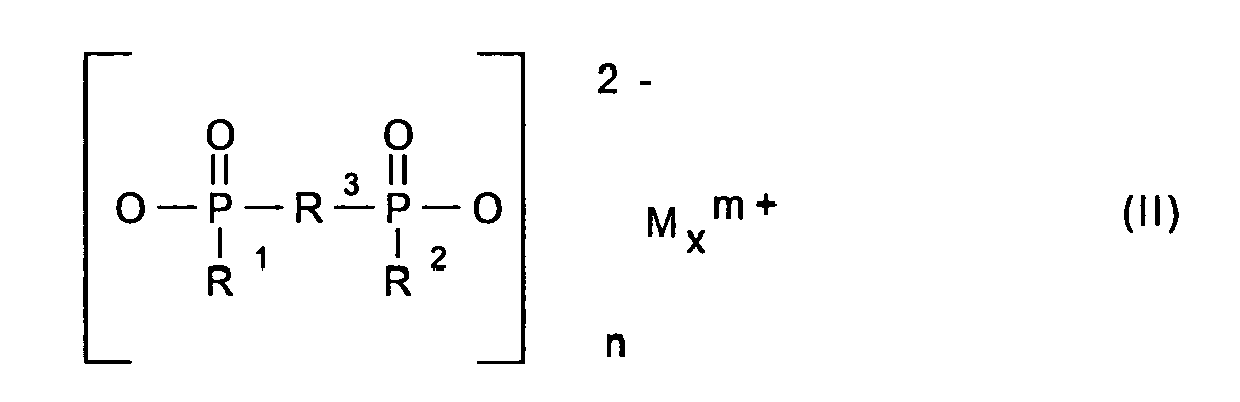
R1, R2 gleich oder verschieden sind und H oder C1-C6-Alkyl, linear oder verzweigt und/oder Aryl;
R3 C1-C10-Alkylen, linear oder verzweigt, C6-C10-Arylen, -Alkylarylen oder -Arylalkylen;
M Mg, Ca, Al, Sb, Sn, Ge, Ti, Fe, Zr, Ce, Bi, Sr, Mn, Li, Na, K und/oder eine protonierte Stickstoffbase;
m 1 bis 4; n 1 bis 4; x 1 bis 4 bedeuten
als Komponente D 5 bis 10 Gew.-% Melaminpolyphosphate, als Komponente E 15 bis 30 Gew.-% Verstärkungsstoffe und als Komponente F 0,1 bis 2 Gew.-% weitere Additive, wobei die Summe der Gewichtskomponenten 100 Gew.-% ergibt. - Flammwidrige Polyestercompounds nach Anspruch 1, dadurch gekennzeichnet, dass R1, R2 gleich oder verschieden sind und Methyl, Ethyl, n-Propyl, iso-Propyl, n-Butyl, tert.-Butyl, n-Pentyl und/oder Phenyl bedeuten.
- Flammwidrige Polyestercompounds nach Anspruch 1 oder 2, dadurch gekennzeichnet, dass R3 Methylen, Ethylen, n-Propylen, iso-Propylen, n-Butylen, tert.-Butylen, n-Pentylen, n-Octylen oder n-Dodecylen; Phenylen oder Naphthylen; Methyl-phenylen, Ethyl-phenylen, tert.-Butylphenylen, Methyl-naphthylen, Ethylnaphthylen oder tert.-Butylnaphthylen; Phenyl-methylen, Phenyl-ethylen, Phenylpropylen oder Phenyl-butylen bedeutet.
- Flammwidrige Polyestercompounds nach einem oder mehreren der Ansprüche 1 bis 3, dadurch gekennzeichnet, dass es sich bei der Komponente E um mineralische teilchenförmige Füllstoffe auf der Basis von Talk, Glimmer, Silikat, Quarz, Titandioxid, Wollastonit, Kaolin, amorphe Kieselsäuren, Magnesiumcarbonat, Kreide, Feldspat und/oder Bariumsulfat handelt.
- Flammwidrige Polyestercompounds nach einem oder mehreren der Ansprüche 1 bis 4, dadurch gekennzeichnet, dass es sich bei der Komponente E um Glasfasern handelt enthalten.
- Flammwidrige Polyestercompounds nach einem oder mehreren der Ansprüche 1 bis 5, dadurch gekennzeichnet, dass sie weiterhin Carbodiimide enthalten.
- Flammwidrige Polyestercompounds nach einem oder mehreren der Ansprüche 1 bis 6, dadurch gekennzeichnet, dass es sich bei der Komponente F um Gleit- und/oder Entformungsmittel handelt und es sich bei den Gleit- und/oder Entformungsmitteln um langkettige Fettsäuren, deren Salze, deren Esterderivate und/oder Amidderivate, Montanwachse und/oder niedermolekulare Polyethylen- und/oder Polypropylenwachse handelt.
- Verfahren zur Herstellung von flammwidrigen Polyestercompounds, dadurch gekennzeichnet, dass man die Komponenten A bis F in den genannten Gewichtsanteilen durch Schmelzextrusion vermischt.
- Fasern, Folien und Formkörpern aus den flammwidrigen Polyestercompounds nach einem oder mehreren der Ansprüche 1 bis 7.
- Verwendung der Fasern, Folien und Formkörper gemäß Anspruch 9 im Haushalt, der Industrie, in Medizin, in Kraftfahrzeugen, in Flugzeugen, in Schiffen, in Raumschiffen sowie in anderen Fortbewegungsmitteln, in Büroausstattungen sowie in Gegenständen und Gebäuden die einen erhöhten Brandschutz erfordern.
Applications Claiming Priority (1)
| Application Number | Priority Date | Filing Date | Title |
|---|---|---|---|
| DE102007041594A DE102007041594A1 (de) | 2007-09-01 | 2007-09-01 | Flammwidrige Polyestercompounds |
Publications (2)
| Publication Number | Publication Date |
|---|---|
| EP2031019A2 true EP2031019A2 (de) | 2009-03-04 |
| EP2031019A3 EP2031019A3 (de) | 2010-04-28 |
Family
ID=40002950
Family Applications (1)
| Application Number | Title | Priority Date | Filing Date |
|---|---|---|---|
| EP08014947A Withdrawn EP2031019A3 (de) | 2007-09-01 | 2008-08-23 | Flammwidrige Polyestercompounds |
Country Status (4)
| Country | Link |
|---|---|
| US (1) | US20090088512A1 (de) |
| EP (1) | EP2031019A3 (de) |
| JP (1) | JP2009057561A (de) |
| DE (1) | DE102007041594A1 (de) |
Cited By (3)
| Publication number | Priority date | Publication date | Assignee | Title |
|---|---|---|---|---|
| WO2010112375A1 (en) * | 2009-03-31 | 2010-10-07 | Dsm Ip Assets B.V. | Polymer composition containing polybutylene terephthalate and flame retardant additives |
| EP2322577A4 (de) * | 2008-07-21 | 2014-11-12 | Mitsubishi Eng Plastics Corp | Flammhemmende harzzusammensetzung auf der basis von polybutylenterephthalat |
| US20190241736A1 (en) * | 2016-09-01 | 2019-08-08 | Lanxess Deutschland Gmbh | Thermoplastic molding compounds |
Families Citing this family (11)
| Publication number | Priority date | Publication date | Assignee | Title |
|---|---|---|---|---|
| JP5321239B2 (ja) * | 2009-05-19 | 2013-10-23 | 三菱エンジニアリングプラスチックス株式会社 | Ledを光源とする照明装置反射板用難燃性ポリエステル樹脂組成物 |
| RU2418016C1 (ru) * | 2009-12-22 | 2011-05-10 | Юрий Андреевич Крутяков | Способ получения трудногорючих полимерных изделий на основе полиэтилентерефталата с биоцидными свойствами |
| CN101942189B (zh) * | 2010-10-25 | 2012-06-27 | 江苏技术师范学院 | 无卤阻燃pc/pbt合金材料及其制备方法 |
| EP2511337A1 (de) * | 2011-04-15 | 2012-10-17 | Basf Se | Flammhemmende thermoplastische Formmasse |
| WO2013045965A1 (en) | 2011-09-28 | 2013-04-04 | Italmatch Chemicals S.P.A. | Halogen-free flame retardant polyesters composition |
| CN104693692A (zh) * | 2013-12-05 | 2015-06-10 | 杜邦公司 | 阻燃性聚对苯二甲酸丙二醇酯组合物及其制品 |
| DE102017215773A1 (de) | 2017-09-07 | 2019-03-07 | Clariant Plastics & Coatings Ltd | Flammhemmende Polyesterzusammensetzungen und deren Verwendung |
| DE102017215776A1 (de) | 2017-09-07 | 2019-03-07 | Clariant Plastics & Coatings Ltd | Flammhemmende Polyesterzusammensetzungen und deren Verwendung |
| CN110577729A (zh) * | 2018-06-07 | 2019-12-17 | 江苏金发科技新材料有限公司 | 具有高灼热丝起燃温度的耐油聚碳酸酯组合物及其制备方法 |
| DE102019201727A1 (de) * | 2019-02-11 | 2020-08-13 | Clariant Plastics & Coatings Ltd | Flammschutzmittelmischung für thermoplastische Polymere |
| EP3945110A1 (de) * | 2020-07-30 | 2022-02-02 | Clariant International Ltd | Flammschutzmittel-stabilisator-kombinationen für flammwidrige polymere mit verbesserter hydrolysebeständigkeit und deren verwendung |
Citations (13)
| Publication number | Priority date | Publication date | Assignee | Title |
|---|---|---|---|---|
| DE1900270A1 (de) | 1968-01-04 | 1969-11-06 | Rhodiaceta | Neue thermoplastische Formmassen |
| DE2252258A1 (de) | 1972-10-25 | 1974-05-09 | Hoechst Ag | Schwerentflammbare thermoplastische polyester |
| DE2407674A1 (de) | 1973-03-30 | 1974-10-10 | Tokyo Kosei Kaken Co | Fahrbare vorrichtung zum schleifen und reinigen von boeden |
| DE2407776A1 (de) | 1974-02-19 | 1975-09-04 | Licentia Gmbh | Schaltung zur regelung der betriebsspannung fuer die transistor-zeilenendstufe eines fernsehempfaengers |
| DE2447727A1 (de) | 1974-10-07 | 1976-04-08 | Hoechst Ag | Schwerentflammbare polyamidformmassen |
| DE2715932A1 (de) | 1977-04-09 | 1978-10-19 | Bayer Ag | Schnellkristallisierende poly(aethylen/alkylen)-terephthalate |
| EP0699708A2 (de) | 1994-08-31 | 1996-03-06 | Hoechst Aktiengesellschaft | Flammengeschützte Polyesterformmassen |
| WO1997039053A1 (de) | 1996-04-12 | 1997-10-23 | Clariant Gmbh | Synergistische flammschutzmittel-kombination für thermoplastische polymere |
| DE19734437A1 (de) | 1997-08-08 | 1999-02-11 | Clariant Gmbh | Synergistische Flammschutzmittel-Kombination für Polymere |
| DE19737727A1 (de) | 1997-08-29 | 1999-07-08 | Clariant Gmbh | Synergistische Flammschutzmittel-Kombination für Kunststoffe |
| US6255371B1 (en) | 1999-07-22 | 2001-07-03 | Clariant Gmbh | Flame-retardant combination |
| WO2005059018A1 (en) | 2003-12-17 | 2005-06-30 | General Electric Company | Flame-retardant polyester composition |
| DE102005050956A1 (de) | 2005-10-25 | 2007-04-26 | Lanxess Deutschland Gmbh | Halogenfreie flammgeschützte thermoplastische Polyester |
Family Cites Families (9)
| Publication number | Priority date | Publication date | Assignee | Title |
|---|---|---|---|---|
| NL8403295A (nl) * | 1984-10-31 | 1986-05-16 | Gen Electric | Polymeermengsel met polycarbonaat en polyester. |
| JPH10505271A (ja) | 1995-06-28 | 1998-05-26 | ゼネラル・エレクトリック・カンパニイ | 洗濯機用の適応水位制御装置 |
| TW491843B (en) | 1997-03-04 | 2002-06-21 | Nissan Chemical Ind Ltd | 1,3,5-triazine derivative salts of polyacids comprising phosphorus, sulfur, and oxygen and process for producing the same |
| DE19739686A1 (de) * | 1997-09-10 | 1999-03-11 | Basf Ag | Thermoplastische Formmassen auf Basis von Polyestern und Polycarbonat |
| DE19820398A1 (de) * | 1998-05-07 | 1999-11-11 | Basf Ag | Flammgeschützte Polyesterformmassen |
| DE19904814A1 (de) * | 1999-02-05 | 2000-08-10 | Basf Ag | Flammgeschützte Polyester/Polycarbonatblends |
| DE10241126A1 (de) * | 2002-09-03 | 2004-03-25 | Clariant Gmbh | Flammschutzmittel-Stabilisator-Kombination für thermoplastische Polymere |
| DE102004026799B4 (de) * | 2004-06-02 | 2006-05-18 | Clariant Gmbh | Pressgranulierte Flammschutzmittelzusammensetzung, Verfahren zu deren Herstellung und deren Verwendung |
| DE102004035508A1 (de) * | 2004-07-22 | 2006-02-16 | Clariant Gmbh | Flammgeschützte Polymerformmassen |
-
2007
- 2007-09-01 DE DE102007041594A patent/DE102007041594A1/de not_active Withdrawn
-
2008
- 2008-08-23 EP EP08014947A patent/EP2031019A3/de not_active Withdrawn
- 2008-08-29 US US12/231,237 patent/US20090088512A1/en not_active Abandoned
- 2008-08-29 JP JP2008220833A patent/JP2009057561A/ja not_active Withdrawn
Patent Citations (13)
| Publication number | Priority date | Publication date | Assignee | Title |
|---|---|---|---|---|
| DE1900270A1 (de) | 1968-01-04 | 1969-11-06 | Rhodiaceta | Neue thermoplastische Formmassen |
| DE2252258A1 (de) | 1972-10-25 | 1974-05-09 | Hoechst Ag | Schwerentflammbare thermoplastische polyester |
| DE2407674A1 (de) | 1973-03-30 | 1974-10-10 | Tokyo Kosei Kaken Co | Fahrbare vorrichtung zum schleifen und reinigen von boeden |
| DE2407776A1 (de) | 1974-02-19 | 1975-09-04 | Licentia Gmbh | Schaltung zur regelung der betriebsspannung fuer die transistor-zeilenendstufe eines fernsehempfaengers |
| DE2447727A1 (de) | 1974-10-07 | 1976-04-08 | Hoechst Ag | Schwerentflammbare polyamidformmassen |
| DE2715932A1 (de) | 1977-04-09 | 1978-10-19 | Bayer Ag | Schnellkristallisierende poly(aethylen/alkylen)-terephthalate |
| EP0699708A2 (de) | 1994-08-31 | 1996-03-06 | Hoechst Aktiengesellschaft | Flammengeschützte Polyesterformmassen |
| WO1997039053A1 (de) | 1996-04-12 | 1997-10-23 | Clariant Gmbh | Synergistische flammschutzmittel-kombination für thermoplastische polymere |
| DE19734437A1 (de) | 1997-08-08 | 1999-02-11 | Clariant Gmbh | Synergistische Flammschutzmittel-Kombination für Polymere |
| DE19737727A1 (de) | 1997-08-29 | 1999-07-08 | Clariant Gmbh | Synergistische Flammschutzmittel-Kombination für Kunststoffe |
| US6255371B1 (en) | 1999-07-22 | 2001-07-03 | Clariant Gmbh | Flame-retardant combination |
| WO2005059018A1 (en) | 2003-12-17 | 2005-06-30 | General Electric Company | Flame-retardant polyester composition |
| DE102005050956A1 (de) | 2005-10-25 | 2007-04-26 | Lanxess Deutschland Gmbh | Halogenfreie flammgeschützte thermoplastische Polyester |
Non-Patent Citations (3)
| Title |
|---|
| "Kunststoff-Handbuch", vol. VIII, 1973, KARL-HANSER-VERLAG, pages: 695 - 710 |
| H. J. BUYSCH ET AL.: "Ullmann's Encyclopedia of Industrial Chemistry", vol. 19, 1991, VCH, pages: 348 |
| TEST FOR FLAMMABILITY OF PLASTIC MATERIALS FOR PARTS IN DEVICES AND APPLIANCES", 1998, pages 14 - 18 |
Cited By (3)
| Publication number | Priority date | Publication date | Assignee | Title |
|---|---|---|---|---|
| EP2322577A4 (de) * | 2008-07-21 | 2014-11-12 | Mitsubishi Eng Plastics Corp | Flammhemmende harzzusammensetzung auf der basis von polybutylenterephthalat |
| WO2010112375A1 (en) * | 2009-03-31 | 2010-10-07 | Dsm Ip Assets B.V. | Polymer composition containing polybutylene terephthalate and flame retardant additives |
| US20190241736A1 (en) * | 2016-09-01 | 2019-08-08 | Lanxess Deutschland Gmbh | Thermoplastic molding compounds |
Also Published As
| Publication number | Publication date |
|---|---|
| US20090088512A1 (en) | 2009-04-02 |
| DE102007041594A1 (de) | 2009-03-05 |
| JP2009057561A (ja) | 2009-03-19 |
| EP2031019A3 (de) | 2010-04-28 |
Similar Documents
| Publication | Publication Date | Title |
|---|---|---|
| EP2031019A2 (de) | Flammwidrige Polyestercompounds | |
| EP2632979B1 (de) | Flammwidrige polyestercompounds | |
| EP1945708B1 (de) | Halogenfreie flammgeschützte thermoplastische polyester | |
| US7169838B2 (en) | Halogen-free flameproof polyester | |
| EP3133112B1 (de) | Thermoplastische formmassen | |
| DE102015211728A1 (de) | Antikorrosive Flammschutzformulierungen für thermoplastische Polymere | |
| US10808120B2 (en) | Polyester blend having a halogen-free flame protection | |
| JP2015101730A (ja) | ポリエステル組成物 | |
| WO2003104316A1 (de) | Flammwidrig ausgerüstete kunststoff-formmassen | |
| DE102017215779B4 (de) | Flammschutzmittelkombinationen für Polymerzusammensetzungen, sowie Polymerzusammensetzungen und deren Verwendung | |
| EP3290470B1 (de) | Thermoplastische formmassen | |
| EP3507330B1 (de) | Thermoplastische formmassen | |
| EP2989153B1 (de) | Spannungsrissbeständige halogenfrei flammgeschützte polyester | |
| KR20000052650A (ko) | 난연성 성형 조성물 | |
| EP1739122B1 (de) | Polymerzubereitungen enthaltend ein Metallsalz einer Phosphonsäure | |
| EP4522686B1 (de) | Kriechstromfeste polyesterzusammensetzungen | |
| EP2878626B1 (de) | Verwendung von polyester-zusammensetzungen |
Legal Events
| Date | Code | Title | Description |
|---|---|---|---|
| PUAI | Public reference made under article 153(3) epc to a published international application that has entered the european phase |
Free format text: ORIGINAL CODE: 0009012 |
|
| AK | Designated contracting states |
Kind code of ref document: A2 Designated state(s): AT BE BG CH CY CZ DE DK EE ES FI FR GB GR HR HU IE IS IT LI LT LU LV MC MT NL NO PL PT RO SE SI SK TR |
|
| AX | Request for extension of the european patent |
Extension state: AL BA MK RS |
|
| RAP1 | Party data changed (applicant data changed or rights of an application transferred) |
Owner name: CLARIANT FINANCE (BVI) LIMITED |
|
| PUAL | Search report despatched |
Free format text: ORIGINAL CODE: 0009013 |
|
| AK | Designated contracting states |
Kind code of ref document: A3 Designated state(s): AT BE BG CH CY CZ DE DK EE ES FI FR GB GR HR HU IE IS IT LI LT LU LV MC MT NL NO PL PT RO SE SI SK TR |
|
| AX | Request for extension of the european patent |
Extension state: AL BA MK RS |
|
| 17P | Request for examination filed |
Effective date: 20101028 |
|
| AKX | Designation fees paid |
Designated state(s): AT BE BG CH CY CZ DE DK EE ES FI FR GB GR HR HU IE IS IT LI LT LU LV MC MT NL NO PL PT RO SE SI SK TR |
|
| 17Q | First examination report despatched |
Effective date: 20110110 |
|
| STAA | Information on the status of an ep patent application or granted ep patent |
Free format text: STATUS: THE APPLICATION HAS BEEN WITHDRAWN |
|
| 18W | Application withdrawn |
Effective date: 20110216 |