EP2511337A1 - Flammhemmende thermoplastische Formmasse - Google Patents
Flammhemmende thermoplastische Formmasse Download PDFInfo
- Publication number
- EP2511337A1 EP2511337A1 EP11162549A EP11162549A EP2511337A1 EP 2511337 A1 EP2511337 A1 EP 2511337A1 EP 11162549 A EP11162549 A EP 11162549A EP 11162549 A EP11162549 A EP 11162549A EP 2511337 A1 EP2511337 A1 EP 2511337A1
- Authority
- EP
- European Patent Office
- Prior art keywords
- molding composition
- thermoplastic molding
- composition according
- weight
- mixtures
- Prior art date
- Legal status (The legal status is an assumption and is not a legal conclusion. Google has not performed a legal analysis and makes no representation as to the accuracy of the status listed.)
- Ceased
Links
- 0 *N(C(N(*)C(N1*)=O)=O)C1=O Chemical compound *N(C(N(*)C(N1*)=O)=O)C1=O 0.000 description 1
Classifications
-
- C—CHEMISTRY; METALLURGY
- C08—ORGANIC MACROMOLECULAR COMPOUNDS; THEIR PREPARATION OR CHEMICAL WORKING-UP; COMPOSITIONS BASED THEREON
- C08L—COMPOSITIONS OF MACROMOLECULAR COMPOUNDS
- C08L67/00—Compositions of polyesters obtained by reactions forming a carboxylic ester link in the main chain; Compositions of derivatives of such polymers
- C08L67/02—Polyesters derived from dicarboxylic acids and dihydroxy compounds
-
- C—CHEMISTRY; METALLURGY
- C08—ORGANIC MACROMOLECULAR COMPOUNDS; THEIR PREPARATION OR CHEMICAL WORKING-UP; COMPOSITIONS BASED THEREON
- C08L—COMPOSITIONS OF MACROMOLECULAR COMPOUNDS
- C08L67/00—Compositions of polyesters obtained by reactions forming a carboxylic ester link in the main chain; Compositions of derivatives of such polymers
- C08L67/02—Polyesters derived from dicarboxylic acids and dihydroxy compounds
- C08L67/03—Polyesters derived from dicarboxylic acids and dihydroxy compounds the dicarboxylic acids and dihydroxy compounds having the carboxyl- and the hydroxy groups directly linked to aromatic rings
-
- C—CHEMISTRY; METALLURGY
- C08—ORGANIC MACROMOLECULAR COMPOUNDS; THEIR PREPARATION OR CHEMICAL WORKING-UP; COMPOSITIONS BASED THEREON
- C08J—WORKING-UP; GENERAL PROCESSES OF COMPOUNDING; AFTER-TREATMENT NOT COVERED BY SUBCLASSES C08B, C08C, C08F, C08G or C08H
- C08J5/00—Manufacture of articles or shaped materials containing macromolecular substances
-
- C—CHEMISTRY; METALLURGY
- C08—ORGANIC MACROMOLECULAR COMPOUNDS; THEIR PREPARATION OR CHEMICAL WORKING-UP; COMPOSITIONS BASED THEREON
- C08K—Use of inorganic or non-macromolecular organic substances as compounding ingredients
- C08K5/00—Use of organic ingredients
- C08K5/16—Nitrogen-containing compounds
-
- C—CHEMISTRY; METALLURGY
- C08—ORGANIC MACROMOLECULAR COMPOUNDS; THEIR PREPARATION OR CHEMICAL WORKING-UP; COMPOSITIONS BASED THEREON
- C08K—Use of inorganic or non-macromolecular organic substances as compounding ingredients
- C08K5/00—Use of organic ingredients
- C08K5/49—Phosphorus-containing compounds
-
- C—CHEMISTRY; METALLURGY
- C08—ORGANIC MACROMOLECULAR COMPOUNDS; THEIR PREPARATION OR CHEMICAL WORKING-UP; COMPOSITIONS BASED THEREON
- C08L—COMPOSITIONS OF MACROMOLECULAR COMPOUNDS
- C08L23/00—Compositions of homopolymers or copolymers of unsaturated aliphatic hydrocarbons having only one carbon-to-carbon double bond; Compositions of derivatives of such polymers
- C08L23/02—Compositions of homopolymers or copolymers of unsaturated aliphatic hydrocarbons having only one carbon-to-carbon double bond; Compositions of derivatives of such polymers not modified by chemical after-treatment
-
- C—CHEMISTRY; METALLURGY
- C08—ORGANIC MACROMOLECULAR COMPOUNDS; THEIR PREPARATION OR CHEMICAL WORKING-UP; COMPOSITIONS BASED THEREON
- C08K—Use of inorganic or non-macromolecular organic substances as compounding ingredients
- C08K5/00—Use of organic ingredients
- C08K5/0008—Organic ingredients according to more than one of the "one dot" groups of C08K5/01 - C08K5/59
- C08K5/0066—Flame-proofing or flame-retarding additives
-
- C—CHEMISTRY; METALLURGY
- C08—ORGANIC MACROMOLECULAR COMPOUNDS; THEIR PREPARATION OR CHEMICAL WORKING-UP; COMPOSITIONS BASED THEREON
- C08L—COMPOSITIONS OF MACROMOLECULAR COMPOUNDS
- C08L23/00—Compositions of homopolymers or copolymers of unsaturated aliphatic hydrocarbons having only one carbon-to-carbon double bond; Compositions of derivatives of such polymers
- C08L23/02—Compositions of homopolymers or copolymers of unsaturated aliphatic hydrocarbons having only one carbon-to-carbon double bond; Compositions of derivatives of such polymers not modified by chemical after-treatment
- C08L23/04—Homopolymers or copolymers of ethene
- C08L23/06—Polyethylene
-
- C—CHEMISTRY; METALLURGY
- C08—ORGANIC MACROMOLECULAR COMPOUNDS; THEIR PREPARATION OR CHEMICAL WORKING-UP; COMPOSITIONS BASED THEREON
- C08L—COMPOSITIONS OF MACROMOLECULAR COMPOUNDS
- C08L23/00—Compositions of homopolymers or copolymers of unsaturated aliphatic hydrocarbons having only one carbon-to-carbon double bond; Compositions of derivatives of such polymers
- C08L23/02—Compositions of homopolymers or copolymers of unsaturated aliphatic hydrocarbons having only one carbon-to-carbon double bond; Compositions of derivatives of such polymers not modified by chemical after-treatment
- C08L23/10—Homopolymers or copolymers of propene
- C08L23/12—Polypropene
-
- C—CHEMISTRY; METALLURGY
- C08—ORGANIC MACROMOLECULAR COMPOUNDS; THEIR PREPARATION OR CHEMICAL WORKING-UP; COMPOSITIONS BASED THEREON
- C08L—COMPOSITIONS OF MACROMOLECULAR COMPOUNDS
- C08L23/00—Compositions of homopolymers or copolymers of unsaturated aliphatic hydrocarbons having only one carbon-to-carbon double bond; Compositions of derivatives of such polymers
- C08L23/02—Compositions of homopolymers or copolymers of unsaturated aliphatic hydrocarbons having only one carbon-to-carbon double bond; Compositions of derivatives of such polymers not modified by chemical after-treatment
- C08L23/10—Homopolymers or copolymers of propene
- C08L23/14—Copolymers of propene
Definitions
- the invention relates to the use of the thermoplastic molding composition according to the invention for the production of fibers, films or moldings and fibers, films or moldings containing the thermoplastic molding composition according to the invention.
- the invention further relates to the use of the thermoplastic molding composition as a coating agent.
- the font KR 10 2007 0 117 410 discloses polyalkylene terephthalate and polyolefin-containing molding compositions. As flame retardants, hydroxide salts are used.
- JP 11 335 534 JP 11 335 534 .
- JP 11 335 534 and JP 11 335 534 Polyalkylene terephthalate and polyolefin-containing molding compositions are known.
- the molding compositions disclosed therein contain red phosphorus as a flame retardant.
- CN 101 434 727 discloses molding compositions comprising a halogen-free flame retardant comprising a polyalkylene terephthalate and a polyolefin.
- molding compositions comprising a polyalkylene terephthalate and a polyolefin. These molding compounds include rare earth salts. The rare earth salts are added in small amounts as nucleating agents.
- the object of the present invention was to develop a molding composition which is easy to process and at the same time has a flame retardant effect. Another object was to provide a molding compound which has high creep resistance. In addition, the molding composition should have the lightest possible color.
- the molding composition should be halogen-free, especially chlorine and bromine-free.
- the formate should contain neither red phosphorus nor rare earth salts.
- thermoplastic molding compound described above.
- thermoplastic molding composition according to the invention is halogen-free.
- halogen-free is to be understood in accordance with the definitions of the International Electronical Commission (IEC 61249-2-21) and the Japan Printed Circuit Association (JPCA-ES-01-1999), which in the case of non-halogenated materials are those which are largely free of chlorine and bromine.
- thermoplastic molding composition contains no rare earths such as lanthanum or cerium.
- thermoplastic molding composition according to the invention contains halogen-free flame retardants.
- Component A) of the thermoplastic molding composition according to the invention is a polyalkylene terephthalate. This also means mixtures of polyalkylene terephthalates of different structure and / or chain length.
- polyalkylene terephthalate is not limited to terephthalate-containing compounds.
- the polyalkylene terephthalate component may also comprise at least one acid other than terephthalic acid.
- This acid can be derived from structures containing an aromatic ring in the backbone derived from an aromatic dicarboxylic acid.
- the aromatic ring may be unsubstituted or substituted. Suitable substituents include C 1 - to C 4 -alkyl groups such as methyl, ethyl, i- or n-propyl and n-, i- or t-butyl groups or fluorine.
- Preferred dicarboxylic acids are substituted, in particular unsubstituted, 2,6-naphthalenedicarboxylic acid, terephthalic acid and isophthalic acid or mixtures thereof. Preference is given to terephthalic acid or isophthalic acid or mixtures thereof.
- Polyalkylene terephthalates contain, in addition to the radicals derived from corresponding dicarboxylic acids, aliphatic hydrocarbon radicals derived from the corresponding alkylene diols derived.
- the alkylenediols can thus be branched or unbranched, ie linear.
- Branched polyalkylene terephthalates include branched hydrocarbon radicals, while linear polyalkylene terephthalates include unbranched hydrocarbon radicals.
- alkylene diols preference is given to diols having 2 to 6 carbon atoms, in particular 1,2-ethanediol, 1,3-propanediol, 1,4-butanediol, 1,6-hexanediol, 1,4-hexanediol, 1,4-cyclohexanediol, 1 , 4-cyclohexanedimethanol or neopentyl glycol or mixtures thereof.
- component A may comprise polyethylene terephthalate, 1,3-polypropylene terephthalate, 1,4-polybutylene terephthalate, polyethylene naphthalate, 1,4-polybutylene naphthalate, 1,3-polypropylene terephthalate, poly (cyclohexane dimethanol terephthalate), or mixtures thereof
- Component A comprises from 5 to 20% by weight of an acid other than terephthalate.
- polyalkylene terephthalates generally have an intrinsic viscosity of 0.4 dL / g to 2.0 dL / g measured in phenol / carbon tetrachloride (1/1 by volume).
- the polyalkylene terephthalates generally have an average molecular weight of 5000 to 13000 g / mol (Mw) (determined by gel permeation chromatography in chloroform / hexafluoroisopropanol (5/95, volume ratio) at 25 ° C measured against a polystyrene standard)
- the thermoplastic molding composition contains, as component B), a polyolefin composed of repeating units comprising ethylene and / or propylene, excluding polar functional groups. These are to be understood according to the invention as mixtures of these polyolefins of different chain lengths.
- Polar functional groups are understood as meaning all functional groups in incorporated monomer units which contain atoms other than carbon and hydrogen.
- the polyolefins used in this invention is essentially composed of the monomer units ethylene and / or propylene, wherein comonomers and / or functional group-containing units are excluded as well as unsaturated groups.
- component B) is composed of saturated aliphatic repeating units consisting of carbon and hydrogen.
- the polyolefin according to component B) may contain common branching sites and, to a small extent, in particular up to 2% by weight, further monomer units which are composed of carbon and hydrogen.
- the polyolefin of component B) can thus small amounts (ie in particular up to 2 wt .-% based on the polyolefin) of other monomer units, for.
- those derived from 1-butene, 1-pentene, 1-hexene, 1-heptene or 1-octene or 4-methylpentene-1 contain.
- thermoplastic molding composition contains as component B) at least one linear or branched polyolefin consisting essentially of repeating units which are selected from ethylene and propylene.
- Component B) is preferably selected from the group of polyethylenes, polypropylenes and copolypropylenes and mixtures thereof.
- component B) is a polypropylene and / or a poly (propylene-ethylene).
- polyethylene is mentioned in the context of the present invention, it is understood to mean a homopolymer of ethylene.
- the polyethylene b1) may also be a mixture of homopolymers of different structure and / or chain length.
- the polyethylene used b1) has a conventional melt flow indices (MFR measured at 190 ° C, 2.16 Kg) of 0.1 g / 10 min to 100 g / 10 min, preferably from 2 g / 10 min to 50 g / 10 min.
- the molecular weight (Mw) of the polyethylene (b1) is typically from 85,000 to 900,000 g / mol, preferably from 95,000 to 750,000 g / mol (determined by high-temperature GPC in trichlorobenzene versus a polystyrene standard at 130 ° C).
- the density of the polyethylene is from 0.850 g / cm 3 to 0.925 g / cm 3 , preferably from 0.870 g / cm 3 to 0.925 g / cm 3 (measured by immersion method according to DIN EN ISO 1183-1).
- polypropylene is mentioned in the context of the present invention, it is understood to mean a homopolymer of propylene which may have branching, in particular linear branching.
- the polypropylene b2) may also be a mixture of homopolypropylene of different structure and chain length.
- the polypropylene b2) has a conventional melt flow indices (MFR measured at 230 ° C, 2.16 Kg) of 0.1 g / 10 min to 100 g / 10 min, preferably from 2 g / 10 min to 50 g / 10 min.
- MFR melt flow indices
- the molecular weight (Mw) of the polypropylene is typically from 85,000 to 900,000 g / mol, preferably from 95,000 to 750,000 g / mol (determined by high temperature GPC in trichlorobenzene versus a polystyrene standard at 135 ° C).
- the density of the polypropylene is from 0.850 g / cm 3 to 0.925 g / cm 3 , preferably from 0.870 g / cm 3 to 0.925 g / cm 3 (measured by immersion method according to DIN EN ISO 1183-1).
- the copolypropylene b3) is preferably a random copolymer or a mixture of random copolymers of different structure and / or chain length.
- the copolymer b3) consists in particular of propylene and ethylene and up to 2 wt .-% of other C3-C20 alkenes, comprising 1-butene, 1-pentene, 1-hexene, methyl-1-butene, methyl-1-pentene, 1 Octenes, 1-decene and mixtures thereof.
- a preferred copolypropylene b3) is copoly (propylene-ethylene) made from propylene and ethylene.
- the propylene content may be 75 to 98% by weight, preferably 85-95% by weight.
- the ethylene content in this copoly (propylene-ethylene) may be 2-25 wt .-%, in particular 5-15 wt .-%.
- the copolypropylene used b3) has a conventional melt flow indices (MFR measured at 230 ° C, 2.16 Kg) of 0.1 g / 10 min to 100 g / 10 min, preferably from 2 g / 10 min to 50 g / 10 minute
- MFR melt flow indices
- the molecular weight (Mw) of the copolypropylene is typically from 85,000 to 900,000 g / mol, preferably from 95,000 to 750,000 g / mol (determined by high-temperature GPC in trichlorobenzene versus a polystyrene standard at 135 ° C).
- the density of the copolypropylene is from 0.850 g / cm 3 to 0.925 g / cm 3 , preferably from 0.870 g / cm 3 to 0.925 g / cm 3 (measured by immersion method according to DIN EN ISO 1183-1).
- the polyolefins used according to the invention are obtainable by polymerization of at least one of the monomers ethylene and propylene. Methods for this are known to the person skilled in the art.
- the inventive thermoplastic molding composition contains a flame retardant C) which is selected from the group of nitrogen-containing compounds c1), the phosphorus-containing compounds c2) and mixtures thereof.
- the thermoplastic molding composition according to the invention may contain a halogen-free compound from the group of nitrogen-containing heterocycles having at least one nitrogen atom. Also, the thermoplastic composition may contain mixtures of the nitrogen-containing heterocycles having at least one nitrogen atom.
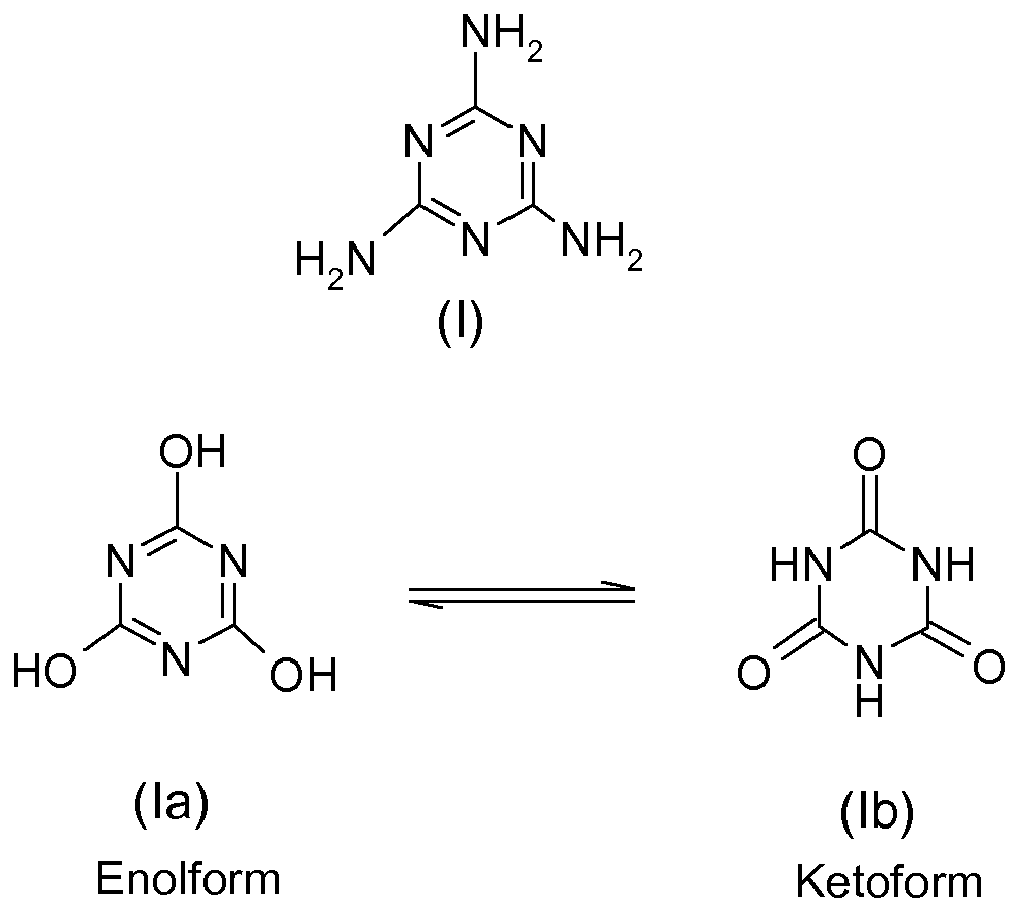
- melamine cyanurate is a reaction product of preferably equimolar amounts of melamine formula (I) and cyanuric acid or isocyanuric acid of formula (Ia) and (Ib).
- Melamine cyanurate can be obtained, for example, by reacting aqueous solutions of the starting compounds at 90 to 100.degree.
- salts or adducts are melamine, melamine borate, and melamine oxalate. It is also possible to use mixtures of these salts. However, no salts of nitrogen-containing heterocycles are used with at least one nitrogen atom and rare earth elements.
- Nitrogen-containing flame retardants are to be understood as meaning those in the WO 2002/96976 are described.
- Melamine phosphate prim. Phosphate sec. And pyrophosphate sec.
- Neopentyl glycol boronic acid melamine and melamine polyphosphate (CAS No. 56386-64-2) are suitable here.
- Suitable guanidine salts are CAS-No. G-carbonate 593-85-1 G-cyanurate prim. 70285-19-7 G-phosphate prim. 5423-22-3 G-phosphate sec. 5423-23-4 G-sulfate prim. 646-34-4 G-sulfate sec.
- compounds are meant to be both e.g. Benzoguanamine itself and its adducts or salts as well as the nitrogen-substituted derivatives and its adducts or salts are understood.
- ammonium phosphate Also suitable is ammonium polyphosphate (NH 4 PO 3 ) n with n of about 200 to 1000, preferably from 600 to 800, and Tris (hydroxyethyl) isocyanurate (THEIC) of formula II
- R 9 , R 10 are straight-chain or branched alkyl radicals having 1 to 10 C atoms, preferably hydrogen, and in particular their adducts with phosphoric acid, boric acid and / or pyrophosphoric acid.
- the cyanoguanidine (formula VI) which can be used according to the invention is obtained, for example, by reacting calcium cyanamide (calcium cyanamide) with carbonic acid, the resulting cyanamide being dimerized at pH 9 to 10 to give cyanoguanidine.
- Suitable nitrogen-containing compounds (c1) are in particular compounds from the group of nitrogen-containing heterocycles having at least one nitrogen atom.
- the thermoplastic molding composition according to the invention may comprise a phosphinic acid salt of the formula (VII) and / or diphosphinic acid salts of the formula (VIII) and / or their polymers.
- the thermoplastic composition may comprise mixtures of the phosphorus-containing compound (c2). However, no rare earth elements are used as cations.
- R 11 and R 12 are hydrogen, methyl, ethyl or isobutyl, where M is preferably Ca, Zn, Mg or Al and aluminum diethylphosphinate and aluminum hypophosphites are very particularly preferred.
- phosphorus of the valence state +0 is not a compound and is thus not suitable according to the invention as flame retardant.
- the thermoplastic molding composition according to the invention is consequently free of red phosphorus.
- the thermoplastic molding composition contains a fibrous or particulate additive D).
- additive D it is also possible to use mixtures of different additives.
- This additive D) may e.g. Glass fibers, carbon fibers, aramid fibers, potassium titanate fibers, glass beads, amorphous silica, calcium silicate, magnesium carbonate, kaolins, chalk, powdered quartz, mica, barium sulfate, felspar, metal hydroxides, metal oxides, similar mineral fillers or a ceramic. Also mixtures of the additives D) are possible.
- the additive D) does not contain halogenated compounds, rare earth salts or red phosphorus.
- thermoplastic molding composition according to the invention may contain an additive E).
- additive E it is also possible to use mixtures of different additives.
- the additives E) can be selected from the group of stabilizers, antistatic agents, nucleating agents, processing aids, impact modifiers, lubricants and demulsifiers, pigments and antioxidants.
- UV stabilizers for example, substituted resorcinols, salicylates, benzotriazoles and benzophenones can be used.
- inorganic pigments for example, titanium dioxide, ultramarine blue and / or carbon black are suitable, while as organic pigments, e.g. Perylenes, phthalocyanines and / or quinacridones can be admixed. Dyes such as nigrosine and / or anthraquinones are also suitable for dyeing the thermoplastic composition.
- long-chain fatty acids e.g., stearic acid
- its salts e.g., Ca-stearate
- Lubricants and mold release agents are usually used in proportions by weight of up to 1% relative to the total mass of the thermoplastic molding composition.
- the plasticizers used may, in particular, be dioctyl phthalate, dibenzyl phthalate, butyl benzyl phthalate, hydrocarbon oils, and / or N- (n-butyl) benzenesulfonamide.
- the additive E) does not contain halogen-containing compounds, rare earth salts or red phosphorus.
- the components A), B), C), D) and E) can be mixed in different proportions by weight.
- the following percentages by weight are based on the total weight of the thermoplastic composition. In a thermoplastic composition, the addition of the individual weight percentages gives 100% by weight.
- thermoplastic molding compositions according to the invention contain, for example, from 40 to 60% by weight of component (A). Preference is given to using (A) in proportions by weight of from 40 to 55% by weight, in particular from 45 to 54% by weight, based on the total mass of the thermoplastic molding composition.
- the novel thermoplastic molding compositions preferably comprise from 0.01 to 10% by weight of component B), based on the total mass of the thermoplastic molding composition.
- the thermoplastic molding composition according to the invention particularly preferably contains from 0.01 to 8% by weight of component B), in particular from 1 to 8% by weight, based on the total mass of the thermoplastic molding composition.
- Component (C) is added in proportions by weight of 10 to 30 wt .-% based on the total mass of the thermoplastic molding composition.
- Component C) is preferably added in proportions by weight of from 5 to 30% by weight, in particular from 5 to 25% by weight.
- the reinforcing agent (D) is used in proportions by weight of 0.01 to 60 wt .-% relative to the total mass of the thermoplastic molding composition.
- the thermoplastic molding composition contains an additive in proportions by weight of 15 to 50 wt .-%, in particular from 15 to 30 wt .-% based on the total mass of the thermoplastic molding composition.
- the additive (E) can be used in proportions by weight of from 0 to 50% by weight, based on the total mass of the thermoplastic molding composition.
- the thermoplastic molding composition contains the additive E) in proportions by weight of from 1 to 50% by weight, in particular from 1 to 45% by weight, based on the total mass of the thermoplastic molding composition.
- thermoplastic composition component Example 1 Ex. 2 Example 3 Example 4 Example 5 Example 6 Example 7 Ex. 8 Ex. 9 Ex. 10 Ex. 11 A 42 48 52 56 52 52 52 52 50 50 50 b1 0 0 0 0 1 0 5 0 0 0 0 b2 3 3 3 0 0 0 0 0 3 3 3 b3 0 0 0 0 0 1 0 5 0 0 0 0 C 15 15 15 15 15 15 15 15 15 15 10 20 15 D 25 25 25 25 25 25 25 25 25 25 25 25 25 25 25 30 e 15 9 5 1 7 7 3 3 7 2 2
- thermoplastic molding composition of the invention is characterized by a high tracking resistance (CTI) with simultaneous freedom from halogen.
- the molding compound is flame-retardant. This means that the thermoplastic molding compound meets the highest requirements of the flame test UL94 and is stable against dripping in the flame test.
- thermoplastic molding composition is characterized by good mechanical properties, in particular a high impact strength.
- thermoplastic molding composition has a light inherent color, since it contains no red phosphorus. The absence of rare earth salts is economically desirable.
- Polypropylene from LyondeIIBasell having a density (measured to ISO1183) of 0.9 g / cm 3 and a melt flow index MFR (measured to ISO 1133) of 12 g / 10 min (230 ° C, 2.16 kg), Moplen® 501.
- Melamine polyphosphate Melapur® 200 from BASF SE.
- Glass fibers diameter 10 ⁇ m, standard fiber length 4.5 mm, PPG 3786 glass fibers.
- Lubricant oxidized polyethylene wax Luwax® OA5 BASF SE.
- the components were extruded in a twin screw extruder with an L / D ratio of 18. During the process, the compounding temperature was 260 ° C. The throughput was 10 kg / h. The screw speed was 300 rpm.
- the resulting polymer strands were cut into granules.
- this granulate was subjected to an injection molding process.
- Residual current tests were carried out in accordance with the IEC 60112 standard. The tests were carried out on samples with the dimensions 60 mm ⁇ 60 mm ⁇ 3 mm
- Comparative Example 1 shows a thermoplastic molding composition to which no polyolefin has been mixed.
- the examples show that the use of a polyolefin increased the creep resistance (CTI) of the halogen-free molding composition.
- CTI creep resistance
- the sample met the highest requirements of the flame test UL94 and was drip-stable in the flame test. In addition, the impact strength was retained.
Landscapes
- Chemical & Material Sciences (AREA)
- Health & Medical Sciences (AREA)
- Chemical Kinetics & Catalysis (AREA)
- Medicinal Chemistry (AREA)
- Polymers & Plastics (AREA)
- Organic Chemistry (AREA)
- Engineering & Computer Science (AREA)
- Manufacturing & Machinery (AREA)
- Materials Engineering (AREA)
- Compositions Of Macromolecular Compounds (AREA)
Abstract
Die Erfindung betrifft eine Halogen - und seltene Erden freie thermoplastische Formmasse, enthaltend
A) von 40 bis 60 Gew.-% eines Polyalkylenterephthalats
B) von 0.01 bis 10 Gew.-% eines Polyolefins ausgewählt aus der Gruppe
b1) Polyethylen
b2) Polypropylen
b3) Polypropylen-Copolymere
und deren Mischungen.
C) von 10 bis 30 Gew.-% eines Flammschutzmittel, ausgewählt aus der Gruppe
c1) der stickstoffhaltigen Verbindungen
c2) der phosphorhaltigen Verbindungen
und deren Mischungen.
D) von 0.01 bis 60 Gew.-% eines Verstärkungsmittels
E) von 0 bis 50 Gew.% eines weiteren Zusatzstoffes
wobei die Summe der Gewichtsanteile 100 Gew.-% bezogen auf die thermoplastische Formmasse ergibt. Weiterhin betrifft die Erfindung die Verwendung der erfindungsgemäßen thermoplastischen Formmasse zur Herstellung von Fasern, Folien oder Formkörpern sowie Fasern, Folien oder Formkörper, die die erfindungsgemäße thermoplastische Formmasse enthalten. Die Erfindung betrifft des Weiteren die Verwendung der thermoplastischen Formmasse als Überzugmittel.
Description
- Die Erfindung betrifft eine Halogen- und seltene Erden freie thermoplastische Formmasse, enthaltend
- A) von 40 bis 60 Gew.-% eines Polyalkylenterephthalats
- B) von 0.01 bis 10 Gew.-% eines Polyolefins ausgewählt aus der Gruppe
- b1) Polyethylen
- b2) Polypropylen
- b3) Polypropylen-Copolymere
- C) von 10 bis 30 Gew.-% eines Flammschutzmittel, ausgewählt aus der Gruppe
- c1) der stickstoffhaltigen Verbindungen
- c2) der phosphorhaltigen Verbindungen
- D) von 0.01 bis 60 Gew.-% eines Verstärkungsmittels
- E) von 0 bis 50 Gew.% eines weiteren Zusatzstoffes
wobei die Summe der Gewichtsanteile 100 Gew.-% bezogen auf die thermoplastische Form masse ergibt. - Weiterhin betrifft die Erfindung die Verwendung der erfindungsgemäßen thermoplastischen Formmasse zur Herstellung von Fasern, Folien oder Formkörpern sowie Fasern, Folien oder Formkörper, die die erfindungsgemäße thermoplastische Formmasse enthalten. Die Erfindung betrifft des Weiteren die Verwendung der thermoplastischen Formmasse als Überzugmittel.
- Bevorzugte Ausführungsformen sind den Ansprüchen und der Beschreibung zu entnehmen. Kombinationen bevorzugter Ausführungsformen fallen in den Rahmen der vorliegenden Erfindung.
- Der Bedarf an flammhemmenden Formmassen ist von wachsendem Interesse, wobei insbesondere Zusammensetzungen gefragt sind, die frei von Zusätzen sind, de potentielle Risiken für Umwelt und Mensch bedeuten können. Gleichzeitig sollen diese Formmassen einem hohen technischen Niveau genügen.
- Die Schrift
KR 10 2007 0 117 410 - Auch aus den Dokumenten
JP 11 335 534 JP 11 335 534 JP 11 335 534 JP 11 335 534 -
CN 101 434 727 offenbart Formmassen umfassend ein halogenfreies Flammschutzmittel, umfassend ein Polyalkylenterephthalat und ein Polyolefin. - In der Schrift
CN 101 445 650 werden Formmassen offenbart, die ein Polyalkylenterephthalat und ein Polyolefin umfassen. Diese Formmassen umfassen seltene Erden Salze. Die seltene Erden Salze werden in geringen Mengen als Nuklierungsmittel zugegeben. - Aufgabe der vorliegenden Erfindung war es, eine Formmasse zu entwickeln, die gut zu verarbeiten ist und zugleich eine flammhemmende Wirkung aufweist. Ein weiteres Ziel war es, eine Formmasse zur Verfügung zu stellen, die eine hohe Kriechstromfestigkeit aufweist. Zudem sollte die Formmasse eine möglichst helle Eigenfarbe aufweisen.
- Allerdings sollte die Formmasse halogenfrei, insbesondere chlor- und bromfrei sein. Darüber hinaus sollte die Formasse weder roten Phosphor noch seltene Erden Salze enthalten.
- Gelöst wird die gestellte Aufgabe mit einer eingangs beschriebenen thermoplastischen Formmasse.
- Die erfindungsgemäße thermoplastische Formmasse ist halogenfrei. Halogenfrei ist in diesem Zusammenhang entsprechend den Definitionen der "International Electronical Commission" (IEC 61249-2-21) und der "Japan Printed Circuit Association" (JPCA-ES-01-1999) zu verstehen, die unter halogenfreien Materialen solche verstehen, die weitestgehend chlor- und bromfrei sind.
- Des Weiteren enthält die thermoplastische Formmasse keine seltenen Erden wie Lanthan oder Cer.
- Insbesondere enthält erfindungsgemäße thermoplastische Formmasse halogenfreie Flammschutzmittel.
- Komponente A) der erfindungsgemäßen thermoplastischen Formmasse ist ein Polyalkylenterephthalat. Hierunter werden auch Mischungen von Polyalkylenterephthalaten unterschiedlicher Struktur und/oder Kettenlänge verstanden.
- Im Rahmen der Erfindung ist Polyalkylenterephthalat nicht auf Terephthalat enthaltende Verbindungen beschränkt. So kann die Polyalkylenterephthalat Komponente auch mindestens eine Säure unterschiedlich von Terephthalsäure umfassen.
- Diese Säure kann sich von Strukturen ableiten, die einen aromatischen Ring in der Hauptkette enthalten, der von einer aromatischen Dicarbonsäure stammt. Der aromatische Ring kann unsubstituiert oder substituiert sein. Als Substituenten bieten sich unter anderem C1- bis C4-Alkylgruppen wie Methyl-, Ethyl-, i- bzw. n-Propyl- und n-, i- bzw. t-Butylgruppen oder Fluor an. Bevorzugte Dicarbonsäuren sind substituierte, insbesondere unsubstituierte 2,6-Naphthalindicarbonsäure, Terephthalsäure und Isophthalsäure oder deren Mischungen. Bevorzugt sind darunter Terephthalsäure oder Isophthalsäure oder deren Mischungen zu verstehen.
- Polyalkylenterephthalate enthalten neben den Resten, die sich von entsprechenden Dicarbonsäuren ableiten, aliphatische Kohlenwasserstoffreste, die sich von den entsprechenden Alkylendiolen ableiten. Die Alkylendiole können verzweigt oder unverzweigt also linear sein. Verzweigte Polyalkylenterephthalate umfassen verzweigte Kohlenwasserstoffreste, während lineare Polyalkylenterephthalate unverzweigte Kohlenwasserstoffreste umfassen. In den erfindungsgemäßen thermoplastischen Zusammensetzungen werden bevorzugt lineare Polyalkylenterephthalate eingesetzt.
- Von den Alkylendiolen werden Diole mit 2 bis 6 Kohlenstoffatomen bevorzugt, insbesondere 1,2-Ethandiol, 1,3-Propandiol, 1,4-Butandiol, 1,6-Hexandiol, 1,4-Hexandiol, 1,4-Cyclohexandiol, 1,4-Cyclohexandimethanol oder Neopentylglykol oder deren Mischungen.
- In einer bevorzugten Ausführungsform der Erfindung kann die Komponente A Polyethylenterephthalat, 1,3-Polypropylenterephthalat, 1,4-Polybutylenterephthalat, Polyethylennaphthalat, 1,4-Polybutylennaphthalat, 1,3-Polypropylenterephthalat, Poly(cyclohexandimethanolterephthalat), oder deren Mischungen umfassen, wobei die Komponente A von 5 bis 20 Gew.-% einer Säure unterschiedlich von Terephthalat umfasst..
- Diese Polyalkylenterephthalate haben in der Regel eine in Phenol/Tetrachlorkohlenstoff (1/1-Volumenverhältniss) gemessene Grenzviskosität von 0.4 dL/g bis 2.0 dL/g. Die Polyalkylenterephthalate haben in der Regel ein mittleres Molekulargewicht von 5000 bis 130000 g/mol (Mw) (bestimmt mittels Gelpermeationschromatographie in Chloroform/Hexafluoroisopropanol (5/95, Volumenverhältniss) bei 25°C gemessen gegen einen Polystyrol-Standart)
- Erfindungsgemäß enthält die thermoplastische Formmasse als Komponente B) ein Polyolefin aufgebaut aus Wiederholungseinheiten, die Ethylen und/oder Propylen umfassen, wobei polare funktionelle Gruppen ausgeschlossen sind. Hierunter sind erfindungsgemäß auch Mischungen dieser Polyolefine unterschiedlicher Kettenlänge zu verstehen.
- Unter polaren funktionellen Gruppen werden alle funktionellen Gruppen in eingebauten Monomereinheiten verstanden, die andere Atome als Kohlenstoff und Wasserstoff beinhalten. Somit ist das die erfindungsgemäß verwendete Polyolefine im Wesentlichen aufgebaut aus den Monomereinheiten Ethylen und/oder Propylen, wobei Comonomere und/oder funktionelle Gruppen enthaltende Einheiten ebenso ausgeschlossen sind wie ungesättigte Gruppen. Folglich ist die Komponente B) aufgebaut aus gesättigten aliphatischen Wiederholungseinheiten, die aus Kohlenstoff und Wasserstoff bestehen.
- Das Polyolefin gemäß Komponente B) kann jedoch übliche Verzweigungsstellen sowie in geringem Umfang, insbesondere bis zu 2 Gew.-%, weitere Monomereinheiten enthalten, die aus Kohlenstoff und Wasserstoff aufgebaut sind. Das Polyolefin der Komponente B) kann somit geringe Mengen (d.h. insbesondere bis 2 Gew.-% bezogen auf das Polyolefin) anderer Monomereinheiten, z. B. solche, die sich von 1-Buten, 1-Penten, 1-Hexen, 1-Hepten oder 1-Octen oder 4-Methylpenten-1 ableiten, enthalten.
- Somit enthält die thermoplastische Formmasse als Komponente B) mindestens ein lineares oder verzweigtes Polyolefin im Wesentlichen bestehend aus Wiederholungseinheiten, die aus Ethylen und Propylen ausgewählt sind.
- Bevorzugt wird die Komponente B) ausgewählt aus der Gruppe der Polyethylene, Polypropylene und Copolypropylene und deren Mischungen. Vorzugsweise ist Komponente B) ein Polypropylen und/oder ein Poly(propylen-ethylen).
- Sofern im Rahmen der vorliegenden Erfindung von Polyethylen die Rede ist, wird darunter ein Homopolymer des Ethylens verstanden. Das Polyethylen b1) kann auch eine Mischung von Homopolymeren unterschiedlicher Struktur und/oder Kettenlänge sein.
- Das verwendete Polyethylen b1) hat einen üblichen Schmelzflussindizes (MFR gemessen bei 190 °C, 2.16 Kg) von 0.1 g/10 min bis 100 g/10 min, bevorzugt von 2 g/10 min bis 50 g/10 min. Das Molekulargewicht (Mw) des Polyethylens (b1) liegt typischer Weise von 85000 bis 900,000 g/mol, bevorzugt von 95000 bis 750,000 g/mol (bestimmt mittels Hochtemperatur-GPC in Trichlorbenzol gegen einen Polystyrolstandard bei 130 °C). Die Dichte des Polyethylens liegt von 0.850 g/cm3 bis 0.925 g/cm3, bevorzugt von 0.870 g/cm3 bis 0.925 g/cm3 (gemessen mittels Eintauchverfahren nach der DIN EN ISO 1183-1).
- Sofern im Rahmen der vorliegenden Erfindung von Polypropylen die Rede ist, wird darunter ein Homopolymer des Propylens verstanden, das Verzweigungen, insbesondere lineare Verzweigungen, aufweisen kann. Das Polypropylen b2) kann auch eine Mischung von Homopolypropylen unterschiedlicher Struktur und Kettenlänge sein.
- Das Polypropylen b2) hat einen üblichen Schmelzflussindizes (MFR gemessen bei 230 °C, 2.16 Kg) von 0.1 g/10 min bis 100 g/10 min, bevorzugt von 2 g/10 min bis 50 g/10 min. Das Molekulargewicht (Mw) des Polypropylens liegt typischer Weise von 85000 bis 900,000 g/mol, bevorzugt von 95000 bis 750,000 g/mol (bestimmt mittels Hochtemperatur-GPC in Trichlorbenzol gegen einen Polystyrolstandard bei 135 °C). Die Dichte des Polypropylens liegt von 0.850 g/cm3 bis 0.925 g/cm3, bevorzugt von 0.870 g/cm3 bis 0.925 g/cm3 (gemessen mittels Eintauchverfahren nach der DIN EN ISO 1183-1).
- Das Copolypropylen b3) ist bevorzugt ein statistisches Copolymer oder eine Mischung von statistischen Copolymeren unterschiedlicher Struktur und/oder Kettenlänge.
- Das Copolymer b3) besteht insbesondere aus Propylen und Ethylen sowie bis zu 2 Gew.-% anderer C3-C20 Alkene, umfassend 1-Buten, 1-Penten, 1-Hexen, Methyl-1-buten, Methyl-1-penten, 1-Octene, 1-Decen und deren Mischungen.
- Ein bevorzugtes Copolypropylen b3) ist Copoly(propylen-ethylen) hergestellt aus Propylen und Ethylen. In diesem Copoly(propylen-ethylen) b3) kann der Propylengehalt bei 75 bis 98 Gew.-%, bevorzugt bei 85-95 Gew.-% liegen. Der Ethylengehalt in diesem Copoly(propylen-ethylen) kann bei 2-25 Gew.-%, insbesondere bei 5-15 Gew.-% liegen.
- Das verwendete Copolypropylen b3) hat einen üblichen Schmelzflussindizes (MFR gemessen bei 230 °C, 2.16 Kg) von 0.1 g/10 min bis 100 g/10 min, bevorzugt von 2 g/10 min bis 50 g/10 min. Das Molekulargewicht (Mw) des Copolypropylens liegt typischer Weise von 85000 bis 900,000 g/mol, bevorzugt von 95000 bis 750,000 g/mol (bestimmt mittels Hochtemperatur-GPC in Trichlorbenzol gegen einen Polystyrolstandard bei 135 °C). Die Dichte des Copolypropylens liegt von 0.850 g/cm3 bis 0.925 g/cm3, bevorzugt von 0.870 g/cm3 bis 0.925 g/cm3 (gemessen mittels Eintauchverfahren nach der DIN EN ISO 1183-1).
- Die erfindungsgemäß verwendeten Polyolefine sind erhältlich durch Polymerisation von mindestens einem der Monomeren Ethylen und Propylen. Methoden hierzu sind dem Fachmann bekannt.
- Zudem enthält die erfindungsgemäße thermoplastische Formmasse ein Flammschutzmittel C) das ausgewählt ist aus der Gruppe der stickstoffhaltigen Verbindungen c1), der phosphorhaltigen Verbindungen c2) und deren Mischungen.
- Aus der Gruppe der stickstoffhaltigen Verbindungen (c1) kann die erfindungsgemäße thermoplastische Formmasse eine halogenfreie Verbindung aus der Gruppe der stickstoffhaltigen Heterocyclen mit mindestens einem Stickstoffatom enthalten. Auch kann die thermoplastische Zusammensetzung Gemische der stickstoffhaltigen Heterocyclen mit mindestens einem Stickstoffatom enthalten.
- Zu den gemäß der Erfindung bevorzugt geeigneten Flammschutzmitteln zählt Melamincyanurat. Melamincyanurat ist ein Reaktionsprodukt aus vorzugsweise äquimolaren Mengen von Melamin Formel (I) und Cyanursäure bzw. Isocyanursäure Formel (la) und (Ib).
- Melamincyanurat kann z.B. durch Umsetzung von wässrigen Lösungen der Ausgangsverbindungen bei 90 bis 100°C erhalten werden.
- Weitere geeignete Verbindungen (oft auch als Salze oder Addukte bezeichnet) sind Melamin, Melaminborat, und Melaminoxalat. Auch können Mischungen dieser Salze eingesetzt werden. Allerdings werden keine Salze von stickstoffhaltigen Heterocyclen mit mindestens einem Stickstoffatom und seltenen Erden Elementen eingesetzt.
- Unter stickstoffhaltigen Flammschutzmitteln sind auch solche zu verstehen, wie sie in der
WO 2002/96976 - Hierbei eignen sich Melaminphosphat prim., -phosphat sec. und -pyrophosphat sec., Neopentylglycolborsäuremelamin sowie Melaminpolyphosphat (CAS-Nr 56386-64-2).
Geeignete Guanidinsalze sindCAS-Nr. G-carbonat 593-85-1 G-cyanurat prim. 70285-19-7 G-phosphat prim. 5423-22-3 G-phosphat sec. 5423-23-4 G-sulfat prim. 646-34-4 G-sulfat sec. 594-14-9 Pentaerythritborsäureguanidin N.A. Neopentylglycolborsäureguanidin N.A. sowie Harnstoffphosphat grün 4861-19-2 Harnstoffcyanurat 57517-11-0 Ammelin 645-92-1 Ammelid 645-93-2 Melem 1502-47-2 Melon 32518-77-7 - Unter Verbindungen im Sinne der vorliegenden Erfindung sollen sowohl z.B. Benzoguanamin selbst und dessen Addukte bzw. Salze als auch die am Stickstoff substituierten Derivate und dessen Addukte bzw. Salze verstanden werden.
- Weiterhin geeignet ist Ammoniumphosphat. Ebenso geeignet ist Ammoniumpolyphosphat (NH4PO3)n mit n ca. von 200 bis 1000 bevorzugt von 600 bis 800, und
Tris(hydroxyethyl)isocyanurat (THEIC) der Formel II
- Weiterhin geeignet sind Benzoguanamin-Verbindungen der Formel III

- Bevorzugt sind ferner Allantoin-Verbindungen der Formel IV


- in der R9 die in Formel III genannte Bedeutung hat.
- Das gemäß der Erfindung verwendbare Cyanguanidin (Formel VI) wird z.B. durch Umsetzung von Kalkstickstoff (Calciumcyanamid) mit Kohlensäure erhalten, wobei das entstehende Cyanamid bei pH 9 bis 10 zu Cyanguanidin dimerisiert.

- Als stickstoffhaltige Verbindungen (c1) eignen sich insbesondere Verbindungen aus der Gruppe der stickstoffhaltigen Heterocyclen mit mindestens einem Stickstoffatom.
- Als phosphorhaltige Verbindung (c2) kann die erfindungsgemäße thermoplastische Formmasse ein Phosphinsäuresalz der Formel (VII) und/oder Diphosphinsäuresalze der Formel (VIII) und/oder deren Polymere umfassen. Auch kann die thermoplastische Zusammensetzung Gemische der phosphorhaltigen Verbindung (c2) umfassen. Allerdings werden als Kationen keine seltenen Erden Elemente eingesetzt.
- Aus der großen Zahl von erfindungsgemäß geeigneten phosphorhaltigen Verbindungen seien nur einige Beispiele erwähnt.


- R11, R12
- Wasserstoff, C1- bis C6-Alkyl, vorzugsweise C1- bis C4-Alkyl, linear oder verzweigt, z.B. Methyl, Ethyl, n-Propyl, iso-Propyl, n-Butyl, tert.-Butyl, n-Pentyl; Phenyl; wobei bevorzugt mindestens ein Rest R11 oder R12, insbesondere R11 und R12 Wasserstoff oder Ethyl ist;
- R13
- C1- bis C10-Alkylen, linear oder verzweigt, z.B. Methylen, Ethylen, n-Propylen, iso-Propylen, n-Butylen, tert.-Butylen, n-Pentylen, n-Octylen, n-Dodecylen; Arylen, z.B. Phenylen, Naphthylen; Alkylarylen, z.B. Methyl-phenylen, Ethyl-phenylen, tert.-Butyl-phenylen, Methylnaphthylen, Ethyl-naphthylen, tert.-Butyl-naphthylen; Arylalkylen, z.B. Phenyl-methylen, Phenyl-ethylen, Phenyl-propylen, Phenyl-butylen;
- M
- ein Erdalkali-, Alkalimetall, Al, Zn, Fe, Mg, Ca;
- s
- eine ganze Zahl von 1 bis 3;
- z
- eine ganze Zahl von 1 und 3 und
- x
- 1 oder 2.
- Besonders bevorzugt sind Verbindungen der Formel VII, in denen R11 und R12 Wasserstoff, Methyl, Ethyl oder Isobutyl sind, wobei M vorzugsweise Ca, Zn, Mg oder Al ist und Aluminium Diethylphosphinat und Aluminium Hypophosphite ganz besonders bevorzugt sind.
- Als Phosphorverbindungen der Oxidationsstufe +5 kommen vor allem alkyl- und arylsubstituierte Phosphate in Betracht. Beispiele sind Phenylbisdodecylphosphat, Phenylethylhydrogenphosphat, Phenyl-bis(3,5,5-trimethylhexyl)phosphat, Ethyldiphenyl-phosphat, 2-Ethylhexyldi(tolyl)phosphat, Diphenylhydrogenphosphat, Bis(2-ethylhexyl)-p-tolylphosphat, Tritolylphosphat, Bis(2-ethylhexyl)-phenylphosphat, Di(nonyl)phenyl-phosphat, Phenylmethylhydrogenphosphat, Di(dodecyl)-p-tolylphosphat, p-Tolyl-bis(2,5,5-trimethylhexyl)phosphat oder 2-Ethylhexyldiphenylphosphat. Besonders geeignet sind Phosphorverbindungen, bei denen jeder Rest ein Aryloxi-Rest ist. Ganz besonders geeignet ist Triphenylphosphat und/oder Resorcinol-bis-(diphenylphosphat) und/oder dessen kernsubstituierten Derivate der allgemeinen Formel X (RDP):

- R18-R21
- ein aromatischer Rest mit 6 bis 20 C-Atomen, bevorzugt ein Phenylrest, welcher mit Alkylgruppen mit 1 bis 4 C-Atomen, bevorzugt Methyl, substituiert sein kann,
- R22
- ein zweiwertiger Phenolrest, bevorzugt

- Die derzeit im Handel erhältlichen RPD-Produkte sind bedingt durch das Herstellungsverfahren Gemische aus ca. 85 % RDP (n=1) mit ca. 2,5 % Triphenylphosphat sowie ca. 12,5 % oligomeren Anteilen, in denen der Oligomerisierungsgrad meist kleiner 10 beträgt.
- Phosphor der Wertigkeitsstufe +0 ist im Sinne der Erfindung keine Verbindung und ist somit erfindungsgemäß nicht als Flammschutzmittel geeignet. Die erfindungsgemäße thermoplstische Formmasse ist folglich frei von rotem Phosphor.
- Erfindungsgemäß enthält die thermoplastische Formmasse einen faser- oder teilchenförmigen Zusatzstoff D). Als Zusatzstoff D) können auch Mischungen unterschiedlicher Zusatzstoffe verwendet werden. Dieser Zusatzstoff D) kann z.B. Glasfasern, Kohlenstoff-Fasern, AramidFasern, Kaliumtitanat-Fasern, Glaskugeln, amorphe Kieselsäure, Calciumsilicat, Magnesiumcarbonat, Kaoline, Kreide, gepulverter Quarz, Glimmer, Bariumsulfat, Felspat, Metallhydroxide, Metalloxide, ähnliche Mineralfüllstoffe oder ein Keramiken umfassen. Auch Mischungen der Zusatzstoffe D) sind möglich.
- Allerdings umfasst der Zusatzstoff D) keine halogenhaltigen Verbindungen, seltenen Erden Salze oder roten Phosphor.
- Des weiteren kann die erfindungsgemäße thermoplastische Formmasse einen Zusatzstoff E) enthalten. Als Zusatzstoff E) können auch Mischungen unterschiedlicher Zusatzstoff verwendet werden. Die Zusatzstoffe E) können Ausgewählt werden aus der Gruppe der Stabilisatoren, Antistatika, Keimbildner, Verarbeitungshilfsmittel, Schlagzähigkeitsverbesserer, Gleit- und Entformungshilfen, Pigmente und Antioxidantien.
- Als UV-Stabilisatoren können zum Beispiel substituierte Resorcine, Salicylate, Benzotriazole und Benzophenonen verwendet werden.
- Als anorganische Pigmente eigenen sich beispielsweise Titandioxid, Ultramarinblau und/oder Ruß, während als organische Pigmente z.B. Perylene, Phthalocyanine und/oder Chinacridone beigemischt werden können. Auch eigenen sich Farbstoffe wie Nigrosin und/oder Antrachione zum Färben der thermoplastischen Zusammensetzung.
- Als Gleit- und Entformunsgmittel können langkettige Fettsäuren (z.B. Stearinsäure) oder deren Salze (z.B.Ca-Stearat) eingesetzt werden. Gleit- und Entformunsgmittel werden zumeist in Gewichtsanteilen von bis zu 1 % in Bezug auf die Gesamtmasse der thermoplastischen Formmasse eingesetzt.
- Als Weichmacher können insbesondere Phthalsäuredioctylester, Phthalsäuredibenzylester, Phthalsäurebutylbenzylester, Kohlenwasserstofföle, und/oder N-(n-Butyl)benzolsulfonamid dienen.
- Allerdings umfasst der Zusatzstoff E) keine halogenhaltigen Verbindungen, seltenen Erden Salze oder roten Phosphor.
- Die Komponenten A), B), C), D) und E) können in verschiedenen Gewichtsanteilen vermischt werden. Die folgenden Angaben zu den Gewichtprozenten beziehen sich auf die Gesamtmasse der thermoplastischen Zusammensetzung. In einer thermoplastischen Zusammensetzung ergibt die Addition der einzelnen Gewichtsprozent-Angaben 100 Gew.-%.
- Bezogen auf die Gesamtmasse enthalten erfindungsgemäße thermoplastische Formmassen zum Beispiel von 40 bis 60 Gew.-% der Komponente (A). Bevorzugt kann (A) in Gewichtsanteilen von 40 bis 55 Gew.-%, insbesondere von 45 bis 54 Gew.-% bezogen auf die Gesamtmasse der thermoplastischen Formmasse eingesetzt werden.
- Vorzugsweise enthalten die erfindungsgemäßen thermoplastischen Formmassen von 0,01 bis 10 Gew.-% der Komponente B), bezogen auf die Gesamtmasse der thermoplastischen Formmasse. Besonders bevorzugt enthält die erfindungsgemäße thermoplastische Formmasse von 0,01 bis 8 Gew.-% der Komponente B), insbesondere von 1 bis 8 Gew.-%, bezogen auf die Gesamtmasse der thermoplastischen Formmasse.
- Komponente (C)wird in Gewichtsanteilen von 10 bis 30 Gew.-% bezogen auf die Gesamtmasse der thermoplastischen Formmasse zugesetzt. Bevorzugt wird Komponente C) in Gewichtsanteilen von 5 bis 30 Gew.-%, insbesondere von 5 bis 25 Gew.-% zugesetzt.
- Das Verstärkungsmittel (D) wird in Gewichtsanteilen von 0.01 bis 60 Gew.-% in Bezug auf die Gesamtmasse der thermoplastischen Formmasse eingesetzt. In einer bevorzugten Ausführungsform enthält die thermoplastische Formmasse einen Zusatzstoff in Gewichtsanteilen von 15 bis 50 Gew.-%, insbesondere von 15 bis 30 Gew.-% bezogen auf die Gesamtmasse der thermoplastischen Formmasse.
- Sofern enthalten kann der Zusatzstoff (E) in Gewichtsanteilen von 0 bis 50 Gew.-% in Bezug auf die Gesamtmasse der thermoplastischen Formmasse eingesetzt werden. In einer bevorzugten Ausführungsform enthält die thermoplastische Formmasse den Zusatzstoff E) in Gewichtsanteilen von 1 bis 50 Gew.-%, insbesondere von 1 bis 45 Gew.-% bezogen auf die Gesamtmasse der thermoplastischen Formmasse.
- Beispiele für Zusammensetzungen der thermoplastischen Zusammensetzung
Komponente Bsp. 1 Bsp. 2 Bsp. 3 Bsp. 4 Bsp. 5 Bsp. 6 Bsp. 7 Bsp. 8 Bsp. 9 Bsp. 10 Bsp. 11 A 42 48 52 56 52 52 52 52 50 50 50 b1 0 0 0 0 1 0 5 0 0 0 0 b2 3 3 3 3 0 0 0 0 3 3 3 b3 0 0 0 0 0 1 0 5 0 0 0 C 15 15 15 15 15 15 15 15 10 20 15 D 25 25 25 25 25 25 25 25 25 25 30 E 15 9 5 1 7 7 3 3 7 2 2 - Die erfindungsgemäße thermoplastische Formmasse zeichnet sich durch eine hohe Kriechstromfestigkeit (CTI) bei gleichzeitiger Halogenfreiheit aus. Die Formmasse ist flammhemmend. Das heißt, dass die thermoplastische Formmasse höchsten Anforderungen des Flammtests UL94 genügt und im Flammtest tropfstabil ist. Darüber hinaus zeichnet sich die thermoplastische Formmasse durch gute mechanische Eigenschaften, insbesondere eine hohe Kerbschlagfestigkeit aus. Außerdem weist die thermoplastische Formmasse eine helle Eigenfarbe auf, da sie keinen roten Phosphor enthält. Die Abwesenheit von seltenen Erden Salzen ist unter wirtschaftlichen Gesichtspunkten wünschenswert.
- ISO 1183
Kunststoffe - Verfahren zur Bestimmung der Dichte von nicht verschäumten Kunststoffen Deutsche Fassung EN ISO 1183:2004. - ISO 1133
Kunststoffe - Bestimmung der Schmelze-Massefließrate (MFR) und der Schmelze-Volumenfließrate (MVR) von Thermoplasten; Deutsche Fassung EN ISO 1133:2005. - UL94
"Test for flammability of plastic materials for parts in devices and appliances" - IEC 60112 Edition 4.1 EN
"Method for the determination of the proof and the comparative tracking indices of solid insulating materials" - Poly(butylenterephthalat), der Firma BASF SE mit einer Viskositätszahl von 107 mL/g (gemessen von einer 0.5 Gew.-% Lösung in einem Phenol/o-Dichlorobenzol (1/1)-Gemisch bei 23 °C), Ultradur® B2550.
- Polypropylen, der Firma LyondeIIBasell mit einer Dichte (gemessen nach ISO1183) von 0.9 g/cm3 und einem Schmelzflussindex MFR (gemessen nach ISO 1133) von 12 g/10 min (230°C, 2.16 kg), Moplen® 501.
- Poly(propylen-ethylen), der Firma LyondeIIBasell mit einer Dichte (gemessen nach ISO1183) von 0.9 g/cm3 und einem Schmelzflussindex MFR (gemessen nach ISO 1133) von 15 g/10 min (230°C, 2.16 kg), Moplen 300N.
- Unmodifiziertes LDPE mit einer Dichte (gemessen nach ISO 1183) von 0.917 g/ cm3 und einem Schmelzflussindex MFR (gemessen nach ISO 1133; Kunststoffe - Bestimmung der Schmelze-Massefließrate (MFR) und der Schmelze-Volumenfließrate (MVR) von Thermoplasten; Deutsche Fassung EN ISO 1133:2005) von 20 g/10 min (190°C, 2.16 kg), Lupolen® 1800S.
- Melaminpolyphosphat, Melapur® 200 der Firma BASF SE.
- Melamincyanurat, Melapur® MC 25 der Firma BASF SE.
- Aluminiumdiethylphosphinat, Exolit® OP 1230 der Firma Clariant.
- Glasfasern, Durchmesser 10 µm, Standard Faserlänge 4,5 mm, PPG 3786 Glasfasern.
- Schmiermittel oxidiertes Polyethylen-Wachs, Luwax® OA5 der Firma BASF SE.
- Die Komponenten wurden in einem Doppelschneckenextruder mit einem L/D Verhältnis von 18 extrudiert. Während des Verfahrens lag die Compoundierungstemperatur bei 260 °C. Der Durchsatz lag bei 10 Kg/h. Die Schneckengeschwindigkeit lag bei 300 rpm.
- Der erhaltenen Polymerstränge wurden in ein Granulat geschnitten. Zur Weiterverarbeitung wurde dieses Granulat einem Spritzgießverfahren unterzogen.
- Flammtests wurde nach der Richtlinie UL94 durchgeführt. Die hierbei verwendeten Proben wiesen eine Dicke von 0,8 mm auf.
- Tests zur Kriechstromfestigkeit wurden nach der Richtlinie IEC 60112 durchgeführt. Die Tests wurden an Proben mit den Abmaßen 60 mm x 60 mm x 3 mm durchgeführt
- Vergleichsbeispiel 1 zeigt eine thermoplastische Formmasse, der kein Polyolefin beigemischt wurde. Die Beispiele zeigen, dass durch den Einsatz eines Polyolefins die Kriechstromfestigkeit (CTI) der halogenfreien Formmasse erhöht wurde. Gleichzeitig genügte die Probe höchsten Anforderungen des Flammtests UL94 und war im Flammtest tropfstabil. Außerdem blieb im Kerbschlagfestigkeit erhalten.
% 1 V 2 3 4 5 6 A-a 52.2 49.2 49.2 51.2 49.2 47.2 B-a - 3 - - - - B-b - - 3 - - - B-c - - - 1 3 5 c1-a 3.75 3.75 3.75 3.75 3.75 3.75 c1-b 3.75 3.75 3.75 3.75 3.75 3.75 c2-a 15 15 15 15 15 15 D-a 25 25 25 25 25 25 E-a 0.3 0.3 0.3 0.3 0.3 0.3 UL94 0.8 mm V2 V0 V0 V0 V0 V2 Tropfstabilität nein ja ja ja ja ja Kriechstromfestigkeit CTI (V) 550 600 600 575 600 575 Tensile strength (MPa) 104 101 102 99 96 90 Tensile Modulus (Gpa) 10.3 10.1 10.1 10.2 9.8 9.4 Elongation beim Bruch (%) 2.0 2.2 2.1 1.8 1.9 1.8 Kerbschlagfestigkeit Charpy (kJ/m2) 40.9 42.1 43.0 37.1 35.5 37.5
Claims (11)
- Halogen- und seltene Erden freie thermoplastische Formmasse, enthaltendA) von 40 bis 60 Gew.-% eines PolyalkylenterephthalatsB) von 0.01 bis 10 Gew.-% eines Polyolefins ausgewählt aus der Gruppeb1) Polyethylenb2) Polypropylenb3) Polypropylen-Copolymereund deren Mischungen.C) von 10 bis 30 Gew.-% eines Flammschutzmittel, ausgewählt aus der Gruppec1) der stickstoffhaltigen Verbindungenc2) der phosphorhaltigen Verbindungenund deren Mischungen.D) von 0.01 bis 60 Gew.-% eines VerstärkungsmittelsE) von 0 bis 50 Gew.-% eines weiteren Zusatzstoffes
wobei die Summe der Gewichtsanteile 100 Gew.-% bezogen auf die thermoplastische Formmasse ergibt. - Thermoplastische Formmasse nach Anspruch 1 worin A) ein Polybutylenterephthalat ist.
- Thermoplastische Formmasse nach Anspruch 1 oder 2 worin c2) ausgewählt ist aus der Gruppe der Phosphate, Phosphin- und Diphosphinsalze sowie deren Mischungen.
- Thermoplastische Formmasse nach mindestens einem der Ansprüche 1 bis 3 worin c1) eine Verbindung aus der Gruppe der stickstoffhaltigen Heterocyclen mit mindestens einem Stickstoffatom ist.
- Thermoplastische Formmasse nach mindestens einem der Ansprüche 1 bis 4 worin c1) ein melaminhaltiges Flammschutzmittel ist.
- Thermoplastische Formmasse nach mindestens einem der Ansprüche 1 bis 5, worin B) eine Polypropylen ist.
- Thermoplastische Formmasse nach mindestens einem der Ansprüche 1 bis 5, worin B) ein Poly(propylen-ethylen) ist.
- Thermoplastische Formmasse nach mindestens einem der Ansprüche 1 bis 5, worin B) ein Polyethylen ist.
- Verwendung der thermoplastischen Formmasse gemäß mindestens einem der Ansprüche 1 bis 8 als Überzugmittel.
- Verwendung der thermoplastischen Formmasse gemäß mindestens einem der Ansprüche 1 bis 8 zur Herstellungen von Fasern, Folien oder Formkörpern.
- Fasern, Folien oder Formkörper enthaltend eine thermoplastische Formmasse gemäß mindestens einem der Ansprüche 1 bis 8.
Priority Applications (8)
| Application Number | Priority Date | Filing Date | Title |
|---|---|---|---|
| EP11162549A EP2511337A1 (de) | 2011-04-15 | 2011-04-15 | Flammhemmende thermoplastische Formmasse |
| PCT/EP2012/056403 WO2012139990A1 (de) | 2011-04-15 | 2012-04-10 | Flammhemmende thermoplastische formmasse |
| JP2014504272A JP2014511926A (ja) | 2011-04-15 | 2012-04-10 | 難燃性の熱可塑性成形材料 |
| BR112013025800A BR112013025800A2 (pt) | 2011-04-15 | 2012-04-10 | composição de moldagem termoplástica, uso de uma composição de moldagem termoplástica, e, fibra, folha ou molde |
| EP12713974.9A EP2697306B1 (de) | 2011-04-15 | 2012-04-10 | Flammhemmende thermoplastische formmasse |
| CN201280018664XA CN103476865A (zh) | 2011-04-15 | 2012-04-10 | 阻燃的热塑性模制组合物 |
| KR1020137027049A KR101888817B1 (ko) | 2011-04-15 | 2012-04-10 | 난연성 열가소성 몰딩 조성물 |
| US13/446,069 US20120264856A1 (en) | 2011-04-15 | 2012-04-13 | Flame-retardant thermoplastic molding composition |
Applications Claiming Priority (1)
| Application Number | Priority Date | Filing Date | Title |
|---|---|---|---|
| EP11162549A EP2511337A1 (de) | 2011-04-15 | 2011-04-15 | Flammhemmende thermoplastische Formmasse |
Publications (1)
| Publication Number | Publication Date |
|---|---|
| EP2511337A1 true EP2511337A1 (de) | 2012-10-17 |
Family
ID=44359743
Family Applications (2)
| Application Number | Title | Priority Date | Filing Date |
|---|---|---|---|
| EP11162549A Ceased EP2511337A1 (de) | 2011-04-15 | 2011-04-15 | Flammhemmende thermoplastische Formmasse |
| EP12713974.9A Active EP2697306B1 (de) | 2011-04-15 | 2012-04-10 | Flammhemmende thermoplastische formmasse |
Family Applications After (1)
| Application Number | Title | Priority Date | Filing Date |
|---|---|---|---|
| EP12713974.9A Active EP2697306B1 (de) | 2011-04-15 | 2012-04-10 | Flammhemmende thermoplastische formmasse |
Country Status (7)
| Country | Link |
|---|---|
| US (1) | US20120264856A1 (de) |
| EP (2) | EP2511337A1 (de) |
| JP (1) | JP2014511926A (de) |
| KR (1) | KR101888817B1 (de) |
| CN (1) | CN103476865A (de) |
| BR (1) | BR112013025800A2 (de) |
| WO (1) | WO2012139990A1 (de) |
Families Citing this family (5)
| Publication number | Priority date | Publication date | Assignee | Title |
|---|---|---|---|---|
| US8987357B2 (en) | 2011-05-27 | 2015-03-24 | Basf Se | Thermoplastic molding composition |
| EP3133112B1 (de) | 2015-03-09 | 2022-01-19 | LANXESS Deutschland GmbH | Thermoplastische formmassen |
| EP3067388A1 (de) | 2015-03-09 | 2016-09-14 | LANXESS Deutschland GmbH | Thermoplastische formmassen |
| US20250304767A1 (en) | 2022-05-12 | 2025-10-02 | Envalior Deutschland Gmbh | Creep-resistant polyester compositions |
| JP7811598B2 (ja) * | 2022-09-16 | 2026-02-05 | エルジー・ケム・リミテッド | ポリブチレンテレフタレート樹脂組成物、その製造方法及びそれから製造された成形品 |
Citations (6)
| Publication number | Priority date | Publication date | Assignee | Title |
|---|---|---|---|---|
| DE2248247A1 (de) * | 1971-10-01 | 1973-04-12 | Gen Electric | Verstaerkte interkristalline thermoplastische polyester-polypropylen-zusammensetzungen |
| JPH11335534A (ja) | 1998-05-25 | 1999-12-07 | Toray Ind Inc | ハウジング用樹脂組成物およびそれからなるハウジング |
| WO2002096976A1 (de) | 2001-05-31 | 2002-12-05 | Basf Aktiengesellschaft | Phosphor-stickstoff-kondensat, verfahren zu dessen herstellung und dessen verwendung als flammschutzmittel |
| DE102007041594A1 (de) * | 2007-09-01 | 2009-03-05 | Clariant International Limited | Flammwidrige Polyestercompounds |
| CN101434727A (zh) | 2008-12-12 | 2009-05-20 | 暨南大学 | 一种无卤阻燃聚合物片材 |
| CN101445650A (zh) | 2008-11-27 | 2009-06-03 | 北京华腾工程新材料有限责任公司 | 无卤阻燃聚对苯二甲酸乙二醇酯工程塑料复合材料及其制备方法 |
Family Cites Families (13)
| Publication number | Priority date | Publication date | Assignee | Title |
|---|---|---|---|---|
| US5859099A (en) * | 1997-04-07 | 1999-01-12 | E. I. Du Pont De Nemours And Company | Flame retardant resin compositions |
| US5814690A (en) * | 1997-09-22 | 1998-09-29 | E. I. Du Pont De Nemours And Company | Flame retarded poly(butylene terephthalate) composition |
| JPH11335533A (ja) * | 1998-05-25 | 1999-12-07 | Toray Ind Inc | 難燃性強化ポリブチレンテレフタレート製コイルボビン用樹脂組成物およびそれからなるコイルボビン |
| JPH11335535A (ja) | 1998-05-25 | 1999-12-07 | Toray Ind Inc | 難燃性強化ポリブチレンテレフタレート製トランス部材用樹脂組成物およびそれからなるトランス部材 |
| JPH11335531A (ja) | 1998-05-25 | 1999-12-07 | Toray Ind Inc | 難燃性強化ポリブチレンテレフタレート樹脂組成物および成形品 |
| DE10130832A1 (de) * | 2001-06-27 | 2003-01-16 | Bayer Ag | Flammwidrige Polyesterformmassen mit Polyolefinadditiven |
| JP2006056997A (ja) * | 2004-08-20 | 2006-03-02 | Mitsubishi Engineering Plastics Corp | ポリブチレンテレフタレート樹脂組成物及び成形品 |
| DE102004042833B4 (de) * | 2004-09-04 | 2022-01-05 | Chemische Fabrik Budenheim Kg | Polyphosphatderivat einer 1,3,5-Triazonverbindung, Verfahren zu dessen Herstellung und dessen Verwendung |
| KR101373241B1 (ko) | 2006-06-08 | 2014-03-19 | 주식회사 하우솔 | 무기소재를 이용한 환경친화형 난연성 폴리올레핀수지조성물 |
| DE102006058414A1 (de) * | 2006-12-12 | 2008-06-19 | Clariant International Limited | Carboxyethyl(alkyl)phosphinsäure-Alkylestersalze |
| JP4983328B2 (ja) * | 2007-03-26 | 2012-07-25 | 日立電線株式会社 | 高耐熱性樹脂組成物及びそれを用いた高耐熱絶縁電線 |
| EP2062938A1 (de) * | 2007-11-26 | 2009-05-27 | Hitachi Cable, Ltd. | Isolierter Draht unter Verwendung einer Harzzusammensetzung |
| US7829614B2 (en) * | 2008-12-30 | 2010-11-09 | Sabic Innovative Plastics Ip B.V. | Reinforced polyester compositions, methods of manufacture, and articles thereof |
-
2011
- 2011-04-15 EP EP11162549A patent/EP2511337A1/de not_active Ceased
-
2012
- 2012-04-10 BR BR112013025800A patent/BR112013025800A2/pt not_active IP Right Cessation
- 2012-04-10 WO PCT/EP2012/056403 patent/WO2012139990A1/de not_active Ceased
- 2012-04-10 EP EP12713974.9A patent/EP2697306B1/de active Active
- 2012-04-10 KR KR1020137027049A patent/KR101888817B1/ko active Active
- 2012-04-10 CN CN201280018664XA patent/CN103476865A/zh active Pending
- 2012-04-10 JP JP2014504272A patent/JP2014511926A/ja active Pending
- 2012-04-13 US US13/446,069 patent/US20120264856A1/en not_active Abandoned
Patent Citations (6)
| Publication number | Priority date | Publication date | Assignee | Title |
|---|---|---|---|---|
| DE2248247A1 (de) * | 1971-10-01 | 1973-04-12 | Gen Electric | Verstaerkte interkristalline thermoplastische polyester-polypropylen-zusammensetzungen |
| JPH11335534A (ja) | 1998-05-25 | 1999-12-07 | Toray Ind Inc | ハウジング用樹脂組成物およびそれからなるハウジング |
| WO2002096976A1 (de) | 2001-05-31 | 2002-12-05 | Basf Aktiengesellschaft | Phosphor-stickstoff-kondensat, verfahren zu dessen herstellung und dessen verwendung als flammschutzmittel |
| DE102007041594A1 (de) * | 2007-09-01 | 2009-03-05 | Clariant International Limited | Flammwidrige Polyestercompounds |
| CN101445650A (zh) | 2008-11-27 | 2009-06-03 | 北京华腾工程新材料有限责任公司 | 无卤阻燃聚对苯二甲酸乙二醇酯工程塑料复合材料及其制备方法 |
| CN101434727A (zh) | 2008-12-12 | 2009-05-20 | 暨南大学 | 一种无卤阻燃聚合物片材 |
Also Published As
| Publication number | Publication date |
|---|---|
| KR20140027151A (ko) | 2014-03-06 |
| BR112013025800A2 (pt) | 2016-12-20 |
| EP2697306B1 (de) | 2016-03-02 |
| US20120264856A1 (en) | 2012-10-18 |
| JP2014511926A (ja) | 2014-05-19 |
| KR101888817B1 (ko) | 2018-08-16 |
| CN103476865A (zh) | 2013-12-25 |
| WO2012139990A1 (de) | 2012-10-18 |
| EP2697306A1 (de) | 2014-02-19 |
Similar Documents
| Publication | Publication Date | Title |
|---|---|---|
| EP3049464B1 (de) | Polyolefinzusammensetzungen für baustoffe | |
| EP3067387B2 (de) | Thermoplastische formmassen | |
| EP1070754B1 (de) | Flammschutzmittel-Kombination | |
| EP1945708B1 (de) | Halogenfreie flammgeschützte thermoplastische polyester | |
| WO1997039053A1 (de) | Synergistische flammschutzmittel-kombination für thermoplastische polymere | |
| EP2476730A1 (de) | Flammhemmende thermoplastische zusammensetzung | |
| WO2012055532A1 (de) | Flammwidrige polyestercompounds | |
| DE102007037019A1 (de) | Flammschutzmittelmischung für thermoplastische Polymere sowie flammwidrige Polymere | |
| EP2697306B1 (de) | Flammhemmende thermoplastische formmasse | |
| DE102007041594A1 (de) | Flammwidrige Polyestercompounds | |
| DE102017215780A1 (de) | Synergistische Flammschutzmittelkombinationen für Polymerzusammensetzungen und deren Verwendung | |
| EP3290470B1 (de) | Thermoplastische formmassen | |
| WO2019048312A1 (de) | Flammschutzmittelkombinationen für polymerzusammensetzungen und deren verwendung | |
| DE102017215777A1 (de) | Flammschutzmittelkombinationen für Polymerzusammensetzungen und deren Verwendung | |
| EP3507330B1 (de) | Thermoplastische formmassen | |
| EP2885346A1 (de) | Langfaserverstärkte flammgeschützte polyester | |
| EP4177311A1 (de) | Verwendung von polyamid 6 |
Legal Events
| Date | Code | Title | Description |
|---|---|---|---|
| PUAI | Public reference made under article 153(3) epc to a published international application that has entered the european phase |
Free format text: ORIGINAL CODE: 0009012 |
|
| AK | Designated contracting states |
Kind code of ref document: A1 Designated state(s): AL AT BE BG CH CY CZ DE DK EE ES FI FR GB GR HR HU IE IS IT LI LT LU LV MC MK MT NL NO PL PT RO RS SE SI SK SM TR |
|
| AX | Request for extension of the european patent |
Extension state: BA ME |
|
| STAA | Information on the status of an ep patent application or granted ep patent |
Free format text: STATUS: THE APPLICATION HAS BEEN REFUSED |
|
| 18R | Application refused |
Effective date: 20120928 |