EP2031792A1 - Sicherer Modulexponent mit Verlustminimierung von Smart-Cards und anderen Cryptosystemen - Google Patents
Sicherer Modulexponent mit Verlustminimierung von Smart-Cards und anderen Cryptosystemen Download PDFInfo
- Publication number
- EP2031792A1 EP2031792A1 EP08075862A EP08075862A EP2031792A1 EP 2031792 A1 EP2031792 A1 EP 2031792A1 EP 08075862 A EP08075862 A EP 08075862A EP 08075862 A EP08075862 A EP 08075862A EP 2031792 A1 EP2031792 A1 EP 2031792A1
- Authority
- EP
- European Patent Office
- Prior art keywords
- cryptographic
- secret
- accumulator
- exponent
- value
- Prior art date
- Legal status (The legal status is an assumption and is not a legal conclusion. Google has not performed a legal analysis and makes no representation as to the accuracy of the status listed.)
- Granted
Links
Images
Classifications
-
- H—ELECTRICITY
- H04—ELECTRIC COMMUNICATION TECHNIQUE
- H04L—TRANSMISSION OF DIGITAL INFORMATION, e.g. TELEGRAPHIC COMMUNICATION
- H04L9/00—Cryptographic mechanisms or cryptographic arrangements for secret or secure communications; Network security protocols
- H04L9/30—Public key, i.e. encryption algorithm being computationally infeasible to invert or user's encryption keys not requiring secrecy
- H04L9/3066—Public key, i.e. encryption algorithm being computationally infeasible to invert or user's encryption keys not requiring secrecy involving algebraic varieties, e.g. elliptic or hyper-elliptic curves
-
- G—PHYSICS
- G06—COMPUTING OR CALCULATING; COUNTING
- G06F—ELECTRIC DIGITAL DATA PROCESSING
- G06F21/00—Security arrangements for protecting computers, components thereof, programs or data against unauthorised activity
- G06F21/50—Monitoring users, programs or devices to maintain the integrity of platforms, e.g. of processors, firmware or operating systems
- G06F21/55—Detecting local intrusion or implementing counter-measures
- G06F21/556—Detecting local intrusion or implementing counter-measures involving covert channels, i.e. data leakage between processes
-
- G—PHYSICS
- G06—COMPUTING OR CALCULATING; COUNTING
- G06F—ELECTRIC DIGITAL DATA PROCESSING
- G06F21/00—Security arrangements for protecting computers, components thereof, programs or data against unauthorised activity
- G06F21/60—Protecting data
- G06F21/602—Providing cryptographic facilities or services
-
- G—PHYSICS
- G06—COMPUTING OR CALCULATING; COUNTING
- G06F—ELECTRIC DIGITAL DATA PROCESSING
- G06F21/00—Security arrangements for protecting computers, components thereof, programs or data against unauthorised activity
- G06F21/70—Protecting specific internal or peripheral components, in which the protection of a component leads to protection of the entire computer
- G06F21/71—Protecting specific internal or peripheral components, in which the protection of a component leads to protection of the entire computer to assure secure computing or processing of information
- G06F21/75—Protecting specific internal or peripheral components, in which the protection of a component leads to protection of the entire computer to assure secure computing or processing of information by inhibiting the analysis of circuitry or operation
- G06F21/755—Protecting specific internal or peripheral components, in which the protection of a component leads to protection of the entire computer to assure secure computing or processing of information by inhibiting the analysis of circuitry or operation with measures against power attack
-
- G—PHYSICS
- G06—COMPUTING OR CALCULATING; COUNTING
- G06F—ELECTRIC DIGITAL DATA PROCESSING
- G06F7/00—Methods or arrangements for processing data by operating upon the order or content of the data handled
- G06F7/60—Methods or arrangements for performing computations using a digital non-denominational number representation, i.e. number representation without radix; Computing devices using combinations of denominational and non-denominational quantity representations, e.g. using difunction pulse trains, STEELE computers, phase computers
- G06F7/72—Methods or arrangements for performing computations using a digital non-denominational number representation, i.e. number representation without radix; Computing devices using combinations of denominational and non-denominational quantity representations, e.g. using difunction pulse trains, STEELE computers, phase computers using residue arithmetic
- G06F7/723—Modular exponentiation
-
- H—ELECTRICITY
- H04—ELECTRIC COMMUNICATION TECHNIQUE
- H04L—TRANSMISSION OF DIGITAL INFORMATION, e.g. TELEGRAPHIC COMMUNICATION
- H04L9/00—Cryptographic mechanisms or cryptographic arrangements for secret or secure communications; Network security protocols
- H04L9/002—Countermeasures against attacks on cryptographic mechanisms
- H04L9/003—Countermeasures against attacks on cryptographic mechanisms for power analysis, e.g. differential power analysis [DPA] or simple power analysis [SPA]
-
- H—ELECTRICITY
- H04—ELECTRIC COMMUNICATION TECHNIQUE
- H04L—TRANSMISSION OF DIGITAL INFORMATION, e.g. TELEGRAPHIC COMMUNICATION
- H04L9/00—Cryptographic mechanisms or cryptographic arrangements for secret or secure communications; Network security protocols
- H04L9/08—Key distribution or management, e.g. generation, sharing or updating, of cryptographic keys or passwords
- H04L9/0816—Key establishment, i.e. cryptographic processes or cryptographic protocols whereby a shared secret becomes available to two or more parties, for subsequent use
- H04L9/0838—Key agreement, i.e. key establishment technique in which a shared key is derived by parties as a function of information contributed by, or associated with, each of these
- H04L9/0841—Key agreement, i.e. key establishment technique in which a shared key is derived by parties as a function of information contributed by, or associated with, each of these involving Diffie-Hellman or related key agreement protocols
-
- G—PHYSICS
- G06—COMPUTING OR CALCULATING; COUNTING
- G06F—ELECTRIC DIGITAL DATA PROCESSING
- G06F2207/00—Indexing scheme relating to methods or arrangements for processing data by operating upon the order or content of the data handled
- G06F2207/72—Indexing scheme relating to groups G06F7/72 - G06F7/729
- G06F2207/7219—Countermeasures against side channel or fault attacks
- G06F2207/7261—Uniform execution, e.g. avoiding jumps, or using formulae with the same power profile
-
- G—PHYSICS
- G06—COMPUTING OR CALCULATING; COUNTING
- G06F—ELECTRIC DIGITAL DATA PROCESSING
- G06F7/00—Methods or arrangements for processing data by operating upon the order or content of the data handled
- G06F7/60—Methods or arrangements for performing computations using a digital non-denominational number representation, i.e. number representation without radix; Computing devices using combinations of denominational and non-denominational quantity representations, e.g. using difunction pulse trains, STEELE computers, phase computers
- G06F7/72—Methods or arrangements for performing computations using a digital non-denominational number representation, i.e. number representation without radix; Computing devices using combinations of denominational and non-denominational quantity representations, e.g. using difunction pulse trains, STEELE computers, phase computers using residue arithmetic
- G06F7/724—Finite field arithmetic
- G06F7/725—Finite field arithmetic over elliptic curves
-
- H—ELECTRICITY
- H04—ELECTRIC COMMUNICATION TECHNIQUE
- H04L—TRANSMISSION OF DIGITAL INFORMATION, e.g. TELEGRAPHIC COMMUNICATION
- H04L2209/00—Additional information or applications relating to cryptographic mechanisms or cryptographic arrangements for secret or secure communication H04L9/00
- H04L2209/12—Details relating to cryptographic hardware or logic circuitry
- H04L2209/127—Trusted platform modules [TPM]
-
- H—ELECTRICITY
- H04—ELECTRIC COMMUNICATION TECHNIQUE
- H04L—TRANSMISSION OF DIGITAL INFORMATION, e.g. TELEGRAPHIC COMMUNICATION
- H04L2209/00—Additional information or applications relating to cryptographic mechanisms or cryptographic arrangements for secret or secure communication H04L9/00
- H04L2209/56—Financial cryptography, e.g. electronic payment or e-cash
Definitions
- the method and apparatus of the invention relate generally to securing cryptographic systems against external attacks and, more specifically, to computing a modular exponentiation of a base raised to an exponent, for use in a private key operation in an asymmetric cryptosystem involving a sequence of processor instructions, to minimize the information discoverable by external monitoring of the processor performing the cryptographic operations involving the modular exponentiation.
- cryptographic smartcards on the market today typically include a hardware microprocessor that executes programs stored in internal secure memory (which can be read-only or updateable). This or other memory is used to hold cryptographic keys, which are managed by these programs.
- Such keys are used in connection with various cryptographic operations including, without limitation, symmetric encryption using DES, triple DES, IDEA, SEAL, and RC4; public key (asymmetric) encryption and decryption using RSA and ElGamal; digital signatures using DSA, ElGamal, and RSA; and Diffie-Hellman key agreement protocols.
- the key-based operations are, in turn, used to securely process messages being handled by the cryptosystem.
- private keys are used to perform digital signatures and decrypt received data.
- a private key includes a secret exponent, and a received message is cryptographically signed (or a received encrypted message is decrypted) by raising the message to the value of the secret exponent.
- timing equalization may deter timing attacks, but not power consumption attacks.
- well-shielded power supplies can deter power consumption attacks, but they cannot be used in small devices.
- This paper suggests that constant-time circuits, delays, blinding, and exponent modification could be used in countermeasures against timing attacks.
- the cryptography of timing attacks is however generally simpler than for attacks such as differential power analysis, that involves analog properties of systems.
- tokens are examples of cryptographic tokens - devices that contain or manipulate cryptographic keys that need to be protected from attackers.
- forms in which tokens may be manufactured include, without limitation, smartcards, specialized encryption and key management devices, secure telephones, secure picture phones, consumer electronics devices using cryptography, secure microprocessors, and other tamper-resistant cryptographic systems.
- cryptographic security techniques can be: a) characterized at the design level before a device is physically built; b) implemented where traditional physical techniques fail or need to be augmented (e.g., against power consumption and timing attacks); and/or c) implemented within the physical constraints of smartcards and other cryptographic tokens.
- Modular exponentiation with a base taken to the power of a large exponent is conventionally performed as a series of squaring (multiplication by self) and multiplication (by other than self) operations. Which of these operations occurs at any particular time is controlled by a conditional jump (or branch) that depends on the value of the exponent (i.e., key) as it is traversed, commonly bit-by-bit.
- conditional jump or branch
- microcontrollers or other forms of microprocessors used in smartcards and other cryptographic devices can exhibit significant differences in power consumption, electromagnetic radiation, and/or timing between when a conditional jump in the execution path is taken and when it is not taken, thus making results of branching decisions often among the easiest information for attackers to identify.
- the invention provides methods of and apparatuses for computing a modular exponentiation of a base raised to an exponent, as part of a private key operation in an asymmetric cryptosystem involving a sequence of processor instructions, in which a base is to be cryptographically processed using an asymmetric cryptographic protocol involving a private key including a secret exponent.
- the method includes storing in a memory one or more values representing predefined positive integer powers of said base, and storing in an accumulator a representation of said base raised to an integer power.
- the method comprises the steps of executing the following sequence of processor instructions, namely: obtaining a digital quantity to be cryptographically processed using an asymmetric cryptographic protocol involving a private key including a secret exponent and an associated modulus; transforming said exponent to an expanded representation thereof, said expanded representation including a sequence of symbols, each said symbol representing a respective modular multiplication operation; loading an accumulator with a positive integer power of said digital quantity; for each said symbol in at least a portion of said expanded representation: (i) multiplying, modulo said modulus, said value in said accumulator by a positive integer power of said digital quantity, said integer power being indicated by said symbol, and (ii) updating said accumulator with the result of said step (i).
- One technique of the invention reduces leakage from cryptosystems by implementing critical operations using "branchless" or fixed execution path routines whereby the execution path does not vary in any manner that can reveal new information about the secret key during subsequent operations. This is achieved by implementing modular exponentiation without key-dependent (i.e. exponent-dependent) conditional jumps.
- Another technique of the invention implements modular multiplication within modular exponentiation processes without using leak-prone multiplication-by-one operations.
- Another technique embodying the invention implements modular exponentiation with fixed memory access patterns, so that (for example) information leaked from the memory bus will not be correlated to the secret key in ways that compromise the key.
- the present invention also contemplates a method of securing a computer processor against external monitoring of cryptographic operations performed on a digital message thereby, comprising: (a) obtaining a cryptographic key including at least a secret portion, where said key indirectly represents a sequence of operations for performing an asymmetric private key cryptographic operation on at least a portion of said message; (b) transforming said secret portion of said private key to produce a fixed path representation of said asymmetric cryptographic operation, by defining a sequence of logic instructions and parameter accesses such that said sequence of logic instructions and parameter accesses is independent of the value of said secret portion; (c) performing said private key operation by executing said sequence of logic instructions and parameter accesses in a manner that, when monitored, reveals no useful information about said secret portion, thereby securing said computer processor against external monitoring of cryptographic operations performed thereby.
- said sequence of operations includes modular exponentiation logic
- said step (c) includes performing said sequence of parameter accesses using memory access patterns independent of the value of said secret portion.
- Said secret portion may include at least a portion of a secret exponent for use as a private key in an asymmetric cryptographic protocol; and said step (c) may include operationally encoding of said exponent to replace a plurality of said path-dependent logic instructions, which are dependent on said secret exponent portion, with instructions having a form that is independent of said operationally encoded exponent.
- the method may be configured for use in an elliptic curve cryptosystems, in which case said step (c) can include a sequence of addition operations on an elliptic curve.
- the present invention further contemplates a method of securing a computer processor against external monitoring of cryptographic operations performed thereby, comprising: (a) receiving logic instructions for execution on said processor to implement a cryptographic operation involving a cryptographic secret; (b) identifying an execution path-dependent portion of said logic instructions configured to produce a first computational result, and which would, if executed, reveal useful information about said cryptographic secret upon external monitoring; and (c) securing said processor against external monitoring, by replacing said path-dependent logic instructions with execution path-independent logic code that, when executed, reproduces said first computational result, and when monitored, reveals no useful information about said cryptographic secret.
- the techniques embodying the invention can be used in place of, or in conjunction with, other techniques (e.g., physical shielding or reforming the cryptographic protocols to incorporate leak resistance) to achieve secure implementation where, for physical constraints and other reasons, no technique by itself is completely effective.
- other techniques e.g., physical shielding or reforming the cryptographic protocols to incorporate leak resistance
- R x ⁇ y mod n
- the base x is the message (or, more generically, some quantity derived therefrom or representation thereof)
- y is the exponent (of k bits in length)
- n is the (prime or composite) modulus: R ⁇ 1.
- y_i denotes bit i of y such that y_0 is the least significant bit and y_(k-1) is the most significant bit.
- a "0" bit specifies a squaring (i.e., multiplication of accumulator R by itself) while a "1" bit specifies squaring followed by a multiplication (of accumulator R by base x).
- Modular multiplication and squaring operations are particularly vulnerable to external monitoring attacks because they involve a relatively high number of state transitions, resulting in significant fluctuations in power consumption. Detectable differences in the leaked information can include timing, operation duration, structure or shape of leaked signals, etc.
- x ⁇ y mod n uses a table containing precomputed powers of x. For example, when exponent bits are considered pairwise or two-at-a-time (in a sense, equivalent to operating in base 4 rather than in base 2), the table would be of size 4 and would contain look-up values for x ⁇ 0, x ⁇ 1, x ⁇ 2, and x ⁇ 3.
- the accumulator steps updating R in the modular exponentiation loop would perform two squaring (mod n) operations, followed by a multiplication (mod n) with one of the table values: x ⁇ 0 for a "00" bit pair (or “0” in base 4); x ⁇ 1 for a "01” bit pair (or “1” in base 4); x ⁇ 2 for a “10” bit pair (or “2” in base 4); and x ⁇ 3 for a "11” bit pair (or “3” in base 4).
- the attacker By identifying the pairs of zero exponent bits, the attacker obtains (statistically) one-fourth of the exponent bits. Also, the attacker knows that the remaining (as-yet unknown) exponent bit pairs are nonzero. As a result, the total unknown information in the exponent is reduced by almost 40 percent.
- This information can be used by an attacker to reduce the computational effort required to determine the remaining bits of the secret exponent. Other fluctuations, including those due to timing and power consumption in memory accesses, can provide the rest of the exponent to an attacker.
- these techniques include: a) implementing path-independent (i.e., branchless) modular exponentiation (which can include avoiding all key-dependence in the execution path); b) making the pattern of accessed values on the memory bus independent of the exponent bit values; and c) avoiding the performance-reducing and often externally-detectable multiplication-by-one.
- path-independent i.e., branchless
- branchless modular exponentiation
- This process is performed by a general purpose microprocessor, by a dedicated cryptoprocessor, or by some other underlying processor, in accordance with software and/or hardwired instructions directing the acts specified in the following steps.
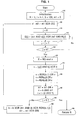
- the apparatus initializes its internal registers for the operation as follows: the result register or accumulator R is loaded with 1, the exponent byte register i is set to the offset of the last exponent byte (k-1), the 8-bit exponent bit counter b is set to 128 (a mask for the most significant bit in a byte), and the first data mask (or index) m 1 is set to 0.
- the device sets m2, the second mask, to equal the bitwise inverse of m1 (the first mask).
- the loop counter register j is initialized to zero.
- step 115 byte j of the modular multiplier register Q is loaded with (m1 ANDed with byte j of the base x) bitwise XORed with (m2 ANDed with byte j of R). Because m1 is either 255 or zero, and because m2 is the bitwise inverse of m1, byte j of Q's final value matches either x[j] or R[j]. In particular, if m1 equals 255 then Q is loaded with x, and otherwise with R. (Note that this step could be implemented identically using byte-wise addition ("+”) or bitwise OR instead of the XOR.
- This step accesses both (x and R) memory buffers (i.e., an exemplary type of fixed memory access pattern) with every loop iteration, which is advantageous for security reasons because it makes it difficult for attackers who are monitoring activity on I/O or bus lines to determine whether the operation is a squaring or a multiplication.
- step 117 j is incremented.
- the accumulated value of R is multiplied either by x or by itself (squaring).
- the accumulator holding R will, after the first iteration of the loop, always contain (mod n) a positive integer power of x, because the previous value is always multiplied (mod n) by x or a previously-stored positive integer power of x.
- this modular multiplication step may be performed using a math coprocessor or other accelerated multiplier.
- step 130 the device loads an exponent bit's negated value into v by loading byte i of the exponent y, ANDing the byte with b, then XORing with b.
- i is used as an index to the appropriate exponent byte
- the (single) bit selected by b is selected with the AND operation.
- the final XOR with b inverts the bit.
- the possible values in v resulting from step 130 are 0 and b, where b is one of 1, 2, 4, 8, 16, 32, 64, and 128.
- step 135 three bit rotation operations (which may be performed in any order) are used to convert values of v into either 0 or 255. Specifically, v is set to 255 if the result of step 130 is a nonzero value in b, otherwise v is set to zero.
- the notation "ROR(v,w)” indicates rotating an 8-bit byte v to the right by w bits. For example, ROR(173,5) would indicate rotating the value 173 decimal ("10101101" binary) five bits to the right, yielding "01101101" binary, or 109 decimal. Most microprocessors and microcontrollers have rotate instructions.
- the Intel 80486 has instructions "ROR” and "ROL” for rotating registers to the right and left.
- the three rotations (which as just noted may be performed in any order) are: set v to ROR(v,1); set v to ROR(v,2); and set v to ROR(v,4).
- the loop and byte counters are updated.
- the mask register m1 is loaded with 255 (if its current value is 255), otherwise with v (which itself equals either 255 or zero) by storing the value of (m1 OR v) into m1.
- the register v is used to hold the result of m1 AND b temporarily.
- the value of (v AND 1) is subtracted from i, which has the effect of decrementing i if the least significant bit of v is set.
- step 145 the device determines whether the exponentiation has completed. If i is less than zero, processing continues to step 160, where the final value R is returned. Otherwise, processing continues to step 150, where b is updated if necessary.
- the exponent bit position is updated whenever the processing moves to a new exponent bit, e.g., after a multiplication or after a squaring with no subsequent multiplication.
- the binary operation "b b XOR (m1 AND (b XOR ROR(b,1)))" at step 150 either leaves b unchanged (if m1 is zero), or rotates b right one bit position (if m1 is 255), and requires no key-dependent conditional branches. Finally, m1 is inverted and processing continues back to step 105 to continue the modular exponentiation.
- FIG. 1 greatly reduce the amount of information leaked from a cryptosystem to an attacker who is monitoring a device's power consumption, while running at virtually the same speed as previously known modular exponentiation techniques, since no extra modular multiplication steps are required. Further, processing path and memory accesses are not correlated to the key's value (except for the key's Hamming weight, which need not be kept secret).
- the exemplary process described above with respect to FIG. 1 loads both (x and R) memory buffers (i.e., an exemplary type of fixed memory access pattern) with every loop iteration, which is advantageous for security reasons because it makes it difficult for attackers who are monitoring activity on I/O or bus lines to determine whether the operation is a squaring or a multiplication.
- x and R memory buffers
- FIG. 1 uses standard exponent encoding conventions in which a "0" bit indirectly specifies a squaring (multiply by self) operation and a "1" bit indirectly specifies a squaring (multiply by self) followed by a multiplication (by other than self) operation.
- these operations are conventionally executed by a bit value-dependent conditional jump (or branch) in the modular exponentiation algorithm. If standard encoding is not required, the method may be implemented using alternate forms of encoding in which the operations are directly specified.
- Each element in the sequence now directly specifies the needed operation, i.e., a "0" bit for squaring (multiplication by self) and a "1" bit for multiplication (by other than self).
- bit windowing techniques such as k -ary modular exponentiation
- 2-bit windowing or pairwise modular exponentiation
- k -ary modular exponentiation techniques are well known (see, e.g., the Handbook of Applied Cryptography by Menezes et al., CRC Press, 1997, pages 614-634 ) and need not be described in greater detail here.
- the operation-based encoding schemes may be combined with the bit windowing techniques using k -ary modular exponentiation where each nonzero exponent digit could represent a power of x, while zero digits could represent squaring operations.
- a "1" digit denotes simple multiplication of the result accumulator by the value x (i.e., by exponentiation of x to the power 1).
- a "2" digit denotes multiplication x ⁇ 2 mod n, and so forth.
- a table of pointers may be employed to indicate the value of the bit.
- the first entry (offset zero) could be a pointer to the result accumulator R (for squaring operations)
- the entry at offset 1 could point to x (i.e., x ⁇ 1)
- the entry at offset 2 (if used) could point to the precomputed value x ⁇ 2 mod n
- the entry at offset 3 (if used) could point to the precomputed value x ⁇ 3 mod n.
- the powers of x may be precomputed at the beginning of the modular exponentiation operation; even so, the performance benefit obtained by reducing the number of multiplication operations during the modular exponentiation generally more than compensates for the precomputation time. Note that x ⁇ 0 (equivalent to multiplication by 1) is not used; all steps involve multiplication with a number larger than 1 because "0" digits in the encoding represent multiplication by R.
- an optimized encoding can reduce memory requirements of the modular exponentiator with little or no performance penalty by re-encoding equivalent representations.
- the operation specified by "02" (denoting R ⁇ R ⁇ 2 followed by R ⁇ R x ⁇ 2) is equivalent to the operation specified by "10” (denoting R ⁇ R x followed by R ⁇ R ⁇ 2), because the overall operation in either case is R ⁇ (R ⁇ 2)(x ⁇ 2). Therefore, the exponent "20010010000100100300200002" can be re-encoded as"100010010000100100301000010"
- the techniques described can be used to design and construct leak-minimizing modular exponentiators before expensive chip layout and construction costs are incurred.
- the techniques can be used to upgrade/replace existing modular exponentiators for improved security in leak-prone systems. Such upgrading/replacement could be performed manually, or implemented in automated code-updating processes that are well-known to those skilled in the art and need not be described in detail here.
- Techniques embodying the invention may be used as an alternative to (or supplement to) other well-known security techniques described in the Background of the Invention section, above.
- Further security can be achieved by recognizing the statistical nature of the attack process.
- an attacker usually gathers data by observing a series of operations, performing statistical operations on the observations (i.e., data sampling), and using the results to determine the key.
- Such observations contain signal (information that usefully corresponds to the key) and noise (information that hinders determination of the key). If the amount of noise is increased, or if the signal is decreased, the number of samples required for a successful attack will increase.
- the number of observations required to identify a signal is roughly proportional (via a constant multiplicative factor) to the square of the value obtained by dividing the amplitude of the noise and error by the amplitude of the signal (i.e., inversely proportional to square of the signal-to-noise ratio). For example, increasing the noise by a factor of 2 and reducing the signal size to 2/3 of its previous value would reduce the signal-to-noise ratio by a factor of 3 and thus increase the required number of samples by a factor of 9.
- attackers can determine the secret exponent from a single operation of a cryptosystem's exponentiators.
- the signal-to-noise ratios observed when monitoring with a sufficiently high sampling rate and accuracy, for example by using a digital storage oscilloscope the key may be determined from one operation.
- the present system can be invaluable, enabling a system designer to reduce the signal size dramatically.
- the invention enables a system designer to minimize the size of leaked signals correlated to secret keys, thereby increasing the amount of work required for an attacker to break the system.
- the attacker's work factor can be made sufficiently large as to make attacks infeasible. For example, consider a system programmed to self-destruct after one million operations - well beyond the expected operational life of most smartcards. If a design not using the present invention requires five operations to break, and using the present invention reduces the signal-to-noise ratio by a factor of 1000, the number of operations required to break the system (i.e., isolate the signal or key from the noise) would increase by a factor of one million. If the attack work factor exceeds the lifetime of the secret or the device, attackers would not be able to collect enough measurements to compromise the secret.
- methods and apparatuses of the present invention might be embodied as program code running on a processor, for example, as instructions stored on in the memory of a smartcard. Where greater security is desired, the code might additionally be signed by a trusted party, for example, by the smartcard issuer.
- the invention might be embodied in a single-chip device containing both a nonvolatile memory for key storage and logic instructions, and a processor for executing such instructions.
- the techniques of the invention may be embodied as code stored in a computer-readable memory of virtually any kind including, without limitation, RAM, ROM, magnetic media, optical media, or magneto-optical media. Even more generally, the invention could be implemented in software, or in hardware, or any combination thereof including, but not limited to, software running on a general purpose processor, microcode, PLAs, ASICs, and any application where there is a need for leak-minimized cryptography that prevents external monitoring attacks.
- cryptographic smartcards of all kinds including without limitation smartcards substantially compliant with ISO 7816-1, ISO 7816-2, and ISO 7816-3 ("ISO 7816-compliant smartcards"); contactless and proximity-based smartcards and cryptographic tokens; stored value cards and systems; cryptographically secured credit and debit cards; customer loyalty cards and systems; stored value cards and systems; cryptographically authenticated credit cards; customer loyalty cards and systems; cryptographic accelerators; gambling and wagering systems; secure cryptographic chips; tamper-resistant microprocessors; software programs (including without limitation programs for use on personal computers, servers, etc.
- cryptographic devices key management devices; banking key management systems; secure web servers; electronic payment systems; micropayment systems and meters; prepaid telephone cards; cryptographic identification cards and other identity verification systems; systems for electronic funds transfer; automatic teller machines; point of sale terminals; certificate issuance systems; electronic badges; door entry systems; physical locks of all kinds using cryptographic keys; systems for decrypting television signals (including without limitation, broadcast television, satellite television, and cable television); systems for decrypting enciphered music and other audio content (including music distributed over computer networks); systems for protecting video signals of all kinds; intellectual property protection and copy protection systems (such as those used to prevent unauthorized copying or use of movies, audio content, computer programs, video games, images, text, databases, etc.); cellular telephone scrambling and authentication systems (including telephone authentication smartcards); secure telephones (including key storage devices for such telephones); cryptographic PCMCIA cards; portable cryptographic tokens; and cryptographic data auditing systems.
- key management devices banking key management systems; secure web servers; electronic payment systems; micropayment systems and meters; prepaid telephone
Landscapes
- Engineering & Computer Science (AREA)
- Theoretical Computer Science (AREA)
- Physics & Mathematics (AREA)
- Computer Security & Cryptography (AREA)
- General Physics & Mathematics (AREA)
- Software Systems (AREA)
- General Engineering & Computer Science (AREA)
- Computer Hardware Design (AREA)
- Mathematical Analysis (AREA)
- Pure & Applied Mathematics (AREA)
- Mathematical Physics (AREA)
- Computer Networks & Wireless Communication (AREA)
- Signal Processing (AREA)
- Mathematical Optimization (AREA)
- Computational Mathematics (AREA)
- Computing Systems (AREA)
- Algebra (AREA)
- Health & Medical Sciences (AREA)
- Bioethics (AREA)
- General Health & Medical Sciences (AREA)
- Storage Device Security (AREA)
- Mobile Radio Communication Systems (AREA)
- Medicines Containing Antibodies Or Antigens For Use As Internal Diagnostic Agents (AREA)
Applications Claiming Priority (2)
| Application Number | Priority Date | Filing Date | Title |
|---|---|---|---|
| US8782998P | 1998-06-03 | 1998-06-03 | |
| EP99951368A EP1084548B1 (de) | 1998-06-03 | 1999-06-03 | Gesicherte moduläre potenzierung mit leckminimierung für chipkarten und andere kryptosysteme |
Related Parent Applications (2)
| Application Number | Title | Priority Date | Filing Date |
|---|---|---|---|
| EP99951368A Division EP1084548B1 (de) | 1998-06-03 | 1999-06-03 | Gesicherte moduläre potenzierung mit leckminimierung für chipkarten und andere kryptosysteme |
| EP99951368.2 Division | 1999-06-03 |
Publications (2)
| Publication Number | Publication Date |
|---|---|
| EP2031792A1 true EP2031792A1 (de) | 2009-03-04 |
| EP2031792B1 EP2031792B1 (de) | 2013-01-09 |
Family
ID=22207495
Family Applications (2)
| Application Number | Title | Priority Date | Filing Date |
|---|---|---|---|
| EP99951368A Expired - Lifetime EP1084548B1 (de) | 1998-06-03 | 1999-06-03 | Gesicherte moduläre potenzierung mit leckminimierung für chipkarten und andere kryptosysteme |
| EP08075862A Expired - Lifetime EP2031792B1 (de) | 1998-06-03 | 1999-06-03 | Gesicherte modulare Exponentiation mit Verlustminimierung für Smart-Cards und andere Kryptosysteme |
Family Applications Before (1)
| Application Number | Title | Priority Date | Filing Date |
|---|---|---|---|
| EP99951368A Expired - Lifetime EP1084548B1 (de) | 1998-06-03 | 1999-06-03 | Gesicherte moduläre potenzierung mit leckminimierung für chipkarten und andere kryptosysteme |
Country Status (6)
| Country | Link |
|---|---|
| US (1) | US6298442B1 (de) |
| EP (2) | EP1084548B1 (de) |
| AT (1) | ATE418099T1 (de) |
| AU (1) | AU6381799A (de) |
| DE (1) | DE69940117D1 (de) |
| WO (1) | WO1999067909A2 (de) |
Cited By (1)
| Publication number | Priority date | Publication date | Assignee | Title |
|---|---|---|---|---|
| US10372886B2 (en) | 2015-05-05 | 2019-08-06 | Nxp B.V. | Protecting the input/output of modular encoded white-box RSA/ECC |
Families Citing this family (77)
| Publication number | Priority date | Publication date | Assignee | Title |
|---|---|---|---|---|
| US6748410B1 (en) | 1997-05-04 | 2004-06-08 | M-Systems Flash Disk Pioneers, Ltd. | Apparatus and method for modular multiplication and exponentiation based on montgomery multiplication |
| US7587044B2 (en) | 1998-01-02 | 2009-09-08 | Cryptography Research, Inc. | Differential power analysis method and apparatus |
| EP1050133B2 (de) | 1998-01-02 | 2009-05-27 | Cryptography Research Inc. | Leckresistentes kryptographisches verfahren und vorrichtung |
| US6278783B1 (en) | 1998-06-03 | 2001-08-21 | Cryptography Research, Inc. | Des and other cryptographic, processes with leak minimization for smartcards and other cryptosystems |
| JP4216475B2 (ja) | 1998-07-02 | 2009-01-28 | クリプターグラフィー リサーチ インコーポレイテッド | 漏洩抵抗力を有する暗号索引付き鍵の更新方法及びデバイス |
| CA2243761C (en) * | 1998-07-21 | 2009-10-06 | Certicom Corp. | Timing attack resistant cryptographic system |
| DE59906893D1 (de) * | 1998-09-22 | 2003-10-09 | Infineon Technologies Ag | Verfahren zur authentifikation zumindest eines teilnehmers bei einem datenaustausch |
| US6507656B1 (en) * | 1999-01-27 | 2003-01-14 | Lucent Technologies Inc. | Non malleable encryption apparatus and method |
| US6804782B1 (en) * | 1999-06-11 | 2004-10-12 | General Instrument Corporation | Countermeasure to power attack and timing attack on cryptographic operations |
| TW546935B (en) * | 1999-08-30 | 2003-08-11 | Nagracard Sa | Multi-module encryption method |
| FR2804225B1 (fr) * | 2000-01-26 | 2002-05-03 | Gemplus Card Int | Algorithme d'exponentiation modulaire dans un composant electrique mettant en oeuvre un algorithme de chiffrement a cle publique |
| WO2001075787A1 (en) * | 2000-04-04 | 2001-10-11 | Koninklijke Philips Electronics N.V. | Data carrier having a chip including means for the controllable voltage supply to a further component of the data carrier |
| FR2818772A1 (fr) * | 2000-12-21 | 2002-06-28 | Bull Cp8 | Procede de securisation d'un operateur logique ou mathematique implante dans un module electronique a microprocesseur, ainsi que le module electronique et le systeme embarque associes |
| JP3454357B2 (ja) * | 2001-07-05 | 2003-10-06 | 株式会社コナミコンピュータエンタテインメントスタジオ | ネットワークゲーム用サーバ装置、ネットワークゲーム進行制御方法及びネットワークゲーム進行制御プログラム |
| WO2003075506A1 (en) * | 2002-03-07 | 2003-09-12 | Axalto Sa | Method for making safe an electronic cryptography assembly with a secret key |
| TW586086B (en) * | 2002-12-27 | 2004-05-01 | Ind Tech Res Inst | Method and apparatus for protecting public key schemes from timing, power and fault attacks |
| US7257718B2 (en) | 2003-05-12 | 2007-08-14 | International Business Machines Corporation | Cipher message assist instructions |
| CA2527668A1 (en) * | 2003-06-02 | 2004-12-16 | Liquid Machines, Inc. | Managing data objects in dynamic, distributed and collaborative contexts |
| US7739521B2 (en) * | 2003-09-18 | 2010-06-15 | Intel Corporation | Method of obscuring cryptographic computations |
| US20050089190A1 (en) * | 2003-10-23 | 2005-04-28 | Eyal Shavit | Recording content distribution information into an adjunct to content |
| JP2005141160A (ja) * | 2003-11-10 | 2005-06-02 | Japan Science & Technology Agency | セキュア・プロセッサ |
| DE602004027943D1 (de) | 2003-11-16 | 2010-08-12 | Sandisk Il Ltd | Verbesserte natürliche montgomery-exponentenmaskierung |
| FR2867289A1 (fr) * | 2004-03-02 | 2005-09-09 | France Telecom | Procede et dispositif pour accomplir une operation cryptographique |
| KR100610367B1 (ko) * | 2004-06-19 | 2006-08-10 | 삼성전자주식회사 | 정보 누출 공격을 방지하기 위한 갈로아 필드 상의 곱셈방법 및 장치, 역변환 장치 그리고 aes 바이트 치환연산장치 |
| US7478902B2 (en) * | 2004-11-04 | 2009-01-20 | Hewlett-Packard Development Company, L.P. | Inkjet compositions |
| US7764785B2 (en) | 2004-11-08 | 2010-07-27 | King Fahd University Of Petroleum And Minerals | Method for communicating securely over an insecure communication channel |
| JP4714482B2 (ja) * | 2005-02-28 | 2011-06-29 | 株式会社日立製作所 | 暗号通信システムおよび方法 |
| FR2884004B1 (fr) * | 2005-03-30 | 2007-06-29 | Oberthur Card Syst Sa | Procede de traitement de donnees impliquant une exponentiation modulaire et un dispositif associe |
| US7404089B1 (en) * | 2005-06-03 | 2008-07-22 | Pitney Bowes Inc. | Method and system for protecting against side channel attacks when performing cryptographic operations |
| DE102005032731A1 (de) * | 2005-07-13 | 2007-01-25 | Siemens Ag | Verfahren zur seitenkanalresistenten Vervielfachung |
| US8874477B2 (en) | 2005-10-04 | 2014-10-28 | Steven Mark Hoffberg | Multifactorial optimization system and method |
| US9313027B2 (en) | 2005-12-29 | 2016-04-12 | Proton World International N.V. | Protection of a calculation performed by an integrated circuit |
| US8150029B2 (en) | 2005-12-29 | 2012-04-03 | Proton World International N.V. | Detection of a disturbance in a calculation performed by an integrated circuit |
| US8301890B2 (en) * | 2006-08-10 | 2012-10-30 | Inside Secure | Software execution randomization |
| US7613907B2 (en) * | 2006-08-11 | 2009-11-03 | Atmel Corporation | Embedded software camouflage against code reverse engineering |
| US7984301B2 (en) * | 2006-08-17 | 2011-07-19 | Inside Contactless S.A. | Bi-processor architecture for secure systems |
| US7554865B2 (en) * | 2006-09-21 | 2009-06-30 | Atmel Corporation | Randomizing current consumption in memory devices |
| US8280041B2 (en) * | 2007-03-12 | 2012-10-02 | Inside Secure | Chinese remainder theorem-based computation method for cryptosystems |
| JP4894913B2 (ja) * | 2007-03-19 | 2012-03-14 | 富士通株式会社 | Fault攻撃対策機能を搭載した組み込み装置 |
| US20090031139A1 (en) * | 2007-07-27 | 2009-01-29 | Mohammed Alawi Geoffrey | System and Method for Electronic Certification and Authentification |
| US8249935B1 (en) * | 2007-09-27 | 2012-08-21 | Sprint Communications Company L.P. | Method and system for blocking confidential information at a point-of-sale reader from eavesdropping |
| US9883381B1 (en) | 2007-10-02 | 2018-01-30 | Sprint Communications Company L.P. | Providing secure access to smart card applications |
| US8126806B1 (en) | 2007-12-03 | 2012-02-28 | Sprint Communications Company L.P. | Method for launching an electronic wallet |
| EP2218208B1 (de) | 2007-12-13 | 2011-06-15 | Oberthur Technologies | Verfahren für kryptografische datenverarbeitung, insbesondere unter verwendung einer s box und diesbezügliche einrichtung und software |
| US8738926B2 (en) | 2008-01-10 | 2014-05-27 | Intel Mobile Communications GmbH | Data processing system, method for executing a cryptographic algorithm and method for preparing execution of a cryptographic algorithm |
| US8655310B1 (en) | 2008-04-08 | 2014-02-18 | Sprint Communications Company L.P. | Control of secure elements through point-of-sale device |
| JP4869452B2 (ja) | 2008-08-19 | 2012-02-08 | エヌエックスピー ビー ヴィ | 暗号に基づくメッセージ認証コードの生成方法 |
| US8768845B1 (en) | 2009-02-16 | 2014-07-01 | Sprint Communications Company L.P. | Electronic wallet removal from mobile electronic devices |
| EP2290872B1 (de) | 2009-08-27 | 2014-06-18 | Nxp B.V. | Vorrichtung zur Erzeugung eines Nachrichtenauthentifizierungscodes zur Authentifizierung einer Nachricht |
| EP2293185A1 (de) * | 2009-09-04 | 2011-03-09 | Thomson Licensing | Gegen Übersprungangriffe gesichertes Exponentiationsverfahren und Vorrichtung zum Durchführen des Verfahrens |
| CN102725737B (zh) | 2009-12-04 | 2016-04-20 | 密码研究公司 | 可验证防泄漏的加密和解密 |
| EP2504757B1 (de) * | 2010-01-28 | 2013-11-06 | NDS Limited | System zur exponentiation |
| GB2480296A (en) | 2010-05-12 | 2011-11-16 | Nds Ltd | Processor with differential power analysis attack protection |
| US8539254B1 (en) | 2010-06-01 | 2013-09-17 | Xilinx, Inc. | Method and integrated circuit for protecting against differential power analysis attacks |
| US8966253B1 (en) | 2010-06-01 | 2015-02-24 | Xilinx, Inc. | Method and apparatus for authenticating a programmable device bitstream |
| US8583944B1 (en) | 2010-08-04 | 2013-11-12 | Xilinx, Inc. | Method and integrated circuit for secure encryption and decryption |
| US8650408B2 (en) | 2010-09-08 | 2014-02-11 | Xilinx, Inc. | Protecting against differential power analysis attacks on decryption keys |
| US8832462B2 (en) | 2010-09-08 | 2014-09-09 | Xilinx, Inc. | Protecting against differential power analysis attacks on sensitive data |
| US8909941B1 (en) | 2011-03-31 | 2014-12-09 | Xilinx, Inc. | Programmable integrated circuit and a method of enabling the detection of tampering with data provided to a programmable integrated circuit |
| US8635467B2 (en) | 2011-10-27 | 2014-01-21 | Certicom Corp. | Integrated circuit with logic circuitry and multiple concealing circuits |
| US8334705B1 (en) | 2011-10-27 | 2012-12-18 | Certicom Corp. | Analog circuitry to conceal activity of logic circuitry |
| US8799675B2 (en) | 2012-01-05 | 2014-08-05 | House Of Development Llc | System and method for electronic certification and authentication of data |
| TWI517655B (zh) * | 2013-05-23 | 2016-01-11 | 晨星半導體股份有限公司 | 密碼裝置以及密鑰保護方法 |
| US9906368B2 (en) * | 2014-12-23 | 2018-02-27 | Nxp B.V. | General encoding functions for modular exponentiation encryption schemes |
| US9985784B2 (en) | 2014-12-23 | 2018-05-29 | Nxp B.V. | Efficient smooth encodings for modular exponentiation |
| US9531540B2 (en) * | 2014-12-23 | 2016-12-27 | Nxp B.V. | Secure token-based signature schemes using look-up tables |
| US9904516B2 (en) | 2014-12-23 | 2018-02-27 | Nxp B.V. | Modular exponentiation using look-up tables |
| US10181944B2 (en) | 2015-06-16 | 2019-01-15 | The Athena Group, Inc. | Minimizing information leakage during modular exponentiation and elliptic curve point multiplication |
| EP3220304B1 (de) * | 2016-02-22 | 2018-11-07 | Eshard | Verfahren zur prüfung des widerstands einer schaltung bei einer seitenkanalanalyse |
| US10997322B2 (en) | 2017-05-22 | 2021-05-04 | Arm Limited | Efficient power distribution |
| US10924261B2 (en) | 2017-05-22 | 2021-02-16 | Arm Limited | Efficient power distribution |
| EP3447509B1 (de) * | 2017-08-21 | 2021-05-26 | Eshard | Verfahren zur prüfung des widerstands einer schaltung bei einer seitenkanalanalyse |
| US11240025B2 (en) * | 2018-11-09 | 2022-02-01 | Ares Technologies, Inc. | Systems and methods for distributed key storage |
| US11394308B1 (en) | 2021-05-05 | 2022-07-19 | Arm Limited | Apparatuses and methods for power isolation |
| WO2023141935A1 (en) | 2022-01-28 | 2023-08-03 | Nvidia Corporation | Techniques, devices, and instruction set architecture for balanced and secure ladder computations |
| CN116830076A (zh) | 2022-01-28 | 2023-09-29 | 辉达公司 | 用于高效模除法和模求逆的技术、设备和指令集架构 |
| WO2023141934A1 (en) * | 2022-01-28 | 2023-08-03 | Nvidia Corporation | Efficient masking of secure data in ladder-type cryptographic computations |
Family Cites Families (10)
| Publication number | Priority date | Publication date | Assignee | Title |
|---|---|---|---|---|
| US4200770A (en) | 1977-09-06 | 1980-04-29 | Stanford University | Cryptographic apparatus and method |
| US4405829A (en) * | 1977-12-14 | 1983-09-20 | Massachusetts Institute Of Technology | Cryptographic communications system and method |
| US4759063A (en) | 1983-08-22 | 1988-07-19 | Chaum David L | Blind signature systems |
| JPH01114995A (ja) | 1987-10-29 | 1989-05-08 | Toppan Printing Co Ltd | Icカード |
| JPH022475A (ja) | 1988-06-15 | 1990-01-08 | Omron Tateisi Electron Co | Icカード |
| US5159632A (en) * | 1991-09-17 | 1992-10-27 | Next Computer, Inc. | Method and apparatus for public key exchange in a cryptographic system |
| IL113375A (en) * | 1995-04-13 | 1997-09-30 | Fortress U & T Ltd | Internationally regulated system for one to one cryptographic communications with national sovereignty without key escrow |
| JP3525209B2 (ja) * | 1996-04-05 | 2004-05-10 | 株式会社 沖マイクロデザイン | べき乗剰余演算回路及びべき乗剰余演算システム及びべき乗剰余演算のための演算方法 |
| WO1998031122A1 (en) * | 1997-01-08 | 1998-07-16 | Bell Communications Research, Inc. | A method and apparatus for generating secure hash functions |
| US6064740A (en) * | 1997-11-12 | 2000-05-16 | Curiger; Andreas | Method and apparatus for masking modulo exponentiation calculations in an integrated circuit |
-
1999
- 1999-06-03 EP EP99951368A patent/EP1084548B1/de not_active Expired - Lifetime
- 1999-06-03 US US09/325,528 patent/US6298442B1/en not_active Expired - Lifetime
- 1999-06-03 WO PCT/US1999/012740 patent/WO1999067909A2/en not_active Ceased
- 1999-06-03 EP EP08075862A patent/EP2031792B1/de not_active Expired - Lifetime
- 1999-06-03 AT AT99951368T patent/ATE418099T1/de not_active IP Right Cessation
- 1999-06-03 DE DE69940117T patent/DE69940117D1/de not_active Expired - Lifetime
- 1999-06-03 AU AU63817/99A patent/AU6381799A/en not_active Abandoned
Non-Patent Citations (4)
| Title |
|---|
| KOCHER P C ED - KOBLITZ N (ED) INTERNATIONAL ASSOCIATION FOR CRYPTOLOGIC RESEARCH: "TIMING ATTACKS ON IMPLEMENTATIONS OF DIFFIE-HELLMAN, RSA, DSS, AND OTHER SYSTEMS", ADVANCES IN CRYPTOLOGY - CRYPTO '96. 16TH. ANNUAL INTERNATIONAL CRYPTOLOGY CONFERENCE. SANTA BARBARA, AUG. 18 - 22, 1996. PROCEEDINGS, PROCEEDINGS OF THE ANNUAL INTERNATIONAL CRYPTOLOGY CONFERENCE (CRYPTO), BERLIN, SPRINGER, DE, vol. CONF. 16, 18 August 1996 (1996-08-18), pages 104 - 113, XP000626590, ISBN: 3-540-61512-1 * |
| MENEZES A J OORSCHOT VAN P C VANSTONE S A ED - MENEZES A J ET AL: "Handbook of applied cryptography", HANDBOOK OF APPLIED CRYPTOGRAPHY; [CRC PRESS SERIES ON DISCRETE MATHEMATICES AND ITS APPLICATIONS], BOCA RATON, FL, CRC PRESS.; US, 1 January 1997 (1997-01-01), pages 591 - 607, XP002955512, ISBN: 978-0-8493-8523-0 * |
| MENEZES ET AL.: "Handbook of Applied Cryptography", 1997, CRC PRESS |
| SCHNEIER: "Applied Cryptography", 1996, WILEY |
Cited By (1)
| Publication number | Priority date | Publication date | Assignee | Title |
|---|---|---|---|---|
| US10372886B2 (en) | 2015-05-05 | 2019-08-06 | Nxp B.V. | Protecting the input/output of modular encoded white-box RSA/ECC |
Also Published As
| Publication number | Publication date |
|---|---|
| US6298442B1 (en) | 2001-10-02 |
| ATE418099T1 (de) | 2009-01-15 |
| EP2031792B1 (de) | 2013-01-09 |
| EP1084548A4 (de) | 2005-04-06 |
| HK1129005A1 (en) | 2009-11-13 |
| WO1999067909A3 (en) | 2000-05-04 |
| DE69940117D1 (de) | 2009-01-29 |
| EP1084548A2 (de) | 2001-03-21 |
| WO1999067909A2 (en) | 1999-12-29 |
| AU6381799A (en) | 2000-01-10 |
| EP1084548B1 (de) | 2008-12-17 |
Similar Documents
| Publication | Publication Date | Title |
|---|---|---|
| EP2031792B1 (de) | Gesicherte modulare Exponentiation mit Verlustminimierung für Smart-Cards und andere Kryptosysteme | |
| CA2333095C (en) | Improved des and other cryptographic processes with leak minimization for smartcards and other cryptosystems | |
| US20040025032A1 (en) | Method and system for resistance to statiscal power analysis | |
| EP1088295B1 (de) | Ausgewogene kryptographische rechenmethode und apparat zur schlupfminimierung in smartcards und anderen kryptosystemen | |
| JP4671571B2 (ja) | 秘密情報の処理装置および秘密情報の処理プログラムを格納するメモリ | |
| US20060090081A1 (en) | Device and method with reduced information leakage | |
| US20120017089A1 (en) | Cryptographic token with leak-resistant key derivation | |
| JP2004304800A (ja) | データ処理装置におけるサイドチャネル攻撃防止 | |
| US7123717B1 (en) | Countermeasure method in an electronic component which uses an RSA-type public key cryptographic algorithm | |
| Seo et al. | SCA-resistant GCM implementation on 8-Bit AVR microcontrollers | |
| EP4372548A1 (de) | Schutz von kryptographischen vorgängen vor horizontalen seitenkanal-analyse-angriffen | |
| HK1129005B (en) | Secure modular exponentiation with leak minimization for smartcards and other cryptosystems | |
| Li et al. | Power analysis attacks against QUAD | |
| EP1802024B1 (de) | Symmetrisches kryptographisches Rechenverfahren und Vorrichtung zur Verlustminimierung bei Chipkarten und anderen Verschlüsselungssystemen | |
| US12634110B2 (en) | Method and system for protecting cryptographic operations against side-channel attacks | |
| US20240187206A1 (en) | Method and system for protecting cryptographic operations against side-channel attacks | |
| EP1933496A2 (de) | Verbessertes DES und andere kryptographische Verfahren mit Verlustminimierung für Chipkarten und andere Verschlüsselungssysteme | |
| Devi et al. | A Review on Different Types of Attacks on RSA and ECC | |
| JP2008224830A (ja) | 耐タンパーベキ乗演算方法 | |
| CA2397615A1 (en) | Method and system for resistance to statistical power analysis | |
| CA2398441A1 (en) | Method and apparatus for balanced electronic operations | |
| HK1116961A (en) | Improved des and other cryptographic processes with leak minimization for smartcards and other cryptosystems | |
| CA2397077A1 (en) | Encoding method and system resistant to power analysis | |
| AU2002348963A1 (en) | Device and method with reduced information leakage |
Legal Events
| Date | Code | Title | Description |
|---|---|---|---|
| PUAI | Public reference made under article 153(3) epc to a published international application that has entered the european phase |
Free format text: ORIGINAL CODE: 0009012 |
|
| AC | Divisional application: reference to earlier application |
Ref document number: 1084548 Country of ref document: EP Kind code of ref document: P |
|
| AK | Designated contracting states |
Kind code of ref document: A1 Designated state(s): AT BE CH CY DE DK ES FI FR GB GR IE IT LI LU MC NL PT SE |
|
| 17P | Request for examination filed |
Effective date: 20090817 |
|
| AKX | Designation fees paid |
Designated state(s): AT BE CH CY DE DK ES FI FR GB GR IE IT LI LU MC NL PT SE |
|
| REG | Reference to a national code |
Ref country code: HK Ref legal event code: DE Ref document number: 1129005 Country of ref document: HK |
|
| 17Q | First examination report despatched |
Effective date: 20091111 |
|
| REG | Reference to a national code |
Ref country code: DE Ref legal event code: R079 Ref document number: 69944570 Country of ref document: DE Free format text: PREVIOUS MAIN CLASS: H04L0009280000 Ipc: G06F0007720000 |
|
| RIC1 | Information provided on ipc code assigned before grant |
Ipc: G06F 7/72 20060101AFI20120412BHEP |
|
| GRAP | Despatch of communication of intention to grant a patent |
Free format text: ORIGINAL CODE: EPIDOSNIGR1 |
|
| GRAS | Grant fee paid |
Free format text: ORIGINAL CODE: EPIDOSNIGR3 |
|
| GRAA | (expected) grant |
Free format text: ORIGINAL CODE: 0009210 |
|
| AC | Divisional application: reference to earlier application |
Ref document number: 1084548 Country of ref document: EP Kind code of ref document: P |
|
| AK | Designated contracting states |
Kind code of ref document: B1 Designated state(s): AT BE CH CY DE DK ES FI FR GB GR IE IT LI LU MC NL PT SE |
|
| REG | Reference to a national code |
Ref country code: GB Ref legal event code: FG4D |
|
| REG | Reference to a national code |
Ref country code: CH Ref legal event code: EP Ref country code: AT Ref legal event code: REF Ref document number: 593116 Country of ref document: AT Kind code of ref document: T Effective date: 20130115 |
|
| REG | Reference to a national code |
Ref country code: IE Ref legal event code: FG4D |
|
| REG | Reference to a national code |
Ref country code: CH Ref legal event code: NV Representative=s name: KATZAROV S.A., CH |
|
| REG | Reference to a national code |
Ref country code: DE Ref legal event code: R096 Ref document number: 69944570 Country of ref document: DE Effective date: 20130314 |
|
| REG | Reference to a national code |
Ref country code: NL Ref legal event code: T3 |
|
| REG | Reference to a national code |
Ref country code: AT Ref legal event code: MK05 Ref document number: 593116 Country of ref document: AT Kind code of ref document: T Effective date: 20130109 |
|
| PG25 | Lapsed in a contracting state [announced via postgrant information from national office to epo] |
Ref country code: AT Free format text: LAPSE BECAUSE OF FAILURE TO SUBMIT A TRANSLATION OF THE DESCRIPTION OR TO PAY THE FEE WITHIN THE PRESCRIBED TIME-LIMIT Effective date: 20130109 Ref country code: BE Free format text: LAPSE BECAUSE OF FAILURE TO SUBMIT A TRANSLATION OF THE DESCRIPTION OR TO PAY THE FEE WITHIN THE PRESCRIBED TIME-LIMIT Effective date: 20130109 Ref country code: SE Free format text: LAPSE BECAUSE OF FAILURE TO SUBMIT A TRANSLATION OF THE DESCRIPTION OR TO PAY THE FEE WITHIN THE PRESCRIBED TIME-LIMIT Effective date: 20130109 Ref country code: ES Free format text: LAPSE BECAUSE OF FAILURE TO SUBMIT A TRANSLATION OF THE DESCRIPTION OR TO PAY THE FEE WITHIN THE PRESCRIBED TIME-LIMIT Effective date: 20130420 |
|
| PG25 | Lapsed in a contracting state [announced via postgrant information from national office to epo] |
Ref country code: PT Free format text: LAPSE BECAUSE OF FAILURE TO SUBMIT A TRANSLATION OF THE DESCRIPTION OR TO PAY THE FEE WITHIN THE PRESCRIBED TIME-LIMIT Effective date: 20130509 Ref country code: GR Free format text: LAPSE BECAUSE OF FAILURE TO SUBMIT A TRANSLATION OF THE DESCRIPTION OR TO PAY THE FEE WITHIN THE PRESCRIBED TIME-LIMIT Effective date: 20130410 |
|
| REG | Reference to a national code |
Ref country code: HK Ref legal event code: GR Ref document number: 1129005 Country of ref document: HK |
|
| PG25 | Lapsed in a contracting state [announced via postgrant information from national office to epo] |
Ref country code: DK Free format text: LAPSE BECAUSE OF FAILURE TO SUBMIT A TRANSLATION OF THE DESCRIPTION OR TO PAY THE FEE WITHIN THE PRESCRIBED TIME-LIMIT Effective date: 20130109 |
|
| PLBE | No opposition filed within time limit |
Free format text: ORIGINAL CODE: 0009261 |
|
| STAA | Information on the status of an ep patent application or granted ep patent |
Free format text: STATUS: NO OPPOSITION FILED WITHIN TIME LIMIT |
|
| PG25 | Lapsed in a contracting state [announced via postgrant information from national office to epo] |
Ref country code: CY Free format text: LAPSE BECAUSE OF FAILURE TO SUBMIT A TRANSLATION OF THE DESCRIPTION OR TO PAY THE FEE WITHIN THE PRESCRIBED TIME-LIMIT Effective date: 20130109 |
|
| 26N | No opposition filed |
Effective date: 20131010 |
|
| PG25 | Lapsed in a contracting state [announced via postgrant information from national office to epo] |
Ref country code: IT Free format text: LAPSE BECAUSE OF FAILURE TO SUBMIT A TRANSLATION OF THE DESCRIPTION OR TO PAY THE FEE WITHIN THE PRESCRIBED TIME-LIMIT Effective date: 20130109 |
|
| PG25 | Lapsed in a contracting state [announced via postgrant information from national office to epo] |
Ref country code: MC Free format text: LAPSE BECAUSE OF FAILURE TO SUBMIT A TRANSLATION OF THE DESCRIPTION OR TO PAY THE FEE WITHIN THE PRESCRIBED TIME-LIMIT Effective date: 20130109 |
|
| REG | Reference to a national code |
Ref country code: DE Ref legal event code: R097 Ref document number: 69944570 Country of ref document: DE Effective date: 20131010 |
|
| REG | Reference to a national code |
Ref country code: IE Ref legal event code: MM4A |
|
| PG25 | Lapsed in a contracting state [announced via postgrant information from national office to epo] |
Ref country code: IE Free format text: LAPSE BECAUSE OF NON-PAYMENT OF DUE FEES Effective date: 20130603 |
|
| PG25 | Lapsed in a contracting state [announced via postgrant information from national office to epo] |
Ref country code: LU Free format text: LAPSE BECAUSE OF NON-PAYMENT OF DUE FEES Effective date: 20130603 |
|
| REG | Reference to a national code |
Ref country code: FR Ref legal event code: PLFP Year of fee payment: 18 |
|
| REG | Reference to a national code |
Ref country code: FR Ref legal event code: PLFP Year of fee payment: 19 |
|
| REG | Reference to a national code |
Ref country code: CH Ref legal event code: PCAR Free format text: NEW ADDRESS: AVENUE DES MORGINES 12, 1213 PETIT-LANCY (CH) |
|
| REG | Reference to a national code |
Ref country code: FR Ref legal event code: PLFP Year of fee payment: 20 |
|
| PGFP | Annual fee paid to national office [announced via postgrant information from national office to epo] |
Ref country code: NL Payment date: 20180626 Year of fee payment: 20 Ref country code: FI Payment date: 20180627 Year of fee payment: 20 |
|
| PGFP | Annual fee paid to national office [announced via postgrant information from national office to epo] |
Ref country code: FR Payment date: 20180626 Year of fee payment: 20 |
|
| PGFP | Annual fee paid to national office [announced via postgrant information from national office to epo] |
Ref country code: DE Payment date: 20180627 Year of fee payment: 20 Ref country code: GB Payment date: 20180627 Year of fee payment: 20 |
|
| PGFP | Annual fee paid to national office [announced via postgrant information from national office to epo] |
Ref country code: CH Payment date: 20180704 Year of fee payment: 20 |
|
| REG | Reference to a national code |
Ref country code: DE Ref legal event code: R071 Ref document number: 69944570 Country of ref document: DE |
|
| REG | Reference to a national code |
Ref country code: NL Ref legal event code: MK Effective date: 20190602 |
|
| REG | Reference to a national code |
Ref country code: CH Ref legal event code: PL |
|
| REG | Reference to a national code |
Ref country code: GB Ref legal event code: PE20 Expiry date: 20190602 |
|
| PG25 | Lapsed in a contracting state [announced via postgrant information from national office to epo] |
Ref country code: GB Free format text: LAPSE BECAUSE OF EXPIRATION OF PROTECTION Effective date: 20190602 |