EP2043183A2 - Verbundteilchen für Elektrode und elektrochemische Vorrichtung - Google Patents
Verbundteilchen für Elektrode und elektrochemische Vorrichtung Download PDFInfo
- Publication number
- EP2043183A2 EP2043183A2 EP08017010A EP08017010A EP2043183A2 EP 2043183 A2 EP2043183 A2 EP 2043183A2 EP 08017010 A EP08017010 A EP 08017010A EP 08017010 A EP08017010 A EP 08017010A EP 2043183 A2 EP2043183 A2 EP 2043183A2
- Authority
- EP
- European Patent Office
- Prior art keywords
- electrode
- active material
- particle
- composite particle
- microparticles
- Prior art date
- Legal status (The legal status is an assumption and is not a legal conclusion. Google has not performed a legal analysis and makes no representation as to the accuracy of the status listed.)
- Granted
Links
Images




Classifications
-
- H—ELECTRICITY
- H01—ELECTRIC ELEMENTS
- H01M—PROCESSES OR MEANS, e.g. BATTERIES, FOR THE DIRECT CONVERSION OF CHEMICAL ENERGY INTO ELECTRICAL ENERGY
- H01M4/00—Electrodes
- H01M4/02—Electrodes composed of, or comprising, active material
- H01M4/62—Selection of inactive substances as ingredients for active masses, e.g. binders, fillers
- H01M4/624—Electric conductive fillers
- H01M4/625—Carbon or graphite
-
- C—CHEMISTRY; METALLURGY
- C01—INORGANIC CHEMISTRY
- C01B—NON-METALLIC ELEMENTS; COMPOUNDS THEREOF; METALLOIDS OR COMPOUNDS THEREOF NOT COVERED BY SUBCLASS C01C
- C01B25/00—Phosphorus; Compounds thereof
- C01B25/16—Oxyacids of phosphorus; Salts thereof
- C01B25/26—Phosphates
- C01B25/45—Phosphates containing plural metal, or metal and ammonium
-
- H—ELECTRICITY
- H01—ELECTRIC ELEMENTS
- H01M—PROCESSES OR MEANS, e.g. BATTERIES, FOR THE DIRECT CONVERSION OF CHEMICAL ENERGY INTO ELECTRICAL ENERGY
- H01M4/00—Electrodes
- H01M4/02—Electrodes composed of, or comprising, active material
- H01M4/13—Electrodes for accumulators with non-aqueous electrolyte, e.g. for lithium-accumulators; Processes of manufacture thereof
- H01M4/136—Electrodes based on inorganic compounds other than oxides or hydroxides, e.g. sulfides, selenides, tellurides, halogenides or LiCoFy
-
- H—ELECTRICITY
- H01—ELECTRIC ELEMENTS
- H01M—PROCESSES OR MEANS, e.g. BATTERIES, FOR THE DIRECT CONVERSION OF CHEMICAL ENERGY INTO ELECTRICAL ENERGY
- H01M4/00—Electrodes
- H01M4/02—Electrodes composed of, or comprising, active material
- H01M4/36—Selection of substances as active materials, active masses, active liquids
- H01M4/362—Composites
- H01M4/366—Composites as layered products
-
- H—ELECTRICITY
- H01—ELECTRIC ELEMENTS
- H01M—PROCESSES OR MEANS, e.g. BATTERIES, FOR THE DIRECT CONVERSION OF CHEMICAL ENERGY INTO ELECTRICAL ENERGY
- H01M4/00—Electrodes
- H01M4/02—Electrodes composed of, or comprising, active material
- H01M4/36—Selection of substances as active materials, active masses, active liquids
- H01M4/58—Selection of substances as active materials, active masses, active liquids of inorganic compounds other than oxides or hydroxides, e.g. sulfides, selenides, tellurides, halogenides or LiCoFy; of polyanionic structures, e.g. phosphates, silicates or borates
- H01M4/5825—Oxygenated metallic salts or polyanionic structures, e.g. borates, phosphates, silicates, olivines
-
- H—ELECTRICITY
- H01—ELECTRIC ELEMENTS
- H01M—PROCESSES OR MEANS, e.g. BATTERIES, FOR THE DIRECT CONVERSION OF CHEMICAL ENERGY INTO ELECTRICAL ENERGY
- H01M10/00—Secondary cells; Manufacture thereof
- H01M10/05—Accumulators with non-aqueous electrolyte
- H01M10/052—Li-accumulators
-
- H—ELECTRICITY
- H01—ELECTRIC ELEMENTS
- H01M—PROCESSES OR MEANS, e.g. BATTERIES, FOR THE DIRECT CONVERSION OF CHEMICAL ENERGY INTO ELECTRICAL ENERGY
- H01M4/00—Electrodes
- H01M4/02—Electrodes composed of, or comprising, active material
- H01M2004/021—Physical characteristics, e.g. porosity, surface area
-
- H—ELECTRICITY
- H01—ELECTRIC ELEMENTS
- H01M—PROCESSES OR MEANS, e.g. BATTERIES, FOR THE DIRECT CONVERSION OF CHEMICAL ENERGY INTO ELECTRICAL ENERGY
- H01M4/00—Electrodes
- H01M4/02—Electrodes composed of, or comprising, active material
-
- Y—GENERAL TAGGING OF NEW TECHNOLOGICAL DEVELOPMENTS; GENERAL TAGGING OF CROSS-SECTIONAL TECHNOLOGIES SPANNING OVER SEVERAL SECTIONS OF THE IPC; TECHNICAL SUBJECTS COVERED BY FORMER USPC CROSS-REFERENCE ART COLLECTIONS [XRACs] AND DIGESTS
- Y02—TECHNOLOGIES OR APPLICATIONS FOR MITIGATION OR ADAPTATION AGAINST CLIMATE CHANGE
- Y02E—REDUCTION OF GREENHOUSE GAS [GHG] EMISSIONS, RELATED TO ENERGY GENERATION, TRANSMISSION OR DISTRIBUTION
- Y02E60/00—Enabling technologies; Technologies with a potential or indirect contribution to GHG emissions mitigation
- Y02E60/10—Energy storage using batteries
-
- Y—GENERAL TAGGING OF NEW TECHNOLOGICAL DEVELOPMENTS; GENERAL TAGGING OF CROSS-SECTIONAL TECHNOLOGIES SPANNING OVER SEVERAL SECTIONS OF THE IPC; TECHNICAL SUBJECTS COVERED BY FORMER USPC CROSS-REFERENCE ART COLLECTIONS [XRACs] AND DIGESTS
- Y10—TECHNICAL SUBJECTS COVERED BY FORMER USPC
- Y10T—TECHNICAL SUBJECTS COVERED BY FORMER US CLASSIFICATION
- Y10T428/00—Stock material or miscellaneous articles
- Y10T428/29—Coated or structually defined flake, particle, cell, strand, strand portion, rod, filament, macroscopic fiber or mass thereof
- Y10T428/2982—Particulate matter [e.g., sphere, flake, etc.]
-
- Y—GENERAL TAGGING OF NEW TECHNOLOGICAL DEVELOPMENTS; GENERAL TAGGING OF CROSS-SECTIONAL TECHNOLOGIES SPANNING OVER SEVERAL SECTIONS OF THE IPC; TECHNICAL SUBJECTS COVERED BY FORMER USPC CROSS-REFERENCE ART COLLECTIONS [XRACs] AND DIGESTS
- Y10—TECHNICAL SUBJECTS COVERED BY FORMER USPC
- Y10T—TECHNICAL SUBJECTS COVERED BY FORMER US CLASSIFICATION
- Y10T428/00—Stock material or miscellaneous articles
- Y10T428/29—Coated or structually defined flake, particle, cell, strand, strand portion, rod, filament, macroscopic fiber or mass thereof
- Y10T428/2982—Particulate matter [e.g., sphere, flake, etc.]
- Y10T428/2991—Coated
-
- Y—GENERAL TAGGING OF NEW TECHNOLOGICAL DEVELOPMENTS; GENERAL TAGGING OF CROSS-SECTIONAL TECHNOLOGIES SPANNING OVER SEVERAL SECTIONS OF THE IPC; TECHNICAL SUBJECTS COVERED BY FORMER USPC CROSS-REFERENCE ART COLLECTIONS [XRACs] AND DIGESTS
- Y10—TECHNICAL SUBJECTS COVERED BY FORMER USPC
- Y10T—TECHNICAL SUBJECTS COVERED BY FORMER US CLASSIFICATION
- Y10T428/00—Stock material or miscellaneous articles
- Y10T428/29—Coated or structually defined flake, particle, cell, strand, strand portion, rod, filament, macroscopic fiber or mass thereof
- Y10T428/2982—Particulate matter [e.g., sphere, flake, etc.]
- Y10T428/2991—Coated
- Y10T428/2998—Coated including synthetic resin or polymer
Definitions
- the present invention relates to composite particles for electrodes and electrochemical devices.
- Lithium-ion secondary batteries with improved discharge capacities and rate characteristics requires enhanced ion diffusion capabilities of active materials used for electrodes of the secondary batteries, increased contact areas between the active materials and electrolytic solutions, or enhanced electron conductivities of active materials.
- Methods for enhancing the ion diffusion capability of the active material and increasing the contact area between the active material and the electrolytic solution include reduction in particle size of the active material.
- Methods for imparting electron conductivity to the active material include compounding of the active material with an electron-conducting material such as carbon.
- Such a composite of the active material and carbon includes a carbonaceous composite of lithium-iron-phosphorous-based complex oxide, which is composed of particulate LiFePO 4 coated with the conductive carbonaceous material, the particulate LiFePO 4 being made from ferrous phosphate octahydrate (Fe 3 (PO 4 ) 2 ⁇ 8H 2 O) and lithium phosphate (Li 3 PO 4 ), the carbonaceous composite being characterized by having an average particle size of 0.5 ⁇ m or less, as is disclosed in Japanese Patent Application Laid-open No. 2003-292308 , for example.
- the present invention has been made in consideration of the problems of the conventional technology, and an object thereof is to provide a composite particle for electrode as an active material capable of forming an electrochemical device with excellent discharge capacities and rate characteristics, and an electrochemical device using the composite particle for electrode.
- a composite particle for electrode comprises a particulate core including at least one mother particle containing an electrode active material, and an electron-conducting layer which covers at least part of the surface of the particulate core, the electron-conducting layer including carbon and microparticles containing an electrode active material, and the microparticles having a particle size of 300 nm or less.
- An electrochemical device comprises an electrode including a composite particle for electrode having at least one mother particle containing an electrode active material, and an electron-conducting layer which covers at least part of the surface of the particulate core, the electron-conducting layer including microparticles containing an electrode active material, and carbon, and the microparticles having a particle size of 300 nm or less.
- the mother particle contained in the particulate core but also the microparticles contained in the electron-conducting layer acts as an active material. Therefore, even a composite particle for electrode comprising the mother particle with a conventional ion diffusion capability can have an enhanced ion diffusion capability as a whole, as compared to a conventional composite of an active material with carbon.
- the carbonaceous electron-conducting layer coated on at least part of the surface of the particulate core including the mother particle enhances the electron conductivity of the composite particle for electrode as a whole.
- microparticles having a particle size of 300 nm or less contained in the electron-conducting layer can enhance the discharge capacity particularly at high rates.
- An electrochemical device including the composite particle for electrode as an active material in the electrode can have improved discharge capacities and rate characteristics.
- the particulate core preferably has a particle size of 10 ⁇ m or less.
- the particulate core having a particle size within the appropriate range can reduce the ion diffusion resistance.
- the electrode active material contained in the mother particle is preferably a lithium-containing phosphate or a lithium-containing silicate salt.
- the electrode active material contained in the microparticles is also a lithium-containing phosphate or a lithium-containing silicate salt.
- An electrochemical device including a composite particle in the electrode in which the electrode active material contained in the mother particle or microparticles is a lithium-containing phosphate or a lithium-containing silicate salt can have further improved discharge capacities and rate characteristics.
- the present invention provides a composite particle for electrode as an active material capable of forming an electrochemical device with excellent discharge capacities and rate characteristics, and an electrochemical device including the composite particle for electrode.
- Fig. 1 is a schematic cross-sectional view that shows one example of a basic structure of a composite particle for electrode according to the present invention.
- a composite particle 8 for electrode comprises a particulate core 4 including at least one mother particle containing an electrode active material, and an electron-conducting layer 6 which covers at least part of the surface of a particulate core 4.
- the particulate core 4 is composed of one mother particle, although the core 4 may be composed of a secondary particle containing multiple mother particles.
- the electron-conducting layer 6 may cover the entire surface of the particulate core 4.
- the particle size of the particulate core 4 is preferably 10 ⁇ m or less, and more preferably 4 ⁇ m or less.
- the particulate core 4 having a particle size within such an appropriate range can hold the balance between reduction in ion diffusion resistance and maintenance of the capacity density in an electrode.
- the electron-conducting layer 6 includes microparticles 3 containing an electrode active material, and carbon.
- the average particle size of the microparticles 3 is 300 nm or less, and preferably from 1 nm to 100 nm.
- the electrode active material contained in the mother particle 4 include lithium-containing phosphate salts such as LiFePO 4 , LiMnPO 4 , and LiVOPO 4 ; lithium-containing silicate salts such as Li 2 FeSiO 4 and Li 2 MnSiO 4 ; and lithium-containing transition metal oxides such as LiCoO 2 and LiNiMnCoO 2 .
- lithium-containing phosphate salts and lithium-containing silicate salts are more preferred.
- Preferred examples of the electrode active material contained in the microparticles 3 also include lithium-containing phosphate salts such as LiFePO 4 , LiMnPO 4 , and LiVOPO 4 ; lithium-containing silicate salts such as Li 2 FeSiO 4 and Li 2 MnSiO 4 ; and lithium-containing transition metal oxides such as LiCoO 2 and LiNiMnCoO 2 .
- lithium-containing phosphate salts and lithium-containing silicate salts are more preferred.
- the electrode active material contained in the mother particle 4 is preferably the same as that in the microparticles 3, but these active materials may be different from each other.
- the difference in lithium reference potential between the mother particle 4 and the microparticles 3 is preferably as small as possible, and particularly within a range of from -0.1 V to 0.1 V.
- the composite particle 8 preferably has a coverage (L'/L) of 0.2 or more wherein L represents the length of the circumference of the particulate core 4, and L' represents the length of the electron-conducting layer 6 formed on the circumference of the particulate core 4 (expressed by the same unit as that of L) in the cross section shown in Fig. 1 .
- L' represents the total length of the electron-conducting layers 6 formed on the circumference of the particulate core 4.
- the coverage is preferably 0.2 or more, more preferably 0.4 or more, further more preferably 0.5 or more, and most preferably from 0.6 to 1.0.
- the particulate core 4 When covered with the electron-conducting layer in a coverage of less than 0.2, the particulate core 4 is in an insufficient state of coverage as compared to in a coverage of 0.2 or more, which tends to reduce the electron conductivity of the composite particle 8 for electrode.
- An electrode with coverage of less than 0.2 is not significantly different from one in which carbon and active material are simply mixed and dispersed, and needs additional carbon. Thus, such an electrode cannot enhance characteristics in a minimal amount of carbon.
- the composite particle 8 for electrode has preferably a BET specific surface area of from 1.5 m 2 /g to 15.0 m 2 /g, and more preferably from 2.0 m 2 /g to 15.0 m 2 /g.
- a composite particle 8 for electrode has a BET specific surface area of less than 1.5 m 2 /g, it tends to have an insufficient coverage with carbon.
- a composite particle for electrode has a BET specific surface area of more than 15.0 m 2 /g, a great amount of binder should be used in preparation of an electrode coating material containing the composite particle 8 for electrode. This reduces the proportion of the active material in the electrode and thus the capacity of the electrodes.
- the electron-conducting layer 6 preferably has an average thickness of from 10 nm to 500 nm, and more preferably from 20 nm to 300 nm.
- the composite particle 8 for electrode tends to have insufficient electron conductivity.
- an undue amount of carbon is contained in the composite particle 8 for electrode, thereby reducing the proportion of the active material to lead to reduction in electrode capacity.
- the composite particle 8 for electrode preferably has a carbon content of from 0.5% to 20% by mass based on the total amount of the composite particle 8 for electrode, more preferably from 1.0% to 15% by mass, and especially preferably from 2.0% to 10% by mass.
- a composite particle 8 for electrode has a carbon content of less than 0.5% by mass, it tends to have insufficient electron conductivity.
- a composite particle 8 for electrode has a carbon content of more than 20% by mass, an undue amount of carbon is needed in the composite particle 8 for electrode, thereby reducing the proportion of the active material to lead to reduction in electrode capacity.
- the composite particle 8 for electrode of the embodiment above can be manufactured by the methods below. Now, the methods for manufacturing the composite particle 8 for electrode including, but not limited to, a first and second methods below will be described.
- the first method for manufacturing the composite particle 8 for electrode of the embodiment is to physically form an electron-conducting layer 6 on the surface of particulate LiVOPO 4 , which is the particulate core 4 (the mother particle). That is, the first manufacturing method includes a fluidizing process that fluidizes the particulate LiVOPO 4 , which is the particulate core 4, and particulate carbon fed in a fluidized bed in which an air stream is generated, thereby forming the electron-conducting layer 6 on at least part of the surface of the particulate core 4.
- the particle size of the microparticles 3 is determined by the primary particle size of the particulate core 4, or the kinetic energy given to the particulate core 4.
- the particulate core 4 can be obtained by mixing the Li, V, and PO 4 sources in stoichiometric ratios of LiVOPO 4 , firing them at from 450°C to 600°C followed by pulverizing the product, for example.
- the Li source include Li 2 CO 3 , LiOH, or lithium acetate.
- the V source include V 2 O 5 or NH 4 VO 3 .
- the PO 4 source include NH 4 H 2 PO 4 or (NH 4 ) 2 HPO 4 .
- the resulting particulate LiVOPO 4 has an orthorhombic crystal structure, which is more symmetric as compared to a triclinic crystal structure obtained at elevated temperatures, and therefore can achieve high capacities of Li ion intercalation and deintercalation.
- particulate carbon examples include acetylene black, ketjen black, or graphite.
- the ratio of the average particle size of the particulate core 4 to that of the particulate carbon is preferably from 10:1 1 to 100:1, and more preferably from 20:1 to 100:1.
- the ratio of the average particle size within the above range can allow the carbon, which is the child particle for the particulate core 4, to selectively cover the particulate core 4, thereby preventing the child particles from aggregating together.
- the average particle size of the particulate core 4 is preferably 10 ⁇ m or less, and more preferably 4 ⁇ m or less.
- the average particle size of the particulate carbon is preferably from 10 nm to 200 nm, and more preferably from 10 nm to 150 nm.
- the average particle size of the microparticles 3 is 300 nm or less, and preferably from 1 nm to 100 nm.
- the particulate core 4 and the particulate carbon are mixed in a fluidized bed rotating at a high rate.
- the surface of the particulate core 4 is covered with the electron-conducting layer 6, and the microparticles 3 are introduced to the electron-conducting layer 6.
- the fluidized bed is preferably rotated at from 1000 rpm to 20000 rpm.
- the resulting electron-conducting layer 6 is barely exfoliated and has an appropriate thickness (for example, from 20 to 300 nm) as described above because the layer 6 is physically bonded strongly to the surface of the particulate core 4.
- the second method for manufacturing the composite particle 8 for electrode of the present invention is to chemically form an electron-conducting layer 6 on the surface of particulate LiVOPO 4 , which is the particulate core 4 (the mother particle). That is, the second manufacturing method includes a dispersing process of dissolving or dispersing the carbon source, and the Li, V, and PO 4 sources in a solvent to which the particulate core 4 is added to give a dispersion liquid of a LiVOPO 4 -conductive layer precursor, and a heating process of heating the dispersion liquid.
- the particulate core 4 can be obtained by the method explained in the first manufacturing method.
- Examples of the carbon source include organic compounds that contain carbon and can dissolve in a solvent such as water, i.e., citric acid, maleic acid, fumaric acid, glucose, polysaccharides and oligosaccharides containing glucose as a constitutional unit, and carbonaceous materials such as acetylene black, ketjen black, or graphite.
- a solvent such as water, i.e., citric acid, maleic acid, fumaric acid, glucose, polysaccharides and oligosaccharides containing glucose as a constitutional unit
- carbonaceous materials such as acetylene black, ketjen black, or graphite.
- Examples of usable solvents for dissolving or dispersing the carbon source include water or organic solvents.
- the organic solvents ethanol is preferred.
- the carbon source, and the Li, V, and PO 4 sources are dissolved or dispersed in a solvent to which the particulate core 4 is added and dispersed to give a dispersion liquid of a LiVOPO 4 -conductive layer precursor.
- the resultant dispersion liquid of the LiVOPO 4 -conductive layer precursor is then heated.
- the dispersion liquid of the LiVOPO 4 -conductive layer precursor is first heated to remove the solvent, thereby forming a LiVOPO 4 /C precursor, and then the precursor is further heated (calcined) in an atmosphere of Ar, H 2 , or N 2 (at normal pressure), or reducing gas (at reduced pressure). This can allow carbon and microparticles 3 of LiVOPO 4 to be deposited on the surface of particulate LiVOPO 4 , which is the particulate core 4, followed by formation of the electron-conducting layer 6.
- the precursor is preferably calcined at a temperature of from 400°C to 600°C, and more preferably from 450°C to 600°C.
- the composite particle 8 for electrode obtained by the first or second manufacturing methods has preferably a carbon content of from 0.5% to 20% by mass based on the total amount of the composite particle, more preferably from 1.0% to 15% by mass, and especially preferably from 2.0% to 10% by mass.
- the carbon content is less than 0.5% by mass, the electron-conducting layers 6 are present in a form of islands, which tends to reduce the conductivity.
- the electric capacity per mass of the composite particle 8 for electrode tends to decrease.
- the coverage of the electron-conducting layer 6 in the composite particle 8 for electrode is preferably formed such that the layer 6 covers the particulate core 4 in a form of a thin film rather than islands.
- the composite particle 8 for electrode of the present invention can be also prepared by methods other than the first and second manufacturing methods.
- Examples of the methods for manufacturing the composite particle other than the first and second manufacturing methods include a method of adding the particulate core 4 and the microparticles 3 and particulate carbon into the dispersion media and mixing them in a ball mill.
- the electrochemical device of the present invention comprises an electrode containing the composite particle 8 for electrode of the embodiment. More specifically, the electrochemical device of the present invention comprises an anode, a cathode, and an electrolytic layer with ion conductivity, the anode being opposed to the cathode with the electrolytic layer interposed therebetween, wherein at least one of the anode and the cathode forms an electrode including the composite particle 8 for electrode of the present invention.
- anode refers to a negative electrode based on the polarity of the electrochemical device at a charge cycle and the term “cathode” refers to a positive electrode based on the polarity of the electrochemical device at a discharge cycle.
- Fig. 2 is a front view that shows a preferred embodiment of the electrochemical device of the present invention (lithium-ion secondary battery).
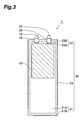
- Fig. 3 is a developed view that shows the interior of the electrochemical device shown in Fig. 2 as seen from the normal direction of the surface of the anode 10.
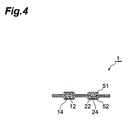
- Fig. 4 is a schematic cross-sectional view that shows the electrochemical device shown in Fig. 2 taken along the line X1-X1 in Fig. 2 .
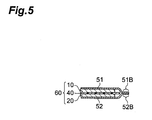
- Figure 5 is a schematic cross-sectional view that shows the principal part of the electrochemical device shown in Fig. 2 taken along the line X2-X2 in Fig. 2 .
- Figure 6 is a schematic cross-sectional view that shows the principal part of the electrochemical device shown in Fig. 2 taken along the line Y-Y in Fig. 2 .
- the electrochemical device 1 is essentially composed of a planar anode 10 and a planar cathode 20 that face each other; a planar separator 40 arranged between the anode 10 and the cathode 20; a lithium ion-containing electrolytic solution (a non-aqueous electrolytic solution in the embodiment); a case 50 accommodating them in a sealed state; an anode lead 12 of which one end is electrically connected with the anode 10 and the other projects from the case 50 to the outside; and a cathode lead 22 of which one end is electrically connected with the cathode 20 and the other projects from the case 50 to the outside.
- Fig. 7 is a schematic cross-sectional view that shows one example of a basic structure of the anode 10 of the electrochemical device shown in Fig. 2 .
- Fig. 8 is a schematic cross-sectional view that shows one example of a basic structure of the cathode 20 of the electrochemical device shown in Fig. 2 .
- the anode 10 shown in Fig. 7 includes a current collector 16 and a layer 18 that contains an anode active material formed on the collector 16.
- the cathode 20 includes a current collector 26 and a layer 28 that contains a cathode active material formed on the collector 26.
- At least one of the layer 18 containing an anode active material and the layer 28 containing a cathode active material contains the composite particle 8 for electrode of the embodiment as described above as the active material.
- the composite particle 8 for electrode of the embodiment which effectively acts as a cathode active material, is typically contained in the layer 28 containing a cathode active material.
- the current collectors 16 and 26 may be any conductor that can achieve sufficient charge transfer to the layer 18 that contains an anode active material and the layer 28 that contains a cathode active material, and include the well-known current collectors used for electrochemical devices.
- the collectors 16 and 26 include metal foils such as copper foils and aluminium foils.
- the layer 18 that contains an anode active material for the anode 10 is essentially composed of an anode active material and a binder.
- the layer 18 that contains an anode active material further includes a conducting aid.
- any anode active material that can reversibly occlude and release lithium ions or deintercalate and intercalate lithium ions can be used, and thus well-known anode active materials can be used.
- Such active materials includes carbonaceous materials such as natural graphite, artificial graphite, hard-graphitizing carbon, graphitizing carbon, low temperature calcined carbon, metals that can be combined with lithium, such as Al, Si, and Sn, noncrystalline compounds that are essentially composed of oxides, such as SiO 2 and SnO 2 , and lithium titanate (Li 4 Ti 5 O 12 ).
- carbonaceous materials are preferred, and those materials that have an interlayer distance (d 002 ) of from 0.335 nm to 0.338 nm, and crystallite size (Lc 002 ) of from 30 nm to 120 nm are more preferred.
- Such carbon materials that meet these requirements include artificial graphite, MCF (mesocarbon fiber), MCMB (mesocarbon microbead).
- the interlayer distance (d 002 ) and crystallite size (Lc 002 ) can be determined by X-ray diffractometry.
- binder can be used in anodes without restriction, for example, fluorinated resins such as polyvinylidene fluoride (PVDF), polytetrafluoroethylene (PTFE), tetrafluoroethylene-hexafluoropropylene copolymers (FEP), tetrafluoroethylene-perfluoroalkylvinylether copolymers (PFA), ethylene-tetrafluoroethylene copolymers (ETFE), polychlorotrifluoroethylene (PCTFE), ethylene-chlorotrifluoroethylene copolymers (ECTFE), and polyvinylfluoride (PVF).
- PVDF polyvinylidene fluoride
- PTFE polytetrafluoroethylene
- FEP tetrafluoroethylene-hexafluoropropylene copolymers
- PFA tetrafluoroethylene-perfluoroalkylvinylether copolymers
- ETFE ethylene-t
- binders may include vinylidenefluoride-related fluorinated rubbers such as vinylidenefluoride-hexafluoropropylene rubber (VDF-HFP rubber), vinylidenefluoride-hexafluoropropylene-tetrafluoroethylene rubber (VDF-HFP-TFE rubber), vinylidenefluoride-pentafluoropropylene rubber (VDF-PFP rubber), vinylidenefluoride-pentafluoropropylene - tetrafluoroethylene rubber (VDF-PFP-TFE rubber), vinylidenefluoride-perfluoromethylvinylether-tetrafluoroethylene rubber (VDF-PFMVE-TFE rubber), and vinylidenefluoride-chlorotrifluoroethylene rubber (VDF-CTFE rubber).
- VDF-HFP rubber vinylidenefluoride-hexafluoropropylene rubber
- VDF-HFP-TFE rubber vinyliden
- binders may include polyethylene, polypropylene, polyethylene terephthalate, aromatic polyamide, cellulose, styrene-butadiene rubber, isoprene rubber, butadiene rubber, and ethylene-propylene rubber.
- thermoplastic elastomeric polymers such as styrene-butadiene-styrene block copolymer and its hydrogen additive, styrene-ethylene-butadiene-styrene copolymer, and styrene-isoprene-styrene block copolymer and its hydrogen additive may be used.
- syndiotactic 1, 2-polybutadiene, ethylene-vinyl acetate copolymer, and propylene-alphaolefin (carbon number of from 2 to 12) copolymer may be also used.
- propylene-alphaolefin (carbon number of from 2 to 12) copolymer may be also used.
- conductive polymers may be also used.
- any of the well-known conducting aids can be used.
- the conducting aid includes carbon blacks, carbonaceous materials, metal powders such as copper, nickel, stainless steel, and iron, mixtures of carbonaceous materials and metal powder, and conductive oxides such as ITO.
- the layer 28 that contains a cathode active material for the cathode 20 is essentially composed of a cathode active material and a binder.
- the layer 28 that contains a cathode active material further includes a conducting aid.
- the layer 28 includes the composite particle 8 for electrode of the embodiment described above as the cathode active material.
- the layer 28 may further contain any well-known cathode active material other than the composite particle 8 for electrode of the embodiment. Any cathode active material that can reversibly occlude and release lithium ions or deintercalate and intercalate lithium ions can be used, and thus the well-known active materials can be used.
- LiCoO 2 lithium cobaltate
- LiNiO 2 lithium nickelate
- LiMn 2 O 4 lithium manganese spinel
- the binder used for the cathode 20 may be similar to that used for the anode 10.
- the conducting aid used for the cathode 20, as necessary may be similar to that used for the anode 10.
- the carbon content is preferably from 2% to 20% by mass based on the total amount of the layer 28, more preferably from 2% to 15% by mass, and most preferably from 2% to 10% by mass.
- the layer 28 has a carbon content of less than 2% by mass, the layer tends to have insufficient electron conductivity.
- the layer 28 has a carbon content of 20% by mass, an undue amount of carbon is contained in the electrode, thereby reducing the proportion of the active material to lead to reduction in electrode capacity.
- the content of the composite particle 8 for electrode of the embodiment is preferably from 75% to 97% by mass based on the total amount of the layer 28, more preferably from 80% to 95% by mass, and most preferably from 85% to 95% by mass.
- a composite particle content of less than 75% by mass tends to reduce the electric capacity of the electrode.
- a composite particle content of more than 97% by mass in which the carbon content in the electrode is low tends to reduce the electron conductivity.
- the current collector in the cathode 20 is electrically connected with one end of a cathode lead 22 made of, for example, aluminium, and the other end of the cathode lead 22 projects from the case 50 to the outside.
- the current collector in the anode 10 is electrically connected with one end of an anode lead 12 made of, for example, copper or nickel, and the other end of the anode lead 12 projects from the case 50 to the outside.
- the separator 40 arranged between the anode 10 and the cathode 20 may be any separator that is made of a porous material having ion permeability and electronic insulating properties, and any well-known separator used for electrochemical devices can be used.
- Examples of such a separator 40 includes laminated films made of polyethylene, polypropylene, or polyolefin, stretched films made of mixtures of these polymers, or non-woven fiber fabrics made of at least one component selected from the group consisting of cellulose, polyester, and polypropylene.
- the void in the case 50 is filled with an electrolytic solution (not shown), and part of the solution is contained within the anode 10, the cathode 20, and the separator 40.
- the electrolytic solution include non-aqueous electrolytic solutions that dissolve lithium salts in organic solvents.
- the lithium salts include salts such as LiPF 6 , LiClO 4 , LiBF 4 , LiAsF 6 , LiCF 3 SO 3 , LiCF 3 CF 2 SO 3 , LiC(CF 3 SO 2 ) 3 , LiN(CF 3 SO 2 ) 2 , LiN(CF 3 CF 2 SO 2 ) 2 , LiN(CF 3 SO 2 )(C 4 F 9 SO 2 ), and LiN(CF 3 CF 2 CO) 2 .
- These salts may be used alone or in combination.
- the electrolytic solution may be in a form of gel by addition of polymer.
- the organic solvent may be any well-known solvent used in electrochemical devices.
- cyclic carbonates, linear carbonates, lactones, and esters can be used alone or in combination.
- the solvent preferably includes propylene carbonate, ethylene carbonate, and diethyl carbonate. These solvents may be used alone or in combination at any proportion.
- the case 50 may be a metal can made of aluminium or stainless steel, or a metal foil of aluminium or stainless steel laminated with a resin film.
- the shape of the electrochemical device of the present invention is not limited to those described above, and may be cylindrical, for example.
- a composite particle 8 for electrode comprising the mother particle with a conventional ion diffusion capability can have an enhanced ion diffusion capability as a whole, as compared to a conventional composite of an active material with carbon.
- the carbonaceous electron-conducting layer 6 coated on at least part of the surface of the particulate core 4 including the mother particle enhances the electron conductivity of the composite particle 8 for electrode as a whole.
- microparticles 3 having a particle size of 300 nm or less contained in the electron-conducting layer 6 can enhance the discharge capacity particularly at high discharge rates.
- An electrochemical device including a composite particle for electrode in the electrode in which the electrode active material contained in the mother particle 4 or microparticles 3 is lithium-containing phosphate or silicate salt can have further improved discharge capacities and rate characteristics.
- An electrochemical device including the composite particle 8 for electrode as an active material in the electrode can have enhanced discharge capacities and rate characteristics.
- the sealing part of the electrochemical device 1 may be folded, thereby making the structure of the device into more compact.
- the electrochemical device 1 provided with one anode 10 and one cathode 20 has been described, but the device may has a structure that is provided with two or more anodes 10 and cathodes 20 each, and a separators 40 between the anode 10 and the cathode 20.
- lithium ion secondary batteries has mainly been described as examples of electrochemical devices of the present invention, but examples of the devices may include secondary batteries other than lithium ion secondary batteries, such as metallic lithium secondary batteries (in which an electrode including a composite particle of the present invention is used for the cathode, and metallic lithium is used for the anode), or electrochemical capacitors such as lithium capacitors.
- the electrochemical device of the present invention can be used in power sources for power self-propelled micromachines or IC cards, and distributed power sources mounted on or within printed boards.
- the electrochemical devices other than lithium ion secondary batteries may have any active material that is suitable for each electrochemical device, other than the composite particle of the present invention.
- Li 2 CO 3 as a Li source, V 2 O 5 as a V source, and NH 4 H 2 PO 4 as a PO 4 source were mixed in a stoichiometric ratio of LiVOPO 4 , and calcined at 600°C for 12 hours to obtain a mother particle 4 (particulate LiVOPO 4 wi average particle size of 3.5 ⁇ m).
- a composite particle 8 for electrode in which an electron-conducting layer 6 including microparticles 3 and carbon is formed on at least part of the surface of the particulate core 4 composed of one mother particle.
- the resulting composite particle 8 for electrode had an electron-conducting layer 6 of a thickness of 300 nm.
- the resulting composite particle for electrode (97 parts by mass), and polyvinylidene fluoride (PVDF) as a binder (3 parts by mass) were then mixed, and dispersed in N-methyl-2-pyrrolidone (NMP) to prepare a slurry for forming a layer containing an active material.
- NMP N-methyl-2-pyrrolidone
- This slurry was coated on aluminium foil being a collector, dried, and rolled by pressure to obtain an electrode including an active material-containing layer of a thickness of 40 ⁇ m on the collector of a thickness of 20 ⁇ m.
- the active material-containing layer had a carbon content of 5% by mass based on the total amount of the active material-containing layer.
- a separator composed of a microporous polyethylene film was sandwiched to obtain a laminate.
- Each composite particle for electrode and each cell for evaluation in Examples 2-7 were prepared in the same manner as in Example 1, except that each particle size of the mother particle and microparticles 3 is shown in Table 1. The discharge voltage and discharge capacity were then determined. Table 1 shows the results.
- a composite particle for electrode and a cell for evaluation in Examples 8 were prepared in the same manner as in Example 1, except that particulate LiNiMnCoO 2 having a particle size of 3.5 ⁇ m was used as a mother particle 4 and microparticles 3 had a particle size of 300 nm.
- the discharge voltage and discharge capacity were then determined in the same manner as in Example 1. Table 1 shows the results.
- a composite particle for electrode and a cell for evaluation in Comparative example 1 were prepared in the same manner as in Example 1, except that microparticles 3 had a particle size of 500 nm.
- the discharge voltage and discharge capacity were then determined in the same manner as in Example 1. Table 1 shows the results.
- the composite particle 8 for electrode was not used as the electrode active material in Comparative Example 2. Instead, in Comparative Example 2, the same active material (LiVOPO 4 ), conductive carbon, and binder as those in Example 1 were kneaded to obtain slurry. The resulting slurry was coated on the aluminium foil to form an electrode. A cell for evaluation in Comparative Example 2 was prepared using this electrode in the same manner as in Example 1. The discharge voltage and discharge capacity were then determined in the same manner as in Example 1. Table 1 shows the results.
- Example 8 the composite particle 8 for electrode was not used as the electrode active material in Comparative Example 3. Instead, in Comparative Example 3, the same active material (LiNiMnCoO 2 ), conductive carbon, and binder as those in Example 8 were kneaded to obtain slurry. The resulting slurry was coated on the aluminium foil to form an electrode. A cell for evaluation in Comparative Example 3 was prepared using this electrode in the same manner as in Example 8. The discharge voltage and discharge capacity were then determined in the same manner as in Example 8. Table 1 shows the results.
- the discharge capacity at 1C is higher in Examples 1-7 in which the microparticles 3 have a particle size of 300 nm or less, as compared to Comparative Example 1 in which the microparticles 3 have a particle size of 500 nm.
- the discharge capacity at 1/20C and 1 C is higher in Examples 1-7 in which the active material-containing layer in the electrode includes the composite particle 8 for electrode, as compared to Comparative Example 2 in which the active material-containing layer does not include the composite particle 8 for electrode.
- Example 8 When the composition of the active material is LiNiMnCoO 2 , the discharge capacity at 1C is higher in Example 8 in which the active material-containing layer in the electrode includes the composite particle 8 for electrode, as compared to Comparative Example 3 in which the active material-containing layer does not include the composite particle 8 for electrode.
- Example 1-7 and Comparative Examples 1 and 2 where the composition of the active material is LiVOPO 4 are compared with Example 8 and Comparative example 3 where the composition of the active material is LiNiMnCoO 2
- the presence of the composite particle for electrode in the active material-containing layer contributes to a significantly higher effect on improvement of the discharge capacity in Examples 1-7 using a phosphate salt for the particulate core 4 and the microparticles 3, as compared to Example 8 using no phosphate salt for the particulate core 4 and the microparticles 3.
Landscapes
- Chemical & Material Sciences (AREA)
- Chemical Kinetics & Catalysis (AREA)
- Electrochemistry (AREA)
- General Chemical & Material Sciences (AREA)
- Inorganic Chemistry (AREA)
- Composite Materials (AREA)
- Organic Chemistry (AREA)
- Crystallography & Structural Chemistry (AREA)
- Engineering & Computer Science (AREA)
- Materials Engineering (AREA)
- Battery Electrode And Active Subsutance (AREA)
- Electric Double-Layer Capacitors Or The Like (AREA)
Applications Claiming Priority (1)
| Application Number | Priority Date | Filing Date | Title |
|---|---|---|---|
| JP2007255141A JP5223281B2 (ja) | 2007-09-28 | 2007-09-28 | リチウムイオン二次電池又はリチウム二次電池の正極用複合粒子、及びリチウムイオン二次電池又はリチウム二次電池 |
Publications (3)
| Publication Number | Publication Date |
|---|---|
| EP2043183A2 true EP2043183A2 (de) | 2009-04-01 |
| EP2043183A3 EP2043183A3 (de) | 2012-01-18 |
| EP2043183B1 EP2043183B1 (de) | 2013-09-04 |
Family
ID=40259164
Family Applications (1)
| Application Number | Title | Priority Date | Filing Date |
|---|---|---|---|
| EP08017010.3A Active EP2043183B1 (de) | 2007-09-28 | 2008-09-26 | Verbundteilchen für Elektrode und elektrochemische Vorrichtung |
Country Status (4)
| Country | Link |
|---|---|
| US (1) | US8586182B2 (de) |
| EP (1) | EP2043183B1 (de) |
| JP (1) | JP5223281B2 (de) |
| CN (1) | CN101399336B (de) |
Cited By (5)
| Publication number | Priority date | Publication date | Assignee | Title |
|---|---|---|---|---|
| EP2683007A4 (de) * | 2011-03-04 | 2014-10-08 | Sumitomo Osaka Cement Co Ltd | Elektrodenaktive substanz und verfahren zu ihrer herstellung |
| US8992795B2 (en) | 2010-10-15 | 2015-03-31 | Semiconductor Energy Laboratory Co., Ltd. | Method for manufacturing positive electrode active material for power storage device |
| US9419271B2 (en) | 2010-07-02 | 2016-08-16 | Semiconductor Energy Laboratory Co., Ltd. | Electrode material and method for forming electrode material |
| US9929402B2 (en) | 2010-06-02 | 2018-03-27 | Semiconductor Energy Laboratory Co., Ltd. | Power storage device |
| US20240006652A1 (en) * | 2022-06-29 | 2024-01-04 | Nissan North America, Inc. | Advanced cathode materials for long-life lithium-ion batteries |
Families Citing this family (50)
| Publication number | Priority date | Publication date | Assignee | Title |
|---|---|---|---|---|
| CA2791156C (en) * | 2003-12-23 | 2015-12-15 | Universite De Montreal | Process for preparing electroactive insertion compounds and electrode materials obtained therefrom |
| JP5396798B2 (ja) * | 2008-09-30 | 2014-01-22 | Tdk株式会社 | 活物質材料、それを用いた正極及びリチウムイオン二次電池 |
| JP5365126B2 (ja) * | 2008-09-30 | 2013-12-11 | Tdk株式会社 | リチウムイオン二次電池の正極用活物質及びリチウムイオン二次電池の正極用活物質の製造方法 |
| US8821763B2 (en) * | 2008-09-30 | 2014-09-02 | Tdk Corporation | Active material and method of manufacturing active material |
| US20100233545A1 (en) * | 2009-03-16 | 2010-09-16 | Tdk Corporation | Active material, method of manufacturing active material, electrode, and lithium-ion secondary battery |
| US20120034526A1 (en) * | 2009-03-31 | 2012-02-09 | Mitsubishi Heavy Industries, Ltd. | Lithium ion secondary battery and battery system |
| JP5310251B2 (ja) * | 2009-05-18 | 2013-10-09 | 信越化学工業株式会社 | 非水電解質二次電池用負極材の製造方法 |
| US20110052995A1 (en) * | 2009-08-28 | 2011-03-03 | Tdk Corporation | Active material, electrode containing the same, lithium secondary battery provided therewith and method for manufacture of the active material |
| CA2678540A1 (fr) * | 2009-09-15 | 2011-03-15 | Hydro-Quebec | Materiau constitue de particules composites d'oxyde, procede pour sa preparation, et son utilisation comme matiere active d'electrode |
| US8734539B2 (en) * | 2009-09-29 | 2014-05-27 | Tdk Corporation | Method of manufacturing active material containing vanadium and method of manufacturing lithium-ion secondary battery containing such active material |
| DE102010006076A1 (de) * | 2010-01-28 | 2011-08-18 | Süd-Chemie AG, 80333 | Elektrode für eine Sekundärlithiumionenbatterie |
| JP6057402B2 (ja) * | 2010-03-02 | 2017-01-11 | 住友大阪セメント株式会社 | 電極活物質とその製造方法及びリチウムイオン電池 |
| DE102010021804A1 (de) * | 2010-05-27 | 2011-12-01 | Süd-Chemie AG | Verbundmaterial enthaltend ein gemischtes Lithium-Metallphosphat |
| US20110300446A1 (en) * | 2010-06-03 | 2011-12-08 | Hon Hai Precision Industry Co., Ltd. | Lithium battery cathode composite material |
| JP2012022995A (ja) * | 2010-07-16 | 2012-02-02 | Tdk Corp | 活物質、これを含む電極、当該電極を備えるリチウム二次電池、及び活物質の製造方法 |
| DE102010032206A1 (de) * | 2010-07-26 | 2012-04-05 | Süd-Chemie AG | Gasphasenbeschichtetes Lithium-Übergangsmetallphosphat und Verfahren zu dessen Herstellung |
| CN102544456B (zh) * | 2010-12-14 | 2014-10-22 | 苏州大学 | 一种二次电池的正极材料及其制备方法以及正极和二次电池 |
| US9960416B2 (en) * | 2010-12-17 | 2018-05-01 | Sumitomo Osaka Cement Co., Ltd. | Positive electrode for non-aqueous electrolyte secondary battery, non-aqueous electrolyte secondary battery and battery module |
| CN102544478B (zh) * | 2010-12-29 | 2014-12-10 | 比亚迪股份有限公司 | 一种正极活性材料及其制备方法、一种正极材料和锂离子电池 |
| KR101462821B1 (ko) * | 2011-02-02 | 2014-11-20 | 후루카와 덴키 고교 가부시키가이샤 | 미립자 혼합물, 정극 활물질 재료, 정극, 2차전지 및 이들의 제조방법 |
| KR20140053875A (ko) * | 2011-03-28 | 2014-05-08 | 미쯔이 죠센 가부시키가이샤 | 2차 전지용 전극 재료, 2차 전지용 전극 재료의 제조방법 및 2차 전지 |
| WO2013005705A1 (ja) * | 2011-07-04 | 2013-01-10 | 昭栄化学工業株式会社 | リチウムイオン二次電池用の正極材料、正極部材、リチウムイオン二次電池及び前記正極材料の製造方法 |
| US9249524B2 (en) | 2011-08-31 | 2016-02-02 | Semiconductor Energy Laboratory Co., Ltd. | Manufacturing method of composite oxide and manufacturing method of power storage device |
| JP6216965B2 (ja) * | 2012-01-31 | 2017-10-25 | 住友大阪セメント株式会社 | 電極材料と電極板及びリチウムイオン電池並びに電極材料の製造方法、電極板の製造方法 |
| WO2013120011A1 (en) | 2012-02-09 | 2013-08-15 | Energ2 Technologies, Inc. | Preparation of polymeric resins and carbon materials |
| US10374221B2 (en) * | 2012-08-24 | 2019-08-06 | Sila Nanotechnologies, Inc. | Scaffolding matrix with internal nanoparticles |
| JP2014060050A (ja) * | 2012-09-18 | 2014-04-03 | Honda Motor Co Ltd | 非水電解質二次電池用正極活物質 |
| KR20150084995A (ko) * | 2012-11-12 | 2015-07-22 | 미쯔이 죠센 가부시키가이샤 | 전극 재료 및 전극 재료의 제조 방법 |
| TWI520422B (zh) * | 2012-11-26 | 2016-02-01 | 財團法人工業技術研究院 | 鋰電池電極粉體與鋰電池極板 |
| JP5861661B2 (ja) | 2013-04-26 | 2016-02-16 | 住友大阪セメント株式会社 | 電極材料及び電極並びにリチウムイオン電池 |
| US10224537B2 (en) * | 2013-11-29 | 2019-03-05 | Sila Nanotechnologies, Inc. | Fluorides in nanoporous, electrically-conductive scaffolding matrix for metal and metal-ion batteries |
| KR102663138B1 (ko) | 2014-03-14 | 2024-05-03 | 그룹14 테크놀로지스, 인코포레이티드 | 용매의 부재하의 졸-겔 중합을 위한 신규한 방법 및 그러한 방법으로부터의 가변형 탄소 구조의 생성 |
| CN105990563B (zh) * | 2015-02-12 | 2019-06-28 | 宁德时代新能源科技股份有限公司 | 二次锂电池及其正极材料、以及正极材料的制备方法 |
| US20190097222A1 (en) | 2015-08-14 | 2019-03-28 | Energ2 Technologies, Inc. | Composites of porous nano-featured silicon materials and carbon materials |
| US10566621B2 (en) | 2016-03-30 | 2020-02-18 | Sumitomo Osaka Cement Co., Ltd | Lithium-ion secondary battery |
| JP6264407B2 (ja) * | 2016-03-30 | 2018-01-24 | 住友大阪セメント株式会社 | リチウムイオン二次電池 |
| JP6090497B1 (ja) | 2016-03-30 | 2017-03-08 | 住友大阪セメント株式会社 | リチウムイオン二次電池用正極材料 |
| DE102016216253A1 (de) | 2016-08-30 | 2018-03-01 | Robert Bosch Gmbh | Elektrodenmaterial für eine Lithium-Ionen-Batterie |
| US11830672B2 (en) | 2016-11-23 | 2023-11-28 | KYOCERA AVX Components Corporation | Ultracapacitor for use in a solder reflow process |
| CN106876669B (zh) * | 2016-12-23 | 2019-10-18 | 山东精工电子科技有限公司 | 一种微晶LiVOPO4-LiMPO4-TiO2复合锂电材料及制备方法 |
| CN107394125B (zh) * | 2017-06-07 | 2020-07-14 | 上海交通大学 | 掺锰硅酸铁锂/石墨烯空心纳米球正极材料及其制备方法 |
| JP2019012609A (ja) * | 2017-06-29 | 2019-01-24 | 株式会社日立製作所 | 二次電池、半電池及び二次電池の製造方法 |
| JP7483192B2 (ja) * | 2020-03-19 | 2024-05-15 | 太平洋セメント株式会社 | 複合粒子およびその製造方法 |
| WO2021199618A1 (ja) * | 2020-03-30 | 2021-10-07 | パナソニックIpマネジメント株式会社 | 被覆正極活物質およびそれを用いた電池 |
| US11639292B2 (en) | 2020-08-18 | 2023-05-02 | Group14 Technologies, Inc. | Particulate composite materials |
| EP4146595A1 (de) | 2020-08-18 | 2023-03-15 | Group14 Technologies, Inc. | Herstellung von silicium-kohlenstoff-verbundwerkstoffen |
| CN116457309B (zh) | 2020-09-30 | 2025-02-14 | 14集团技术公司 | 控制硅-碳复合材料的氧含量和反应性的钝化方法 |
| JP7640331B2 (ja) * | 2021-03-29 | 2025-03-05 | Tdk株式会社 | リチウムイオン二次電池用電極およびリチウムイオン二次電池 |
| CN115832219B (zh) * | 2022-01-05 | 2025-02-21 | 宁德时代新能源科技股份有限公司 | 一种复合材料、正极极片及二次电池 |
| JP7799921B1 (ja) * | 2025-03-01 | 2026-01-16 | 株式会社物質科学研究所 | リチウムイオン2次電池用正極活物質の製造方法、リチウムイオン2次電池用電極、ならびにリチウムイオン2次電池 |
Citations (1)
| Publication number | Priority date | Publication date | Assignee | Title |
|---|---|---|---|---|
| JP2003292308A (ja) | 2002-01-31 | 2003-10-15 | Nippon Chem Ind Co Ltd | リチウム鉄リン系複合酸化物炭素複合体、その製造方法、リチウム二次電池正極活物質及びリチウム二次電池 |
Family Cites Families (22)
| Publication number | Priority date | Publication date | Assignee | Title |
|---|---|---|---|---|
| JPH02239564A (ja) * | 1989-03-14 | 1990-09-21 | Toshiba Battery Co Ltd | 電池用正極合剤の製造方法 |
| JP3496414B2 (ja) * | 1996-11-27 | 2004-02-09 | 株式会社デンソー | リチウム二次電池用正極活物質およびその製造方法、並びにリチウム二次電池用正極 |
| US6482547B1 (en) * | 1998-05-21 | 2002-11-19 | Samsung Display Devices Co., Ltd. | Negative active material for lithium secondary battery and lithium secondary battery using the same |
| CA2270771A1 (fr) * | 1999-04-30 | 2000-10-30 | Hydro-Quebec | Nouveaux materiaux d'electrode presentant une conductivite de surface elevee |
| KR100350535B1 (ko) * | 1999-12-10 | 2002-08-28 | 삼성에스디아이 주식회사 | 리튬 이차 전지용 음극 활물질 및 그의 제조 방법 |
| JP4308446B2 (ja) * | 2001-03-02 | 2009-08-05 | 三星エスディアイ株式会社 | 炭素質材料及びリチウム二次電池 |
| CN1208866C (zh) | 2001-11-02 | 2005-06-29 | 中国科学院物理研究所 | 以纳米表面包覆复合材料为正极活性物质的锂二次电池 |
| JP2003157850A (ja) * | 2001-11-22 | 2003-05-30 | Kyushu Univ | 2次電池用正極材料、および2次電池 |
| JP2003308845A (ja) * | 2002-04-17 | 2003-10-31 | Mikuni Color Ltd | リチウム二次電池用電極及びこれを用いたリチウム二次電池 |
| JP4314859B2 (ja) * | 2003-03-31 | 2009-08-19 | 祐作 滝田 | 非水電解質二次電池用電極活物質、非水電解質二次電池用電極及び非水電解質二次電池 |
| JP4061586B2 (ja) * | 2003-04-11 | 2008-03-19 | ソニー株式会社 | 非水電解質二次電池用正極活物質及びそれを用いた非水電解質二次電池 |
| US20050064289A1 (en) * | 2003-07-03 | 2005-03-24 | Tdk Corporation | Electrode, electrochemical device, method for manufacturing electrode, and method for manufacturing electrochemical device |
| JP4077432B2 (ja) * | 2003-07-07 | 2008-04-16 | Tdk株式会社 | 電気化学素子 |
| US9012096B2 (en) * | 2004-05-28 | 2015-04-21 | Uchicago Argonne, Llc | Long life lithium batteries with stabilized electrodes |
| JP4779323B2 (ja) * | 2004-08-24 | 2011-09-28 | 日産自動車株式会社 | 非水電解質リチウムイオン二次電池用正極材料およびその製造方法 |
| KR100816604B1 (ko) * | 2004-08-26 | 2008-03-24 | 마쯔시다덴기산교 가부시키가이샤 | 전극용 복합 입자 및, 그 제조법, 및 이차전지 |
| US7700236B2 (en) | 2005-09-09 | 2010-04-20 | Aquire Energy Co., Ltd. | Cathode material for manufacturing a rechargeable battery |
| CN100422112C (zh) | 2005-07-08 | 2008-10-01 | 中国科学院物理研究所 | 一种具有球形核壳结构的碳硅复合材料及其制法和用途 |
| US7939201B2 (en) | 2005-08-08 | 2011-05-10 | A123 Systems, Inc. | Nanoscale ion storage materials including co-existing phases or solid solutions |
| CN100361893C (zh) | 2006-03-30 | 2008-01-16 | 上海交通大学 | 用磷酸铁制备碳包覆磷酸亚铁锂的方法 |
| KR20080068593A (ko) * | 2007-01-18 | 2008-07-23 | 주식회사 엘지화학 | 양극 활물질 및 이를 포함한 이차전지 |
| JP4317239B2 (ja) | 2007-04-27 | 2009-08-19 | Tdk株式会社 | 電極用複合粒子の製造方法 |
-
2007
- 2007-09-28 JP JP2007255141A patent/JP5223281B2/ja active Active
-
2008
- 2008-09-24 US US12/236,602 patent/US8586182B2/en active Active
- 2008-09-26 EP EP08017010.3A patent/EP2043183B1/de active Active
- 2008-09-28 CN CN2008101695445A patent/CN101399336B/zh active Active
Patent Citations (1)
| Publication number | Priority date | Publication date | Assignee | Title |
|---|---|---|---|---|
| JP2003292308A (ja) | 2002-01-31 | 2003-10-15 | Nippon Chem Ind Co Ltd | リチウム鉄リン系複合酸化物炭素複合体、その製造方法、リチウム二次電池正極活物質及びリチウム二次電池 |
Cited By (8)
| Publication number | Priority date | Publication date | Assignee | Title |
|---|---|---|---|---|
| US9929402B2 (en) | 2010-06-02 | 2018-03-27 | Semiconductor Energy Laboratory Co., Ltd. | Power storage device |
| US9419271B2 (en) | 2010-07-02 | 2016-08-16 | Semiconductor Energy Laboratory Co., Ltd. | Electrode material and method for forming electrode material |
| US10256467B2 (en) | 2010-07-02 | 2019-04-09 | Semiconductor Energy Laboratory Co., Ltd. | Electrode material and method for forming electrode material |
| US8992795B2 (en) | 2010-10-15 | 2015-03-31 | Semiconductor Energy Laboratory Co., Ltd. | Method for manufacturing positive electrode active material for power storage device |
| US10272594B2 (en) | 2010-10-15 | 2019-04-30 | Semiconductor Energy Laboratory Co., Ltd. | Method for manufacturing positive electrode active material for power storage device |
| EP2683007A4 (de) * | 2011-03-04 | 2014-10-08 | Sumitomo Osaka Cement Co Ltd | Elektrodenaktive substanz und verfahren zu ihrer herstellung |
| US20240006652A1 (en) * | 2022-06-29 | 2024-01-04 | Nissan North America, Inc. | Advanced cathode materials for long-life lithium-ion batteries |
| US12463242B2 (en) * | 2022-06-29 | 2025-11-04 | Nissan North America, Inc. | Advanced cathode materials for long-life lithium-ion batteries |
Also Published As
| Publication number | Publication date |
|---|---|
| US20090087660A1 (en) | 2009-04-02 |
| JP5223281B2 (ja) | 2013-06-26 |
| US8586182B2 (en) | 2013-11-19 |
| CN101399336A (zh) | 2009-04-01 |
| EP2043183B1 (de) | 2013-09-04 |
| EP2043183A3 (de) | 2012-01-18 |
| CN101399336B (zh) | 2011-12-21 |
| JP2009087682A (ja) | 2009-04-23 |
Similar Documents
| Publication | Publication Date | Title |
|---|---|---|
| EP2043183B1 (de) | Verbundteilchen für Elektrode und elektrochemische Vorrichtung | |
| JP4317239B2 (ja) | 電極用複合粒子の製造方法 | |
| JP4336372B2 (ja) | 電極用複合粒子及びその製造方法、並びに、電気化学デバイス | |
| JP5072110B2 (ja) | リチウム電池に用いる正極材料 | |
| JP5396798B2 (ja) | 活物質材料、それを用いた正極及びリチウムイオン二次電池 | |
| US8178238B2 (en) | Positive-electrode active material for lithium-ion secondary battery, positive electrode, manufacturing method thereof, and lithium-ion secondary battery | |
| JP5131246B2 (ja) | 電極用複合粒子及び電気化学デバイス | |
| US20140001413A1 (en) | Active material, electrode, lithium ion secondary battery, and method for manufacturing active material | |
| JP2008251249A (ja) | アノード及びリチウムイオン二次電池 | |
| JP2023069760A (ja) | 二次電池用の負極およびその製造方法 | |
| JP5375009B2 (ja) | 活物質材料、それを用いた正極及びリチウムイオン二次電池 | |
| KR102849966B1 (ko) | 양극 활물질, 이의 제조방법 및 이를 포함하는 양극 및 리튬 이차전지 | |
| JP6992580B2 (ja) | 活物質およびそれを用いたリチウムイオン二次電池 | |
| JP6992577B2 (ja) | 活物質及びそれを用いたリチウムイオン二次電池 | |
| KR20250179694A (ko) | 양극 활물질, 이를 포함하는 양극 및 리튬 이차전지 | |
| JP2019145296A (ja) | リチウムイオン二次電池用電極及びそれを用いたリチウムイオン二次電池 |
Legal Events
| Date | Code | Title | Description |
|---|---|---|---|
| PUAI | Public reference made under article 153(3) epc to a published international application that has entered the european phase |
Free format text: ORIGINAL CODE: 0009012 |
|
| 17P | Request for examination filed |
Effective date: 20080926 |
|
| AK | Designated contracting states |
Kind code of ref document: A2 Designated state(s): AT BE BG CH CY CZ DE DK EE ES FI FR GB GR HR HU IE IS IT LI LT LU LV MC MT NL NO PL PT RO SE SI SK TR |
|
| AX | Request for extension of the european patent |
Extension state: AL BA MK RS |
|
| PUAL | Search report despatched |
Free format text: ORIGINAL CODE: 0009013 |
|
| AK | Designated contracting states |
Kind code of ref document: A3 Designated state(s): AT BE BG CH CY CZ DE DK EE ES FI FR GB GR HR HU IE IS IT LI LT LU LV MC MT NL NO PL PT RO SE SI SK TR |
|
| AX | Request for extension of the european patent |
Extension state: AL BA MK RS |
|
| RIC1 | Information provided on ipc code assigned before grant |
Ipc: H01M 4/36 20060101ALN20111213BHEP Ipc: H01M 4/58 20100101AFI20111213BHEP Ipc: H01M 4/02 20060101ALN20111213BHEP Ipc: H01M 4/62 20060101ALI20111213BHEP |
|
| AKX | Designation fees paid |
Designated state(s): AT BE BG CH CY CZ DE DK EE ES FI FR GB GR HR HU IE IS IT LI LT LU LV MC MT NL NO PL PT RO SE SI SK TR |
|
| 17Q | First examination report despatched |
Effective date: 20120912 |
|
| RIC1 | Information provided on ipc code assigned before grant |
Ipc: H01M 4/36 20060101ALN20130124BHEP Ipc: H01M 4/62 20060101ALI20130124BHEP Ipc: H01M 4/02 20060101ALN20130124BHEP Ipc: H01M 4/58 20100101AFI20130124BHEP |
|
| GRAP | Despatch of communication of intention to grant a patent |
Free format text: ORIGINAL CODE: EPIDOSNIGR1 |
|
| GRAS | Grant fee paid |
Free format text: ORIGINAL CODE: EPIDOSNIGR3 |
|
| GRAA | (expected) grant |
Free format text: ORIGINAL CODE: 0009210 |
|
| AK | Designated contracting states |
Kind code of ref document: B1 Designated state(s): AT BE BG CH CY CZ DE DK EE ES FI FR GB GR HR HU IE IS IT LI LT LU LV MC MT NL NO PL PT RO SE SI SK TR |
|
| REG | Reference to a national code |
Ref country code: GB Ref legal event code: FG4D |
|
| REG | Reference to a national code |
Ref country code: CH Ref legal event code: EP |
|
| REG | Reference to a national code |
Ref country code: AT Ref legal event code: REF Ref document number: 630923 Country of ref document: AT Kind code of ref document: T Effective date: 20130915 |
|
| REG | Reference to a national code |
Ref country code: IE Ref legal event code: FG4D |
|
| REG | Reference to a national code |
Ref country code: DE Ref legal event code: R096 Ref document number: 602008027244 Country of ref document: DE Effective date: 20131031 |
|
| REG | Reference to a national code |
Ref country code: AT Ref legal event code: MK05 Ref document number: 630923 Country of ref document: AT Kind code of ref document: T Effective date: 20130904 |
|
| REG | Reference to a national code |
Ref country code: NL Ref legal event code: VDEP Effective date: 20130904 |
|
| PG25 | Lapsed in a contracting state [announced via postgrant information from national office to epo] |
Ref country code: SE Free format text: LAPSE BECAUSE OF FAILURE TO SUBMIT A TRANSLATION OF THE DESCRIPTION OR TO PAY THE FEE WITHIN THE PRESCRIBED TIME-LIMIT Effective date: 20130904 Ref country code: HR Free format text: LAPSE BECAUSE OF FAILURE TO SUBMIT A TRANSLATION OF THE DESCRIPTION OR TO PAY THE FEE WITHIN THE PRESCRIBED TIME-LIMIT Effective date: 20130904 Ref country code: LT Free format text: LAPSE BECAUSE OF FAILURE TO SUBMIT A TRANSLATION OF THE DESCRIPTION OR TO PAY THE FEE WITHIN THE PRESCRIBED TIME-LIMIT Effective date: 20130904 Ref country code: CY Free format text: LAPSE BECAUSE OF FAILURE TO SUBMIT A TRANSLATION OF THE DESCRIPTION OR TO PAY THE FEE WITHIN THE PRESCRIBED TIME-LIMIT Effective date: 20130731 Ref country code: AT Free format text: LAPSE BECAUSE OF FAILURE TO SUBMIT A TRANSLATION OF THE DESCRIPTION OR TO PAY THE FEE WITHIN THE PRESCRIBED TIME-LIMIT Effective date: 20130904 Ref country code: NO Free format text: LAPSE BECAUSE OF FAILURE TO SUBMIT A TRANSLATION OF THE DESCRIPTION OR TO PAY THE FEE WITHIN THE PRESCRIBED TIME-LIMIT Effective date: 20131204 |
|
| REG | Reference to a national code |
Ref country code: NL Ref legal event code: VDEP Effective date: 20130904 |
|
| REG | Reference to a national code |
Ref country code: LT Ref legal event code: MG4D |
|
| PG25 | Lapsed in a contracting state [announced via postgrant information from national office to epo] |
Ref country code: FI Free format text: LAPSE BECAUSE OF FAILURE TO SUBMIT A TRANSLATION OF THE DESCRIPTION OR TO PAY THE FEE WITHIN THE PRESCRIBED TIME-LIMIT Effective date: 20130904 Ref country code: PL Free format text: LAPSE BECAUSE OF FAILURE TO SUBMIT A TRANSLATION OF THE DESCRIPTION OR TO PAY THE FEE WITHIN THE PRESCRIBED TIME-LIMIT Effective date: 20130904 Ref country code: LV Free format text: LAPSE BECAUSE OF FAILURE TO SUBMIT A TRANSLATION OF THE DESCRIPTION OR TO PAY THE FEE WITHIN THE PRESCRIBED TIME-LIMIT Effective date: 20130904 Ref country code: GR Free format text: LAPSE BECAUSE OF FAILURE TO SUBMIT A TRANSLATION OF THE DESCRIPTION OR TO PAY THE FEE WITHIN THE PRESCRIBED TIME-LIMIT Effective date: 20131205 Ref country code: SI Free format text: LAPSE BECAUSE OF FAILURE TO SUBMIT A TRANSLATION OF THE DESCRIPTION OR TO PAY THE FEE WITHIN THE PRESCRIBED TIME-LIMIT Effective date: 20130904 |
|
| PG25 | Lapsed in a contracting state [announced via postgrant information from national office to epo] |
Ref country code: CY Free format text: LAPSE BECAUSE OF FAILURE TO SUBMIT A TRANSLATION OF THE DESCRIPTION OR TO PAY THE FEE WITHIN THE PRESCRIBED TIME-LIMIT Effective date: 20130904 Ref country code: BE Free format text: LAPSE BECAUSE OF FAILURE TO SUBMIT A TRANSLATION OF THE DESCRIPTION OR TO PAY THE FEE WITHIN THE PRESCRIBED TIME-LIMIT Effective date: 20130904 |
|
| PG25 | Lapsed in a contracting state [announced via postgrant information from national office to epo] |
Ref country code: RO Free format text: LAPSE BECAUSE OF FAILURE TO SUBMIT A TRANSLATION OF THE DESCRIPTION OR TO PAY THE FEE WITHIN THE PRESCRIBED TIME-LIMIT Effective date: 20130904 Ref country code: IS Free format text: LAPSE BECAUSE OF FAILURE TO SUBMIT A TRANSLATION OF THE DESCRIPTION OR TO PAY THE FEE WITHIN THE PRESCRIBED TIME-LIMIT Effective date: 20140104 Ref country code: EE Free format text: LAPSE BECAUSE OF FAILURE TO SUBMIT A TRANSLATION OF THE DESCRIPTION OR TO PAY THE FEE WITHIN THE PRESCRIBED TIME-LIMIT Effective date: 20130904 Ref country code: CZ Free format text: LAPSE BECAUSE OF FAILURE TO SUBMIT A TRANSLATION OF THE DESCRIPTION OR TO PAY THE FEE WITHIN THE PRESCRIBED TIME-LIMIT Effective date: 20130904 Ref country code: SK Free format text: LAPSE BECAUSE OF FAILURE TO SUBMIT A TRANSLATION OF THE DESCRIPTION OR TO PAY THE FEE WITHIN THE PRESCRIBED TIME-LIMIT Effective date: 20130904 Ref country code: NL Free format text: LAPSE BECAUSE OF FAILURE TO SUBMIT A TRANSLATION OF THE DESCRIPTION OR TO PAY THE FEE WITHIN THE PRESCRIBED TIME-LIMIT Effective date: 20130904 |
|
| REG | Reference to a national code |
Ref country code: CH Ref legal event code: PL |
|
| PG25 | Lapsed in a contracting state [announced via postgrant information from national office to epo] |
Ref country code: ES Free format text: LAPSE BECAUSE OF FAILURE TO SUBMIT A TRANSLATION OF THE DESCRIPTION OR TO PAY THE FEE WITHIN THE PRESCRIBED TIME-LIMIT Effective date: 20130904 |
|
| REG | Reference to a national code |
Ref country code: DE Ref legal event code: R097 Ref document number: 602008027244 Country of ref document: DE |
|
| PG25 | Lapsed in a contracting state [announced via postgrant information from national office to epo] |
Ref country code: PT Free format text: LAPSE BECAUSE OF FAILURE TO SUBMIT A TRANSLATION OF THE DESCRIPTION OR TO PAY THE FEE WITHIN THE PRESCRIBED TIME-LIMIT Effective date: 20140106 Ref country code: MC Free format text: LAPSE BECAUSE OF FAILURE TO SUBMIT A TRANSLATION OF THE DESCRIPTION OR TO PAY THE FEE WITHIN THE PRESCRIBED TIME-LIMIT Effective date: 20130904 |
|
| REG | Reference to a national code |
Ref country code: IE Ref legal event code: MM4A |
|
| PLBE | No opposition filed within time limit |
Free format text: ORIGINAL CODE: 0009261 |
|
| STAA | Information on the status of an ep patent application or granted ep patent |
Free format text: STATUS: NO OPPOSITION FILED WITHIN TIME LIMIT |
|
| PG25 | Lapsed in a contracting state [announced via postgrant information from national office to epo] |
Ref country code: LI Free format text: LAPSE BECAUSE OF NON-PAYMENT OF DUE FEES Effective date: 20130930 Ref country code: IE Free format text: LAPSE BECAUSE OF NON-PAYMENT OF DUE FEES Effective date: 20130926 Ref country code: CH Free format text: LAPSE BECAUSE OF NON-PAYMENT OF DUE FEES Effective date: 20130930 |
|
| 26N | No opposition filed |
Effective date: 20140605 |
|
| PG25 | Lapsed in a contracting state [announced via postgrant information from national office to epo] |
Ref country code: IT Free format text: LAPSE BECAUSE OF FAILURE TO SUBMIT A TRANSLATION OF THE DESCRIPTION OR TO PAY THE FEE WITHIN THE PRESCRIBED TIME-LIMIT Effective date: 20130904 |
|
| REG | Reference to a national code |
Ref country code: DE Ref legal event code: R097 Ref document number: 602008027244 Country of ref document: DE Effective date: 20140605 |
|
| PG25 | Lapsed in a contracting state [announced via postgrant information from national office to epo] |
Ref country code: DK Free format text: LAPSE BECAUSE OF FAILURE TO SUBMIT A TRANSLATION OF THE DESCRIPTION OR TO PAY THE FEE WITHIN THE PRESCRIBED TIME-LIMIT Effective date: 20130904 |
|
| PG25 | Lapsed in a contracting state [announced via postgrant information from national office to epo] |
Ref country code: MT Free format text: LAPSE BECAUSE OF FAILURE TO SUBMIT A TRANSLATION OF THE DESCRIPTION OR TO PAY THE FEE WITHIN THE PRESCRIBED TIME-LIMIT Effective date: 20130904 Ref country code: TR Free format text: LAPSE BECAUSE OF FAILURE TO SUBMIT A TRANSLATION OF THE DESCRIPTION OR TO PAY THE FEE WITHIN THE PRESCRIBED TIME-LIMIT Effective date: 20130904 |
|
| PG25 | Lapsed in a contracting state [announced via postgrant information from national office to epo] |
Ref country code: LU Free format text: LAPSE BECAUSE OF NON-PAYMENT OF DUE FEES Effective date: 20130926 Ref country code: BG Free format text: LAPSE BECAUSE OF FAILURE TO SUBMIT A TRANSLATION OF THE DESCRIPTION OR TO PAY THE FEE WITHIN THE PRESCRIBED TIME-LIMIT Effective date: 20130904 Ref country code: HU Free format text: LAPSE BECAUSE OF FAILURE TO SUBMIT A TRANSLATION OF THE DESCRIPTION OR TO PAY THE FEE WITHIN THE PRESCRIBED TIME-LIMIT; INVALID AB INITIO Effective date: 20080926 |
|
| REG | Reference to a national code |
Ref country code: FR Ref legal event code: PLFP Year of fee payment: 9 |
|
| REG | Reference to a national code |
Ref country code: FR Ref legal event code: PLFP Year of fee payment: 10 |
|
| REG | Reference to a national code |
Ref country code: FR Ref legal event code: PLFP Year of fee payment: 11 |
|
| P01 | Opt-out of the competence of the unified patent court (upc) registered |
Effective date: 20230512 |
|
| PGFP | Annual fee paid to national office [announced via postgrant information from national office to epo] |
Ref country code: DE Payment date: 20250730 Year of fee payment: 18 |
|
| PGFP | Annual fee paid to national office [announced via postgrant information from national office to epo] |
Ref country code: GB Payment date: 20250807 Year of fee payment: 18 |
|
| PGFP | Annual fee paid to national office [announced via postgrant information from national office to epo] |
Ref country code: FR Payment date: 20250808 Year of fee payment: 18 |