EP2054397B1 - Inhibiteurs à petites molécules de kynurénine-3-monooxygénase - Google Patents
Inhibiteurs à petites molécules de kynurénine-3-monooxygénase Download PDFInfo
- Publication number
- EP2054397B1 EP2054397B1 EP07814178.5A EP07814178A EP2054397B1 EP 2054397 B1 EP2054397 B1 EP 2054397B1 EP 07814178 A EP07814178 A EP 07814178A EP 2054397 B1 EP2054397 B1 EP 2054397B1
- Authority
- EP
- European Patent Office
- Prior art keywords
- substituted
- hydrogen
- methyl
- nitrophenyl
- benzenesulfonamide
- Prior art date
- Legal status (The legal status is an assumption and is not a legal conclusion. Google has not performed a legal analysis and makes no representation as to the accuracy of the status listed.)
- Not-in-force
Links
- 0 Cc1cc([N+](*C(*2)=NC(C*(CCO)CCO*)=C2c2cc(*)ccc2)[O-])ccc1* Chemical compound Cc1cc([N+](*C(*2)=NC(C*(CCO)CCO*)=C2c2cc(*)ccc2)[O-])ccc1* 0.000 description 4
- NDPBMCKQJOZAQX-UHFFFAOYSA-N COc(c(OC)c1)ccc1S(Nc1nc(-c2cc([N+]([O-])=O)ccc2)c[s]1)(=O)=O Chemical compound COc(c(OC)c1)ccc1S(Nc1nc(-c2cc([N+]([O-])=O)ccc2)c[s]1)(=O)=O NDPBMCKQJOZAQX-UHFFFAOYSA-N 0.000 description 3
- GOWBSGKWACGSGN-UHFFFAOYSA-N COc(c(OC)c1)ccc1S(Nc1nc(-c2cc([N+]([O-])=O)ccc2)c(CN2CCOCC2)[s]1)(=O)=O Chemical compound COc(c(OC)c1)ccc1S(Nc1nc(-c2cc([N+]([O-])=O)ccc2)c(CN2CCOCC2)[s]1)(=O)=O GOWBSGKWACGSGN-UHFFFAOYSA-N 0.000 description 2
- UWOLENFAWYDYIW-UHFFFAOYSA-N CCOC(N(c1nc(-c2cc([N+]([O-])=O)ccc2)c[s]1)S(c(cc1OC)ccc1OC)(=O)=O)=O Chemical compound CCOC(N(c1nc(-c2cc([N+]([O-])=O)ccc2)c[s]1)S(c(cc1OC)ccc1OC)(=O)=O)=O UWOLENFAWYDYIW-UHFFFAOYSA-N 0.000 description 1
- KYTOISAOWXKPFK-UHFFFAOYSA-N CN(C)Cc1c(-c2cccc([N+]([O-])=O)c2)nc(NS(c(cc2)cc(OC)c2OC)(=O)=O)[s]1 Chemical compound CN(C)Cc1c(-c2cccc([N+]([O-])=O)c2)nc(NS(c(cc2)cc(OC)c2OC)(=O)=O)[s]1 KYTOISAOWXKPFK-UHFFFAOYSA-N 0.000 description 1
- LWLBKFRPIJUUJJ-UHFFFAOYSA-N COc(ccc(S(N(CN1CCOCC1)c1nc(-c2cc([N+]([O-])=O)ccc2)c[s]1)(=O)=O)c1)c1OC Chemical compound COc(ccc(S(N(CN1CCOCC1)c1nc(-c2cc([N+]([O-])=O)ccc2)c[s]1)(=O)=O)c1)c1OC LWLBKFRPIJUUJJ-UHFFFAOYSA-N 0.000 description 1
- SCDIEBRPARNIQR-UHFFFAOYSA-N COc(ccc(S(Nc1nc(-c2cc([N+]([O-])=O)ccc2)c(CN(CCO)CCO)[s]1)(=O)=O)c1)c1OC Chemical compound COc(ccc(S(Nc1nc(-c2cc([N+]([O-])=O)ccc2)c(CN(CCO)CCO)[s]1)(=O)=O)c1)c1OC SCDIEBRPARNIQR-UHFFFAOYSA-N 0.000 description 1
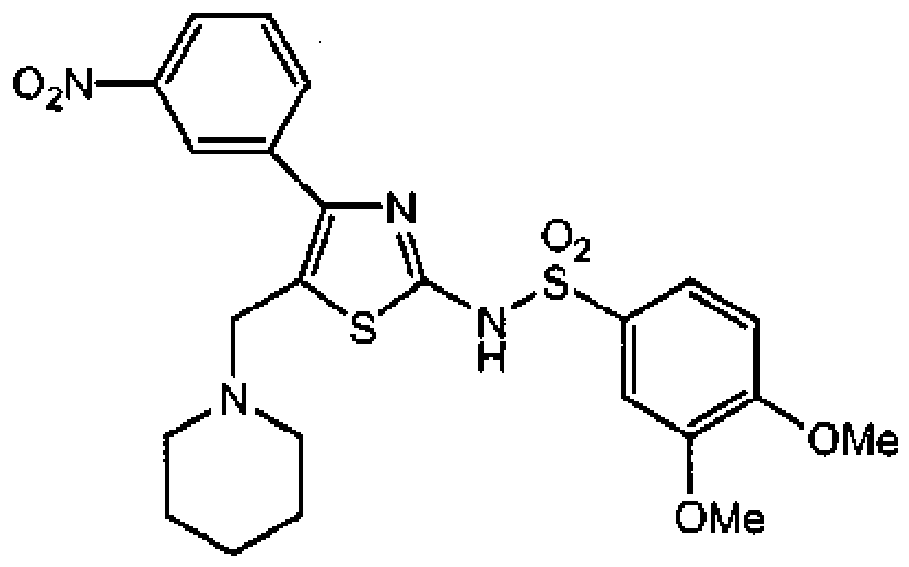
- AOZLMMDVJOGGEQ-UHFFFAOYSA-N COc(ccc(S(Nc1nc(-c2cc([N+]([O-])=O)ccc2)c(CN2CCCCC2)[s]1)(=O)=O)c1)c1OC Chemical compound COc(ccc(S(Nc1nc(-c2cc([N+]([O-])=O)ccc2)c(CN2CCCCC2)[s]1)(=O)=O)c1)c1OC AOZLMMDVJOGGEQ-UHFFFAOYSA-N 0.000 description 1
Images


Classifications
-
- C—CHEMISTRY; METALLURGY
- C07—ORGANIC CHEMISTRY
- C07D—HETEROCYCLIC COMPOUNDS
- C07D277/00—Heterocyclic compounds containing 1,3-thiazole or hydrogenated 1,3-thiazole rings
- C07D277/02—Heterocyclic compounds containing 1,3-thiazole or hydrogenated 1,3-thiazole rings not condensed with other rings
- C07D277/20—Heterocyclic compounds containing 1,3-thiazole or hydrogenated 1,3-thiazole rings not condensed with other rings having two or three double bonds between ring members or between ring members and non-ring members
- C07D277/32—Heterocyclic compounds containing 1,3-thiazole or hydrogenated 1,3-thiazole rings not condensed with other rings having two or three double bonds between ring members or between ring members and non-ring members with hetero atoms or with carbon atoms having three bonds to hetero atoms with at the most one bond to halogen, e.g. ester or nitrile radicals, directly attached to ring carbon atoms
- C07D277/38—Nitrogen atoms
- C07D277/50—Nitrogen atoms bound to hetero atoms
- C07D277/52—Nitrogen atoms bound to hetero atoms to sulfur atoms, e.g. sulfonamides
-
- A—HUMAN NECESSITIES
- A61—MEDICAL OR VETERINARY SCIENCE; HYGIENE
- A61P—SPECIFIC THERAPEUTIC ACTIVITY OF CHEMICAL COMPOUNDS OR MEDICINAL PREPARATIONS
- A61P25/00—Drugs for disorders of the nervous system
-
- A—HUMAN NECESSITIES
- A61—MEDICAL OR VETERINARY SCIENCE; HYGIENE
- A61P—SPECIFIC THERAPEUTIC ACTIVITY OF CHEMICAL COMPOUNDS OR MEDICINAL PREPARATIONS
- A61P25/00—Drugs for disorders of the nervous system
- A61P25/08—Antiepileptics; Anticonvulsants
-
- A—HUMAN NECESSITIES
- A61—MEDICAL OR VETERINARY SCIENCE; HYGIENE
- A61P—SPECIFIC THERAPEUTIC ACTIVITY OF CHEMICAL COMPOUNDS OR MEDICINAL PREPARATIONS
- A61P25/00—Drugs for disorders of the nervous system
- A61P25/14—Drugs for disorders of the nervous system for treating abnormal movements, e.g. chorea, dyskinesia
- A61P25/16—Anti-Parkinson drugs
-
- A—HUMAN NECESSITIES
- A61—MEDICAL OR VETERINARY SCIENCE; HYGIENE
- A61P—SPECIFIC THERAPEUTIC ACTIVITY OF CHEMICAL COMPOUNDS OR MEDICINAL PREPARATIONS
- A61P25/00—Drugs for disorders of the nervous system
- A61P25/18—Antipsychotics, i.e. neuroleptics; Drugs for mania or schizophrenia
-
- A—HUMAN NECESSITIES
- A61—MEDICAL OR VETERINARY SCIENCE; HYGIENE
- A61P—SPECIFIC THERAPEUTIC ACTIVITY OF CHEMICAL COMPOUNDS OR MEDICINAL PREPARATIONS
- A61P25/00—Drugs for disorders of the nervous system
- A61P25/22—Anxiolytics
-
- A—HUMAN NECESSITIES
- A61—MEDICAL OR VETERINARY SCIENCE; HYGIENE
- A61P—SPECIFIC THERAPEUTIC ACTIVITY OF CHEMICAL COMPOUNDS OR MEDICINAL PREPARATIONS
- A61P25/00—Drugs for disorders of the nervous system
- A61P25/24—Antidepressants
-
- A—HUMAN NECESSITIES
- A61—MEDICAL OR VETERINARY SCIENCE; HYGIENE
- A61P—SPECIFIC THERAPEUTIC ACTIVITY OF CHEMICAL COMPOUNDS OR MEDICINAL PREPARATIONS
- A61P25/00—Drugs for disorders of the nervous system
- A61P25/28—Drugs for disorders of the nervous system for treating neurodegenerative disorders of the central nervous system, e.g. nootropic agents, cognition enhancers, drugs for treating Alzheimer's disease or other forms of dementia
-
- A—HUMAN NECESSITIES
- A61—MEDICAL OR VETERINARY SCIENCE; HYGIENE
- A61P—SPECIFIC THERAPEUTIC ACTIVITY OF CHEMICAL COMPOUNDS OR MEDICINAL PREPARATIONS
- A61P25/00—Drugs for disorders of the nervous system
- A61P25/30—Drugs for disorders of the nervous system for treating abuse or dependence
-
- A—HUMAN NECESSITIES
- A61—MEDICAL OR VETERINARY SCIENCE; HYGIENE
- A61P—SPECIFIC THERAPEUTIC ACTIVITY OF CHEMICAL COMPOUNDS OR MEDICINAL PREPARATIONS
- A61P3/00—Drugs for disorders of the metabolism
- A61P3/08—Drugs for disorders of the metabolism for glucose homeostasis
- A61P3/10—Drugs for disorders of the metabolism for glucose homeostasis for hyperglycaemia, e.g. antidiabetics
-
- A—HUMAN NECESSITIES
- A61—MEDICAL OR VETERINARY SCIENCE; HYGIENE
- A61P—SPECIFIC THERAPEUTIC ACTIVITY OF CHEMICAL COMPOUNDS OR MEDICINAL PREPARATIONS
- A61P31/00—Antiinfectives, i.e. antibiotics, antiseptics, chemotherapeutics
-
- A—HUMAN NECESSITIES
- A61—MEDICAL OR VETERINARY SCIENCE; HYGIENE
- A61P—SPECIFIC THERAPEUTIC ACTIVITY OF CHEMICAL COMPOUNDS OR MEDICINAL PREPARATIONS
- A61P31/00—Antiinfectives, i.e. antibiotics, antiseptics, chemotherapeutics
- A61P31/04—Antibacterial agents
-
- A—HUMAN NECESSITIES
- A61—MEDICAL OR VETERINARY SCIENCE; HYGIENE
- A61P—SPECIFIC THERAPEUTIC ACTIVITY OF CHEMICAL COMPOUNDS OR MEDICINAL PREPARATIONS
- A61P31/00—Antiinfectives, i.e. antibiotics, antiseptics, chemotherapeutics
- A61P31/12—Antivirals
-
- A—HUMAN NECESSITIES
- A61—MEDICAL OR VETERINARY SCIENCE; HYGIENE
- A61P—SPECIFIC THERAPEUTIC ACTIVITY OF CHEMICAL COMPOUNDS OR MEDICINAL PREPARATIONS
- A61P35/00—Antineoplastic agents
Definitions
- This invention relates generally to benzenesulfonamide compounds and compounds for use as inhibitors of kynurenine-3-monooxygenase.
- Tryptophan is metabolized in mammals via the kynurenine pathway to yield three neuroactive substances, 3-hydroxykynurenine, kynurenic acid and quinolinic acid.
- Kynurenic acid has neuroprotective activities in vivo while 3-hydroxykynurenine and quinolinic acid are neurotoxic.
- 3-hydroxykynurenine and quinolinic acid are causative or contribute to delayed neurological damages and are associated with a variety of human diseases including neurodegenerative disorders and psychiatric diseases.
- Pharmacological intervention aimed at blocking 3-hydroxykynurenine and quinolinic acid synthesis and/or increasing kynurenic acid formation have been attempted in treatment of neurological diseases and their peripheral indications, such as diabetes.
- Kynurenine-3-monooxygenase is an enzyme in the tryptophan degradation pathway that catalyzes the conversion of kynurenine into 3-hydroxykynurenine which is a precursor of the neurotoxin quinolinic acid. Therefore, compounds which act as inhibitors of KMO are of particular interest since they block the metabolism toward quinolinic acid and at the same time, increase the formation of neuroprotective metabolite kynurenic acid.
- Inhibitors of KMO have been known in the art.
- U.S. Patent No. 5,877,193 describes N-(4-arylthiazol-2-yl)-sulfonamide derivatives for treating neurodegenerative disorders resulting from an activation of the immune system.
- This invention is directed to novel compounds, pharmaceutical compositions and compounds for use in methods to inhibit KMO.
- This invention is also describes novel intermediates used in the preparation of such compounds.
- the invention also provides pharmaceutical compositions comprising one or more compounds of Formula I(a) and/or I(b) as defined in the claims and a pharmaceutically acceptable excipient.
- this invention is directed to compounds of Formula Ia or Ib, as defined in the claims, for use in a method for inhibiting activity of kynurenine-3-monooxygenase activity.
- this invention is directed to one or more compounds of Formula I(a) and/or I(b) or a pharmaceutical composition comprising a pharmaceutically acceptable excipient and one or more compound of Formula Ia or Ib as defined in the claims for use in a method for treating a disease mediated at least in part by kynurenine-3-monooxygenase.
- kynurenine-3-monooxygenase include those selected from the group consisting of Huntington's disease and other polyglutamine disorders such as spinocerebellar ataxias, Alzheimer's disease, Parkinson's disease, high-pressure neurological syndrome, dystonia, olivopontocerebellar atrophy, amyotrophic lateral sclerosis, multiple sclerosis, epilepsy, consequences of stroke, cerebral ischemia, hypoxia, multi-infarct dementia, consequences of cerebral trauma or damage, damage to the spinal cord, AIDS-dementia complex, viral or bacterial meningitis, general central nervous system (CNS) infections such as viral, bacterial or parasites, for example, poliomyelitis, Lyme disease (Borrelia burgdorferi infection) and malaria, cancers with cerebral localization, Tourette's syndrome, hepatic encephalopathy, systemic lupus, analgesia and opiatewithdrawal symptoms, feeding behaviour,
- this invention is directed to an article of manufacture for use to inhibit kynurenine-3-monooxygenase for treating a disease mediated at least in part by kynurenine-3-monooxygenase comprising a composition comprising a compound of the Formula Ia or Ib as provided in the claims.
- the diseases mediated at least in part by kynurenine-3-monooxygenase are as provided herein.
- the article of manufacture further comprises a label with instructions for using the composition to treat a disease mediated at least in part by kynurenine-3-monooxygenase.
- Alkyl refers to monovalent saturated aliphatic hydrocarbyl groups having from 1 to 10 carbon atoms and preferably 1 to 6 carbon atoms. This term includes, by way of example, linear and branched hydrocarbyl groups such as methyl (CH 3 -), ethyl (CH 3 CH 2 -), n-propyl (CH 3 CH 2 CH 2 -), isopropyl ((CH 3 ) 2 CH-), n -butyl (CH 3 CH 2 CH 2 CH 2 -), isobutyl ((CH 3 ) 2 CHCH 2 -), sec -butyl ((CH 3 )(CH 3 CH 2 )CH-), t -butyl ((CH 3 ) 3 C-), n -pentyl (CH 3 CH 2 CH 2 CH 2 CH 2 -), and neopentyl ((CH 3 ) 3 CCH 2 -).
- alkynyl groups include acetylenyl (-C ⁇ CH), and propargyl (-CH 2 C ⁇ CH).
- Substituted alkyl refers to an alkyl group having from 1 to 5, preferably 1 to 3, or more preferably 1 to 2 substituents selected from the group consisting of alkoxy, substituted alkoxy, acyl, acylamino, acyloxy, amino, substituted amino, aminocarbonyl, aminothiocarbonyl, aminocarbonylamino, aminothiocarbonylamino, aminocarbonyloxy, aminosulfonyl, aminosulfonyloxy, aminosulfonylamino, amidino, aryl, substituted aryl, aryloxy, substituted aryloxy, arylthio, substituted arylthio, carboxyl, carboxyl ester, (carboxyl ester)amino, (carboxyl ester)oxy, cyano, cycloalkyl, substituted cycloalkyl, cycloalkyloxy, substituted cycloalkyloxy, cycloalkylthio,
- Preferred substituted alkyl groups included halogenated alkyl groups and particularly halogenated methyl groups such as trifluoromethyl, difluromethyl, fluoromethyl and the like.
- Substituted alkenyl refers to alkenyl groups having from 1 to 3 substituents, and preferably 1 to 2 substituents, selected from the group consisting of alkoxy, substituted alkoxy, acyl, acylamino, acyloxy, amino, substituted amino, aminocarbonyl, aminothiocarbonyl, aminocarbonylamino, aminothiocarbonylamino, aminocarbonyloxy, aminosulfonyl, aminosulfonyloxy, aminosulfonylamino, amidino, aryl, substituted aryl, aryloxy, substituted aryloxy, arylthio, substituted arylthio, carboxyl, carboxyl ester, (carboxyl ester)amino, (carboxyl ester)oxy, cyano, cycloalkyl, substituted cycloalkyl, cycloalkyloxy, substituted cycloalkyloxy, cycloalkylthio,
- Substituted alkynyl refers to alkynyl groups having from 1 to 3 substituents, and preferably 1 to 2 substituents, selected from the group consisting of alkoxy, substituted alkoxy, acyl, acylamino, acyloxy, amino, substituted amino, aminocarbonyl, aminothiocarbonyl, aminocarbonylamino, aminothiocarbonylamino, aminocarbonyloxy, aminosulfonyl, aminosulfonyloxy, aminosulfonylamino, amidino, aryl, substituted aryl, aryloxy, substituted aryloxy, arylthio, substituted arylthio, carboxyl, carboxyl ester, (carboxyl ester)amino, (carboxyl ester)oxy, cyano, cycloalkyl, substituted cycloalkyl, cycloalkyloxy, substituted cycloalkyloxy, cycloalkyloxy
- Alkoxy refers to the group -O-alkyl wherein alkyl is defined herein. Alkoxy includes, by way of example, methoxy, ethoxy, n -propoxy, isopropoxy, n-butoxy, t -butoxy, sec- butoxy, and n -pentoxy.
- Substituted alkoxy refers to the group -O-(substituted alkyl) wherein substituted alkyl is defined herein.
- Preferred substituted alkyl groups in -O-(substituted alkyl) include halogenated alkyl groups and particularly halogenated methyl groups such as trifluoromethyl, difluromethyl, fluoromethyl and the like.
- Acyl refers to the groups H-C(O)-, alkyl-C(O)-, substituted alkyl-C(O)-, alkenyl-C(O)-, substituted alkenyl-C(O)-, alkynyl-C(O)-, substituted alkynyl-C(O)-, cycloalkyl-C(O)-, substituted cycloalkyl-C(O)-, aryl-C(O)-, substituted aryl-C(O)-, heteroaryl-C(O)-, substituted heteroaryl-C(O)-, heterocyclic-C(O)-, and substituted heterocyclic-C(O)-, wherein alkyl, substituted alkyl, alkenyl, substituted alkenyl, alkynyl, substituted alkynyl, cycloalkyl, substituted cycloalkyl, aryl, substituted aryl, heteroaryl, substituted
- Acylamino refers to the groups -NR 30 C(O)alkyl, -NR 30 C(O)substituted alkyl, -NR 30 C(O)cycloalkyl, -NR 30 C(O)substituted cycloalkyl, -N R 30 C(0)alkenyl, -NR 30 C(O)substituted alkenyl, -NR 30 C(O)alkynyl, -NR 30 C(O)substituted alkynyl, -NR 30 C(O)aryl, -NR 30 C(O)substituted aryl, -NR 30 C(O)heteroaryl, -NR 30 C(O)substituted heteroaryl, -NR 30 C(0)heterocyclic, and -NR 30 C(O)substituted heterocyclic wherein R 30 is hydrogen or alkyl and wherein alkyl, substituted alkyl, alkenyl, substitute
- Acyloxy refers to the groups alkyl-C(O)O-, substituted alkyl-C(O)O-, alkenyl-C(O)O-, substituted alkenyl-C(O)O-, alkynyl-C(O)O-, substituted alkynyl-C(O)O-, aryl-C(O)O-, substituted aryl-C(O)O-, cycloalkyl-C(O)O-, substituted cycloalkyl-C(O)O-, heteroaryl-C(O)O-, substituted heteroaryl-C(O)O)-, heterocyclic-C(O)O-, and substituted heterocyclic-C(O)O- wherein alkyl, substituted alkyl, alkenyl, substituted alkenyl, alkynyl, substituted alkynyl, cycloalkyl, substituted cycloalkyl, aryl, substituted ary
- Amino refers to the group -NH 2 .
- Substituted amino refers to the group -NR 31 R 32 where R 31 and R 32 are independently selected from the group consisting of hydrogen, alkyl, substituted alkyl, alkenyl, substituted alkenyl, alkynyl, substituted alkynyl, aryl, substituted aryl, cycloalkyl, substituted cycloalkyl, heteroaryl, substituted heteroaryl, heterocyclic, substituted heterocyclic, and substituted sulfonyl and wherein R 31 and R 32 are optionally joined, together with the nitrogen bound thereto to form a heterocyclic or substituted heterocyclic group, provided that R 31 and R 32 are both not hydrogen, and wherein alkyl, substituted alkyl, alkenyl, substituted alkenyl, alkynyl, substituted alkynyl, cycloalkyl, substituted cycloalkyl, aryl, substituted aryl, heteroaryl, substituted heteroaryl, heterocyclic, and
- R 31 is hydrogen and R 32 is alkyl
- the substituted amino group is sometimes referred to herein as alkylamino.
- R 31 and R 32 are alkyl
- the substituted amino group is sometimes referred to herein as dialkylamino.
- a monosubstituted amino it is meant that either R 31 or R 32 is hydrogen but not both.
- a disubstituted amino it is meant that neither R 31 nor R 32 are hydrogen.
- Aminocarbonyl refers to the group -C(O)NR 33 R 34 where R 33 and R 34 are independently selected from the group consisting of hydrogen, alkyl, substituted alkyl, alkenyl, substituted alkenyl, alkynyl, substituted alkynyl, aryl, substituted aryl, cycloalkyl, substituted cycloalkyl heteroaryl, substituted heteroaryl, heterocyclic, and substituted heterocyclic and where R 33 and R 34 are optionally joined together with the nitrogen bound thereto to form a heterocyclic or substituted heterocyclic group, and wherein alkyl, substituted alkyl, alkenyl, substituted alkenyl, alkynyl, substituted alkynyl, cycloalkyl, substituted cycloalkyl, aryl, substituted aryl, heteroaryl, substituted heteroaryl, heterocyclic and substituted heterocyclic are as defined herein.
- Aminothiocarbonyl refers to the group -C(S)NR 33 R 34 where R 33 and R 34 are independently selected from the group consisting of hydrogen, alkyl, substituted alkyl, alkenyl, substituted alkenyl, alkynyl, substituted alkynyl, aryl, substituted aryl, cycloalkyl, substituted cycloalkyl, heteroaryl, substituted heteroaryl, heterocyclic, and substituted heterocyclic and where R 33 and R 34 are optionally joined together with the nitrogen bound thereto to form a heterocyclic or substituted heterocyclic group, and wherein alkyl, substituted alkyl, alkenyl, substituted alkenyl, alkynyl, substituted alkynyl, cycloalkyl, substituted cycloalkyl, aryl, substituted aryl, heteroaryl, substituted heteroaryl, heterocyclic and substituted heterocyclic are as defined herein.
- Aminocarbonylamino refers to the group -NR 30 C(O)NR 33 R 34 where R 30 is hydrogen or alkyl and R 33 and R 34 are independently selected from the group consisting of hydrogen, alkyl, substituted alkyl, alkenyl, substituted alkenyl, alkynyl, substituted alkynyl, aryl, substituted aryl, cycloalkyl, substituted cycloalkyl, heteroaryl, substituted heteroaryl, heterocyclic, and substituted heterocyclic and where R 33 and R 34 are optionally joined together with the nitrogen bound thereto to form a heterocyclic or substituted heterocyclic group, and wherein alkyl, substituted alkyl, alkenyl, substituted alkenyl, alkynyl, substituted alkynyl, cycloalkyl, substituted cycloalkyl, aryl, substituted aryl, heteroaryl, substituted heteroaryl, heterocyclic and substituted heterocyclic are as defined
- Aminothiocarbonylamino refers to the group -NR 30 C(S)NR 33 R 34 where R 30 is hydrogen or alkyl and R 33 and R 34 are independently selected from the group consisting of hydrogen, alkyl, substituted alkyl, alkenyl, substituted alkenyl, alkynyl, substituted alkynyl, aryl, substituted aryl, cycloalkyl, substituted cycloalkyl, heteroaryl, substituted heteroaryl, heterocyclic, and substituted heterocyclic and where R 33 and R 34 are optionally joined together with the nitrogen bound thereto to form a heterocyclic or substituted heterocyclic group, and wherein alkyl, substituted alkyl, alkenyl, substituted alkenyl, alkynyl, substituted alkynyl, cycloalkyl, substituted cycloalkyl, aryl, substituted aryl, heteroaryl, substituted heteroaryl, heterocyclic and substituted heterocyclic are
- Aminocarbonyloxy refers to the group -O-C(O)NR 33 R 34 where R 33 and R 34 are independently selected from the group consisting of hydrogen, alkyl, substituted alkyl, alkenyl, substituted alkenyl, alkynyl, substituted alkynyl, aryl, substituted aryl, cycloalkyl, substituted cycloalkyl, heteroaryl, substituted heteroaryl, heterocyclic, and substituted heterocyclic and where R 33 and R 34 are optionally joined together with the nitrogen bound thereto to form a heterocyclic or substituted heterocyclic group, and wherein alkyl, substituted alkyl, alkenyl, substituted alkenyl, alkynyl, substituted alkynyl, cycloalkyl, substituted cycloalkyl, aryl, substituted aryl, heteroaryl, substituted heteroaryl, heterocyclic and substituted heterocyclic are as defined herein.
- Aminosulfonyl refers to the group -SO 2 NR 33 R 34 where R 33 and R 34 are independently selected from the group consisting of hydrogen, alkyl, substituted alkyl, alkenyl, substituted alkenyl, alkynyl, substituted alkynyl, aryl, substituted aryl, cycloalkyl, substituted cycloalkyl, heteroaryl, substituted heteroaryl, heterocyclic, and substituted heterocyclic and where R 33 and R 34 are optionally joined together with the nitrogen bound thereto to form a heterocyclic or substituted heterocyclic group, and wherein alkyl, substituted alkyl, alkenyl, substituted alkenyl, alkynyl, substituted alkynyl, cycloalkyl, substituted cycloalkyl, aryl, substituted aryl, heteroaryl, substituted heteroaryl, heterocyclic and substituted heterocyclic are as defined herein.
- Aminosulfonyloxy refers to the group -O-SO 2 NR 33 R 34 where R 33 and R 34 are independently selected from the group consisting of hydrogen, alkyl, substituted alkyl, alkenyl, substituted alkenyl, alkynyl, substituted alkynyl, aryl, substituted aryl, cycloalkyl, substituted cycloalkyl, heteroaryl, substituted heteroaryl, heterocyclic, and substituted heterocyclic and where R 33 and R 34 are optionally joined together with the nitrogen bound thereto to form a heterocyclic or substituted heterocyclic group, and wherein alkyl, substituted alkyl, alkenyl, substituted alkenyl, alkynyl, substituted alkynyl, cycloalkyl, substituted cycloalkyl, aryl, substituted aryl, heteroaryl, substituted heteroaryl, heterocyclic and substituted heterocyclic are as defined herein.
- Aminosulfonylamino refers to the group -NR 30 -SO 2 NR 33 R 34 where R 30 is hydrogen or alkyl and R 33 and R 34 are independently selected from the group consisting of hydrogen, alkyl, substituted alkyl, alkenyl, substituted alkenyl, alkynyl, substituted alkynyl, aryl, substituted aryl, cycloalkyl, substituted cycloalkyl, heteroaryl, substituted heteroaryl, heterocyclic, and substituted heterocyclic and where R 33 and R 34 are optionally joined together with the nitrogen bound thereto to form a heterocyclic or substituted heterocyclic group, and wherein alkyl, substituted alkyl, alkenyl, substituted alkenyl, alkynyl, substituted alkynyl, cycloalkyl, substituted cycloalkyl, aryl, substituted aryl, heteroaryl, substituted heteroaryl, heterocyclic and substituted heterocyclic
- Aryl or “Ar” refers to a monovalent aromatic carbocyclic group of from 6 to 14 carbon atoms having a single ring ( e.g., phenyl) or multiple condensed rings ( e.g., naphthyl or anthryl) which condensed rings may or may not be aromatic (e.g., 2-benzoxazolinone, 2H-1,4-benzoxazin-3(4H)-one-7-yl, and the like) provided that the point of attachment is at an aromatic carbon atom.
- Preferred aryl groups include phenyl and naphthyl.
- Substituted aryl refers to aryl groups which are substituted with 1 to 5, preferably 1 to 3, or more preferably 1 to 2 substituents selected from the group consisting of alkyl, substituted alkyl, alkenyl, substituted alkenyl, alkynyl, substituted alkynyl, alkoxy, substituted alkoxy, acyl, acylamino, acyloxy, amino, substituted amino, aminocarbonyl, aminothiocarbonyl, aminocarbonylamino, aminothiocarbonylamino, aminocarbonyloxy, aminosulfonyl, aminosulfonyloxy, aminosulfonylamino, amidino, aryl, substituted aryl, aryloxy, substituted aryloxy, arylthio, substituted arylthio, carboxyl, carboxyl ester, (carboxyl ester)amino, (carboxyl ester)oxy, cyano, cycloal
- Aryloxy refers to the group -O-aryl, where aryl is as defined herein, that includes, by way of example, phenoxy and naphthoxy.
- Substituted aryloxy refers to the group -O-(substituted aryl) where substituted aryl is as defined herein.
- Arylthio refers to the group -S-aryl, where aryl is as defined herein.
- Substituted arylthio refers to the group -S-(substituted aryl), where substituted aryl is as defined herein.
- Carboxy or “carboxyl” refers to -COOH or salts thereof.
- Carboxyl ester or “carboxy ester” refers to the groups -C(O)O-alkyl, -C(O)O-substituted alkyl, -C(O)O-alkenyl, -C(O)O-substituted alkenyl, -C(O)O-alkynyl, -C(O)O-substituted alkynyl, -C(O)O-aryl, -C(O)O-substituted aryl, -C(O)O-cycloalkyl, -C(O)O-substituted cycloalkyl, -C(O)O-heteroaryl, -C(O)O-substituted heteroaryl, -C(O)O-heterocyclic, and -C(O)O-substituted heterocyclic wherein alkyl, substituted alkyl, alkenyl,
- (Carboxyl ester)amino refers to the group -NR 30 -C(O)O-alkyl, -NR 30 -C(O)O-substituted alkyl, -NR 30 -C(O)O-alkenyl, -NR 30 -C(O)O-substituted alkenyl, -NR 30 -C(O)O-alkynyl, -NR 30 -C(O)O-substituted alkynyl, -NR 30 -C(O)O-aryl, -NR 30 -C(O)O-substituted aryl, -NR 30 -C(O)O-cycloalkyl, -NR 30 -C(O)O-substituted cycloalkyl, -NR 30 -C(O)O-heteroaryl, -NR 30 -C(O)O-substituted heteroaryl, -NR
- (Carboxyl ester)oxy refers to the group -O-C(O)O-alkyl, -O-C(O)O-substituted alkyl, -O-C(O)O-alkenyl, -O-C(O)O-substituted alkenyl, -O-C(O)O-alkynyl, -O-C(O)O-substituted alkynyl, -O-C(O)O-aryl, -O-C(O)O-substituted.
- alkyl, substituted alkyl, alkenyl, substituted alkenyl, alkynyl, substituted alkynyl, cycloalkyl, substituted cycloalkyl, aryl, substituted aryl, heteroaryl, substituted heteroaryl, heterocyclic, and substituted heterocyclic are as defined herein.
- Cyano refers to the group -C ⁇ N.
- Cycloalkyl refers to a saturated or unsaturated but nonaromatic cyclic alkyl groups of from 3 to 10 carbon atoms having single or multiple cyclic rings including fused, bridged, and spiro ring systems.
- suitable cycloalkyl groups include, for instance, adamantyl, cyclopropyl, cyclobutyl, cyclopentyl, and cyclooctyl.
- One or more the rings can be aryl, heteroaryl, or heterocyclic provided that the point of attachment is through the non-aromatic, non-heterocyclic ring saturated carbocyclic ring.
- Substituted cycloalkyl refers to a cycloalkyl group having from 1 to 5 or preferably 1 to 3 substituents selected from the group consisting of oxo, thione, alkyl, substituted alkyl, alkenyl, substituted alkenyl, alkynyl, substituted alkynyl, alkoxy, substituted alkoxy, acyl, acylamino, acyloxy, amino, substituted amino, aminocarbonyl, aminothiocarbonyl, aminocarbonylamino, aminothiocarbonylamino, aminocarbonyloxy, aminosulfonyl, aminosulfonyloxy, aminosulfonylamino, amidino, aryl, substituted aryl, aryloxy, substituted aryloxy, arylthio, substituted arylthio, carboxyl, carboxyl ester, (carboxyl ester)amino, (carboxyl ester)oxy,
- Cycloalkyloxy refers to -O-cycloalkyl.
- Substituted cycloalkyloxy refers to -O-(substituted cycloalkyl).
- Cycloalkylthio refers to -S-cycloalkyl.
- Substituted cycloalkylthio refers to -S-(substituted cycloalkyl).
- Halo or halogen refers to fluoro, chloro, bromo and iodo and preferably is fluoro or chloro.
- Heteroaryl refers to an aromatic group of from 1 to 10 carbon atoms and 1 to 4 heteroatoms selected from the group consisting of oxygen, nitrogen and sulfur within the ring.
- Such heteroaryl groups can have a single ring ( e.g. , pyridinyl or furyl) or multiple condensed rings ( e.g. , indolizinyl or benzothienyl) wherein the condensed rings may or may not be aromatic and/or contain a heteroatom provided that the point of attachment is through an atom of the aromatic heteroaryl group.
- the nitrogen and/or the sulfur ring atom(s) of the heteroaryl group are optionally oxidized to provide for the N-oxide (N ⁇ O), sulfinyl, or sulfonyl moieties.
- Preferred heteroaryls include pyridinyl, pyrrolyl, indolyl, thiophenyl, and furanyl.
- Substituted heteroaryl refers to heteroaryl groups that are substituted with from 1 to 5, preferably 1 to 3, or more preferably 1 to 2 substituents selected from the group consisting of the same group of substituents defined for substituted aryl.
- Heteroaryloxy refers to -O-heteroaryl.
- Substituted heteroaryloxy refers to the group -O-(substituted heteroaryl).
- Heteroarylthio refers to the group -S-heteroaryl.
- Substituted heteroarylthio refers to the group -S-(substituted heteroaryl).
- Heterocycle or “heterocyclic” or “heterocycloalkyl” or “heterocyclyl” refers to a saturated or partially saturated, but not aromatic, group having from 1 to 10 ring carbon atoms and from 1 to 4 ring heteroatoms selected from the group consisting of nitrogen, sulfur, or oxygen. Heterocycle encompasses single ring or multiple condensed rings, including fused bridged and spiro ring systems. In fused ring systems, one or more the rings can be cycloalkyl, aryl or heteroaryl provided that the point of attachment is through the non-aromatic ring. In one embodiment, the nitrogen and/or sulfur atom(s) of the heterocyclic group are optionally oxidized to provide for the N-oxide, sulfinyl, sulfonyl moieties.
- Substituted heterocyclic or “substituted heterocycloalkyl” or “substituted heterocyclyl” refers to heterocyclyl groups that are substituted with from 1 to 5 or preferably 1 to 3 of the same substituents as defined for substituted cycloalkyl.
- Heterocyclyloxy refers to the group -O-heterocycyl.
- Substituted heterocyclyloxy refers to the group -O-(substituted heterocycyl).
- Heterocyclylthio refers to the group -S-heterocycyl.
- Substituted heterocyclylthio refers to the group -S-(substituted heterocycyl).
- heterocycle and heteroaryl include, but are not limited to, azetidine, pyrrole, imidazole, pyrazole, pyridine, pyrazine, pyrimidine, pyridazine, indolizine, isoindole, indole, dihydroindole, indazole, purine, quinolizine, isoquinoline, quinoline, phthalazine, naphthylpyridine, quinoxaline, quinazoline, cinnoline, pteridine, carbazole, carboline, phenanthridine, acridine, phenanthroline, isothiazole, phenazine, isoxazole, phenoxazine, phenothiazine, imidazolidine, imidazoline, piperidine, piperazine, indoline, phthalimide, 1,2,3,4-tetrahydroisoquinoline, 4,5,6,7-
- Niro refers to the group -NO 2 .
- “Spiro ring systems” refers to bicyclic ring systems that have a single ring carbon atom common to both rings.
- Sulfonyl refers to the divalent group -S(O) 2 -.
- Substituted sulfonyl refers to the group -SO 2 -alkyl, -SO 2 -substituted alkyl, -SO 2 -alkenyl, -SO 2 -substituted alkenyl, -SO 2 -cycloalkyl, -SO 2 -substituted cylcoalkyl, -SO 2 -aryl, -SO 2 -substituted aryl, -SO 2 -heteroaryl, -SO 2 -substituted heteroaryl, -SO 2 -heterocyclic, -SO 2 -substituted heterocyclic, wherein alkyl, substituted alkyl, alkenyl, substituted alkenyl, alkynyl, substituted alkynyl, cycloalkyl, substituted cycloalkyl, aryl, substituted aryl, heteroaryl, substituted heteroaryl,
- Substituted sulfonyl includes groups such as methyl-SO 2 -, phenyl-SO 2 -, and 4-methylphenyl-SO 2 -.
- Preferred substituted alkyl groups on the substituted alkyl-SO 2 - include halogenated alkyl groups and particularly halogenated methyl groups such as trifluoromethyl, difluromethyl, fluoromethyl and the like.
- Substituted sulfinyl refers to the group -SO-alkyl, -SO-substituted alkyl, -SO-alkenyl, -SO-substituted alkenyl, -SO-cycloalkyl, -SO-substituted cylcoalkyl, -SO-aryl, -SO-substituted aryl, -SO-heteroaryl, -SO-substituted heteroaryl, -SO-heterocyclic, -SO-substituted heterocyclic, wherein alkyl, substituted alkyl, alkenyl, substituted alkenyl, alkynyl, substituted alkynyl, cycloalkyl, substituted cycloalkyl, aryl, substituted aryl, heteroaryl, substituted heteroaryl, heterocyclic and substituted heterocyclic are as defined herein.
- Substituted sulfinyl includes groups such as methyl-SO-, phenyl-SO-, and 4-methylphenyl-SO-.
- Preferred substituted alkyl groups on the substituted alkyl-SO-in include halogenated alkyl groups and particularly halogenated methyl groups such as trifluoromethyl, difluromethyl, fluoromethyl and the like.
- “Sulfonyloxy” or “substituted sulfonyloxy” refers to the group -OSO 2 -alkyl, -OSO 2 -substituted alkyl, -OSO 2 -alkenyl, -OSO 2 -substituted alkenyl, -OSO 2 -cycloalkyl, -OSO 2 -substituted cylcoalkyl, -OSO 2 -aryl, -OSO 2 -substituted aryl, -OSO 2 -heteroaryl, -OSO 2 -substituted heteroaryl, -OSO 2 -heterocyclic, -OSO 2 -substituted heterocyclic, wherein alkyl, substituted alkyl, alkenyl, substituted alkenyl, alkynyl, substituted alkynyl, cycloalkyl, substituted cyclo
- Thioacyl refers to the groups H-C(S)-, alkyl-C(S)-, substituted alkyl-C(S)-, alkenyl-C(S)-, substituted alkenyl-C(S)-, alkynyl-C(S)-, substituted alkynyl-C(S)-, cycloalkyl-C(S)-, substituted cycloalkyl-C(S)-, aryl-C(S)-, substituted aryl-C(S)-, heteroaryl-C(S)-, substituted heteroaryl-C(S)-, heterocyclic-C(S)-, and substituted heterocyclic-C(S)-, wherein alkyl, substituted alkyl, alkenyl, substituted alkenyl, alkynyl, substituted alkynyl, cycloalkyl, substituted cycloalkyl, aryl, substituted aryl, heteroaryl, substituted
- Forml refers to the group -C(O)H.
- Alkylthio refers to the group -S-alkyl wherein alkyl is as defined herein.
- Substituted alkylthio refers to the group -S-(substituted alkyl) wherein substituted alkyl is as defined herein.
- Preferred substituted alkyl groups on -S-(substituted alkyl) include halogenated alkyl groups and particularly halogenated methyl groups such as trifluoromethyl, difluromethyl, fluoromethyl and the like.
- Stereoisomer or “stereoisomers” refer to compounds that differ in the chirality of one or more stereocenters. Stereoisomers include enantiomers and diastereomers.
- Treating” or “treatment” of a disease in a patient refers to 1) preventing the disease from occurring in a patient that is predisposed or does not yet display symptoms of the disease; 2) inhibiting the disease or arresting its development; or 3) ameliorating or causing regression of the disease.
- alkoxycarbonylalkyl refers to the group (alkoxy)-C(O)-(alkyl)-.
- impermissible substitution patterns e.g., methyl substituted with 5 fluoro groups.
- impermissible substitution patterns are well known to the skilled artisan.
- This invention is directed to compounds, compositions and compounds as inhibitors of kynurenine-3-monooxygenase (KMO) and inhibit the KMO activities in the brain.
- KMO kynurenine-3-monooxygenase
- the present invention is directed only to compounds of formula (Ia) of (Ib) and the specific examples encompassed by the current set of claims. All other structures are reference embodiments.
- the present invention provides compounds of Formula Ia or Ib: wherein:
- R 1 and R 2 independently are hydrogen or nitro.
- R 4 and R 5 independently are hydrogen or alkoxy.
- R 3 is substituted alkyl.
- R 6 is hydrogen, alkyl, substituted alkyl, carboxyl, or carboxyl ester.
- Table 1 Compound Structure Compound Name 3,4-dimethoxy-N-[4-(3-nitrophenyl)-5-dimethylaminomethyl-1,3-thiazole-2-yl]benzenesulfonamide A 3,4-dimethoxy-N-[4-(3-nitrophenyl)-5-(pyrrolidin-1-ylmethyl)-1,3-thiazole-2-yl]benzenesulfonamide B 3,4-dimethoxy-N-[4-(3-nitrophenyl)-5-(piperidin-1-ylmethyl)-1,3-thiazole-2-yl]benzenesulfonamide C 3,4-dimethoxy-N-[4-(3-nitrophenyl)-5-morpholinomethyl-1,3-thiazole-2-yl]benzenesulfonamide D 3,4-dimethoxy-N-[4-(3-nitrophenyl)-5-((4-methylpiperaz
- the invention provides pharmaceutical compositions comprising one or more compounds of Formula Ia or Ib and a pharmaceutically acceptable excipient.
- the invention provides compounds for use in a method for inhibiting activity of kynurenine-3-monooxygenase activity and/or a method for treating a disease mediated at least in part by kynurenine-3-monooxygenase.
- the compounds of the invention are useful in inhibiting the activity of kynurenine-3-monooxygenase activity in the CNS as well as in peripheral immune cells.
- the compounds are also useful for treating peripheral infections or immune dysfunction.
- this invention is directed to compounds for use in a method for inhibiting activity of kynurenine-3-monooxygenase activity.
- kynurenine-3-monooxygenase include those selected from the group consisting of Huntington's disease and other polyglutamine disorders such as spinocerebellar ataxias, Alzheimer's disease, Parkinson's disease, high-pressure neurological syndrome, dystonia, olivopontocerebellar atrophy, amyotrophic lateral sclerosis, multiple sclerosis, epilepsy, consequences of stroke, cerebral ischemia, hypoxia, multi-infarct dementia, consequences of cerebral trauma or damage, damage to the spinal cord, AIDS-dementia complex, viral or bacterial meningitis, general central nervous system (CNS) infections such as viral, bacterial or parasites, for example, poliomyelitis, Lyme disease (Borrelia burgdorferi infection) and malaria, cancers with cerebral localization, Tourette's syndrome, hepatic encephalopathy, systemic lupus, analgesia and opiatewithdrawal symptoms, feeding behaviour,
- the compounds of this invention may also influence synaptogenesis after brain injury.
- the compounds also may influence memory.
- the diseases of addiction refer to addictive diseases which adversely affect or alter the neuronal function including by way of example, drug addition such as alcoholism, nicotine addiction, illicit drug addiction (e.g., heroine, cocaine, marijuana, etc.).
- the compounds of this invention are useful in the diagnosis and treatment of a variety of human diseases including neurodegenerative and neurological disorders, consequences of stroke and/or cerebral ischaemia, hypoxia, multi-infarct dementia, consequences of trauma and damages to the cerebrum or spinal cord, autoimmune disease, and psychiatric illness.
- the compounds of the present invention are particularly useful in treating neurodegenerative disorders such as Huntington's disease and other polyglutamine disorders such as spinocerebellar ataxias, Alzheimer's disease, Parkinson's disease, high-pressure neurological syndrome, dystonia, olivopontocerebellar atrophy, amyotrophic lateral sclerosis, multiple sclerosis, epilepsy, consequences of stroke, cerebral ischemia, hypoxia, multi-infarct dementia, consequences of cerebral trauma or damage, damage to the spinal cord, AIDS-dementia complex, viral or bacterial meningitis, general central nervous system (CNS) infections such as viral, bacterial or parasites, for example, poliomyelitis, Lyme disease (Borrelia burgdorferi infection) and malaria, cancers with cerebral localization, Tourette's syndrome, hepatic encephalopathy, systemic lupus, analgesia and opiatewithdrawal symptoms, feeding behaviour, schizophrenia, chronic anxiety, depressive disorders, disorders of the developing
- the compounds of this invention can be prepared from readily available starting materials using the following general methods and procedures. It will be appreciated that where typical or preferred process conditions (i.e., reaction temperatures, times, mole ratios of reactants, solvents, pressures, etc.) are given, other process conditions can also be used unless otherwise stated. Optimum reaction conditions may vary with the particular reactants or solvent used, but such conditions can be determined by one skilled in the art by routine optimization procedures.
- protecting groups may be necessary to prevent certain functional groups from undergoing undesired reactions.
- Suitable protecting groups for various functional groups as well as suitable conditions for protecting and deprotecting particular functional groups are well known in the art. For example, numerous protecting groups are described in T. W. Greene and P. G. M. Wuts, Protecting Groups in Organic Synthesis, Third Edition, Wiley, New York, 1999 , and references cited therein.
- stereoisomers i.e., as individual enantiomers or diastereomers, or as stereoisomer-enriched mixtures. All such stereoisomers (and enriched mixtures) are included within the scope of this invention, unless otherwise indicated. Pure stereoisomers (or enriched mixtures) may be prepared using, for example, optically active starting materials or stereoselective reagents well-known in the art. Alternatively, racemic mixtures of such compounds can be separated using, for example, chiral column chromatography, chiral resolving agents and the like.
- the starting materials for the following reactions are generally known compounds or can be prepared by known procedures or obvious modifications thereof.
- many of the starting materials are available from commercial suppliers such as Aldrich Chemical Co. (Milwaukee, Wisconsin, USA), Bachem (Torrance, California, USA), Emka-Chemce or Sigma (St. Louis, Missouri, USA).
- the method involves reacting an appropriate benzenesulfonyl halide with an appropriate amine.
- the compounds of general formula Ia or Ib can be prepared according to Scheme 1: wherein X" represents halogen and R 1 -R 6 and X are as defined herein.
- reaction 1 is combined with an equimolar amount and preferably an excess of compound 2 under coupling conditions to provide for compound 3.
- this reaction is typically conducted by reacting amino compound 1 with at least one equivalent, preferably about 1.1 to about 2 equivalents, of sulfonyl halide (e.g., chloride), compound 2, in an inert diluent such as dichloromethane and the like.
- sulfonyl halide e.g., chloride
- inert diluent such as dichloromethane and the like.
- the reaction is conducted at a temperature ranging from about -70°C to about 40°C for about 1 to about 24 h.
- this reaction is conducted in the presence of a suitable base to scavenge the acid generated during the reaction.
- Suitable bases include, by way of example, tertiary amines, such as triethylamine, diisopropylethylamine, N-methylmorpholine and the like.
- the reaction can be conducted under Schotten-Baumann-type conditions using aqueous alkali, such as sodium hydroxide and the like, as the base.
- compound 1 can be reacted with compound 2 in pyridine solution where pyridine acts both as a base and as a solvent.
- the resulting N-sulfonyl compound 3 is recovered by conventional methods including neutralization, extraction, precipitation, chromatography, filtration, and the like.
- the sulfonyl halides of compound 2 are either known compounds or compounds that can be prepared from known compounds by conventional synthetic procedures. Such compounds are typically prepared from the corresponding sulfonic acid, i.e., from compounds of the formula Ph(R 4 )(R 5 )SO 3 H where R 4 and R 5 are as defined above, using phosphorous trihalide and phosphorous pentahalide.
- This reaction is generally conducted by contacting the sulfonic acid with about 2 to 5 molar equivalents of phosphorous trihalide and phosphorous pentahalide, either neat or in an inert solvent, such as dichloromethane, at temperature in the range of about 0°C to about 80°C for about 1 to about 48 h to afford the sulfonyl halide.
- the sulfonyl halides can be prepared from the corresponding thiol compound, i.e., from compounds of the formula Ph(R 4 )(R 5 )SH where R 4 and R 5 are as defined above, by treating the thiol with chlorine (Cl 2 ) and water under conventional reaction conditions.
- sulfonyl chlorides suitable for use in this invention include, but are not limited to, methanesulfonyl chloride, 2-propanesulfonyl chloride, 1-butanesulfonyl chloride, benzenesulfonyl chloride, 1-naphthalenesulfonyl chloride, 2-naphthalenesulfonyl chloride, p-toluenesulfonyl chloride, ⁇ -toluenesulfonyl chloride, 4-acetamidobenzenesulfonyl chloride, 4-amidinobenzenesulfonyl chloride, 4-tert-butylbenzenesulfonyl chloride, 4-bromobenzenesulfonyl chloride, 2-carboxybenzenesulfonyl chloride, 4-cyanobenzenesulfonyl chloride, 3,4-dichlorobenzenesulfonyl chloride
- a sulfonyl fluoride, sulfonyl bromide or sulfonic acid anhydride may be used in place of the sulfonyl chloride in the above reaction to form the N-sulfonyl compound 3.
- Amino compounds 1 or 1' can be prepared from known compounds or can be prepared in analogy to known methods.
- the appropriate aryl-substituted amino-thiazole can be prepared according to Scheme 2: where R 1 and R 2 are as described herein.
- This reaction is typically conducted by adding equimolar amounts of compound 4 and 5 in a polar solvent, such as ethanol or isopropanol, at a temperature ranging from about 40°C to about 100°C.
- a polar solvent such as ethanol or isopropanol
- heteroarylamines can be prepared in a manner similar to the above and are illustrated in the examples below.
- heteroarylamines can be prepared using methodology well known in the art such as Suzuki coupling of an aromatic or heteroaromatic halide with an aromatic or heteroaromatic boron derivative using techniques well known in the art.
- heteroarylamines can be commercially available from vendors such as Aldrich Chemical Company including, for example, 3-amino-5-phenylpyrazole, 2-amino-5-phenyl-1,3,4-thiadiazole, 2-amino-4-( p- tolyl)-thiazole, 2-amino-4-(4-bromophenyl)-thiazole, 2-amino-4-(4-chlorophenyl)-thiazole, and the like.
- compounds of formula Ia or Ib having substitution on the amino group of the sulfonamide can be prepared as a post-synthetic modification of the compounds of formula Ia or Ib with no substitution on the amino group of the sulfonamide.
- One embodiment is shown below in Scheme 3 for the synthesis of derivatives of 3,4-dimethoxy-N-[4-(3-nitrophenyl)thiazol-2-yl]benzenesulfonamide:
- the aminomethylene derivative, compound 8 can be prepared using well known Eschenmoser salts or Mannich base salts in polar solvents, such as ethanol, under elevated temperatures.
- derivatives of 3,4-dimethoxy-N-[4-(3-nitrophenyl)thiazol-2-yl]benzenesulfonamide can be prepared by Scheme 4 as follows:
- Such derivations are contemplated to allow for active metabolites to be formed in the brain rather than in the peripheral circulation and inhibits KMO activity in the brain upon metabolic activation as an irreversible enzyme inhibitor.
- the compounds in accordance with the present invention have high activities as inhibitors of kynurenine-3-monooxygenase.
- the KMO inhibiting activities of the compounds of the present invention were evaluated using standard methods. See Erickson et al., A Radiometric Assay for Kynurenine 3-Hydroxylase Based on the Release of 3H2O During Hydroxylation of L-[3,5-3H]-Kynurenine, Anal. Biochem. 1992, 205, 257-262 , the disclosure of which is hereby incorporated by reference.
- Table 2 shows IC 50 values or percent inhibition for some of the compounds of this invention.
- the IC 50 value is the half maximal inhibitory concentration and represents the concentration of an inhibitor that is required for 50% inhibition of an enzyme activity and the percent inhibition measures the amount of enzyme activity inhibited at a given concentration of compound.
- Table 2 Compound # % inhibition at 10 ⁇ M A 58 B 9* C 24 D 64 E 6* F 74 G 73 T 52 U 81 V 84 W 85 * Prodrug entity: may not inhibit KMO until metabolized appropriately The compounds in this table have been identified in Table 1 herein
- the present invention provides novel compounds possessing KMO inhibition activity and, accordingly, are useful in treating disorders mediated by (or at least in part by) the presence of 3-hydroxykynurenine and/or quinolinic acid.
- diseases include, for example, Huntington's disease and other polyglutamine disorders such as spinocerebellar ataxias, Alzheimer's disease, Parkinson's disease, high-pressure neurological syndrome, dystonia, olivopontocerebellar atrophy, amyotrophic lateral sclerosis, multiple sclerosis, epilepsy, consequences of stroke, cerebral ischemia, hypoxia, multi-infarct dementia, consequences of cerebral trauma or damage, damage to the spinal cord, AIDS-dementia complex, viral or bacterial meningitis, general central nervous system (CNS) infections such as viral, bacterial or parasites, for example, poliomyelitis, Lyme disease (Borrelia burgdorferi infection) and malaria, cancers with cerebral localization, Tourette's syndrome, hepatic ence
- the compounds of this invention will be administered in a therapeutically effective amount by any of the accepted modes of administration for agents that serve similar utilities.
- the actual amount of the compound of this invention, i.e., the active ingredient will depend upon numerous factors such as the severity of the disease to be treated, the age and relative health of the subject, the potency of the compound used, the route and form of administration, and other factors well know to the skilled artisan.
- the drug can be administered at least once a day, preferably once or twice a day.
- a therapeutically effective dose can be estimated initially using a variety of techniques well-known in the art. Initial doses used in animal studies may be based on effective concentrations established in cell culture assays. Dosage ranges appropriate for human subjects can be determined, for example, using data obtained from animal studies and cell culture assays.
- an effective amount or a therapeutically effective amount or dose of an agent refers to that amount of the agent or compound that results in amelioration of symptoms or a prolongation of survival in a subject.
- Toxicity and therapeutic efficacy of such molecules can be determined by standard pharmaceutical procedures in cell cultures or experimental animals, e.g., by determining the LD50 (the dose lethal to 50 % of the population) and the ED50 (the dose therapeutically effective in 50 % of the population).
- the dose ratio of toxic to therapeutic effects is the therapeutic index, which can be expressed as the ratio LD50/ ED50. Agents that exhibit high therapeutic indices are preferred.
- the effective amount or therapeutically effective amount is the amount of the compound or pharmaceutical composition that will elicit the biological or medical response of a tissue, system, animal or human that is being sought by the researcher, veterinarian, medical doctor or other clinician. Dosages particularly fall within a range of circulating concentrations that includes the ED50 with little or no toxicity. Dosages may vary within this range depending upon the dosage form employed and/or the route of administration utilized. The exact formulation, route of administration, dosage, and dosage interval should be chosen according to methods known in the art, in view of the specifics of a subject's condition.
- Dosage amount and interval may be adjusted individually to provide plasma levels of the active moiety that are sufficient to achieve the desired effects; i.e., the minimal effective concentration (MEC).
- MEC minimal effective concentration
- the MEC will vary for each compound but can be estimated from, for example, in vitro data and animal experiments. Dosages necessary to achieve the MEC will depend on individual characteristics and route of administration. In cases of local administration or selective uptake, the effective local concentration of the drug may not be related to plasma concentration.
- the amount of agent or composition administered may be dependent on a variety of factors, including the sex, age, and weight of the subject being treated, the severity of the affliction, the manner of administration, and the judgment of the prescribing physician.
- compositions will be administered as pharmaceutical compositions by any one of the following routes: oral, systemic (e.g., transdermal, intranasal or by suppository), or parenteral (e.g., intramuscular, intravenous or subcutaneous) administration.
- routes e.g., oral, systemic (e.g., transdermal, intranasal or by suppository), or parenteral (e.g., intramuscular, intravenous or subcutaneous) administration.
- parenteral e.g., intramuscular, intravenous or subcutaneous
- the preferred manner of administration is oral using a convenient daily dosage regimen that can be adjusted according to the degree of affliction.
- Compositions can take the form of tablets, pills, capsules, semisolids, powders, sustained release formulations, solutions, suspensions, elixirs, aerosols, or any other appropriate compositions.
- Another preferred manner for administering compounds of this invention is inhalation.
- the choice of formulation depends on various factors such as the mode of drug administration and bioavailability of the drug substance.
- the compound can be formulated as liquid solution, suspensions, aerosol propellants or dry powder and loaded into a suitable dispenser for administration.
- suitable dispenser for administration There are several types of pharmaceutical inhalation devices-nebulizer inhalers, metered dose inhalers (MDI) and dry powder inhalers (DPI).
- MDI metered dose inhalers
- DPI dry powder inhalers
- Nebulizer devices produce a stream of high velocity air that causes the therapeutic agents (which are formulated in a liquid form) to spray as a mist that is carried into the patient's respiratory tract.
- MDI's typically are formulation packaged with a compressed gas.
- the device Upon actuation, the device discharges a measured amount of therapeutic agent by compressed gas, thus affording a reliable method of administering a set amount of agent.
- DPI dispenses therapeutic agents in the form of a free flowing powder that can be dispersed in the patient's inspiratory air-stream during breathing by the device.
- the therapeutic agent In order to achieve a free flowing powder, the therapeutic agent is formulated with an excipient such as lactose.
- a measured amount of the therapeutic agent is stored in a capsule form and is dispensed with each actuation.
- compositions of the present invention can include one or more physiologically acceptable inactive ingredients that facilitate processing of active molecules into preparations for pharmaceutical use.
- compositions are comprised of in general, a compound of the present invention in combination with at least one pharmaceutically acceptable excipient.
- Acceptable excipients are non-toxic, aid administration, and do not adversely affect the therapeutic benefit of the claimed compounds.
- excipient may be any solid, liquid, semi-solid or, in the case of an aerosol composition, gaseous excipient that is generally available to one of skill in the art.
- Solid pharmaceutical excipients include starch, cellulose, talc, glucose, lactose, sucrose, gelatin, malt, rice, flour, chalk, silica gel, magnesium stearate, sodium stearate, glycerol monostearate, sodium chloride, dried skim milk and the like.
- Liquid and semisolid excipients may be selected from glycerol, propylene glycol, water, ethanol and various oils, including those of petroleum, animal, vegetable or synthetic origin, e.g., peanut oil, soybean oil, mineral oil, sesame oil, etc.
- Preferred liquid carriers, particularly for injectable solutions include water, saline, aqueous dextrose, and glycols.
- Compressed gases may be used to disperse a compound of this invention in aerosol form.
- Inert gases suitable for this purpose are nitrogen, carbon dioxide, etc.
- Other suitable pharmaceutical excipients and their formulations are described in Remington's Pharmaceutical Sciences, edited by E. W. Martin (Mack Publishing Company, 18th ed., 1990 ).
- compositions may, if desired, be presented in a pack or dispenser device containing one or more unit dosage forms containing the active ingredient.
- a pack or device may, for example, comprise metal or plastic foil, such as a blister pack, or glass, and rubber stoppers such as in vials.
- the pack or dispenser device may be accompanied by instructions for administration.
- Compositions comprising a compound of the invention formulated in a compatible pharmaceutical carrier may also be prepared, placed in an appropriate container, and labeled for treatment of an indicated condition.
- the amount of the compound in a formulation can vary within the full range employed by those skilled in the art.
- the formulation will contain, on a weight percent (wt %) basis, from about 0.01-99.99 wt % of a compound of the present invention based on the total formulation, with the balance being one or more suitable pharmaceutical excipients.
- the compound is present at a level of about 1-80 wt %. Representative pharmaceutical formulations are described below.
- ingredients are mixed intimately and pressed into single scored tablets.
- Ingredient Quantity per tablet mg compound of this invention 400 cornstarch 50 croscarmellose sodium 25 lactose 120 magnesium stearate 5
- Ingredient Amount compound of this invention 1.0 g fumaric acid 0.5 g sodium chloride 2.0 g methyl paraben 0.15 g propyl paraben 0.05 g granulated sugar 25.0 g sorbitol (70% solution) 13.00 g Veegum K (Vanderbilt Co.) 1.0 g flavoring 0.035 mL colorings 0.5 mg distilled water q.s. to 100 mL
- Ingredient Amount compound of this invention 0.2 mg-20 mg sodium acetate buffer solution, 0.4 M 2.0 mL HCl (1N) or NaOH (1N) q.s. to suitable pH water (distilled, sterile) q.s. to 20 mL
- a suppository of total weight 2.5 g is prepared by mixing the compound of the invention with Witepsol® H-15 (triglycerides of saturated vegetable fatty acid; Riches-Nelson, Inc., New York), and has the following composition: Ingredient Amount Compound of the invention 500 mg Witepsol® H-15 balance
- the foam was dissolved in 20 mL of 2M NaOH and 20 mL of EtOH to give a red colored solution. This solution was made slightly acidic with concentrated HCl to give a solid material which was taken up in EtOAc, washed with water and evaporated in vacuo to give a red glass (376 mg). The product was taken up again in EtOAc, treated with charcoal, filtered and evaporated in vacuo to give 277 mg of a yellow foam. The yellow foam was taken up in 1:1 ethanol, 1M NaOH (10 mL) and brought to pH 3 with drop wise addition and stirring of 1M HCl. A yellow solid separated from the red colored solution. After stirring to effect granulation the solid was collected by filtration, washed with cold 40:60 EtOH-H 2 O and dried in vacuo. The yellow powder weighed 256 mg. The product was not crystalline and did not have a distinct melting point.
- Triethylamine (0.161 g, 1.6 mmol) and piperidine (0.8 mmol) were added to a stirred solution of the crude chloride 11 (0.250 g) in dimethyl formamide (5 mL) under a nitrogen atmosphere at room temperature.
- the reaction mixture was stirred at room temperature overnight and then it was partitioned between ethyl acetate and water. The organic phase was dried over anhydrous sulfate, and the solvent was removed in vacuo.
- the reaction mixture was subjected to purification by column chromatography on silica gel.
- the product (0.044g) was eluted with with a dichloromethane-methanol mixture (99:1).
- the spectral properties of this material were identical to those prepared by method as described supra.
- Example 3 The procedure is same as Example 3 except that morpholine is a secondary amine and that after 0.5 h of the reaction, the ethanol was removed in vacuo and the residue was partitioned between water and ethyl acetate. The organic phase was combined with an ethyl acetate extract of the aqueous phase and then it was washed successively with water and saturated sodium chloride solution, dried over anhydrous sodium sulfate, and the solvent was removed in vacuo to give the desired material as solid. The product was yellow solid in 70% yield with mp 143°C.
- Example 3 Same procedure as Example 3 except for using thiomorpholine as a secondary amine.
- the graphs shown in Figures 1-11 are the results from radiolabel experiments to follow 3 H-KYN metabolism in vivo.
- mice were treated with vehicle or 100 mg/kg of compounds.
- mice were injected in the striatum with 3 H-KYN.
- mice were sacrificed, the brains were removed, and radioactive and non-radioactive KP metabolite levels were analyzed.
- Data are mean ⁇ SEM values, in percentages of recovered radioactivity of four control and four treated animals. The recovery of injected radioactivity was substantially and significantly decreased for 3-HK and QUIN in most animals treated with A10 vs. vehicle control.
- the data establishes the specificity of the biological activity in the brain of the treated mammals.
- Figure 12 shows an in vivo data on the comparison of the compound 61-8048 described in US Patent No. 5,877,193 with the compounds of the invention where the data shows that the compound 61-8048 does not decrease 3-HK in the brain after oral administration while the compounds of the invention do.
- the structure of the compound 61-8048 is as below:
- Figure 13 shows the effect of compound M (JM6 in Figure 13 ) on survival in a mouse model of Huntington's disease (the R6/2 model of Huntington's disease [ Mangiarini, L. et al. "Exon 1 of the HD gene with an expanded CAG repeat is sufficient to cause a progressive neurological phenotype in transgenic mice" Cell 87, 493-506 (1996 )]).
- the magnitude of the effect of protection of this compound is equal to or greater to that reported for any single agent administered in this model, and also that the compound (61-8048) at 100 mg/kg/day did not have a significant effect on survival (not shown in the figure).
- the structure of the compound M is
Landscapes
- Health & Medical Sciences (AREA)
- Chemical & Material Sciences (AREA)
- Organic Chemistry (AREA)
- Life Sciences & Earth Sciences (AREA)
- Animal Behavior & Ethology (AREA)
- General Health & Medical Sciences (AREA)
- Veterinary Medicine (AREA)
- Public Health (AREA)
- Pharmacology & Pharmacy (AREA)
- Chemical Kinetics & Catalysis (AREA)
- General Chemical & Material Sciences (AREA)
- Medicinal Chemistry (AREA)
- Nuclear Medicine, Radiotherapy & Molecular Imaging (AREA)
- Bioinformatics & Cheminformatics (AREA)
- Engineering & Computer Science (AREA)
- Neurology (AREA)
- Neurosurgery (AREA)
- Biomedical Technology (AREA)
- Psychiatry (AREA)
- Oncology (AREA)
- Communicable Diseases (AREA)
- Diabetes (AREA)
- Pain & Pain Management (AREA)
- Endocrinology (AREA)
- Hematology (AREA)
- Psychology (AREA)
- Obesity (AREA)
- Emergency Medicine (AREA)
- Hospice & Palliative Care (AREA)
- Virology (AREA)
- Addiction (AREA)
- Pharmaceuticals Containing Other Organic And Inorganic Compounds (AREA)
Claims (15)
- Composé de formule Ia ou Ib :
 lorsque le composé est de formule Ia, R1 et R2 sont indépendamment choisis dans le groupe constitué par un atome d'hydrogène, les groupes nitro, trifluorométhyle et cyano ;lorsque le composé est de formule Ib, R1 et R2 sont indépendamment choisis dans le groupe constitué par un atome d'hydrogène et un groupe nitro ;R3 est un atome d'hydrogène ou un groupe alkyl substitué ;R4 et R5 sont indépendamment un atome d'hydrogène ou un groupe alcoxy ; etR6 est choisi dans le groupe constitué par un atome d'hydrogène, un groupe alkyle, alkyle substitué, carboxyle et ester carboxylique ;ou tautomère et/ou sel pharmaceutiquement acceptable de celui-ci, à condition que seul l'un de R3 ou R6 puisse être un atome d'hydrogène et à condition également que lorsque R3 est un atome d'hydrogène, R6 ne soit pas un groupe alkyle, et un groupe alkyle dans les termes alkyle ou alcoxy faisant référence à des groupes hydrocarbyle aliphatiques saturés monovalents ayant 1 à 10 atomes de carbone.
 - Composé selon la revendication 1, dans lequel R1 et R2 sont indépendamment un atome d'hydrogène ou un groupe nitro.
- Composé selon la revendication 1, le composé étant de formule Ia :
 R1 et R2 indépendamment choisis dans le groupe constitué par un atome d'hydrogène, les groupes nitro, trifluorométhyle et cyano ;R3 est un atome d'hydrogène ou un groupe alkyle substitué ;R4 et R5 sont indépendamment un atome d'hydrogène ou un groupe alcoxy ; andR6 est un atome d'hydrogène, un groupe alkyle, alkyle substitué, carboxyle et ester carboxylique ;ou tautomère et/ou sel pharmaceutiquement acceptable de celui-ci à condition que seul l'un de R3 ou R6 puisse être un atome d'hydrogène et à condition également que lorsque R3 est un atome d'hydrogène, R6 ne soit pas un groupe alkyle.
 - Composé selon la revendication 1, le composé étant de formule Ia :
 R1 et R2 sont indépendamment choisis dans le groupe constitué par un atome d'hydrogène, un groupe nitro, un groupe trifluorométhyle ou cyano ;R3 est un groupe alkyle substitué ;R4 et R5 sont indépendamment un atome d'hydrogène ou un groupe alcoxy ; etR6 est choisi dans le groupe constitué par un atome d'hydrogène, un groupe alkyle, alkyle substitué, carboxyle et ester carboxylique ;ou tautomère et/ou sel pharmaceutiquement acceptable de celui-ci.
 - Composé selon l'une quelconque des revendications précédentes, dans lequel au moins l'un de R1 et R2 est un atome d'hydrogène ou un groupe nitro.
- Composé selon l'une quelconque des revendications 3 à 5, dans lequel au moins l'un de R4 et R5 est un atome d'hydrogène ou un groupe méthoxy.
- Composé selon l'une quelconque des revendications 3 à 6, dans lequel R6 est choisi dans le groupe constitué par un atome d'hydrogène, un groupe méthyle, (éthylcarboxylate)méthyle, éthylcarboxylate et méthylcarboxylate.
- Composé selon l'une quelconque des revendications 3 ou 5 à 7, dans lequel R3 est choisi dans le groupe constitué par un atome d'hydrogène, les groupes hydroxyméthyle, diméthylaminométhyle, pyrrolidin-1-ylméthyle, pipéridin-1-ylméthyle, morpholinométhyle, (4-méthylpipérazin-1-yl)méthyle, (diéthylamino)méthyle, (méthylpropylamino)méthyle, thiomorpholinométhyle et bis(hydroxyéthyl)amino)méthyle.
- Composé selon la revendication 4, dans lequel R3 est choisi dans le groupe constitué par les groupes hydroxyméthyle, diméthylaminométhyle, pyrrolidin-1-ylméthyle, pipéridin-1-ylméthyle, morpholinométhyle, (4-méthylpipérazin-1-yl)méthyle, (diéthylamino)méthyle, (méthylpropylamino)méthyle, thiomorpholinométhyle et bis(hydroxyéthyl)amino)méthyle.
- Composé selon la revendication 3 ou 4, dans lequel R1 est un atome d'hydrogène et R2 est un groupe nitro ;R3 est choisi dans le groupe constitué par un atome d'hydrogène, les groupes hydroxyméthyle, diméthylaminométhyle, pyrrolidin-1-ylméthyle, pipéridin-1-ylméthyle, morpholinométhyle, (4-méthylpipérazin-1-yl)méthyle, (diéthylamino)méthyle, (méthylpropylamino)méthyle, thiomorpholinométhyle et bis(hydroxyéthyl)amino)méthyle ;R4 et R5 sont un groupe méthoxy ; etR6 est choisi dans le groupe constitué par un atome d'hydrogène, les groupes méthyle, (éthylcarboxylate)méthyle, éthylcarboxylate et méthylcarboxylate ;ou tautomère et/ou sel pharmaceutiquement acceptable de celui-ci.
- Composé choisi dans le groupe constitué par les éléments suivants :3,4-diméthoxy-N-[4-(3-nitrophényl)-5-diméthylaminométhyl-1,3-thiazole-2-yl]benzenesulfonamide ;3,4-diméthoxy-N-[4-(3-nitrophényl)-5-(pyrrolidin-1-ylméthyl)-1,3-thiazole-2- yl]benzenesulfonamide ;3,4-diméthoxy-N-[4-(3-nitrophényl)-5-(pipéridin-1-ylméthyl)-1,3-thiazole-2-yl]benzenesulfonamide ;3,4-diméthoxy-N-[4-(3-nitrophényl)-5-morpholinométhyl-1,3-thiazole-2-yl]benzenesulfonamide ;3,4-diméthoxy-N-[4-(3-nitrophényl)-5-((4-méthylpipérazin-1-yl)méthyl)-1,3-thiazole-2-yl]benzenesulfonamide ;3,4-diméthoxy-N-[4-(3-nitrophényl)-5-(diéthylamino)méthyl-1,3-thiazole-2-yl]benzenesulfonamide ;3,4-diméthoxy-N-[4-(3-nitrophényl)-5-(méthylpropylamino)méthyl-1,3-thiazole-2-yl]benzenesulfonamide ;3,4-diméthoxy-N-[4-(3-nitrophényl)-5-thiomorpholinométhyl-1,3-thiazole-2-yl]benzenesulfonamide ;3,4-diméthoxy-N-[4-(3-nitrophényl)-5-(bis(hydroxyéthyl)amino)méthyl)-1,3-thiazole-2-yl]benzenesulfonamide ;3,4-diméthoxy-N-[4-(3-nitrophényl)-5-(hydroxyméthyl)-1,3-thiazole-2-yl]benzenesulfonamide ;3,4-diméthoxy-N-[4-(3-nitrophényl)thiazol-2-yl]-N-(méthyl)benzenesulfonamide ;3,4-diméthoxy-N-[4-(3-nitrophényl)thiazol-2-yl]-N-[(éthylcarboxylate)méthyl]benzenesulfonamide ;3,4-diméthoxy-N-[4-(3-nitrophényl)thiazol-2-yl]-N-(éthylcarboxylate)benzenesulfonamide ; et3,4-diméthoxy-N-[4-(3-nitrophényl)thiazol-2-yl]-N-(méthylcarboxylate)benzenesulfonamide ;ou tautomères et/ou sel pharmaceutiquement acceptable de celui-ci.
- Composé de la revendication 1, qui est
- Composition pharmaceutique comprenant un ou plusieurs composés de l'une quelconque des revendications précédentes et un excipient pharmaceutiquement acceptable.
- Procédé in vitro permettant d'inhiber l'activité de la kynurénine-3-monooxygénase, le procédé comprenant la mise en contact de cellules avec une quantité efficace d'un ou plusieurs composés de l'une quelconque des revendications 1 à 12.
- Composé à utiliser dans un procédé permettant de traiter une maladie médiée au moins en partie par la kynurénine-3-monooxygénase, le composé étant un composé de l'une quelconque des revendications 1 à 12.
Applications Claiming Priority (3)
| Application Number | Priority Date | Filing Date | Title |
|---|---|---|---|
| US83844606P | 2006-08-16 | 2006-08-16 | |
| US95109907P | 2007-07-20 | 2007-07-20 | |
| PCT/US2007/076139 WO2008022281A1 (fr) | 2006-08-16 | 2007-08-16 | Inhibiteurs à petites molécules de kynurénine-3-monooxygénase |
Publications (3)
| Publication Number | Publication Date |
|---|---|
| EP2054397A1 EP2054397A1 (fr) | 2009-05-06 |
| EP2054397A4 EP2054397A4 (fr) | 2009-12-23 |
| EP2054397B1 true EP2054397B1 (fr) | 2015-10-07 |
Family
ID=39082363
Family Applications (1)
| Application Number | Title | Priority Date | Filing Date |
|---|---|---|---|
| EP07814178.5A Not-in-force EP2054397B1 (fr) | 2006-08-16 | 2007-08-16 | Inhibiteurs à petites molécules de kynurénine-3-monooxygénase |
Country Status (4)
| Country | Link |
|---|---|
| US (2) | US7994338B2 (fr) |
| EP (1) | EP2054397B1 (fr) |
| DK (1) | DK2054397T3 (fr) |
| WO (1) | WO2008022281A1 (fr) |
Families Citing this family (15)
| Publication number | Priority date | Publication date | Assignee | Title |
|---|---|---|---|---|
| DK2054397T3 (en) | 2006-08-16 | 2016-01-18 | J David Gladstone Inst A Testamentary Trust Established Under The Will Of J David Gladstone | SMALL MOLECULAR INHIBITORS OF KYNURENIN-3-MONOOXYGENASE |
| EP2420494B1 (fr) | 2006-08-16 | 2014-10-08 | The J. David Gladstone Institutes, A Testamentary Trust Established under The Will of J. David Gladstone | Utilisation de composes derives de thiadiazoles comme inhibiteurs de la kynurenine-3- monooxygenase |
| DE102008019838A1 (de) * | 2008-04-19 | 2009-12-10 | Boehringer Ingelheim International Gmbh | Neue Arylsulfonylglycin-Derivate, deren Herstellung und deren Verwendung als Arzneimittel |
| UA103319C2 (en) | 2008-05-06 | 2013-10-10 | Глаксосмитклайн Ллк | Thiazole- and oxazole-benzene sulfonamide compounds |
| US8691824B2 (en) * | 2008-08-04 | 2014-04-08 | Chdi Foundation, Inc. | Certain kynurenine-3-monooxygenase inhibitors, pharmaceutical compositions, and methods of use thereof |
| MX2012008346A (es) * | 2010-01-25 | 2012-11-12 | Chdi Foundation Inc | Determinados inhibidores de cinurenina-3-monooxigenasa, composiciones farmceuticas y metodos de uso de los mismos. |
| MX2014002459A (es) | 2011-08-30 | 2014-04-10 | Chdi Foundation Inc | Inhibidores de quinurenina-3-monooxigenasa, composiciones farmaceuticas y metodos de uso de los mismos. |
| SI2750677T1 (sl) | 2011-08-30 | 2017-10-30 | Chdi Foundation, Inc. | Inhibitorji kinurenin-3-monooksigenaze, farmacevtski sestavki in postopki njihove uporabe |
| CN107007597A (zh) | 2012-05-31 | 2017-08-04 | 菲尼克斯药品股份公司 | 作为孤儿核受体RORγ调节物的经甲酰胺或磺酰胺取代的噻唑及相关衍生物的制药用途 |
| GB201322538D0 (en) | 2013-06-21 | 2014-02-05 | Immusmol Sas | Method for detecting small molecules in a sample |
| GB201322512D0 (en) | 2013-12-19 | 2014-02-05 | Glaxosmithkline Ip Dev Ltd | Novel compounds |
| CN106715421A (zh) | 2014-07-17 | 2017-05-24 | Chdi基金会股份有限公司 | 用于治疗hiv相关病症的方法和组合物 |
| GB201508864D0 (en) | 2015-05-22 | 2015-07-01 | Glaxosmithkline Ip Dev Ltd | Compounds |
| GB201508857D0 (en) | 2015-05-22 | 2015-07-01 | Glaxosmithkline Ip Dev Ltd | Compounds |
| BR112019006652A2 (pt) | 2016-10-13 | 2019-07-02 | Juno Therapeutics Inc | métodos e composições para imunoterapia envolvendo moduladores da via metabólica do triptofano |
Family Cites Families (33)
| Publication number | Priority date | Publication date | Assignee | Title |
|---|---|---|---|---|
| US2921066A (en) * | 1957-04-18 | 1960-01-12 | Bayer Ag | Sulfonamides |
| DE1057125B (de) * | 1957-12-10 | 1959-05-14 | Bayer Ag | Verfahren zur Herstellung von 5-Arylsulfonamido-1,2,4-thiodiazolen |
| GB905369A (en) | 1960-02-01 | 1962-09-05 | Nordmark Werke Gmbh | A process for the production of 2-amino-oxazoles |
| DE1121052B (de) | 1960-02-01 | 1962-01-04 | Nordmark Werke Gmbh | Verfahren zur Herstellung von 4, 5-substituierten 2-Amino-oxazolen |
| DE1249869B (de) | 1964-06-16 | 1967-09-14 | Heidelberg Dr Takeo Takayanagi | Verfahren zur Herstellung cancerostatisch wirksamer Sulfonamidverbm dun gen |
| US4107288A (en) * | 1974-09-18 | 1978-08-15 | Pharmaceutical Society Of Victoria | Injectable compositions, nanoparticles useful therein, and process of manufacturing same |
| EP0462179A4 (en) | 1989-02-27 | 1992-03-18 | The Du Pont Merck Pharmaceutical Company | Novel sulfonamides as radiosensitizers |
| US5145684A (en) * | 1991-01-25 | 1992-09-08 | Sterling Drug Inc. | Surface modified drug nanoparticles |
| JP3176619B2 (ja) | 1991-09-05 | 2001-06-18 | ファルノ−ヴェトロファルム ゲゼルシャフト ミット ベシュレンクテル ハフツング | 芳香族スルホンアミド化合物、阻害剤及びそれを含有する医薬組成物 |
| JPH06199047A (ja) | 1993-01-08 | 1994-07-19 | New Oji Paper Co Ltd | 感熱記録体 |
| AU689972B2 (en) * | 1994-11-29 | 1998-04-09 | Hisamitsu Pharmaceutical Co., Inc. | Antibacterial preparation or bactericide comprising 2-aminothiazole derivative and/or salt thereof |
| US5877193A (en) * | 1996-07-19 | 1999-03-02 | Hoffmann-La Roche Inc. | Use of N-(4-aryl-thiazol-2-yl)-sulfonamides |
| GB9618349D0 (en) * | 1996-09-03 | 1996-10-16 | Pharmacia Spa | N-substituted 2-amino-4-phenyl-4-oxo-butanoic acid derivatives with kynurenine-3-hydroxylase inhibitory activity |
| GB9725055D0 (en) | 1997-11-26 | 1998-01-28 | Pharmacia & Upjohn Spa | 1,3,4-thiadiazoles compounds |
| GB9725141D0 (en) * | 1997-11-27 | 1998-01-28 | Pharmacia & Upjohn Spa | Benzenesulfonamide compounds |
| US6191170B1 (en) * | 1998-01-13 | 2001-02-20 | Tularik Inc. | Benzenesulfonamides and benzamides as therapeutic agents |
| WO2001083427A1 (fr) | 2000-04-28 | 2001-11-08 | Sankyo Company, Limited | MODULATEURS DE PPAR$g(g) |
| JP2002129048A (ja) * | 2000-10-27 | 2002-05-09 | Fuji Photo Film Co Ltd | ジアゾニウム塩と離脱基を有するカプラーとを用いたアゾカップリング反応方法及びそのカプラーを含有する記録材料 |
| RS44204A (sr) | 2001-11-22 | 2007-06-04 | Biovitrum Ab., | Inhibitori 11-beta- hidroksistereoidne dehidrogenaze tipa 1 |
| WO2003044000A1 (fr) | 2001-11-22 | 2003-05-30 | Biovitrum Ab | Inhibiteurs de la 11-beta-hydroxysteroide deshydrogenase de type 1 |
| EP1486490A1 (fr) * | 2002-02-28 | 2004-12-15 | Takeda Chemical Industries, Ltd. | Composes d'azole |
| JP2003292485A (ja) * | 2002-04-01 | 2003-10-15 | Yamanouchi Pharmaceut Co Ltd | スルホンアミド誘導体 |
| US7491827B2 (en) * | 2002-12-23 | 2009-02-17 | Millennium Pharmaceuticals, Inc. | Aryl sulfonamides useful as inhibitors of chemokine receptor activity |
| FR2849598B1 (fr) * | 2003-01-07 | 2006-09-22 | Merck Sante Sas | Utilisation d'inhibiteurs de la kynurenine-3-hydroxylase pour le traitement du diabete, par augmentation du nombre de cellules des ilots de langerhans |
| WO2004103980A1 (fr) | 2003-05-21 | 2004-12-02 | Biovitrum Ab | Inhibiteurs de 11-beta-hydroxy steroide deshydrogenase de type i |
| US7173030B2 (en) | 2003-05-21 | 2007-02-06 | Biovitrum Ab | Inhibitors of 11-β-hydroxy steroid dehydrogenase type 1 |
| JP2009513523A (ja) | 2003-07-08 | 2009-04-02 | ノバルティス アクチエンゲゼルシャフト | ベンゼンスルホニルアミノ化合物およびそれらを含む医薬組成物 |
| US8202861B2 (en) | 2003-08-08 | 2012-06-19 | Vertex Pharmaceuticals Incorporated | Compositions useful as inhibitors of voltage-gated sodium channels |
| WO2005079790A1 (fr) | 2004-01-20 | 2005-09-01 | Warner-Lambert Company Llc | Inhibiteurs de l'hmg-coa reductase utilisant un imidazole |
| NZ550114A (en) | 2004-04-20 | 2011-02-25 | Transtech Pharma Inc | Substituted thiazole and pyrimidine derivatives as melanocortin receptor modulators |
| WO2007039175A1 (fr) | 2005-10-06 | 2007-04-12 | Sanofi-Aventis | N-[1,3,4]-thiadiazol-2-yl-benzene sulfonamides : procedes de preparation et utilisation comme produits pharmaceutiques |
| EP2420494B1 (fr) * | 2006-08-16 | 2014-10-08 | The J. David Gladstone Institutes, A Testamentary Trust Established under The Will of J. David Gladstone | Utilisation de composes derives de thiadiazoles comme inhibiteurs de la kynurenine-3- monooxygenase |
| DK2054397T3 (en) | 2006-08-16 | 2016-01-18 | J David Gladstone Inst A Testamentary Trust Established Under The Will Of J David Gladstone | SMALL MOLECULAR INHIBITORS OF KYNURENIN-3-MONOOXYGENASE |
-
2007
- 2007-08-16 DK DK07814178.5T patent/DK2054397T3/en active
- 2007-08-16 WO PCT/US2007/076139 patent/WO2008022281A1/fr not_active Ceased
- 2007-08-16 US US11/840,138 patent/US7994338B2/en active Active
- 2007-08-16 EP EP07814178.5A patent/EP2054397B1/fr not_active Not-in-force
-
2011
- 2011-06-29 US US13/171,930 patent/US8710237B2/en active Active
Also Published As
| Publication number | Publication date |
|---|---|
| WO2008022281A1 (fr) | 2008-02-21 |
| DK2054397T3 (en) | 2016-01-18 |
| US20080070905A1 (en) | 2008-03-20 |
| US8710237B2 (en) | 2014-04-29 |
| US7994338B2 (en) | 2011-08-09 |
| EP2054397A4 (fr) | 2009-12-23 |
| US20120022052A1 (en) | 2012-01-26 |
| EP2054397A1 (fr) | 2009-05-06 |
Similar Documents
| Publication | Publication Date | Title |
|---|---|---|
| EP2054397B1 (fr) | Inhibiteurs à petites molécules de kynurénine-3-monooxygénase | |
| EP2420494B1 (fr) | Utilisation de composes derives de thiadiazoles comme inhibiteurs de la kynurenine-3- monooxygenase | |
| ES2215902T3 (es) | Derivados de acil-fenil-ureas, procedimiento para su preparacion y su utilizacion como medicamentos. | |
| CN1946398B (zh) | 噻二唑二酮作为gsk-3抑制剂 | |
| CN103130737B (zh) | 环己烷胺类化合物及其作为抗精神分裂症药物的应用 | |
| EP3841093B1 (fr) | Sels d'addition d'acide de succinate et de fumarate de dérivés de pipérazine en tant qu'inhibiteurs de glycosidase | |
| EP2995617B1 (fr) | Composé de benzoisothiazole et utilisation dans la préparation de médicaments antipsychotiques | |
| BR112020000863A2 (pt) | Inibidores de magl | |
| DE69507293T2 (de) | Benzamid-derivate als vasopressin-antagonisten | |
| HU184966B (en) | Process for producing phenyl-piperazine derivatives of anti-agression activity | |
| EP0555478A1 (fr) | Derive de pyrimidine et medicament | |
| AU2022275470C1 (en) | Sulfinylaminobenzamide and sulfonylaminobenzamide derivatives | |
| CZ20022838A3 (cs) | 8,8a-Dihydroindeno [1,2-d]thiazolové deriváty, substituované v poloze 8a, způsob jejich přípravy a jejich pouľití jako léčiv | |
| WO2014086098A1 (fr) | Composé cyclohexane amine et son application pour des médicaments anti-schizophrénie | |
| CA1331464C (fr) | Methode et composes antitumoraux | |
| JPS58963A (ja) | 新規な置換2−アミノ−ピリジン誘導体化合物 | |
| AU2006212209B2 (en) | [1,2,4]-dithiazoli(di)ne derivatives, inducers of gluthathione-S-transferase and NADPH quinone oxido-reductase, for prophylaxis and treatment of adverse conditions associated with cytotoxicity in general and apoptosis in particular | |
| EP0187639A1 (fr) | Dérivés de pipérazine, procédés pour leur production et compositions pharmaceutiques contenant ces composés comme ingrédients actifs | |
| US3697516A (en) | Certain thiazine-2-thione compounds and method of preparing same | |
| HK40049106B (en) | Sulfonylaminobenzamide derivatives | |
| HK40049106A (en) | Sulfonylaminobenzamide derivatives | |
| US3130196A (en) | Sulphonamides | |
| BR122025009117A2 (pt) | Processos para produção de 2-(3-(4-(7h-pirrolo[2,3-d]pirimidin-4-il)-1h- pirazol-1-il)-1-(ciclopropilsulfonil)azetidin-3-il)acetonitrila e de suas formas cristalinas, seus usos, e composições | |
| HUT71608A (en) | Novel substituted thiosemicarbazone derivatives, process for producing them and pharmaceutical compositions containing them | |
| HK40057124A (en) | Succinate and fumarate acid addition salts of piperazine derivatives useful as glycosidase inhibitors |
Legal Events
| Date | Code | Title | Description |
|---|---|---|---|
| PUAI | Public reference made under article 153(3) epc to a published international application that has entered the european phase |
Free format text: ORIGINAL CODE: 0009012 |
|
| 17P | Request for examination filed |
Effective date: 20090303 |
|
| AK | Designated contracting states |
Kind code of ref document: A1 Designated state(s): AT BE BG CH CY CZ DE DK EE ES FI FR GB GR HU IE IS IT LI LT LU LV MC MT NL PL PT RO SE SI SK TR |
|
| AX | Request for extension of the european patent |
Extension state: AL BA HR MK RS |
|
| RIC1 | Information provided on ipc code assigned before grant |
Ipc: A61K 31/425 20060101ALI20091110BHEP Ipc: A61P 25/08 20060101ALI20091110BHEP Ipc: C07D 277/28 20060101AFI20080331BHEP |
|
| A4 | Supplementary search report drawn up and despatched |
Effective date: 20091119 |
|
| 17Q | First examination report despatched |
Effective date: 20110520 |
|
| DAX | Request for extension of the european patent (deleted) | ||
| GRAP | Despatch of communication of intention to grant a patent |
Free format text: ORIGINAL CODE: EPIDOSNIGR1 |
|
| INTG | Intention to grant announced |
Effective date: 20150311 |
|
| GRAS | Grant fee paid |
Free format text: ORIGINAL CODE: EPIDOSNIGR3 |
|
| GRAA | (expected) grant |
Free format text: ORIGINAL CODE: 0009210 |
|
| AK | Designated contracting states |
Kind code of ref document: B1 Designated state(s): AT BE BG CH CY CZ DE DK EE ES FI FR GB GR HU IE IS IT LI LT LU LV MC MT NL PL PT RO SE SI SK TR |
|
| REG | Reference to a national code |
Ref country code: GB Ref legal event code: FG4D |
|
| REG | Reference to a national code |
Ref country code: AT Ref legal event code: REF Ref document number: 753672 Country of ref document: AT Kind code of ref document: T Effective date: 20151015 Ref country code: CH Ref legal event code: EP Ref country code: CH Ref legal event code: NV Representative=s name: VENI GMBH, CH |
|
| REG | Reference to a national code |
Ref country code: SE Ref legal event code: TRGR |
|
| REG | Reference to a national code |
Ref country code: IE Ref legal event code: FG4D |
|
| REG | Reference to a national code |
Ref country code: DE Ref legal event code: R096 Ref document number: 602007043424 Country of ref document: DE |
|
| REG | Reference to a national code |
Ref country code: DK Ref legal event code: T3 Effective date: 20160111 |
|
| REG | Reference to a national code |
Ref country code: NL Ref legal event code: MP Effective date: 20151007 |
|
| REG | Reference to a national code |
Ref country code: AT Ref legal event code: MK05 Ref document number: 753672 Country of ref document: AT Kind code of ref document: T Effective date: 20151007 |
|
| REG | Reference to a national code |
Ref country code: LT Ref legal event code: MG4D |
|
| PG25 | Lapsed in a contracting state [announced via postgrant information from national office to epo] |
Ref country code: IT Free format text: LAPSE BECAUSE OF FAILURE TO SUBMIT A TRANSLATION OF THE DESCRIPTION OR TO PAY THE FEE WITHIN THE PRESCRIBED TIME-LIMIT Effective date: 20151007 Ref country code: LT Free format text: LAPSE BECAUSE OF FAILURE TO SUBMIT A TRANSLATION OF THE DESCRIPTION OR TO PAY THE FEE WITHIN THE PRESCRIBED TIME-LIMIT Effective date: 20151007 Ref country code: ES Free format text: LAPSE BECAUSE OF FAILURE TO SUBMIT A TRANSLATION OF THE DESCRIPTION OR TO PAY THE FEE WITHIN THE PRESCRIBED TIME-LIMIT Effective date: 20151007 Ref country code: IS Free format text: LAPSE BECAUSE OF FAILURE TO SUBMIT A TRANSLATION OF THE DESCRIPTION OR TO PAY THE FEE WITHIN THE PRESCRIBED TIME-LIMIT Effective date: 20160207 Ref country code: NL Free format text: LAPSE BECAUSE OF FAILURE TO SUBMIT A TRANSLATION OF THE DESCRIPTION OR TO PAY THE FEE WITHIN THE PRESCRIBED TIME-LIMIT Effective date: 20151007 |
|
| PG25 | Lapsed in a contracting state [announced via postgrant information from national office to epo] |
Ref country code: FI Free format text: LAPSE BECAUSE OF FAILURE TO SUBMIT A TRANSLATION OF THE DESCRIPTION OR TO PAY THE FEE WITHIN THE PRESCRIBED TIME-LIMIT Effective date: 20151007 Ref country code: PT Free format text: LAPSE BECAUSE OF FAILURE TO SUBMIT A TRANSLATION OF THE DESCRIPTION OR TO PAY THE FEE WITHIN THE PRESCRIBED TIME-LIMIT Effective date: 20160208 Ref country code: LV Free format text: LAPSE BECAUSE OF FAILURE TO SUBMIT A TRANSLATION OF THE DESCRIPTION OR TO PAY THE FEE WITHIN THE PRESCRIBED TIME-LIMIT Effective date: 20151007 Ref country code: GR Free format text: LAPSE BECAUSE OF FAILURE TO SUBMIT A TRANSLATION OF THE DESCRIPTION OR TO PAY THE FEE WITHIN THE PRESCRIBED TIME-LIMIT Effective date: 20160108 Ref country code: PL Free format text: LAPSE BECAUSE OF FAILURE TO SUBMIT A TRANSLATION OF THE DESCRIPTION OR TO PAY THE FEE WITHIN THE PRESCRIBED TIME-LIMIT Effective date: 20151007 Ref country code: AT Free format text: LAPSE BECAUSE OF FAILURE TO SUBMIT A TRANSLATION OF THE DESCRIPTION OR TO PAY THE FEE WITHIN THE PRESCRIBED TIME-LIMIT Effective date: 20151007 |
|
| REG | Reference to a national code |
Ref country code: DE Ref legal event code: R097 Ref document number: 602007043424 Country of ref document: DE |
|
| PG25 | Lapsed in a contracting state [announced via postgrant information from national office to epo] |
Ref country code: CZ Free format text: LAPSE BECAUSE OF FAILURE TO SUBMIT A TRANSLATION OF THE DESCRIPTION OR TO PAY THE FEE WITHIN THE PRESCRIBED TIME-LIMIT Effective date: 20151007 |
|
| PLBE | No opposition filed within time limit |
Free format text: ORIGINAL CODE: 0009261 |
|
| STAA | Information on the status of an ep patent application or granted ep patent |
Free format text: STATUS: NO OPPOSITION FILED WITHIN TIME LIMIT |
|
| REG | Reference to a national code |
Ref country code: FR Ref legal event code: PLFP Year of fee payment: 10 |
|
| PG25 | Lapsed in a contracting state [announced via postgrant information from national office to epo] |
Ref country code: RO Free format text: LAPSE BECAUSE OF FAILURE TO SUBMIT A TRANSLATION OF THE DESCRIPTION OR TO PAY THE FEE WITHIN THE PRESCRIBED TIME-LIMIT Effective date: 20151007 Ref country code: SK Free format text: LAPSE BECAUSE OF FAILURE TO SUBMIT A TRANSLATION OF THE DESCRIPTION OR TO PAY THE FEE WITHIN THE PRESCRIBED TIME-LIMIT Effective date: 20151007 Ref country code: EE Free format text: LAPSE BECAUSE OF FAILURE TO SUBMIT A TRANSLATION OF THE DESCRIPTION OR TO PAY THE FEE WITHIN THE PRESCRIBED TIME-LIMIT Effective date: 20151007 |
|
| 26N | No opposition filed |
Effective date: 20160708 |
|
| PG25 | Lapsed in a contracting state [announced via postgrant information from national office to epo] |
Ref country code: SI Free format text: LAPSE BECAUSE OF FAILURE TO SUBMIT A TRANSLATION OF THE DESCRIPTION OR TO PAY THE FEE WITHIN THE PRESCRIBED TIME-LIMIT Effective date: 20151007 |
|
| PG25 | Lapsed in a contracting state [announced via postgrant information from national office to epo] |
Ref country code: BE Free format text: LAPSE BECAUSE OF FAILURE TO SUBMIT A TRANSLATION OF THE DESCRIPTION OR TO PAY THE FEE WITHIN THE PRESCRIBED TIME-LIMIT Effective date: 20151007 |
|
| PG25 | Lapsed in a contracting state [announced via postgrant information from national office to epo] |
Ref country code: MC Free format text: LAPSE BECAUSE OF FAILURE TO SUBMIT A TRANSLATION OF THE DESCRIPTION OR TO PAY THE FEE WITHIN THE PRESCRIBED TIME-LIMIT Effective date: 20151007 |
|
| REG | Reference to a national code |
Ref country code: IE Ref legal event code: MM4A |
|
| PG25 | Lapsed in a contracting state [announced via postgrant information from national office to epo] |
Ref country code: IE Free format text: LAPSE BECAUSE OF NON-PAYMENT OF DUE FEES Effective date: 20160816 |
|
| REG | Reference to a national code |
Ref country code: FR Ref legal event code: PLFP Year of fee payment: 11 |
|
| PG25 | Lapsed in a contracting state [announced via postgrant information from national office to epo] |
Ref country code: LU Free format text: LAPSE BECAUSE OF NON-PAYMENT OF DUE FEES Effective date: 20160816 |
|
| PGFP | Annual fee paid to national office [announced via postgrant information from national office to epo] |
Ref country code: DE Payment date: 20170829 Year of fee payment: 11 Ref country code: CH Payment date: 20170827 Year of fee payment: 11 Ref country code: GB Payment date: 20170829 Year of fee payment: 11 Ref country code: FR Payment date: 20170825 Year of fee payment: 11 |
|
| PGFP | Annual fee paid to national office [announced via postgrant information from national office to epo] |
Ref country code: DK Payment date: 20170825 Year of fee payment: 11 Ref country code: SE Payment date: 20170829 Year of fee payment: 11 |
|
| PG25 | Lapsed in a contracting state [announced via postgrant information from national office to epo] |
Ref country code: HU Free format text: LAPSE BECAUSE OF FAILURE TO SUBMIT A TRANSLATION OF THE DESCRIPTION OR TO PAY THE FEE WITHIN THE PRESCRIBED TIME-LIMIT; INVALID AB INITIO Effective date: 20070816 Ref country code: CY Free format text: LAPSE BECAUSE OF FAILURE TO SUBMIT A TRANSLATION OF THE DESCRIPTION OR TO PAY THE FEE WITHIN THE PRESCRIBED TIME-LIMIT Effective date: 20151007 |
|
| PG25 | Lapsed in a contracting state [announced via postgrant information from national office to epo] |
Ref country code: TR Free format text: LAPSE BECAUSE OF FAILURE TO SUBMIT A TRANSLATION OF THE DESCRIPTION OR TO PAY THE FEE WITHIN THE PRESCRIBED TIME-LIMIT Effective date: 20151007 Ref country code: MT Free format text: LAPSE BECAUSE OF NON-PAYMENT OF DUE FEES Effective date: 20160831 |
|
| PG25 | Lapsed in a contracting state [announced via postgrant information from national office to epo] |
Ref country code: BG Free format text: LAPSE BECAUSE OF FAILURE TO SUBMIT A TRANSLATION OF THE DESCRIPTION OR TO PAY THE FEE WITHIN THE PRESCRIBED TIME-LIMIT Effective date: 20151007 |
|
| REG | Reference to a national code |
Ref country code: DE Ref legal event code: R119 Ref document number: 602007043424 Country of ref document: DE |
|
| REG | Reference to a national code |
Ref country code: DK Ref legal event code: EBP Effective date: 20180831 |
|
| REG | Reference to a national code |
Ref country code: CH Ref legal event code: PL |
|
| REG | Reference to a national code |
Ref country code: SE Ref legal event code: EUG |
|
| GBPC | Gb: european patent ceased through non-payment of renewal fee |
Effective date: 20180816 |
|
| PG25 | Lapsed in a contracting state [announced via postgrant information from national office to epo] |
Ref country code: LI Free format text: LAPSE BECAUSE OF NON-PAYMENT OF DUE FEES Effective date: 20180831 Ref country code: CH Free format text: LAPSE BECAUSE OF NON-PAYMENT OF DUE FEES Effective date: 20180831 |
|
| PG25 | Lapsed in a contracting state [announced via postgrant information from national office to epo] |
Ref country code: SE Free format text: LAPSE BECAUSE OF NON-PAYMENT OF DUE FEES Effective date: 20180817 |
|
| PG25 | Lapsed in a contracting state [announced via postgrant information from national office to epo] |
Ref country code: DE Free format text: LAPSE BECAUSE OF NON-PAYMENT OF DUE FEES Effective date: 20190301 Ref country code: DK Free format text: LAPSE BECAUSE OF NON-PAYMENT OF DUE FEES Effective date: 20180831 |
|
| PG25 | Lapsed in a contracting state [announced via postgrant information from national office to epo] |
Ref country code: FR Free format text: LAPSE BECAUSE OF NON-PAYMENT OF DUE FEES Effective date: 20180831 |
|
| PG25 | Lapsed in a contracting state [announced via postgrant information from national office to epo] |
Ref country code: GB Free format text: LAPSE BECAUSE OF NON-PAYMENT OF DUE FEES Effective date: 20180816 |