EP2064077B1 - Textile schneekette für fahrzeugreifen - Google Patents
Textile schneekette für fahrzeugreifen Download PDFInfo
- Publication number
- EP2064077B1 EP2064077B1 EP07823841.7A EP07823841A EP2064077B1 EP 2064077 B1 EP2064077 B1 EP 2064077B1 EP 07823841 A EP07823841 A EP 07823841A EP 2064077 B1 EP2064077 B1 EP 2064077B1
- Authority
- EP
- European Patent Office
- Prior art keywords
- wheel
- net
- adhesion
- chain
- motor vehicle
- Prior art date
- Legal status (The legal status is an assumption and is not a legal conclusion. Google has not performed a legal analysis and makes no representation as to the accuracy of the status listed.)
- Active
Links
Images
Classifications
-
- B—PERFORMING OPERATIONS; TRANSPORTING
- B60—VEHICLES IN GENERAL
- B60C—VEHICLE TYRES; TYRE INFLATION; TYRE CHANGING; CONNECTING VALVES TO INFLATABLE ELASTIC BODIES IN GENERAL; DEVICES OR ARRANGEMENTS RELATED TO TYRES
- B60C27/00—Non-skid devices temporarily attachable to resilient tyres or resiliently-tyred wheels
- B60C27/06—Non-skid devices temporarily attachable to resilient tyres or resiliently-tyred wheels extending over the complete circumference of the tread, e.g. made of chains or cables
- B60C27/16—Non-skid devices temporarily attachable to resilient tyres or resiliently-tyred wheels extending over the complete circumference of the tread, e.g. made of chains or cables formed of close material, e.g. leather or synthetic mats
- B60C27/18—Non-skid devices temporarily attachable to resilient tyres or resiliently-tyred wheels extending over the complete circumference of the tread, e.g. made of chains or cables formed of close material, e.g. leather or synthetic mats the material being fabric, e.g. woven wire or textile
-
- D—TEXTILES; PAPER
- D04—BRAIDING; LACE-MAKING; KNITTING; TRIMMINGS; NON-WOVEN FABRICS
- D04B—KNITTING
- D04B21/00—Warp knitting processes for the production of fabrics or articles not dependent on the use of particular machines; Fabrics or articles defined by such processes
- D04B21/10—Open-work fabrics
- D04B21/12—Open-work fabrics characterised by thread material
-
- D—TEXTILES; PAPER
- D10—INDEXING SCHEME ASSOCIATED WITH SUBLASSES OF SECTION D, RELATING TO TEXTILES
- D10B—INDEXING SCHEME ASSOCIATED WITH SUBLASSES OF SECTION D, RELATING TO TEXTILES
- D10B2403/00—Details of fabric structure established in the fabric forming process
- D10B2403/02—Cross-sectional features
- D10B2403/024—Fabric incorporating additional compounds
- D10B2403/0241—Fabric incorporating additional compounds enhancing mechanical properties
-
- D—TEXTILES; PAPER
- D10—INDEXING SCHEME ASSOCIATED WITH SUBLASSES OF SECTION D, RELATING TO TEXTILES
- D10B—INDEXING SCHEME ASSOCIATED WITH SUBLASSES OF SECTION D, RELATING TO TEXTILES
- D10B2403/00—Details of fabric structure established in the fabric forming process
- D10B2403/02—Cross-sectional features
- D10B2403/024—Fabric incorporating additional compounds
- D10B2403/0241—Fabric incorporating additional compounds enhancing mechanical properties
- D10B2403/02411—Fabric incorporating additional compounds enhancing mechanical properties with a single array of unbent yarn, e.g. unidirectional reinforcement fabrics
Definitions
- the invention relates to a device for conferring adhesion for a wheel of a motor vehicle, especially on snow.
- a device is conventionally called "chain” because of the fact that the various devices fulfilling this function, known to date, are in the form of chains, usually metal, a term that has become generic.
- chains of the type in question comprising a belt made essentially of a textile material and suitable for surrounding the tread of the wheel in question.
- This textile belt is held in place by means of flexible inner and outer side parts.
- the tread consists of a mesh made of PVC coated with a polyester and even with rubber or polyurethane in order to confer the necessary strength to the textile material used.
- the object of the present invention is to provide chains called "textile" overcoming the disadvantages of the prior art, and may further have an increased wear resistance.
- This adhesion chain for a motor vehicle wheel comprises an adhesion band designed to come into contact with at least the tread of the wheel in question and held in place by means of tensioning cables, external and internal, respectively.
- the adhesive band consists of a net made of textile material, said net being made by knitting cords themselves made by knitting, so as to define the mesh of said net, said cords incorporating a reinforcing core, made of a high modulus material.
- the invention consists in producing, for the adhesion band of the chains in question, a net based on cords, in particular made of polyester, polyamide or a polyamide-based polymer by knitting, and enclosing an aramid reinforcing core, and assembling such threads or cords also by knitting, so as to define meshes, in particular diamond-shaped or square 40 x 40 mm, suitable for defining the adhesion band.
- high modulus material is meant a material having a toughness or tensile strength greater than 150 cN / tex and / or an initial modulus greater than 1000cN / tex.
- initial module is meant in the present description the modulus in low-strain extension of the constituents of the reinforcing core. This initial modulus is defined as the slope of the linear part of the force / elongation curve of the core, measured just after a standard pretension of 0.5 cN / tex.
- the aramid is chosen as the material.
- the constituent cords of the net are made as already said by knitting, so that their outer envelope has an average thickness typically between 3 and 7 mm. Thickness means the smallest transverse dimension of its cross section, when it is not circular.
- These cords are made of polyester or polyamide 6 or polyamide 66.
- the constituent thread of the adhesive strip is closed by means of a closure strap, also called joining tape.
- the inner edge of the thread intended to be positioned at the inner face of the wheel, is provided with an elastic tensioning cable, likely to have an elongation capacity of about 120%. It advantageously has a breaking strength greater than 55 daN.
- the outer edge of the net intended to be positioned at the outer face of the wheel, is provided with a cable or rigid cord, so inelastic, for locking the net once in place on the wheel.
- the cable used has ideally a zero elongation under low load, and in any case limited to 1% under traction of 10 daN, and 10% under traction of 100 daN.
- this cable is intended to fill, is further likely to be doubled by means of crossed diametrical straps, the number (2 to 4) is a function of the dimensions of the wheel.
- these straps are secured to each other at their crossing point, thus facilitating the centering of the chain relative to the wheel during assembly.
- the junction zones of the cords defining the meshes of the constituent net of the warp are obtained by knitting, and use only the constituent elements of the knit excluding the reinforcing core.
- the reinforcing core of the invention is present only substantially at the region of the thread intended to come into contact with the tread of the tire in question.
- said net is free of this reinforcing core at its areas intended to be folded on the sides of the tire in question.
- the centering of said thread on the tire which is automatically performed as soon as the vehicle progresses, is facilitated, thus favoring the correct positioning of the chain on said tire, and thereby decreasing the risk of inadvertent retraction of the chain. out of the wheel considered.
- the cost of making the net is reduced.
- the thread comprises, at the level of the various intersections, cords which define the meshes which constitute it, and limitatively at the level of the zone intended to come in line with the tread of the tire. staples or clips, optimizing the junction of the cords at this level. More specifically, these clips or clips, reported at this level after completion of the net, and thus intended to come into contact with the roadway, can relieve the constituent cords of the net, promoting the sustainability of the chain.
- These clips or clips are metallic, or are made of plastic or thermoplastic.
- these staples or clips are composite, including a metal insert partially covered with a thermoplastic, the uncoated area being directed towards the outside of the net, and intended to come into contact with the roadway, while the rest is covered with thermoplastic, limiting wear phenomena in contact with the constituent cords of the net.
- These clips or clips further optimize the adhesion of the chain on frozen surfaces (ice, ice).
- the constituent cords of the net are coated with elastomer, and in particular with polyurethane, so as to give them greater resistance to unraveling, in addition to greater resistance to abrasion. Moreover, the implementation of this impregnation, promotes the self-centering of the net on the tire.
- transverse bands are distributed periodically or not along the tread, and are typically 6 to 8 in number.
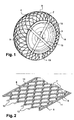
- the inner face of the wheel (1), the face at which the axle or the gimbal ends, and the outer face (3) of the wheel the one directly visible without any manipulation, and likely to receive, for example, a hubcap.
- the adhesion chain according to the invention basically comprises an adhesion band (5) intended to come into intimate contact with the tread (4) of the tire which is provided with the wheel which is to be fitted, in addition to flanks (2) of said tire.
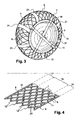
- this adhesion band (5) consists of a net made of textile material, and defining a number of stitches (6), said stitches being intended to form as many crampons, suitable for ensuring the adhesion sought on a slippery and relatively loose surface, and especially on snow.
- the meshs thus defined form projections, whose typical height relative to the tread (4) of the tire is of the order of 3 to 7 mm.
- This net is constituted by knitting cords (7), themselves obtained by knitting.
- the knitting operation of the cords (7) and the net (5) itself is performed simultaneously, for example on MULLER knitting machines, and more precisely on a square section knitting machine. double needle GWM or on a round single needle knitting machine RD3MT3.
- the cords (7) are made as already said by knitting, and each comprises several strands, and for example from 3 to 10, the desired diameter of the bead being obtained by knitting and clamping said strands together.
- the number of strands is also a function of the desired strength of said cords.
- the cords consist of two strands of three strands made of polyester, and advantageously of polyamide 66. This material has the advantage of combining a high mechanical strength, good properties of adhesion, especially on snow and especially a high resistance to abrasion.
- the polyamide used is stabilized beforehand, by heat treatment (typically at about 120 ° C.), inducing a pre-shrinkage.
- the knitting density of the net is such that, apart from any reinforcing core, it has a linear density of 12.3 g / m.
- This aramid has a tenacity of 200 cN / tex.
- This material could be substituted with the material sold under the trademark VECTRAN ®, or by a polyethylene sold under the trademark DYNEEMA ®, both materials having a respective tenacity of 230 cN / tex and 180 cN / tex.
- the respective webs of the cords never intersect or come into contact with each other. This eliminates shear phenomena, and therefore premature wear of these materials, in addition to overthickness at the junction areas of the cords, suitable for defining the meshes.
- the zones (17) and (18) of the net that is to say the areas other than that (19) intended to come into contact with the tread (4) of the tire, are free of the soul (12). In doing so, it gives more flexibility to the net, and corollary, its implementation on the wheel is facilitated. In addition, the self-centering of the net during its installation, in addition to the progression of the vehicle is also improved.
- the polyamide cords thus provide a protection of the reinforcing core against the phenomena of abrasion and mechanical injuries, which is particularly interesting, especially during emergency braking, where said abrasion phenomena are intense.
- the reinforcing core for example made of aramid, gives the structure greater resistance to fracture.
- the original combination of the two, according to the invention, provides a flexible chain, light, which nevertheless fulfills its primary function of adhesion, especially in the snow.
- meshes (6) whose dimensions are substantially standardized (typically 40 x 40 mm), which when the net in question is stretched on the wheel of the motor vehicle, have a square shape or rhombus, as can be seen in the various figures.
- the net thus formed is defined by two lateral edges (8, 9), respectively internal (8) and external (9), intended to be folded on either side of the tread (4) of the wheel considered (1). As a corollary, these lateral edges are biased to ensure the positioning and maintenance of the textile chain thus produced at said wheel.
- closure or joining strip made of polyester or polyamide. This strap is fixed by welding, sewing etc.
- This strap can be double, one extending below the net, and the other above, these two straps then being sewn to one another, by seizing the two ends of the net by sewing. It can be simple, and come surround the net by extending above and below, the two strands thus defined being also sewn to one another, after imprisonment and sewing the two ends of the net.
- the meshes of the inner edge (8) of the net receive an elastic tensioning cable (not shown), the ends of which are secured at the level of the band or closure strap (13) during the introduction of the latter.
- This elastic tensioning cable is capable of having an elongation capacity close to 120%, capable of allowing the effective positioning of the chain notwithstanding the closure of the adhesion band (the thread (5)) constituting it, c that is to say the covering of the tread (4) of the wheel in question, besides the correct positioning of the chain and its tension sufficient to enable it to fulfill its function.
- This elastic tensioning cable is for example made of a rubber core coated with a polyester sheath.
- the outer edge (9) of the net (5) intended to be folded on the outer face (2) of the wheel is provided with a cable or rigid cord (14), so inelastic, intended to block the net once in place on the wheel.
- This rigid cable is for example made of a polyester core, coated with a sheath, also made of polyester.
- this cable Because of its blocking function, this cable is given an elongation capacity close to zero.
- the chain is provided with several crossed straps (15, 16), the number of which (between 2 and 4) depends on the dimensions of the wheel, and the ends of which are secured to the wheel. level of the outer edge (9) of said net.
- these straps are secured to each other substantially in their middle, that is to say at the crossing point. These crossed straps therefore extend above the outer face (3) of the wheel.
- the intersecting zones are provided with cords (7) defining the stitches (6) of staples or clips (20).
- These clips or clips (20) are set up only at the area (19) of the net, that is to say the area intended to come into contact with the tread of the tire.
- the mixed junction areas ie located at the level of the dividing line between the zone (19) and the adjacent zones (17) and (18) are devoid of such clips, it is perfectly conceivable that they have them.
- These clips or clips (20) first optimize the junction of the cords (7) defining the mesh, relieving the force exerted on the polyamide that constitutes them. In addition, being intended to come into contact with the road because of the protrusions they define relative to the general envelope of the chain, they promote adhesion, particularly on ice or ice.
- These strips are fixed by any means, and especially by sewing, and are coated on their outer surface, that is to say on the surface intended to come into contact with the roadway, protrusions of any type, clean again, to optimize the adhesion of the wheel considered on a frozen surface.
- the strings (7) constituting the net are coated with elastomer, and more particularly with polyurethane, so as to give them greater resistance to unraveling, in addition to greater resistance to abrasion. 'abrasion.
- This coating operation for example carried out by roller or spray, subsequent to the establishment of staples or clips, when the net is provided.
- this coating is carried out using a polyurethane of very low viscosity, typically less than 20 centipoise, allowing a very good impregnation of the constituent elements of the net.
- the polyurethane is chosen so as to polymerize at room temperature or almost at ambient temperature.
- the elastomer, and in particular the polyurethane is impregnated only at the outer face of the net, that is to say, the face intended to come into contact with the roadway. Indeed, the absence of this material at the inner face of the net promotes the self-centering of the latter.
Landscapes
- Engineering & Computer Science (AREA)
- Textile Engineering (AREA)
- Mechanical Engineering (AREA)
- Ropes Or Cables (AREA)
- Knitting Of Fabric (AREA)
- Tires In General (AREA)
Claims (18)
- Schneekette für Fahrzeugreifen (1), die eine Haftfläche (5) aufweist, die dazu bestimmt ist, in Kontakt mit mindestens der Lauffläche (4) des betreffenden Rades zu kommen, und durch jeweils ein äußeres (14) und ein inneres Spannseil in Position gehalten wird, wobei die Haftfläche aus einem Netz, das aus textilem Material hergestellt ist, gebildet ist, dadurch gekennzeichnet, dass das Netz (5) aus Schnüren (7) gebildet ist, die durch Stricken hergestellt sind, wobei die Schnüre ebenfalls durch Stricken derart miteinander verbunden sind, um die Maschen (6) des Netzes zu definieren, und dass die Schnüre (7) einen Verstärkungskern (12) integrieren, der aus einem Material mit hohem Modul hergestellt ist.
- Schneekette für Fahrzeugreifen (1) nach Anspruch 1, dadurch gekennzeichnet, dass das Material mit hohem Modul, das den Verstärkungskern (12) bildet, eine Zähigkeit oder Zerreißfestigkeit von mehr als 150 cN/tex und/oder ein Anfangsmodul von mehr als 1.000 cN/tex aufweist.
- Schneekette für Fahrzeugreifen (1) nach einem der Ansprüche 1 und 2, dadurch gekennzeichnet, dass das Material mit hohem Modul, das den Verstärkungskern (12) bildet, aus Aramid gebildet ist.
- Schneekette für Fahrzeugreifen (1) nach einem der Ansprüche 1 bis 3, dadurch gekennzeichnet, dass die Verbindungsbereiche der Schnüre (7), die die Maschen des Netzes (5) bilden, durch Stricken erhalten werden und nur die Bestandteile des Strickgewebes unter Ausschluss des Verstärkungskerns verwenden.
- Schneekette für Fahrzeugreifen (1) nach einem der Ansprüche 1 bis 4, dadurch gekennzeichnet, dass der Verstärkungskern (12) nur im Wesentlichen an dem Bereich (19) des Netzes (5) vorhanden ist, der dazu bestimmt ist, in Kontakt mit der Lauffläche (4) des betreffenden Reifens zu kommen.
- Schneekette für Fahrzeugreifen (1) nach einem der Ansprüche 1 bis 5, dadurch gekennzeichnet, dass die Schnüre (7), die die Maschen des Netzes (5) bilden, durch Stricken von mehreren Strängen derart hergestellt sind, dass ihre äußere Umhüllung eine durchschnittliche Dicke aufweist, die typischerweise zwischen 3 und 7 mm beträgt.
- Schneekette für Fahrzeugreifen (1) nach einem der Ansprüche 1 bis 6, dadurch gekennzeichnet, dass die Schnüre (7), die das Netz (5) bilden, aus Polyester, aus Polyamid 6 oder aus Polyamid 66 hergestellt sind.
- Schneekette für Fahrzeugreifen (1) nach einem der Ansprüche 1 bis 7, dadurch gekennzeichnet:• dass das Netz (5), das die Haftfläche bildet, durch einen Verschlussgurt (13) verschlossen ist,• dass der Innenrand (8) des Netzes (5), der dazu bestimmt ist, auf die Innenseite des Rades umgeklappt zu werden, mit einem elastischen Spannseil ausgestattet ist,• und dass der Außenrand (9) des Netzes (5), der dazu bestimmt ist, auf die Außenseite des Rades umgeklappt zu werden, mit einem Kabel oder einer starren Schnur (14) ausgestattet ist, die dazu bestimmt ist, das Netz zu blockieren, sobald es auf dem Rad in Position ist.
- Schneekette für Fahrzeugreifen (1) nach Anspruch 8, dadurch gekennzeichnet, dass das elastische Spannseil eine Fähigkeit zur Verlängerung von rund 120 % aufweist.
- Schneekette für Fahrzeugreifen (1) nach einem der Ansprüche 8 und 9, dadurch gekennzeichnet, dass das elastische Spannseil eine Reißfestigkeit von mehr als 55 daN aufweist.
- Schneekette für Fahrzeugreifen (1) nach einem der Ansprüche 8 bis 10, dadurch gekennzeichnet, dass für die Zwecke des Optimierens des Blockierens des Netzes (5) auf dem Rad die Kette mit mehreren gekreuzte Gurten (15, 16) ausgestattet wird, deren Enden an dem Außenrand (9) des Netzes fest verbunden sind, und die sich über der Außenseite (3) des Rades erstrecken.
- Schneekette für Fahrzeugreifen (1) nach Anspruch 11, dadurch gekennzeichnet, dass die Gurte (15, 16) an ihrer Kreuzungsstelle miteinander fest verbunden sind.
- Schneekette für Fahrzeugreifen (1) nach einem der Ansprüche 1 bis 12, dadurch gekennzeichnet, dass das Netz (5) an den verschiedenen Kreuzungen der Schnüre (7), die es definieren, die auf der Haftfläche angeordnet sind und folglich dazu bestimmt sind, mit der Fahrbahn in Kontakt zu kommen, Klammern oder Clips (20) aufweist, die dazu bestimmt sind, die Verbindung der Schnüre auf dieser Ebene zu optimieren.
- Schneekette für Fahrzeugreifen (1) nach Anspruch 13, dadurch gekennzeichnet, dass die Klammern oder Clips (20) aus Metall sind oder aus Kunststoff oder Thermoplast hergestellt sind.
- Schneekette für Fahrzeugreifen (1) nach Anspruch 13, dadurch gekennzeichnet, dass die Klammern oder Clips (20) zusammengesetzt sind, insbesondere mit einem metallischen Einsatz, der teilweise mit einem Thermoplast bedeckt ist, wobei der nicht bedeckte Bereich in Richtung der Außenseite des Netzes gerichtet ist und dazu bestimmt ist, mit der Fahrbahn in Kontakt zu kommen, während der Rest mit Thermoplast bedeckt ist.
- Schneekette für Fahrzeugreifen (1) nach einem der Ansprüche 1 bis 15, dadurch gekennzeichnet, dass die Schnüre (7), die das Netz (5) bilden, mit einem Elastomer und insbesondere mit Polyurethan beschichtet sind.
- Schneekette für Fahrzeugreifen (1) nach Anspruch 16, dadurch gekennzeichnet, dass das Elastomer nur an der Außenseite des Netzes, das heißt der Fläche, die dazu bestimmt ist, in Kontakt mit der Fahrbahn zu kommen, imprägniert ist.
- Schneekette für Fahrzeugreifen (1) nach einem der Ansprüche 1 bis 17, dadurch gekennzeichnet, dass mehrere Streifen (21), die sich quer zu der bevorzugten Bewegungsrichtung des Rades erstrecken, auf dem die Kette bestimmt ist, befestigt zu werden, auf der Außenseite der Haftfläche der Kette aufgebracht sind, die folglich dazu bestimmt sind, in Kontakt mit der Fahrbahn zu kommen, wobei die Streifen auf ihrer Außenfläche mit Unebenheiten oder mit Vorsprüngen ausgestattet sind, die geeignet sind, die Haftung des Rades auf Eis oder Glatteis zu begünstigen.
Applications Claiming Priority (2)
| Application Number | Priority Date | Filing Date | Title |
|---|---|---|---|
| FR0653832A FR2905895B1 (fr) | 2006-09-20 | 2006-09-20 | Chaine d'adherence pour roue de vehicule automobile |
| PCT/FR2007/051946 WO2008035000A2 (fr) | 2006-09-20 | 2007-09-17 | Chaine d'adherence pour roue de vehicule automobile |
Publications (2)
| Publication Number | Publication Date |
|---|---|
| EP2064077A2 EP2064077A2 (de) | 2009-06-03 |
| EP2064077B1 true EP2064077B1 (de) | 2016-03-30 |
Family
ID=37943965
Family Applications (1)
| Application Number | Title | Priority Date | Filing Date |
|---|---|---|---|
| EP07823841.7A Active EP2064077B1 (de) | 2006-09-20 | 2007-09-17 | Textile schneekette für fahrzeugreifen |
Country Status (10)
| Country | Link |
|---|---|
| US (1) | US7931060B2 (de) |
| EP (1) | EP2064077B1 (de) |
| JP (1) | JP5721325B2 (de) |
| CN (1) | CN101541569B (de) |
| CA (1) | CA2663699C (de) |
| ES (1) | ES2575992T3 (de) |
| FR (1) | FR2905895B1 (de) |
| PL (1) | PL2064077T3 (de) |
| RU (1) | RU2425761C2 (de) |
| WO (1) | WO2008035000A2 (de) |
Families Citing this family (15)
| Publication number | Priority date | Publication date | Assignee | Title |
|---|---|---|---|---|
| DE102007015764A1 (de) * | 2007-03-30 | 2008-10-02 | Rud Ketten Rieger & Dietz Gmbh U. Co. Kg | Leicht verstaubare Gleitschutzvorrichtung |
| ITBS20080119A1 (it) * | 2008-06-09 | 2009-12-10 | Agripool S R L | Copertura antiscivolo per pneumatici |
| FR2952279B1 (fr) * | 2009-11-06 | 2011-11-25 | Joubert Productions | Chausson antiderapant |
| DE102010032627A1 (de) | 2010-07-29 | 2012-02-02 | Rud Ketten Rieger & Dietz Gmbh U. Co. Kg | Textile Gleitschutzvorrichtung mit Traktionsfaden in Maschenbindung |
| US20120112430A1 (en) * | 2010-11-07 | 2012-05-10 | Justin Shaw | Bicycle tire traction device, system and method |
| CN102218979A (zh) * | 2011-05-15 | 2011-10-19 | 山东鲁普耐特新材料工程技术研究中心 | 一种轮胎防滑网 |
| CN102797109B (zh) * | 2011-05-23 | 2014-12-10 | 徐照仪 | 汽车纤维编织防滑网的编织方法 |
| CN102797108B (zh) * | 2011-05-23 | 2015-03-04 | 徐晔 | 汽车纤维编织防滑网 |
| FR2987313B1 (fr) * | 2012-02-23 | 2016-02-19 | Emmanuel Scarselli | Dispositif de tricot pour augmenter l'adherence entre une surface d'appui glissante et un mobile en contact avec celle-ci, et procede de realisation d'un tel dispositif |
| KR101221027B1 (ko) * | 2012-06-29 | 2013-01-10 | 백운산 | 타이어용 넌슬립 커버 |
| JP5658299B2 (ja) * | 2013-03-22 | 2015-01-21 | 東洋ゴム織布株式会社 | 車両用タイヤの滑り止め装置 |
| US9908376B2 (en) * | 2015-08-24 | 2018-03-06 | Alireza Sedighpour | Tire grip enhancing assembly |
| CN107467783A (zh) * | 2017-08-15 | 2017-12-15 | 江来法 | 一种防滑鞋底及其制备方法 |
| CN107650583A (zh) * | 2017-08-15 | 2018-02-02 | 江来法 | 一种轮胎表面辅助防滑装置及其制备方法 |
| CA3158233A1 (en) * | 2019-12-30 | 2021-07-08 | Philippe Souyri | Snow cover for tyres |
Family Cites Families (21)
| Publication number | Priority date | Publication date | Assignee | Title |
|---|---|---|---|---|
| US710562A (en) * | 1901-10-22 | 1902-10-07 | Pierre De Caters | Pneumatic tire for vehicle-wheels. |
| US1342753A (en) * | 1919-04-02 | 1920-06-08 | Robert T Ash | Non-skid device |
| GB162932A (en) * | 1920-05-21 | 1921-05-12 | William Connolly Mcgeorge | Improvements in non-skid devices for wheel tyres |
| US1700081A (en) * | 1927-09-23 | 1929-01-22 | Backstay Welt Company | Spare-tire cover |
| US1908808A (en) * | 1929-06-17 | 1933-05-16 | Vincent J Auciunas | Tire armor |
| US1934318A (en) * | 1932-04-18 | 1933-11-07 | Columbian Rope Co | Antiskid device |
| US2341316A (en) * | 1942-01-07 | 1944-02-08 | Lothar A Ederer | Antiskid net for vehicle tires and the like |
| US2392577A (en) * | 1942-10-23 | 1946-01-08 | Us Rubber Co | Tire tread cover |
| US2682907A (en) * | 1951-10-03 | 1954-07-06 | Max E Krueger | Traction increasing means for tires |
| DE1605718A1 (de) * | 1967-07-31 | 1970-03-26 | Haeschlatex Kg | Reifengleitschutz fuer luftbereifte,motoren- oder muskelkraftbetriebene Raeder |
| DE1912788A1 (de) * | 1969-03-13 | 1970-09-24 | Werner Gerbecks | Rutschsicherheitsnetze mit Spikes an Stelle von Schneeketten |
| AT338122B (de) * | 1973-11-06 | 1977-07-25 | Muller Peter | Netzstreifenartige rutschsicherung fur kraftfahrzeugreifen |
| CH574334A5 (de) * | 1974-02-27 | 1976-04-15 | Bula Karl | |
| DE2900792A1 (de) * | 1979-01-10 | 1980-07-24 | Michio Hayashi | Schlupfverhinderungsvorrichtung fuer fahrzeugreifen |
| JP2545689Y2 (ja) * | 1987-12-24 | 1997-08-25 | 株式会社ブリヂストン | タイヤの滑り止め具用紐 |
| US5009256A (en) * | 1988-12-21 | 1991-04-23 | Manufacturer's Consultants, Inc. | Cord-type tire traction device |
| JPH02216306A (ja) * | 1989-02-15 | 1990-08-29 | Sumitomo Rubber Ind Ltd | 非金属滑止用治具 |
| JPH0483805U (de) * | 1990-11-29 | 1992-07-21 | ||
| NO309184B1 (no) * | 1999-04-06 | 2000-12-27 | Dekk Sokk As | Anordning for anbringelse på et kjöretöyhjul og fremgangsmåte for anbringelse av anordningen |
| US6860304B1 (en) * | 2002-11-19 | 2005-03-01 | Basil Ethan Dalrymple | Two sided traction belt for tires |
| ITBS20050114A1 (it) * | 2005-10-06 | 2007-04-07 | Agripol S R L | Dispositivo antislittamento per veicoli |
-
2006
- 2006-09-20 FR FR0653832A patent/FR2905895B1/fr not_active Expired - Fee Related
-
2007
- 2007-09-17 CA CA2663699A patent/CA2663699C/fr active Active
- 2007-09-17 EP EP07823841.7A patent/EP2064077B1/de active Active
- 2007-09-17 WO PCT/FR2007/051946 patent/WO2008035000A2/fr not_active Ceased
- 2007-09-17 CN CN2007800348183A patent/CN101541569B/zh active Active
- 2007-09-17 US US12/442,022 patent/US7931060B2/en active Active
- 2007-09-17 PL PL07823841.7T patent/PL2064077T3/pl unknown
- 2007-09-17 ES ES07823841.7T patent/ES2575992T3/es active Active
- 2007-09-17 RU RU2009114703/11A patent/RU2425761C2/ru active
- 2007-09-17 JP JP2009528765A patent/JP5721325B2/ja not_active Expired - Fee Related
Also Published As
| Publication number | Publication date |
|---|---|
| CA2663699C (fr) | 2015-02-17 |
| PL2064077T3 (pl) | 2016-12-30 |
| CA2663699A1 (fr) | 2008-03-27 |
| JP5721325B2 (ja) | 2015-05-20 |
| US7931060B2 (en) | 2011-04-26 |
| WO2008035000A2 (fr) | 2008-03-27 |
| RU2009114703A (ru) | 2010-10-27 |
| WO2008035000A3 (fr) | 2008-05-08 |
| CN101541569B (zh) | 2011-01-19 |
| EP2064077A2 (de) | 2009-06-03 |
| FR2905895B1 (fr) | 2011-03-11 |
| JP2010504243A (ja) | 2010-02-12 |
| US20100018620A1 (en) | 2010-01-28 |
| CN101541569A (zh) | 2009-09-23 |
| FR2905895A1 (fr) | 2008-03-21 |
| ES2575992T3 (es) | 2016-07-04 |
| RU2425761C2 (ru) | 2011-08-10 |
Similar Documents
| Publication | Publication Date | Title |
|---|---|---|
| CA2663699C (fr) | Chaine d'adherence pour roue de vehicule automobile | |
| CH591965A5 (de) | ||
| FR2625783A1 (fr) | Organe de transmission pour variateur continu de vitesse, a maillons transversaux poussants et ame souple, fonctionnant par frottement sec | |
| WO2018130785A1 (fr) | Assemblage pour pneumatique comprenant une structure rompable et une structure porteuse | |
| FR3061673A1 (fr) | Assemblage comprenant une structure elastique et une structure porteuse | |
| EP2026984B1 (de) | Reifen mit anker mit einem bielastischen verstärkungselement | |
| FR2995251A1 (fr) | Pneumatique comportant une armature de flanc supplementaire. | |
| FR2995252A1 (fr) | Pneumatique comportant une armature de flanc supplementaire. | |
| FR2979639A1 (fr) | Cable de renfort pour produits en elastomere, en particulier pour couche de carcasse ou couche de bandage de ceinture de bandages pneumatiques pour roue de vehicule. | |
| EP0721854A1 (de) | Notlaufvorrichtung für Auto und Verfahren zu ihrer Herstellung | |
| EP2121353B1 (de) | Zusätzliche seitenwandverstärkung für einen reifen für ein schwer-nutzfahrzeug | |
| EP3074247B1 (de) | Reifen mit einem defektmaskierenden muster auf einer seitenwand | |
| EP1957295B1 (de) | Textile gleitschutzkette für fahrzeugreifen | |
| EP2026985B1 (de) | Reifen mit unterem bereich mit einem bielastischen verstärkungselement | |
| FR2984223A1 (fr) | Pneumatique comportant des cables d'armature de carcasse presentant une faible permeabilite, et des fils textiles associes a l'armature de carcasse | |
| FR2930910A1 (fr) | Pneumatique renforce pour vehicule lourd | |
| FR3140637A1 (fr) | Textile et dispositif permettant d’augmenter l’adhérence d’un pneumatique sur sol glissant | |
| FR3128665A1 (fr) | Câble et bandage pneumatique comprenant une structure de câble spécifique | |
| FR2884762A1 (fr) | Pneumatiques de bicyclette | |
| EP3074245B1 (de) | Reifen mit einem defektmaskierenden muster auf einer seitenwand | |
| EP1101633B1 (de) | Lufftreifen mit entkoppelter niedriger Zone | |
| FR2912958A1 (fr) | Housse antiderapante pour pneumatique | |
| FR2928104A1 (fr) | Pneumatique pourvu d'une armature supplementaire ameliorant son endurance. | |
| EP1515860B1 (de) | Reifen mit einer in einer karkasslage überlappenden gürtellage | |
| FR2912959A1 (fr) | Housse antiderapante pour pneumatique |
Legal Events
| Date | Code | Title | Description |
|---|---|---|---|
| PUAI | Public reference made under article 153(3) epc to a published international application that has entered the european phase |
Free format text: ORIGINAL CODE: 0009012 |
|
| 17P | Request for examination filed |
Effective date: 20090324 |
|
| AK | Designated contracting states |
Kind code of ref document: A2 Designated state(s): AT BE BG CH CY CZ DE DK EE ES FI FR GB GR HU IE IS IT LI LT LU LV MC MT NL PL PT RO SE SI SK TR |
|
| AX | Request for extension of the european patent |
Extension state: AL BA HR MK RS |
|
| DAX | Request for extension of the european patent (deleted) | ||
| R17D | Deferred search report published (corrected) |
Effective date: 20080508 |
|
| RAP1 | Party data changed (applicant data changed or rights of an application transferred) |
Owner name: COMPAGNIE GENERALE DES ETABLISSEMENTS MICHELIN Owner name: MICHELIN RECHERCHE ET TECHNIQUE S.A. Owner name: JOUBERT PRODUCTIONS |
|
| RIC1 | Information provided on ipc code assigned before grant |
Ipc: B60C 27/18 20060101AFI20150813BHEP Ipc: D04B 21/12 20060101ALI20150813BHEP |
|
| GRAP | Despatch of communication of intention to grant a patent |
Free format text: ORIGINAL CODE: EPIDOSNIGR1 |
|
| INTG | Intention to grant announced |
Effective date: 20151007 |
|
| GRAS | Grant fee paid |
Free format text: ORIGINAL CODE: EPIDOSNIGR3 |
|
| GRAA | (expected) grant |
Free format text: ORIGINAL CODE: 0009210 |
|
| AK | Designated contracting states |
Kind code of ref document: B1 Designated state(s): AT BE BG CH CY CZ DE DK EE ES FI FR GB GR HU IE IS IT LI LT LU LV MC MT NL PL PT RO SE SI SK TR |
|
| REG | Reference to a national code |
Ref country code: GB Ref legal event code: FG4D Free format text: NOT ENGLISH |
|
| REG | Reference to a national code |
Ref country code: CH Ref legal event code: EP |
|
| REG | Reference to a national code |
Ref country code: AT Ref legal event code: REF Ref document number: 784943 Country of ref document: AT Kind code of ref document: T Effective date: 20160415 |
|
| REG | Reference to a national code |
Ref country code: IE Ref legal event code: FG4D Free format text: LANGUAGE OF EP DOCUMENT: FRENCH |
|
| REG | Reference to a national code |
Ref country code: DE Ref legal event code: R096 Ref document number: 602007045568 Country of ref document: DE |
|
| REG | Reference to a national code |
Ref country code: ES Ref legal event code: FG2A Ref document number: 2575992 Country of ref document: ES Kind code of ref document: T3 Effective date: 20160704 |
|
| REG | Reference to a national code |
Ref country code: LT Ref legal event code: MG4D |
|
| PG25 | Lapsed in a contracting state [announced via postgrant information from national office to epo] |
Ref country code: GR Free format text: LAPSE BECAUSE OF FAILURE TO SUBMIT A TRANSLATION OF THE DESCRIPTION OR TO PAY THE FEE WITHIN THE PRESCRIBED TIME-LIMIT Effective date: 20160701 Ref country code: FI Free format text: LAPSE BECAUSE OF FAILURE TO SUBMIT A TRANSLATION OF THE DESCRIPTION OR TO PAY THE FEE WITHIN THE PRESCRIBED TIME-LIMIT Effective date: 20160330 |
|
| REG | Reference to a national code |
Ref country code: NL Ref legal event code: MP Effective date: 20160330 |
|
| REG | Reference to a national code |
Ref country code: AT Ref legal event code: MK05 Ref document number: 784943 Country of ref document: AT Kind code of ref document: T Effective date: 20160330 |
|
| PG25 | Lapsed in a contracting state [announced via postgrant information from national office to epo] |
Ref country code: LT Free format text: LAPSE BECAUSE OF FAILURE TO SUBMIT A TRANSLATION OF THE DESCRIPTION OR TO PAY THE FEE WITHIN THE PRESCRIBED TIME-LIMIT Effective date: 20160330 Ref country code: SE Free format text: LAPSE BECAUSE OF FAILURE TO SUBMIT A TRANSLATION OF THE DESCRIPTION OR TO PAY THE FEE WITHIN THE PRESCRIBED TIME-LIMIT Effective date: 20160330 Ref country code: LV Free format text: LAPSE BECAUSE OF FAILURE TO SUBMIT A TRANSLATION OF THE DESCRIPTION OR TO PAY THE FEE WITHIN THE PRESCRIBED TIME-LIMIT Effective date: 20160330 |
|
| REG | Reference to a national code |
Ref country code: FR Ref legal event code: PLFP Year of fee payment: 10 |
|
| PG25 | Lapsed in a contracting state [announced via postgrant information from national office to epo] |
Ref country code: NL Free format text: LAPSE BECAUSE OF FAILURE TO SUBMIT A TRANSLATION OF THE DESCRIPTION OR TO PAY THE FEE WITHIN THE PRESCRIBED TIME-LIMIT Effective date: 20160330 |
|
| PG25 | Lapsed in a contracting state [announced via postgrant information from national office to epo] |
Ref country code: IS Free format text: LAPSE BECAUSE OF FAILURE TO SUBMIT A TRANSLATION OF THE DESCRIPTION OR TO PAY THE FEE WITHIN THE PRESCRIBED TIME-LIMIT Effective date: 20160730 Ref country code: EE Free format text: LAPSE BECAUSE OF FAILURE TO SUBMIT A TRANSLATION OF THE DESCRIPTION OR TO PAY THE FEE WITHIN THE PRESCRIBED TIME-LIMIT Effective date: 20160330 |
|
| PG25 | Lapsed in a contracting state [announced via postgrant information from national office to epo] |
Ref country code: SK Free format text: LAPSE BECAUSE OF FAILURE TO SUBMIT A TRANSLATION OF THE DESCRIPTION OR TO PAY THE FEE WITHIN THE PRESCRIBED TIME-LIMIT Effective date: 20160330 Ref country code: RO Free format text: LAPSE BECAUSE OF FAILURE TO SUBMIT A TRANSLATION OF THE DESCRIPTION OR TO PAY THE FEE WITHIN THE PRESCRIBED TIME-LIMIT Effective date: 20160330 Ref country code: AT Free format text: LAPSE BECAUSE OF FAILURE TO SUBMIT A TRANSLATION OF THE DESCRIPTION OR TO PAY THE FEE WITHIN THE PRESCRIBED TIME-LIMIT Effective date: 20160330 Ref country code: PT Free format text: LAPSE BECAUSE OF FAILURE TO SUBMIT A TRANSLATION OF THE DESCRIPTION OR TO PAY THE FEE WITHIN THE PRESCRIBED TIME-LIMIT Effective date: 20160801 Ref country code: CZ Free format text: LAPSE BECAUSE OF FAILURE TO SUBMIT A TRANSLATION OF THE DESCRIPTION OR TO PAY THE FEE WITHIN THE PRESCRIBED TIME-LIMIT Effective date: 20160330 |
|
| REG | Reference to a national code |
Ref country code: DE Ref legal event code: R097 Ref document number: 602007045568 Country of ref document: DE |
|
| PG25 | Lapsed in a contracting state [announced via postgrant information from national office to epo] |
Ref country code: DK Free format text: LAPSE BECAUSE OF FAILURE TO SUBMIT A TRANSLATION OF THE DESCRIPTION OR TO PAY THE FEE WITHIN THE PRESCRIBED TIME-LIMIT Effective date: 20160330 |
|
| PLBE | No opposition filed within time limit |
Free format text: ORIGINAL CODE: 0009261 |
|
| STAA | Information on the status of an ep patent application or granted ep patent |
Free format text: STATUS: NO OPPOSITION FILED WITHIN TIME LIMIT |
|
| PG25 | Lapsed in a contracting state [announced via postgrant information from national office to epo] |
Ref country code: BE Free format text: LAPSE BECAUSE OF NON-PAYMENT OF DUE FEES Effective date: 20160930 |
|
| 26N | No opposition filed |
Effective date: 20170103 |
|
| PG25 | Lapsed in a contracting state [announced via postgrant information from national office to epo] |
Ref country code: MC Free format text: LAPSE BECAUSE OF FAILURE TO SUBMIT A TRANSLATION OF THE DESCRIPTION OR TO PAY THE FEE WITHIN THE PRESCRIBED TIME-LIMIT Effective date: 20160330 |
|
| PG25 | Lapsed in a contracting state [announced via postgrant information from national office to epo] |
Ref country code: SI Free format text: LAPSE BECAUSE OF FAILURE TO SUBMIT A TRANSLATION OF THE DESCRIPTION OR TO PAY THE FEE WITHIN THE PRESCRIBED TIME-LIMIT Effective date: 20160330 |
|
| REG | Reference to a national code |
Ref country code: IE Ref legal event code: MM4A |
|
| PG25 | Lapsed in a contracting state [announced via postgrant information from national office to epo] |
Ref country code: IE Free format text: LAPSE BECAUSE OF NON-PAYMENT OF DUE FEES Effective date: 20160917 |
|
| PG25 | Lapsed in a contracting state [announced via postgrant information from national office to epo] |
Ref country code: LU Free format text: LAPSE BECAUSE OF NON-PAYMENT OF DUE FEES Effective date: 20160917 |
|
| REG | Reference to a national code |
Ref country code: FR Ref legal event code: PLFP Year of fee payment: 11 |
|
| REG | Reference to a national code |
Ref country code: BE Ref legal event code: MM Effective date: 20160930 |
|
| PG25 | Lapsed in a contracting state [announced via postgrant information from national office to epo] |
Ref country code: CY Free format text: LAPSE BECAUSE OF FAILURE TO SUBMIT A TRANSLATION OF THE DESCRIPTION OR TO PAY THE FEE WITHIN THE PRESCRIBED TIME-LIMIT Effective date: 20160330 Ref country code: HU Free format text: LAPSE BECAUSE OF FAILURE TO SUBMIT A TRANSLATION OF THE DESCRIPTION OR TO PAY THE FEE WITHIN THE PRESCRIBED TIME-LIMIT; INVALID AB INITIO Effective date: 20070917 |
|
| PG25 | Lapsed in a contracting state [announced via postgrant information from national office to epo] |
Ref country code: TR Free format text: LAPSE BECAUSE OF FAILURE TO SUBMIT A TRANSLATION OF THE DESCRIPTION OR TO PAY THE FEE WITHIN THE PRESCRIBED TIME-LIMIT Effective date: 20160330 Ref country code: MT Free format text: LAPSE BECAUSE OF FAILURE TO SUBMIT A TRANSLATION OF THE DESCRIPTION OR TO PAY THE FEE WITHIN THE PRESCRIBED TIME-LIMIT Effective date: 20160330 |
|
| PG25 | Lapsed in a contracting state [announced via postgrant information from national office to epo] |
Ref country code: BG Free format text: LAPSE BECAUSE OF FAILURE TO SUBMIT A TRANSLATION OF THE DESCRIPTION OR TO PAY THE FEE WITHIN THE PRESCRIBED TIME-LIMIT Effective date: 20160330 |
|
| REG | Reference to a national code |
Ref country code: FR Ref legal event code: PLFP Year of fee payment: 12 |
|
| REG | Reference to a national code |
Ref country code: CH Ref legal event code: U11 Free format text: ST27 STATUS EVENT CODE: U-0-0-U10-U11 (AS PROVIDED BY THE NATIONAL OFFICE) Effective date: 20251001 |
|
| PGFP | Annual fee paid to national office [announced via postgrant information from national office to epo] |
Ref country code: DE Payment date: 20250919 Year of fee payment: 19 |
|
| PGFP | Annual fee paid to national office [announced via postgrant information from national office to epo] |
Ref country code: IT Payment date: 20250923 Year of fee payment: 19 |
|
| PGFP | Annual fee paid to national office [announced via postgrant information from national office to epo] |
Ref country code: GB Payment date: 20250918 Year of fee payment: 19 |
|
| PGFP | Annual fee paid to national office [announced via postgrant information from national office to epo] |
Ref country code: FR Payment date: 20250919 Year of fee payment: 19 |
|
| PGFP | Annual fee paid to national office [announced via postgrant information from national office to epo] |
Ref country code: CH Payment date: 20251001 Year of fee payment: 19 |
|
| PGFP | Annual fee paid to national office [announced via postgrant information from national office to epo] |
Ref country code: ES Payment date: 20251028 Year of fee payment: 19 |
|
| PGFP | Annual fee paid to national office [announced via postgrant information from national office to epo] |
Ref country code: PL Payment date: 20250905 Year of fee payment: 19 |