EP2064180B1 - Dérivés indoliques condensés en positions 4 et 5 utilisés pour le traitement ou la prévention des infections par le vhc et autre infections virales associées - Google Patents
Dérivés indoliques condensés en positions 4 et 5 utilisés pour le traitement ou la prévention des infections par le vhc et autre infections virales associées Download PDFInfo
- Publication number
- EP2064180B1 EP2064180B1 EP07862998.7A EP07862998A EP2064180B1 EP 2064180 B1 EP2064180 B1 EP 2064180B1 EP 07862998 A EP07862998 A EP 07862998A EP 2064180 B1 EP2064180 B1 EP 2064180B1
- Authority
- EP
- European Patent Office
- Prior art keywords
- alkyl
- compound
- nhso
- heteroaryl
- aryl
- Prior art date
- Legal status (The legal status is an assumption and is not a legal conclusion. Google has not performed a legal analysis and makes no representation as to the accuracy of the status listed.)
- Active
Links
- 0 C**[n](c(*)c1*)c2c1c(CCC1)c1c(*)c2* Chemical compound C**[n](c(*)c1*)c2c1c(CCC1)c1c(*)c2* 0.000 description 20
- WUFPROBRQGEMAH-UHFFFAOYSA-N CC(C(C1)Cl)=CC(N2)=C1NC2=O Chemical compound CC(C(C1)Cl)=CC(N2)=C1NC2=O WUFPROBRQGEMAH-UHFFFAOYSA-N 0.000 description 1
- FTZFIWWLBDDFGF-UHFFFAOYSA-N CC(C(F)=CN1)=CC1=O Chemical compound CC(C(F)=CN1)=CC1=O FTZFIWWLBDDFGF-UHFFFAOYSA-N 0.000 description 1
- PCVBVLIVJXGCCF-UHFFFAOYSA-N CC(C)(C)OC(N(C(C)=Nc1c2cc(C[n](c3cc(F)c(cc[o]4)c4c33)c(C(O)=O)c3C3=CC=CNC3=O)c(F)c1)C2=O)=O Chemical compound CC(C)(C)OC(N(C(C)=Nc1c2cc(C[n](c3cc(F)c(cc[o]4)c4c33)c(C(O)=O)c3C3=CC=CNC3=O)c(F)c1)C2=O)=O PCVBVLIVJXGCCF-UHFFFAOYSA-N 0.000 description 1
- UBPJRFUDWVZKAK-UHFFFAOYSA-N CC(C)(C)OC([n](c1ccc(C[n](c2cc(F)c(cc[o]3)c3c22)c(C(O)=O)c2C2=CC=CNC2=O)cc11)nc1N)=O Chemical compound CC(C)(C)OC([n](c1ccc(C[n](c2cc(F)c(cc[o]3)c3c22)c(C(O)=O)c2C2=CC=CNC2=O)cc11)nc1N)=O UBPJRFUDWVZKAK-UHFFFAOYSA-N 0.000 description 1
- VKCJBODDKBUBPH-UHFFFAOYSA-O CC(C1)C(C)C2=C1[NH2+]CO2 Chemical compound CC(C1)C(C)C2=C1[NH2+]CO2 VKCJBODDKBUBPH-UHFFFAOYSA-O 0.000 description 1
- IOLHNVACAKEUQI-UHFFFAOYSA-N CC(C1=C)c2c1nc[s]2 Chemical compound CC(C1=C)c2c1nc[s]2 IOLHNVACAKEUQI-UHFFFAOYSA-N 0.000 description 1
- PXABQNIVCDHTGR-UHFFFAOYSA-N CC(C1C)C2=C1OCO2 Chemical compound CC(C1C)C2=C1OCO2 PXABQNIVCDHTGR-UHFFFAOYSA-N 0.000 description 1
- NLPOULPYPFWFTM-UHFFFAOYSA-N CC(c1c2nc[o]1)=CC2=C Chemical compound CC(c1c2nc[o]1)=CC2=C NLPOULPYPFWFTM-UHFFFAOYSA-N 0.000 description 1
- KASNFCSQBRYXRF-UHFFFAOYSA-N CC1=CC2OC2NC=C1C Chemical compound CC1=CC2OC2NC=C1C KASNFCSQBRYXRF-UHFFFAOYSA-N 0.000 description 1
- MVKDNXIKAWKCCS-UHFFFAOYSA-N CC1=CC=CNC1=O Chemical compound CC1=CC=CNC1=O MVKDNXIKAWKCCS-UHFFFAOYSA-N 0.000 description 1
- NHRJWFBOWUBAKE-UHFFFAOYSA-M CCC(C)N(N)S(NC(c([n](Cc(cc(cccc1)c1n1)c1Cl)c1cc(F)c(cc[o]2)c2c11)c1C1=CC=C[N-]C1=O)=O)(=O)=O Chemical compound CCC(C)N(N)S(NC(c([n](Cc(cc(cccc1)c1n1)c1Cl)c1cc(F)c(cc[o]2)c2c11)c1C1=CC=C[N-]C1=O)=O)(=O)=O NHRJWFBOWUBAKE-UHFFFAOYSA-M 0.000 description 1
- QBEQOHZOIWDPHK-UHFFFAOYSA-N CCOC(c([nH]c1c2c(OCC3(C)C)c3cc1)c2I)=O Chemical compound CCOC(c([nH]c1c2c(OCC3(C)C)c3cc1)c2I)=O QBEQOHZOIWDPHK-UHFFFAOYSA-N 0.000 description 1
- YZKQATXLBMTNPN-UHFFFAOYSA-N CCOC(c([n](Cc(cc(ccc(SC)c1)c1n1)c1Cl)c1cc(F)c(cc[o]2)c2c11)c1C1=CC=CNC1=O)=O Chemical compound CCOC(c([n](Cc(cc(ccc(SC)c1)c1n1)c1Cl)c1cc(F)c(cc[o]2)c2c11)c1C1=CC=CNC1=O)=O YZKQATXLBMTNPN-UHFFFAOYSA-N 0.000 description 1
- XOEZVUBSCYFRPM-UHFFFAOYSA-N CCOC(c1cc(c(OCC2(C)C)c2cc2)c2[nH]1)=O Chemical compound CCOC(c1cc(c(OCC2(C)C)c2cc2)c2[nH]1)=O XOEZVUBSCYFRPM-UHFFFAOYSA-N 0.000 description 1
- XBPVVDFHPRIPGA-UHFFFAOYSA-N CN(C=C(C(C[n](c1cc(F)c(cc[o]2)c2c11)c(C(O)=O)c1C1=CC=CNC1=O)=C1)F)C1=O Chemical compound CN(C=C(C(C[n](c1cc(F)c(cc[o]2)c2c11)c(C(O)=O)c1C1=CC=CNC1=O)=C1)F)C1=O XBPVVDFHPRIPGA-UHFFFAOYSA-N 0.000 description 1
- KZAWBSQOEQXEEU-UHFFFAOYSA-N CNc1n[o]c2c1C=C(C[n](c1cc(F)c(cc[o]3)c3c11)c(C(NS(C3CC3)(=O)=O)=O)c1C1=CC=CNC1=O)CC=C2 Chemical compound CNc1n[o]c2c1C=C(C[n](c1cc(F)c(cc[o]3)c3c11)c(C(NS(C3CC3)(=O)=O)=O)c1C1=CC=CNC1=O)CC=C2 KZAWBSQOEQXEEU-UHFFFAOYSA-N 0.000 description 1
- BAEHWCWAZCLGOJ-UHFFFAOYSA-N CS(NC(c([n](Cc(cc12)ccc1[o]nc2N)c1cc(F)c(cc[o]2)c2c11)c1C1=CC=CNC1=O)=O)(=O)=O Chemical compound CS(NC(c([n](Cc(cc12)ccc1[o]nc2N)c1cc(F)c(cc[o]2)c2c11)c1C1=CC=CNC1=O)=O)(=O)=O BAEHWCWAZCLGOJ-UHFFFAOYSA-N 0.000 description 1
- LSEBGSZHUPXUMX-UHFFFAOYSA-N CS(NC(c([n](Cc1c[s]c(C(N)=O)c1)c1cc(F)c(CCO2)c2c11)c1C1=CC=CNC1=O)=O)(=O)=O Chemical compound CS(NC(c([n](Cc1c[s]c(C(N)=O)c1)c1cc(F)c(CCO2)c2c11)c1C1=CC=CNC1=O)=O)(=O)=O LSEBGSZHUPXUMX-UHFFFAOYSA-N 0.000 description 1
- PTPPNEPSUMIPRW-UHFFFAOYSA-N CS(NC(c([n](Cc1c[s]c(C(N)=O)c1)c1cc(F)c(cc[o]2)c2c11)c1C1=CC=CNC1=O)=O)(=O)=O Chemical compound CS(NC(c([n](Cc1c[s]c(C(N)=O)c1)c1cc(F)c(cc[o]2)c2c11)c1C1=CC=CNC1=O)=O)(=O)=O PTPPNEPSUMIPRW-UHFFFAOYSA-N 0.000 description 1
- HOEZAERUCDJIPT-UHFFFAOYSA-N CS(NC(c([n](Cc1cc(Cl)nc2c1cccc2)c1cc(F)c(cc[o]2)c2c11)c1C1=CC=CNC1=O)=O)(=O)=O Chemical compound CS(NC(c([n](Cc1cc(Cl)nc2c1cccc2)c1cc(F)c(cc[o]2)c2c11)c1C1=CC=CNC1=O)=O)(=O)=O HOEZAERUCDJIPT-UHFFFAOYSA-N 0.000 description 1
- DKUMUNBRGQCVNJ-ACUKJOMKSA-N C[C@H](CC1C(O)=NCNC1(C)C1)C1F Chemical compound C[C@H](CC1C(O)=NCNC1(C)C1)C1F DKUMUNBRGQCVNJ-ACUKJOMKSA-N 0.000 description 1
- YAEPXRRKVAJHHQ-UHFFFAOYSA-N Cc(c(F)c1)cc(C#N)c1N Chemical compound Cc(c(F)c1)cc(C#N)c1N YAEPXRRKVAJHHQ-UHFFFAOYSA-N 0.000 description 1
- JCKAXUVEWBQECT-UHFFFAOYSA-N Cc(c(F)c1)cc(C(OC)=O)c1N Chemical compound Cc(c(F)c1)cc(C(OC)=O)c1N JCKAXUVEWBQECT-UHFFFAOYSA-N 0.000 description 1
- JFONHTQRVUGNKX-UHFFFAOYSA-N Cc(c(F)c1)cc2c1[nH]c[n]2 Chemical compound Cc(c(F)c1)cc2c1[nH]c[n]2 JFONHTQRVUGNKX-UHFFFAOYSA-N 0.000 description 1
- XLAFKBXUNAYWQC-UHFFFAOYSA-N Cc(c(F)c1)cc2c1[nH]nc2N Chemical compound Cc(c(F)c1)cc2c1[nH]nc2N XLAFKBXUNAYWQC-UHFFFAOYSA-N 0.000 description 1
- PVQJVCHWOMSOHM-UHFFFAOYSA-N Cc1c(C[n](c2c3c(OCC4)c4cc2)c(C(NS(C2CC2)(=O)=O)=O)c3C2=CC=CNC2=O)cc(cccc2)c2n1 Chemical compound Cc1c(C[n](c2c3c(OCC4)c4cc2)c(C(NS(C2CC2)(=O)=O)=O)c3C2=CC=CNC2=O)cc(cccc2)c2n1 PVQJVCHWOMSOHM-UHFFFAOYSA-N 0.000 description 1
- CYAXMDQOMJKUHW-UHFFFAOYSA-N Cc1c[o]c2c3c(C4=CC=CNC4=O)c(C(O)=O)[n](Cc4cc5ccccc5nc4C)c3cc(F)c12 Chemical compound Cc1c[o]c2c3c(C4=CC=CNC4=O)c(C(O)=O)[n](Cc4cc5ccccc5nc4C)c3cc(F)c12 CYAXMDQOMJKUHW-UHFFFAOYSA-N 0.000 description 1
- VCNGNQLPFHVODE-UHFFFAOYSA-N Cc1ccc(C(O)=O)[s]1 Chemical compound Cc1ccc(C(O)=O)[s]1 VCNGNQLPFHVODE-UHFFFAOYSA-N 0.000 description 1
- LEGPAEYWEVRJQH-UHFFFAOYSA-N Cc1ccc(C2(N)OC2)[s]1 Chemical compound Cc1ccc(C2(N)OC2)[s]1 LEGPAEYWEVRJQH-UHFFFAOYSA-N 0.000 description 1
- MHOXATRWOUPNTF-UHFFFAOYSA-N Cc1ccc(cc(C[n](c2cc(F)c(CCO3)c3c22)c(C(O)=O)c2C2=CC=CNC2=O)c(Cl)n2)c2c1 Chemical compound Cc1ccc(cc(C[n](c2cc(F)c(CCO3)c3c22)c(C(O)=O)c2C2=CC=CNC2=O)c(Cl)n2)c2c1 MHOXATRWOUPNTF-UHFFFAOYSA-N 0.000 description 1
- LVFCJPSQANXHIP-UHFFFAOYSA-N Cc1n[n](C)c2c1cc(C)cc2 Chemical compound Cc1n[n](C)c2c1cc(C)cc2 LVFCJPSQANXHIP-UHFFFAOYSA-N 0.000 description 1
- PXZOQVCPZALYQX-UHFFFAOYSA-N NC(c1cc(C[n](c2c3c([o]cc4)c4c(F)c2)c(C(NS(C2CC2)(=O)=O)=O)c3C2=CC=CNC2=O)c[s]1)=O Chemical compound NC(c1cc(C[n](c2c3c([o]cc4)c4c(F)c2)c(C(NS(C2CC2)(=O)=O)=O)c3C2=CC=CNC2=O)c[s]1)=O PXZOQVCPZALYQX-UHFFFAOYSA-N 0.000 description 1
- SSWFSYNZHLPVHK-UHFFFAOYSA-N NC(c1cc(C[n](c2cc(F)c(cc[o]3)c3c22)c(C(O)=O)c2C2=CC=CNC2=O)c[s]1)=O Chemical compound NC(c1cc(C[n](c2cc(F)c(cc[o]3)c3c22)c(C(O)=O)c2C2=CC=CNC2=O)c[s]1)=O SSWFSYNZHLPVHK-UHFFFAOYSA-N 0.000 description 1
- LGCSJAADHTXOBB-UHFFFAOYSA-N Nc1c[nH]c2c1cc(C[n](c1ccc(CCO3)c3c11)c(C(O)=O)c1C1=CC=CNC1=O)c(F)c2 Chemical compound Nc1c[nH]c2c1cc(C[n](c1ccc(CCO3)c3c11)c(C(O)=O)c1C1=CC=CNC1=O)c(F)c2 LGCSJAADHTXOBB-UHFFFAOYSA-N 0.000 description 1
- MLZPSFQKSVUICX-UHFFFAOYSA-N Nc1ccccc1S(NC(c([n](Cc(cc(cccc1)c1n1)c1Cl)c1cc(F)c(cc[o]2)c2c11)c1C1=CC=CNC1=O)=O)(=O)=O Chemical compound Nc1ccccc1S(NC(c([n](Cc(cc(cccc1)c1n1)c1Cl)c1cc(F)c(cc[o]2)c2c11)c1C1=CC=CNC1=O)=O)(=O)=O MLZPSFQKSVUICX-UHFFFAOYSA-N 0.000 description 1
- NYNVOQUYRUJBTN-UHFFFAOYSA-N O=C(c([n](CC(C(F)=CN1)=CC1=O)c1cc(F)c(cc[o]2)c2c11)c1C1=CC=CNC1=O)NS(C1CC1)(=O)=O Chemical compound O=C(c([n](CC(C(F)=CN1)=CC1=O)c1cc(F)c(cc[o]2)c2c11)c1C1=CC=CNC1=O)NS(C1CC1)(=O)=O NYNVOQUYRUJBTN-UHFFFAOYSA-N 0.000 description 1
- MVQLXCXNCXRUGR-UHFFFAOYSA-N O=C(c([n](CC([I]=C1)=CC(N2)=C1NC2=O)c1cc(F)c(cc[o]2)c2c11)c1C1=CC=CNC1=O)NS(C1CC1)(=O)=O Chemical compound O=C(c([n](CC([I]=C1)=CC(N2)=C1NC2=O)c1cc(F)c(cc[o]2)c2c11)c1C1=CC=CNC1=O)NS(C1CC1)(=O)=O MVQLXCXNCXRUGR-UHFFFAOYSA-N 0.000 description 1
- OHGIOZQGQRKMHV-UHFFFAOYSA-N O=C1Nc(cc(C2CC2)cc2)c2N1 Chemical compound O=C1Nc(cc(C2CC2)cc2)c2N1 OHGIOZQGQRKMHV-UHFFFAOYSA-N 0.000 description 1
- CSTXUGZBTJAKTA-UHFFFAOYSA-N O=C1Oc2ncccc2-c2c1[n](Cc(c(F)c1)cc3c1N=CNC3=O)c1cc(F)c(cc[o]3)c3c21 Chemical compound O=C1Oc2ncccc2-c2c1[n](Cc(c(F)c1)cc3c1N=CNC3=O)c1cc(F)c(cc[o]3)c3c21 CSTXUGZBTJAKTA-UHFFFAOYSA-N 0.000 description 1
- MBVFRSJFKMJRHA-UHFFFAOYSA-N O=Cc(cc1)c2[o]ccc2c1F Chemical compound O=Cc(cc1)c2[o]ccc2c1F MBVFRSJFKMJRHA-UHFFFAOYSA-N 0.000 description 1
- RVBYFDICUSWPSC-UHFFFAOYSA-N OC(c([n](CC1=Cc2ccccc2NC1=O)c1cc(F)c(cc[o]2)c2c11)c1C1=CC=CNC1=O)=O Chemical compound OC(c([n](CC1=Cc2ccccc2NC1=O)c1cc(F)c(cc[o]2)c2c11)c1C1=CC=CNC1=O)=O RVBYFDICUSWPSC-UHFFFAOYSA-N 0.000 description 1
- OVSSGXKHFSCNAY-UHFFFAOYSA-N OC(c([n](Cc(c(Cl)c1)cc2c1[nH]cn2)c1c2c([o]cc3)c3c(F)c1)c2C1=CC=CNC1=[IH])=O Chemical compound OC(c([n](Cc(c(Cl)c1)cc2c1[nH]cn2)c1c2c([o]cc3)c3c(F)c1)c2C1=CC=CNC1=[IH])=O OVSSGXKHFSCNAY-UHFFFAOYSA-N 0.000 description 1
- NVOIBXOPOULPPW-UHFFFAOYSA-N OC(c([n](Cc(c(F)c1)cc2c1N=CNC2=O)c1cc(F)c(cc[o]2)c2c11)c1C1=CCCNC1=O)=O Chemical compound OC(c([n](Cc(c(F)c1)cc2c1N=CNC2=O)c1cc(F)c(cc[o]2)c2c11)c1C1=CCCNC1=O)=O NVOIBXOPOULPPW-UHFFFAOYSA-N 0.000 description 1
- OKPWZDDBCOBWDJ-UHFFFAOYSA-N OC(c([n](Cc(cc(c(N1)c2)NC1=O)c2Cl)c1c2c([o]cc3)c3c(F)c1)c2C1=CC=CNC1=O)=O Chemical compound OC(c([n](Cc(cc(c(N1)c2)NC1=O)c2Cl)c1c2c([o]cc3)c3c(F)c1)c2C1=CC=CNC1=O)=O OKPWZDDBCOBWDJ-UHFFFAOYSA-N 0.000 description 1
- SFFNRWVNOIZYAG-UHFFFAOYSA-N OC(c([n](Cc(cc1nc[nH]c1c1)c1Cl)c1c2c([o]cc3)c3c(F)c1)c2C1=CC=CNC1=O)=O Chemical compound OC(c([n](Cc(cc1nc[nH]c1c1)c1Cl)c1c2c([o]cc3)c3c(F)c1)c2C1=CC=CNC1=O)=O SFFNRWVNOIZYAG-UHFFFAOYSA-N 0.000 description 1
- JSYMOSNTJAWHBT-UHFFFAOYSA-N OC(c([n](Cc1cc(cccc2)c2nc1Cl)c1c2c(OCC3)c3cc1)c2C1=CC=CNC1=O)=O Chemical compound OC(c([n](Cc1cc(cccc2)c2nc1Cl)c1c2c(OCC3)c3cc1)c2C1=CC=CNC1=O)=O JSYMOSNTJAWHBT-UHFFFAOYSA-N 0.000 description 1
- ZAQIBMCQNBVVIK-UHFFFAOYSA-N OC(c([n](Cc1cc(cccc2)c2nc1Cl)c1cc(F)c(CCO2)c2c11)c1C1=CC=CNC1=O)=O Chemical compound OC(c([n](Cc1cc(cccc2)c2nc1Cl)c1cc(F)c(CCO2)c2c11)c1C1=CC=CNC1=O)=O ZAQIBMCQNBVVIK-UHFFFAOYSA-N 0.000 description 1
- JSYMOSNTJAWHBT-UHFFFAOYSA-O [OH2+]C(c([n](Cc1cc2ccccc2nc1Cl)c1ccc(CCO2)c2c11)c1C1=CC=CNC1=O)=O Chemical compound [OH2+]C(c([n](Cc1cc2ccccc2nc1Cl)c1ccc(CCO2)c2c11)c1C1=CC=CNC1=O)=O JSYMOSNTJAWHBT-UHFFFAOYSA-O 0.000 description 1
Classifications
-
- C—CHEMISTRY; METALLURGY
- C07—ORGANIC CHEMISTRY
- C07D—HETEROCYCLIC COMPOUNDS
- C07D491/00—Heterocyclic compounds containing in the condensed ring system both one or more rings having oxygen atoms as the only ring hetero atoms and one or more rings having nitrogen atoms as the only ring hetero atoms, not provided for by groups C07D451/00 - C07D459/00, C07D463/00, C07D477/00 or C07D489/00
- C07D491/02—Heterocyclic compounds containing in the condensed ring system both one or more rings having oxygen atoms as the only ring hetero atoms and one or more rings having nitrogen atoms as the only ring hetero atoms, not provided for by groups C07D451/00 - C07D459/00, C07D463/00, C07D477/00 or C07D489/00 in which the condensed system contains two hetero rings
- C07D491/04—Ortho-condensed systems
-
- A—HUMAN NECESSITIES
- A61—MEDICAL OR VETERINARY SCIENCE; HYGIENE
- A61K—PREPARATIONS FOR MEDICAL, DENTAL OR TOILETRY PURPOSES
- A61K31/00—Medicinal preparations containing organic active ingredients
- A61K31/33—Heterocyclic compounds
- A61K31/395—Heterocyclic compounds having nitrogen as a ring hetero atom, e.g. guanethidine or rifamycins
- A61K31/40—Heterocyclic compounds having nitrogen as a ring hetero atom, e.g. guanethidine or rifamycins having five-membered rings with one nitrogen as the only ring hetero atom, e.g. sulpiride, succinimide, tolmetin, buflomedil
- A61K31/407—Heterocyclic compounds having nitrogen as a ring hetero atom, e.g. guanethidine or rifamycins having five-membered rings with one nitrogen as the only ring hetero atom, e.g. sulpiride, succinimide, tolmetin, buflomedil condensed with other heterocyclic ring systems, e.g. ketorolac, physostigmine
-
- A—HUMAN NECESSITIES
- A61—MEDICAL OR VETERINARY SCIENCE; HYGIENE
- A61P—SPECIFIC THERAPEUTIC ACTIVITY OF CHEMICAL COMPOUNDS OR MEDICINAL PREPARATIONS
- A61P1/00—Drugs for disorders of the alimentary tract or the digestive system
- A61P1/16—Drugs for disorders of the alimentary tract or the digestive system for liver or gallbladder disorders, e.g. hepatoprotective agents, cholagogues, litholytics
-
- A—HUMAN NECESSITIES
- A61—MEDICAL OR VETERINARY SCIENCE; HYGIENE
- A61P—SPECIFIC THERAPEUTIC ACTIVITY OF CHEMICAL COMPOUNDS OR MEDICINAL PREPARATIONS
- A61P31/00—Antiinfectives, i.e. antibiotics, antiseptics, chemotherapeutics
- A61P31/12—Antivirals
-
- A—HUMAN NECESSITIES
- A61—MEDICAL OR VETERINARY SCIENCE; HYGIENE
- A61P—SPECIFIC THERAPEUTIC ACTIVITY OF CHEMICAL COMPOUNDS OR MEDICINAL PREPARATIONS
- A61P31/00—Antiinfectives, i.e. antibiotics, antiseptics, chemotherapeutics
- A61P31/12—Antivirals
- A61P31/14—Antivirals for RNA viruses
-
- C—CHEMISTRY; METALLURGY
- C07—ORGANIC CHEMISTRY
- C07D—HETEROCYCLIC COMPOUNDS
- C07D401/00—Heterocyclic compounds containing two or more hetero rings, having nitrogen atoms as the only ring hetero atoms, at least one ring being a six-membered ring with only one nitrogen atom
- C07D401/02—Heterocyclic compounds containing two or more hetero rings, having nitrogen atoms as the only ring hetero atoms, at least one ring being a six-membered ring with only one nitrogen atom containing two hetero rings
- C07D401/04—Heterocyclic compounds containing two or more hetero rings, having nitrogen atoms as the only ring hetero atoms, at least one ring being a six-membered ring with only one nitrogen atom containing two hetero rings directly linked by a ring-member-to-ring-member bond
-
- C—CHEMISTRY; METALLURGY
- C07—ORGANIC CHEMISTRY
- C07D—HETEROCYCLIC COMPOUNDS
- C07D487/00—Heterocyclic compounds containing nitrogen atoms as the only ring hetero atoms in the condensed system, not provided for by groups C07D451/00 - C07D477/00
- C07D487/02—Heterocyclic compounds containing nitrogen atoms as the only ring hetero atoms in the condensed system, not provided for by groups C07D451/00 - C07D477/00 in which the condensed system contains two hetero rings
- C07D487/04—Ortho-condensed systems
-
- C—CHEMISTRY; METALLURGY
- C07—ORGANIC CHEMISTRY
- C07D—HETEROCYCLIC COMPOUNDS
- C07D495/00—Heterocyclic compounds containing in the condensed system at least one hetero ring having sulfur atoms as the only ring hetero atoms
- C07D495/02—Heterocyclic compounds containing in the condensed system at least one hetero ring having sulfur atoms as the only ring hetero atoms in which the condensed system contains two hetero rings
- C07D495/04—Ortho-condensed systems
-
- C—CHEMISTRY; METALLURGY
- C07—ORGANIC CHEMISTRY
- C07D—HETEROCYCLIC COMPOUNDS
- C07D513/00—Heterocyclic compounds containing in the condensed system at least one hetero ring having nitrogen and sulfur atoms as the only ring hetero atoms, not provided for in groups C07D463/00, C07D477/00 or C07D499/00 - C07D507/00
- C07D513/02—Heterocyclic compounds containing in the condensed system at least one hetero ring having nitrogen and sulfur atoms as the only ring hetero atoms, not provided for in groups C07D463/00, C07D477/00 or C07D499/00 - C07D507/00 in which the condensed system contains two hetero rings
- C07D513/04—Ortho-condensed systems
Definitions
- the present invention relates to 4,5-ring annulated indole derivatives, compositions comprising at least one 4,5-ring annulated indole derivatives, and discloses methods of using the 4,5-ring annulated indole derivatives for treating or preventing a viral infection or a virus-related disorder in a patient.
- HCV is a (+)-sense single-stranded RNA virus that has been implicated as the major causative agent in non-A, non-B hepatitis (NANBH).
- NANBH is distinguished from other types of viral-induced liver disease, such as hepatitis A virus (HAV), hepatitis B virus (HBV), hepatitis delta virus (HDV), as well as from other forms of liver disease such as alcoholism and primary biliary cirrhosis.
- HAV hepatitis A virus
- HBV hepatitis B virus
- HDV hepatitis delta virus
- Hepatitis C virus is a member of the hepacivirus genus in the family Flaviviridae. It is the major causative agent of non-A, non-B viral hepatitis and is the major cause of transfusion-associated hepatitis and accounts for a significant proportion of hepatitis cases worldwide.
- acute HCV infection is often asymptomatic, nearly 80% of cases resolve to chronic hepatitis.
- About 60% of patients develop liver disease with various clinical outcomes ranging from an asymptomatic carrier state to chronic active hepatitis and liver cirrhosis (occurring in about 20% of patients), which is strongly associated with the development of hepatocellular carcinoma (occurring in about 1-5% of patients).
- the World Health Organization estimates that 170 million people are chronically infected with HCV, with an estimated 4 million living in the United States.
- HCV has been implicated in cirrhosis of the liver and in induction of hepatocellular carcinoma.
- the prognosis for patients suffering from HCV infection remains poor as HCV infection is more difficult to treat than other forms of hepatitis.
- Current data indicates a four-year survival rate of below 50% for patients suffering from cirrhosis and a five-year survival rate of below 30% for patients diagnosed with localized resectable hepatocellular carcinoma. Patients diagnosed with localized unresectable hepatocellular carcinoma fare even worse, having a five-year survival rate of less than 1%.
- HCV is an enveloped RNA virus containing a single-stranded positive-sense RNA genome approximately 9.5 kb in length.
- the RNA genome contains a 5'-nontranslated region (5' NTR) of 341 nucleotides, a large open reading frame (ORF) encoding a single polypeptide of 3,010 to 3,040 amino acids, and a 3'-nontranslated region (3'-NTR) of variable length of about 230 nucleotides.
- 5' NTR 5'-nontranslated region
- ORF open reading frame
- 3'-NTR 3'-nontranslated region
- the 5' NTR contains an internal ribosome entry site (IRES) which plays a pivotal role in the initiation of translation of the viral polyprotein.
- IRS internal ribosome entry site
- a single long open reading frame encodes a polyprotein, which is co- or post-translationally processed into structural (core, E1, E2 and p7) and nonstructural (NS2, NS3, NS4A, NS4B, NS5A, and NS5B) viral proteins by either cellular or viral proteinases.
- the 3' NTR consists of three distinct regions: a variable region of about 38 nucleotides following the stop codon of the polyprotein, a polyuridine tract of variable length with interspersed substitutions of cytidines, and 98 nucleotides (nt) at the very 3' end which are highly conserved among various HCV isolates.
- the 3'-NTR is thought to play an important role in viral RNA synthesis.
- the order of the genes within the genome is: NH 2 -C-E1-E2-p7-NS2-NS3-NS4A-NS4B-NSSA-NSSB-COOH.
- the HCV polyprotein is first cleaved by a host signal peptidase generating the structural proteins C/E1, E1/E2, E2/p7, and p7/NS2.
- the NS2-3 proteinase which is a metalloprotease, then cleaves at the NS2/NS3 junction.
- NS3/4A proteinase complex (NS3 being a serine protease and NS4A acting as a cofactor of the NS3 protease), is then responsible for processing all the remaining cleavage junctions.
- RNA helicase and NTPase activities have also been identified in the NS3 protein.
- One-third of the NS3 protein functions as a protease, and the remaining two-thirds of the molecule acts as the helicase/ATPase that is thought to be involved in HCV replication.
- NS5A may be phosphorylated and acts as a putative cofactor of NS5B.
- NS5B The fourth viral enzyme, NS5B, is a membrane-associated RNA-dependent RNA polymerase (RdRp) and a key component responsible for replication of the viral RNA genome.
- RdRp membrane-associated RNA-dependent RNA polymerase
- NS5B contains the "GDD" sequence motif, which is highly conserved among all RdRps characterized to date.
- RNA-dependent RNA polymerase RNA-dependent RNA polymerase
- NS5B Using recombinant baculoviruses to express NS5B in insect cells and a synthetic nonviral RNA as a substrate, two enzymatic activities have been identified as being associated with it: a primer-dependent RdRp and a terminal transferase (TNTase) activity. It was subsequently confirmed and further characterized through the use of the HCV RNA genome as a substrate. Other studies have shown that NS5B with a C-terminal 21 amino-acid truncation expressed in Escherichia coli is also active for in vitro RNA synthesis.
- NS5B has been shown to catalyze RNA synthesis via a de novo initiation mechanism, which has been postulated to be the mode of viral replication in vivo. Templates with single-stranded 3' termini, especially those containing a 3'-terminal cytidylate moiety, have been found to direct de novo synthesis efficiently. There has also been evidence for NS5B to utilize di- or tri-nucleotides as short primers to initiate replication.
- HCV replication inhibitors that are useful for the treatment and prevention of HCV related disorders.
- New approaches currently under investigation include the development of prophylactic and therapeutic vaccines, the identification of interferons with improved pharmacokinetic characteristics, and the discovery of agents designed to inhibit the function of three major viral proteins: protease, helicase and polymerase.
- the HCV RNA genome itself, particularly the IRES element is being actively exploited as an antiviral target using antisense molecules and catalytic ribozymes.
- Particular therapies for HCV infection include ⁇ -interferon monotherapy and combination therapy comprising ⁇ -interferon and ribavirin. These therapies have been shown to be effective in some patients with chronic HCV infection.
- the use of antisense oligonucleotides for treatment of HCV infection has also been proposed as has the use of free bile acids, such as ursodeoxycholic acid and chenodeoxycholic acid, and conjugated bile acids, such as tauroursodeoxycholic acid.
- Phosphonoformic acid esters have also been proposed as potentially for the treatment of various viral infections including HCV.
- Vaccine development has been hampered by the high degree of viral strain heterogeneity and immune evasion and the lack of protection against reinfection, even with the same inoculum.
- NS5B the RNA-dependent RNA polymerase
- VP32947 (3-[((2-dipropylamino)ethyl)thio]-5H-1,2,4-triazino[5,6-b]indole) is a potent inhibitor of pestivirus replication and most likely inhibits the NS5B enzyme since resistant strains are mutated in this gene.
- Inhibition of RdRp activity by (-) ⁇ -L-2',3'-dideoxy-3'-thiacytidine 5'-triphosphate (3TC; lamivudine triphosphate) and phosphonoacetic acid also has been observed.
- WO-A-2004035571 (Rigel Pharmaceuticals Inc.), WO-A-2006020082 (Bristol Myers Squibb Co.) and WO-A-2004106328 (Gemin X Biotechnologies Inc.) disclose indole derivatives as HCV inhibitors.
- the present invention provides 4,5-ring annulated indole deriviatives (herein referred to as the "Compounds of Formula (I)”): and pharmaceutically acceptable salts and solvates thereof, wherein
- heterocycloalkenyl means a heterocycloalkyl as defined above which contains at least one endocyclic carbon-carbon or carbon-nitrogen double bond.
- the Compounds of Formula (I) or pharmaceutically acceptable salts, solvates or esters thereof can be useful for treating or preventing a viral infection in a patient.
- the Compounds of Formula (I) or pharmaceutically acceptable salts, solvates or esters thereof can be useful for treating or preventing a virus-related disorder in a patient.
- the present invention further provides pharmaceutical compositions comprising an effective amount of at least one Compound of Formula (I) or a pharmaceutically acceptable salt, solvate thereof, and a pharmaceutically acceptable carrier.
- the compositions can be useful for treating or preventing a viral infection or a virus-related disorder in a patient.
- the present invention provides Compounds of Formula (I), pharmaceutical compositions comprising at least one Compound of Formula (I), and Compounds of Formula (I) for use in treating or preventing a viral infection or a virus-related disorder in a patient.
- a "patient” is a human or non-human mammal.
- a patient is a human.
- a patient is a non-human mammal, including, but not limited to, a monkey, dog, baboon, rhesus, mouse, rat, horse, cat or rabbit.
- a patient is a companion animal, including but not limited to a dog, cat, rabbit, horse or ferret.
- a patient is a dog.
- a patient is a cat.
- alkyl refers to an aliphatic hydrocarbon group, wherein one of the aliphatic hydrocarbon group's hydrogen atoms is replaced with a single bond.
- An alkyl group can be straight or branched and can contain from 1 to 20 carbon atoms. In one embodiment, an alkyl group contains from 1 to 12 carbon atoms. In another embodiment, an alkyl group contains from 1 to 6 carbon atoms.
- alkyl groups include methyl, ethyl, n-propyl, isopropyl, n-butyl, sec-butyl, isobutyl, tert-butyl, n-pentyl, neopentyl, isopentyl, n-hexyl, isohexyl and neohexyl.
- an alkyl group is unsubstituted.
- an alkyl group is a straight chain alkyl group.
- an alkyl group is a branched alkyl group.
- alkenyl refers to an aliphatic hydrocarbon group having at least one carbon-carbon double bond, wherein one of the aliphatic hydrocarbon group's hydrogen atoms is replaced with a single bond.
- An alkenyl group can be straight or branched and can contain from 2 to 15 carbon atoms. In one embodiment, an alkenyl group contains from 2 to 10 carbon atoms. In another embodiment, an alkenyl group contains from 2 to 6 carbon atoms.
- Non-limiting examples of illustrative alkenyl groups include ethenyl, propenyl, n-butenyl, 3-methylbut-2-enyl, n-pentenyl, octenyl and decenyl. In one embodiment, an alkenyl group is unsubstituted. In another embodiment, an alkenyl group is a straight chain alkenyl group. In another embodiment, an alkyl group is a branched alkenyl group.
- alkynyl refers to an aliphatic hydrocarbon group having at least one carbon-carbon triple bond, wherein one of the aliphatic hydrocarbon group's hydrogen atoms is replaced with a single bond.
- An alkynyl group can be straight or branched and can contain from 2 to 15 carbon atoms. In one embodiment, an alkynyl group contains from 2 to 10 carbon atoms. In another embodiment, an alkynyl group contains from 2 to 6 carbon atoms.
- Non-limiting examples of illustrative alkynyl groups include ethynyl, propynyl, 2-butynyl and 3-methylbutynyl.
- an alkynyl group is unsubstituted. In another embodiment, an alkynyl group is a straight chain alkynyl group. In another embodiment, an alkynyl group is a branched alkynyl group.
- alkylene refers to an alkyl group, as defined above, wherein one of the alkyl group's hydrogen atoms is replaced with a bond.
- alkylene include, but are not limited to, -CH 2 -, -CH 2 CH 2 -, -CH 2 CH 2 CH 2 -, -CH 2 CH 2 CH 2 CH 2 -,-CH(CH 3 )CH 2 CH 2 -, -CH 2 CH(CH 3 )CH 2 - and -CH 2 CH 2 CH(CH 3 )-.
- an alkylene group is a straight chain alkylene group.
- an alkylene group is a branched alkylene group.
- Aryl means an aromatic monocyclic or multicyclic ring system having from 6 to 14 ring carbon atoms. In one embodiment, an aryl group has from 6 to 10 ring carbon atoms. Non-limiting examples of illustrative aryl groups include phenyl and naphthyl. In one embodiment, an aryl group is unsubstituted. In another embodiment, an aryl group is a phenyl group.
- cycloalkyl refers to a non-aromatic mono- or multicyclic ring system having from 3 to 10 ring carbon atoms. In one embodiment, a cycloalkyl has from 5 to 10 ring carbon atoms. In another embodiment, a cycloalkyl has from 5 to 7 ring carbon atoms.
- Non-limiting examples of illustrative monocyclic cycloalkyls include cyclopropyl, cyclopentyl, cyclohexyl, cycloheptyl and the like.
- Non-limiting examples of illustrative multicyclic cycloalkyls include 1-decalinyl, norbornyl, adamantyl and the like. In one embodiment, a cycloalkyl group is unsubstituted.
- cycloalkenyl refers to a non-aromatic mono- or multicyclic ring system comprising from 3 to 10 ring carbon atoms and containing at least one endocyclic double bond. In one embodiment, a cycloalkenyl contains from 5 to 10 ring carbon atoms. In another embodiment, a cycloalkenyl contains 5 or 6 ring carbon atoms.
- Non-limiting examples of illustrative monocyclic cycloalkenyls include cyclopentenyl, cyclohexenyl, cyclohepta-1,3-dienyl, and the like. In one embodiment, a cycloalkenyl group is unsubstituted.
- 5-membered cycloalkenyl refers to a cycloalkenyl group, as defined above, which has 5 ring carbon atoms.
- halo means -F, -Cl, -Br or -I. In one embodiment, halo refers to -Cl or -F.
- haloalkyl refers to an alkyl group as defined above, wherein one or more of the alkyl group's hydrogen atoms has been replaced with a halogen.
- a haloalkyl group has from 1 to 6 carbon atoms.
- a haloalkyl group is substituted with from 1 to 3 F atoms.
- Non-limiting examples of illustrative haloalkyl groups include -CH 2 F, -CHF 2 , -CF 3 , -CH 2 Cl and -CCl 3 .
- hydroxyalkyl refers to an alkyl group as defined above, wherein one or more of the alkyl group's hydrogen atoms has been replaced with an -OH group.
- a hydroxyalkyl group has from 1 to 6 carbon atoms.
- Non-limiting examples of illustrative hydroxyalkyl groups include hydroxymethyl, 2-hydroxyethyl, 3-hydroxypropyl, 4-hydroxybutyl and -CH(OH)CH 2 CH 3 .
- heteroaryl refers to an aromatic monocyclic or multicyclic ring system comprising 5 to 14 ring atoms, wherein from 1 to 4 of the ring atoms is independently O, N or S and the remaining ring atoms are carbon atoms.
- a heteroaryl group has 5 to 10 ring atoms.
- a heteroaryl group is monocyclic and has 5 or 6 ring atoms.
- a heteroaryl group is monocyclic and has 5 or 6 ring atoms and at least one nitrogen ring atom.
- heteroaryl group is joined via a ring carbon atom and any nitrogen atom of a heteroaryl can be optionally oxidized to the corresponding N-oxide.
- heteroaryl also encompasses a heteroaryl group, as defined above, which has been fused to a benzene ring.
- Non-limiting examples of illustrative heteroaryls include pyridyl, pyrazinyl, furanyl, thienyl, pyrimidinyl, isoxazolyl, isothiazolyl, oxazolyl, thiazolyl, pyrazolyl, furazanyl, pyrrolyl, pyrazolyl, triazolyl, 1,2,4-thiadiazolyl, pyrazinyl, pyridazinyl, quinoxalinyl, phthalazinyl, oxindolyl, imidazo[1,2-a]pyridinyl, imidazo[2,1-b]thiazolyl, benzofurazanyl, indolyl, azaindolyl, benzimidazolyl, benzothienyl, quinolinyl, imidazolyl, thienopyridyl, quinazolinyl, thienopyrimidyl,
- heteroaryl also refers to partially saturated heteroaryl moieties such as, for example, tetrahydroisoquinolyl, tetrahydroquinolyl and the like.
- a heteroaryl group is a 6-membered heteroaryl group.
- a heteroaryl group is a 5-membered heteroaryl group.
- 5-membered heteroaryl refers to a heteroaryl group, as defined above, which has 5 ring atoms.
- heterocycloalkyl refers to a non-aromatic saturated monocyclic or multicyclic ring system comprising 3 to 10 ring atoms, wherein from 1 to 4 of the ring atoms are independently O, S or N and the remainder of the ring atoms are carbon atoms.
- a heterocycloalkyl group has from 5 to 10 ring atoms.
- a heterocycloalkyl group has 5 or 6 ring atoms. There are no adjacent oxygen and/or sulfur atoms present in the ring system.
- Any -NH group in a heterocycloalkyl ring may exist protected such as, for example, as an -N(Boc), -N(CBz), -N(Tos) group and the like; such protected heterocycloalkyl groups are considered part of this invention.
- the nitrogen or sulfur atom of the heterocyclyl can be optionally oxidized to the corresponding N-oxide, S-oxide or S,S-dioxide.
- Non-limiting examples of illustrative monocyclic heterocycloalkyl rings include piperidyl, pyrrolidinyl, piperazinyl, morpholinyl, thiomorpholinyl, thiazolidinyl, 1,4-dioxanyl, tetrahydrofuranyl, tetrahydrothiophenyl, lactam, lactone, and the like.
- a ring carbon atom of a heterocycloalkyl group may be functionalized as a carbonyl group.
- An illustrative example of such a heterocycloalkyl group is is pyrrolidonyl:
- a heterocycloalkyl group is a 6-membered heterocycloalkyl group.
- a heterocycloalkyl group is a 5-membered heterocycloalkyl group.
- 5-membered heterocycloalkyl refers to a heterocycloalkyl group, as defined above, which has 5 ring atoms.
- heterocycloalkenyl refers to a heterocycloalkyl group, as defined above, wherein the heterocycloalkyl group contains from 3 to 10 ring atoms, and at least one endocyclic carbon-carbon or carbon-nitrogen double bond.
- a heterocycloalkenyl group has from 5 to 10 ring atoms.
- a heterocycloalkenyl group is monocyclic and has 5 or 6 ring atoms.
- the nitrogen or sulfur atom of the heterocycloalkenyl can be optionally oxidized to the corresponding N-oxide, S-oxide or S,S-dioxide.
- Non-limiting examples of illustrative heterocycloalkenyl groups include 1,2,3,4-tetrahydropyridinyl, 1,2-dihydropyridinyl, 1,4-dihydropyridinyl, 1,2,3,6-tetrahydropyridinyl, 1,4,5,6-tetrahydropyrimidinyl, 2-pyrrolinyl, 3-pyrrolinyl, 2-imidazolinyl, 2-pyrazolinyl, pyridone, 2-pyridone, dihydroimidazolyl, dihydrooxazolyl, dihydrooxadiazolyl, dihydrothiazolyl, 3,4-dihydro-2H-pyranyl, dihydrofuranyl, fluorodihydrofuranyl, 7-oxabicyclo[2.2.1]heptenyl, pyridone, 2-pyridone, dihydrothiophenyl, dihydrothiopyranyl, and the like.
- a ring carbon atom of a heterocyclenyl group may be functionalized as a carbonyl group.
- An illustrative example of such a heterocyclenyl group is:
- a heterocycloalkenyl group is a 6-membered heterocycloalkenyl group.
- a heterocycloalkenyl group is a 5-membered heterocycloalkenyl group.
- heterocycloalkenyl refers to a heterocycloalkenyl group, as defined above, which has 5 ring atoms.
- substituted means that one or more hydrogens on the designated atom is replaced with a selection from the indicated group, provided that the designated atom's normal valency under the existing circumstances is not exceeded, and that the substitution results in a stable compound. Combinations of substituents and/or variables are permissible only if such combinations result in stable compounds.
- stable compound' or “stable structure” is meant a compound that is sufficiently robust to survive isolation to a useful degree of purity from a reaction mixture, and formulation into an efficacious therapeutic agent.
- purified in purified form or “in isolated and purified form” as used herein, for a compound refers to the physical state of said compound after being isolated from a synthetic process (e.g. from a reaction mixture), or natural source or combination thereof.
- purified in purified form or “in isolated and purified form” for a compound refers to the physical state of said compound after being obtained from a purification process or processes described herein or well known to the skilled artisan (e.g., chromatography, recrystallization and the like), in sufficient purity to be characterizable by standard analytical techniques described herein or well known to the skilled artisan.
- protecting groups When a functional group in a compound is termed "protected", this means that the group is in modified form to preclude undesired side reactions at the protected site when the compound is subjected to a reaction. Suitable protecting groups will be recognized by those with ordinary skill in the art as well as by reference to standard textbooks such as, for example, T. W. Greene et al, Protective Groups in organic Synthesis (1991), Wiley, New York .
- any variable e.g., aryl, heterocycle, R 11 , etc.
- its definition on each occurrence is independent of its definition at every other occurrence, unless otherwise noted.
- One or more compounds of the invention may exist in unsolvated as well as solvated forms with pharmaceutically acceptable solvents such as water, ethanol, and the like, and it is intended that the invention embrace both solvated and unsolvated forms.
- “Solvate” means a physical association of a compound of this invention with one or more solvent molecules. This physical association involves varying degrees of ionic and covalent bonding, including hydrogen bonding. In certain instances the solvate will be capable of isolation, for example when one or more solvent molecules are incorporated in the crystal lattice of the crystalline solid. "Solvate” encompasses both solution-phase and isolatable solvates. Non-limiting examples of illustrative solvates include ethanolates, methanolates, and the like.
- “Hydrate” is a solvate wherein the solvent molecule is H 2 O.
- One or more compounds of the invention may optionally be converted to a solvate.
- Preparation of solvates is generally known.
- M. Caira et al, J. Pharmaceutical Sci., 93(3), 601-611 (2004 ) describe the preparation of the solvates of the antifungal fluconazole in ethyl acetate as well as from water.
- Similar preparations of solvates, hemisolvate, hydrates and the like are described by E. C. van Tonder et al, AAPS PharmSciTech., 5(1), article 12 (2004 ); and A. L. Bingham et al, Chem. Commun., 603-604 (2001 ).
- a typical, non-limiting, process involves dissolving the inventive compound in desired amounts of the desired solvent (organic or water or mixtures thereof) at a higher than ambient temperature, and cooling the solution at a rate sufficient to form crystals which are then isolated by standard methods.
- Analytical techniques such as, for example I. R. spectroscopy, show the presence of the solvent (or water) in the crystals as a solvate (or hydrate).
- an effective amount or “therapeutically effective amount” is meant to describe an amount of compound or a composition of the present invention that is effective to treat or prevent a viral infection or a virus-related disorder.
- Metabolic conjugates such as glucuronides and sulfates which can undergo reversible conversion to the Compounds of Formula (I) are contemplated in the present invention.
- the Compounds of Formula (I) may form salts, and all such salts are contemplated within the scope of this invention.
- Reference to a Compound of Formula (I) herein is understood to include reference to salts thereof, unless otherwise indicated.
- the term "salt(s)", as employed herein, denotes acidic salts formed with inorganic and/or organic acids, as well as basic salts formed with inorganic and/or organic bases.
- salts when a Compound of Formula (I) contains both a basic moiety, such as, but not limited to a pyridine or imidazole, and an acidic moiety, such as, but not limited to a carboxylic acid, zwitterions ("inner salts") may be formed and are included within the term "salt(s)" as used herein.
- Pharmaceutically acceptable (i.e., non-toxic, physiologically acceptable) salts are preferred, although other salts are also useful. Salts of the compounds of the Formula I may be formed, for example, by reacting a Compound of Formula (I) with an amount of acid or base, such as an equivalent amount, in a medium such as one in which the salt precipitates or in an aqueous medium followed by lyophilization.
- Exemplary acid addition salts include acetates, ascorbates, benzoates, benzenesulfonates, bisulfates, borates, butyrates, citrates, camphorates, camphorsulfonates, fumarates, hydrochlorides, hydrobromides, hydroiodides, lactates, maleates, methanesulfonates, naphthalenesulfonates, nitrates, oxalates, phosphates, propionates, salicylates, succinates, sulfates, tartarates, thiocyanates, toluenesulfonates (also known as tosylates,) and the like.
- Exemplary basic salts include ammonium salts, alkali metal salts such as sodium, lithium, and potassium salts, alkaline earth metal salts such as calcium and magnesium salts, salts with organic bases (for example, organic amines) such as dicyclohexylamines, t-butyl amines, and salts with amino acids such as arginine, lysine and the like.
- Basic nitrogen-containing groups may be quarternized with agents such as lower alkyl halides (e.g. methyl, ethyl, and butyl chlorides, bromides and iodides), dialkyl sulfates (e.g.
- dimethyl, diethyl, and dibutyl sulfates dimethyl, diethyl, and dibutyl sulfates
- long chain halides e.g. decyl, lauryl, and stearyl chlorides, bromides and iodides
- aralkyl halides e.g. benzyl and phenethyl bromides
- esters of the present compounds include the following groups: (1) carboxylic acid esters obtained by esterification of the hydroxy groups, in which the non-carbonyl moiety of the carboxylic acid portion of the ester grouping is selected from straight or branched chain alkyl (for example, acetyl, n-propyl, t-butyl, or n-butyl), alkoxyalkyl (for example, methoxymethyl), aralkyl (for example, benzyl), aryloxyalkyl (for example, phenoxymethyl), aryl (for example, phenyl optionally substituted with, for example, halogen, C 1-4 alkyl, or C 1-4 alkoxy or amino); (2) sulfonate esters, such as alkyl- or aralkylsulfonyl (for example, methanesulfonyl); (3) amino acid esters (for example, L-valyl or L-isoleucyl); (4) phosphoric acid
- the Compounds of Formula (I) may contain asymmetric or chiral centers, and, therefore, exist in different stereoisomeric forms. It is intended that all stereoisomeric forms of the Compounds of Formula (I) as well as mixtures thereof, including racemic mixtures, form part of the present invention.
- the present invention embraces all geometric and positional isomers. For example, if a Compound of Formula (I) incorporates a double bond or a fused ring, both the cis- and trans-forms, as well as mixtures, are embraced within the scope of the invention.
- Diastereomeric mixtures can be separated into their individual diastereomers on the basis of their physical chemical differences by methods well known to those skilled in the art, such as, for example, by chromatography and/or fractional crystallization.
- Enantiomers can be separated by converting the enantiomeric mixture into a diastereomeric mixture by reaction with an appropriate optically active compound (e.g., chiral auxiliary such as a chiral alcohol or Mosher's acid chloride), separating the diastereomers and converting (e.g., hydrolyzing) the individual diastereomers to the corresponding pure enantiomers.
- an appropriate optically active compound e.g., chiral auxiliary such as a chiral alcohol or Mosher's acid chloride
- converting e.g., hydrolyzing
- some of the Compounds of Formula (I) may be atropisomers (e.g., substituted biaryls) and are considered as part of this invention.
- the straight line -as a bond generally indicates a mixture of, or either of, the possible isomers, non-limiting example(s) include, containing (R)- and (S)- stereochemistry.
- non-limiting example(s) include, containing (R)- and (S)- stereochemistry.
- a dashed line (-----) represents an optional bond.
- Lines drawn into the ring systems such as, for example: indicate that the indicated line (bond) may be attached to any of the substitutable ring atoms, non limiting examples include carbon, nitrogen and sulfur ring atoms.
- All stereoisomers (for example, geometric isomers, optical isomers and the like) of the present compounds including those of the salts, solvates, hydrates, esters and prodrugs of the compounds as well as the salts, solvates and esters of the prodrugs), such as those which may exist due to asymmetric carbons on various substituents, including enantiomeric forms (which may exist even in the absence of asymmetric carbons), rotameric forms, atropisomers, and diastereomeric forms, are contemplated within the scope of this invention, as are positional isomers (such as, for example, 4-pyridyl and 3-pyridyl).
- positional isomers such as, for example, 4-pyridyl and 3-pyridyl.
- Individual stereoisomers of the compounds of the invention may, for example, be substantially free of other isomers, or may be admixed, for example, as racemates or with all other, or other selected, stereoisomers.
- the chiral centers of the present invention can have the S or R configuration as defined by the IUPAC 1974 Recommendations.
- the use of the terms "salt”, “solvate”, “ester” and the like, is intended to equally apply to the salt, solvate and ester of enantiomers, stereoisomers, rotamers or racemates of the inventive compounds.
- the present invention also embraces isotopically-labelled compounds of the present invention which are identical to those recited herein, but for the fact that one or more atoms are replaced by an atom having an atomic mass or mass number different from the atomic mass or mass number usually found in nature. Such compounds are useful as therapeutic, diagnostic or research reagents.
- isotopes that can be incorporated into compounds of the invention include isotopes of hydrogen, carbon, nitrogen, oxygen, phosphorus, fluorine and chlorine, such as 2 H , 3 H, 13 C 14 C, 15 N, 18 O, 17 O, 31 P, 32 P, 35 S, 18 F, and 36 Cl, respectively.
- Certain isotopically-labelled Compounds of Formula (I) are useful in compound and/or substrate tissue distribution assays. Tritiated (i.e., 3 H) and carbon-14 (i.e., 14 C) isotopes are particularly preferred for their ease of preparation and detectability. Further, substitution with heavier isotopes such as deuterium (i.e., 2 H) may afford certain therapeutic advantages resulting from greater metabolic stability (e.g., increased in vivo half-life or reduced dosage requirements) and hence may be preferred in some circumstances.
- Isotopically labelled Compounds of Formula (I) can generally be prepared by following procedures analogous to those disclosed in the Schemes and/or in the Examples herein below, by substituting an appropriate isotopically labelled reagent for a non-isotopically labelled reagent.
- BINAP is racemic-2,2'-bis(diphenylphosphino)-1,1'-binaphthyl
- CSA camphorsulfonic acid
- DBPD 2-(Di-t-butylphosphino)biphenyl
- DBU is 1,8-diazabicyclo[5.4.0]undec-7-ene
- DBN is 1,5-diazabicyclo[4.3.0]non-5-ene
- DCC is dicyclohexylcarbodiimide
- DCM dichloromethane
- Dibal-H is diisobutylaluminum hydride
- DMF is dimethylformamide
- EDCI is 1-(3-dimethylaminopropyl)-3-ethylcarbodiimide
- HATU is N-(diethylamino)-1H-1,2,3-triazolo[4,5-b]pyridine-1-ylmethylene]-
- the present invention provides Compounds of Formula (I): and pharmaceutically acceptable salts and solvates thereof, wherein R 1 , R 2 , R 3 , R 6 , R 7 , R 10 and Z are defined above for the Compounds of Formula (I).
- R 2 is -C(O)OH.
- R 2 is -C(O)OCH 3
- R 2 is -C(O)OCH 2 CH 3 .
- R 2 is -C(O)NHSO 2 CH 3 .
- R 2 is -C(O)NHSO 2 CH 2 CH 3 .
- R 2 is -C(O)NHSO 2 -isopropyl.
- R 2 is -C(O)NHSO 2 -cyclopropyl.
- R 2 is:
- R 2 is:
- R 2 is:
- R 2 is -C(O)OH, -C(O)NHSO 2 -alkyl, -C(O)NHSO 2 -aryl or -C(O)NHSO 2 -cycloalkyl.
- R 2 is -C(O)OH, -C(O)NHSO 2 CH 3 or -C(O)NHSO 2 -cyclopropyl.
- R 2 is -C(O)OH, -C(O)Oalkyl, -C(O)NH 2 , -C(O)NH-alkyl,-C(O)NH-cycloalkyl, -C(O)NHSO 2 R 11 , heteroaryl, wherein the heteroaryl, arylthiazin-yl- or arylthiadiazol-yl- group can be optionally substituted with up to 3 substituents, which are the same or different, and are selected from alkyl, aryl, heteroaryl, halo, haloalkyl, hydroxyalkyl, -OH, -CN, -C(O)R 8 , -C(O)OR 9 , -C(O)N(R 9 ) 2 ,-[C(R 12 ) 2 ] q -OR 9 , -[C(R 12 ) 2 ] q -N(R 9 ) 2 , -NHC(O)
- R 2 is -C(O)NHSO 2 -alkyl, -C(O)NHSO 2 -aryl or -C(O)NHSO 2 -cycloalkyl.
- R 3 is aryl
- R 3 is phenyl
- R 3 is:
- R 3 is:
- R 6 is -H.
- R 6 is alkyl
- R 6 is haloalkyl
- R 6 is hydroxyalkyl
- R 6 is aryl
- R 6 is halo
- R 6 is -OH.
- R 6 is -O-haloalkyl
- R 6 is -alkoxy
- R 6 is -CN.
- R 6 is -[C(R 12 ) 2 ] q -OR 9 .
- R 6 is -[C(R 12 ) 2 ] q -N(R 9 ) 2 .
- R 6 is -C(O)R 8 .
- R 6 is -C(O)OR 9 .
- R 6 is -C(O)N(R 9 ) 2 .
- R 6 is -NHC(O)R 8 .
- R 6 is -NHSO 2 R 11 .
- R 6 is -S(O) p R 11
- R 6 is -SO 2 N(R 9 ) 2 .
- R 7 is -H.
- R 7 is alkyl
- R 7 is haloalkyl
- R 7 is hydroxyalkyl
- R 7 is aryl
- R 7 is halo
- R 7 is -OH.
- R 7 is -O-haloalkyl
- R 7 is -alkoxy
- R 7 is -CN.
- R 7 is -[C(R 12 ) 2 ] q -OR 9 .
- R 7 is -[C(R 12 ) 2 ] q -N(R 9 ) 2 .
- R 7 is -C(O)R 8 .
- R 7 is -C(O)OR 9 .
- R 7 is -C(O)N(R 9 ) 2 .
- R 7 is -NHC(O)R 8 .
- R 7 is -NHSO 2 R 11 .
- R 7 is -S(O) p R 11
- R 7 is -SO 2 N(R 9 ) 2 .
- R 6 and R 7 are each -H.
- one, but not both, of R 6 and R 7 is -H.
- each of R 6 and R 7 are other than -H.
- R 6 and R 7 are each independently selected from H, alkyl, F, Cl, -CF 3 , -OH, -O-alkyl, -OCF 3 , -NH 2 or -NHSO 2 -alkyl.
- ring Z is cyclopentenyl
- the invention provides compounds of formula (I), wherein ring Z is a 5-membered heterocycloalkenyl or 5-membered heteroaryl.
- ring Z is a 5-membered heterocycloalkyl.
- ring Z is a 5-membered heterocycloalkenyl.
- ring Z is a 5-membered heteroaryl.
- ring Z is a cyclopentyl
- ring Z is: wherein a dotted line represents an optional and additional bond, and wherein the above ring Z groups can be optionally substituted as set forth above for the compounds of formula (I).
- ring Z is:
- ring Z is:
- ring Z is:
- R 1 is -CH 2 -
- R 2 is -C(O)NHSO 2 -alkyl, -C(O)NHSO 2 -aryl or -C(O)NHSO 2 -cycloalkyl.
- R 1 is -CH 2 -
- R 3 is aryl, heteroaryl or heterocycloalkenyl, each of which is unsubstituted or optionally substituted with up to 3 substituents, which are the same or different, and are selected from alkyl, aryl, cycloalkyl, heterocycloalkyl, heteroaryl, halo, haloalkyl, hydroxyalkyl, -OH, -CN, -C(O)alkyl, -C(O)N(R 9 ) 2 , -N(R 9 ) 2 , -O-haloalkyl, - NHC(O)NH 2 , -NHC(O)NH-alkyl, -NHSO 2 R 11 , -S(O) 2 R 11 or -SO 2 NHR 11 .
- R 1 is -CH 2 -
- R 3 is pyridyl, wherein the pyridyl group can be unsubstituted or optionally substituted with up to 3 substituents, which are the same or different, and are selected from alkyl, haloalkyl, hydroxyalkyl, halo, -OH, -CN, -C(O)CH 3 ,-C(O)NH 2 , -C(O)NHalkyl, -O-hydroxyalkyl, -NH 2 , -NHalkyl, -NHC(O)NH 2 , -NHC(O)NHalkyl, -NHSO 2 alkyl, -S(O) 2 alkyl or -SO 2 NHalkyl.
- R 1 is -CH 2 -
- ring Z is a 5-membered heterocycloalkenyl or 5-membered heteroaryl group.
- R 1 is -CH 2 -
- ring Z is one of the following: wherein a dotted line represents an optional and additional bond, and wherein the above ring Z groups can be optionally substituted as set forth above for the compounds of formula (I).
- R 1 is -CH 2 -;
- R 2 is -C(O)OH, -C(O)NH 2 , -C(O)NH-alkyl, -C(O)NHSO 2 R 11 ,
- R 3 is: which is unsubstituted or optionally substituted with up to 3 substituents, which are the same or different, and are selected from alkyl, CN, -CF 3 , -C(O)CH 3 , -C(O)NH 2 , -C(O)NHalkyl, -F, -Cl, -OH, -OCF 3 , -NH 2 , -NHalkyl, -NHC(O)NH 2 ,-NHC(O)NH-alkyl, -NHSO 2 alkyl, -S(O) 2 -alkyl or -SO 2 NHalkyl;
- ring Z is: wherein a dotted line represents an optional and additional bond, and wherein the above
- the invention provides compounds of formula (I), wherein ring Z is wherein a dotted line represents an optional and additional bond, and wherein the above ring Z groups can be optionally substituted as set forth above in claim 1;
- R 1 is a bond or -CH 2 -;
- R 2 is -C(O)OH or -C(O)NHSO 2 R 11 ;
- R 3 is R 6 and R 7 are each independently selected from H, methyl, F, Cl, -CF 3 , -OH, methoxy, -OCF 3 , -NH 2 or -NHSO 2 CH 3 ; and
- R 10 is:
- R 1 , R 2 , R 3 , R 6 , R 7 , R 10 and Z are selected independently from each other.
- a Compound of Formula (I) is in purified form.
- Non-limiting examples of the Compounds of Formula (I) include, but are not limited to, the following compounds: 244 253 254 255 258 260 and pharmaceutically acceptable salts, solvates and esters thereof.
- Scheme 1 shows one method for preparing compounds of formula A4, which are useful intermediates for making of the Compounds of Formula (I). wherein R 6 , R 7 and Z are defined above for the Compounds of Formula (I), and R is any carbonyl substituent that is encompassed by R 2 , as defined above for the compounds of formula (I).
- a 3,4-ring fused aniline compound of formula A1 can be converted to an indole compound of formula A4 using various indole syntheses that are well-known to those skilled in the art of organic synthesis, including but not limited to, a Fischer indole synthesis through intermediates of type A2 and A3, the method set forth in Nazare et al., Angew. Chem., 116:4626-4629 (2004 ).
- Scheme 2 shows methods useful for making compounds B4 and B6, which are useful intermediates for making of the Compounds of Formula (I). wherein R 6 , R 7 and Z are defined above for the Compounds of Formula (I), and R is any carbonyl substituent that is encompassed by R 2 , as defined above for the compounds of formula (I).
- a bicyclic benzene derivative of formula B1, wherein R 7 is H can be di-brominated to give compound B2.
- Selective de-bromination provides the corresponding monobromo analog B3, which under palladium catalyzed cyclization conditions provides the desired intermediate B4, wherein R 7 is H.
- a compound of formula B1 , wherein R 7 is other than H can be monobrominated to give compound B5.
- Compound B5 can then undergo under palladium catalyzed cyclization conditions provides the desired intermediate B6, wherein R 7 is other than H.
- Scheme 3 shows an alternative method to make compounds of formula C5, which are analogous to compounds B4 and B6 and are also useful intermediates for making of the Compounds of Formula (I). wherein R 6 , R 7 and Z are defined above for the Compounds of Formula (I), and W', Y and A are defined below.
- a 2,6-dibromophenol compound of formula C1 having a group -A-Y-W', wherein A and Y are atoms of ring Z and W' is a group capable of undergoing a ring formation reaction with the aryl bromide group in the presence of n-butyllithium, can be ring closed using ring formation reactions that are well-known to one skilled in the art of organic synthesis to provide compounds of formula C2.
- the bicyclic bromide C2 can in turn be converted to an aromatic aldehyde of formula C3.
- the aromatic aldehyde C3 can undergo a condensation reaction in the presence of an alkyl azido acetate to provide the azido compounds of formula C4 which can be converted to tricyclic indoles of formula C5 using methods well-known to those skilled in the art of synthetic organic chemistry.
- Scheme 4 shows methods useful for making compounds of formula F, which are useful intermediates for making of the Compounds of Formula (I) wherein R 6 , R 7 and Z are defined above for the Compounds of Formula (I); R is any carbonyl substituent that is encompassed by R 2 , as defined above for the compounds of formula (I); and W, W', Y, A and A' are defined below.
- a compound of formula D1 having a group -A-Y-W', wherein A and Y are atoms of ring Z and W' is a group capable of undergoing a ring formation reaction with the benzene ring to which -A-Y-W' is attached, can undergo numerous ring formation reactions that are well-known to one skilled in the art of organic synthesis to form the tricyclic compounds of formula F.
- a compound of formula D2 having a group -W-Y-A', wherein W and Y are atoms of ring Z and A' is a group capable of undergoing a ring formation reaction with the benzene ring to which -W-Y-A' is attached, can undergo numerous ring formation reactions that are well-known to one skilled in the art of organic synthesis to form the tricyclic compounds of formula F.
- ring formation methods include, but are not limited to, those disclosed in as Comprehensive Heterocyclic Synthesis (Pergamon Press ); John et al., J. Org. Chem, 47:2196 (1982 ); Maria et al., Synthesis, 1814 (2000 ); Martin et al., J. Med.
- Scheme 5 illustrates methods by which intermediate compounds of formula F can be further derivatized to provide the Compounds of Formula (I), wherein R 2 is -C(O)OH.
- R 1 , R 3 R 6 R 7 , R 10 and Z are defined above for the Compounds of Formula (I);
- PG is a carboxy protecting group; and
- X is halo, -O-triflate, -B(OH) 2 , -Sn(alkyl) 3 , -MgBr, -MgCl,-ZnBr, -ZnCl, or any metal which can participate in an organometallic cross-coupling reaction.
- An intermediate compound of formula F can be converted to a 3-substituted indole of formula G using methods well-known to one skilled in the art of organic synthesis.
- a compound of formula G, wherein X is halo or -O-triflate can then be coupled with an appropriate compound of formula R 3 -M (wherein M is -B(OH) 2 , -Sn(alkyl) 3 , -MgBr, -MgCl,-ZnBr, -ZnCl, or any metal which can participate in an organometallic cross-coupling reaction) using an organometallic cross-coupling method.
- a compound of formula G wherein X is -B(OH) 2 , -Sn(alkyl) 3 , -MgBr, -MgCl, -ZnBr, -ZnCl, or any metal which can participate in an organometallic cross-coupling reaction, can then be coupled with an appropriate compound of formula R 3 -M (wherein M is halo or -O-triflate) using an organometallic cross-coupling method.
- Suitable cross-coupling methods include, but not limited to, a Stille coupling (see Choshi et al., J. Org. Chem., 62:2535-2543 (1997 ), and Scott et al., J. Am. Chem.
- the carboxy protecting group, PG can then be removed from the compound of formula H and the resulting carboxylic acid can be derivatized using the methods described below in Schemes 6-8 in order to make the appropriate R 2 groups and make the compounds of formula K, which correspond to the compounds formula (I), wherein R 2 is -C(O)OH.
- a compound of formula F can first be deprotected and the R 2 group attached using the above methods to provide a compound of formula J.
- a compound of formula J can then be cross-coupled with a compound of R 3 -X or R 3 -M as described above to provide make the compounds of formula K.
- Scheme 6 shows a method useful for making the Compounds of Formula (I), wherein R 2 is -C(O)N(R 9 )SO 2 R 11 . wherein R 1 , R 3 , R 6 , R 7 , R 9 , R 10 , R 11 and Z are as defined for the Compounds of Formula (I).
- a 2-carboxy indole compound of formula K can be coupled with a compound of formula R 11 SO 2 NH 2 in the presence of carbonyldiimidazole (CDI) and 1,8-diazabicyclo[5.4.0]undec-7-ene (DBU) to provide the compounds of formula L, which correspond to the Compounds of Formula (I) wherein R 2 is -C(O)NHSO 2 R 11 .
- CDI carbonyldiimidazole
- DBU 1,8-diazabicyclo[5.4.0]undec-7-ene
- Scheme 7 shows a method useful for making the Compounds of Formula (I), wherein R 2 is -C(O)N(R 9 ) 2 . wherein R 1 , R 3 , R 6 , R 7 , R 9 , R 10 and Z are as defined for the Compounds of Formula (I).
- a 2-carboxy indole compound of formula K can be coupled with an amine of formula NH(R 9 ) 2 in the presence of carbonyldiimidazole (CDI) and 1,8-diazabicyclo[5.4.0]undec-7-ene (DBU) to provide the compounds of formula M, which correspond to the Compounds of Formula (I) wherein R 2 is -C(O)N(R 9 ) 2 .
- CDI carbonyldiimidazole
- DBU 1,8-diazabicyclo[5.4.0]undec-7-ene
- Scheme 8 shows a method useful for making the Compounds of Formula (I), wherein R 2 is: wherein R 1 , R 3 , R 6 , R 7 , R 10 and Z are as defined for the Compounds of Formula (I) and R 2 is:
- a 2-carboxy indole compound of formula K can be converted to the compounds of formula N, which correspond to the Compounds of Formula (I) wherein R 2 is: using the methods set forth in U.S. Patent Application No. US2005/0075331 .
- Scheme 9 shows a method useful for making the Compounds of Formula (I), wherein R 3 is 1 H -pyridin-2-one-3-yl. wherein R 1 , R 2 , R 6 , R 7 , R 10 and Z are as defined for the Compounds of Formula (I), and PG is a carboxy protecting group.
- a 3-iodoindole compound of formula O can be coupled with 2-hydroxypyridine-3-boronic acid using a Suzuki coupling reaction to provide the R 3 -substituted indole compounds of formula P.
- a compound of formula P can be further elaborated using methods set forth above to provide the compounds of formula Q.
- the 2-hydroxypyridyl moiety of a compound of formula Q can then be reacted with hydrochloric acid to provide a compound of formula R, which corresponds to the Compounds of Formula (I), wherein R 3 is 1 H -pyridin-2-one-3-yl.
- amide bonds include but are not limited to, the use of a reactive carboxy derivative (e.g. acid halide, or ester at elevated temperatures) or the use of an acid with a coupling reagent (e.g. DECI, DCC) with an amine.
- a reactive carboxy derivative e.g. acid halide, or ester at elevated temperatures
- a coupling reagent e.g. DECI, DCC
- the starting materials used and the intermediates prepared using the methods set forth in Schemes 1-9 may be isolated and purified if desired using conventional techniques, including but not limited to filtration, distillation, crystallization, chromatography and the like. Such materials can be characterized using conventional means, including physical constants and spectral data.
- reaction mixture was diluted with EtOAc (1000 mL) and washed with aqueous NaOH (500 mL, 1M), dried (MgSO 4 ), filtered, concentrated in vacuo, and purified using flash column chromatography SiO 2 (THF/Hexanes 0--> 60%) to provide compound 1261 (16.65 g, 79.7%) as pale brown solid.
- reaction mixture was quenched with aqueous HCl (1M, 3 mL) and mixture was purified by HPLC (reverse phase) using following conditions: Coloumn: Waters: Delta Pk, P/No 11805, Wat 011805, 300x30 mm (L/ID) C18, 15 ⁇ M, 300 A, 343K16006 (W): 30 mL/min flow; 30-70% ramp acetonitrile, water; 0--> 40 minutes, to provide compound 126 (47.00 mg, 34.82%) as colorless solid.
- Coloumn Waters: Delta Pk, P/No 11805, Wat 011805, 300x30 mm (L/ID) C18, 15 ⁇ M, 300 A, 343K16006 (W): 30 mL/min flow; 30-70% ramp acetonitrile, water; 0--> 40 minutes, to provide compound 126 (47.00 mg, 34.82%) as colorless solid.
- the column was eluted with hexanes (200 mL) and a gradient of 0 to 10 % ethyl acetate in hexanes.
- the product 231B (5.3 g, 60 %) was obtained as a colorless oil.
- reaction mixture was stirred for further 4 h at which point TLC (20 % ethyl acetate in hexanes) showed almost complete consumption of starting material.
- the reaction mixture was diluted with ethyl acetate (1.0 L) and washed with aqueous 0.5 M HCl (3 x 200 mL) and brine (100 mL). The organic layer was dried over magnesium sulfate, filtered and concentrated in rotavap. The residue was purified on a silica gel column (8 x 18 cm).
- the 8-(2-methoxy-pyridin-3-yl)-3,3-dimethyl-3,6-dihydro-2H-1-oxa-6-aza-indacene-7-carboxylic acid ethyl ester (840 mg, 2.292 mmol) was dissolved in 4 M HCl solution in dioxane (20 mL) and methanol (5 mL). The homogeneous solution was heated in a sealed tube (95 °C) until all starting material had been consumed. After 3 h, the mixture was concentrated to dryness in rotavap to provide compound 231J (ca 100 %, 807 mg) as a slightly yellow solid which was dried under high vacuum and used without further purification.
- the lactone (145 mg; 0.473 mmol) was suspended in 2.5 mL of DMF and treated with 2-chloro-3-chloromethyl-quinoline (1.20 eq, 120 mg) and cessium carbonate (2.0 eq, 308 g). The reaction mixture was stirred at room for 6 hours. TLC (40 % THF in hexanes) showed complete consumption of the starting material. The slurry was filtered using filter paper (whatman #1) and the solids were washed with dichloromethane (20 mL), water (2 x 20 mL) and ether (2 x 20 mL) to provide compound 231M (ca. 100 %, 227 mg) as a white solid which was used without further purification.
- the lactone (40 mg; 0.100 mmol) was suspended in 5 mL of a 2:1 mixture of THF/water and treated with lithium hydroxide monohydrate (5.0 eq, 99 mg). The mixture was stirred at room temp. TLC (40 % THF in hexanes) showed complete consumption of the starting material after 1 hour. The reaction was quenched by addition of aqueous 1 M HCl (3 mL) and the THF was removed in rotavap. The product precipitated as a white solid and the mixture was dissolved in DMF (10 mL) and purified on prep-HPLC (reverse C-18) to give the product (60 mg, 25 %) as a white solid.
- D-RNA or DCoH An in vitro transcribed heteropolymeric RNA known as D-RNA or DCoH has been shown to be an efficient template for HCV NS5B polymerase ( S.-E. Behrens et al., EMBO J. 15: 12-22 (1996 ); WO 96/37619 ).
- the sequence of the template RNA was: 5'-UGU GCC GGU CUU UCU GAA CGG GAU AUA AAC CUG GCC AGC UUC AUC GAA CAA GUU GCC GUG UCU AUG ACA UAG AUC-3'.
- a soluble C-terminal 21-amino acid truncated NS5B enzyme form (NS5B ⁇ CT21, from HCV-Con 1 isolate, genotype 1b, Genbank accession number AJ238799) was produced and purified from Escherichia coli as C-terminal polyhistidine-tagged fusion protein as described in Ferrari et al., J. Virol. 73:1649-1654 (1999 ).
- a typical assay contained 20 mM Hepes pH 7.3, 10 mM MgCl 2 , 60 mM NaCl, 100 ⁇ g/ml BSA, 20 units/ml RNasin, 7.5 mM DTT, 0.1 ⁇ M ATP/GTP/UTP, 0.026 ⁇ M CTP, 0.25 mM GAU, 0.03 ⁇ M RNA template, 20 ⁇ Ci/ml [ 33 P]-CTP, 2% DMSO, and 30 or 150 nM NS5B enzyme.
- Reactions were incubated at 22 °C for 2 hours, then stopped by adding 150 mM EDTA, washed in DE81 filter plate in 0.5M di-basic sodium phosphate buffer, pH 7.0, and counted using Packard TopCount after the addition of scintillation cocktail. Polynucleotide synthesis was monitored by the incorporation of radiolabeled CTP.
- the effect of the Compounds of Formula (I) on the polymerase activity was evaluated by adding various concentrations of a Compound of Formula (I), typically in 10 serial 2-fold dilutions, to the assay mixture. The starting concentrations ranged from 200 ⁇ M to 1 ⁇ M.
- RNA template RNA template, primer, nucleotides, NS5B polymerase form, buffer composition
- modifications can be made to develop similar assays that yield the same result for the efficacy of the compounds and compositions described in the invention.
- NS5B polymerase inhibition data for selected Compounds of Formula (I) is provided below in Table 2, wherein the compound numbers correspond to the compound numbering set forth in the above specification. The data is designated as follows: “A” for IC 50 values less than 25 nanomolar (nM), “B” for IC 50 values between 25 to and 100 nM and “C” for IC 50 values greater than 100 nM.
- replicon cells were seeded at 5000 cells/well in 96-well collagen I-coated Nunc plates in the presence of the Compound of Formula (I).
- Various concentrations of a Compound of Formula (I) typically in 10 serial 2-fold dilutions, were added to the assay mixture, with the starting concentration ranging from 250 ⁇ M to 1 ⁇ M.
- the final concentration of DMSO was 0.5%, fetal bovine serum was 5%, in the assay media.
- Cells were harvested on day 3 by the addition of 1x cell lysis buffer (Ambion cat #8721).
- the replicon RNA level was measured using real time PCR (Taqman assay).
- the amplicon was located in 5B.
- the PCR primers were: 5B.2F, ATGGACAGGCGCCCTGA; 5B.2R, TTGATGGGCAGCTTGGTTTC; the probe sequence was FAM-labeled CACGCCATGCGCTGCGG.
- GAPDH RNA was used as endogenous control and was amplified in the same reaction as NS5B (multiplex PCR) using primers and VIC-labeled probe recommended by the manufacturer (PE Applied Biosystem).
- the real-time RT-PCR reactions were run on ABI PRISM 7900HT Sequence Detection System using the following program: 48°C for 30 min, 95°C for 10 min, 40 cycles of 95°C for 15 sec, 60°C for 1 min.
- ⁇ CT values (CT 5B -CT GAPDH ) were plotted against the concentration of test compound and fitted to the sigmoid dose-response model using XLfit4 (MDL).
- a standard curve was established by including serially diluted T7 transcripts of replicon RNA in the Taqman assay. All Taqman reagents were from PE Applied Biosystems. Such an assay procedure was described in detail in e.g. Malcolm et al., Antimicrobial Agents and Chemotherapy 50: 1013-1020 (2006 ).
- HCV Replicon assay data for selected Compounds of Formula (I) is provided below in Table 1, wherein the compound numbers correspond to the compound numbering set forth in the above specification. The data is designated as follows: “A” for EC 50 values less than 0.5 micromolar ⁇ M), “B” for EC 50 values between 0.5 and 1.5 ⁇ M and “C” for EC 50 values greater than 1.5 ⁇ M.
- the Compounds of Formula (I) are useful in human and veterinary medicine for treating or preventing a viral infection or a virus-related disorder in a patient.
- the Compounds of Formula (I) can be administered to a patient in need of treatment or prevention of a viral infection or a virus-related disorder.
- methods for treating a viral infection in a patient comprising administering to the patient an effective amount of at least one Compound of Formula (I) or a pharmaceutically acceptable salt, solvate or ester thereof.
- methods for treating a virus-related disorder in a patient comprising administering to the patient an effective amount of at least one Compound of Formula (I) or a pharmaceutically acceptable salt, solvate or ester thereof.
- the Compounds of Formula (I) can be used to treat or prevent a viral infection.
- the Compounds of Formula (I) can be inhibitors of viral replication.
- the Compounds of Formula (I) can be inhibitors of HCV replication. Accordingly, the Compounds of Formula (I) are useful for treating viral diseases and disorders related to the activity of a virus, such as HCV polymerase.
- viral infections examples include but are not limited to, hepatitis A infection, hepatitis B infection and hepatitis C infection.
- the viral infection is hepatitis C infection.
- the hepatitis C infection is acute hepatitis C. In another embodiment, the hepatitis C infection is chronic hepatitis C.
- compositions and combinations of the present invention can be useful for treating a patient suffering from infection related to any HCV genotype.
- HCV types and subtypes may differ in their antigenicity, level of viremia, severity of disease produced, and response to interferon therapy as described in Holland et al., Pathology, 30(2): :192-195 (1998 ).
- the nomenclature set forth in Simmonds et al., J Gen Virol, 74(Pt1 1):2391-2399 (1993 ) is widely used and classifies isolates into six major genotypes, 1 through 6, with two or more related subtypes, e.g., 1a, 1b.
- genotypes 7-10 and 11 have been proposed, however the phylogenetic basis on which this classification is based has been questioned, and thus types 7, 8, 9 and 11 isolates have been reassigned as type 6, and type 10 isolates as type 3 (see Lamballerie et al, J Gen Virol, 78(Pt1):45-51 (1997 )).
- the major genotypes have been defined as having sequence similarities of between 55 and 72% (mean 64.5%), and subtypes within types as having 75%-86% similarity (mean 80%) when sequenced in the NS-5 region (see Simmonds et al., J Gen Virol, 75(Pt 5):1053-1061 (1994 )).
- the Compounds of Formula (I) can be used to treat or prevent a virus-related disorder. Accordingly, the Compounds of Formula (I) are useful for treating disorders related to the activity of a virus, such as liver inflammation or cirrhosis.
- Virus-related disorders include, but are not limited to, RNA-dependent polymerase-related disorders and disorders related to HCV infection.
- the Compounds of Formula (I) are useful for treating or preventing a RNA dependent polymerase (RdRp) related disorder in a patient.
- RdRp RNA dependent polymerase
- disorders include viral infections wherein the infective virus contain a RdRp enzyme.
- the Compounds of Formula (I) can also be useful for treating or preventing a disorder related to an HCV infection.
- disorders include, but are not limited to, cirrhosis, portal hypertension, ascites, bone pain, varices, jaundice, hepatic encephalopathy, thyroiditis, porphyria cutanea tarda, cryoglobulinemia, glomerulonephritis, sicca syndrome, thrombocytopenia, lichen planus and diabetes mellitus.
- the methods for treating or preventing a viral infection can further comprise the administration of one or more additional therapeutic agents which are not Compounds of Formula (I).
- the additional therapeutic agent is an antiviral agent.
- the additional therapeutic agent is an immunomodulatory agent, such as an immunosuppressive agent.
- a viral infection in a patient comprising administering to the patient: (i) at least one Compound of Formula (I), or a pharmaceutically acceptable salt, solvate or ester thereof, and (ii) at least one other antiviral agent that is other than a Compound of Formula (I), wherein the amounts administered are together effective to treat or prevent a viral infection.
- the therapeutic agents in the combination, or a pharmaceutical composition or compositions comprising the therapeutic agents may be administered in any order such as, for example, sequentially, concurrently, together, simultaneously and the like.
- the amounts of the various actives in such combination therapy may be different amounts (different dosage amounts) or same amounts (same dosage amounts).
- a Compound of Formula (I) and an additional therapeutic agent may be present in fixed amounts (dosage amounts) in a single dosage unit (e.g., a capsule, a tablet and the like).
- a commercial example of such single dosage unit containing fixed amounts of two different active compounds is VYTORIN ® (available from Merck Schering-Plough Pharmaceuticals, Kenilworth, New Jersey).
- the at least one Compound of Formula (I) is administered during at time when the additional antiviral agent(s) exert their prophylactic or therapeutic effect, or vice versa .
- the at least one Compound of Formula (I) and the additional antiviral agent(s) are administered in doses commonly employed when such agents are used as monotherapy for treating a viral infection.
- the at least one Compound of Formula (I) and the additional antiviral agent(s) are administered in doses lower than the doses commonly employed when such agents are used as monotherapy for treating a viral infection.
- the at least one Compound of Formula (I) and the additional antiviral agent(s) act synergistically and are administered in doses lower than the doses commonly employed when such agents are used as monotherapy for treating a viral infection.
- the at least one Compound of Formula (I) and the additional antiviral agent(s) are present in the same composition.
- this composition is suitable for oral administration. In another embodiment, this composition is suitable for intravenous administration.
- Viral infections and virus-related disorders that can be treated or prevented using the combination therapy methods disclosed herein include, but are not limited to, those listed above.
- the viral infection is HCV infection.
- the at least one Compound of Formula (I) and the additional antiviral agent(s) can act additively or synergistically.
- a synergistic combination may allow the use of lower dosages of one or more agents and/or less frequent administration of one or more agents of a combination therapy.
- a lower dosage or less frequent administration of one or more agents may lower toxicity of the therapy without reducing the efficacy of the therapy.
- the administration of at least one Compound of Formula (I) and the additional antiviral agent(s) may inhibit the resistance of a viral infection to these agents.
- Non-limiting examples of other therapeutic agents useful in the present compositions and methods include an HCV polymerase inhibitor, an interferon, a viral replication inhibitor, an antisense agent, a therapeutic vaccine, a viral protease inhibitor, a virion production inhibitor, an antibody therapy (monoclonal or polyclonal), and any agent useful for treating an RNA-dependent polymerase-related disorder.
- the other antiviral agent is a viral protease inhibitor.
- the other antiviral agent is an HCV protease inhibitor.
- the other antiviral agent is an interferon.
- the other antiviral agent is a viral replication inhibitor.
- the other antiviral agent is an antisense agent.
- the other antiviral agent is a therapeutic vaccine.
- the other antiviral agent is an virion production inhibitor.
- the other antiviral agent is antibody therapy.
- the other antiviral agents comprise a protease inhibitor and a polymerase inhibitor.
- the other antiviral agents comprise a protease inhibitor and an immunosuppressive agent.
- the other antiviral agents comprise a polymerase inhibitor and an immunosuppressive agent.
- the other antiviral agents comprise a protease inhibitor, a polymerase inhibitor and an immunosuppressive agent.
- the other agent is ribavirin.
- HCV polymerase inhibitors useful in the present methods and compositions include, but are not limited to VP-19744 (Wyeth/ViroPharma), HCV-796 (Wyeth/ViroPharma), NM-283 (Idenix/Novartis), R-1626 (Roche), MK-0608 (Merck), A848837 (Abbott), GSK-71185 (Glaxo SmithKline), XTL-2125 (XTL Biopharmaceuticals), and those disclosed in Ni et al., Current Opinion in Drug Discovery and Development, 7(4):446 (2004 ); Tan et al., Nature Reviews, 1:867 (2002 ); and Beaulieu et al., Current Opinion in Investigational Drugs, 5:838 (2004 ).
- Interferons useful in the present methods and compositions include, but are not limited to, interferon alfa-2a, interferon alfa-2b, interferon alfacon-1 and PEG-interferon alpha conjugates.
- PEG-interferon alpha conjugates are interferon alpha molecules covalently attached to a PEG molecule.
- Illustrative PEG-interferon alpha conjugates include interferon alpha-2a (RoferonTM, Hoffman La-Roche, Nutley, New Jersey) in the form of pegylated interferon alpha-2a (e.g., as sold under the trade name PegasysTM), interferon alpha-2b (IntronTM, from Schering-Plough Corporation) in the form of pegylated interferon alpha-2b (e.g., as sold under the trade name PEG-IntronTM), interferon alpha-2c (Berofor AlphaTM, Boehringer Ingelheim, Ingelheim, Germany), interferon alpha fusion polypeptides, or consensus interferon as defined by determination of a consensus sequence of naturally occurring interferon alphas (InfergenTM, Amgen, Thousand Oaks, California).
- interferon alpha-2a RosferonTM, Hoffman La-Roche, Nutley, New Jersey
- PegasysTM interferon alpha-2b
- Antibody therapy agents useful in the present methods and compositions include, but are not limited to, antibodies specific to IL-10 (such as those disclosed in US Patent Publication No. US2005/0101770 , humanized 12G8, a humanized monoclonal antibody against human IL-10, plasmids containing the nucleic acids encoding the humanized 12G8 light and heavy chains were deposited with the American Type Culture Collection (ATCC) as deposit numbers PTA-5923 and PTA-5922, respectively), and the like).
- Viral protease inhibitors useful in the present methods and compositions include, but are not limited to, NS3 serine protease inhibitors (including, but are not limited to, those disclosed in U.S. Patent Nos.
- HCV protease inhibitors e.g., SCH503034 (Schering-Plough), VX-950 (Vertex), GS-9132 (Gilead/Achillion), ITMN-191 (InterMune/Roche)
- amprenavir atazanavir, fosaffirnavir, indinavir, lopinavir, ritonavir, nelfinavir, saquinavir, tipranavir and TMC114.
- Viral replication inhibitors useful in the present methods and compositions include, but are not limited to, NS3 helicase inhibitors, NS5A inhibitors, ribavirin, viramidine, A-831 (Arrow Therapeutics); an antisense agent or a therapeutic vaccine.
- viral replication inhibitors useful in the present methods and compositions include, but are not limited to, NS3 helicase inhibitors or NS5A inhibitors.
- protease inhbitors useful in the present methods include, but are not limited to, an HCV protease inhibitor and a NS-3 serine protease inhbitor.
- HCV protease inhbitors useful in the present methods include, but are not limited to, those disclosed in Landro et al., Biochemistry, 36 31:9340-9348 (1997 ); Ingallinella et al., Biochemistry, 37(25): 8906-8914 (1998 ); Llinàs-Brunet et al., Bioorg Med Chem Lett, 8(13):1713-1718 (1998 ); Martin et al., Biochemistry, 37(33):11459-11468 (1998 ); Dimasi et al., J Virol, 71(10):7461-7469 (1997 ); Martin et al., Protein Eng, 10(5):607-614 (1997 ); Elzouki et al., J Hepat, 27(1):42-48 (1997 ); BioWorld Today, 9(217):4 (November 10, 1998 ); and International Publication Nos. WO 98/14181 ; WO 98/17679 ,
- protease inhibitors useful in the present methods include, but are not limited to,
- Additional examples of other therapeutic agents useful in the present methods include, but are not limited to, LevovirinTM (ICN Pharmaceuticals, Costa Mesa, California), VP 50406TM (Viropharma, Incorporated, Exton, Pennsylvania), ISIS 14803TM (ISIS Pharmaceuticals, Carlsbad, California), HeptazymeTM (Ribozyme Pharmaceuticals, Boulder, Colorado), VX-950TM (Vertex Pharmaceuticals, Cambridge, Massachusetts), ThymosinTM (SciClone Pharmaceuticals, San Mateo, California), MaxamineTM (Maxim Pharmaceuticals, San Diego, California), NKB-122 (JenKen Bioscience Inc., North Carolina), mycophenolate mofetil (Hoffman-LaRoche, Nutley, New Jersey).
- the doses and dosage regimen of the other agents used in the combination therapies of the present invention for the treatment or prevention of a viral infection can be determined by the attending clinician, taking into consideration the the approved doses and dosage regimen in the package insert; the age, sex and general health of the patient; and the type and severity of the viral infection or related disease or disorder.
- the Compound of Formula (I)(s) and the other agent(s) for treating diseases or conditions listed above can be administered simultaneously ( i.e., in the same composition or in separate compositions one right after the other) or sequentially.
- kits comprising the separate dosage forms is therefore advantageous.
- a total daily dosage of the at least one Compound of Formula (I) and the additional antiviral agent(s), when administered as combination therapy can range from about 0.1 to about 2000 mg per day, although variations will necessarily occur depending on the target of the therapy, the patient and the route of administration.
- the dosage is from about 10 to about 500 mg/day, administered in a single dose or in 2-4 divided doses.
- the dosage is from about 1 to about 200 mg/day, administered in a single dose or in 2-4 divided doses.
- the dosage is from about 1 to about 100 mg/day, administered in a single dose or in 2-4 divided doses.
- the dosage is from about 1 to about 50 mg/day, administered in a single dose or in 2-4 divided doses. In a further embodiment, the dosage is from about 1 to about 20 mg/day, administered in a single dose or in 2-4 divided doses. In another embodiment, the dosage is from about 500 to about 1500 mg/day, administered in a single dose or in 2-4 divided doses. In still another embodiment, the dosage is from about 500 to about 1000 mg/day, administered in a single dose or in 2-4 divided doses. In yet another embodiment, the dosage is from about 100 to about 500 mg/day, administered in a single dose or in 2-4 divided doses.
- this agent when the other therapeutic agent is INTRON-A interferon alpha 2b (commercially available from Schering-Plough Corp.), this agent is administered by subcutaneous injection at 3MIU(12 mcg)/0.5mL/TIW is for 24 weeks or 48 weeks for first time treatment.
- this agent when the other therapeutic agent is PEG-INTRON interferon alpha 2b pegylated (commercially available from Schering-Plough Corp.), this agent is administered by subcutaneous injection at 1.5 mcg/kg/week, within a range of 40 to 150 mcg/week, for at least 24 weeks.
- PEG-INTRON interferon alpha 2b pegylated commercially available from Schering-Plough Corp.
- the other therapeutic agent is ROFERON A inteferon alpha 2a (commercially available from Hoffmann-La Roche)
- this agent is administered by subcutaneous or intramuscular injection at 3MIU(11.1 mcg/mL)/TIW for at least 48 to 52 weeks, or alternatively 6MIU/TIW for 12 weeks followed by 3MIU/TIW for 36 weeks.
- this agent when the other therapeutic agent is PEGASUS interferon alpha 2a pegylated (commercially available from Hoffmann-La Roche), this agent is administered by subcutaneous injection at 180mcg/1mL or 180mcg/0.5mL, once a week for at least 24 weeks.
- this agent when the other therapeutic agent is INFERGEN interferon alphacon-1 (commercially available from Amgen), this agent is administered by subcutaneous injection at 9mcg/TIW is 24 weeks for first time treatment and up to 15 mcg/TIW for 24 weeks for non-responsive or relapse treatment.
- INFERGEN interferon alphacon-1 commercially available from Amgen
- Ribavirin when the other therapeutic agent is Ribavirin (commercially available as REBETOL ribavirin from Schering-Plough or COPEGUS ribavirin from Hoffmann-La Roche), this agent is administered at a daily dosage of from about 600 to about 1400 mg/day for at least 24 weeks.
- Ribavirin commercially available as REBETOL ribavirin from Schering-Plough or COPEGUS ribavirin from Hoffmann-La Roche
- this agent is administered at a daily dosage of from about 600 to about 1400 mg/day for at least 24 weeks.
- the Compounds of Formula (I) are useful in veterinary and human medicine. As described above, the Compounds of Formula (I) are useful for treating or preventing a viral infection or a virus-related disorder in a patient in need thereof.
- the IDs When administered to a patient, the IDs can be administered as a component of a composition that comprises a pharmaceutically acceptable carrier or vehicle.
- the present invention provides pharmaceutical compositions comprising an effective amount of at least one Compound of Formula (I) and a pharmaceutically acceptable carrier.
- the active ingredients will typically be administered in admixture with suitable carrier materials suitably selected with respect to the intended form of administration, i.e. oral tablets, capsules (either solid-filled, semi-solid filled or liquid filled), powders for constitution, oral gels, elixirs, dispersible granules, syrups, suspensions, and the like, and consistent with conventional pharmaceutical practices.
- the active drug component may be combined with any oral non-toxic pharmaceutically acceptable inert carrier, such as lactose, starch, sucrose, cellulose, magnesium stearate, dicalcium phosphate, calcium sulfate, talc, mannitol, ethyl alcohol (liquid forms) and the like.
- Solid form preparations include powders, tablets, dispersible granules, capsules, cachets and suppositories. Powders and tablets may be comprised of from about 5 to about 95 percent inventive composition. Tablets, powders, cachets and capsules can be used as solid dosage forms suitable for oral administration.
- suitable binders include starch, gelatin, natural sugars, corn sweeteners, natural and synthetic gums such as acacia, sodium alginate, carboxymethylcellulose, polyethylene glycol and waxes.
- lubricants there may be mentioned for use in these dosage forms, boric acid, sodium benzoate, sodium acetate, sodium chloride, and the like.
- Disintegrants include starch, methylcellulose, guar gum and the like. Sweetening and flavoring agents and preservatives may also be included where appropriate.
- Liquid form preparations include solutions, suspensions and emulsions and may include water or water-propylene glycol solutions for parenteral injection.
- Liquid form preparations may also include solutions for intranasal administration.
- Aerosol preparations suitable for inhalation may include solutions and solids in powder form, which may be in combination with a pharmaceutically acceptable carrier, such as an inert compressed gas.
- a pharmaceutically acceptable carrier such as an inert compressed gas.
- solid form preparations which are intended to be converted, shortly before use, to liquid form preparations for either oral or parenteral administration.
- liquid forms include solutions, suspensions and emulsions.
- a low melting wax such as a mixture of fatty acid glycerides or cocoa butter is first melted, and the active ingredient is dispersed homogeneously therein as by stirring. The molten homogeneous mixture is then poured into convenient sized molds, allowed to cool and thereby solidify.
- the Compounds of Formula (I) of the present invention may also be deliverable transdermally.
- the transdermal compositions can take the form of creams, lotions, aerosols and/or emulsions and can be included in a transdermal patch of the matrix or reservoir type as are conventional in the art for this purpose.
- compositions of the present invention may be formulated in sustained release form to provide the rate controlled release of any one or more of the components or active ingredients to optimize the therapeutic effects, i.e. anti-inflammatory activity and the like.
- Suitable dosage forms for sustained release include layered tablets containing layers of varying disintegration rates or controlled release polymeric matrices impregnated with the active components and shaped in tablet form or capsules containing such impregnated or encapsulated porous polymeric matrices.
- the one or more Compounds of Formula (I) are administered orally.
- the one or more Compounds of Formula (I) are administered intravenously.
- the one or more Compounds of Formula (I) are administered topically.
- the one or more Compounds of Formula (I) are administered sublingually.
- a pharmaceutical preparation comprising at least one Compound of Formula (I) is in unit dosage form.
- the preparation is subdivided into unit doses containing appropriate quantities of the active component, e.g., an effective amount to achieve the desired purpose.
- compositions can be prepared according to conventional mixing, granulating or coating methods, respectively, and the present compositions can contain, in one embodiment, from about 0.1 % to about 99% of the Compound of Formula (I)(s) by weight or volume. In various embodiments, the present compositions can contain, in one embodiment, from about 1% to about 70% or from about 5% to about 60% of the Compound of Formula (I)(s) by weight or volume.
- the quantity of Compound of Formula (I) in a unit dose of preparation may be varied or adjusted from about 0.1 mg to about 2000 mg. In various embodiment, the quantity is from about 1 mg to about 2000 mg, 100 mg to about 200 mg, 500 mg to about 2000 mg, 100 mg to about 1000 mg, and 1 mg to about 500 mg.
- the total daily dosage may be divided and administered in portions during the day if desired. In one embodiment, the daily dosage is administered in one portion. In another embodiment, the total daily dosage is administered in two divided doses over a 24 hour period. In another embodiment, the total daily dosage is administered in three divided doses over a 24 hour period. In still another embodiment, the total daily dosage is administered in four divided doses over a 24 hour period.
- a total daily dosage of the Compounds of Formula (I) range from about 0.1 to about 2000 mg per day, although variations will necessarily occur depending on the target of the therapy, the patient and the route of administration.
- the dosage is from about 1 to about 200 mg/day, administered in a single dose or in 2-4 divided doses.
- the dosage is from about 10 to about 2000 mg/day, administered in a single dose or in 2-4 divided doses.
- the dosage is from about 100 to about 2000 mg/day, administered in a single dose or in 2-4 divided doses.
- the dosage is from about 500 to about 2000 mg/day, administered in a single dose or in 2-4 divided doses.
- compositions of the invention can further comprise one or more additional therapeutic agents, selected from those listed above herein. Accordingly, in one embodiment, the present invention provides compositions comprising: (i) at least one Compound of Formula (I) or a pharmaceutically acceptable salt, solvate or ester thereof; (ii) one or more additional therapeutic agents that are not a Compound of Formula (I); and (iii) a pharmaceutically acceptable carrier, wherein the amounts in the composition are together effective to treat a viral infection or a virus-related disorder.
- kits comprising a therapeutically effective amount of at least one Compound of Formula (I), or a pharmaceutically acceptable salt, solvate, ester or prodrug of said compound and a pharmaceutically acceptable carrier, vehicle or diluent.
- kits comprising an amount of at least one Compound of Formula (I), or a pharmaceutically acceptable salt, solvate, ester or prodrug of said compound and an amount of at least one additional therapeutic agent listed above, wherein the amounts of the two or more ingredients result in a desired therapeutic effect.
Landscapes
- Chemical & Material Sciences (AREA)
- Organic Chemistry (AREA)
- Health & Medical Sciences (AREA)
- Life Sciences & Earth Sciences (AREA)
- Veterinary Medicine (AREA)
- Public Health (AREA)
- General Health & Medical Sciences (AREA)
- Animal Behavior & Ethology (AREA)
- Pharmacology & Pharmacy (AREA)
- Medicinal Chemistry (AREA)
- Chemical Kinetics & Catalysis (AREA)
- Nuclear Medicine, Radiotherapy & Molecular Imaging (AREA)
- General Chemical & Material Sciences (AREA)
- Virology (AREA)
- Oncology (AREA)
- Communicable Diseases (AREA)
- Bioinformatics & Cheminformatics (AREA)
- Gastroenterology & Hepatology (AREA)
- Engineering & Computer Science (AREA)
- Molecular Biology (AREA)
- Epidemiology (AREA)
- Pharmaceuticals Containing Other Organic And Inorganic Compounds (AREA)
- Medicines That Contain Protein Lipid Enzymes And Other Medicines (AREA)
- Plural Heterocyclic Compounds (AREA)
- Nitrogen And Oxygen Or Sulfur-Condensed Heterocyclic Ring Systems (AREA)
- Medicines Containing Antibodies Or Antigens For Use As Internal Diagnostic Agents (AREA)
- Nitrogen Condensed Heterocyclic Rings (AREA)
- Heterocyclic Carbon Compounds Containing A Hetero Ring Having Oxygen Or Sulfur (AREA)
Claims (24)
- Composé ayant la formule:

oùle cycle Z, de formule (I), est un cycle cyclopentyle, cyclopentényle, hétérocycloalkyle à 5 chaînons, hétérocycloalcényle à 5 chaînons ou hétéroaryle à 5 chaînons, le cycle Z pouvant être: (i) facultativement substitué sur un ou plusieurs atomes de carbone cycliques par des substituants qui sont identiques ou différents et qui sont choisis parmi alkyle, aryle, hétéroaryle, halogéno, halogénoalkyle, hydroxyalkyle, -OH, -CN, -C(O)R8, -C(O)OR9, -C(O)N(R9)2, -[C(R12)2]q-OR9, -[C(R12)2]q-N(R9)2, -NHC(O)R8, -NHSO2R11, -S(O)pR11 ou -SO2N(R9)2; et/ou (ii) facultativement substitué sur un atome d'azote cyclique par des substituants qui sont identiques ou différents et qui sont choisis parmi alkyle, aryle, halogénoalkyle, hétéroaryle, hydroxyalkyle, -C(O)R8, -C(O)OR9, -C(O)N(R9)2, -[C(R12)2]r-OR9, -[C(R12)2]r-N(R9)2, -NHC(O)R8, -NHSO2R11, -S(O)pR11 ou -SO2N(R9)2;R1 est un -CH2-;R2 est -C(O)OH, -C(O)Oalkyle, -C(O)NH2, -C(O)NH-alkyle, -C(O)NH-cycloalkyle, -C(O)NHSO2R11, hétéroaryle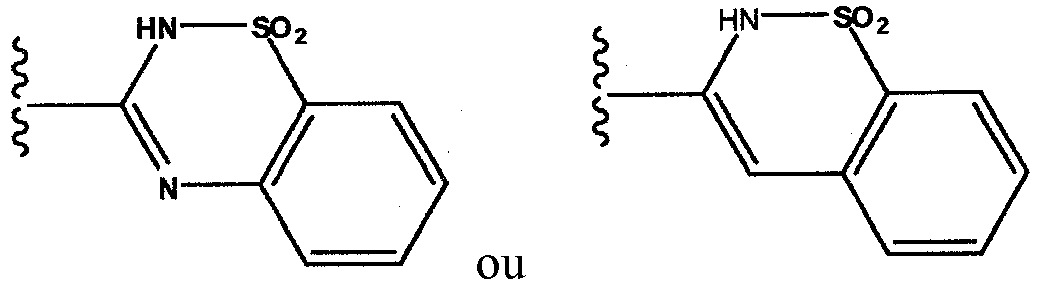 R3 est aryle, hétérocycloalcényle ou hétéroaryle, dont chacun est facultativement substitué par jusqu'à 3 substituants, qui sont identiques ou différents, et sont choisis parmi alkyle, aryle, cycloalkyle, hétéroaryle, hétérocycloalkyle, halogéno, halogénoalkyle, hydroxyalkyle, -OH, -CN, -C(O)alkyle, -C(O)N(R9)2, -N(R9)2, -NHC(O)NH2, -NHSO2R11, -S(O)2R11, -SO2NHR11, -O-halogénoalkyle ou -NHC(O)NH-alkyle;R6 et R7 sont chacun indépendamment H, alkyle, alcényle, alcynyle, aryle, [C(R12)2]q-cycloalkyle, -[C(R12)2]q-cycloalcényle, -[C(R12)2]q-hétérocycloalkyle, -[C(R12)2]q-hétérocycloalcényle, -[C(R12)2]q-hétéroaryle, -[C(R12)2]q-halogénoalkyle, -[C(R12)2]q-hydroxyalkyle, halogéno, -OH, -OR9, -CN, -[C(R12)2]q-C(O)R8, -[C(R12)2]q-C(O)OR9, -[C(R12)2]q-C(O)N(R9)2, -[C(R12)2]q-OR9, -[C(R12)2]q-N(R9)2, -[C(R12)2]q-NHC(O)R8, -[C(R12)2]q-NR8C(O)N(R9)2, -[C(R12)2]q-NHSO2R11 -[C(R12)2]q-S(O)pR11, -[C(R12)2]q-SO2N(R9)2 ou -SO2N(R9)C(O)N(R9)2;
chaque occurrence de R8 est indépendamment H, alkyle, alcényle, alcynyle, -[C(R12)2]q-aryle, -[C(R12)2]q-cycloalkyle, -[C(R12)2]q-cycloalcényle, -[C(R12)2]q-hétérocycloalkyle, -[C(R12)2]q-hétérocycloalcényle, -[C(R12)2]q-hétéroaryle, halogénoalkyle ou hydroxyalkyle;
chaque occurrence de R9 est indépendamment H, alkyle, alcényle, alcynyle, -[C(R12)2]q-aryle, -[C(R12)2]q-cycloalkyle, -[C(R12)2]q-cycloalcényle, -[C(R12)2]q-hétérocycloalkyle, -[C(R12)2]q-hétérocycloalcényle, -[C(R12)2]q-hétéroaryle, halogénoalkyle ou hydroxyalkyle, ou deux groupes R9 qui sont attachés à un atome d'azote commun, conjointement avec l'atome d'azote auquel ils sont attachés, se combinent pour former un groupe hétérocycloalkyle, hétérocycloalcényle ou hétéroaryle;R10 est

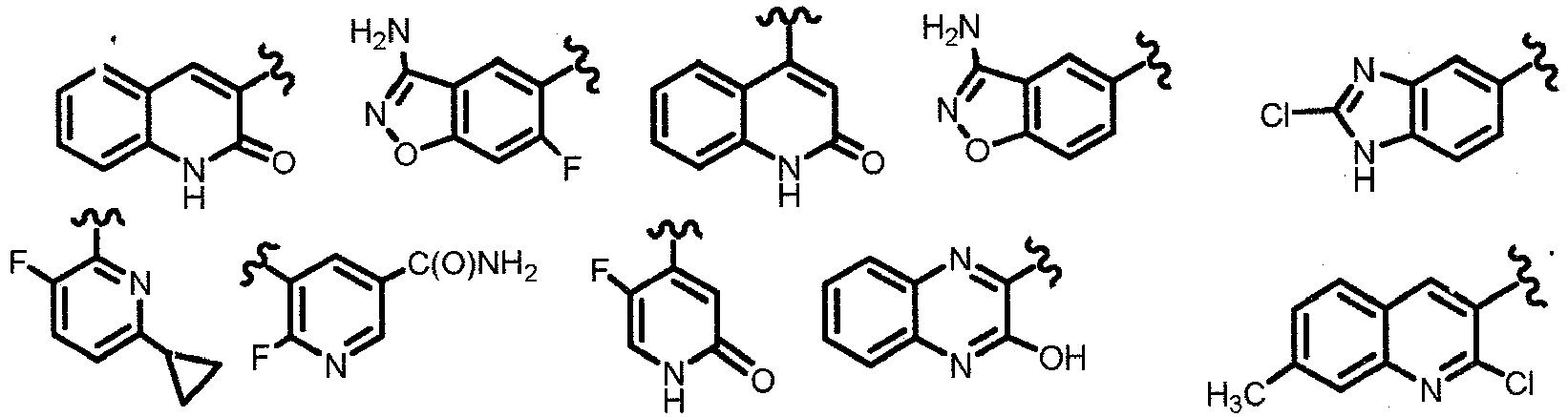


chaque occurrence de R12 est indépendamment H, halogéno, -N(R9)2, -OR9, alkyle, cycloalkyle, cycloalcényle, hétérocycloalkyle ou hétérocycloalcényle, où un groupe cycloalkyle, cycloalcényle, hétérocycloalkyle ou hétérocycloalcényle peut être facultativement substitué par jusqu'à 4 substituants qui sont chacun indépendamment choisis parmi alkyle, halogéno, halogénoalkyle, hydroxyalkyle, -OH, -CN, -C(O)alkyle, -C(O)Oalkyle, -C(O)NHalkyle, -C(O)N(alkyle)2, -O-alkyle, -NH2, -NH(alkyle), -N(alkyle)2, -NHC(O)alkyle, -NHSO2alkyle, -SO2alkyle ou -SO2NH-alkyle, ou deux groupes R12, conjointement avec les atomes de carbone auxquels ils sont attachés, se joignent pour former un groupe cycloalkyle, hétérocycloalkyle ou C=O;
chaque occurrence de R20 est indépendamment H, alkyle, aryle, cycloalkyle, hétérocycloalkyle ou hétéroaryle, ou les deux groupes R20 et les atomes de carbone auxquels ils sont attachés se joignent pour former un groupe cycloalkyle, cyclohétéroalkyle, aryle ou hétéroaryle dans lequel un groupe cycloalkyle, cyclohétéroalkyle, aryle ou hétéroaryle peut être substitué par jusqu'à 4 groupes, qui sont chacun indépendamment choisis parmi alkyle, alcényle, alcynyle, halogéno, -OH, -OR9, -CN, -[C(R12)2]q-cycloalkyle, -[C(R12)2]q-cycloalcényle, -[C(R12)2]q-hétérocycloalkyle, -[C(R12)2]q-hétérocycloalcényle, -[C(R12)2]q-halogénoalkyle, -[C(R12)2]q-hydroxyalkyle, -[C(R12)2]q-C(O)R8, -[C(R12)2]q-C(O)OR9, -[C(R12)2]q-C(O)N(R9)2, -[C(R12)2]q-OR9, -[C(R12)2]q-N(R9)2, -[C(R12)2]q-NHC(O)R8, -[C(R12)2]q-NR8C(O)N(R9)2, -[C(R12)2]q-NHSO2R11, -[C(R12)2]q-S(O)pR11, -[C(R12)2]q-SO2N(R9)2 et -SO2N(R9)C(O)N(R9)2;
chaque occurrence de R30 est indépendamment H, alkyle, alcényle, alcynyle, aryle, -[C(R12)2]q-cycloalkyle, -[C(R12)2]q-cycloalcényle, -[C(R12)2]q-hétérocycloalkyle, -[C(R12)2]q-hétérocycloalcényle, -[C(R12)2]q-hétéroaryle, -[C(R12)2]q-halogénoalkyle, -[C(R12)2]q-hydroxyalkyle, halogéno, -OH, -OR9, -CN, -[C(R12)2]q-C(O)R8, -[C(R12)2]q-C(O)OR9, -[C(R12)2]q-C(O)N(R9)2, -[C(R12)2]q-OR9, -[C(R12)2]q-N(R9)2, -[C(R12)2]q-NHC(O)R8, -[C(R12)2]q-NR8C(O)N(R9)2, -[C(R12)2]q-NHSO2R11, -[C(R12)2]q-S(O)pR11, -[C(R12)2]q-SO2N(R9)2 ou -SO2N(R9)C(O)N(R9)2, ou deux groupes R30 adjacents, conjointement avec les atomes de carbone auxquels ils sont attachés, se joignent pour former un cycle à 3 à 7 chaînons choisis parmi aryle, cycloalkyle, hétéroaryle et hétérocycloalkyle;
chaque occurrence de p est indépendamment 0, 1 ou 2;
chaque occurrence de q est indépendamment un entier allant de 0 à 4;
chaque occurrence de r est indépendamment un entier allant de 1 à 4; et
dans lequel alkyle contient de 1 à 20 atomes de carbone;
alcényle contient de 2 à 15 atomes de carbone;
alcynyle contient de 2 à 15 atomes de carbone;
aryle signifie un groupe monocyclique ou multicyclique ayant de 6 à 14 atomes de carbone cycliques;
cycloalkyle contient de 3 à 10 atomes de carbone cycliques;
cycloalcényle contient de 3 à 10 atomes de carbone cycliques;
hétéroaryle signifie un système cyclique monocyclique ou multicyclique aromatique contenant 5 à 14 atomes cycliques, dans lequel 1 à 4 des atomes cycliques est indépendamment O, N ou S et les atomes cycliques restants sont du carbone;
hétérocycloalkyle signifie un système cyclique monocyclique ou multicyclique non aromatique saturé contenant 3 à 10 atomes cycliques, dans lequel de 1 à 4 des atomes cycliques sont indépendamment O, S ou N et le reste des atomes cycliques sont des atomes de carbone; et
hétérocycloalcényle signifie un hétérocycloalkyle tel que défini ci-dessus qui contient au moins une liaison double carbone-carbone ou carbone-azote endocyclique. - Composé selon la revendication 1, dans lequel R2 est -C(O)NHSO2-alkyle, -C(O)NHSO2-aryle, -C(O)NHSO2-cycloalkyle.
- Composé selon la revendication 1 ou 2, dans lequel R3 est phényle, pyridyle ou

- Composé selon la revendication 3, dans lequel R3 est:
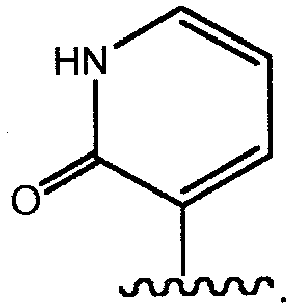
- Composé selon l'une quelconque des revendications précédentes, dans lequel le cycle Z est un hétérocycloalcényle à 5 chaînons ou un hétéroaryle à 5 chaînons.
- Composé selon la revendication 5, dans lequel le cycle Z est:


- Composé selon l'une quelconque des revendications précédentes, dans lequel R6 et R7 sont chacun indépendamment choisis parmi H, alkyle, F, Cl, -CF3, -OH, -O-alkyle, -OCF3, -NH2 ou -NHSO2-alkyle.
- Composé selon la revendication 7, dans lequel R6 et R7 sont chacun H.
- Composé selon la revendication 1, ayant la formule:
 R2 est -C(O)OR9 ou -C(O)NHSO2R11;R6 et R7 sont chacun indépendamment choisis parmi H, alkyle, F, Cl, -CF3, -OH, -O-alkyle, -OCF3, -NH2 et -NHSO2-alkyle;R9 est H ou alkyle;R10 est tel que défini dans la revendication 1; etR11 est alkyle, aryle ou cycloalkyle.
 - Composé selon la revendication 9, dans lequel R2 est -C(O)NHSO2R11 et R11 est alkyle, aryle ou cycloalkyle.
- Composé selon la revendication 10, dans lequel R2 est -C(O)NHSO2-méthyle, -C(O)NHSO2-éthyle, -C(O)NHSO2-isopropyle, -C(O)NHSO2-t-butyle, -C(O)NHSO2-phényle ou -C(O)NHSO2-cyclopropyle.
- Composé selon la revendication 9, dans lequel R2 est -C(O)OH.
- Composé selon la revendication 1, ayant la structure:


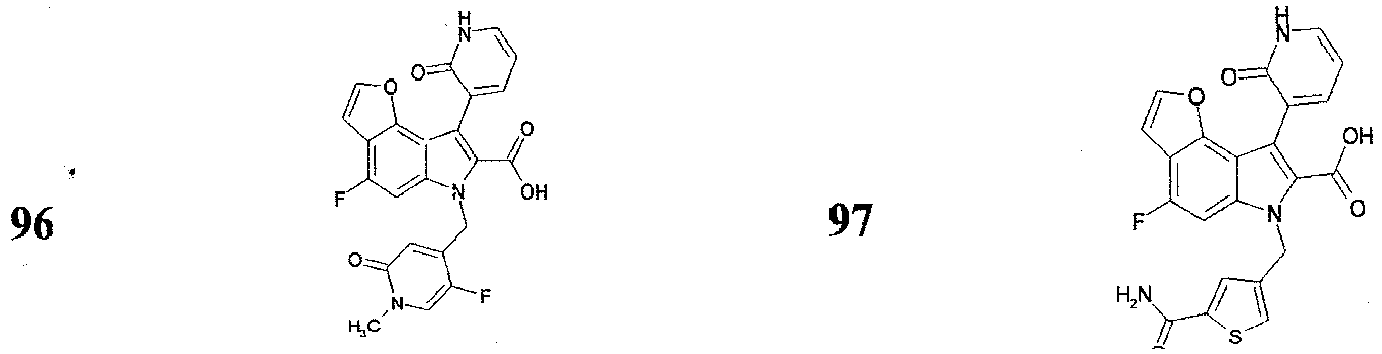


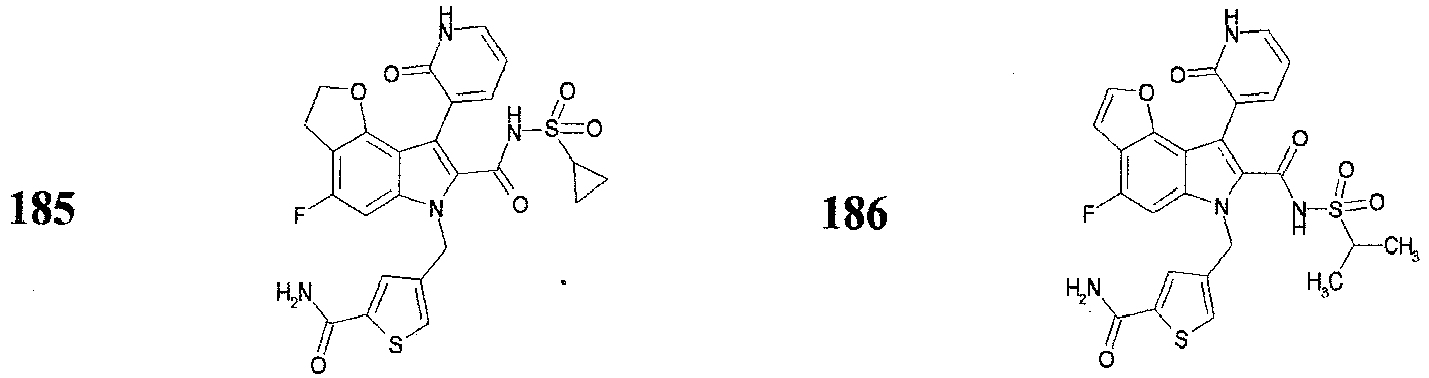


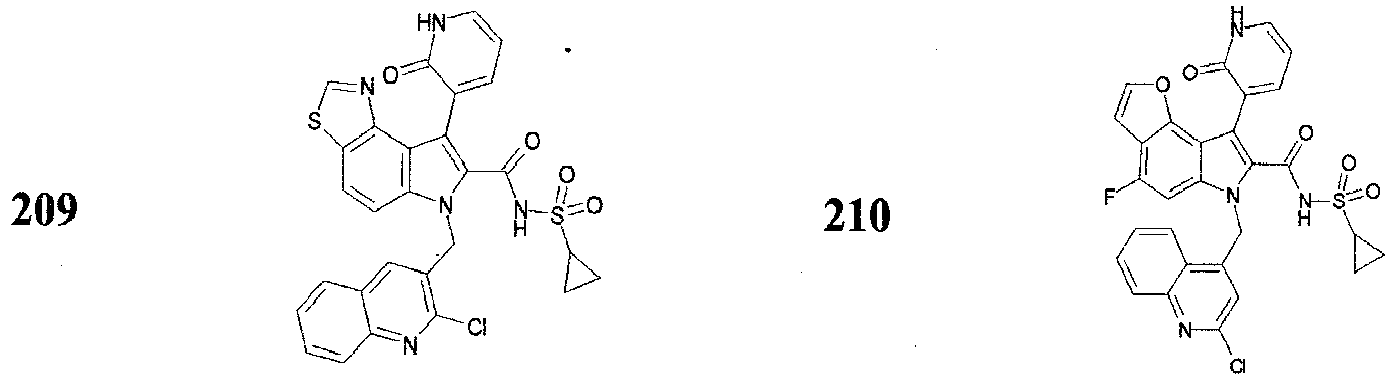


- Composé selon la revendication 1, qui est

- Composition pharmaceutique comprenant au moins un composé selon l'une quelconque des revendications précédentes ou un sel ou solvate pharmaceutiquement acceptable de celui-ci, et au moins un véhicule pharmaceutiquement acceptable.
- Combinaison d'un composé selon l'une quelconque des revendications 1 à 4 ou d'un sel, ester ou solvate pharmaceutiquement acceptable de celui-ci et d'au moins un agent antiviral supplémentaire, dans laquelle l'agent supplémentaire n'est pas un composé selon la revendication 1.
- Combinaison selon la revendication 16, dans laquelle l'agent antiviral supplémentaire est choisi parmi: un inhibiteur de la polymérase du VHC; un interféron; un inhibiteur de réplication d'ARN; un agent antisens; un vaccin thérapeutique; un inhibiteur de protéase; une thérapie par anticorps (monoclonaux ou polyclonaux); et tout agent utile pour traiter un trouble lié à une polymérase ARN dépendante.
- Combinaison selon la revendication 17, dans laquelle l'interféron est l'interféron alpha-2a, l'interféron alpha-2b, l'interféron alfacon-1 ou un interféron pégylé.
- Combinaison selon la revendication 17, dans laquelle l'inhibiteur de protéase est un inhibiteur de protéase du VHC ou un inhibiteur de la sérine protéase NS-3.
- Composé selon l'une quelconque des revendications 1 à 14 ou sel, ester ou solvate pharmaceutiquement acceptable de celui-ci, pour l'utilisation dans un procédé de traitement du corps humain par thérapie.
- Composé pour l'utilisation selon la revendication 20, dans lequel la thérapie est le traitement d'une infection virale.
- Composé pour l'utilisation selon la revendication 21, dans lequel l'infection virale est une infection par VHC.
- Utilisation d'un composé selon l'une quelconque des revendications 1 à 14 ou d'un sel, ester ou solvate pharmaceutiquement acceptable de celui-ci pour la fabrication d'un médicament pour traiter une infection virale.
- Utilisation selon la revendication 23, dans laquelle l'infection virale est une infection par VHC.
Applications Claiming Priority (2)
| Application Number | Priority Date | Filing Date | Title |
|---|---|---|---|
| US87687706P | 2006-12-22 | 2006-12-22 | |
| PCT/US2007/025754 WO2008082484A1 (fr) | 2006-12-22 | 2007-12-17 | Dérivés indoliques annulaires à noyau cyclique à 4 à 5 éléments utilisables pour le traitement ou la prévention des infections par le vhc et autre infections virales associées |
Publications (2)
| Publication Number | Publication Date |
|---|---|
| EP2064180A1 EP2064180A1 (fr) | 2009-06-03 |
| EP2064180B1 true EP2064180B1 (fr) | 2016-07-13 |
Family
ID=39186835
Family Applications (1)
| Application Number | Title | Priority Date | Filing Date |
|---|---|---|---|
| EP07862998.7A Active EP2064180B1 (fr) | 2006-12-22 | 2007-12-17 | Dérivés indoliques condensés en positions 4 et 5 utilisés pour le traitement ou la prévention des infections par le vhc et autre infections virales associées |
Country Status (18)
| Country | Link |
|---|---|
| US (1) | US8557848B2 (fr) |
| EP (1) | EP2064180B1 (fr) |
| JP (1) | JP5079818B2 (fr) |
| KR (1) | KR20090094154A (fr) |
| CN (1) | CN101631773A (fr) |
| AR (1) | AR064428A1 (fr) |
| AU (1) | AU2007339382B2 (fr) |
| BR (1) | BRPI0720625A2 (fr) |
| CA (1) | CA2673249C (fr) |
| CL (1) | CL2007003686A1 (fr) |
| CO (1) | CO6190515A2 (fr) |
| EC (1) | ECSP099447A (fr) |
| MX (1) | MX2009006880A (fr) |
| NO (1) | NO20092742L (fr) |
| PE (1) | PE20081608A1 (fr) |
| RU (1) | RU2009127855A (fr) |
| TW (1) | TW200831496A (fr) |
| WO (1) | WO2008082484A1 (fr) |
Families Citing this family (42)
| Publication number | Priority date | Publication date | Assignee | Title |
|---|---|---|---|---|
| US20110104109A1 (en) * | 2005-07-13 | 2011-05-05 | Frank Bennett | Tetracyclic indole derivatives and their use for treating or preventing viral infections |
| US8557848B2 (en) | 2006-12-22 | 2013-10-15 | Merck Sharp & Dohme Corp. | 4,5-ring annulated indole derivatives for treating or preventing of HCV and related viral infections |
| WO2008082488A1 (fr) | 2006-12-22 | 2008-07-10 | Schering Corporation | Dérivés condensés à 4,5 noyaux destinés au traitement ou à la prévention du vhc et des infections virales associées |
| CN101611025A (zh) | 2006-12-22 | 2009-12-23 | 先灵公司 | 5,6-环化的吲哚衍生物及其使用方法 |
| WO2009032116A1 (fr) * | 2007-08-29 | 2009-03-12 | Schering Corporation | Dérivés d'indole substitués en 2 et 3 pour traiter des infections virales |
| ATE541845T1 (de) * | 2007-08-29 | 2012-02-15 | Schering Corp | 2,3-substituierte azaindolderivate zur behandlung von virusinfektionen |
| EP2408761B1 (fr) | 2007-08-29 | 2014-01-01 | Merck Sharp & Dohme Corp. | Dérivés d'indole substitués et procédés d'utilisation associés |
| MX2010005356A (es) * | 2007-11-16 | 2010-05-27 | Schering Corp | Derivados de indol 3-heterociclico sustituidos y metodos de uso de los mismos. |
| US8377928B2 (en) * | 2007-11-16 | 2013-02-19 | Merck Sharp & Dohme Corp. | 3-aminosulfonyl substituted indole derivatives and methods of use thereof |
| MX2010013630A (es) * | 2008-06-13 | 2010-12-21 | Schering Corp | Derivados triciclicos de indol y metodos de uso de los mismos. |
| CN102164909A (zh) * | 2008-09-26 | 2011-08-24 | 弗·哈夫曼-拉罗切有限公司 | 用于治疗hcv的吡啶或吡嗪衍生物 |
| CN102256968A (zh) | 2008-12-22 | 2011-11-23 | 弗·哈夫曼-拉罗切有限公司 | 杂环抗病毒化合物 |
| MX2011008641A (es) * | 2009-03-06 | 2011-09-06 | Hoffmann La Roche | Compuestos heterociclicos antivirales. |
| JP2012528195A (ja) | 2009-05-29 | 2012-11-12 | メルク・シャープ・アンド・ドーム・コーポレーション | C型肝炎などの疾患を処置するための3つの結合アリール部分で構成された抗菌性化合物 |
| WO2011000566A2 (fr) * | 2009-06-30 | 2011-01-06 | Savira Pharmaceuticals Gmbh | Composés et compositions pharmaceutiques pour le traitement de dinfections virales à arn simple brin, sens négatif |
| EP2503881B1 (fr) * | 2009-11-25 | 2015-05-13 | Merck Sharp & Dohme Corp. | Composés tricycliques fusionnés et leurs dérivés utiles pour le traitement de maladies virales |
| AU2010341537A1 (en) | 2009-12-22 | 2012-08-09 | Merck Sharp & Dohme Corp. | Fused Tricyclic Compounds and methods of use thereof for the treatment of viral diseases |
| EP2545060B1 (fr) | 2010-03-09 | 2015-11-25 | Merck Sharp & Dohme Corp. | Composés de silyle tricycliques fusionnés et leurs procédés d'utilisation pour le traitement de maladies virales |
| AU2011286276A1 (en) | 2010-07-26 | 2013-01-24 | Merck Sharp & Dohme Corp. | Substituted biphenylene compounds and methods of use thereof for the treatment of viral diseases |
| JP2013540122A (ja) | 2010-09-29 | 2013-10-31 | メルク・シャープ・エンド・ドーム・コーポレイション | 縮合四環式化合物誘導体およびウィルス疾患治療のためのそれの使用方法 |
| EP2697242B1 (fr) | 2011-04-13 | 2018-10-03 | Merck Sharp & Dohme Corp. | Dérivés de nucléosides à substitution 2'-azido et leurs procédés d'utilisation pour le traitement de maladies virales |
| BR112013026345A2 (pt) | 2011-04-13 | 2019-04-24 | Merck Sharp & Dohe Corp. | composto, composição farmacêutica, uso de um composto, e, método para tratar um paciente infectado com hcv |
| WO2013033901A1 (fr) | 2011-09-08 | 2013-03-14 | Merck Sharp & Dohme Corp. | Dérivés benzofuranes substitués par un hétérocycle et leurs procédés d'utilisation pour le traitement de maladies virales |
| WO2013033899A1 (fr) | 2011-09-08 | 2013-03-14 | Merck Sharp & Dohme Corp. | Composés benzofuranes substitués et leur procédés d'utilisation pour le traitement de maladies virales |
| WO2013033900A1 (fr) | 2011-09-08 | 2013-03-14 | Merck Sharp & Dohme Corp. | Composés hétérocycliques tétracycliques et leurs procédés d'utilisation pour le traitement de maladies virales |
| EP2755981A4 (fr) | 2011-09-14 | 2015-03-25 | Merck Sharp & Dohme | Composés hétérocycliques contenant un silyle et méthodes d'utilisation desdits composés pour traiter les maladies virales |
| US9457039B2 (en) | 2012-10-17 | 2016-10-04 | Merck Sharp & Dohme Corp. | 2′-disubstituted nucleoside derivatives and methods of use thereof for the treatment of viral diseases |
| EP2909209B1 (fr) | 2012-10-17 | 2022-08-03 | Merck Sharp & Dohme LLC | Dérivés nucléosides à substitution 2'-cyano et leurs méthodes d'utilisation pour le traitement de maladies virales |
| AR092959A1 (es) | 2012-10-17 | 2015-05-06 | Merck Sharp & Dohme | Derivados de nucleosidos 2-metil sustituidos y metodos de uso de los mismos para el tratamiento de enfermedades virales |
| JP2016501200A (ja) | 2012-11-19 | 2016-01-18 | メルク・シャープ・アンド・ドーム・コーポレーションMerck Sharp & Dohme Corp. | ウイルス性疾患を処置するための2−アルキニル置換ヌクレオシド誘導体 |
| WO2014205593A1 (fr) | 2013-06-24 | 2014-12-31 | Merck Sharp & Dohme Corp. | Composés de benzofurane substitués et leurs méthodes d'utilisation pour le traitement de maladies virales |
| WO2014205592A1 (fr) | 2013-06-24 | 2014-12-31 | Merck Sharp & Dohme Corp. | Composés hétérocycliques et leurs procédés d'utilisation pour le traitement de l'hépatite c |
| EP3063140A4 (fr) | 2013-10-30 | 2017-11-08 | Merck Sharp & Dohme Corp. | Pseudopolymorphes d'un inhibiteur de la protéine ns5a du vhc et leurs utilisations |
| CN106810557B (zh) * | 2015-11-27 | 2021-05-04 | 南京圣和药物研发有限公司 | 杂环化合物及其应用 |
| ES2990061T3 (es) | 2016-05-10 | 2024-11-28 | C4 Therapeutics Inc | Degronímeros espirocíclicos para la degradación de proteínas diana |
| CN109641874A (zh) | 2016-05-10 | 2019-04-16 | C4医药公司 | 用于靶蛋白降解的c3-碳连接的戊二酰亚胺降解决定子体 |
| EP3454856B1 (fr) | 2016-05-10 | 2024-09-11 | C4 Therapeutics, Inc. | Dégronimères hétérocycliques pour la dégradation de protéines cibles |
| CN109790143A (zh) | 2016-05-10 | 2019-05-21 | C4医药公司 | 用于靶蛋白降解的胺连接的c3-戊二酰亚胺降解决定子体 |
| EP3471737B1 (fr) | 2016-06-20 | 2025-06-04 | Merck Sharp & Dohme LLC | Composés nucléosides cycliques à substitution phosphate et leurs procédés d'utilisation pour le traitement de maladies virales |
| WO2018044986A1 (fr) * | 2016-08-30 | 2018-03-08 | The Rockefeller University | Inhibiteurs chimiques de biogenèse de ribosomes eucaryotes à base de triazinoindole |
| CN110769822A (zh) | 2017-06-20 | 2020-02-07 | C4医药公司 | 用于蛋白降解的n/o-连接的降解决定子和降解决定子体 |
| WO2021119183A1 (fr) | 2019-12-13 | 2021-06-17 | 712 North, Inc. | Composés tricycliques ayant des propriétés modulatrices de l'oma1/opa1 |
Family Cites Families (56)
| Publication number | Priority date | Publication date | Assignee | Title |
|---|---|---|---|---|
| DE648639C (de) | 1935-05-19 | 1937-08-05 | I G Farbenindustrie Akt Ges | Verfahren zur Darstellung von Dipyrrolen |
| US3404157A (en) * | 1965-02-24 | 1968-10-01 | American Cyanamid Co | Substituted pyrroloindazole compounds |
| US3632805A (en) | 1967-12-08 | 1972-01-04 | Sumitomo Chemical Co | Process for producing 1-aminoalkyl-benzodiazepine derivatives |
| US3631057A (en) * | 1970-01-06 | 1971-12-28 | American Cyanamid Co | Novel 4 7 - dimethyl-6-(lower alkyl) isoxazolo(5 4-e)indoles and methods of preparing same |
| AU575854B2 (en) | 1983-10-04 | 1988-08-11 | Shionogi & Co., Ltd. | 7beta-(carboxyalkenamido) cephalosporins |
| US5017380A (en) | 1986-07-02 | 1991-05-21 | Shionogi & Co., Ltd. | Gelatin hard capsule containing crystalline hydrate of oral cephalosporin |
| NZ220764A (en) | 1986-07-02 | 1989-09-27 | Shionogi & Co | Crystalline form of 7beta((z)-2-(2-aminothiazol-4-yl)-4- carboxybut-2-enoylamino)-3-cephem-4-carboxylic acid and pharmaceutical compositions |
| CA2038925A1 (fr) | 1990-03-26 | 1991-09-27 | Takashi Sohda | Derives d'indole; preparation et utilisation |
| JPH04149429A (ja) | 1990-10-12 | 1992-05-22 | Fuji Photo Film Co Ltd | ハロゲン化銀カラー反転写真感光材料およびそれを用いた画像形成方法 |
| IT1278077B1 (it) | 1995-05-25 | 1997-11-17 | Angeletti P Ist Richerche Bio | Metodologia per riprodurre in vitro le attivita' di rna polimerasi rna-dipendente e di nucleotidiltransferasi terminale codificate dal |
| US5922757A (en) | 1996-09-30 | 1999-07-13 | The Regents Of The University Of California | Treatment and prevention of hepatic disorders |
| KR100509388B1 (ko) | 1996-10-18 | 2005-08-23 | 버텍스 파마슈티칼스 인코포레이티드 | 세린 프로테아제, 특히 간염 c 바이러스 ns3 프로테아제의 저해제 |
| GB9623908D0 (en) | 1996-11-18 | 1997-01-08 | Hoffmann La Roche | Amino acid derivatives |
| ES2234144T3 (es) | 1997-08-11 | 2005-06-16 | Boehringer Ingelheim (Canada) Ltd. | Analogos de peptidos inhibidores de la hepatitis c. |
| FR2768146B1 (fr) | 1997-09-05 | 2000-05-05 | Oreal | Nouveaux composes de la famille des indole-carboxyliques et leur utilisation |
| AR029903A1 (es) | 2000-04-05 | 2003-07-23 | Schering Corp | Inhibidores macrociclicos de la ns3-serina proteasa, del virus de la hepatitis c, que comprenden partes p2 n-ciclicas, composiciones farmaceuticas y utilizacion de los mismos para la manufactura de un medicamento |
| CN101580536A (zh) | 2000-04-19 | 2009-11-18 | 先灵公司 | 含有烷基和芳基丙氨酸p2部分的丙型肝炎病毒的大环ns3-丝氨酸蛋白酶抑制剂 |
| DK1385870T3 (da) | 2000-07-21 | 2010-07-05 | Schering Corp | Peptider som inhibitorer af NS3-serinprotease fra hepatitis C-virus |
| AR029851A1 (es) | 2000-07-21 | 2003-07-16 | Dendreon Corp | Nuevos peptidos como inhibidores de ns3-serina proteasa del virus de hepatitis c |
| KR20030081297A (ko) | 2000-07-21 | 2003-10-17 | 쉐링 코포레이션 | C형 간염 바이러스의 ns3-세린 프로테아제억제제로서의 신규한 펩티드 |
| AR034127A1 (es) | 2000-07-21 | 2004-02-04 | Schering Corp | Imidazolidinonas como inhibidores de ns3-serina proteasa del virus de hepatitis c, composicion farmaceutica, un metodo para su preparacion, y el uso de las mismas para la manufactura de un medicamento |
| AU2002211901A1 (en) | 2000-10-10 | 2002-04-22 | Smithkline Beecham Corporation | Substituted indoles, pharmaceutical compositions containing such indoles and their use as PPAR-gamma binding agents |
| KR20030091946A (ko) | 2000-12-12 | 2003-12-03 | 쉐링 코포레이션 | C형 간염 바이러스의 ns3-세린 프로테아제억제제로서의 디아릴 펩티드 |
| JP2004518658A (ja) | 2000-12-18 | 2004-06-24 | イーライ・リリー・アンド・カンパニー | 新規なsPLA2インヒビター |
| ES2299560T3 (es) | 2001-02-22 | 2008-06-01 | University Of Bradford | Derivados de pirrolindol y de pirroloquinolina como profarmacos para el tratamiento de tumores. |
| EP2335700A1 (fr) | 2001-07-25 | 2011-06-22 | Boehringer Ingelheim (Canada) Ltd. | Inhibiteurs de la polymerase du virus hepatitis C avec une structure heterobicylic |
| WO2004035571A1 (fr) * | 2002-10-15 | 2004-04-29 | Rigel Pharmaceuticals, Inc. | Indoles substitues et leur utilisation en tant qu'inhibiteurs du virus de l'hepatite c (vhc) |
| US20050075331A1 (en) | 2003-10-06 | 2005-04-07 | Pratt John K. | Anti-infective agents |
| ES2382377T3 (es) * | 2003-05-30 | 2012-06-07 | Gemin X Pharmaceuticals Canada Inc. | Compuestos triheterocíclicos, composiciones, y métodos para tratar cáncer |
| GB0323845D0 (en) | 2003-10-10 | 2003-11-12 | Angeletti P Ist Richerche Bio | Chemical compounds,compositions and uses |
| AR046833A1 (es) | 2003-11-10 | 2005-12-28 | Schering Corp | Anticuerpos anti-interleuquina-10 |
| DE602005021760D1 (de) | 2004-02-27 | 2010-07-22 | Schering Corp | Schwefelverbindungen als inhibitoren der ns3-serinprotease des hepatitis-c-virus |
| US20070219212A1 (en) | 2004-03-01 | 2007-09-20 | Condon Stephen M | Pyranouidole Derivatives and the Use Thereof for the Treatment of Hepatitis C Virus Infection or Disease |
| AR049635A1 (es) | 2004-05-06 | 2006-08-23 | Schering Corp | (1r,2s,5s)-n-((1s)-3-amino-1-(ciclobutilmetil)-2,3-dioxopropil)-3-((2s)-2-((((1,1-dimetiletil)amino)carbonil)amino)-3,3-dimetil-1-oxobutil)-6,6-dimetil-3-azabiciclo(3.1.0)hexan-2-carboxamida como inhibidor de la ns3/ns4a serina proteasa del virus de la hepatitis c |
| EP1604988A1 (fr) | 2004-05-18 | 2005-12-14 | Sanofi-Aventis Deutschland GmbH | Dérivés de pyridazinone, méthodes de leur préparation et leur utilisation comme pharmaceutiques |
| WO2007084413A2 (fr) | 2004-07-14 | 2007-07-26 | Ptc Therapeutics, Inc. | Procedes de traitement de l’hepatite c |
| US7153848B2 (en) | 2004-08-09 | 2006-12-26 | Bristol-Myers Squibb Company | Inhibitors of HCV replication |
| WO2006034337A2 (fr) | 2004-09-23 | 2006-03-30 | Wyeth | Derives de carbazole et de cyclopentaindole destines a traiter une infection par le virus de l'hepatite c |
| DE102004047272A1 (de) | 2004-09-24 | 2006-04-06 | Schering Ag | Inhibitoren der löslichen Adenylatzyklase |
| JP4149429B2 (ja) | 2004-10-26 | 2008-09-10 | 本田技研工業株式会社 | 車両の走行安全装置 |
| WO2006046039A2 (fr) | 2004-10-26 | 2006-05-04 | Istituto Di Ricerche Di Biologia Molecolare P Angeletti Spa | Derives d'indole tetracycliques utilises comme agents antiviraux |
| CN101103026A (zh) | 2005-01-14 | 2008-01-09 | 健亚生物科技公司 | 用于治疗病毒感染的吲哚衍生物 |
| US20110104109A1 (en) | 2005-07-13 | 2011-05-05 | Frank Bennett | Tetracyclic indole derivatives and their use for treating or preventing viral infections |
| GB0518390D0 (en) | 2005-09-09 | 2005-10-19 | Angeletti P Ist Richerche Bio | Therapeutic compounds |
| US7482360B2 (en) | 2005-09-23 | 2009-01-27 | Schering Corporation | Fused tetracyclic mGluR1 antagonists as therapeutic agents |
| WO2007084435A2 (fr) | 2006-01-13 | 2007-07-26 | Ptc Therapeutics, Inc. | Procedes de traitement de l’hepatite c |
| MX2008010355A (es) | 2006-02-09 | 2008-10-31 | Schering Corp | Combinaciones que comprenden inhibidores de proteasa del virus de la hepatitis c e inhibidores de polimerasa del virus de la hepatitis c, y metodos de tratamiento relacionados con los mismos. |
| WO2008082488A1 (fr) | 2006-12-22 | 2008-07-10 | Schering Corporation | Dérivés condensés à 4,5 noyaux destinés au traitement ou à la prévention du vhc et des infections virales associées |
| CN101611025A (zh) | 2006-12-22 | 2009-12-23 | 先灵公司 | 5,6-环化的吲哚衍生物及其使用方法 |
| US8557848B2 (en) | 2006-12-22 | 2013-10-15 | Merck Sharp & Dohme Corp. | 4,5-ring annulated indole derivatives for treating or preventing of HCV and related viral infections |
| EP2408761B1 (fr) | 2007-08-29 | 2014-01-01 | Merck Sharp & Dohme Corp. | Dérivés d'indole substitués et procédés d'utilisation associés |
| WO2009032116A1 (fr) | 2007-08-29 | 2009-03-12 | Schering Corporation | Dérivés d'indole substitués en 2 et 3 pour traiter des infections virales |
| ATE541845T1 (de) | 2007-08-29 | 2012-02-15 | Schering Corp | 2,3-substituierte azaindolderivate zur behandlung von virusinfektionen |
| MX2010005356A (es) | 2007-11-16 | 2010-05-27 | Schering Corp | Derivados de indol 3-heterociclico sustituidos y metodos de uso de los mismos. |
| US8377928B2 (en) | 2007-11-16 | 2013-02-19 | Merck Sharp & Dohme Corp. | 3-aminosulfonyl substituted indole derivatives and methods of use thereof |
| MX2010013630A (es) | 2008-06-13 | 2010-12-21 | Schering Corp | Derivados triciclicos de indol y metodos de uso de los mismos. |
-
2007
- 2007-12-17 US US12/519,715 patent/US8557848B2/en not_active Expired - Fee Related
- 2007-12-17 BR BRPI0720625-9A2A patent/BRPI0720625A2/pt not_active Application Discontinuation
- 2007-12-17 KR KR1020097015298A patent/KR20090094154A/ko not_active Ceased
- 2007-12-17 MX MX2009006880A patent/MX2009006880A/es unknown
- 2007-12-17 JP JP2009542835A patent/JP5079818B2/ja not_active Expired - Fee Related
- 2007-12-17 EP EP07862998.7A patent/EP2064180B1/fr active Active
- 2007-12-17 CN CN200780051419A patent/CN101631773A/zh active Pending
- 2007-12-17 CA CA2673249A patent/CA2673249C/fr active Active
- 2007-12-17 WO PCT/US2007/025754 patent/WO2008082484A1/fr not_active Ceased
- 2007-12-17 AU AU2007339382A patent/AU2007339382B2/en not_active Ceased
- 2007-12-17 RU RU2009127855/04A patent/RU2009127855A/ru not_active Application Discontinuation
- 2007-12-18 AR ARP070105705A patent/AR064428A1/es not_active Application Discontinuation
- 2007-12-18 CL CL200703686A patent/CL2007003686A1/es unknown
- 2007-12-18 TW TW096148504A patent/TW200831496A/zh unknown
-
2008
- 2008-01-02 PE PE2008000053A patent/PE20081608A1/es not_active Application Discontinuation
-
2009
- 2009-06-18 CO CO09063496A patent/CO6190515A2/es not_active Application Discontinuation
- 2009-06-19 EC EC2009009447A patent/ECSP099447A/es unknown
- 2009-07-21 NO NO20092742A patent/NO20092742L/no not_active Application Discontinuation
Also Published As
| Publication number | Publication date |
|---|---|
| AU2007339382B2 (en) | 2013-05-02 |
| US8557848B2 (en) | 2013-10-15 |
| TW200831496A (en) | 2008-08-01 |
| CA2673249A1 (fr) | 2008-07-10 |
| AR064428A1 (es) | 2009-04-01 |
| US20100098661A1 (en) | 2010-04-22 |
| CL2007003686A1 (es) | 2008-06-27 |
| JP5079818B2 (ja) | 2012-11-21 |
| PE20081608A1 (es) | 2008-11-12 |
| NO20092742L (no) | 2009-09-21 |
| JP2010513490A (ja) | 2010-04-30 |
| BRPI0720625A2 (pt) | 2014-03-25 |
| CN101631773A (zh) | 2010-01-20 |
| MX2009006880A (es) | 2009-07-03 |
| RU2009127855A (ru) | 2011-01-27 |
| CO6190515A2 (es) | 2010-08-19 |
| EP2064180A1 (fr) | 2009-06-03 |
| AU2007339382A1 (en) | 2008-07-10 |
| CA2673249C (fr) | 2013-04-30 |
| WO2008082484A1 (fr) | 2008-07-10 |
| ECSP099447A (es) | 2009-07-31 |
| KR20090094154A (ko) | 2009-09-03 |
Similar Documents
| Publication | Publication Date | Title |
|---|---|---|
| EP2064180B1 (fr) | Dérivés indoliques condensés en positions 4 et 5 utilisés pour le traitement ou la prévention des infections par le vhc et autre infections virales associées | |
| EP2081922B1 (fr) | Dérivés indoliques condensés en 5,6 à un cycle et leur utilisation | |
| EP2195317B1 (fr) | Dérivés d'azaindoles substitués en 2 et 3 destinés au traitement d'infections virales | |
| AU2007339386B2 (en) | 4, 5-ring annulated indole derivatives for treating or preventing of HCV and related viral infections | |
| EP2222660B1 (fr) | Dérivés d'indole à substitution hétérocyclique en position 3 et leurs procédés d'utilisation | |
| EP2408761B1 (fr) | Dérivés d'indole substitués et procédés d'utilisation associés | |
| JP5179585B2 (ja) | 四環系インドール誘導体およびその使用法 | |
| EP2222672B1 (fr) | Dérivés d'indole à substitution par aminosulfonyle en position 3 et leurs procédés d'utilisation | |
| US20110104109A1 (en) | Tetracyclic indole derivatives and their use for treating or preventing viral infections |
Legal Events
| Date | Code | Title | Description |
|---|---|---|---|
| PUAI | Public reference made under article 153(3) epc to a published international application that has entered the european phase |
Free format text: ORIGINAL CODE: 0009012 |
|
| 17P | Request for examination filed |
Effective date: 20080330 |
|
| AK | Designated contracting states |
Kind code of ref document: A1 Designated state(s): AT BE BG CH CY CZ DE DK EE ES FI FR GB GR HU IE IS IT LI LT LU LV MC MT NL PL PT RO SE SI SK TR |
|
| AX | Request for extension of the european patent |
Extension state: AL BA HR MK RS |
|
| REG | Reference to a national code |
Ref country code: HK Ref legal event code: DE Ref document number: 1127049 Country of ref document: HK |
|
| RIN1 | Information on inventor provided before grant (corrected) |
Inventor name: KOZLOWSKI, JOSEPH A. Inventor name: ZENG, QINGBEI Inventor name: ANILKUMAR, GOPINADHAN N. Inventor name: SHIH, NENG-YANG Inventor name: DUCA, JOSE S. Inventor name: LESBURG, CHARLES A. Inventor name: ROSENBLUM, STUART B. Inventor name: NJOROGE, F., GEORGE Inventor name: VENKATRAMAN, SRIKANTH Inventor name: CHEN, KEVIN X. Inventor name: VELAZQUEZ, FRANCISCO |
|
| 17Q | First examination report despatched |
Effective date: 20100129 |
|
| RAP1 | Party data changed (applicant data changed or rights of an application transferred) |
Owner name: MERCK SHARP & DOHME CORP. |
|
| REG | Reference to a national code |
Ref country code: HK Ref legal event code: WD Ref document number: 1127049 Country of ref document: HK |
|
| GRAP | Despatch of communication of intention to grant a patent |
Free format text: ORIGINAL CODE: EPIDOSNIGR1 |
|
| INTG | Intention to grant announced |
Effective date: 20151125 |
|
| GRAS | Grant fee paid |
Free format text: ORIGINAL CODE: EPIDOSNIGR3 |
|
| GRAA | (expected) grant |
Free format text: ORIGINAL CODE: 0009210 |
|
| AK | Designated contracting states |
Kind code of ref document: B1 Designated state(s): AT BE BG CH CY CZ DE DK EE ES FI FR GB GR HU IE IS IT LI LT LU LV MC MT NL PL PT RO SE SI SK TR |
|
| AX | Request for extension of the european patent |
Extension state: AL BA HR MK RS |
|
| REG | Reference to a national code |
Ref country code: GB Ref legal event code: FG4D |
|
| REG | Reference to a national code |
Ref country code: AT Ref legal event code: REF Ref document number: 812175 Country of ref document: AT Kind code of ref document: T Effective date: 20160715 Ref country code: CH Ref legal event code: EP |
|
| REG | Reference to a national code |
Ref country code: IE Ref legal event code: FG4D |
|
| REG | Reference to a national code |
Ref country code: DE Ref legal event code: R096 Ref document number: 602007047016 Country of ref document: DE |
|
| REG | Reference to a national code |
Ref country code: LT Ref legal event code: MG4D |
|
| REG | Reference to a national code |
Ref country code: NL Ref legal event code: MP Effective date: 20160713 |
|
| REG | Reference to a national code |
Ref country code: AT Ref legal event code: MK05 Ref document number: 812175 Country of ref document: AT Kind code of ref document: T Effective date: 20160713 |
|
| PG25 | Lapsed in a contracting state [announced via postgrant information from national office to epo] |
Ref country code: IT Free format text: LAPSE BECAUSE OF FAILURE TO SUBMIT A TRANSLATION OF THE DESCRIPTION OR TO PAY THE FEE WITHIN THE PRESCRIBED TIME-LIMIT Effective date: 20160713 Ref country code: IS Free format text: LAPSE BECAUSE OF FAILURE TO SUBMIT A TRANSLATION OF THE DESCRIPTION OR TO PAY THE FEE WITHIN THE PRESCRIBED TIME-LIMIT Effective date: 20161113 Ref country code: LT Free format text: LAPSE BECAUSE OF FAILURE TO SUBMIT A TRANSLATION OF THE DESCRIPTION OR TO PAY THE FEE WITHIN THE PRESCRIBED TIME-LIMIT Effective date: 20160713 Ref country code: FI Free format text: LAPSE BECAUSE OF FAILURE TO SUBMIT A TRANSLATION OF THE DESCRIPTION OR TO PAY THE FEE WITHIN THE PRESCRIBED TIME-LIMIT Effective date: 20160713 Ref country code: NL Free format text: LAPSE BECAUSE OF FAILURE TO SUBMIT A TRANSLATION OF THE DESCRIPTION OR TO PAY THE FEE WITHIN THE PRESCRIBED TIME-LIMIT Effective date: 20160713 |
|
| PG25 | Lapsed in a contracting state [announced via postgrant information from national office to epo] |
Ref country code: ES Free format text: LAPSE BECAUSE OF FAILURE TO SUBMIT A TRANSLATION OF THE DESCRIPTION OR TO PAY THE FEE WITHIN THE PRESCRIBED TIME-LIMIT Effective date: 20160713 Ref country code: SE Free format text: LAPSE BECAUSE OF FAILURE TO SUBMIT A TRANSLATION OF THE DESCRIPTION OR TO PAY THE FEE WITHIN THE PRESCRIBED TIME-LIMIT Effective date: 20160713 Ref country code: LV Free format text: LAPSE BECAUSE OF FAILURE TO SUBMIT A TRANSLATION OF THE DESCRIPTION OR TO PAY THE FEE WITHIN THE PRESCRIBED TIME-LIMIT Effective date: 20160713 Ref country code: AT Free format text: LAPSE BECAUSE OF FAILURE TO SUBMIT A TRANSLATION OF THE DESCRIPTION OR TO PAY THE FEE WITHIN THE PRESCRIBED TIME-LIMIT Effective date: 20160713 Ref country code: PT Free format text: LAPSE BECAUSE OF FAILURE TO SUBMIT A TRANSLATION OF THE DESCRIPTION OR TO PAY THE FEE WITHIN THE PRESCRIBED TIME-LIMIT Effective date: 20161114 Ref country code: GR Free format text: LAPSE BECAUSE OF FAILURE TO SUBMIT A TRANSLATION OF THE DESCRIPTION OR TO PAY THE FEE WITHIN THE PRESCRIBED TIME-LIMIT Effective date: 20161014 Ref country code: PL Free format text: LAPSE BECAUSE OF FAILURE TO SUBMIT A TRANSLATION OF THE DESCRIPTION OR TO PAY THE FEE WITHIN THE PRESCRIBED TIME-LIMIT Effective date: 20160713 Ref country code: BE Free format text: LAPSE BECAUSE OF FAILURE TO SUBMIT A TRANSLATION OF THE DESCRIPTION OR TO PAY THE FEE WITHIN THE PRESCRIBED TIME-LIMIT Effective date: 20160713 |
|
| REG | Reference to a national code |
Ref country code: DE Ref legal event code: R097 Ref document number: 602007047016 Country of ref document: DE |
|
| PG25 | Lapsed in a contracting state [announced via postgrant information from national office to epo] |
Ref country code: RO Free format text: LAPSE BECAUSE OF FAILURE TO SUBMIT A TRANSLATION OF THE DESCRIPTION OR TO PAY THE FEE WITHIN THE PRESCRIBED TIME-LIMIT Effective date: 20160713 Ref country code: EE Free format text: LAPSE BECAUSE OF FAILURE TO SUBMIT A TRANSLATION OF THE DESCRIPTION OR TO PAY THE FEE WITHIN THE PRESCRIBED TIME-LIMIT Effective date: 20160713 |
|
| PLBE | No opposition filed within time limit |
Free format text: ORIGINAL CODE: 0009261 |
|
| STAA | Information on the status of an ep patent application or granted ep patent |
Free format text: STATUS: NO OPPOSITION FILED WITHIN TIME LIMIT |
|
| PG25 | Lapsed in a contracting state [announced via postgrant information from national office to epo] |
Ref country code: DK Free format text: LAPSE BECAUSE OF FAILURE TO SUBMIT A TRANSLATION OF THE DESCRIPTION OR TO PAY THE FEE WITHIN THE PRESCRIBED TIME-LIMIT Effective date: 20160713 Ref country code: CZ Free format text: LAPSE BECAUSE OF FAILURE TO SUBMIT A TRANSLATION OF THE DESCRIPTION OR TO PAY THE FEE WITHIN THE PRESCRIBED TIME-LIMIT Effective date: 20160713 Ref country code: SK Free format text: LAPSE BECAUSE OF FAILURE TO SUBMIT A TRANSLATION OF THE DESCRIPTION OR TO PAY THE FEE WITHIN THE PRESCRIBED TIME-LIMIT Effective date: 20160713 Ref country code: BG Free format text: LAPSE BECAUSE OF FAILURE TO SUBMIT A TRANSLATION OF THE DESCRIPTION OR TO PAY THE FEE WITHIN THE PRESCRIBED TIME-LIMIT Effective date: 20161013 |
|
| 26N | No opposition filed |
Effective date: 20170418 |
|
| REG | Reference to a national code |
Ref country code: DE Ref legal event code: R119 Ref document number: 602007047016 Country of ref document: DE |
|
| REG | Reference to a national code |
Ref country code: CH Ref legal event code: PL |
|
| GBPC | Gb: european patent ceased through non-payment of renewal fee |
Effective date: 20161217 |
|
| PG25 | Lapsed in a contracting state [announced via postgrant information from national office to epo] |
Ref country code: SI Free format text: LAPSE BECAUSE OF FAILURE TO SUBMIT A TRANSLATION OF THE DESCRIPTION OR TO PAY THE FEE WITHIN THE PRESCRIBED TIME-LIMIT Effective date: 20160713 |
|
| PG25 | Lapsed in a contracting state [announced via postgrant information from national office to epo] |
Ref country code: MC Free format text: LAPSE BECAUSE OF FAILURE TO SUBMIT A TRANSLATION OF THE DESCRIPTION OR TO PAY THE FEE WITHIN THE PRESCRIBED TIME-LIMIT Effective date: 20160713 |
|
| REG | Reference to a national code |
Ref country code: FR Ref legal event code: ST Effective date: 20170831 |
|
| PG25 | Lapsed in a contracting state [announced via postgrant information from national office to epo] |
Ref country code: LI Free format text: LAPSE BECAUSE OF NON-PAYMENT OF DUE FEES Effective date: 20161231 Ref country code: LU Free format text: LAPSE BECAUSE OF NON-PAYMENT OF DUE FEES Effective date: 20161217 Ref country code: CH Free format text: LAPSE BECAUSE OF NON-PAYMENT OF DUE FEES Effective date: 20161231 Ref country code: FR Free format text: LAPSE BECAUSE OF NON-PAYMENT OF DUE FEES Effective date: 20170102 |
|
| PG25 | Lapsed in a contracting state [announced via postgrant information from national office to epo] |
Ref country code: GB Free format text: LAPSE BECAUSE OF NON-PAYMENT OF DUE FEES Effective date: 20161217 Ref country code: DE Free format text: LAPSE BECAUSE OF NON-PAYMENT OF DUE FEES Effective date: 20170701 Ref country code: IE Free format text: LAPSE BECAUSE OF NON-PAYMENT OF DUE FEES Effective date: 20161217 |
|
| PG25 | Lapsed in a contracting state [announced via postgrant information from national office to epo] |
Ref country code: HU Free format text: LAPSE BECAUSE OF FAILURE TO SUBMIT A TRANSLATION OF THE DESCRIPTION OR TO PAY THE FEE WITHIN THE PRESCRIBED TIME-LIMIT; INVALID AB INITIO Effective date: 20071217 Ref country code: CY Free format text: LAPSE BECAUSE OF FAILURE TO SUBMIT A TRANSLATION OF THE DESCRIPTION OR TO PAY THE FEE WITHIN THE PRESCRIBED TIME-LIMIT Effective date: 20160713 |
|
| PG25 | Lapsed in a contracting state [announced via postgrant information from national office to epo] |
Ref country code: TR Free format text: LAPSE BECAUSE OF FAILURE TO SUBMIT A TRANSLATION OF THE DESCRIPTION OR TO PAY THE FEE WITHIN THE PRESCRIBED TIME-LIMIT Effective date: 20160713 |
|
| PG25 | Lapsed in a contracting state [announced via postgrant information from national office to epo] |
Ref country code: MT Free format text: LAPSE BECAUSE OF NON-PAYMENT OF DUE FEES Effective date: 20161217 |