EP2071034A1 - Verfahren zur Behandlung einer Lösung zum Vernichten von Ribonukleinsäure nach der Amplifikation - Google Patents
Verfahren zur Behandlung einer Lösung zum Vernichten von Ribonukleinsäure nach der Amplifikation Download PDFInfo
- Publication number
- EP2071034A1 EP2071034A1 EP07024024A EP07024024A EP2071034A1 EP 2071034 A1 EP2071034 A1 EP 2071034A1 EP 07024024 A EP07024024 A EP 07024024A EP 07024024 A EP07024024 A EP 07024024A EP 2071034 A1 EP2071034 A1 EP 2071034A1
- Authority
- EP
- European Patent Office
- Prior art keywords
- rnase
- rna
- ribonuclease inhibitor
- amplification
- heating step
- Prior art date
- Legal status (The legal status is an assumption and is not a legal conclusion. Google has not performed a legal analysis and makes no representation as to the accuracy of the status listed.)
- Withdrawn
Links
- 238000003199 nucleic acid amplification method Methods 0.000 title claims abstract description 89
- 230000003321 amplification Effects 0.000 title claims abstract description 88
- 238000000034 method Methods 0.000 title claims abstract description 83
- 229920002477 rna polymer Polymers 0.000 title abstract description 3
- 102100037968 Ribonuclease inhibitor Human genes 0.000 claims abstract description 106
- 239000003161 ribonuclease inhibitor Substances 0.000 claims abstract description 52
- 101710141795 Ribonuclease inhibitor Proteins 0.000 claims abstract description 51
- 229940122208 Ribonuclease inhibitor Drugs 0.000 claims abstract description 51
- 150000007523 nucleic acids Chemical class 0.000 claims abstract description 51
- 108020004707 nucleic acids Proteins 0.000 claims abstract description 46
- 102000039446 nucleic acids Human genes 0.000 claims abstract description 46
- 102000006382 Ribonucleases Human genes 0.000 claims abstract description 42
- 108010083644 Ribonucleases Proteins 0.000 claims abstract description 42
- 239000003153 chemical reaction reagent Substances 0.000 claims abstract description 20
- 238000013518 transcription Methods 0.000 claims abstract description 11
- 230000035897 transcription Effects 0.000 claims abstract description 11
- 230000000593 degrading effect Effects 0.000 claims abstract description 4
- 230000009471 action Effects 0.000 claims abstract description 3
- 108020002230 Pancreatic Ribonuclease Proteins 0.000 claims description 73
- 102000005891 Pancreatic ribonuclease Human genes 0.000 claims description 73
- 238000010438 heat treatment Methods 0.000 claims description 55
- 108010057105 porcine ribonuclease inhibitor Proteins 0.000 claims description 55
- 238000006243 chemical reaction Methods 0.000 claims description 43
- 102000004190 Enzymes Human genes 0.000 claims description 32
- 108090000790 Enzymes Proteins 0.000 claims description 32
- 239000000523 sample Substances 0.000 claims description 29
- 230000008569 process Effects 0.000 claims description 19
- 108020004414 DNA Proteins 0.000 claims description 17
- 238000001514 detection method Methods 0.000 claims description 12
- 125000003729 nucleotide group Chemical group 0.000 claims description 12
- 230000002779 inactivation Effects 0.000 claims description 11
- 239000002773 nucleotide Substances 0.000 claims description 11
- 230000000694 effects Effects 0.000 claims description 9
- 238000011282 treatment Methods 0.000 claims description 9
- 125000004122 cyclic group Chemical group 0.000 claims description 7
- 102100034343 Integrase Human genes 0.000 claims description 6
- 102000004169 proteins and genes Human genes 0.000 claims description 6
- 108090000623 proteins and genes Proteins 0.000 claims description 6
- 238000011897 real-time detection Methods 0.000 claims description 4
- 108091027305 Heteroduplex Proteins 0.000 claims description 3
- 101710203526 Integrase Proteins 0.000 claims description 3
- 108010092799 RNA-directed DNA polymerase Proteins 0.000 claims description 3
- 102000004163 DNA-directed RNA polymerases Human genes 0.000 claims description 2
- 108090000626 DNA-directed RNA polymerases Proteins 0.000 claims description 2
- 108010024226 placental ribonuclease inhibitor Proteins 0.000 claims description 2
- 108010066476 ribonuclease B Proteins 0.000 claims description 2
- 108010066483 ribonuclease C Proteins 0.000 claims description 2
- 238000002474 experimental method Methods 0.000 abstract description 10
- 238000011109 contamination Methods 0.000 abstract description 9
- 238000003556 assay Methods 0.000 abstract description 8
- 230000003449 preventive effect Effects 0.000 abstract 1
- 230000001225 therapeutic effect Effects 0.000 abstract 1
- 108091032973 (ribonucleotides)n+m Proteins 0.000 description 75
- 239000000243 solution Substances 0.000 description 39
- 230000015556 catabolic process Effects 0.000 description 25
- 238000006731 degradation reaction Methods 0.000 description 25
- 239000003085 diluting agent Substances 0.000 description 13
- 238000003752 polymerase chain reaction Methods 0.000 description 12
- 238000012360 testing method Methods 0.000 description 10
- 108091093088 Amplicon Proteins 0.000 description 9
- 238000005259 measurement Methods 0.000 description 8
- 239000000203 mixture Substances 0.000 description 7
- ISAKRJDGNUQOIC-UHFFFAOYSA-N Uracil Chemical compound O=C1C=CNC(=O)N1 ISAKRJDGNUQOIC-UHFFFAOYSA-N 0.000 description 6
- IAZDPXIOMUYVGZ-UHFFFAOYSA-N Dimethylsulphoxide Chemical compound CS(C)=O IAZDPXIOMUYVGZ-UHFFFAOYSA-N 0.000 description 5
- 108091034117 Oligonucleotide Proteins 0.000 description 5
- 230000007022 RNA scission Effects 0.000 description 5
- 230000005764 inhibitory process Effects 0.000 description 5
- XLYOFNOQVPJJNP-UHFFFAOYSA-N water Chemical class O XLYOFNOQVPJJNP-UHFFFAOYSA-N 0.000 description 5
- 241000725303 Human immunodeficiency virus Species 0.000 description 4
- 230000004913 activation Effects 0.000 description 4
- 239000000872 buffer Substances 0.000 description 4
- 230000000295 complement effect Effects 0.000 description 4
- 102000040650 (ribonucleotides)n+m Human genes 0.000 description 3
- 102000053602 DNA Human genes 0.000 description 3
- 241000713772 Human immunodeficiency virus 1 Species 0.000 description 3
- JLCPHMBAVCMARE-UHFFFAOYSA-N [3-[[3-[[3-[[3-[[3-[[3-[[3-[[3-[[3-[[3-[[3-[[5-(2-amino-6-oxo-1H-purin-9-yl)-3-[[3-[[3-[[3-[[3-[[3-[[5-(2-amino-6-oxo-1H-purin-9-yl)-3-[[5-(2-amino-6-oxo-1H-purin-9-yl)-3-hydroxyoxolan-2-yl]methoxy-hydroxyphosphoryl]oxyoxolan-2-yl]methoxy-hydroxyphosphoryl]oxy-5-(5-methyl-2,4-dioxopyrimidin-1-yl)oxolan-2-yl]methoxy-hydroxyphosphoryl]oxy-5-(6-aminopurin-9-yl)oxolan-2-yl]methoxy-hydroxyphosphoryl]oxy-5-(6-aminopurin-9-yl)oxolan-2-yl]methoxy-hydroxyphosphoryl]oxy-5-(6-aminopurin-9-yl)oxolan-2-yl]methoxy-hydroxyphosphoryl]oxy-5-(6-aminopurin-9-yl)oxolan-2-yl]methoxy-hydroxyphosphoryl]oxyoxolan-2-yl]methoxy-hydroxyphosphoryl]oxy-5-(5-methyl-2,4-dioxopyrimidin-1-yl)oxolan-2-yl]methoxy-hydroxyphosphoryl]oxy-5-(4-amino-2-oxopyrimidin-1-yl)oxolan-2-yl]methoxy-hydroxyphosphoryl]oxy-5-(5-methyl-2,4-dioxopyrimidin-1-yl)oxolan-2-yl]methoxy-hydroxyphosphoryl]oxy-5-(5-methyl-2,4-dioxopyrimidin-1-yl)oxolan-2-yl]methoxy-hydroxyphosphoryl]oxy-5-(6-aminopurin-9-yl)oxolan-2-yl]methoxy-hydroxyphosphoryl]oxy-5-(6-aminopurin-9-yl)oxolan-2-yl]methoxy-hydroxyphosphoryl]oxy-5-(4-amino-2-oxopyrimidin-1-yl)oxolan-2-yl]methoxy-hydroxyphosphoryl]oxy-5-(4-amino-2-oxopyrimidin-1-yl)oxolan-2-yl]methoxy-hydroxyphosphoryl]oxy-5-(4-amino-2-oxopyrimidin-1-yl)oxolan-2-yl]methoxy-hydroxyphosphoryl]oxy-5-(6-aminopurin-9-yl)oxolan-2-yl]methoxy-hydroxyphosphoryl]oxy-5-(4-amino-2-oxopyrimidin-1-yl)oxolan-2-yl]methyl [5-(6-aminopurin-9-yl)-2-(hydroxymethyl)oxolan-3-yl] hydrogen phosphate Polymers Cc1cn(C2CC(OP(O)(=O)OCC3OC(CC3OP(O)(=O)OCC3OC(CC3O)n3cnc4c3nc(N)[nH]c4=O)n3cnc4c3nc(N)[nH]c4=O)C(COP(O)(=O)OC3CC(OC3COP(O)(=O)OC3CC(OC3COP(O)(=O)OC3CC(OC3COP(O)(=O)OC3CC(OC3COP(O)(=O)OC3CC(OC3COP(O)(=O)OC3CC(OC3COP(O)(=O)OC3CC(OC3COP(O)(=O)OC3CC(OC3COP(O)(=O)OC3CC(OC3COP(O)(=O)OC3CC(OC3COP(O)(=O)OC3CC(OC3COP(O)(=O)OC3CC(OC3COP(O)(=O)OC3CC(OC3COP(O)(=O)OC3CC(OC3COP(O)(=O)OC3CC(OC3COP(O)(=O)OC3CC(OC3COP(O)(=O)OC3CC(OC3CO)n3cnc4c(N)ncnc34)n3ccc(N)nc3=O)n3cnc4c(N)ncnc34)n3ccc(N)nc3=O)n3ccc(N)nc3=O)n3ccc(N)nc3=O)n3cnc4c(N)ncnc34)n3cnc4c(N)ncnc34)n3cc(C)c(=O)[nH]c3=O)n3cc(C)c(=O)[nH]c3=O)n3ccc(N)nc3=O)n3cc(C)c(=O)[nH]c3=O)n3cnc4c3nc(N)[nH]c4=O)n3cnc4c(N)ncnc34)n3cnc4c(N)ncnc34)n3cnc4c(N)ncnc34)n3cnc4c(N)ncnc34)O2)c(=O)[nH]c1=O JLCPHMBAVCMARE-UHFFFAOYSA-N 0.000 description 3
- 239000012190 activator Substances 0.000 description 3
- 230000015572 biosynthetic process Effects 0.000 description 3
- 239000003795 chemical substances by application Substances 0.000 description 3
- 238000003776 cleavage reaction Methods 0.000 description 3
- 238000005202 decontamination Methods 0.000 description 3
- 239000012634 fragment Substances 0.000 description 3
- 108091033319 polynucleotide Proteins 0.000 description 3
- 102000040430 polynucleotide Human genes 0.000 description 3
- 239000002157 polynucleotide Substances 0.000 description 3
- 230000007017 scission Effects 0.000 description 3
- 229940035893 uracil Drugs 0.000 description 3
- 208000035657 Abasia Diseases 0.000 description 2
- 108010053770 Deoxyribonucleases Proteins 0.000 description 2
- 102000016911 Deoxyribonucleases Human genes 0.000 description 2
- AHCYMLUZIRLXAA-SHYZEUOFSA-N Deoxyuridine 5'-triphosphate Chemical compound O1[C@H](COP(O)(=O)OP(O)(=O)OP(O)(O)=O)[C@@H](O)C[C@@H]1N1C(=O)NC(=O)C=C1 AHCYMLUZIRLXAA-SHYZEUOFSA-N 0.000 description 2
- TWRXJAOTZQYOKJ-UHFFFAOYSA-L Magnesium chloride Chemical compound [Mg+2].[Cl-].[Cl-] TWRXJAOTZQYOKJ-UHFFFAOYSA-L 0.000 description 2
- 230000008901 benefit Effects 0.000 description 2
- NHVNXKFIZYSCEB-XLPZGREQSA-N dTTP Chemical compound O=C1NC(=O)C(C)=CN1[C@@H]1O[C@H](COP(O)(=O)OP(O)(=O)OP(O)(O)=O)[C@@H](O)C1 NHVNXKFIZYSCEB-XLPZGREQSA-N 0.000 description 2
- 230000003588 decontaminative effect Effects 0.000 description 2
- 230000001419 dependent effect Effects 0.000 description 2
- 230000029087 digestion Effects 0.000 description 2
- 238000009396 hybridization Methods 0.000 description 2
- 238000002955 isolation Methods 0.000 description 2
- 238000004519 manufacturing process Methods 0.000 description 2
- 239000013642 negative control Substances 0.000 description 2
- 238000005457 optimization Methods 0.000 description 2
- ZCCUUQDIBDJBTK-UHFFFAOYSA-N psoralen Chemical compound C1=C2OC(=O)C=CC2=CC2=C1OC=C2 ZCCUUQDIBDJBTK-UHFFFAOYSA-N 0.000 description 2
- 238000010791 quenching Methods 0.000 description 2
- 230000000171 quenching effect Effects 0.000 description 2
- 238000003757 reverse transcription PCR Methods 0.000 description 2
- 230000035945 sensitivity Effects 0.000 description 2
- VXGRJERITKFWPL-UHFFFAOYSA-N 4',5'-Dihydropsoralen Natural products C1=C2OC(=O)C=CC2=CC2=C1OCC2 VXGRJERITKFWPL-UHFFFAOYSA-N 0.000 description 1
- 241000894006 Bacteria Species 0.000 description 1
- BHPQYMZQTOCNFJ-UHFFFAOYSA-N Calcium cation Chemical compound [Ca+2] BHPQYMZQTOCNFJ-UHFFFAOYSA-N 0.000 description 1
- KCXVZYZYPLLWCC-UHFFFAOYSA-N EDTA Chemical compound OC(=O)CN(CC(O)=O)CCN(CC(O)=O)CC(O)=O KCXVZYZYPLLWCC-UHFFFAOYSA-N 0.000 description 1
- 241000233866 Fungi Species 0.000 description 1
- 241000186781 Listeria Species 0.000 description 1
- 108010059724 Micrococcal Nuclease Proteins 0.000 description 1
- 101000817240 Mus musculus Eosinophil cationic protein 1 Proteins 0.000 description 1
- 101710163270 Nuclease Proteins 0.000 description 1
- 108020005187 Oligonucleotide Probes Proteins 0.000 description 1
- 229910019142 PO4 Inorganic materials 0.000 description 1
- 108091028664 Ribonucleotide Proteins 0.000 description 1
- 240000004808 Saccharomyces cerevisiae Species 0.000 description 1
- 108020004682 Single-Stranded DNA Proteins 0.000 description 1
- 101710137500 T7 RNA polymerase Proteins 0.000 description 1
- RYYWUUFWQRZTIU-UHFFFAOYSA-N Thiophosphoric acid Chemical class OP(O)(S)=O RYYWUUFWQRZTIU-UHFFFAOYSA-N 0.000 description 1
- 108020004566 Transfer RNA Proteins 0.000 description 1
- 241000700605 Viruses Species 0.000 description 1
- 239000003513 alkali Substances 0.000 description 1
- 125000005600 alkyl phosphonate group Chemical group 0.000 description 1
- 239000002585 base Substances 0.000 description 1
- 238000009835 boiling Methods 0.000 description 1
- 239000008366 buffered solution Substances 0.000 description 1
- 229910001424 calcium ion Inorganic materials 0.000 description 1
- 230000008859 change Effects 0.000 description 1
- SUYVUBYJARFZHO-RRKCRQDMSA-N dATP Chemical compound C1=NC=2C(N)=NC=NC=2N1[C@H]1C[C@H](O)[C@@H](COP(O)(=O)OP(O)(=O)OP(O)(O)=O)O1 SUYVUBYJARFZHO-RRKCRQDMSA-N 0.000 description 1
- SUYVUBYJARFZHO-UHFFFAOYSA-N dATP Natural products C1=NC=2C(N)=NC=NC=2N1C1CC(O)C(COP(O)(=O)OP(O)(=O)OP(O)(O)=O)O1 SUYVUBYJARFZHO-UHFFFAOYSA-N 0.000 description 1
- RGWHQCVHVJXOKC-SHYZEUOFSA-J dCTP(4-) Chemical compound O=C1N=C(N)C=CN1[C@@H]1O[C@H](COP([O-])(=O)OP([O-])(=O)OP([O-])([O-])=O)[C@@H](O)C1 RGWHQCVHVJXOKC-SHYZEUOFSA-J 0.000 description 1
- HAAZLUGHYHWQIW-KVQBGUIXSA-N dGTP Chemical compound C1=NC=2C(=O)NC(N)=NC=2N1[C@H]1C[C@H](O)[C@@H](COP(O)(=O)OP(O)(=O)OP(O)(O)=O)O1 HAAZLUGHYHWQIW-KVQBGUIXSA-N 0.000 description 1
- 239000005547 deoxyribonucleotide Substances 0.000 description 1
- 125000002637 deoxyribonucleotide group Chemical group 0.000 description 1
- 230000001627 detrimental effect Effects 0.000 description 1
- 238000011161 development Methods 0.000 description 1
- 238000004090 dissolution Methods 0.000 description 1
- VHJLVAABSRFDPM-QWWZWVQMSA-N dithiothreitol Chemical compound SC[C@@H](O)[C@H](O)CS VHJLVAABSRFDPM-QWWZWVQMSA-N 0.000 description 1
- 238000005516 engineering process Methods 0.000 description 1
- 230000002255 enzymatic effect Effects 0.000 description 1
- DEFVIWRASFVYLL-UHFFFAOYSA-N ethylene glycol bis(2-aminoethyl)tetraacetic acid Chemical compound OC(=O)CN(CC(O)=O)CCOCCOCCN(CC(O)=O)CC(O)=O DEFVIWRASFVYLL-UHFFFAOYSA-N 0.000 description 1
- 238000001704 evaporation Methods 0.000 description 1
- 230000008020 evaporation Effects 0.000 description 1
- 230000005284 excitation Effects 0.000 description 1
- 239000007850 fluorescent dye Substances 0.000 description 1
- 230000007062 hydrolysis Effects 0.000 description 1
- 238000006460 hydrolysis reaction Methods 0.000 description 1
- 230000006872 improvement Effects 0.000 description 1
- 239000003112 inhibitor Substances 0.000 description 1
- 230000002401 inhibitory effect Effects 0.000 description 1
- 230000000977 initiatory effect Effects 0.000 description 1
- 229910001629 magnesium chloride Inorganic materials 0.000 description 1
- 230000001404 mediated effect Effects 0.000 description 1
- 108020004999 messenger RNA Proteins 0.000 description 1
- WVJKHCGMRZGIJH-UHFFFAOYSA-N methanetriamine Chemical compound NC(N)N WVJKHCGMRZGIJH-UHFFFAOYSA-N 0.000 description 1
- 238000012986 modification Methods 0.000 description 1
- 230000004048 modification Effects 0.000 description 1
- 239000002751 oligonucleotide probe Substances 0.000 description 1
- 239000002245 particle Substances 0.000 description 1
- NBIIXXVUZAFLBC-UHFFFAOYSA-K phosphate Chemical compound [O-]P([O-])([O-])=O NBIIXXVUZAFLBC-UHFFFAOYSA-K 0.000 description 1
- 239000010452 phosphate Substances 0.000 description 1
- 238000006116 polymerization reaction Methods 0.000 description 1
- 230000002265 prevention Effects 0.000 description 1
- 230000002035 prolonged effect Effects 0.000 description 1
- XKMLYUALXHKNFT-UHFFFAOYSA-N rGTP Natural products C1=2NC(N)=NC(=O)C=2N=CN1C1OC(COP(O)(=O)OP(O)(=O)OP(O)(O)=O)C(O)C1O XKMLYUALXHKNFT-UHFFFAOYSA-N 0.000 description 1
- 239000011541 reaction mixture Substances 0.000 description 1
- 230000008439 repair process Effects 0.000 description 1
- 230000010076 replication Effects 0.000 description 1
- 238000011160 research Methods 0.000 description 1
- 230000002441 reversible effect Effects 0.000 description 1
- 239000002336 ribonucleotide Substances 0.000 description 1
- 125000002652 ribonucleotide group Chemical group 0.000 description 1
- 108020004418 ribosomal RNA Proteins 0.000 description 1
- 150000003839 salts Chemical class 0.000 description 1
- 238000011896 sensitive detection Methods 0.000 description 1
- 238000000926 separation method Methods 0.000 description 1
- 239000002904 solvent Substances 0.000 description 1
- 239000012798 spherical particle Substances 0.000 description 1
- 239000000758 substrate Substances 0.000 description 1
- 230000002459 sustained effect Effects 0.000 description 1
- 238000003786 synthesis reaction Methods 0.000 description 1
- LENZDBCJOHFCAS-UHFFFAOYSA-N tris Chemical compound OCC(N)(CO)CO LENZDBCJOHFCAS-UHFFFAOYSA-N 0.000 description 1
- 238000011144 upstream manufacturing Methods 0.000 description 1
Images


Classifications
-
- C—CHEMISTRY; METALLURGY
- C12—BIOCHEMISTRY; BEER; SPIRITS; WINE; VINEGAR; MICROBIOLOGY; ENZYMOLOGY; MUTATION OR GENETIC ENGINEERING
- C12Q—MEASURING OR TESTING PROCESSES INVOLVING ENZYMES, NUCLEIC ACIDS OR MICROORGANISMS; COMPOSITIONS OR TEST PAPERS THEREFOR; PROCESSES OF PREPARING SUCH COMPOSITIONS; CONDITION-RESPONSIVE CONTROL IN MICROBIOLOGICAL OR ENZYMOLOGICAL PROCESSES
- C12Q1/00—Measuring or testing processes involving enzymes, nucleic acids or microorganisms; Compositions therefor; Processes of preparing such compositions
- C12Q1/68—Measuring or testing processes involving enzymes, nucleic acids or microorganisms; Compositions therefor; Processes of preparing such compositions involving nucleic acids
- C12Q1/6844—Nucleic acid amplification reactions
- C12Q1/6865—Promoter-based amplification, e.g. nucleic acid sequence amplification [NASBA], self-sustained sequence replication [3SR] or transcription-based amplification system [TAS]
Definitions
- the present invention provides a method for treating a solution containing among others, target nucleic acid to be amplified in order to destroy any ribonucleic acid that is present in the solution and that could possibly be amplified in another assay.
- the method is useful to avoid carry-over contamination between experiments.
- a primary source of contamination is target sequences carried-over from previous amplifications, which become dispersed in the laboratory area and serve unintentionally as templates in subsequent amplifications.
- a common pre-amplification method to avoid carry-over in PCR is described in US-B-5,418,149 . It consists in replacing deoxythymidine triphosphate (dTTP) in the amplification reaction by deoxyuridine triphosphate (dUTP).
- dTTP deoxythymidine triphosphate
- dUTP deoxyuridine triphosphate
- Uracil-N-glycosilase Uracil-N-glycosilase
- This enzyme cleaves the uracil bases from DNA and so an abasic site originates in the uracil-containing DNA. These abasic sites are susceptible to hydrolysis by heat or alkali, a process that fragments the uracil-containing DNA and renders it unamplifiable in subsequent PCR.
- thermolabile DNase is used to degrade carried-over non-target double-stranded DNA present in the amplification reaction mixture.
- the nucleic acid sample to be amplified can be present in the reaction vessel during the decontamination process, if double stranded DNA sample were denatured e.g. by boiling to render it single stranded and therefore not susceptible to DNase degradation.
- the patent application US-A-2002/0172972 discloses a method of digesting nucleic acids contaminating a sample, before amplification, by using an enzyme.
- This enzyme can be activated by an activator and inactivated by an agent capable of binding to or displacing the activator from the enzyme.
- the enzyme a micrococcal nuclease
- the enzyme is activated by calcium ions in order to remove contaminating nucleic acids from a PCR mixture.
- EGTA or EDTA is added to remove the bound activator and consequently to inactivate the nuclease.
- the amplification is then carried out.
- the present invention provides a method for treating a solution containing at least one target nucleic acid of interest to be amplified comprising the following steps:
- RNase is inactive before and during the amplification step due to the presence of its inhibitor. Then, after amplification, the solution is treated in order to inactivate the ribonuclease inhibitor and activate the RNase.
- This treatment can be any treatment which can inactivate ribonuclease inhibitor, for example, heat inactivation or heat treatment.
- the RNases are well-known in the art, such as those disclosed in Raines et al., Chem. Rev., 98, 1045-1065 (1998 ). They are proteins which cleave single stranded RNA. Although RNA in a RNA:RNA or RNA:DNA duplex is not its preferential substrate, RNAse may break it down.
- Suitable RNases for the present invention include RNase A, RNase B and/or RNase C.
- the RNase degrades any RNA present in the solution after amplification of the targets. The degradation is in such a way that the remaining RNAs can not be amplified and therefore do not lead to contamination.
- the decontamination is any process that cleaves nucleic acids (target or amplicons) at least once within the sequence of said target or corresponding to said target, between the regions where the forward and reverse primers can hybridize.
- the number of cleavages of the nucleic acids between the two extremities of the primer set is sufficient to prevent any amplification, such as PCR, NASBA, TMA, 3SR etc.
- these cleavages lead to oligonucleotide fragments of less than 100 nucleotides in length, preferentially less than 70, more preferentially less than 50 and even more preferentially less than 30 nucleotides in length.
- the ribonuclease inhibitors are also well described in literature, for example, Blackburn et al., the Journal of Biological Chemistry, 252, 16, 5904-5910 (1977 ) or U.S. Pat. No 5,965,399 .
- the ribonuclease inhibitor is a protein such as placental ribonuclease inhibitor or porcine ribonuclease inhibitor (PRI).
- the ribonuclease inhibitor inhibits the said RNase present in the solution but not the enzymes suitable for amplification.
- the amount of ribonuclease inhibitor is such that RNase activity is inhibited in the solution.
- the "RNase activity is inhibited” means that almost the whole, preferably the whole RNase activity is inhibited in the solution before and during the amplification.
- the "whole RNase activity is inhibited” means that the outcome of the assay is not influenced as compared to an assay that does not contain RNase A and ribonuclease inhibitor.
- the RNase and ribonuclease inhibitor are mixed before they are brought into contact with suitable amplification reagents and at least one target nucleic acid.
- a transcription-based amplification of the target nucleic acid is performed.
- the target nucleic acid is DNA or RNA, in the form of double-stranded nucleic acid or single-stranded nucleic acid or a heteroduplex DNA:RNA.
- the nucleic acids can be melt in order to render them single stranded.
- RNAse H which cleaves the RNA in an RNA:DNA duplex, to break down the RNA and leave single stranded DNA.
- the amplification reaction is a NASBA reaction.
- the NASBA process is described in European patent no. EP-B-0.329.822 . Although this process allows amplification of RNA it can be used to amplify double stranded nucleic acid as described in the European patent application EP-A-1.366.179 . A major advantage of these methods over PCR is that they are performed isothermally.
- a detection step is performed after having performed the transcription-based amplification.
- the detection step is performed during the transcription-based amplification.
- the amplification reagents contain at least one probe to enable the detection step.
- the amplification reagents contain at least one real-time detection probe to enable the detection step.
- the amplification reagents contain at least one probe which is a molecular beacon.
- a heating step is included.
- the heating step occurs between 30°C and 100°C, preferably between 37°C and 70°C and more preferably between 60°C and 65°C.
- the heating step can be a one step process, a two step process or a cyclic process.
- the main goal of the heating step is to inactivate ribonuclease inhibitor and the second goal is to reach a more optimal temperature for ribonuclease to break down the RNA.
- a third goal of the heating step is to render RNA single stranded.
- the heating step is a one step process where the temperature is high enough to inactivate the ribonuclease inhibitor and activate the RNase.
- the heating step is a two steps process:
- the temperature of the first heating step allows to inactivate the ribonuclease inhibitor, to activate the RNase and to denature RNA polymerase and reverse transcriptase.
- the temperature of the second heating step is used to break down the single stranded RNA and the RNA in an RNA:DNA duplex by respectively RNase A and RNase H.
- the heating step is a cyclic process.
- the cyclic process consists of a heating step to render RNA single stranded and a heating step to degrade RNA.
- the cyclic process takes place after inactivation of the ribonuclease inhibitor.
- Another object of the present invention is a kit for carrying out the method comprising:
- the suitable amplification reagents include nucleotides and amplification enzymes.
- a kit, adapted for use with NASBA may contain suitable amounts of reverse transcriptase, RNase H and T7 RNA polymerase.
- Said enzymes may be present in the kit in a buffered solution but can likewise be provided as a lyophilized composition, for example, a lyophilized spherical particle. Such lyophilized particles have been disclosed in PCT/EP95/01268 .
- the kit may further be furnished with buffer compositions, suitable for carrying out an amplification reaction.
- Said buffers may be optimized for the particular amplification technique for which the kit is intended as well as for use with the particular oligonucleotides that are provided with the kit.
- said buffers might contain, for example, DMSO, which enhances the amplification reaction (as is disclosed in PCT/US90/04733 ).
- the kit may be provided with an internal control as a check on the amplification procedure and to prevent the occurrence of false negative test results due to failures in the amplification procedure.
- the use of internal controls in transcription based amplification techniques is described in PCT/EP93/02248 .
- Kits may also contain reagents for the isolation of nucleic acid from biological specimens prior to amplification. A suitable method for the isolation of nucleic acid is disclosed in EP-A-0.389.063 .
- nucleic acid means both DNA and RNA, both in any possible configuration, i.e. in the form of double-stranded (ds) nucleic acid, or in the form of single-stranded (ss) nucleic acid, or as a combination thereof.
- nucleic acid corresponds to a succession of at least two deoxyribonucleotides or ribonucleotides optionally comprising at least one modified nucleotide.
- This polynucleotide may also be modified at the level of the internucleotide bond, such as, for example, phosphorothioates, H-phosphonates, alkyl phosphonates, at the level of the backbone such as, for example, alpha-oligonucleotides ( FR-A-2 607 507 ) or PNAs ( M. Egholm et al., J. Am. Chem. Soc., 114, 1895-1897, 1992 ) or 2'-O-alkylriboses. Each of these modifications may be taken in combination as long as at least one phosphate is present in the nucleic acid.
- the nucleic acid may be natural or synthetic, an oligonucleotide, a polynucleotide, a nucleic acid fragment, a ribosomal RNA, a messenger RNA, a transfer RNA, a nucleic acid obtained by an enzymatic amplification technique such as:
- nucleic acid may be used as target, primer or probe.
- the "target sequence” is defined as the part of the nucleic acid molecule to be detected. It is amplified by means of the primers and the amplification related enzymes. The amplification leads to formation of "amplicons”, which are the nucleic acid molecules that are physically detected by hybridisation to the probe. Its length is up to 30 nucleotides and preferably between 100 and 300 nucleotides but longer polynucleotides, up to 1500 nucleotides, can be considered.
- the term "primer” as used herein refers to an oligonucleotide either naturally occurring (e.g.
- a primer extension product which is complementary to a part of a nucleic acid strand (template or target sequence) when placed under suitable conditions (e.g. buffer, salt, temperature and pH) in the presence of nucleotides and an agent for nucleic acid polymerization, such as an enzyme, for instance DNA dependent or RNA dependent polymerase.
- suitable conditions e.g. buffer, salt, temperature and pH
- an agent for nucleic acid polymerization such as an enzyme, for instance DNA dependent or RNA dependent polymerase.
- a set of primers will consist of at least two primers, one "upstream” primer and one "downstream” primer, which together define the amplicon (the sequence that will be amplified using said primers and that is a part of or complementary to a part of the target sequence).
- the length of the primer should be between 10 and 50, preferably between 15 and 30 nucleotides.
- a primer could additionally be associated to a promoter sequence for instance a T7 promoter.
- the term "probe” is intended to comprise a stretch of nucleotides hybridising to the amplicon.
- the hybridising part is a stretch of 10-50, more preferably 15-35, most preferably 15-30 nucleotides.
- the probe according to the invention is preferably a so-called molecular beacon (MB).
- Molecular beacons are single-stranded oligonucleotides having a stem-loop structure.
- the loop portion contains the sequence complementary to the amplicon (either DNA or RNA).
- the stem is formed due to hybridisation of the complementary sequence of the 3'-end with the 5'-end.
- the stem can be unrelated to the amplicon and is double-stranded.
- One arm of the stem is labelled with a fluorescent dye (fluorophore) at its freed end, whereas the other one is coupled to a quenching moiety also at its freed end.
- a fluorescent dye fluorophore
- the probe produces only little fluorescence because the energy of the fluorophore is transferred to the quenching molecule.
- the molecular beacon hybridises to the amplicon the stem-loop structure is lost and the quencher and fluorophore become separated. At that stage the fluorescence emitted by the fluorophore is no longer quenched and can be detected and quantified.
- the chronology of these experiments is the following: 0-60 minutes (not shown): the NASBA amplification. 60-70 minutes: 10 minutes heating to 65°C to stop the NASBA. It is not possible to measure fluorescence during this heating step. 70-80 minutes: 10 minutes measurement of fluorescence to know the starting level of fluorescence before RNA degradation. 80-90 minutes: Addition of the mixture of RNase A and PRI. This took approximately 10 minutes to fill all wells. 90-135 minutes: 45 minutes measurement of fluorescence to see whether RNA was degraded by the mixture. Note: No degradation (flat line) means Rnase A inhibition by PRI. This is only observed when 2 U/ ⁇ l PRI is added. 135-145 minutes: 10 minutes heating to inactivate PRI. 145-160 minutes: measurement of fluorescence to see whether RNA was degraded. 160-170 minutes: 10 minutes heating to inactivate PRI. 170-185 minutes: measurement of fluorescence.
- Figure 7 Influence of RNase A and ribonuclease inhibitor on course of NASBA.
- NASBA curves (IC-signal, average of a measurement in threefold): normal; in the presence of RNase A; in the presence of RNase A and PRI.
- Figure 8 Inactivation of PRI and Activation of RNase A after NASBA amplification and heating. Fluorescence was not measured during the heating.
- the line of the normal NASBA is an average of four measurements, while the lines of the NASBAs performed in the presence of RNase A and PRI are averages of eight measurements.
- Enzyme accuspheres (NucliSENS EasyQ Basic Kit bioMérieux, Ref. 280104, Boxtel (NL)) were dissolved in enzyme diluent (purified water class 1, buffered with trisaminomethane to pH 8.5) to prepare an enzyme solution. 45 ⁇ L enzyme diluent was used for every enzyme accusphere.
- enzyme diluent purified water class 1, buffered with trisaminomethane to pH 8.5
- primer diluent 80 mM tris(hydroxymethyl)aminomethane, 33% dimethylsulfoxide, 139 mM KCl, pH 8.5
- primer/beacon solution concentration in primer/beacon solution: 0.4 ⁇ M of both primers (HIV-1 GAG-1), 0.2 ⁇ M of both molecular beacons (2'-O-Me beacon WT HIV 1 and beacon Q HIV-1), 24 mM MgCl 2 , 140 mM KCl, 10 mM dithiothreitol, 2 mM dATP, 2 mM dCTP, 2 mM dGTP, 2 mM DTTP, 4 mM rATP, 4 mM rCTP, 4 mM rUTP, 3 mM rGTP and 1 mM rITP).
- RNA template was used as sample.
- the sample was prepared by dissolving one RNA accusphere in 1,000 ⁇ L NASBA-water and adding 20 ⁇ L of this solution to 980 ⁇ L NASBA-water.
- the used template accuspheres contained IC-RNA (1.2 x 10 6 templates/accusphere, resulting in 120 templates per test).
- As negative control water was used as sample.
- the IC-RNA is similar to WT-RNA, but the sequence to which the molecular beacons bind is different. Consequently, IC-RNA is used as a model system.
- 5.0 ⁇ L of the prepared enzyme solution was put in each cap of a cap-strip (PCR Strip Caps, 1x8, Dormed Lid, for 0.2ml Strip Tubes, Greiner bio-one, art. 373270).
- the wells were placed in a Nuclisens EasyQ Incubator (Molecular Diagnostic, bioMérieux, Ref.
- RNA degradation RNA formation after a NASBA amplification can be detrimental for that purpose.
- NASBA HIV amplifications were carried out in the wells of a PCR strip with RNA accuspheres containing IC-RNA, but stopped after 20 minutes.
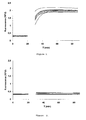
- One strip containing eight NASBAs was placed for 10 minutes at 65°C, while a control was left at 41°C. Afterwards, fluorescence was measured at 41°C for 1 hour.
- NASBAs were carried out, but after 20 minutes the NASBA enzymes were inactivated by leaving NASBA solutions for 10 minutes at 65°C ( fig. 2 ). Control NASBAs were left at 41°C ( fig. 1 ). Fluorescence was measured at 41°C for 1 hour after the heating step ( Figures 1 to 2 ). After the heating step, no increase in fluorescence of any of the beacons is observed for the NASBA solution that had stood at 65°C. The other solution, which had stood at 41°C, shows an increase in fluorescence for all IC, which is normal for a NASBA that is performed with these amounts of template RNA. This means that 10 minutes heating at 65°C stops the NASBA and no more RNA is formed.
- RNase I "A” (Amersham, art nr 27-0323-01, 936 U/mg) at different concentrations (0, 425, 1265, 3840, 11700, 34500, 105000, 315000 and 935000 U/l) were prepared. Twenty seven NASBA reactions were performed with RNA accuspheres containing only IC-RNA as template. A 5 ⁇ l volume of the different RNase A solutions was added at the end of the NASBA. This was done three times for every produced RNase I "A".
- RNase A can be used to break down RNA after a NASBA reaction.
- ribonuclease inhibitor, PRI ribonuclease inhibitor
- RNA degradation is induced or accelerated when the samples were left for 10 minutes at 65°C. Degradation was even accelerated for the sample that did not contain any PRI.
- the increase in reaction rate is, in that case, caused by an increase in activity of RNase A at higher temperature. It is known from literature that the optimum temperature for RNA cleavage by RNase A is 60°C. For samples that did contain PRI, the accelerated RNA cleavage is mainly caused by the inactivation of PRI during the heating for 10 minutes at 65°C.
- NASBA reactions with IC-RNA accuspheres as template were performed in the presence and absence of RNase A and PRI and in the presence of only RNase A. These proteins were added to the enzyme diluent prior to dissolution of the enzyme accusphere.
- the enzyme diluent was prepared by adding 11.2 ⁇ L RNAguard to 9 ⁇ L 46.8 U/mL RNase I "A” and 24.8 ⁇ L enzyme diluent and contained 9.36 U/ml RNase A and 10 U/ ⁇ L PRI.
- the enzyme diluent was prepared by adding 9 ⁇ l 46.8 /mL RNase I "A" to 36 ⁇ l enzyme diluent and contained 9.36 U/ml RNase A. NASBAs were performed in threefold for all 3 conditions.
- NASBA assays in the presence of 2.34 U/mL of Rnase A and 120 copies of IC-RNA as template do not show an increase in fluorescence during the test ( Figure 7 ).
- the IC-curve proceeds like a normal IC-curve for a NASBA when 2 U/ ⁇ L PRI is added besides 2.34 U/mL RNase A. It is not possible to carry out a NASBA reaction when the concentration of RNase A in the solution is 2.34 U/ml. However, this becomes possible when besides RNase A, PRI is added at a concentration of 2 U/ ⁇ l. PRI inhibits RNase A in such a way that a NASBA amplification can be carried out in the presence of both proteins.
- RNase A was activated after the NASBA by leaving the solution for 10 minutes at 65°C. It starts at 1 hour and 20 minutes (1 hour NASBA + 10 minutes measurement of fluorescence + 10 minutes inactivation of PRI). At that temperature PRI irreversibly loses its ability to inhibit RNase A. It was already shown that the NASBA reaction is stopped after leaving the solution for 10 minutes at 65°C and that no more RNA is formed. From the NASBA-curves only the end values are shown in Figure 8 . It is useless to measure fluorescence during the heating step because the high temperature causes all beacons to dissociate from their target and no conclusion can be drawn from the measured signal.
- Heating a normal NASBA for 1 hour at 65°C does not lead to a decrease in fluorescence of the beacon. Unlike for a normal NASBA, heating a NASBA that was carried out in the presence of RNase A and PRI for 10 minutes to 65°C leads to a decrease in fluorescence, which indicates that target RNA is broken down by the RNase A.
- This experiment aims to reduce the time that is necessary for RNase A to degrade RNA to below the level of detection of the molecular beacons
- NASBAs Sixteen NASBAs were carried out with IC-RNA accuspheres as template. four of them were a normal NASBA and twelve were with the addition of RNase A and PRI. For those that were carried out with RNase A and PRI, the enzyme diluent was replaced by a mixture of 24.8 ⁇ l enzyme diluent, 9 ⁇ l 46.8 U/ml RNase I "A" and 11.2 ⁇ l RNAguard. Four samples that contained RNase A and PRI were left at 41°C after the test. The other samples were placed for 10 minutes at 65°C after the NASBA. Afterwards, the normal NASBAs and four of the NASBAs with RNase A and PRI were placed for 4 hours at 60°C. The remaining four NASBAs were placed for 4 hours at 41°C. All samples were put back in the analyzer at 41°C immediately after these temperature treatments. Back in the analyzer, fluorescence was measured using director software.
- RNA degradation after the NASBA was increased by changing the temperature after the PRI inactivation step to 60 °C ( figure 9 ). It is remarkable that RNA degradation also takes place when the PRI is not heat-inactivated, although this process starts later. This means that the PRI can be inactivated even at 41°C.
- NASBAs in the presence of RNase A and PRI were performed with IC-RNA accuspheres as template. At the end of the test they were heated for 10 minutes at 65°C and divided into three groups of four. The groups were put for 2, 3 or 4 hours at 60°C. After the heating all samples were put back in the analyzer at 41°C and fluorescence was measured using director software.
- RNA Only a small amount of RNA was degraded after standing for 2 hours at 60°C ( ⁇ in Figure 10 ). More RNAs are degraded when the period at 60°C is prolonged to 3 hours ( ⁇ ), but the degradation is not sufficient to reach the lower detection limit of the molecular beacons. Again, this was achieved when the solution is left for 4 hours at 60°C ( ⁇ ).
- RNA amplification it is desirable to stop the RNA amplification at the end of a test to enable RNA degradation without simultaneous RNA production. This can be done by heating the NASBA for 10 minutes to 65°C. Although heating to a lower temperature may be sufficient to stop the NASBA, heating for 10 minutes to 65°C is preferred because PRI is inactivated during this temperature treatment. Heating a NASBA reaction that was carried out in the presence of RNase A and PRI for 10 minutes to 65°C stops the RNA production and can simultaneously start RNA degradation by RNase A.
- RNAs are rapidly degraded after a NASBA amplification when RNase A is added to a final concentration of 2.34 U/mL. RNA cleavage by RNase A at that concentration is inhibited when PRI is added to a concentration of at least 2 U/ ⁇ L. These proteins can be added to a HIV-NASBA test at these concentrations without causing a change in the course of the NASBA-curves and without affecting the test result. RNA degradation was also observed for samples that were left at 41°C. In that case it took over 6 hours before RNA degradation was observed. PRI is an unstable enzyme and is probably slowly inactivated at 41°C, causing a slow but steady increase in RNase A activity. After the initial activation, RNA degradation is fastest when the cleavage takes place at 60°C, which is the optimum temperature for RNA cleavage by RNase A.
Landscapes
- Chemical & Material Sciences (AREA)
- Life Sciences & Earth Sciences (AREA)
- Organic Chemistry (AREA)
- Engineering & Computer Science (AREA)
- Zoology (AREA)
- Wood Science & Technology (AREA)
- Proteomics, Peptides & Aminoacids (AREA)
- Health & Medical Sciences (AREA)
- Biophysics (AREA)
- Chemical Kinetics & Catalysis (AREA)
- Immunology (AREA)
- Microbiology (AREA)
- Molecular Biology (AREA)
- Analytical Chemistry (AREA)
- Physics & Mathematics (AREA)
- Biotechnology (AREA)
- Biochemistry (AREA)
- Bioinformatics & Cheminformatics (AREA)
- General Engineering & Computer Science (AREA)
- General Health & Medical Sciences (AREA)
- Genetics & Genomics (AREA)
- Measuring Or Testing Involving Enzymes Or Micro-Organisms (AREA)
- Pharmaceuticals Containing Other Organic And Inorganic Compounds (AREA)
Priority Applications (4)
| Application Number | Priority Date | Filing Date | Title |
|---|---|---|---|
| EP07024024A EP2071034A1 (de) | 2007-12-12 | 2007-12-12 | Verfahren zur Behandlung einer Lösung zum Vernichten von Ribonukleinsäure nach der Amplifikation |
| EP08859087.2A EP2229455B1 (de) | 2007-12-12 | 2008-12-11 | Verfahren zur behandlung einer lösung zum vernichten von ribonukleinsäure nach der amplifikation |
| US12/733,936 US8293476B2 (en) | 2007-12-12 | 2008-12-11 | Method for treating a solution in order to destroy any ribonucleic acid after amplification |
| PCT/EP2008/010519 WO2009074315A2 (en) | 2007-12-12 | 2008-12-11 | Method for treating a solution in order to destroy any ribonucleic acid after amplification |
Applications Claiming Priority (1)
| Application Number | Priority Date | Filing Date | Title |
|---|---|---|---|
| EP07024024A EP2071034A1 (de) | 2007-12-12 | 2007-12-12 | Verfahren zur Behandlung einer Lösung zum Vernichten von Ribonukleinsäure nach der Amplifikation |
Publications (1)
| Publication Number | Publication Date |
|---|---|
| EP2071034A1 true EP2071034A1 (de) | 2009-06-17 |
Family
ID=39135234
Family Applications (2)
| Application Number | Title | Priority Date | Filing Date |
|---|---|---|---|
| EP07024024A Withdrawn EP2071034A1 (de) | 2007-12-12 | 2007-12-12 | Verfahren zur Behandlung einer Lösung zum Vernichten von Ribonukleinsäure nach der Amplifikation |
| EP08859087.2A Not-in-force EP2229455B1 (de) | 2007-12-12 | 2008-12-11 | Verfahren zur behandlung einer lösung zum vernichten von ribonukleinsäure nach der amplifikation |
Family Applications After (1)
| Application Number | Title | Priority Date | Filing Date |
|---|---|---|---|
| EP08859087.2A Not-in-force EP2229455B1 (de) | 2007-12-12 | 2008-12-11 | Verfahren zur behandlung einer lösung zum vernichten von ribonukleinsäure nach der amplifikation |
Country Status (3)
| Country | Link |
|---|---|
| US (1) | US8293476B2 (de) |
| EP (2) | EP2071034A1 (de) |
| WO (1) | WO2009074315A2 (de) |
Cited By (2)
| Publication number | Priority date | Publication date | Assignee | Title |
|---|---|---|---|---|
| WO2011030145A1 (en) * | 2009-09-08 | 2011-03-17 | Enigma Diagnostics Limited | Nucleic acid amplification employing temperature oscillation |
| WO2022248874A1 (en) | 2021-05-27 | 2022-12-01 | Lumiradx Uk Ltd | Improvements in or relating to digestion of reaction products |
Citations (19)
| Publication number | Priority date | Publication date | Assignee | Title |
|---|---|---|---|---|
| US4683202A (en) | 1985-03-28 | 1987-07-28 | Cetus Corporation | Process for amplifying nucleic acid sequences |
| US4683195A (en) | 1986-01-30 | 1987-07-28 | Cetus Corporation | Process for amplifying, detecting, and/or-cloning nucleic acid sequences |
| FR2607507A1 (fr) | 1986-12-02 | 1988-06-03 | Centre Nat Rech Scient | Nouveaux derives a-d-oligonucleotides, leur preparation et leur emploi |
| US4800159A (en) | 1986-02-07 | 1989-01-24 | Cetus Corporation | Process for amplifying, detecting, and/or cloning nucleic acid sequences |
| WO1990001069A1 (en) | 1988-07-20 | 1990-02-08 | Segev Diagnostics, Inc. | Process for amplifying and detecting nucleic acid sequences |
| WO1990006995A1 (en) | 1988-12-16 | 1990-06-28 | Siska Diagnostics, Inc. | Self-sustained sequence replication system |
| EP0389063A2 (de) | 1989-03-23 | 1990-09-26 | Akzo Nobel N.V. | Verfahren zur Reinigung von Nukleinsäuren |
| WO1991002818A1 (en) | 1989-08-23 | 1991-03-07 | Cangene Corporation | Enhanced nucleic acid amplification process |
| WO1993018651A1 (en) | 1992-03-19 | 1993-09-30 | University Of Hawaii | Cyclic anti-tumor promoter compounds, compositions and methods for production and use |
| EP0329822B1 (de) | 1988-02-24 | 1994-06-08 | Cangene Corporation | Verfahren zur Amplifizierung von Nukleinsäuren |
| US5399491A (en) | 1989-07-11 | 1995-03-21 | Gen-Probe Incorporated | Nucleic acid sequence amplification methods |
| US5418149A (en) | 1990-07-24 | 1995-05-23 | Hoffmann-La Roche Inc. | Reduction of non-specific amplification glycosylase using DUTP and DNA uracil |
| WO1995027721A1 (en) | 1994-04-07 | 1995-10-19 | Akzo Nobel N.V. | Freeze-dried compositions comprising rna |
| EP0569272B1 (de) | 1992-04-29 | 1998-06-17 | Bio Merieux | Einstufiges Amplifikationsverfahren für RNS |
| WO1999007887A2 (en) | 1997-08-06 | 1999-02-18 | Norwegian Institute Of Fisheries And Aquaculture Ltd. | A method of removing nucleic acid contamination in amplification reactions |
| US5965399A (en) | 1996-08-16 | 1999-10-12 | Life Technologies, Inc. | Cloning and expression of rat liver and porcine liver ribonuclease inhibitor |
| US20020172972A1 (en) | 2001-05-15 | 2002-11-21 | President And Fellows Of Harvard College | Use of a selectively inactivatable enzyme to digest contaminating nucleic acid |
| EP1366179A2 (de) | 2001-03-07 | 2003-12-03 | bioMerieux B.V | Methode zur amplifizierung und detektion von dna unter verwendung einer auf transkription basierenden amplifizierung |
| WO2004094674A1 (en) * | 2003-03-31 | 2004-11-04 | Promega Corporation | Method of inactivating ribonucleases at high temperature |
Family Cites Families (3)
| Publication number | Priority date | Publication date | Assignee | Title |
|---|---|---|---|---|
| JP3924330B2 (ja) * | 1997-05-23 | 2007-06-06 | 天生水産株式会社 | 新規タンパク質、その遺伝子、アポトーシス誘導用試薬及び抗ガン剤 |
| US8426126B2 (en) | 2004-03-18 | 2013-04-23 | Applied Biosystems, Llc | Modified surfaces as solid supports for nucleic acid purification |
| US7361465B2 (en) | 2004-09-07 | 2008-04-22 | Applera Corporation | Methods and compositions for tailing and amplifying RNA |
-
2007
- 2007-12-12 EP EP07024024A patent/EP2071034A1/de not_active Withdrawn
-
2008
- 2008-12-11 US US12/733,936 patent/US8293476B2/en not_active Expired - Fee Related
- 2008-12-11 EP EP08859087.2A patent/EP2229455B1/de not_active Not-in-force
- 2008-12-11 WO PCT/EP2008/010519 patent/WO2009074315A2/en not_active Ceased
Patent Citations (21)
| Publication number | Priority date | Publication date | Assignee | Title |
|---|---|---|---|---|
| US4683202A (en) | 1985-03-28 | 1987-07-28 | Cetus Corporation | Process for amplifying nucleic acid sequences |
| US4683202B1 (de) | 1985-03-28 | 1990-11-27 | Cetus Corp | |
| US4683195A (en) | 1986-01-30 | 1987-07-28 | Cetus Corporation | Process for amplifying, detecting, and/or-cloning nucleic acid sequences |
| US4683195B1 (de) | 1986-01-30 | 1990-11-27 | Cetus Corp | |
| US4800159A (en) | 1986-02-07 | 1989-01-24 | Cetus Corporation | Process for amplifying, detecting, and/or cloning nucleic acid sequences |
| FR2607507A1 (fr) | 1986-12-02 | 1988-06-03 | Centre Nat Rech Scient | Nouveaux derives a-d-oligonucleotides, leur preparation et leur emploi |
| EP0329822B1 (de) | 1988-02-24 | 1994-06-08 | Cangene Corporation | Verfahren zur Amplifizierung von Nukleinsäuren |
| WO1990001069A1 (en) | 1988-07-20 | 1990-02-08 | Segev Diagnostics, Inc. | Process for amplifying and detecting nucleic acid sequences |
| WO1990006995A1 (en) | 1988-12-16 | 1990-06-28 | Siska Diagnostics, Inc. | Self-sustained sequence replication system |
| EP0389063A2 (de) | 1989-03-23 | 1990-09-26 | Akzo Nobel N.V. | Verfahren zur Reinigung von Nukleinsäuren |
| US5399491A (en) | 1989-07-11 | 1995-03-21 | Gen-Probe Incorporated | Nucleic acid sequence amplification methods |
| WO1991002818A1 (en) | 1989-08-23 | 1991-03-07 | Cangene Corporation | Enhanced nucleic acid amplification process |
| US5418149A (en) | 1990-07-24 | 1995-05-23 | Hoffmann-La Roche Inc. | Reduction of non-specific amplification glycosylase using DUTP and DNA uracil |
| WO1993018651A1 (en) | 1992-03-19 | 1993-09-30 | University Of Hawaii | Cyclic anti-tumor promoter compounds, compositions and methods for production and use |
| EP0569272B1 (de) | 1992-04-29 | 1998-06-17 | Bio Merieux | Einstufiges Amplifikationsverfahren für RNS |
| WO1995027721A1 (en) | 1994-04-07 | 1995-10-19 | Akzo Nobel N.V. | Freeze-dried compositions comprising rna |
| US5965399A (en) | 1996-08-16 | 1999-10-12 | Life Technologies, Inc. | Cloning and expression of rat liver and porcine liver ribonuclease inhibitor |
| WO1999007887A2 (en) | 1997-08-06 | 1999-02-18 | Norwegian Institute Of Fisheries And Aquaculture Ltd. | A method of removing nucleic acid contamination in amplification reactions |
| EP1366179A2 (de) | 2001-03-07 | 2003-12-03 | bioMerieux B.V | Methode zur amplifizierung und detektion von dna unter verwendung einer auf transkription basierenden amplifizierung |
| US20020172972A1 (en) | 2001-05-15 | 2002-11-21 | President And Fellows Of Harvard College | Use of a selectively inactivatable enzyme to digest contaminating nucleic acid |
| WO2004094674A1 (en) * | 2003-03-31 | 2004-11-04 | Promega Corporation | Method of inactivating ribonucleases at high temperature |
Non-Patent Citations (6)
| Title |
|---|
| BENCINA MOJCA ET AL: "Preparation and characterisation of ribonuclease monolithic bioreactor", JOURNAL OF CHROMATOGRAPHY A, vol. 1144, no. 1, March 2007 (2007-03-01), pages 135 - 142, XP002472062, ISSN: 0021-9673 * |
| BLACKBURN ET AL., JOURNAL OF BIOLOGICAL CHEMISTRY, vol. 252, no. 16, 1977, pages 5904 - 5910 |
| M. EGHOLM ET AL., J. AM. CHEM. SOC., vol. 114, 1992, pages 1895 - 1897 |
| PIATEK ET AL., NATURE BIOTECHNOLOGY, vol. 16, 1998, pages 359 - 363 |
| RAINES ET AL., CHEM. REV., vol. 98, 1998, pages 1045 - 1065 |
| TYAGI; KRAMER, NATURE BIOTECHNOLOGY, vol. 14, 1996, pages 303 - 308 |
Cited By (2)
| Publication number | Priority date | Publication date | Assignee | Title |
|---|---|---|---|---|
| WO2011030145A1 (en) * | 2009-09-08 | 2011-03-17 | Enigma Diagnostics Limited | Nucleic acid amplification employing temperature oscillation |
| WO2022248874A1 (en) | 2021-05-27 | 2022-12-01 | Lumiradx Uk Ltd | Improvements in or relating to digestion of reaction products |
Also Published As
| Publication number | Publication date |
|---|---|
| WO2009074315A2 (en) | 2009-06-18 |
| EP2229455A2 (de) | 2010-09-22 |
| US8293476B2 (en) | 2012-10-23 |
| WO2009074315A3 (en) | 2009-11-12 |
| US20100233713A1 (en) | 2010-09-16 |
| EP2229455B1 (de) | 2016-03-30 |
Similar Documents
| Publication | Publication Date | Title |
|---|---|---|
| EP0684315B1 (de) | Strangverdrängungsamplifikation unter Verwendung von thermophilen Enzymen | |
| US8846312B2 (en) | Compositions and methods for detecting certain flaviviruses, including members of the Japanese encephalitis virus serogroup | |
| EP0373960B1 (de) | 4 Selbstfortsetzendes System für Sequenzreplikation | |
| KR20120058520A (ko) | 역전사 및 증폭반응에서 핵산 오염을 제거하는 방법 | |
| JPH09107997A (ja) | 標的核酸の増幅方法及び増幅キット並びにpcr用組成物 | |
| EP3655554B1 (de) | Zusammensetzungen und verfahren zum nachweis von babesia | |
| US20110086354A1 (en) | Methods and compositions for multiplex pcr amplifications | |
| EP4022086B1 (de) | Zusammensetzungen und verfahren zur amplifikation und detektion von hepatitis-b-virus-rna, einschliesslich aus cccdna transkribierter hbv-rna | |
| EP2256215A1 (de) | Testsystem unter Verwendung einer Nukleaseaktivität einer Nukleinsäurepolymerase | |
| US7074558B2 (en) | Nucleic acid amplification using an RNA polymerase and DNA/RNA mixed polymer intermediate products | |
| US20120052482A1 (en) | Kit for detecting hepatitis c virus and method of detecting hepatitis c virus using the same | |
| CA2579918A1 (en) | Nucleic acid detection method involving the direct generation of a measurable signal | |
| US8293476B2 (en) | Method for treating a solution in order to destroy any ribonucleic acid after amplification | |
| CA3009716C (en) | Generic method for the stabilization of specific rna | |
| JP5052500B2 (ja) | Dnaの同時分解を伴う逆転写及びrnaの増幅 | |
| EP4577674A1 (de) | Zusammensetzungen und verfahren zum nachweis des affektoxvirus | |
| EP3469102B1 (de) | Zusammensetzungen und verfahren zur detektion von hepatitis-c-virus-genotyp 3 | |
| EP3494227B1 (de) | Helfer-oligonukleotid zur verbesserung der effizienz der amplifikation und detektion/quantifizierung von nukleinsäuren | |
| JP7628085B2 (ja) | 鎖分離温度に基づくDNAに対してRNA標的の優先的/選択的増幅のためのdITPの利用 | |
| HK1093224B (en) | Compositions and methods for detecting certain flaviviruses, including members of the japanese encephalitis virus serogroup | |
| WO2002101041A1 (en) | Method of amplifying nucleic acid and method of detecting nucleotide polymorphism with the use of nucleotide analog |
Legal Events
| Date | Code | Title | Description |
|---|---|---|---|
| PUAI | Public reference made under article 153(3) epc to a published international application that has entered the european phase |
Free format text: ORIGINAL CODE: 0009012 |
|
| 17P | Request for examination filed |
Effective date: 20071224 |
|
| AK | Designated contracting states |
Kind code of ref document: A1 Designated state(s): AT BE BG CH CY CZ DE DK EE ES FI FR GB GR HU IE IS IT LI LT LU LV MC MT NL PL PT RO SE SI SK TR |
|
| AX | Request for extension of the european patent |
Extension state: AL BA HR MK RS |
|
| AKX | Designation fees paid |
Designated state(s): AT BE BG CH CY CZ DE DK EE ES FI FR GB GR HU IE IS IT LI LT LU LV MC MT NL PL PT RO SE SI SK TR |
|
| STAA | Information on the status of an ep patent application or granted ep patent |
Free format text: STATUS: THE APPLICATION IS DEEMED TO BE WITHDRAWN |
|
| 18D | Application deemed to be withdrawn |
Effective date: 20091217 |