EP2073045A1 - Procédé de préparation de multicouches présentant une structure mésoporeuse ordonnée, matériau ainsi obtenu et son utilisation - Google Patents
Procédé de préparation de multicouches présentant une structure mésoporeuse ordonnée, matériau ainsi obtenu et son utilisation Download PDFInfo
- Publication number
- EP2073045A1 EP2073045A1 EP07823056A EP07823056A EP2073045A1 EP 2073045 A1 EP2073045 A1 EP 2073045A1 EP 07823056 A EP07823056 A EP 07823056A EP 07823056 A EP07823056 A EP 07823056A EP 2073045 A1 EP2073045 A1 EP 2073045A1
- Authority
- EP
- European Patent Office
- Prior art keywords
- mesoporous structure
- ordered mesoporous
- structure according
- multilayer
- film
- Prior art date
- Legal status (The legal status is an assumption and is not a legal conclusion. Google has not performed a legal analysis and makes no representation as to the accuracy of the status listed.)
- Withdrawn
Links
- 239000000463 material Substances 0.000 title claims description 50
- 238000004519 manufacturing process Methods 0.000 title claims description 27
- 238000000034 method Methods 0.000 claims abstract description 24
- 239000011148 porous material Substances 0.000 claims abstract description 21
- 239000004094 surface-active agent Substances 0.000 claims abstract description 20
- 239000000203 mixture Substances 0.000 claims abstract description 17
- 230000008569 process Effects 0.000 claims abstract description 16
- LFQSCWFLJHTTHZ-UHFFFAOYSA-N Ethanol Chemical compound CCO LFQSCWFLJHTTHZ-UHFFFAOYSA-N 0.000 claims description 42
- 239000002243 precursor Substances 0.000 claims description 40
- 230000003287 optical effect Effects 0.000 claims description 36
- VYPSYNLAJGMNEJ-UHFFFAOYSA-N silicon dioxide Inorganic materials O=[Si]=O VYPSYNLAJGMNEJ-UHFFFAOYSA-N 0.000 claims description 35
- XLYOFNOQVPJJNP-UHFFFAOYSA-N water Substances O XLYOFNOQVPJJNP-UHFFFAOYSA-N 0.000 claims description 29
- 239000000758 substrate Substances 0.000 claims description 28
- 239000002904 solvent Substances 0.000 claims description 27
- 229910052710 silicon Inorganic materials 0.000 claims description 19
- OKKJLVBELUTLKV-UHFFFAOYSA-N Methanol Chemical compound OC OKKJLVBELUTLKV-UHFFFAOYSA-N 0.000 claims description 18
- 238000002360 preparation method Methods 0.000 claims description 18
- 238000000151 deposition Methods 0.000 claims description 14
- 239000011521 glass Substances 0.000 claims description 14
- 238000010438 heat treatment Methods 0.000 claims description 14
- 230000006641 stabilisation Effects 0.000 claims description 14
- 238000011105 stabilization Methods 0.000 claims description 14
- 238000003618 dip coating Methods 0.000 claims description 13
- LRHPLDYGYMQRHN-UHFFFAOYSA-N N-Butanol Chemical compound CCCCO LRHPLDYGYMQRHN-UHFFFAOYSA-N 0.000 claims description 12
- XUIMIQQOPSSXEZ-UHFFFAOYSA-N Silicon Chemical compound [Si] XUIMIQQOPSSXEZ-UHFFFAOYSA-N 0.000 claims description 11
- 239000007788 liquid Substances 0.000 claims description 11
- 150000007522 mineralic acids Chemical class 0.000 claims description 11
- 239000010703 silicon Substances 0.000 claims description 11
- WYURNTSHIVDZCO-UHFFFAOYSA-N Tetrahydrofuran Chemical compound C1CCOC1 WYURNTSHIVDZCO-UHFFFAOYSA-N 0.000 claims description 10
- -1 poly(oxyethylene) Polymers 0.000 claims description 10
- KFZMGEQAYNKOFK-UHFFFAOYSA-N Isopropanol Chemical compound CC(C)O KFZMGEQAYNKOFK-UHFFFAOYSA-N 0.000 claims description 9
- 229910052751 metal Inorganic materials 0.000 claims description 9
- 239000002184 metal Substances 0.000 claims description 9
- 238000001179 sorption measurement Methods 0.000 claims description 9
- CSCPPACGZOOCGX-UHFFFAOYSA-N Acetone Chemical compound CC(C)=O CSCPPACGZOOCGX-UHFFFAOYSA-N 0.000 claims description 8
- 238000005406 washing Methods 0.000 claims description 8
- VEXZGXHMUGYJMC-UHFFFAOYSA-N Hydrochloric acid Chemical compound Cl VEXZGXHMUGYJMC-UHFFFAOYSA-N 0.000 claims description 7
- 239000012298 atmosphere Substances 0.000 claims description 7
- 230000001588 bifunctional effect Effects 0.000 claims description 7
- 125000002524 organometallic group Chemical group 0.000 claims description 7
- 125000001997 phenyl group Chemical group [H]C1=C([H])C([H])=C(*)C([H])=C1[H] 0.000 claims description 7
- RTZKZFJDLAIYFH-UHFFFAOYSA-N Diethyl ether Chemical compound CCOCC RTZKZFJDLAIYFH-UHFFFAOYSA-N 0.000 claims description 6
- 230000032683 aging Effects 0.000 claims description 6
- HHFAWKCIHAUFRX-UHFFFAOYSA-N ethoxide Chemical compound CC[O-] HHFAWKCIHAUFRX-UHFFFAOYSA-N 0.000 claims description 6
- 238000000605 extraction Methods 0.000 claims description 6
- 239000002736 nonionic surfactant Substances 0.000 claims description 6
- 229920000642 polymer Polymers 0.000 claims description 6
- IOLCXVTUBQKXJR-UHFFFAOYSA-M potassium bromide Chemical compound [K+].[Br-] IOLCXVTUBQKXJR-UHFFFAOYSA-M 0.000 claims description 6
- BDERNNFJNOPAEC-UHFFFAOYSA-N propan-1-ol Chemical compound CCCO BDERNNFJNOPAEC-UHFFFAOYSA-N 0.000 claims description 6
- IKNCGYCHMGNBCP-UHFFFAOYSA-N propan-1-olate Chemical compound CCC[O-] IKNCGYCHMGNBCP-UHFFFAOYSA-N 0.000 claims description 6
- OGHBATFHNDZKSO-UHFFFAOYSA-N propan-2-olate Chemical compound CC(C)[O-] OGHBATFHNDZKSO-UHFFFAOYSA-N 0.000 claims description 6
- 238000004528 spin coating Methods 0.000 claims description 6
- 238000003756 stirring Methods 0.000 claims description 6
- 229910052719 titanium Inorganic materials 0.000 claims description 6
- LGQXXHMEBUOXRP-UHFFFAOYSA-N tributyl borate Chemical compound CCCCOB(OCCCC)OCCCC LGQXXHMEBUOXRP-UHFFFAOYSA-N 0.000 claims description 6
- VEXZGXHMUGYJMC-UHFFFAOYSA-M Chloride anion Chemical compound [Cl-] VEXZGXHMUGYJMC-UHFFFAOYSA-M 0.000 claims description 5
- 150000004703 alkoxides Chemical class 0.000 claims description 5
- 230000008030 elimination Effects 0.000 claims description 5
- 238000003379 elimination reaction Methods 0.000 claims description 5
- 125000000524 functional group Chemical group 0.000 claims description 5
- GRYLNZFGIOXLOG-UHFFFAOYSA-N Nitric acid Chemical compound O[N+]([O-])=O GRYLNZFGIOXLOG-UHFFFAOYSA-N 0.000 claims description 4
- 239000002253 acid Substances 0.000 claims description 4
- 238000013019 agitation Methods 0.000 claims description 4
- 230000005540 biological transmission Effects 0.000 claims description 4
- 239000003153 chemical reaction reagent Substances 0.000 claims description 4
- 238000002329 infrared spectrum Methods 0.000 claims description 4
- 229910052809 inorganic oxide Inorganic materials 0.000 claims description 4
- 229910017604 nitric acid Inorganic materials 0.000 claims description 4
- 239000010453 quartz Substances 0.000 claims description 4
- POILWHVDKZOXJZ-ARJAWSKDSA-M (z)-4-oxopent-2-en-2-olate Chemical compound C\C([O-])=C\C(C)=O POILWHVDKZOXJZ-ARJAWSKDSA-M 0.000 claims description 3
- 229910019142 PO4 Inorganic materials 0.000 claims description 3
- 150000001298 alcohols Chemical class 0.000 claims description 3
- 150000001299 aldehydes Chemical class 0.000 claims description 3
- 150000003973 alkyl amines Chemical class 0.000 claims description 3
- 125000000217 alkyl group Chemical group 0.000 claims description 3
- 125000004414 alkyl thio group Chemical group 0.000 claims description 3
- 125000000304 alkynyl group Chemical group 0.000 claims description 3
- 150000001412 amines Chemical class 0.000 claims description 3
- 125000004429 atom Chemical group 0.000 claims description 3
- WUKWITHWXAAZEY-UHFFFAOYSA-L calcium difluoride Chemical compound [F-].[F-].[Ca+2] WUKWITHWXAAZEY-UHFFFAOYSA-L 0.000 claims description 3
- 229910001634 calcium fluoride Inorganic materials 0.000 claims description 3
- 125000004432 carbon atom Chemical group C* 0.000 claims description 3
- 150000007942 carboxylates Chemical class 0.000 claims description 3
- 239000004020 conductor Substances 0.000 claims description 3
- 150000004292 cyclic ethers Chemical class 0.000 claims description 3
- 229920000359 diblock copolymer Polymers 0.000 claims description 3
- 238000001035 drying Methods 0.000 claims description 3
- 229920001477 hydrophilic polymer Polymers 0.000 claims description 3
- 238000007654 immersion Methods 0.000 claims description 3
- 238000012423 maintenance Methods 0.000 claims description 3
- 229910052758 niobium Inorganic materials 0.000 claims description 3
- VLTRZXGMWDSKGL-UHFFFAOYSA-N perchloric acid Chemical compound OCl(=O)(=O)=O VLTRZXGMWDSKGL-UHFFFAOYSA-N 0.000 claims description 3
- NBIIXXVUZAFLBC-UHFFFAOYSA-K phosphate Chemical compound [O-]P([O-])([O-])=O NBIIXXVUZAFLBC-UHFFFAOYSA-K 0.000 claims description 3
- 239000010452 phosphate Substances 0.000 claims description 3
- UEZVMMHDMIWARA-UHFFFAOYSA-M phosphonate Chemical compound [O-]P(=O)=O UEZVMMHDMIWARA-UHFFFAOYSA-M 0.000 claims description 3
- 229920006389 polyphenyl polymer Polymers 0.000 claims description 3
- QQONPFPTGQHPMA-UHFFFAOYSA-N propylene Natural products CC=C QQONPFPTGQHPMA-UHFFFAOYSA-N 0.000 claims description 3
- 125000004805 propylene group Chemical group [H]C([H])([H])C([H])([*:1])C([H])([H])[*:2] 0.000 claims description 3
- YLQBMQCUIZJEEH-UHFFFAOYSA-N tetrahydrofuran Natural products C=1C=COC=1 YLQBMQCUIZJEEH-UHFFFAOYSA-N 0.000 claims description 3
- 150000003573 thiols Chemical class 0.000 claims description 3
- ZDHXKXAHOVTTAH-UHFFFAOYSA-N trichlorosilane Chemical compound Cl[SiH](Cl)Cl ZDHXKXAHOVTTAH-UHFFFAOYSA-N 0.000 claims description 3
- 239000005052 trichlorosilane Substances 0.000 claims description 3
- 229910052720 vanadium Inorganic materials 0.000 claims description 3
- 229910052726 zirconium Inorganic materials 0.000 claims description 3
- 125000003903 2-propenyl group Chemical group [H]C([*])([H])C([H])=C([H])[H] 0.000 claims description 2
- 229910052684 Cerium Inorganic materials 0.000 claims description 2
- 150000001252 acrylic acid derivatives Chemical class 0.000 claims description 2
- 150000001875 compounds Chemical class 0.000 claims description 2
- 150000002170 ethers Chemical class 0.000 claims description 2
- 150000002734 metacrylic acid derivatives Chemical class 0.000 claims description 2
- 239000002120 nanofilm Substances 0.000 claims description 2
- 230000004044 response Effects 0.000 claims description 2
- 125000000391 vinyl group Chemical group [H]C([*])=C([H])[H] 0.000 claims description 2
- 229920002554 vinyl polymer Polymers 0.000 claims description 2
- 230000001699 photocatalysis Effects 0.000 claims 1
- 238000003980 solgel method Methods 0.000 abstract description 10
- 238000007306 functionalization reaction Methods 0.000 abstract description 8
- 239000000126 substance Substances 0.000 abstract description 4
- 239000011368 organic material Substances 0.000 abstract description 2
- 239000000470 constituent Substances 0.000 abstract 1
- 239000011147 inorganic material Substances 0.000 abstract 1
- 229910010272 inorganic material Inorganic materials 0.000 abstract 1
- 238000001338 self-assembly Methods 0.000 abstract 1
- 239000010410 layer Substances 0.000 description 82
- 239000010408 film Substances 0.000 description 69
- 239000000243 solution Substances 0.000 description 56
- GWEVSGVZZGPLCZ-UHFFFAOYSA-N Titan oxide Chemical compound O=[Ti]=O GWEVSGVZZGPLCZ-UHFFFAOYSA-N 0.000 description 37
- YXFVVABEGXRONW-UHFFFAOYSA-N Toluene Chemical compound CC1=CC=CC=C1 YXFVVABEGXRONW-UHFFFAOYSA-N 0.000 description 24
- 238000011282 treatment Methods 0.000 description 19
- 229910052681 coesite Inorganic materials 0.000 description 15
- 229910052906 cristobalite Inorganic materials 0.000 description 15
- 239000000377 silicon dioxide Substances 0.000 description 15
- 229910052682 stishovite Inorganic materials 0.000 description 15
- 229910052905 tridymite Inorganic materials 0.000 description 15
- 229910021426 porous silicon Inorganic materials 0.000 description 12
- 238000001354 calcination Methods 0.000 description 9
- 235000012239 silicon dioxide Nutrition 0.000 description 8
- 239000007787 solid Substances 0.000 description 8
- 238000007669 thermal treatment Methods 0.000 description 7
- 239000010936 titanium Substances 0.000 description 7
- 230000008901 benefit Effects 0.000 description 6
- 230000015572 biosynthetic process Effects 0.000 description 6
- 238000000280 densification Methods 0.000 description 6
- 238000003786 synthesis reaction Methods 0.000 description 6
- 238000009833 condensation Methods 0.000 description 5
- 238000005530 etching Methods 0.000 description 5
- 239000004038 photonic crystal Substances 0.000 description 5
- 238000000985 reflectance spectrum Methods 0.000 description 5
- 239000010409 thin film Substances 0.000 description 5
- BOTDANWDWHJENH-UHFFFAOYSA-N Tetraethyl orthosilicate Chemical compound CCO[Si](OCC)(OCC)OCC BOTDANWDWHJENH-UHFFFAOYSA-N 0.000 description 4
- MCMNRKCIXSYSNV-UHFFFAOYSA-N Zirconium dioxide Chemical compound O=[Zr]=O MCMNRKCIXSYSNV-UHFFFAOYSA-N 0.000 description 4
- 238000010521 absorption reaction Methods 0.000 description 4
- 230000005494 condensation Effects 0.000 description 4
- 239000013078 crystal Substances 0.000 description 4
- 238000005259 measurement Methods 0.000 description 4
- 230000008439 repair process Effects 0.000 description 4
- 235000012431 wafers Nutrition 0.000 description 4
- 229910003074 TiCl4 Inorganic materials 0.000 description 3
- RTAQQCXQSZGOHL-UHFFFAOYSA-N Titanium Chemical compound [Ti] RTAQQCXQSZGOHL-UHFFFAOYSA-N 0.000 description 3
- 238000004090 dissolution Methods 0.000 description 3
- 238000002310 reflectometry Methods 0.000 description 3
- 238000001228 spectrum Methods 0.000 description 3
- XJDNKRIXUMDJCW-UHFFFAOYSA-J titanium tetrachloride Chemical compound Cl[Ti](Cl)(Cl)Cl XJDNKRIXUMDJCW-UHFFFAOYSA-J 0.000 description 3
- 229910004298 SiO 2 Inorganic materials 0.000 description 2
- 229910010413 TiO 2 Inorganic materials 0.000 description 2
- 238000004458 analytical method Methods 0.000 description 2
- 239000007864 aqueous solution Substances 0.000 description 2
- 238000001311 chemical methods and process Methods 0.000 description 2
- 238000000576 coating method Methods 0.000 description 2
- 238000002425 crystallisation Methods 0.000 description 2
- 238000011161 development Methods 0.000 description 2
- 230000018109 developmental process Effects 0.000 description 2
- 239000006185 dispersion Substances 0.000 description 2
- 238000006073 displacement reaction Methods 0.000 description 2
- 238000009826 distribution Methods 0.000 description 2
- 238000000445 field-emission scanning electron microscopy Methods 0.000 description 2
- 239000007789 gas Substances 0.000 description 2
- 230000007062 hydrolysis Effects 0.000 description 2
- 238000006460 hydrolysis reaction Methods 0.000 description 2
- 238000011835 investigation Methods 0.000 description 2
- 238000001000 micrograph Methods 0.000 description 2
- 238000012986 modification Methods 0.000 description 2
- 230000004048 modification Effects 0.000 description 2
- 230000001105 regulatory effect Effects 0.000 description 2
- 238000000926 separation method Methods 0.000 description 2
- 238000000235 small-angle X-ray scattering Methods 0.000 description 2
- 230000003595 spectral effect Effects 0.000 description 2
- 238000000411 transmission spectrum Methods 0.000 description 2
- 238000002371 ultraviolet--visible spectrum Methods 0.000 description 2
- 241001439211 Almeida Species 0.000 description 1
- LZZYPRNAOMGNLH-UHFFFAOYSA-M Cetrimonium bromide Chemical compound [Br-].CCCCCCCCCCCCCCCC[N+](C)(C)C LZZYPRNAOMGNLH-UHFFFAOYSA-M 0.000 description 1
- 238000005033 Fourier transform infrared spectroscopy Methods 0.000 description 1
- QLZHNIAADXEJJP-UHFFFAOYSA-N Phenylphosphonic acid Chemical compound OP(O)(=O)C1=CC=CC=C1 QLZHNIAADXEJJP-UHFFFAOYSA-N 0.000 description 1
- GEIAQOFPUVMAGM-UHFFFAOYSA-N ZrO Inorganic materials [Zr]=O GEIAQOFPUVMAGM-UHFFFAOYSA-N 0.000 description 1
- NIXOWILDQLNWCW-UHFFFAOYSA-N acrylic acid group Chemical group C(C=C)(=O)O NIXOWILDQLNWCW-UHFFFAOYSA-N 0.000 description 1
- 238000004873 anchoring Methods 0.000 description 1
- ICSSIKVYVJQJND-UHFFFAOYSA-N calcium nitrate tetrahydrate Chemical compound O.O.O.O.[Ca+2].[O-][N+]([O-])=O.[O-][N+]([O-])=O ICSSIKVYVJQJND-UHFFFAOYSA-N 0.000 description 1
- 239000000919 ceramic Substances 0.000 description 1
- 230000008859 change Effects 0.000 description 1
- 238000012512 characterization method Methods 0.000 description 1
- 239000003795 chemical substances by application Substances 0.000 description 1
- 238000010668 complexation reaction Methods 0.000 description 1
- 230000006835 compression Effects 0.000 description 1
- 238000007906 compression Methods 0.000 description 1
- 239000012141 concentrate Substances 0.000 description 1
- 230000001276 controlling effect Effects 0.000 description 1
- 230000007797 corrosion Effects 0.000 description 1
- 238000005260 corrosion Methods 0.000 description 1
- 230000008025 crystallization Effects 0.000 description 1
- 239000008367 deionised water Substances 0.000 description 1
- 230000008021 deposition Effects 0.000 description 1
- 238000001212 derivatisation Methods 0.000 description 1
- 238000013461 design Methods 0.000 description 1
- 239000003599 detergent Substances 0.000 description 1
- 238000010586 diagram Methods 0.000 description 1
- RNPXCFINMKSQPQ-UHFFFAOYSA-N dicetyl hydrogen phosphate Chemical compound CCCCCCCCCCCCCCCCOP(O)(=O)OCCCCCCCCCCCCCCCC RNPXCFINMKSQPQ-UHFFFAOYSA-N 0.000 description 1
- BVDPFTQTMQKPGQ-UHFFFAOYSA-N ethanol hydrofluoride Chemical compound F.CCO BVDPFTQTMQKPGQ-UHFFFAOYSA-N 0.000 description 1
- 238000002474 experimental method Methods 0.000 description 1
- 238000000349 field-emission scanning electron micrograph Methods 0.000 description 1
- 239000012530 fluid Substances 0.000 description 1
- 230000008570 general process Effects 0.000 description 1
- 229910001385 heavy metal Inorganic materials 0.000 description 1
- 238000000265 homogenisation Methods 0.000 description 1
- 238000011065 in-situ storage Methods 0.000 description 1
- 238000005305 interferometry Methods 0.000 description 1
- 150000002500 ions Chemical class 0.000 description 1
- JEIPFZHSYJVQDO-UHFFFAOYSA-N iron(III) oxide Inorganic materials O=[Fe]O[Fe]=O JEIPFZHSYJVQDO-UHFFFAOYSA-N 0.000 description 1
- 230000001788 irregular Effects 0.000 description 1
- 230000007774 longterm Effects 0.000 description 1
- 150000002739 metals Chemical class 0.000 description 1
- 229910021421 monocrystalline silicon Inorganic materials 0.000 description 1
- 239000005304 optical glass Substances 0.000 description 1
- 125000000962 organic group Chemical group 0.000 description 1
- 230000003647 oxidation Effects 0.000 description 1
- 238000007254 oxidation reaction Methods 0.000 description 1
- 125000000913 palmityl group Chemical group [H]C([*])([H])C([H])([H])C([H])([H])C([H])([H])C([H])([H])C([H])([H])C([H])([H])C([H])([H])C([H])([H])C([H])([H])C([H])([H])C([H])([H])C([H])([H])C([H])([H])C([H])([H])C([H])([H])[H] 0.000 description 1
- 230000000737 periodic effect Effects 0.000 description 1
- 238000005240 physical vapour deposition Methods 0.000 description 1
- 229920001983 poloxamer Polymers 0.000 description 1
- 239000002244 precipitate Substances 0.000 description 1
- 230000001737 promoting effect Effects 0.000 description 1
- 230000005855 radiation Effects 0.000 description 1
- 229920006395 saturated elastomer Polymers 0.000 description 1
- 239000004065 semiconductor Substances 0.000 description 1
- 239000004054 semiconductor nanocrystal Substances 0.000 description 1
- 230000035939 shock Effects 0.000 description 1
- 229910052814 silicon oxide Inorganic materials 0.000 description 1
- 239000002356 single layer Substances 0.000 description 1
- 239000002689 soil Substances 0.000 description 1
- 241000894007 species Species 0.000 description 1
- 238000012306 spectroscopic technique Methods 0.000 description 1
- 230000035882 stress Effects 0.000 description 1
- 230000002194 synthesizing effect Effects 0.000 description 1
- OGIDPMRJRNCKJF-UHFFFAOYSA-N titanium oxide Inorganic materials [Ti]=O OGIDPMRJRNCKJF-UHFFFAOYSA-N 0.000 description 1
- 238000002834 transmittance Methods 0.000 description 1
- 238000001797 two-dimensional small-angle X-ray scattering Methods 0.000 description 1
- 238000001429 visible spectrum Methods 0.000 description 1
Images





Classifications
-
- G—PHYSICS
- G02—OPTICS
- G02B—OPTICAL ELEMENTS, SYSTEMS OR APPARATUS
- G02B6/00—Light guides; Structural details of arrangements comprising light guides and other optical elements, e.g. couplings
- G02B6/10—Light guides; Structural details of arrangements comprising light guides and other optical elements, e.g. couplings of the optical waveguide type
- G02B6/12—Light guides; Structural details of arrangements comprising light guides and other optical elements, e.g. couplings of the optical waveguide type of the integrated circuit kind
- G02B6/13—Integrated optical circuits characterised by the manufacturing method
- G02B6/132—Integrated optical circuits characterised by the manufacturing method by deposition of thin films
-
- G—PHYSICS
- G02—OPTICS
- G02B—OPTICAL ELEMENTS, SYSTEMS OR APPARATUS
- G02B5/00—Optical elements other than lenses
- G02B5/20—Filters
- G02B5/28—Interference filters
- G02B5/285—Interference filters comprising deposited thin solid films
-
- B—PERFORMING OPERATIONS; TRANSPORTING
- B82—NANOTECHNOLOGY
- B82Y—SPECIFIC USES OR APPLICATIONS OF NANOSTRUCTURES; MEASUREMENT OR ANALYSIS OF NANOSTRUCTURES; MANUFACTURE OR TREATMENT OF NANOSTRUCTURES
- B82Y20/00—Nanooptics, e.g. quantum optics or photonic crystals
-
- B—PERFORMING OPERATIONS; TRANSPORTING
- B82—NANOTECHNOLOGY
- B82Y—SPECIFIC USES OR APPLICATIONS OF NANOSTRUCTURES; MEASUREMENT OR ANALYSIS OF NANOSTRUCTURES; MANUFACTURE OR TREATMENT OF NANOSTRUCTURES
- B82Y30/00—Nanotechnology for materials or surface science, e.g. nanocomposites
-
- B—PERFORMING OPERATIONS; TRANSPORTING
- B82—NANOTECHNOLOGY
- B82Y—SPECIFIC USES OR APPLICATIONS OF NANOSTRUCTURES; MEASUREMENT OR ANALYSIS OF NANOSTRUCTURES; MANUFACTURE OR TREATMENT OF NANOSTRUCTURES
- B82Y40/00—Manufacture or treatment of nanostructures
-
- C—CHEMISTRY; METALLURGY
- C23—COATING METALLIC MATERIAL; COATING MATERIAL WITH METALLIC MATERIAL; CHEMICAL SURFACE TREATMENT; DIFFUSION TREATMENT OF METALLIC MATERIAL; COATING BY VACUUM EVAPORATION, BY SPUTTERING, BY ION IMPLANTATION OR BY CHEMICAL VAPOUR DEPOSITION, IN GENERAL; INHIBITING CORROSION OF METALLIC MATERIAL OR INCRUSTATION IN GENERAL
- C23C—COATING METALLIC MATERIAL; COATING MATERIAL WITH METALLIC MATERIAL; SURFACE TREATMENT OF METALLIC MATERIAL BY DIFFUSION INTO THE SURFACE, BY CHEMICAL CONVERSION OR SUBSTITUTION; COATING BY VACUUM EVAPORATION, BY SPUTTERING, BY ION IMPLANTATION OR BY CHEMICAL VAPOUR DEPOSITION, IN GENERAL
- C23C18/00—Chemical coating by decomposition of either liquid compounds or solutions of the coating forming compounds, without leaving reaction products of surface material in the coating; Contact plating
- C23C18/02—Chemical coating by decomposition of either liquid compounds or solutions of the coating forming compounds, without leaving reaction products of surface material in the coating; Contact plating by thermal decomposition
- C23C18/12—Chemical coating by decomposition of either liquid compounds or solutions of the coating forming compounds, without leaving reaction products of surface material in the coating; Contact plating by thermal decomposition characterised by the deposition of inorganic material other than metallic material
- C23C18/1204—Chemical coating by decomposition of either liquid compounds or solutions of the coating forming compounds, without leaving reaction products of surface material in the coating; Contact plating by thermal decomposition characterised by the deposition of inorganic material other than metallic material inorganic material, e.g. non-oxide and non-metallic such as sulfides, nitrides based compounds
- C23C18/1208—Oxides, e.g. ceramics
- C23C18/1212—Zeolites, glasses
-
- C—CHEMISTRY; METALLURGY
- C23—COATING METALLIC MATERIAL; COATING MATERIAL WITH METALLIC MATERIAL; CHEMICAL SURFACE TREATMENT; DIFFUSION TREATMENT OF METALLIC MATERIAL; COATING BY VACUUM EVAPORATION, BY SPUTTERING, BY ION IMPLANTATION OR BY CHEMICAL VAPOUR DEPOSITION, IN GENERAL; INHIBITING CORROSION OF METALLIC MATERIAL OR INCRUSTATION IN GENERAL
- C23C—COATING METALLIC MATERIAL; COATING MATERIAL WITH METALLIC MATERIAL; SURFACE TREATMENT OF METALLIC MATERIAL BY DIFFUSION INTO THE SURFACE, BY CHEMICAL CONVERSION OR SUBSTITUTION; COATING BY VACUUM EVAPORATION, BY SPUTTERING, BY ION IMPLANTATION OR BY CHEMICAL VAPOUR DEPOSITION, IN GENERAL
- C23C18/00—Chemical coating by decomposition of either liquid compounds or solutions of the coating forming compounds, without leaving reaction products of surface material in the coating; Contact plating
- C23C18/02—Chemical coating by decomposition of either liquid compounds or solutions of the coating forming compounds, without leaving reaction products of surface material in the coating; Contact plating by thermal decomposition
- C23C18/12—Chemical coating by decomposition of either liquid compounds or solutions of the coating forming compounds, without leaving reaction products of surface material in the coating; Contact plating by thermal decomposition characterised by the deposition of inorganic material other than metallic material
- C23C18/1204—Chemical coating by decomposition of either liquid compounds or solutions of the coating forming compounds, without leaving reaction products of surface material in the coating; Contact plating by thermal decomposition characterised by the deposition of inorganic material other than metallic material inorganic material, e.g. non-oxide and non-metallic such as sulfides, nitrides based compounds
- C23C18/1208—Oxides, e.g. ceramics
- C23C18/1216—Metal oxides
-
- C—CHEMISTRY; METALLURGY
- C23—COATING METALLIC MATERIAL; COATING MATERIAL WITH METALLIC MATERIAL; CHEMICAL SURFACE TREATMENT; DIFFUSION TREATMENT OF METALLIC MATERIAL; COATING BY VACUUM EVAPORATION, BY SPUTTERING, BY ION IMPLANTATION OR BY CHEMICAL VAPOUR DEPOSITION, IN GENERAL; INHIBITING CORROSION OF METALLIC MATERIAL OR INCRUSTATION IN GENERAL
- C23C—COATING METALLIC MATERIAL; COATING MATERIAL WITH METALLIC MATERIAL; SURFACE TREATMENT OF METALLIC MATERIAL BY DIFFUSION INTO THE SURFACE, BY CHEMICAL CONVERSION OR SUBSTITUTION; COATING BY VACUUM EVAPORATION, BY SPUTTERING, BY ION IMPLANTATION OR BY CHEMICAL VAPOUR DEPOSITION, IN GENERAL
- C23C18/00—Chemical coating by decomposition of either liquid compounds or solutions of the coating forming compounds, without leaving reaction products of surface material in the coating; Contact plating
- C23C18/02—Chemical coating by decomposition of either liquid compounds or solutions of the coating forming compounds, without leaving reaction products of surface material in the coating; Contact plating by thermal decomposition
- C23C18/12—Chemical coating by decomposition of either liquid compounds or solutions of the coating forming compounds, without leaving reaction products of surface material in the coating; Contact plating by thermal decomposition characterised by the deposition of inorganic material other than metallic material
- C23C18/1204—Chemical coating by decomposition of either liquid compounds or solutions of the coating forming compounds, without leaving reaction products of surface material in the coating; Contact plating by thermal decomposition characterised by the deposition of inorganic material other than metallic material inorganic material, e.g. non-oxide and non-metallic such as sulfides, nitrides based compounds
- C23C18/122—Inorganic polymers, e.g. silanes, polysilazanes, polysiloxanes
-
- C—CHEMISTRY; METALLURGY
- C23—COATING METALLIC MATERIAL; COATING MATERIAL WITH METALLIC MATERIAL; CHEMICAL SURFACE TREATMENT; DIFFUSION TREATMENT OF METALLIC MATERIAL; COATING BY VACUUM EVAPORATION, BY SPUTTERING, BY ION IMPLANTATION OR BY CHEMICAL VAPOUR DEPOSITION, IN GENERAL; INHIBITING CORROSION OF METALLIC MATERIAL OR INCRUSTATION IN GENERAL
- C23C—COATING METALLIC MATERIAL; COATING MATERIAL WITH METALLIC MATERIAL; SURFACE TREATMENT OF METALLIC MATERIAL BY DIFFUSION INTO THE SURFACE, BY CHEMICAL CONVERSION OR SUBSTITUTION; COATING BY VACUUM EVAPORATION, BY SPUTTERING, BY ION IMPLANTATION OR BY CHEMICAL VAPOUR DEPOSITION, IN GENERAL
- C23C18/00—Chemical coating by decomposition of either liquid compounds or solutions of the coating forming compounds, without leaving reaction products of surface material in the coating; Contact plating
- C23C18/02—Chemical coating by decomposition of either liquid compounds or solutions of the coating forming compounds, without leaving reaction products of surface material in the coating; Contact plating by thermal decomposition
- C23C18/12—Chemical coating by decomposition of either liquid compounds or solutions of the coating forming compounds, without leaving reaction products of surface material in the coating; Contact plating by thermal decomposition characterised by the deposition of inorganic material other than metallic material
- C23C18/1225—Deposition of multilayers of inorganic material
-
- C—CHEMISTRY; METALLURGY
- C23—COATING METALLIC MATERIAL; COATING MATERIAL WITH METALLIC MATERIAL; CHEMICAL SURFACE TREATMENT; DIFFUSION TREATMENT OF METALLIC MATERIAL; COATING BY VACUUM EVAPORATION, BY SPUTTERING, BY ION IMPLANTATION OR BY CHEMICAL VAPOUR DEPOSITION, IN GENERAL; INHIBITING CORROSION OF METALLIC MATERIAL OR INCRUSTATION IN GENERAL
- C23C—COATING METALLIC MATERIAL; COATING MATERIAL WITH METALLIC MATERIAL; SURFACE TREATMENT OF METALLIC MATERIAL BY DIFFUSION INTO THE SURFACE, BY CHEMICAL CONVERSION OR SUBSTITUTION; COATING BY VACUUM EVAPORATION, BY SPUTTERING, BY ION IMPLANTATION OR BY CHEMICAL VAPOUR DEPOSITION, IN GENERAL
- C23C18/00—Chemical coating by decomposition of either liquid compounds or solutions of the coating forming compounds, without leaving reaction products of surface material in the coating; Contact plating
- C23C18/02—Chemical coating by decomposition of either liquid compounds or solutions of the coating forming compounds, without leaving reaction products of surface material in the coating; Contact plating by thermal decomposition
- C23C18/12—Chemical coating by decomposition of either liquid compounds or solutions of the coating forming compounds, without leaving reaction products of surface material in the coating; Contact plating by thermal decomposition characterised by the deposition of inorganic material other than metallic material
- C23C18/1229—Composition of the substrate
- C23C18/1233—Organic substrates
-
- C—CHEMISTRY; METALLURGY
- C23—COATING METALLIC MATERIAL; COATING MATERIAL WITH METALLIC MATERIAL; CHEMICAL SURFACE TREATMENT; DIFFUSION TREATMENT OF METALLIC MATERIAL; COATING BY VACUUM EVAPORATION, BY SPUTTERING, BY ION IMPLANTATION OR BY CHEMICAL VAPOUR DEPOSITION, IN GENERAL; INHIBITING CORROSION OF METALLIC MATERIAL OR INCRUSTATION IN GENERAL
- C23C—COATING METALLIC MATERIAL; COATING MATERIAL WITH METALLIC MATERIAL; SURFACE TREATMENT OF METALLIC MATERIAL BY DIFFUSION INTO THE SURFACE, BY CHEMICAL CONVERSION OR SUBSTITUTION; COATING BY VACUUM EVAPORATION, BY SPUTTERING, BY ION IMPLANTATION OR BY CHEMICAL VAPOUR DEPOSITION, IN GENERAL
- C23C18/00—Chemical coating by decomposition of either liquid compounds or solutions of the coating forming compounds, without leaving reaction products of surface material in the coating; Contact plating
- C23C18/02—Chemical coating by decomposition of either liquid compounds or solutions of the coating forming compounds, without leaving reaction products of surface material in the coating; Contact plating by thermal decomposition
- C23C18/12—Chemical coating by decomposition of either liquid compounds or solutions of the coating forming compounds, without leaving reaction products of surface material in the coating; Contact plating by thermal decomposition characterised by the deposition of inorganic material other than metallic material
- C23C18/1229—Composition of the substrate
- C23C18/1245—Inorganic substrates other than metallic
-
- C—CHEMISTRY; METALLURGY
- C23—COATING METALLIC MATERIAL; COATING MATERIAL WITH METALLIC MATERIAL; CHEMICAL SURFACE TREATMENT; DIFFUSION TREATMENT OF METALLIC MATERIAL; COATING BY VACUUM EVAPORATION, BY SPUTTERING, BY ION IMPLANTATION OR BY CHEMICAL VAPOUR DEPOSITION, IN GENERAL; INHIBITING CORROSION OF METALLIC MATERIAL OR INCRUSTATION IN GENERAL
- C23C—COATING METALLIC MATERIAL; COATING MATERIAL WITH METALLIC MATERIAL; SURFACE TREATMENT OF METALLIC MATERIAL BY DIFFUSION INTO THE SURFACE, BY CHEMICAL CONVERSION OR SUBSTITUTION; COATING BY VACUUM EVAPORATION, BY SPUTTERING, BY ION IMPLANTATION OR BY CHEMICAL VAPOUR DEPOSITION, IN GENERAL
- C23C18/00—Chemical coating by decomposition of either liquid compounds or solutions of the coating forming compounds, without leaving reaction products of surface material in the coating; Contact plating
- C23C18/02—Chemical coating by decomposition of either liquid compounds or solutions of the coating forming compounds, without leaving reaction products of surface material in the coating; Contact plating by thermal decomposition
- C23C18/12—Chemical coating by decomposition of either liquid compounds or solutions of the coating forming compounds, without leaving reaction products of surface material in the coating; Contact plating by thermal decomposition characterised by the deposition of inorganic material other than metallic material
- C23C18/125—Process of deposition of the inorganic material
- C23C18/1254—Sol or sol-gel processing
-
- C—CHEMISTRY; METALLURGY
- C23—COATING METALLIC MATERIAL; COATING MATERIAL WITH METALLIC MATERIAL; CHEMICAL SURFACE TREATMENT; DIFFUSION TREATMENT OF METALLIC MATERIAL; COATING BY VACUUM EVAPORATION, BY SPUTTERING, BY ION IMPLANTATION OR BY CHEMICAL VAPOUR DEPOSITION, IN GENERAL; INHIBITING CORROSION OF METALLIC MATERIAL OR INCRUSTATION IN GENERAL
- C23C—COATING METALLIC MATERIAL; COATING MATERIAL WITH METALLIC MATERIAL; SURFACE TREATMENT OF METALLIC MATERIAL BY DIFFUSION INTO THE SURFACE, BY CHEMICAL CONVERSION OR SUBSTITUTION; COATING BY VACUUM EVAPORATION, BY SPUTTERING, BY ION IMPLANTATION OR BY CHEMICAL VAPOUR DEPOSITION, IN GENERAL
- C23C18/00—Chemical coating by decomposition of either liquid compounds or solutions of the coating forming compounds, without leaving reaction products of surface material in the coating; Contact plating
- C23C18/02—Chemical coating by decomposition of either liquid compounds or solutions of the coating forming compounds, without leaving reaction products of surface material in the coating; Contact plating by thermal decomposition
- C23C18/12—Chemical coating by decomposition of either liquid compounds or solutions of the coating forming compounds, without leaving reaction products of surface material in the coating; Contact plating by thermal decomposition characterised by the deposition of inorganic material other than metallic material
- C23C18/125—Process of deposition of the inorganic material
- C23C18/1283—Control of temperature, e.g. gradual temperature increase, modulation of temperature
-
- G—PHYSICS
- G02—OPTICS
- G02B—OPTICAL ELEMENTS, SYSTEMS OR APPARATUS
- G02B2207/00—Coding scheme for general features or characteristics of optical elements and systems of subclass G02B, but not including elements and systems which would be classified in G02B6/00 and subgroups
- G02B2207/107—Porous materials, e.g. for reducing the refractive index
-
- G—PHYSICS
- G02—OPTICS
- G02B—OPTICAL ELEMENTS, SYSTEMS OR APPARATUS
- G02B2207/00—Coding scheme for general features or characteristics of optical elements and systems of subclass G02B, but not including elements and systems which would be classified in G02B6/00 and subgroups
- G02B2207/109—Sols, gels, sol-gel materials
-
- Y—GENERAL TAGGING OF NEW TECHNOLOGICAL DEVELOPMENTS; GENERAL TAGGING OF CROSS-SECTIONAL TECHNOLOGIES SPANNING OVER SEVERAL SECTIONS OF THE IPC; TECHNICAL SUBJECTS COVERED BY FORMER USPC CROSS-REFERENCE ART COLLECTIONS [XRACs] AND DIGESTS
- Y10—TECHNICAL SUBJECTS COVERED BY FORMER USPC
- Y10T—TECHNICAL SUBJECTS COVERED BY FORMER US CLASSIFICATION
- Y10T428/00—Stock material or miscellaneous articles
- Y10T428/24—Structurally defined web or sheet [e.g., overall dimension, etc.]
- Y10T428/24942—Structurally defined web or sheet [e.g., overall dimension, etc.] including components having same physical characteristic in differing degree
- Y10T428/2495—Thickness [relative or absolute]
- Y10T428/24967—Absolute thicknesses specified
- Y10T428/24975—No layer or component greater than 5 mils thick
Definitions
- the object of the present invention is a process for producing materials with optical properties, which can be used in optical devices such as sensors, or waveguides.
- Materials with multilayer structure feature important applications such as optical elements, as they act as interference filters or Bragg reflectors, capable of selectively reflecting or transmitting a range of electromagnetic frequencies, generally comprised between the ultraviolet and infra-red zones of the spectrum, determined by the thickness and index of refraction of the layers.
- these materials are mono-dimensional photonic crystals, since they feature a periodic modulation of the index of refraction in one of the three spatial directions.
- the multilayer systems that are currently marketed are mainly manufactured by means of techniques that tend to be included under the name of physical vapour deposition. In all of them, the deposition is carried out in vacuum conditions and the solid condenses directly from the vapour phase.
- the optical coatings obtained by means of this type of techniques feature a great stability against variations of the ambient conditions as well as a great mechanical strength.
- sol-gel techniques C. J. Brinker and G. W. Scherer, Sol- Gel Science : The Physics and Chemistry of Sol-Gel Processing. Academic, New York, 1990 ), feature big advantages: it is a simple method which permits one to deposit a wide variety of materials (oxides, semi-conductors, piezoelectrics, ferroelectrics, etc.) in the form of thin films on various substrates (polymers, ceramics, metals, etc.).
- the variety of materials that can be deposited allows for the design of sol-gel structures in the form of devices with photonic band-gap, or photonic crystals.
- the Bragg reflectors, or BRs, in 1D are the photonic crystals that have reached the furthest development through sol-gel. Very high reflectivities are obtained in these materials due to the Bragg reflection phenomenon. In general, they are produced by alternating layers of materials that have high and low indices of refractions, forming a stack of dielectric layers.
- the BRs synthesized by sol-gel can be obtained by spin-coating [ R. M. Almeida, S. Portal, Photonic band gap structures by sol-gel processing. Current Opinion in Solid State and Materials Science 7 (2003) 151 .
- P. K. Biswas, D. Kundu, and D. Ganguli Preparation of wavelength-selective reflectors by sol-gel processing. J. Mater. Sci. Lett. 6 (1987) 1481 ] or by dip-coating.
- n values of the materials which are used and the number of layers are the most important parameters of the BRs.
- PBG photonic band gap
- SiO 2 , TiO 2 and ZrO 2 are used because of the big difference between their indices of refraction (1.45-1.52, 2.07-2.55. 2.1-2.2, respectively).
- the thermal densification treatments are carried out after the synthesis of each one of the layers, and by using such high temperatures, this cannot prevent the crystallization of the TiO 2 of the first layers, which are submitted to the higher temperatures for longer time periods because of the aforementioned thermal treatments that they undergo.
- Porous silicon multilayers (pSi) obtained by electrochemical etching, alternating layers of different porosity
- porous silicon (pSi) layers of different porosity permits one to obtain structures with a predetermined profile of indices of refraction, which leads to an interferential multilayer filter or BR.
- the index of refraction of each layer is designed according to the porosity thereof, which is obtained by electrochemical etching of monocrystalline silicon wafers in an ethanol-hydrofluoric acid solution.
- the thickness and, therefore, the optical properties can also be controlled, adjusting the synthesis conditions such as the acid concentration, the current density and the time of etching.
- the pSi films are interesting because of their high specific surface area (200 m 2 /cm 3 ), which can be used to collect and concentrate molecular species, and because of the considerable changes that their optical and electrical properties undergo when they interact with gases and fluids.
- An additional advantage of the porous silicon systems is that their surface can be chemically modified with elements of specific or non-specific recognition.
- the characteristics mentioned above make these materials very good candidates for chemical sensors [ V. Torres-Costa, F.
- BRs In the form of BRs, a large number of layers can be obtained without the structural integrity problems that the multilayer films obtained by sol-gel have, and the thickness and porosity of each layer can be controlled very precisely.
- the main problem of these materials is their long-term stability.
- the application of the pSi BRs in air or aqueous mediums creates rust on the surface in just a few hours, which means that they must be chemically modified to increase their resistance to oxidation.
- One object of the present invention constitutes a Process for preparing multilayers with an ordered mesoporous structure, which includes the following steps:
- a mixture of the precursor type chloride MCl 4 or alkoxide M(OR) 4 can be used with an organometallic precursor Si(OR) 4-x R' x , or Si(OR) 3 R'Si(OR) 3 where the R groups are preferably selected from amongst ethoxide, propoxide, iso-propoxide or n-butoxide, and the R' group is an organic residue wherein the first C atom of the chain is bonded to the Si atom, with R' preferably being selected from amongst phenyl, phenyl substitute, alkyl, alkylamine, alkylthio, alkynyl, or polymerizable residues such as alkylnitrile, allyl, vinyl, acrylates, methacrylates or their derivatives.
- the proportions between the reagents are comprised between the following ranges:
- the precursor solution is aged under mechanical agitation at temperatures of between 20° and 60°, for a time period of between 20 minutes and 8 days.
- the substrate whereon the aged precursor solution is deposited in the form of thin nanostructured film is any chemically inert material which can be soaked in a hydroalcoholic solution, being preferably selected from amongst sheets of glass, quartz, silicon wafer or doped silicon, conductive glasses (ITO or FTO), potassium bromide, calcium fluoride, or hydrophilic polymers, including polymer conductors.
- a hydroalcoholic solution being preferably selected from amongst sheets of glass, quartz, silicon wafer or doped silicon, conductive glasses (ITO or FTO), potassium bromide, calcium fluoride, or hydrophilic polymers, including polymer conductors.
- the depositing of the films can be carried out by means of dip-coating at temperatures between 22°C and 32°C, under an atmosphere of controlled humidity, preferably between 20% and 50% relative humidity, at stirring speeds of the substrate of between 0.1 and 5 mm/s, preferably of between 0.5 and 2 mm/s, and drying times of between 10 seconds and 30 minutes, depending on the relative humidity, or by means of spin-coating at temperatures of between 22°C and 32°C, under an atmosphere of controlled humidity, preferably between 20% and 50% relative humidity, at turning speeds of between 1 revolution per second and 200 revolutions per second, for a time period of between 10 seconds and 20 minutes.
- the stabilization of the thin mesostructured film is made up of the following steps:
- the surfactant molecules incorporated in the stabilized multilayer film must be eliminated, which can be carried out by means of heating of the substrate-film system at 350-500°C for a period of 2 to 24 hours, increasing the temperature at a rate of 0.1 to 10°/minute until the maximum temperature selected, or by means of extraction in solutions of an inorganic acid, preferably HCl, HNO 3 or HClO 4 with a concentration of between 10 -4 and and 1.0 moles of acid per litre of solution, in a hydroalcoholic solution of water/alcohol of low molecular weight selected from amongst methanol, ethanol, propanol, i-propanol or butanol, mixed in any proportion.
- an inorganic acid preferably HCl, HNO 3 or HClO 4 with a concentration of between 10 -4 and and 1.0 moles of acid per litre of solution
- a hydroalcoholic solution of water/alcohol of low molecular weight selected from amongst methanol, ethanol, propanol
- the anchor group G of the bifunctional molecule is preferably selected from amongst trialkoxysilane, trichlorosilane, phosphate, phosphonate, polyphenyl, carboxylate, acetylacetonate, aldehyde, amine and thiol and the solvent is preferably selected from amongst water, alcohols or ethers of low molecular weight.
- An object of the present invention also constitutes a multilayer material with ordered mesoporous structure, which features a number of layers of between 2 and 20, which are transparent in the visible and close infra-red ranges, are free of cracks and feature:
- each layer corresponds to an inorganic oxide, or to an organic-inorganic hybrid material type M 1-x (RSi) x O 2-x/2 , where 0 ⁇ x ⁇ 0.5 or to a superficially modified oxide of type M(R-G) x O 2 , where R is a functional group, 0 ⁇ x ⁇ 0 and G is an anchor group.
- RSi organic-inorganic hybrid material type M 1-x (RSi) x O 2-x/2 , where 0 ⁇ x ⁇ 0.5 or to a superficially modified oxide of type M(R-G) x O 2 , where R is a functional group, 0 ⁇ x ⁇ 0 and G is an anchor group.
- the multilayer materials with ordered mesoporous structures object of the present invention feature an optical reflection peak, or the corresponding fall in optical transmission, of some range of photonic frequencies of the visible or close infra-red spectrum, whose position depends on the thickness and index of refraction of each one of the layers which constitute the material and whose origin is in the phenomenon of interference of the light beams reflected in each one of the interfaces present in the multilayer structure.
- An object of the present invention constitutes a Process for preparing mesoporous multilayers, which features a prohibited adjustable band in the interval of close visible-infra-red light, typical of photonic crystals. Due to the porosity, the position of the band can change according to the presence of certain molecules on the surface or in the interior of the pore, whether it is because the film has been submerged in a solution of said molecule, or because said molecule is present in the ambient medium.
- the preparation Process includes the following steps:
- the precursor solution contains i) an inorganic precursor of chloride type MCl 4 or alkoxide M(OR) 4 .
- the metal M is selected from amongst Si, Ti, Zr, Si, Nb, V, Ce, Hf;
- the R groups are preferably selected from amongst ethoxide, propoxide, iso-propoxide or n-butoxide.
- a mixture of the previous precursor can be used with an organometallic precursor Si(OR) 4-x R' x , where the R groups are preferably selected from amongst ethoxide, propoxide, iso-propoxide, n-butoxide, and the R' group is an organic residue wherein the first C atom of the chain is bonded to the atom of Si; R' is chosen from amongst a large variety of groups, preferably phenyl, phenyl substitute, alkyl, alkylamine, alkylthio, alkynyl, ..., ii) an inorganic acid, preferably HCl, HNO 3 or HCl 3 , a surfactant, preferably a non-ionic surfactant, preferably an alkyl-poly(oxyethylene) diblock copolymer) (i.e.
- alkyl-PEO or triblock (PEO) n (PPO) 1n (PEO) n ,
- PPO is polyoxide propylene
- iii) water and iv) a volatilizable liquid medium which is selected from amongst a low-weight molecular alcohol such as methanol, ethanol, propanol, i-propanal, n-butanol..., an ether, a cyclic ether such as tetrahydrofuran, or a mixture of the previously mentioned solvents in any proportion.
- the solution must be aged under mechanical agitation at temperatures of between 20° and 60° for time periods of between 20 minutes and 8 days with the aim of optimising the chemical processes of hydrolysis and condensation.
- the substrate whereon the films are to be deposited can be any chemically inert material which can be soaked in a hydroalcoholic solution.
- the substrate can be selected from amongst sheets of glass, quartz, silicon wafers or doped silicon, conductive glasses (ITO or FTO), potassium bromide, calcium fluoride, or hydrophilic polymers, including polymer conductors.
- aqueous solutions and detergent are used for the washing of the substrate.
- the substrate Prior to depositing the first film, the substrate is sequentially washed in water, ethanol and acetone.
- the depositing of the layers can be carried out by means of dip-coating or spin-coating at temperatures of between 22 and 32°C, under an atmosphere of controlled humidity, preferably between 20 and 50% relative humidity (RH).
- RH relative humidity
- stirring speeds of the substrate of between 0.1 and 5 mm/s, preferably of between 0.5 and 2 mm/s, are used, and drying times of between 10 seconds and 30 minutes, depending on the HR.
- spin-coating speeds of between 1 revolution per second and 200 revolutions per second are used, for a time period of between 10 seconds and 20 minutes.
- a layer Once a layer has been deposited, it must be submitted to a stabilization treatment with the aim of consolidating the inorganic walls by means of the promotion of the condensation, and promoting the separation of polymer-inorganic network phases.
- the beginning of this post-synthesis treatment to permit a suitable formation of the porous system has been described, for example, in Crepaldi et al. New Journal of Chemistry 2003, 27 (1), 9.
- the treatment described herein has also been designed to optimise the condensation of each layer. This point is essential to prevent the dissolution of each layer during the deposit of the next layer.
- the typical thickness of these layers is in the 30-300 nm range; the typical porosity, between 10 and 60%.
- the post-synthesis stabilization treatment is made up of several steps, to which a recently synthesized layer is submitted: 1) maintenance of the constant RH of between 40% and 70%, preferably at 50% for 2 to 36 hours, 2) heating in an oven at 50-90°C for a period of 2 to 48 hours, 3) heating in an oven at 100-150°C for a period of 2 to 48 hours, 4) heating in an oven at 150-200°C for a period of 2 to 48 hours, preferably from 2 to 6 hours.
- a new layer of identical composition can be deposited on the previous one, depending on the metallic centres present in the precursor solution.
- the particular mechanical properties of these mesoporous films permit the preparation of multilayer films of up to 10 or more layers, depending on the thickness of each one (see examples).
- These multilayer films are free of cracks, are transparent in the visible range and feature an absorption band in the visible and infra-red spectrum, whose position can be controlled by means of the control of the thickness and of the index of refraction of each one of the layers that make up the multilayer. Said absorption band becomes more intense and narrower as the number of alternated layers increases (see M. Francon, Optimal Interferometry, Academic Press, 1966 ).
- the surfactant present in the multilayer systems is eliminated by heating the substrate-film system at 350-500°C for a period of 2 to 24 hours; in order to prevent thermal shocks, the temperature is increased by 0.1 at 10°/minute until reaching the calcinate temperature selected.
- a stabilized multilayer system can be submitted to extraction of the surfactant in solutions of an inorganic acid, preferably HCl, HNO 3 or HClO 4 of concentration of between 10 -4 and 1.0 moles of acid per litre of solution, in a hydroalcoholic solution of water/alcohol of low molecular weight selected from amongst methanol, ethanol, propanol, i-propanol or butanol, mixed in any proportion.
- each layer can be an inorganic oxide, or an organic-inorganic hybrid material type M1-x(R-Si)xO 2 -x/ 2 , where 0 ⁇ x ⁇ 0.5.
- the surface area of these multilayers can be adjusted from between 150 and 800 m 2 /g; the pore diameter can be adjusted from between 2 and 15 nm according to the surfactant used as pore mould.
- organic functions can be incorporated to the surface of a type of layers, by a post-synthesis treatment, similar to what has been described in Angelomé and Soler-IIIia, Journal of Materials Chemistry 2005, 15, 3903 .
- bifunctional molecules are used, with an anchor group selected from amongst trialkoxysilane, trichlorosilane, phosphate, phosphonate, polyphenyl, carboxylate, acetylacetonate, aldehyde, amine and thiol..., and a functional organic group bonded to the anchor group by means of a covalent bond.
- the anchor group can be selected so that it is bonded by a covalent bond or by means of a coordination bond to the surface of one of the oxides, or to a group previously bonded to the surface of the oxide.
- This bifunctional molecule is dissolved in a suitable solvent (water, alcohols, etc.), in a concentration of between 10 -5 and 1.0 mole per litre.
- a suitable solvent water, alcohols, etc.
- a multilayer film is submerged in this solution for a time of between 10 minutes and 4 hours, at ambient temperature; subsequently, it is washed with the same solvent used to prepare the solution. It has been shown that this Process permits the selective addition of an organic function to this type of layer ( Angelomé et al. Adv. Mater, 2006 , in press).
- the main substrates used are 25 x 60 mm optical glass microscope slides.
- the glasses were washed with water and washing liquid, then with de-ionized water and finally with acetone.
- the films were deposited on 25 x 60 mm glass cover slips, and for the FE-SEM micrographs silicon was used as a substrate, cut in 20 x 30 mm rectangles. Both substrates were washed in similar fashion to that of the microscope slides.
- tetraethoxysilane TEOS
- F127 structuring agent
- the films were synthesized by dip-coating.
- the equipment for the manufacturing of the films (dip-coater) is formed by a metal frame with a mobile ascending-descending headpiece.
- the headpiece is directed by a screw, which is mobilised by an continuous current electrical motor.
- the speed of the motor is regulated by means of a variable voltage source.
- the equipment is located inside an acrylic chamber, which permits the modification of the relative humidity wherein the film is made and eliminates the air currents.
- the substrate is attached to the mobile headpiece and a glass of precipitates with the precursor solution is placed underneath.
- the substrate is submerged in the solution and raised with a controlled speed.
- the solvent is left to evaporate inside the chamber for several minutes, one of the sides of the substrate is cleaned with ethanol (in the event of using it for optical measurements) and then the film/substrate system is submitted to the stabilization and calcination post-treatments.
- the temperatures of the solutions during the dip-coating process were 25°C for solution A and 35°C for solution B. For both solutions, a relative humidity of 50% was used inside the chamber.
- the speed of dip-coating which mainly regulates the thickness of the film, varied from between 0.4 and 1.8 mm/s.
- the post-treatment was made up of the stabilization and subsequent calcination of the films.
- the stabilization was carried out in three steps. First, the films were placed in a fixed humidity chamber at 50% (controlled by a saturated aqueous solution of Ca(NO 3 ) 2 .4H 2 O). Then, the films were placed in an oven at 60°C and finally in an oven at 130°C. Each one of these steps lasted for between 1 and 2 days.
- the stabilized films were calcinated for 2 hours at 200°C in a tubular ORL oven, with DHACEL DH 100 controller and air atmosphere. The first layer is obtained in this manner.
- the multilayer films are made in the following way: the first layer is deposited (using solution A), which was stabilized and calcinated for 2 hours at 200°C, and then, the second layer was deposited thereon (using solution B), which underwent the same treatment. This treatment is necessary to prevent the dissolution of the first layer when depositing the second layer.
- the third layer was formed from solution A, and continuing in this way.
- the polymer is not eliminated from the multilayer until the final calcination.
- Once the hybrid multilayer is obtained with the number of layers desired (between 2 and 10), this is calcinated in the tubular oven.
- the final calcination consisted of a heating ramp of 1°C/min from 25° until the calcination temperature, 350°C.
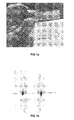
- the multilayers were maintained at that temperature for 2 hours, and were left to cool inside the oven until reaching ambient temperature. After the calcination of the material, a mesoporous multilayer formed by alternate amorphous layers of SiO 2 and TiO 2 are obtained, with ordered mesoporous structure (lm3m), and variable thicknesses of between 30 and 300 nm.
- Organic functions which give desired characteristics can be added to each one of the mesoporous oxide layers.
- This process hereinafter called selective functionalization, can be carried out by means of two processes: pre-functionalization and post-functionalization.
- the reagents of both precursors must be controlled, as they depend on their chemical nature, the concentration in solution, the pH of the average, the time and temperature of ageing of the solutions, etc.
- the organic functions can be localized on the surface of the pores, in the interior of the walls, or in both places.
- the anchoring of the molecules on the surface of the pores makes the derivatization of the films by post-functionalization possible.
- the functions are added to the surface of the pores.
- the modification is carried out by means of the adsorption of bifunctional molecules, with an anchor group which bonds to the surface of the pores by complexation of the metal (for example, of the Ti(IV)), and the functional group desired.
- groups that are easily detectable by spectroscopic techniques were used, in order to be able to follow the adsorption of said molecule in time ( P.C. Angelomé, G.J.A.A. Soler-IIIia, J. Mater. Chem. 2005, 15, 3903 ).
- the post-functionalization is carried out by means of the immersion of calcinated multilayer films, synthesised on microscope glass slide substrates, in a solution of 0.01 M of dihexadecylphosphate (hereinafter, DHDP) in THF or in a solution of phenylphosphonic acid (hereinafter, PPA), for variable times of between 4 and 24 hours.
- DHDP dihexadecylphosphate
- PPA phenylphosphonic acid
- the films with functions and without them were submerged in different solvents (water, THF and toluene) for variable times of between 1 and 10 minutes, to evaluate the displacement of the PBG using a UV-visible spectrophotometer with diode repair.
- the optical properties were studied with a Hewlett Packard 8453 spectrophotometer in transmission, between 200 and 1100 nm.
- the films, synthesised on glass on one of the faces, were directly placed on the sample container and the spectra were obtained with normal incidence to the substrate.
- the digital photographs were obtained with a Kodak digital camera.
- each one of the TiO 2 layers has an index of refraction of between 1,640 and 1,670, a weight of 113 ⁇ 4 nm, a porosity of between 38 to 41% in volume, an ellipsoidal pore size of 10 x 4 nm, which form a pore repair derived from a cubic lm3m structure.
- each one of the SiO 2 layers has an index of refraction of between 1,220 and 1,290, a thickness of 40 ⁇ 4 nm, a porosity of 36 to 45% in volume, an ellipsoidal pore size of 10 x 5 nm, which form a pore repair derived from a cubic lm3m structure.
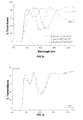
- optical properties of the porous photonic crystals presented can be used to quantify the sorption of solvents of different characteristics inside the multilayers. Measurements of optical reflectance are made depending on the partial vapour pressure of several solvents to analyse the interrelation between affinity and accessibility of the different types of layers within the structure.
- a multilayer of 8 alternating layers of SiO 2 with small pores (3 nm, moulded with CTAB) and TiO 2 with large pores (10-12 nm, moulded with F127) was studied. To do that, the multilayer was introduced inside a chamber, where inside the partial vapour pressure could be varied between 0 and 1.
- the chamber has a quartz window wherethrough reflectance spectra were measured in situ at normal incidence with a Bruker IFS-66 FTIR spectrophotometer.
- the multilayers were submitted to toluene vapours, water and isopropanol, and as an example the series of spectra obtained for partial toluene variable pressures are shown in figure 5.a.
- figures 5.b and c present the variation of the maximum spectral position together with its intensity for the three solvents studied, observing a marked difference in the optical behaviour of the multilayer against the different solvents.
- the water seems to be adsorbed indistinctly and at the same time on the silicon or titanium walls, while the isopropanol and even more so the toluene are preferentially adsorbed on silicon during the first steps of the process and on recent titanium at high partial pressures.
- Quantitative information about the variation of the index of refraction according to the vapour pressure can be extracted from the analyses of the optical reflectance spectra.
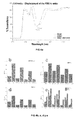
- Theoretical adjustments of the reflectance spectra obtained were made to determine the variation of the index of refraction of each type of layer (SiO2 or TiO2) independently, as the solvent was introduced in the structure.
- figure 6.a an example of the adjustments obtained for a multilayer in vacuum (10-2 torr) and for a partial toluene pressure of 0.93 are presented.
Landscapes
- Chemical & Material Sciences (AREA)
- Engineering & Computer Science (AREA)
- Physics & Mathematics (AREA)
- Materials Engineering (AREA)
- Chemical Kinetics & Catalysis (AREA)
- Inorganic Chemistry (AREA)
- Organic Chemistry (AREA)
- Metallurgy (AREA)
- Mechanical Engineering (AREA)
- General Chemical & Material Sciences (AREA)
- Thermal Sciences (AREA)
- Nanotechnology (AREA)
- General Physics & Mathematics (AREA)
- Crystallography & Structural Chemistry (AREA)
- Optics & Photonics (AREA)
- Ceramic Engineering (AREA)
- Condensed Matter Physics & Semiconductors (AREA)
- Manufacturing & Machinery (AREA)
- Composite Materials (AREA)
- Life Sciences & Earth Sciences (AREA)
- Biophysics (AREA)
- Dispersion Chemistry (AREA)
- Microelectronics & Electronic Packaging (AREA)
- Silicates, Zeolites, And Molecular Sieves (AREA)
Applications Claiming Priority (2)
| Application Number | Priority Date | Filing Date | Title |
|---|---|---|---|
| ES200602405A ES2296533B1 (es) | 2006-09-22 | 2006-09-22 | Procedimiento de preparacion de multicapas con estructura mesoporosa ordenada, material asi obtenido y utilizacion. |
| PCT/ES2007/070162 WO2008034932A1 (fr) | 2006-09-22 | 2007-09-18 | Procédé de préparation de multicouches présentant une structure mésoporeuse ordonnée, matériau ainsi obtenu et son utilisation |
Publications (2)
| Publication Number | Publication Date |
|---|---|
| EP2073045A1 true EP2073045A1 (fr) | 2009-06-24 |
| EP2073045A4 EP2073045A4 (fr) | 2011-02-16 |
Family
ID=39200211
Family Applications (1)
| Application Number | Title | Priority Date | Filing Date |
|---|---|---|---|
| EP07823056A Withdrawn EP2073045A4 (fr) | 2006-09-22 | 2007-09-18 | Procédé de préparation de multicouches présentant une structure mésoporeuse ordonnée, matériau ainsi obtenu et son utilisation |
Country Status (4)
| Country | Link |
|---|---|
| US (1) | US20110149400A1 (fr) |
| EP (1) | EP2073045A4 (fr) |
| ES (1) | ES2296533B1 (fr) |
| WO (1) | WO2008034932A1 (fr) |
Cited By (3)
| Publication number | Priority date | Publication date | Assignee | Title |
|---|---|---|---|---|
| WO2010146088A1 (fr) * | 2009-06-17 | 2010-12-23 | Nlab Solar Ab | Cellule solaire à colorant et son procédé de fabrication |
| EP2453266A1 (fr) * | 2010-11-16 | 2012-05-16 | Samsung SDI Co., Ltd. | Cellule solaire sensibilisée aux colorants |
| US9182528B2 (en) | 2007-02-23 | 2015-11-10 | Consejo Superior De Investigaciones Cientificas | Multilayer structure formed by nanoparticular lamina with unidimensional photonic crystal properties, method for the production thereof and use thereof |
Families Citing this family (11)
| Publication number | Priority date | Publication date | Assignee | Title |
|---|---|---|---|---|
| CA2726342C (fr) * | 2008-05-30 | 2018-04-10 | Opalux Incorporated | Empilement de bragg accordable |
| CN102473531A (zh) | 2009-07-09 | 2012-05-23 | Nlab太阳能股份公司 | 有改进光学特征的染料敏化太阳能电池 |
| JP5610852B2 (ja) * | 2010-06-02 | 2014-10-22 | キヤノン株式会社 | X線導波路及びその製造方法 |
| FR2961219B1 (fr) | 2010-06-09 | 2012-07-13 | Essilor Int | Procede de preparation a basse temperature de revetements mesostructures electroconducteurs |
| JP6188711B2 (ja) * | 2011-12-01 | 2017-08-30 | ザ ユニバーシティ オブ ユタ リサーチ ファウンデイション | 平坦および湾曲する基板上のフォトニック素子およびその製造方法 |
| CN103668067B (zh) * | 2013-12-09 | 2016-01-13 | 西南技术物理研究所 | 大角度多波段红外高反射膜系的制备方法 |
| US10828400B2 (en) | 2014-06-10 | 2020-11-10 | The Research Foundation For The State University Of New York | Low temperature, nanostructured ceramic coatings |
| KR102467762B1 (ko) | 2014-08-27 | 2022-11-15 | 쓰리엠 이노베이티브 프로퍼티즈 컴파니 | 전기적 다층 라미네이션 전사 필름 |
| US9586385B2 (en) | 2014-08-27 | 2017-03-07 | 3M Innovative Properties Company | Inorganic multilayer lamination transfer films |
| US11247501B2 (en) | 2014-08-27 | 2022-02-15 | 3M Innovative Properties Company | Layer-by-layer assembled multilayer lamination transfer films |
| IT201700048421A1 (it) * | 2017-05-04 | 2018-11-04 | Materias S R L | Dispositivo per la somministrazione transdermica di molecole attive, usi di tale dispositivo e metodi di produzione di tale dispositivo e di relativi componenti |
-
2006
- 2006-09-22 ES ES200602405A patent/ES2296533B1/es not_active Expired - Fee Related
-
2007
- 2007-09-18 WO PCT/ES2007/070162 patent/WO2008034932A1/fr not_active Ceased
- 2007-09-18 EP EP07823056A patent/EP2073045A4/fr not_active Withdrawn
- 2007-09-18 US US12/442,491 patent/US20110149400A1/en not_active Abandoned
Non-Patent Citations (3)
| Title |
|---|
| DATABASE COMPENDEX [Online] ENGINEERING INFORMATION, INC., NEW YORK, NY, US; 18 September 2006 (2006-09-18), ANGELOME P C ET AL: "Multifunctional, multilayer, multiscale: Integrative synthesis of complex macroporous and mesoporous thin films with spatial separation of porosity and function", XP002614736, Database accession no. E20064110159015 & ADVANCED MATERIALS 20060918 WILEY-VCH VERLAG DE, vol. 18, no. 18, 18 September 2006 (2006-09-18), pages 2397-2402, DOI: DOI:10.1002/ADMA.200600439 * |
| DAVID GROSSO ET AL: "Preparation, treatment and characterisation of nanocrystalline mesoporous ordered layers", JOURNAL OF SOL-GEL SCIENCE AND TECHNOLOGY, KLUWER ACADEMIC PUBLISHERS, BO, vol. 40, no. 2-3, 6 July 2006 (2006-07-06) , pages 141-154, XP019436281, ISSN: 1573-4846, DOI: DOI:10.1007/S10971-006-8990-6 * |
| See also references of WO2008034932A1 * |
Cited By (3)
| Publication number | Priority date | Publication date | Assignee | Title |
|---|---|---|---|---|
| US9182528B2 (en) | 2007-02-23 | 2015-11-10 | Consejo Superior De Investigaciones Cientificas | Multilayer structure formed by nanoparticular lamina with unidimensional photonic crystal properties, method for the production thereof and use thereof |
| WO2010146088A1 (fr) * | 2009-06-17 | 2010-12-23 | Nlab Solar Ab | Cellule solaire à colorant et son procédé de fabrication |
| EP2453266A1 (fr) * | 2010-11-16 | 2012-05-16 | Samsung SDI Co., Ltd. | Cellule solaire sensibilisée aux colorants |
Also Published As
| Publication number | Publication date |
|---|---|
| ES2296533A1 (es) | 2008-04-16 |
| ES2296533B1 (es) | 2009-04-01 |
| US20110149400A1 (en) | 2011-06-23 |
| EP2073045A4 (fr) | 2011-02-16 |
| WO2008034932A1 (fr) | 2008-03-27 |
Similar Documents
| Publication | Publication Date | Title |
|---|---|---|
| US20110149400A1 (en) | Process for preparing multilayers with an ordered mesoporous structure, material obtained in this manner, and use | |
| Fuertes et al. | Photonic crystals from ordered mesoporous thin‐film functional building blocks | |
| ES2469831T3 (es) | Estructura multicapa formada por láminas de nanopart�culas con propiedades de cristal fotónico unidimensional, procedimiento para su fabricación y sus aplicaciones | |
| KR100870711B1 (ko) | 복합 필름으로 코팅된 기판 및 이를 제조하는 방법 | |
| Zukalová et al. | Organized mesoporous TiO2 films exhibiting greatly enhanced performance in dye-sensitized solar cells | |
| Bernsmeier et al. | Antireflective coatings with adjustable refractive index and porosity synthesized by micelle-templated deposition of MgF2 sol particles | |
| Anaya et al. | Solution processed high refractive index contrast distributed Bragg reflectors | |
| Sánchez-Sobrado et al. | Versatility and multifunctionality of highly reflecting Bragg mirrors based on nanoparticle multilayers | |
| EP3210000A1 (fr) | Dispositifs de détection de gaz et de vapeur faisant appel à un matériau de nanofeuille 2d | |
| Ghazzal et al. | Porosity control and surface sensitivity of titania/silica mesoporous multilayer coatings: applications to optical Bragg resonance tuning and molecular sensing | |
| Faustini | Sol–gel engineering to tune structural colours | |
| Cop et al. | Comparison of in-plane stress development in sol–gel-and nanoparticle-derived mesoporous metal oxide thin films | |
| Jia et al. | A facile approach to fabricate three-dimensional ordered macroporous rutile titania at low calcination temperature | |
| Fan et al. | Stepwise assembly in three dimensions: Preparation and characterization of layered gold nanoparticles in porous silica matrices | |
| KR20160099903A (ko) | 다기능성 복합 코팅의 제조방법 | |
| Rouse et al. | Preparation of thin silica films with controlled thickness and tunable refractive index | |
| Löbmann | Antireflective coatings and optical filters | |
| Lopes de Jesus et al. | A systematic study of multifunctional x TiO2/(100− x) SiO2 thin films prepared by sol–gel process | |
| Liu et al. | Sol–gel precursor inks and films | |
| Moon et al. | Room temperature chemical vapor deposition for fabrication of titania inverse opals: Fabrication, morphology analysis and optical characterization | |
| Naudin et al. | Sol-gel derived functional coatings for optics | |
| Venkatesh et al. | Morphological and optical properties of dielectric multilayer structures prepared with distinct precursor concentrations | |
| CN115812068A (zh) | 具有包含纳米嵌入物的溶胶-凝胶涂层的玻璃板 | |
| JP2003321222A (ja) | 多孔質酸化チタン薄膜とその製造方法 | |
| Cheng et al. | Shear-Assembly of Crack-Free, Mesomorphic Ceramics from Zinc Oxide Nanorods for Waveplates |
Legal Events
| Date | Code | Title | Description |
|---|---|---|---|
| PUAI | Public reference made under article 153(3) epc to a published international application that has entered the european phase |
Free format text: ORIGINAL CODE: 0009012 |
|
| 17P | Request for examination filed |
Effective date: 20090422 |
|
| AK | Designated contracting states |
Kind code of ref document: A1 Designated state(s): AT BE BG CH CY CZ DE DK EE ES FI FR GB GR HU IE IS IT LI LT LU LV MC MT NL PL PT RO SE SI SK TR |
|
| RIC1 | Information provided on ipc code assigned before grant |
Ipc: B29D 11/00 20060101ALI20110104BHEP Ipc: G02B 6/132 20060101AFI20080416BHEP Ipc: G01D 5/00 20060101ALI20110104BHEP Ipc: G01D 11/00 20060101ALI20110104BHEP Ipc: H01S 5/183 20060101ALI20110104BHEP Ipc: G02B 6/122 20060101ALI20110104BHEP |
|
| A4 | Supplementary search report drawn up and despatched |
Effective date: 20110113 |
|
| STAA | Information on the status of an ep patent application or granted ep patent |
Free format text: STATUS: THE APPLICATION IS DEEMED TO BE WITHDRAWN |
|
| 18D | Application deemed to be withdrawn |
Effective date: 20110812 |