EP2080228B1 - Leistungsbauelement mit einem pseudomorphen transistor mit hoher elektronenmobilität (phemt) mit einzelspannungsversorgung und herstellungsprozess dafür - Google Patents
Leistungsbauelement mit einem pseudomorphen transistor mit hoher elektronenmobilität (phemt) mit einzelspannungsversorgung und herstellungsprozess dafür Download PDFInfo
- Publication number
- EP2080228B1 EP2080228B1 EP06821723.1A EP06821723A EP2080228B1 EP 2080228 B1 EP2080228 B1 EP 2080228B1 EP 06821723 A EP06821723 A EP 06821723A EP 2080228 B1 EP2080228 B1 EP 2080228B1
- Authority
- EP
- European Patent Office
- Prior art keywords
- layer
- contact layer
- power device
- schottky
- source
- Prior art date
- Legal status (The legal status is an assumption and is not a legal conclusion. Google has not performed a legal analysis and makes no representation as to the accuracy of the status listed.)
- Active
Links
Images


Classifications
-
- H—ELECTRICITY
- H10—SEMICONDUCTOR DEVICES; ELECTRIC SOLID-STATE DEVICES NOT OTHERWISE PROVIDED FOR
- H10D—INORGANIC ELECTRIC SEMICONDUCTOR DEVICES
- H10D30/00—Field-effect transistors [FET]
- H10D30/40—FETs having zero-dimensional [0D], one-dimensional [1D] or two-dimensional [2D] charge carrier gas channels
- H10D30/47—FETs having zero-dimensional [0D], one-dimensional [1D] or two-dimensional [2D] charge carrier gas channels having two-dimensional [2D] charge carrier gas channels, e.g. nanoribbon FETs or high electron mobility transistors [HEMT]
- H10D30/471—High electron mobility transistors [HEMT] or high hole mobility transistors [HHMT]
- H10D30/473—High electron mobility transistors [HEMT] or high hole mobility transistors [HHMT] having confinement of carriers by multiple heterojunctions, e.g. quantum well HEMT
- H10D30/4732—High electron mobility transistors [HEMT] or high hole mobility transistors [HHMT] having confinement of carriers by multiple heterojunctions, e.g. quantum well HEMT using Group III-V semiconductor material
- H10D30/4738—High electron mobility transistors [HEMT] or high hole mobility transistors [HHMT] having confinement of carriers by multiple heterojunctions, e.g. quantum well HEMT using Group III-V semiconductor material having multiple donor layers
-
- H—ELECTRICITY
- H10—SEMICONDUCTOR DEVICES; ELECTRIC SOLID-STATE DEVICES NOT OTHERWISE PROVIDED FOR
- H10D—INORGANIC ELECTRIC SEMICONDUCTOR DEVICES
- H10D62/00—Semiconductor bodies, or regions thereof, of devices having potential barriers
- H10D62/80—Semiconductor bodies, or regions thereof, of devices having potential barriers characterised by the materials
- H10D62/81—Semiconductor bodies, or regions thereof, of devices having potential barriers characterised by the materials of structures exhibiting quantum-confinement effects, e.g. single quantum wells; of structures having periodic or quasi-periodic potential variation
- H10D62/815—Semiconductor bodies, or regions thereof, of devices having potential barriers characterised by the materials of structures exhibiting quantum-confinement effects, e.g. single quantum wells; of structures having periodic or quasi-periodic potential variation of structures having periodic or quasi-periodic potential variation, e.g. superlattices or multiple quantum wells [MQW]
- H10D62/8161—Semiconductor bodies, or regions thereof, of devices having potential barriers characterised by the materials of structures exhibiting quantum-confinement effects, e.g. single quantum wells; of structures having periodic or quasi-periodic potential variation of structures having periodic or quasi-periodic potential variation, e.g. superlattices or multiple quantum wells [MQW] potential variation due to variations in composition or crystallinity, e.g. heterojunction superlattices
- H10D62/8162—Semiconductor bodies, or regions thereof, of devices having potential barriers characterised by the materials of structures exhibiting quantum-confinement effects, e.g. single quantum wells; of structures having periodic or quasi-periodic potential variation of structures having periodic or quasi-periodic potential variation, e.g. superlattices or multiple quantum wells [MQW] potential variation due to variations in composition or crystallinity, e.g. heterojunction superlattices having quantum effects only in the vertical direction, i.e. layered structures having quantum effects solely resulting from vertical potential variation
- H10D62/8164—Semiconductor bodies, or regions thereof, of devices having potential barriers characterised by the materials of structures exhibiting quantum-confinement effects, e.g. single quantum wells; of structures having periodic or quasi-periodic potential variation of structures having periodic or quasi-periodic potential variation, e.g. superlattices or multiple quantum wells [MQW] potential variation due to variations in composition or crystallinity, e.g. heterojunction superlattices having quantum effects only in the vertical direction, i.e. layered structures having quantum effects solely resulting from vertical potential variation comprising only semiconductor materials
-
- H—ELECTRICITY
- H10—SEMICONDUCTOR DEVICES; ELECTRIC SOLID-STATE DEVICES NOT OTHERWISE PROVIDED FOR
- H10D—INORGANIC ELECTRIC SEMICONDUCTOR DEVICES
- H10D64/00—Electrodes of devices having potential barriers
- H10D64/111—Field plates
-
- H—ELECTRICITY
- H10—SEMICONDUCTOR DEVICES; ELECTRIC SOLID-STATE DEVICES NOT OTHERWISE PROVIDED FOR
- H10D—INORGANIC ELECTRIC SEMICONDUCTOR DEVICES
- H10D64/00—Electrodes of devices having potential barriers
- H10D64/20—Electrodes characterised by their shapes, relative sizes or dispositions
- H10D64/23—Electrodes carrying the current to be rectified, amplified, oscillated or switched, e.g. sources, drains, anodes or cathodes
- H10D64/251—Source or drain electrodes for field-effect devices
- H10D64/254—Source or drain electrodes for field-effect devices for lateral devices wherein the source or drain electrodes extend entirely through the semiconductor bodies, e.g. via-holes for back side contacts
Definitions
- the present invention relates in general to a power device, and more particularly to a pseudomorphic high electron mobility transistor (PHEMT) power device and to a process for manufacturing the same.
- PHEMT pseudomorphic high electron mobility transistor
- PHEMTs pseudomorphic high electron mobility transistors
- PHEMTs pseudomorphic high electron mobility transistors
- PHEMT technology is also used in high-speed analog and digital IC's such as 2.5-10 Gb/s lightwave communication systems.
- the higher frequency response of PHEMTs are currently finding use in millimeter wave communications (40 Gb/s) and radar systems.
- pseudomorphic high electron mobility transistors PHEMTs usually require a negative gate voltage bias to operate (see for example US 2002/024057 A1 ). Therefore, as compared to heterojunction bipolar transistors (HBTs) that use a positive gate voltage, the introduction of such a negative voltage disadvantageously requires a dedicated voltage supply circuit that increases chip complexity and manufacturing costs.
- HBTs heterojunction bipolar transistors
- a PHEMT power device capable of operating with a single voltage supply is for example disclosed in US 2003/122152 A1 .
- the PHEMT power device includes an epitaxial substrate including a GaAs buffer layer, an AlGaAs/GaAs superlattice layer, an undoped AlGaAs layer, a first doped silicon layer, a first spacer, an InGaAs electron transit layer, a second spacer, a second doped silicon layer having a different doping concentration from the first doped silicon layer, a lightly doped AlGaAs layer, and an undoped GaAs cap layer stacked sequentially on a semi-insulating GaAs substrate; a source electrode and a drain electrode formed on and in ohmic contact with the undoped GaAs cap layer; and a gate electrode formed on the lightly doped AlGaAs layer to extend through the undoped GaAs cap layer.
- EP 0 514 079 A2 discloses a high electron mobility transistor which includes a pair of charge screen layers disposed over a first one of active and charge donor layers of the high electron mobility transistor.
- the two screen layers are patterned to provide a double recessed channel.
- a first charge screen layer disposed adjacent to the charge donor layer is etched to provide a recess having a first length between source and drain electrodes, whereas a second charge screen layer disposed over the first aforementioned charge screen layer and a portion of the aforementioned first charge screen layer are etched to provide a second, substantially longer length between source and drain electrodes.
- the gate electrode is provided in the first aforementioned recess in Schottky barrier contact with the charge donor layer.
- WO 2004/025707 A discloses a semiconductor structure that integrates wide bandgap semiconductors with silicon.
- the semiconductor structure includes: a substrate; a SiCAIN region formed over the substrate, and an active region formed over the SiCAIN region.
- the substrate can comprise silicon, silicon carbide (SiC) or silicon germanium (SiGe).
- the active region can include a gallium nitride material region, such as GaN, AlGaN, InGaN or AlInGaN. It also can include AIN and InN region.
- the structure also can include a crystalline oxide interface formed between the substrate and the SiCAIN region. A preferred crystalline oxide interface is Si-Al-O-N.
- the active layer can be formed by known fabrication processes, including metal organic chemical vapor deposition or by atomic layer epitaxy.
- the crystalline oxide interface is normally formed by growing SiCAIN on Si(111) via a crystalline oxide interface, but can also be formed by metal organic chemical vapor deposition or by atomic layer epitaxy.
- the Applicant has noticed that in order to provide a PHEMT power device operable with a single voltage supply (the drain supply voltage only), it is necessary to optimize the pinch-off voltage that permits to achieve class A operating conditions (drain-to-source current equal to half of the maximum achievable one) while maintaining the gate grounded without any bias.
- an optimized PHEMT power device having excellent linearity and power-added efficiency, high breakdown voltage, and capable of operating with a single voltage supply should meet the following requirements: a low knee voltage, a high and uniform transconductance, and a low source-gate capacitance.
- the main objective of present invention is therefore to provide a PHEMT power device operable with a single voltage supply, suitable for a satisfactory use in highfrequency digital wireless communications, in particular which may be used to amplify signals up to 40GHz, i.e., for example C frequency band, X frequency band and Ka frequency band, and having a higher linearity, breakdown voltage and power-added efficiency than the PHEMTs in the prior art.
- a PHEMT power device operable with a single voltage supply, suitable for a satisfactory use in highfrequency digital wireless communications, in particular which may be used to amplify signals up to 40GHz, i.e., for example C frequency band, X frequency band and Ka frequency band, and having a higher linearity, breakdown voltage and power-added efficiency than the PHEMTs in the prior art.
- Another objective of present invention is to provide a process for manufacturing this PHEMT power device.
- the present invention achieves the aforementioned objective by exploiting advances in epitaxial growth technologies of III-V semiconductor heterojunctions, which advances ensure the possibility of engineering the band structure, doping type and level in different regions of semiconductor devices, and by adopting new semiconductor materials with superior electrical characteristics, such as wide band-gap semiconductor, and by properly designing the PHEMT structure. Use of these additional degrees of freedom provides the opportunity of developing new devices with considerable improvement in RF performance.
- the present invention achieves the aforementioned objective by introducing an optimized epilayer sequence and a double recessed gate geometry. More in detail, the present invention achieves the aforementioned objective by providing a pseudomorphic high electron mobility transistor (PHEMT) power device including:
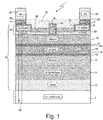
- Figure 1 is a sectional view of a PHEMT power device according to an embodiment of the present invention.
- the PHEMT power device 1 includes a III-V substrate 2, e.g., a semi-insulating GaAs substrate, a doped epitaxial substrate 3 formed on the semi-insulating GaAs substrate 2, and source, drain and gate electrodes 4, 5 and 6 formed on the epitaxial substrate 3.
- a III-V substrate 2 e.g., a semi-insulating GaAs substrate
- a doped epitaxial substrate 3 formed on the semi-insulating GaAs substrate 2
- source, drain and gate electrodes 4, 5 and 6 formed on the epitaxial substrate 3.
- epitaxial substrate 3 comprises an undoped GaAs buffer layer 10; an undoped AlGaAs/GaAs superlattice layer 11; an undoped wide-bandgap AlGaAs layer 12; a first ultrathin doped silicon (pulse) electron supply (donor) layer 13, a first spacer layer 14, an undoped narrow-bandgap InGaAs electron transit (channel) layer 15, a second spacer layer 16, a second ultrathin silicon doped (pulse) electron supply (donor) layer 17 with a different doping concentration than the first electron supply layer 13, an undoped or lightly doped wide-bandgap Schottky AlGaAs layer 18, and a GaAs (ohmic) contact (cap) layer 19 sequentially stacked on the semi-insulating GaAs substrate 2.
- GaAs contact layer 19 is doped and includes a lower lightly doped GaAs contact layer 20 and an upper highly doped GaAs contact layer 21.
- doped GaAs contact layer 19 is approximately 100 nm thick
- lightly doped GaAs contact layer 20 is approximately 30 nm thick and is formed to have a doping concentration of approximately 3.10 17 cm -3
- highly doped GaAs contact layer 21 is approximately 70 nm thick and is formed to have a doping concentration of approximately 3.5 ⁇ 10 18 cm -3 .
- Undoped AlGaAs layer 12 is approximately 4 nm thick and contains aluminum (Al) approximately ranging from 22% to 24% by mole ratio
- InGaAs electron transit layer 15 is approximately 13-15 nm thick and contains indium (In) ranging approximately from 15% to 20% by mole ratio
- lightly doped AlGaAs layer 18 is approximately 30 nm thick, contains aluminum (Al) approximately ranging from 22% to 24% by mole ratio, and is formed to have a doping concentration ranging approximately from 1.0.10 17 to 3.0 ⁇ 10 17 cm -3 .
- the first electron supply layer 13 has a lower doping concentration than the second electron supply layer 17. Additionally, in order to have a doping level in the InGaAs electron transit layer 15 approximately ranging from 1.7 ⁇ 10 12 to 2.7 ⁇ 10 12 cm -2 , first electron supply layer 13 is formed to have a doping level of approximately 1 ⁇ 10 12 cm -2 , and second electron supply layer 17 is formed to have a doping level of approximately 5 ⁇ 10 12 cm -2 . Additionally, the first and the second electron supply layers 13, 17 are each approximately 0.5 nm thick.
- an Au/Ge/Ni/Au metallization is deposited on the highly doped GaAs contact layer 21 and subjected to rapid thermal annealing (RTA) to form source and drain electrodes 4, 5 in ohmic contact with the highly doped GaAs contact layer 21.
- RTA rapid thermal annealing
- epitaxial substrate 3 may be mesa-etched or, preferably, ion implanted using Deuterium or Fluorine high energy ions down to the AlGaAs/GaAs superlattice layer 11.
- doped GaAs contact layer 19 is recess etched to form a double recess structure 22 including an upper wide recess 23 formed in the highly doped GaAs contact layer 21 and a lower narrow recess 24 formed in lightly doped GaAs contact layer 20 and partly in lightly doped AlGaAs layer 18.
- highly doped GaAs contact layer 21 between source and drain electrodes 4, 5 is etched to form wide recess 23, and then lightly doped GaAs contact layer 20 is selectively wet etched inside the wide recess 23 down to lightly doped AlGaAs layer 18 to form narrow recess 24.
- selective etching is carried out using a ph-controlled and temperature-controlled citric acid and hydrogen peroxide solution.
- each one of the two etchings are performed by patterning lightly and highly doped GaAs contact layers 20, 21 with positive i-line photoresists. Presence of the lightly doped AlGaAs layer 18 ensures etching uniformity even in wet etching performed to form the double recess during the manufacture of the PHEMT power device 1.
- gate electrode 6 is then formed in contact with the AlGaAs Schottky layer 18 by evaporating titanium (Ti) and aluminium (Al) on an exposed surface of lightly doped AlGaAs layer 18.
- gate electrode 6 extends centrally in double recess 22 from AlGaAs Schottky layer 18 and through both lightly and highly doped lower GaAs contact layers 20, 21 and protrudes outside double recess 22.
- PECVD Plasma Enhanced Chemical Vapour Deposition
- a Ti/Pt/Au base metal layer 26 is then formed, for example by evaporation, and then layered on source and drain electrodes 4, 5, and an Au layer 27 is then formed, for example by electroplating, on the base metal layer 26.
- Base metal layer 26 defines an interdiffusion barrier that isolates ohmic contact and prevents gold from diffusing from Au-plated layer 27 to source and gate electrodes 4, 5.
- Source and drain electrodes 4, 5 are then connected to respective source and drain pads (not shown) via Au-plated airbridges (not shown).
- semi-insulating GaAs substrate 2 is thinned down from an initial thickness of approximately 650 ⁇ m to a final thickness ranging approximately from 50 to 120 ⁇ m, and then the PHEMT 1 is back-etched to form a via-hole 28, which is metallized, including a surrounding area, with a thick Au layer to extend from thinned semi-insulating GaAs substrate 2 up to source electrode 4 for source pad interconnection, in order to minimize the parasitic source-to-ground inductances, and heat sink provision.
- FIG. 2 is a sectional view of a PHEMT power device similar to that shown in Figure 1 , where same reference numerals designate same elements.
- PHEMT power device shown in Figure 2 designated by 1', differs from PHEMT power device 1 shown in Figure 1 in that gate electrode 6 is generally T-shaped with a lower leg portion 6a formed of Ti and an upper head portion 6b formed of A1. More in detail, leg portion 6a of gate electrode 6 has an height substantially equal to depth of double recess 22, so that head portion 6b of gate electrode 6 protrudes outside double recess 22.
- the T shape is obtained by dry-etching the Ti of the gate metal stack in a suitable Fluorine/Oxygen plasma chemistry in low-damage isotropic plasma-etch reactor.
- the Fluorine gas carrier could be CF 4 , or CHF 3 or SF 6 .
- the oxygen carrier gas could be O 2 .
- the Plasma is created by an RF discharge in a Plasma Etch parallel plate configuration.
- Each plate of the chamber is heated, for example in the range 100 to 200 °C, the chamber pressure is in the range 200 to 1000 mTorr.
- RF power discharge should be lowered to reduce as much as possible surface damage caused by ion and electron bombardment.
- the RF power discharge must be lower than 50 Watt.
- ECR Electron Cyclotron Resonance, ICP - Inductively Coupled Plasma.
- the Al of the head portion 6b of the gate electrode 6 is used as a mask layer because the Al becomes fluorinated and remains un-etched by the Fluorine plasma. So, the head portion 6b of the gate electrode 6, made of Al, stays un-etched, while the leg portion 6a of the of the gate electrode 6, made of Ti and lying on the AlGaAs Schottky layer 18, becomes laterally etched. In this way a gate length down to 0.15 ⁇ m can be obtained with a quick and low-cost manufacturing process, keeping a low gate finger resistance.
- FIG 3 is a sectional view of a PHEMT power device similar to those shown in Figures 1 and 2 , where same reference numerals designate same elements.
- PHEMT power device shown in Figure 3 designated by 1" differs from PHEMT power devices shown in Figures 1 and 2 in that it is provided with a field plate 29 connected to the gate electrode 6 and extending toward the drain electrode 5 without overlapping either the highly doped contact layer 21 or the drain electrode (5).
- the field plate 29 is formed as a gate extension 6c coplanar with highly doped GaAs contact layer 21, vertically overlapping part of protective insulating layer 25 on the lightly doped GaAs contact layer 20, and ending at a distance of 1.0 ⁇ m from highly doped lower GaAs contact layer 21.
- the protective insulating layer 25 made of silicon nitride (Si 3 N 4 ) is ultrathin (less than 50 nm), and is deposited by PECVD so optimized to reach a high dielectric constant of the Si 3 N 4 , and to control the GaAs/Si 3 N 4 interface states.
- AlGaAs layer 18 is the donor layer, and in the final PHEMT power device this layer should be depleted from Schottky gate 6 to AlGaAs/GaAs interface to eliminate any effect of parallel conduction in AlGaAs otherwise detrimental to PHEMT performance.
- this layer must be considered that increasing the doping level in the donor layer reduces the breakdown voltage of the PHEMT.
- a pulsed doped, ⁇ doped AlGaAs layer is possible to use of a Si monolayer, approximately 0.5 nm thick, with a very high doping level.
- GaAs buffer layer 10 because of drain to source electric field, part of electrons can be injected into GaAs buffer layer 10. This phenomenon induces a gain reduction as a result of increasing drain output conductance.
- electron injection into the GaAs buffer layer 10 is controlled by means of AlGaAs/GaAs superlattice layer 11 into GaAs buffer layer 10, that at the same time does not change channel quality.
- the PHEMT power device with different gate length according to the present invention has a pinch-off voltage approximately from - 0.8V to -0.6V, a saturation current ranging from 100 to 300 mA/mm at a gate voltage of 0V, and a maximum saturation current ranging from 300 to 600 mA/mm at a gate voltage of 0.8V.
- transconductance is nearly consistent in the range of 250-350 mS/mm at a gate voltage ranging from 0 to 1V.
- the PHEMT power device exhibits improved linearity.
- the PHEMT power device according to the present invention exhibits a low knee voltage of about 1V and an off-state breakdown voltage of about 18V without a field-plate structure and of 40V with a field-plate structure, while maximum current remained unaffected. This result explains that a high gate drain breakdown voltage can be obtained keeping low ohmic contact resistance.
- the PHEMT power device has an output power up to 29 dBm/mm with an associated power gain up to 12 dB, which power characteristics have been determined by a load-pull method at a typical value of 1 dB of gain compression up to a frequency of 10 GHz if the gate length is conveniently adapted.
- power performance are additionally increased achieving an output power up to 32 dBm/mm and an associated power gain up to 15 dB for C band applications.
- the PHEMT power device may be used to amplify signals up to 40GHz by appropriately varying the gate length.
- the formation of a doped GaAs contact layer 19, particularly made up of a lower lightly doped lower GaAs contact layer 20 and an upper highly doped lower GaAs contact layer 21 in ohmic contact with the source and drain electrodes allows the contact resistance therebetween to be lowered, thus improving voltage characteristics of the PHEMT.
- a double recess structure 22 made up of an upper wide recess 23 formed in upper highly doped GaAs contact layer 21 and of a lower narrow recess 24 formed in lower lightly doped GaAs contact layer 20 allows for the ohmic contact to be placed on highly doped GaAs contact layer 21, thus improving the overall power characteristics of the PHEMT, in particular significantly increasing the breakdown voltage while maintaining a low knee voltage, and improving linearity and power-added efficiency.
- the combination of the double recess structure 22 with the lightly and highly doped GaAs contact layers 20, 21 allows the PHEMT power device to operate with a single voltage supply, without any need for a negative bias voltage to the gate contact.
- the PHEMT of the present invention allows the Class A amplifier requirements to be fulfilled with the gate contact pad directly connected to ground.
- the doped silicon layer 13 with a lower doping concentration than the doped silicon layer 17 makes the transconductance of the PHEMT power device invariant with respect to gate-to-source voltages, while the lightly doped AlGaAs layer 18 ensures etching uniformity in wet recess etching performed to manufacture the PHEMT power device, thus making the overall manufacturing process for the PHEMT power device easy and hence improving the productivity.
- a T-gate structure allows gate-to-source capacitance and gate finger resistance to be significantly reduced, allowing the PHEMT to achieve operating frequencies up to 40 GHz.
- the undoped wide-bandgap AlGaAs layer 12 and the first ultrathin doped silicon electron supply layer 13 may be replaced with a single uniformly doped AlGaAs electron supply layer.
Landscapes
- Junction Field-Effect Transistors (AREA)
- Electrodes Of Semiconductors (AREA)
Claims (33)
- Leistungsvorrichtung (1; 1'; 1") eines pseudomorphen Ka-Band-Transistors mit hoher Elektronenbeweglichkeit (pseudomorphic high electron mobility transistor - PHEMT) mit einzelner Spannungsversorgung, die umfasst:ein halbisolierendes Substrat (2);ein epitaktisches Substrat (3), das auf dem halbisolierenden Substrat (2) ausgebildet ist;wobei das epitaktische Substrat (3) eine Pufferschicht (10), eine Übergitterschicht (11), eine erste Elektronenversorgungsschicht (12, 13), eine erste Abstandshalterschicht (14), eine Elektronentransitschicht (15), eine zweite Abstandshalterschicht (16), eine zweite Elektronenversorgungsschicht (17), eine Schottky-Schicht (18) und eine Kontaktschicht (19) nacheinander auf dem halbisolierenden Substrat (2) gestapelt umfasst;wobei die erste Elektronenversorgungsschicht (12, 13) eine niedrigere Dotierungskonzentration als die zweite Elektronenversorgungsschicht (17) aufweist;Source- und Drainelektroden (4, 5), die auf und in ohmschem Kontakt mit der Kontaktschicht (19) ausgebildet sind; undeine Gateelektrode (6), die auf der Schottky-Schicht (18) ausgebildet ist, um sich durch die Kontaktschicht (19) zu erstrecken;wobei die Kontaktschicht (19) umfasst:eine leicht dotierte Kontaktschicht (20), die auf der Schottky-Schicht (18) ausgebildet ist; undeine stark dotierte Kontaktschicht (21), die auf der leicht dotierten Kontaktschicht (20) ausgebildet ist und eine Dotierungskonzentration aufweist, die höher ist als die der leicht dotierten Kontaktschicht (20);wobei die PHEMT-Leistungsvorrichtung (1) ferner umfasst:eine breite Aussparung (23), die ausgebildet ist, um die stark dotierte Kontaktschicht (21) zu durchdringen, um eine Oberfläche der leicht dotierten Kontaktschicht (20) freizulegen; undeine schmale Aussparung (24), die in der breiten Aussparung (23) ausgebildet ist, um die leicht dotierte Kontaktschicht (20) zu durchdringen, um eine Oberfläche der Schottky-Schicht (18) freizulegen;wobei die Gateelektrode (6) in der schmalen Aussparung (24) und in Schottky-Kontakt mit der Schottky-Schicht (18) ausgebildet ist, um sich aus der freiliegenden Oberfläche der Schottky-Schicht (18) durch die leicht und die stark dotierte Kontaktschicht (20, 21) zu erstrecken; undwobei die Source- und Drainelektroden (4, 5) auf und in ohmschem Kontakt mit der stark dotierten Kontaktschicht (21) außerhalb der breiten Aussparung (23) so ausgebildet sind, dass die breite Aussparung (23) zwischen den Source- und Drainelektroden (4, 5) angeordnet ist.
- PHEMT-Leistungsvorrichtung nach Anspruch 1, die ferner beinhaltet:
eine Schutzisolierschicht (25), die auf einer Oberfläche der stark dotierten Kontaktschicht (21) ausgebildet ist, die durch Source-, Drain- und Gateelektroden (4, 5, 6) freigelegt ist. - PHEMT-Leistungsvorrichtung nach Anspruch 1 oder 2, die ferner beinhaltet:eine Grundmetallschicht (26), die auf den Source- und Drainelektroden (4, 5) ausgebildet ist; undeine Au-Schicht (27), die auf der Grundmetallschicht (26) ausgebildet ist.
- PHEMT-Leistungsvorrichtung nach einem der vorhergehenden Ansprüche, die ferner beinhaltet:
ein metallisiertes Durchgangsloch (28), das ausgebildet ist, um sich von dem halbisolierenden Substrat (2) zu der Sourceelektrode (4) für eine Verbindung der Sourceanschlussfläche und für eine Bereitstellung eines Kühlkörpers zu erstrecken. - PHEMT-Leistungsvorrichtung nach einem der vorhergehenden Ansprüche, wobei die Gateelektrode (6) im Allgemeinen T-förmig ist.
- PHEMT-Leistungsvorrichtung nach Anspruch 2, die ferner beinhaltet:
eine Feldplatte (29), die auf der Schutzisolierschicht (25) ausgebildet ist, die elektrisch mit der Gateelektrode (6) verbunden ist und sich in Richtung der Drainelektrode (5) erstreckt, ohne die stark dotierte Kontaktschicht (21) oder die Drainelektrode (5) zu überlappen. - PHEMT-Leistungsvorrichtung nach Anspruch 6, wobei die Feldplatte als eine Gateerweiterung (6c) ausgebildet ist, die im Wesentlichen koplanar zu der stark dotierten GaAs-Kontaktschicht (21) ist, die einen Teil der leicht dotierten GaAs-Kontaktschicht (20) vertikal überlappt und die in einem Abstand von der stark dotierten Kontaktschicht (21) endet.
- PHEMT-Leistungsvorrichtung nach Anspruch 1, 2 und 3, wobei das Substrat (2) ein aus GaAs ausgebildetes halbisolierendes Substrat ist, die Pufferschicht (10) aus GaAs ausgebildet ist, die Übergitterschicht (11) aus AlGaAs/GaAs ausgebildet ist, die erste und die zweite Elektronenversorgungsschicht (13, 17) aus dotiertem Silizium ausgebildet sind, die Elektronentransitschicht (15) aus InGaAs ausgebildet ist;
die Schottky-Schicht (18) aus AlGaAs ausgebildet ist, die leicht und die stark dotierte Kontaktschicht (21, 22) aus GaAs ausgebildet sind, die Gateelektrode (6) aus Ti/Al ausgebildet ist, die Source- und Drainelektroden (4, 5) aus Au/Ge/Ni/Au-Metalldünnfilmen ausgebildet sind, die Schutzisolierschicht (25) aus Siliziumnitrid ausgebildet ist und die Grundmetallschicht (26) aus Ti/Pt/Au ausgebildet ist. - PHEMT-Leistungsvorrichtung nach einem der vorhergehenden Ansprüche, wobei die leicht dotierte Kontaktschicht (20) eine Dotierungskonzentration von ungefähr 3·1017 cm-3 aufweist und die stark dotierte Kontaktschicht (21) eine Dotierungskonzentration von ungefähr 3,5·1018 cm-3 aufweist.
- PHEMT-Leistungsvorrichtung nach einem der vorhergehenden Ansprüche, wobei die erste und die zweite Elektronenversorgungsschicht (13, 17) ausgebildet sind, um Dotierungskonzentrationen aufzuweisen, um einen Dotierungsgrad in der Elektronentransitschicht (15) von ungefähr in einem Bereich von 1,7·1012 bis 2,7·1012 cm-2 aufzuweisen.
- PHEMT-Leistungsvorrichtung nach einem der vorhergehenden Ansprüche, wobei die erste Elektronenversorgungsschicht (13) ausgebildet ist, um einen Dotierungsgrad von ungefähr 1·1012 cm-2 aufzuweisen, und die zweite Elektronenversorgungsschicht (17) ausgebildet ist, um einen Dotierungsgrad von ungefähr 5·1012 cm-2 aufzuweisen.
- PHEMT-Leistungsvorrichtung nach einem der vorhergehenden Ansprüche, wobei die Elektronentransitschicht (15) Indium enthält, das ungefähr in einem Molverhältnisbereich von 15 % bis 20 % liegt, die Schottky-Schicht (18) Aluminium enthält, das ungefähr in einem Molverhältnisbereich von 22 % bis 24 % liegt und ausgebildet ist, um eine Dotierungskonzentration in einem Bereich von ungefähr 1,0·1017 bis 3,0·1017 cm-3 aufzuweisen.
- PHEMT-Leistungsvorrichtung nach einem der vorhergehenden Ansprüche, wobei die erste Elektronenversorgungsschicht (12, 13) beinhaltet:eine undotierte Schicht mit breiter Bandlücke (12), die auf der Übergitterschicht (11) ausgebildet ist; undeine dotierte Siliziumschicht (13), die auf der undotierten Schicht mit breiter Bandlücke (12) ausgebildet ist.
- PHEMT-Leistungsvorrichtung nach Anspruch 13, wobei die undotierte Schicht mit breiter Bandlücke (12) aus AlGaAs ausgebildet ist und Aluminium in einem ungefähren Molverhältnisbereich von 22 % bis 24 % enthält.
- Verfahren zum Herstellen einer Leistungsvorrichtung (1; 1'; 1") eines pseudomorphen Ka-Band-Transistors mit hoher Elektronenbeweglichkeit (PHEMT) mit einzelner Spannungsversorgung, das umfasst:Bereitstellen eines halbisolierenden Substrats (2);Ausbilden eines epitaktischen Substrats (3) auf dem halbisolierenden Substrat (2), wobei das Ausbilden eines epitaktischen Substrats (3) das aufeinanderfolgende Stapeln einer Pufferschicht (10), einer Übergitterschicht (11), einer ersten Elektronenversorgungsschicht (12, 13), einer ersten Abstandshalterschicht (14), einer Elektronentransitschicht (15), einer zweiten Abstandshalterschicht (16), einer zweiten Elektronenversorgungsschicht (17), einer Schottky-Schicht (18) und einer Kontaktschicht (19) auf dem halbisolierenden Substrat (2) umfasst;wobei die erste Elektronenversorgungsschicht (12, 13) eine niedrigere Dotierungskonzentration als die zweite Elektronenversorgungsschicht (17) aufweist;Ausbilden von Source- und Drainelektroden (4, 5) auf und in ohmschem Kontakt mit der Kontaktschicht (19); undAusbilden einer Gateelektrode (6) auf der Schottky-Schicht (18), um sich durch die Kontaktschicht (19) zu erstrecken;wobei das Ausbilden einer Kontaktschicht (19) umfasst:Ausbilden einer leicht dotierten Kontaktschicht (20) auf der Schottky-Schicht (18);Ausbilden einer stark dotierten Kontaktschicht (21) auf der leicht dotierten Kontaktschicht (20) und Aufweisen einer höheren Dotierungskonzentration als die der leicht dotierten Kontaktschicht (20);wobei das Herstellungsverfahren ferner umfasst:Ausbilden einer breiten Aussparung (23), um die stark dotierte Kontaktschicht (21) zu durchdringen, um eine Oberfläche der leicht dotierten Kontaktschicht (20) freizulegen; undAusbilden einer schmalen Aussparung (24) in der breiten Aussparung (23), um die leicht dotierte Kontaktschicht (20) zu durchdringen, um eine Oberfläche der Schottky-Schicht (18) freizulegen;wobei die Gateelektrode (6) in der schmalen Aussparung (24) und in Schottky-Kontakt mit der Schottky-Schicht (18) ausgebildet wird, um sich aus der freiliegenden Oberfläche der Schottky-Schicht (18) durch die leicht und die stark dotierte Kontaktschicht (20, 21) zu erstrecken; undwobei die Source- und Drainelektroden (4, 5) auf und in ohmschem Kontakt mit der stark dotierten Kontaktschicht (21) außerhalb der breiten Aussparung (23) so ausgebildet werden, dass die breite Aussparung (23) zwischen den Source- und Drainelektroden (4, 5) angeordnet wird.
- Verfahren nach Anspruch 15, wobei Source- und Drainelektroden (4, 5) vor der breiten und der schmalen Aussparung (20, 21) ausgebildet werden.
- Verfahren nach Anspruch 15 oder 16, wobei das Ausbilden von Source- und Drainelektroden (4, 5) beinhaltet:Ausbilden jeweiliger Metalldünnfilme auf der stark dotierten Kontaktschicht (21); undschnelles thermisches Tempern der abgeschiedenen Metalldünnfilme.
- Verfahren nach einem der vorhergehenden Ansprüche 15 bis 17, das ferner beinhaltet:
Ausbilden einer Schutzisolierschicht (25) auf einer Oberfläche der stark dotierten Kontaktschicht (21), die durch die Source-, Drain- und Gateelektroden (4, 5, 6) freigelegt wird. - Verfahren nach einem der vorhergehenden Ansprüche 15 bis 18, das ferner beinhaltet:Ausbilden einer Grundmetallschicht (26) auf den Source- und Drainelektroden (4, 5); undAusbilden einer Au-Schicht (27) auf der Grundmetallschicht (26).
- Verfahren nach einem der vorhergehenden Ansprüche 15 bis 19, das ferner beinhaltet:
Ausbilden und Metallisieren eines Durchgangslochs (28), das sich von dem halbisolierenden Substrat (2) zu der Sourceelektrode (4) für die Verbindung der Sourceanschlussfläche und für die Bereitstellung eines Kühlkörpers erstreckt. - Verfahren nach Anspruch 20, wobei das Ausbilden eines Durchgangslochs (28) beinhaltet:
Rückätzen des halbisolierenden Substrats (2) und des epitaktischen Substrats (3). - Verfahren nach Anspruch 20 oder 21, das ferner beinhaltet:
Ausdünnen des halbisolierenden Substrats (2) vor der Ausbildung des Durchgangslochs (28). - Verfahren nach einem der vorhergehenden Ansprüche 15 bis 22, wobei die Gateelektrode (6) im Allgemeinen T-förmig ist.
- Verfahren nach Anspruch 23, wobei die T-förmige Gateelektrode (6) einen schmalen aus Titan ausgebildeten Abschnitt (6a) in der schmalen Aussparung (24) und einen breiten aus Aluminium ausgebildeten Abschnitt (6b) außerhalb der schmalen Aussparung (24) beinhaltet; und
wobei das Ausbilden der T-förmigen Gateelektrode (6) beinhaltet:Verdampfen des Titans und des Aluminiums auf einer freigelegten Oberfläche der Schottky-Schicht (18); undTrockenätzen des Titans in einem Fluor/Sauerstoff-Plasma. - Verfahren nach Anspruch 18, das ferner beinhaltet:
Ausbilden einer Feldplatte (29) auf der Schutzisolierschicht (25), die elektrisch mit der Gateelektrode (6) verbunden ist und sich in Richtung der Drainelektrode (5) erstreckt, ohne die stark dotierte Kontaktschicht (21) oder die Drainelektrode (5) zu überlappen. - Verfahren nach Anspruch 25, wobei das Ausbilden einer Feldplatte beinhaltet:
Ausbilden einer Gateerweiterung (6c), die im Wesentlichen koplanar zu der stark dotierten GaAs-Kontaktschicht (21) ist, die einen Teil der leicht dotierten GaAs-Kontaktschicht (20) vertikal überlappt und die in einem Abstand von der stark dotierten Kontaktschicht (21) endet. - Verfahren nach Anspruch 15, 18 und 19, wobei das Substrat (2) ein aus GaAs ausgebildetes halbisolierendes Substrat ist, die Pufferschicht (10) aus GaAs ausgebildet wird, die Übergitterschicht (11) aus AlGaAs/GaAs ausgebildet wird, die erste und die zweite Elektronenversorgungsschicht (13, 17) aus dotiertem Silizium ausgebildet werden, die Elektronentransitschicht (15) aus InGaAs ausgebildet wird;
die Schottky-Schicht (18) aus AlGaAs ausgebildet wird, die leicht und die stark dotierte Kontaktschicht (21, 22) aus GaAs ausgebildet werden, die Gateelektrode (6) aus Ti/Al ausgebildet wird, die Source- und Drainelektroden (4, 5) aus Au/Ge/Ni/Au-Metalldünnfilmen ausgebildet werden, die Schutzisolierschicht (25) aus Siliziumnitrid ausgebildet wird und die Grundmetallschicht (26) aus Ti/Pt/Au ausgebildet wird. - Verfahren nach einem der vorhergehenden Ansprüche 15 bis 27, wobei die leicht dotierte Kontaktschicht (20) eine Dotierungskonzentration von ungefähr 3.1017 cm-3 aufweist und die stark dotierte Kontaktschicht (21) eine Dotierungskonzentration von ungefähr 3,5·1018 cm-3 aufweist.
- Verfahren nach einem der vorhergehenden Ansprüche 15 bis 28, wobei die erste und die zweite Elektronenversorgungsschicht (13, 17) ausgebildet werden, um Dotierungskonzentrationen aufzuweisen, um einen Dotierungsgrad in der Elektronentransitschicht (15) von ungefähr in einem Bereich von 1,7.1012 bis 2,7.1012 cm-2 aufzuweisen.
- Verfahren nach einem der Ansprüche 15 bis 29, wobei die erste Elektronenversorgungsschicht (13) ausgebildet wird, um einen Dotierungsgrad von ungefähr 1·1012cm-2 aufzuweisen, und die zweite Elektronenversorgungsschicht (17) ausgebildet wird, um einen Dotierungsgrad von ungefähr 5·1012 cm-2 aufzuweisen.
- Verfahren nach einem der vorhergehenden Ansprüche 15 bis 30, wobei die Elektronentransitschicht (15) Indium enthält, das in einem ungefähren Molverhältnisbereich von 15 % bis 20 % liegt, die Schottky-Schicht (18) Aluminium enthält, das ungefähr in einem Molverhältnisbereich von 22 % bis 24 % liegt und ausgebildet wird, um eine Dotierungskonzentration in einem Bereich von ungefähr von 1,0·1017 bis 3,0·1017 cm-3 aufzuweisen.
- Verfahren nach einem der vorhergehenden Ansprüche 15 bis 31, wobei die erste Elektronenversorgungsschicht (12, 13) beinhaltet:eine undotierte Schicht mit breiter Bandlücke (12), die auf der Übergitterschicht (11) ausgebildet ist; undeine dotierte Siliziumschicht (13), die auf der undotierten Schicht mit breiter Bandlücke (12) ausgebildet ist.
- Verfahren nach Anspruch 32, wobei die undotierte Schicht mit breiter Bandlücke (12) aus AlGaAs ausgebildet wird und Aluminium in einem ungefähren Molverhältnisbereich von 22 % bis 24 % enthält.
Priority Applications (1)
| Application Number | Priority Date | Filing Date | Title |
|---|---|---|---|
| PL06821723T PL2080228T3 (pl) | 2006-10-04 | 2006-10-04 | Urządzenie mocy pseudomorficznego tranzystora o wysokiej ruchliwości elektronów (phemt) z zasilaniem jednonapięciowym i sposób jego wytwarzania |
Applications Claiming Priority (1)
| Application Number | Priority Date | Filing Date | Title |
|---|---|---|---|
| PCT/IT2006/000705 WO2008041249A1 (en) | 2006-10-04 | 2006-10-04 | Single voltage supply pseudomorphic high electron mobility transistor (phemt) power device and process for manufacturing the same |
Publications (2)
| Publication Number | Publication Date |
|---|---|
| EP2080228A1 EP2080228A1 (de) | 2009-07-22 |
| EP2080228B1 true EP2080228B1 (de) | 2020-12-02 |
Family
ID=38043017
Family Applications (1)
| Application Number | Title | Priority Date | Filing Date |
|---|---|---|---|
| EP06821723.1A Active EP2080228B1 (de) | 2006-10-04 | 2006-10-04 | Leistungsbauelement mit einem pseudomorphen transistor mit hoher elektronenmobilität (phemt) mit einzelspannungsversorgung und herstellungsprozess dafür |
Country Status (9)
| Country | Link |
|---|---|
| US (1) | US8120066B2 (de) |
| EP (1) | EP2080228B1 (de) |
| JP (1) | JP2010506397A (de) |
| CN (1) | CN101636843B (de) |
| ES (1) | ES2837454T3 (de) |
| PL (1) | PL2080228T3 (de) |
| PT (1) | PT2080228T (de) |
| TW (1) | TWI433317B (de) |
| WO (1) | WO2008041249A1 (de) |
Families Citing this family (59)
| Publication number | Priority date | Publication date | Assignee | Title |
|---|---|---|---|---|
| US7573078B2 (en) * | 2004-05-11 | 2009-08-11 | Cree, Inc. | Wide bandgap transistors with multiple field plates |
| US7550783B2 (en) * | 2004-05-11 | 2009-06-23 | Cree, Inc. | Wide bandgap HEMTs with source connected field plates |
| US9773877B2 (en) * | 2004-05-13 | 2017-09-26 | Cree, Inc. | Wide bandgap field effect transistors with source connected field plates |
| US8981876B2 (en) | 2004-11-15 | 2015-03-17 | Avago Technologies General Ip (Singapore) Pte. Ltd. | Piezoelectric resonator structures and electrical filters having frame elements |
| US7791434B2 (en) * | 2004-12-22 | 2010-09-07 | Avago Technologies Wireless Ip (Singapore) Pte. Ltd. | Acoustic resonator performance enhancement using selective metal etch and having a trench in the piezoelectric |
| US11791385B2 (en) * | 2005-03-11 | 2023-10-17 | Wolfspeed, Inc. | Wide bandgap transistors with gate-source field plates |
| EP1921669B1 (de) * | 2006-11-13 | 2015-09-02 | Cree, Inc. | GaN-basierte HEMTs mit vergrabenen Feldplatten |
| US7884394B2 (en) * | 2009-02-09 | 2011-02-08 | Transphorm Inc. | III-nitride devices and circuits |
| US8902023B2 (en) | 2009-06-24 | 2014-12-02 | Avago Technologies General Ip (Singapore) Pte. Ltd. | Acoustic resonator structure having an electrode with a cantilevered portion |
| US8248185B2 (en) | 2009-06-24 | 2012-08-21 | Avago Technologies Wireless Ip (Singapore) Pte. Ltd. | Acoustic resonator structure comprising a bridge |
| WO2010151721A1 (en) * | 2009-06-25 | 2010-12-29 | The Government Of The United States Of America, As Represented By The Secretary Of The Navy | Transistor with enhanced channel charge inducing material layer and threshold voltage control |
| US8324661B2 (en) * | 2009-12-23 | 2012-12-04 | Intel Corporation | Quantum well transistors with remote counter doping |
| US8796904B2 (en) | 2011-10-31 | 2014-08-05 | Avago Technologies General Ip (Singapore) Pte. Ltd. | Bulk acoustic resonator comprising piezoelectric layer and inverse piezoelectric layer |
| US9243316B2 (en) | 2010-01-22 | 2016-01-26 | Avago Technologies General Ip (Singapore) Pte. Ltd. | Method of fabricating piezoelectric material with selected c-axis orientation |
| US8860120B2 (en) * | 2010-09-22 | 2014-10-14 | Nxp, B.V. | Field modulating plate and circuit |
| US8962443B2 (en) | 2011-01-31 | 2015-02-24 | Avago Technologies General Ip (Singapore) Pte. Ltd. | Semiconductor device having an airbridge and method of fabricating the same |
| JP5776217B2 (ja) * | 2011-02-24 | 2015-09-09 | 富士通株式会社 | 化合物半導体装置 |
| US9148117B2 (en) | 2011-02-28 | 2015-09-29 | Avago Technologies General Ip (Singapore) Pte. Ltd. | Coupled resonator filter comprising a bridge and frame elements |
| US9425764B2 (en) | 2012-10-25 | 2016-08-23 | Avago Technologies General Ip (Singapore) Pte. Ltd. | Accoustic resonator having composite electrodes with integrated lateral features |
| US9154112B2 (en) | 2011-02-28 | 2015-10-06 | Avago Technologies General Ip (Singapore) Pte. Ltd. | Coupled resonator filter comprising a bridge |
| US9136818B2 (en) | 2011-02-28 | 2015-09-15 | Avago Technologies General Ip (Singapore) Pte. Ltd. | Stacked acoustic resonator comprising a bridge |
| US9099983B2 (en) | 2011-02-28 | 2015-08-04 | Avago Technologies General Ip (Singapore) Pte. Ltd. | Bulk acoustic wave resonator device comprising a bridge in an acoustic reflector |
| US9203374B2 (en) | 2011-02-28 | 2015-12-01 | Avago Technologies General Ip (Singapore) Pte. Ltd. | Film bulk acoustic resonator comprising a bridge |
| US8575820B2 (en) | 2011-03-29 | 2013-11-05 | Avago Technologies General Ip (Singapore) Pte. Ltd. | Stacked bulk acoustic resonator |
| US9490771B2 (en) | 2012-10-29 | 2016-11-08 | Avago Technologies General Ip (Singapore) Pte. Ltd. | Acoustic resonator comprising collar and frame |
| US9444426B2 (en) | 2012-10-25 | 2016-09-13 | Avago Technologies General Ip (Singapore) Pte. Ltd. | Accoustic resonator having integrated lateral feature and temperature compensation feature |
| US9490418B2 (en) | 2011-03-29 | 2016-11-08 | Avago Technologies General Ip (Singapore) Pte. Ltd. | Acoustic resonator comprising collar and acoustic reflector with temperature compensating layer |
| US9401692B2 (en) | 2012-10-29 | 2016-07-26 | Avago Technologies General Ip (Singapore) Pte. Ltd. | Acoustic resonator having collar structure |
| US9024357B2 (en) * | 2011-04-15 | 2015-05-05 | Stmicroelectronics S.R.L. | Method for manufacturing a HEMT transistor and corresponding HEMT transistor |
| US8350445B1 (en) | 2011-06-16 | 2013-01-08 | Avago Technologies Wireless Ip (Singapore) Pte. Ltd. | Bulk acoustic resonator comprising non-piezoelectric layer and bridge |
| CN102280476B (zh) * | 2011-08-08 | 2012-12-19 | 中国电子科技集团公司第五十五研究所 | 一种赝配高电子迁移率晶体管及其制作方法 |
| CN102299170B (zh) * | 2011-08-08 | 2013-07-24 | 中国电子科技集团公司第五十五研究所 | 一种砷化镓赝配高电子迁移率晶体管外延材料 |
| US8772833B2 (en) * | 2011-09-21 | 2014-07-08 | Electronics And Telecommunications Research Institute | Power semiconductor device and fabrication method thereof |
| US9958416B2 (en) | 2011-11-23 | 2018-05-01 | The General Hospital Corporation | Analyte detection using magnetic hall effect |
| CN103187249B (zh) * | 2011-12-30 | 2016-05-25 | 中国科学院物理研究所 | 一种半导体纳米材料器件的制作方法 |
| US9385684B2 (en) | 2012-10-23 | 2016-07-05 | Avago Technologies General Ip (Singapore) Pte. Ltd. | Acoustic resonator having guard ring |
| KR102024290B1 (ko) * | 2012-11-08 | 2019-11-04 | 엘지이노텍 주식회사 | 전력 반도체 소자 |
| CN103123933A (zh) * | 2012-12-25 | 2013-05-29 | 中国电子科技集团公司第五十五研究所 | 砷化镓赝配高电子迁移率晶体管 |
| US9006791B2 (en) * | 2013-03-15 | 2015-04-14 | The Government Of The United States Of America, As Represented By The Secretary Of The Navy | III-nitride P-channel field effect transistor with hole carriers in the channel |
| US9679981B2 (en) | 2013-06-09 | 2017-06-13 | Cree, Inc. | Cascode structures for GaN HEMTs |
| US9847411B2 (en) | 2013-06-09 | 2017-12-19 | Cree, Inc. | Recessed field plate transistor structures |
| US9041061B2 (en) * | 2013-07-25 | 2015-05-26 | International Business Machines Corporation | III-V device with overlapped extension regions using replacement gate |
| CN103943677B (zh) * | 2014-04-16 | 2016-08-17 | 中国科学院半导体研究所 | 一种芯片尺寸级氮化镓基晶体管及其制备方法 |
| WO2018188649A1 (zh) * | 2017-04-14 | 2018-10-18 | 苏州能讯高能半导体有限公司 | 半导体器件及其制造方法 |
| CN106960874A (zh) * | 2017-04-29 | 2017-07-18 | 复旦大学 | 一种提高AlGaN/GaN高电子迁移率场效应器件击穿电压的方法 |
| CN109103243A (zh) * | 2018-07-24 | 2018-12-28 | 厦门市三安集成电路有限公司 | 一种高值电阻的phemt器件 |
| EP3871268B1 (de) * | 2018-11-16 | 2026-04-01 | Atomera Incorporated | Halbleiterbauelement einschliesslich supergittern zur blockierung der source/drain-dotierstoffdiffusion zur verringerung des kontaktwiderstands und zugehörige verfahren |
| US11081485B2 (en) * | 2019-10-23 | 2021-08-03 | Win Semiconductors Corp. | Monolithic integrated circuit device having gate-sinking pHEMTs |
| US12206014B2 (en) | 2019-11-29 | 2025-01-21 | Nippon Telegraph And Telephone Corporation | Field-effect transistor and method for manufacturing the same |
| JPWO2021186653A1 (de) * | 2020-03-18 | 2021-09-23 | ||
| JPWO2021186651A1 (de) * | 2020-03-18 | 2021-09-23 | ||
| JPWO2021186652A1 (de) * | 2020-03-18 | 2021-09-23 | ||
| CN113363254B (zh) * | 2021-06-02 | 2024-06-18 | 厦门市三安集成电路有限公司 | 一种半导体器件及其制备方法 |
| CN113363255B (zh) * | 2021-06-02 | 2024-02-27 | 厦门市三安集成电路有限公司 | 一种半导体器件及其制备方法 |
| US11876128B2 (en) * | 2021-09-13 | 2024-01-16 | Walter Tony WOHLMUTH | Field effect transistor |
| CN115995488A (zh) * | 2021-10-19 | 2023-04-21 | 吴华特 | 场效晶体管 |
| CN114373804A (zh) * | 2021-12-14 | 2022-04-19 | 华为技术有限公司 | 赝配高迁移率晶体管、低噪声放大器及相关装置 |
| JP2025510563A (ja) * | 2022-03-30 | 2025-04-15 | モンデ ワイヤレス インコーポレイテッド | P型層を備えたn極性iii族窒化物デバイス構造 |
| CN116960150A (zh) * | 2022-04-19 | 2023-10-27 | 联华电子股份有限公司 | 高电子迁移率晶体管 |
Citations (3)
| Publication number | Priority date | Publication date | Assignee | Title |
|---|---|---|---|---|
| US5811844A (en) * | 1997-07-03 | 1998-09-22 | Lucent Technologies Inc. | Low noise, high power pseudomorphic HEMT |
| US6307221B1 (en) * | 1998-11-18 | 2001-10-23 | The Whitaker Corporation | InxGa1-xP etch stop layer for double recess pseudomorphic high electron mobility transistor structures |
| WO2001091188A2 (en) * | 2000-05-24 | 2001-11-29 | Raytheon Company | Semiconductor structures for hemt |
Family Cites Families (17)
| Publication number | Priority date | Publication date | Assignee | Title |
|---|---|---|---|---|
| JPH0491441A (ja) * | 1990-08-02 | 1992-03-24 | Nikko Kyodo Co Ltd | 電界効果トランジスタの製造方法 |
| US5140386A (en) | 1991-05-09 | 1992-08-18 | Raytheon Company | High electron mobility transistor |
| JPH05152347A (ja) * | 1991-11-28 | 1993-06-18 | Sanyo Electric Co Ltd | 化合物半導体装置 |
| JP3163822B2 (ja) * | 1993-02-23 | 2001-05-08 | セイコーエプソン株式会社 | トランジスタ及びその製造方法 |
| JPH1056168A (ja) * | 1996-08-08 | 1998-02-24 | Mitsubishi Electric Corp | 電界効果トランジスタ |
| JP3534624B2 (ja) * | 1998-05-01 | 2004-06-07 | 沖電気工業株式会社 | 半導体装置の製造方法 |
| AU4847799A (en) | 1998-07-31 | 2000-02-21 | Raytheon Company | High electron mobility transistor |
| JP3353764B2 (ja) * | 1999-11-12 | 2002-12-03 | 日本電気株式会社 | 半導体装置の製造方法 |
| TWI257179B (en) * | 2000-07-17 | 2006-06-21 | Fujitsu Quantum Devices Ltd | High-speed compound semiconductor device operable at large output power with minimum leakage current |
| US6703638B2 (en) * | 2001-05-21 | 2004-03-09 | Tyco Electronics Corporation | Enhancement and depletion-mode phemt device having two ingap etch-stop layers |
| KR100438895B1 (ko) | 2001-12-28 | 2004-07-02 | 한국전자통신연구원 | 고전자 이동도 트랜지스터 전력 소자 및 그 제조 방법 |
| JP2003206199A (ja) * | 2002-01-16 | 2003-07-22 | Nikko Materials Co Ltd | 化合物半導体結晶 |
| JP2004055788A (ja) * | 2002-07-19 | 2004-02-19 | Sony Corp | 半導体装置 |
| WO2004025707A2 (en) | 2002-09-13 | 2004-03-25 | Arizona Board Of Regents | Active electronic devices based on gallium nitride and its alloys grown on silicon substrates with buffer layers of sicain |
| US7078743B2 (en) * | 2003-05-15 | 2006-07-18 | Matsushita Electric Industrial Co., Ltd. | Field effect transistor semiconductor device |
| JP2008511980A (ja) * | 2004-08-31 | 2008-04-17 | コーニンクレッカ フィリップス エレクトロニクス エヌ ヴィ | 層構造に多段リセスを形成する方法、及び多段リセスゲートを具備した電界効果トランジスタ |
| US11791385B2 (en) * | 2005-03-11 | 2023-10-17 | Wolfspeed, Inc. | Wide bandgap transistors with gate-source field plates |
-
2006
- 2006-10-04 EP EP06821723.1A patent/EP2080228B1/de active Active
- 2006-10-04 ES ES06821723T patent/ES2837454T3/es active Active
- 2006-10-04 CN CN2006800564991A patent/CN101636843B/zh not_active Expired - Fee Related
- 2006-10-04 WO PCT/IT2006/000705 patent/WO2008041249A1/en not_active Ceased
- 2006-10-04 PT PT68217231T patent/PT2080228T/pt unknown
- 2006-10-04 JP JP2009531017A patent/JP2010506397A/ja active Pending
- 2006-10-04 US US12/444,383 patent/US8120066B2/en active Active
- 2006-10-04 PL PL06821723T patent/PL2080228T3/pl unknown
-
2007
- 2007-10-04 TW TW096137320A patent/TWI433317B/zh active
Patent Citations (3)
| Publication number | Priority date | Publication date | Assignee | Title |
|---|---|---|---|---|
| US5811844A (en) * | 1997-07-03 | 1998-09-22 | Lucent Technologies Inc. | Low noise, high power pseudomorphic HEMT |
| US6307221B1 (en) * | 1998-11-18 | 2001-10-23 | The Whitaker Corporation | InxGa1-xP etch stop layer for double recess pseudomorphic high electron mobility transistor structures |
| WO2001091188A2 (en) * | 2000-05-24 | 2001-11-29 | Raytheon Company | Semiconductor structures for hemt |
Also Published As
| Publication number | Publication date |
|---|---|
| CN101636843A (zh) | 2010-01-27 |
| TWI433317B (zh) | 2014-04-01 |
| WO2008041249A8 (en) | 2008-08-14 |
| JP2010506397A (ja) | 2010-02-25 |
| CN101636843B (zh) | 2012-06-13 |
| TW200834917A (en) | 2008-08-16 |
| ES2837454T3 (es) | 2021-06-30 |
| WO2008041249A1 (en) | 2008-04-10 |
| PL2080228T3 (pl) | 2021-04-19 |
| US8120066B2 (en) | 2012-02-21 |
| EP2080228A1 (de) | 2009-07-22 |
| PT2080228T (pt) | 2020-12-23 |
| US20100102358A1 (en) | 2010-04-29 |
Similar Documents
| Publication | Publication Date | Title |
|---|---|---|
| EP2080228B1 (de) | Leistungsbauelement mit einem pseudomorphen transistor mit hoher elektronenmobilität (phemt) mit einzelspannungsversorgung und herstellungsprozess dafür | |
| US11075271B2 (en) | Stepped field plates with proximity to conduction channel and related fabrication methods | |
| CN103026491B (zh) | 常关断型三族氮化物金属-二维电子气隧穿结场效应晶体管 | |
| CN108028273B (zh) | 半导体装置和制造半导体装置的方法 | |
| TWI430341B (zh) | 單一或多重閘極場平板之製造 | |
| CN103887334B (zh) | GaN高电子迁移率晶体管和GaN二极管 | |
| US12402348B2 (en) | Field effect transistor with selective channel layer doping | |
| EP2601678B1 (de) | Herstellung von transistoren mit hoher elektronenmobilität und skalierbarer gatelänge | |
| US20130313561A1 (en) | Group iii-nitride transistor with charge-inducing layer | |
| US12342562B2 (en) | High electron mobility transistor and method for forming the same using the metal gate layer and spacer as an etch mask | |
| WO2011013306A1 (ja) | 半導体装置 | |
| TW201926718A (zh) | 半導體裝置 | |
| US6144048A (en) | Heterojunction field effect transistor and method of fabricating the same | |
| Hao et al. | Research on GaN-based RF devices: high-frequency gate structure design, submicrometer-length gate fabrication, suppressed SCE, low parasitic resistance, minimized current collapse, and lower gate leakage | |
| EP0855748B1 (de) | Heteroübergangsfeldeffekttransistor und Verfahren zu dessen Herstellung | |
| US6455361B1 (en) | Semiconductor device and manufacturing method of the same | |
| US20240274507A1 (en) | Vias for Semiconductor Devices Formed from Multiple Etching | |
| KR100523065B1 (ko) | 적층된 감마형 게이트를 이용한 화합물 반도체소자 제조방법 | |
| KR20240011386A (ko) | 이중자기정렬 게이트를 갖는 GaN 반도체 소자의 구조 및 그 제조방법 | |
| CN119907261A (zh) | 高电子迁移率晶体管芯片及其制备方法 | |
| CN121795110A (zh) | 半导体装置、半导体装置的制造方法以及通信装置 | |
| KR20130053952A (ko) | 반도체 장치 및 그 제조 방법 |
Legal Events
| Date | Code | Title | Description |
|---|---|---|---|
| PUAI | Public reference made under article 153(3) epc to a published international application that has entered the european phase |
Free format text: ORIGINAL CODE: 0009012 |
|
| 17P | Request for examination filed |
Effective date: 20090430 |
|
| AK | Designated contracting states |
Kind code of ref document: A1 Designated state(s): AT BE BG CH CY CZ DE DK EE ES FI FR GB GR HU IE IS IT LI LT LU LV MC NL PL PT RO SE SI SK TR |
|
| DAX | Request for extension of the european patent (deleted) | ||
| 17Q | First examination report despatched |
Effective date: 20130626 |
|
| APBK | Appeal reference recorded |
Free format text: ORIGINAL CODE: EPIDOSNREFNE |
|
| APBN | Date of receipt of notice of appeal recorded |
Free format text: ORIGINAL CODE: EPIDOSNNOA2E |
|
| APBR | Date of receipt of statement of grounds of appeal recorded |
Free format text: ORIGINAL CODE: EPIDOSNNOA3E |
|
| APAF | Appeal reference modified |
Free format text: ORIGINAL CODE: EPIDOSCREFNE |
|
| APBX | Invitation to file observations in appeal sent |
Free format text: ORIGINAL CODE: EPIDOSNOBA2E |
|
| APBZ | Receipt of observations in appeal recorded |
Free format text: ORIGINAL CODE: EPIDOSNOBA4E |
|
| APBT | Appeal procedure closed |
Free format text: ORIGINAL CODE: EPIDOSNNOA9E |
|
| GRAP | Despatch of communication of intention to grant a patent |
Free format text: ORIGINAL CODE: EPIDOSNIGR1 |
|
| STAA | Information on the status of an ep patent application or granted ep patent |
Free format text: STATUS: GRANT OF PATENT IS INTENDED |
|
| INTG | Intention to grant announced |
Effective date: 20200720 |
|
| GRAS | Grant fee paid |
Free format text: ORIGINAL CODE: EPIDOSNIGR3 |
|
| RAP1 | Party data changed (applicant data changed or rights of an application transferred) |
Owner name: LEONARDO S.P.A. |
|
| GRAA | (expected) grant |
Free format text: ORIGINAL CODE: 0009210 |
|
| STAA | Information on the status of an ep patent application or granted ep patent |
Free format text: STATUS: THE PATENT HAS BEEN GRANTED |
|
| AK | Designated contracting states |
Kind code of ref document: B1 Designated state(s): AT BE BG CH CY CZ DE DK EE ES FI FR GB GR HU IE IS IT LI LT LU LV MC NL PL PT RO SE SI SK TR |
|
| REG | Reference to a national code |
Ref country code: GB Ref legal event code: FG4D |
|
| REG | Reference to a national code |
Ref country code: AT Ref legal event code: REF Ref document number: 1341863 Country of ref document: AT Kind code of ref document: T Effective date: 20201215 Ref country code: CH Ref legal event code: EP |
|
| REG | Reference to a national code |
Ref country code: PT Ref legal event code: SC4A Ref document number: 2080228 Country of ref document: PT Date of ref document: 20201223 Kind code of ref document: T Free format text: AVAILABILITY OF NATIONAL TRANSLATION Effective date: 20201215 Ref country code: NL Ref legal event code: FP Ref country code: IE Ref legal event code: FG4D |
|
| REG | Reference to a national code |
Ref country code: DE Ref legal event code: R096 Ref document number: 602006059837 Country of ref document: DE |
|
| REG | Reference to a national code |
Ref country code: SE Ref legal event code: TRGR |
|
| PG25 | Lapsed in a contracting state [announced via postgrant information from national office to epo] |
Ref country code: FI Free format text: LAPSE BECAUSE OF FAILURE TO SUBMIT A TRANSLATION OF THE DESCRIPTION OR TO PAY THE FEE WITHIN THE PRESCRIBED TIME-LIMIT Effective date: 20201202 Ref country code: GR Free format text: LAPSE BECAUSE OF FAILURE TO SUBMIT A TRANSLATION OF THE DESCRIPTION OR TO PAY THE FEE WITHIN THE PRESCRIBED TIME-LIMIT Effective date: 20210303 |
|
| REG | Reference to a national code |
Ref country code: AT Ref legal event code: MK05 Ref document number: 1341863 Country of ref document: AT Kind code of ref document: T Effective date: 20201202 |
|
| PG25 | Lapsed in a contracting state [announced via postgrant information from national office to epo] |
Ref country code: LV Free format text: LAPSE BECAUSE OF FAILURE TO SUBMIT A TRANSLATION OF THE DESCRIPTION OR TO PAY THE FEE WITHIN THE PRESCRIBED TIME-LIMIT Effective date: 20201202 Ref country code: BG Free format text: LAPSE BECAUSE OF FAILURE TO SUBMIT A TRANSLATION OF THE DESCRIPTION OR TO PAY THE FEE WITHIN THE PRESCRIBED TIME-LIMIT Effective date: 20210302 |
|
| REG | Reference to a national code |
Ref country code: ES Ref legal event code: FG2A Ref document number: 2837454 Country of ref document: ES Kind code of ref document: T3 Effective date: 20210630 |
|
| REG | Reference to a national code |
Ref country code: LT Ref legal event code: MG9D |
|
| PG25 | Lapsed in a contracting state [announced via postgrant information from national office to epo] |
Ref country code: LT Free format text: LAPSE BECAUSE OF FAILURE TO SUBMIT A TRANSLATION OF THE DESCRIPTION OR TO PAY THE FEE WITHIN THE PRESCRIBED TIME-LIMIT Effective date: 20201202 Ref country code: SK Free format text: LAPSE BECAUSE OF FAILURE TO SUBMIT A TRANSLATION OF THE DESCRIPTION OR TO PAY THE FEE WITHIN THE PRESCRIBED TIME-LIMIT Effective date: 20201202 Ref country code: RO Free format text: LAPSE BECAUSE OF FAILURE TO SUBMIT A TRANSLATION OF THE DESCRIPTION OR TO PAY THE FEE WITHIN THE PRESCRIBED TIME-LIMIT Effective date: 20201202 Ref country code: CZ Free format text: LAPSE BECAUSE OF FAILURE TO SUBMIT A TRANSLATION OF THE DESCRIPTION OR TO PAY THE FEE WITHIN THE PRESCRIBED TIME-LIMIT Effective date: 20201202 Ref country code: EE Free format text: LAPSE BECAUSE OF FAILURE TO SUBMIT A TRANSLATION OF THE DESCRIPTION OR TO PAY THE FEE WITHIN THE PRESCRIBED TIME-LIMIT Effective date: 20201202 |
|
| PG25 | Lapsed in a contracting state [announced via postgrant information from national office to epo] |
Ref country code: AT Free format text: LAPSE BECAUSE OF FAILURE TO SUBMIT A TRANSLATION OF THE DESCRIPTION OR TO PAY THE FEE WITHIN THE PRESCRIBED TIME-LIMIT Effective date: 20201202 |
|
| REG | Reference to a national code |
Ref country code: DE Ref legal event code: R097 Ref document number: 602006059837 Country of ref document: DE |
|
| PG25 | Lapsed in a contracting state [announced via postgrant information from national office to epo] |
Ref country code: IS Free format text: LAPSE BECAUSE OF FAILURE TO SUBMIT A TRANSLATION OF THE DESCRIPTION OR TO PAY THE FEE WITHIN THE PRESCRIBED TIME-LIMIT Effective date: 20210402 |
|
| PLBE | No opposition filed within time limit |
Free format text: ORIGINAL CODE: 0009261 |
|
| STAA | Information on the status of an ep patent application or granted ep patent |
Free format text: STATUS: NO OPPOSITION FILED WITHIN TIME LIMIT |
|
| 26N | No opposition filed |
Effective date: 20210903 |
|
| PG25 | Lapsed in a contracting state [announced via postgrant information from national office to epo] |
Ref country code: SI Free format text: LAPSE BECAUSE OF FAILURE TO SUBMIT A TRANSLATION OF THE DESCRIPTION OR TO PAY THE FEE WITHIN THE PRESCRIBED TIME-LIMIT Effective date: 20201202 Ref country code: DK Free format text: LAPSE BECAUSE OF FAILURE TO SUBMIT A TRANSLATION OF THE DESCRIPTION OR TO PAY THE FEE WITHIN THE PRESCRIBED TIME-LIMIT Effective date: 20201202 |
|
| REG | Reference to a national code |
Ref country code: CH Ref legal event code: PL |
|
| PG25 | Lapsed in a contracting state [announced via postgrant information from national office to epo] |
Ref country code: IS Free format text: LAPSE BECAUSE OF FAILURE TO SUBMIT A TRANSLATION OF THE DESCRIPTION OR TO PAY THE FEE WITHIN THE PRESCRIBED TIME-LIMIT Effective date: 20210402 |
|
| REG | Reference to a national code |
Ref country code: BE Ref legal event code: MM Effective date: 20211031 |
|
| PG25 | Lapsed in a contracting state [announced via postgrant information from national office to epo] |
Ref country code: MC Free format text: LAPSE BECAUSE OF FAILURE TO SUBMIT A TRANSLATION OF THE DESCRIPTION OR TO PAY THE FEE WITHIN THE PRESCRIBED TIME-LIMIT Effective date: 20201202 |
|
| PG25 | Lapsed in a contracting state [announced via postgrant information from national office to epo] |
Ref country code: LU Free format text: LAPSE BECAUSE OF NON-PAYMENT OF DUE FEES Effective date: 20211004 Ref country code: BE Free format text: LAPSE BECAUSE OF NON-PAYMENT OF DUE FEES Effective date: 20211031 |
|
| PG25 | Lapsed in a contracting state [announced via postgrant information from national office to epo] |
Ref country code: LI Free format text: LAPSE BECAUSE OF NON-PAYMENT OF DUE FEES Effective date: 20211031 Ref country code: CH Free format text: LAPSE BECAUSE OF NON-PAYMENT OF DUE FEES Effective date: 20211031 |
|
| PG25 | Lapsed in a contracting state [announced via postgrant information from national office to epo] |
Ref country code: IE Free format text: LAPSE BECAUSE OF NON-PAYMENT OF DUE FEES Effective date: 20211004 |
|
| PG25 | Lapsed in a contracting state [announced via postgrant information from national office to epo] |
Ref country code: HU Free format text: LAPSE BECAUSE OF FAILURE TO SUBMIT A TRANSLATION OF THE DESCRIPTION OR TO PAY THE FEE WITHIN THE PRESCRIBED TIME-LIMIT; INVALID AB INITIO Effective date: 20061004 Ref country code: CY Free format text: LAPSE BECAUSE OF FAILURE TO SUBMIT A TRANSLATION OF THE DESCRIPTION OR TO PAY THE FEE WITHIN THE PRESCRIBED TIME-LIMIT Effective date: 20201202 |
|
| PG25 | Lapsed in a contracting state [announced via postgrant information from national office to epo] |
Ref country code: TR Free format text: LAPSE BECAUSE OF FAILURE TO SUBMIT A TRANSLATION OF THE DESCRIPTION OR TO PAY THE FEE WITHIN THE PRESCRIBED TIME-LIMIT Effective date: 20201202 |
|
| REG | Reference to a national code |
Ref country code: DE Ref legal event code: R079 Ref document number: 602006059837 Country of ref document: DE Free format text: PREVIOUS MAIN CLASS: H01L0029423000 Ipc: H10D0064270000 |
|
| PGFP | Annual fee paid to national office [announced via postgrant information from national office to epo] |
Ref country code: PT Payment date: 20250915 Year of fee payment: 20 |
|
| PGFP | Annual fee paid to national office [announced via postgrant information from national office to epo] |
Ref country code: PL Payment date: 20250909 Year of fee payment: 20 |
|
| PGFP | Annual fee paid to national office [announced via postgrant information from national office to epo] |
Ref country code: NL Payment date: 20251024 Year of fee payment: 20 |
|
| PGFP | Annual fee paid to national office [announced via postgrant information from national office to epo] |
Ref country code: DE Payment date: 20251028 Year of fee payment: 20 |
|
| PGFP | Annual fee paid to national office [announced via postgrant information from national office to epo] |
Ref country code: GB Payment date: 20251023 Year of fee payment: 20 |
|
| PGFP | Annual fee paid to national office [announced via postgrant information from national office to epo] |
Ref country code: IT Payment date: 20251003 Year of fee payment: 20 |
|
| PGFP | Annual fee paid to national office [announced via postgrant information from national office to epo] |
Ref country code: FR Payment date: 20251027 Year of fee payment: 20 |
|
| PGFP | Annual fee paid to national office [announced via postgrant information from national office to epo] |
Ref country code: SE Payment date: 20251024 Year of fee payment: 20 |
|
| PGFP | Annual fee paid to national office [announced via postgrant information from national office to epo] |
Ref country code: ES Payment date: 20251118 Year of fee payment: 20 |