EP2085293A1 - Über ein fahrzeughinterrad gesteuertes winkelkontrollgerät - Google Patents
Über ein fahrzeughinterrad gesteuertes winkelkontrollgerät Download PDFInfo
- Publication number
- EP2085293A1 EP2085293A1 EP07827919A EP07827919A EP2085293A1 EP 2085293 A1 EP2085293 A1 EP 2085293A1 EP 07827919 A EP07827919 A EP 07827919A EP 07827919 A EP07827919 A EP 07827919A EP 2085293 A1 EP2085293 A1 EP 2085293A1
- Authority
- EP
- European Patent Office
- Prior art keywords
- wheel steering
- steering angle
- rear wheel
- vehicle
- yaw rate
- Prior art date
- Legal status (The legal status is an assumption and is not a legal conclusion. Google has not performed a legal analysis and makes no representation as to the accuracy of the status listed.)
- Granted
Links
Images



Classifications
-
- B—PERFORMING OPERATIONS; TRANSPORTING
- B62—LAND VEHICLES FOR TRAVELLING OTHERWISE THAN ON RAILS
- B62D—MOTOR VEHICLES; TRAILERS
- B62D7/00—Steering linkage; Stub axles or their mountings
- B62D7/06—Steering linkage; Stub axles or their mountings for individually-pivoted wheels, e.g. on king-pins
- B62D7/14—Steering linkage; Stub axles or their mountings for individually-pivoted wheels, e.g. on king-pins the pivotal axes being situated in more than one plane transverse to the longitudinal centre line of the vehicle, e.g. all-wheel steering
- B62D7/15—Steering linkage; Stub axles or their mountings for individually-pivoted wheels, e.g. on king-pins the pivotal axes being situated in more than one plane transverse to the longitudinal centre line of the vehicle, e.g. all-wheel steering characterised by means varying the ratio between the steering angles of the steered wheels
- B62D7/159—Steering linkage; Stub axles or their mountings for individually-pivoted wheels, e.g. on king-pins the pivotal axes being situated in more than one plane transverse to the longitudinal centre line of the vehicle, e.g. all-wheel steering characterised by means varying the ratio between the steering angles of the steered wheels characterised by computing methods or stabilisation processes or systems, e.g. responding to yaw rate, lateral wind, load, road condition
Definitions
- the present invention relates to a vehicle rear wheel steering angle controlling device for changing the rear wheel steering angle.
- rear wheel toe angle controlling device configured to change the toe angles of right and left rear wheels individually by extending and retracting linear displacement actuators such as hydraulic cylinders mounted to parts of the vehicle body where lateral links or trailing links of a suspension device supporting the right and left rear wheels are joined (see Japanese patent laid open publication (kokai) No. 09-30438 ).
- Such rear wheel toe angle controlling device can steer right and left rear wheels in a same phase relationship and control their steering angle.
- Conventional rear wheel steering controllers are configured to control the rear wheel steering angle according to the turning behavior of the vehicle and thus improve vehicle stability and responsiveness.
- a rear wheel steering angle control it is a common practice to determine a control target value of the rear wheel steering angle according to the front wheel steering angle, lateral acceleration, and/or yaw rate.
- the rear wheel steering angle is controlled such that the slip angle becomes 0 (See Japanese Patent No. 3, 179, 271 ).
- the term "slip angle" refers to the angle between the travel direction to which the vehicle body is headed and the direction in which the vehicle is actually traveling when the vehicle is cornering.
- the present invention was conceived in view of such problems of the prior art and its main object is to provide a rear wheel steering angle controlling device which can prevent the vehicle operator from experiencing a discomfort regarding the vehicle handling and improve vehicle stability and yaw responsiveness.
- a rear wheel steering angle controlling device for vehicles comprising: a rear wheel steering mechanism (5R, 5L) for changing a rear wheel steering angle; a front wheel steering angle detector (9) for detecting a front wheel steering angle ( ⁇ f ); a vehicle velocity detector (10R, 10L) for detecting a vehicle velocity (V); a feedforward rear wheel steering angle control target value setting unit (21) for setting a feedforward control target value ( ⁇ r FF) of said rear wheel steering angle according to said front wheel steering angle, said vehicle velocity, a steering yaw rate transfer function property (G ⁇ 0 ) without a rear wheel steering angle control and a prescribed reference steering yaw rate transfer function property (G ideal ); and a controlling device (11) for controlling said rear wheel steering mechanism according to said feedforward rear wheel steering angle control target value; wherein a steady-state property of said reference steering yaw rate transfer function property is configured to be identical to said steering yaw rate transfer function
- the rear wheel steering mechanism may comprise, for example, actuators capable of controlling the toe angles of right and left rear wheels individually.
- the vehicle velocity detector may include vehicle wheel velocity sensors mounted to rear wheels. The vehicle velocity can also be obtained by integrating the acceleration obtained from acceleration sensors. The acceleration may also be obtained by differentiating the vehicle velocity.
- the rear wheel steering angle controlling device for vehicles configured as above, in a transient state, vehicle responsiveness and stability can be improved by controlling the rear wheel steering angle, while in a steady state, the vehicle operator can be prevented from experiencing an unfamiliar feeling or otherwise experiencing discomfort regarding the vehicle handling by controlling the slip angle ⁇ to be the same as it would be when the rear wheel steering angle is not controlled.
- a rear wheel steering angle controlling device for vehicles comprising: a rear wheel steering mechanism (5R, 5L) for changing a rear wheel steering angle; a front wheel steering angle detector (9) for detecting a front wheel steering angle ( ⁇ f ); a vehicle velocity detector (10R, 10L) for detecting a vehicle velocity (V); a fore-and-aft acceleration/deceleration detector (7x) for detecting a fore-and-aft acceleration/deceleration of said vehicle; a feedforward rear wheel steering angle control target value setting unit (21) for setting a feedforward control target value of said rear wheel steering angle according to said front wheel steering angle and said vehicle velocity; and a controlling device (11) for controlling said rear wheel steering mechanism according to said feedforward rear wheel steering angle control target value; wherein said rear wheel steering angle feedforward control target value setting unit changes said feedforward rear wheel steering angle control target value according to a change in a vehicle steer property caused by said fore-and-aft acceleration/
- changes in the steer property of the vehicle caused by its acceleration/deceleration can be addressed, thereby preventing the vehicle operator from experiencing an unfamiliar feeling regarding the vehicle handling even when the vehicle is accelerating or decelerating, and improving vehicle stability and responsiveness.
- the rear wheel steering angle controlling device for vehicles of the present invention further comprises a yaw rate detector (8) for detecting a yaw rate of said vehicle; a lateral acceleration detector (7y) for detecting a lateral acceleration of said vehicle; a target yaw rate setting unit (23) for determining a target yaw rate from said vehicle velocity and said lateral acceleration; and a feedback rear wheel steering angle control target value setting unit (24) for determining a feedback rear wheel steering angle control target value according to a difference between a yaw rate detected by said yaw rate detector and said target yaw rate; wherein said rear wheel steering mechanism is controlled according to a rear wheel steering angle control target value ( ⁇ f REF) obtained by adding said feedforward rear wheel steering angle control target value to said feedback rear wheel steering angle control target value.
- ⁇ f REF rear wheel steering angle control target value
- the feedback rear wheel steering angle control target value can be determined based on the target yaw rate, which has been set according to changes in the lateral acceleration.
- the controlling device can be configured to have a highly robust stability and to be stable against changes in road condition.
- a transfer function (G ⁇ ) which defines the relation between the velocity, lateral acceleration, and target yaw rate is preferred to reflect the feedforward rear wheel steering angle control.
- vehicle stability and responsiveness in a transient state, vehicle stability and responsiveness can be improved by controlling the rear wheel steering angle, while in a steady state, the slip angle ⁇ can be controlled to be the same as it would be when the rear wheel steering angle is not controlled, and thus the vehicle operator can be prevented from experiencing an unfamiliar feeling regarding the vehicle handling.
- the controlling device can be configured to be able to perform control actions appropriately according to changes in road condition.
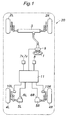
- FIG. 1 shows an outline of a vehicle with the present invention applied thereto.
- This vehicle 20 comprises a front wheel steering device 3 for directly steering right and left front wheels 2R and 2L according to the steering of a steering wheel 1, right and left actuators 5R and 5 L for individually changing toe angles of right and left rear wheels 4R and 4L by changing the length of, for example, right and left lateral links of a rear wheel suspension device which supports the right and left rear wheels 4R and 4L, right and left toe angle sensors 6R and 6L for individually detecting the toe angles of the right and left rear wheels 4R and 4L from the displacement amount of the right and left actuators 5R and 5L, a fore-and-aft acceleration sensor 7x for detecting a fore-and-aft acceleration acting on the vehicle body, a lateral acceleration sensor 7y for detecting a lateral acceleration, a yaw rate sensor 8 for detecting a yaw rate of the vehicle body, a steering angle sensor 9 for detecting a steering angle
- a rotary/linear motion converter combining an electric motor having a reduction gear and a screw mechanism, a cylinder device that linearly actuates a piston rod with hydraulic pressure, or any other known linear displacement actuator can be used.
- the toe-in and toe-out of the rear wheels 4R and 4L can be freely controlled as required by simultaneously actuating the right and left actuators 5R and 5L in a symmetric manner. Furthermore, by extending one of the right and left actuators 5R and 5L and retracting the other one, both of the rear wheels 4R and 4L can be steered either to the right or to the left.
- FIG. 2 shows a control block diagram showing the configuration of the control unit 11.
- the control unit 11 may comprise a microcomputer.
- a steering amount ⁇ f of the front wheels 2R and 2L is detected by the steering angle sensor 9 and is inputted into a feedforward computing unit 21.
- an output ⁇ x of the fore-and-aft acceleration sensor 7x mounted to the vehicle body is inputted into modified stability factor calculating unit 22.
- a modified stability factor A calculated from the fore-and-aft acceleration ⁇ x is inputted into the feedforward computing unit 21.
- a velocity V obtained by computing the average value of the outputs from the wheel velocity sensors 10 R and 10L of the rear wheels 4R and 4L is inputted into the feedforward computing unit 21.
- the feedforward computing unit 21 then, computes and outputs a feedforward control target value ⁇ r FF for the rear wheel steering angle (toe angle) from the inputted front wheel steering angle ⁇ f , modified stability factor A, vehicle velocity V and so on, as will be described later in detail.
- an output ⁇ y from the lateral acceleration sensor 7y mounted to the vehicle body and the above vehicle velocity V are inputted into a target yaw rate computing unit 23, and based on these inputted data, a target yaw rate ⁇ ref is computed and outputted.
- a rear wheel steering angle (toe angle) computing unit 24 computes a corrected rear wheel steering angle that minimizes this deviation, and outputs it as a feedback control target value ⁇ r FB for the rear wheel steering angle.
- the feedforward control target value ⁇ r FF is added to the feedback control target value ⁇ r FB to obtain a rear wheel steering angle (toe angle) control target value ⁇ r REF, which is then provided to the actuators 5R and 5L.
- the control unit 11 actuates the actuators 5 R and 5L such that the rear wheel steering angle ⁇ r becomes equal to the rear wheel steering angle control target value ⁇ r REF.
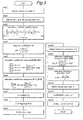
- control procedure of the present invention performed by the control unit 11 configured as above, is described with reference to Figure 3 .
- step 1 the vehicle velocity V is obtained by computing the average value of the outputs from the wheel velocity sensors 10R and 10 L of the rear wheels 4R and 4 L.
- the fore-and-aft acceleration ⁇ x is obtained from the output of the fore-and-aft acceleration sensor 7x.
- This value in addition to being directly obtained from the acceleration sensor, may also be obtained by other means such as estimating it from the differential value of the vehicle velocity.
- step 3 the modified stability factor value A is calculated (see the equation (8) shown below).
- step 4 a ratio c0 of the steady-state gain of the steering yaw rate transfer function property of the base vehicle (with acceleration/deceleration) to that of the ideal vehicle (without acceleration/deceleration) is obtained from the modified stability factor value A, steady-state stability factor A 0 , and vehicle velocity V obtained in Step 1.
- This value is a variable that varies depending on the vehicle velocity and fore-and-aft acceleration and can be obtained from a prescribed map or the like.
- step 5 a sequence of coefficients (a0 k , b0 k ) for digitally-representing the first half of an equation (or a transfer function property for the rear wheel steering angle ⁇ r to an input of the front wheel steering angle ⁇ f as given in Equation (3) below) which determines the rear wheel steering angle ⁇ r in relation to the front wheel steering angle ⁇ f so as to achieve a required steering yaw rate transfer function property (the reference steering yaw rate transfer function property) G ideal are computed.
- the transfer function on the left hand side in the block for step 5 is a phase-lead/lag property which depends on the vehicle velocity, and a0 k and b0 k are coefficients of a difference equation obtained by digitally-representing this transfer function.
- the digital representation of the transfer function is expressed as Hz0.
- step 6 a sequence of coefficients (a1 k , b1 k ) for digitally-representing the second half of the equation (3) is calculated.
- G ⁇ 0 is the steering yaw rate transfer function property when the rear wheel steering angle is 0 (i.e., is not controlled). Since G ⁇ 0 and G ideal are transfer functions which depend on the vehicle velocity, and as each of them is in the form of (first order function / second order function), G ideal / G ⁇ 0 is given in the form of (third order function / third order function).
- a1 k , b1 k are coefficients of a difference equation obtained when this function is converted into a discrete function and digitally-represented. The digital representation of this transfer function is expressed as Hz1.
- the steady-state gain of G ideal / G ⁇ 0 is a function of acceleration as described below, and corresponds to the value c0 obtained in step 4.
- step 7 the front wheel steering angle ⁇ f is inputted into the discrete transfer function Hz0 obtained in step 5, and the first half ⁇ r 1 of the equation (3) described below is calculated.
- step 8 the second half ⁇ r 2 of the equation (3) is calculated from Hz0 and Hz1.
- step 9 the rear wheel steering angle ⁇ r , which is the final result of the equation (3), is calculated based on the values obtained in step 7 and step 8, and stored as the feedforward rear wheel steering angle control target value ⁇ r FF.
- step 10 the feedback rear wheel steering angle control target value ⁇ r FB is calculated.
- step 10 the output ⁇ y from the lateral acceleration sensor 7y is obtained.
- step 11 a sequence of coefficients (a2 k , b2 k ) for digitally-representing the transfer function property G ⁇ (see equation (13) below) of the lateral acceleration ⁇ y and yaw rate ⁇ is calculated. This difference equation depends on the vehicle velocity which was obtained in step 1.
- step 12 the transfer function property G ⁇ obtained in step 11 is multiplied by the lateral acceleration ⁇ y obtained in step 10.
- the resulting value is divided by the vehicle velocity V to generate the target yaw rate ⁇ ref , which is the reference value of the feedback control (see equation (14) below).
- the division in the equation (14) becomes impossible. It is therefore necessary to make sure that division by zero does not occur in this computation.
- step 13 the actual yaw rate value is obtained from the output of yaw rate sensor 8. Then, in step 14, the feedback control target value ⁇ r FB of the rear wheel steering angle is calculated such that the actual yaw rate obtained in step 13 closely tracks the target yaw rate ⁇ ref calculated in step 12.
- a PID controller was used for adjustment. Also, a yaw moment that is expected to be generated by the rear wheel steering angle may be calculated.
- step 15 the feedforward control target value ⁇ r FF of the rear wheel steering angle, which was obtained in step 9, is added to the feedback control target value ⁇ r FB of the rear wheel steering angle, which was obtained in step 14, to determine the control target value ⁇ r of the rear wheel steering angle.
- ⁇ yaw rate
- s Laplace operator
- the desired reference steering yaw rate transfer function property G ideal can be readily obtained by controlling the transfer function property of the feedforward rear wheel steering angle control target value ⁇ r FF in relation to the front wheel actual steering angle ⁇ f ( ⁇ r / ⁇ f ).
- the rear wheel steering angle ⁇ r obtained from equation (3) is used as the feedforward rear wheel steering angle control target value ⁇ r FF.
- G ⁇ G ⁇ ⁇ 0 ⁇ 1 + V ⁇ s ⁇ I / k f ⁇ L + L f + V 2 ⁇ m ⁇ L r / k f ⁇ L / V ⁇ s ⁇ I / k r ⁇ L + L r + V 2 ⁇ m ⁇ L f / k r ⁇ L ⁇ ⁇ r / ⁇ f
- I yaw moment of inertia
- G ⁇ 0 transfer function property of the vehicle slip angle ⁇ in relation to the front wheel steering angle ⁇ f when the rear wheel steering angle is not controlled.
- the steering yaw rate ⁇ and the slip angle ⁇ cannot be arbitrarily determined.
- the rear wheel steering angle ⁇ r in a steady-state or feedforward rear wheel steering angle control target value ⁇ r FF) becomes 0 according to equation (3)
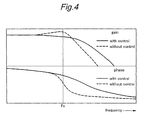
- Figure 4 shows a bode chart of steering yaw rate responses in presence and absence of rear wheel steering angle control, according to the present invention.
- the steady-state yaw rate gain is the same regardless of the presence of the control, however a pronounced resonance occurs in absence of the control at a certain frequency Fx, but no resonance is detected in presence of the control.
- the phase significantly changes near this yaw resonance so that there is a high likelihood that the vehicle may become unstable for a given input by a vehicle operator.
- the phase delay is small so that the vehicle is kept stable, and it is easier for the vehicle operator to handle the vehicle.
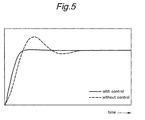
- Figure 5 shows yaw responses to a step steering input in presence and absence of rear wheel steering angle control according to the present invention.
- the front and rear wheel cornering powers k f and k r are constants k f 0 and k r 0, and the stability factor A is a constant A 0 .
- the yaw rate transfer function property G ⁇ o in relation to the front wheel steering angle can be expressed with the constant A 0 as the following equation (5').
- G ⁇ ⁇ o n 1 ⁇ s + V / L ⁇ 1 / 1 + A 0 ⁇ V 2 / d 2 ⁇ s 2 + d 1 ⁇ s + 1
- the stability factor A 0 at a constant velocity and steering yaw rate transfer function property G ⁇ o (based on the stability factor A 0 ) without rear wheel steering angle control can be obtained experimentally, for example, by driving the vehicle in slalom at a constant velocity and measuring data. Therefore, the rear wheel steering angle ⁇ r (feedforward control target value ⁇ r FF) for achieving the reference steering yaw rate transfer function property G ideal may be obtained by using the transfer function property G ⁇ o obtained from equation (5') in equation (3).
- the stability factor A in presence of acceleration/deceleration can be expressed with the fore-and-aft acceleration ⁇ x , stability factor A 0 without acceleration/deceleration, and cornering powers k f 0 and k r 0 generated when the vehicle is turning at a constant velocity as the following equation.
- A A 0 ⁇ L f / L f + h ⁇ ⁇ x ⁇ L f ⁇ k f ⁇ 0 - L r / L r - h ⁇ ⁇ x ⁇ L r ⁇ k r ⁇ 0 / L f ⁇ k f ⁇ 0 - L r ⁇ k r ⁇ 0 0
- Figure 6 shows the graph of equation (8). As shown in the figure, when a vehicle without rear wheel steering angle control accelerates while turning, it understeers. On the other hand, when it decelerates while turning, it oversteers.
- the stability factor A given by equation (8) is used as the modified stability factor (i.e., both of equation (5) and equation (8) are used) instead of the stability factor A 0 (which was used in equation (5') to determine G ⁇ o used in equation (3)). Therefore, the rear wheel steering angle is controlled by the feedforward rear wheel steering angle control target value ⁇ r FF that matches the actual stability factor, which changes according to the vehicle fore-and-aft acceleration/deceleration, thereby preventing the vehicle operator from experiencing an unfamiliar feeling regarding the vehicle handling and improving vehicle stability and responsiveness.
- one of the factors that could disturb vehicle motion stability is the acceleration/deceleration during a turn. This is because, as is obvious from equation (8), when the vehicle accelerates/decelerates during a turn, the fore-and-aft load distribution changes, and thus the vehicle turning property changes.
- the feedforward control target value of the rear wheel steering angle is adjusted automatically according to changes in turning property, the vehicle behavior maintains stability even when the vehicle is accelerating/decelerating during a turn. Therefore, according to the present invention, even when the vehicle is accelerating/decelerating, the vehicle operator can be prevented from experiencing an unfamiliar feeling regarding the vehicle handling, and vehicle responsiveness and stability can be improved.
- ⁇ f , ⁇ r slip angles of front and rear wheels
- I vehicle yaw moment of inertia
- m vehicle mass.
- the time rate change of the vehicle slip angle ⁇ (d ⁇ / dt) can be expressed by the lateral acceleration ⁇ y , vehicle velocity V, and yaw rate ⁇ , as the following equation.
- d ⁇ ⁇ / dt ⁇ y / V - ⁇
- the rear wheel steering angle is feedback-controlled (i.e., the feedback rear wheel steering angle target value ⁇ r FB is adjusted) such that the actual yaw rate ⁇ becomes identical to this target yaw rate ⁇ ref calculated from the vehicle velocity V and the actual lateral acceleration ⁇ y .
- the feedforward-control which is performed to achieve the reference steering yaw rate property G ideal based on equation (3), even when the road friction coefficient ⁇ and other parameters change, the lateral acceleration ⁇ y changes only in a corresponding manner, and ⁇ ref changes as a result thereof so that a yaw rate inappropriate for the road condition will not be generated.
- not only the effects of the road friction coefficient ⁇ but also those of changes in various properties of the vehicle including vehicle mass change (caused, for example, by the number of vehicle occupants) will be reduced.
- the steady-state property of the reference steering yaw rate transfer function property which is used to determine the rear wheel steering angle feedforward control target value from the front wheel steering angle
- the slip angle ⁇ is controlled to be the same as it would be when the rear wheel steering angle is not controlled, thereby preventing the vehicle operator from experiencing an unfamiliar feeling regarding the vehicle handling.
- the feedforward target rear wheel steering angle is set according to changes in vehicle steer property caused by fore-and-aft acceleration, thereby preventing the vehicle operator from experiencing an unfamiliar feeling regarding the vehicle handling and improving vehicle stability and responsiveness even when the vehicle is accelerating or decelerating.
- the target yaw rate is set according to changes in road condition, and the feedback rear wheel steering angle control target value is determined accordingly, the controlling device can be configured to be stable against changes in road condition and show a highly robust stability. Therefore, the rear wheel steering angle controlling device for vehicles of the present invention is extremely useful in industry.
Landscapes
- Engineering & Computer Science (AREA)
- Physics & Mathematics (AREA)
- Mathematical Physics (AREA)
- Theoretical Computer Science (AREA)
- Chemical & Material Sciences (AREA)
- Combustion & Propulsion (AREA)
- Transportation (AREA)
- Mechanical Engineering (AREA)
- Steering Control In Accordance With Driving Conditions (AREA)
- Steering-Linkage Mechanisms And Four-Wheel Steering (AREA)
Applications Claiming Priority (2)
| Application Number | Priority Date | Filing Date | Title |
|---|---|---|---|
| JP2006285722 | 2006-10-20 | ||
| PCT/JP2007/001140 WO2008047481A1 (en) | 2006-10-20 | 2007-10-19 | Vehicle rear wheel steered angle controller |
Publications (3)
| Publication Number | Publication Date |
|---|---|
| EP2085293A1 true EP2085293A1 (de) | 2009-08-05 |
| EP2085293A4 EP2085293A4 (de) | 2009-11-11 |
| EP2085293B1 EP2085293B1 (de) | 2011-03-16 |
Family
ID=39313737
Family Applications (1)
| Application Number | Title | Priority Date | Filing Date |
|---|---|---|---|
| EP07827919A Not-in-force EP2085293B1 (de) | 2006-10-20 | 2007-10-19 | Vorrichtung zur Hinterradlenkwinkelsteuerung eines Fahrzeuges |
Country Status (6)
| Country | Link |
|---|---|
| US (1) | US8554416B2 (de) |
| EP (1) | EP2085293B1 (de) |
| JP (1) | JP5135224B2 (de) |
| CA (1) | CA2661781C (de) |
| DE (1) | DE602007013267D1 (de) |
| WO (1) | WO2008047481A1 (de) |
Cited By (4)
| Publication number | Priority date | Publication date | Assignee | Title |
|---|---|---|---|---|
| US8494719B2 (en) | 2009-02-12 | 2013-07-23 | GM Global Technology Operations LLC | Method and apparatus for controlling active rear steering |
| CN105835873A (zh) * | 2015-02-02 | 2016-08-10 | 本田技研工业株式会社 | 车辆行为信息取得装置及车辆行驶控制装置 |
| CN113721620A (zh) * | 2021-08-30 | 2021-11-30 | 山东交通学院 | 基于粒子群-遗传混合算法的车辆横向pid控制方法 |
| US20220219754A1 (en) * | 2021-01-11 | 2022-07-14 | Hyundai Mobis Co., Ltd. | Method for rear steering control of a vehicle |
Families Citing this family (19)
| Publication number | Priority date | Publication date | Assignee | Title |
|---|---|---|---|---|
| US8068955B2 (en) * | 2008-01-08 | 2011-11-29 | Honda Motor Co., Ltd. | Vehicle with a variable rear toe angle |
| CN101959746B (zh) * | 2008-03-10 | 2013-07-17 | 本田技研工业株式会社 | 车辆操纵性控制装置 |
| EP2210790B1 (de) | 2008-03-11 | 2012-12-26 | Honda Motor Co., Ltd. | Steuervorrichtung zur stabilisierung des verhaltens eines fahrzeugs |
| JP5297117B2 (ja) * | 2008-08-19 | 2013-09-25 | 富士重工業株式会社 | 車両挙動制御装置 |
| JP5384905B2 (ja) * | 2008-10-16 | 2014-01-08 | 本田技研工業株式会社 | 舵角比可変制御装置 |
| US9194566B2 (en) * | 2012-06-08 | 2015-11-24 | Lg Innotek Co., Ltd. | Lamp unit and vehicle lamp apparatus using the same |
| JP6081349B2 (ja) * | 2013-12-24 | 2017-02-15 | 本田技研工業株式会社 | 車両の旋回制御システム |
| KR102202752B1 (ko) * | 2017-06-30 | 2021-01-14 | 현대모비스 주식회사 | 차량의 후륜 조향 제어 방법 및 장치 |
| JP6734905B2 (ja) * | 2018-11-07 | 2020-08-05 | 本田技研工業株式会社 | 車両挙動安定化装置 |
| KR102703074B1 (ko) * | 2019-12-20 | 2024-09-06 | 현대자동차주식회사 | 후륜 조향 제어 장치 및 후륜 조향 제어 방법 |
| CN113276942B (zh) * | 2020-02-19 | 2022-07-26 | 广州汽车集团股份有限公司 | 一种后轮主动转向控制方法及其系统、控制设备 |
| CN111703503B (zh) * | 2020-05-26 | 2022-08-23 | 江苏大学 | 一种结合自动驾驶模块的悬架前轮前束角控制系统及方法 |
| KR102791576B1 (ko) * | 2020-08-24 | 2025-04-04 | 현대자동차주식회사 | 휠 모터 구동차량의 주행 안정화 방법 |
| CN114194286B (zh) * | 2022-01-04 | 2023-11-03 | 吉林大学 | 一种基于差速原理的双模式后轮主动转向装置 |
| GB2618545B (en) * | 2022-05-09 | 2024-10-16 | Jaguar Land Rover Ltd | Control system and method for vehicle steering |
| CN115158459B (zh) * | 2022-07-11 | 2024-01-16 | 上汽通用汽车有限公司 | 后轮转角控制方法、装置、设备及计算机可读存储介质 |
| CN119078957A (zh) * | 2023-06-06 | 2024-12-06 | 英业达科技有限公司 | 后车轮转向系统 |
| FR3157336A1 (fr) | 2023-12-22 | 2025-06-27 | Ampere Sas | Procédé de commande d’un véhicule automobile à quatre roues directrices prenant en compte le recentrage du volant |
| FR3157335A1 (fr) | 2023-12-22 | 2025-06-27 | Ampere Sas | Procédé de commande d’un véhicule automobile à quatre roues directrices, comportant la commande d’un actionneur de braquage des roues arrière par un signal à action directe |
Family Cites Families (30)
| Publication number | Priority date | Publication date | Assignee | Title |
|---|---|---|---|---|
| JPH06104455B2 (ja) * | 1985-03-15 | 1994-12-21 | 日産自動車株式会社 | 車両運動状態推定装置 |
| JP2616762B2 (ja) * | 1985-11-19 | 1997-06-04 | トヨタ自動車株式会社 | 後輪操舵装置 |
| US5208751A (en) * | 1988-04-19 | 1993-05-04 | Dr. Ing. H.C.F. Porsche Ag | Active four-wheel steering system for motor vehicles |
| JPH01285465A (ja) * | 1988-05-12 | 1989-11-16 | Nissan Motor Co Ltd | 車両用実舵角制御装置 |
| JP2502691B2 (ja) * | 1988-06-28 | 1996-05-29 | 日産自動車株式会社 | 車両用実舵角制御装置 |
| JP2606295B2 (ja) * | 1988-07-04 | 1997-04-30 | 日産自動車株式会社 | 車両用実舵角制御装置 |
| US5159553A (en) * | 1988-09-13 | 1992-10-27 | Aisin Seiki Kabushiki Kaisha | Steering control apparatus |
| JPH02241880A (ja) * | 1989-03-16 | 1990-09-26 | Kayaba Ind Co Ltd | 後輪操舵装置 |
| JP2787362B2 (ja) * | 1990-02-28 | 1998-08-13 | マツダ株式会社 | 車両の後輪操舵装置 |
| US5267160A (en) * | 1990-05-02 | 1993-11-30 | Nissan Motor Co., Ltd. | Steering control system for vehicle |
| DE69109185T2 (de) * | 1990-06-04 | 1996-01-11 | Nippon Denso Co | Signalverarbeitungsschaltung für Giergeschwindigkeitssensor. |
| JP3039010B2 (ja) * | 1990-11-29 | 2000-05-08 | トヨタ自動車株式会社 | 車両のステアリング特性制御装置 |
| JPH05131946A (ja) * | 1991-11-13 | 1993-05-28 | Toyota Motor Corp | 車両の後輪操舵制御装置 |
| JPH05139325A (ja) * | 1991-11-21 | 1993-06-08 | Toyota Motor Corp | 車両の後輪操舵装置 |
| JP3033314B2 (ja) * | 1992-01-14 | 2000-04-17 | トヨタ自動車株式会社 | 車両の走行特性制御装置 |
| JPH05229444A (ja) * | 1992-02-05 | 1993-09-07 | Toyota Motor Corp | 4輪操舵車の後輪操舵制御装置 |
| JPH06211152A (ja) * | 1993-01-19 | 1994-08-02 | Aisin Seiki Co Ltd | 車輌の操舵装置 |
| JP3179271B2 (ja) * | 1993-12-01 | 2001-06-25 | 本田技研工業株式会社 | 前後輪操舵装置の制御方法 |
| JPH07257416A (ja) * | 1994-03-18 | 1995-10-09 | Honda Motor Co Ltd | 前後輪操舵車両の制御方法 |
| JP3476972B2 (ja) | 1995-07-17 | 2003-12-10 | 本田技研工業株式会社 | 後輪転舵装置 |
| US6397135B1 (en) * | 2000-07-13 | 2002-05-28 | Aisin Seiki Kabushiki Kaisha | Rear-wheel steering angle control device |
| US6453226B1 (en) * | 2001-01-25 | 2002-09-17 | Delphi Technologies, Inc. | Integrated control of active tire steer and brakes |
| US6735510B2 (en) * | 2001-10-12 | 2004-05-11 | Delphi Technologies, Inc. | Dynamic side to side brake proportioning |
| JP2003252229A (ja) * | 2002-03-04 | 2003-09-10 | Mitsubishi Electric Corp | 車両用操舵制御装置 |
| US6819998B2 (en) * | 2002-11-26 | 2004-11-16 | General Motors Corporation | Method and apparatus for vehicle stability enhancement system |
| JP4120427B2 (ja) * | 2003-03-06 | 2008-07-16 | トヨタ自動車株式会社 | 車輌用操舵制御装置 |
| JP4155246B2 (ja) * | 2004-08-17 | 2008-09-24 | トヨタ自動車株式会社 | 車輌の運動制御装置 |
| JP2006062505A (ja) * | 2004-08-26 | 2006-03-09 | Nissan Motor Co Ltd | 車両用サスペンション装置 |
| US7213675B2 (en) * | 2004-09-29 | 2007-05-08 | Delphi Technologies, Inc. | Method and system for anti-static steering for vehicle steering systems |
| KR100656328B1 (ko) * | 2004-10-13 | 2006-12-13 | 닛산 지도우샤 가부시키가이샤 | 조향 가능한 차량을 위한 조향 장치 |
-
2007
- 2007-10-19 JP JP2008539679A patent/JP5135224B2/ja not_active Expired - Fee Related
- 2007-10-19 EP EP07827919A patent/EP2085293B1/de not_active Not-in-force
- 2007-10-19 DE DE602007013267T patent/DE602007013267D1/de active Active
- 2007-10-19 US US12/311,295 patent/US8554416B2/en not_active Expired - Fee Related
- 2007-10-19 WO PCT/JP2007/001140 patent/WO2008047481A1/ja not_active Ceased
- 2007-10-19 CA CA2661781A patent/CA2661781C/en not_active Expired - Fee Related
Cited By (7)
| Publication number | Priority date | Publication date | Assignee | Title |
|---|---|---|---|---|
| US8494719B2 (en) | 2009-02-12 | 2013-07-23 | GM Global Technology Operations LLC | Method and apparatus for controlling active rear steering |
| DE102010007615B4 (de) * | 2009-02-12 | 2015-06-25 | GM Global Technology Operations LLC (n. d. Ges. d. Staates Delaware) | Aktives Hinterradlenksteuersystem und Controller eines aktiven Hinterradlenksteuersystems |
| CN105835873A (zh) * | 2015-02-02 | 2016-08-10 | 本田技研工业株式会社 | 车辆行为信息取得装置及车辆行驶控制装置 |
| CN105835873B (zh) * | 2015-02-02 | 2018-04-20 | 本田技研工业株式会社 | 车辆行驶控制装置 |
| US20220219754A1 (en) * | 2021-01-11 | 2022-07-14 | Hyundai Mobis Co., Ltd. | Method for rear steering control of a vehicle |
| US11685434B2 (en) * | 2021-01-11 | 2023-06-27 | Hyundai Mobis Co., Ltd. | Method for rear steering control of a vehicle |
| CN113721620A (zh) * | 2021-08-30 | 2021-11-30 | 山东交通学院 | 基于粒子群-遗传混合算法的车辆横向pid控制方法 |
Also Published As
| Publication number | Publication date |
|---|---|
| WO2008047481A1 (en) | 2008-04-24 |
| JP5135224B2 (ja) | 2013-02-06 |
| CA2661781A1 (en) | 2008-04-24 |
| CA2661781C (en) | 2011-07-19 |
| JPWO2008047481A1 (ja) | 2010-02-18 |
| EP2085293B1 (de) | 2011-03-16 |
| US20100023217A1 (en) | 2010-01-28 |
| EP2085293A4 (de) | 2009-11-11 |
| DE602007013267D1 (de) | 2011-04-28 |
| US8554416B2 (en) | 2013-10-08 |
Similar Documents
| Publication | Publication Date | Title |
|---|---|---|
| EP2085293B1 (de) | Vorrichtung zur Hinterradlenkwinkelsteuerung eines Fahrzeuges | |
| JP3058172B2 (ja) | 車両の運動制御装置 | |
| CN112074449B (zh) | 用于控制车辆转向的方法和系统 | |
| CN108602529B (zh) | 用于控制车辆转向和车辆行为的方法 | |
| JP2932589B2 (ja) | 車両の運動制御装置 | |
| EP3444157B1 (de) | Vorrichtung und verfahren zur fahrzeugsteuerung | |
| EP1521695B1 (de) | Verfahren zum erhöhen der stabilität eines fahrzeugs | |
| US7516965B2 (en) | Variable rear wheel toe angle control system for a vehicle | |
| EP2112053B1 (de) | Gierstabilitäts-Regelsystem | |
| EP2657106B1 (de) | Steuervorrichtung für fahrzeuglenkung | |
| DE60202086T3 (de) | Überrollstabilitätssteuerung für ein Kraftfahrzeug | |
| US10272943B2 (en) | Control unit for vehicle and control method for vehicle | |
| EP2213547B1 (de) | Fahrzeug mit hinterradlenkung | |
| US9573590B2 (en) | Method for stabilizing a two-wheeled vehicle during cornering | |
| EP2020361B1 (de) | Fahrzeuglenkhilfevorrichtung | |
| CN114502448A (zh) | 用于车辆转向的方法和系统布置以及具有这种系统的车辆 | |
| EP1577194A1 (de) | Lenkeinrichtung für ein Fahrzeug und Steuerverfahren dafür | |
| JP7109406B2 (ja) | 車両制御装置 | |
| WO2007093969A1 (en) | Turning behavior control apparatus and turning behavior control process for a motor vehicle | |
| EP1989093B1 (de) | Fahrzeugverhaltenssteuerung | |
| EP1892179A1 (de) | Variables Hinterradspurwinkelsteuerungssystem für Fahrzeuge | |
| JP2008074185A (ja) | 車両運動制御方法および車両運動制御装置 | |
| EP2289746A1 (de) | System zur Verbesserung der Kurvenfahrtleistung eines Fahrzeugs, das von einem Sicherheitssystem gesteuert wird | |
| JP5313760B2 (ja) | 後輪トー角制御装置および電動アクチュエータの基準作動量設定方法 | |
| US8660750B2 (en) | System for enhancing cornering performance of a vehicle equipped with a stability control system |
Legal Events
| Date | Code | Title | Description |
|---|---|---|---|
| PUAI | Public reference made under article 153(3) epc to a published international application that has entered the european phase |
Free format text: ORIGINAL CODE: 0009012 |
|
| 17P | Request for examination filed |
Effective date: 20090310 |
|
| AK | Designated contracting states |
Kind code of ref document: A1 Designated state(s): DE FR GB |
|
| RBV | Designated contracting states (corrected) |
Designated state(s): AT BE BG CH CY CZ DE DK EE ES FI FR GB GR HU IE IS IT LI LT LU LV MC MT NL PL PT RO SE SI SK TR |
|
| RBV | Designated contracting states (corrected) |
Designated state(s): AT BE BG CH CY CZ DE DK EE ES FI FR GB GR HU IE IS IT LI LT LU LV MC MT NL PL PT RO SE SI SK TR |
|
| RBV | Designated contracting states (corrected) |
Designated state(s): DE FR GB |
|
| 17Q | First examination report despatched |
Effective date: 20090917 |
|
| A4 | Supplementary search report drawn up and despatched |
Effective date: 20090903 |
|
| DAX | Request for extension of the european patent (deleted) | ||
| GRAP | Despatch of communication of intention to grant a patent |
Free format text: ORIGINAL CODE: EPIDOSNIGR1 |
|
| GRAS | Grant fee paid |
Free format text: ORIGINAL CODE: EPIDOSNIGR3 |
|
| RIN1 | Information on inventor provided before grant (corrected) |
Inventor name: SASAKI, HIROAKI Inventor name: HORIUCHI, YUTAKA Inventor name: YANAGI, TAKASHI |
|
| RTI1 | Title (correction) |
Free format text: REAR WHEEL STEERING ANGLE CONTROLLING DEVICE FOR VEHICLES |
|
| GRAA | (expected) grant |
Free format text: ORIGINAL CODE: 0009210 |
|
| AK | Designated contracting states |
Kind code of ref document: B1 Designated state(s): DE FR GB |
|
| REG | Reference to a national code |
Ref country code: GB Ref legal event code: FG4D |
|
| RIN2 | Information on inventor provided after grant (corrected) |
Inventor name: HORIUCHI, YUTAKA Inventor name: YANAGI, TAKASHI Inventor name: SASAKI, HIROAKI |
|
| REF | Corresponds to: |
Ref document number: 602007013267 Country of ref document: DE Date of ref document: 20110428 Kind code of ref document: P |
|
| REG | Reference to a national code |
Ref country code: DE Ref legal event code: R096 Ref document number: 602007013267 Country of ref document: DE Effective date: 20110428 |
|
| PLBE | No opposition filed within time limit |
Free format text: ORIGINAL CODE: 0009261 |
|
| STAA | Information on the status of an ep patent application or granted ep patent |
Free format text: STATUS: NO OPPOSITION FILED WITHIN TIME LIMIT |
|
| 26N | No opposition filed |
Effective date: 20111219 |
|
| REG | Reference to a national code |
Ref country code: DE Ref legal event code: R097 Ref document number: 602007013267 Country of ref document: DE Effective date: 20111219 |
|
| GBPC | Gb: european patent ceased through non-payment of renewal fee |
Effective date: 20111019 |
|
| PG25 | Lapsed in a contracting state [announced via postgrant information from national office to epo] |
Ref country code: GB Free format text: LAPSE BECAUSE OF NON-PAYMENT OF DUE FEES Effective date: 20111019 |
|
| REG | Reference to a national code |
Ref country code: DE Ref legal event code: R084 Ref document number: 602007013267 Country of ref document: DE |
|
| REG | Reference to a national code |
Ref country code: DE Ref legal event code: R084 Ref document number: 602007013267 Country of ref document: DE Effective date: 20140821 |
|
| REG | Reference to a national code |
Ref country code: FR Ref legal event code: PLFP Year of fee payment: 9 |
|
| PGFP | Annual fee paid to national office [announced via postgrant information from national office to epo] |
Ref country code: FR Payment date: 20150908 Year of fee payment: 9 |
|
| REG | Reference to a national code |
Ref country code: FR Ref legal event code: ST Effective date: 20170630 |
|
| PG25 | Lapsed in a contracting state [announced via postgrant information from national office to epo] |
Ref country code: FR Free format text: LAPSE BECAUSE OF NON-PAYMENT OF DUE FEES Effective date: 20161102 |
|
| PGFP | Annual fee paid to national office [announced via postgrant information from national office to epo] |
Ref country code: DE Payment date: 20181009 Year of fee payment: 12 |
|
| REG | Reference to a national code |
Ref country code: DE Ref legal event code: R119 Ref document number: 602007013267 Country of ref document: DE |
|
| PG25 | Lapsed in a contracting state [announced via postgrant information from national office to epo] |
Ref country code: DE Free format text: LAPSE BECAUSE OF NON-PAYMENT OF DUE FEES Effective date: 20200501 |