EP2090426A1 - Harzbeschichtetes aluminiumlegierungs-bahnenmaterial für das gehäuse eines elektrolytischen aluminium-kondensators, gehäuse für einen elektrolytischen aluminium-kondensator sowie elektrolytischer aluminium-kondensator - Google Patents
Harzbeschichtetes aluminiumlegierungs-bahnenmaterial für das gehäuse eines elektrolytischen aluminium-kondensators, gehäuse für einen elektrolytischen aluminium-kondensator sowie elektrolytischer aluminium-kondensator Download PDFInfo
- Publication number
- EP2090426A1 EP2090426A1 EP08703103A EP08703103A EP2090426A1 EP 2090426 A1 EP2090426 A1 EP 2090426A1 EP 08703103 A EP08703103 A EP 08703103A EP 08703103 A EP08703103 A EP 08703103A EP 2090426 A1 EP2090426 A1 EP 2090426A1
- Authority
- EP
- European Patent Office
- Prior art keywords
- wax
- resin layer
- resin
- electrolytic capacitor
- aluminum electrolytic
- Prior art date
- Legal status (The legal status is an assumption and is not a legal conclusion. Google has not performed a legal analysis and makes no representation as to the accuracy of the status listed.)
- Granted
Links
Images

Classifications
-
- C—CHEMISTRY; METALLURGY
- C09—DYES; PAINTS; POLISHES; NATURAL RESINS; ADHESIVES; COMPOSITIONS NOT OTHERWISE PROVIDED FOR; APPLICATIONS OF MATERIALS NOT OTHERWISE PROVIDED FOR
- C09D—COATING COMPOSITIONS, e.g. PAINTS, VARNISHES OR LACQUERS; FILLING PASTES; CHEMICAL PAINT OR INK REMOVERS; INKS; CORRECTING FLUIDS; WOODSTAINS; PASTES OR SOLIDS FOR COLOURING OR PRINTING; USE OF MATERIALS THEREFOR
- C09D167/00—Coating compositions based on polyesters obtained by reactions forming a carboxylic ester link in the main chain; Coating compositions based on derivatives of such polymers
-
- B—PERFORMING OPERATIONS; TRANSPORTING
- B32—LAYERED PRODUCTS
- B32B—LAYERED PRODUCTS, i.e. PRODUCTS BUILT-UP OF STRATA OF FLAT OR NON-FLAT, e.g. CELLULAR OR HONEYCOMB, FORM
- B32B15/00—Layered products comprising a layer of metal
- B32B15/04—Layered products comprising a layer of metal comprising metal as the main or only constituent of a layer, which is next to another layer of the same or of a different material
- B32B15/08—Layered products comprising a layer of metal comprising metal as the main or only constituent of a layer, which is next to another layer of the same or of a different material of synthetic resin
-
- C—CHEMISTRY; METALLURGY
- C08—ORGANIC MACROMOLECULAR COMPOUNDS; THEIR PREPARATION OR CHEMICAL WORKING-UP; COMPOSITIONS BASED THEREON
- C08G—MACROMOLECULAR COMPOUNDS OBTAINED OTHERWISE THAN BY REACTIONS ONLY INVOLVING UNSATURATED CARBON-TO-CARBON BONDS
- C08G59/00—Polycondensates containing more than one epoxy group per molecule; Macromolecules obtained by polymerising compounds containing more than one epoxy group per molecule using curing agents or catalysts which react with the epoxy groups
- C08G59/18—Macromolecules obtained by polymerising compounds containing more than one epoxy group per molecule using curing agents or catalysts which react with the epoxy groups ; e.g. general methods of curing
- C08G59/40—Macromolecules obtained by polymerising compounds containing more than one epoxy group per molecule using curing agents or catalysts which react with the epoxy groups ; e.g. general methods of curing characterised by the curing agents used
- C08G59/4007—Curing agents not provided for by the groups C08G59/42 - C08G59/66
- C08G59/4014—Nitrogen containing compounds
- C08G59/4021—Ureas; Thioureas; Guanidines; Dicyandiamides
-
- C—CHEMISTRY; METALLURGY
- C08—ORGANIC MACROMOLECULAR COMPOUNDS; THEIR PREPARATION OR CHEMICAL WORKING-UP; COMPOSITIONS BASED THEREON
- C08L—COMPOSITIONS OF MACROMOLECULAR COMPOUNDS
- C08L23/00—Compositions of homopolymers or copolymers of unsaturated aliphatic hydrocarbons having only one carbon-to-carbon double bond; Compositions of derivatives of such polymers
- C08L23/02—Compositions of homopolymers or copolymers of unsaturated aliphatic hydrocarbons having only one carbon-to-carbon double bond; Compositions of derivatives of such polymers not modified by chemical after-treatment
- C08L23/04—Homopolymers or copolymers of ethene
-
- C—CHEMISTRY; METALLURGY
- C09—DYES; PAINTS; POLISHES; NATURAL RESINS; ADHESIVES; COMPOSITIONS NOT OTHERWISE PROVIDED FOR; APPLICATIONS OF MATERIALS NOT OTHERWISE PROVIDED FOR
- C09D—COATING COMPOSITIONS, e.g. PAINTS, VARNISHES OR LACQUERS; FILLING PASTES; CHEMICAL PAINT OR INK REMOVERS; INKS; CORRECTING FLUIDS; WOODSTAINS; PASTES OR SOLIDS FOR COLOURING OR PRINTING; USE OF MATERIALS THEREFOR
- C09D163/00—Coating compositions based on epoxy resins; Coating compositions based on derivatives of epoxy resins
-
- C—CHEMISTRY; METALLURGY
- C09—DYES; PAINTS; POLISHES; NATURAL RESINS; ADHESIVES; COMPOSITIONS NOT OTHERWISE PROVIDED FOR; APPLICATIONS OF MATERIALS NOT OTHERWISE PROVIDED FOR
- C09D—COATING COMPOSITIONS, e.g. PAINTS, VARNISHES OR LACQUERS; FILLING PASTES; CHEMICAL PAINT OR INK REMOVERS; INKS; CORRECTING FLUIDS; WOODSTAINS; PASTES OR SOLIDS FOR COLOURING OR PRINTING; USE OF MATERIALS THEREFOR
- C09D175/00—Coating compositions based on polyureas or polyurethanes; Coating compositions based on derivatives of such polymers
- C09D175/04—Polyurethanes
- C09D175/06—Polyurethanes from polyesters
-
- H—ELECTRICITY
- H01—ELECTRIC ELEMENTS
- H01G—CAPACITORS; CAPACITORS, RECTIFIERS, DETECTORS, SWITCHING DEVICES, LIGHT-SENSITIVE OR TEMPERATURE-SENSITIVE DEVICES OF THE ELECTROLYTIC TYPE
- H01G9/00—Electrolytic capacitors, rectifiers, detectors, switching devices, light-sensitive or temperature-sensitive devices; Processes of their manufacture
- H01G9/004—Details
- H01G9/08—Housing; Encapsulation
-
- C—CHEMISTRY; METALLURGY
- C08—ORGANIC MACROMOLECULAR COMPOUNDS; THEIR PREPARATION OR CHEMICAL WORKING-UP; COMPOSITIONS BASED THEREON
- C08L—COMPOSITIONS OF MACROMOLECULAR COMPOUNDS
- C08L91/00—Compositions of oils, fats or waxes; Compositions of derivatives thereof
- C08L91/06—Waxes
-
- Y—GENERAL TAGGING OF NEW TECHNOLOGICAL DEVELOPMENTS; GENERAL TAGGING OF CROSS-SECTIONAL TECHNOLOGIES SPANNING OVER SEVERAL SECTIONS OF THE IPC; TECHNICAL SUBJECTS COVERED BY FORMER USPC CROSS-REFERENCE ART COLLECTIONS [XRACs] AND DIGESTS
- Y10—TECHNICAL SUBJECTS COVERED BY FORMER USPC
- Y10T—TECHNICAL SUBJECTS COVERED BY FORMER US CLASSIFICATION
- Y10T428/00—Stock material or miscellaneous articles
- Y10T428/25—Web or sheet containing structurally defined element or component and including a second component containing structurally defined particles
- Y10T428/254—Polymeric or resinous material
Definitions
- the present invention relates to a resin-coated aluminum alloy sheet material featuring superior formability to a deep drawing and ironing, and more particularly, relates to such a resin-coated aluminum alloy sheet material useful to a case for an aluminum electrolytic capacitor, such an aluminum electrolytic capacitor case, and such an aluminum electrolytic capacitor.
- a resin-coated aluminum alloy sheet material which does not need an insulative resin-coating process after a formation process, is used as a material for an aluminum electrolytic capacitor case. Due to the fact that this aluminum electrolytic capacitor case material is subjected to a severe formation process including a combination of a deep drawing and an ironing, if a usual resin-coated aluminum alloy sheet material for buildings or the like is used instead, cracks, peelings and so forth occur in the resin layer thereof, and thus a sufficient insulative property can not be ensured.
- a formation process using a volatile press oil which does not need a solvent degreasing process, prevails in order to obey the recent regulation of solvent, and thus requires a higher formability in comparison with a conventional formation process using a high viscosity oil.
- a solid lubricant such as wax is effective in improving a formability of a resin-coated aluminum alloy sheet material.
- a part (or all) of the wax cures in the state of existing on a surface of the resin layer due to the fact that the wax generally features a smaller surface energy than that of a base resin as a main component of the resin layer.
- the wax existing on the surface of the resin layer acts as a lubricant, and thus a press tool can smoothly slide on the surface of the resin layer so that cracks or peelings can not easily occur in the resin layer during the press formation process.
- Patent Document 1 discloses a coated metal web featuring a superior formability to an ironing, wherein, in the coated metal web material containing inner wax for a multi-stage ironing formation, regarding wax particles observed in a direction of a cross-section of a coated layer by a transmission electron microscope, a cross-sectional area of the wax particles, existing in a depth measured from the uppermost surface of a coated layer to a distance of (100-Ya) ⁇ Z/100) before an a-th formation stage, is at least 3 %: Ya% is a reduction rate of a thickness of the coated layer when it is subjected to the a-th formation stage; and Z( ⁇ m) is a thickness of the coated layer before it is subjected to the a-th formation stage.
- Patent Document 2 discloses a production method for producing aluminum alloy sheet material for can end, wherein a coating process for coating a metal sheet with a coating material containing wax is carried out in such a manner that a temperature of the metal sheet is controlled at 110 °C after 5 seconds from the start of the coating process, and that it is then controlled at most 180 °C after 10 seconds from the start of the coating process.
- the above-mentioned methods are directed to an improvement of the formability by giving a surface of a resin layer a superior lubricant property, and by making a press tool smoothly slide thereon.
- a resin layer a large stretchability progress a followingability of the resin layer to deformation of an aluminum alloy sheet material is also effective in the improvement of the formability.
- increasing a molecular weight of a base resin material of the resin layer is included.
- Patent Document 3 discloses a resin-coated aluminum alloy sheet material for a capacitor case, which is characterized by the fact that a resin material of the resin layer includes an epoxy-series resin as a main component, and at least one or no less than two resin materials selected from the group consisting of a phenolic resin, an acrylic resin, a urethane resin and a urea resin, features a number average molecular weight falling within a range from 5,000 to 30,000, and contains a lubricant of 0.1 to 10 weight parts per 100 weight pats of the resin, the tensile strength of the resin layer being at least 40 N/mm 2 , the elongation of the resin layer being at least 2 %, the thickness of the resin layer falling within a range from 3 ⁇ m to 30 ⁇ m, and that a cross-cut survival rate in a cross-cut test is at least 60 % when the resin-coated aluminum alloy
- Patent Document 4 discloses a lubricated steel sheet for cans which is excellent in a drawing/ironing formability, wherein a surface of the lubricated steel sheet, which is defined as an inner wall face of a can, is coated with a coating composition composed of an epoxy resin featuring an number average molecular weight falling within a range from 2,000 to 100,000 and an epoxy equivalent weight falling within a range from 1,500 to 50,000, and wax featuring a softening point of at least 30 °C, so that a coated layer is formed on the inner wall surface in a dry-coating weight falling within a range from 10-85 mg/100 cm 2 , the coated layer having a coefficient of dynamic friction falling within a range from 0.03 to 0.20 at the temperature of 60 °C, and a pencil hardness of at least "H" at the temperature of 60 °C.
- a coating composition composed of an epoxy resin featuring an number average molecular weight falling within a range from 2,000 to 100,000 and an epoxy equivalent weight falling within a range from 1,500 to 50,000, and
- a more preferable range for the average molecular weight is from 3,000 to 70,000, and it is specified in a sub-claim that the wax is composed of at least one kind of wax selected from the group consisting of esters of fatty acid-series wax, fluorine-series wax, polyolefin-series wax, lanolin-series wax, montan wax, microcrystalline wax and carnauba wax.
- the metal sheet disclosed in Patent Document 1 is used in production of cans which are subjected to a conventional ironing formation process, and is defined as the coated metal sheet which is intended to eliminate a degreasing process and a coating process after the ironing formation process, the cross-sectional area of the wax particles, which exist in the depth measured from the uppermost surface of the coated layer to the distance of (100-Ya) ⁇ Z/100) before the a-th formation stage, being controlled so as to be at least 3 % to thereby improve the formability for the ironing formation process.
- the minimum cross-sectional area of the wax particles is regulated under the specific conditions, uniform distribution of the wax particles can not be sufficiently ensured.
- the coated layer is susceptible to rupture because the excess amount of wax particles causes a rupture occurring point of the coated layer.
- Patent Document 1 is used to produce a case for an aluminum electrolytic capacitor featuring a large height/diameter ratio by a deep drawing formation process and an ironing formation process using a volatile press oil, it is impossible to solve the problem in which the coated layer is subjected to damage due to a local lock of lubrication and a lock of strength in the coated layer.
- Patent Document 2 when the coating material containing wax, with which the aluminum alloy sheet is coated, is baked, the temperature of the metal sheet is controlled after respective 5 seconds and 10 seconds from the start of the baking process, and it is disclosed as an embodiment by way of example that polyethylene wax, carnauba wax and lanolin wax are added to an epoxy-urea-series coating material at 5 % of respective kinds of wax to a solid content of the epoxy-urea-series coating material.
- the aluminum electrolytic capacitor case features the height/diameter ratio of approximately 1.1 to 1.7, whereas a can end features a height/diameter ratio (unit-depth/curl-dia ratio) of approximately 0.13.
- the resin-coated aluminum alloy sheet material concerned could be used for can end without any problems, the lubricating property of the resin layer was insufficient in forming the aluminum electrolytic capacitor case featuring the large height/diameter ratio, so that damages might occur in the resin layer.
- an object of the present invention is to provide a resin-coated aluminum alloy sheet material for an aluminum electrolytic capacitor case which can exhibit superior formability although such aluminum electrolytic capacitor case featuring a large height/diameter ratio is formed by using a volatile press oil , and to provide a case for an aluminum electrolytic capacitor, and such an aluminum electrolytic capacitor.
- the inventors produced resin layers using a variety of kinds of wax under a variety of conditions, studied a relationships between a wax-existing state on a surface of a resin layer and a wax-existing state in an interior of the resin layer, and found as the studying results that, although a resin-coated aluminum alloy sheet material was formed into an aluminum electrolytic capacitor case featuring a large height/diameter ratio, cracks, peelings and so forth could not occur in the resin layer after the formation process by regulating a size of wax particles and a number of wax particles in the interior of the resin layer and by concretely controlling the formation process so that wax oozed from the interior of the resin layer when the resin layer stretched, resulting in the completion of the present invention.
- the inventors defined a resin layer on an aluminum sheet material by using an epoxy-series resin having a variety of molecular weights as a main component, formed it into a capacitor case by using a volatile press oil, and then studied a formability thereof. As a result, it was found that, when the main component of the resin layer was an epoxy-series resin having a specific molecular weight, it exhibited a superior formability.
- a resin-coated aluminum alloy sheet material for an aluminum electrolytic capacitor case comprises a resin layer containing wax composed of at least one of polyethylene wax and carnauba wax, characterized in that the resin layer has a cross-section thickness falling within a range from at least 2 ⁇ m to at most 22 ⁇ m when being cut in a direction perpendicular to a surface of the resin layer, that a total of lengths of wax particles, which are defined when the wax particles are cut along a straight line of 100 ⁇ m optionally drawn on the surface of the resin layer, is at least 10 ⁇ m, that a number of the wax particles, which have a cross-sectional shape featured by a major axis extent having a length of at most 80 % of the thickness of the resin layer and of at least 0.1 ⁇ m, and which exist in a cross-sectional area of the resin layer defined by using the straight line of 100 ⁇ m as a side thereof, falls within a range from at least 3 to at most 50, and that a
- the aluminum alloy sheet material may includes a pure aluminum sheet material.
- the aforesaid wax may feature a rate of polyethylene wax to carnauba wax falling within a range between 1:4 and 4:1.
- a resin forming the aforesaid resin layer is either an epoxy-series resin or a polyester-series resin. It is more preferable that the resin forming the resin layer includes the epoxy-series resin having a number average molecular weight falling within a range from at least 5,000 to at most 13,000 as a main component.
- An aluminum electrolytic capacitor case using the aforesaid resin-coated aluminum alloy sheet material is preferable.
- An aluminum electrolytic capacitor using the aforesaid aluminum electrolytic capacitor case is preferable.
- a resin layer is removed from an resin-coated aluminum alloy sheet material by dissolving an aluminum alloy material thereof, the removed resin layer is colored with ruthenic acid, the colored resin layer is embedded in an epoxy resin, the embedded resin layer is sliced into an ultra thin film by a ultramicrotome, and then a cross-sectional state of the resin layer is observed by a transmission electron microscope.
- the wax on a surface of the resin layer is observed as linear lines extending in parallel to the surface of the resin layer, whereas the wax in an interior of the resin layer is observed as circular shapes or ellipsoidal-like shapes.
- the wax features a smaller surface energy than that of the resin material, the wax has a tendency to ooze toward the surface of the resin layer and the oozed wax becomes to wetly and flatly extend thereon, and thus the wax is observed as the linear lines in the cross-sectional view of the resin layer.
- Fig. 1 is a typical view visually illustrating a wax-existing state of a variety of wax particles 2a to 2d in the interior of the resin layer 1, the resin layer 1 has the interface to the aluminum alloy sheet, the surface of the resin layer 1 is defined as the one opposed to that interface.
- the wax particles 2a to 2d in the interior of the resin layer have a liquid state within the liquid resin phase, and thus the wax particles have a tendency to equilibrium-theoretically become a shape having the smallest interface shape to the liquid resin, i.e., a spheral shape.
- the baking process for the coating material is carried out in a relatively short time, and thus the wax particles 2a to 2d have a metastable shape which is obtained prior to the equilibrium condition.
- This metastable shape is an ellipsoidal-like shape featuring a small difference between a major axis and a minor axis in its cross-sectional view before a completely-spheral shape is obtained, or otherwise a distorted spheral shape.
- the wax particles hardly become an ellipsoidal-like shape or a needle-like shape featuring a large interface-area/volume ratio, i.e., a large difference between the major axis and the minor axis.
- a wax-particle shape can be estimated by defining a size of the wax particles 2a to 2d in comparison with a completely spheral shape having a circular shape in its cross-sectional view.
- a wax particle featuring a major axis extent (which is defined as a diameter section if the wax particle is circular in its cross-sectional view) of at least x ⁇ m is defined as the wax particle 2c featuring a larger cross-sectional shape than that of a circle 3 having a diameter of x ⁇ m.
- the cross-sectional shape of the wax particle 2c is not encompassed by the circle 3 so that the major axis section is outwardly extended from the circle 3 when the circle 3 is put over the cross-section of the wax particle 2c.
- the wax particle 2d having the cross-sectional shape a major axis extent of which is at most y % of the thickness of the resin layer 1
- the wax particle 2d having a smaller cross-sectional shape than a circle 4 having a diameter of z ⁇ m ( the resin layer thickness ⁇ y/ 100) which is at most y % of the thickness of the resin layer 1 shown in Fig. 1 .
- the cross-sectional shape of the wax particle 2d is encompassed by the circle 4 without being outwardly extended therefrom when the circle 4 is put over the cross-section of the wax particle 2d.
- the resin-coated aluminum alloy sheet material includes the resin layer 1 containing wax composed of at least one of polyethylene wax and carnauba wax.
- polyethylene wax is desirable.
- Polyethylene wax having a variety of particle sizes is commercially available, not only can a distribution of wax particles according to the present invention be easily obtained by using polyethylene wax, but also a lubricant property of polyethylene wax is superior to another kind of wax although the other kind of wax has a similar distribution to that of polyethylene wax.
- the lubricant property can be further improved. It is desirable that a rate of polyethylene wax to carnauba wax falls within a range between 1:4 and 4:1. This is because an effect obtained when either polyethylene wax or carnauba has a smaller rate than that defined on the above is equivalent to that obtained when only one of the kinds of wax is used.
- a curing agent addition type epoxy-series resin a self-crosslink epoxy-series resin, a polyester/melamine-series resin, a polyester/isocyanate-series resin, an amino-alkyd-series resin, a vinyl chloride-series resin and so forth may be used.
- a curing agent for the epoxy-series resin a usual resin for curing the epoxy-series resin may be used.
- an amino-series type such as urea, melamine, benzoguanamine, acetoguanamine or the like, a phenol-series type such as cresol, butylphenol, phenol or the like, an isocyanate-series type such as hexamethylene isocyanate, isophorone di-isocyanate or the like, and so forth. It is preferable that an amount of addition of the curing agent is from 1 to 30 wt% in the resin layer.
- a curing condition of a resin layer is variable by a combination of a resin and a curing agent, especially, the epoxy/urea-series resin and the polyester/isocyanate-series resin are desirable because the resin layer can exhibit a suitable softness and adhesion property, and because it is possible to obtain a superior formability.
- a resin (base resin) forming the resin layer 1 includes at least an epoxy-series resin as a main component.
- This epoxy-series resin features a number average molecular weight falling within a range from at least 5,000 to at most 13,000 (in a weight average molecular weight, a range from at least 40,000 to at most 90,000 is desirable).
- the molecular weight of the epoxy-series resin becomes larger, the more elongated molecules are entangled with each other, and thus a freedom of displacement among the molecules becomes larger so as to give the resin layer a large stretchability. As a result, it is possible to improve a followingability of the resin layer to an aluminum sheet during a formation process.
- the resin layer has a tendency toward decreasing an adhesion property, resulting in spoilage of the improvement of the formability. More desirably, the number average molecular weight is from at least 7,000 to at most 11,000 (the weight average molecular weight is from at least 40,000 to at most 83,000).
- a number average molecular weight of an epoxy resin is measured by using GPC(Gel Permeation Chromatography).
- a surface treatment of a substrate for the resin layer 1 there is a phosphate-chromate treatment which is conventionally used for aluminum alloy, and it is possible to use another treatment, such as a no-rinse-type chromate treatment and non-chromate treatment by paying attention to an environment or the like.
- a non-chromate treatment it is possible to use a reaction-type phosphate-zirconate treatment, a phosphate-titanate treatment, a coating-type zirconium treatment or the like.
- a cross-section thickness of the aforesaid resin layer 1 is from at least 2 ⁇ m to at most 22 ⁇ m when being cut in a direction perpendicular to a surface of the resin layer.
- the thickness of the resin layer 1 must be from at least 2 ⁇ m to at most 22 ⁇ m. This is because the resin layer 1 is susceptible to rupture during a stretching process when the thickness is less than 2 ⁇ m, and because the resin layer 1 is subjected to damage when the thickness exceeds 22 ⁇ m in that, when a formation process is carried out by using a usual die for a capacitor case, a sufficient clearance can not be obtained between a punch and a dice so that a surface pressure becomes too large to thereby cause a lack of lubrication regardless of the addition of wax. Note that a preferable thickness of the resin layer 1 is from at least 5 ⁇ m to at most 14 ⁇ m.
- a total of lengths of wax particles which is defined when the wax particles are cut along a straight line 5 of 100 ⁇ m optionally drawn on the surface of the resin layer 1, is at least 10 ⁇ m.
- the total of cutting lengths d1, d2, d3, d4, d5 and d6 of the wax particles is at least 10 ⁇ m.
- the total (d1+d2+d3+d4+d5+d6) of the cutting lengths of the wax particles 2e and 2f must be at least 10 ⁇ m when the wax particles are cut along the straight line 5 of 100 ⁇ m optionally drawn on the surface of the resin layer 1, i.e., the occupation percentage of the wax to the surface of the resin layer 1 must be at least 10 %.
- the wax-occupation percentage is less than 10 %, the lubrication is insufficient at the beginning of the forming process to thereby cause damage of the resin layer 1 after the forming process.
- the wax-occupation percentage is at least 20 %.
- the surface of the resin layer 1 may be covered at 100 % with wax.
- a number of the wax particles 2a, 2d which have a cross-sectional shape featured by a major axis extent having a length of at most 80 % of the thickness of the resin layer 1 and of at least 0.1 ⁇ m, and which exist in a cross-sectional area of the resin layer defined by using the straight line 5 of 100 ⁇ m as a side thereof, falls within a range from at least 3 to at most 50.
- the wax particles which have the cross-sectional shape featured by the major axis extent having a length of at most 80 % of the thickness of the resin layer 1 and of at least 0.1 ⁇ m, and which are from at least 3 to at most 50, must exist as the wax oozed from the interior of the resin layer 1 for the lubrication.
- the wax particles 2a and 2d having the cross-sectional shape, the major axis extent of which has the length of at most 80 % of the thickness of the resin layer 1, are defined as the wax particles 2a and 2d featuring the smaller cross-sectional shape than the circle 4 having a diameter which is at most 80 % of the thickness of the resin layer 1 shown in Fig. 1 .
- the cross-sectional shape of the wax particles 2a and 2d is encompassed by the circle 4 without being outwardly extended therefrom when the circle 4 is put over each of the cross-sections of the wax particles 2a and 2d.
- the wax particles having the cross-sectional shape, the major axis extent of which has the length of at least 0.1 ⁇ m, are defined as the wax particles 2a, 2c and 2d having the larger cross-sectional shape than a circle 6 having a diameter of 0.1 ⁇ m, as shown in Fig. 1 .
- a wax particle 2b is not the wax particle having the major axis extent having the length of at least 0.1 ⁇ m.
- the resin layer 1 could be subjected to large damage. This is because a sufficient lubrication can not be obtained when the wax particles existing in the interior of the resin layer 1 are too small although the wax is added to the resin layer.
- the wax particles 2a and 2d existing within the range between at least 3 and at most 50 must be featured by the major axis extent which has the length of at most 80 % of the thickness of the resin layer 1.
- the coated layer can be prevented from being easily ruptured by the fact that the wax particle 2c featuring a larger major axis extent than the length of at most 80 % of the thickness of the resin layer 1 may cause a rupture occurring point.
- the number of the wax particles is preferably from at least 8 to at most 34.
- the wax particles 2c observed in the interior of the resin layer 1 which have the cross-sectional shape featured by the major axis extent having the length of more than 80 % of the thickness of the resin layer, i.e., the wax particles 2c having a large size which exceeds that of the circle 4 having 80 % of the thickness of the resin layer 1, are increased so that the size of the wax particles existing in the interior of the resin layer 1 is too large, each of these wax particles may cause a rupture occurring point, and thus the resin layer 1 may be subjected to disadvantageous large damage.
- the number of the wax particles 2c having the cross-sectional shape, the size of which exceeds that of the circle 4 having 80 % of the thickness of the resin layer 1, must be less than 10.
- the number of the wax particles 2c is less than 5.
- the number of the wax particles 2 existing in the cross-sectional area cut along the straight line extent 5 of 100 ⁇ m optionally drawn on the surface of the resin layer 1 is from at least 3 to at most 50.
- the number of the wax particles is less than 3, a sufficient lubrication can not be obtained although the wax particles have a large size.
- the number of the wax particles exceeds 50, a portion easily becoming rupture occurring point is increased when the resin layer 1 is stretched although the size of the wax particles is small. As a result, the resin layer 1 is susceptible to damage.
- a resin-coated aluminum alloy sheet material for an aluminum electrolytic capacitor case by making the wax particle 2 exist in the resin layer 1 so that the aforesaid conditions of the present invention can be satisfied, is previously prepared a resin material to which wax is added, and in which a concentration of wax is adjusted so that a total of lengths of wax particles 2, which are defined when the wax particles are cut along a straight line 5 of 100 ⁇ m optionally drawn on a surface of a resin layer could at least 10 ⁇ m, and so that a number of the wax particles 2, which have a cross-sectional shape featured by a major axis extent having a length of at most 80 % of the thickness of the resin layer and of at least 0.1 ⁇ m, and which exist in a cross-sectional area of the resin layer defined by using the straight line 5 of 100 ⁇ m as a side thereof, could fall within a range from at least 3 to at most 50, and then the prepared material may be extruded and laminated.
- a coating process is advantageous when production cost is taken into consideration, and, in the coating process, an average diameter of wax particles and an amount of addition of wax particles are controlled so that a total of lengths of wax particles 2, which are defined when the wax particles are cut along a straight line 5 of 100 ⁇ m optionally drawn on a surface of a resin layer, could be at least 10 ⁇ m, so that a number of the wax particles 2, which have a cross-sectional shape featured by a major axis extent having a length of at most 80 % of the thickness of the resin layer and of at least 0.1 ⁇ m, and which exist in a cross-sectional area of the resin layer defined by using the straight line 5 of 100 ⁇ m as a side thereof, could fall within a range from at least 3 to at most 50, and so that a number of the wax particles 2, which have a cross-sectional shape featured by a major axis extent having a length of more than 80 % of the thickness of the resin layer, and which exist in the cross-sectional area of the
- the wax particles 2 concretely, concretely, for the wax particles 2, the wax particles having an average size, which is at least 10 % of the thickness of the resin layer 1, and which is less than 80 % of the thickness of the resin layer 1, is used, and this wax is then added to a coating material at a range from at least 0.5 wt% to less than 5.0 wt % to a solid content of the coating material.
- a wax distribution according to the present invention can be obtained by carrying out a baking process as explained below.
- a temperature of the coating material is elevated while a convection is caused in the coating material.
- the wax is changed into a liquid phase, and thus the wax is agitated so that the wax oozed on the surface of the coating material wetly extends over the surface of the coating material due to the fact that a surface energy of the wax is smaller than that of the base resin of the coating material.
- the wax particles 2 remaining in the interior of the coating material gather and grow into large-sized particles in accordance with the same principle as the so-called Ostwald growth.
- the resin of the coating material cures before the wax particles 2 ooze from the coating material to the surface thereof.
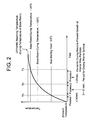
- the temperature of the coating material is rapidly elevated to a level at which the wax is melted (Process 1), that the temperature of the coating material is maintained at a temperature range in which the wax is melted but the resin of the coating material can not be cured, until the amount of the wax oozed from the coating material to the surface thereof reaches the wax-occupation percentage at least 10 % (Process 2), and thereafter, the temperature of the coating material is elevated to a level at which the resin can be cured at no less than a certain degree so that the growth of the interior wax particles is prevented by being fixed with the resin (Process 3).
- the temperature at which the wax is melted should be higher than the melting point of the added wax by at least 6 °C (when the wax is composed of some kinds of wax, the highest melting point is used). This is because the wax can not be sufficiently melted when the temperature is higher than the melting point of the wax by less than 6 °C.
- T1 seconds when a time, during which the temperature of the coating material is elevated to a level which is higher than the melting point of the wax by 6 °C, is defined as T1 seconds, it is desirable that the time T1 is at most 10 seconds. This is because, when the time T1 exceeds 10 seconds, a solvent or water for dissolving or dispersing the resin component is evaporated so that a viscosity of the coating material is increased, and thus the sufficient ooze of the wax from the coating material to the surface thereof is prevented although the temperature is maintained at the level at which the resin can not be cured.
- the temperature range, in which the wax is melted while the resin is not cured is defined as the range between the temperature which is higher than the melting point of the wax by at least 6 °C and the temperature which is lower than the ultimately reaching temperature, at which the resin can be sufficiently cured, by at least 100 °C.
- a temperature-maintaining time T2-T1 is desirably from at least 3 seconds to less than 15 seconds.
- the time T2 (seconds) is defined as a time between a time point at which the baking process is started and a time point at which the temperature reaches the level which is lower than the ultimately reaching temperature by 100 °C.
- the wax can not sufficiently ooze from the resin layer to the surface thereof.
- a certain kind of resin may start to be cured.
- the temperature, at which the resin can be cured at no less than a certain degree so that the wax is fixed is a temperature which is lower than the ultimately reaching temperature by 20 °C.
- T3 seconds a time, during which the temperature is elevated from the start of the baking process to the level which is lower than the ultimately reaching temperature by 20 °C, is defined as T3 seconds, it is desirable that a time (T3-T2) is at most 20 seconds.
- the ultimately reaching temperature at which the resin can be sufficiently cured, may be determined so that properties of the base resin are most demonstrated.
- the ultimately reaching temperature is from 240 °C to 300 °C
- the ultimately reaching temperature is from 230 °C to 300 °C.
- a method of continuously coating an aluminum alloy web with the coating material by using a roll coater is most suitable.
- the coating process is carried out by this method, since the coating material is baked by a baking oven which is divided into several baking zones, temperatures are set so as to coincide with the graph of Fig. 2 as much as possible. It is desirable that a baking time is from at least 10 seconds to at most 60 seconds. More desirably, the baking time is from at least 20 seconds to at most 45 seconds.
- 1100-H24 aluminum sheets having a thickness of 0.3 mm were subjected to a degreasing process as a surface treatment of a substrate for coating, using a commercially available alkaline degreasing solution, and then were subjected to chemical conversion with a commercially available phosphate-chromate treatment solution. Then, as shown in Tables1-1, 1-2 and1-3, each of one-side surface of the aluminum sheets was coated with a coating material under a condition, to thereby form a coated layer thereon, and then the coated layer were subjected to a baking process, resulting in production of samples.
- the baking process was carried out by using a hot-air drying oven divided into three zones, and each of ambient temperatures was set at the zones so that each of ultimately reaching temperatures as shown in Table 1 could be obtained.
- the ultimately reaching temperature was measured by using a thermocouple. Note, in Table 1, the underlines in the columns represent significant features in the production conditions.
- each of these samples was cut at five locations in a direction perpendicular to a surface of the coated resin layer, and each of the five cross-sectional areas was observed along a length of 100 ⁇ m by using a transmission electron microscope. Then, in the respective five locations of each sample, wax-occupation percentages on the surface of the resin layer were measured (the measured five values were averaged), and, in the respective five cross-sectional areas, numbers of wax particles were counted (the counted five values were averaged). Then, each of the samples was formed into aluminum electrolytic capacitor cases having various sizes, so that the outer surface of each capacitor case was defined by the resin-coated surface of each sample, and the resin layers of the capacitor cases were visually observed and evaluated after the formation. In the formation process, a volatile press oil having the dynamic viscosity of 1.6 mm 2 /s was used.
- the respective coating processes were carried out, using 100 % polyethylene wax, and, in Nos. 21 to 23 sample pieces, the respective coating processes were carried out, using 100 % carnauba wax.
- the respective coating processes were carried out, using carnauba/polyethylene wax with a mixing rate falling within a range from 82%/18% to 17%/83%.
- the coating process was carried out, using carnauba/polyethylene wax with a mixing rate of 56%/44%.
- the resin layers were subjected to the respective baking processes so as to have a thickness falling within a range from 7.6 ⁇ m to 9.4 ⁇ m.
- the resin layers were subjected to the respective baking processes so as to have a thickness falling within a range from 2.5 ⁇ m to 21.3 ⁇ m.
- the resin layers were subjected to the respective baking processes so as to have a thicknesses of 5.5 ⁇ m, 13.4 ⁇ m, 13.8 ⁇ m and 13.1 ⁇ m, respectively.
- the wax in Nos. 1 to 40 sample pieces, the wax was composed of at least one of polyethylene wax and carnauba wax.
- the sample pieces meet the conditions stated in claim 1.
- the respective coating processes were carried out, using carnauba/polyethylene wax with the mixing rate falling within the range from 82%/18% to 17%/83%, and, in Nos. 31 to 40 sample pieces, the coating process was carried out, using carnauba/polyethylene wax with the mixing rate of 56%/44%.
- Nos. 25 to 27 sample pieces meet the conditions of claim 2 featuring the rate of polyethylene wax to carnauba wax falling within the range between 1:4 and 4:1.
- the resin layers were subjected to the respective baking processes so as to have a thickness falling within the range from 7.6 ⁇ m to 13.4 ⁇ m.
- the sample pieces meet the conditions of claim 1 in which it is specified that the resin layer has the cross-section thickness falling within the range from at least 2 ⁇ m to at most 22 ⁇ m. Further, in Nos.
- the resin layers were subjected to the respective baking processes so as to have a thickness falling within the range from 2.5 ⁇ m to 21.3 ⁇ m so that can be supported the numerical critical significance of claim 1 in which it is specified that the resin layer has the cross-section thickness falling within the range from at least 2 ⁇ m to at most 22 ⁇ m.
- these sample pieces meet the conditions stated in claim 1.
- Nos. 1 to 5 sample pieces were produced under the same conditions except for the conditions of the baking processes, and the wax occupation percentages falling within the range from 86.9 % to 12.8 % were obtained in each different baking condition.
- the respective wax occupation percentages were 11.0 % and 14.0 % which were approximate to the lower limit specified in claim 1.
- any one of the sample piece meets the conditions of claim 1 in which it is specified that the number of the wax particles, which have the cross-sectional shape featured by the major axis extent having the length of at most 80 % of the thickness of the resin layer and of at least 0.1 ⁇ m, falls within the range from at least 3 to at most 50.
- the numbers of the wax particles fell within the range from 3.5 to 45.2, and were different from each other.
- any one of Nos. 1 to 40 sample pieces which are the Examples of the present invention a number of wax particles, which was featured by a major axis extent having a length of more than 80 % of the thickness of the resin layer, i.e., wax particles having a large size more than that of a circle having 80 % of the thickness of the resin layer, was less than 10, and, in the sample pieces rather than Nos. 12, 13 and 40 sample pieces, the number of the wax particles was less than 5. Especially, in No. 12 sample piece, the number of the wax particles was 9.6 which was approximate to the upper limit specified in claim 1, and No. 40 sample piece was featured by 5.5 exceeding 5.
- the resin layers of the Examples according to the present invention have the features as mentioned above, and any one of the resin layers exhibits a superior lubricating property so that a sufficient and practical electrical insulation property can be obtained even in formation of an aluminum electrolytic capacitor case having a large height/diameter ratio.
- Nos. 41 to 48 sample pieces which are the Comparative Examples, the respective coating processes were carried out at the ultimately reaching temperature of 240 °C, using an epoxy/urea-series resin.
- the wax in Nos. 41 to 46 sample pieces, 100 % polyethylene wax was used, in No. 47 sample piece, lanolin wax was used, and, in No. 48 sample piece, paraffin wax was used.
- Nos. 47 and 48 sample pieces do not meet the conditions of claim 1 in which it is specified that the wax is composed of at least one of polyethylene wax and carnauba wax.
- No. 41 sample piece an amount of addition of the wax was somewhat less, i.e., 0.5 wt%, and (T2-T1) was too short, so that a wax occupation percentage was lacking as 9.3 %.
- No. 41 sample piece does not meet the conditions of claim 1 in which it is specified that the total length of the chords of the wax particles, which exist on the straight line of 100 ⁇ m optionally drawn on the surface of the resin layer, is at least 10 ⁇ m (10 %).
- a number of the wax particles featured by the major axis extent having a length of more than 80 % of the thickness of the resin layer was 12. 8 which was more than the upper limit, i.e., 10, of the conditions of claim 1 in which it is specified that the number of the wax particles featured by the major axis extent having the length of more than 80 % of the thickness of the resin layer, i.e., the wax particles having the larger size more than that of the circle having 80 % of the thickness of the resin layer, is less than 10.
- a number of wax particles, which have a cross-sectional shape featured by a major axis extent having a length of at most 80 % of the thickness of the resin layer and of at least 0.1 ⁇ m was 2.2 which did not reach the lower limit, i.e., 3, of th condition of claim 1 in which it is specified that the number of the wax particles, which have the cross-sectional shape featured by the major axis extent having the length of at most 80 % of the thickness of the resin layer and of at least 0.1 ⁇ m, falls within the range from at least 3 to at most 50.
- 1100-H24 aluminum sheets having a thickness of 0.3 mm were subjected to a degreasing process as a surface treatment of a substrate for coating, using an commercially available alkaline degreasing solution, and then were subjected to chemical conversion with a commercially available phosphate-chromate treatment solution. Then, as shown in Table 3, each of one-side surface of the aluminum sheets was coated with a coating material under a condition, to thereby form a coated layer thereon, and then the coated layer were subjected to a baking process, resulting in production of samples.
- a number average molecular weight of each of the coating materials was measured by using GPC: HLC8020 by TOSO, a column: TSK-GEL G4000HXL (particle diameter 5 ⁇ m, rejection limit molecular weight (polystyrene) 10000+TSK-GEL G2000HXL (particle diameter 5 ⁇ m, rejection limit molecular weight (polystyrene) 4000000, an eluent: tetrahydrofuran, and a detector: RI.
- the baking process was carried out by using a hot-air drying oven divided into three zones, and each of ambient temperatures was set at the zones so that each of ultimately reaching temperatures as shown in Table 3 could be obtained.
- the ultimately reaching temperature was measured by using a thermocouple.
- each of these samples was cut at five locations in a direction perpendicular to a surface of the coated resin layer, and each of the five cross-sectional areas was observed along a length of 100 ⁇ m by using a transmission electron microscope. Then, in the respective five locations of each sample, wax-occupation percentages on the surface of the resin layer were measured (the measured five values were averaged), and, in the respective five cross-sectional areas, numbers of wax particles were counted (the counted five values were averaged).
- each of the samples was formed into aluminum electrolytic capacitor cases having various sizes, so that the outer surface of each capacitor case was defined by the resin-coated surface of each sample, and the resin layers of the capacitor cases were visually observed and evaluated after the formation.
- a volatile press oil having the dynamic viscosity of 1.6 mm 2 /s was used.
- the coating process was carried out, using polyethylene/carnauba wax with a mixing rate of 56%/44%. Accordingly, in any one of Nos. 49 to 56 sample pieces, since the wax was composed of at least one of polyethylene wax and carnauba wax, these sample pieces meet the conditions of the present invention.
- the resin layers were subjected to the respective baking processes so as to have a thickness falling within a range from 7.4 ⁇ m to 8.4 ⁇ m.
- the sample pieces meet the conditions of the present invention in which it is specified that the resin layer has the thickness falling within the range from at least 2 ⁇ m to at most 22 ⁇ m.
- any one of the sample piece meets the conditions of the present invention in which it is specified that the number of the wax particles, which have the cross-sectional shape featured by the major axis extent having the length of at most 80 % of the thickness of the resin layer and of at least 0.1 ⁇ m, falls within the range from at least 3 to at most 50.
- any one of Nos. 49 to 56 sample pieces which are the Examples of the present invention a number of wax particles, which was featured by a major axis extent having a length of more than 80 % of the thickness of the resin layer, i.e., wax particles having a large size more than that of a circle having 80 % of the thickness of the resin layer, was less than 5.
- the resin layers of the Examples according to the present invention have the features as mentioned above, and any one of the resin layers exhibits a superior lubricating property so that a sufficient and practical electrical insulation property can be obtained even in formation of an aluminum electrolytic capacitor case having a large height/diameter ratio.
Landscapes
- Chemical & Material Sciences (AREA)
- Engineering & Computer Science (AREA)
- Organic Chemistry (AREA)
- Life Sciences & Earth Sciences (AREA)
- Materials Engineering (AREA)
- Wood Science & Technology (AREA)
- Chemical Kinetics & Catalysis (AREA)
- Power Engineering (AREA)
- Polymers & Plastics (AREA)
- Medicinal Chemistry (AREA)
- Health & Medical Sciences (AREA)
- Microelectronics & Electronic Packaging (AREA)
- Laminated Bodies (AREA)
- Paints Or Removers (AREA)
Applications Claiming Priority (2)
| Application Number | Priority Date | Filing Date | Title |
|---|---|---|---|
| JP2007005224A JP4091963B1 (ja) | 2007-01-12 | 2007-01-12 | アルミニウム電解コンデンサケース用樹脂被覆アルミニウム合金板材及びアルミニウム電解コンデンサケース、アルミニウム電解コンデンサ |
| PCT/JP2008/050239 WO2008084839A1 (ja) | 2007-01-12 | 2008-01-11 | アルミニウム電解コンデンサケース用樹脂被覆アルミニウム合金板材、アルミニウム電解コンデンサケース、及びアルミニウム電解コンデンサ |
Publications (3)
| Publication Number | Publication Date |
|---|---|
| EP2090426A1 true EP2090426A1 (de) | 2009-08-19 |
| EP2090426A4 EP2090426A4 (de) | 2009-11-18 |
| EP2090426B1 EP2090426B1 (de) | 2010-09-01 |
Family
ID=39509565
Family Applications (1)
| Application Number | Title | Priority Date | Filing Date |
|---|---|---|---|
| EP08703103A Active EP2090426B1 (de) | 2007-01-12 | 2008-01-11 | Harzbeschichtetes aluminiumlegierungs-schichtmaterial für das gehäuse eines elektrolytischen aluminium-kondensators, gehäuse für einen elektrolytischen aluminium-kondensator sowie elektrolytischer aluminium-kondensator |
Country Status (9)
| Country | Link |
|---|---|
| US (1) | US8045321B2 (de) |
| EP (1) | EP2090426B1 (de) |
| JP (1) | JP4091963B1 (de) |
| KR (1) | KR101364596B1 (de) |
| CN (1) | CN101541527B (de) |
| DE (1) | DE602008002400D1 (de) |
| MY (1) | MY142995A (de) |
| TW (1) | TW200842916A (de) |
| WO (1) | WO2008084839A1 (de) |
Families Citing this family (7)
| Publication number | Priority date | Publication date | Assignee | Title |
|---|---|---|---|---|
| KR101477298B1 (ko) * | 2008-04-23 | 2014-12-29 | 삼성전기주식회사 | 왁스를 포함하는 절연층의 제조방법 및 그에 의하여 제조된절연층을 포함하는 내장형 커패시터 |
| JP5252494B2 (ja) * | 2008-11-28 | 2013-07-31 | 三菱アルミニウム株式会社 | 樹脂被覆アルミニウム材料及びそれを用いた電解コンデンサケース |
| CN102568829A (zh) * | 2011-11-08 | 2012-07-11 | 上海永铭电子有限公司 | 一种提高散热性能的引线型铝电解电容器 |
| MY172212A (en) * | 2013-01-25 | 2019-11-18 | Uacj Corp | Lubricative coated aluminum material |
| CN103680936A (zh) * | 2013-12-24 | 2014-03-26 | 安徽赛福电子有限公司 | 一种电容器绝缘式外壳 |
| JP2015174984A (ja) * | 2014-03-18 | 2015-10-05 | 株式会社Uacj | コンデンサケース塗装材用塗料組成物及びコンデンサケース用アルミニウム塗装材 |
| KR101594758B1 (ko) | 2015-10-19 | 2016-02-17 | 이숙 | 알루미늄 전해콘덴서 케이스 팩킹용 고무 적층판 및 그의 제조방법 |
Family Cites Families (24)
| Publication number | Priority date | Publication date | Assignee | Title |
|---|---|---|---|---|
| US4250534A (en) * | 1980-02-22 | 1981-02-10 | Western Electric Company, Inc. | Packaged electrical capacitor |
| JPS63268241A (ja) * | 1987-04-27 | 1988-11-04 | Matsushita Electric Ind Co Ltd | 固体電解コンデンサ |
| JPH0750663B2 (ja) | 1990-06-29 | 1995-05-31 | 三洋電機株式会社 | 有機半導体固体電解コンデンサの製造方法 |
| JPH04338624A (ja) | 1991-05-15 | 1992-11-25 | Nippon Kayaku Co Ltd | 粉体塗装されたアルミニュウム電解コンデンサー |
| JPH06166138A (ja) | 1992-11-30 | 1994-06-14 | Kawasaki Steel Corp | 無塗油で良好な加工性を有する表面処理アルミニウム材料 |
| JPH07166125A (ja) * | 1993-12-13 | 1995-06-27 | Kobe Steel Ltd | プレス成形性及び耐食性にすぐれる樹脂塗装アルミニウム又はアルミニウム合金材及びその製造方法 |
| JP3338156B2 (ja) | 1993-12-29 | 2002-10-28 | 神鋼アルコア輸送機材株式会社 | 成形性と耐疵付性に優れた有機被覆アルミ板材料 |
| JP3297521B2 (ja) | 1994-01-11 | 2002-07-02 | 帝人株式会社 | 金属板貼合せ成形加工用ポリエステルフィルム |
| JPH11244778A (ja) | 1998-03-06 | 1999-09-14 | Furukawa Electric Co Ltd:The | 缶蓋用アルミニウム塗装板の製造方法 |
| KR100286690B1 (ko) | 1998-05-14 | 2001-04-16 | 손봉락 | 전해 콘덴서 외장용기용 알루미늄 적층체의 제조방법 및 그 물건 |
| JP4347934B2 (ja) | 1998-12-15 | 2009-10-21 | 古河スカイ株式会社 | 成形性および塗膜密着性に優れた缶蓋用アルミニウム合金塗装板材およびその製造方法 |
| US6307734B1 (en) * | 1998-12-31 | 2001-10-23 | General Electric Company | Electrolytic capacitor |
| KR19990064634A (ko) * | 1999-04-22 | 1999-08-05 | 손봉락 | 알루미늄 전해콘덴서용 외장용기 |
| US6723441B1 (en) | 1999-09-22 | 2004-04-20 | Nkk Corporation | Resin film laminated metal sheet for can and method for fabricating the same |
| JP2003532777A (ja) | 2000-05-12 | 2003-11-05 | クラリアント・ゲゼルシヤフト・ミト・ベシユレンクテル・ハフツング | 塗料用ワックス混合物 |
| JP4714374B2 (ja) | 2001-02-13 | 2011-06-29 | 古河スカイ株式会社 | コンデンサケース用樹脂被覆アルミニウム材、及びこれを用いたコンデンサケース、及びこのコンデンサケースを備えたコンデンサ |
| JP3962366B2 (ja) | 2002-08-26 | 2007-08-22 | 三洋化成工業株式会社 | 樹脂粒子 |
| JP2004314415A (ja) | 2003-04-16 | 2004-11-11 | Kansai Paint Co Ltd | 絞りしごき加工性に優れた缶用潤滑鋼板 |
| JP4267500B2 (ja) | 2004-04-05 | 2009-05-27 | 新日本製鐵株式会社 | しごき成形性に優れたインナーワックスを含有する塗装金属帯 |
| DE102004030981A1 (de) * | 2004-06-26 | 2006-01-12 | Klöckner Pentaplast GmbH & Co. KG | Beschichtung auf Basis von Polyvinylidenchlorid, Verfahren zur Herstellung einer Beschichtung und ihre Verwendung |
| JP4338624B2 (ja) | 2004-12-07 | 2009-10-07 | 三洋電機株式会社 | 周波数オフセット推定方法およびそれを利用した周波数オフセット補正装置 |
| KR100627509B1 (ko) | 2005-05-24 | 2006-09-22 | 엘에스전선 주식회사 | 전선 피복재료용 폴리에스테르계 수지 조성물 및 이를이용한 전선 |
| JP2006334917A (ja) | 2005-06-02 | 2006-12-14 | Furukawa Sky Kk | コンデンサケース用樹脂被覆アルミニウム合金板およびそれを用いたコンデンサケース |
| CN100585722C (zh) * | 2005-11-22 | 2010-01-27 | 古河Sky株式会社 | 用于插槽驱动器盒的预涂金属片 |
-
2007
- 2007-01-12 JP JP2007005224A patent/JP4091963B1/ja not_active Expired - Fee Related
-
2008
- 2008-01-11 KR KR1020087032252A patent/KR101364596B1/ko active Active
- 2008-01-11 DE DE602008002400T patent/DE602008002400D1/de active Active
- 2008-01-11 US US12/309,003 patent/US8045321B2/en active Active
- 2008-01-11 CN CN2008800006053A patent/CN101541527B/zh active Active
- 2008-01-11 MY MYPI20090744A patent/MY142995A/en unknown
- 2008-01-11 WO PCT/JP2008/050239 patent/WO2008084839A1/ja not_active Ceased
- 2008-01-11 TW TW097101238A patent/TW200842916A/zh unknown
- 2008-01-11 EP EP08703103A patent/EP2090426B1/de active Active
Also Published As
| Publication number | Publication date |
|---|---|
| WO2008084839A1 (ja) | 2008-07-17 |
| JP4091963B1 (ja) | 2008-05-28 |
| MY142995A (en) | 2011-02-14 |
| DE602008002400D1 (de) | 2010-10-14 |
| KR101364596B1 (ko) | 2014-02-19 |
| TWI375972B (de) | 2012-11-01 |
| KR20090099027A (ko) | 2009-09-21 |
| EP2090426B1 (de) | 2010-09-01 |
| US8045321B2 (en) | 2011-10-25 |
| US20090237864A1 (en) | 2009-09-24 |
| TW200842916A (en) | 2008-11-01 |
| JP2008168557A (ja) | 2008-07-24 |
| CN101541527A (zh) | 2009-09-23 |
| EP2090426A4 (de) | 2009-11-18 |
| CN101541527B (zh) | 2013-09-04 |
Similar Documents
| Publication | Publication Date | Title |
|---|---|---|
| EP2090426B1 (de) | Harzbeschichtetes aluminiumlegierungs-schichtmaterial für das gehäuse eines elektrolytischen aluminium-kondensators, gehäuse für einen elektrolytischen aluminium-kondensator sowie elektrolytischer aluminium-kondensator | |
| KR101677390B1 (ko) | 표면품질 및 프레스 성형성이 우수한 도금강판의 제조방법 및 이에 의해 제조된 도금강판 | |
| CN102470407B (zh) | 钛板及钛板的制造方法 | |
| EP1172426B1 (de) | Überzugszusammensetzung zur bildung eines alkalilöslichen schmierenden filmes geeignet für formgebung und ihre verwendung | |
| JP7273206B2 (ja) | プレス成形性及び塗装後鮮映性に優れた溶融亜鉛めっき鋼板の製造方法及びこれによって製造された溶融亜鉛めっき鋼板 | |
| EP3556482A1 (de) | Walze und damit hergestelltes plattiertes stahlblech | |
| AU761334B2 (en) | Steel band with good forming properties and method for producing same | |
| JP6829213B2 (ja) | 鱗状微細組織の電極線材料およびその製造方法と使用 | |
| JP2010255085A (ja) | チタン板及びチタン板の製造方法 | |
| EP3428298A1 (de) | Martensitische edelstahlfolie und verfahren zur herstellung davon | |
| US5324594A (en) | Galvannealed steel sheets exhibiting excellent press die sliding property | |
| KR100188044B1 (ko) | 프레스 성형성이 우수한 합금화 처리 철-아연합금 용융 도금강판 및 그 제조방법 | |
| CN114042774A (zh) | 一种z形异形钢丝生产方法 | |
| CN112547818A (zh) | 一种z形异形钢丝生产方法 | |
| JP2009032881A (ja) | アルミニウム電解コンデンサケース用樹脂被覆アルミニウム合金板材及びアルミニウム電解コンデンサケース、アルミニウム電解コンデンサ | |
| JP4922865B2 (ja) | アルミニウム電解コンデンサケース用樹脂被覆アルミニウム合金板材及びアルミニウム電解コンデンサケース、アルミニウム電解コンデンサ | |
| JP2001214182A (ja) | プレス加工性に優れた潤滑被膜処理亜鉛系めっき鋼板 | |
| JP4157390B2 (ja) | 成形安定性に優れたシームレス加工缶体用メタリック外観金属帯、シームレス加工缶体およびこれらの製造方法 | |
| KR101047828B1 (ko) | 외관 광택 안정성이 우수한 메탈릭 외관 금속대 | |
| KR102281203B1 (ko) | 프레스 성형성 및 도장 선영성이 우수한 도금강판용 조질압연 롤 및 이를 이용한 도금강판의 제조방법 | |
| JP2001149860A (ja) | 自己潤滑性に優れた塗装鋼板 | |
| KR20180073386A (ko) | 조질 압연기 및 이를 이용한 조질압연방법 | |
| KR20050107421A (ko) | 성형 안정성이 우수한 메탈릭 외관의 금속대와 심리스 가공캔 및 그 제조 방법 | |
| KR20020048083A (ko) | 냉연 법랑강판 제조방법 | |
| JPH0334846A (ja) | 曲げ加工性に優れた複合型金属板 |
Legal Events
| Date | Code | Title | Description |
|---|---|---|---|
| PUAI | Public reference made under article 153(3) epc to a published international application that has entered the european phase |
Free format text: ORIGINAL CODE: 0009012 |
|
| 17P | Request for examination filed |
Effective date: 20090217 |
|
| AK | Designated contracting states |
Kind code of ref document: A1 Designated state(s): AT BE BG CH CY CZ DE DK EE ES FI FR GB GR HR HU IE IS IT LI LT LU LV MC MT NL NO PL PT RO SE SI SK TR |
|
| A4 | Supplementary search report drawn up and despatched |
Effective date: 20091015 |
|
| GRAP | Despatch of communication of intention to grant a patent |
Free format text: ORIGINAL CODE: EPIDOSNIGR1 |
|
| DAX | Request for extension of the european patent (deleted) | ||
| RBV | Designated contracting states (corrected) |
Designated state(s): DE FR GB |
|
| GRAS | Grant fee paid |
Free format text: ORIGINAL CODE: EPIDOSNIGR3 |
|
| GRAA | (expected) grant |
Free format text: ORIGINAL CODE: 0009210 |
|
| AK | Designated contracting states |
Kind code of ref document: B1 Designated state(s): DE FR GB |
|
| REG | Reference to a national code |
Ref country code: GB Ref legal event code: FG4D |
|
| REF | Corresponds to: |
Ref document number: 602008002400 Country of ref document: DE Date of ref document: 20101014 Kind code of ref document: P |
|
| PLBE | No opposition filed within time limit |
Free format text: ORIGINAL CODE: 0009261 |
|
| STAA | Information on the status of an ep patent application or granted ep patent |
Free format text: STATUS: NO OPPOSITION FILED WITHIN TIME LIMIT |
|
| 26N | No opposition filed |
Effective date: 20110606 |
|
| REG | Reference to a national code |
Ref country code: DE Ref legal event code: R097 Ref document number: 602008002400 Country of ref document: DE Effective date: 20110606 |
|
| GBPC | Gb: european patent ceased through non-payment of renewal fee |
Effective date: 20120111 |
|
| PG25 | Lapsed in a contracting state [announced via postgrant information from national office to epo] |
Ref country code: GB Free format text: LAPSE BECAUSE OF NON-PAYMENT OF DUE FEES Effective date: 20120111 |
|
| REG | Reference to a national code |
Ref country code: FR Ref legal event code: PLFP Year of fee payment: 9 |
|
| REG | Reference to a national code |
Ref country code: FR Ref legal event code: PLFP Year of fee payment: 10 |
|
| REG | Reference to a national code |
Ref country code: FR Ref legal event code: PLFP Year of fee payment: 11 |
|
| P01 | Opt-out of the competence of the unified patent court (upc) registered |
Effective date: 20230816 |
|
| PGFP | Annual fee paid to national office [announced via postgrant information from national office to epo] |
Ref country code: DE Payment date: 20260121 Year of fee payment: 19 |
|
| PGFP | Annual fee paid to national office [announced via postgrant information from national office to epo] |
Ref country code: FR Payment date: 20260123 Year of fee payment: 19 |