EP2090614A1 - Artikel aus einer Zusammensetzung auf Polyesterbasis mit Siliziumteilchen - Google Patents
Artikel aus einer Zusammensetzung auf Polyesterbasis mit Siliziumteilchen Download PDFInfo
- Publication number
- EP2090614A1 EP2090614A1 EP08002738A EP08002738A EP2090614A1 EP 2090614 A1 EP2090614 A1 EP 2090614A1 EP 08002738 A EP08002738 A EP 08002738A EP 08002738 A EP08002738 A EP 08002738A EP 2090614 A1 EP2090614 A1 EP 2090614A1
- Authority
- EP
- European Patent Office
- Prior art keywords
- article
- wall
- stretched
- density
- less
- Prior art date
- Legal status (The legal status is an assumption and is not a legal conclusion. Google has not performed a legal analysis and makes no representation as to the accuracy of the status listed.)
- Withdrawn
Links
- VYPSYNLAJGMNEJ-UHFFFAOYSA-N Silicium dioxide Chemical compound O=[Si]=O VYPSYNLAJGMNEJ-UHFFFAOYSA-N 0.000 title claims abstract description 102
- 239000000203 mixture Substances 0.000 title claims abstract description 25
- 229920000728 polyester Polymers 0.000 title description 18
- 239000002245 particle Substances 0.000 claims abstract description 42
- 239000000377 silicon dioxide Substances 0.000 claims abstract description 33
- 230000005540 biological transmission Effects 0.000 claims abstract description 32
- 229920001225 polyester resin Polymers 0.000 claims abstract description 22
- 239000004645 polyester resin Substances 0.000 claims abstract description 22
- 238000000034 method Methods 0.000 claims description 31
- 229910052906 cristobalite Inorganic materials 0.000 claims description 14
- 239000002356 single layer Substances 0.000 claims description 10
- 230000005855 radiation Effects 0.000 claims description 9
- 235000013365 dairy product Nutrition 0.000 claims description 5
- 229920001577 copolymer Polymers 0.000 claims description 3
- 239000010453 quartz Substances 0.000 claims description 3
- 238000004806 packaging method and process Methods 0.000 description 22
- 229920000139 polyethylene terephthalate Polymers 0.000 description 20
- 239000005020 polyethylene terephthalate Substances 0.000 description 20
- 239000007788 liquid Substances 0.000 description 11
- GWEVSGVZZGPLCZ-UHFFFAOYSA-N Titan oxide Chemical compound O=[Ti]=O GWEVSGVZZGPLCZ-UHFFFAOYSA-N 0.000 description 9
- 239000008188 pellet Substances 0.000 description 8
- 238000000071 blow moulding Methods 0.000 description 6
- 230000007423 decrease Effects 0.000 description 6
- 239000000243 solution Substances 0.000 description 6
- 229910052681 coesite Inorganic materials 0.000 description 5
- 238000013329 compounding Methods 0.000 description 5
- 150000001875 compounds Chemical class 0.000 description 5
- 238000009826 distribution Methods 0.000 description 5
- 238000002347 injection Methods 0.000 description 5
- 239000007924 injection Substances 0.000 description 5
- 229910052500 inorganic mineral Inorganic materials 0.000 description 5
- 238000007561 laser diffraction method Methods 0.000 description 5
- 239000000463 material Substances 0.000 description 5
- 239000011707 mineral Substances 0.000 description 5
- -1 polyethylene terephthalate Polymers 0.000 description 5
- 229910052682 stishovite Inorganic materials 0.000 description 5
- 229910052905 tridymite Inorganic materials 0.000 description 5
- 239000003795 chemical substances by application Substances 0.000 description 4
- 230000000694 effects Effects 0.000 description 4
- 235000013305 food Nutrition 0.000 description 4
- 238000004519 manufacturing process Methods 0.000 description 4
- 239000004408 titanium dioxide Substances 0.000 description 4
- LYCAIKOWRPUZTN-UHFFFAOYSA-N Ethylene glycol Chemical compound OCCO LYCAIKOWRPUZTN-UHFFFAOYSA-N 0.000 description 3
- MUBZPKHOEPUJKR-UHFFFAOYSA-N Oxalic acid Chemical compound OC(=O)C(O)=O MUBZPKHOEPUJKR-UHFFFAOYSA-N 0.000 description 3
- DNIAPMSPPWPWGF-UHFFFAOYSA-N Propylene glycol Chemical compound CC(O)CO DNIAPMSPPWPWGF-UHFFFAOYSA-N 0.000 description 3
- 239000002253 acid Substances 0.000 description 3
- 125000003118 aryl group Chemical group 0.000 description 3
- 238000007664 blowing Methods 0.000 description 3
- 238000012937 correction Methods 0.000 description 3
- 150000001991 dicarboxylic acids Chemical class 0.000 description 3
- MTHSVFCYNBDYFN-UHFFFAOYSA-N diethylene glycol Chemical compound OCCOCCO MTHSVFCYNBDYFN-UHFFFAOYSA-N 0.000 description 3
- 238000010103 injection stretch blow moulding Methods 0.000 description 3
- 238000005259 measurement Methods 0.000 description 3
- 235000013336 milk Nutrition 0.000 description 3
- 239000008267 milk Substances 0.000 description 3
- 210000004080 milk Anatomy 0.000 description 3
- 229920000642 polymer Polymers 0.000 description 3
- XLYOFNOQVPJJNP-UHFFFAOYSA-N water Substances O XLYOFNOQVPJJNP-UHFFFAOYSA-N 0.000 description 3
- PUPZLCDOIYMWBV-UHFFFAOYSA-N (+/-)-1,3-Butanediol Chemical compound CC(O)CCO PUPZLCDOIYMWBV-UHFFFAOYSA-N 0.000 description 2
- 229920001634 Copolyester Polymers 0.000 description 2
- LFQSCWFLJHTTHZ-UHFFFAOYSA-N Ethanol Chemical compound CCO LFQSCWFLJHTTHZ-UHFFFAOYSA-N 0.000 description 2
- VZCYOOQTPOCHFL-OWOJBTEDSA-N Fumaric acid Chemical compound OC(=O)\C=C\C(O)=O VZCYOOQTPOCHFL-OWOJBTEDSA-N 0.000 description 2
- 239000004594 Masterbatch (MB) Substances 0.000 description 2
- KKEYFWRCBNTPAC-UHFFFAOYSA-N Terephthalic acid Chemical compound OC(=O)C1=CC=C(C(O)=O)C=C1 KKEYFWRCBNTPAC-UHFFFAOYSA-N 0.000 description 2
- WNLRTRBMVRJNCN-UHFFFAOYSA-N adipic acid Chemical compound OC(=O)CCCCC(O)=O WNLRTRBMVRJNCN-UHFFFAOYSA-N 0.000 description 2
- 235000013361 beverage Nutrition 0.000 description 2
- WERYXYBDKMZEQL-UHFFFAOYSA-N butane-1,4-diol Chemical compound OCCCCO WERYXYBDKMZEQL-UHFFFAOYSA-N 0.000 description 2
- 238000001354 calcination Methods 0.000 description 2
- 230000003247 decreasing effect Effects 0.000 description 2
- 150000002009 diols Chemical class 0.000 description 2
- 230000005484 gravity Effects 0.000 description 2
- 238000007654 immersion Methods 0.000 description 2
- QQVIHTHCMHWDBS-UHFFFAOYSA-N isophthalic acid Chemical compound OC(=O)C1=CC=CC(C(O)=O)=C1 QQVIHTHCMHWDBS-UHFFFAOYSA-N 0.000 description 2
- BDJRBEYXGGNYIS-UHFFFAOYSA-N nonanedioic acid Chemical compound OC(=O)CCCCCCCC(O)=O BDJRBEYXGGNYIS-UHFFFAOYSA-N 0.000 description 2
- 238000006068 polycondensation reaction Methods 0.000 description 2
- 238000006116 polymerization reaction Methods 0.000 description 2
- 229920005989 resin Polymers 0.000 description 2
- 239000011347 resin Substances 0.000 description 2
- CXMXRPHRNRROMY-UHFFFAOYSA-N sebacic acid Chemical compound OC(=O)CCCCCCCCC(O)=O CXMXRPHRNRROMY-UHFFFAOYSA-N 0.000 description 2
- 238000012360 testing method Methods 0.000 description 2
- VZCYOOQTPOCHFL-UHFFFAOYSA-N trans-butenedioic acid Natural products OC(=O)C=CC(O)=O VZCYOOQTPOCHFL-UHFFFAOYSA-N 0.000 description 2
- DNIAPMSPPWPWGF-VKHMYHEASA-N (+)-propylene glycol Chemical compound C[C@H](O)CO DNIAPMSPPWPWGF-VKHMYHEASA-N 0.000 description 1
- 229940015975 1,2-hexanediol Drugs 0.000 description 1
- YPFDHNVEDLHUCE-UHFFFAOYSA-N 1,3-propanediol Substances OCCCO YPFDHNVEDLHUCE-UHFFFAOYSA-N 0.000 description 1
- QPYKYDBKQYZEKG-UHFFFAOYSA-N 2,2-dimethylpropane-1,1-diol Chemical compound CC(C)(C)C(O)O QPYKYDBKQYZEKG-UHFFFAOYSA-N 0.000 description 1
- UFMBOFGKHIXOTA-UHFFFAOYSA-N 2-methylterephthalic acid Chemical compound CC1=CC(C(O)=O)=CC=C1C(O)=O UFMBOFGKHIXOTA-UHFFFAOYSA-N 0.000 description 1
- WMRCTEPOPAZMMN-UHFFFAOYSA-N 2-undecylpropanedioic acid Chemical compound CCCCCCCCCCCC(C(O)=O)C(O)=O WMRCTEPOPAZMMN-UHFFFAOYSA-N 0.000 description 1
- WVDRSXGPQWNUBN-UHFFFAOYSA-N 4-(4-carboxyphenoxy)benzoic acid Chemical compound C1=CC(C(=O)O)=CC=C1OC1=CC=C(C(O)=O)C=C1 WVDRSXGPQWNUBN-UHFFFAOYSA-N 0.000 description 1
- NEQFBGHQPUXOFH-UHFFFAOYSA-N 4-(4-carboxyphenyl)benzoic acid Chemical compound C1=CC(C(=O)O)=CC=C1C1=CC=C(C(O)=O)C=C1 NEQFBGHQPUXOFH-UHFFFAOYSA-N 0.000 description 1
- BPQQTUXANYXVAA-UHFFFAOYSA-N Orthosilicate Chemical compound [O-][Si]([O-])([O-])[O-] BPQQTUXANYXVAA-UHFFFAOYSA-N 0.000 description 1
- ALQSHHUCVQOPAS-UHFFFAOYSA-N Pentane-1,5-diol Chemical compound OCCCCCO ALQSHHUCVQOPAS-UHFFFAOYSA-N 0.000 description 1
- 239000004698 Polyethylene Substances 0.000 description 1
- OFOBLEOULBTSOW-UHFFFAOYSA-N Propanedioic acid Natural products OC(=O)CC(O)=O OFOBLEOULBTSOW-UHFFFAOYSA-N 0.000 description 1
- KDYFGRWQOYBRFD-UHFFFAOYSA-N Succinic acid Natural products OC(=O)CCC(O)=O KDYFGRWQOYBRFD-UHFFFAOYSA-N 0.000 description 1
- XDODWINGEHBYRT-UHFFFAOYSA-N [2-(hydroxymethyl)cyclohexyl]methanol Chemical compound OCC1CCCCC1CO XDODWINGEHBYRT-UHFFFAOYSA-N 0.000 description 1
- LUSFFPXRDZKBMF-UHFFFAOYSA-N [3-(hydroxymethyl)cyclohexyl]methanol Chemical compound OCC1CCCC(CO)C1 LUSFFPXRDZKBMF-UHFFFAOYSA-N 0.000 description 1
- YIMQCDZDWXUDCA-UHFFFAOYSA-N [4-(hydroxymethyl)cyclohexyl]methanol Chemical compound OCC1CCC(CO)CC1 YIMQCDZDWXUDCA-UHFFFAOYSA-N 0.000 description 1
- 239000001361 adipic acid Substances 0.000 description 1
- 235000011037 adipic acid Nutrition 0.000 description 1
- 125000001931 aliphatic group Chemical group 0.000 description 1
- PNEYBMLMFCGWSK-UHFFFAOYSA-N aluminium oxide Inorganic materials [O-2].[O-2].[O-2].[Al+3].[Al+3] PNEYBMLMFCGWSK-UHFFFAOYSA-N 0.000 description 1
- KDYFGRWQOYBRFD-NUQCWPJISA-N butanedioic acid Chemical compound O[14C](=O)CC[14C](O)=O KDYFGRWQOYBRFD-NUQCWPJISA-N 0.000 description 1
- 229910052593 corundum Inorganic materials 0.000 description 1
- QYQADNCHXSEGJT-UHFFFAOYSA-N cyclohexane-1,1-dicarboxylate;hydron Chemical compound OC(=O)C1(C(O)=O)CCCCC1 QYQADNCHXSEGJT-UHFFFAOYSA-N 0.000 description 1
- FOTKYAAJKYLFFN-UHFFFAOYSA-N decane-1,10-diol Chemical compound OCCCCCCCCCCO FOTKYAAJKYLFFN-UHFFFAOYSA-N 0.000 description 1
- 238000001739 density measurement Methods 0.000 description 1
- 230000001627 detrimental effect Effects 0.000 description 1
- 238000002050 diffraction method Methods 0.000 description 1
- 239000000539 dimer Substances 0.000 description 1
- GWZCCUDJHOGOSO-UHFFFAOYSA-N diphenic acid Chemical compound OC(=O)C1=CC=CC=C1C1=CC=CC=C1C(O)=O GWZCCUDJHOGOSO-UHFFFAOYSA-N 0.000 description 1
- 150000002148 esters Chemical class 0.000 description 1
- 125000001301 ethoxy group Chemical group [H]C([H])([H])C([H])([H])O* 0.000 description 1
- 238000010101 extrusion blow moulding Methods 0.000 description 1
- 229920002457 flexible plastic Polymers 0.000 description 1
- 239000001530 fumaric acid Substances 0.000 description 1
- 238000010438 heat treatment Methods 0.000 description 1
- FHKSXSQHXQEMOK-UHFFFAOYSA-N hexane-1,2-diol Chemical compound CCCCC(O)CO FHKSXSQHXQEMOK-UHFFFAOYSA-N 0.000 description 1
- 229920001519 homopolymer Polymers 0.000 description 1
- JEIPFZHSYJVQDO-UHFFFAOYSA-N iron(III) oxide Inorganic materials O=[Fe]O[Fe]=O JEIPFZHSYJVQDO-UHFFFAOYSA-N 0.000 description 1
- 239000010410 layer Substances 0.000 description 1
- 235000020191 long-life milk Nutrition 0.000 description 1
- VZCYOOQTPOCHFL-UPHRSURJSA-N maleic acid Chemical compound OC(=O)\C=C/C(O)=O VZCYOOQTPOCHFL-UPHRSURJSA-N 0.000 description 1
- 239000011976 maleic acid Substances 0.000 description 1
- 239000011159 matrix material Substances 0.000 description 1
- 238000010128 melt processing Methods 0.000 description 1
- 125000000956 methoxy group Chemical group [H]C([H])([H])O* 0.000 description 1
- 238000002156 mixing Methods 0.000 description 1
- CHDRADPXNRULGA-UHFFFAOYSA-N naphthalene-1,3-dicarboxylic acid Chemical compound C1=CC=CC2=CC(C(=O)O)=CC(C(O)=O)=C21 CHDRADPXNRULGA-UHFFFAOYSA-N 0.000 description 1
- VAWFFNJAPKXVPH-UHFFFAOYSA-N naphthalene-1,6-dicarboxylic acid Chemical compound OC(=O)C1=CC=CC2=CC(C(=O)O)=CC=C21 VAWFFNJAPKXVPH-UHFFFAOYSA-N 0.000 description 1
- RXOHFPCZGPKIRD-UHFFFAOYSA-N naphthalene-2,6-dicarboxylic acid Chemical compound C1=C(C(O)=O)C=CC2=CC(C(=O)O)=CC=C21 RXOHFPCZGPKIRD-UHFFFAOYSA-N 0.000 description 1
- WPUMVKJOWWJPRK-UHFFFAOYSA-N naphthalene-2,7-dicarboxylic acid Chemical compound C1=CC(C(O)=O)=CC2=CC(C(=O)O)=CC=C21 WPUMVKJOWWJPRK-UHFFFAOYSA-N 0.000 description 1
- SLCVBVWXLSEKPL-UHFFFAOYSA-N neopentyl glycol Chemical compound OCC(C)(C)CO SLCVBVWXLSEKPL-UHFFFAOYSA-N 0.000 description 1
- OEIJHBUUFURJLI-UHFFFAOYSA-N octane-1,8-diol Chemical compound OCCCCCCCCO OEIJHBUUFURJLI-UHFFFAOYSA-N 0.000 description 1
- 235000006408 oxalic acid Nutrition 0.000 description 1
- 230000003647 oxidation Effects 0.000 description 1
- 238000007254 oxidation reaction Methods 0.000 description 1
- XNGIFLGASWRNHJ-UHFFFAOYSA-N phthalic acid Chemical compound OC(=O)C1=CC=CC=C1C(O)=O XNGIFLGASWRNHJ-UHFFFAOYSA-N 0.000 description 1
- 239000000049 pigment Substances 0.000 description 1
- 229920002959 polymer blend Polymers 0.000 description 1
- 229920000166 polytrimethylene carbonate Polymers 0.000 description 1
- 238000002360 preparation method Methods 0.000 description 1
- 239000012429 reaction media Substances 0.000 description 1
- 238000003303 reheating Methods 0.000 description 1
- 238000007619 statistical method Methods 0.000 description 1
- 238000003856 thermoforming Methods 0.000 description 1
- 238000005303 weighing Methods 0.000 description 1
- 229910001845 yogo sapphire Inorganic materials 0.000 description 1
Images



Classifications
-
- C—CHEMISTRY; METALLURGY
- C08—ORGANIC MACROMOLECULAR COMPOUNDS; THEIR PREPARATION OR CHEMICAL WORKING-UP; COMPOSITIONS BASED THEREON
- C08K—Use of inorganic or non-macromolecular organic substances as compounding ingredients
- C08K3/00—Use of inorganic substances as compounding ingredients
- C08K3/34—Silicon-containing compounds
- C08K3/36—Silica
Definitions
- the present invention relates to articles comprising a stretched wall and made from a polyester-based composition comprising silica particles.
- Aromatic polyester resins and in particular polyethylene terephthalate (PET), are widely used in the packaging industry for making various packaging articles.
- the wording "packaging article” used therein refers to any article that is used for storing any product or material, and especially (but not only) food or beverages and that comprises a stretched wall, i.e. a wall which has been stretched in at least one direction during the manufacturing process of the packaging article.
- a packaging article can be a stretch blow moulded container, such as bottle, jar or the like, a flexible plastic container, a film or a sheet for a package.
- PET is a polymer widely used for making transparent packaging articles.
- PET is used in the packaging industry for making transparent biaxially stretched containers having good mechanical properties (top load, burst pressure) and good thermal performances.
- Packaging articles made of PET alone are however not suitable for storing products that are sensible to ultraviolet radiations and/or visible light radiations (i.e. that can be altered or degraded by light radiations and/or by light induced oxidation), such as for example dairy products in the food industry.
- Such light sensible products need to be stored in opaque packaging articles having a low light transmission at wavelengths up to 800nm, and more especially for visible light radiations between 400nm and 550nm.
- light transmissions required for milk application are typically less than 1 % at 550nm and less than 2.5% at 800nm.
- a first solution for making a low light transmission packaging articles consists in using an aromatic polyester composition, and for example a PET resin, mixed with a sufficient amount of opacifying agents such as for example titanium dioxide (TiO 2 ).
- opacifying agents such as titanium dioxide (TiO 2 ).
- TiO 2 titanium dioxide
- a second solution for making truly opaque packaging articles consists in making multilayered packaging articles including a black layer.
- This solution is efficient in terms of opacity to UV (wavelengths up to 400nm) and visible light (wavelengths ranging from 400nm to 800nm) and is commonly used for example in the food industry for storing dairy products such as UHT milk.
- This solution is however more costly than a monolayer solution.
- silica concentration higher than 30wt % it becomes for example difficult to stretch and blow mould a standard preform in a mould in order to make a bottle or the like, and only small stretch ratios can be practiced with high silica concentration, which in turn leads to the manufacturing of stretch-blow moulded containers of small volumes only.
- the stretching of a low light transmission polyester article decreases the thickness of the wall of the article, and thus leads to a decrease of the opacity of the stretched wall and also to an increase of the wall density.
- the present invention is mainly based on the discovery that the stretching of the wall of an article made from a polymeric composition comprising a polyester resin and silica particles dispersed in the polyester resin surprisingly enables to increase the opacity of the wall and to decrease the density of the wall. High wall opacity and low wall density can thus be advantageously and surprisingly achieved with lower silica particles concentration and higher stretch ratios.
- a first object of the invention is thus an article made from a polymeric composition comprising at least a polyester resin and silica particles dispersed in the polyester resin.
- the article comprises a stretched wall ; the silica particle concentration is not more than 40wt%, and :
- the article of the invention can be advantageously a packaging article.
- packaging article used therein means any article that is used for storing any product or material, and especially (but not only) food or beverages and that comprises a stretched wall, i.e. a wall which has been stretched in at least one direction during the manufacturing process of the packaging article.
- the invention is however not limited to packaging articles, but can be practised to make any kind of article, in particular any kind of article wherein opacity of at least a portion of the article is needed.
- the article can be an opaque thin wall sheet for printing.
- silica particles used therein mean any particle having a silica content of at least 50wt%.
- the "polyester resin” may be constituted of a single polymer (the polyester), or of a copolyester, or of a polymer blend wherein at least one component is a polyester or a copolyester.
- the polyester may be constituted of a single polymer (the polyester), or of a copolyester, or of a polymer blend wherein at least one component is a polyester or a copolyester.
- other polymers like PE, can be blended with the polyester.
- Polyester resins that are suitable for carrying out the invention are those generally obtained through polycondensation of diols and dicarboxylic acids or esters thereof.
- diols suitable for carrying out the invention one can mention : ethylene glycol, diethylene glycol, propylene glycol, 1,3-propanediol, 1,4-butanediol, 1,3-butanediol, 2,2-dimethylpropanediol, neopentyl glycol, 1,5-pentanediol, 1,2-hexanediol, 1,8-octanediol, 1,10-decanediol, 1,4-cyclohexanedimethanol, 1,5-cyclohexanedimethanol, 1,2-cyclohexanedimethanol, or mixtures thereof.
- terephthalic acid isophthalic acid, orthophthalic acid, 2,5-naphthalene dicarboxylic acid, 2, 6-naphthalene dicarboxylic acid, 1,3-naphthalene dicarboxylic acid, 2,7-naphthalene dicarboxylic acid, methyl terephthalic acid, 4,4'-diphenyldicarboxylic acid, 2,2'-diphenyldicarboxylic acid, 4,4'-diphenylether dicarboxylic acid, 4,4'-diphenylmethanedicarboxylic acid, 4,4'- diphenylsulfonedicarboxylic acid, 4,4'-diphenylisopropylidene-dicarboxylic acid, sulfo-5-isophthalic acid, oxalic acid, succinic acid, adipic acid, sebacic acid, azelaic acid
- polyesters for carrying out the invention are polyethylene terephthalate (PET), homo or copolymers thereof, and mixtures thereof.
- any silica particles having at least 50wt% of SiO 2 can be used.
- the preferred silica particles one can use cristobalite or quartz.
- high purity silica particles will be used, in particular silica particles comprising at least 90wt% of SiO 2 , more preferably at least 95wt% of SiO 2 , and even more.preferably at least 99wt% of SiO 2 .
- the polyester/silica composition used for making the article of the invention can be prepared by several methods, including notably compounding methods.
- the inert silica particles can be dispersed and mixed in the molten polyester resin, for example by using an extruder (single or twin screw extruder).
- the compound can be also used as a master batch and blended with another resin, preferably a polyester resin.
- the silica particles can be also introduced in the polyester reaction medium, preferably before the polymerization starts, said polymerization being carried out in the presence of the silica particles.
- the silica particles are micrometrical particle.
- micrometrical particles used therein mean particles having a particle size of at least 1 ⁇ m.
- particle size used therein mean the diameter of the particles measured by any standard laser diffraction method and for example the standard Malvern laser diffraction method.
- the laser diffraction method is well known in the prior art and is commonly used for measuring the size distribution of particles. It has to be reminded that with a laser diffraction method such as the Malvern diffraction method, the volume of the particles is actually measured, and the particle diameters are calculated from the measured volume of the particles, but with the assumption that the particles are spherical. Consequently, the diameter of the particle is calculated from a sphere equivalent volume equal to the measured volume of the particle..
- the invention further relates to a process of making an article by stretching a first intermediary article made from a polymeric composition comprising a polyester resin and silica particles dispersed in the polyester resin, wherein the silica particle concentration is not more than 40wt%, and the said first intermediary article is being sufficiently stretched in order to form in the article a wall having :
- the invention further relates to use of the article of the invention for storing a product that is sensible to UV radiations and/or visible light radiations, and more particularly for storing a dairy product.
- the following detailed description is focused on the manufacturing of several examples of biaxially stretched containers by using the well-know injection stretch blow moulding technique. Nevertheless, it must be underlined that the scope of the invention is not limited to this particular type of packaging article, but can be extended to any article having a wall that is being stretched in at least one direction.
- the invention for making a packaging article (flexible or rigid) having a stretch wall by any other known technique, and for example by using the extrusion blow moulding or thermoforming techniques.
- the article of the invention can have a monolayer structure or multilayer structure.
- a polyester/silica compound (A1/B) is prepared in a first compounding step.
- said polyester/silica compound (A1/B) is blended as a master batch with a second polyester resin (A2).
- Compounding step Polyester/Silica compound (A1/B) Said compound is made with 55 wt% of PET pellets (A1) and 45 wt% of micrometrical silica particles (B).
- PET pellets (A1) are those commercialized under reference 9921 P by company named from VORIDIAN.
- the silica particles (B) are made of cristobalite.
- Cristobalite is high purity silica having a narrow particle size distribution.
- the cristobalite particles are for example those commercialized under reference Sibelite® M 6000 by company named SIBELCO.
- Sibelite® M 6000 particles The composition of Sibelite® M 6000 particles is given in table 1.
- Table 1 Sibelite® M 6000 composition SiO 2 99.5% Fe 2 O 3 0.03% Al 2 O 3 0.20% TiO 2 0.02% K 2 O 0.05% CaO 0.01%
- the Sibelite® M6000 particles are substantially spherical and have a density around 2.35Kg/dm 3 .
- the main granulometric data of Sibelite® M 6000 particles are given in table 2.
- Table 2 Particle size distribution - Sibelite® M 6000 Particle Sizes ( ⁇ m) Size distribution >20 None >15 1% >10 3% >5 24% >2 67% >1 89%
- table 2 The particle sizes of table 2 were measured by using the standard Malvern laser diffraction method carried out with an analyzer "MASTERSIZER S" from GOFFYN MEYVIS. In table 2, the size distribution (second column) is expressed in volume percentage.
- Sibelite® M 6000 particles 89% of the Sibelite® M 6000 particles have a size greater than 1 ⁇ m ; 67% of the Sibelite® M 6000 particles have a size greater than 2 ⁇ m, 24% of the Sibelite® M 6000 particles have a size greater than 5 ⁇ m, 3% of the Sibelite® M 6000 particles have a size greater than 10 ⁇ m ; 1 % of the Sibelite® M 6000 particles have a size greater than 15 ⁇ m.
- the average particle size of the Sibelite® M 6000 is around 3 ⁇ m.
- the compounding step is performed as follows with a co-extruder.
- PET is first dried at 160 °c during 6 hours under dried air having a dew point of - 60°c.
- the residual moisture content is approximately 42 ppm.
- the co-extruder is a Berstorff Compex low-shear corotating twin-screw extruder.
- the cristobalite (45 wt% of total weight) is added in the molten PET material in the co-extruder via a side feeder.
- Table 3 Extruder- temperature profile Zones Z1 Z2 Z3 Z4 Z5 Z6 Z7 Z8 Z9 Z10 Z11 Z12 Temperature (°C) 80 300 300 290 280 270 260 250 250 250 250 250 260
- the side feeder (for adding the cristobalite in the extruder) is connected to the fifth extruder zone (Z5).
- the rotational speed of the extruder screw is settled to 180 rpm, and the material output is approximately 350 kg /hours
- the inert cristobalite micrometrical particles (B) are thus dispersed in the polyester matrix formed by the polyester resin A1.
- the molten compound is extruded into strings and cooled down in cold water bath (50°C). Then pellets are cut by using a Rieter cutter. Pellets dimension is adjusted to be similar to the pellets of polyester resin (A2).
- Blending step - final material (A1/A2/B)
- PET pellets (A2) and the aforesaid compound (A1/B) are dry blended at different blend ratios of PET and silicate in order to obtain six different compositions characterized respectively by a silica concentration of about 0wt%, 5wt%, 10 wt%, 15wt% 20 wt% and 25wt%.
- the PET pellets (A2) are virgin PET pellets of standard grade commercialized by VORIDIAN under reference "9921 w”.
- the blend is then air dried during 6 hours at 160°c (dew point of - 51°C) before melt processing.
- compositions are injected in a standard way in order to make monolayer preforms 1, as the one shown on figure 1 .
- the injection step of the preforms is performed on a Husky LX 160 injection machine having a two cavities injection mould.
- the injection process conditions were the same for all preforms.
- Said preforms 1 have the well-known general following structure:
- Different preform designs are manufactured and are characterized respectively by a wall thickness (WTp) of 2.1 mm, 2.5mm and 3mm.
- the wall thickness (WTp) is measured in the cylindrical wall 2a of the preform.
- the preforms are biaxially stretched and blow-moulded on a Sidel stretch blow moulding machine (SBO2/3 ® ), in order to make 0.5L and 1.L bottles like the one shown on figure 2 .
- SBO2/3 ® Sidel stretch blow moulding machine
- Table 4 Blowing machine settings General heating power 79% Zone 1 80% Zone 2 65% Zone 3 25% Zone 4 10% Zone 5 10% Zone 6 65% Zone 7 30% Output 1100 bottle/mould.hour Preblow pressure 10 bars Blow pressure 38 bars Blow mould temperature 10°C Stretch rod diameter 14 mm
- a two-stage injection stretch blow moulding technique was used.
- the preforms are reheated for example by infrared radiations before their introduction in the blowing mould.
- one skilled in the art can also use a one-stage injection stretch blow moulding technique (i.e. without a reheating step of the preforms prior to the blowing step).
- the density measurements are performed as follows by using a method based on the Archimede principle and with a picnometer density determination kit for METTLER TOLEDO AT and AG balances.
- a bottle 1' obtained from the preform 1 of figure 1 comprises a main biaxially stretched cylindrical wall 2'a that is obtained after biaxially stretching the cylindrical wall 2a of the preform 1.
- the neck portion 4 of the bottle 1' has not been stretched during the stretch blow moulding process and is thus identical to the neck portion 4 of the preform 1.
- the density (db) of the bottle is measured on a square portion of the stretched wall 2'a, that is referred “db" and is delimited by a fictive dotted line on figure 2 . To this end, a sample corresponding to this square portion is cut in the bottle.
- the density (dp) of the preform is measured on a square portion of the wall 2a, that is referred "dp" and is delimited by a fictive dotted line on figure 1 . To this end, a sample corresponding to this square portion "dp" is cut in the preform.
- the density (dp) of the preform can be also measured in the same way in the neck portion 4 of the preform 1 or in the neck portion 4 of the bottle 1'.
- the density (dp) of the neck portion 4 of the bottle 1' is actually the same than the density (dp) of the neck portion 4 of the preform 1, because the neck portion 4 is not stretched.
- the density (db or dp) of the sample is determined with the aid of a liquid whose density ⁇ 0 is known (water or ethanol are usually used as auxiliary liquids).
- the sample is weighted in air.
- the sample is immersed in the auxiliary liquid contained in a beaker of know diameter (D1) by means of a pan rigidly attached to two wires of know diameter (D2), and is weighted in the liquid.
- the pan for holding and immersing the sample during weighing in liquid is rigidly attached to two wires and is immersed approximately 30mm below the surface of the liquid. Since the balance is tarred before each measurement, the additional buoyancy caused by the immersed part of the measuring device is not allowed for in the specific gravity determination.
- K is then equal to 0.99983.
- the bottles were burnt at 700°C and the residual ash content weight after calcination was measured. This ash content after calcination at 700°c characterises the real weight percentage of silica (on the total weight of the bottle).
- the light transmission was measured through the stretched wall 2'a of the bottle.
- a small square-shaped sample (approximately 1.5cmx1.5cm) was cut into the stretched wall 2'a of the bottle.
- the wall thickness (WTb) of the sample was measured and the light transmissions at 500nm and at 800nm were measured with a spectrophotometer Shimadzu 2401/2501.
- Table 5 1L generic Bottle Ref weight WT b WT P dp LSR Ash db T @800nm T @550nm (I) ⁇ d (II) % ⁇ d g mm mm gr/cc % Minerals g/cm 3 % % gr/cc % A 23.8 0.241 2.1 1.423 10.282 14.99 1.206 3.831 2.393 -0.217 -15.2 B 23.8 0.267 2.1 1.456 10.555 19.92 1.085 2.286 1.234 -0.371 -25.5 C 23.8 0.282 2.1 24.61 1.462 0.697 D 26.7 0.281 2.5 1.422 11.206 14.88 1.129 2.42 1.292 -0.293 -20.6 E 26.7 0.312 2.5 1.454 11.355 19.71 1.026 1.54 0.697 -0.428 -29.4 F 26.7 0.34 2.5 24.57 1.112 0.45 G 29.8 0.322 3 1.4
- LSR WTp ⁇ dp WTb ⁇ db
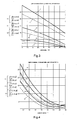
- the solid lines p (WTb, db, m) are the light transmission at 800 nm
- the doted line o(WTb, db, m) are the light transmission at 550 nm.
- Figure 3 shows that surprisingly the bottle wall opacity increases with stretch ratio, i.e. the more the wall 2'a of the bottle is stretched, the higher the opacity of the bottle wall is.
- stretch ratio i.e. the more the wall 2'a of the bottle is stretched, the higher the opacity of the bottle wall is.
- the effect of stretching is indeed the opposite, i.e. the bottle wall opacity decreases with local stretch ratio.
- high opacity can be achieved with low silica amount (not more than 40wt% and more especially not more than 30%) and with higher stretch ratios.
- low silica amount advantageously facilitates the stretch blow moulding of the bottle.
- a high opacity can be advantageously achieved with thinner stretched wall.
- LSR local stretch ratio
- LSR local stretch ratio
- WTb bottle wall thickness
- Figure 6 shows that surprisingly the bottle wall density (db) decreases with stretch ratio, i.e. the more the wall of the bottle has been stretched, the lower the density (db) of the bottle wall is.
- a standard coloured (pigmented or died) PET monolayer stretched blow moulded bottle the effect of stretching is indeed the opposite, i.e. the bottle wall density increases with stretch ratio above the density of the preform and is typically higher than 1.3g/cm 3 .
- the density db of the stretched wall 2'a of the bottle can be surprisingly decreased to a value that is at least 13% less than the density dp of the unstreched neck portion 4 of the preform 1 or bottle 1' (see table 5 - % ⁇ d), and thereby to low light transmission through the stretched wall 2'a. More especially, very low light transmission can be achieved at 500nm and 800nm when the density db of the stretched wall 2'a of the bottle is at least 25% less than the density dp of the unstreched neck portion 4 of the preform or bottle. More particularly, a density db lower than 1.3 g/cm 3 can be achieved with low silica amount (not more than 40wt%, and more especially not more than 30%) and with higher stretch ratios.
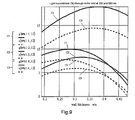
- Figure 8 shows the impact of the bottle wall density (db) on the light transmission, for a given silica amount (15wt%) and for different bottle wall thickness values (WTb).
- the graphs of figure 8 show that the light transmission reaches a minimum value for a given optimal density value (db). Otherwise stated, when the local stretch ratio (LSR) is increased up to a value corresponding to this optimal density value, the opacity of the bottle is increased. If the local stretch ratio (LSR) is increased further (the density db being decreased further), then the opacity of the bottle wall decreases.
- LSR local stretch ratio
- LSR local stretch ratio
- db bottle wall density
- a suitable range for the bottle wall density (db) is between 1g/cm 3 and 1.3 g/cm 3 , and more preferably between 1.15 g/cm 3 and 1.25 g/cm 3 .
Landscapes
- Chemical & Material Sciences (AREA)
- Health & Medical Sciences (AREA)
- Chemical Kinetics & Catalysis (AREA)
- Medicinal Chemistry (AREA)
- Polymers & Plastics (AREA)
- Organic Chemistry (AREA)
- Blow-Moulding Or Thermoforming Of Plastics Or The Like (AREA)
- Containers Having Bodies Formed In One Piece (AREA)
- Compositions Of Macromolecular Compounds (AREA)
Priority Applications (2)
| Application Number | Priority Date | Filing Date | Title |
|---|---|---|---|
| EP08002738A EP2090614A1 (de) | 2008-02-14 | 2008-02-14 | Artikel aus einer Zusammensetzung auf Polyesterbasis mit Siliziumteilchen |
| PCT/EP2009/000792 WO2009100849A1 (en) | 2008-02-14 | 2009-02-05 | Article made from a polyester-based composition comprising silica particles |
Applications Claiming Priority (1)
| Application Number | Priority Date | Filing Date | Title |
|---|---|---|---|
| EP08002738A EP2090614A1 (de) | 2008-02-14 | 2008-02-14 | Artikel aus einer Zusammensetzung auf Polyesterbasis mit Siliziumteilchen |
Publications (1)
| Publication Number | Publication Date |
|---|---|
| EP2090614A1 true EP2090614A1 (de) | 2009-08-19 |
Family
ID=40307631
Family Applications (1)
| Application Number | Title | Priority Date | Filing Date |
|---|---|---|---|
| EP08002738A Withdrawn EP2090614A1 (de) | 2008-02-14 | 2008-02-14 | Artikel aus einer Zusammensetzung auf Polyesterbasis mit Siliziumteilchen |
Country Status (2)
| Country | Link |
|---|---|
| EP (1) | EP2090614A1 (de) |
| WO (1) | WO2009100849A1 (de) |
Cited By (1)
| Publication number | Priority date | Publication date | Assignee | Title |
|---|---|---|---|---|
| RU2570448C2 (ru) * | 2010-07-07 | 2015-12-10 | Континенталь Райфен Дойчланд Гмбх | Резиновая смесь |
Citations (1)
| Publication number | Priority date | Publication date | Assignee | Title |
|---|---|---|---|---|
| WO2006125549A1 (en) | 2005-05-24 | 2006-11-30 | Amcor Limited | Polyester composition comprising silica particles and use thereof for making packaging articles |
-
2008
- 2008-02-14 EP EP08002738A patent/EP2090614A1/de not_active Withdrawn
-
2009
- 2009-02-05 WO PCT/EP2009/000792 patent/WO2009100849A1/en not_active Ceased
Patent Citations (1)
| Publication number | Priority date | Publication date | Assignee | Title |
|---|---|---|---|---|
| WO2006125549A1 (en) | 2005-05-24 | 2006-11-30 | Amcor Limited | Polyester composition comprising silica particles and use thereof for making packaging articles |
Cited By (1)
| Publication number | Priority date | Publication date | Assignee | Title |
|---|---|---|---|---|
| RU2570448C2 (ru) * | 2010-07-07 | 2015-12-10 | Континенталь Райфен Дойчланд Гмбх | Резиновая смесь |
Also Published As
| Publication number | Publication date |
|---|---|
| WO2009100849A1 (en) | 2009-08-20 |
Similar Documents
| Publication | Publication Date | Title |
|---|---|---|
| EP1562728B1 (de) | Zusammensetzung aus polyethyleneterephthalatcopolymeren mit verbesserten mechanischen eigenschaften und streckverhältnis, daraus hergestellte artikel und verfahren | |
| TW200417462A (en) | Glassy carbon thermoplastic compositions | |
| MXPA06011791A (es) | Articulos de envasado, tal como botellas opacas y metodo de produccion de los mismos. | |
| KR20070108359A (ko) | 아연과 코발트를 함유하는 폴리에스테르와 산소 제거폴리아미드의 블렌드 | |
| EP4143096B1 (de) | Leichter heissfüllbehälter und verfahren zur herstellung davon | |
| KR20150058217A (ko) | 산소 제거 플라스틱 물질 | |
| JP7047869B2 (ja) | 多層容器、その製造方法、及び再生ポリエステルの製造方法 | |
| EP1192222B1 (de) | Polyesterzusammensetzungen mit niedrigem restaldehydgehalt | |
| KR20160131051A (ko) | 플라스틱 물질용 산소 제거 조성물 | |
| EP1980590A1 (de) | Polyestergasbarriereharz und Verfahren dafür | |
| EP2186853B1 (de) | Polyesterzusammensetzung enthaltend Kieselsäureteilchen und deren Verwendung zur Herstellung von Verpackungsartikeln | |
| EP2199227B1 (de) | Polymerisches Material zur Herstellung von Verpackungsartikeln mit sauerstoffhemmenden Eigenschaften und niedrigen Lichtübertragungseigenschaften | |
| WO2009100849A1 (en) | Article made from a polyester-based composition comprising silica particles | |
| JPH04239624A (ja) | 紫外線遮断性に優れた食品包装容器 | |
| JP3046084B2 (ja) | 紫外線遮断性に優れた中空成形体および食品包装容器 | |
| US20070299182A1 (en) | Polyester-Based Thermoplastic Composition, Manufacturing Process and Hollow Bodies Obtained From These Compositions | |
| EP4019249B1 (de) | Schichtkörper aus harz | |
| JP2010500940A (ja) | 酸素排除性を持つドライブレンド、及び単層包装物品を作るためのその使用 | |
| JP3063766B2 (ja) | ポリエステル樹脂組成物 | |
| JPH02276856A (ja) | 中空成形用ポリエチレンテレフタレート配合物 | |
| JPH04239640A (ja) | 紫外線遮断性に優れた食品包装容器 | |
| JP2005504662A (ja) | 中空品の製造プロセス、このプロセスによって得られる中空品、プレフォーム及びボトル | |
| JPH04239529A (ja) | 透明性および紫外線遮断性に優れた成形品並びに食品包装容器 | |
| JPH11342530A (ja) | ポリエステルボトルの製造方法 | |
| WO2006112840A1 (en) | Polyester composition with enhanced gas barrier, articles made therewith, and methods |
Legal Events
| Date | Code | Title | Description |
|---|---|---|---|
| PUAI | Public reference made under article 153(3) epc to a published international application that has entered the european phase |
Free format text: ORIGINAL CODE: 0009012 |
|
| 17P | Request for examination filed |
Effective date: 20090605 |
|
| AK | Designated contracting states |
Kind code of ref document: A1 Designated state(s): AT BE BG CH CY CZ DE DK EE ES FI FR GB GR HR HU IE IS IT LI LT LU LV MC MT NL NO PL PT RO SE SI SK TR |
|
| AX | Request for extension of the european patent |
Extension state: AL BA MK RS |
|
| AKX | Designation fees paid |
Designated state(s): AT BE BG CH CY CZ DE DK EE ES FI FR GB GR HR HU IE IS IT LI LT LU LV MC MT NL NO PL PT RO SE SI SK TR |
|
| 19U | Interruption of proceedings before grant |
Effective date: 20130719 |
|
| 19W | Proceedings resumed before grant after interruption of proceedings |
Effective date: 20160601 |
|
| RAP1 | Party data changed (applicant data changed or rights of an application transferred) |
Owner name: PLASTIPAK BAWT S.A.R.L. |
|
| STAA | Information on the status of an ep patent application or granted ep patent |
Free format text: STATUS: THE APPLICATION IS DEEMED TO BE WITHDRAWN |
|
| 18D | Application deemed to be withdrawn |
Effective date: 20170805 |