EP2097940B1 - Gaselektrode, verfahren zu deren herstellung und ihre anwendung - Google Patents
Gaselektrode, verfahren zu deren herstellung und ihre anwendung Download PDFInfo
- Publication number
- EP2097940B1 EP2097940B1 EP07872402A EP07872402A EP2097940B1 EP 2097940 B1 EP2097940 B1 EP 2097940B1 EP 07872402 A EP07872402 A EP 07872402A EP 07872402 A EP07872402 A EP 07872402A EP 2097940 B1 EP2097940 B1 EP 2097940B1
- Authority
- EP
- European Patent Office
- Prior art keywords
- layer
- layers
- constituted
- electrode according
- electrode
- Prior art date
- Legal status (The legal status is an assumption and is not a legal conclusion. Google has not performed a legal analysis and makes no representation as to the accuracy of the status listed.)
- Not-in-force
Links
- 238000000034 method Methods 0.000 title claims description 26
- 239000007787 solid Substances 0.000 claims abstract description 63
- PXHVJJICTQNCMI-UHFFFAOYSA-N nickel Substances [Ni] PXHVJJICTQNCMI-UHFFFAOYSA-N 0.000 claims abstract description 58
- 239000000758 substrate Substances 0.000 claims abstract description 45
- 239000007784 solid electrolyte Substances 0.000 claims abstract description 19
- 229910052779 Neodymium Inorganic materials 0.000 claims abstract description 13
- 229910052777 Praseodymium Inorganic materials 0.000 claims abstract description 13
- 229910052746 lanthanum Inorganic materials 0.000 claims abstract description 13
- 229910052723 transition metal Inorganic materials 0.000 claims abstract description 10
- 150000003624 transition metals Chemical class 0.000 claims abstract description 10
- 239000000446 fuel Substances 0.000 claims abstract description 9
- 229910052759 nickel Inorganic materials 0.000 claims abstract description 9
- 229910052691 Erbium Inorganic materials 0.000 claims abstract description 5
- 229910052693 Europium Inorganic materials 0.000 claims abstract description 5
- 229910052772 Samarium Inorganic materials 0.000 claims abstract description 5
- 229910052742 iron Inorganic materials 0.000 claims abstract description 5
- 229910052688 Gadolinium Inorganic materials 0.000 claims abstract description 4
- 229910052748 manganese Inorganic materials 0.000 claims abstract description 4
- 239000012071 phase Substances 0.000 claims description 36
- 239000000463 material Substances 0.000 claims description 29
- 230000008021 deposition Effects 0.000 claims description 28
- 239000002245 particle Substances 0.000 claims description 28
- 239000000203 mixture Substances 0.000 claims description 18
- 239000000725 suspension Substances 0.000 claims description 17
- 239000000919 ceramic Substances 0.000 claims description 15
- 239000007788 liquid Substances 0.000 claims description 13
- 238000004519 manufacturing process Methods 0.000 claims description 12
- 239000002243 precursor Substances 0.000 claims description 12
- 239000011159 matrix material Substances 0.000 claims description 10
- 230000008569 process Effects 0.000 claims description 9
- 238000005137 deposition process Methods 0.000 claims description 8
- 239000002904 solvent Substances 0.000 claims description 8
- 238000002425 crystallisation Methods 0.000 claims description 5
- 239000011148 porous material Substances 0.000 claims description 5
- 239000004020 conductor Substances 0.000 claims description 4
- 238000000354 decomposition reaction Methods 0.000 claims description 3
- 239000007791 liquid phase Substances 0.000 claims description 2
- 230000001747 exhibiting effect Effects 0.000 claims 7
- 239000006193 liquid solution Substances 0.000 claims 1
- 238000007669 thermal treatment Methods 0.000 claims 1
- 239000011343 solid material Substances 0.000 abstract description 6
- 238000002360 preparation method Methods 0.000 abstract description 4
- 239000007789 gas Substances 0.000 description 27
- 239000003570 air Substances 0.000 description 17
- MCMNRKCIXSYSNV-UHFFFAOYSA-N Zirconium dioxide Chemical compound O=[Zr]=O MCMNRKCIXSYSNV-UHFFFAOYSA-N 0.000 description 16
- 238000000151 deposition Methods 0.000 description 16
- 239000002689 soil Substances 0.000 description 16
- 230000010287 polarization Effects 0.000 description 13
- YRKCREAYFQTBPV-UHFFFAOYSA-N acetylacetone Chemical compound CC(=O)CC(C)=O YRKCREAYFQTBPV-UHFFFAOYSA-N 0.000 description 12
- 239000002609 medium Substances 0.000 description 11
- 239000000843 powder Substances 0.000 description 10
- 238000010438 heat treatment Methods 0.000 description 8
- VKYKSIONXSXAKP-UHFFFAOYSA-N hexamethylenetetramine Chemical compound C1N(C2)CN3CN1CN2C3 VKYKSIONXSXAKP-UHFFFAOYSA-N 0.000 description 8
- 229920000620 organic polymer Polymers 0.000 description 8
- RUDFQVOCFDJEEF-UHFFFAOYSA-N yttrium(III) oxide Inorganic materials [O-2].[O-2].[O-2].[Y+3].[Y+3] RUDFQVOCFDJEEF-UHFFFAOYSA-N 0.000 description 8
- QTBSBXVTEAMEQO-UHFFFAOYSA-N Acetic acid Chemical compound CC(O)=O QTBSBXVTEAMEQO-UHFFFAOYSA-N 0.000 description 6
- 239000000470 constituent Substances 0.000 description 6
- 238000010586 diagram Methods 0.000 description 6
- 239000003792 electrolyte Substances 0.000 description 6
- 241000894007 species Species 0.000 description 6
- LFQSCWFLJHTTHZ-UHFFFAOYSA-N Ethanol Chemical compound CCO LFQSCWFLJHTTHZ-UHFFFAOYSA-N 0.000 description 5
- 238000001354 calcination Methods 0.000 description 5
- 125000002091 cationic group Chemical group 0.000 description 5
- 239000003795 chemical substances by application Substances 0.000 description 5
- ZWEHNKRNPOVVGH-UHFFFAOYSA-N 2-Butanone Chemical compound CCC(C)=O ZWEHNKRNPOVVGH-UHFFFAOYSA-N 0.000 description 4
- 238000003618 dip coating Methods 0.000 description 4
- 239000004312 hexamethylene tetramine Substances 0.000 description 4
- 235000010299 hexamethylene tetramine Nutrition 0.000 description 4
- 150000002910 rare earth metals Chemical group 0.000 description 4
- 150000001450 anions Chemical class 0.000 description 3
- 239000011230 binding agent Substances 0.000 description 3
- 230000008025 crystallization Effects 0.000 description 3
- 238000009792 diffusion process Methods 0.000 description 3
- 239000002270 dispersing agent Substances 0.000 description 3
- 229910052751 metal Inorganic materials 0.000 description 3
- 239000002184 metal Substances 0.000 description 3
- KBJMLQFLOWQJNF-UHFFFAOYSA-N nickel(ii) nitrate Chemical compound [Ni+2].[O-][N+]([O-])=O.[O-][N+]([O-])=O KBJMLQFLOWQJNF-UHFFFAOYSA-N 0.000 description 3
- 239000000126 substance Substances 0.000 description 3
- 230000007704 transition Effects 0.000 description 3
- 241001198704 Aurivillius Species 0.000 description 2
- MYMOFIZGZYHOMD-UHFFFAOYSA-N Dioxygen Chemical compound O=O MYMOFIZGZYHOMD-UHFFFAOYSA-N 0.000 description 2
- 241000877463 Lanio Species 0.000 description 2
- 229910019142 PO4 Inorganic materials 0.000 description 2
- 239000002202 Polyethylene glycol Substances 0.000 description 2
- FAPWRFPIFSIZLT-UHFFFAOYSA-M Sodium chloride Chemical compound [Na+].[Cl-] FAPWRFPIFSIZLT-UHFFFAOYSA-M 0.000 description 2
- 229910052769 Ytterbium Inorganic materials 0.000 description 2
- 238000000137 annealing Methods 0.000 description 2
- QVGXLLKOCUKJST-UHFFFAOYSA-N atomic oxygen Chemical compound [O] QVGXLLKOCUKJST-UHFFFAOYSA-N 0.000 description 2
- 230000015572 biosynthetic process Effects 0.000 description 2
- WUKWITHWXAAZEY-UHFFFAOYSA-L calcium difluoride Chemical compound [F-].[F-].[Ca+2] WUKWITHWXAAZEY-UHFFFAOYSA-L 0.000 description 2
- 150000001768 cations Chemical class 0.000 description 2
- IKNAJTLCCWPIQD-UHFFFAOYSA-K cerium(3+);lanthanum(3+);neodymium(3+);oxygen(2-);phosphate Chemical compound [O-2].[La+3].[Ce+3].[Nd+3].[O-]P([O-])([O-])=O IKNAJTLCCWPIQD-UHFFFAOYSA-K 0.000 description 2
- 239000002738 chelating agent Substances 0.000 description 2
- 229910001882 dioxygen Inorganic materials 0.000 description 2
- 239000006185 dispersion Substances 0.000 description 2
- 230000000694 effects Effects 0.000 description 2
- 230000008030 elimination Effects 0.000 description 2
- 238000003379 elimination reaction Methods 0.000 description 2
- 239000010408 film Substances 0.000 description 2
- 238000005259 measurement Methods 0.000 description 2
- 239000002905 metal composite material Substances 0.000 description 2
- CFYGEIAZMVFFDE-UHFFFAOYSA-N neodymium(3+);trinitrate Chemical compound [Nd+3].[O-][N+]([O-])=O.[O-][N+]([O-])=O.[O-][N+]([O-])=O CFYGEIAZMVFFDE-UHFFFAOYSA-N 0.000 description 2
- 239000001301 oxygen Substances 0.000 description 2
- 229910052760 oxygen Inorganic materials 0.000 description 2
- 125000004430 oxygen atom Chemical group O* 0.000 description 2
- VSIIXMUUUJUKCM-UHFFFAOYSA-D pentacalcium;fluoride;triphosphate Chemical compound [F-].[Ca+2].[Ca+2].[Ca+2].[Ca+2].[Ca+2].[O-]P([O-])([O-])=O.[O-]P([O-])([O-])=O.[O-]P([O-])([O-])=O VSIIXMUUUJUKCM-UHFFFAOYSA-D 0.000 description 2
- NBIIXXVUZAFLBC-UHFFFAOYSA-K phosphate Chemical compound [O-]P([O-])([O-])=O NBIIXXVUZAFLBC-UHFFFAOYSA-K 0.000 description 2
- 239000010452 phosphate Substances 0.000 description 2
- 229920001223 polyethylene glycol Polymers 0.000 description 2
- 229920000642 polymer Polymers 0.000 description 2
- 238000011160 research Methods 0.000 description 2
- 150000003839 salts Chemical class 0.000 description 2
- 238000012360 testing method Methods 0.000 description 2
- 230000000930 thermomechanical effect Effects 0.000 description 2
- 229910052727 yttrium Inorganic materials 0.000 description 2
- 229910052726 zirconium Inorganic materials 0.000 description 2
- 229910017803 (Zr,Y)O2 Inorganic materials 0.000 description 1
- 229910003371 Ba2In2O5 Inorganic materials 0.000 description 1
- OKTJSMMVPCPJKN-UHFFFAOYSA-N Carbon Chemical compound [C] OKTJSMMVPCPJKN-UHFFFAOYSA-N 0.000 description 1
- 229910052684 Cerium Inorganic materials 0.000 description 1
- UFHFLCQGNIYNRP-UHFFFAOYSA-N Hydrogen Chemical compound [H][H] UFHFLCQGNIYNRP-UHFFFAOYSA-N 0.000 description 1
- 229910002287 La2Mo2O9 Inorganic materials 0.000 description 1
- 229910001477 LaPO4 Inorganic materials 0.000 description 1
- 229910019792 NbO4 Inorganic materials 0.000 description 1
- 229920002472 Starch Polymers 0.000 description 1
- 241001080024 Telles Species 0.000 description 1
- 238000002441 X-ray diffraction Methods 0.000 description 1
- BQENXCOZCUHKRE-UHFFFAOYSA-N [La+3].[La+3].[O-][Mn]([O-])=O.[O-][Mn]([O-])=O.[O-][Mn]([O-])=O Chemical class [La+3].[La+3].[O-][Mn]([O-])=O.[O-][Mn]([O-])=O.[O-][Mn]([O-])=O BQENXCOZCUHKRE-UHFFFAOYSA-N 0.000 description 1
- 230000001464 adherent effect Effects 0.000 description 1
- 239000012080 ambient air Substances 0.000 description 1
- 238000004458 analytical method Methods 0.000 description 1
- 125000000129 anionic group Chemical group 0.000 description 1
- 229910052586 apatite Inorganic materials 0.000 description 1
- 239000012736 aqueous medium Substances 0.000 description 1
- 239000003125 aqueous solvent Substances 0.000 description 1
- 229910052799 carbon Inorganic materials 0.000 description 1
- 238000005266 casting Methods 0.000 description 1
- 239000011195 cermet Substances 0.000 description 1
- 239000011248 coating agent Substances 0.000 description 1
- 238000000576 coating method Methods 0.000 description 1
- 230000003247 decreasing effect Effects 0.000 description 1
- 238000003411 electrode reaction Methods 0.000 description 1
- 239000002001 electrolyte material Substances 0.000 description 1
- VQCBHWLJZDBHOS-UHFFFAOYSA-N erbium(III) oxide Inorganic materials O=[Er]O[Er]=O VQCBHWLJZDBHOS-UHFFFAOYSA-N 0.000 description 1
- 230000008020 evaporation Effects 0.000 description 1
- 238000001704 evaporation Methods 0.000 description 1
- 238000002474 experimental method Methods 0.000 description 1
- 238000013213 extrapolation Methods 0.000 description 1
- 239000010436 fluorite Substances 0.000 description 1
- 125000001153 fluoro group Chemical group F* 0.000 description 1
- -1 fluorocarbon compound Chemical class 0.000 description 1
- 238000003837 high-temperature calcination Methods 0.000 description 1
- 239000001257 hydrogen Substances 0.000 description 1
- 229910052739 hydrogen Inorganic materials 0.000 description 1
- 238000002847 impedance measurement Methods 0.000 description 1
- 238000001566 impedance spectroscopy Methods 0.000 description 1
- 150000002576 ketones Chemical class 0.000 description 1
- FYDKNKUEBJQCCN-UHFFFAOYSA-N lanthanum(3+);trinitrate Chemical compound [La+3].[O-][N+]([O-])=O.[O-][N+]([O-])=O.[O-][N+]([O-])=O FYDKNKUEBJQCCN-UHFFFAOYSA-N 0.000 description 1
- 239000006194 liquid suspension Substances 0.000 description 1
- 239000012528 membrane Substances 0.000 description 1
- 238000002156 mixing Methods 0.000 description 1
- 229910052590 monazite Inorganic materials 0.000 description 1
- 230000007935 neutral effect Effects 0.000 description 1
- 238000005457 optimization Methods 0.000 description 1
- 150000002894 organic compounds Chemical class 0.000 description 1
- 239000003960 organic solvent Substances 0.000 description 1
- 244000045947 parasite Species 0.000 description 1
- 239000008188 pellet Substances 0.000 description 1
- 230000000737 periodic effect Effects 0.000 description 1
- 239000004014 plasticizer Substances 0.000 description 1
- 239000004810 polytetrafluoroethylene Substances 0.000 description 1
- 229920001343 polytetrafluoroethylene Polymers 0.000 description 1
- 239000012078 proton-conducting electrolyte Substances 0.000 description 1
- 229910052761 rare earth metal Inorganic materials 0.000 description 1
- 230000009257 reactivity Effects 0.000 description 1
- 230000009467 reduction Effects 0.000 description 1
- 239000011780 sodium chloride Substances 0.000 description 1
- 238000004611 spectroscopical analysis Methods 0.000 description 1
- 238000004528 spin coating Methods 0.000 description 1
- 235000019698 starch Nutrition 0.000 description 1
- 239000008107 starch Substances 0.000 description 1
- 229910052712 strontium Inorganic materials 0.000 description 1
- CIOAGBVUUVVLOB-UHFFFAOYSA-N strontium atom Chemical compound [Sr] CIOAGBVUUVVLOB-UHFFFAOYSA-N 0.000 description 1
- 239000004094 surface-active agent Substances 0.000 description 1
- 239000010409 thin film Substances 0.000 description 1
- 238000002604 ultrasonography Methods 0.000 description 1
Images
Classifications
-
- H—ELECTRICITY
- H01—ELECTRIC ELEMENTS
- H01M—PROCESSES OR MEANS, e.g. BATTERIES, FOR THE DIRECT CONVERSION OF CHEMICAL ENERGY INTO ELECTRICAL ENERGY
- H01M4/00—Electrodes
- H01M4/86—Inert electrodes with catalytic activity, e.g. for fuel cells
- H01M4/8605—Porous electrodes
- H01M4/861—Porous electrodes with a gradient in the porosity
-
- C—CHEMISTRY; METALLURGY
- C01—INORGANIC CHEMISTRY
- C01F—COMPOUNDS OF THE METALS BERYLLIUM, MAGNESIUM, ALUMINIUM, CALCIUM, STRONTIUM, BARIUM, RADIUM, THORIUM, OR OF THE RARE-EARTH METALS
- C01F17/00—Compounds of rare earth metals
- C01F17/30—Compounds containing rare earth metals and at least one element other than a rare earth metal, oxygen or hydrogen, e.g. La4S3Br6
- C01F17/32—Compounds containing rare earth metals and at least one element other than a rare earth metal, oxygen or hydrogen, e.g. La4S3Br6 oxide or hydroxide being the only anion, e.g. NaCeO2 or MgxCayEuO
-
- C—CHEMISTRY; METALLURGY
- C01—INORGANIC CHEMISTRY
- C01G—COMPOUNDS CONTAINING METALS NOT COVERED BY SUBCLASSES C01D OR C01F
- C01G53/00—Compounds of nickel
- C01G53/40—Complex oxides containing nickel and at least one other metal element
- C01G53/42—Complex oxides containing nickel and at least one other metal element containing alkali metals, e.g. LiNiO2
-
- C—CHEMISTRY; METALLURGY
- C01—INORGANIC CHEMISTRY
- C01G—COMPOUNDS CONTAINING METALS NOT COVERED BY SUBCLASSES C01D OR C01F
- C01G53/00—Compounds of nickel
- C01G53/40—Complex oxides containing nickel and at least one other metal element
- C01G53/42—Complex oxides containing nickel and at least one other metal element containing alkali metals, e.g. LiNiO2
- C01G53/44—Complex oxides containing nickel and at least one other metal element containing alkali metals, e.g. LiNiO2 containing manganese
-
- C—CHEMISTRY; METALLURGY
- C01—INORGANIC CHEMISTRY
- C01G—COMPOUNDS CONTAINING METALS NOT COVERED BY SUBCLASSES C01D OR C01F
- C01G53/00—Compounds of nickel
- C01G53/40—Complex oxides containing nickel and at least one other metal element
- C01G53/70—Complex oxides containing nickel and at least one other metal element containing rare earths, e.g. LaNiO3
-
- H—ELECTRICITY
- H01—ELECTRIC ELEMENTS
- H01M—PROCESSES OR MEANS, e.g. BATTERIES, FOR THE DIRECT CONVERSION OF CHEMICAL ENERGY INTO ELECTRICAL ENERGY
- H01M4/00—Electrodes
- H01M4/86—Inert electrodes with catalytic activity, e.g. for fuel cells
- H01M4/8647—Inert electrodes with catalytic activity, e.g. for fuel cells consisting of more than one material, e.g. consisting of composites
- H01M4/8657—Inert electrodes with catalytic activity, e.g. for fuel cells consisting of more than one material, e.g. consisting of composites layered
-
- H—ELECTRICITY
- H01—ELECTRIC ELEMENTS
- H01M—PROCESSES OR MEANS, e.g. BATTERIES, FOR THE DIRECT CONVERSION OF CHEMICAL ENERGY INTO ELECTRICAL ENERGY
- H01M4/00—Electrodes
- H01M4/86—Inert electrodes with catalytic activity, e.g. for fuel cells
- H01M4/88—Processes of manufacture
- H01M4/8878—Treatment steps after deposition of the catalytic active composition or after shaping of the electrode being free-standing body
- H01M4/8882—Heat treatment, e.g. drying, baking
- H01M4/8885—Sintering or firing
-
- H—ELECTRICITY
- H01—ELECTRIC ELEMENTS
- H01M—PROCESSES OR MEANS, e.g. BATTERIES, FOR THE DIRECT CONVERSION OF CHEMICAL ENERGY INTO ELECTRICAL ENERGY
- H01M4/00—Electrodes
- H01M4/86—Inert electrodes with catalytic activity, e.g. for fuel cells
- H01M4/90—Selection of catalytic material
- H01M4/9016—Oxides, hydroxides or oxygenated metallic salts
-
- C—CHEMISTRY; METALLURGY
- C01—INORGANIC CHEMISTRY
- C01P—INDEXING SCHEME RELATING TO STRUCTURAL AND PHYSICAL ASPECTS OF SOLID INORGANIC COMPOUNDS
- C01P2002/00—Crystal-structural characteristics
- C01P2002/30—Three-dimensional structures
- C01P2002/34—Three-dimensional structures perovskite-type (ABO3)
-
- C—CHEMISTRY; METALLURGY
- C01—INORGANIC CHEMISTRY
- C01P—INDEXING SCHEME RELATING TO STRUCTURAL AND PHYSICAL ASPECTS OF SOLID INORGANIC COMPOUNDS
- C01P2004/00—Particle morphology
- C01P2004/01—Particle morphology depicted by an image
- C01P2004/03—Particle morphology depicted by an image obtained by SEM
-
- C—CHEMISTRY; METALLURGY
- C01—INORGANIC CHEMISTRY
- C01P—INDEXING SCHEME RELATING TO STRUCTURAL AND PHYSICAL ASPECTS OF SOLID INORGANIC COMPOUNDS
- C01P2004/00—Particle morphology
- C01P2004/60—Particles characterised by their size
- C01P2004/61—Micrometer sized, i.e. from 1-100 micrometer
-
- C—CHEMISTRY; METALLURGY
- C01—INORGANIC CHEMISTRY
- C01P—INDEXING SCHEME RELATING TO STRUCTURAL AND PHYSICAL ASPECTS OF SOLID INORGANIC COMPOUNDS
- C01P2004/00—Particle morphology
- C01P2004/60—Particles characterised by their size
- C01P2004/62—Submicrometer sized, i.e. from 0.1-1 micrometer
-
- C—CHEMISTRY; METALLURGY
- C01—INORGANIC CHEMISTRY
- C01P—INDEXING SCHEME RELATING TO STRUCTURAL AND PHYSICAL ASPECTS OF SOLID INORGANIC COMPOUNDS
- C01P2004/00—Particle morphology
- C01P2004/80—Particles consisting of a mixture of two or more inorganic phases
- C01P2004/82—Particles consisting of a mixture of two or more inorganic phases two phases having the same anion, e.g. both oxidic phases
- C01P2004/84—Particles consisting of a mixture of two or more inorganic phases two phases having the same anion, e.g. both oxidic phases one phase coated with the other
-
- C—CHEMISTRY; METALLURGY
- C01—INORGANIC CHEMISTRY
- C01P—INDEXING SCHEME RELATING TO STRUCTURAL AND PHYSICAL ASPECTS OF SOLID INORGANIC COMPOUNDS
- C01P2006/00—Physical properties of inorganic compounds
- C01P2006/40—Electric properties
-
- H—ELECTRICITY
- H01—ELECTRIC ELEMENTS
- H01M—PROCESSES OR MEANS, e.g. BATTERIES, FOR THE DIRECT CONVERSION OF CHEMICAL ENERGY INTO ELECTRICAL ENERGY
- H01M8/00—Fuel cells; Manufacture thereof
- H01M8/10—Fuel cells with solid electrolytes
- H01M8/12—Fuel cells with solid electrolytes operating at high temperature, e.g. with stabilised ZrO2 electrolyte
- H01M2008/1293—Fuel cells with solid oxide electrolytes
-
- H—ELECTRICITY
- H01—ELECTRIC ELEMENTS
- H01M—PROCESSES OR MEANS, e.g. BATTERIES, FOR THE DIRECT CONVERSION OF CHEMICAL ENERGY INTO ELECTRICAL ENERGY
- H01M4/00—Electrodes
- H01M4/86—Inert electrodes with catalytic activity, e.g. for fuel cells
- H01M4/90—Selection of catalytic material
- H01M4/9016—Oxides, hydroxides or oxygenated metallic salts
- H01M4/9025—Oxides specially used in fuel cell operating at high temperature, e.g. SOFC
- H01M4/9033—Complex oxides, optionally doped, of the type M1MeO3, M1 being an alkaline earth metal or a rare earth, Me being a metal, e.g. perovskites
-
- Y—GENERAL TAGGING OF NEW TECHNOLOGICAL DEVELOPMENTS; GENERAL TAGGING OF CROSS-SECTIONAL TECHNOLOGIES SPANNING OVER SEVERAL SECTIONS OF THE IPC; TECHNICAL SUBJECTS COVERED BY FORMER USPC CROSS-REFERENCE ART COLLECTIONS [XRACs] AND DIGESTS
- Y02—TECHNOLOGIES OR APPLICATIONS FOR MITIGATION OR ADAPTATION AGAINST CLIMATE CHANGE
- Y02E—REDUCTION OF GREENHOUSE GAS [GHG] EMISSIONS, RELATED TO ENERGY GENERATION, TRANSMISSION OR DISTRIBUTION
- Y02E60/00—Enabling technologies; Technologies with a potential or indirect contribution to GHG emissions mitigation
- Y02E60/30—Hydrogen technology
- Y02E60/50—Fuel cells
Definitions
- the invention relates to a gas electrode comprising a plurality of layers stacked on each other from a solid substrate such as a solid electrolyte, the different layers being adapted to allow the passage of reactive species through the thickness of this electrode, and comprising a first layer in contact with said solid substrate and a last layer having an external free surface intended to be placed in contact with a gas, in particular with a source of oxygen gas such as ambient air.
- a gas electrode - particularly with air - is in particular applicable to form an electrode - in particular the cathode - of an electrolytic cell, in particular a solid electrolyte electrochemical cell (SOEC), and in particular a fuel cell. solid oxide (so-called SOFC). It is also applicable in the production of an electrochemical membrane.
- Fuel cells are extremely promising energy production devices, but their technological optimization has yet to be achieved to enable their wide dissemination, particularly in applications for the general public, particularly in the field of transport or transportation. residential or industrial premises.
- One of the problems that arises with these devices is in particular that of achieving efficient electrodes at reasonable temperatures (typically below 800 ° C.), stable over time and having a polarization resistance as low as possible, in any case sufficiently weak to allow obtaining an acceptable electrical efficiency.
- this objective must be achieved with the use of compatible manufacturing techniques, in terms of profitability and feasibility, with exploitation on an industrial scale.
- solutions have already been proposed to improve the interface between the air electrode and the electrolyte and / or to take into account the differences in composition and coefficient of thermal expansion between the constituent materials of the electrolyte and electrode.
- porous ceramics based on perovskite oxide of structure for example lanthanum manganites doped with strontium LSM ( WO 9933134 , EP 0510820 , FR 2697947 , JP 2006012764 , JP 2005183279 ). With these materials, at best a polarization resistance value of the order of 100 ⁇ .cm 2 at 800 ° C. is obtained.
- the solid electrolyte is a dense ceramic, generally based on an oxide of fluorine structure, and the anode is a porous ceramic-metal composite, generally consisting of a ceramic of the same material as that forming the solid electrolyte, in which a metal has been dispersed, for example nickel.
- WO 2005/099003 discloses a novel oxide material which can be advantageously used to produce a gas electrode, in particular an air electrode forming the cathode of a fuel cell.
- the invention therefore aims to solve this problem by proposing a gas electrode having improved polarization resistance and service life, especially for a range of operating temperatures between 400 ° C and 800 ° C.
- the invention aims to provide a gas electrode having, for an operating temperature of less than 800 ° C., in particular between 650 ° C. and 800 ° C., a polarization resistance of less than 5 ⁇ .cm 2 .
- the invention aims to provide such a gas electrode whose costs and manufacturing techniques are compatible with industrial scale operation.
- the invention also aims at providing a method for manufacturing such an electrode, as well as an electrochemical cell incorporating such an electrode, and having the same advantages.
- An electrode according to the invention thus differs from the state of the art in particular by the choice of the constituent materials of the layers that constitute it.
- the inventors have indeed found that this specific family of materials makes it possible in practice to obtain surprisingly superior results to other more or less similar materials envisaged up to now in the context of the realization of a gas electrode, and without that no precise scientific explanation can be given to these surprising results.
- an electrode according to the invention is also distinguished by the fact that the various layers that constitute it have a heterogeneous microstructure, that is to say that varies from one layer to another.
- the microstructure of the first layer is different from that of the superimposed layer in contact with this first layer.
- This difference in microstructures stems in particular from the fact that the layers are made by distinct deposition processes, with materials which, although belonging to the same family (formula (I) mentioned above), are different (in particular because of different proportions for the different constituent elements of the material), and with parameters also distinct in terms of thickness, size of the grains of deposited material, pore sizes, etc.
- the first layer advantageously has macroscopic characteristics which are at the nanoscale (that is to say with dimensions of between 1 nm and 1000 nm), while the last layer, and more particularly all the layers superimposed on the first layer, have macroscopic characteristics which are at the micrometer scale (that is to say with dimensions between 1 ⁇ m and 1000 ⁇ m).
- the microstructure of the different layers is such that the porosity increases from the first layer to the last layer.
- the various stacked layers form a network of solid material interconnected between the outer free surface of the last layer and the solid substrate, so that the ionic species and the electrons can circulate in contact with this network while crossing the thickness of the electrode.
- each of the layers of the electrode in particular said first layer and / or said last layer, is produced so that it complies with all or some of the characteristics mentioned above.
- said first layer is produced with a deposition method different from the deposition method of the superimposed layer in contact with this first layer.
- Said first layer is deposited on the solid substrate by at least one sol-gel deposit in which precursor species intended to form at least one mixed oxide are mixed in a solvent, and the suspension is then mixed with an organic polymer matrix, and then applied this mixture on the solid substrate, then the whole is subjected to a heat treatment adapted to cause the crystallization of each mixed oxide and the decomposition of the organic polymer matrix.
- said last layer is applied by producing at least one slip deposit in which a slip is produced containing solid particles of at least one mixed oxide dispersed in a liquid medium, and then this slip is applied. in the form of at least one layer, then the whole is subjected to a treatment adapted to cause the evacuation of the liquid medium.
- said last layer is applied by a slip deposit.
- said last layer is applied by producing at least one loaded soil deposit in which a suspension is produced containing solid particles dispersed in a liquid medium containing precursors of species intended to form at least a mixed oxide, then this suspension is applied in the form of at least one layer, then the whole is subjected to a suitable treatment to cause the deposition and crystallization of the mixed oxides and the evacuation of the liquid phase.
- each intermediate layer is applied between said first layer and said last layer by producing at least one slip deposit and / or at least one loaded soil deposit as indicated above.
- each layer superimposed on said first layer is applied to the last layer using the same deposition method (slip or loaded soil).
- the solid substrate is a gas-tight (non-porous) solid electrolyte selected from the group consisting of conductive ceramics of O 2 anions and proton conducting ceramics.
- the mixed oxides corresponding to formula (I) are phases of the Ruddlesden-Popper series (L n + 1 Ni n O 3n + 1 ).
- the phases of Ruddlesden-Popper are well known (see, for example, the publication M. Greenblatt "Ruddlesden-Popper nickelates Lnn + 1NinO3n + 1: structure and properties", Current Opinion in Solid State & Materials Science, 2 (1997) p. 174-183 ) and have been studied in particular concerning their magnetic and electrical properties. It has also been envisaged to use some of these mixed oxides as a porous electrode (see, for example, the publication F. Mauvy et al.
- an electrode according to the invention has unexpected performance in terms of stability over time and polarization resistance.
- an electrode according to the invention may have, for an operating temperature of less than 800 ° C., in particular between 650 ° C. and 800 ° C., a polarization resistance of less than 5 ⁇ ⁇ cm 2, in particular order of 1 ⁇ .cm 2 at 800 ° C.
- the invention is particularly advantageously applicable for the production of a gas electrode of an electrochemical cell. Accordingly, the invention extends to an electrochemical cell comprising at least one gas electrode according to the invention. More particularly, the invention extends to a fuel cell electrochemical cell characterized in that it comprises a solid electrolyte carrying a cathode formed of an air electrode according to the invention.
- the gas electrode has a generally flat shape, or a generally cylindrical shape - particularly cylindrical in revolution - or any other shape.
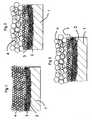
- a gas electrode according to the invention consists of a plurality of layers 2, 3, 4 superimposed on each other from a solid substrate 1 formed of a dense ceramic.
- the first layer 2 consists of at least one mixed oxide chosen from the group formed by the Ruddlesden-Popper phases corresponding to the following general formula (I):
- L is a member selected from the rare earth group
- Ni nickel
- M is a transition metal
- n is a nonzero integer
- x , y and ⁇ are real numbers satisfying the following relationships: 0 ⁇ x ⁇ not + 1 0 ⁇ there ⁇ not 0 ⁇ ⁇ ⁇ 0 , 25.
- each of the other layers 3, 4 consists of at least one mixed oxide chosen from the group formed by perovskites and Ruddlesden-Popper phases corresponding to the general formula (I) mentioned above.
- each of said layers 2, 3 consists of at least one mixed oxide chosen from the group formed solely of the Ruddlesden-Popper phases corresponding to formula (I), with the exception of the last layer 4 which is constituted at least one mixed oxide chosen from the group of perovskites and Ruddlesden-Popper phases corresponding to formula (I), that is to say which may comprise at least one mixed oxide selected from the group of perovskites.
- the oxygen atoms form a sheet whose structure is of the NaCl type.
- the number n represents the number of perovskite layers linked together by the top of the octahedra, and ⁇ represents the number of interstitial oxygen atoms inserted in the LO layer (see, for example, the publication M. Greenblatt "Ruddlesden-Popper nickelates Lnn + 1NinO3n + 1: structure and properties", Current opinion in Solid State & Materials Science, 2 (1997) p. 174-183 ).
- the first layer 2 deposited in contact with the solid substrate 1 is formed of a thin film whose microstructure has dimensional characteristics which are at the nanoscale.
- the last layer 4, and preferably each of the layers 3, 4 superimposed on this first layer 2 is formed of a thicker layer made of a material belonging to the family mentioned above, but which is different, with respect to With regard to its microstructure, the first layer 2, the last layer 4, and preferably each of the layers 3, 4 superimposed on this first layer 2, is produced according to a different deposition process, and so as to have a microstructure whose characteristics dimensions are at the micrometric scale.
- L is a member selected from the group consisting of La, Pr, Nd, Sm, Eu, Er, and Gd
- M is a transition metal selected from the group consisting of Fe, Co, and Mn.
- the elements L and M are the same for all said layers of the electrode. This results in particular in a better chemical affinity, a better thermomechanical compatibility and fewer problems related to the phenomena of diffusion of the constituent elements of the electrode into each other.
- A denotes an alkaline or alkaline-earth element
- B and M denote transition metals belonging to groups 3 to 14 of the periodic table
- L denotes a rare earth.
- a sol-gel type deposition process In such a process, precursors of the species capable of forming at least one mixed oxide are mixed in a neutral liquid medium, and this suspension is then mixed with an organic polymer matrix, and this mixture is then applied to the solid substrate, and the mixture is then subjected to together with a heat treatment adapted to cause the crystallization of each mixed oxide and the decomposition of the organic polymer matrix.
- a heat treatment adapted to cause the crystallization of each mixed oxide and the decomposition of the organic polymer matrix.
- the molar ratio between the amount of organic polymer matrix on the amount of inorganic precursors is between four and six.
- the concentration of the precursors used in the initial suspension also makes it possible to control the total thickness of the layer formed.
- this process can be carried out by any known technique, preferably by the so-called dip-coating technique in which the solid substrate is immersed in the liquid mixture and then extracted from this mixture with a speed - controlled, then subjected to a heat treatment at high temperature, generally greater than 700 ° C.
- this first layer 2 use is preferably made of a material consisting of at least one mixed oxide chosen from the group of Ruddlesden-Popper phases corresponding to formula (I) with n ⁇ ⁇ 1. More particularly, chooses said material such that (n + 1-x) / (ny) ⁇ 2.
- a first layer 2 consisting of a mixed oxide of formula L 2-x NiO 4 + ⁇ , L being chosen from the group consisting of La, Pr, Nd.
- an electrode according to the invention advantageously comprises a total number of layers superimposed on the solid substrate between two and five.
- the different layers 3, 4 superimposed on the first layer 2 consist of a material corresponding to the same family (formula (I)), preferably with elements L and M identical in all the layers of the same electrode, but only possibly varying, from one layer to another, the proportions of the different elements in the formula (I), that is to say the values of the parameters n, x , y and ⁇ of the formula (I).
- the different layers 3, 4 superimposed on the first layer 2 have a microstructure different from that of the first layer 2.
- This variation of microstructures can result in particular from the use of a different deposition process.
- the inventors have indeed found that the materials corresponding to the formula (I) can be deposited according to various processes, and that the choice of the process used for the deposition makes it possible to vary the microstructure and in particular the porosity and the electronic conduction properties. and ionic of each deposited layer.
- the last layer 4 of the electrode which comes into contact with the gas, in particular air, is formed so as to consist of elementary solid particles forming between them open pores and constituting an interconnected network of solid material to throughout its thickness, these elementary solid particles being connected in contact with each other with an average size of the elementary particles of between 100 nm and 5 ⁇ m - typically of the order of 1 ⁇ m-.
- the thickness of the last layer 4 is advantageously between 1 micron and 5 microns.
- each intermediate layer 3 superimposed on the first layer 2 is advantageously between 1 ⁇ m and 5 ⁇ m.
- the thickness of the different layers of the electrode, and in particular of the last layer 4 and of each intermediate layer 3 superimposed on the first layer 2, is adjusted so as to obtain a total thickness of the appropriate electrode.
- This total thickness of the electrode must be sufficient on the one hand to allow sufficient electrocatalytic activity (this activity depends on the amount of material in contact with which the reactive species may come), on the other hand to have a good thermomechanical behavior and avoid short circuits during operation. To do this, the total thickness of the electrode is greater than 1 micron, and preferably greater than 5 microns. Conversely, the total thickness of the electrode should be as low as possible to have a resistivity that is not too high and to limit manufacturing costs.
- the invention makes it possible to satisfy all of these conditions with an electrode whose thickness is between 1 ⁇ m and 15 ⁇ m.
- the total thickness of the electrode according to the invention is preferably between 1 ⁇ m and 15 ⁇ m.
- the volume porosity of the last layer 4 is between 10% and 50% -ypically of the order of 30% -.
- the last layer 4 is by Moreover, it is designed to have an ionic conductivity greater than 10 -4 S.cm -1 , and an electronic conductivity greater than 50 S.cm -1 .
- the last layer 4 by a slip deposit, that is to say by producing a slip containing particles of mixed oxide (s) dispersed in suspension in a liquid medium, by applying this slip in the form of a layer, then subjecting the assembly to a treatment -partement a heat treatment- adapted to cause the evacuation of the liquid medium.
- a suspension deposition charged with mixed oxide particles may be carried out in practice according to various techniques known per se, for example dip coating, rotational coating. (“Spin-coating”), strip casting, ...
- the liquid medium used to make the slip may be an aqueous solvent or an organic solvent (for example chosen from an alcohol, a ketone, etc.).
- the solid particles of each mixed oxide can themselves be obtained by sol-gel, by preparing a salt suspension of the precursor species in a solvent, by adding an organic polymer matrix in this suspension, and then subjecting the assembly to a heat treatment at a temperature between 700 ° C and 1000 ° C. The choice of temperature in particular allows to influence the size of the oxide particles (s) obtained.
- the particles obtained are dispersed in the liquid solvent to form the slip.
- a certain minority proportion of at least one porogenic agent is also added, for example chosen from starch, carbon, a fluorocarbon compound (for example PTFE), etc.
- Such an inert pore-forming agent is also removed during the subsequent heat treatment phase.
- the elimination treatment of the liquid medium from the suspension may be a high temperature calcination, typically of the order of 1000 ° C. None also prevents, alternatively or in combination, to use any other elimination treatment, for example by evaporation.
- An uncracked adherent homogeneous layer 4 having a thickness of the order of several microns is obtained.
- the last layer 4 may be formed not by a slip deposit, but by a so-called deposit of loaded soil.
- a charged soil deposit differs from a slip deposit in that the liquid medium contains both solid particles of mixed oxide (s) and particles of precursor species of mixed oxide (s) ( s), that is to say in practice particles of metal salts, as in a sol-gel type deposit.
- a charged sol deposition also differs from a sol-gel deposition in that no organic polymer matrix is added to the liquid suspension.
- a final layer 4 consisting of a mixed oxide selected from the group consisting of LNiO 3 , L 2-x NiO 4 + ⁇ , L 3 Ni 2 O 7 - ⁇ , and L 4 Ni 3 O 10 - ⁇ , L being selected from the group consisting of La, Pr, Nd.
- At least one intermediate layer 3 may be interposed between said first layer 2 and said last layer 4.
- Such intermediate layer 3 has characteristics intermediate between those of the first layer 2 and those of the last layer 4, in particular with respect to its porosity and its properties of ionic conduction and electronic conduction.
- the porosity of the various layers is increasing from that of the first layer 2 to that of the last layer 4.
- the first layer 2 has the highest ionic conductivity, and the ionic conductivity is decreasing since that of the first layer 2 to that of the last layer 4.
- the first layer 2 has the lowest electronic conductivity, and the electronic conductivity is increasing from that of the first layer 2 to that of the last layer 4.
- each intermediate layer 3 results from a deposit chosen from a slip deposit and a loaded soil deposit, that is to say is carried out according to a deposition process similar to that of the last layer 4.
- the microstructure of each intermediate layer 3 is similar to that of the last layer 4, and therefore different from that of the first layer 2.
- a gas electrode according to the invention therefore has a gradient of microstructure, porosity and composition through its thickness, from the solid substrate 1, to its free outer surface intended to be placed in contact with a gas.
- Such a gas electrode according to the invention can act as a cathode for an electrochemical cell forming a solid oxide fuel cell, capable of converting chemical energy into electrical energy at an operating temperature of between 600 ° C. and 800 ° C. ° C.
- the oxygen gas is reduced to O 2 anions which diffuse through the electrolyte to react with the hydrogen from the anode disposed on an opposite side of the electrolytic substrate.
- Such anode may be formed of a porous ceramic-metal composite (commonly referred to as a "cermet"), for example a ceramic similar to that constituting the solid electrolyte, but in which a metal has been dispersed, for example metallic nickel. .
- the first layer 2 is made by dip-coating of a substrate 1 formed of a polished yttria zirconia (YSZ) pellet 1 cm in diameter, with a controlled speed (3 cm / min). in a polymer floor.
- YSZ yttria zirconia
- the soil is prepared from the protocol described by US3330697 (Pechini ), and results from the mixture of precursors of oxides, nickel nitrate and lanthanum nitrate, introduced in stoichiometric proportions.
- the precursors are introduced with a cationic ratio
- the 3+ / Ni 2+ is equal to 1.98, which makes it possible to form the oxide La 1.98 NiO 4 + ⁇ after annealing the soil.
- Organic agents are also added, including acetylacetone, hexamethylenetetramine, and acetic acid. After heating the soil to 70 ° C. during ten minutes so as to obtain an adequate viscosity (of the order of 30 mPa.s), the deposit is made.
- the soil film is then calcined in air at 700 ° C. for 2 hours, with a slow rise in temperature (50 ° C./h), in order to eliminate the organic compounds and crystallize the oxide.
- the intermediate layer 3 is made by soaking-shrinking ("dip-coating") of the substrate 1 YSZ covered by the first crystallized layer 2, with a controlled rate (3 cm / min) in a suspension.
- the suspension is prepared from the dispersion of a ceramic powder of La 4 Ni 3 O 10 oxide in an organic or aqueous medium.
- Said medium may contain different surfactants, such as a dispersing agent, a binding agent and a plasticizer.
- the suspension may also contain a pore-forming agent.
- the ceramic powder is obtained by calcining the polymer sols under air at 1000 ° C. for 2 hours. The suspension is homogenized, for example by the use of ultrasound.
- the layer obtained is then calcined in air at 1000 ° C. for 2 hours.
- several deposits can be made and / or the ceramic particle load can be increased.
- the last layer 4 is prepared in the same way as the intermediate layer 3, but with a powder whose composition is La 2 NiO 4 + ⁇ .
- the first layer 2 of this sample is made as indicated above for the sample [1], but with a cationic ratio La 3+ / Ni 2+ equal to 1.33 which makes it possible to form after oxide annealing the oxide The 4 Ni 3 O 10 .
- the intermediate layer 3 is prepared as described above in the case of the sample [1].
- the last layer 4 is prepared by slip deposit as described above in the case of the sample [1], with a powder whose composition is LaNiO 3 .
- the powder is annealed under air at a temperature above the calcination temperature of the sols, for example 1200 ° C., and / or for a duration of temperature plateau greater than 2 hours, for example 10am.
- the first layer 2 is prepared as described above in the case of the sample [1].
- the intermediate layer 3 is prepared as described above in the case of the sample [1], but using a powder whose composition is La 2 NiO 4 + ⁇ .
- the last layer 4 is prepared as described above in the case of the sample [2], but with a powder whose composition is La 4 Ni 3 O 10 .
- the first layer 2 is produced by a sol-gel deposition as described above in the case of the sample [1], but with a mixture of nickel nitrate and neodymium nitrate introduced with a cationic ratio Nd 3+ / Ni 2+ equal to 1.95.
- the total molar ratio of the Nd 3+ and Ni 2+ cations on the chelating agent (acetylacetone) is set at 3.
- the molar ratio of acetylacetone to hexamethylenetetramine is set to 1.
- the last layer 4 of this sample [4] (which comprises only two layers 2, 4 stacked on the substrate 1) is produced by a slip deposit, with a slip formed of 10 g of Nd 1.95 NiO 4 powder dispersed in 15 g of solvent.
- the solvent is an azeotropic mixture of ethyl methyl ketone and ethanol (66/34% by volume).
- the slip also contains 100 mg of a commercial dispersant referenced C213 and 1 g of polyethylene glycol binder.
- the last porous layer 4 is deposited on the first layer 2 and the sample is calcined in air at 1000 ° C. for 1 hour, with a short plateau at 400 ° C. The heating rate is 1 ° C / min up to 400 °, then 5 ° C / min up to 1000 ° C.
- the first layer 2 of this sample is made by a sol-gel deposition as described in the case of the sample [4] with a mixture of nickel nitrate and neodymium nitrate introduced with a cationic ratio La 3+ / Ni 2+ equal to 1.98.
- Organic agents are also added, such as acetylacetone, hexamethylenetetramine, and acetic acid.
- the total molar ratio of La 3+ and Ni 2+ cations on the chelating agent (acetylacetone) is set at 3.
- the molar ratio of acetylacetone to hexamethylenetetramine is set at 1.
- the soil film is then calcined under air at 700 ° C for 2 hours, with a slow rise in temperature (50 ° C / h). Three deposits were made with, after each deposit, a calcination step at 700 ° C with a temperature rise rate of 100 ° C / h.
- the second and last porous layer 4 of this sample is made by a slip deposit consisting of 10 g of La 4 Ni 3 O 10 mixed oxide powder dispersed in 15 g of solvent.
- the solvent is an azeotropic mixture of ethylmethylketone and ethanol (66/34% by volume).
- the slip also contains 100 mg of a commercial dispersant referenced C213 and 1 g of polyethylene glycol binder.
- the porous layer 4 is deposited on the first layer 2 and the sample is calcined in air at 1000 ° C. for 1 hour, with a short stop at 400 ° C. The heating rate is 1 ° C / min up to 400 °, then 5 ° C / min up to 1000 ° C.
- the first layer 2 of this sample is prepared as described above in the case of the sample [4].
- the second and last porous layer 4 of this sample is prepared by slip deposition as described above in the case of the sample [5].
- FIGS. 1 to 3 are diagrams illustrating the microstructure of the electrodes respectively conforming to samples [1], [2] and [3].
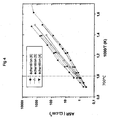
- the polarization resistance of the cathode is determined at from the extrapolation on the axis of the real electrical contributions apparent at medium and low frequencies. These two contributions are generally modelizable by two adjacent or superimposed semicircles, in representation mode of the Nyquist diagrams.
- the samples according to the invention [4], [5] and [6] all operate at 700 ° C, and even for some at a lower temperature, up to 650 ° C, and all have a a very satisfactory specific polarization resistance value, of the order of 1 ⁇ .cm 2 at 800 ° C.
- the samples according to the invention have a stable chemical resistance. This result is based in particular on reactivity tests carried out from the calcination at 800 ° C. under air for 3 weeks of pulverulent mixing of the YSZ oxides, electrolyte material, and mixed oxides of the formula (I). No parasite phase was observed following this experiment. In addition, similar tests were performed on layers, and led to the same results. Finally, studies carried out with LBO 4 proton conducting electrolyte materials led to the same results. The analysis of the tested samples was carried out by X-ray diffraction of the powder mixtures and the surfaces of the different layers, as well as by microscopic studies coupled to electron dispersion spectroscopy studies carried out on slices of the electrochemical cells.
- the 1.98 NiO 4 Nd 1.95 NiO 4 deposit process sol-gel sol-gel sol-gel sol-gel sol-gel sol-gel grain size 200 nm 200 nm 200 nm porosity 10% 10% 10% thickness 300 nm 300 nm 300 nm intermediate layer
- the 4 Ni 3 O 10 The 4 Ni 3 O 10 The 2 NiO 4 - - -
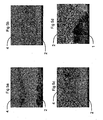
- FIGS 5a, 5b, 5c, 5d represent electron microscopic photographs of different parts of the sample [4] according to the invention.
- the Figures 5a, 5b, 5c represent the interface between the first layer 2 and the last layer 4 superimposed on it with variable magnification (x 2000, x 5000, and x 10 000 respectively).
- the figure 5d shows the interface between the electrolyte 1 and the first layer 2.
- the first layer 2 is porous, but less porous than the last layer 4. It is further noted that the various structural characteristics mentioned above are well obtained.
- the invention can be subject to many different embodiments with respect to the only embodiments described and shown in the figures.
- the number of layers can vary.
Landscapes
- Chemical & Material Sciences (AREA)
- Organic Chemistry (AREA)
- General Chemical & Material Sciences (AREA)
- Inorganic Chemistry (AREA)
- Chemical Kinetics & Catalysis (AREA)
- Electrochemistry (AREA)
- Engineering & Computer Science (AREA)
- Geology (AREA)
- Life Sciences & Earth Sciences (AREA)
- Materials Engineering (AREA)
- General Life Sciences & Earth Sciences (AREA)
- Composite Materials (AREA)
- Physics & Mathematics (AREA)
- Thermal Sciences (AREA)
- Manufacturing & Machinery (AREA)
- Inert Electrodes (AREA)
- Battery Electrode And Active Subsutance (AREA)
- Steroid Compounds (AREA)
- Fuel Cell (AREA)
Claims (36)
- Gaselektrode mit einer Vielzahl von Schichten (2, 3, 4), die aufeinander ab einem festen Substrat (1), wie z. B. einem festen Elektrolyt, übereinander gestapelt sind, wobei die unterschiedlichen Schichten (2, 3, 4) geeignet sind, um den Durchgang von Reagensarten über die Dicke dieser Elektrode zu erlauben, und mit einer ersten Schicht (2), die mit dem genannten festen Substrat (1) in Kontakt ist, und einer letzten Schicht (4), die eine freie externe Oberfläche aufweist, die dazu bestimmt ist, mit einem Gas in Kontakt zu stehen, wobei jede der genannten Schichten aus wenigstens einem gemischten Oxid gebildet wird,
dadurch gekennzeichnet, dass:- jede der genannten Schichten (2, 3, 4) aus wenigstens einem gemischten Oxid ausgewählt ist, das aus der Gruppe ausgewählt ist, die aus Perowskiten gebildet wird, und aus Ruddlesden-Popperphasen, die der nachstehenden allgemeinen Formel (I) entsprechen:
in der L ein Element ist, das aus der Gruppe der seltenen Erden ausgewählt ist, Ni für Nickel steht, M ein Übergangsmetall ist, n eine ganze Zahl ungleich Null ist, x, y und δ reelle Zahlen sind, die den folgenden Verhältnissen unterstehen:


wobei die genannte erste Schicht (2) aus wenigstens einem gemischten Oxid gebildet wird, das aus der Gruppe der Ruddlesden-Popperphasen ausgewählt ist, die der Formel (I) genügen,
die Mikrostruktur der genannten ersten Schicht (2) unterschiedlich von der Mikrostruktur der genannten letzten Schicht (4) ist,
die Porosität der unterschiedlichen Schichten (2, 3, 4) ab der genannten ersten Schicht (2) ansteigt, deren Porosität die geringste ist, bis zur genannten letzten Schicht (4), deren Porosität die höchste ist,
die unterschiedlichen, übereinander gestapelten Schichten (2, 3, 4) ein Netz aus festem, miteinander verbundenem Material zwischen der freien externen Oberfläche der letzten Schicht (4) und dem festen Substrat (1) bilden, und eine gesamte Dicke von mehr als 1 µm aufweisen. - Elektrode gemäß Anspruch 1, dadurch gekennzeichnet, dass die Mikrostruktur der genannten ersten Schicht (2) unterschiedlich von der Mikrostruktur der überlagerten Schicht (3, 4) ist, die mit dieser ersten Schicht (2) in Kontakt ist.
- Elektrode gemäß Anspruch 1 oder 2, dadurch gekennzeichnet, dass der Unterschied der Mikrostrukturen aus unterschiedlichen Proportionen für die das Material bildenden unterschiedlichen Elemente stammt.
- Elektrode gemäß Anspruch 1 bis 3, dadurch gekennzeichnet, dass die genannte letzte Schicht (4) aus wenigstens einem gemischten Oxid gebildet wird, das aus der Gruppe ausgewählt ist, die aus Perowskiten und Ruddlesden-Popperphasen gebildet wird, die der Formel (I) genügt, und alle anderen Schichten (2, 3) aus wenigstens einem gemischtem Oxid gebildet werden, das aus der Gruppe ausgewählt ist, die aus Ruddlesden-Popperphasen gebildet wird, die der allgemeinen Formel (I) unterstehen.
- Elektrode gemäß Anspruch 1 bis 4, dadurch gekennzeichnet, dass jede der Schichten (2, 3, 4) aus wenigstens einem gemischten Oxid gebildet ist, das aus der Gruppe ausgewählt ist, die aus Ruddlesden-Popperphasen gebildet wird, die der allgemeinen Formel (I) unterstehen, und dass die Elemente L und M für alle die genannten Schichten (2, 3, 4) der Elektrode dieselben sind.
- Elektrode gemäß Anspruch 1 bis 5, dadurch gekennzeichnet, dass L ein Element ist, das aus der Gruppe ausgewählt ist, das aus La, Pr, Nd, Sm, Eu, Er und Gd gebildet wird und M ein Übergangsmetall ist, das aus der Gruppe ausgewählt ist, die aus Fe, Co und Mn gebildet wird.
- Elektrode gemäß Anspruch 1 bis 6, dadurch gekennzeichnet, dass für die genannte erste Schicht (2) n-x ≠ 1 ist .
- Elektrode gemäß Anspruch 1 bis 7, dadurch gekennzeichnet, dass für die genannte erste Schicht (2) a (n+1-x) / (n-y) < 2 gilt.
- Elektrode gemäß Anspruch 1 bis 8, dadurch gekennzeichnet, dass die genannte erste Schicht (2) aus einem gemischten Oxid mit der Formel L2-x NiO4+δ gebildet wird, wobei L aus der Gruppe ausgewählt ist, die aus La, Pr, Nd gebildet wird.
- Elektrode gemäß Anspruch 1 bis 9, dadurch gekennzeichnet, dass die genannte letzte Schicht (4) aus einem gemischten Oxid gebildet wird, das aus der Gruppe ausgewählt ist, die aus LNiO3, L2-x NiO4+δ, L3 Ni2O7-δ, und Ly Ni3O10 gebildet wird, wobei L aus der Gruppe ausgewählt ist, die aus La, Pr, Nd gebildet wird.
- Elektrode gemäß Anspruch 1 bis 10, dadurch gekennzeichnet, dass die genannte erste Schicht (2) aus festen, elementaren, verbundenen Partikeln gebildet wird, die untereinander in Kontakt sind, wobei die durchschnittliche Größe dieser elementaren Partikel geringer ist als 300 nm.
- Elektrode gemäß Anspruch 1 bis 11, dadurch gekennzeichnet, dass die Dicke der genannten ersten Schicht (2) geringer ist als 200 m, - insbesondere in der Größenordnung von 50 nm.
- Elektrode gemäß Anspruch 1 bis 12, dadurch gekennzeichnet, dass die genannte letzte Schicht (4) aus festen elementaren Partikeln gebildet wird, die untereinander offene Poren bilden und ein untereinander vernetztes Netz aus festem Material über seine gesamte Dicke bilden.
- Elektrode gemäß Anspruch 1 bis 13, dadurch gekennzeichnet, dass die genannte letzte Schicht (4) aus festen, elementaren, verbundenen Partikeln gebildet wird, die untereinander in Kontakt sind, wobei die durchschnittliche Größe dieser elementaren Partikel zwischen 100 nm und 5 µm inbegriffen ist.
- Elektrode gemäß Anspruch 1 bis 14, dadurch gekennzeichnet, dass sie zwischen zwei und fünf auf dem festen Substrat gestapelte Schichten umfasst, wobei die unterschiedlichen gestapelten Schichten (2, 3, 4) eine zwischen 1 µm und 15 µm inbegriffene Dicke aufweisen.
- Elektrode gemäß Anspruch 1 bis 15, dadurch gekennzeichnet, dass die genannte erste Schicht (2) eine Porosität aufweist, die im Volumen geringer ist als 10 %.
- Elektrode gemäß Anspruch 1 bis 16, dadurch gekennzeichnet, dass die genannte letzte Schicht (4) eine Porosität aufweist, die im Volumen höher ist als 10 % und geringer als 50 %.
- Elektrode gemäß Anspruch 1 bis 17, dadurch gekennzeichnet, dass sie eine Vielzahl von Schichten (3, 4) aufweist, die der genannten ersten Schicht (2), die mit dem festen Substrat (1) in Kontakt ist, überlagert sind, und deren Porosität ab der genannten ersten Schicht (2) bis zur genannten letzten Schicht (4) ansteigt.
- Elektrode gemäß Anspruch 1 bis 18, dadurch gekennzeichnet, dass aus jeder der genannten Schichten (2, 3, 4) wenigstens eine Ablagerung resultiert, die aus einer Schlempeablagerung, einer Ablagerung aus belastetem Boden und einer Ablagerung Boden-Gel ausgewählt ist.
- Elektrode gemäß Anspruch 18 und 19, dadurch gekennzeichnet, dass wenigstens eine Zwischenschicht (3) zwischen der genannten ersten Schicht (2) und der genannten letzten Schicht (4) aus wenigstens einer Ablagerung resultiert, die aus einer Schlempeablagerung und einer Ablagerung aus belastetem Boden ausgewählt ist.
- Elektrode gemäß Anspruch 19 oder 20, dadurch gekennzeichnet, dass die genannte erste Schicht (2) aus wenigstens einer Ablagerung Boden-Gel resultiert.
- Elektrode gemäß Anspruch 19 bis 21, dadurch gekennzeichnet, dass die genannte letzte Schicht (4) aus wenigstens einer Schicht resultiert, die aus einer Schlempeablagerung und einer Ablagerung aus belastetem Boden ausgewählt ist.
- Elektrode gemäß Anspruch 1 bis 22, dadurch gekennzeichnet, dass die genannte erste Schicht (2) unter den unterschiedlichen Schichten (2, 3, 4) die größte ionische Leitfähigkeit aufweist.
- Elektrode gemäß Anspruch 1 bis 23, dadurch gekennzeichnet, dass die genannte erste Schicht (2) aus einem Material gebildet wird, dessen ionische Leitfähigkeit höher als oder gleich 10-2 S.cm-1 ist.
- Elektrode gemäß Anspruch 1 bis 24, dadurch gekennzeichnet, dass die genannte letzte Schicht (4) aus einem Material gebildet wird, dessen ionische Leitfähigkeit größer als 10-4 S.cm-1 ist und dessen elektronische Leitfähigkeit größer als 50 S.cm-1 ist.
- Herstellungsverfahren einer Gaselektrode, bei dem ausgehend von einem festen Substrat (1), wie z. B. einem festen Elektrolyt, eine Vielzahl von Schichten übereinander gestapelt werden, wobei die unterschiedlichen Schichten (2, 3, 4) realisiert werden, um den Durchgang von Reagensarten durch die Dicke dieser Elektrode zu erlauben, und eine erste Schicht (2) umfassen, die mit dem genannten festen Substrat (1) in Kontakt ist, und eine letzte Schicht (4), die eine externe freie Oberfläche aufweist, die dazu bestimmt ist, mit einem Gas in Kontakt gebracht zu werden, wobei jede der genannten Schichten (2, 3, 4) aus wenigstens einem gemischten Oxid gebildet wird, dadurch gekennzeichnet, dass:- jede der genannten Schichten (2, 3, 4) derart realisiert wird, dass sie aus wenigstens einem gemischten Oxid gebildet wird, das aus der Gruppe ausgewählt ist, die aus Perowskiten gebildet wird, und aus Ruddlesden-Popperphasen, die der folgenden allgemeinen Formel (I) genügen:

in der L ein Element ist, das aus der Gruppe der seltenen Erden ausgewählt ist, Ni für Nickel steht, M ein Übergangsmetall ist, n eine ganze Zahl ungleich Null ist, x, y und δ reelle Zahlen sind, die den folgenden Verhältnissen unterstehen:


wobei die genannte erste Schicht (2) derart realisiert wird, dass wenigstens ein gemischtes Oxid gebildet wird, das aus der Gruppe der Ruddlesden-Popperphasen ausgewählt ist, die der Formel (I) genügen,
die genannte erste Schicht (2) gemäß einem von dem Ablagerungsverfahren, mit dem die genannte letzte Schicht (4) realisiert wird, unterschiedlichen Ablagerungsverfahren realisiert wird, so dass:
die Mikrostruktur der genannten ersten Schicht (2) unterschiedlich von der Mikrostruktur von der genannten letzten Schicht (4) ist,
die Porosität der unterschiedlichen Schichten (2, 3, 4) ab der genannten ersten Schicht (2), deren Porosität am geringsten ist, bis zu der genannten letzten Schicht (4), deren Porosität am größten ist, steigt,
die gestapelten unterschiedlichen Schichten (2, 3, 4) derart realisiert werden, dass sie ein Netz aus miteinander verbundenem festem Material zwischen der externen freien Oberfläche (4) und dem festen Substrat (1) bilden und eine gesamte Dicke von mehr als 1 µm aufweisen. - Verfahren gemäß Anspruch 26, dadurch gekennzeichnet, dass die genannte erste Schicht (2) gemäß einem Ablagerungsverfahren realisiert wird, das von dem Ablagerungsverfahren der übereinander gelagerten Schicht (3, 4), die mit dieser ersten Schicht in Kontakt ist, unterschiedlich ist.
- Verfahren gemäß Anspruch 26 oder 27, dadurch gekennzeichnet, dass die genannte erste Schicht (2) auf dem festen Substrat durch wenigstens eine Ablagerung Boden-Gel aufgebracht wird, in der in einem Lösungsmittel die Vorläuferarten vermischt werden, die dazu bestimmt sind, wenigstens ein gemischtes Oxid zu bilden, dann die Suspension mit einer organischen Polymermatrix vermischt wird, dann diese Mischung auf das feste Substrat angewendet wird, dann die Struktur einer Wärmebehandlung unterzogen wird, die geeignet ist, die Kristallisation jedes gemischten Oxids sowie die Zersetzung der organischen Polymermatrix nach sich zu ziehen.
- Verfahren gemäß Anspruch 26 bis 28, dadurch gekennzeichnet, dass die genannte letzte Schicht (4) durch Realisieren wenigstens einer Schlempeablagerung angewendet wird, in der eine Schlempe realisiert wird, die feste Partikel aus wenigstens einem gemischten Oxid enthält, die in einem flüssigen Milieu dispergiert sind, dann diese Schlempe in Form von wenigstens einer Schicht angewendet wird, dann die Struktur einer Behandlung unterzogen wird, die geeignet ist, den Austrag des flüssigen Milieus nach sich zu ziehen.
- Verfahren gemäß Anspruch 26 bis 29, dadurch gekennzeichnet, dass die genannte letzte Schicht (4) unter Realisierung von wenigstens einer Ablagerung aus belastetem Boden angewendet wird, in der eine Suspension realisiert wird, die feste Partikel enthält, die in einer flüssigen Lösung aus Artenvorläufern dispergiert sind, die dazu bestimmt sind, wenigstens ein gemischtes Oxid zu bilden, dann diese Suspension in Form von wenigstens einer Schicht angewendet wird, dann die Struktur einer Behandlung unterzogen wird, die geeignet ist, die Ablagerung und die Kristallisierung der gemischten Oxide und den Austrag der flüssigen Phase nach sich zu ziehen.
- Verfahren gemäß Anspruch 26 bis 30, dadurch gekennzeichnet, dass auf dem festen Substrat (1) zwischen zwei und fünf Schichten (2, 3, 4) aufgebracht werden, wobei die unterschiedlichen gestapelten Schichten (2, 3, 4) eine zwischen 1 µm und 15 µm inbegriffene gesamte Dicke aufweisen.
- Verfahren gemäß Anspruch 26 bis 31, dadurch gekennzeichnet, dass das feste Substrat (1) ein gegen Gas dichtes, festes Elektrolyt ist, das aus der Gruppe ausgewählt ist, die aus leitfähigen Keramiken der Anionen O2- und der leitfähigen Keramiken der Protonen gebildet wird.
- Elektrochemische Zelle, die wenigstens eine Gaselektrode umfasst, dadurch gekennzeichnet, dass sie wenigstens eine Gaselektrode gemäß Anspruch 1 bis 25 umfasst.
- Elektrochemische Batteriezelle mit Brennstoff, dadurch gekennzeichnet, dass sie ein festes Elektrolyt umfasst, das eine Kathode trägt, die aus einer Luftelektrode gemäß Anspruch 1 bis 25 gebildet wird.
- Elektrochemische Zelle gemäß Anspruch 33 oder 34, dadurch gekennzeichnet, dass die Gaselektrode eine insgesamt ebene Form aufweist.
- Elektrochemische Zelle gemäß Anspruch 33 oder 34, dadurch gekennzeichnet, dass diese eine insgesamt zylindrische - insbesondere revolutionszylindrische - Form aufweist.
Applications Claiming Priority (2)
| Application Number | Priority Date | Filing Date | Title |
|---|---|---|---|
| FR0611280A FR2910720B1 (fr) | 2006-12-22 | 2006-12-22 | Electrode a gaz,procede de fabrication et applications. |
| PCT/FR2007/002115 WO2008093020A1 (fr) | 2006-12-22 | 2007-12-19 | Electrode a gaz, son procede de fabrication et ses applications |
Publications (2)
| Publication Number | Publication Date |
|---|---|
| EP2097940A1 EP2097940A1 (de) | 2009-09-09 |
| EP2097940B1 true EP2097940B1 (de) | 2010-09-22 |
Family
ID=38222399
Family Applications (1)
| Application Number | Title | Priority Date | Filing Date |
|---|---|---|---|
| EP07872402A Not-in-force EP2097940B1 (de) | 2006-12-22 | 2007-12-19 | Gaselektrode, verfahren zu deren herstellung und ihre anwendung |
Country Status (7)
| Country | Link |
|---|---|
| US (1) | US20100092829A1 (de) |
| EP (1) | EP2097940B1 (de) |
| AT (1) | ATE482482T1 (de) |
| DE (1) | DE602007009423D1 (de) |
| ES (1) | ES2353441T3 (de) |
| FR (1) | FR2910720B1 (de) |
| WO (1) | WO2008093020A1 (de) |
Families Citing this family (6)
| Publication number | Priority date | Publication date | Assignee | Title |
|---|---|---|---|---|
| JP6511431B2 (ja) | 2013-03-15 | 2019-05-15 | エルジー フューエル セル システムズ インクLg Fuel Cell Systems Inc. | クロムを捕捉するよう構成された燃料電池システム |
| KR20160021872A (ko) * | 2013-06-29 | 2016-02-26 | 생-고뱅 세라믹스 앤드 플라스틱스, 인코포레이티드 | 조밀한 장벽층을 가지는 고체 산화물 연료전지 |
| CA2956069A1 (en) | 2014-07-21 | 2016-01-28 | Lg Fuel Cell Systems, Inc. | Composition for fuel cell electrode |
| JP6155247B2 (ja) * | 2014-11-17 | 2017-06-28 | 一般財団法人ファインセラミックスセンター | 窒素酸化物応答性素子及びその製造方法 |
| US10115974B2 (en) | 2015-10-28 | 2018-10-30 | Lg Fuel Cell Systems Inc. | Composition of a nickelate composite cathode for a fuel cell |
| KR102314029B1 (ko) | 2017-03-30 | 2021-10-18 | 주식회사 엘지에너지솔루션 | 고로딩 전극의 제조 방법 |
Family Cites Families (9)
| Publication number | Priority date | Publication date | Assignee | Title |
|---|---|---|---|---|
| JPH0748378B2 (ja) * | 1991-03-28 | 1995-05-24 | 日本碍子株式会社 | 固体電解質燃料電池用空気電極及びこれを有する固体電解質燃料電池 |
| DE4237519C1 (de) * | 1992-11-06 | 1994-03-31 | Dornier Gmbh | Festelektrolyt mit darauf angebrachter mehrschichtiger Elektrode |
| DE19600218C2 (de) * | 1996-01-05 | 1999-02-04 | Forschungszentrum Juelich Gmbh | Perowskit mit AO*(ABO¶3¶)¶n¶-Schicht nebst Herstellungsverfahren |
| US5932146A (en) * | 1996-02-29 | 1999-08-03 | Siemens Westinghouse Power Corporation | Air electrode composition for solid oxide fuel cell |
| AU2003256251A1 (en) * | 2002-04-24 | 2003-11-10 | The Regents Of The University Of California | Planar electrochemical device assembly |
| JP4222203B2 (ja) * | 2003-12-22 | 2009-02-12 | 日産自動車株式会社 | 燃料電池用電極材料、これを用いた固体酸化物形燃料電池及び固体電解質型ガスセンサ |
| FR2868211B1 (fr) * | 2004-03-24 | 2009-02-13 | Electricite De France | Materiau oxyde et electrode pour pile a combustible le comprenant |
| JP2006012764A (ja) * | 2004-05-28 | 2006-01-12 | Dowa Mining Co Ltd | 固体電解質型燃料電池の電極用材料および電極 |
| US20070184324A1 (en) * | 2006-01-26 | 2007-08-09 | The Government Of The Us, As Represented By The Secretary Of The Navy | Solid oxide fuel cell cathode comprising lanthanum nickelate |
-
2006
- 2006-12-22 FR FR0611280A patent/FR2910720B1/fr not_active Expired - Fee Related
-
2007
- 2007-12-19 US US12/520,473 patent/US20100092829A1/en not_active Abandoned
- 2007-12-19 DE DE602007009423T patent/DE602007009423D1/de active Active
- 2007-12-19 AT AT07872402T patent/ATE482482T1/de not_active IP Right Cessation
- 2007-12-19 ES ES07872402T patent/ES2353441T3/es active Active
- 2007-12-19 EP EP07872402A patent/EP2097940B1/de not_active Not-in-force
- 2007-12-19 WO PCT/FR2007/002115 patent/WO2008093020A1/fr not_active Ceased
Also Published As
| Publication number | Publication date |
|---|---|
| ES2353441T3 (es) | 2011-03-02 |
| ATE482482T1 (de) | 2010-10-15 |
| FR2910720B1 (fr) | 2009-03-06 |
| WO2008093020A1 (fr) | 2008-08-07 |
| EP2097940A1 (de) | 2009-09-09 |
| DE602007009423D1 (de) | 2010-11-04 |
| WO2008093020A8 (fr) | 2008-10-16 |
| FR2910720A1 (fr) | 2008-06-27 |
| US20100092829A1 (en) | 2010-04-15 |
Similar Documents
| Publication | Publication Date | Title |
|---|---|---|
| JP5762295B2 (ja) | 低温sofc用の新素材および構造 | |
| EP2097940B1 (de) | Gaselektrode, verfahren zu deren herstellung und ihre anwendung | |
| EP2110873B1 (de) | Perowskitstruktur-Titanate oder deren Derivate und ihre Anwendungen | |
| EP2700122B1 (de) | Verfahren zur herstellung einer elektrochemischen halbzelle | |
| EP1358002B1 (de) | Gestapelte mikrostrukturen leitender, keramischer oxidionenmembranen; verwendung zur trennung von sauerstoff von luft | |
| WO2010029242A1 (fr) | Electrolyte pour pile sofc et son procédé de fabrication | |
| CN115066774A (zh) | 固体氧化物电池的隔层 | |
| EP1358003B1 (de) | Gestapelte mikrostrukturen leitender, keramischer oxidionenmembranen; verwendung zur hochdrucksauerstoffproduktion | |
| JP2005503246A5 (de) | ||
| EP2166602B1 (de) | Herstellung einer Feststoffoxid-Brennstoffzellen-Membranelektrodenanordnung | |
| EP2684238B1 (de) | Verfahren zur herstellung einer luftelektrode, elektrode und ihre verwendung | |
| Choudhary et al. | Fabrication of fuel electrode supported proton conducting SOFC via EPD of La2Ce2O7 electrolyte and its performance evaluation | |
| US20140193743A1 (en) | Method for the densification of ceramic layers, especially ceramic layers within solid oxide cell (soc) technology, and products obtained by the method | |
| JP4783080B2 (ja) | プロトン導電性酸化物、酸化物プロトン導電性膜、水素透過構造体及びそれを用いた燃料電池 | |
| FR2959246A1 (fr) | Poudre composite et utilisation de cette poudre pour constituer des materiaux d'electrode | |
| Song | Chromium Tolerant, Highly Active and Stable Electrocatalytic Internal Surface Coating for Cathode of Commercial SOFCs | |
| Benamira | Conducteurs mixtes nanostructurés pour les piles à combustible à oxyde solide (SOFC): élaboration et performances de nouvelles architectures | |
| Bozza et al. | Electrophoretic Deposition of Dense La0. 8Sr0. 2Ga0. 8Mg0. 115Co0. 085O3− δ Electrolyte Films from Single‐Phase Powders for Intermediate Temperature Solid Oxide Fuel Cells | |
| Brahim | Conception et performances électrochimiques de matériaux nanostructurés pour piles à combustible à oxyde solide | |
| Mitterdorfer et al. | La2Zr2O7 Formation Between Yttria-Stabilized Zirconia and La0. 85Sr0. 15MnO3 at 1373 K | |
| Garcia et al. | LaSrMnO {sub 3} thin films on YSZ/YSZ-NiO by the spin coating method: synthesis and microstructural characterization | |
| Beeaff et al. | 5 RE-OXIDATION OF NI/YSZ-INFILTRATED ZIRCONIA HONEYCOMB | |
| WO2010125254A2 (fr) | Titanates de baryum doublement substitues au cérium et fer ou manganese de structure pérovskite |
Legal Events
| Date | Code | Title | Description |
|---|---|---|---|
| PUAI | Public reference made under article 153(3) epc to a published international application that has entered the european phase |
Free format text: ORIGINAL CODE: 0009012 |
|
| 17P | Request for examination filed |
Effective date: 20090630 |
|
| AK | Designated contracting states |
Kind code of ref document: A1 Designated state(s): AT BE BG CH CY CZ DE DK EE ES FI FR GB GR HU IE IS IT LI LT LU LV MC MT NL PL PT RO SE SI SK TR |
|
| DAX | Request for extension of the european patent (deleted) | ||
| GRAP | Despatch of communication of intention to grant a patent |
Free format text: ORIGINAL CODE: EPIDOSNIGR1 |
|
| GRAS | Grant fee paid |
Free format text: ORIGINAL CODE: EPIDOSNIGR3 |
|
| GRAA | (expected) grant |
Free format text: ORIGINAL CODE: 0009210 |
|
| AK | Designated contracting states |
Kind code of ref document: B1 Designated state(s): AT BE BG CH CY CZ DE DK EE ES FI FR GB GR HU IE IS IT LI LT LU LV MC MT NL PL PT RO SE SI SK TR |
|
| REG | Reference to a national code |
Ref country code: GB Ref legal event code: FG4D Free format text: NOT ENGLISH |
|
| REG | Reference to a national code |
Ref country code: CH Ref legal event code: EP |
|
| REG | Reference to a national code |
Ref country code: IE Ref legal event code: FG4D Free format text: LANGUAGE OF EP DOCUMENT: FRENCH |
|
| REF | Corresponds to: |
Ref document number: 602007009423 Country of ref document: DE Date of ref document: 20101104 Kind code of ref document: P |
|
| PG25 | Lapsed in a contracting state [announced via postgrant information from national office to epo] |
Ref country code: AT Free format text: LAPSE BECAUSE OF FAILURE TO SUBMIT A TRANSLATION OF THE DESCRIPTION OR TO PAY THE FEE WITHIN THE PRESCRIBED TIME-LIMIT Effective date: 20100922 Ref country code: LT Free format text: LAPSE BECAUSE OF FAILURE TO SUBMIT A TRANSLATION OF THE DESCRIPTION OR TO PAY THE FEE WITHIN THE PRESCRIBED TIME-LIMIT Effective date: 20100922 Ref country code: FI Free format text: LAPSE BECAUSE OF FAILURE TO SUBMIT A TRANSLATION OF THE DESCRIPTION OR TO PAY THE FEE WITHIN THE PRESCRIBED TIME-LIMIT Effective date: 20100922 |
|
| REG | Reference to a national code |
Ref country code: NL Ref legal event code: VDEP Effective date: 20100922 |
|
| LTIE | Lt: invalidation of european patent or patent extension |
Effective date: 20100922 |
|
| PG25 | Lapsed in a contracting state [announced via postgrant information from national office to epo] |
Ref country code: SI Free format text: LAPSE BECAUSE OF FAILURE TO SUBMIT A TRANSLATION OF THE DESCRIPTION OR TO PAY THE FEE WITHIN THE PRESCRIBED TIME-LIMIT Effective date: 20100922 Ref country code: PL Free format text: LAPSE BECAUSE OF FAILURE TO SUBMIT A TRANSLATION OF THE DESCRIPTION OR TO PAY THE FEE WITHIN THE PRESCRIBED TIME-LIMIT Effective date: 20100922 |
|
| REG | Reference to a national code |
Ref country code: ES Ref legal event code: FG2A Effective date: 20110218 |
|
| PG25 | Lapsed in a contracting state [announced via postgrant information from national office to epo] |
Ref country code: GR Free format text: LAPSE BECAUSE OF FAILURE TO SUBMIT A TRANSLATION OF THE DESCRIPTION OR TO PAY THE FEE WITHIN THE PRESCRIBED TIME-LIMIT Effective date: 20101223 Ref country code: SE Free format text: LAPSE BECAUSE OF FAILURE TO SUBMIT A TRANSLATION OF THE DESCRIPTION OR TO PAY THE FEE WITHIN THE PRESCRIBED TIME-LIMIT Effective date: 20100922 Ref country code: LV Free format text: LAPSE BECAUSE OF FAILURE TO SUBMIT A TRANSLATION OF THE DESCRIPTION OR TO PAY THE FEE WITHIN THE PRESCRIBED TIME-LIMIT Effective date: 20100922 |
|
| REG | Reference to a national code |
Ref country code: IE Ref legal event code: FD4D |
|
| PG25 | Lapsed in a contracting state [announced via postgrant information from national office to epo] |
Ref country code: IE Free format text: LAPSE BECAUSE OF FAILURE TO SUBMIT A TRANSLATION OF THE DESCRIPTION OR TO PAY THE FEE WITHIN THE PRESCRIBED TIME-LIMIT Effective date: 20100922 |
|
| PG25 | Lapsed in a contracting state [announced via postgrant information from national office to epo] |
Ref country code: EE Free format text: LAPSE BECAUSE OF FAILURE TO SUBMIT A TRANSLATION OF THE DESCRIPTION OR TO PAY THE FEE WITHIN THE PRESCRIBED TIME-LIMIT Effective date: 20100922 Ref country code: RO Free format text: LAPSE BECAUSE OF FAILURE TO SUBMIT A TRANSLATION OF THE DESCRIPTION OR TO PAY THE FEE WITHIN THE PRESCRIBED TIME-LIMIT Effective date: 20100922 Ref country code: IS Free format text: LAPSE BECAUSE OF FAILURE TO SUBMIT A TRANSLATION OF THE DESCRIPTION OR TO PAY THE FEE WITHIN THE PRESCRIBED TIME-LIMIT Effective date: 20110122 Ref country code: PT Free format text: LAPSE BECAUSE OF FAILURE TO SUBMIT A TRANSLATION OF THE DESCRIPTION OR TO PAY THE FEE WITHIN THE PRESCRIBED TIME-LIMIT Effective date: 20110124 Ref country code: SK Free format text: LAPSE BECAUSE OF FAILURE TO SUBMIT A TRANSLATION OF THE DESCRIPTION OR TO PAY THE FEE WITHIN THE PRESCRIBED TIME-LIMIT Effective date: 20100922 Ref country code: NL Free format text: LAPSE BECAUSE OF FAILURE TO SUBMIT A TRANSLATION OF THE DESCRIPTION OR TO PAY THE FEE WITHIN THE PRESCRIBED TIME-LIMIT Effective date: 20100922 Ref country code: CZ Free format text: LAPSE BECAUSE OF FAILURE TO SUBMIT A TRANSLATION OF THE DESCRIPTION OR TO PAY THE FEE WITHIN THE PRESCRIBED TIME-LIMIT Effective date: 20100922 |
|
| BERE | Be: lapsed |
Owner name: CENTRE NATIONAL DE LA RECHERCHE SCIENTIFIQUE (CNR Effective date: 20101231 Owner name: UNIVERSITE PAUL SABATIER (TOULOUSE III) Effective date: 20101231 |
|
| PG25 | Lapsed in a contracting state [announced via postgrant information from national office to epo] |
Ref country code: MC Free format text: LAPSE BECAUSE OF NON-PAYMENT OF DUE FEES Effective date: 20101231 |
|
| PLBE | No opposition filed within time limit |
Free format text: ORIGINAL CODE: 0009261 |
|
| STAA | Information on the status of an ep patent application or granted ep patent |
Free format text: STATUS: NO OPPOSITION FILED WITHIN TIME LIMIT |
|
| 26N | No opposition filed |
Effective date: 20110623 |
|
| PG25 | Lapsed in a contracting state [announced via postgrant information from national office to epo] |
Ref country code: DK Free format text: LAPSE BECAUSE OF FAILURE TO SUBMIT A TRANSLATION OF THE DESCRIPTION OR TO PAY THE FEE WITHIN THE PRESCRIBED TIME-LIMIT Effective date: 20100922 |
|
| PG25 | Lapsed in a contracting state [announced via postgrant information from national office to epo] |
Ref country code: BE Free format text: LAPSE BECAUSE OF NON-PAYMENT OF DUE FEES Effective date: 20101231 |
|
| REG | Reference to a national code |
Ref country code: DE Ref legal event code: R097 Ref document number: 602007009423 Country of ref document: DE Effective date: 20110623 |
|
| PG25 | Lapsed in a contracting state [announced via postgrant information from national office to epo] |
Ref country code: MT Free format text: LAPSE BECAUSE OF FAILURE TO SUBMIT A TRANSLATION OF THE DESCRIPTION OR TO PAY THE FEE WITHIN THE PRESCRIBED TIME-LIMIT Effective date: 20100922 Ref country code: IT Free format text: LAPSE BECAUSE OF NON-PAYMENT OF DUE FEES Effective date: 20101219 |
|
| REG | Reference to a national code |
Ref country code: CH Ref legal event code: PL |
|
| PG25 | Lapsed in a contracting state [announced via postgrant information from national office to epo] |
Ref country code: CY Free format text: LAPSE BECAUSE OF FAILURE TO SUBMIT A TRANSLATION OF THE DESCRIPTION OR TO PAY THE FEE WITHIN THE PRESCRIBED TIME-LIMIT Effective date: 20100922 |
|
| PG25 | Lapsed in a contracting state [announced via postgrant information from national office to epo] |
Ref country code: HU Free format text: LAPSE BECAUSE OF FAILURE TO SUBMIT A TRANSLATION OF THE DESCRIPTION OR TO PAY THE FEE WITHIN THE PRESCRIBED TIME-LIMIT Effective date: 20110323 Ref country code: LU Free format text: LAPSE BECAUSE OF NON-PAYMENT OF DUE FEES Effective date: 20101219 Ref country code: BG Free format text: LAPSE BECAUSE OF FAILURE TO SUBMIT A TRANSLATION OF THE DESCRIPTION OR TO PAY THE FEE WITHIN THE PRESCRIBED TIME-LIMIT Effective date: 20100922 |
|
| PG25 | Lapsed in a contracting state [announced via postgrant information from national office to epo] |
Ref country code: CH Free format text: LAPSE BECAUSE OF NON-PAYMENT OF DUE FEES Effective date: 20111231 Ref country code: LI Free format text: LAPSE BECAUSE OF NON-PAYMENT OF DUE FEES Effective date: 20111231 Ref country code: TR Free format text: LAPSE BECAUSE OF FAILURE TO SUBMIT A TRANSLATION OF THE DESCRIPTION OR TO PAY THE FEE WITHIN THE PRESCRIBED TIME-LIMIT Effective date: 20100922 |
|
| PG25 | Lapsed in a contracting state [announced via postgrant information from national office to epo] |
Ref country code: BG Free format text: LAPSE BECAUSE OF FAILURE TO SUBMIT A TRANSLATION OF THE DESCRIPTION OR TO PAY THE FEE WITHIN THE PRESCRIBED TIME-LIMIT Effective date: 20101222 |
|
| PGFP | Annual fee paid to national office [announced via postgrant information from national office to epo] |
Ref country code: ES Payment date: 20141219 Year of fee payment: 8 Ref country code: GB Payment date: 20141217 Year of fee payment: 8 |
|
| PGFP | Annual fee paid to national office [announced via postgrant information from national office to epo] |
Ref country code: IT Payment date: 20141218 Year of fee payment: 8 |
|
| PGFP | Annual fee paid to national office [announced via postgrant information from national office to epo] |
Ref country code: DE Payment date: 20150226 Year of fee payment: 8 |
|
| PGFP | Annual fee paid to national office [announced via postgrant information from national office to epo] |
Ref country code: FR Payment date: 20141219 Year of fee payment: 8 |
|
| REG | Reference to a national code |
Ref country code: DE Ref legal event code: R119 Ref document number: 602007009423 Country of ref document: DE |
|
| GBPC | Gb: european patent ceased through non-payment of renewal fee |
Effective date: 20151219 |
|
| REG | Reference to a national code |
Ref country code: FR Ref legal event code: ST Effective date: 20160831 |
|
| PG25 | Lapsed in a contracting state [announced via postgrant information from national office to epo] |
Ref country code: DE Free format text: LAPSE BECAUSE OF NON-PAYMENT OF DUE FEES Effective date: 20160701 Ref country code: GB Free format text: LAPSE BECAUSE OF NON-PAYMENT OF DUE FEES Effective date: 20151219 |
|
| PG25 | Lapsed in a contracting state [announced via postgrant information from national office to epo] |
Ref country code: FR Free format text: LAPSE BECAUSE OF NON-PAYMENT OF DUE FEES Effective date: 20151231 |
|
| PG25 | Lapsed in a contracting state [announced via postgrant information from national office to epo] |
Ref country code: IT Free format text: LAPSE BECAUSE OF NON-PAYMENT OF DUE FEES Effective date: 20151219 |
|
| PG25 | Lapsed in a contracting state [announced via postgrant information from national office to epo] |
Ref country code: ES Free format text: LAPSE BECAUSE OF NON-PAYMENT OF DUE FEES Effective date: 20151220 |
|
| REG | Reference to a national code |
Ref country code: ES Ref legal event code: FD2A Effective date: 20180710 |