EP2099485B1 - Alphavirus and alphavirus replicon particle formulations and methods - Google Patents
Alphavirus and alphavirus replicon particle formulations and methods Download PDFInfo
- Publication number
- EP2099485B1 EP2099485B1 EP07844849.5A EP07844849A EP2099485B1 EP 2099485 B1 EP2099485 B1 EP 2099485B1 EP 07844849 A EP07844849 A EP 07844849A EP 2099485 B1 EP2099485 B1 EP 2099485B1
- Authority
- EP
- European Patent Office
- Prior art keywords
- virus
- alphavirus
- protein
- formulations
- formulation
- Prior art date
- Legal status (The legal status is an assumption and is not a legal conclusion. Google has not performed a legal analysis and makes no representation as to the accuracy of the status listed.)
- Active
Links
Images









Classifications
-
- C—CHEMISTRY; METALLURGY
- C12—BIOCHEMISTRY; BEER; SPIRITS; WINE; VINEGAR; MICROBIOLOGY; ENZYMOLOGY; MUTATION OR GENETIC ENGINEERING
- C12N—MICROORGANISMS OR ENZYMES; COMPOSITIONS THEREOF; PROPAGATING, PRESERVING, OR MAINTAINING MICROORGANISMS; MUTATION OR GENETIC ENGINEERING; CULTURE MEDIA
- C12N7/00—Viruses; Bacteriophages; Compositions thereof; Preparation or purification thereof
-
- A—HUMAN NECESSITIES
- A61—MEDICAL OR VETERINARY SCIENCE; HYGIENE
- A61K—PREPARATIONS FOR MEDICAL, DENTAL OR TOILETRY PURPOSES
- A61K39/00—Medicinal preparations containing antigens or antibodies
- A61K39/12—Viral antigens
-
- A—HUMAN NECESSITIES
- A61—MEDICAL OR VETERINARY SCIENCE; HYGIENE
- A61K—PREPARATIONS FOR MEDICAL, DENTAL OR TOILETRY PURPOSES
- A61K9/00—Medicinal preparations characterised by special physical form
- A61K9/14—Particulate form, e.g. powders, Processes for size reducing of pure drugs or the resulting products, Pure drug nanoparticles
- A61K9/19—Particulate form, e.g. powders, Processes for size reducing of pure drugs or the resulting products, Pure drug nanoparticles lyophilised, i.e. freeze-dried, solutions or dispersions
-
- A—HUMAN NECESSITIES
- A61—MEDICAL OR VETERINARY SCIENCE; HYGIENE
- A61P—SPECIFIC THERAPEUTIC ACTIVITY OF CHEMICAL COMPOUNDS OR MEDICINAL PREPARATIONS
- A61P31/00—Antiinfectives, i.e. antibiotics, antiseptics, chemotherapeutics
- A61P31/12—Antivirals
- A61P31/14—Antivirals for RNA viruses
-
- A—HUMAN NECESSITIES
- A61—MEDICAL OR VETERINARY SCIENCE; HYGIENE
- A61P—SPECIFIC THERAPEUTIC ACTIVITY OF CHEMICAL COMPOUNDS OR MEDICINAL PREPARATIONS
- A61P43/00—Drugs for specific purposes, not provided for in groups A61P1/00-A61P41/00
-
- A—HUMAN NECESSITIES
- A61—MEDICAL OR VETERINARY SCIENCE; HYGIENE
- A61K—PREPARATIONS FOR MEDICAL, DENTAL OR TOILETRY PURPOSES
- A61K39/00—Medicinal preparations containing antigens or antibodies
- A61K2039/51—Medicinal preparations containing antigens or antibodies comprising whole cells, viruses or DNA/RNA
- A61K2039/525—Virus
-
- A—HUMAN NECESSITIES
- A61—MEDICAL OR VETERINARY SCIENCE; HYGIENE
- A61K—PREPARATIONS FOR MEDICAL, DENTAL OR TOILETRY PURPOSES
- A61K39/00—Medicinal preparations containing antigens or antibodies
- A61K2039/51—Medicinal preparations containing antigens or antibodies comprising whole cells, viruses or DNA/RNA
- A61K2039/525—Virus
- A61K2039/5256—Virus expressing foreign proteins
-
- C—CHEMISTRY; METALLURGY
- C12—BIOCHEMISTRY; BEER; SPIRITS; WINE; VINEGAR; MICROBIOLOGY; ENZYMOLOGY; MUTATION OR GENETIC ENGINEERING
- C12N—MICROORGANISMS OR ENZYMES; COMPOSITIONS THEREOF; PROPAGATING, PRESERVING, OR MAINTAINING MICROORGANISMS; MUTATION OR GENETIC ENGINEERING; CULTURE MEDIA
- C12N2770/00—MICROORGANISMS OR ENZYMES; COMPOSITIONS THEREOF; PROPAGATING, PRESERVING, OR MAINTAINING MICROORGANISMS; MUTATION OR GENETIC ENGINEERING; CULTURE MEDIA ssRNA viruses positive-sense
- C12N2770/00011—Details
- C12N2770/36011—Togaviridae
- C12N2770/36111—Alphavirus, e.g. Sindbis virus, VEE, EEE, WEE, Semliki
- C12N2770/36134—Use of virus or viral component as vaccine, e.g. live-attenuated or inactivated virus, VLP, viral protein
-
- C—CHEMISTRY; METALLURGY
- C12—BIOCHEMISTRY; BEER; SPIRITS; WINE; VINEGAR; MICROBIOLOGY; ENZYMOLOGY; MUTATION OR GENETIC ENGINEERING
- C12N—MICROORGANISMS OR ENZYMES; COMPOSITIONS THEREOF; PROPAGATING, PRESERVING, OR MAINTAINING MICROORGANISMS; MUTATION OR GENETIC ENGINEERING; CULTURE MEDIA
- C12N2770/00—MICROORGANISMS OR ENZYMES; COMPOSITIONS THEREOF; PROPAGATING, PRESERVING, OR MAINTAINING MICROORGANISMS; MUTATION OR GENETIC ENGINEERING; CULTURE MEDIA ssRNA viruses positive-sense
- C12N2770/00011—Details
- C12N2770/36011—Togaviridae
- C12N2770/36111—Alphavirus, e.g. Sindbis virus, VEE, EEE, WEE, Semliki
- C12N2770/36151—Methods of production or purification of viral material
Definitions
- Vaccines in general are often lyophilized, or freeze-dried, to improve their storage stability, yet protective excipients must be chosen carefully to realize these improvements and there is a need to identify excipients that will provide commercially useful and physiologically acceptable preparations of alphavirus-based vaccines.
- the Alphavirus genus includes a variety of viruses, all of which are members of the Togaviridae family.
- the alphaviruses include Eastern Equine Encephalitis Virus (EEE), Venezuelan Equine Encephalitis Virus (VEE), Everglades Virus, Mucambo Virus, Pixuna Virus, Western Equine Encephalitis Virus (WEE), Sindbis Virus, Semliki Forest Virus, Middleburg Virus, Chikungunya Virus, O'nyong-nyong Virus, Ross River Virus, Barmah Forest Virus, Getah Virus, Sagiyama Virus, Bebaru Virus, Mayaro Virus, Una Virus, Aura Virus, Whataroa Virus, Babanki Virus, Kyzylagach Virus, Highlands J Virus, Fort Morgan Virus, Ndumu Virus, and Buggy Creek Virus.
- EEE Eastern Equine Encephalitis Virus
- VEE Venezuelan Equine Encephalitis Virus
- the viral genome is a single-stranded, messenger-sense RNA, modified at the 5'-end with a methylated cap and at the 3'-end with a variable-length poly (A) tract.
- Structural subunits containing a single viral protein, capsid associate with the RNA genome in an icosahedral nucleocapsid.
- the capsid is surrounded by a lipid envelope covered with a regular array of transmembrane protein spikes, each of which consists of a heterodimeric complex of two glycoproteins, E1 and E2. See Pedersen et al., J. Virol 14:40 (1974 ).
- Sindbis and Semliki Forest viruses are considered the prototypical alphaviruses and have been studied extensively. See Schlesinger, The Togaviridae and Flaviviridae, Plenum Publishing Corp., New York (1986 ).
- the VEE virus has been studied extensively, see, e.g., U.S. Patent No. 5,185,440 .
- One alternative strategy is the insertion of sequences encoding immunizing antigens of such agents into a live, replicating strain of another virus.
- One such system utilizing a live VEE vector is described in U.S. Patent Nos. 5,505,947 and 5,643,576 to Johnston et al.
- Another such system is described by Hahn et al., Proc. Natl. Acad. Sci. USA 89:2679-2683 (1992 ), wherein Sindbis virus constructs express a truncated form of the influenza hemagglutinin protein.
- Another system is the alphavirus replicon system, as described in U.S. Patent No. 6,190,666 to Garoff et al. , U.S. Patent Nos.
- Alphavirus-based vaccines include live-attenuated alphavirus strains as well as alphavirus replicon particles ("ARP", also designated VRP for virus-like replicon particles). VRP is also sometimes used herein as an acronym for a species of ARP known as VEE-based replicon particles.
- ARP alphavirus replicon particles
- An ARP is a -70 nm propagation-defective virus-like particle which is produced in cells or cell cultures and incorporates a "replicon" that can express non-alphavirus genes within a virion shell comprising alphavirus structural proteins and membrane lipids.
- ARP and alphaviruses have very similar or identical surface compositions and are expected to behave similarly in formulation processes.
- ARP formulations appeared to be relatively labile in solution, which has presented a hurdle in their commercial development.
- US Patent No 6015686 discloses compositions and methods for utilizing recombinant alphavirus vectors, as well as, compositions and methods for making and utilizing eukaryotic layered vector initiation systems.
- US Patent Publication No. 2002/015945 discloses methods of production and purification for viruses and virus-derived vectors, including those related to alphaviruses, as well as, methods of purification that subject alphavirus replicon particle preparations to one or more steps of chromatographic purification, such as using an ion exchange resin, and methods of characterizing alphavirus replicon particles and utilizing these materials for vaccines and gene-based therapeutics.
- compositions with freeze drying, rehydration and storage stability comprising (1) alphaviruses or alphavirus replicon particles, (2) a salt, (3) a surfactant, and (4) a hydrogen-bonding sugar, sugar alcohol or polyol.
- the salt can be sodium sulfate, sodium citrate, sodium glutamate, magnesium sulfate, or sodium sucrose octasulfate, among others.
- the surfactant can be selected from among the following nonlimiting examples: a protein, a polyoxyethylene sorbitan fatty acid ester such as polysorbate 20 or polysorbate 80, a polyoxyethylene alkyl ether such as BrijTM 35, a nonaethylene glycol octylphenol ether such as Triton X-100 or NP40, heptaethylene glycol octylphenyl ethers, sorbitan trioleates including Span 85, and block copolymers of polyoxyethylene and polyoxypropylene such as the PluronicTM series of nonionic surfactants.
- a protein a polyoxyethylene sorbitan fatty acid ester such as polysorbate 20 or polysorbate 80
- a polyoxyethylene alkyl ether such as BrijTM 35
- a nonaethylene glycol octylphenol ether such as Triton X-100 or NP40
- the sugar, sugar alcohol or polyol which serves as a lyoprotectant can be chosen from the following nonlimiting examples: sucrose, raffinose, trehalose, glycerol, mannitol, sorbitol.
- the composition can optionally further comprise a bulking agent; nonlimiting examples include hydroxyethyl starch, dextran, mannitol, glycine, Ficoll (branched polymers of sucrose), and polyvinylpyrrolidone).
- the composition can further comprise a plasticizer.
- the plasticizer can be glycerol, propylene glycol or dimethyl sulfoxide, among others.
- the present invention encompasses methods for preparing a dried composition with rehydration and storage stability and a dried composition obtainable by the aforesaid method, both as recited in the accompanying claims.
- the present invention encompasses methods for preparing alphavirus or alphavirus replicon particle preparations comprising the steps of (a) preparing an aqueous solution or dispersion comprising Venezuelan Equine Encephalitis Virus (VEE) or replicon particles thereof, a salt, wherein the salt is sodium sulfate at an ionic strength-from 50 mM to 400 mM; or wherein the salt is sodium chloride at an ionic strength from 100 mM to 500 mM, a surfactant, wherein the surfactant is human serum albumin, and sucrose; and optionally a plasticizer comprising glycerol; maintaining the solution or dispersion at a pH from 7 to 9 prior to drying; and buffering the solution or dispersion with boric acid and a pharmaceutically acceptable salt of tetraborate prior to drying and (b) drying the aqueous dispersion to obtain a composition wherein the VEE or replicon particles thereof is dispersed in an amorphous glass
- the solution or dispersion prior to drying comprises alphavirus or alphavirus replicon particles, desirably from about 10 4 to about 10 10 or about 10 11 , or from about 10 4 to about 10 9 or from about 10 4 to about 10 8 per mL.
- a salt is present from about 0.1 ⁇ M (for highly charged molecules such as polyanions, e.g. protamine sulfate) to 250 mM, from about 1 mM to about 250 mM, or from about 20 mM to about 500 mM, depending on the particular salt.
- the salt concentration needs to be high enough to prevent ARP aggregation but not so high as to render the formulation too hypertonic for administration or too concentrated to dry properly.
- a surfactant is present at a concentration which is high enough to protect ARP during freezing but not high enough to disrupt the lipid envelope.
- human serum albumin the concentration in the solution or dispersion is from about 0.001 % to about 10% (w/v).
- surfactants or detergents
- the useful concentration depends on the particular surfactant (or detergent), method of freezing, and how it interacts with lipid envelope.
- the aqueous solution or dispersion of ARP (VRP) further contains a sugar, sugar alcohol or polyol at a concentration from about 0.1% to about 10% (w/v).
- the aqueous solution or dispersion can further comprise a bulking agent at a concentration from about 0.001% to about to 10% (w/v).
- the dried (as exemplified, freeze-dried) compositions of the present invention there is optionally residual moisture present, at about 0.5% to about 10% (w/w), about 1 to about 8, 2 to 7, 2 to 6, or 3 to 5%.
- Glycerol is included in the aqueous and subsequent dried compositions as a plasticizing agent and the concentration of glycerol in the solution prior to drying is typically from about 0.01% to about 5%, or 0.05 to 2%, or about 0.2 to about 1% (w/v) or about 0.25%.
- the drying process results in the formation of an amorphous phase containing the alphavirus or alphavirus replicon particles, the surfactant, and the sugar, sugar alcohol, or polyol and optionally, a plasticizer. If a bulking agent is present, it can be present in the amorphous phase or it could be crystalline.
- a useful formulation prior to drying, comprises Venezuelan Equine Encephalitis Virus (VEE) particles and 10 mM sodium phosphate, 4% sucrose, 0.1% HSA, 100 mM sodium sulfate, and 0.25% glycerol.
- VEE Venezuelan Equine Encephalitis Virus
- nm means nanometer
- mL or ml
- VEE Venezuelan Equine Encephalitis Virus
- EMC Encephalomyocarditis Virus
- BHK means baby hamster kidney cells
- HA hemagglutinin
- GFP green fluorescent protein
- N means nucleocapsid
- FACS fluorescence activated cell sorter
- IRES means internal ribosome entry site
- pfu means plaque forming units
- IU infectious units
- FBS Fetal Bovine Serum.
- E2 amino acid e.g., Lys, Thr, etc.
- ARP and VRP are used interchangeably, and mean alphavirus or alphavirus replicon particles or VEE virus or virus replicon particles.
- alphavirus has its conventional meaning in the art, and includes the various species such as VEE Virus, a VEE TC-83, Semliki Forest Virus (SFV), Sindbis, Ross River Virus, Western Equine Encephalitis Virus, Eastern Equine Encephalitis Virus, Chikungunya Virus, S.A.
- VEE Virus a VEE TC-83
- Semliki Forest Virus SFV
- Sindbis Sindbis
- Ross River Virus Western Equine Encephalitis Virus
- Eastern Equine Encephalitis Virus Chikungunya Virus
- AR86 Everglades Virus, Mucambo Virus, Barmah Forest Virus, Middleburg Virus, Pixuna Virus, O'nyong-nyong Virus, Getah Virus, Sagiyama Virus, Bebaru Virus, Mayaro Virus, Una Virus, Aura Virus, Whataroa Virus, Banbanki Virus, Kyzylagach Virus, Highlands J Virus, Fort Morgan Virus, Ndumu Virus, and Buggy Creek Virus.
- the alphaviruses used in the constructs and methods described herein are VEE, S.A. AR86, Sindbis (e.g. TR339, see U.S. Patent No. 6,008,035 ), and Semliki Forest Virus (SFV).
- alphavirus RNA replicon refers to an RNA molecule expressing nonstructural protein genes such that it can direct its own replication (amplification) and comprises, at a minimum, 5' and 3' alphavirus replication recognition sequences (which may be the minimal sequences, as defined above, but may alternatively be the entire regions from the alphavirus), coding sequences for alphavirus nonstructural proteins, and a polyadenylation tract. It may additionally contain one or more elements (such as a promoter or an IRES) to direct the expression, meaning transcription and translation, of a heterologous RNA sequence.
- alphavirus RNA replicon refers to an RNA molecule expressing nonstructural protein genes such that it can direct its own replication (amplification) and comprises, at a minimum, 5' and 3' alphavirus replication recognition sequences (which may be the minimal sequences, as defined above, but may alternatively be the entire regions from the alphavirus), coding sequences for alphavirus nonstructural proteins, and a polyadenylation tract.
- Johnston et al., Polo et al. (U.S. Published Application No. 2002-0015945 ), Smith et al (International Patent Publication WO 2004/085660 ) and Smith et al. (U.S. Patent No. 7,045,335 ) describe numerous constructs for such alphavirus RNA replicons.
- alphavirus RNA replicons may contain one or more attenuating mutations, an attenuating mutation being a nucleotide deletion, addition, or substitution of one or more nucleotide(s), or a mutation that comprises rearrangement or chimeric construction which results in a loss of virulence in a live virus containing the mutation as compared to the appropriate wild-type alphavirus.
- Examples of an attenuating nucleotide substitution include a mutation at nsP1 amino acid position 538, nsP2 amino acid position 96, or nsP2 amino acid position 372 in the alphavirus S.A.AR86, and an example of an attenuating mutation in the non-coding region of the replicon nucleic acid is the substitution of A or C at nucleotide 3 in VEE.
- alphavirus structural protein/protein(s) refers to one or a combination of the structural proteins encoded by alphaviruses. These are produced by the virus as a polyprotein and are represented generally in the literature as C-E3-E2-6k-E1. E3 and 6k serve as membrane translocation/transport signals for the two glycoproteins, E2 and E1.
- E1 herein can refer to E1, E3-E1, 6k-E1, or E3-6k-E1
- E2 herein can refer to E2, E3-E2, 6k-E2, or E3-6k-E2.
- Attenuating mutations can be introduced into any one or more of the alphavirus structural proteins.
- helper(s) or "helper construct(s)” refer to a nucleic acid molecule that is capable of expressing one or more alphavirus structural proteins.
- Johnston et al. U.S. Patent Nos. 5,792,462 and 6,156,558
- Polo et al. U.S. Published Application No. 2002-0015945
- Smith et al International Patent Publication WO 2004/085660
- Smith et al. U.S. Patent No. 7,045,335
- helper constructs useful for expressing alphavirus structural proteins in the production of ARPs.
- helper cell and "packaging cell” are used interchangeably herein and refer to the cell in which alphavirus replicon particles are produced.
- the helper cell comprises a set of helpers that encode one or more alphavirus structural proteins.
- the helpers may be RNA or DNA.
- the cell can be any cell that is alphavirus-permissive, i.e. cells that are capable of producing alphavirus particles upon introduction of a viral RNA transcript.
- Alphavirus-permissive cells include, but are not limited to, Vero, baby hamster kidney (BHK), 293, 293T, chicken embryo fibroblast (CEF), and Chinese hamster ovary (CHO) cells.
- the helper or packaging cell may additionally include a heterologous RNA-dependent RNA polymerase and/or a sequence-specific protease.
- the nucleic acids encoding alphavirus structural proteins can be present in the helper cell transiently or by stable integration into the genome of the helper cell.
- the nucleic acid encoding the alphavirus structural proteins that are used to produce alphavirus particles can be under the control of constitutive and/or inducible promoters.
- the alpha virus structural protein coding sequences can be provided on a single DNA helper (see Smith et al U.S. Patent No.
- helper cells comprise nucleic acid sequences encoding the alphavirus structural proteins in a combination and/or amount sufficient to produce an alphavirus particle when a recombinant replicon nucleic acid is introduced into the cell under conditions whereby the alphavirus structural proteins are produced and the recombinant replicon nucleic acid is packaged into alphavirus replicon particles.
- alphavirus replicon particles mean a virion-like structural complex incorporating an alphavirus replicon RNA that expresses one or more heterologous RNA sequences.
- the virion-like structural complex includes one or more alphavirus structural proteins embedded in a lipid envelope enclosing a nucleocapsid that in turn encloses the RNA.
- the lipid envelope is typically derived from the plasma membrane of the cell in which the particles are produced.
- the alphavirus replicon RNA is surrounded by a nucleocapsid structure comprised of the alphavirus capsid protein, and the alphavirus glycoproteins are embedded in the cell-derived lipid envelope.
- the structural proteins and replicon RNA may be derived from the same or different alphaviruses.
- the replicon RNA and structural proteins are from VEE, e.g. see Smith et al., U.S. Patent Publication 2005-0266550 .
- the replicon RNA is derived from VEE and the structural proteins are derived from Sindbis Virus (see, e.g. Dubensky et al., U.S. Patent No. 6,376,236 ).
- the alphavirus replicon particles are infectious but propagation-defective, i.e. the replicon RNA cannot propagate beyond the host cell into which the particles initially infect, in the absence of the helper nucleic acid(s) encoding the alphavirus structural proteins.
- the immunogenic compositions can encompass an ARP which does not express a heterologous nucleic acid; i.e. it is an "empty" ARP.
- ARP which does not express a heterologous nucleic acid
- Such empty ARPs are described in Thompson et al. (2006) "Mucosal and systemic adjuvant activity of alphavirus replicon particles” Proc. Natl. Acad. Sci. USA 103:3722-3737 .
- Such empty ARPs can be formulated by the methods disclosed hereunder, and they may be useful as vaccine adjuvants for other ARP preparations or non-ARP antigen preparations.
- the live, attenuated alphavirus particle expresses a heterologous nucleic acid sequence of interest, as described in U.S. Patent No. 5,643,576 (Johnston et al. ).
- Methods for making live, attenuated alphavirus particles are known in the art, e.g. U.S. Patent No. 5,185,440 (Davis et al. ).
- the ARP encodes "a heterologous nucleic acid” or heterologous nucleic acid sequence which can mean one heterologous nucleic acid or multiple heterologous nucleic acids.
- the heterologous nucleic acid can encode a protein or peptide, which can be, but is not limited to, an antigen, an immunogen or immunogenic polypeptide or peptide, a fusion protein, a fusion peptide, a cancer antigen, an immunostimulatory protein etc.
- proteins and/or peptides encoded by the heterologous nucleic acid include, but are not limited to, immunogenic polypeptides and peptides suitable for protecting a subject against a disease or for reducing incidence and/or severity of a disease, including but not limited to microbial, bacterial, protozoal, fungal, parasitic, and viral diseases and neoplastic disorders (e.g., cancer).
- immunogenic protein includes any peptide, protein or polypeptide that elicits an immune response in a subject and in certain embodiments, the immunogenic polypeptide is suitable for providing some degree of protection to a subject against a disease. These terms can be used interchangeably with the term "antigen.”
- the immunogen can comprise, consist essentially of, or consist of one or more "epitopes.”
- An “epitope” is a set of amino acid residues that is involved in recognition by a particular immunoglobulin.
- an epitope is defined as the set of amino acid residues necessary for recognition by T cell receptor proteins and/or MHC receptors.
- an epitope refers to the collective features of a molecule, such as primary, secondary and/or tertiary peptide structure, and/or charge, that together form a site recognized by an immunoglobulin, T cell receptor and/or HLA molecule.
- a B-cell (antibody) epitope it is typically a minimum of 3-4 amino acids, preferably at least 5, ranging up to approximately 50 amino acids.
- the humoral response-inducing epitopes are between 5 and 30 amino acids, usually between 12 and 25 amino acids, and most commonly between 15 and 20 amino acids.
- an epitope includes at least about 7-9 amino acids, and for a helper T-cell epitope, at least about 12-20 amino acids.
- such a T-cell epitope will include between about 7 and 15 amino acids, e.g., 7, 8, 9, 10, 11, 12, 13, 14 or 15 amino acids.
- the protein or peptide encoded by the heterologous nucleic acid can be, or can be derived from, an orthomyxovirus immunogen (e.g., an influenza virus protein or peptide such as the influenza virus hemagglutinin (HA) surface protein or the influenza virus nucleoprotein, or an equine influenza virus protein or peptide), or a parainfluenza virus immunogen, or a metapneumovirus immunogen, or a respiratory syncytial virus immunogen, or a rhinovirus immunogen, a lentivirus immunogen (e.g., an equine infectious anemia virus protein or peptide, a Simian Immunodeficiency Virus (SIV) protein or peptide, or a Human Immunodeficiency Virus (HIV) protein or peptide, such as the HIV or SIV envelope GP160 protein, the HIV or SIV matrix/capsid proteins, and the HIV or SIV gag, pol and en
- the protein or peptide can also be an arenavirus immunogen (e.g., Lassa fever virus protein or peptide, such as the Lassa fever virus nucleocapsid protein and the Lassa fever envelope glycoprotein), a picornavirus immunogen (e.g., a Foot and Mouth Disease virus protein or peptide), a poxvirus immunogen (e.g., a vaccinia protein or peptide, such as the vaccinia L1 or L8 protein), an orbivirus immunogen (e.g., an African horse sickness virus protein or peptide), a flavivirus immunogen (e.g., a yellow fever virus protein or peptide, a West Nile virus protein or peptide, or a Japanese encephalitis virus protein or peptide), a filovirus immunogen (e.g., an Ebola virus protein or peptide, or a Marburg virus protein or peptide, such as NP and GP proteins), a bunyavirus immunogen (e
- the protein or polypeptide encoded by the heterologous nucleic acid can further be a polio antigen, herpes antigen (e.g., CMV, EBV, HSV antigens) mumps antigen, measles antigen, rubella antigen, varicella antigen, botulinum toxin, diphtheria toxin or other diphtheria antigen, pertussis antigen, hepatitis (e.g., Hepatitis A, Hepatitis B, Hepatitis C, Hepatitis D, or Hepatitis E) antigen, or any other vaccine antigen known in the art.
- herpes antigen e.g., CMV, EBV, HSV antigens
- mumps antigen e.g., measles antigen, rubella antigen, varicella antigen, botulinum toxin, diphtheria toxin or other diphtheria antigen, pertussis antigen
- hepatitis
- the ARPs may also express a nucleic acid encoding an immunogenic polypeptide in a subject (e.g., for vaccination or for immunotherapy, e.g., to treat a subject with cancer or tumors).
- the immunogenic protein or peptide can be any tumor or cancer cell antigen.
- the tumor or cancer antigen is expressed on the surface of the cancer cell.
- Exemplary cancer antigens for specific breast cancers are the HER2 and BRCA1 antigens. Other illustrative cancer and tumor cell antigens are described in S.A.
- Immunity 10:281 and include, but are not limited to, MART-1/MelanA, gp100, tyrosinase, TRP-1, TRP-2, MAGE-1, MAGE-3, GAGE-1/2, BAGE, RAGE, NY-ESO-1, CDK-4, ⁇ -catenin, MUM-1, Caspase-8, KIAA0205, HPVE&, SART-1, PRAME, p15 and p53 antigens, Wilms' tumor antigen, tyrosinase, carcinoembryonic antigen (CEA), prostate specific antigen (PSA), prostate-specific membrane antigen (PSMA), prostate stem cell antigen (PSCA), human aspartyl (asparaginyl) ⁇ -hydroxylase (HAAH), and EphA2 (an epithelial cell tyrosine kinase, see International Patent Publication No. WO 01/12172 ).
- CEA carcinoembryonic antigen
- PSA prostate specific anti
- the ARP-containing compositions provided herein can also be employed to produce an immune response against chronic or latent infectious agents, which typically persist because they fail to elicit a strong immune response in the subject.
- Illustrative latent or chronic infectious agents include, but are not limited to, hepatitis B, hepatitis C, Epstein-Barr Virus, herpes viruses, human immunodeficiency virus, and human papilloma viruses.
- the immunogenic polypeptide or peptide expressed by the ARPs can also be a "universal” or “artificial” cancer or tumor cell antigen as described in international patent publication WO 99/51263 .
- a promoter for directing transcription of RNA of messenger RNA is employed to produce a protein encoded by the alphavirus replicon RNA, for example an immunogenic protein, a therapeutic protein or a protein with immune-modulating activity.
- the promoter is operably linked to the coding sequence for this protein.
- RNA transcript encoding the helper or RNA replicon vectors
- the helper cell is eventually translated to produce the encoded polypeptides or proteins.
- the RNA vector replicon is transcribed in vitro from a DNA plasmid and then introduced into the helper cell by electroporation.
- the RNA vector replicon is transcribed in vivo from a DNA vector plasmid that is transfected into the helper cell (e.g. see U.S. Patent No. 5,814,482 ), or it is delivered to the helper cell via a virus or virus-like particle.
- the alphavirus RNA vector replicon used in the methods and compositions provided herein can also be engineered to express IL-12, thereby generating an ARP that can be used as an adjuvant for ARPs, the replicon in the latter ARP expressing one or more heterologous coding sequence(s), as described herein above.
- Other cytokines and immunomodulatory factors can be expressed in ARPs and formulated according to the methods and formulations described herein.
- expression directed by a particular sequence is the transcription of an associated downstream sequence. If appropriate and desired for the associated sequence, there the term expression also encompasses translation (protein synthesis) of the transcribed or introduced RNA. Alternatively, different sequences can be used to direct transcription and translation.
- Alphavirus-permissive cells employed in the present methods are cells that, upon transfection with a complete viral RNA transcript, are capable of producing viral particles.
- Alphaviruses have a broad host range.
- suitable packaging cells include, but are not limited to, Vero cells, baby hamster kidney (BHK) cells, chicken embryo fibroblast cells, DF-1, 293, 293T, Chinese Hamster Ovary (CHO) cells, and insect cells.
- the structural proteins of the alphavirus are distributed among one or more helper nucleic acid molecules (e.g., a first helper RNA (or DNA) and a second helper RNA(or DNA)).
- one or more structural proteins may be located on the same molecule as the replicon nucleic acid, provided that at least one structural protein is deleted from the replicon RNA such that the replicon and resulting alphavirus particle are replication defective.
- the terms “deleted” or “deletion” mean either total deletion of the specified segment or the deletion of a sufficient portion of the specified segment to render the segment inoperative or nonfunctional, in accordance with standard usage. See, e.g., U.S. Patent No.
- replication defective as used herein is synonymous with “propagation-defective”, and means that the particles produced in a given host cell cannot produce progeny particles in the host cell, due to the absence of the helper function, i.e. the alphavirus structural proteins required for packaging the replicon nucleic acid. However, the replicon nucleic acid is capable of replicating itself and being expressed within the host cell into which it has been introduced.
- the single DNA helper can be introduced into the packaging cell by any means known to the art, including but not limited to electroporation, lipid-mediated transfection (lipofection), viral vectored (e.g. adenovirus or SV-40), or calcium phosphate-mediated transfection.
- the DNA is introduced via electroporation-based methods.
- the DNA is typically electroporated into cells with a decrease in voltage and an increase in capacitance, as compared to that required for the uptake of RNA. In all electroporations, the value for the voltage and capacitance must be set so as to avoid destroying the ability of the packaging (host) cells to produce infective alphavirus particles.
- helper function in this format and under an inducible promoter, can be incorporated into the packaging cell genome prior to the introduction/expression of the RNA vector replicon, and then induced with the appropriate stimulus just prior to, concomitant with, or after the introduction of the RNA vector replicon.
- one or more of the nucleic acids encoding the alphavirus structural proteins contains one or more attenuating mutations.
- Attenuating mutation excludes mutations which would be lethal to the virus, unless such a mutation is used in combination with a "restoring" mutation which renders the virus viable, albeit attenuated.
- Methods for identifying suitable attenuating mutations in the alphavirus genome are known in the art. Olmsted et al. (1984; Science 225:424 ) describes a method of identifying attenuating mutations in Sindbis virus by selecting for rapid growth in cell culture.
- Johnston and Smith (1988; Virology 162:437 ) describe the identification of attenuating mutations in VEE by applying direct selective pressure for accelerated penetration of BHK cells.
- Attenuating mutations in alphaviruses have been described in the art, e.g. White et al. 2001 J. Virology 75:3706 ; Kinney et al. 1989 Virology 70:19 ; Heise et al. 2000 J. Virology 74:4207 ; Bernard et al 2000 Virology 276:93 ; Smith et al 2001 J. Virology 75:11196 ; Heidner and Johnston 1994 J. Virology 68:8064 ; Klimstra et al. 1999 J.
- the replicon RNA comprises at least one attenuating mutation.
- the helper nucleic acid(s) include at least one attenuating mutation.
- at least one molecule includes at least one attenuating mutation, or both can encode at least one attenuating mutation.
- the helper nucleic acid, or at least one of the first or second helper nucleic acids includes at least two, or multiple, attenuating mutations. Appropriate attenuating mutations depend upon the alphavirus used.
- suitable attenuating mutations may be selected from the group consisting of codons at E2 amino acid position 76 which specify an attenuating amino acid, preferably lysine, arginine, or histidine as E2 amino acid 76; codons at E2 amino acid position 120 which specify an attenuating amino acid, preferably lysine as E2 amino acid 120; codons at E2 amino acid position 209 which specify an attenuating amino acid, preferably lysine, arginine, or histidine as E2 amino acid 209; codons at E1 amino acid 272 which specify an attenuating mutation, preferably threonine or serine as E1 amino acid 272; codons at E1 amino acid 81 which specify an attenuating mutation, preferably isoleucine or leucine as E1 amino acid 81; and codons at E1 amino acid 253 which specify an attenuating mutation, preferably serine or threon
- Additional attenuating mutations include deletions or substitution mutations in the cleavage domain between E3 and E2 such that the E3/E2 polyprotein is not cleaved; this mutation in combination with the mutation at E1-253 is a preferred attenuated strain.
- mutations present in existing live vaccine strains e.g. strain TC83 (see Kinney et al., 1989, Virology 170: 19-30 , particularly the mutation at nucleotide 3), are also advantageously employed in the particles.
- suitable attenuating mutations may be selected from the group consisting of codons at nsP1 amino acid position 538 which specify an attenuating amino acid, preferably isoleucine as nsP1 amino acid 538; codons at E2 amino acid position 304 which specify an attenuating amino acid, preferably threonine as E2 amino acid position 304; codons at E2 amino acid position 314 which specify an attenuating amino acid, preferably lysine as E2 amino acid 314; codons at E2 amino acid position 376 which specify an attenuating amino acid, preferably alanine as E2 amino acid 376; codons at E2 amino acid position 372 which specify an attenuating amino acid, preferably leucine as E2 amino acid 372; codons at nsP2 amino acid position 96 which specify an attenuating amino acid, preferably glycine as
- Attenuating mutations may be introduced into the RNA by performing site-directed mutagenesis on the cDNA which encodes the RNA, in accordance with known procedures. See, Kunkel, Proc. Natl. Acad. Sci. USA 82:488 (1985 ). Alternatively, mutations may be introduced into the RNA by replacement of homologous restriction fragments in the cDNA which codes for the RNA, in accordance with known procedures, or in cDNA copies using mutagenic polymerase chain reaction methods.
- allelic variations may occur in the coding sequences which do not significantly change activity of the amino acid sequences of the peptides which those sequences encode. All such equivalent DNA sequences are included with respect to a promoter.
- Standard techniques for cloning, DNA isolation, amplification and purification, for enzymatic reactions involving DNA ligase, DNA polymerase, restriction endonucleases and the like, and various separation techniques are those known and commonly employed by those skilled in the art.
- a number of standard techniques are described in Sambrook et al. (1989) Molecular Cloning, Second Edition, Cold Spring Harbor Laboratory, Plainview, New York ; Maniatis et al. (1982) Molecular Cloning, Cold Spring Harbor Laboratory, Plainview, New York ; Wu (ed.) (1993) Meth. Enzymol. 218, Part I ; Wu (ed.) (1979) Meth. Enzymol. 68 ; Wu et al.
- compositions comprise an immunogenic amount of the infectious, propagation defective alphavirus replicon particles (ARP) or live, attenuated alphavirus particles in combination with a pharmaceutically acceptable carrier.
- ARP infectious, propagation defective alphavirus replicon particles
- An "immunogenic amount” is an amount of the infectious alphavirus particles which is sufficient to evoke an immune response in the subject to which the pharmaceutical formulation is administered.
- An amount of from about 10 4 to about 10 10 or 10 11 , especially from about 10 6 to about 10 8 , or especially 10 6 to 10 9 infectious units, or ARPs per dose is believed suitable, depending upon the age and species of the subject being treated.
- Doses suitable for live, attenuated alphavirus particles may be the same, or may be 1-2 orders of magnitude less than those used for ARP administration.
- Subjects to which immunogenic amounts of the infectious, replication defective alphavirus particles may be administered include human and animal (e.g., dog, cat, cattle, horse, donkey, mouse, hamster, monkeys, guinea pigs, birds, eggs, among others) subjects. Administration may be by any suitable means, such as intraperitoneal, intramuscular, intradermal, intranasal, intravaginal, intrarectal, subcutaneous or intravenous administration.
- Immunogenic compositions comprising the ARPs (which direct the expression of the sequence(s) of interest when the compositions are administered to a human or animal) produced using the methods described herein may be formulated as described herein, for good stability with respect to freeze drying, storage and reconstitution.
- the immunogenic (or otherwise biologically active) ARP-containing compositions are administered in a manner compatible with the dosage formulation, and in such amount as is prophylactically and/or therapeutically effective.
- the quantity to be administered which is generally in the range of about 10 4 to about 10 10 or from about 10 4 to about 10 9 or from about 10 4 to about 10 8 infectious units per mL in a dose, depends on the subject to be treated, the route by which the ARPs are administered, the immunogenicity of the expression product, the types of effector immune responses desired, and the degree of protection desired. Precise amounts of the active ingredient required to be administered may depend on the judgment of the physician, veterinarian or other health practitioner and may be peculiar to each individual, but such a determination is within the skill of such a practitioner.
- the vaccine or other immunogenic composition may be given in a single dose or multiple dose schedule.
- a multiple dose schedule is one in which a primary course of vaccination may include 1 to 10 or more separate doses, followed by other doses administered at subsequent time intervals as required to maintain and or reinforce the immune response, e.g., weekly or at 1 to 4 months for a second dose, and if needed, a subsequent dose(s) after several months/years.
- a lyophilized, or freeze-dried, formulation should greatly improve the stability of a labile vaccine, as removal of bulk water would reduce the rate of the several degradation pathways that occur in solution (Carpenter et al., 1997; Carpenter et al., 2002; Rexroad et al., 2002).
- stabilizing excipients are, nonetheless, often necessary to protect against denaturing stresses encountered during freezing, drying, storage, and rehydration (Carpenter et al., 1997; Carpenter et al., 2002).
- the formulation must be easy to lyophilize and maintain an acceptable cake structure without evidence of collapse. Fulfilling all of these requirements can be a nontrivial and challenging exercise for any biomolecule.
- Carpenter et al. have outlined a rational and straightforward approach to developing stable lyophilized protein formulations (Carpenter et al., 2002). However, there is no similar strategy that has been developed for lyophilized ARP formulations.
- An existing, experimental Venezuelan Equine Encephalitis virus vaccine known as TC-83 was produced in the 1960s and is still used to vaccinate researchers against infection by an alphavirus, Venezuelan equine encephalitis virus (VEE); this vaccine is stored frozen as a lyophilized preparation, but no details are available regarding its preparation.
- VEE Venezuelan equine encephalitis virus
- the ARP or VRP can be live, attenuated or inactivated alphaviruses or alphavirus replicon particles.
- the viral nucleic acid can be derived from a wild type or attenuated virus, it can have been engineered to contain one or more attenuating mutations, especially in virus structural proteins, it can have been engineered to contain and express one or more heterologous (to the parent virus) coding or noncoding sequences such as an immunostimulatory protein or an antigenic protein or other biologically active protein needed for expression within the human or animal to which a composition is administered.
- an optimized lyophilized ARP formulation was defined as containing minimally a salt, a sugar, and a surfactant.
- the formulation comprises the disaccharide sucrose and the protein human serum albumin (HSA). While not wishing to be held to any specific theory, the inventors believe that HSA stabilizes ARP during freezing, helps to maintain infectivity upon rehydration, and prevents aggregation during storage and subsequent rehydration. Tween 80TM can also be used in place of or in combination with HSA.
- Surfactants in the general category of nonionic detergents can be used as long as an optimal concentration is determined for each detergent, because they can have differing interactions with the lipid envelope of the alphaviruses or ARP.
- the functional requirements for the dried compositions described herein are provided by several classes of molecules, but one class may provide more than one function.
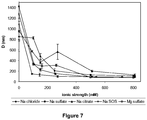
- FIG. 7 dynamic light scattering measurements were made in ARP solutions in various salts of different ionic strengths. At low ionic strength, the "effective" diameter of particles in solution is much greater than 70 nm, indicating that the ARPs are aggregated.
- Figs. 8 and 9 show that filtration (0.2 micron) of low ionic strength ARP solutions results in a loss of ARP infectivity concomitant with a loss in genome quantities, again indicating aggregation since it is assumed that ARP aggregates do not pass through the filter.
- Figures 10A-B show that highly charged polypeptides and proteins mitigate infectivity loss after filtration.
- an ionic strength sufficient to prevent aggregation is included.
- the present inventors believe that aggregation introduces variability in quality from preparation to preparation, inconsistency in infectivity and thus inconsistency in effectiveness of a vaccine or other preparation administered to a human or animal in need thereof, as well as introducing uncertainty with respect to quality control.
- the particular formulation strategies and compositions provided herein address these concerns and reduce such inconsistency, uncertainty and potential ineffectiveness.
- Sodium citrate which remains amorphous during lyophilization and has a reported Tg' of -41 °C (Chang and Randall, 1992), can be used.
- Formulations containing sodium sulfate result in good cakes, and crystallization of the salt after annealing was observed by DSC. On the other hand, certain formulations containing sodium citrate collapsed due to its low Tg'.
- a lyoprotectant acts to stabilize the alphavirus or alphavirus replicon particles during the drying portion of a freeze drying process.
- the lyoprotectant can be a saccharide or polyol, for example, trehalose, sucrose or raffinose, or other hydrophilic polyol such as maltodextrin, fructose, glycerol, sorbitol, inositol and mannose, among others, with the proviso that the lyoprotectant must remain at least partially amorphous during drying.
- the lyoprotectant is added to the aqueous solution or dispersion comprising the alphavirus or alphavirus replicon particles along with salt and surfactant prior to lyophilization.
- Tween 80TM had a remarkable stabilization effect during storage when VRP were lyophilized in the presence of sucrose, in contrast to its potentially destabilizing properties in solution and/or during freezing if present at concentrations that would disrupt the alphavirus or ARP lipid envelope.
- an optimized lyophilized ARP formulation would contain minimally a disaccharide such as sucrose along with HSA.
- a salt is necessary to prevent aggregation.
- HSA preparations from human blood being contaminated with blood-borne pathogens may present concerns for its use, so a preferred embodiment is to use recombinant HSA or a nonionic detergent (e.g., Tween 80), whose concentration is carefully determined so as to minimize or eliminate adverse interactions of the detergent with the alphavirus or ARP lipid envelope.
- a nonionic detergent e.g., Tween 80
- the dried material that contains the alphavirus or alphavirus replicon particles is readily dispersed in aqueous milieus, water or solutions such as 5% dextrose or normal saline, in the case of human or veterinary applications, prior to infectivity testing or administration as part of an immunogenic composition.
- a surfactant which can be a polypeptide, a protein, or a nonionic detergent, is important to producing a stable lyophilized ARP preparation.
- polypeptides or proteins include protamine sulfate, serum albumin, gelatin, and poly-L-lysine.
- human serum albumin is a component in a lyophilized formulation.
- the serum albumin source is preferably matched to the target species; e.g. porcine serum albumin for swine vaccines; bovine serum albumin for cattle vaccines, and so on.
- surfactants that can be used in preparing stable dried VRP or alphavirus preparations include but are not limited to polysorbates (e.g., Tween surfactants, e.g. Tween 20TM (polyoxyethylene (20) sorbitan monolaurate), Tween 80TM (Polyoxyethylenesorbitan monooleate), and polysorbate 80), Brij 35TM (poly(ethoxethylene-23) lauryl ether), block copolymer surfactants (e.g., block copolymers of propylene oxide and ethylene oxide surfactants (such as PluronicTM surfactants, BASF Corporation, Mount Olive, NJ; poloxamer 188 (triblock copolymer of the form poly(ethylene oxide)-poly(propylene oxide)-poly(ethylene oxide)), and surfactant lipids from mammalian sources, provided they are nonionic.
- polysorbates e.g., Tween surfactants, e.g. Tween 20TM (poly
- Surfactants are believed to protect proteins and/or alphaviruses and alphavirus replicon particles in solution via one of two common mechanisms. First, they can bind directly to the protein to promote thermodynamic stabilization. Second, the surfactant could compete with protein molecules for hydrophobic interfaces, such as the air-water interface. Surfactants compete with the alphavirus or alphavirus replicon particles for interfaces, which are a source of adsorptive losses and the location of surface-induced denaturation events. In addition to the sample container (e.g., glass vial), examples of such interfaces also include air-water such as those encountered during agitation or ice-water such as those encountered during freezing.
- Bulking agents may optionally be included to add bulk for stability, visibility, and handling, and to increase the collapse temperature.
- a plasticizer in this context is any component that reduces the Tg and preferably remains amorphous in the dried composition.
- plasticizers are generally known in the art and include, but are not limited to, glycerol, sorbitol, propylene glycol, and dimethyl sulfoxide (DMSO). Combinations of these types of molecules may be particularly advantageous.
- Figure 17 shows the improvement in ARP storage stability in the presence of poly-propylene glycol (molecular weights 725 and 3500) in lyophilized formulations containing glycerol.
- compositions provided herein preferably have a collapse temperature higher than the required storage temperature. While bulking agents are typically used to provide structural support to the lyophilized cake (see above), advantages of amorphous, polymeric bulking agents such as dextran or hydroxyethyl starch (HES) are that they also have high collapse temperatures during lyophilization and have relatively high Tg (glass transition temperature) values for a given residual moisture content. Alternatively, borate ions, which are used to provide buffering capacity to maintain the pH between about 7 and about 9, can also be used to increase the collapse temperature and raise Tg of the dried solid. Borate ions form crosslinks with OH groups on sugars, resulting in better glass-forming properties (Miller et al. 1998).
- Antioxidants can also be added to enhance storage stability, e.g. methionine, triethanolamine or a thiol such as cysteine.
- Stability of ARP preparations upon freezing is dependent upon having a thermodynamically stabilizing excipient that remains in the amorphous phase with the ARP. This is accomplished through the use of HSA.
- HSA The use of hydroxyethyl starch as a stabilizer in protein formulations is discussed in U. S. Patent No. 6,982,080 . Without wishing to be held to any particular theory, it is concluded that the best ARP titer recovery upon freezing requires the presence of both a thermodynamic stabilizer and a surfactant.
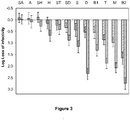
- HSA by itself should fulfill both of these requirements, and the results in Fig. 3 illustrate that the HSA-containing formulations (A and SA) retain infectivity after freezing and thawing.
- the formulation containing sucrose and HSA also retains full or near-complete infectivity titer upon rehydration and holding at room temperature for up to ca 8 hr ( Fig. 4 ). It is surprising that the HES-containing formulations (H and SH) also provided complete GFP VRP titer recovery upon freezing and thawing, because HES is not usually reported to function as a surfactant.
- An alternative embodiment comprises the use of Tween 80TM as the surfactant, but the optimal concentration and freezing conditions using this excipient must be carefully controlled to minimize or eliminate adverse interactions of this detergent with the alphavirus or alphavirus replicon particle lipid envelope.
- compositions for nasal, upper respiratory or pulmonary delivery via aerosolized compositions or nebulization or other means are provided by the present disclosure.
- Formulations for subcutaneous, intramuscular, intradermal, intravenous, mucosal or intraperitoneal administration of liquid formulations (reconstituted) is also encompassed, with the specific composition adapted for the particular route of administration.
- compositions dried or reconstituted or prepared for aerosol or nebulized administration
- a composition as described herein can be chosen by the individual physician in view of the patient's condition, size and age (see e.g. Fingl et al., in The Pharmacological Basis of Therapeutics, 1975, Ch. 1 p. 1 ).
- the attending physician knows how to and when to terminate, interrupt, or adjust dose and/or schedule due to toxicity, organ dysfunctions, or successful immunological response. Conversely, the attending physician also knows to adjust treatment to higher levels if the immunological or other response is not adequate (precluding toxicity). Further, the dose and/or dose frequency also vary according to the age, body weight, and response of the individual patient. Similar considerations apply to veterinary medicine as well.
- an immunogenic composition comprising an alphavirus or alphavirus replicon particle preparation as the active ingredient may be formulated and administered, for example, by mucosal, intradermal, subcutaneous or intramuscular administration. Techniques for formulation and administration are well known to the art.
- the immunogenic composition may be reconstituted in aqueous solutions, preferably in physiologically compatible buffers such as Hanks' solution, Ringer's solution, water for irrigation or physiological saline buffer.
- Immunological adjuvants can be incorporated prior to lyophilization or during or after the reconstitution of a freeze-dried preparation.
- a protein functioning as an immunological adjuvant for example, interleukin-12
- alphavirus replicon particles included within or added to the immunological composition.
- compositions in particular those formulated and/or reconstituted as solutions, may be administered parenterally, such as by intravenous injection.
- Appropriate compounds can be formulated readily using pharmaceutically acceptable carriers well known in the art into dosages suitable for oral administration.
- Such carriers enable the present compounds to be formulated as tablets, pills, capsules, liquids, gels, syrups, slurries, suspensions and the like, for oral ingestion by a patient to be treated.
- Sucrose, dextran (average MW 40 kDa), Tween 80TM, and mannitol were obtained from Spectrum Chemical, Gardena, CA.
- Sodium sulfate was purchased from JT Baker, Phillipsburg, NJ.
- Sodium citrate, HES (6% solution in 0.9% NaCl), and pH 7.4 preset Tris crystals were obtained from Sigma (St. Louis, MO).
- a 25% solution of HSA (BuminateTM, Baxter Healthcare Corp. Westlake Village, CA) and Water for Irrigation (WFI) were obtained from Baxter. Where available, all of these reagents were at minimum NF grade.
- molecular biology grade water was obtained from Eppendorf. 1X Tris-EDTA (TE) buffer, pH 8.0, and a 10% SDS solution were purchased from Ambion.
- the Universal RT Master Mix was obtained from Applied Biosystems, Foster City, CA, and the NSP2 primers and probe were purchased from Biosearch Technologies, Novato, CA.
- VRP Venezuelan equine encephalitis virus
- GFP green fluorescent protein
- the starting materials for these studies were purified VRP encoding GFP ("GFP VRP") in 10 mM sodium phosphate, 0.8 M NaCl, pH 7.3.
- a silver-stained SDS-PAGE gel of this material is shown in Fig. 1 .
- the constituent proteins of VRP are clearly shown. Aliquots of this stock solution were diluted directly into each formulation buffer targeting a VRP titer of 2 x 10 8 infectious units per ml (IU/ml).
- Formulations with and without GFP VRP were lyophilized in this study. Those without VRP (placebos) were used for post-lyophilization moisture analysis. Since the amount of VRP in each vial was less than one microgram, it is assumed that the contribution of VRP on the final moisture content is negligible.
- Formulated VRP and placebos (0.5 ml) were pipetted into 2-ml Type I borosilicate glass vials (Kimble) and placed on precooled shelves (5°C) in an FTS LyoStarTM II freeze-drier (Stone Ridge, NY). After equilibrating the vials at 5°C for 30 min, freezing was achieved by cooling the shelves at 1°C/min to -50°C.
- the samples were then annealed for 15 min at -20°C min to allow for crystallization of sodium sulfate.
- the shelf was then maintained at -47°C for 2 h. Approximately 1 h into this hold step, one vial per formulation was removed and thawed in order to assess the effects of freeze/thawing. For the remaining vials, the shelf temperature was raised to - 45°C where primary drying occurred at 40 mTorr for 64 h. Secondary drying occurred by raising the shelf temperature to -20°C at 0.5°C/min (40 mTorr) and then to +20°C at 0.5°C/min (200 mTorr) followed by holding at +20°C for 3 h.
- the Tg' of the citrate-containing formulation was -44°C, a relatively long cycle with a very low temperature was utilized for primary drying. Upon completion of the cycle, the shelf temperature was kept at 0°C until the vials were stoppered under vacuum (FluroTecTM 4432/50 gray lyo stoppers, West), removed from the freeze-drier, and crimped with an aluminum seal. The water content of each formulation was determined by coulometric Karl Fischer titration.
- t0 (time zero) vials were reconstituted with 0.5 ml WFI and assayed for titer. To assess stability after rehydration, titers were also determined ca. four and eight hours later while holding at room temperature. To assess storage stability, lyophilized vials were stored at 37°C. In addition, one non-lyophilized vial per formulation was stored at 2-8°C.
- Vero cells An in vitro infectivity assay using Vero cells was used to measure the potency titer of GFP VRP.
- Infected Vero cells express the GFP gene, allowing the infected cells to be visualized with a fluorescent microscope.
- Vero cells were seeded in Vero Growth Medium (VGM, Minimum Essential Medium with Earle's salts and L-glutamine supplemented with non-essential amino acids and 5% FBS) at 8 x 10 4 /0.5 ml/well in a 48 well plate.
- VGM Vero Growth Medium
- GFP VRP samples were serially diluted in VGM with a minimum 10-fold dilution made for each sample.
- VGM was removed from the well and replaced by 120 ⁇ l of the infecting GFP VRP sample.
- Table 1 summarizes the composition of the twelve formulations selected for this study. All formulations contained Tris as the buffer to avoid pH changes during freezing (Anchordoquy and Carpenter, 1996), and a pH of 7.4 was chosen since this is an optimal pH condition for stability of ARP in solution.
- Various excipients were studied to identify optimal formulations, including a sugar (the disaccharide sucrose), amorphous bulking agents (dextran, HES, HSA), a crystalline bulking agent (mannitol), and a nonionic surfactant (Tween 80TM).
- VRP samples were diluted in 1X TE buffer to an estimated concentration of 1 x 10 5 to 1 x 10 7 IU/ml based upon values determined by the IFA. Two dilutions were prepared for each sample. 20 ⁇ l of each dilution were then added to 20 ⁇ l of a 0.2% SDS solution and lysed for 10 min in a 60°C water bath. After lysis, samples were cooled to room temperature, diluted 1:100 in molecular biology grade water, and the amount of VRP genomes present in each sample were quantified by qPCR.
- a 5 ⁇ l aliquot of each lysed and diluted sample was added to 20 ⁇ l of a PCR mixture composed of 1X Universal RT master mix and 200 nM each of a forward primer, reverse primer, and a 6-FAM labeled probe.
- the two primers and probe were designed to detect a region of the sequence of a non-structural protein (NSP2) gene present in all VRP genomes.
- NSP2 non-structural protein
- the primer sequences were as follows: forward primer, SEQ ID NO:1, CAAAAGCATCTCTCGCCGTTG; reverse primer, SEQ ID NO:2, TCTCTTTCGGATTCGTCGTTCTC; and probe, SEQ ID NO:3, TCTGTGACTTCGGTCGTCTCAACCTTGTT.
- PCR cycling was initiated with a 48°C hold for 30 min to generate cDNA and a 95°C hold for 10 min to activate the polymerase, and was followed by a 40 cycle repetition of 15 sec at 95°C, 60 sec at 60°C.
- Amplification was performed on an Applied Biosystems 7500 Fast sequence detection system (software version 1.3.1) which measures the fluorescent signal intensity of each sample during PCR cycling and reports it as a cycle threshold (Ct) value.
- Ct value of each sample was compared to the Ct values of RNA standards at known concentrations to determine the genome quantities of each sample.
- the RNA standards for the assay were generated using a single-stranded RNA transcribed from a plasmid containing the NSP2 gene. The precision of the instrument is such that two-fold differences in genome quantities can be detected with 99.7% confidence (Applied Biosystems, 2006).
- Tg' values of the formulations as obtained by DSC are summarized in Table 2.
- the Tg' of formulation B1 was -44°C, leading to the selection of a conservative lyophilization cycle in order to avoid collapse of this formulation during lyophilization.
- No glass transition was observed for B2, presumably due to the crystallization of sodium sulfate.
- the addition of sucrose (formulation S) inhibited the crystallization of sodium sulfate as shown in Fig. 2 (bottom scan). Without annealing, a metastable glass with a Tg' of ca. -40°C was observed which crystallizes during heating above the glass transition as evidenced by the exotherm.
- Table 3 summarizes the residual moisture contents measured after lyophilization.
- the residual moisture was very high for formulation B1 (>10%), presumably as a result of this formulation's collapse.
- the residual moistures were higher than what is typically recommended (about 1% or lower) (Carpenter et al., 1997; Carpenter et al., 2002; Tang and Pikal, 2004), especially for those formulations containing an amorphous bulking agent without sucrose (D, A, H).
- Table 3 also lists the glass transition temperatures (Tg) of the dried solids as determined by DSC. A glass transition was not detected in the formulations containing dextran, HSA, or HES as the sole amorphous excipient (D, A, H), which is not unusual.
- Fig. 3 illustrates the losses in GFP VRP infectivity titer after the freezing and thawing steps. The largest losses in infectivity were measured in the formulations containing mannitol and/or sodium sulfate (M, B2), which crystallize during freezing as per Table 2. In these formulations, no excipient is available in the phase containing the VRP to provide cryoprotection.
- Fig. 3 illustrates the losses in GFP VRP infectivity titer after lyophilization. In most cases, the losses were greater than those after freezing alone, confirming that drying is an additional stress to GFP VRP after freezing. The only formulations that exhibited no significant losses in titer after the lyophilization process were those containing HSA (A and SA).
- infectivity titers were determined upon removal from the freeze-drier, and again ca. 4 and 8 hours post-rehydration. Vials remained at room temperature between timepoints.
- Fig. 4A shows the losses in infectivity titer over time.
- the data clearly show that all formulations are relatively labile in solution at room temperature over the course of 8 hr.
- the non-lyophilized -80°C control exhibited the best stability, along with lyophilized formulation SA.
- SA was one of the two formulations that maintained titer during the lyophilization process.
- all formulations lost titer at room temperature more rapidly after lyophilization and rehydration, as compared to the -80°C non-lyophilized control.
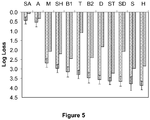
- Fig. 5 The stability of GFP VRP in solution is demonstrated in Fig. 5 .
- Non-lyophilized vials were stored at 2-8°C for one month. Samples were then reanalyzed for infectivity and underwent qPCR analysis to measure genome quantities (GQ). IFA and qPCR results from these stored samples were compared to the respective values obtained immediately upon formulation. Both infectivity titers and GQ dropped significantly for most of the formulations, indicating that GFP virus replicon particles are lost to the surface of the vial during long-term storage in solution. In addition, the losses in infectivity are greater than the losses in GQ, suggesting that adsorption to the vial is not the only degradation pathway occurring in solution. Formulations with HSA (A and SA) had minimal losses in GQ, signifying that HSA may be functioning as a surfactant that minimizes GFP VRP loss to the glass vial surface.
- Lyophilized GFP VRP formulations were stored at 37°C in order to assess their ability to maintain infectivity over time. At various timepoints, vials were removed from storage, rehydrated with 0.5 ml WFI, and immediately assayed by IFA.
- Fig. 6 plots the losses in infectivity titers during storage at 37°C over the course of 14 days, and Table 4 tabulates the losses at the 14 day timepoint as compared to the initial titer obtained immediately upon lyophilization.
- the formulations also exhibited different stability profiles during storage at 37°C.
- formulations B1, B2, M, and T had lost all of their infectivity.
- Fig. 3 these were among the formulations that were most destabilized during freeze-thawing and freeze-drying.
- Formulation A maintained titer during lyophilization ( Fig. 3 ), yet was unstable during storage ( Fig. 6 , Table 4). Upon the inclusion of sucrose, this formulation (SA) exhibited better storage stability. Further examination of Fig. 6 and Table 4 reveals that the formulations with the lowest losses in titer during 37°C storage were those that contained sucrose, suggesting that a disaccharide is required for optimal storage stability of a lyophilized ARP.
- the formulation that lost the least amount of infectivity during storage at 37°C was the one containing sucrose and Tween 80TM (formulation ST). While this particular formulation did see a significant drop in titer upon lyophilization (see Fig. 3 ), the improvement in storage stability using Tween 80TM is beneficial.
- Tg is an important condition for storage stability (Kreilgaard et al., 1998b; Kreilgaard et al., 1999; Garzon-Rodriguez et al., 2004).
- Kreilgaard et al. 1999; Cicerone et al., 2003; Cicerone et al., 2004; Garzon-Rodriguez et al., 2004; Chang et al., 2005).
- Fig. 15 plots infectivity data during storage under frozen and refrigerated conditions (-20°C and 2-8°C, respectively). Under frozen conditions, infectivity decreased very slightly ( ⁇ 0.2 log) after almost two years. Under refrigerated conditions, the infectivity dropped less than 1 log after almost two years.
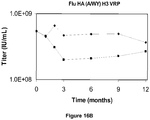
- FIG. 16 plots infectivity data during storage under frozen and refrigerated conditions (-20°C and 2-8°C, respectively). Under both frozen and refrigerated conditions, infectivity remained essentially unchanged after six months, followed by a decrease of about 0.5 log when stability was assessed over twelve months. While methionine may be present, it is believed not to be required for stability.
- GFP green fluorescent protein
- Figs. 16B-16C plot infectivity data when this same matrix is used to formulate an ARP based on Venezuelan equine encephalitis virus, i.e. a VRP, expressing influenza virus hemagglutinin (HA) surface protein (A/WY H3) in the replicon RNA from two separate production processes.
- HA hemagglutinin
- A/WY H3 influenza virus hemagglutinin surface protein
- FIG. 17 plots infectivity data during storage at room temperature. After six months, infectivity loss is greatest in the sample lacking both glycerol and poly-propylene glycol. The addition of glycerol alone attenuates the infectivity loss. The addition of both glycerol and poly-propylene glycol results in improved stability compared to the use of glycerol alone, with polypropylene glycol 725 increasing stability to a greater extent than poly-propylene glycol 3500.
- GFP green fluorescent protein
- FIG. 18 plots infectivity data during storage at room temperature in the presence or absence of sodium tetraborate. After four months of storage, the stabilization effect of sodium tetraborate is evident.
- VRP Venezuelan equine encephalitis virus
- a VRP Venezuelan equine encephalitis virus
- the partially purified VRP preparation was divided into aliquots and subjected to CellufineTM sulfate chromatography under a variety of elution conditions to provide purified VRP, devoid of sodium chloride, to improve stability and processing during lyophilization operations.
- One portion of the partially purified material was further purified according to current methods (see Reap et al.;Talarico et al.) using buffers containing sodium chloride.
- the sodium chloride content of purified VRP in this process was approximately 800 mM.
- the recovery of VRP from the sulfate elution was slightly lower than corresponding VRP eluted with sodium chloride.
- the purity of the VRP was essentially equivalent between operations.
- the results of the different CellufineTM sulfate elution schemes are shown in Table 6.
Landscapes
- Health & Medical Sciences (AREA)
- Life Sciences & Earth Sciences (AREA)
- Chemical & Material Sciences (AREA)
- Medicinal Chemistry (AREA)
- General Health & Medical Sciences (AREA)
- Bioinformatics & Cheminformatics (AREA)
- Engineering & Computer Science (AREA)
- Virology (AREA)
- Public Health (AREA)
- Veterinary Medicine (AREA)
- Animal Behavior & Ethology (AREA)
- Organic Chemistry (AREA)
- Pharmacology & Pharmacy (AREA)
- Genetics & Genomics (AREA)
- Epidemiology (AREA)
- Zoology (AREA)
- Wood Science & Technology (AREA)
- Immunology (AREA)
- Microbiology (AREA)
- General Engineering & Computer Science (AREA)
- Biochemistry (AREA)
- Biotechnology (AREA)
- Mycology (AREA)
- Biomedical Technology (AREA)
- Chemical Kinetics & Catalysis (AREA)
- General Chemical & Material Sciences (AREA)
- Nuclear Medicine, Radiotherapy & Molecular Imaging (AREA)
- Molecular Biology (AREA)
- Communicable Diseases (AREA)
- Oncology (AREA)
- Medicines Containing Antibodies Or Antigens For Use As Internal Diagnostic Agents (AREA)
- Micro-Organisms Or Cultivation Processes Thereof (AREA)
- Medicinal Preparation (AREA)
- Medicines Containing Material From Animals Or Micro-Organisms (AREA)
Applications Claiming Priority (2)
| Application Number | Priority Date | Filing Date | Title |
|---|---|---|---|
| US86436606P | 2006-11-03 | 2006-11-03 | |
| PCT/US2007/083537 WO2008058035A1 (en) | 2006-11-03 | 2007-11-02 | Alphavirus and alphavirus replicon particle formulations and methods |
Publications (2)
| Publication Number | Publication Date |
|---|---|
| EP2099485A1 EP2099485A1 (en) | 2009-09-16 |
| EP2099485B1 true EP2099485B1 (en) | 2018-03-21 |
Family
ID=39110550
Family Applications (1)
| Application Number | Title | Priority Date | Filing Date |
|---|---|---|---|
| EP07844849.5A Active EP2099485B1 (en) | 2006-11-03 | 2007-11-02 | Alphavirus and alphavirus replicon particle formulations and methods |
Country Status (10)
| Country | Link |
|---|---|
| US (2) | US20090047255A1 (da) |
| EP (1) | EP2099485B1 (da) |
| AU (1) | AU2007317347B2 (da) |
| CA (1) | CA2668417A1 (da) |
| DK (1) | DK2099485T3 (da) |
| ES (1) | ES2673823T3 (da) |
| IL (1) | IL198364A (da) |
| NZ (1) | NZ576563A (da) |
| WO (1) | WO2008058035A1 (da) |
| ZA (1) | ZA200903791B (da) |
Families Citing this family (22)
| Publication number | Priority date | Publication date | Assignee | Title |
|---|---|---|---|---|
| US8168206B1 (en) | 2005-10-06 | 2012-05-01 | Allergan, Inc. | Animal protein-free pharmaceutical compositions |
| DK2099485T3 (da) * | 2006-11-03 | 2018-05-22 | Alphavax Inc | Alfavirus- og alfavirusreplikonpartikelformuleringer samt tilhørende fremgangsmåder |
| AU2010234362B2 (en) | 2009-04-08 | 2015-11-26 | Alphavax, Inc. | Alphavirus replicon particles expressing TRP2 |
| CA2795050C (en) | 2010-03-31 | 2018-05-22 | Stabilitech Ltd. | Method for preserving alum adjuvants and alum-adjuvanted vaccines |
| WO2011121301A1 (en) | 2010-03-31 | 2011-10-06 | Stabilitech Ltd | Excipients for stabilising viral particles, polypeptides or biological material |
| ES2757591T3 (es) * | 2010-03-31 | 2020-04-29 | Stabilitech Biopharma Ltd | Estabilización de partículas virales |
| MX349294B (es) | 2010-12-02 | 2017-07-21 | Oncolytics Biotech Inc | Formulaciones virales liofilizadas. |
| EP2646051A4 (en) | 2010-12-02 | 2014-05-28 | Oncolytics Biotech Inc | FORMULATIONS OF LIQUID VIRUSES |
| GB201117233D0 (en) | 2011-10-05 | 2011-11-16 | Stabilitech Ltd | Stabilisation of polypeptides |
| US11576958B2 (en) | 2013-02-07 | 2023-02-14 | Children's Medical Center Corporation | Protein antigens that provide protection against pneumococcal colonization and/or disease |
| AP2015008733A0 (en) * | 2013-03-14 | 2015-09-30 | Takeda Vaccines Inc | Compositions and methods for live, attenuated alphavirus formulations |
| KR101398764B1 (ko) | 2013-08-29 | 2014-05-27 | 강릉원주대학교산학협력단 | 입자의 이동에 의해 분석물질을 검출하는 장치 및 방법 |
| GB201406569D0 (en) | 2014-04-11 | 2014-05-28 | Stabilitech Ltd | Vaccine compositions |
| EP4026568A1 (en) | 2015-04-17 | 2022-07-13 | CureVac Real Estate GmbH | Lyophilization of rna |
| EP3297682B1 (en) | 2015-05-20 | 2021-07-14 | CureVac AG | Dry powder composition comprising long-chain rna |
| WO2016184575A1 (en) | 2015-05-20 | 2016-11-24 | Curevac Ag | Dry powder composition comprising long-chain rna |
| EP3127550A1 (en) * | 2015-08-07 | 2017-02-08 | HSC Development GmbH | Stabilizing composition for dry formulation of virus |
| GB2562241B (en) | 2017-05-08 | 2022-04-06 | Stabilitech Biopharma Ltd | Vaccine compositions |
| SG11202005792RA (en) | 2017-12-20 | 2020-07-29 | Vlp Therapeutics Llc | Alphavirus replicon particle |
| MX2022007905A (es) | 2019-12-31 | 2022-08-25 | Elixirgen Therapeutics Inc | Administracion transitoria basada en temperatura de acidos nucleicos y proteinas a celulas y tejidos. |
| TWI891771B (zh) | 2020-04-17 | 2025-08-01 | 美商Vlp醫療股份有限公司 | 冠狀病毒疫苗 |
| AU2021264216A1 (en) * | 2020-04-30 | 2022-11-10 | Vlp Therapeutics, Inc. | Cytokine immunotherapy |
Family Cites Families (28)
| Publication number | Priority date | Publication date | Assignee | Title |
|---|---|---|---|---|
| US4650764A (en) * | 1983-04-12 | 1987-03-17 | Wisconsin Alumni Research Foundation | Helper cell |
| US5185440A (en) * | 1989-06-20 | 1993-02-09 | North Carolina State University | cDNA clone coding for Venezuelan equine encephalitis virus and attenuating mutations thereof |
| SE9003978D0 (sv) | 1990-12-13 | 1990-12-13 | Henrik Garoff | Dna expressionssystem baserade paa ett virus replikon |
| US6015686A (en) * | 1993-09-15 | 2000-01-18 | Chiron Viagene, Inc. | Eukaryotic layered vector initiation systems |
| US5505947A (en) * | 1994-05-27 | 1996-04-09 | The University Of North Carolina At Chapel Hill | Attenuating mutations in Venezuelan Equine Encephalitis virus |
| US5580856A (en) * | 1994-07-15 | 1996-12-03 | Prestrelski; Steven J. | Formulation of a reconstituted protein, and method and kit for the production thereof |
| US5792462A (en) * | 1995-05-23 | 1998-08-11 | University Of North Carolina At Chapel Hill | Alphavirus RNA replicon systems |
| EP2298900A1 (en) * | 1996-09-17 | 2011-03-23 | Novartis Vaccines and Diagnostics, Inc. | Compositions and methods for treating intracellular diseases |
| US6616931B1 (en) * | 1996-09-26 | 2003-09-09 | Merck & Co., Inc. | Rotavirus vaccine formulations |
| US5811407A (en) * | 1997-02-19 | 1998-09-22 | The University Of North Carolina At Chapel Hill | System for the in vivo delivery and expression of heterologous genes in the bone marrow |
| US6689600B1 (en) * | 1998-11-16 | 2004-02-10 | Introgen Therapeutics, Inc. | Formulation of adenovirus for gene therapy |
| US6242259B1 (en) * | 1998-12-31 | 2001-06-05 | Chiron Corporation | Compositions and methods for packing of alphavirus vectors |
| AU769539B2 (en) * | 1999-01-29 | 2004-01-29 | Zoetis Services Llc | Adjuvants for use in vaccines |
| AU764138B2 (en) * | 1999-02-05 | 2003-08-14 | Merck Sharp & Dohme Corp. | Human papilloma virus vaccine formulations |
| ES2261230T3 (es) | 1999-08-17 | 2006-11-16 | Purdue Research Foundation | Tratamiento de la enfermedad metastasica. |
| TR200200420T2 (tr) * | 1999-08-17 | 2002-05-21 | Smithkline Beecham Biologicals S.A. | Aşı |
| US6767699B2 (en) * | 2000-05-31 | 2004-07-27 | Chiron Corporation | Method for the quantitation of alphavirus replicon particles |
| ES2330202T5 (es) * | 2001-09-06 | 2014-01-20 | Alphavax, Inc. | Sistemas vectores basados en replicones de alfavirus |
| CA2469623C (en) * | 2001-12-12 | 2012-05-29 | F H Faulding & Co Limited | Composition for the preservation of viruses |
| SI1478394T1 (sl) * | 2002-02-27 | 2008-12-31 | Immunex Corp | STABILIZIRAN TNFR-Fc SESTAVEK Z ARGININOM |
| US6982080B2 (en) * | 2002-03-15 | 2006-01-03 | Wyeth | Hydroxyethyl starch—containing polypeptide compositions |
| US7078218B2 (en) * | 2002-12-13 | 2006-07-18 | Alphavax, Inc. | Alphavirus particles and methods for preparation |
| US7442381B2 (en) | 2003-03-20 | 2008-10-28 | Alphavax, Inc. | Alphavirus replicons and helper constructs |
| CN1989250B (zh) * | 2004-05-18 | 2013-11-20 | 阿尔法瓦克斯公司 | Tc-83衍生的甲病毒属载体、颗粒和方法 |
| BRPI0511764B8 (pt) * | 2004-06-01 | 2021-05-25 | Avigen Inc | método de prevenção de agregação de vírions de vírus adeno-associado recombinante (raav) em uma preparação purificada de virions raav |
| EP1773403B1 (en) | 2004-07-09 | 2018-04-25 | The University of North Carolina At Chapel Hill | Alphavirus-based adjuvants |
| US20060198854A1 (en) * | 2004-12-28 | 2006-09-07 | Peter Pushko | Vector platforms derived from the alphavirus vaccines |
| DK2099485T3 (da) * | 2006-11-03 | 2018-05-22 | Alphavax Inc | Alfavirus- og alfavirusreplikonpartikelformuleringer samt tilhørende fremgangsmåder |
-
2007
- 2007-11-02 DK DK07844849.5T patent/DK2099485T3/da active
- 2007-11-02 AU AU2007317347A patent/AU2007317347B2/en active Active
- 2007-11-02 US US11/934,702 patent/US20090047255A1/en not_active Abandoned
- 2007-11-02 NZ NZ57656307A patent/NZ576563A/xx unknown
- 2007-11-02 WO PCT/US2007/083537 patent/WO2008058035A1/en not_active Ceased
- 2007-11-02 CA CA 2668417 patent/CA2668417A1/en not_active Abandoned
- 2007-11-02 ES ES07844849.5T patent/ES2673823T3/es active Active
- 2007-11-02 EP EP07844849.5A patent/EP2099485B1/en active Active
-
2009
- 2009-04-23 IL IL198364A patent/IL198364A/en active IP Right Grant
- 2009-06-01 ZA ZA200903791A patent/ZA200903791B/xx unknown
-
2011
- 2011-01-24 US US13/012,714 patent/US9187729B2/en active Active
Non-Patent Citations (3)
| Title |
|---|
| FUMIYOSHI FUKUMOTO ET AL: "EFFECT OF VARIOUS ADDITIVES ON LONG-TERM PRESERVATION OF CUCUMBER MOSAIC VIRUS IN-VITRO", JAPANESE JOURNAL OF PHYTOPATHOLOGY, vol. 46, no. 4, 1 January 1980 (1980-01-01), pages 448 - 454, XP055216129, ISSN: 0031-9473, DOI: 10.3186/jjphytopath.46.448 * |
| KEN-ICHI IZUTSU ET AL: "Effects of sodium tetraborate and boric acid on nonisothermal mannitol crystallization in frozen solutions and freeze-dried solids", INTERNATIONAL JOURNAL OF PHARMACEUTICS, vol. 273, no. 1-2, 1 April 2004 (2004-04-01), pages 85 - 93, XP055216115, ISSN: 0378-5173, DOI: 10.1016/j.ijpharm.2003.12.024 * |
| KEN-ICHI IZUTSU ET AL: "Protection of Protein Secondary Structure by Saccharides of Different Molecular Weights during Freeze-Drying", CHEMICAL & PHARMACEUTICAL BULLETIN, vol. 52, no. 2, 1 January 2004 (2004-01-01), pages 199 - 203, XP055216161, ISSN: 0009-2363, DOI: 10.1248/cpb.52.199 * |
Also Published As
| Publication number | Publication date |
|---|---|
| EP2099485A1 (en) | 2009-09-16 |
| US9187729B2 (en) | 2015-11-17 |
| WO2008058035A1 (en) | 2008-05-15 |
| ES2673823T3 (es) | 2018-06-25 |
| AU2007317347B2 (en) | 2014-02-06 |
| IL198364A0 (en) | 2011-08-01 |
| CA2668417A1 (en) | 2008-05-15 |
| ZA200903791B (en) | 2010-03-31 |
| US20110182941A1 (en) | 2011-07-28 |
| US20090047255A1 (en) | 2009-02-19 |
| AU2007317347A1 (en) | 2008-05-15 |
| NZ576563A (en) | 2012-09-28 |
| DK2099485T3 (da) | 2018-05-22 |
| IL198364A (en) | 2017-11-30 |
Similar Documents
| Publication | Publication Date | Title |
|---|---|---|
| EP2099485B1 (en) | Alphavirus and alphavirus replicon particle formulations and methods | |
| JP6817370B2 (ja) | 弱毒生ウイルス組成物 | |
| EP2061508B1 (en) | Alphavirus replicon particles matched to protein antigens as immunological adjuvants | |
| EP2066346B1 (en) | Alphavirus replicon particles encoding il-12 as immunological adjuvants | |
| JP2023524860A (ja) | SARS-CoV-2ワクチン | |
| AU2018236897B2 (en) | Compositions and methods for live, attenuated alphavirus formulations | |
| US20190111124A1 (en) | Compositions and Methods for Stabilizing Alphaviruses with Improved Formulations | |
| AU2016213859B2 (en) | Methods and compositions for live attenuated viruses | |
| HK1140516B (en) | Methods and compositions for live attenuated viruses |
Legal Events
| Date | Code | Title | Description |
|---|---|---|---|
| PUAI | Public reference made under article 153(3) epc to a published international application that has entered the european phase |
Free format text: ORIGINAL CODE: 0009012 |
|
| 17P | Request for examination filed |
Effective date: 20090603 |
|
| AK | Designated contracting states |
Kind code of ref document: A1 Designated state(s): AT BE BG CH CY CZ DE DK EE ES FI FR GB GR HU IE IS IT LI LT LU LV MC MT NL PL PT RO SE SI SK TR |
|
| DAX | Request for extension of the european patent (deleted) | ||
| 17Q | First examination report despatched |
Effective date: 20150227 |
|
| STAA | Information on the status of an ep patent application or granted ep patent |
Free format text: STATUS: EXAMINATION IS IN PROGRESS |
|
| GRAP | Despatch of communication of intention to grant a patent |
Free format text: ORIGINAL CODE: EPIDOSNIGR1 |
|
| STAA | Information on the status of an ep patent application or granted ep patent |
Free format text: STATUS: GRANT OF PATENT IS INTENDED |
|
| RIC1 | Information provided on ipc code assigned before grant |
Ipc: A61K 39/00 20060101ALI20170925BHEP Ipc: A61K 39/12 20060101AFI20170925BHEP Ipc: C12N 7/00 20060101ALI20170925BHEP Ipc: A61K 9/19 20060101ALI20170925BHEP Ipc: C12N 15/86 20060101ALI20170925BHEP |
|
| INTG | Intention to grant announced |
Effective date: 20171013 |
|
| GRAS | Grant fee paid |
Free format text: ORIGINAL CODE: EPIDOSNIGR3 |
|
| GRAA | (expected) grant |
Free format text: ORIGINAL CODE: 0009210 |
|
| STAA | Information on the status of an ep patent application or granted ep patent |
Free format text: STATUS: THE PATENT HAS BEEN GRANTED |
|
| AK | Designated contracting states |
Kind code of ref document: B1 Designated state(s): AT BE BG CH CY CZ DE DK EE ES FI FR GB GR HU IE IS IT LI LT LU LV MC MT NL PL PT RO SE SI SK TR |
|
| REG | Reference to a national code |
Ref country code: GB Ref legal event code: FG4D |
|
| REG | Reference to a national code |
Ref country code: CH Ref legal event code: EP |
|
| REG | Reference to a national code |
Ref country code: AT Ref legal event code: REF Ref document number: 980384 Country of ref document: AT Kind code of ref document: T Effective date: 20180415 |
|
| REG | Reference to a national code |
Ref country code: IE Ref legal event code: FG4D |
|
| REG | Reference to a national code |
Ref country code: DE Ref legal event code: R096 Ref document number: 602007054320 Country of ref document: DE |
|
| REG | Reference to a national code |
Ref country code: DK Ref legal event code: T3 Effective date: 20180516 |
|
| REG | Reference to a national code |
Ref country code: SE Ref legal event code: TRGR |
|
| REG | Reference to a national code |
Ref country code: ES Ref legal event code: FG2A Ref document number: 2673823 Country of ref document: ES Kind code of ref document: T3 Effective date: 20180625 |
|
| REG | Reference to a national code |
Ref country code: NL Ref legal event code: FP |
|
| PG25 | Lapsed in a contracting state [announced via postgrant information from national office to epo] |
Ref country code: LT Free format text: LAPSE BECAUSE OF FAILURE TO SUBMIT A TRANSLATION OF THE DESCRIPTION OR TO PAY THE FEE WITHIN THE PRESCRIBED TIME-LIMIT Effective date: 20180321 Ref country code: FI Free format text: LAPSE BECAUSE OF FAILURE TO SUBMIT A TRANSLATION OF THE DESCRIPTION OR TO PAY THE FEE WITHIN THE PRESCRIBED TIME-LIMIT Effective date: 20180321 Ref country code: CY Free format text: LAPSE BECAUSE OF FAILURE TO SUBMIT A TRANSLATION OF THE DESCRIPTION OR TO PAY THE FEE WITHIN THE PRESCRIBED TIME-LIMIT Effective date: 20180321 |
|
| REG | Reference to a national code |
Ref country code: LT Ref legal event code: MG4D |
|
| REG | Reference to a national code |
Ref country code: AT Ref legal event code: MK05 Ref document number: 980384 Country of ref document: AT Kind code of ref document: T Effective date: 20180321 |
|
| PG25 | Lapsed in a contracting state [announced via postgrant information from national office to epo] |
Ref country code: LV Free format text: LAPSE BECAUSE OF FAILURE TO SUBMIT A TRANSLATION OF THE DESCRIPTION OR TO PAY THE FEE WITHIN THE PRESCRIBED TIME-LIMIT Effective date: 20180321 Ref country code: GR Free format text: LAPSE BECAUSE OF FAILURE TO SUBMIT A TRANSLATION OF THE DESCRIPTION OR TO PAY THE FEE WITHIN THE PRESCRIBED TIME-LIMIT Effective date: 20180622 Ref country code: BG Free format text: LAPSE BECAUSE OF FAILURE TO SUBMIT A TRANSLATION OF THE DESCRIPTION OR TO PAY THE FEE WITHIN THE PRESCRIBED TIME-LIMIT Effective date: 20180621 |
|
| PG25 | Lapsed in a contracting state [announced via postgrant information from national office to epo] |
Ref country code: RO Free format text: LAPSE BECAUSE OF FAILURE TO SUBMIT A TRANSLATION OF THE DESCRIPTION OR TO PAY THE FEE WITHIN THE PRESCRIBED TIME-LIMIT Effective date: 20180321 Ref country code: PL Free format text: LAPSE BECAUSE OF FAILURE TO SUBMIT A TRANSLATION OF THE DESCRIPTION OR TO PAY THE FEE WITHIN THE PRESCRIBED TIME-LIMIT Effective date: 20180321 Ref country code: EE Free format text: LAPSE BECAUSE OF FAILURE TO SUBMIT A TRANSLATION OF THE DESCRIPTION OR TO PAY THE FEE WITHIN THE PRESCRIBED TIME-LIMIT Effective date: 20180321 |
|
| PG25 | Lapsed in a contracting state [announced via postgrant information from national office to epo] |
Ref country code: AT Free format text: LAPSE BECAUSE OF FAILURE TO SUBMIT A TRANSLATION OF THE DESCRIPTION OR TO PAY THE FEE WITHIN THE PRESCRIBED TIME-LIMIT Effective date: 20180321 Ref country code: CZ Free format text: LAPSE BECAUSE OF FAILURE TO SUBMIT A TRANSLATION OF THE DESCRIPTION OR TO PAY THE FEE WITHIN THE PRESCRIBED TIME-LIMIT Effective date: 20180321 Ref country code: SK Free format text: LAPSE BECAUSE OF FAILURE TO SUBMIT A TRANSLATION OF THE DESCRIPTION OR TO PAY THE FEE WITHIN THE PRESCRIBED TIME-LIMIT Effective date: 20180321 |
|
| PG25 | Lapsed in a contracting state [announced via postgrant information from national office to epo] |
Ref country code: PT Free format text: LAPSE BECAUSE OF FAILURE TO SUBMIT A TRANSLATION OF THE DESCRIPTION OR TO PAY THE FEE WITHIN THE PRESCRIBED TIME-LIMIT Effective date: 20180723 |
|
| REG | Reference to a national code |
Ref country code: DE Ref legal event code: R097 Ref document number: 602007054320 Country of ref document: DE |
|
| PLBE | No opposition filed within time limit |
Free format text: ORIGINAL CODE: 0009261 |
|
| STAA | Information on the status of an ep patent application or granted ep patent |
Free format text: STATUS: NO OPPOSITION FILED WITHIN TIME LIMIT |
|
| 26N | No opposition filed |
Effective date: 20190102 |
|
| PG25 | Lapsed in a contracting state [announced via postgrant information from national office to epo] |
Ref country code: SI Free format text: LAPSE BECAUSE OF FAILURE TO SUBMIT A TRANSLATION OF THE DESCRIPTION OR TO PAY THE FEE WITHIN THE PRESCRIBED TIME-LIMIT Effective date: 20180321 |
|
| PG25 | Lapsed in a contracting state [announced via postgrant information from national office to epo] |
Ref country code: MC Free format text: LAPSE BECAUSE OF FAILURE TO SUBMIT A TRANSLATION OF THE DESCRIPTION OR TO PAY THE FEE WITHIN THE PRESCRIBED TIME-LIMIT Effective date: 20180321 Ref country code: LU Free format text: LAPSE BECAUSE OF NON-PAYMENT OF DUE FEES Effective date: 20181102 |
|
| REG | Reference to a national code |
Ref country code: BE Ref legal event code: MM Effective date: 20181130 |
|
| PG25 | Lapsed in a contracting state [announced via postgrant information from national office to epo] |
Ref country code: BE Free format text: LAPSE BECAUSE OF NON-PAYMENT OF DUE FEES Effective date: 20181130 |
|
| PG25 | Lapsed in a contracting state [announced via postgrant information from national office to epo] |
Ref country code: MT Free format text: LAPSE BECAUSE OF NON-PAYMENT OF DUE FEES Effective date: 20181102 |
|
| PG25 | Lapsed in a contracting state [announced via postgrant information from national office to epo] |
Ref country code: TR Free format text: LAPSE BECAUSE OF FAILURE TO SUBMIT A TRANSLATION OF THE DESCRIPTION OR TO PAY THE FEE WITHIN THE PRESCRIBED TIME-LIMIT Effective date: 20180321 |
|
| PG25 | Lapsed in a contracting state [announced via postgrant information from national office to epo] |
Ref country code: HU Free format text: LAPSE BECAUSE OF FAILURE TO SUBMIT A TRANSLATION OF THE DESCRIPTION OR TO PAY THE FEE WITHIN THE PRESCRIBED TIME-LIMIT; INVALID AB INITIO Effective date: 20071102 |
|
| PG25 | Lapsed in a contracting state [announced via postgrant information from national office to epo] |
Ref country code: IS Free format text: LAPSE BECAUSE OF FAILURE TO SUBMIT A TRANSLATION OF THE DESCRIPTION OR TO PAY THE FEE WITHIN THE PRESCRIBED TIME-LIMIT Effective date: 20180721 |
|
| P01 | Opt-out of the competence of the unified patent court (upc) registered |
Effective date: 20230525 |
|
| PGFP | Annual fee paid to national office [announced via postgrant information from national office to epo] |
Ref country code: NL Payment date: 20250912 Year of fee payment: 19 |
|
| PGFP | Annual fee paid to national office [announced via postgrant information from national office to epo] |
Ref country code: GB Payment date: 20250911 Year of fee payment: 19 |
|
| PGFP | Annual fee paid to national office [announced via postgrant information from national office to epo] |
Ref country code: FR Payment date: 20250908 Year of fee payment: 19 |
|
| PGFP | Annual fee paid to national office [announced via postgrant information from national office to epo] |
Ref country code: SE Payment date: 20250910 Year of fee payment: 19 |
|
| PGFP | Annual fee paid to national office [announced via postgrant information from national office to epo] |
Ref country code: IE Payment date: 20250909 Year of fee payment: 19 |
|
| REG | Reference to a national code |
Ref country code: CH Ref legal event code: U11 Free format text: ST27 STATUS EVENT CODE: U-0-0-U10-U11 (AS PROVIDED BY THE NATIONAL OFFICE) Effective date: 20251201 |
|
| PGFP | Annual fee paid to national office [announced via postgrant information from national office to epo] |
Ref country code: DE Payment date: 20250910 Year of fee payment: 19 |
|
| PGFP | Annual fee paid to national office [announced via postgrant information from national office to epo] |
Ref country code: DK Payment date: 20251112 Year of fee payment: 19 Ref country code: IT Payment date: 20251022 Year of fee payment: 19 |
|
| PGFP | Annual fee paid to national office [announced via postgrant information from national office to epo] |
Ref country code: CH Payment date: 20251201 Year of fee payment: 19 |
|
| PGFP | Annual fee paid to national office [announced via postgrant information from national office to epo] |
Ref country code: ES Payment date: 20251210 Year of fee payment: 19 |