EP2103288A2 - Dispositif et procédé de stimulation auditive - Google Patents
Dispositif et procédé de stimulation auditive Download PDFInfo
- Publication number
- EP2103288A2 EP2103288A2 EP08007638A EP08007638A EP2103288A2 EP 2103288 A2 EP2103288 A2 EP 2103288A2 EP 08007638 A EP08007638 A EP 08007638A EP 08007638 A EP08007638 A EP 08007638A EP 2103288 A2 EP2103288 A2 EP 2103288A2
- Authority
- EP
- European Patent Office
- Prior art keywords
- frequency
- signal
- stimulation
- unit
- acoustic stimulation
- Prior art date
- Legal status (The legal status is an assumption and is not a legal conclusion. Google has not performed a legal analysis and makes no representation as to the accuracy of the status listed.)
- Granted
Links
Images




Classifications
-
- A—HUMAN NECESSITIES
- A61—MEDICAL OR VETERINARY SCIENCE; HYGIENE
- A61H—PHYSICAL THERAPY APPARATUS, e.g. DEVICES FOR LOCATING OR STIMULATING REFLEX POINTS IN THE BODY; ARTIFICIAL RESPIRATION; MASSAGE; BATHING DEVICES FOR SPECIAL THERAPEUTIC OR HYGIENIC PURPOSES OR SPECIFIC PARTS OF THE BODY
- A61H23/00—Percussion or vibration massage, e.g. using supersonic vibration; Suction-vibration massage; Massage with moving diaphragms
-
- A—HUMAN NECESSITIES
- A61—MEDICAL OR VETERINARY SCIENCE; HYGIENE
- A61B—DIAGNOSIS; SURGERY; IDENTIFICATION
- A61B5/00—Measuring for diagnostic purposes; Identification of persons
- A61B5/48—Other medical applications
- A61B5/486—Biofeedback
-
- A—HUMAN NECESSITIES
- A61—MEDICAL OR VETERINARY SCIENCE; HYGIENE
- A61F—FILTERS IMPLANTABLE INTO BLOOD VESSELS; PROSTHESES; DEVICES PROVIDING PATENCY TO, OR PREVENTING COLLAPSING OF, TUBULAR STRUCTURES OF THE BODY, e.g. STENTS; ORTHOPAEDIC, NURSING OR CONTRACEPTIVE DEVICES; FOMENTATION; TREATMENT OR PROTECTION OF EYES OR EARS; BANDAGES, DRESSINGS OR ABSORBENT PADS; FIRST-AID KITS
- A61F11/00—Methods or devices for treatment of the ears or hearing sense; Non-electric hearing aids; Methods or devices for enabling ear patients to achieve auditory perception through physiological senses other than hearing sense; Protective devices for the ears, carried on the body or in the hand
-
- A—HUMAN NECESSITIES
- A61—MEDICAL OR VETERINARY SCIENCE; HYGIENE
- A61H—PHYSICAL THERAPY APPARATUS, e.g. DEVICES FOR LOCATING OR STIMULATING REFLEX POINTS IN THE BODY; ARTIFICIAL RESPIRATION; MASSAGE; BATHING DEVICES FOR SPECIAL THERAPEUTIC OR HYGIENIC PURPOSES OR SPECIFIC PARTS OF THE BODY
- A61H1/00—Apparatus for passive exercising; Vibrating apparatus; Chiropractic devices, e.g. body impacting devices, external devices for briefly extending or aligning unbroken bones
-
- A—HUMAN NECESSITIES
- A61—MEDICAL OR VETERINARY SCIENCE; HYGIENE
- A61M—DEVICES FOR INTRODUCING MEDIA INTO, OR ONTO, THE BODY; DEVICES FOR TRANSDUCING BODY MEDIA OR FOR TAKING MEDIA FROM THE BODY; DEVICES FOR PRODUCING OR ENDING SLEEP OR STUPOR
- A61M21/00—Other devices or methods to cause a change in the state of consciousness; Devices for producing or ending sleep by mechanical, optical, or acoustical means, e.g. for hypnosis
-
- A—HUMAN NECESSITIES
- A61—MEDICAL OR VETERINARY SCIENCE; HYGIENE
- A61H—PHYSICAL THERAPY APPARATUS, e.g. DEVICES FOR LOCATING OR STIMULATING REFLEX POINTS IN THE BODY; ARTIFICIAL RESPIRATION; MASSAGE; BATHING DEVICES FOR SPECIAL THERAPEUTIC OR HYGIENIC PURPOSES OR SPECIFIC PARTS OF THE BODY
- A61H2201/00—Characteristics of apparatus not provided for in the preceding codes
- A61H2201/50—Control means thereof
- A61H2201/5005—Control means thereof for controlling frequency distribution, modulation or interference of a driving signal
-
- A—HUMAN NECESSITIES
- A61—MEDICAL OR VETERINARY SCIENCE; HYGIENE
- A61H—PHYSICAL THERAPY APPARATUS, e.g. DEVICES FOR LOCATING OR STIMULATING REFLEX POINTS IN THE BODY; ARTIFICIAL RESPIRATION; MASSAGE; BATHING DEVICES FOR SPECIAL THERAPEUTIC OR HYGIENIC PURPOSES OR SPECIFIC PARTS OF THE BODY
- A61H2205/00—Devices for specific parts of the body
- A61H2205/02—Head
-
- A—HUMAN NECESSITIES
- A61—MEDICAL OR VETERINARY SCIENCE; HYGIENE
- A61M—DEVICES FOR INTRODUCING MEDIA INTO, OR ONTO, THE BODY; DEVICES FOR TRANSDUCING BODY MEDIA OR FOR TAKING MEDIA FROM THE BODY; DEVICES FOR PRODUCING OR ENDING SLEEP OR STUPOR
- A61M21/00—Other devices or methods to cause a change in the state of consciousness; Devices for producing or ending sleep by mechanical, optical, or acoustical means, e.g. for hypnosis
- A61M2021/0005—Other devices or methods to cause a change in the state of consciousness; Devices for producing or ending sleep by mechanical, optical, or acoustical means, e.g. for hypnosis by the use of a particular sense, or stimulus
- A61M2021/0027—Other devices or methods to cause a change in the state of consciousness; Devices for producing or ending sleep by mechanical, optical, or acoustical means, e.g. for hypnosis by the use of a particular sense, or stimulus by the hearing sense
Definitions
- the invention relates to a device and a method for auditory stimulation.
- Tinnitus refers to an ear noise, usually in the form of a high-pitched tone, but occasionally of throbbing, throbbing or hammering character. It is a widespread disease in the form of disturbing abnormal sensation, which is distressing in many patients.
- Pharmacotherapy and deep brain stimulation are available therapy methods for such diseases.
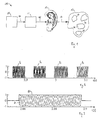
- a device 100 which consists of a control unit 10 and connected to the control unit 10 stimulation unit 11.
- a device 100 which consists of a control unit 10 and connected to the control unit 10 stimulation unit 11.
- a ear 12 of a patient and the auditory cortex 13 in the brain of the patient are shown schematically.
- the stimulation unit 11 is controlled by the control unit 10 by means of one or more control signals 14 and the stimulation unit 11 generates based on the control signal 14 one or more acoustic stimulation signals 15.
- the frequency spectrum of the acoustic stimulation signal 15 may be wholly or partly in for the People are audible range.
- the acoustic stimulation signal 15 is picked up by the patient via one or both ears 12 and relayed via the or the auditory nerves 16 to neuron populations in the brain.
- the acoustic stimulation signal 15 is designed to stimulate neuron populations in the auditory cortex 13.
- In the frequency spectrum of the acoustic stimulation signal 15 at least a first frequency f 1 and a second frequency f 2 are present.
- the acoustic stimulation signal 15 may also have other frequencies or frequency mixtures contained in the in Fig. 1 In the embodiment shown, these are a third frequency f 3 and a fourth frequency f 4 .
- the device 100 may be used, in particular, for the treatment of neurological or psychiatric disorders, e.g. Tinnitus, migraine, headache of various forms and genesis (eg cluster headache), trigeminal neuralgia, sleep disorders, neuralgia and headache in neuroborelliosis, attention deficit syndrome (ADS), attention deficit hyperactivity disorder (ADHD, Attention Deficit hyperactivity syndrome), neurosis, obsessive-compulsive disorder, depression, mania, schizophrenia, tumors, cardiac arrhythmias, addictions, bruxism (nocturnal teeth grinding) or eating disorders, as well as other diseases.
- neurological or psychiatric disorders e.g. Tinnitus, migraine, headache of various forms and genesis (eg cluster headache), trigeminal neuralgia, sleep disorders, neuralgia and headache in neuroborelliosis, attention deficit syndrome (ADS), attention deficit hyperactivity disorder (ADHD, Attention Deficit hyperactivity syndrome), neurosis, obsessive-compuls
- the above-mentioned diseases can be caused by a disturbance of the bioelectrical communication of neuron assemblies that are connected in specific circuits.
- a neuron population generates persistently pathological neuronal activity and possibly associated pathological connectivity (network structure).
- a large number of neurons synchronously form action potentials, i. the participating neurons fire excessively synchronously.
- the diseased neuron population has an oscillatory neuronal activity, i. the neurons fire rhythmically.
- the mean frequency of the abnormal rhythmic activity of the affected neuronal associations is approximately in the range of 1 to 30 Hz, but may be outside this range. In healthy humans, the neurons fire qualitatively differently, e.g. in an uncontrolled way.
- the acoustic stimulation signal 15 generated by the stimulation unit 11 is converted in the inner ear into nerve impulses and forwarded via the auditory nerve 16 to the auditory cortex 13. Due to the tonotopic arrangement of the auditory cortex 13, a specific part of the auditory cortex 13 is activated during the acoustic stimulation of the inner ear at a specific frequency.
- the tonotopic arrangement of the auditory cortex is described, for example, in the following articles: Tonotopic organization of the human auditory cortex as detected by BOLD-FMRI "by D. Bilecen, K. Scheffler, N. Schmid, K. Tschopp and J.
- Fig. 1 is the acoustic stimulation signal 15 designed so that it stimulates a neuron population of the auditory cortex 13 with a morbid synchronous and oscillatory activity.
- This neuron population can be subdivided into various subpopulations before the start of the stimulation, at least in the in Fig. 1 Subpopulations 17, 18, 19 and 20 are shown before the start of the stimulation.
- the neurons of all subpopulations 17 to 20 fire largely synchronously and on average with the same pathological frequency.
- the first subpopulation 17 becomes by means of the first frequency f 1
- the second subpopulation 18 by means of the second frequency f 2
- the third subpopulation 19 by means of the third frequency f 3
- Subpopulation 20 stimulates.
- the stimulation with the acoustic stimulation signal 15 causes in the respective subpopulations 17 to 20 a reset, a so-called reset, the phase of the neuronal activity of the stimulated neurons.
- the phase of the stimulated neurons regardless of the current phase value, becomes a certain phase value, eg 0 °, set.
- the phase of neuronal activity of the diseased subpopulations 17-20 is controlled by targeted stimulation.
- the auditory cortex 13 and the plurality of frequencies f 1 to f 4 contained in the acoustic stimulation signal 15 it is possible to specifically stimulate the diseased neuron population at the different locations 17 to 20. This makes it possible to reset the phase of neuronal activity of the diseased neuron population at the different stimulation sites 17 to 20 at different times by applying the frequencies f 1 to f 4 at different times. As a result, the diseased neuron population, whose neurons were previously synchronous and active at the same frequency and phase, is split into subpopulations 17 to 20.
- each of the subpopulations 17-20 the neurons continue to be in sync and continue to fire on average at the same pathological frequency, but each of the subpopulations 17-20 has the phase of its neuronal activity given by the stimulation stimulus at the associated frequency f 1 until f 4 was imposed.
- the condition created by the stimulation is unstable with at least two subpopulations, and the entire neuron population is rapidly approaching a state of complete desynchronization in which the neurons fire uncorrelated.
- the desired state ie the complete desynchronization, is thus not immediately present after the application of the acoustic stimulation signal 15 via the stimulation unit 11, but usually occurs within a few periods or even less than one period of the pathological activity.
- the ultimately desired desynchronization is made possible by the pathologically increased interaction between the neurons.
- a self-organization process is used, which is responsible for the morbid synchronization. It also causes a division of an entire population into subpopulations with different phases followed by desynchronization.
- stimulation with the device 100 can reorganize the connectivity of the disturbed neural networks so that long-lasting therapeutic effects that significantly outlast the acoustic stimulation can be achieved.
- Fig. 1 To the auditory cortex 13 at different locations, eg the in Fig. 1 pure points of the associated frequencies f 1 , f 2 , f 3 and f 4 must be administered. Due to the tonotopic arrangement of the auditory cortex 13 different parts of the brain are stimulated by the simultaneous administration of the associated different pure tones f 1 to f 4 , ie by the superposition of different sinusoids. If the four different locations 17 to 20 are to be stimulated at different times, for example, the four different frequencies f 1 to f 4 are applied at the respective times. This is exemplified in Fig. 2 shown.
- the intensity of the stimulation of the respective area in the auditory cortex 13 produced by the respective sinusoidal oscillation corresponds to the amplitude of the respective sinusoidal oscillation.
- a sinusoidal oscillation 21 is multiplied by a rectangular function 22, which can assume, for example, the values 0 or 1.
- the rectangular function 22 can assume, for example, the values 0 or 1.
- the sine wave 21 may be multiplied by any other function. As a result, this multiplication corresponds to an amplitude modulation of the sine wave 21.
- oscillating signals with another signal shape such as e.g. Rectangular signals which oscillate with the corresponding fundamental frequency are used to generate the acoustic stimulation signal 15.
- frequency mixtures are applied instead of individual frequencies, for example pulse-shaped.
- frequency mixtures are applied instead of individual frequencies, for example pulse-shaped.
- all the parts of the auditory cortex 13 are stimulated, which are stimulated by the frequencies between f down and f up due to the tonotopic arrangement.
- the device 100 can be operated, for example, in a so-called "open loop” mode, in which the control unit 10 controls the stimulation unit 11 in such a way that generates these predetermined acoustic stimulation signals 15 during a particular stimulation time (eg, for several hours). Furthermore, the device 100 can also be used in a Fig. 4 be further developed device 400, which represents a so-called "closed loop” system.
- the device 400 includes in addition to the Fig. 1 known components, a measuring unit 23, which provides one or more recorded on the patient measurement signals 24 and forwards them to the control unit 10. It can be provided that the control unit 10 controls the stimulation unit 11 on the basis of the measuring signals 24 recorded by the measuring unit 23.
- the measurement unit 23 may be non-invasive sensors, such as electroencephalography (EEG) electrodes, magnetoencephalography (MEG) sensors, accelerometers, electromyography (EMG) electrodes and sensors for determining blood pressure, respiration, or skin conductance. Furthermore, the measuring unit 23 may be implanted in the form of one or more sensors in the body of the patient. For example, epicortical, intracortical or subcutaneous electrodes can serve as invasive sensors. In particular, by means of the measuring unit 23, the physiological activity in the stimulated target area or an associated area can be measured.
- EEG electroencephalography
- MEG magnetoencephalography
- EMG electromyography
- control unit 10 With regard to the interaction of the control unit 10 with the measuring unit 23, various embodiments are conceivable.
- an on-demand stimulation can be performed by the control unit 10.
- the control unit 10 detects the presence and / or the expression of one or more pathological features on the basis of the measuring signals 24 recorded by the measuring unit 23.
- the amplitude or the amount of neural activity can be measured and compared with a predetermined threshold.
- the control unit 10 may be designed such that a stimulation of one or more target areas in the auditory cortex is started as soon as the predetermined threshold value is exceeded.
- the Control unit 10 Based on the nature of the pathological features parameters of the acoustic stimulation signals 15, such as the amplitudes of the respective sinusoidal oscillations or the pauses between stimulation sequences are set. For example, one or more threshold values may be predetermined, and when the amplitude or the magnitude of the measurement signals 24 is exceeded or under a certain threshold value, the control unit 10 varies a specific parameter of the acoustic stimulation signal 15, such as the amplitude of one or more sinusoidal oscillations from which the acoustic stimulation signal 15 is composed.
- the measurement signals 24 recorded by the measuring unit 23 are converted directly or optionally after one or more processing steps into acoustic stimulation signals 15 and are applied by the stimulation unit 11.
- the measuring signals 24 can be amplified and, if appropriate after mathematical calculation (for example after mixing of the measuring signals 24) with a time delay and linear and / or non-linear calculating steps, fed into the control input of the stimulation unit 11 as control signals.
- the billing mode is chosen in this case so that the pathological neuronal activity is counteracted and the acoustic stimulation signals 15 also disappear with decreasing morbid neuronal activity or are at least significantly reduced in their strength (amplitude).
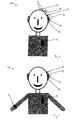
- a device 500 is shown, which is a development of in Fig. 1 shown device 100 represents. No component of device 500 needs to be implanted so that the entire device 500 is outside the patient's body. In addition, the device 500 does not use a signal measured by a sensor for demand-controlled variation of the stimulation.
- a stimulation unit 11 is in the device 500 a Sound generator (speaker) used, which is enclosed in an earplug 30. The earplug 30 is inserted into the external ear canal of an ear 12 of the patient and attached to the ear 12 with or without brackets or other suitable mechanical aid.
- the control unit 10 which controls the sound generator, as well as a battery or a rechargeable battery for powering the electrical components of the device 500 may be accommodated in one or more separate units 31.
- the unit 31 may be connected to the earplug 30 by means of a mechanical support, eg a bracket.
- a connection cable 32 connects the earplug 30 to the control unit 10 and the battery, respectively.
- a headset containing the control unit 10 and the battery may also be used.
- the device 500 may be powered on by the patient by means of a control unit (e.g., power button and / or knob) attached either to the unit 31 or directly to the earplug 30. With the rotary control, e.g. the maximum stimulation intensity can be set.
- the device 500 can have a control medium 33, which is connected to the control unit 10, for example by telemetry (for example by radio) or via a connecting cable. In the case of a connection via a cable plug connections can be used for the connection or disconnection.
- the device 500 may also be over another, e.g. have to be operated by the doctor control medium (not shown), which is connected by telemetry or via a connecting cable with the control unit 10.
- the doctor control medium not shown
- a connecting cable with the control unit 10.
- one or more sensors eg EEG electrodes or an accelerometer, for registration and / or Documentation of the stimulation success and for examination by the doctor be provided.
- the devices 600 to 900 each have a measuring unit 23, with which a demand control and / or a feedback (feedback) of the measuring signals 24 into the stimulation unit 11 can be carried out.
- the devices 600 and 700 are non-invasive variants while the devices 800 and 900 are partially implanted in the body of the patient.
- the devices 600 to 900 include an earplug 30 or a headset with a sound generator.
- the illustrated device 600 has epicutaneous EEG electrodes 34, which are attached to the skin of the patient and are connected to the control unit 10 in the unit 31 via connection cables 35, 36.
- the control unit 10 amplifies the potential difference measured by means of the EEG electrodes 34 and uses this after an optional linear or non-linear calculation to control the sound generator in the earplug 30.
- the EEG electrodes 34 can also be wireless that is telemetrically connected to the control unit 10. This has the advantage that the patient is not hampered by connecting cables and can, for example, hang on obstacles.
- device 700 has an accelerometer (accelerometer) 37 as a measuring unit instead of an EEG electrode.
- the accelerometer 37 is attached to a disease-trembling limb of the patient, for example in the manner of a clock.
- the acceleration signals recorded by the accelerometer 37 are amplified in the control unit 10 and after an optional linear or non-linear billing used to drive the sound generator in the earplug 30.
- the accelerometer 37 may be connected to the control unit 10 telemetrically or via a connection cable.
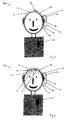
- the device 800 includes one or more subcutaneously implanted electrodes 38 as a measuring unit, a connection cable 39, and a transmitting and receiving unit 40 implanted in the body of the patient under the scalp 41 and outside the bony skull 42. Outside the patient's body are a transmitting and receiving unit 43, which is connected via a connecting cable 44 to the unit 31 and the control unit 10 located therein. Via the transmitting and receiving units 40 and 43, which are implemented, for example, in each case as a coil and between which wireless and bidirectional signals and electrical power can be transmitted, the measured signals received by the electrode 38 are forwarded to the control unit. In the control unit 10, the potential differences measured by the electrode 38 are amplified and, after an optional linear or non-linear calculation, used to control the sound generator integrated in the earplug 30.
- FIG. 9 Another invasive variant is shown schematically in Fig. 9 shown.
- one or more epicortically implanted electrodes 45 serve as a measuring unit.
- "Epicortical” means “located on the cerebral cortex”; for illustration is in Fig. 9 the cerebral cortex 46, 47 of both hemispheres shown schematically.
- the control unit 10 amplifies the potential difference measured by means of the epicortically implanted electrode 45 and uses this after an optional linear or non-linear calculation for driving the sound generator in the earplug 30.
- epicortical electrode 45 shown may also be replaced by an intracortical electrode (not shown).
- the measuring signals recorded by the differently configured measuring units 23, ie the EEG electrodes 34, the accelerometer 37 or the electrodes 38 or 45, can be used for feedback control as described in more detail below and fed into the sound generator as control signals , Alternatively, a demand control can be performed based on the measurement signals 24.
- a stimulation aimed at resetting the neuronal phases of neuron subpopulations certain parameters of the stimulation process, such as stimulation intensity or duration, may be adjusted based on the measurement signals 24. This type of demand control is discussed below in connection with the 10 to 12 explained in more detail.
- the four frequencies f 1 to f 4 are used to explain by way of example how, by time-delayed resetting of the phases of the neuronal activity of subpopulations of a pathologically synchronous and oscillatory neuron population, a desynchronization of the entire neuron population can be achieved.
- the four frequencies f 1 to f 4 are to be understood as examples only, ie any other number of frequencies or frequency mixtures may be used for stimulation purposes.
- the frequencies f 1 to f 4 have been selected in such a way that specific areas 17 to 20 of the auditory cortex 13 are stimulated with them. This allows the above-described splitting of a diseased neuron population into subpopulations 17 to 20. So that the subpopulations 17 to 20 have different phases after the stimulation, the frequencies f 1 to f 4 can be applied, for example, with a time delay.
- Fig. 10 In the upper four lines, four sinusoidal oscillations with the frequencies f 1 , f 2 , f 3 and f 4 are plotted against the time t. From the sinusoids shown, the acoustic stimulation signal 15 is formed. To generate pulsed sinusoids, the four sinusoids have been multiplied by rectangular functions. Each sinusoidal pulse repeats periodically at a frequency f stim .
- Such sequences of pulsed sinusoids when applied as acoustic stimulation signals 15, are capable of resetting the neuronal phase of the respective stimulated diseased neuron subpopulations 17, 18, 19 and 20, respectively.
- the phase reset does not necessarily result after only one or a few pulses, but a certain number of pulses can be generated in Fig. 10 shown sinusoidal pulses may be required to reset the neuronal phase of the respective subpopulation 17, 18, 19 and 20, respectively.
- the frequency f stim may, for example, be in the range of the mean frequency of the pathologically rhythmic activity of the target network.
- the mean frequency is typically in the range of 1 to 30 Hz, but may be outside this range.
- tinnitus for example, in the frequency range of 1.5 to 4 Hz, excessively synchronous neuronal activity is found.
- the frequency with which the diseased neurons fire synchronously is usually not constant, but may well have variations and also shows individual deviations in each patient.
- the average peak frequency of the pathological rhythmic activity of the patient can be determined.
- This peak frequency can then be used as a stimulation frequency f stim or else be varied, for example in a range of f stim - 3 Hz to f stim + 3 Hz.
- a frequency f stim in the range of 1 to 30 Hz are chosen and these are varied during the stimulation, for example, until the frequency f stim is found, with which the best stimulation successes can be achieved.
- a literature value known for the respective disease can be used for the stimulation frequency f stim . This value may still be varied until, for example, optimal stimulation results are achieved.
- the duration of a sinusoidal pulse ie the period of time in which the rectangular function assumes the value 1 in the present embodiment, may be, for example, T stim / 2.
- the time during which the respective frequency contributes to the stimulation and the subsequent stimulation pause are the same length.
- it is also possible to choose different stimulation durations for example in the range of T stim / 2 - T stim / 10 to T stim / 2 + T stim / 10.
- Other stimulation periods are possible, for example, the stimulation duration is in the in the Fig. 11 and 12
- the stimulation durations T stim / 4 can be determined experimentally.
- the administration of the individual frequencies f 1 to f 4 takes place with a time delay between the individual frequencies f 1 to f 4 .
- the beginning of temporally successive pulses having different frequencies can be shifted by a time ⁇ .
- the requirement that the time delay ⁇ between each two successive sinusoidal pulses T stim / N is, can be deviated to some extent.
- the value T stim / N for the time delay ⁇ can be deviated by up to ⁇ 10%, ⁇ 20% or ⁇ 30%. In the case of such a deviation, stimulation successes were still achieved, ie a desynchronizing effect could still be observed.
- the acoustic stimulation signal 15 is formed by superposition.
- the individual sinusoidal oscillation pulses can be combined, for example, linearly or non-linearly with each other. This means that the sinusoids of the individual frequencies f 1 to f 4 need not necessarily be combined with the same amplitudes to the acoustic stimulation signal 15.
- the frequency spectrum of the acoustic stimulation signal 15 is shown at four different times t 1 , t 2 , t 3 and t 4 .
- the frequency spectra shown there, in particular the height and shape of the frequency peaks, are to be understood merely as examples and may also have completely different shapes.
- a frequency mixture j there may be any number of frequencies in the range from f j down to f j above .
- Fig. 11 is already in Fig. 10 shown stimulation over a longer period of time.
- an example recorded by the measuring unit 23 measuring signal 24 is shown, which reflects the neuronal activity in the auditory cortex before and during stimulation.
- the stimulation is started at time t start .
- the strictly periodic stimulation pattern shown may vary in different ways to deviate.
- the time delay ⁇ between two consecutive sinusoidal pulses does not necessarily always have to be the same. It can be provided that the time intervals between the individual sinusoidal oscillation pulses are selected differently.
- the delay times can also be varied during the treatment of a patient. The delay times with regard to the physiological signal propagation times can also be adjusted.
- 15 pauses may be provided during the application of the acoustic stimulation signal during which no stimulation occurs.
- the pauses can be selected arbitrarily long and in particular amount to an integer multiple of the period T stim .
- the pauses can be followed after any number of stimulations. For example, stimulation may be performed during N consecutive periods of length T stim followed by a pause pause during M periods of length T stim , where N and M are small integers, eg in the range 1 to 15.
- This scheme may be either be continued periodically or modified stochastically and / or deterministically, eg chaotically.
- the order in which the frequencies involved f j or frequency mixtures with the limits f j below and f j applied above can be varied. This variation can be stochastic or deterministic or mixed stochastic-deterministic.
- the stimulation signals described above cause the phase of neuronal activity of the diseased neuron population at the different stimulation sites to be reset at different times.
- the diseased neuron population whose neurons were previously synchronous and active with the same frequency and phase, split into several subpopulations, which ultimately leads to desynchronization.
- All of the stimulation forms described above can also be performed in a "closed loop" mode.
- the resetting of the phases of the individual subpopulation can, for example, be linked to a demand control.
- a threshold value can be specified, and if the amplitude of the measurement signal 24 is above or below the threshold value, the stimulation can be started or interrupted.
- certain stimulation parameters such as the amplitude / strength of the stimulation signals or the duration of the stimulation, can be set.
- the stimulation is started by the patient, for example by a telemetric activation.
- the patient may receive the stimulation for a predetermined period of time, e.g. Activate for 5 minutes or the patient can start and stop the stimulation automatically.
- the measuring signals 24 received by the measuring unit 23 can be used to generate a control signal 14 with which the stimulation unit 11 is activated.
- the measurement signal 24 can be converted into the acoustic stimulation signal 15 either directly or, if appropriate, after one or more processing steps, and applied by the stimulation unit 11.
- the billing mode can be chosen so that the pathological neuronal activity is counteracted and the acoustic stimulation signal 15 also disappears with decreasing pathological neuronal activity or at least significantly reduced in its intensity.
- the measuring signal 24 can be processed linearly or non-linearly.
- the measurement signal 24 can be filtered and / or amplified and / or acted upon by a time delay and / or mixed with another measurement signal 24.
- the amplitude of a sinusoidal oscillation with a frequency in the audible range be modulated and the amplitude-modulated sinusoidal can then be applied by means of the sound generator as an acoustic stimulation signal 15 or as part thereof.
- the complete measurement signal 24 does not necessarily have to be used. It can be provided, for example, that only a part of the measuring signal 24 or of the processed measuring signal 24 is used, for example the part which lies above or below a certain threshold value.
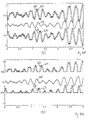
- Such an amplitude modulation is in Fig. 13 exemplified.
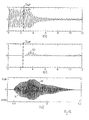
- the band-pass filtered measurement signal 24 is plotted against the time t, and the start time t start of the stimulation is also indicated.
- the mean graph shows the modulation signal 50 obtained from the measurement signal 24.
- the modulation signal 50 represents the envelope of the sine wave, as in the lowermost graph of FIG Fig. 13 is shown for a small time excerpt.
- the thus obtained amplitude-modulated sinusoidal oscillation has subsequently been fed back into the stimulation unit 11 in order to be converted by the sound generator into the acoustic stimulation signal 15.
- the modulation signal 50 may also be multiplied by any mixture of sinusoids (or other oscillations) in the audible frequency range, depending on where in the auditory cortex the desynchronization is to occur.
- Fig. 13 shown measurement signal 24 can be read that the acoustic non-linear time-delayed half-wave stimulation leads to a robust suppression of morbid synchronous neuronal activity.
- the mechanism of action of this stimulation differs from the mode of action of eg Fig. 10 shown stimulation method.
- the stimulation shown is not reset to the phase of neuronal activity in the respective stimulated subpopulations, but the synchronization in the diseased active neuron population is suppressed by affecting the saturation process of the synchronization.
- K is a gain which can be suitably selected
- Z (t) a mean state variable of the measurement signal 24
- the auditory cortex can also be selectively stimulated at different points.
- Fig. 14 such stimulation is exemplified.
- the modulation signals 51, 52, 53 and 54 have been obtained here by linear processing steps, with which amplitude modulations of the frequencies f 1 to f 4 have been performed.
- the control signal 14 has been generated, which has been converted by the sound generator 11 into the acoustic stimulation signal 15.
- the modulation signals 51 to 54 can be obtained, for example, from the measurement signal 24 by delaying the measurement signal 24 by the delay times ⁇ 1 , ⁇ 2 , ⁇ 3 and ⁇ 4 , respectively:
- S j t K ⁇ Z ⁇ t - ⁇ j
- S 1 (t), S 2 (t), S 3 (t) and S 4 (t) represent the modulation signals 51 to 54 and Z (t) the measurement signal 24.
- K is a gain factor. which can be suitably chosen.
- all negative values (or all values above or below a certain threshold) of the modulation signals S 1 (t) to S 4 (t) can be set to zero.
- the modulation signals S 1 (t) to S 4 (t) are calculated only from the delay times ⁇ 1 and ⁇ 2 , wherein the modulation signals S 1 (t) and S 2 (t) or S 3 (t) and S 4 (t) each have different polarities:
- S 1 t K ⁇ Z ⁇ t - ⁇ 1
- S 2 t - K ⁇ Z ⁇ t - ⁇ 1
- S 3 t K ⁇ Z ⁇ t - ⁇ 2
- S 4 t - K ⁇ Z ⁇ t - ⁇ 2
Landscapes
- Health & Medical Sciences (AREA)
- Life Sciences & Earth Sciences (AREA)
- Animal Behavior & Ethology (AREA)
- Veterinary Medicine (AREA)
- Public Health (AREA)
- General Health & Medical Sciences (AREA)
- Physics & Mathematics (AREA)
- Engineering & Computer Science (AREA)
- Biomedical Technology (AREA)
- Heart & Thoracic Surgery (AREA)
- Biophysics (AREA)
- Psychology (AREA)
- Acoustics & Sound (AREA)
- Epidemiology (AREA)
- Rehabilitation Therapy (AREA)
- Physical Education & Sports Medicine (AREA)
- Pain & Pain Management (AREA)
- Molecular Biology (AREA)
- Surgery (AREA)
- Medical Informatics (AREA)
- Pathology (AREA)
- Biodiversity & Conservation Biology (AREA)
- Vascular Medicine (AREA)
- Anesthesiology (AREA)
- Hematology (AREA)
- Otolaryngology (AREA)
- Electrotherapy Devices (AREA)
Priority Applications (1)
| Application Number | Priority Date | Filing Date | Title |
|---|---|---|---|
| EP14186204.5A EP2826448B1 (fr) | 2008-03-20 | 2008-04-18 | Dispositif de stimulation auditive |
Applications Claiming Priority (1)
| Application Number | Priority Date | Filing Date | Title |
|---|---|---|---|
| DE102008015259A DE102008015259B4 (de) | 2008-03-20 | 2008-03-20 | Vorrichtung und Verfahren zur auditorischen Stimulation |
Related Child Applications (2)
| Application Number | Title | Priority Date | Filing Date |
|---|---|---|---|
| EP14186204.5A Division EP2826448B1 (fr) | 2008-03-20 | 2008-04-18 | Dispositif de stimulation auditive |
| EP14186204.5A Division-Into EP2826448B1 (fr) | 2008-03-20 | 2008-04-18 | Dispositif de stimulation auditive |
Publications (3)
| Publication Number | Publication Date |
|---|---|
| EP2103288A2 true EP2103288A2 (fr) | 2009-09-23 |
| EP2103288A3 EP2103288A3 (fr) | 2009-12-16 |
| EP2103288B1 EP2103288B1 (fr) | 2014-11-05 |
Family
ID=40791014
Family Applications (2)
| Application Number | Title | Priority Date | Filing Date |
|---|---|---|---|
| EP14186204.5A Active EP2826448B1 (fr) | 2008-03-20 | 2008-04-18 | Dispositif de stimulation auditive |
| EP08007638.3A Active EP2103288B1 (fr) | 2008-03-20 | 2008-04-18 | Dispositif de stimulation auditive |
Family Applications Before (1)
| Application Number | Title | Priority Date | Filing Date |
|---|---|---|---|
| EP14186204.5A Active EP2826448B1 (fr) | 2008-03-20 | 2008-04-18 | Dispositif de stimulation auditive |
Country Status (7)
| Country | Link |
|---|---|
| US (4) | US8423144B2 (fr) |
| EP (2) | EP2826448B1 (fr) |
| JP (1) | JP5280515B2 (fr) |
| CN (2) | CN104546289B (fr) |
| DE (1) | DE102008015259B4 (fr) |
| ES (2) | ES2817832T3 (fr) |
| WO (1) | WO2009115088A2 (fr) |
Cited By (5)
| Publication number | Priority date | Publication date | Assignee | Title |
|---|---|---|---|---|
| WO2011127918A1 (fr) * | 2010-04-12 | 2011-10-20 | Forschungszentrum Jülich GmbH | Dispositif et procédé pour la stimulation désynchronisante conditionnée non invasive |
| WO2011127917A3 (fr) * | 2010-04-15 | 2012-03-22 | Forschungszentrum Jülich GmbH | Dispositif et procédé de traitement de maladies du cerveau et/ou de la moelle épinière au moyen du neurofeedback |
| EP3496807A4 (fr) * | 2016-08-12 | 2020-03-04 | The Board of Trustees of the Leland Stanford Junior University | Dispositif et procédé de stimulation acoustique adaptée au seuil auditif |
| WO2020220140A1 (fr) * | 2019-05-02 | 2020-11-05 | Lucid Inc. | Dispositif, procédé et support d'intégration de stimulation de battements auditifs dans de la musique |
| EP2533747B1 (fr) * | 2010-02-11 | 2022-06-22 | Tass, Peter | Appareil pour le traitement d'un patient par l'application de stimulations vibratoires, tactiles et/ou thermales |
Families Citing this family (42)
| Publication number | Priority date | Publication date | Assignee | Title |
|---|---|---|---|---|
| DE102008015259B4 (de) | 2008-03-20 | 2010-07-22 | Anm Adaptive Neuromodulation Gmbh | Vorrichtung und Verfahren zur auditorischen Stimulation |
| EP2533550B2 (fr) † | 2011-06-06 | 2021-06-23 | Oticon A/s | Diminution du niveau sonore de tintement par traitement d'instrument auditif |
| DE102012002436B4 (de) | 2012-02-08 | 2014-08-21 | Forschungszentrum Jülich GmbH | Vorrichtung zur Eichung einer nicht-invasiven desynchronisierenden Neurostimulation |
| WO2014027695A1 (fr) * | 2012-08-16 | 2014-02-20 | 株式会社アクション・リサーチ | Dispositif et procédé de traitement de vibration |
| US20140052033A1 (en) * | 2012-08-20 | 2014-02-20 | BAUD Energetics, Corp | Device and method for pulsed acoustical stimulation of the brain |
| DE102012218057A1 (de) * | 2012-10-02 | 2014-04-03 | Forschungszentrum Jülich GmbH | Vorrichtung und verfahren zur untersuchung einer krankhaften interaktion zwischen verschiedenen hirnarealen |
| JP2014116652A (ja) * | 2012-12-06 | 2014-06-26 | Scalar Corp | センサ装置、センサシステム、及びプログラム |
| US9764110B2 (en) * | 2013-03-22 | 2017-09-19 | Mind Rocket, Inc. | Binaural sleep inducing system |
| DE102013013278A1 (de) | 2013-08-08 | 2015-02-12 | Forschungszentrum Jülich GmbH | Vorrichtung und Verfahren zur Eichung einer akustischen desynchronisierenden Neurostimulation |
| CN104055625A (zh) * | 2014-06-11 | 2014-09-24 | 三峡大学 | 一种治疗耳鸣的电声刺激器 |
| DE102014115997B4 (de) * | 2014-11-03 | 2016-12-22 | Forschungszentrum Jülich GmbH | Vorrichtung zur effektiven nicht-invasiven desynchronisierenden Neurostimulation |
| DE102014115994B4 (de) | 2014-11-03 | 2016-12-22 | Forschungszentrum Jülich GmbH | Vorrichtung zur effektiven invasiven desynchronisierenden Neurostimulation |
| FR3029117B1 (fr) * | 2014-11-27 | 2022-05-06 | Dreem | Dispositif et procede de stimulation des ondes lentes cerebrales |
| DE102014117427B4 (de) * | 2014-11-27 | 2016-12-15 | Forschungszentrum Jülich GmbH | Vorrichtung zur effektiven nicht-invasiven Neurostimulation mittels variierender Reizsequenzen |
| DE102015101371A1 (de) * | 2015-01-30 | 2016-08-04 | Forschungszentrum Jülich GmbH | Vorrichtung und Verfahren zur nicht-invasiven Neurostimulation mittels Mehrkanal-Bursts |
| DE102015101823A1 (de) | 2015-02-09 | 2016-08-11 | Forschungszentrum Jülich GmbH | Vorrichtung und Verfahren zur Kalibrierung einer nicht-invasiven mechanisch taktilen und/oder thermischen Neurostimulation |
| US9724521B2 (en) | 2015-04-09 | 2017-08-08 | Medtronic, Inc. | Frequency based therapy generation |
| FR3039773A1 (fr) * | 2015-08-04 | 2017-02-10 | Dreem | Procedes et systemes de stimulation acoustique des ondes cerebrales. |
| US10413737B2 (en) | 2015-09-25 | 2019-09-17 | Boston Scientific Neuromodulation Corporation | Systems and methods for providing therapy using electrical stimulation to disrupt neuronal activity |
| CA3003183A1 (fr) | 2015-11-24 | 2017-06-01 | Massachusetts Institute Of Technology | Systemes et procedes de prevention, attenuation et/ou traitement de la demence |
| DE102016104913B4 (de) * | 2016-03-16 | 2018-04-26 | Forschungszentrum Jülich GmbH | Vorrichtung zur effektiven, invasiven und amplitudenmodulierten Neurostimulation |
| US10198076B2 (en) | 2016-09-06 | 2019-02-05 | Neosensory, Inc. | Method and system for providing adjunct sensory information to a user |
| US10279192B2 (en) | 2016-11-17 | 2019-05-07 | Cognito Therapeutics, Inc. | Methods and systems for neural stimulation via visual stimulation |
| WO2019060298A1 (fr) | 2017-09-19 | 2019-03-28 | Neuroenhancement Lab, LLC | Procédé et appareil de neuro-activation |
| EP3694464B1 (fr) | 2017-10-10 | 2025-12-10 | Massachusetts Institute of Technology | Systèmes de prévention, atténuation et/ou traitement de la démence |
| US10960225B2 (en) | 2017-10-10 | 2021-03-30 | Massachusetts Institute Of Technology | Systems and methods for preventing, mitigating, and/or treating dementia via visual stimulation that binds higher order brain regions, reduces neurodegeneration and neuroinflammation, and improves cognitive function |
| US11717686B2 (en) | 2017-12-04 | 2023-08-08 | Neuroenhancement Lab, LLC | Method and apparatus for neuroenhancement to facilitate learning and performance |
| US12280219B2 (en) | 2017-12-31 | 2025-04-22 | NeuroLight, Inc. | Method and apparatus for neuroenhancement to enhance emotional response |
| US11478603B2 (en) | 2017-12-31 | 2022-10-25 | Neuroenhancement Lab, LLC | Method and apparatus for neuroenhancement to enhance emotional response |
| US11027121B2 (en) | 2018-01-26 | 2021-06-08 | Regents Of The University Of Minnesota | Systems, methods and media for directional coordinated reset deep brain stimulation |
| US11364361B2 (en) | 2018-04-20 | 2022-06-21 | Neuroenhancement Lab, LLC | System and method for inducing sleep by transplanting mental states |
| IT201800004742A1 (it) * | 2018-04-20 | 2019-10-20 | Applicazione software su dispositivo elettronico per la riduzione di dolori alla testa | |
| CN109260591B (zh) * | 2018-08-02 | 2022-08-19 | 深圳英智科技有限公司 | 经颅刺激方法和装置 |
| US11452839B2 (en) | 2018-09-14 | 2022-09-27 | Neuroenhancement Lab, LLC | System and method of improving sleep |
| DE102018131534A1 (de) * | 2018-12-10 | 2020-06-25 | Joachim Loskill | Behandlungsvorrichtung und Handgriff für die Behandlung des menschlichen Körpers |
| TWI708592B (zh) * | 2019-05-09 | 2020-11-01 | 原相科技股份有限公司 | 產生減緩耳鳴影響聲音之方法及執行該方法之耳鳴遮蔽器 |
| US11786694B2 (en) | 2019-05-24 | 2023-10-17 | NeuroLight, Inc. | Device, method, and app for facilitating sleep |
| US11079854B2 (en) | 2020-01-07 | 2021-08-03 | Neosensory, Inc. | Method and system for haptic stimulation |
| US20220218268A1 (en) * | 2020-07-22 | 2022-07-14 | Actibrain Bio, Inc. | Ai (artificial intelligence) based method for providing brain information |
| US11497675B2 (en) * | 2020-10-23 | 2022-11-15 | Neosensory, Inc. | Method and system for multimodal stimulation |
| US11862147B2 (en) | 2021-08-13 | 2024-01-02 | Neosensory, Inc. | Method and system for enhancing the intelligibility of information for a user |
| KR102832615B1 (ko) * | 2024-10-21 | 2025-07-10 | 주식회사 에스옴니 | Olas 동조화 사운드를 이용한 수면 케어 서비스 장치 |
Family Cites Families (13)
| Publication number | Priority date | Publication date | Assignee | Title |
|---|---|---|---|---|
| JPS6319134A (ja) * | 1986-07-11 | 1988-01-26 | 工業技術院長 | 神経あるいは被刺激性組織の刺激装置 |
| EP0901340A1 (fr) * | 1994-11-21 | 1999-03-17 | Neurotrain, L.C. | Examen d'un individu par retroaction encephalographique de "desentrainement" |
| DE10233960B4 (de) * | 2002-07-29 | 2006-11-02 | Forschungszentrum Jülich GmbH | Vorrichtung zur bedarfsgesteuerten Modulation physiologischer und pathologischer neuronaler rhythmischer Aktivität im Gehirn mittels sensorischer Stimulation |
| DE10318071A1 (de) * | 2003-04-17 | 2004-11-25 | Forschungszentrum Jülich GmbH | Vorrichtung zur Desynchronisation von neuronaler Hirnaktivität |
| WO2004098690A1 (fr) * | 2003-05-06 | 2004-11-18 | Oticon A/S | Traitement des acouphenes |
| US7166070B2 (en) * | 2003-08-29 | 2007-01-23 | Lawlis G Frank | Method and apparatus for acoustical stimulation of the brain |
| UY28083A1 (es) * | 2003-11-14 | 2003-12-31 | Nicolas Fernandez Tourn Suarez | Unidad de rehabilitacion vestibular |
| KR101014234B1 (ko) * | 2004-03-31 | 2011-02-14 | 엘지전자 주식회사 | 오디오 기기에서의 맥동 잡음 발생장치 및 방법 |
| US20060020161A1 (en) * | 2004-07-20 | 2006-01-26 | James Mageras | Method and device for auditory stimulation for therapeutic application |
| WO2006057734A1 (fr) * | 2004-10-21 | 2006-06-01 | Advanced Neuromodulation Systems, Inc. | Nouvelle conception de stimulation pour la neuromodulation |
| JP2008535538A (ja) * | 2005-03-01 | 2008-09-04 | ファンクショナル ニューロサイエンス インコーポレイテッド | 神経変調を用いて、鬱病、気分障害および不安障害を処置するための方法 |
| SE529032C2 (sv) * | 2005-05-25 | 2007-04-10 | Guy Madison | Förnimbara signaler som ger intryck av kontinuerlig hastighetsförändring |
| DE102008015259B4 (de) * | 2008-03-20 | 2010-07-22 | Anm Adaptive Neuromodulation Gmbh | Vorrichtung und Verfahren zur auditorischen Stimulation |
-
2008
- 2008-03-20 DE DE102008015259A patent/DE102008015259B4/de active Active
- 2008-04-18 EP EP14186204.5A patent/EP2826448B1/fr active Active
- 2008-04-18 EP EP08007638.3A patent/EP2103288B1/fr active Active
- 2008-04-18 ES ES14186204T patent/ES2817832T3/es active Active
- 2008-04-18 ES ES08007638.3T patent/ES2529238T3/es active Active
-
2009
- 2009-03-20 CN CN201410379599.4A patent/CN104546289B/zh not_active Expired - Fee Related
- 2009-03-20 CN CN200980109830.5A patent/CN101977576B/zh not_active Expired - Fee Related
- 2009-03-20 JP JP2011500043A patent/JP5280515B2/ja active Active
- 2009-03-20 WO PCT/DE2009/000399 patent/WO2009115088A2/fr not_active Ceased
-
2010
- 2010-09-17 US US12/884,557 patent/US8423144B2/en active Active
-
2013
- 2013-03-12 US US13/796,422 patent/US8825167B2/en active Active
-
2014
- 2014-07-28 US US14/444,317 patent/US9987191B2/en active Active
-
2018
- 2018-06-04 US US15/996,819 patent/US10973733B2/en not_active Expired - Fee Related
Non-Patent Citations (3)
| Title |
|---|
| VON D. BILECEN ET AL., TONOTOPIC ORGANIZATION OF THE HUMAN AUDITORY CORTEX AS DETECTED BY BOLD-FMRI, vol. 126, 1998, pages 19 - 27 |
| VON D. R. M. LANGERS; W. H. BACKES; P. VAN DIJK: "Representation of lateralization and tonotopy in primary versus secondary human auditory cortex", NEUROIMAGE, vol. 34, 2007, pages 264 - 273 |
| VON W. MÜHLNICKEL ET AL.: "Reorganization of auditory cortex in tinnitus", PROC. NATL. ACAD. SCI. USA, vol. 95, 1998, pages 10340 - 10343 |
Cited By (12)
| Publication number | Priority date | Publication date | Assignee | Title |
|---|---|---|---|---|
| EP2533747B1 (fr) * | 2010-02-11 | 2022-06-22 | Tass, Peter | Appareil pour le traitement d'un patient par l'application de stimulations vibratoires, tactiles et/ou thermales |
| EP4074299A1 (fr) * | 2010-02-11 | 2022-10-19 | Gretap AG | Dispositif de traitement d'un patient par stimulation vibratoire, tactile et/ou thermique |
| EP4094745A1 (fr) * | 2010-02-11 | 2022-11-30 | Gretap AG | Dispositif de traitement d'un patient par stimulation vibratoire, tactile et/ou thermique |
| WO2011127918A1 (fr) * | 2010-04-12 | 2011-10-20 | Forschungszentrum Jülich GmbH | Dispositif et procédé pour la stimulation désynchronisante conditionnée non invasive |
| CN102905760A (zh) * | 2010-04-12 | 2013-01-30 | 于利奇研究中心有限公司 | 条件化的去同步化的非侵入式刺激的设备与方法 |
| US9884164B2 (en) | 2010-04-12 | 2018-02-06 | Forschungszentrum Juelich Gmbh | Apparatus and method for the conditioned desynchronized non-invasive stimulation |
| WO2011127917A3 (fr) * | 2010-04-15 | 2012-03-22 | Forschungszentrum Jülich GmbH | Dispositif et procédé de traitement de maladies du cerveau et/ou de la moelle épinière au moyen du neurofeedback |
| EP3496807A4 (fr) * | 2016-08-12 | 2020-03-04 | The Board of Trustees of the Leland Stanford Junior University | Dispositif et procédé de stimulation acoustique adaptée au seuil auditif |
| US10933213B2 (en) | 2016-08-12 | 2021-03-02 | The Board Of Trustees Of The Leland Stanford Junior University | Device and method for hearing threshold-adapted acoustic stimulation |
| WO2020220140A1 (fr) * | 2019-05-02 | 2020-11-05 | Lucid Inc. | Dispositif, procédé et support d'intégration de stimulation de battements auditifs dans de la musique |
| US20220262332A1 (en) * | 2019-05-02 | 2022-08-18 | Lucid Inc. | Device, method, and medium for integrating auditory beat stimulation into music |
| US12205566B2 (en) | 2019-05-02 | 2025-01-21 | Lucid Inc. | Device, method, and medium for integrating auditory beat stimulation into music |
Also Published As
| Publication number | Publication date |
|---|---|
| WO2009115088A3 (fr) | 2009-12-30 |
| ES2817832T3 (es) | 2021-04-08 |
| ES2529238T3 (es) | 2015-02-18 |
| EP2103288A3 (fr) | 2009-12-16 |
| CN104546289A (zh) | 2015-04-29 |
| US9987191B2 (en) | 2018-06-05 |
| US20130190663A1 (en) | 2013-07-25 |
| US10973733B2 (en) | 2021-04-13 |
| US20110009921A1 (en) | 2011-01-13 |
| CN101977576A (zh) | 2011-02-16 |
| US8423144B2 (en) | 2013-04-16 |
| EP2826448A1 (fr) | 2015-01-21 |
| CN101977576B (zh) | 2014-09-03 |
| DE102008015259A1 (de) | 2009-09-24 |
| JP5280515B2 (ja) | 2013-09-04 |
| CN104546289B (zh) | 2018-08-10 |
| EP2103288B1 (fr) | 2014-11-05 |
| US20180325770A1 (en) | 2018-11-15 |
| US8825167B2 (en) | 2014-09-02 |
| JP2011514220A (ja) | 2011-05-06 |
| US20140336547A1 (en) | 2014-11-13 |
| EP2826448B1 (fr) | 2020-06-24 |
| WO2009115088A2 (fr) | 2009-09-24 |
| DE102008015259B4 (de) | 2010-07-22 |
Similar Documents
| Publication | Publication Date | Title |
|---|---|---|
| EP2103288B1 (fr) | Dispositif de stimulation auditive | |
| EP3183033B1 (fr) | Dispositif de neurostimulation non-invasive efficace à l'aide de séquences d'excitation variables | |
| EP2358430B1 (fr) | Dispositif de stimulation conditionnelle de desynchronisation | |
| EP3188794B1 (fr) | Dispositif de neurostimulation non effractive au moyen de rafales multicanaux | |
| EP2533747B1 (fr) | Appareil pour le traitement d'un patient par l'application de stimulations vibratoires, tactiles et/ou thermales | |
| DE102007051848B4 (de) | Vorrichtung zur Stimulation von Neuronenverbänden | |
| EP2797667B1 (fr) | Dispositif d'étalonnage d'une neurostimulation désynchronisante non effractive | |
| EP2547398B1 (fr) | Dispositif pour la stimulation désynchronisante conditionnée non invasive | |
| EP1944059B1 (fr) | Dispositif de désynchronisation de l'activité cérébrale neuronale | |
| EP2797666B1 (fr) | Dispositif d'étalonnage d'une neurostimulation électrique désynchronisante effractive | |
| EP3310432B1 (fr) | Dispositif pour neurostimulation efficace non invasive en deux étapes | |
| DE102010016461B4 (de) | Vorrichtung zur Behandlung von Erkrankungen des Gehirns und/oder Rückenmarks mittels Neurofeedback | |
| EP2098261A2 (fr) | Dispositif et procédé de stimulation visuelle | |
| EP3183031B1 (fr) | Dispositif de neurostimulation désynchronisante efficace non invasive | |
| DE102008039387B4 (de) | Vorrichtung zur transkutanen Stimulation | |
| DE202013006065U1 (de) | Vorrichtung zur akustischen Stimulation mit einer adaptiven dynamischen Stimulationssignalkonditionierung |
Legal Events
| Date | Code | Title | Description |
|---|---|---|---|
| PUAI | Public reference made under article 153(3) epc to a published international application that has entered the european phase |
Free format text: ORIGINAL CODE: 0009012 |
|
| AK | Designated contracting states |
Kind code of ref document: A2 Designated state(s): AT BE BG CH CY CZ DE DK EE ES FI FR GB GR HR HU IE IS IT LI LT LU LV MC MT NL NO PL PT RO SE SI SK TR |
|
| AX | Request for extension of the european patent |
Extension state: AL BA MK RS |
|
| PUAL | Search report despatched |
Free format text: ORIGINAL CODE: 0009013 |
|
| AK | Designated contracting states |
Kind code of ref document: A3 Designated state(s): AT BE BG CH CY CZ DE DK EE ES FI FR GB GR HR HU IE IS IT LI LT LU LV MC MT NL NO PL PT RO SE SI SK TR |
|
| AX | Request for extension of the european patent |
Extension state: AL BA MK RS |
|
| 17P | Request for examination filed |
Effective date: 20100223 |
|
| 17Q | First examination report despatched |
Effective date: 20100322 |
|
| RAP1 | Party data changed (applicant data changed or rights of an application transferred) |
Owner name: UNIVERSITAET ZU KOELN Owner name: ANM ADAPTIVE NEUROMODULATION GMBH Owner name: FORSCHUNGSZENTRUM JUELICH GMBH |
|
| AKX | Designation fees paid |
Designated state(s): AT BE BG CH CY CZ DE DK EE ES FI FR GB GR HR HU IE IS IT LI LT LU LV MC MT NL NO PL PT RO SE SI SK TR |
|
| RIN1 | Information on inventor provided before grant (corrected) |
Inventor name: ROULET, JEAN-CHRISTOPHE Inventor name: BARNIKOL, BIRGIT UTAKO Inventor name: POPOVYCH, OLEKSANDR Inventor name: FREUND, HANS-JOACHIM Inventor name: TASS, PETER Inventor name: NIEDERHAUSER, JOEL Inventor name: SCHNELL, URBAN |
|
| GRAP | Despatch of communication of intention to grant a patent |
Free format text: ORIGINAL CODE: EPIDOSNIGR1 |
|
| INTG | Intention to grant announced |
Effective date: 20140514 |
|
| GRAS | Grant fee paid |
Free format text: ORIGINAL CODE: EPIDOSNIGR3 |
|
| GRAA | (expected) grant |
Free format text: ORIGINAL CODE: 0009210 |
|
| AK | Designated contracting states |
Kind code of ref document: B1 Designated state(s): AT BE BG CH CY CZ DE DK EE ES FI FR GB GR HR HU IE IS IT LI LT LU LV MC MT NL NO PL PT RO SE SI SK TR |
|
| REG | Reference to a national code |
Ref country code: GB Ref legal event code: FG4D Free format text: NOT ENGLISH |
|
| REG | Reference to a national code |
Ref country code: CH Ref legal event code: EP |
|
| REG | Reference to a national code |
Ref country code: AT Ref legal event code: REF Ref document number: 694197 Country of ref document: AT Kind code of ref document: T Effective date: 20141115 |
|
| REG | Reference to a national code |
Ref country code: IE Ref legal event code: FG4D Free format text: LANGUAGE OF EP DOCUMENT: GERMAN |
|
| REG | Reference to a national code |
Ref country code: DE Ref legal event code: R096 Ref document number: 502008012365 Country of ref document: DE Effective date: 20141224 |
|
| REG | Reference to a national code |
Ref country code: NL Ref legal event code: T3 |
|
| REG | Reference to a national code |
Ref country code: ES Ref legal event code: FG2A Ref document number: 2529238 Country of ref document: ES Kind code of ref document: T3 Effective date: 20150218 |
|
| REG | Reference to a national code |
Ref country code: SE Ref legal event code: TRGR |
|
| RAP2 | Party data changed (patent owner data changed or rights of a patent transferred) |
Owner name: FORSCHUNGSZENTRUM JUELICH GMBH Owner name: UNIVERSITAET ZU KOELN |
|
| REG | Reference to a national code |
Ref country code: LT Ref legal event code: MG4D |
|
| PG25 | Lapsed in a contracting state [announced via postgrant information from national office to epo] |
Ref country code: LT Free format text: LAPSE BECAUSE OF FAILURE TO SUBMIT A TRANSLATION OF THE DESCRIPTION OR TO PAY THE FEE WITHIN THE PRESCRIBED TIME-LIMIT Effective date: 20141105 Ref country code: NO Free format text: LAPSE BECAUSE OF FAILURE TO SUBMIT A TRANSLATION OF THE DESCRIPTION OR TO PAY THE FEE WITHIN THE PRESCRIBED TIME-LIMIT Effective date: 20150205 Ref country code: IS Free format text: LAPSE BECAUSE OF FAILURE TO SUBMIT A TRANSLATION OF THE DESCRIPTION OR TO PAY THE FEE WITHIN THE PRESCRIBED TIME-LIMIT Effective date: 20150305 Ref country code: FI Free format text: LAPSE BECAUSE OF FAILURE TO SUBMIT A TRANSLATION OF THE DESCRIPTION OR TO PAY THE FEE WITHIN THE PRESCRIBED TIME-LIMIT Effective date: 20141105 Ref country code: PT Free format text: LAPSE BECAUSE OF FAILURE TO SUBMIT A TRANSLATION OF THE DESCRIPTION OR TO PAY THE FEE WITHIN THE PRESCRIBED TIME-LIMIT Effective date: 20150305 |
|
| PG25 | Lapsed in a contracting state [announced via postgrant information from national office to epo] |
Ref country code: HR Free format text: LAPSE BECAUSE OF FAILURE TO SUBMIT A TRANSLATION OF THE DESCRIPTION OR TO PAY THE FEE WITHIN THE PRESCRIBED TIME-LIMIT Effective date: 20141105 Ref country code: LV Free format text: LAPSE BECAUSE OF FAILURE TO SUBMIT A TRANSLATION OF THE DESCRIPTION OR TO PAY THE FEE WITHIN THE PRESCRIBED TIME-LIMIT Effective date: 20141105 Ref country code: CY Free format text: LAPSE BECAUSE OF FAILURE TO SUBMIT A TRANSLATION OF THE DESCRIPTION OR TO PAY THE FEE WITHIN THE PRESCRIBED TIME-LIMIT Effective date: 20141105 Ref country code: GR Free format text: LAPSE BECAUSE OF FAILURE TO SUBMIT A TRANSLATION OF THE DESCRIPTION OR TO PAY THE FEE WITHIN THE PRESCRIBED TIME-LIMIT Effective date: 20150206 Ref country code: PL Free format text: LAPSE BECAUSE OF FAILURE TO SUBMIT A TRANSLATION OF THE DESCRIPTION OR TO PAY THE FEE WITHIN THE PRESCRIBED TIME-LIMIT Effective date: 20141105 |
|
| RAP2 | Party data changed (patent owner data changed or rights of a patent transferred) |
Owner name: UNIVERSITAET ZU KOELN Owner name: FORSCHUNGSZENTRUM JUELICH GMBH |
|
| REG | Reference to a national code |
Ref country code: CH Ref legal event code: NV Representative=s name: INTELLECTUAL PROPERTY SERVICES GMBH, CH Ref country code: CH Ref legal event code: PUEA Owner name: FORSCHUNGSZENTRUM JUELICH GMBH, DE Free format text: FORMER OWNER: FORSCHUNGSZENTRUM JUELICH GMBH, DE |
|
| REG | Reference to a national code |
Ref country code: DE Ref legal event code: R082 Ref document number: 502008012365 Country of ref document: DE Representative=s name: MANITZ, FINSTERWALD & PARTNER GBR, DE Ref country code: DE Ref legal event code: R081 Ref document number: 502008012365 Country of ref document: DE Owner name: UNIVERSITAET ZU KOELN, DE Free format text: FORMER OWNER: ANM ADAPTIVE NEUROMODULATION GM, FORSCHUNGSZENTRUM JUELICH GMBH, UNIVERSITAET ZU KOELN, , DE Ref country code: DE Ref legal event code: R081 Ref document number: 502008012365 Country of ref document: DE Owner name: FORSCHUNGSZENTRUM JUELICH GMBH, DE Free format text: FORMER OWNER: ANM ADAPTIVE NEUROMODULATION GM, FORSCHUNGSZENTRUM JUELICH GMBH, UNIVERSITAET ZU KOELN, , DE Ref country code: DE Ref legal event code: R081 Ref document number: 502008012365 Country of ref document: DE Owner name: UNIVERSITAET ZU KOELN, DE Free format text: FORMER OWNERS: ANM ADAPTIVE NEUROMODULATION GMBH, 52428 JUELICH, DE; FORSCHUNGSZENTRUM JUELICH GMBH, 52428 JUELICH, DE; UNIVERSITAET ZU KOELN, 50931 KOELN, DE Ref country code: DE Ref legal event code: R081 Ref document number: 502008012365 Country of ref document: DE Owner name: FORSCHUNGSZENTRUM JUELICH GMBH, DE Free format text: FORMER OWNERS: ANM ADAPTIVE NEUROMODULATION GMBH, 52428 JUELICH, DE; FORSCHUNGSZENTRUM JUELICH GMBH, 52428 JUELICH, DE; UNIVERSITAET ZU KOELN, 50931 KOELN, DE Ref country code: DE Ref legal event code: R082 Ref document number: 502008012365 Country of ref document: DE Representative=s name: MUELLER-BORE & PARTNER PATENTANWAELTE PARTG MB, DE Ref country code: DE Ref legal event code: R082 Ref document number: 502008012365 Country of ref document: DE Representative=s name: MANITZ FINSTERWALD PATENTANWAELTE PARTMBB, DE |
|
| REG | Reference to a national code |
Ref country code: NL Ref legal event code: SD Effective date: 20150707 |
|
| PG25 | Lapsed in a contracting state [announced via postgrant information from national office to epo] |
Ref country code: RO Free format text: LAPSE BECAUSE OF FAILURE TO SUBMIT A TRANSLATION OF THE DESCRIPTION OR TO PAY THE FEE WITHIN THE PRESCRIBED TIME-LIMIT Effective date: 20141105 Ref country code: DK Free format text: LAPSE BECAUSE OF FAILURE TO SUBMIT A TRANSLATION OF THE DESCRIPTION OR TO PAY THE FEE WITHIN THE PRESCRIBED TIME-LIMIT Effective date: 20141105 Ref country code: SK Free format text: LAPSE BECAUSE OF FAILURE TO SUBMIT A TRANSLATION OF THE DESCRIPTION OR TO PAY THE FEE WITHIN THE PRESCRIBED TIME-LIMIT Effective date: 20141105 Ref country code: EE Free format text: LAPSE BECAUSE OF FAILURE TO SUBMIT A TRANSLATION OF THE DESCRIPTION OR TO PAY THE FEE WITHIN THE PRESCRIBED TIME-LIMIT Effective date: 20141105 Ref country code: CZ Free format text: LAPSE BECAUSE OF FAILURE TO SUBMIT A TRANSLATION OF THE DESCRIPTION OR TO PAY THE FEE WITHIN THE PRESCRIBED TIME-LIMIT Effective date: 20141105 |
|
| REG | Reference to a national code |
Ref country code: GB Ref legal event code: 732E Free format text: REGISTERED BETWEEN 20150709 AND 20150715 |
|
| REG | Reference to a national code |
Ref country code: DE Ref legal event code: R097 Ref document number: 502008012365 Country of ref document: DE |
|
| PLBE | No opposition filed within time limit |
Free format text: ORIGINAL CODE: 0009261 |
|
| STAA | Information on the status of an ep patent application or granted ep patent |
Free format text: STATUS: NO OPPOSITION FILED WITHIN TIME LIMIT |
|
| 26N | No opposition filed |
Effective date: 20150806 |
|
| PG25 | Lapsed in a contracting state [announced via postgrant information from national office to epo] |
Ref country code: MC Free format text: LAPSE BECAUSE OF FAILURE TO SUBMIT A TRANSLATION OF THE DESCRIPTION OR TO PAY THE FEE WITHIN THE PRESCRIBED TIME-LIMIT Effective date: 20141105 |
|
| PG25 | Lapsed in a contracting state [announced via postgrant information from national office to epo] |
Ref country code: SI Free format text: LAPSE BECAUSE OF FAILURE TO SUBMIT A TRANSLATION OF THE DESCRIPTION OR TO PAY THE FEE WITHIN THE PRESCRIBED TIME-LIMIT Effective date: 20141105 |
|
| REG | Reference to a national code |
Ref country code: FR Ref legal event code: PLFP Year of fee payment: 9 |
|
| PG25 | Lapsed in a contracting state [announced via postgrant information from national office to epo] |
Ref country code: MT Free format text: LAPSE BECAUSE OF FAILURE TO SUBMIT A TRANSLATION OF THE DESCRIPTION OR TO PAY THE FEE WITHIN THE PRESCRIBED TIME-LIMIT Effective date: 20141105 |
|
| REG | Reference to a national code |
Ref country code: DE Ref legal event code: R081 Ref document number: 502008012365 Country of ref document: DE Owner name: GRETAP AG, CH Free format text: FORMER OWNERS: FORSCHUNGSZENTRUM JUELICH GMBH, 52428 JUELICH, DE; UNIVERSITAET ZU KOELN, 50931 KOELN, DE Ref country code: DE Ref legal event code: R081 Ref document number: 502008012365 Country of ref document: DE Owner name: TASS, PETER, PROF. DR. DR., DE Free format text: FORMER OWNERS: FORSCHUNGSZENTRUM JUELICH GMBH, 52428 JUELICH, DE; UNIVERSITAET ZU KOELN, 50931 KOELN, DE Ref country code: DE Ref legal event code: R081 Ref document number: 502008012365 Country of ref document: DE Owner name: FORSCHUNGSZENTRUM JUELICH GMBH, DE Free format text: FORMER OWNERS: FORSCHUNGSZENTRUM JUELICH GMBH, 52428 JUELICH, DE; UNIVERSITAET ZU KOELN, 50931 KOELN, DE Ref country code: DE Ref legal event code: R082 Ref document number: 502008012365 Country of ref document: DE Representative=s name: MUELLER-BORE & PARTNER PATENTANWAELTE PARTG MB, DE Ref country code: DE Ref legal event code: R082 Ref document number: 502008012365 Country of ref document: DE Representative=s name: MANITZ FINSTERWALD PATENTANWAELTE PARTMBB, DE |
|
| REG | Reference to a national code |
Ref country code: CH Ref legal event code: PUE Owner name: FORSCHUNGSZENTRUM JUELICH GMBH, DE Free format text: FORMER OWNER: FORSCHUNGSZENTRUM JUELICH GMBH, DE |
|
| REG | Reference to a national code |
Ref country code: FR Ref legal event code: PLFP Year of fee payment: 10 |
|
| PG25 | Lapsed in a contracting state [announced via postgrant information from national office to epo] |
Ref country code: BG Free format text: LAPSE BECAUSE OF FAILURE TO SUBMIT A TRANSLATION OF THE DESCRIPTION OR TO PAY THE FEE WITHIN THE PRESCRIBED TIME-LIMIT Effective date: 20141105 Ref country code: HU Free format text: LAPSE BECAUSE OF FAILURE TO SUBMIT A TRANSLATION OF THE DESCRIPTION OR TO PAY THE FEE WITHIN THE PRESCRIBED TIME-LIMIT; INVALID AB INITIO Effective date: 20080418 |
|
| PG25 | Lapsed in a contracting state [announced via postgrant information from national office to epo] |
Ref country code: BE Free format text: LAPSE BECAUSE OF NON-PAYMENT OF DUE FEES Effective date: 20150430 |
|
| PG25 | Lapsed in a contracting state [announced via postgrant information from national office to epo] |
Ref country code: TR Free format text: LAPSE BECAUSE OF FAILURE TO SUBMIT A TRANSLATION OF THE DESCRIPTION OR TO PAY THE FEE WITHIN THE PRESCRIBED TIME-LIMIT Effective date: 20141105 |
|
| REG | Reference to a national code |
Ref country code: DE Ref legal event code: R082 Ref document number: 502008012365 Country of ref document: DE Representative=s name: DF-MP DOERRIES FRANK-MOLNIA & POHLMAN PATENTAN, DE Ref country code: DE Ref legal event code: R082 Ref document number: 502008012365 Country of ref document: DE Representative=s name: MUELLER-BORE & PARTNER PATENTANWAELTE PARTG MB, DE |
|
| REG | Reference to a national code |
Ref country code: ES Ref legal event code: PC2A Owner name: FORSCHUNGSZENTRUM JUELICH GMBH Effective date: 20171121 |
|
| REG | Reference to a national code |
Ref country code: FR Ref legal event code: TP Owner name: FORSCHUNGSZENTRUM JULICH GMBH, DE Effective date: 20180105 |
|
| REG | Reference to a national code |
Ref country code: FR Ref legal event code: PLFP Year of fee payment: 11 |
|
| REG | Reference to a national code |
Ref country code: GB Ref legal event code: 732E Free format text: REGISTERED BETWEEN 20180405 AND 20180411 |
|
| REG | Reference to a national code |
Ref country code: NL Ref legal event code: PD Owner name: FORSCHUNGSZENTRUM JUELICH GMBH; DE Free format text: DETAILS ASSIGNMENT: CHANGE OF OWNER(S), ASSIGNMENT; FORMER OWNER NAME: UNIVERSITAET ZU KOELN Effective date: 20180807 |
|
| REG | Reference to a national code |
Ref country code: LU Ref legal event code: PD Owner name: FORSCHUNGSZENTRUM JUELICH GMBH; DE Free format text: FORMER OWNER: UNIVERSITAET ZU KOELN Effective date: 20180829 |
|
| PGFP | Annual fee paid to national office [announced via postgrant information from national office to epo] |
Ref country code: LU Payment date: 20190429 Year of fee payment: 12 |
|
| PG25 | Lapsed in a contracting state [announced via postgrant information from national office to epo] |
Ref country code: LU Free format text: LAPSE BECAUSE OF NON-PAYMENT OF DUE FEES Effective date: 20200418 |
|
| REG | Reference to a national code |
Ref country code: DE Ref legal event code: R082 Ref document number: 502008012365 Country of ref document: DE Representative=s name: DF-MP DOERRIES FRANK-MOLNIA & POHLMAN PATENTAN, DE Ref country code: DE Ref legal event code: R082 Ref document number: 502008012365 Country of ref document: DE Representative=s name: DF-MP PATENTANWAELTE RECHTSANWAELTE PARTG MBB, DE |
|
| REG | Reference to a national code |
Ref country code: DE Ref legal event code: R081 Ref document number: 502008012365 Country of ref document: DE Owner name: GRETAP AG, CH Free format text: FORMER OWNER: FORSCHUNGSZENTRUM JUELICH GMBH, 52428 JUELICH, DE |
|
| REG | Reference to a national code |
Ref country code: DE Ref legal event code: R081 Ref document number: 502008012365 Country of ref document: DE Owner name: GRETAP AG, CH Free format text: FORMER OWNER: TASS, PETER, PROF. DR. DR., 83684 TEGERNSEE, DE |
|
| PGFP | Annual fee paid to national office [announced via postgrant information from national office to epo] |
Ref country code: NL Payment date: 20220419 Year of fee payment: 15 |
|
| PGFP | Annual fee paid to national office [announced via postgrant information from national office to epo] |
Ref country code: SE Payment date: 20220422 Year of fee payment: 15 Ref country code: IT Payment date: 20220429 Year of fee payment: 15 Ref country code: IE Payment date: 20220421 Year of fee payment: 15 Ref country code: ES Payment date: 20220518 Year of fee payment: 15 |
|
| PGFP | Annual fee paid to national office [announced via postgrant information from national office to epo] |
Ref country code: CH Payment date: 20220421 Year of fee payment: 15 Ref country code: AT Payment date: 20220414 Year of fee payment: 15 |
|
| REG | Reference to a national code |
Ref country code: SE Ref legal event code: EUG |
|
| REG | Reference to a national code |
Ref country code: CH Ref legal event code: PL |
|
| REG | Reference to a national code |
Ref country code: NL Ref legal event code: MM Effective date: 20230501 |
|
| REG | Reference to a national code |
Ref country code: AT Ref legal event code: MM01 Ref document number: 694197 Country of ref document: AT Kind code of ref document: T Effective date: 20230418 |
|
| PG25 | Lapsed in a contracting state [announced via postgrant information from national office to epo] |
Ref country code: SE Free format text: LAPSE BECAUSE OF NON-PAYMENT OF DUE FEES Effective date: 20230419 Ref country code: NL Free format text: LAPSE BECAUSE OF NON-PAYMENT OF DUE FEES Effective date: 20230501 Ref country code: LI Free format text: LAPSE BECAUSE OF NON-PAYMENT OF DUE FEES Effective date: 20230430 Ref country code: CH Free format text: LAPSE BECAUSE OF NON-PAYMENT OF DUE FEES Effective date: 20230430 Ref country code: AT Free format text: LAPSE BECAUSE OF NON-PAYMENT OF DUE FEES Effective date: 20230418 |
|
| REG | Reference to a national code |
Ref country code: IE Ref legal event code: MM4A |
|
| PG25 | Lapsed in a contracting state [announced via postgrant information from national office to epo] |
Ref country code: IE Free format text: LAPSE BECAUSE OF NON-PAYMENT OF DUE FEES Effective date: 20230418 |
|
| PG25 | Lapsed in a contracting state [announced via postgrant information from national office to epo] |
Ref country code: IT Free format text: LAPSE BECAUSE OF NON-PAYMENT OF DUE FEES Effective date: 20230418 Ref country code: IE Free format text: LAPSE BECAUSE OF NON-PAYMENT OF DUE FEES Effective date: 20230418 |
|
| REG | Reference to a national code |
Ref country code: ES Ref legal event code: FD2A Effective date: 20240531 |
|
| PG25 | Lapsed in a contracting state [announced via postgrant information from national office to epo] |
Ref country code: ES Free format text: LAPSE BECAUSE OF NON-PAYMENT OF DUE FEES Effective date: 20230419 |
|
| PG25 | Lapsed in a contracting state [announced via postgrant information from national office to epo] |
Ref country code: ES Free format text: LAPSE BECAUSE OF NON-PAYMENT OF DUE FEES Effective date: 20230419 |
|
| REG | Reference to a national code |
Ref country code: GB Ref legal event code: 732E Free format text: REGISTERED BETWEEN 20240926 AND 20241002 |
|
| PGFP | Annual fee paid to national office [announced via postgrant information from national office to epo] |
Ref country code: DE Payment date: 20250417 Year of fee payment: 18 |
|
| PGFP | Annual fee paid to national office [announced via postgrant information from national office to epo] |
Ref country code: GB Payment date: 20250423 Year of fee payment: 18 |
|
| PGFP | Annual fee paid to national office [announced via postgrant information from national office to epo] |
Ref country code: FR Payment date: 20250422 Year of fee payment: 18 |