EP4094745A1 - Dispositif de traitement d'un patient par stimulation vibratoire, tactile et/ou thermique - Google Patents
Dispositif de traitement d'un patient par stimulation vibratoire, tactile et/ou thermique Download PDFInfo
- Publication number
- EP4094745A1 EP4094745A1 EP22177955.6A EP22177955A EP4094745A1 EP 4094745 A1 EP4094745 A1 EP 4094745A1 EP 22177955 A EP22177955 A EP 22177955A EP 4094745 A1 EP4094745 A1 EP 4094745A1
- Authority
- EP
- European Patent Office
- Prior art keywords
- stimulation
- stimuli
- stim
- unit
- stimulus
- Prior art date
- Legal status (The legal status is an assumption and is not a legal conclusion. Google has not performed a legal analysis and makes no representation as to the accuracy of the status listed.)
- Granted
Links
Images




Classifications
-
- A—HUMAN NECESSITIES
- A61—MEDICAL OR VETERINARY SCIENCE; HYGIENE
- A61H—PHYSICAL THERAPY APPARATUS, e.g. DEVICES FOR LOCATING OR STIMULATING REFLEX POINTS IN THE BODY; ARTIFICIAL RESPIRATION; MASSAGE; BATHING DEVICES FOR SPECIAL THERAPEUTIC OR HYGIENIC PURPOSES OR SPECIFIC PARTS OF THE BODY
- A61H23/00—Percussion or vibration massage, e.g. using supersonic vibration; Suction-vibration massage; Massage with moving diaphragms
- A61H23/02—Percussion or vibration massage, e.g. using supersonic vibration; Suction-vibration massage; Massage with moving diaphragms with electric or magnetic drive
- A61H23/0245—Percussion or vibration massage, e.g. using supersonic vibration; Suction-vibration massage; Massage with moving diaphragms with electric or magnetic drive with ultrasonic transducers, e.g. piezoelectric
-
- A—HUMAN NECESSITIES
- A61—MEDICAL OR VETERINARY SCIENCE; HYGIENE
- A61F—FILTERS IMPLANTABLE INTO BLOOD VESSELS; PROSTHESES; DEVICES PROVIDING PATENCY TO, OR PREVENTING COLLAPSING OF, TUBULAR STRUCTURES OF THE BODY, e.g. STENTS; ORTHOPAEDIC, NURSING OR CONTRACEPTIVE DEVICES; FOMENTATION; TREATMENT OR PROTECTION OF EYES OR EARS; BANDAGES, DRESSINGS OR ABSORBENT PADS; FIRST-AID KITS
- A61F7/00—Heating or cooling appliances for medical or therapeutic treatment of the human body
-
- A—HUMAN NECESSITIES
- A61—MEDICAL OR VETERINARY SCIENCE; HYGIENE
- A61H—PHYSICAL THERAPY APPARATUS, e.g. DEVICES FOR LOCATING OR STIMULATING REFLEX POINTS IN THE BODY; ARTIFICIAL RESPIRATION; MASSAGE; BATHING DEVICES FOR SPECIAL THERAPEUTIC OR HYGIENIC PURPOSES OR SPECIFIC PARTS OF THE BODY
- A61H23/00—Percussion or vibration massage, e.g. using supersonic vibration; Suction-vibration massage; Massage with moving diaphragms
- A61H23/02—Percussion or vibration massage, e.g. using supersonic vibration; Suction-vibration massage; Massage with moving diaphragms with electric or magnetic drive
- A61H23/0254—Percussion or vibration massage, e.g. using supersonic vibration; Suction-vibration massage; Massage with moving diaphragms with electric or magnetic drive with rotary motor
-
- A—HUMAN NECESSITIES
- A61—MEDICAL OR VETERINARY SCIENCE; HYGIENE
- A61H—PHYSICAL THERAPY APPARATUS, e.g. DEVICES FOR LOCATING OR STIMULATING REFLEX POINTS IN THE BODY; ARTIFICIAL RESPIRATION; MASSAGE; BATHING DEVICES FOR SPECIAL THERAPEUTIC OR HYGIENIC PURPOSES OR SPECIFIC PARTS OF THE BODY
- A61H7/00—Devices for suction-kneading massage; Devices for massaging the skin by rubbing or brushing not otherwise provided for
- A61H7/001—Devices for suction-kneading massage; Devices for massaging the skin by rubbing or brushing not otherwise provided for without substantial movement between the skin and the device
-
- A—HUMAN NECESSITIES
- A61—MEDICAL OR VETERINARY SCIENCE; HYGIENE
- A61H—PHYSICAL THERAPY APPARATUS, e.g. DEVICES FOR LOCATING OR STIMULATING REFLEX POINTS IN THE BODY; ARTIFICIAL RESPIRATION; MASSAGE; BATHING DEVICES FOR SPECIAL THERAPEUTIC OR HYGIENIC PURPOSES OR SPECIFIC PARTS OF THE BODY
- A61H2201/00—Characteristics of apparatus not provided for in the preceding codes
- A61H2201/02—Characteristics of apparatus not provided for in the preceding codes heated or cooled
-
- A—HUMAN NECESSITIES
- A61—MEDICAL OR VETERINARY SCIENCE; HYGIENE
- A61H—PHYSICAL THERAPY APPARATUS, e.g. DEVICES FOR LOCATING OR STIMULATING REFLEX POINTS IN THE BODY; ARTIFICIAL RESPIRATION; MASSAGE; BATHING DEVICES FOR SPECIAL THERAPEUTIC OR HYGIENIC PURPOSES OR SPECIFIC PARTS OF THE BODY
- A61H2201/00—Characteristics of apparatus not provided for in the preceding codes
- A61H2201/10—Characteristics of apparatus not provided for in the preceding codes with further special therapeutic means, e.g. electrotherapy, magneto therapy or radiation therapy, chromo therapy, infrared or ultraviolet therapy
-
- A—HUMAN NECESSITIES
- A61—MEDICAL OR VETERINARY SCIENCE; HYGIENE
- A61H—PHYSICAL THERAPY APPARATUS, e.g. DEVICES FOR LOCATING OR STIMULATING REFLEX POINTS IN THE BODY; ARTIFICIAL RESPIRATION; MASSAGE; BATHING DEVICES FOR SPECIAL THERAPEUTIC OR HYGIENIC PURPOSES OR SPECIFIC PARTS OF THE BODY
- A61H2201/00—Characteristics of apparatus not provided for in the preceding codes
- A61H2201/14—Special force transmission means, i.e. between the driving means and the interface with the user
- A61H2201/1418—Cam
-
- A—HUMAN NECESSITIES
- A61—MEDICAL OR VETERINARY SCIENCE; HYGIENE
- A61H—PHYSICAL THERAPY APPARATUS, e.g. DEVICES FOR LOCATING OR STIMULATING REFLEX POINTS IN THE BODY; ARTIFICIAL RESPIRATION; MASSAGE; BATHING DEVICES FOR SPECIAL THERAPEUTIC OR HYGIENIC PURPOSES OR SPECIFIC PARTS OF THE BODY
- A61H2201/00—Characteristics of apparatus not provided for in the preceding codes
- A61H2201/16—Physical interface with patient
- A61H2201/1657—Movement of interface, i.e. force application means
- A61H2201/1664—Movement of interface, i.e. force application means linear
- A61H2201/1669—Movement of interface, i.e. force application means linear moving along the body in a reciprocating manner
-
- A—HUMAN NECESSITIES
- A61—MEDICAL OR VETERINARY SCIENCE; HYGIENE
- A61H—PHYSICAL THERAPY APPARATUS, e.g. DEVICES FOR LOCATING OR STIMULATING REFLEX POINTS IN THE BODY; ARTIFICIAL RESPIRATION; MASSAGE; BATHING DEVICES FOR SPECIAL THERAPEUTIC OR HYGIENIC PURPOSES OR SPECIFIC PARTS OF THE BODY
- A61H2201/00—Characteristics of apparatus not provided for in the preceding codes
- A61H2201/50—Control means thereof
- A61H2201/5002—Means for controlling a set of similar massage devices acting in sequence at different locations on a patient
-
- A—HUMAN NECESSITIES
- A61—MEDICAL OR VETERINARY SCIENCE; HYGIENE
- A61H—PHYSICAL THERAPY APPARATUS, e.g. DEVICES FOR LOCATING OR STIMULATING REFLEX POINTS IN THE BODY; ARTIFICIAL RESPIRATION; MASSAGE; BATHING DEVICES FOR SPECIAL THERAPEUTIC OR HYGIENIC PURPOSES OR SPECIFIC PARTS OF THE BODY
- A61H2201/00—Characteristics of apparatus not provided for in the preceding codes
- A61H2201/50—Control means thereof
- A61H2201/5058—Sensors or detectors
- A61H2201/5084—Acceleration sensors
-
- A—HUMAN NECESSITIES
- A61—MEDICAL OR VETERINARY SCIENCE; HYGIENE
- A61H—PHYSICAL THERAPY APPARATUS, e.g. DEVICES FOR LOCATING OR STIMULATING REFLEX POINTS IN THE BODY; ARTIFICIAL RESPIRATION; MASSAGE; BATHING DEVICES FOR SPECIAL THERAPEUTIC OR HYGIENIC PURPOSES OR SPECIFIC PARTS OF THE BODY
- A61H2205/00—Devices for specific parts of the body
- A61H2205/06—Arms
-
- A—HUMAN NECESSITIES
- A61—MEDICAL OR VETERINARY SCIENCE; HYGIENE
- A61H—PHYSICAL THERAPY APPARATUS, e.g. DEVICES FOR LOCATING OR STIMULATING REFLEX POINTS IN THE BODY; ARTIFICIAL RESPIRATION; MASSAGE; BATHING DEVICES FOR SPECIAL THERAPEUTIC OR HYGIENIC PURPOSES OR SPECIFIC PARTS OF THE BODY
- A61H2205/00—Devices for specific parts of the body
- A61H2205/06—Arms
- A61H2205/065—Hands
-
- A—HUMAN NECESSITIES
- A61—MEDICAL OR VETERINARY SCIENCE; HYGIENE
- A61H—PHYSICAL THERAPY APPARATUS, e.g. DEVICES FOR LOCATING OR STIMULATING REFLEX POINTS IN THE BODY; ARTIFICIAL RESPIRATION; MASSAGE; BATHING DEVICES FOR SPECIAL THERAPEUTIC OR HYGIENIC PURPOSES OR SPECIFIC PARTS OF THE BODY
- A61H2205/00—Devices for specific parts of the body
- A61H2205/10—Leg
-
- A—HUMAN NECESSITIES
- A61—MEDICAL OR VETERINARY SCIENCE; HYGIENE
- A61H—PHYSICAL THERAPY APPARATUS, e.g. DEVICES FOR LOCATING OR STIMULATING REFLEX POINTS IN THE BODY; ARTIFICIAL RESPIRATION; MASSAGE; BATHING DEVICES FOR SPECIAL THERAPEUTIC OR HYGIENIC PURPOSES OR SPECIFIC PARTS OF THE BODY
- A61H2205/00—Devices for specific parts of the body
- A61H2205/12—Feet
-
- A—HUMAN NECESSITIES
- A61—MEDICAL OR VETERINARY SCIENCE; HYGIENE
- A61H—PHYSICAL THERAPY APPARATUS, e.g. DEVICES FOR LOCATING OR STIMULATING REFLEX POINTS IN THE BODY; ARTIFICIAL RESPIRATION; MASSAGE; BATHING DEVICES FOR SPECIAL THERAPEUTIC OR HYGIENIC PURPOSES OR SPECIFIC PARTS OF THE BODY
- A61H2230/00—Measuring physical parameters of the user
- A61H2230/08—Other bio-electrical signals
- A61H2230/10—Electroencephalographic signals
-
- A—HUMAN NECESSITIES
- A61—MEDICAL OR VETERINARY SCIENCE; HYGIENE
- A61H—PHYSICAL THERAPY APPARATUS, e.g. DEVICES FOR LOCATING OR STIMULATING REFLEX POINTS IN THE BODY; ARTIFICIAL RESPIRATION; MASSAGE; BATHING DEVICES FOR SPECIAL THERAPEUTIC OR HYGIENIC PURPOSES OR SPECIFIC PARTS OF THE BODY
- A61H2230/00—Measuring physical parameters of the user
- A61H2230/30—Blood pressure
-
- A—HUMAN NECESSITIES
- A61—MEDICAL OR VETERINARY SCIENCE; HYGIENE
- A61H—PHYSICAL THERAPY APPARATUS, e.g. DEVICES FOR LOCATING OR STIMULATING REFLEX POINTS IN THE BODY; ARTIFICIAL RESPIRATION; MASSAGE; BATHING DEVICES FOR SPECIAL THERAPEUTIC OR HYGIENIC PURPOSES OR SPECIFIC PARTS OF THE BODY
- A61H2230/00—Measuring physical parameters of the user
- A61H2230/40—Respiratory characteristics
-
- A—HUMAN NECESSITIES
- A61—MEDICAL OR VETERINARY SCIENCE; HYGIENE
- A61H—PHYSICAL THERAPY APPARATUS, e.g. DEVICES FOR LOCATING OR STIMULATING REFLEX POINTS IN THE BODY; ARTIFICIAL RESPIRATION; MASSAGE; BATHING DEVICES FOR SPECIAL THERAPEUTIC OR HYGIENIC PURPOSES OR SPECIFIC PARTS OF THE BODY
- A61H2230/00—Measuring physical parameters of the user
- A61H2230/60—Muscle strain, i.e. measured on the user, e.g. Electromyography [EMG]
-
- A—HUMAN NECESSITIES
- A61—MEDICAL OR VETERINARY SCIENCE; HYGIENE
- A61H—PHYSICAL THERAPY APPARATUS, e.g. DEVICES FOR LOCATING OR STIMULATING REFLEX POINTS IN THE BODY; ARTIFICIAL RESPIRATION; MASSAGE; BATHING DEVICES FOR SPECIAL THERAPEUTIC OR HYGIENIC PURPOSES OR SPECIFIC PARTS OF THE BODY
- A61H2230/00—Measuring physical parameters of the user
- A61H2230/65—Impedance, e.g. skin conductivity; capacitance, e.g. galvanic skin response [GSR]
Definitions
- the invention relates to a device and a method for treating a patient with vibration and/or tactile and/or thermal stimuli.
- the invention relates to a stimulation device and a stimulation method for the treatment of diseases in which there is increased neuronal synchronization.
- the invention can be used in particular to treat diseases of the brain, such as movement disorders, Parkinson's disease, essential tremor, dystonia, migraines, tension headaches, spasticity, functional disorders after a stroke, neuropathic pain, chronic pain conditions, neuralgia, amputation pain, tremor and other functional disorders in the condition after brain trauma.
- gastrointestinal diseases such as irritable bowel syndrome can also be treated. Painful cramps and inefficient intestinal motility can be unlearned.
- Treatment with the device according to the invention can also have an antispasmodic and pain-relieving effect in the case of ulcerative colitis and Crohn's disease.
- bronchial asthma, cardiac ischemia and peripheral arterial occlusive disease can be treated with the device according to the invention.
- pharmacological or stereotactic therapies For the treatment of the aforementioned diseases there are - if at all - only pharmacological or stereotactic therapies.
- the effectiveness of pharmacological therapies is typically temporary.
- the stereotactic treatment involves relevant risks, eg the risk of arterial bleeding when implanting the brain pacemaker.
- a device 100 for the non-invasive treatment of a patient with vibration, tactile and/or thermal stimuli is shown schematically.
- the device 100 consists of the in 1 shown embodiment from a first stimulation unit 11 for generating first stimuli, a second stimulation unit 12 for generating second stimuli, a third stimulation unit 13 for generating third stimuli and a fourth stimulation unit 14 for generating fourth stimuli.
- the device 100 can also have a control unit 10, which is connected to the stimulation units 11 to 14 via suitable connecting lines or via radio and controls the generation of the stimuli.
- the Control unit 10 can also be integrated into one or more or all stimulation units 11 to 14.
- the stimulation units 11 to 14 can each generate one or more stimuli from the group consisting of vibration, tactile and thermal stimuli.
- the stimulation units 11 to 14 are designed in such a way that they can be placed on the patient's skin.
- the stimulation units 11 to 14 are attached to the patient's skin in a suitable arrangement, for example on the patient's arm, leg, hand and/or foot.
- vibration, touch and thermal stimulation can be applied to the skin either individually or in combination.
- the plurality of stimulation units 11 to 14 makes it possible to stimulate different receptive areas of the skin via the individual stimulation units 11 to 14 in a temporally and spatially coordinated manner.
- the stimulation units 11 to 14 can be arranged on the patient's skin in such a way that the stimuli applied to the skin tissue are transmitted via nerve lines to different target areas, which are located, for example, in the spinal cord and/or the brain. Consequently, the device 100 can be used to stimulate different target areas in the spinal cord and/or brain during the same stimulation period with possibly different and/or time-delayed stimuli.
- a stimulation method that can be performed with the device 100 is in 2 shown schematically.
- the stimuli 20 applied via the stimulation units 11 to 14 are plotted against the time t.
- each of the stimulation units 11 to 14 applies the stimulus 20 periodically to the respective receptive area of the skin on which the stimulation unit 11 to 14 is attached.
- the duration D stim of an individual stimulus 20 can depend in particular on the type of stimulus. In the 2 The ordinate shown also depends on the type of stimuli 20 .
- the deflection l of a stimulation element can be plotted against the time t; in the case of a thermal stimulus, a temperature T can be displayed.
- the stimuli 20 applied via the various stimulation units 11 to 14 can be identical or different.
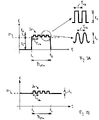
- FIGs 3A, 3B , 3C and 3D Various configurations of individual vibration stimuli 20 are in Figures 3A, 3B , 3C and 3D shown.
- the deflection l of a stimulation element is plotted against time t.
- the stimulation element is deflected from its resting position at time t 1 and pressed into the patient's skin.
- the location of the skin surface is represented by a broken line 21 .
- the duration D stim of the vibration stimulus 20 can be in the range of 10 to 500 ms.
- the stimulation duration D stim is in the range of 0 ⁇ D stim ⁇ T stim N , where N is the number of stimulation units.
- N is the number of stimulation units.
- T stim 1 Hz
- temporally overlapping stimuli can also be used.
- the stimulation element is returned to its resting position where it is not in contact with the skin.
- the vibratory stimulus 20 may be a square wave or sinusoidal stimulus, but may have other shapes.
- Deflection l 1 shown for pressing the stimulation element into the skin can be in the range of 0.5 to 3 mm.
- the deflection l 2 of the stimulation element during vibration can be between 0.1 and 0.5 mm.
- FIG 3B is a variation of the in Figure 3A shown vibration stimulus 20 is shown.
- the stimulation element is always in contact with the patient's skin.
- a vibration stimulus 20 as described above is applied during the stimulation period D stim .
- FIG. 3C Another variation of the vibration stimulus 20 is in Figure 3C shown.
- the stimulation element is already retracted again during the stimulation period D stim so that the vibrations press less into the skin over time and the stimulation element finally detaches completely from the skin.
- the stimulation element can be retracted along a linear or non-linear, for example exponential, curve 22 on which the vibrations f vib of the stimulation element are superimposed.
- the falling edge of each pulse extends down to curve 22 .
- the subsequent pulse has a fixed predetermined height l 2 , ie the rising edge of each pulse has the height l 2 .
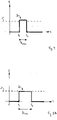
- An embodiment of a tactile stimulus 20 is in 4 shown.
- the stimulation element is pressed into the patient's skin at time t 1 , remains there for the stimulation duration D stim and is moved back again at time t 2 .
- the stimulation duration D stim is in the range from 10 to 500 ms.
- the stimulation duration D stim is in the range specified above in (1), but temporally overlapping stimuli can also be used.
- FIG. 5A , 5B and 5C Various embodiments of individual thermal stimuli 20 are in Figure 5A , 5B and 5C shown.
- a stimulation element is heated to a temperature T temp or cooled.
- the temperature T temp can only be generated shortly before the thermal stimulus 20 is applied.
- the stimulation element has a temperature T 0 during the stimulation pauses, which corresponds to room temperature, for example.
- the stimulation element can be kept at a constant temperature T temp .
- the heated or cooled stimulation element is placed on the patient's skin at time t 1 and remains there for the entire stimulation duration D stim .
- the stimulation element is periodically brought to the skin at a frequency f thermo and removed again during the stimulation duration D stim .
- the thermal stimulus 20 shown essentially corresponds to the thermal stimulus 20 from Figure 5B .
- the difference is that the thermal stimulus 20 off Figure 5C is generated without contact.
- the stimulation temperature T temp is generated by electromagnetic radiation, for example infrared light.
- the stimulation duration D stim is in the range from 10 to 500 ms.
- the stimulation duration D stim is in the range specified above in (1), but temporally overlapping stimuli can also be used.
- the temperature T temp can be from 22 to 42 °C.
- the temperature T 0 is usually the body temperature of the patient.
- the frequency f thermo can be between 1 and 10 Hz, but can also be outside of this range.
- a single stimulus 20 includes several stimulus types.
- the in Figure 3A Vibration stimulus 20 shown can be a thermal stimulus at the same time, provided that the stimulation element exerting the stimulus is heated or cooled accordingly.
- the vibration stimulus 20 is off Figure 3A at the same time a tactile stimulus (tactile receptors are activated by the impact of the stimulation element on the skin).
- the device 100 can be used in particular for the treatment of diseases in which there is increased neuronal synchronization.
- the device 100 can be used in particular to treat diseases of the brain, such as movement disorders, Parkinson's disease, essential tremor, dystonia, migraines, tension headaches, spasticity, functional disorders after a stroke, neuropathic pain, chronic pain conditions, neuralgia, amputation pain, tremor and other functional disorders in the condition after brain trauma.
- diseases of the brain such as movement disorders, Parkinson's disease, essential tremor, dystonia, migraines, tension headaches, spasticity, functional disorders after a stroke, neuropathic pain, chronic pain conditions, neuralgia, amputation pain, tremor and other functional disorders in the condition after brain trauma.
- gastrointestinal diseases such as irritable bowel syndrome can also be treated.
- ulcerative colitis, Crohn's disease, Bronchial asthma, cardiac ischemia and peripheral arterial occlusive disease are treated with the device 100.
- the diseases mentioned above can be caused by a disturbance in the bioelectrical communication of neuron assemblies that are connected in specific circuits.
- a neuron population generates sustained pathological neuronal activity and possibly associated pathological connectivity (network structure).
- a large number of neurons synchronously form action potentials, i.e. the neurons involved fire excessively synchronously.
- the diseased neuron population exhibits oscillatory neuronal activity, i.e. the neurons fire rhythmically.
- the mean frequency of the pathological rhythmic activity of the affected neuron clusters is approximately in the range from 1 to 30 Hz, but can also lie outside this range.
- the neurons fire qualitatively differently, e.g. in an uncorrelated way.
- the stimuli 20 applied by the stimulation units 11 to 14 are received by receptors located in or under the skin and forwarded to the nervous system. These receptors include, for example, Merkel cells, Ruffini bodies, Meissner bodies and hair follicle receptors, which act in particular as receptors for the tactile stimuli 20 .
- the vibration stimuli 20 are primarily aimed at deep sensitivity.
- the vibrational stimuli 20 can be picked up by receptors located in the patient's skin, muscles, subcutaneous tissue and/or tendons.
- the Vater-Pacini corpuscles which mediate vibration sensations and accelerations, should be mentioned as an example of the receptors for the vibration stimuli.
- the thermal stimuli are absorbed by the thermoreceptors of the skin. These are warm receptors (also called heat receptors, warm sensors or thermal sensors) and Cold sensors (also called cold sensors, cold receptors or cold receptors). In the human skin, the cold sensors are more superficial, the warm receptors somewhat deeper.
- the stimuli 20 generated by the stimulation elements 11 to 14 are designed in such a way that when they are received by the corresponding receptors and are conducted via the nerve lines to a neuron population in the brain or spinal cord with a pathologically synchronous and oscillatory activity, they enter the neuron population Resetting, a so-called reset, the phase of the neuronal activity of the stimulated neurons. Resetting sets the phase of the stimulated neurons to a specific phase value, e.g. 0°, regardless of the current phase value. Thus, the phase of the neuronal activity of the diseased neuron population is controlled by means of a targeted stimulation.
- the diseased neuron population whose neurons were previously active synchronously and with the same frequency and phase, is split into several subpopulations. Within a subpopulation, the neurons remain synchronous and continue to fire at the same pathological rate, but each of the subpopulations exhibits the phase of neuronal activity imposed by the stimulus.
- the state generated by the stimulation is unstable with at least two subpopulations, and the entire neuron population rapidly approaches a state of complete desynchronization, in which the neurons fire uncorrelated.
- the desired state i.e. the complete desynchronization, is therefore not present immediately after the application of the stimuli 20, but usually occurs within a few periods or even in less than one period of the pathological activity.
- the respective receptors are stimulated with vibration and/or tactile and/or thermal stimuli 20 at different points of the skin 15 via the stimulation units 11 to 14 .
- the stimuli 20 applied by the stimulation units 11, 12, 13 and 14 are forwarded to different subpopulations 31, 32, 33 and 34 of the neuron population 30 (stimuli from stimulation unit 11 to subpopulation 31, stimuli from stimulation unit 12 to sub-population 32, stimuli from stimulation unit 13 to sub-population 33 and stimuli from stimulation unit 14 to sub-population 34) and reset the phases of these sub-populations at different points in time, whereby a desynchronization of the entire neuron population 30 is achieved.
- the targeted stimulation of certain areas of the brain or spinal cord is made possible by the somatotopic assignment of body regions to these areas.
- the stimulation units 11 to 14 can be attached to the foot, lower leg and thigh or to the hand, lower arm and upper arm of the patient. Due to the somatotopic structure of the nerve conduction pathways, different neurons are stimulated by the stimuli applied at the respective points.
- the somatotopic assignment of skin areas to areas of the brain is, for example, in A. Benninghoff et al.: "Textbook on human anatomy. Presented with preference for functional relationships. 3rd volume. Nervous system, skin and sensory organs", Urban and Schwarzenberg, Kunststoff 1964 , described.
- the stimuli 20 which cause the phase of neurons to be reset, can be delivered with a time delay via the different stimulation units 11 to 14 to the respective receptive fields of the skin.
- the stimuli can, for example, be applied phase-shifted or with different polarity, so that they also result in a time-shifted resetting of the phases of the different subpopulations 31 to 34.
- a stimulation method suitable for the purposes described above is in 7 shown schematically.
- the stimuli 20 applied via the stimulation units 11 to 14 are plotted against the time t.
- stimuli 20 for example, in the Figures 3A to 5C vibration, tactile and thermal stimuli shown are used.
- the diagram shown is divided into periodically repeating first time segments of length T stim .
- the first time sections of length T stim are further subdivided into second time sections of length T stim /4.
- the first time segments could be subdivided into N second time segments of length T stim /N.
- each of the stimulation units 11 to 14 does not generate more than one stimulus 20 within a first time segment.
- Stimuli 20 can be generated by different stimulation units 11 to 14 in subsequent second time segments.
- each of the stimulation units 11 to 14 applies a stimulus 20 strictly periodically with the frequency f stim .
- the administration of the stimuli 20 via different stimulation units 11 to 14 takes place with a time delay between the individual stimulation units 11 to 14 by T stim /4.
- the frequency f stim can, for example, be in the range of the average frequency of the pathologically rhythmic activity of the target network.
- the mean frequency is typically in the range of 1 to 30 Hz, but can also lie outside this range. It should be noted here that the frequency at which the affected neurons fire synchronously is usually not constant, but can vary and also shows individual deviations in each patient.
- the strictly periodic stimulation pattern shown can be deviated from in different ways.
- the time delay T stim between successive stimuli 20 generated by the same stimulation unit does not always have to be the same, but can vary in the range of ⁇ 10% or ⁇ 5% or ⁇ 3% around T stim .
- the time interval between two consecutive stimuli 20 generated by different stimulation units can also vary in the range of ⁇ 10% or ⁇ 5% or ⁇ 3% around T stim /N. Provision can certainly be made for the time intervals between the individual stimuli 20 to be selected differently.
- the delay times can also be varied during the treatment of a patient. The delay times can also be adjusted with regard to the physiological signal propagation times.
- pauses can be provided during the application of the stimuli, during which no stimulation takes place. Such a break is exemplified in 8 shown.
- the pauses can be chosen to be of any length and, in particular, can be an integer multiple of the period T stim .
- the pauses can be after any number of stimulations are complied with. For example, stimulation can be performed for n consecutive periods of length T stim and then a pause for m periods of length T stim without stimulation, where n and m are small integers, eg in the range 1 to 10.
- This scheme can either be continued periodically or modified stochastically and/or deterministically or mixed stochastically-deterministically.
- the order in which the stimulation units 11 to 14 apply the stimuli 20 can be varied per period T stim (or also in other time steps), as is shown in FIG 9 is shown.
- This randomization can be stochastic or deterministic or mixed stochastic-deterministic.
- randomization can be done with the in 8 shown stimulation form can be combined.
- a new randomization can be carried out in each of the n consecutive stimulation time sections of the length T stim or a randomization takes place after each pause of the length mx T stim and within the following n stimulation time sections the order in which the stimulation units 11 to 14 apply the stimuli 20, constant.
- stimulation units 11 to 14 can be used for stimulation per period T stim (or in another time interval) and the stimulation units involved in the stimulation can be varied in each time interval. This variation can also be stochastic or deterministic or mixed stochastic-deterministic.
- the stimulation is started by the patient, for example by telemetric activation.
- the patient can, for example, use an external transmitter to activate the stimulation for a specified period of, for example, 60 minutes, or the patient can start and stop the stimulation himself.
- the device 100 can be operated, for example, in what is known as an “open loop” mode, in which the control unit 10 controls the stimulation units 11 to 14 in such a way that they generate predetermined stimuli 20 that are delivered to the skin tissue. Furthermore, the device 100 can also be used for an in 10 Device 200 shown can be further developed, which represents a so-called "closed loop” system. The device 200 also contains a measuring unit 16 which provides one or more measuring signals recorded on the patient and forwards them to the control unit 10 . Provision can be made for the control unit 10 to control the stimulation units 11 to 14 on the basis of the measurement signals recorded by the measurement unit 16 .
- the measuring unit 16 can be non-invasive sensors, such as electroencephalography (EEG) electrodes, magnetoencephalography (MEG) sensors, accelerometers, electromyography (EMG) electrodes and sensors for determining blood pressure, respiration or skin resistance. Furthermore, the measuring unit 16 can be implanted in the patient's body in the form of one or more sensors. For example, deep brain electrodes, sub- or epidural brain electrodes, subcutaneous EEG electrodes and sub- or epidural spinal cord electrodes can serve as invasive sensors. Furthermore, electrodes to be attached to peripheral nerves can be used as sensors. In particular, by means of of the measuring unit 16 the neuronal activity in the stimulated target area, ie for example the neuronal activity of the in 6 schematically illustrated neuron population 30, or an associated area can be measured.
- EEG electroencephalography
- MEG magnetoencephalography
- EMG electromyography
- control unit 10 uses the measurement signals recorded by the measurement unit 16 to detect the presence and/or the severity of one or more pathological features. For example, the amplitude or amount of neural activity can be measured and compared to a predetermined threshold.
- the control unit 10 can be designed in such a way that stimulation is started as soon as the predefined threshold value is exceeded.
- the control unit 10 can set the strength of the stimuli, for example, based on the severity of the pathological features.
- one or more threshold values can be specified, and if the amplitude or the amount of the measurement signals exceeds a specific threshold value, the control unit 10 sets a specific strength of the stimuli 20, e.g. a specific frequency f vib or indentation depth l 2 in the case of vibration stimuli, a.
- the measurement signals recorded by the measurement unit 16 are used as stimuli 20 directly or possibly after one or more processing steps and are fed by the control unit 1 into one or more of the stimulation units 11 to 14 .
- the measurement signals can be amplified and possibly after mathematical calculation (eg after mixing the measurement signals) with a time delay and linear and/or non-linear calculation steps and combinations processed and fed into at least one of the stimulation units 11 to 14.
- the calculation mode is selected in such a way that the pathological neuronal activity is counteracted and the stimulation signal likewise disappears or at least its strength is significantly reduced as the pathological neuronal activity decreases.
- the (possibly further processed) measurement signals can be analogous to the stimulation method 7 are applied with a time delay of T stim /4 via the individual stimulation units 11 to 14.
- This type of stimulation in which the measurement signals recorded on the patient are fed back into the patient's body to desynchronize a neuron population, could in principle also be carried out with just a single stimulation unit, but any larger number of stimulation units can also be provided.
- the measurement signals can be amplified, for example, and optionally used after mathematical calculation (e.g. after mixing the measurement signals) with a time delay and linear and/or non-linear calculation steps for electrical activation of the stimulation units, which then convert the measurement signals into vibration, Implement tactile or thermal stimuli.
- the calculation mode can be selected in such a way that the pathological neuronal activity is counteracted and the applied stimulus also disappears or at least its strength is significantly reduced as the pathological neuronal activity decreases.
- the measurement signal can be filtered and/or amplified and/or subjected to a time delay, for example, before the signal processed in this way is fed into the stimulation unit and used in a vibration and/or tactile and /or thermal stimulus is implemented.
- the measurement signal was recorded using an EEG electrode and reflects the pathological activity in the target area. Accordingly, the measurement signal is a sinusoidal oscillation with a frequency in the range from 1 to 30 Hz. It is also assumed, for example, that the measurement signal has a frequency of 5 Hz.
- the measurement signal can be filtered using a bandpass filter with a passband in the range of 5 Hz and amplified using an amplifier so that it has a level suitable for driving the stimulation unit.
- the amplified sinusoidal oscillation thus obtained is then used to control the stimulation unit.
- the stimulation element In the case of a stimulation unit for applying vibration or tactile stimuli, the stimulation element then carries out a sinusoidal movement with a frequency of 5 Hz.
- the measurement signal can be 7 shown time delays T stim / N are applied before it is fed into the corresponding stimulation units.
- the measurement signal can be subjected to non-linear processing before it is stimulation stimulus is used.
- the measurement signal can also be filtered and/or amplified and/or subjected to a time delay.
- S (t) K ⁇ Z ⁇ 2 t ⁇ Z ⁇ * t ⁇ ⁇
- K is a gain factor that can be suitably chosen, and e.g (t) an average state variable of the measurement signal.
- FIGS 11A to 11C show schematically different possibilities for the realization of a stimulation unit for generating vibration and / or tactile stimuli, as in the Figures 3A to 4 are shown.
- the stimulation units include a stimulation element 40, for example in the form of a rod, with one end of which the skin 15 of the patient is stimulated.
- the stimulation element 40 is driven by an electromechanical converter 41 (or actuator or actuator), which converts electrical energy into a movement of the stimulation element 40 .
- Suitable electromechanical converters 41 are, for example, direct current motors, voice coils, piezoelectric converters or converters constructed from electroactive polymers (EAP), which change their shape when an electrical voltage is applied.
- EAP electroactive polymers
- the electromechanical converters 41 can be designed in such a way that the stimulation element 40 is deflected perpendicularly to the skin surface (cf. Figure 11A ) or parallel to it (cf. Figure 11B ). However, the movement of the stimulation element 40 can also take place on any other paths. An example of this is in Figure 11C a pendulum-shaped deflection of the stimulation element 40 is shown.
- the end of the stimulation element 40 which comes into contact with the skin surface and ultimately generates the stimuli, can essentially have the shape of a hemisphere, for example (cf. 12A ) or have a nub-like surface (cf. Figure 12B ) or any other suitable form.
- FIG. 13A to 13C is an embodiment of a stimulation element for the application of vibratory and/or tactile stimuli in a transparent view (cf. 13A ), top view from below (cf. Figure 13B ) and in cross section (cf. Figure 13C ) shown.
- the present stimulation element contains a piezo actuator 41 as an electromechanical converter. Since the deflection of the piezo actuator 41 is not sufficient for the intended purposes, a mechanism for amplification the deflection of the piezo actuator 41 may be provided.
- a lever arm 42 is shown here as an example, which amplifies the movement of the piezoelectric actuator 41 .
- the lever arm is an elongate bending spring 42 which is attached at one end to the housing 43 of the stimulation element and at the other end of which the stimulation element 40 is attached.
- the piezo actuator 41 presses on the upper side of the spiral spring 42 and the stimulation element 40 attached to the underside of the spiral spring 42 follows the deflection of the piezo actuator 41 with an amplified amplitude due to the geometric arrangement and applies the vibration and/or tactile stimuli to the patient's skin.
- the underside of the stimulation element 40 which comes into contact with the skin, can have different geometries and dimensions.
- the underside of the stimulation element 40 can be flat, round or irregular.
- a space 44 for electronics and connection terminals can also be provided in the housing 43 of the stimulation element, which houses the piezoactuator 41 and the amplification mechanism.
- an adjustment ring 45 is attached to the underside of the housing 43, which is connected to the housing 43 via a thread and which enables the height by which the stimulation element 40 protrudes from the underside of the stimulation unit in its rest position to be adjusted.
- the underside of the stimulation unit sits on the patient's skin and is attached to the patient's body, for example, with a suitable cuff.
- the stimulation unit could also be attached to the patient's skin with a single-sided or double-sided medical adhesive tape.
- the housing 43 protects the patient from potential hazards such as electrical voltage.
- FIGS 14A to 14B show schematically differently designed stimulation units for generating thermal stimuli, as in the Figures 5A to 5C are shown.
- the stimulation unit works without contact and uses the light from an infrared LED 50 to heat the skin.
- Stimulator units that apply thermal stimuli by touching the skin surface are in the Figures 14B and 14C shown.
- the stimulation unit shown contains, with an electromechanical converter 41 and a rod-shaped stimulation element 40, essentially the same components as the stimulation unit Figure 11A .
- the stimulation unit Figure 14B a heating and/or cooling element (eg in the form of a heating loop) which heats or cools the stimulation element.
- the thermal stimuli are generated by the movements of the stimulation element 40, during which the stimulation element 40 repeatedly comes into contact with the skin 15 and is removed again.
- the temperature of the stimulation element 40 can be constant throughout the stimulation.
- the heatable or coolable stimulation element 40 as in Figure 14C shown in contact with the patient's skin 15 throughout the stimulation period.
- the thermal stimuli are generated by varying the temperature of the stimulation element 40 over time.
- An electromechanical converter is not absolutely necessary in this configuration.
- FIG. 15A to 15C is an embodiment of a stimulation element for the application of thermal stimuli in transparency (cf. Figure 15A ), top view from below (cf. Figure 15B ) and in cross section (cf. Figure 15C ) shown.
- the stimulation unit contains a rod-shaped stimulation element 40, the lower end of which can be heated and/or cooled.
- the stimulation element 40 is driven by a cam disk 51 at its upper end.
- a DC motor 52 causes cam 51 to rotate.
- a return spring 54 ensures that the stimulation element 40 then returns to its starting position.
- the rotational movement of the cam disk 51 is converted into a linear movement of the stimulation element 40 by this mechanism.
- the stimulation element 40 can either be in contact with the patient's skin for a certain period of time, or the stimulation element 40 is cyclically brought onto the skin and removed again by a rotation of the cam disk 51 .
- the components of the stimulation unit can be placed in a housing 55 .
- a space 56 for electronics and connection terminals can be provided in the housing 55 .
- an adjustment ring 57 can be attached to the underside of the housing 55, which is connected to the housing 55 via a thread and which enables the height by which the stimulation element 40 protrudes from the underside of the stimulation unit in its rest position (the stimulation element 40 Due to the adjustment ring, it can also lie completely above the underside of the adjustment ring in its rest position).
- the underside of the stimulation unit sits on the patient's skin and is attached to the patient's body, for example, with a suitable cuff.
- the stimulation unit could also be attached to the patient's skin with a single-sided or double-sided medical adhesive tape.
- the housing 55 protects the patient from potential hazards such as electrical voltage.
- the stimulation units described in this application can be attached individually to the patient or several can also be integrated into a module.
- a module can include a cuff with multiple stimulation units attached. The cuff can then be attached to the patient's arm or leg.
- 16 shows stimulation methods that can be carried out with a total of N modules, each of which contains, for example, four stimulation units. At the in 16 In the stimulation method shown on the far left, all stimulation units apply a vibration, tactile or thermal stimulus 20 at the beginning of a stimulation period T stim 16 In the stimulation methods shown, the stimuli 20 of the four different stimulation units of a module are each shifted by T stim /4 relative to one another.
- exactly one stimulation unit of each module applies a stimulus 20 in each time segment of length T stim /4 16
- the four stimulation units of a module generate their stimuli 20 simultaneously, but the stimuli 20 of different modules are shifted relative to one another.
- any pauses can also be observed during the stimulation.
- the stimulation pauses have the length of one or more stimulation periods T stim . This is an example in 17 shown. In the stimulation method presented there, stimulation is carried out during two consecutive stimulation periods T stim , after which a stimulation pause is observed during a stimulation period T stim . This pattern repeats itself periodically.
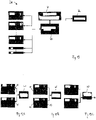
- the device 300 includes n modules, each with n stimulation units and n sensors.
- the modules and sensors are connected via connecting lines or via radio (eg a WPAN (Wireless Personal Area Network) network) to a connection module 60 which in turn can be connected to a computer 61 , eg a laptop, and external devices 62 .
- a computer 61 eg a laptop
- external devices 62 e.g a Wi-Fi Protected Access
- Not all modules and sensors have to be used at the same time; depending on the type of stimulation, only a subset of them can be used.
- the modules and/or sensors can be powered by batteries or accumulators, so that they are independent of a central power supply.
- the user for example a doctor, can use suitable software stored on the computer 61 to select a stimulation method and set the parameters of this stimulation method.
- the stimulation units integrated into the modules can be controlled via the computer 61 .
- a control unit 10 can be integrated into each module (cf. Figure 19A ), which is responsible for controlling the stimulation units of the respective module. This enables largely independent operation of the modules.
- a separate control unit 10 can be provided for each stimulation unit (cf. Figure 19B ). This allows for the greatest versatility in the operation of the stimulation units, but increases the weight and dimensions of the modules.
- the control unit 10 can be placed centrally in the connection module 60 . The advantages of this are the low weight and size of the modules and low-cost production. However, in this configuration, the modules cannot be operated independently of the connection module 60 .
Landscapes
- Health & Medical Sciences (AREA)
- Animal Behavior & Ethology (AREA)
- Veterinary Medicine (AREA)
- Public Health (AREA)
- General Health & Medical Sciences (AREA)
- Life Sciences & Earth Sciences (AREA)
- Physical Education & Sports Medicine (AREA)
- Epidemiology (AREA)
- Pain & Pain Management (AREA)
- Rehabilitation Therapy (AREA)
- Dermatology (AREA)
- Vascular Medicine (AREA)
- Heart & Thoracic Surgery (AREA)
- Biomedical Technology (AREA)
- Engineering & Computer Science (AREA)
- Percussion Or Vibration Massage (AREA)
- Electrotherapy Devices (AREA)
- Radiation-Therapy Devices (AREA)
- Thermotherapy And Cooling Therapy Devices (AREA)
Applications Claiming Priority (3)
| Application Number | Priority Date | Filing Date | Title |
|---|---|---|---|
| DE102010000390A DE102010000390A1 (de) | 2010-02-11 | 2010-02-11 | Vorrichtung und Verfahren zur Behandlung eines Patienten mit Vibrations-, Tast- und/oder Thermoreizen |
| EP11707565.5A EP2533747B8 (fr) | 2010-02-11 | 2011-01-18 | Appareil pour le traitement d'un patient par l'application de stimulations vibratoires, tactiles et/ou thermales |
| PCT/DE2011/075004 WO2011098082A1 (fr) | 2010-02-11 | 2011-01-18 | Dispositif de traitement d'un patient par des stimuli vibrationnels, tactiles et/ou thermiques |
Related Parent Applications (2)
| Application Number | Title | Priority Date | Filing Date |
|---|---|---|---|
| EP11707565.5A Division EP2533747B8 (fr) | 2010-02-11 | 2011-01-18 | Appareil pour le traitement d'un patient par l'application de stimulations vibratoires, tactiles et/ou thermales |
| EP11707565.5A Division-Into EP2533747B8 (fr) | 2010-02-11 | 2011-01-18 | Appareil pour le traitement d'un patient par l'application de stimulations vibratoires, tactiles et/ou thermales |
Publications (2)
| Publication Number | Publication Date |
|---|---|
| EP4094745A1 true EP4094745A1 (fr) | 2022-11-30 |
| EP4094745B1 EP4094745B1 (fr) | 2025-08-27 |
Family
ID=43982211
Family Applications (3)
| Application Number | Title | Priority Date | Filing Date |
|---|---|---|---|
| EP11707565.5A Active EP2533747B8 (fr) | 2010-02-11 | 2011-01-18 | Appareil pour le traitement d'un patient par l'application de stimulations vibratoires, tactiles et/ou thermales |
| EP22177955.6A Active EP4094745B1 (fr) | 2010-02-11 | 2011-01-18 | Dispositif de traitement d'un patient par stimulation vibratoire, tactile et/ou thermique |
| EP22177954.9A Active EP4074299B1 (fr) | 2010-02-11 | 2011-01-18 | Dispositif de traitement d'un patient par stimulation vibratoire, tactile et/ou thermique |
Family Applications Before (1)
| Application Number | Title | Priority Date | Filing Date |
|---|---|---|---|
| EP11707565.5A Active EP2533747B8 (fr) | 2010-02-11 | 2011-01-18 | Appareil pour le traitement d'un patient par l'application de stimulations vibratoires, tactiles et/ou thermales |
Family Applications After (1)
| Application Number | Title | Priority Date | Filing Date |
|---|---|---|---|
| EP22177954.9A Active EP4074299B1 (fr) | 2010-02-11 | 2011-01-18 | Dispositif de traitement d'un patient par stimulation vibratoire, tactile et/ou thermique |
Country Status (8)
| Country | Link |
|---|---|
| US (3) | US20130041296A1 (fr) |
| EP (3) | EP2533747B8 (fr) |
| JP (1) | JP5746715B2 (fr) |
| CN (1) | CN102858302B (fr) |
| DE (1) | DE102010000390A1 (fr) |
| DK (1) | DK2533747T5 (fr) |
| ES (3) | ES3048484T3 (fr) |
| WO (1) | WO2011098082A1 (fr) |
Families Citing this family (44)
| Publication number | Priority date | Publication date | Assignee | Title |
|---|---|---|---|---|
| DE102010016404A1 (de) | 2010-04-12 | 2012-12-27 | Forschungszentrum Jülich GmbH | Vorrichtung und Verfahren zur konditionierten desynchronisierenden nicht-invasiven Stimulation |
| DE102010016461B4 (de) | 2010-04-15 | 2013-03-21 | Forschungszentrum Jülich GmbH | Vorrichtung zur Behandlung von Erkrankungen des Gehirns und/oder Rückenmarks mittels Neurofeedback |
| WO2013059658A1 (fr) * | 2011-10-19 | 2013-04-25 | Sympara Medical Inc. | Méthodes et dispositifs pour le traitement de l'hypertension |
| DE102012002436B4 (de) * | 2012-02-08 | 2014-08-21 | Forschungszentrum Jülich GmbH | Vorrichtung zur Eichung einer nicht-invasiven desynchronisierenden Neurostimulation |
| US10632040B2 (en) * | 2012-02-29 | 2020-04-28 | Frederick Muench | Systems, devices, components and methods for triggering or inducing resonance or high amplitude oscillations in a cardiovascular system of a patient |
| US10973736B2 (en) * | 2012-02-29 | 2021-04-13 | Frederick J. Muench | Systems, devices, components and methods for triggering or inducing resonance or high amplitude oscillations in a cardiovascular system of a patient |
| US10098810B1 (en) * | 2013-02-27 | 2018-10-16 | Frederick Muench | Systems, devices, components and methods for triggering or inducing resonance or high amplitude oscillations in a cardiovascular system of a patient |
| US9943461B1 (en) * | 2012-02-29 | 2018-04-17 | Frederick Muench | Systems, devices, components and methods for triggering or inducing resonance or high amplitude oscillations in a cardiovascular system of a patient |
| DE102012005030B4 (de) * | 2012-03-12 | 2016-06-16 | Forschungszentrum Jülich GmbH | Vorrichtung und Verfahren zur Stimulation mit Thermoreizen |
| CN104379109A (zh) * | 2012-05-16 | 2015-02-25 | 辛帕拉医疗有限公司 | 向身体提供机械刺激的方法和设备 |
| US9849025B2 (en) * | 2012-09-07 | 2017-12-26 | Yale University | Brain cooling system |
| NO335546B1 (no) * | 2013-03-14 | 2014-12-29 | Redcord As | Fremgangsmåte og anordning ved bruk av behandlingsutstyr |
| US10071015B2 (en) | 2013-04-18 | 2018-09-11 | Uwm Research Foundation, Inc. | Wearable device for improving tactile sensitivity |
| US20150025421A1 (en) * | 2013-07-19 | 2015-01-22 | Highland Instruments, Inc. | Stimulation to guide physical therapy |
| SE1400126A1 (sv) * | 2014-03-07 | 2015-09-08 | Atlasbalans Ab | En apparat och ett förfarande för behandling av fascia |
| DE102015119741B4 (de) | 2014-11-14 | 2024-02-15 | Universität Potsdam | Vorrichtung zur individuell rückgekoppelten Regulation von Muskel- und/oder Sehnen-Oszillationen eines menschlichen und/oder tierischen Nutzers |
| DE102014117427B4 (de) | 2014-11-27 | 2016-12-15 | Forschungszentrum Jülich GmbH | Vorrichtung zur effektiven nicht-invasiven Neurostimulation mittels variierender Reizsequenzen |
| DE102014117429A1 (de) * | 2014-11-27 | 2016-06-02 | Forschungszentrum Jülich GmbH | Vorrichtung und Verfahren zur effektiven invasiven Neurostimulation mittels variierender Reizsequenzen |
| DE102015101371A1 (de) | 2015-01-30 | 2016-08-04 | Forschungszentrum Jülich GmbH | Vorrichtung und Verfahren zur nicht-invasiven Neurostimulation mittels Mehrkanal-Bursts |
| DE102015101823A1 (de) * | 2015-02-09 | 2016-08-11 | Forschungszentrum Jülich GmbH | Vorrichtung und Verfahren zur Kalibrierung einer nicht-invasiven mechanisch taktilen und/oder thermischen Neurostimulation |
| FR3034313B1 (fr) * | 2015-04-03 | 2021-03-05 | Yves Charton | Dispositif generateur de stimuli et procede de mise en oeuvre. |
| DE102015109988B4 (de) * | 2015-06-22 | 2017-04-27 | Forschungszentrum Jülich GmbH | Vorrichtung zur effektiven invasiven Zwei-Stufen-Neurostimulation |
| CN104958177B (zh) * | 2015-07-10 | 2017-04-05 | 京东方科技集团股份有限公司 | 肌肉按摩装置 |
| US11031117B2 (en) | 2016-04-18 | 2021-06-08 | Vmas Solutions, Inc. | Systems and methods for reducing stress |
| US11000437B2 (en) * | 2016-04-18 | 2021-05-11 | Vmas Solutions Inc. | System and method for reducing stress |
| WO2018111905A1 (fr) | 2016-12-12 | 2018-06-21 | The General Hospital Corporation | Systèmes et procédés de traitement de troubles mentaux et neurologiques impliquant une connectivité cérébrale anormalement élevée |
| US20210330547A1 (en) * | 2017-09-01 | 2021-10-28 | Adventus Ventures, Llc | Systems and methods for controlling the effects of tremors |
| US20210186794A1 (en) * | 2017-09-26 | 2021-06-24 | Georgia Tech Research Corporation | Device and Method for Passive Tactile Stimulation |
| SG10201708113UA (en) * | 2017-10-03 | 2019-05-30 | Aitreat Pte Ltd | Automatic artificial human massage apparatus |
| US10959674B2 (en) | 2017-10-23 | 2021-03-30 | Datafeel Inc. | Communication devices, methods, and systems |
| DE102018004685B4 (de) * | 2018-06-12 | 2023-02-09 | Bhm-Tech Produktionsgesellschaft M.B.H. | Vibrotaktiles Stimulationssystem |
| WO2019243634A1 (fr) * | 2018-06-22 | 2019-12-26 | Gretap Ag | Dispositif de traitement médical et procédé de stimulation de neurones d'un patient pour supprimer une activité pathologiquement synchrone de celui-ci |
| TWI702038B (zh) * | 2018-09-10 | 2020-08-21 | 微采視像科技股份有限公司 | 促進毛髮生長系統 |
| US11701293B2 (en) | 2018-09-11 | 2023-07-18 | Encora, Inc. | Apparatus and method for reduction of neurological movement disorder symptoms using wearable device |
| US11839583B1 (en) | 2018-09-11 | 2023-12-12 | Encora, Inc. | Apparatus and method for reduction of neurological movement disorder symptoms using wearable device |
| US12318341B2 (en) | 2018-09-11 | 2025-06-03 | Encora, Inc. | Apparatus and method for reduction of neurological movement disorder symptoms using wearable device |
| AU2018444554A1 (en) * | 2018-10-03 | 2021-04-08 | Breas Medical Ab | Devices and methods for treating a breathing-related sleep disorder, methods of use and control processes for such a device |
| CN109700438A (zh) * | 2019-02-27 | 2019-05-03 | 复旦大学 | 一种给予实验动物机械力与高温的复合体感刺激器 |
| KR102160875B1 (ko) * | 2019-03-11 | 2020-09-28 | 한국광기술원 | 복합 자극을 통한 뇌 운동 장치 및 방법 |
| CN109820711B (zh) * | 2019-03-26 | 2020-09-25 | 清华大学 | 一种气动驱动的局部振动康复训练设备 |
| EP3772353A1 (fr) * | 2019-08-07 | 2021-02-10 | Daniele Di Lernia | Appareil et procédé de stimulation tactile de la peau humaine |
| EP3838334A1 (fr) * | 2019-12-18 | 2021-06-23 | ONWARD Medical B.V. | Système de fourniture de stimulation |
| US11364173B2 (en) * | 2020-05-23 | 2022-06-21 | Lucas Smith | Customizable massage device |
| WO2025009891A1 (fr) * | 2023-07-06 | 2025-01-09 | 주식회사 씨케이머티리얼즈랩 | Appareil pour mesurer la fermeté de la peau |
Citations (4)
| Publication number | Priority date | Publication date | Assignee | Title |
|---|---|---|---|---|
| US4370602A (en) * | 1977-05-25 | 1983-01-25 | Jones Jr Johnny O | Waterbed vibrator |
| US20080275372A1 (en) * | 2007-05-02 | 2008-11-06 | Yoshio Shimotori | Neurological disease prevention apparatus |
| EP2103288A2 (fr) * | 2008-03-20 | 2009-09-23 | Universität zu Köln | Dispositif et procédé de stimulation auditive |
| WO2009136931A1 (fr) * | 2008-05-08 | 2009-11-12 | Lotus Magnus, Llc. | Systèmes, dispositifs et procédés pour traiter le syndrome des jambes sans repos et un trouble périodique du mouvement des membres |
Family Cites Families (53)
| Publication number | Priority date | Publication date | Assignee | Title |
|---|---|---|---|---|
| US2924216A (en) * | 1957-06-10 | 1960-02-09 | James B Stewart | Massage table |
| US5042479A (en) * | 1988-02-29 | 1991-08-27 | Brotz Gregory R | Therapeutic vibratory bath |
| JPH0796016A (ja) * | 1991-08-13 | 1995-04-11 | Iwasaki Kiyoko | 皮膚の触角を刺激する方法及び其の装置 |
| US5336159A (en) * | 1992-08-25 | 1994-08-09 | Cheng Tzu Keng | Infrared massager |
| RU2047298C1 (ru) * | 1993-05-27 | 1995-11-10 | Специализированное конструкторско-технологическое бюро "Норд" | Устройство для криомассажа |
| CN2172112Y (zh) * | 1993-06-14 | 1994-07-20 | 张风 | 治疗保健盆 |
| US5611771A (en) * | 1994-11-14 | 1997-03-18 | Sharper Image Corporation | Head mounted pulse action facial massager |
| US5800481A (en) | 1995-12-28 | 1998-09-01 | Loos; Hendricus G. | Thermal excitation of sensory resonances |
| US6027463A (en) * | 1996-12-27 | 2000-02-22 | Moriyasu; Hiro | Music massager |
| CN2300412Y (zh) * | 1997-02-02 | 1998-12-16 | 曹金奎 | 气功练功辅助器 |
| WO2002058618A1 (fr) * | 1998-03-16 | 2002-08-01 | Brotz Gregory R | Appareil de massage therapeutiquement stimulant |
| US6217533B1 (en) * | 1998-11-18 | 2001-04-17 | Wahl Clipper Corporation | Portable vibrating units having different speeds |
| WO2001003638A1 (fr) * | 1999-07-12 | 2001-01-18 | Dermispa Group, Inc. | Dispositif de massage et de stimulation et son procede d'utilisation |
| US6432072B1 (en) * | 2000-01-21 | 2002-08-13 | Brookstone Company, Inc. | Hand held percussive massager with adjustable nodes |
| US6458089B1 (en) * | 2000-04-20 | 2002-10-01 | Amir Ziv-Av | Methods and devices for reducing trembling |
| RU2202323C2 (ru) * | 2001-01-24 | 2003-04-20 | Савельев Борис Сергеевич | Способ волновой биомеханотерапии б.с. савельева |
| US7520875B2 (en) * | 2001-04-06 | 2009-04-21 | Mattioli Engineering Ltd. | Method and apparatus for skin absorption enhancement and transdermal drug delivery |
| US7572239B1 (en) * | 2001-07-09 | 2009-08-11 | Brotz Gregory R | Wave exercise device and method of use |
| JP2003293207A (ja) * | 2002-03-29 | 2003-10-15 | Mizuno Corp | 衣類、姿勢形成方法およびトレーニング指導方法 |
| US6934580B1 (en) * | 2002-07-20 | 2005-08-23 | Flint Hills Scientific, L.L.C. | Stimulation methodologies and apparatus for control of brain states |
| DE10318071A1 (de) | 2003-04-17 | 2004-11-25 | Forschungszentrum Jülich GmbH | Vorrichtung zur Desynchronisation von neuronaler Hirnaktivität |
| US20040260215A1 (en) | 2003-06-23 | 2004-12-23 | Hakjin Kim | Human body massaging method and apparatus |
| CN2645656Y (zh) * | 2003-06-24 | 2004-10-06 | 杨云峰 | 颈部热磁按摩带 |
| EP1501175B1 (fr) | 2003-07-01 | 2006-05-24 | Alcatel | Procédé pour éviter la saturation d'un enroulement inductif et circuit d'enroulement inductif pour la realisation d'un tel procédé |
| US20070203435A1 (en) | 2004-03-26 | 2007-08-30 | Peter Novak | System And Method For Gait Synchronized Vibratory Stimulation Of The Feet |
| DE102004025825A1 (de) * | 2004-05-24 | 2005-12-29 | Forschungszentrum Jülich GmbH | Vorrichtung zur Behandlung von Patienten mittels Hirnstimulation, ein elektronisches Bauteil sowie die Verwendung der Vorrichtung und des elektronischen Bauteils in der Medizin und medizinisches Behandlungsverfahren |
| WO2005117797A2 (fr) * | 2004-05-26 | 2005-12-15 | The Metrohealth System | Methode et appareil pour soulager la cephalee |
| JP2005348766A (ja) * | 2004-06-08 | 2005-12-22 | Tanaka Kikaku:Kk | 絆創膏 |
| US20060100567A1 (en) * | 2004-07-30 | 2006-05-11 | Rocky Mountain Biosystems, Inc | Microsurgical tissue treatment system |
| WO2006046846A1 (fr) * | 2004-10-28 | 2006-05-04 | Francisco Alvarado Barrientos | Module chauffant pour liquides et chaudiere a vapeur |
| DE102004060514A1 (de) * | 2004-12-16 | 2006-06-29 | Forschungszentrum Jülich GmbH | Verfahren und Vorrichtung zur Desynchronisation neuronaler Hirnaktivität, Steuerung, sowie Verfahren zur Behandlung neuronaler und/oder psychiatrischer Erkrankungen |
| US20070100214A1 (en) | 2005-03-10 | 2007-05-03 | Steinert John W | Method and apparatus for stimulating exercise |
| US8388561B2 (en) * | 2005-07-01 | 2013-03-05 | The United States Of America, As Represented By The Secretary, Department Of Health And Human Services | Systems and methods for recovery from motor control via stimulation to a substituted site to an affected area |
| TW200714272A (en) * | 2005-10-14 | 2007-04-16 | Chao-Ren Xu | Fomentation massager having phototherapeutic and vibrating functions |
| US8357108B2 (en) | 2006-01-13 | 2013-01-22 | Advanced Therapy Systems Llc | Physical therapy tool |
| EP1991129B1 (fr) * | 2006-02-24 | 2016-06-29 | NanoVibronix Inc. | Systeme pour le traitement de la peau par onde acoustique de surface |
| KR20080105028A (ko) | 2006-03-31 | 2008-12-03 | 패밀리 가부시키가이샤 | 마사지기 |
| JP2007268048A (ja) * | 2006-03-31 | 2007-10-18 | Toto Ltd | 浴室装置 |
| US20070255187A1 (en) * | 2006-04-26 | 2007-11-01 | Branch Alan P | Vibrating therapy device |
| US20080200854A1 (en) * | 2006-12-06 | 2008-08-21 | Merlex Corporation Pty Ltd | Method of treating muscle soreness or a soft tissue oedema |
| US20090005713A1 (en) | 2007-02-12 | 2009-01-01 | Podrazhansky Yury M | Method and Device for Using Vibroacoustical Stimulation to Treat Target Tissue Areas of Living Organisms |
| JP4416019B2 (ja) * | 2007-07-31 | 2010-02-17 | パナソニック電工株式会社 | マッサージ機 |
| US8177825B2 (en) * | 2007-12-10 | 2012-05-15 | Remco International, Inc. | Method of dynamic binary temperature therapy |
| CA2716407C (fr) * | 2008-02-29 | 2018-04-03 | Sensory Medical, Inc. | Dispositifs et procedes de traitement du syndrome des jambes sans repos |
| CA2623464A1 (fr) * | 2008-04-08 | 2009-10-08 | Daniel Belanger | Appareil permettant de faire vibrer la tete chez l'humain |
| DE102008052078B4 (de) | 2008-10-17 | 2011-06-01 | Forschungszentrum Jülich GmbH | Vorrichtung zur konditionierten desynchronisierenden Stimulation |
| NO329077B1 (no) * | 2008-11-21 | 2010-08-16 | Vibrotron As | Fremgangsmate og anordning for ereksjonsforsterkning |
| US8162398B2 (en) * | 2009-03-26 | 2012-04-24 | Schukra of North America Co. | Zone lumbar massage system |
| US20100274175A1 (en) | 2009-04-22 | 2010-10-28 | Mattioli Engineering Ltd. | Method and apparatus for skin absorption enhancement and transdermal drug delivery |
| US20100318007A1 (en) * | 2009-06-10 | 2010-12-16 | O'brien Donald J | Electromechanical tactile stimulation devices and methods |
| DE102009025407B4 (de) | 2009-06-18 | 2020-07-09 | Forschungszentrum Jülich GmbH | Vorrichtung zur Stimulation von neuronalem Gewebe mittels optischer Reize |
| US9861519B2 (en) * | 2010-12-16 | 2018-01-09 | Scion Neurostim, Llc | Apparatus and methods for titrating caloric vestibular stimulation |
| US10548810B2 (en) * | 2015-01-28 | 2020-02-04 | Rapid Release Technology, LLC | Systems and methods for high speed vibration therapy |
-
2010
- 2010-02-11 DE DE102010000390A patent/DE102010000390A1/de not_active Ceased
-
2011
- 2011-01-18 EP EP11707565.5A patent/EP2533747B8/fr active Active
- 2011-01-18 ES ES22177955T patent/ES3048484T3/es active Active
- 2011-01-18 EP EP22177955.6A patent/EP4094745B1/fr active Active
- 2011-01-18 ES ES22177954T patent/ES3048382T3/es active Active
- 2011-01-18 EP EP22177954.9A patent/EP4074299B1/fr active Active
- 2011-01-18 US US13/578,375 patent/US20130041296A1/en not_active Abandoned
- 2011-01-18 CN CN201180014533.XA patent/CN102858302B/zh active Active
- 2011-01-18 WO PCT/DE2011/075004 patent/WO2011098082A1/fr not_active Ceased
- 2011-01-18 ES ES11707565T patent/ES2923633T3/es active Active
- 2011-01-18 DK DK11707565.5T patent/DK2533747T5/da active
- 2011-01-18 JP JP2012552256A patent/JP5746715B2/ja active Active
-
2019
- 2019-06-26 US US16/453,590 patent/US11253424B2/en active Active
-
2022
- 2022-02-17 US US17/674,522 patent/US12193988B2/en active Active
Patent Citations (4)
| Publication number | Priority date | Publication date | Assignee | Title |
|---|---|---|---|---|
| US4370602A (en) * | 1977-05-25 | 1983-01-25 | Jones Jr Johnny O | Waterbed vibrator |
| US20080275372A1 (en) * | 2007-05-02 | 2008-11-06 | Yoshio Shimotori | Neurological disease prevention apparatus |
| EP2103288A2 (fr) * | 2008-03-20 | 2009-09-23 | Universität zu Köln | Dispositif et procédé de stimulation auditive |
| WO2009136931A1 (fr) * | 2008-05-08 | 2009-11-12 | Lotus Magnus, Llc. | Systèmes, dispositifs et procédés pour traiter le syndrome des jambes sans repos et un trouble périodique du mouvement des membres |
Also Published As
| Publication number | Publication date |
|---|---|
| CN102858302A (zh) | 2013-01-02 |
| WO2011098082A1 (fr) | 2011-08-18 |
| ES2923633T3 (es) | 2022-09-29 |
| DK2533747T5 (da) | 2022-08-08 |
| DK2533747T3 (da) | 2022-08-01 |
| US12193988B2 (en) | 2025-01-14 |
| US20130041296A1 (en) | 2013-02-14 |
| EP2533747B8 (fr) | 2022-08-03 |
| US20220168180A1 (en) | 2022-06-02 |
| ES3048484T3 (en) | 2025-12-10 |
| EP4074299A1 (fr) | 2022-10-19 |
| EP4094745B1 (fr) | 2025-08-27 |
| US11253424B2 (en) | 2022-02-22 |
| EP2533747B1 (fr) | 2022-06-22 |
| JP5746715B2 (ja) | 2015-07-08 |
| CN102858302B (zh) | 2014-10-01 |
| DE102010000390A1 (de) | 2011-08-11 |
| EP2533747A1 (fr) | 2012-12-19 |
| EP4074299B1 (fr) | 2025-08-27 |
| US20200214933A1 (en) | 2020-07-09 |
| ES3048382T3 (en) | 2025-12-10 |
| JP2013519400A (ja) | 2013-05-30 |
Similar Documents
| Publication | Publication Date | Title |
|---|---|---|
| EP2533747B1 (fr) | Appareil pour le traitement d'un patient par l'application de stimulations vibratoires, tactiles et/ou thermales | |
| EP2358430B1 (fr) | Dispositif de stimulation conditionnelle de desynchronisation | |
| EP2103288B1 (fr) | Dispositif de stimulation auditive | |
| DE102007051848B4 (de) | Vorrichtung zur Stimulation von Neuronenverbänden | |
| EP2547398B1 (fr) | Dispositif pour la stimulation désynchronisante conditionnée non invasive | |
| EP3183033B1 (fr) | Dispositif de neurostimulation non-invasive efficace à l'aide de séquences d'excitation variables | |
| EP3429682B1 (fr) | Dispositif de neurostimulation efficace, effractive et modulée en amplitude | |
| EP3310432B1 (fr) | Dispositif pour neurostimulation efficace non invasive en deux étapes | |
| EP3397336B1 (fr) | Dispositif pour la neurostimulation neurologique invasive efficace à plusieurs segments | |
| EP3215007A1 (fr) | Dispositif et procédé d'étalonnage d'une neurostimulation mécaniquement tactile et/ou thermique non invasive | |
| EP3285854B1 (fr) | Dispositif de stimulation neurologique invasive efficace à deux niveaux | |
| EP3183032A1 (fr) | Dispositif et procédé de neurostimulation invasive efficace à l'aide de séquences d'excitation variables | |
| DE102008039387B4 (de) | Vorrichtung zur transkutanen Stimulation |
Legal Events
| Date | Code | Title | Description |
|---|---|---|---|
| PUAI | Public reference made under article 153(3) epc to a published international application that has entered the european phase |
Free format text: ORIGINAL CODE: 0009012 |
|
| STAA | Information on the status of an ep patent application or granted ep patent |
Free format text: STATUS: THE APPLICATION HAS BEEN PUBLISHED |
|
| AC | Divisional application: reference to earlier application |
Ref document number: 2533747 Country of ref document: EP Kind code of ref document: P |
|
| AK | Designated contracting states |
Kind code of ref document: A1 Designated state(s): AL AT BE BG CH CY CZ DE DK EE ES FI FR GB GR HR HU IE IS IT LI LT LU LV MC MK MT NL NO PL PT RO RS SE SI SK SM TR |
|
| STAA | Information on the status of an ep patent application or granted ep patent |
Free format text: STATUS: REQUEST FOR EXAMINATION WAS MADE |
|
| 17P | Request for examination filed |
Effective date: 20230525 |
|
| RBV | Designated contracting states (corrected) |
Designated state(s): AL AT BE BG CH CY CZ DE DK EE ES FI FR GB GR HR HU IE IS IT LI LT LU LV MC MK MT NL NO PL PT RO RS SE SI SK SM TR |
|
| GRAP | Despatch of communication of intention to grant a patent |
Free format text: ORIGINAL CODE: EPIDOSNIGR1 |
|
| STAA | Information on the status of an ep patent application or granted ep patent |
Free format text: STATUS: GRANT OF PATENT IS INTENDED |
|
| INTG | Intention to grant announced |
Effective date: 20250325 |
|
| GRAS | Grant fee paid |
Free format text: ORIGINAL CODE: EPIDOSNIGR3 |
|
| GRAA | (expected) grant |
Free format text: ORIGINAL CODE: 0009210 |
|
| STAA | Information on the status of an ep patent application or granted ep patent |
Free format text: STATUS: THE PATENT HAS BEEN GRANTED |
|
| AC | Divisional application: reference to earlier application |
Ref document number: 2533747 Country of ref document: EP Kind code of ref document: P |
|
| AK | Designated contracting states |
Kind code of ref document: B1 Designated state(s): AL AT BE BG CH CY CZ DE DK EE ES FI FR GB GR HR HU IE IS IT LI LT LU LV MC MK MT NL NO PL PT RO RS SE SI SK SM TR |
|
| REG | Reference to a national code |
Ref country code: CH Ref legal event code: EP |
|
| REG | Reference to a national code |
Ref country code: DE Ref legal event code: R096 Ref document number: 502011017501 Country of ref document: DE |
|
| REG | Reference to a national code |
Ref country code: IE Ref legal event code: FG4D Free format text: LANGUAGE OF EP DOCUMENT: GERMAN |
|
| REG | Reference to a national code |
Ref country code: CH Ref legal event code: R17 Free format text: ST27 STATUS EVENT CODE: U-0-0-R10-R17 (AS PROVIDED BY THE NATIONAL OFFICE) Effective date: 20251124 |
|
| REG | Reference to a national code |
Ref country code: ES Ref legal event code: FG2A Ref document number: 3048484 Country of ref document: ES Kind code of ref document: T3 Effective date: 20251210 |
|
| REG | Reference to a national code |
Ref country code: NL Ref legal event code: MP Effective date: 20250827 |
|
| PG25 | Lapsed in a contracting state [announced via postgrant information from national office to epo] |
Ref country code: IS Free format text: LAPSE BECAUSE OF FAILURE TO SUBMIT A TRANSLATION OF THE DESCRIPTION OR TO PAY THE FEE WITHIN THE PRESCRIBED TIME-LIMIT Effective date: 20251227 |
|
| PG25 | Lapsed in a contracting state [announced via postgrant information from national office to epo] |
Ref country code: NO Free format text: LAPSE BECAUSE OF FAILURE TO SUBMIT A TRANSLATION OF THE DESCRIPTION OR TO PAY THE FEE WITHIN THE PRESCRIBED TIME-LIMIT Effective date: 20251127 |
|
| REG | Reference to a national code |
Ref country code: LT Ref legal event code: MG9D |
|
| PG25 | Lapsed in a contracting state [announced via postgrant information from national office to epo] |
Ref country code: PT Free format text: LAPSE BECAUSE OF FAILURE TO SUBMIT A TRANSLATION OF THE DESCRIPTION OR TO PAY THE FEE WITHIN THE PRESCRIBED TIME-LIMIT Effective date: 20251229 |
|
| PG25 | Lapsed in a contracting state [announced via postgrant information from national office to epo] |
Ref country code: FI Free format text: LAPSE BECAUSE OF FAILURE TO SUBMIT A TRANSLATION OF THE DESCRIPTION OR TO PAY THE FEE WITHIN THE PRESCRIBED TIME-LIMIT Effective date: 20250827 |
|
| PG25 | Lapsed in a contracting state [announced via postgrant information from national office to epo] |
Ref country code: HR Free format text: LAPSE BECAUSE OF FAILURE TO SUBMIT A TRANSLATION OF THE DESCRIPTION OR TO PAY THE FEE WITHIN THE PRESCRIBED TIME-LIMIT Effective date: 20250827 Ref country code: NL Free format text: LAPSE BECAUSE OF FAILURE TO SUBMIT A TRANSLATION OF THE DESCRIPTION OR TO PAY THE FEE WITHIN THE PRESCRIBED TIME-LIMIT Effective date: 20250827 |
|
| PG25 | Lapsed in a contracting state [announced via postgrant information from national office to epo] |
Ref country code: GR Free format text: LAPSE BECAUSE OF FAILURE TO SUBMIT A TRANSLATION OF THE DESCRIPTION OR TO PAY THE FEE WITHIN THE PRESCRIBED TIME-LIMIT Effective date: 20251128 |
|
| PG25 | Lapsed in a contracting state [announced via postgrant information from national office to epo] |
Ref country code: SE Free format text: LAPSE BECAUSE OF FAILURE TO SUBMIT A TRANSLATION OF THE DESCRIPTION OR TO PAY THE FEE WITHIN THE PRESCRIBED TIME-LIMIT Effective date: 20250827 |
|
| PG25 | Lapsed in a contracting state [announced via postgrant information from national office to epo] |
Ref country code: LV Free format text: LAPSE BECAUSE OF FAILURE TO SUBMIT A TRANSLATION OF THE DESCRIPTION OR TO PAY THE FEE WITHIN THE PRESCRIBED TIME-LIMIT Effective date: 20250827 |
|
| PG25 | Lapsed in a contracting state [announced via postgrant information from national office to epo] |
Ref country code: BG Free format text: LAPSE BECAUSE OF FAILURE TO SUBMIT A TRANSLATION OF THE DESCRIPTION OR TO PAY THE FEE WITHIN THE PRESCRIBED TIME-LIMIT Effective date: 20250827 Ref country code: PL Free format text: LAPSE BECAUSE OF FAILURE TO SUBMIT A TRANSLATION OF THE DESCRIPTION OR TO PAY THE FEE WITHIN THE PRESCRIBED TIME-LIMIT Effective date: 20250827 |
|
| PG25 | Lapsed in a contracting state [announced via postgrant information from national office to epo] |
Ref country code: RS Free format text: LAPSE BECAUSE OF FAILURE TO SUBMIT A TRANSLATION OF THE DESCRIPTION OR TO PAY THE FEE WITHIN THE PRESCRIBED TIME-LIMIT Effective date: 20251127 |
|
| REG | Reference to a national code |
Ref country code: CH Ref legal event code: U11 Free format text: ST27 STATUS EVENT CODE: U-0-0-U10-U11 (AS PROVIDED BY THE NATIONAL OFFICE) Effective date: 20260201 |
|
| PG25 | Lapsed in a contracting state [announced via postgrant information from national office to epo] |
Ref country code: SM Free format text: LAPSE BECAUSE OF FAILURE TO SUBMIT A TRANSLATION OF THE DESCRIPTION OR TO PAY THE FEE WITHIN THE PRESCRIBED TIME-LIMIT Effective date: 20250827 |
|
| PGFP | Annual fee paid to national office [announced via postgrant information from national office to epo] |
Ref country code: GB Payment date: 20260122 Year of fee payment: 16 |
|
| PGFP | Annual fee paid to national office [announced via postgrant information from national office to epo] |
Ref country code: ES Payment date: 20260217 Year of fee payment: 16 |
|
| PG25 | Lapsed in a contracting state [announced via postgrant information from national office to epo] |
Ref country code: DK Free format text: LAPSE BECAUSE OF FAILURE TO SUBMIT A TRANSLATION OF THE DESCRIPTION OR TO PAY THE FEE WITHIN THE PRESCRIBED TIME-LIMIT Effective date: 20250827 |
|
| PGFP | Annual fee paid to national office [announced via postgrant information from national office to epo] |
Ref country code: DE Payment date: 20260120 Year of fee payment: 16 |
|
| PG25 | Lapsed in a contracting state [announced via postgrant information from national office to epo] |
Ref country code: IT Free format text: LAPSE BECAUSE OF FAILURE TO SUBMIT A TRANSLATION OF THE DESCRIPTION OR TO PAY THE FEE WITHIN THE PRESCRIBED TIME-LIMIT Effective date: 20250827 |
|
| PGFP | Annual fee paid to national office [announced via postgrant information from national office to epo] |
Ref country code: FR Payment date: 20260128 Year of fee payment: 16 |
|
| PG25 | Lapsed in a contracting state [announced via postgrant information from national office to epo] |
Ref country code: CZ Free format text: LAPSE BECAUSE OF FAILURE TO SUBMIT A TRANSLATION OF THE DESCRIPTION OR TO PAY THE FEE WITHIN THE PRESCRIBED TIME-LIMIT Effective date: 20250827 |
|
| PGFP | Annual fee paid to national office [announced via postgrant information from national office to epo] |
Ref country code: CH Payment date: 20260201 Year of fee payment: 16 |
|
| PG25 | Lapsed in a contracting state [announced via postgrant information from national office to epo] |
Ref country code: SK Free format text: LAPSE BECAUSE OF FAILURE TO SUBMIT A TRANSLATION OF THE DESCRIPTION OR TO PAY THE FEE WITHIN THE PRESCRIBED TIME-LIMIT Effective date: 20250827 Ref country code: EE Free format text: LAPSE BECAUSE OF FAILURE TO SUBMIT A TRANSLATION OF THE DESCRIPTION OR TO PAY THE FEE WITHIN THE PRESCRIBED TIME-LIMIT Effective date: 20250827 |