EP2104111A1 - Sonde pour SPM avec un porte-à-faux raccourci - Google Patents
Sonde pour SPM avec un porte-à-faux raccourci Download PDFInfo
- Publication number
- EP2104111A1 EP2104111A1 EP20080005248 EP08005248A EP2104111A1 EP 2104111 A1 EP2104111 A1 EP 2104111A1 EP 20080005248 EP20080005248 EP 20080005248 EP 08005248 A EP08005248 A EP 08005248A EP 2104111 A1 EP2104111 A1 EP 2104111A1
- Authority
- EP
- European Patent Office
- Prior art keywords
- holding element
- spring bar
- cantilever
- elevation
- silicon
- Prior art date
- Legal status (The legal status is an assumption and is not a legal conclusion. Google has not performed a legal analysis and makes no representation as to the accuracy of the status listed.)
- Withdrawn
Links
- 239000000523 sample Substances 0.000 title claims abstract description 101
- 238000000034 method Methods 0.000 claims abstract description 44
- 229910052710 silicon Inorganic materials 0.000 claims abstract description 34
- 239000010703 silicon Substances 0.000 claims abstract description 34
- 238000004519 manufacturing process Methods 0.000 claims abstract description 31
- 239000010409 thin film Substances 0.000 claims abstract description 6
- 239000011521 glass Substances 0.000 claims abstract description 5
- 239000000463 material Substances 0.000 claims description 57
- 239000007858 starting material Substances 0.000 claims description 47
- 238000005530 etching Methods 0.000 claims description 44
- XUIMIQQOPSSXEZ-UHFFFAOYSA-N Silicon Chemical compound [Si] XUIMIQQOPSSXEZ-UHFFFAOYSA-N 0.000 claims description 33
- 239000010408 film Substances 0.000 claims description 20
- 230000008569 process Effects 0.000 claims description 19
- 230000001681 protective effect Effects 0.000 claims description 19
- 239000000126 substance Substances 0.000 claims description 12
- 239000013078 crystal Substances 0.000 claims description 11
- 229910021421 monocrystalline silicon Inorganic materials 0.000 claims description 7
- 238000004621 scanning probe microscopy Methods 0.000 description 34
- 238000007493 shaping process Methods 0.000 description 12
- 239000010410 layer Substances 0.000 description 10
- VYPSYNLAJGMNEJ-UHFFFAOYSA-N Silicium dioxide Chemical compound O=[Si]=O VYPSYNLAJGMNEJ-UHFFFAOYSA-N 0.000 description 8
- 229910052581 Si3N4 Inorganic materials 0.000 description 4
- 239000012528 membrane Substances 0.000 description 4
- 235000012239 silicon dioxide Nutrition 0.000 description 4
- 239000000377 silicon dioxide Substances 0.000 description 4
- HQVNEWCFYHHQES-UHFFFAOYSA-N silicon nitride Chemical compound N12[Si]34N5[Si]62N3[Si]51N64 HQVNEWCFYHHQES-UHFFFAOYSA-N 0.000 description 4
- 239000002994 raw material Substances 0.000 description 3
- 238000013459 approach Methods 0.000 description 2
- 230000008901 benefit Effects 0.000 description 2
- 230000015572 biosynthetic process Effects 0.000 description 2
- 238000003486 chemical etching Methods 0.000 description 2
- 239000011229 interlayer Substances 0.000 description 2
- 238000005304 joining Methods 0.000 description 2
- 238000002360 preparation method Methods 0.000 description 2
- 239000011241 protective layer Substances 0.000 description 2
- 230000009467 reduction Effects 0.000 description 2
- 239000000758 substrate Substances 0.000 description 2
- 238000005211 surface analysis Methods 0.000 description 2
- 230000007704 transition Effects 0.000 description 2
- ZOXJGFHDIHLPTG-UHFFFAOYSA-N Boron Chemical compound [B] ZOXJGFHDIHLPTG-UHFFFAOYSA-N 0.000 description 1
- 238000004458 analytical method Methods 0.000 description 1
- 229910052796 boron Inorganic materials 0.000 description 1
- 238000001311 chemical methods and process Methods 0.000 description 1
- 238000007796 conventional method Methods 0.000 description 1
- 238000013461 design Methods 0.000 description 1
- 238000011161 development Methods 0.000 description 1
- 230000018109 developmental process Effects 0.000 description 1
- 238000003384 imaging method Methods 0.000 description 1
- 238000002513 implantation Methods 0.000 description 1
- 239000012212 insulator Substances 0.000 description 1
- 238000010884 ion-beam technique Methods 0.000 description 1
- 230000007246 mechanism Effects 0.000 description 1
- 230000002441 reversible effect Effects 0.000 description 1
- 238000012216 screening Methods 0.000 description 1
- 239000007787 solid Substances 0.000 description 1
- 238000012876 topography Methods 0.000 description 1
- 238000003631 wet chemical etching Methods 0.000 description 1
Images


Classifications
-
- G—PHYSICS
- G01—MEASURING; TESTING
- G01Q—SCANNING-PROBE TECHNIQUES OR APPARATUS; APPLICATIONS OF SCANNING-PROBE TECHNIQUES, e.g. SCANNING PROBE MICROSCOPY [SPM]
- G01Q70/00—General aspects of SPM probes, their manufacture or their related instrumentation, insofar as they are not specially adapted to a single SPM technique covered by group G01Q60/00
- G01Q70/08—Probe characteristics
- G01Q70/10—Shape or taper
-
- B—PERFORMING OPERATIONS; TRANSPORTING
- B82—NANOTECHNOLOGY
- B82Y—SPECIFIC USES OR APPLICATIONS OF NANOSTRUCTURES; MEASUREMENT OR ANALYSIS OF NANOSTRUCTURES; MANUFACTURE OR TREATMENT OF NANOSTRUCTURES
- B82Y35/00—Methods or apparatus for measurement or analysis of nanostructures
-
- G—PHYSICS
- G01—MEASURING; TESTING
- G01Q—SCANNING-PROBE TECHNIQUES OR APPARATUS; APPLICATIONS OF SCANNING-PROBE TECHNIQUES, e.g. SCANNING PROBE MICROSCOPY [SPM]
- G01Q70/00—General aspects of SPM probes, their manufacture or their related instrumentation, insofar as they are not specially adapted to a single SPM technique covered by group G01Q60/00
- G01Q70/16—Probe manufacture
Definitions
- the invention relates to an SPM probe, with a holding element and with a spring bar, which projects laterally from the holding element and carries at its free end a scanning tip, and a method for producing such probes.
- Atomic force microscopes also called Scanning Probe Microscopy (SPM)
- SPM probes are well known and are used to scan the surface of high-resolution samples with fine sensors called SPM probes.
- the sensor is formed by a resilient micro-beam having at one end a holding element for attachment to a probe carrier and at the other end a sensor tip, with which the sample is scanned.
- Scanning probe microscopy has developed into an established surface analysis technique, which among other things allows imaging of surface topographies with a resolution of a few nanometers or even into the atomic range.
- An essential core element of this technique is the scanning probe.
- the nature and quality of the probes significantly contributes to the achievable resolution of the surface analysis.
- different methods have been established, which are based either on the etching of monocrystalline silicon or on thin layers prefers. Of silicon nitride.
- a major drawback of scanning probe microscopy as a whole is the slow rate of analysis because the probe is scanned point-by-point across the surface.
- the speed of the screening is limited on the one hand by the raster mechanism itself but also by the resonant frequency of the cantilever of the probe.
- Recent developments in scanning probe microscopy address this by developing novel systems and probes that operate at significantly higher speeds.
- the spring bar in all dimensions must be significantly reduced.
- the length of these high-frequency cantilevers below 20 microns, their width is less than 5 microns and their thickness is well below 1 micron and thus at least in length and thickness about a factor of 10 smaller than currently common spring bar of SPM probes.
- Fluctuations in the slope of the etch flank and / or variations in the total thickness of the stock result in significant variations in cantilever length which are no longer acceptable for short cantilevers. Even with assembly of spring beams on a separately manufactured holding element, for example by anodic bonding, the variations in the assembly are too large for the targeted beam sizes, so that the method can not be applied to very small spring beams.
- a common approach to this problem is the design of the cantilever with a significant broadening, which usually exceeds the width of the actual cantilever many times.
- the aim of this shaping is to realize a quasi-lithographic definition step, which is attached to a short, very broad overhang (the broadening mentioned above).
- the tolerances of the holding element etching process should thus be shifted from the actual cantilever to the length of this overhang.
- the length of the overhang on which the actual cantilever hangs has a great influence on the vibration characteristics of the overall spring beam, which thus again depend significantly on the tolerances of the holding element etching process.
- the holding element is the Probe in the region of the spring bar attachment point very close to the sample surface, so that the corners of the holding element can sit on the sample surface by a few degrees with slight lateral tilting of the probes. This would prevent the intended function and possibly even damage the sample to be examined.
- the holding element is manufactured in such a way that the shortest possible edge is created on the side of the clamping of the cantilever so that the distance resulting from the length of the bar, the height of the scanning tip and the mounting angle of the probe is sufficient in order to avoid putting on the holding element corners even with slight tilting of the probe.
- the most commonly used embodiment are bevelled corners of the support member which result in a short edge on the cantilever; at the same time ensured ease of handling the entire probe by a significantly larger width of the actual holding element.
- the production of this described short edge of the holding element is subject in the commonly used manufacturing processes such as wet chemical anisotropic deep sets considerable fluctuations, so that this shape can not be readily transferred to the case of smaller spring beams and thus necessary significant reduction of the retaining element edge.
- Even Alternatiwerfahren, such as sawing the side edges of the holding element encounter their limits, since hereby only flanks can be realized, which are oriented parallel to the cantilever direction. With regard to tilting sufficiently narrow sawn holding elements are due to their small width but no longer manageable.
- the present invention is therefore an object of the invention to provide an SPM probe with short cantilever, in which the corners of the holding element or the short edge is arranged on the cantilever, sit on lateral tilting of the probe by a few degrees not on the surface of the sample can.
- Another object of the invention is to provide a method for producing the proposed SPM probe.
- the basic idea of the invention is to give the holding element a special shape, in which the lateral distance of the scanning tip to the longitudinal side edges of the nearest holding element surface compared to conventional probes significantly reduced and / or the distance between the scanning tip supporting cantilever top and the associated holding element surface over the usual Probes is significantly enlarged.
- the SPM probe according to the invention has an elongated holding element with a substantially trapezoidal cross-sectional shape, wherein the spring bar is arranged on a front end side of the holding element at a transverse edge, preferably at the wide transverse edge.
- a substantially trapezoidal cross-sectional shape and rectangular and / or stepped cross-sections are understood.
- one of the Abtast dictate and an imaginary, by one of the transverse edge associated critical plane parallel to the lateral longitudinal edges of the Garlementunterseite extending straight line spanned plane relative to the transverse edge forms at least a tilt angle of 5 degrees.
- a critical corner is understood to mean that corner which is closest to the sample during scanning.
- the corner critical corner that has the smallest distance to the spring bar and would first put on the sample surface.
- a widening of the holding element from the front end of the probe with the spring bar to the opposite rear end side of the probe may be useful to improve the handling of the probe.
- the probe can be tilted laterally up to 5 degrees, without the sample facing the transverse edge of the holding element touches the sample surface, whereby damage to the sample is largely excluded.
- the holding element on an elongated elevation, which extends in the longitudinal direction of the holding element and the cantilever.
- at least the elevation is formed with a substantially trapezoidal or rectangular cross-sectional shape and arranged the spring bar frontally on the narrow transverse edge of the survey of the holding element.
- the typical maximum possible tilting due to manufacturing tolerances of the SPM measuring system and the tolerances of the probe mounting are on the order of up to 5 degrees.
- a placement of the retaining element edge on the sample surface in such a tilting can be safely avoided if the height of the survey or the attached spring beam H relative to the length of the retaining element edge L applies: tan 5 ⁇ ° ⁇ L 2 ⁇ H
- the vertical distance between the cantilever base, the Scanning tip carries, and the holding element underside, which carries the survey is at least 1/20 of the width of the transverse edge of the holding element on which the survey is arranged with the attached spring bar.
- the starting material for the holding element and the spring bar is monocrystalline silicon and at least the front side flank of the holding element, to which the spring bar is fastened, formed from a ⁇ 111> plane of the silicon crystal. It is also advantageous if the starting material has an integrated etch stop layer to define the thickness of the cantilever.
- the holding element including the elevation of one and the spring bar of a second material.
- the holding element including the elevation of one and the spring bar of a second material.
- the holding element including the elevation of one and the spring bar of a second material.
- the holding element including the elevation of one and the spring bar of a second material.
- the holding element including the elevation of one and the spring bar of a second material.
- an amorphous thin film be provided as a material for the holding element and the survey glass or silicon and the spring bar, an amorphous thin film.
- the holding element, the survey and the cantilever consist of different materials.
- the material for the holding element may include glass, for collecting silicon and for the cantilever an amorphous thin film.
- the lateral flanks of the holding element and the lateral flanks of the survey may have an identical inclination and preferably steplessly connect to each other. Also preferred is an embodiment of the invention, wherein at least the end face flank to which the cantilever is attached, an undercut Have shape. It is also advantageous if the lateral longitudinal side flanks of the holding element preferably converge toward one another in the direction of the cantilever.
- the holding element side below the cantilever is preferably at least partially by a ⁇ 111> plane of the Silicon crystal formed and the ⁇ 111> level production reasons determined by a transverse line as a stop line for the etching, which is orthogonal to the cantilever direction above the spring bar side underside of the support member.
- the SPM probe according to the invention can be made of one piece or at least the spring bar first made separately and then connected to the holding element, and if present, preferably with its collection.
- the retaining element if it has a survey, made in one piece or consist of two joined parts.
- the method according to the invention advantageously has at least the two following process steps.
- the thickness of the cantilever is adjusted by etching from the other opposite second material side of the starting material.
- the lateral longitudinal side flanks of the holding element from a first material side of the starting material and the front side edge, on which the spring bar is attached, worked out from the other second material side of the starting material ago.
- an advantageous method sequence takes place after the working out of the longitudinal side edges of the holding element and / or the elevation and the spring bar shape by anisotropic etching from a first material side of the starting material and covering the respective material side of the starting material including the etched structures with an etch-resistant protective film, the etching of Flanks at the front and the rear end side of the probe of the holding element from the other material side.
- the front end side flank, over which the spring bar projects is thus produced by etching from the second material side as well by means of an anisotropic wet-chemical method and the protective film is selectively removed after the etching process.
- the production of the SPM probe preferably takes place with the following method steps, in which first the spring bar is worked out of the silicon layer above the etching stop on the first material side of the silicon wafer. Then, the first material side of the silicon wafer, including the etched structures, is covered with an etch-resistant protective film, then a window is opened in the etch-resistant protective film, which excludes the spring bar and at the same time defines an etch stop line of the holding element, which determines the length of the cantilever. Thereafter, by means of a wet-chemical anisotropic process, the silicon is etched within the opened window in such a way that the spring bar is completely exposed by undercutting and below the spring beam a ⁇ 111> surface of the silicon crystal is formed.
- the holding element is worked out from the second material side of the silicon wafer in such a way that a ⁇ 111> surface of the silicon crystal forms as an edge of the etching process, which is deposited on the opposite first material side of the silicon wafer.
- Disc formed ⁇ 111> surface meets below the cantilever.
- the wet-chemical anisotropic etch process is continued to form a new ⁇ 111> surface with undercut flank profile at least in a region below the cantilever, the rapid etching attack on the exposed surface between the two ⁇ 111> faces etched from front and back is exploited.
- the protective film is selectively removed.
- a further protective film is applied to the back of the silicon wafer including the ⁇ tzflanken and then by means of an anisotropic etching process from the front of the silicon wafer, the survey, the spring bar includes, is worked out of the holding element. Subsequently, the new protective film is again selectively removed.
- top, bottom, top, bottom and the like refer to a conventional position of use of the SPM probe, wherein the spring arm from above a sample located underneath samples with a downward scanning tip.
- the probe for displaying otherwise hidden details against the position of use is shown with the scanning tip pointing upwards.
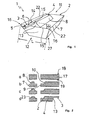
- FIG. 1 shows an SPM probe 1 with a holding element 2, in which the spring bar 3 emanates from an elongated elevation 4, which is supported by the holding element 2.
- the spring bar 3 carries a scanning tip 5 on a cantilever base 6.
- the holding element 2 has laterally longitudinal side flanks 7 and the elevation 4 longitudinal side flanks 8 and rear transverse side flanks 9, 10 connecting respectively two longitudinal side flanks 7 and 8.
- the transverse side flanks 9, 10 on the rear end face 11 of the probe 1 lies on the front end face 12, over which the spring arm 3 protrudes, a common front end face edge 13 opposite.
- the elevation 4 emerges from a retaining element underside 14 of the retaining element 2 and is aligned at the same lateral distance from its longitudinal side edges 22. The conditional by the survey 4 elevated position of the cantilever 3 relative to the underside 14 of the support member 2 compensates for the possible lateral tilting of the SPM probe 1 from.
- the holding element 2 and the elevation 4 of the SPM probe 1 have a trapezoidal cross-sectional shape, wherein the spring bar 3 is arranged at a front narrow lower transverse edge 15 of the front end side flank 13 on the survey 4.
- the elevation 4 is located centrally to the front corners 16 of the support member 2, which are connected by the wider transverse edge 15 ', wherein the elongated elevation 4 extends in the longitudinal direction of the support member 2 and the cantilever 3 over a portion of the length of the support member 2.
- the shape of the probe 1 can be carried out both by a simultaneous lithographic definition of spring bar 3 and survey 4 and holding element 2 as well as by independent production in separate steps.
- the first material side 18, the bottom 14 and the second material side 19, the top 27 of the retaining element 2 assigned.
- FIGS. 3a to 3d shown in the same views, but also the definition of the thickness of the cantilever 3 before the production of the survey 4 and the cantilever 3 by realization of a thin membrane 20 be realized ( FIGS. 3a, b ).
- Spring bar 3 and elevation 4 are then worked out of the membrane 20 and the solid starting material 17 of the later holding element 2 ( FIGS. 3c, d ).
- a special case of the separate production of survey 4 and cantilever 3 results from the use of a starting material 17 with integrated ⁇ tzstopp Anlagen 21, as in the FIGS. 4a to 4f outlined.
- an etch stop 21 can be generated, for example, by an integrated silicon dioxide layer (so-called silicon-on-oxide or SOI substrates) or by implantation of high concentrations of boron.
- Such an integrated etch stop layer 21 can be used to increase the thickness of the cantilever 3 with high precision, by realizing the spring bar 3 of the thin layer of extremely homogeneous thickness that can be produced over the etching stop layer 21, while the holding element 2 is essentially made of the remaining starting material 17 below the etching stop layer 21.
- the etch stop 21 prevents an increase in the variation of the cantilever thickness.
- the realization of the survey 4 described above to reduce the risk of placing the holding member 2 on the sample by means of two-stage process remains unaffected.
- FIG. 7 Another special case of the described shape of the holding element 2 with survey 4 is the formation of the longitudinal side edges 7 of the support member 2 and the longitudinal side edges 8 of the survey 4 with an identical inclination and with a stepless transition of the side edges 7 to the side edges 8, as in the FIG. 7 shown.
- This special cross-sectional shape of the holding element 2 and the survey 4 also considerable tilting of the probe 1 are possible, as they are necessary for some applications of Scanning Probe Microscopy, without the risk of placing the holding element 2 on the sample surface.
- the longitudinal side edges 7, 8 of the holding element 2 and the survey 4 of the probe 1 close directly aligned to each other.
- the holding element 2 has according to FIG. 7 a trapezoidal cross section and an inverted to the cross section, substantially trapezoidal longitudinal section.
- An essential manufacturing method for the holding element 2 according to FIG. 7 with the inclined face edge 13 is the manufacture of a corresponding SPM probe 1 made of monocrystalline silicon.
- an elevation and cantilever structure 4, 3 is worked out from the starting material 17 from a first material side 18 by means of anisotropic wet or dry chemical etching, wherein the removal according to the representations 8a, b to opposite second material side 19 of the starting material 17th forming the lateral merging lateral flanks 7, 8 of the holding element 2 takes place.
- the etched structure is protected with a suitable protective layer 23, such as a silicon dioxide or silicon nitride thin film, as a cover, and then etched the front face 5 and the opposite rear face 11 of the probe 1.
- the missing front end side flank 13 of the holding element 2 is starting from the second material side 19 of the starting material 17, as in FIGS FIGS. 8d, e shown, worked out.
- the thickness of the cantilever 3 can be adjusted in this step.
- the procedure is also reversible.
- first the front end face 12 and the rear end face 11 of the probe 1 are etched from the second material side 19.
- 17 pits 24 are etched in the starting material 17 under the later spring bar 3 and at the rear end face 11 of the starting material, see FIGS. 9a, b , so that membranes 20 are formed whose thickness corresponds to the later thickness of the spring bar 3.
- these pits 24 are replaced by an adequate protective layer 23 in the form of a film according to the FIG. 9c protected and the survey 4 etched from the opposite first material side 18, so that from the membrane 23 of the spring bar 3 is formed, and the longitudinal side edges 7, the eighth the survey 4 and the holding element 2, as the FIGS. 9d, e show, arise.
- a significant advantage of this method with separate shaping of the lateral longitudinal side flanks 7, 8 and the important end face flank 13 of different first and second material sides 18, 19 is that when using anisotropic wet-chemical silicon etching no open corners arise.
- anisotropic wet-chemical silicon etching no open corners arise.
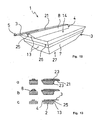
- a precise, homogeneous and reproducible definition of the length of the cantilever 3 according to the invention in a probe 1 according to FIG. 10 achieved by a lithographic structuring of the transition between the spring bar 3 and holding element 2 from the same first material side 18 of the starting material 17.
- the spring bar 3 is thereby exposed, as usual in surface micromechanics, by lateral undercutting the masked cantilever 3.
- the actual working out of the holding element 2 takes place from the opposite second material side 19 of the starting material 17, in which also the material of the starting material 17 remaining under the spring bar 3 is removed.
- the extremely low etching rate of the ⁇ 111> planes of the crystal can be exploited to define the front side flank 13 of the holding element 2 under the spring bar 3.
- the undercut of the cantilever 3 stops exactly at the lithographic next to the spring bar 3 defined stop line 25 perpendicular to the spring bar longitudinal axis.
- the resulting etching flank will initially be inclined below the cantilever 3.
- the overetching can also be interrupted before the complete end face flank 13 has formed. Only directly below the spring beam 3, the undercut ⁇ 111> plane should already be formed. In this way, a corresponding to the FIG. 10 trained SPM probe 1 are generated with an undercut shape of the end face edge 13.
- the spring bar 3 is also made of silicon in the exemplary embodiment described above, the use of a starting material 17 with integrated etching stop 21 is necessary.
- the spring bar 3 and possibly the integrated scanning tip 5 is first from the upper silicon layer, ie from the first material side 18 of the starting material 17 by wet or dry chemical etching process according to the figures of FIGS. 11a, b worked out and then covered with a suitable protective film 23 such as silicon dioxide or silicon nitride, such as FIG. 11c shows.
- the etch stop line 25 of the holding element 2 is lithographically defined, wherein the spring bar 3 must also remain protected, see FIGS. 11d, e ,
- the integrated etch stop layer 21 prevents a backside etching attack on the beam 3, such as FIGS. 11f, g, h clarify.
- the method for the exact definition of the length of the cantilever 3 can be combined with the concept of the holding element 2 with elevation 4 ( FIG. 12 ).
- the window around the spring bar 3 is first opened from the first material side 18 and this is completely undercut.
- the holding element 2 is etched from the second material side 19 with sufficient overetching, so that below the cantilever 3, the undercut ⁇ 111> -Kristallebene arises.
- the second material side 19 of the holding element 2, including the side flanks 9, 10, 13 etched from this side, must be protected with an appropriate protective film 23, for example of silicon dioxide or silicon nitride, and the elevation 4 etched from the first material side 18. Finally, the protective films 23 are selectively according to FIG. 13c away.
- the etching surfaces between the etching stop line 25, the constriction edge 26 and the upper side 27 of the holding element 2 are not shown to scale to each other.
- all end-side etching surfaces are combined, which extend from the upper side 27 of the holding element 2 to the ⁇ tzstopptik 21.
Landscapes
- Physics & Mathematics (AREA)
- Health & Medical Sciences (AREA)
- General Health & Medical Sciences (AREA)
- General Physics & Mathematics (AREA)
- Nuclear Medicine, Radiotherapy & Molecular Imaging (AREA)
- Radiology & Medical Imaging (AREA)
- Chemical & Material Sciences (AREA)
- Engineering & Computer Science (AREA)
- Nanotechnology (AREA)
- Analytical Chemistry (AREA)
- Crystallography & Structural Chemistry (AREA)
- Length Measuring Devices With Unspecified Measuring Means (AREA)
Priority Applications (4)
| Application Number | Priority Date | Filing Date | Title |
|---|---|---|---|
| EP20080005248 EP2104111A1 (fr) | 2008-03-20 | 2008-03-20 | Sonde pour SPM avec un porte-à-faux raccourci |
| US12/402,576 US8011016B2 (en) | 2008-03-20 | 2009-03-12 | SPM probe with shortened cantilever |
| JP2009067782A JP2009229460A (ja) | 2008-03-20 | 2009-03-19 | 短縮化カンチレバーを備えたspmプローブ及びspmプローブの製造方法 |
| CN2009101276592A CN101540209B (zh) | 2008-03-20 | 2009-03-19 | 带有缩短的弹簧杆的扫描探针显微镜探针 |
Applications Claiming Priority (1)
| Application Number | Priority Date | Filing Date | Title |
|---|---|---|---|
| EP20080005248 EP2104111A1 (fr) | 2008-03-20 | 2008-03-20 | Sonde pour SPM avec un porte-à-faux raccourci |
Publications (1)
| Publication Number | Publication Date |
|---|---|
| EP2104111A1 true EP2104111A1 (fr) | 2009-09-23 |
Family
ID=39314899
Family Applications (1)
| Application Number | Title | Priority Date | Filing Date |
|---|---|---|---|
| EP20080005248 Withdrawn EP2104111A1 (fr) | 2008-03-20 | 2008-03-20 | Sonde pour SPM avec un porte-à-faux raccourci |
Country Status (4)
| Country | Link |
|---|---|
| US (1) | US8011016B2 (fr) |
| EP (1) | EP2104111A1 (fr) |
| JP (1) | JP2009229460A (fr) |
| CN (1) | CN101540209B (fr) |
Cited By (1)
| Publication number | Priority date | Publication date | Assignee | Title |
|---|---|---|---|---|
| EP3591410A1 (fr) * | 2018-07-06 | 2020-01-08 | Nederlandse Organisatie voor toegepast- natuurwetenschappelijk onderzoek TNO | Puce de sonde, tête de balayage, dispositif de microscopie à sonde de balayage et utilisation d'une puce de sonde |
Families Citing this family (5)
| Publication number | Priority date | Publication date | Assignee | Title |
|---|---|---|---|---|
| JP5874995B2 (ja) * | 2011-09-06 | 2016-03-02 | 株式会社日立ハイテクサイエンス | カンチレバーのバネ定数特定方法およびその方法を採用した走査型プローブ顕微鏡 |
| US8756710B2 (en) * | 2012-08-31 | 2014-06-17 | Bruker-Nano, Inc. | Miniaturized cantilever probe for scanning probe microscopy and fabrication thereof |
| US8689361B1 (en) * | 2012-10-29 | 2014-04-01 | Oicmicro, LLC | Method of making thin film probe tip for atomic force microscopy |
| US11719719B2 (en) * | 2021-06-16 | 2023-08-08 | Bruker Nano, Inc. | Metrology probe with built-in angle and method of fabrication thereof |
| CN116430088B (zh) * | 2023-06-13 | 2023-11-24 | 南方科技大学 | 探针及其制备方法 |
Citations (6)
| Publication number | Priority date | Publication date | Assignee | Title |
|---|---|---|---|---|
| JPH0518740A (ja) | 1991-07-10 | 1993-01-26 | Hitachi Ltd | 表面観察装置用プローブおよびその製造方法ならびに表面観察装置 |
| JPH08262040A (ja) | 1995-03-17 | 1996-10-11 | Olympus Optical Co Ltd | Afmカンチレバー |
| US5753912A (en) | 1996-03-12 | 1998-05-19 | Olympus Optical Co., Ltd. | Cantilever chip |
| JPH10307144A (ja) | 1997-05-02 | 1998-11-17 | Olympus Optical Co Ltd | カンチレバーチップ |
| EP1359593A1 (fr) | 2002-03-20 | 2003-11-05 | Nanoworld AG | Capteur pour la SPM et procedé pour sa fabrication |
| JP2004012401A (ja) * | 2002-06-11 | 2004-01-15 | Olympus Corp | Spmカンチレバー及びその製造方法 |
Family Cites Families (8)
| Publication number | Priority date | Publication date | Assignee | Title |
|---|---|---|---|---|
| JPH047308A (ja) * | 1990-04-25 | 1992-01-10 | Nippon Zeon Co Ltd | 合せガラス用塩化ビニル樹脂の製造方法 |
| JP3148946B2 (ja) * | 1991-05-30 | 2001-03-26 | キヤノン株式会社 | 探針駆動機構並びに該機構を用いたトンネル電流検出装置、情報処理装置、圧電式アクチュエータ |
| US5450746A (en) * | 1993-10-12 | 1995-09-19 | The University Of North Carolina | Constant force stylus profiling apparatus and method |
| US5753812A (en) * | 1995-12-07 | 1998-05-19 | Schlumberger Technology Corporation | Transducer for sonic logging-while-drilling |
| JPH11271347A (ja) * | 1998-03-23 | 1999-10-08 | Olympus Optical Co Ltd | 走査型プローブ顕微鏡用カンチレバー及びその製造方法 |
| JP4733319B2 (ja) * | 2000-09-18 | 2011-07-27 | アイメック | プローブチップ構造の製造方法 |
| CN1278923C (zh) * | 2004-09-17 | 2006-10-11 | 中国科学院上海微系统与信息技术研究所 | 用掩膜和无掩膜技术一次成型原子力显微镜探针和悬臂梁 |
| FR2886407B1 (fr) * | 2005-05-27 | 2007-09-28 | Thales Sa | Injecteur local d'electrons polarises de spin a pointe en semi-conducteur sous excitation lumineuse |
-
2008
- 2008-03-20 EP EP20080005248 patent/EP2104111A1/fr not_active Withdrawn
-
2009
- 2009-03-12 US US12/402,576 patent/US8011016B2/en not_active Expired - Fee Related
- 2009-03-19 CN CN2009101276592A patent/CN101540209B/zh not_active Expired - Fee Related
- 2009-03-19 JP JP2009067782A patent/JP2009229460A/ja active Pending
Patent Citations (6)
| Publication number | Priority date | Publication date | Assignee | Title |
|---|---|---|---|---|
| JPH0518740A (ja) | 1991-07-10 | 1993-01-26 | Hitachi Ltd | 表面観察装置用プローブおよびその製造方法ならびに表面観察装置 |
| JPH08262040A (ja) | 1995-03-17 | 1996-10-11 | Olympus Optical Co Ltd | Afmカンチレバー |
| US5753912A (en) | 1996-03-12 | 1998-05-19 | Olympus Optical Co., Ltd. | Cantilever chip |
| JPH10307144A (ja) | 1997-05-02 | 1998-11-17 | Olympus Optical Co Ltd | カンチレバーチップ |
| EP1359593A1 (fr) | 2002-03-20 | 2003-11-05 | Nanoworld AG | Capteur pour la SPM et procedé pour sa fabrication |
| JP2004012401A (ja) * | 2002-06-11 | 2004-01-15 | Olympus Corp | Spmカンチレバー及びその製造方法 |
Cited By (3)
| Publication number | Priority date | Publication date | Assignee | Title |
|---|---|---|---|---|
| EP3591410A1 (fr) * | 2018-07-06 | 2020-01-08 | Nederlandse Organisatie voor toegepast- natuurwetenschappelijk onderzoek TNO | Puce de sonde, tête de balayage, dispositif de microscopie à sonde de balayage et utilisation d'une puce de sonde |
| WO2020009582A1 (fr) * | 2018-07-06 | 2020-01-09 | Nederlandse Organisatie Voor Toegepast- Natuurwetenschappelijk Onderzoek Tno | Puce de sonde, tête de balayage, dispositif de microscopie à sonde de balayage et utilisation d'une puce de sonde |
| US12117467B2 (en) | 2018-07-06 | 2024-10-15 | Nederlandse Organisatie Voor Toegepast-Natuurwetenschappelijk Onderzoek Tno | Probe chip, scan head, scanning probe microscopy device and use of a probe chip |
Also Published As
| Publication number | Publication date |
|---|---|
| US8011016B2 (en) | 2011-08-30 |
| CN101540209B (zh) | 2012-10-24 |
| US20090241233A1 (en) | 2009-09-24 |
| CN101540209A (zh) | 2009-09-23 |
| JP2009229460A (ja) | 2009-10-08 |
Similar Documents
| Publication | Publication Date | Title |
|---|---|---|
| DE4126151C2 (de) | Ausleger für ein Scansondenmikroskop und ein Verfahren zu dessen Herstellung | |
| DE69714320T2 (de) | Sonde für Atomkraftmikroskop, Verfahren zur Herstellung der Sonde und Atomkraftmikroskop | |
| DE60306852T2 (de) | Schichtwellenleiter in einem zwei-dimensionalen Photonenkristall mit nicht-zirkularen Löchern | |
| DE3335772C2 (de) | Meßwandler und Verfahren zum Herstellen eines Meßwandlers, der auf Piezo-Widerstandsbasis arbeitet | |
| EP2104111A1 (fr) | Sonde pour SPM avec un porte-à-faux raccourci | |
| DE4214400A1 (de) | Auslegerchip fuer ein abtastsondenmikroskop und herstellungsverfahren | |
| DE19719601A1 (de) | Beschleunigungssensor | |
| EP1359593B1 (fr) | Capteur pour la SPM et procedé pour sa fabrication | |
| EP0001038A1 (fr) | Procédé de fabrication d'un masque de silicium et son utilisation | |
| DE10339220B4 (de) | Spiegel für eine Ablenkeinheit in einem Lasersystem, Verfahren zu dessen Herstellung sowie Ablenkeinheit für ein Lasersystem | |
| DE102014211555A1 (de) | Verfahren zum Ausbilden einer Kavität und Bauelement mit einer Kavität | |
| DE102006007431B4 (de) | Durch Halbleitersilizium-Verfahrenstechnik gebildeter Probenträger sowie Verfahren zur Herstellung | |
| DE4314301C1 (de) | Abtastvorrichtung zur Untersuchung von Oberflächenstrukturen mit Auflösung im submicron-Bereich und Verfahren zu deren Herstellung | |
| EP1113980B1 (fr) | Ouverture pratiquee dans un materiau semi-conducteur et realisation de cette ouverture et son utilisation | |
| DE69407429T2 (de) | Herstellung eines vergrabenen wellenleiters mit verschiedenen eindringtiefen | |
| DE102022130976B3 (de) | Monolithische Membran aus Glas, Doppel-Vertikalmembran-Anordnung, mikromechanische Federstruktur und zugehöriges Herstellungsverfahren | |
| DE10046621B4 (de) | Verfahren zur Herstellung eines Membransensor-Arrays sowie Membransensor-Array | |
| WO1999034421A1 (fr) | Procede de production d'une couche poreuse par un processus de gravure electrochimique | |
| EP4136052B1 (fr) | Procédé de production d'au moins un premier et un second dispositif de micro-miroir | |
| DE10303961B4 (de) | Sonde für ein optisches Nahfeldmikroskop und Verfahren zu deren Herstellung | |
| DE10236150A1 (de) | Verfahren zur Herstellung wenigstens einer kleinen Öffnung in einer Schicht auf einem Substrat und damit hergestellte Bauelemente | |
| DE69217051T2 (de) | Mikroprobe für einen oberflächen-rastermikroskop | |
| DE19926601B4 (de) | Apertur in einem Halbleitermaterial sowie Herstellung der Apertur und Verwendung | |
| DE102023117699B4 (de) | Mikrostruktur aus Glas, Mikro-Mechanik und zugehörige Verwendung | |
| WO2004015362A2 (fr) | Procede pour realiser une structure dotee d'une arete etroite ou d'une pointe effilee et barre de flexion pourvue d'une telle structure |
Legal Events
| Date | Code | Title | Description |
|---|---|---|---|
| PUAI | Public reference made under article 153(3) epc to a published international application that has entered the european phase |
Free format text: ORIGINAL CODE: 0009012 |
|
| 17P | Request for examination filed |
Effective date: 20080725 |
|
| AK | Designated contracting states |
Kind code of ref document: A1 Designated state(s): AT BE BG CH CY CZ DE DK EE ES FI FR GB GR HR HU IE IS IT LI LT LU LV MC MT NL NO PL PT RO SE SI SK TR |
|
| AX | Request for extension of the european patent |
Extension state: AL BA MK RS |
|
| AKX | Designation fees paid |
Designated state(s): CH DE FR GB LI |
|
| 17Q | First examination report despatched |
Effective date: 20100520 |
|
| STAA | Information on the status of an ep patent application or granted ep patent |
Free format text: STATUS: THE APPLICATION IS DEEMED TO BE WITHDRAWN |
|
| 18D | Application deemed to be withdrawn |
Effective date: 20160820 |