EP2106576B1 - Procédé de commande et/ou de régulation d'un système technique assistées par ordinateur - Google Patents
Procédé de commande et/ou de régulation d'un système technique assistées par ordinateur Download PDFInfo
- Publication number
- EP2106576B1 EP2106576B1 EP07857886A EP07857886A EP2106576B1 EP 2106576 B1 EP2106576 B1 EP 2106576B1 EP 07857886 A EP07857886 A EP 07857886A EP 07857886 A EP07857886 A EP 07857886A EP 2106576 B1 EP2106576 B1 EP 2106576B1
- Authority
- EP
- European Patent Office
- Prior art keywords
- technical system
- neural network
- states
- time
- recurrent neural
- Prior art date
- Legal status (The legal status is an assumption and is not a legal conclusion. Google has not performed a legal analysis and makes no representation as to the accuracy of the status listed.)
- Not-in-force
Links
Images


Classifications
-
- G—PHYSICS
- G05—CONTROLLING; REGULATING
- G05B—CONTROL OR REGULATING SYSTEMS IN GENERAL; FUNCTIONAL ELEMENTS OF SUCH SYSTEMS; MONITORING OR TESTING ARRANGEMENTS FOR SUCH SYSTEMS OR ELEMENTS
- G05B13/00—Adaptive control systems, i.e. systems automatically adjusting themselves to have a performance which is optimum according to some preassigned criterion
- G05B13/02—Adaptive control systems, i.e. systems automatically adjusting themselves to have a performance which is optimum according to some preassigned criterion electric
- G05B13/0265—Adaptive control systems, i.e. systems automatically adjusting themselves to have a performance which is optimum according to some preassigned criterion electric the criterion being a learning criterion
- G05B13/027—Adaptive control systems, i.e. systems automatically adjusting themselves to have a performance which is optimum according to some preassigned criterion electric the criterion being a learning criterion using neural networks only
-
- G—PHYSICS
- G06—COMPUTING OR CALCULATING; COUNTING
- G06N—COMPUTING ARRANGEMENTS BASED ON SPECIFIC COMPUTATIONAL MODELS
- G06N3/00—Computing arrangements based on biological models
- G06N3/02—Neural networks
-
- G—PHYSICS
- G06—COMPUTING OR CALCULATING; COUNTING
- G06N—COMPUTING ARRANGEMENTS BASED ON SPECIFIC COMPUTATIONAL MODELS
- G06N3/00—Computing arrangements based on biological models
- G06N3/02—Neural networks
- G06N3/04—Architecture, e.g. interconnection topology
- G06N3/044—Recurrent networks, e.g. Hopfield networks
-
- G—PHYSICS
- G06—COMPUTING OR CALCULATING; COUNTING
- G06N—COMPUTING ARRANGEMENTS BASED ON SPECIFIC COMPUTATIONAL MODELS
- G06N3/00—Computing arrangements based on biological models
- G06N3/02—Neural networks
- G06N3/04—Architecture, e.g. interconnection topology
- G06N3/044—Recurrent networks, e.g. Hopfield networks
- G06N3/0442—Recurrent networks, e.g. Hopfield networks characterised by memory or gating, e.g. long short-term memory [LSTM] or gated recurrent units [GRU]
-
- G—PHYSICS
- G06—COMPUTING OR CALCULATING; COUNTING
- G06N—COMPUTING ARRANGEMENTS BASED ON SPECIFIC COMPUTATIONAL MODELS
- G06N3/00—Computing arrangements based on biological models
- G06N3/02—Neural networks
- G06N3/04—Architecture, e.g. interconnection topology
- G06N3/048—Activation functions
-
- G—PHYSICS
- G06—COMPUTING OR CALCULATING; COUNTING
- G06N—COMPUTING ARRANGEMENTS BASED ON SPECIFIC COMPUTATIONAL MODELS
- G06N3/00—Computing arrangements based on biological models
- G06N3/02—Neural networks
- G06N3/04—Architecture, e.g. interconnection topology
- G06N3/0499—Feedforward networks
-
- G—PHYSICS
- G06—COMPUTING OR CALCULATING; COUNTING
- G06N—COMPUTING ARRANGEMENTS BASED ON SPECIFIC COMPUTATIONAL MODELS
- G06N3/00—Computing arrangements based on biological models
- G06N3/02—Neural networks
- G06N3/08—Learning methods
- G06N3/084—Backpropagation, e.g. using gradient descent
-
- G—PHYSICS
- G06—COMPUTING OR CALCULATING; COUNTING
- G06N—COMPUTING ARRANGEMENTS BASED ON SPECIFIC COMPUTATIONAL MODELS
- G06N3/00—Computing arrangements based on biological models
- G06N3/02—Neural networks
- G06N3/08—Learning methods
- G06N3/09—Supervised learning
-
- G—PHYSICS
- G06—COMPUTING OR CALCULATING; COUNTING
- G06N—COMPUTING ARRANGEMENTS BASED ON SPECIFIC COMPUTATIONAL MODELS
- G06N3/00—Computing arrangements based on biological models
- G06N3/02—Neural networks
- G06N3/08—Learning methods
- G06N3/092—Reinforcement learning
-
- G—PHYSICS
- G05—CONTROLLING; REGULATING
- G05B—CONTROL OR REGULATING SYSTEMS IN GENERAL; FUNCTIONAL ELEMENTS OF SUCH SYSTEMS; MONITORING OR TESTING ARRANGEMENTS FOR SUCH SYSTEMS OR ELEMENTS
- G05B2219/00—Program-control systems
- G05B2219/30—Nc systems
- G05B2219/33—Director till display
- G05B2219/33011—Link between hidden and input layer is sigmoid, and between output is linear
-
- G—PHYSICS
- G05—CONTROLLING; REGULATING
- G05B—CONTROL OR REGULATING SYSTEMS IN GENERAL; FUNCTIONAL ELEMENTS OF SUCH SYSTEMS; MONITORING OR TESTING ARRANGEMENTS FOR SUCH SYSTEMS OR ELEMENTS
- G05B2219/00—Program-control systems
- G05B2219/30—Nc systems
- G05B2219/33—Director till display
- G05B2219/33021—Connect plural macrocircuits, neural network modules in a larger network
-
- G—PHYSICS
- G05—CONTROLLING; REGULATING
- G05B—CONTROL OR REGULATING SYSTEMS IN GENERAL; FUNCTIONAL ELEMENTS OF SUCH SYSTEMS; MONITORING OR TESTING ARRANGEMENTS FOR SUCH SYSTEMS OR ELEMENTS
- G05B2219/00—Program-control systems
- G05B2219/30—Nc systems
- G05B2219/33—Director till display
- G05B2219/33025—Recurrent artificial neural network
-
- G—PHYSICS
- G05—CONTROLLING; REGULATING
- G05B—CONTROL OR REGULATING SYSTEMS IN GENERAL; FUNCTIONAL ELEMENTS OF SUCH SYSTEMS; MONITORING OR TESTING ARRANGEMENTS FOR SUCH SYSTEMS OR ELEMENTS
- G05B2219/00—Program-control systems
- G05B2219/30—Nc systems
- G05B2219/33—Director till display
- G05B2219/33036—Error back propagation
Definitions
- the invention relates to a method for computer-aided control and / or regulation of a technical system and a corresponding computer program product.
- the document [3] describes strengthening learning methods for neural networks.
- recurrent network structures are disclosed, in which past features, which are output by a recurrent neural network, flow into another neural network.
- the object of the invention is to provide a method for computer-aided prediction of the dynamic behavior of a technical system, which is generally applicable to any technical systems and provides good results.
- information about the dynamic behavior of the technical system for several points in time is respectively obtained by a state of the technical system and an action performed on the technical system, wherein a respective action at a respective time in a new state of the technical system at the next time leads.
- the technical system can be configured as desired, so that the states can be any measurable parameters of the technical system.
- the actions are any changes to the technical system, which are characterized by the changes of corresponding manipulated variables in the technical system.
- a state is preferably characterized by a plurality of environmental or state variables, each state variable representing a specific measurand of the technical system.
- the state is thus often a state vector.
- the action may include a plurality of manipulated variables to be changed, which each form an entry in a corresponding action vector.
- the dynamic behavior of the technical system with a recurrent neural network is modeled with the aid of training data comprising known states and actions at several points in time.
- the recurrent neural network is in this case formed by at least one input layer comprising the states of the technical system and the actions performed on the technical system at the multiple points in time, at least one hidden recurrent layer comprising hidden states and at least one output layer comprising the states of the technical system among the several times.
- the recurrence in the neural network arises here through the temporal development of the system, which is reflected in the hidden layer by the coupling of hidden states at different times.
- an action selection rule is learned.
- the learning ensues in such a way that the recurrent neural network, which was trained with the training data in the first step, is coupled to a further neural network for a current and future time, wherein the further neural network comprises at least one input layer, at least one hidden layer includes hidden states and at least one source layer.
- the input layer of the further neural network comprises at least a part of the hidden states of the recurrent neural network at the respective time
- the output layer of the further neural network comprises the action carried out on the technical system at the respective time at a particular time.
- the additional neural network thus assumes the task of optimally controlling the technical system with regard to the future actions taking into account the modeled dynamics of the technical system, which was carried out in the first step.
- the action selection rule is learned according to an evaluation function that takes into account one or more criteria related to the states of the technical system and / or the actions performed on the technical system and / or learned in the step of modeling the dynamic behavior of the technical system becomes.
- a feed-forward network is used in which the neurons of the hidden layers are not fed back in time.
- the evaluation function is selected such that it parametrizes an optimal dynamic behavior of the technical system. In this way, the optimal control of the technical system can be realized by appropriate choice of the evaluation function.
- the evaluation function can be represented, for example, by a cost function to be optimized.
- the states of the technical system and the actions preferably include several variables.
- the hidden states of the recurrent or further neural network preferably also consist of several hidden variables.
- the number of hidden variables of a hidden state of the recurrent and / or further neural network is smaller than the number of environment variables of a state of the technical system.
- the number of hidden states is preferably selected such that the method is both data-efficient and provides good results.
- the error between the states determined by the recurrent neural network and the states of the training data is minimized.
- the method according to the invention is used to use the method to model a nonlinear dynamic behavior of a technical system and / or to learn a nonlinear action selection rule.
- a backpropagation method is used for modeling the dynamic behavior of the technical system with the recurrent neural network in the first step of the method and / or for learning the action selection rule in the second step of the method.
- Such backpropagation methods are sufficiently known from the prior art and in this case, in particular, the method described in reference [1] is used.
- the recurrent neural network used to model the dynamic behavior of the technical system is preferably a network with dynamically consistent temporal evolution taking into account future states and actions, which is referred to in English as the Recurrent Neural Network with Dynamically Consistent Overshooting.
- the network's own forecasts in the output layer are used as a substitute for future inputs in the input layer.
- ⁇ wherein the range of values of ⁇ comprises a predetermined number m of time steps before time t and a predetermined number n of time steps after time t; where t ⁇ ⁇ m, ..., Tn ⁇ , where T is the number of times for which training data is present; where X ⁇ represents the state of the technical system determined by the recurrent neural network at time ⁇ ; in which x ⁇ d represents the state of the technical system at time ⁇ according to the training data; where a ⁇ represents the action at time ⁇ ; where S ⁇ and p ⁇ represent the hidden state at time ⁇ of the hidden layer of the recurrent neural network; where 1 is the unit matrix and A, B, C, D are matrices to be determined and ⁇ is a bias to be determined.
- the corresponding matrices A, B, C, D and the corresponding bias ⁇ are selected, which are chosen such that the quadratic error between predicted and actual states is minimized.
- G is a matrix and h is an arbitrary activation function which maps the state X ⁇ + 1 of the technical system to a state R ⁇ + 1 relevant to the cost function c ( ⁇ ); where f is any activation function; where E and F are matrices to be determined and b are a bias to be determined.
- the functions f and h can be any activation functions, in particular they can also represent the identity mapping.
- the inventive method can be used for any technical systems.
- An application is e.g. a turbine, in particular a gas turbine.
- control of the technical system takes place in such a way that at the beginning of the control, first all steps of the method according to the invention are carried out except for the actual action selection step and subsequently the resulting recurrent neural network with learned action selection rule coupled to the further neural network for selecting the actions used to control the technical system is used.
- the control rules are thus once set and not changed during the control of the technical system.
- the invention further comprises a computer program product with a program code stored on a machine-readable carrier for carrying out the inventive control method when the program is run on a computer.
- the method according to the invention will be described in detail below.
- the method is applicable to any type of technical system whose dynamic behavior can be described by a state space X and an action space A with a (stochastic) transition function P (x t , a t , x t + 1 ).
- x t , x t + 1 ⁇ X are states of the technical system at times t and t + 1, respectively, where each state is characterized by a plurality of state or environment variables.
- environment variables are thereby measurable state variables of the technical system, for example the gas pressure, the gas temperature, combustion chamber accelerations and the like in a gas turbine.
- the actions a t ⁇ A are here changes of manipulated variables of the technical system at the time t, which in turn have influence on later states of the technical system.
- Analogous to the state x t t can be a plurality of action variables also include the action A and an action can thus be characterized by the variation of several control variables.
- An example of a manipulated variable that can be changed on a technical system is the setting of valves in a gas turbine.
- the technical systems are also designed so that the state space and the action space overlap, ie that a manipulated variable in the technical system also characterizes the state of the technical system.
- the reward function is determined to reflect desired characteristics of the technical system, the optimum being achieved when the function is maximum.
- the cost function could be, for example, an advantageous desired state of the technical system, which is then optimal, if it has a maximum value.
- the technical system is a deterministic Markov decision process with discrete time steps, wherein the state spaces X and A are continuous.
- a Markov decision process is modeled with a recurrent neural network RNN, whereby an image of the dynamic behavior of the technical system, ie the transfer function P ( ⁇ ), is mapped by a high-dimensional non-linear system equation.
- the recurrent neural network RNN used in the variant of the invention described here is in Fig. 1 shown.
- the recurrent neural network comprises an input layer I, which shows the states and the actions at the individual points in time. Exemplary are in Fig. 1 the states x t-1 , x t and the actions a t-1 , a t , a t + 1 reproduced.
- the input layer is coupled to a hidden layer H via respective matrices B and D, which are further defined below.
- the hidden layer has hidden states for each time point in which Fig. 1 the states p t-1 , s t-1 , P t , s t , P t + 1 and s t + 1 are reproduced by way of example.
- the hidden layer H is recurrent since the individual hidden states are coupled together, which is represented by corresponding matrices I (corresponding to the unit matrix) and A and a bias ⁇ in Fig. 1 is reproduced.
- the recurrent neural network of Fig. 1 further comprises an output layer O formed by the states of the technical system, wherein Fig. 1 the states x t , x t + 1 and x t + 2 are reproduced. These states are in each case coupled to the hidden states s t-1 , s t and s t + 1 by a matrix C.
- the neural network according to Fig. 1 is a network with dynamically consistent temporal evolution considering future states, which is called "Neural Network with Dynamically Consistent Overshooting". This means that in the modeling of the neural network not only timing ⁇ in the past, but also timing ⁇ in the future are taken into account and the own predicted states of the network in the output layer are used as inputs to future states in the input layer.
- the parameter ⁇ is bounded by the length of the previous deconvolution m and the length of the so-called supershot n, so that: ⁇ ⁇ ⁇ tm, ..., t + n ⁇ for all considered times t ⁇ ⁇ m, ... , Tn ⁇ , where T represents the number of available times for which carrying data for learning the neural network is present.
- a sequence of states x ⁇ and actions a ⁇ are provided on the input side of the recurrent neural network, the network being temporally developed at a predetermined interval taking into account the past and the future.
- the state p ⁇ is referred to herein as the pre-state, which aggregates the information from a previous hidden state s ⁇ -1 and from the external state x ⁇ .
- the nonlinearity in the hidden layer is expressed here by the hyperbolic tangent.
- the pre-state p ⁇ has the same dimension as the hidden state s ⁇ and is connected to it via the identity matrix I , which is not learned during the training of the neural network.
- the hidden state s ⁇ has as an input an action a ⁇ and is used to calculate the expected next state x ⁇ + 1 of the technical system.
- the matrix D is an additional matrix with a suitable dimension, which takes into account the influence of the actions a ⁇ on the state s ⁇ .
- the actions a ⁇ are also provided to the neural network RNN as future inputs ( ⁇ > t) since they do not directly influence the dynamics of the technical system and therefore should not be learned by the network.
- the recurrent neural network for modeling the technical system should be modeled with training data in which the actions a ⁇ are chosen randomly. Otherwise, the learned dynamics may be dependent on a specific rule.
- the aim of the method according to the invention is now a neural network learned with training data Fig. 1 with reinforcing learning to learn the optimal rule Liste mentioned above.
- This is inventively achieved in that the recurrent neural network of Fig. 1 is combined with another so-called control network, whereby the above reward function c is implemented in the neural network.
- the additional control network is a three-layered neural feed-forward network with an input layer, a hidden layer and a Output layer. Even if other, more complex topologies were possible, any type of control function can be modeled using the model described here. Since the optimal action a ⁇ is to be predicted, the control network is coupled to the recurrent neural network only for future times (ie ⁇ > t). For the past temporal unfolding (ie, ⁇ ⁇ t), the previously applied actions are used in the recurrent neural network.
- the parts of the network which relate to the feed-forward control network are shown in dashed lines.
- the control network uses as input layer the hidden states p t , p t + 1 , ..., etc., which are coupled to a hidden layer R with corresponding states r t , r t + 1 and so on.
- the hidden states r ⁇ are further coupled via a matrix F to the future actions a ⁇ to be modeled.
- a matrix G which couples future states X t + 1 X t + 2 etc. to states R t + 1 , R t + 2 , etc., the latter being states relevant to the calculation rule.
- the neural network RCNN used according to the invention has to fulfill two different tasks. On the one hand it has to identify the dynamics of the underlying technical system and on the other hand it has to achieve optimal control of the technical system by means of a corresponding action selection or reward rule.
- the net is thus in two consecutive steps, namely a step of learning the recurrent neural network with training data and a step of learning a reward rule by coupling the recurrent neural network to a feed-forward network.
- This inventive approach differs from conventional methods in which a combined learning of both tasks is attempted in one step.
- the dynamics of the underlying Markov decision process is modeled, which corresponds to the dynamic behavior of a technical system.
- the network RCNN is thus reduced to a recurrent neural network RNN with dynamically consistent temporal evolution taking into account future conditions.
- the last equation represents the task of training, in which it is to be achieved that a state x ⁇ , which is determined by the recurrent neural network RNN, agrees as well as possible with the state x ⁇ d of the training data.
- the matrices A, B, C and D determined in this step and the bias ⁇ are retained, ie their weights are not changed during the further training.
- the matrices E and F and the bias b are activated, which in Fig. 2 are shown.
- the recurrent neural network does not receive future actions as external inputs, but these actions are learned with the feed-forward network, taking into account the reward rule.
- the output clusters x ⁇ are omitted since they were only needed for the modeling of the dynamics in the first step.
- the error function according to equation (4) is replaced by the reward or cost function c ( ⁇ ), which is mentioned below in equation (9).
- This is achieved in architecture by the additional reward clusters R ⁇ which are connected to the output clusters by a problem-specific fixed matrix G which depends on the above-mentioned reward function c ( ⁇ ) and a possible activation function h within the output clusters X ⁇ .
- the reward function c ( ⁇ ) is encoded within the neural architecture.
- the reward cluster R ⁇ need not only be calculated on the basis of the output cluster x ⁇ , but that it can also be described more generally, which also enables more complicated network architectures.
- the reward function can be learned explicitly, which is particularly helpful if c ( ⁇ ) is not known or is only specified incompletely. This can be achieved by another additional three-layered neural network with the output of the RCNN as inputs.
- the weights of the feed-forward network are only calculated according to the backpropagated reward from the reward clusters R ⁇ ( ⁇ > t) adapted. This corresponds to the idea that the second step of learning the action selection rule is not to identify the dynamics, but only to learn a rule that maximizes the reward, with the dynamics of the system already modeled earlier.
- the second step of learning the reward rule can be mathematically represented by the following equations (5) to (9). In doing so, the matrices E and F as well as the bias b are learned.
- each training pattern T corresponds to a point in time, to which corresponding training data in the form of the state of the technical system and the action taken are assigned at that time.
- the step of learning the reward rule may here be regarded as the backward propagation of the error of the reward function c ( ⁇ ).
- the above-described embodiment of the recurrent neural control network RCNN ideally combines the advantages of a recurrent neuronal network RNN with dynamically consistent temporal unfolding taking into account future states for identifying the dynamics with a three-layered neural control network for learning the reward rule. In this way, a high approximation accuracy is achieved, and even complex dynamic systems can be controlled in a very data-efficient manner.
- the system can be easily scaled to higher dimensions, and an only partially observable environment can be reconstructed from states of the technical system.
- the network can very well process continuous state spaces and action spaces.
- M is the mass of the carriage 1 and m the mass of the rod 3. 1 corresponds to half the length of the rod, g is the gravitational acceleration and F is the force exerted on the carriage in the horizontal direction. This power is also in Fig. 3 shown.
- the goal of the cart-pole problem is to balance the bar for as long a succession of time steps on the cart as possible, without the cart bumping against the walls 2a. Possible actions are to move the cart left or right with a constant force F.
- the system was punished with a negative reinforcing signal when the cart touched one of the walls 2a or when the bar came around tilted more than 12 °. In all other cases, a zero reward was awarded.
- the cart-pole problem has been completely solved by known strengthening learning techniques, but this required a large amount of training data. The following describes the solution of the Cart-Pole problem based on the network RCNN according to the invention.
- the dimension for the hidden layer states in the recurrent neural network was set at 20 neurons and the hidden layer dimension R of the control network was set at 40 neurons.
- the hyperbolic tangent was used as an activation function of the clusters a ⁇ (see equation (8)).
- the action space of the network RCNN was limited to [-1,1].
- the inventive neural network RCNN was trained with different training data.
- the thus learned Reward rule according to equation (11) was tested for the Cart-Pole problem, wherein in each test the number of steps N was determined, which corresponds to the number of steps, how long the rod 3 is balanced on the carriage 1, without the Car the walls 2a starts.
- To learn the Reward Rule three sets of 300, 1000, 3000, 10000, 30000, and 100000 training values were used.
- the median ME and the average AV of steps N were determined over 100 different random initializations of the carriage and the stick during the test.
- the median here is the sequence of all determined numbers N in ascending order of the mean value in this order.
- the average is the arithmetic mean of all detected numbers N.
- Fig. 4 1 shows a table in which the median ME and the average AV for the individual data sets DS are specified for the method according to the invention with the network RCNN and for other known algorithms, namely the adaptive heuristic critique algorithm AHC and the Q-learning algorithm QL are. It is known that the AHC algorithm gives good results in the cart-pole problem.
- the Q-Learning algorithm is a standard method for reinforcement learning.
- the inventive method with the neural network RCNN solves the cart-pole problem very data-efficient and significantly better than the other method.
- the average number of steps in which the pole is balanced is very large, the number is 33573.
- the reward rule could already be learned with a data set size of 1000.
- the AHC algorithm needed one Record size of at least 100000 data values to find a good solution.
- the results of the Q-learning method were even worse and with this method no dataset reached the maximum number of steps.
- the results of the table are in Fig. 4 also again graphically with logarithmic scale in Fig. 5 and Fig. 6 shown. In Fig.
- the abscissa indicates the data set size DS and along the ordinate the median ME for the three learning methods, wherein the inventive method RCNN is shown as a solid line, the AHC method as a dotted line and Q-learning methods as a dashed line.
- the presentation of the Fig. 6 corresponds to the representation of Fig. 5 with the only difference that along the ordinate now the average AV is plotted. You can see clearly from the two FIGS. 5 and 6 in that the method according to the invention gives better results than the methods according to the prior art.
- the method of the invention has been tested only with respect to the Cart-Pole problem, it is not limited only to this problem. In particular, it can be applied to any technical system in which arbitrary types of states can be measured and in which arbitrary types of actions can be performed in the form of variation of manipulated variables.
Landscapes
- Engineering & Computer Science (AREA)
- Physics & Mathematics (AREA)
- Theoretical Computer Science (AREA)
- Artificial Intelligence (AREA)
- Evolutionary Computation (AREA)
- General Physics & Mathematics (AREA)
- Health & Medical Sciences (AREA)
- Software Systems (AREA)
- Biophysics (AREA)
- General Engineering & Computer Science (AREA)
- Life Sciences & Earth Sciences (AREA)
- Biomedical Technology (AREA)
- Mathematical Physics (AREA)
- Computational Linguistics (AREA)
- Data Mining & Analysis (AREA)
- General Health & Medical Sciences (AREA)
- Molecular Biology (AREA)
- Computing Systems (AREA)
- Automation & Control Theory (AREA)
- Medical Informatics (AREA)
- Computer Vision & Pattern Recognition (AREA)
- Feedback Control In General (AREA)
- Mobile Radio Communication Systems (AREA)
- Management, Administration, Business Operations System, And Electronic Commerce (AREA)
Claims (16)
- Procédé de commande et/ou de régulation d'un système technique assistées par ordinateur, dans lequel :a) le comportement dynamique du système technique est caractérisé, pour plusieurs instants (t), respectivement par un état (xt) du système technique et une action (at) exécutée sur le système technique, une action respective (at) à un instant respectif (t) menant à un nouvel état (xt+1) du système technique à l'instant suivant (t+1) ;b) le comportement dynamique du système technique étant modélisé avec un réseau neuronal récurrent à l'aide de données d'apprentissage comprenant des états (xt) et actions connus (at) à plusieurs instants (t), le réseau neuronal récurrent étant formé par au moins une couche d'entrée (I) comprenant les états (xt) du système technique et les actions (at) exécutées sur le système technique aux plusieurs instants (t), au moins une couche récurrente cachée (H) comprenant des états cachés (st, pt) et au moins une couche de sortie (O) comprenant les états (xt) du système technique aux plusieurs instants (t) ;c) après l'exécution de l'étape b), une règle de sélection d'action est apprise par le fait que le réseau neuronal récurrent est couplé pour un instant actuel et des instants (t) futurs à un autre réseau neuronal comprenant au moins une couche d'entrée (H), au moins une couche cachée (R) comprenant des états cachés (rt) et au moins une couche de sortie (O'), la couche d'entrée (H) de l'autre réseau neuronal comprenant, à un instant respectif (t), au moins une partie des états cachés (pt) du réseau neuronal récurrent à l'instant respectif (t) et la couche de sortie (O') de l'autre réseau neuronal comprenant à l'instant respectif l'action (at) exécutée sur le système technique à l'instant respectif ;d) des actions (at) à exécuter sur le système technique sont déterminées par le réseau neuronal récurrent couplé à l'autre réseau neuronal au moyen de la règle de sélection d'action apprise.
- Procédé selon la revendication 1, dans lequel la règle de sélection s'apprend conformément à une fonction d'évaluation qui tient compte d'un ou de plusieurs critères relatifs aux états (xt) du système technique et/ou aux actions (at) exécutées sur le système technique et/ou s'apprend à l'étape b).
- Procédé selon la revendication 2, dans lequel la fonction d'évaluation est choisie de manière telle qu'elle paramétrise un comportement dynamique optimal du système technique.
- Procédé selon la revendication 3, dans lequel la fonction d'évaluation est représentée par une fonction de coût à optimiser.
- Procédé selon l'une des revendications précédentes, dans lequel un état (xt) du système technique comprend une ou plusieurs variables d'environnement et/ou une action (at) à exécuter sur le système technique comprend une ou plusieurs variables d'action et/ou un état caché (st, pt, rt) du réseau neuronal récurrent et/ou de l'autre réseau neuronal comprend une ou plusieurs variables cachées.
- Procédé selon la revendication 5, dans lequel le nombre de variables cachées d'un état caché (st, pt, rt) du réseau neuronal récurrent et/ou de l'autre réseau neuronal est inférieur au nombre de variables d'environnement d'un état (xt) du système technique.
- Procédé selon l'une des revendications précédentes, dans lequel l'erreur entre les états (xt) déterminés par le réseau neuronal récurrent et les états (xt d) des données d'apprentissage est minimisée pour modéliser le comportement dynamique du système technique avec le réseau neuronal récurrent.
- Procédé selon l'une des revendications précédentes, dans lequel, à l'étape b) de la revendication 1, un comportement dynamique non linéaire du système technique est modélisé et/ou, à l'étape c) de la revendication 1, une règle non linéaire de sélection d'action est apprise.
- Procédé selon l'une des revendications précédentes, dans lequel un procédé de rétropropagation est utilisé pour modéliser le comportement dynamique du système technique avec le réseau neuronal récurrent à l'étape b) et/ou pour apprendre la règle de sélection d'action à l'étape c).
- Procédé selon l'une des revendications précédentes, dans lequel le réseau neuronal récurrent est un réseau à déconvolution temporelle dynamiquement consistante compte tenu d'états (xt) et d'actions (at) futurs.
- Procédé selon l'une des revendications précédentes, dans lequel la modélisation du comportement dynamique du système technique avec le réseau neuronal récurrent est représentée par les équations suivantes :


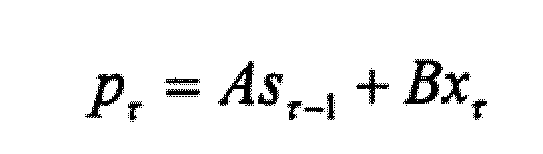

avec t ∈ {m,..., T-n}, T étant le nombre d'instants pour lesquels on a des données d'apprentissage ;x τ représentant l'état du système technique déterminé par le réseau neuronal récurrent à l'instant τ ; a τ représentant l'action à l'instant τ ;S τ et représentant p τ l'état caché à l'instant τ dela couche cachée du réseau neuronal récurrent ;I étant la matrice unitaire et A, B, C, D étant des matrices à déterminer et θ étant un décalage à déterminer.
 - Procédé selon la revendication 11, dans lequel l'apprentissage de la règle de sélection d'action est représenté par les équations suivantes :


G étant une matrice et h, une fonction d'activation quelconque qui applique l'état x τ+1 du système technique sur un état R τ+1 pertinent pour la fonction de coût c(·) ;
f étant une fonction d'activation quelconque ;
E et F étant des matrices à déterminer et b, un décalage à déterminer. - Procédé selon l'une des revendications précédentes, dans lequel le système technique est une turbine, et plus particulièrement une turbine à gaz.
- Procédé selon l'une des revendications précédentes, dans lequel, tout d'abord, les étapes a) à d) de la revendication 1 sont exécutées au début du procédé de commande et, ensuite, le réseau neuronal récurrent qui en résulte et est couplé à l'autre réseau neuronal est utilisé avec la règle de sélection d'action apprise pour déterminer les actions (at).
- Procédé selon l'une des revendications 1 à 13, dans lequel les étapes a) à d) de la revendication 1 sont exécutées pendant le procédé de commande à intervalles réguliers, les nouveaux états (xt) et actions (at) résultants pendant la commande étant pris en compte en tant que données d'apprentissage nouvelles et/ou supplémentaires pendant l'exécution de ces étapes et, après l'exécution de ces étapes, le réseau neuronal récurrent qui en résulte et est couplé à l'autre réseau neuronal étant utilisé avec la règle de sélection d'action apprise pour sélectionner d'autres actions (at).
- Produit de programme informatique avec un code de programme stocké sur un support lisible par machine pour réaliser le procédé selon l'une des revendications précédentes lorsque le programme tourne sur un ordinateur.
Applications Claiming Priority (2)
| Application Number | Priority Date | Filing Date | Title |
|---|---|---|---|
| DE102007001025A DE102007001025B4 (de) | 2007-01-02 | 2007-01-02 | Verfahren zur rechnergestützten Steuerung und/oder Regelung eines technischen Systems |
| PCT/EP2007/064265 WO2008080864A1 (fr) | 2007-01-02 | 2007-12-19 | Procédé de commande et/ou de régulation d'un système technique assistées par ordinateur |
Publications (2)
| Publication Number | Publication Date |
|---|---|
| EP2106576A1 EP2106576A1 (fr) | 2009-10-07 |
| EP2106576B1 true EP2106576B1 (fr) | 2012-04-04 |
Family
ID=39166895
Family Applications (1)
| Application Number | Title | Priority Date | Filing Date |
|---|---|---|---|
| EP07857886A Not-in-force EP2106576B1 (fr) | 2007-01-02 | 2007-12-19 | Procédé de commande et/ou de régulation d'un système technique assistées par ordinateur |
Country Status (6)
| Country | Link |
|---|---|
| US (1) | US8554707B2 (fr) |
| EP (1) | EP2106576B1 (fr) |
| JP (1) | JP5300739B2 (fr) |
| AT (1) | ATE552536T1 (fr) |
| DE (1) | DE102007001025B4 (fr) |
| WO (1) | WO2008080864A1 (fr) |
Cited By (1)
| Publication number | Priority date | Publication date | Assignee | Title |
|---|---|---|---|---|
| DE102018108106A1 (de) | 2018-04-05 | 2019-10-10 | Nolden Regelsysteme GmbH | Temperaturregelung in der Kunststoffverarbeitung |
Families Citing this family (37)
| Publication number | Priority date | Publication date | Assignee | Title |
|---|---|---|---|---|
| DE102008007700A1 (de) | 2007-10-31 | 2009-05-07 | Siemens Aktiengesellschaft | Verfahren zur rechnergestützten Exploration von Zuständen eines technischen Systems |
| DE102008020379A1 (de) | 2008-04-23 | 2009-10-29 | Siemens Aktiengesellschaft | Verfahren zur rechnergestützten Steuerung und/oder Regelung eines technischen Systems |
| EP2296062B1 (fr) * | 2009-09-09 | 2021-06-23 | Siemens Aktiengesellschaft | Procédé d'apprentissage assisté par ordinateur d'une commande et/ou d'un réglage d'un système technique |
| US9323639B2 (en) * | 2009-09-10 | 2016-04-26 | International Business Machines Corporation | Dynamic recommendation framework for information technology management |
| DE102010011221B4 (de) * | 2010-03-12 | 2013-11-14 | Siemens Aktiengesellschaft | Verfahren zur rechnergestützten Steuerung und/oder Regelung eines technischen Systems |
| WO2011129805A1 (fr) | 2010-04-12 | 2011-10-20 | Siemens Aktiengesellschaft | Procédé de commande informatisée, en boucle fermée et/ou en boucle ouverte, d'un système technique |
| US8775341B1 (en) | 2010-10-26 | 2014-07-08 | Michael Lamport Commons | Intelligent control with hierarchical stacked neural networks |
| US9015093B1 (en) | 2010-10-26 | 2015-04-21 | Michael Lamport Commons | Intelligent control with hierarchical stacked neural networks |
| EP2649567B1 (fr) * | 2010-12-10 | 2016-08-17 | Siemens Aktiengesellschaft | Procédée pour la modélisation sur ordinateur d'un système technique |
| JP5832644B2 (ja) | 2011-06-03 | 2015-12-16 | シーメンス アクチエンゲゼルシヤフトSiemens Aktiengesellschaft | 殊にガスタービンまたは風力タービンのような技術システムのデータドリブンモデルを計算機支援で形成する方法 |
| DE102012206651A1 (de) | 2012-04-23 | 2013-10-24 | Siemens Aktiengesellschaft | Verfahren zur Regelung einer Turbine |
| DE102012216574A1 (de) | 2012-09-17 | 2014-03-20 | Siemens Aktiengesellschaft | Verfahren zur rechnergestützten Steuerung und/oder Regelung eines technischen Systems |
| DE102013205356B4 (de) | 2013-03-26 | 2016-07-07 | Siemens Aktiengesellschaft | Verfahren zur rechnergestützten Steuerung und/oder Regelung eines technischen Systems |
| WO2015043806A1 (fr) | 2013-09-25 | 2015-04-02 | Siemens Aktiengesellschaft | Procédé de commande et/ou de régulation assistée(s) par ordinateur d'un système technique |
| US9679258B2 (en) | 2013-10-08 | 2017-06-13 | Google Inc. | Methods and apparatus for reinforcement learning |
| EP3183699B1 (fr) | 2014-08-20 | 2025-02-12 | Hitachi Energy AG | Configuration de prédiction de dysfonctionnements pour des éléments et des unités d'entités techniques |
| EP3183698B1 (fr) | 2014-08-20 | 2025-10-01 | Hitachi Energy AG | Prédiction de dysfonctionnement pour composants et unités d'entités techniques |
| US10387775B2 (en) * | 2015-09-09 | 2019-08-20 | Emerson Process Management Power & Water Solutions, Inc. | Model-based characterization of pressure/load relationship for power plant load control |
| KR20180080211A (ko) * | 2015-11-06 | 2018-07-11 | 에프앤피 로보틱스 아게 | 자동으로 의사 결정을 하는 방법 |
| DE102015226656B4 (de) | 2015-12-23 | 2019-10-10 | Siemens Aktiengesellschaft | Verfahren und Softsensor zum Ermitteln einer Leistung eines Energieerzeugers |
| EP3400558B1 (fr) * | 2016-02-09 | 2024-11-20 | Google LLC | Apprentissage par consolidation en utilisant des estimations des avantages |
| JP6550678B2 (ja) * | 2016-05-27 | 2019-07-31 | 日本電信電話株式会社 | 行動決定装置、未来予測モデル学習装置、ネットワーク学習装置、方法、及びプログラム |
| WO2018188981A1 (fr) | 2017-04-12 | 2018-10-18 | Koninklijke Philips N.V. | Tirer des conclusions à partir de textes de forme libre avec apprentissage de renforcement profond |
| US10853724B2 (en) | 2017-06-02 | 2020-12-01 | Xerox Corporation | Symbolic priors for recurrent neural network based semantic parsing |
| FI20175970A1 (en) * | 2017-11-01 | 2019-05-02 | Curious Ai Oy | Setting up a control system for the target system |
| JP7190496B2 (ja) | 2018-02-19 | 2022-12-15 | ブラウン ゲーエムベーハー | 可動式処置デバイスの運動を分類するための装置及び方法 |
| US11775982B2 (en) * | 2018-02-26 | 2023-10-03 | Accenture Global Solutions Limited | Augmented intelligence assistant for agents |
| EP3588211A1 (fr) | 2018-06-27 | 2020-01-01 | Siemens Aktiengesellschaft | Dispositif de commande destiné à la commande d'un système technique et procédé de configuration du dispositif de commande |
| WO2020034092A1 (fr) | 2018-08-14 | 2020-02-20 | 西门子股份公司 | Système de commande de processus et son procédé ainsi que son système |
| KR102719425B1 (ko) * | 2018-10-12 | 2024-10-21 | 딥마인드 테크놀로지스 리미티드 | TVT(temporal value transport)를 사용하여 롱 타임 스케일에 대한 에이전트 제어 |
| CN110017184B (zh) * | 2019-04-01 | 2024-02-27 | 华电电力科学研究院有限公司 | 一种基于强化学习算法的分布式余压发电系统及其控制方法 |
| WO2021144619A1 (fr) | 2020-01-14 | 2021-07-22 | Dubai Electricity & Water Authority | Système de surveillance et de commande d'un réseau dynamique |
| US20230186078A1 (en) * | 2020-04-30 | 2023-06-15 | Visa International Service Association | System, Method, and Computer Program Product for Dynamic User Interfaces for RNN-Based Deep Reinforcement Machine-Learning Models |
| US11883746B2 (en) * | 2021-02-23 | 2024-01-30 | Electronic Arts Inc. | Adversarial reinforcement learning for procedural content generation and improved generalization |
| DE102021203228B3 (de) * | 2021-03-30 | 2022-06-23 | Robert Bosch Gesellschaft mit beschränkter Haftung | Verfahren und Vorrichtung zur Manipulationskennung an einer technischen Einrichtung in einem Kraftfahrzeug mithilfe Methoden künstlicher Intelligenz |
| EP4068011A1 (fr) * | 2021-04-01 | 2022-10-05 | Siemens Aktiengesellschaft | Commande de machine, ainsi que procédé de configuration de la commande de machine |
| EP4582884A1 (fr) * | 2024-01-03 | 2025-07-09 | Siemens Aktiengesellschaft | Procédé de génération d'une commande de fonctionnement pour une machine au moyen d'un dispositif de calcul électronique, produit de programme informatique, support de stockage lisible par ordinateur et dispositif de calcul électronique |
Family Cites Families (5)
| Publication number | Priority date | Publication date | Assignee | Title |
|---|---|---|---|---|
| JP2533942B2 (ja) * | 1989-03-13 | 1996-09-11 | 株式会社日立製作所 | 知識抽出方法およびプロセス運転支援システム |
| US5857321A (en) * | 1996-06-11 | 1999-01-12 | General Electric Company | Controller with neural network for estimating gas turbine internal cycle parameters |
| DE19742902A1 (de) * | 1997-09-29 | 1999-04-15 | Abb Patent Gmbh | Verfahren zur Planung und Durchführung von Versuchen |
| WO2003061318A1 (fr) * | 2002-01-16 | 2003-07-24 | Siemens Aktiengesellschaft | Procede faisant appel a un reseau neuronal et fonde sur un modele et dispositif pour minimiser les perturbations pour des tranches de temps de liaisons ascendantes/descendantes variant dans des cellules voisines |
| DE102004011426B3 (de) * | 2004-03-09 | 2005-05-25 | Fraunhofer-Gesellschaft zur Förderung der angewandten Forschung e.V. | Vorrichtung zum Erkennen einer in einem Sprachsignal enthaltenen Emotion und Verfahren zum Erkennen einer in einem Sprachsignal enthaltenen Emotion |
-
2007
- 2007-01-02 DE DE102007001025A patent/DE102007001025B4/de not_active Expired - Fee Related
- 2007-12-19 JP JP2009544387A patent/JP5300739B2/ja not_active Expired - Fee Related
- 2007-12-19 WO PCT/EP2007/064265 patent/WO2008080864A1/fr not_active Ceased
- 2007-12-19 EP EP07857886A patent/EP2106576B1/fr not_active Not-in-force
- 2007-12-19 US US12/522,040 patent/US8554707B2/en not_active Expired - Fee Related
- 2007-12-19 AT AT07857886T patent/ATE552536T1/de active
Cited By (2)
| Publication number | Priority date | Publication date | Assignee | Title |
|---|---|---|---|---|
| DE102018108106A1 (de) | 2018-04-05 | 2019-10-10 | Nolden Regelsysteme GmbH | Temperaturregelung in der Kunststoffverarbeitung |
| DE102018108106B4 (de) | 2018-04-05 | 2020-01-23 | Nolden Regelsysteme GmbH | Verfahren zum Regeln einer Temperatur einer Spritzgießmaschine und Regelsystem |
Also Published As
| Publication number | Publication date |
|---|---|
| US20100094788A1 (en) | 2010-04-15 |
| US8554707B2 (en) | 2013-10-08 |
| JP2010515182A (ja) | 2010-05-06 |
| DE102007001025B4 (de) | 2008-11-20 |
| WO2008080864A1 (fr) | 2008-07-10 |
| JP5300739B2 (ja) | 2013-09-25 |
| ATE552536T1 (de) | 2012-04-15 |
| EP2106576A1 (fr) | 2009-10-07 |
| DE102007001025A1 (de) | 2008-07-03 |
Similar Documents
| Publication | Publication Date | Title |
|---|---|---|
| EP2106576B1 (fr) | Procédé de commande et/ou de régulation d'un système technique assistées par ordinateur | |
| EP2108139B1 (fr) | Procédé de régulation et/ou de contrôle assisté par ordinateur d'un système technique, en particulier d'une turbine à gaz | |
| EP2112568B1 (fr) | Procédé de commande et/ou réglage assistées par ordinateur d'un système technique | |
| EP2135140B1 (fr) | Procédé de commande et/ou de réglage assisté par ordinateur d'un système technique | |
| EP2519861B1 (fr) | Procédé de commande et/ou de régulation assistée par ordinateur d'un système technique | |
| EP2097793B1 (fr) | Procédé de commande et/ou de régulation d'un système technique assistés par ordinateur | |
| DE4301130C2 (de) | Verfahren und Vorrichtung zum Regeln eines Objektes unter Verwendung einer Lernfunktion | |
| EP2649567B1 (fr) | Procédée pour la modélisation sur ordinateur d'un système technique | |
| DE19531967C2 (de) | Verfahren zum Training eines neuronalen Netzes mit dem nicht deterministischen Verhalten eines technischen Systems | |
| EP2422246B1 (fr) | Circuit de commande | |
| EP2962161B1 (fr) | Procédé de conception d'un régulateur non linéaire pour processus non linéaires | |
| EP2999998B1 (fr) | Méthode de détermination d'un modèle d'une grandeur de sortie d'un système technique | |
| EP3751466A1 (fr) | Procédé de prédiction d'un niveau de pollution dans l'air | |
| EP1052558A1 (fr) | Procédé et dispositif d'estimation d' état | |
| WO2020187591A1 (fr) | Procédé et dispositif de commande d'un robot | |
| EP1327959B1 (fr) | Réseau neuronal pour modéliser un système physique et procédé de construction de ce réseau neuronal | |
| EP1055180B1 (fr) | Procede et dispositif de conception d'un systeme technique | |
| EP2088486A1 (fr) | Procédé de mesure d'un système réel dynamique non linéaire selon un plan d'expériences | |
| DE102020213238A1 (de) | Erzeugung von vereinfachten computer-implementierten neuronalen netzwerken | |
| DE19703964C1 (de) | Verfahren zur Transformation einer zur Nachbildung eines technischen Prozesses dienenden Fuzzy-Logik in ein neuronales Netz | |
| EP3489773B1 (fr) | Procédé de commande assisté par ordinateur d'un système technique, en particulier d'une installation de production d'énergie | |
| DE102011076969B4 (de) | Verfahren zum rechnergestützten Lernen einer Regelung und/oder Steuerung eines technischen Systems | |
| DE112021008149T5 (de) | Verfahren und System zum Vorhersagen der Temperatur eines thermischen Systems | |
| DE19742902A1 (de) | Verfahren zur Planung und Durchführung von Versuchen | |
| DE102020105485A1 (de) | Trainieren lokaler künstlicher neuronaler Netzwerke |
Legal Events
| Date | Code | Title | Description |
|---|---|---|---|
| PUAI | Public reference made under article 153(3) epc to a published international application that has entered the european phase |
Free format text: ORIGINAL CODE: 0009012 |
|
| 17P | Request for examination filed |
Effective date: 20090529 |
|
| AK | Designated contracting states |
Kind code of ref document: A1 Designated state(s): AT BE BG CH CY CZ DE DK EE ES FI FR GB GR HU IE IS IT LI LT LU LV MC MT NL PL PT RO SE SI SK TR |
|
| 17Q | First examination report despatched |
Effective date: 20091027 |
|
| DAX | Request for extension of the european patent (deleted) | ||
| GRAP | Despatch of communication of intention to grant a patent |
Free format text: ORIGINAL CODE: EPIDOSNIGR1 |
|
| GRAS | Grant fee paid |
Free format text: ORIGINAL CODE: EPIDOSNIGR3 |
|
| GRAA | (expected) grant |
Free format text: ORIGINAL CODE: 0009210 |
|
| AK | Designated contracting states |
Kind code of ref document: B1 Designated state(s): AT BE BG CH CY CZ DE DK EE ES FI FR GB GR HU IE IS IT LI LT LU LV MC MT NL PL PT RO SE SI SK TR |
|
| REG | Reference to a national code |
Ref country code: GB Ref legal event code: FG4D Free format text: NOT ENGLISH |
|
| REG | Reference to a national code |
Ref country code: CH Ref legal event code: EP Ref country code: CH Ref legal event code: NV Representative=s name: SIEMENS SCHWEIZ AG |
|
| REG | Reference to a national code |
Ref country code: AT Ref legal event code: REF Ref document number: 552536 Country of ref document: AT Kind code of ref document: T Effective date: 20120415 |
|
| REG | Reference to a national code |
Ref country code: IE Ref legal event code: FG4D Free format text: LANGUAGE OF EP DOCUMENT: GERMAN |
|
| REG | Reference to a national code |
Ref country code: DE Ref legal event code: R096 Ref document number: 502007009642 Country of ref document: DE Effective date: 20120531 |
|
| REG | Reference to a national code |
Ref country code: NL Ref legal event code: VDEP Effective date: 20120404 |
|
| LTIE | Lt: invalidation of european patent or patent extension |
Effective date: 20120404 |
|
| PG25 | Lapsed in a contracting state [announced via postgrant information from national office to epo] |
Ref country code: PL Free format text: LAPSE BECAUSE OF FAILURE TO SUBMIT A TRANSLATION OF THE DESCRIPTION OR TO PAY THE FEE WITHIN THE PRESCRIBED TIME-LIMIT Effective date: 20120404 Ref country code: CY Free format text: LAPSE BECAUSE OF FAILURE TO SUBMIT A TRANSLATION OF THE DESCRIPTION OR TO PAY THE FEE WITHIN THE PRESCRIBED TIME-LIMIT Effective date: 20120404 Ref country code: SE Free format text: LAPSE BECAUSE OF FAILURE TO SUBMIT A TRANSLATION OF THE DESCRIPTION OR TO PAY THE FEE WITHIN THE PRESCRIBED TIME-LIMIT Effective date: 20120404 Ref country code: LT Free format text: LAPSE BECAUSE OF FAILURE TO SUBMIT A TRANSLATION OF THE DESCRIPTION OR TO PAY THE FEE WITHIN THE PRESCRIBED TIME-LIMIT Effective date: 20120404 Ref country code: FI Free format text: LAPSE BECAUSE OF FAILURE TO SUBMIT A TRANSLATION OF THE DESCRIPTION OR TO PAY THE FEE WITHIN THE PRESCRIBED TIME-LIMIT Effective date: 20120404 Ref country code: IS Free format text: LAPSE BECAUSE OF FAILURE TO SUBMIT A TRANSLATION OF THE DESCRIPTION OR TO PAY THE FEE WITHIN THE PRESCRIBED TIME-LIMIT Effective date: 20120804 Ref country code: SI Free format text: LAPSE BECAUSE OF FAILURE TO SUBMIT A TRANSLATION OF THE DESCRIPTION OR TO PAY THE FEE WITHIN THE PRESCRIBED TIME-LIMIT Effective date: 20120404 |
|
| PG25 | Lapsed in a contracting state [announced via postgrant information from national office to epo] |
Ref country code: PT Free format text: LAPSE BECAUSE OF FAILURE TO SUBMIT A TRANSLATION OF THE DESCRIPTION OR TO PAY THE FEE WITHIN THE PRESCRIBED TIME-LIMIT Effective date: 20120806 Ref country code: GR Free format text: LAPSE BECAUSE OF FAILURE TO SUBMIT A TRANSLATION OF THE DESCRIPTION OR TO PAY THE FEE WITHIN THE PRESCRIBED TIME-LIMIT Effective date: 20120705 Ref country code: LV Free format text: LAPSE BECAUSE OF FAILURE TO SUBMIT A TRANSLATION OF THE DESCRIPTION OR TO PAY THE FEE WITHIN THE PRESCRIBED TIME-LIMIT Effective date: 20120404 |
|
| PG25 | Lapsed in a contracting state [announced via postgrant information from national office to epo] |
Ref country code: RO Free format text: LAPSE BECAUSE OF FAILURE TO SUBMIT A TRANSLATION OF THE DESCRIPTION OR TO PAY THE FEE WITHIN THE PRESCRIBED TIME-LIMIT Effective date: 20120404 Ref country code: SK Free format text: LAPSE BECAUSE OF FAILURE TO SUBMIT A TRANSLATION OF THE DESCRIPTION OR TO PAY THE FEE WITHIN THE PRESCRIBED TIME-LIMIT Effective date: 20120404 Ref country code: EE Free format text: LAPSE BECAUSE OF FAILURE TO SUBMIT A TRANSLATION OF THE DESCRIPTION OR TO PAY THE FEE WITHIN THE PRESCRIBED TIME-LIMIT Effective date: 20120404 Ref country code: NL Free format text: LAPSE BECAUSE OF FAILURE TO SUBMIT A TRANSLATION OF THE DESCRIPTION OR TO PAY THE FEE WITHIN THE PRESCRIBED TIME-LIMIT Effective date: 20120404 Ref country code: DK Free format text: LAPSE BECAUSE OF FAILURE TO SUBMIT A TRANSLATION OF THE DESCRIPTION OR TO PAY THE FEE WITHIN THE PRESCRIBED TIME-LIMIT Effective date: 20120404 Ref country code: CZ Free format text: LAPSE BECAUSE OF FAILURE TO SUBMIT A TRANSLATION OF THE DESCRIPTION OR TO PAY THE FEE WITHIN THE PRESCRIBED TIME-LIMIT Effective date: 20120404 |
|
| PLBE | No opposition filed within time limit |
Free format text: ORIGINAL CODE: 0009261 |
|
| STAA | Information on the status of an ep patent application or granted ep patent |
Free format text: STATUS: NO OPPOSITION FILED WITHIN TIME LIMIT |
|
| PGFP | Annual fee paid to national office [announced via postgrant information from national office to epo] |
Ref country code: GB Payment date: 20121212 Year of fee payment: 6 Ref country code: IT Payment date: 20121220 Year of fee payment: 6 |
|
| 26N | No opposition filed |
Effective date: 20130107 |
|
| PG25 | Lapsed in a contracting state [announced via postgrant information from national office to epo] |
Ref country code: ES Free format text: LAPSE BECAUSE OF FAILURE TO SUBMIT A TRANSLATION OF THE DESCRIPTION OR TO PAY THE FEE WITHIN THE PRESCRIBED TIME-LIMIT Effective date: 20120715 |
|
| REG | Reference to a national code |
Ref country code: DE Ref legal event code: R097 Ref document number: 502007009642 Country of ref document: DE Effective date: 20130107 |
|
| BERE | Be: lapsed |
Owner name: SIEMENS A.G. Effective date: 20121231 |
|
| PG25 | Lapsed in a contracting state [announced via postgrant information from national office to epo] |
Ref country code: BG Free format text: LAPSE BECAUSE OF FAILURE TO SUBMIT A TRANSLATION OF THE DESCRIPTION OR TO PAY THE FEE WITHIN THE PRESCRIBED TIME-LIMIT Effective date: 20120704 Ref country code: MC Free format text: LAPSE BECAUSE OF NON-PAYMENT OF DUE FEES Effective date: 20121231 |
|
| REG | Reference to a national code |
Ref country code: CH Ref legal event code: PL |
|
| REG | Reference to a national code |
Ref country code: IE Ref legal event code: MM4A |
|
| REG | Reference to a national code |
Ref country code: FR Ref legal event code: ST Effective date: 20130830 |
|
| PG25 | Lapsed in a contracting state [announced via postgrant information from national office to epo] |
Ref country code: BE Free format text: LAPSE BECAUSE OF NON-PAYMENT OF DUE FEES Effective date: 20121231 |
|
| PG25 | Lapsed in a contracting state [announced via postgrant information from national office to epo] |
Ref country code: CH Free format text: LAPSE BECAUSE OF NON-PAYMENT OF DUE FEES Effective date: 20121231 Ref country code: IE Free format text: LAPSE BECAUSE OF NON-PAYMENT OF DUE FEES Effective date: 20121219 Ref country code: LI Free format text: LAPSE BECAUSE OF NON-PAYMENT OF DUE FEES Effective date: 20121231 |
|
| PG25 | Lapsed in a contracting state [announced via postgrant information from national office to epo] |
Ref country code: FR Free format text: LAPSE BECAUSE OF NON-PAYMENT OF DUE FEES Effective date: 20130102 Ref country code: MT Free format text: LAPSE BECAUSE OF FAILURE TO SUBMIT A TRANSLATION OF THE DESCRIPTION OR TO PAY THE FEE WITHIN THE PRESCRIBED TIME-LIMIT Effective date: 20120404 |
|
| REG | Reference to a national code |
Ref country code: AT Ref legal event code: MM01 Ref document number: 552536 Country of ref document: AT Kind code of ref document: T Effective date: 20121219 |
|
| PG25 | Lapsed in a contracting state [announced via postgrant information from national office to epo] |
Ref country code: TR Free format text: LAPSE BECAUSE OF FAILURE TO SUBMIT A TRANSLATION OF THE DESCRIPTION OR TO PAY THE FEE WITHIN THE PRESCRIBED TIME-LIMIT Effective date: 20120404 |
|
| PG25 | Lapsed in a contracting state [announced via postgrant information from national office to epo] |
Ref country code: AT Free format text: LAPSE BECAUSE OF NON-PAYMENT OF DUE FEES Effective date: 20121219 Ref country code: LU Free format text: LAPSE BECAUSE OF NON-PAYMENT OF DUE FEES Effective date: 20121219 |
|
| PG25 | Lapsed in a contracting state [announced via postgrant information from national office to epo] |
Ref country code: HU Free format text: LAPSE BECAUSE OF FAILURE TO SUBMIT A TRANSLATION OF THE DESCRIPTION OR TO PAY THE FEE WITHIN THE PRESCRIBED TIME-LIMIT Effective date: 20071219 |
|
| GBPC | Gb: european patent ceased through non-payment of renewal fee |
Effective date: 20131219 |
|
| PG25 | Lapsed in a contracting state [announced via postgrant information from national office to epo] |
Ref country code: GB Free format text: LAPSE BECAUSE OF NON-PAYMENT OF DUE FEES Effective date: 20131219 |
|
| PG25 | Lapsed in a contracting state [announced via postgrant information from national office to epo] |
Ref country code: IT Free format text: LAPSE BECAUSE OF NON-PAYMENT OF DUE FEES Effective date: 20131231 |
|
| PGFP | Annual fee paid to national office [announced via postgrant information from national office to epo] |
Ref country code: DE Payment date: 20160219 Year of fee payment: 9 |
|
| PG25 | Lapsed in a contracting state [announced via postgrant information from national office to epo] |
Ref country code: IT Free format text: LAPSE BECAUSE OF NON-PAYMENT OF DUE FEES Effective date: 20131219 |
|
| REG | Reference to a national code |
Ref country code: DE Ref legal event code: R119 Ref document number: 502007009642 Country of ref document: DE |
|
| PG25 | Lapsed in a contracting state [announced via postgrant information from national office to epo] |
Ref country code: DE Free format text: LAPSE BECAUSE OF NON-PAYMENT OF DUE FEES Effective date: 20170701 |