EP2107201A2 - Herstellungsverfahren für ein ökologisches modulares Fenster - Google Patents
Herstellungsverfahren für ein ökologisches modulares Fenster Download PDFInfo
- Publication number
- EP2107201A2 EP2107201A2 EP09425128A EP09425128A EP2107201A2 EP 2107201 A2 EP2107201 A2 EP 2107201A2 EP 09425128 A EP09425128 A EP 09425128A EP 09425128 A EP09425128 A EP 09425128A EP 2107201 A2 EP2107201 A2 EP 2107201A2
- Authority
- EP
- European Patent Office
- Prior art keywords
- planks
- window
- plank
- leaf
- layer
- Prior art date
- Legal status (The legal status is an assumption and is not a legal conclusion. Google has not performed a legal analysis and makes no representation as to the accuracy of the status listed.)
- Withdrawn
Links
- 238000004519 manufacturing process Methods 0.000 title claims abstract description 55
- 239000002023 wood Substances 0.000 claims abstract description 41
- 239000007799 cork Substances 0.000 claims abstract description 39
- 238000003754 machining Methods 0.000 claims abstract description 10
- 238000002360 preparation method Methods 0.000 claims abstract description 9
- 239000000463 material Substances 0.000 claims description 35
- 239000003292 glue Substances 0.000 claims description 21
- 238000000034 method Methods 0.000 claims description 20
- 238000003801 milling Methods 0.000 claims description 19
- 238000007493 shaping process Methods 0.000 claims description 18
- 230000008569 process Effects 0.000 claims description 9
- XEEYBQQBJWHFJM-UHFFFAOYSA-N Iron Chemical compound [Fe] XEEYBQQBJWHFJM-UHFFFAOYSA-N 0.000 claims description 8
- 125000000391 vinyl group Chemical group [H]C([*])=C([H])[H] 0.000 claims description 7
- 229920002554 vinyl polymer Polymers 0.000 claims description 7
- XLYOFNOQVPJJNP-UHFFFAOYSA-N water Substances O XLYOFNOQVPJJNP-UHFFFAOYSA-N 0.000 claims description 7
- 230000005540 biological transmission Effects 0.000 claims description 5
- 238000009413 insulation Methods 0.000 claims description 4
- 229910052742 iron Inorganic materials 0.000 claims description 4
- 238000001035 drying Methods 0.000 claims description 2
- 238000003892 spreading Methods 0.000 claims description 2
- 230000007480 spreading Effects 0.000 claims description 2
- 230000000284 resting effect Effects 0.000 claims 2
- 238000005304 joining Methods 0.000 claims 1
- 238000010276 construction Methods 0.000 description 9
- 230000006872 improvement Effects 0.000 description 5
- 239000002994 raw material Substances 0.000 description 5
- 239000007787 solid Substances 0.000 description 5
- 230000008901 benefit Effects 0.000 description 4
- 239000002699 waste material Substances 0.000 description 3
- 238000004026 adhesive bonding Methods 0.000 description 2
- 239000004411 aluminium Substances 0.000 description 2
- XAGFODPZIPBFFR-UHFFFAOYSA-N aluminium Chemical compound [Al] XAGFODPZIPBFFR-UHFFFAOYSA-N 0.000 description 2
- 229910052782 aluminium Inorganic materials 0.000 description 2
- 239000011248 coating agent Substances 0.000 description 2
- 238000000576 coating method Methods 0.000 description 2
- 238000005470 impregnation Methods 0.000 description 2
- 238000000465 moulding Methods 0.000 description 2
- 239000003973 paint Substances 0.000 description 2
- 238000004378 air conditioning Methods 0.000 description 1
- FFBHFFJDDLITSX-UHFFFAOYSA-N benzyl N-[2-hydroxy-4-(3-oxomorpholin-4-yl)phenyl]carbamate Chemical compound OC1=C(NC(=O)OCC2=CC=CC=C2)C=CC(=C1)N1CCOCC1=O FFBHFFJDDLITSX-UHFFFAOYSA-N 0.000 description 1
- 150000001638 boron Chemical class 0.000 description 1
- 150000001875 compounds Chemical class 0.000 description 1
- 238000005520 cutting process Methods 0.000 description 1
- 230000000694 effects Effects 0.000 description 1
- 238000005265 energy consumption Methods 0.000 description 1
- 239000011521 glass Substances 0.000 description 1
- 238000009499 grossing Methods 0.000 description 1
- 238000010438 heat treatment Methods 0.000 description 1
- 230000004048 modification Effects 0.000 description 1
- 238000012986 modification Methods 0.000 description 1
- 229930014626 natural product Natural products 0.000 description 1
- 238000012358 sourcing Methods 0.000 description 1
- 230000003068 static effect Effects 0.000 description 1
- 238000003860 storage Methods 0.000 description 1
- 239000000126 substance Substances 0.000 description 1
- 238000002834 transmittance Methods 0.000 description 1
Images


Classifications
-
- E—FIXED CONSTRUCTIONS
- E06—DOORS, WINDOWS, SHUTTERS, OR ROLLER BLINDS IN GENERAL; LADDERS
- E06B—FIXED OR MOVABLE CLOSURES FOR OPENINGS IN BUILDINGS, VEHICLES, FENCES OR LIKE ENCLOSURES IN GENERAL, e.g. DOORS, WINDOWS, BLINDS, GATES
- E06B3/00—Window sashes, door leaves, or like elements for closing wall or like openings; Layout of fixed or moving closures, e.g. windows in wall or like openings; Features of rigidly-mounted outer frames relating to the mounting of wing frames
- E06B3/04—Wing frames not characterised by the manner of movement
- E06B3/263—Frames with special provision for insulation
- E06B3/26345—Frames with special provision for insulation for wooden or plastic section members
-
- Y—GENERAL TAGGING OF NEW TECHNOLOGICAL DEVELOPMENTS; GENERAL TAGGING OF CROSS-SECTIONAL TECHNOLOGIES SPANNING OVER SEVERAL SECTIONS OF THE IPC; TECHNICAL SUBJECTS COVERED BY FORMER USPC CROSS-REFERENCE ART COLLECTIONS [XRACs] AND DIGESTS
- Y02—TECHNOLOGIES OR APPLICATIONS FOR MITIGATION OR ADAPTATION AGAINST CLIMATE CHANGE
- Y02A—TECHNOLOGIES FOR ADAPTATION TO CLIMATE CHANGE
- Y02A30/00—Adapting or protecting infrastructure or their operation
- Y02A30/24—Structural elements or technologies for improving thermal insulation
-
- Y—GENERAL TAGGING OF NEW TECHNOLOGICAL DEVELOPMENTS; GENERAL TAGGING OF CROSS-SECTIONAL TECHNOLOGIES SPANNING OVER SEVERAL SECTIONS OF THE IPC; TECHNICAL SUBJECTS COVERED BY FORMER USPC CROSS-REFERENCE ART COLLECTIONS [XRACs] AND DIGESTS
- Y02—TECHNOLOGIES OR APPLICATIONS FOR MITIGATION OR ADAPTATION AGAINST CLIMATE CHANGE
- Y02B—CLIMATE CHANGE MITIGATION TECHNOLOGIES RELATED TO BUILDINGS, e.g. HOUSING, HOUSE APPLIANCES OR RELATED END-USER APPLICATIONS
- Y02B80/00—Architectural or constructional elements improving the thermal performance of buildings
Definitions
- the present invention refers to a production process for an eco modular (French) window which allows thermal and acoustic performance to be increased considerably with respect to a traditional window.
- a window is linked to the use of a material made of a single timber type (solid wood system) or of alternate layers (normally a maximum of three), in order to reduce internal tensioning (lamellar system), but it is always made of a single type of material.
- solid wood system solid wood system
- alternate layers normally a maximum of three
- the material positioned centrally is sometimes different solely for the purposes of lowering the cost as a less renowned (and therefore lower cost) wood is used.
- planks have been realised with alternate wood and cork layers.
- the system for the realisation of these planks is illustrated in European patent n. 01830150.7 .
- the aforesaid system comprises the laying of a layer of wood on the lower platen of a press and a film of glue is spread over the upper surface of the layer of wood, onto which a layer of cork is placed. A film of glue is spread over the layer of cork, onto which a second layer of wood is placed.
- the upper platen of the press is placed on the surface of the second layer of wood and is heated to approx. 150° - 170° C, with the assembly kept under pressure for approx. five minutes to make the various layers of wood and cork stick together.
- the assembly it also says that there may also be two layers of cork placed inside.
- the construction system described in the aforesaid patent has brought various drawbacks to light.
- a second drawback encountered by the construction system described in the patent is that the system allows a plank to be realised but does not take into account the fact that there is cork present, which is a material that is mechanically weak in points where certain levels of stress resistance and water tightness are required, therefore this specialist application, i.e. of the finished industrial product (the window) has not been taken into account.
- cork cannot be exposed to the external environment as it wears and deteriorates very quickly while the patent illustrates a detail of a cut-away view of a window in which the presence of cork is not protected with wood and is exposed to the environment and bad weather.
- the aim of the present invention is essentially to overcome the drawbacks of the commonly known technique by resolving the difficulties by means of a production process for an eco modular window able to increase, in a clear and variable manner, the thermal and acoustic performance of the window realised.
- a second aim of the present invention is to realise a production process for an eco modular window able to fulfil and satisfy the most disparate aesthetic requirements, within - naturally - the mechanical limits determined by the said materials.
- a further aim of the present invention is to realise a production process for an eco modular window able to allow energy savings during both production and use.
- a still further aim of the present invention is to realise a production process for an eco modular window which allows the use of natural materials.
- a still further aim of the present invention is to realise a production process for an eco modular window which proves particularly flexible and allows the wastage of material (and therefore of trees) to be reduced considerably during the construction of the window.
- a further but not last aim of the present invention is to realise a production process for an eco modular window which is simple to realise and works well.
- planks are brought to the machinery comprised of milling units and machined to generate an internal profile for the windows and the relative pin connections (joints); the elements thus obtained are assembled together in an mullion/transom fashion, or vice versa, thereby creating a part of the leaf.
- the elements are then brought to a machine known as a "clamp" to be assembled, pressed against each other, by means of glue. At this point the internal shaping of the leaf is realised.
- the element obtained then passes once again through the milling units to outline the external shaping of the leaf.
- the work then proceeds with the casing for the window, using the milling machines to mill the planks to realise the internal shaping of the casing.
- the loose planks and the leaves are then painted.
- the elements comprising the casing are assembled together, creating the external perimeter of the window, and then the leaves are joined to the casing and the iron fittings and seals are mounted.
- plank for the leaf a plank for the head jamb and side jambs and a plank for the bottom jamb, as shown in figures 2A, 2B and 2C and in figures 3A, 3B and 3C .
- the different configurations of the planks mentioned earlier serve for the realisation of the elements for the leaves, elements for the side and head jambs and elements for the bottom jamb of the window.
- the production process 1 in question comprises two series of operations: one which concerns the preparation of the planks and the other, which concerns their subsequent machining to obtain the desired window.
- the materials wood and cork
- suitable sections width, height and length
- the thicknesses of the components of each plank are studied and pre-determined to obtain finished products ranging from 58 to 92 mm, for the finished thickness of both the leaf and the casing.
- planks The materials chosen to realise the planks are brought to the machining warehouse, where they are checked to ensure they meet the order specifications in terms of size and timber type and their humidity levels are checked.
- the realisation of the plank, for the subsequent production of the window starts with the planarity check of the individual elements and their storage beside the press, divided into groups, for the realisation of the three types of plank necessary for the subsequent production of a window.
- plank production process will start with the realisation of the planks for the leaves.
- the plank 1 is essentially composed of a plurality of alternating layers of wood 2 and cork 3.
- the thickness of the individual layers both of wood and cork is established according to the final size of the plank one intends to obtain.
- the first layer of which the plank is composed is a wooden layer and it is laid on the platen of a press with an off-set die 10 on one side whose task is to give the plank their final 'stepped' shaped.
- a layer of glue (one-part vinyl glue with seal class D4 - the only product deemed suitable to give stability in the union of the parts and create less tension between them) is spread over the upper surface of the wood 2, onto which a first layer of semi-manufactured cork 3 with a suitably pre-determined high thickness density is placed.
- a second offset die 10a is positioned on a part of the upper surface of the cork layer while the remaining part has a second layer of one-part vinyl glue with seal class D4 placed on it, followed by a central wooden layer, a third layer of glue and a second layer of cork of the same thickness as the previous layer. Finally, a further layer of glue is spread and a final layer of wood applied.
- the stages described earlier are actuated in the process of realisation of the 5-layer plank (wood-cork-wood-cork-wood), shown in figures 2 , which is used in the realisation of planks with window sections ranging from 58 mm to 68 mm.
- the same operative sequence is also applied to obtaining a 7-layer plank (wood-cork-wood-cork-wood-cork-wood), shown in figures 3 , for a window section of 92 mm by simply adding a stage in which one extra layer of cork and one of wood are added.
- the drawing of the shapes of the three types of plank has been obtained depending on the end shaping of the window, so that the milling machines subsequently used can be employed, removing as little material as possible in order to obtain the shape of the elements comprising a frame.
- the shape obtained with particular "milling units” allows the realisation of elements which, regardless of the material used, i.e. wood+cork plank, lamellar plank, or a solid plank, have delivered high performance results in terms of resistance to wind, water, temperatures and acoustics.
- the milling machines used allow less wood to be removed, which results in savings in material and positively affects the machinery, which is under less pressure, during the machining stage, due to the reduced removal of material and consequent greater energy savings. Furthermore, since less material is removed, there are less shavings and residue waste, which means less work for the disposal of the residue and also fewer trees cut down and less raw material is required. All these savings convert into an economic advantage, in addition to an important ecological advantage and a safeguard for the natural environment. In fact, the production process in question allows an average saving in materials of no less than 18% with respect to a standard window realised according to the commonly known technique.
- the thicknesses of the planks have been studied for the realisation of windows with a finished section ranging from 58 to 92 mm.
- the "raw" planks are placed in the milling machine for the realisation of the planks for leaves for French windows and normal windows.
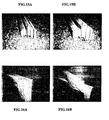
- a first tool realises the shaping of the internal profile 5 of the leaf of the window, shown in detail in figure 14A , by realising the pin connections to size with the pins 4, shown in figure 8 , which are envisaged to be inserted in corresponding seats present in the plank for the mullion which will then be joined, creating a joint between the two planks shown in figure 16A .
- the machining stage of the process which envisages the milling of the plank allows planks to be realised which maintain the mechanical performance of the joints (interlocks) which will then be realised.
- the shaped elements are taken to a machine known as a clamp, in which, by means of a uniform spreading of one-part vinyl glue D4 over pin 4, the elements constituting the leaf of the window are assembled: in fact, the mullions and transoms are joined and vice versa.
- the elements (pairs) are thus clamped to outline the four sides of the leaf (the milling was realised solely on the internal side of the leaf of the window).
- the leaf thus obtained passes once again through the "milling unit" to determine, this time, the shaping of the external profile 6 of the leaf of the window shown in figure 14B .
- planks which are shaped according to the present process allow minimal removal of material since they have been studied specifically for leaves and also for the parts of the frame.
- the impregnation with water-soluble products occurs with a first coat of water-soluble, water-based product, followed by the necessary drying time. Then a second coating, in which a layer of water-based undercoat is applied and left to dry; the window is subsequently sandpapered and, last of all, a third coat is applied, which is the finishing coat and consists of a water-based paint which is left to dry for a suitable time.
- the impregnation with natural products occurs with a first coating with a compound of boron salts and natural earth, and then, subsequently, one proceeds by smoothing the window, followed by a second and third coat and one or more coats of finishing wax.
- the elements constituting the casing once dry, are fastened together either with glue (D4) or in a mechanical fashion using screws.
- the seal 8 used features an annular configuration which allows suitable insulation to prevent blows and deaden the vibrations which are generated between the casing and leaf also creating a notable seal against the passing of air, wind, and water, in addition to noise.
- a third seal 80 located on the leaf which increases the acoustic seal further.
- a double glazed pane 9 is added which, once in place, is suitably shimmed and sealed.
- the series of operations for the realisation of the wood+cork plank can also be applied to realise lamellar planks of a commonly known type, thus allowing a saving in material also in the construction of conventional windows, while it is not applicable to windows constructed with solid planks.
- the shape realised with the milling machine concerning the shaping of the internal profile 5 of the leaf allows the pane 9 to rest on a first segment 11 of cork which allows, from an acoustic point of view, a considerable seal against noise and, similarly, the mobile pane holder 12 rests against a second segment of cork 13 which, in its turn, is touching the pane 9, therefore excellent noise insulation is created also on the inside of the window.
- the presence of the segments of cork 11 and 13 which are placed at the sides of the pane allow an improvement also in the seal against the transmission of heat along lateral edges of the glass at the points where the pane holder 12 is present.
- the production process allows energy savings and savings in terms of the trees used, and employs natural materials only, unlike as occurs with synthetic or chemical materials according to the commonly known technique.
- the production process according to the present invention proves particularly flexible and allows the waste of materials during the window construction stage to be reduced considerably.
- the production process in question uses natural materials, allows the manufacturer to offer school-garde solutions to problems concerning savings in energy and materials both in the production of the plank constituting the base of the window and during window use.
- planks are milled
- the particular shaping with which the planks are milled has allowed a product to be realised which is geometrically suitable for the realisation of a high-performance window as the combination of the shaped wood+cork plank and the milling contours has allowed a product to be obtained which is suitable for the realisation of a window, in all its parts, also from a mechanical point of view, unlike those presently produced according to the commonly known technique.
- the plank features a good static seal between the parts comprising it, created by its gluing under pressure, at room temperature, for approx. four hours using one-part vinyl glue.
- the production process according to the present invention allows notable savings in both energy and raw material; an average saving in raw material has been calculated at 18% of the total product, with respect to an industrially manufactured window realised according to the methods of the commonly known technique.
- the data stated refers to the savings in raw materials, but the related industrial activities and the window realised lead us to add that energy saving percentages are improved along the entire production chain, from cutting down the trees to the end use of the product in any building.
- the production process in question furthermore, renders the window produced ecological: everything utilised in its production is, in fact, recoverable and/or recyclable.
- a further, but not final, advantage of the present invention is that the production process proves simple to realise and works well.
Landscapes
- Engineering & Computer Science (AREA)
- Civil Engineering (AREA)
- Structural Engineering (AREA)
- Wing Frames And Configurations (AREA)
- Automobile Manufacture Line, Endless Track Vehicle, Trailer (AREA)
- Securing Of Glass Panes Or The Like (AREA)
Applications Claiming Priority (1)
| Application Number | Priority Date | Filing Date | Title |
|---|---|---|---|
| IT000008A ITMN20080008A1 (it) | 2008-04-04 | 2008-04-04 | Processo di produzione di un serramento ecocomponibile. |
Publications (1)
| Publication Number | Publication Date |
|---|---|
| EP2107201A2 true EP2107201A2 (de) | 2009-10-07 |
Family
ID=40297052
Family Applications (1)
| Application Number | Title | Priority Date | Filing Date |
|---|---|---|---|
| EP09425128A Withdrawn EP2107201A2 (de) | 2008-04-04 | 2009-04-03 | Herstellungsverfahren für ein ökologisches modulares Fenster |
Country Status (2)
| Country | Link |
|---|---|
| EP (1) | EP2107201A2 (de) |
| IT (1) | ITMN20080008A1 (de) |
Cited By (1)
| Publication number | Priority date | Publication date | Assignee | Title |
|---|---|---|---|---|
| CN109800524A (zh) * | 2019-01-29 | 2019-05-24 | 福州大学 | 基于COMSOL Multiphysics的汽车风挡玻璃成型模拟方法 |
Citations (1)
| Publication number | Priority date | Publication date | Assignee | Title |
|---|---|---|---|---|
| EP1830150A1 (de) | 2004-11-25 | 2007-09-05 | Daikin Industries, Ltd. | Wärmetauscher |
-
2008
- 2008-04-04 IT IT000008A patent/ITMN20080008A1/it unknown
-
2009
- 2009-04-03 EP EP09425128A patent/EP2107201A2/de not_active Withdrawn
Patent Citations (1)
| Publication number | Priority date | Publication date | Assignee | Title |
|---|---|---|---|---|
| EP1830150A1 (de) | 2004-11-25 | 2007-09-05 | Daikin Industries, Ltd. | Wärmetauscher |
Cited By (2)
| Publication number | Priority date | Publication date | Assignee | Title |
|---|---|---|---|---|
| CN109800524A (zh) * | 2019-01-29 | 2019-05-24 | 福州大学 | 基于COMSOL Multiphysics的汽车风挡玻璃成型模拟方法 |
| CN109800524B (zh) * | 2019-01-29 | 2023-04-18 | 福州大学 | 基于COMSOL Multiphysics的汽车风挡玻璃成型模拟方法 |
Also Published As
| Publication number | Publication date |
|---|---|
| ITMN20080008A1 (it) | 2009-10-05 |
Similar Documents
| Publication | Publication Date | Title |
|---|---|---|
| CN102535752B (zh) | 一种结构用层板胶合木圆木柱及制备方法 | |
| CN201810170U (zh) | 阻燃单板层积材木质防火门 | |
| EP2668349B1 (de) | Trittflächenabdeckung sowie zugehörige verfahren und prozesse | |
| US5771656A (en) | Fiberboard doors | |
| CN101323124A (zh) | 竹材原态多方重组材料及其制造方法 | |
| CN105697975B (zh) | 一种木基复合材料 | |
| CN101967947A (zh) | 阻燃单板层积材木质防火门及其制作方法 | |
| CN103465320B (zh) | 一种抗变形、节材、免漆杉木三层复合板的生产方法 | |
| EP3352986B1 (de) | Verfahren zur herstellung eines laminierten holzbauteils und daraus hergestelltes laminiertes holzbauteil | |
| CN105479558A (zh) | 展平竹层积材拼板及其制造方法 | |
| CN109866301A (zh) | 一种osb室内门及其制造工艺 | |
| US1594889A (en) | Method of making veneered wood products | |
| CN110145210A (zh) | 组合式防变形实木复合免漆门及制作方法 | |
| Teischinger et al. | Sawn-timber products | |
| RU2325988C1 (ru) | Клееное оцилиндрованное бревно и способ его изготовления | |
| EP1957741B1 (de) | Rahmenstruktur und verfahren zur herstellung solch einer rahmenstruktur | |
| EP0577689B1 (de) | Leitersteigen und daraus hergestellte leiter | |
| CN102359227A (zh) | 人工林薄板条集成木 | |
| CN214687028U (zh) | 具有卯榫结构的细木工板 | |
| ITMN20080008A1 (it) | Processo di produzione di un serramento ecocomponibile. | |
| DE102010034688A1 (de) | Kanteln für Energiesparfenster | |
| RU2297332C2 (ru) | Криволинейный композитный элемент и способ его изготовления | |
| RU109482U1 (ru) | Стеновой брус | |
| CN210414894U (zh) | 一种osb板连接系统 | |
| CN210414896U (zh) | 一种osb室内门 |
Legal Events
| Date | Code | Title | Description |
|---|---|---|---|
| PUAI | Public reference made under article 153(3) epc to a published international application that has entered the european phase |
Free format text: ORIGINAL CODE: 0009012 |
|
| AK | Designated contracting states |
Kind code of ref document: A2 Designated state(s): AT BE BG CH CY CZ DE DK EE ES FI FR GB GR HR HU IE IS IT LI LT LU LV MC MK MT NL NO PL PT RO SE SI SK TR |
|
| STAA | Information on the status of an ep patent application or granted ep patent |
Free format text: STATUS: THE APPLICATION IS DEEMED TO BE WITHDRAWN |
|
| 18D | Application deemed to be withdrawn |
Effective date: 20151103 |