EP2109466B1 - Positronenemissionstomografieverfahren - Google Patents
Positronenemissionstomografieverfahren Download PDFInfo
- Publication number
- EP2109466B1 EP2109466B1 EP08729271.0A EP08729271A EP2109466B1 EP 2109466 B1 EP2109466 B1 EP 2109466B1 EP 08729271 A EP08729271 A EP 08729271A EP 2109466 B1 EP2109466 B1 EP 2109466B1
- Authority
- EP
- European Patent Office
- Prior art keywords
- compound
- folate
- radiophore
- linker
- diagnosing
- Prior art date
- Legal status (The legal status is an assumption and is not a legal conclusion. Google has not performed a legal analysis and makes no representation as to the accuracy of the status listed.)
- Not-in-force
Links
- 0 CC(C)(CC*)OCCC(C)(C)OCCC(NCCNC(CCC(C(O)=O)NC(c(cc1)ccc1NCc(cn1)nc2c1N=C(N)NC2=O)=O)=O)=O Chemical compound CC(C)(CC*)OCCC(C)(C)OCCC(NCCNC(CCC(C(O)=O)NC(c(cc1)ccc1NCc(cn1)nc2c1N=C(N)NC2=O)=O)=O)=O 0.000 description 7
- JAFXXQDTPMLNEA-UHFFFAOYSA-N CC(CCOCCNC(c(cc1)ccc1F)=O)OCCC(NCCNC(CCC(C(O)=O)NC(c(cc1)ccc1NCc(cn1)nc2c1N=C(N)NC2=O)=O)=O)=O Chemical compound CC(CCOCCNC(c(cc1)ccc1F)=O)OCCC(NCCNC(CCC(C(O)=O)NC(c(cc1)ccc1NCc(cn1)nc2c1N=C(N)NC2=O)=O)=O)=O JAFXXQDTPMLNEA-UHFFFAOYSA-N 0.000 description 1
- VZVDQSZPHQYQSH-UHFFFAOYSA-N CCOC(c(cc(cc1)[N+]([O-])=O)c1[N+]([O-])=O)=O Chemical compound CCOC(c(cc(cc1)[N+]([O-])=O)c1[N+]([O-])=O)=O VZVDQSZPHQYQSH-UHFFFAOYSA-N 0.000 description 1
- IKPVPSXCJNEMPJ-UHFFFAOYSA-N CC[O](C)C(c1cc([N+]([O-])=O)ccc1F)=O Chemical compound CC[O](C)C(c1cc([N+]([O-])=O)ccc1F)=O IKPVPSXCJNEMPJ-UHFFFAOYSA-N 0.000 description 1
- AMQSXUXWTFFSMK-UHFFFAOYSA-N NC(NC1=O)=Nc2c1nc(CNc(cc1)ccc1C(NC(CCC(NCCO)=O)C(O)=O)=O)cn2 Chemical compound NC(NC1=O)=Nc2c1nc(CNc(cc1)ccc1C(NC(CCC(NCCO)=O)C(O)=O)=O)cn2 AMQSXUXWTFFSMK-UHFFFAOYSA-N 0.000 description 1
- DZSZUCUYRIZBAT-UHFFFAOYSA-N NC(NC1=O)=Nc2c1nc(CNc(cc1)ccc1C(NC(CCC(NCCOCCCOCCC(NCCNC(c(cc(cc1)[N+]([O-])=O)c1F)=O)=O)=O)C(O)=O)=O)cn2 Chemical compound NC(NC1=O)=Nc2c1nc(CNc(cc1)ccc1C(NC(CCC(NCCOCCCOCCC(NCCNC(c(cc(cc1)[N+]([O-])=O)c1F)=O)=O)=O)C(O)=O)=O)cn2 DZSZUCUYRIZBAT-UHFFFAOYSA-N 0.000 description 1
- BBYDXOIZLAWGSL-UHFFFAOYSA-N OC(c(cc1)ccc1F)=O Chemical compound OC(c(cc1)ccc1F)=O BBYDXOIZLAWGSL-UHFFFAOYSA-N 0.000 description 1
- ICXSHFWYCHJILC-UHFFFAOYSA-N [O-][N+](c(cc1)cc(C(O)=O)c1F)=O Chemical compound [O-][N+](c(cc1)cc(C(O)=O)c1F)=O ICXSHFWYCHJILC-UHFFFAOYSA-N 0.000 description 1
Images

Classifications
-
- A—HUMAN NECESSITIES
- A61—MEDICAL OR VETERINARY SCIENCE; HYGIENE
- A61K—PREPARATIONS FOR MEDICAL, DENTAL OR TOILETRY PURPOSES
- A61K51/00—Preparations containing radioactive substances for use in therapy or testing in vivo
- A61K51/02—Preparations containing radioactive substances for use in therapy or testing in vivo characterised by the carrier, i.e. characterised by the agent or material covalently linked or complexing the radioactive nucleus
- A61K51/04—Organic compounds
- A61K51/08—Peptides, e.g. proteins, carriers being peptides, polyamino acids, proteins
- A61K51/088—Peptides, e.g. proteins, carriers being peptides, polyamino acids, proteins conjugates with carriers being peptides, polyamino acids or proteins
-
- A—HUMAN NECESSITIES
- A61—MEDICAL OR VETERINARY SCIENCE; HYGIENE
- A61K—PREPARATIONS FOR MEDICAL, DENTAL OR TOILETRY PURPOSES
- A61K51/00—Preparations containing radioactive substances for use in therapy or testing in vivo
- A61K51/02—Preparations containing radioactive substances for use in therapy or testing in vivo characterised by the carrier, i.e. characterised by the agent or material covalently linked or complexing the radioactive nucleus
- A61K51/04—Organic compounds
- A61K51/0497—Organic compounds conjugates with a carrier being an organic compounds
-
- A—HUMAN NECESSITIES
- A61—MEDICAL OR VETERINARY SCIENCE; HYGIENE
- A61P—SPECIFIC THERAPEUTIC ACTIVITY OF CHEMICAL COMPOUNDS OR MEDICINAL PREPARATIONS
- A61P43/00—Drugs for specific purposes, not provided for in groups A61P1/00-A61P41/00
-
- C—CHEMISTRY; METALLURGY
- C07—ORGANIC CHEMISTRY
- C07B—GENERAL METHODS OF ORGANIC CHEMISTRY; APPARATUS THEREFOR
- C07B59/00—Introduction of isotopes of elements into organic compounds ; Labelled organic compounds per se
- C07B59/002—Heterocyclic compounds
-
- C—CHEMISTRY; METALLURGY
- C07—ORGANIC CHEMISTRY
- C07D—HETEROCYCLIC COMPOUNDS
- C07D475/00—Heterocyclic compounds containing pteridine ring systems
- C07D475/02—Heterocyclic compounds containing pteridine ring systems with an oxygen atom directly attached in position 4
- C07D475/04—Heterocyclic compounds containing pteridine ring systems with an oxygen atom directly attached in position 4 with a nitrogen atom directly attached in position 2
Definitions
- This invention relates to compositions and methods to diagnose and/or monitor pathogenic disease states using positron emission tomography.
- this invention relates to pathogenic cells that uniquely express, preferentially express, or overexpress vitamin receptors.
- Vitamin receptor binding compounds conjugated to a radiophore useful in positron emission tomography are described for diagnosing and/or monitoring disease states using an extra-corporeal device.
- Vitamin receptors are overexpressed on cancer cells.
- the folate receptor a 38 KD GPI-anchored protein that binds the vitamin folic acid with high affinity ( ⁇ 1 nM)
- ⁇ 1 nM the folate receptor
- many malignant tissues including ovarian, breast, bronchial, and brain cancers.
- 95% of all ovarian carcinomas overexpress the folate receptor.
- normal tissues express low or nondetectable levels of the folate receptor.
- Most cells also use an unrelated reduced folate carrier to acquire the necessary folic acid.
- activated monocytes overexpress the folate receptor.
- the overexpression of folate receptors on activated macrophages, and on activated monocytes, is described in U.S. Patent Application Nos. 60/696,740 and U.S. Patent Application Publication No. US 2002/0192157 .
- the folate receptor ⁇ the nonepithelial isoform of the folate receptor, is expressed on activated, but not resting, synovial macrophages.
- Activated macrophages can participate in the immune response by nonspecifically engulfing and killing foreign pathogens within the macrophage, by displaying degraded peptides from foreign proteins on the macrophage cell surface where they can be recognized by other immune cells, and by secreting cytokines and other factors that modulate the function of T and B lymphocytes, resulting in further stimulation of immune responses.
- activated macrophages can also contribute to the pathophysiology of disease in some instances. For example, activated macrophages can contribute to atherosclerosis, rheumatoid arthritis, autoimmune disease states, and graft versus host disease, among other disease states.
- Atherosclerosis is a disease state initiated when a fatty streak forms within a blood vessel wall. Formation of fatty streaks is believed to result from accumulation of lipoprotein particles in the intima layer of the blood vessel wall, the layer of the vessel wall underlying the luminal endothelial cell layer. Lipoprotein particles can associate with extracellular matrix components in the intima layer and can become inaccessible to plasma antioxidants, resulting in oxidative modification of the lipoprotein particles.
- Such oxidative modification may trigger a local inflammatory response resulting in adhesion of activated macrophages and T lymphocytes to the luminal endothelium followed by migration into the intima layer.
- the oxidized lipoprotein particles themselves can act as chemo-attractants for cells of the immune system, such as macrophages and T cells, or can induce cells in the vascular wall to produce chemo-attractants.
- the atherosclerotic lesion may then form a fibrous cap with a lipid-rich core filled with activated macrophages.
- Atherosclerotic lesions that are unstable are characterized by local inflammation, and lesions that have ruptured and have caused fatal myocardial infarction are characterized by an infiltration of activated macrophages and T lymphocytes.
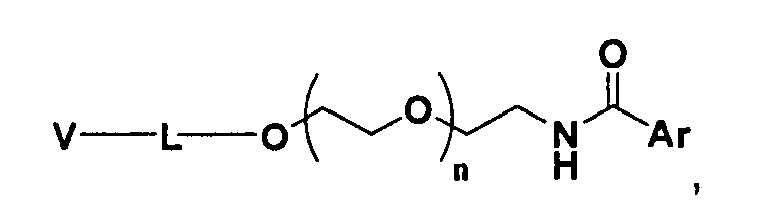
- the invention relates to a compound of the formula wherein V is a folate receptor binding moiety; L is an optional bivalent linker; n is an integer selected from 1 to 20; and Ar is an aryl group or a heteroaryl group, that includes one or more substituents (R f ) m comprising a radiophore or nitro, wherein said radiophore is a fluoro, and wherein m is an integer selected from 1 to 3.
- the invention relates to a composition
- a composition comprising the above compound and a carrier therefor, where the compound is present in an amount sufficient for use in positron emission tomography.
- the invention relates to the use of the above compound or the above composition in the manufacture of a medicament for diagnosing or monitoring in a patient a disease state mediated by activated monocytes or activated macrophages having accessible binding sites for a vitamin, the method comprising the steps of:
- the invention relates to the use of the above compound or the above composition in the manufacture of a medicament for diagnosing or monitoring a cancer wherein the cancer cells uniquely express, preferentially express, or overexpress vitamin receptors, the method comprising the steps of:
- the invention relates to the use of the above compound or the above composition in the manufacture of a medicament for diagnosing or monitoring active atherosclerotic plaques associated with blood vessels wherein the plaques comprise activated macrophages having accessible binding sites for a vitamin, the method comprising the steps of:
- compositions and methods to diagnose and/or monitor pathogenic disease states using positron emission tomography include cancers, disease states that involve activated macrophages or activated monocytes, disease states that involve activated plaques, and the like.
- pathogenic disease states include cancers, disease states that involve activated macrophages or activated monocytes, disease states that involve activated plaques, and the like.
- the compositions and methods pertain to pathogenic cells that uniquely express, preferentially express, or overexpress vitamin receptors. It is disclosed that vitamins, or analogs thereof, conjugated to a radiophore may be used to diagnose and/or monitor such disease states extra-corporeally using positron emission tomography.
- Methods are disclosed for diagnosing and/or monitoring a cancer wherein the cancer cells uniquely express, preferentially express, or overexpress vitamin receptors.
- the methods comprise the steps of administering to a patient being evaluated for the cancer an effective amount of a conjugate of the general formula B-L-X, wherein B comprises a vitamin, or an analog thereof, the group X comprises a radiophore, and L is an optional bivalent linker.
- the method includes allowing sufficient time for the vitamin conjugate to bind to the cancer cells, and diagnosing and/or monitoring the cancer extra-corporeally using positron emission tomography.
- the methods comprise the steps of administering to a patient being evaluated for the disease state an effective amount of a conjugate of the general formula B-L-X, wherein B comprises a vitamin, or an analog thereof, the group X comprises a radiophore, and L is an optional bivalent linker.
- the method includes allowing sufficient time for the vitamin conjugate to bind to activated monocytes or activated macrophages, and diagnosing and/or monitoring the disease state extra-corporeally using positron emission tomography.
- the methods comprise the steps of administering to a patient being evaluated for atherosclerosis an effective amount of a conjugate of the general formula B-L-X, wherein B comprises a vitamin, or an analog thereof, the group X comprises a radiophore, and L is an optional bivalent linker.
- the method includes allowing sufficient time for the vitamin conjugate to bind to activated macrophages associated with active plaques, and diagnosing and/or monitoring the active plaques extra-corporeally using positron emission tomography.
- the radiophore is a positron-emitting isotope, wherein the isotope emits a pair of_annihilation photons moving in opposite directions that result from positron annihilation with an electron.
- the radiophore decays with a half-life of about 80 minutes to about 8 hours by emission of positrons.
- compositions comprising a compound of formula B-L-X, wherein B comprises a vitamin, or an analog thereof, the group X comprises a radiophore, and L is an optional bivalent linker.
- the radiophore is a positron-emitting isotope, wherein the isotope emits a pair of annihilation photons moving in opposite directions that result from positron annihilation with an electron.
- the radiophore has a half-life of about 80 minutes to about 8 hours.
- the invention relates to a compound of the formula wherein V is a folate receptor binding moiety,; L is an optional bivalent linker; n is an integer selected from 1 to 20; Ar is an aryl group or a heteroaryl group, that includes one or more substituents (R f ) m comprising a radiophore or nitro, said radiophore is a fluoro; and m is an integer selected from 1 to 3.
- Ar may be a precursor for preparing an 18 F fluoroaryl radiophore, and accordingly R f comprises one or more nitro groups.
- Ar may also be an 18 F fluoroaryl radiophore where R f comprises one or more fluoro groups.
- R f may include more then one nitro group, or R f may include both fluoro and nitro, or R f may include more than one fluoro group. It is also to be understood that the fluorine isotopes found in the various embodiments and aspects, and variations described herein may be selected from 18 F and 19 F, or isotopic combinations thereof.
- the compound in another embodiment of the compounds described herein, is of the formula wherein V is a folate; L is an optional bivalent linker; n is an integer selected from 1 to 20; R f is as defined for the invention above; and m is an integer selected from 1 to 3.
- the compound in another embodiment, is of the formula wherein L is an optional bivalent linker; n is an integer selected from 1 to 20; R f is as defined for the invention above; and m is an integer selected from 1 to 3.
- one or more asymmetric carbons may be present. Accordingly, described herein are each of the various stereochemical variants of those asymmetric carbons. Specific enantiomers and diasteromers, specific racemic mixtures, and various mixtures and combinations of each of the foregoing are described herein.
- the radiophore decays with a half-life of about 80 minutes to about 8 hours by emission of positrons, and where the radiophore emits a pair of annihilation photons moving in opposite directions resulting from positron annihilation with an electron.
- the methods comprise the steps of providing the vitamin, in a reactive form capable of reacting with a radiophore in reactive form, providing the radiophore in the reactive form capable of reacting with the vitamin in reactive form, and contacting the reactive form of the vitamin with the reactive form of the radiophore.
- each of the reactive forms of the vitamin, or analog or derivative thereof, and the radiophore are reacted with a reactive form of a bivalent linker. It is appreciated that such chemical steps may be performed in various sequences, and may include optional protecting groups.
- the methods include the step of reacting a conjugate of a nitroaryl precursor with an 18 F and/or 19 F fluorinating agent.
- kits for preparing 18 F radiolabeled and/or 19 F compounds for use in PET imaging comprise a conjugate of arylnitro precursor, an 18 F and/or 19 F fluorinating agent, an optional solvent, and a reaction container for reacting the arylnitro precursor with the fluorinating agent.
- the kits also include a purification system.
- the kit itself does not include the fluorinating agent, but rather, the fluorinating agent is generated prior to use with the kit, such as through the use of a cyclotron or other generator.
- the present disclosure relates to compositions and methods to diagnose and/or monitor pathogenic disease states using positron emission tomography (PET), wherein the pathogenic cells uniquely express, preferentially express, or overexpress vitamin receptors or other receptors.
- PET positron emission tomography
- the disclosure is applicable to populations of pathogenic cells that cause a variety of pathologies such as cancer, disease states that involve activated macrophages or activated monocytes, disease states that involve activated plaques, and the like.
- the population of pathogenic cells may be a cancer cell population that is tumorigenic, including benign tumors and malignant tumors, or it can be non-tumorigenic.
- the cancer cell population may arise spontaneously or by such processes as mutations present in the germline of the patient or somatic mutations, or it may be chemically, virally, or radiation induced.
- the disclosure can be utilized to diagnose and/or monitor such cancers as carcinomas, sarcomas, lymphomas, Hodgkin's disease, melanomas, mesotheliomas, Burkitt's lymphoma, nasopharyngeal carcinomas, leukemias, myelomas, and the like.
- the cancer cell population can include, but is not limited to, oral, thyroid, endocrine, skin, gastric, esophageal, laryngeal, pancreatic, colon, bladder, bone, ovarian, cervical, uterine, breast, testicular, prostate, rectal, kidney, liver, lung, and other cancers.
- the pathogenic cells can also be activated monocytes or macrophages associated with disease states such as fibromyalgia, rheumatoid arthritis, osteoarthritis, ulcerative colitis, Crohn's disease, psoriasis, osteomyelitis, multiple sclerosis, pulmonary fibrosis, sarcoidosis, systemic sclerosis, organ transplant rejection (GVHD), lupus erythematosus, Sjögren's syndrome, glomerulonephritis, inflammations of the skin, such as psoriasis, and the like, chronic inflammations, and inflammations due to injury, such as head or spinal cord injury, embolisms, and the like.
- the disease state is atherosclerosis.
- the invention relates to a compound of the formula wherein V is a folate receptor binding moiety; L is an optional bivalent linker; n is an integer selected from 1 to 20; and Ar is an aryl group or a heteroaryl group, that includes one or more substituents (R f ) m comprising a radiophore or nitro, wherein said radiophore is a fluoro, and wherein m is an integer selected from 1 to 3.
- the invention relates to a composition
- a composition comprising the above compound and a carrier therefor, where the compound is present in an amount sufficient for use in positron emission tomography.
- the invention relates to the use of the above compound or the above composition in the manufacture of a medicament for diagnosing or monitoring in a patient a disease state mediated by activated monocytes or activated macrophages having accessible binding sites for a vitamin, the method comprising the steps of:
- the invention relates to the use of the above compound or the above composition in the manufacture of a medicament for diagnosing or monitoring a cancer wherein the cancer cells uniquely express, preferentially express, or overexpress vitamin receptors, the method comprising the steps of:
- the invention relates to the use of the above compound or the above composition in the manufacture of a medicament for diagnosing or monitoring active atherosclerotic plaques associated with blood vessels wherein the plaques comprise activated macrophages having accessible binding sites for a vitamin, the method comprising the steps of:
- a method for diagnosing and/or monitoring a disease state mediated by activated macrophages or activated monocytes having accessible binding sites for a vitamin comprises the steps of administering to a patient being evaluated for the disease state an effective amount of a conjugate of the general formula B-L-X, wherein B comprises a vitamin, or an analog or derivative thereof capable of binding to a vitamin receptor, the group X comprises a radiophore, and L is an optional linker.
- the method includes allowing sufficient time for the conjugate to bind to activated monocytes or the activated macrophages, and diagnosing and/or monitoring the disease state extra-corporeally using positron emission tomography.
- the radiophore has a half-life of about 80 minutes to about 8 hours.
- a further method for diagnosing and/or monitoring a cancer wherein the cancer cells uniquely express, preferentially express, or overexpress vitamin receptors.
- the method comprises the steps of administering to a patient being evaluated for the cancer an effective amount of a conjugate of the general formula B-L-X, wherein B comprises a vitamin, or an analog or derivative thereof capable of binding to a vitamin receptor, the group X comprises a radiophore, and L is an optional linker.
- the radiophore has a half-life of about 80 minutes to about 8 hours, and the method includes allowing sufficient time for the conjugate to bind to the cancer cells, and diagnosing and/or monitoring the cancer extra-corporeally using positron emission tomography.
- a further method for diagnosing/monitoring active atherosclerotic plaques associated with blood vessels wherein the plaques comprise activated macrophages having accessible binding sites for a vitamin.
- the method comprises the steps of administering to a patient being evaluated for atherosclerosis an effective amount of a conjugate of the general formula B-L-X, wherein B comprises a vitamin, or an analog or derivative thereof capable of binding to a vitamin receptor, the group X comprises a radiophore, and L is an optional linker.
- the radiophore is capable of decaying by emission of positrons
- the method includes allowing sufficient time for the vitamin conjugate to bind to the activated macrophages associated with active plaques, and diagnosing and/or monitoring the active plaques extra-corporeally using positron emission tomography.
- the radiophore has a half-life of about 80 minutes to about 8 hours.
- the disclosed method or inventive use relates to diagnosing and/or monitoring active atherosclerotic plaques in blood vessel walls.
- the ligand such as a vitamin, or an analog or derivative thereof, binds to a receptor which is preferentially expressed, uniquely expressed, or overexpressed on the surface of activated macrophages relative to resting macrophages, is conjugated to a radiophore.
- the conjugates are administered to a patient being evaluated for atherosclerosis.
- the conjugates bind to activated macrophages associated with active atherosclerotic plaques.
- the radiation emitted by the radiophore is detected extra-corporeally using positron emission tomography. Accordingly, the conjugates can be used to distinguish active atherosclerotic plaques, containing activated macrophages, from inactive plaques wherein the plaques are present in the arteries or veins of a patient being evaluated for atherosclerosis.
- the disclosed method and inventive use of the present invention represents a significant advance in diagnosing and/or monitoring the risk of myocardial infarction, and in evaluating the need for clinical intervention, in patients suffering from atherosclerosis.
- the term "useful in positron emission tomography” means a compound that emits positron radiation capable of producing a pair of annihilation photons moving in opposite directions, the annihilation photons being produced as a result of positron annihilation with an electron. Those photons are capable of being detected by positron emission tomography (PET) using a suitable extra-corporeal device.
- PET positron emission tomography
- V is a folate receptor binding moiety
- L is an optional bivalent linker
- n is an integer selected from 1 to 20
- Ar is an aryl group, or a heteroaryl group, that includes one or more substituents (R f ) m comprising a radiophore or nitro, said radiophore is a fluoro
- m is an integer selected from 1 to 3.
- Ar may be a precursor for preparing an 18 F fluoroaryl radiophore, and accordingly R f comprises one or more nitro groups.
- Ar may also be an 18 F fluoroaryl radiophore where R f comprises one or more fluoro groups.
- R f may include more then one nitro group, or R f may include both fluoro and nitro, or R f may include more than one fluoro group. It is also to be understood that the fluorine isotopes found in the various embodiments and aspects, and variations described herein may be selected from 18 F and 19 F, or isotopic combinations thereof.
- the vitamins, or analogs or derivatives thereof may be used to diagnose and/or monitor disease states using an extra-corporeal device.
- PET detection using an extra-corporeal device is also referred to as a "PET scan," and devices for extra-corporeal detection using PET are well known in the art.
- the conjugates can be formed from a wide variety of ligands and radiophores, including any ligand that binds to a receptor overexpressed, uniquely expressed, or preferentially expressed on the surface of activated monocytes or activated macrophages that is not expressed or presented or is not present in significant amounts on the surface of resting monocytes or macrophages.
- such ligands include N-formyl peptides, such as formyl-Met-Leu-Phe, high mobility group factor 1 protein (HMGB1), hyaluronan (also referred to as hyaluronic acid and/or hyaluronate), and fragments thereof, heat shock proteins, including HSP-70, toll-like receptor ligands, scavenger receptor ligands, co-receptors for antigen presentation, ligands that bind to the CD68, BER-MAC3, RFD7, CD4, CD14, and HLA-D markers on activated macrophages, ligands that bind to urokinase plasminogen activator receptors, such as the WX-360 peptide, antibodies, or fragments thereof, that bind preferentially to activated macrophages, and vitamins or receptor-binding vitamin analogs and derivatives.
- N-formyl peptides such as formyl-Met-Leu-Phe,
- the monocyte-binding ligand can be any ligand that binds to a receptor expressed or overexpressed on activated monocytes including CD40, CD16, CD14, CDllb, and CD62 binding ligands, 5-hydroxytryptamine, macrophage inflammatory protein 1- ⁇ , MIP-2, receptor activator of nuclear factor ⁇ B ligand antagonists, monocyte chemotactic protein 1-binding ligands, chemokine receptor 5 binding ligands, RANTES binding ligands, chemokine receptor-binding ligands, and vitamins or receptor-binding vitamin analogs and derivatives, and the like.
- the conjugates are capable of preferentially binding to activated monocytes or activated macrophages compared to resting monocytes or macrophages due to preferential expression of the receptor for the ligand on activated monocytes or macrophages.
- the ligand such as the vitamin or analog or derivative thereof, can be any ligand that binds to a receptor which is preferentially expressed, uniquely expressed, or overexpressed the surface of cancer cells, or activated monocytes or activated macrophages relative to resting monocytes or macrophages.
- exemplary of such ligands are vitamins selected from the group consisting of folate receptor-binding ligands, biotin receptor-binding ligands, vitamin B 12 receptor-binding ligands, riboflavin receptor-binding ligands, thiamine receptor-binding ligands, and other vitamin receptor-binding ligands, or analogs or derivatives thereof.
- the subject matter of the invention involves a folate receptor-binding moiety, in particular folate.
- Acceptable vitamin moieties that can be used in accordance with the disclosures herein include niacin, pantothenic acid, riboflavin, thiamine, biotin, vitamin B 12 , and the lipid soluble vitamins A, D, E and K.
- these vitamins, and their receptor-binding analogs and derivatives constitute the targeting entity that can be coupled with a radiophore, capable of emitting radiation, to form the conjugates for use in accordance with the invention.
- One illustrative group of vitamin moieties includes biotin, riboflavin, thiamine, vitamin B 12 , and receptor-binding analogs and derivatives of these vitamin molecules, and other related vitamin receptor-binding molecules. Further illustrative vitamins and analogs and derivatives thereof are described in U.S. Patent No. 5,688,488 .
- the vitamin receptor-binding ligand can be folic acid, a folic acid analog, or another folate receptor-binding molecule.
- a vitamin analog is a folate analog containing a glutamic acid residue in the D configuration, where it is understood that folic acid normally contains one glutamic acid in the L configuration linked to pteroic acid.
- Other analogs of folate that can be used include folinic acid, pteropolyglutamic acid, and folate receptor-binding pteridines such as tetrahydropterins, dihydrofolates, tetrahydrofolates, and their deaza and dideaza analogs.
- the terms “deaza” and “dideaza” analogs refers to the art recognized analogs having a carbon atom substituted for one or two nitrogen atoms in the naturally occurring folic acid structure.
- the deaza analogs include the 1-deaza, 3-deaza, 5-deaza, 8-deaza, and 10-deaza analogs.
- the dideaza analogs include, for example, 1,5 dideaza, 5,10-dideaza, 8,10-dideaza, and 5,8-dideaza analogs.
- the foregoing folic acid analogs are conventionally termed "folates,” reflecting their capacity to bind to folate receptors.
- folate receptor-binding analogs include aminopterin, amethopterin (methotrexate), N 10 -methylfolate, 2-deamino-hydroxyfolate, deaza analogs such as 1-deazamethopterin or 3-deazamethopterin, and 3',5'-dichloro-4-amino-4-deoxy-N 10 -methylpteroylglutamic acid (dichloromethotrexate).
- the radiophores are radiophores and emit radiation that is useful in diagnostic and/or monitoring methods employing positron emission tomography.
- the compounds emit positron radiation capable of producing a pair of annihilation photons moving in opposite directions, the annihilation photons are produced as a result of positron annihilation with an electron.
- the radiophore is generally a radioisotope linked to another chemical structure, such as aryl rings, including heteroaryl rings.
- the radiophore can comprise the radioisotope alone.
- the radiophore may include a positron-emitting isotope having a suitable half-life and toxicity profile.
- the radioisotope has a half-life of more than 30 minutes, more than 70 minutes, more than 80 minutes, more than 90 minutes, more than 100 minutes, less than 8 hours, less than 6 hours, less than 4 hours, or less than 3 hours.
- the radioisotope has a half-life of about 30 minutes to about 4 hours, about 70 minutes to about 4 hours, about 80 minutes to about 4 hours, about 90 minutes to about 4 hours, about 100 minutes to about 4 hours, about 30 minutes to about 6 hours, about 70 minutes to about 6 hours, about 80 minutes to about 6 hours, about 90 minutes to about 6 hours, about 100 minutes to about 6 hours, about 30 minutes to about 8 hours, about 70 minutes to about 8 hours, about 80 minutes to about 8 hours, about 90 minutes to about 8 hours, or about 100 minutes to about 8 hours.
- the compounds include a useful positron emitting isotope.
- a suitable radiophore for use in the invention may be prepared using the fluorine isotope 18F.
- Other useful positron-emitting isotopes for use in the disclosures may also be employed, such as 34 Cl, 45 Ti, 51 Mn, 61 Cu, 63 Zn, 82 Rb, 68 Ga, 66 Ga, 11 C, 13 N, 15 O, and 18 F.
- the radioisotope is selected from 64 Cu, 68 Ga, 66 Ga, and 18 F.
- Factors that may be included during selection of a suitable isotope include sufficient half-life of the positron-emitting isotope to permit preparation of a diagnostic composition in a pharmaceutically acceptable carrier prior to administration to the patient, and sufficient remaining half-life to yield sufficient activity to permit extra-corporeal measurement by a PET scan. Further, a suitable isotope should have a sufficiently short half-life to limit patient exposure to unnecessary radiation. In an illustrative embodiment, 18 F, having a half-life of 110 minutes, provides adequate time for preparation of the diagnostic composition, as well as an acceptable deterioration rate. Further, on decay 18 F is converted to 18 O.
- the isotope should have sufficient chemical activity to permit the isotope to become bound to a chemical compound and in turn to the ligand, whether or not a linker is used. Isotopes of elements having toxic properties can be avoided.
- Positron-decaying isotopes having suitable half-lives include: 34 Cl, half-life about 32 minutes; 45 Ti, half-life about 3 hours; 51 Mn, half-life about 45 minutes; 61 Cu, half-life about 3.4 hours; 63 Zn, half-life about 38 minutes; 82 Rb, half-life about 2 minutes; 68 Ga, half-life about 68 minutes, 66 Ga, half-life about 9.5 hours, 11 C, half-life about 20 minutes, 15 O, half-life about 2 minutes, 13 N, half-life about 10 minutes, or 18 F, half-life about 110 minutes.
- the radioisotope is covalently attached to an aromatic group, such as an aryl or heteroaryl group.
- aromatic group such as an aryl or heteroaryl group.
- aryl and heteroaryl groups include benzamidyl, benzylic, phenyl, pyridinyl, pyrimidinyl, pyridazinyl, and like groups, other aromatic groups, including polycyclic aryl groups such as, naphthyl, benzothiazolyl, benzimizolyl, benzoxazolyl, and like groups.
- the radioisotope is 18 F and the radiophore includes an aryl group to which the radioisotope is covalently attached.
- the conjugates can bind with high affinity to receptors on cancer cells or activated monocytes or activated macrophages. It is understood that the high affinity binding can be inherent to the ligand or the binding affinity can be enhanced by the use of a chemically modified ligand (i.e., an analog or a derivative) or by the particular chemical linkage, in the conjugate, between the ligand and the radiophore.
- a chemically modified ligand i.e., an analog or a derivative
- the chemical linkage in the conjugate between the ligand and the radiophore can be a direct linkage or can be through an intermediary linker.
- an intermediary linker can be any biocompatible linker known in the art.
- the linker comprises a chain of about 1 to about 50 atoms selected from carbon, nitrogen, oxygen, and sulfur atoms.
- the linker comprises a chain of about 5 to about 25 atoms.
- the linkers described herein may also include phosphorus atoms.
- the linker is a lower molecular weight linker, such as a linker having an approximate molecular weight less than about 1000, or illustratively in the range of about 30 to about 500.
- any manner of forming a conjugate between the ligand and the radiophore, or alternatively between an optional linker and the ligand, or between an optional linker and the radiophore can be utilized in the compounds and methods described herein.
- the conjugate can be formed by conjugation of the components of the conjugate, for example, through hydrogen, ionic, or covalent bonds.
- covalent bonding of the components of the conjugate is used, for example, through the formation of ether, amino, amide, ester, disulfide, thiol, hydrazino, hydrazono, imino, and/or hydroxylimino bonds carbon fragments bearing the appropriate functionalities, such as between acid, aldehyde, hydroxy, amino, sulfhydryl, hydroxylamine, and/or hydrazine groups.
- the linker can comprise an indirect means for associating the ligand with the radiophore, such as by connection through spacer arms or bridging molecules, or through the use of complexing agents that are incorporated into the conjugate.
- the linker contributes to water solubility of the conjugate, or at least does not materially detract from water solubility.
- Advantageous linkers for water solubility include water soluble polymers such as dextran, cellulose ethers, amino acid, oligopeptide and polypeptide linkers of varying lengths, and polyalkylene glycols, including polyethylene glycols of varying lengths.
- such polymers have a molecular weight of less than about 1000, or have a molecular weight in the range of about 30 to about 500.
- linkers including carboxylic acid bearing amino acids such as aspartic acid and glutamic acid
- linkers including amino groups such as ornithine, lysine, and arginine
- highly water soluble linkers such as carbohydrate linkers, and linkers of carbohydrate analogs and derivatives, such as those described in U.S. provisional patent application serial No. 60/946,092 , may also be included in the optional linker L.
- the hydrophilic spacer linkers described herein include a polyether, such as the linkers of the following formulae: where m is an integer independently selected in each instance from 1 to about 8; p is an integer selected 1 to about 10; and n is an integer independently selected in each instance from 1 to about 3. In one aspect, m is independently in each instance 1 to about 3. In another aspect, n is 1 in each instance. In another aspect, p is independently in each instance about 4 to about 6.
- the corresponding polypropylene polyethers corresponding to the foregoing are contemplated herein and may be included in the conjugates as hydrophilic spacer linkers.
- mixed polyethylene and polypropylene polyethers may be included in the conjugates as hydrophilic spacer linkers.
- cyclic variations of the foregoing polyether compounds such as those that include tetrahydrofuranyl, 1,3-dioxanes, 1,4-dioxanes, and the like are contemplated herein.
- the hydrophilic spacer linkers described herein include a plurality of hydroxyl functional groups, such as linkers that incorporate monosaccharides, oligosaccharides, polysaccharides, and the like. It is to be understood that the polyhydroxyl containing spacer linkers comprises a plurality of -(CROH)- groups, where R is hydrogen or alkyl.
- linkers are described that may also limit the rate of excretion of the conjugate from the patient by permitting the ligand to associate with the site of interest, such as cancer cells or activated monocytes or activated macrophages before being excreted in the bile from the liver, or in the urine.
- a linker may facilitate, or may delay metabolic consumption of the conjugate such as by retarding reticuloendothelial system uptake, particularly by the liver.
- a linker may also help avoid association of the conjugate with non-target organs, cells, fluids, or proteins.
- the PET scan would provide a scan of the patient's blood vessels generally, in contrast to the specific location of cancer cells or activated monocytes or activated macrophages sought.
- the linker may facilitate or accelerate a preferred route of excretion of the conjugate, such as through urine, for example, by encouraging the patient to drink significant fluids after the administration of the conjugate.
- including a hydrophilic or plurality of hydrophilic groups on the linker may direct the conjugate to preferential clearance by the kidney rather than the liver.
- the compound in another embodiment of the compounds described herein, is of the formula wherein V is a folate, or an analog or derivative thereof; L is an optional bivalent linker; n is an integer selected from 1 to 20; R f is as defined for the invention above herein; and m is an integer selected from 1 to 3. In one variation, the integer n is in the range from 3 to about 8.
- the compound in another embodiment of the compounds described herein, is of the formula wherein L is an optional bivalent linker; n is an integer selected from 1 to 20; R f is as defined for the invention above herein; and m is an integer selected from 1 to 3. In one variation, the integer n is in the range from 3 to about 8.
- the folate, or analog/derivative thereof can be conjugated to the linker by an art-recognized procedure that utilizes trifluoroacetic anhydride to prepare ⁇ -esters of folic acid via a pteroyl azide intermediate. This procedure results in the synthesis of folate, conjugated to the linker selectively through the ⁇ -carboxy group of the glutamic acid groups of folate.
- folic acid analogs can be coupled by art-recognized procedures through the ⁇ -carboxy moiety of the glutamic acid group or both the ⁇ and ⁇ carboxylic acid entities.
- folic acid may be coupled to such amino acids, or peptide intermediates, to prepare folate linkers, and analogs and derivatives of folic acid, that may be coupled to the radiophore.
- amino acid coupling reactions may also be performed on resins, such as Merrifield resins, Wang resins, Universal resins, and the like. Additional details for processes of preparing peptide linker intermediates of pteroic acid and folic acid, and analogs and derivatives of each, are described in PCT international application publication WO 2006/071754 .
- pteroic acid is prepared by amidase or protease degradation of folic acid, or the corresponding analog or derivative thereof.
- carboxypeptidase G and like proteases, may be used.
- the resulting pteroic acid may be protected to allow for the selective functionalization of the alpha or gamma carboxylates, such as by protection of the N(10) amine.
- An illustrative synthesis is shown in the following scheme:
- analogs and derivatives of folic acid may be similarly converted into the corresponding analog or derivative of pteroic acid.
- the pteroic acid, or analog of derivative thereof may then illustratively be coupled to an optional linker, such as a peptide linker, a sugar or carbohydrate linker, a polyalkylene glycol linker, or other linker.
- an optional linker such as a peptide linker, a sugar or carbohydrate linker, a polyalkylene glycol linker, or other linker.
- the solid supported pteroic acid or folic acid, or analog or derivative thereof is attached to an optional linker, such as a PEG linker as shown in the following scheme, where n is an integer from 1 to 20, or is illustratively in the range from about 3 to about 8: It is appreciated that PEG linkers of widely varying length, such as shorter lengths of 3 or 4 repeating units, or longer lengths of 6, 7, or 8 repeating units or significantly longer lengths of 10 or 20 repeating units may be prepared according to this synthetic procedure.
- the solid supported intermediate is connected to a radiophore precursor, such as a nitroaryl group Ar 1 , where Ar 1 may include phenyl or naphthyl, and heteroaryl, such as pyridinyl, piperidinyl, benzoxazole or benzothiazole, each of which is substituted with at least one nitro group, as shown in the following scheme, where n is an integer from 1 to 20, or is illustratively in the range from about 3 to about 8:
- n is an integer from 1 to 20, or is illustratively in the range from about 3 to about 8:
- reverse amides are described herein, where in the above scheme, the PEG intermediate terminates in a carboxylic acid and the nitroaryl containing group is an aniline, or the corresponding aryl or heteroaryl variation thereof, such as 3-nitro-5-aminopyridine, and the like.
- thioamides, ureas, ethers, esters, and other chemical links are described herein for attaching the nitroaryl group.
- a nitroaryl group Ar 1 is converted into the corresponding fluoroaryl group Ar 2 , as shown in the following scheme, where n is an integer from 1 to 20, or is illustratively in the range from about 3 to about 8:
- n is an integer from 1 to 20, or is illustratively in the range from about 3 to about 8:
- the foregoing scheme is illustrated for fluoroaryl containing carboxylic acids; however, it is to be understood that additional fluoroaryl containing compounds, including fluoroheteroaryl containing compounds, may be used by the appropriate selection of an attachment atom.
- reverse amides are described herein, where in the above scheme, the PEG intermediate terminates in a carboxylic acid and the fluoroaryl containing group is an aniline, or the corresponding aryl or heteroaryl variation thereof, such as 3-fluoro-5-aminopyridine, and the like.
- thioamides, ureas, ethers, esters, and other chemical links are described herein for attaching the fluoroaryl group. It is to be understood that the compounds described herein may include more than one nitro group that may be converted into the corresponding fluoro group.
- the nitroaryl and the fluoroaryl group is the corresponding phenyl group, as shown in the following scheme where R f is selected from nitro and fluoro, providing that at least one of R f is fluoro; m is 1, 2, or 3; and n is an integer from 1 to 20, and is illustratively 3 or 5:
- the nitroaryl is 4-nitrophenyl. In another aspect, the nitroaryl is 2,5-dinitrophenyl. In another aspect, the fluoroaryl is 4-fluorophenyl. In another aspect, the fluoroaryl is 5-fluorophenyl. In another aspect, the fluoroaryl is 2,5-difluorophenyl.
- PEG linkers of varying lengths such as 3, 4, 5, or 6 repeating units may be prepared according to this synthetic procedure.
- the fluorination agent is either an 18 F or a 19 F fluorination reagent, or an isotopic mixture thereof.
- the radioisotope may be introduced into an intermediate compound rather than the final compound.
- compounds described herein may be prepared as follows, where LG is a leaving group: where n is an integer selected from 1 20, or in the range from 3 to about 8. It is understood that either or both of 18 F and 19 F isotopes, and mixtures thereof, may be prepared according to the above process.
- n is an integer selected from 1 to 20, or in the range from 3 to about 8. It is understood that either or both of 18 F and 19 F isotopes, and mixtures thereof, may be prepared according to the above process.
- n is an integer selected from 1 to 20, or in the range from 3 to about 8. It is understood that either or both of 18 F and 19 F isotopes, and mixtures thereof, may be prepared according to the above process. Additional synthetic details are described in Bioorg Med Chem Lett. 10:1501-1503 (2000 ).
- n is an integer selected from 1 to 20, or in the range from 3 to about 8. It is understood that either or both of 18 F and 19 F isotopes, and mixtures thereof, may be prepared according to the above process.
- the fluorodenitrification step described in the various process embodiments may take place at various steps in the process.
- conversion late in the synthesis carries the advantage of minimizing the decay time of the radioisotope during imaging agent preparation.
- the elapsed time complete conversion is as follows: about 3 min for radiolabeling, about 7 min for cleave from the resin, overall time including purification about 25 -30 min., radiochemical labeling yield about 70-80%.
- an "effective amount" of the conjugate is an amount sufficient to bind to cancer cells or activated monocytes or activated macrophages and to be useful in the diagnosis and/or monitoring of cancer or disease states involving activated monocytes or activated macrophages.
- the effective amount of the conjugate to be administered to a patient being evaluated for cancer or disease states involving activated monocytes or activated macrophages can range from about 1 pg/kg to about 10 mg/kg, 1 ng/kg to about 10 mg/kg, or from about 10 ⁇ g/kg to about 1 mg/kg, or from about 100 ⁇ g/kg to about 500 ⁇ g/kg.
- the conjugate can be administered in one or more doses, such as from about 1 to about 3 doses, prior to detection with the extra-corporeal PET imaging device.
- doses such as from about 1 to about 3 doses, prior to detection with the extra-corporeal PET imaging device.
- the number of doses depends on the molecular weight of the conjugate, its route of administration, and its tissue distribution, among other factors.
- the extra-corporeal detection procedure is typically performed about 1 minute to about 6 hours post-administration of the conjugate, but the extra-corporeal detection procedure can be performed at any time post-administration of the conjugate as long as binding of the conjugate to cancer cells or activated monocytes or activated macrophages is detectable and sufficient time is allowed for elimination of a substantial fraction of the unbound conjugate from the body.
- the conjugates administered in accordance with the disclosed methods and inventive uses described herein are preferably administered parenterally to the patient, for example, intravenously, intradermally, subcutaneously, intramuscularly, or intraperitoneally, in combination with a pharmaceutically acceptable carrier.
- the conjugates can be administered to the patient by other medically useful procedures such as in an orally available formulation. It is appreciated that any patient suspected of having cancer or a disease state involving activated monocytes or activated macrophages, whether symptomatic or not, who would benefit from an evaluation using the method of the present invention can be evaluated.
- the conjugates used are used in one aspect of this invention to formulate diagnostic compositions comprising effective amounts of the conjugate and an acceptable carrier therefor.
- parenteral dosage forms include aqueous solutions of the conjugate, for example, a solution in isotonic saline, 5% glucose or other well-known pharmaceutically acceptable liquid carriers such as alcohols, glycols, esters and amides. Any orally available dosage forms known in the art can also be used.
- the conjugates used herein are formed to target and, thus, to concentrate the conjugate at the site of a tumor or at the site of accumulation of activated monocytes or activated macrophages, such as activated macrophages adhering to the luminal endothelial layer of the plaque or activated macrophages present in the lipid-rich core of the plaque in the patient.
- activated monocytes or activated macrophages such as activated macrophages adhering to the luminal endothelial layer of the plaque or activated macrophages present in the lipid-rich core of the plaque in the patient.
- the radiophore comprises an elemental isotope which is a positron emitter.
- Positron emitters emit in three dimensions from the source atom, but the emission proceeds in two parts in exactly opposite directions.
- the anti-particle of the electron when the positron from a decaying isotope comes in contact with electrons in nearby matter, it annihilates emitting energy from the annihilation as gamma rays. To conserve momentum, the gamma ray photons travel in opposite directions.
- the location in the patient where the conjugate has accumulated is more readily and therefore more accurately, detected within a time frame reasonable for patient diagnosis.
- the signal-to-noise ratio of positron annihilation is markedly improved over unidirectional gamma rays. Further, by back-projecting coincident rays, the location of the source emission is located.
- PET is presently used in medical centers as a diagnostic tool for the detection of cancer.
- a patient may be administered glucose that has been tagged with a positron emitter, such as 18 F fluorodeoxyglucose, because glucose concentrates in fast-growing cancer cells.
- the presence of a cancer may be detected by the concentration of the PET imaging agent.
- the location of the cancer in the body is determined by back-projecting the coincident gamma radiation by means of the PET scanner.
- the methods disclosed herein may be used in combination with 18 F fluorodeoxyglucose to detect cancer cells.
- the methods may also be used in combination with any other methods of cancer diagnosis already developed and known in the art, including methods using other already developed diagnostic agents and utilizing x-ray computed tomography (CT), magnetic resonance imaging (MRI), functional magnetic resonance imaging (fMRI), ultrasound, and single photon emission computed tomography (SPECT).
- CT computed tomography
- MRI magnetic resonance imaging
- fMRI functional magnetic resonance imaging
- SPECT single photon emission computed tomography
- the uses described herein can be employed alone or in combination with any other method(s) known in the art for the detection, analysis, and/or ablation of atherosclerotic plaques.
- the uses can be employed in combination with methods to ablate atherosclerotic plaques in cases where active plaques cause narrowing of blood vessels.
- the conjugates described herein can be used not only to identify active atherosclerotic plaques as compared to inactive plaques, but also to distinguish between atherosclerotic and normal tissue to aid in ablation procedures.
- the uses and compositions can be employed to analyze both the physiological and the morphological state of atherosclerotic plaques.
- angioplasty involves the non-surgical widening of a vessel narrowed by plaque deposition, and laser energy, for example, directed through optical fibers in a catheter-based device, can be used to ablate or partially remove the plaque deposits.
- laser energy for example, directed through optical fibers in a catheter-based device
- Catheter-based devices for ablating plaques using laser energy are described in U.S. Patent Nos. 4,817,601 , 4,850,351 , and 4,950,266 .
- each of the processes and synthetic methods described herein either substantially complete fluorination, or alternatively only partial fluorination may be desired. Accordingly, the processes and synthetic methods described herein may be performed in various alternative embodiments. It is therefore understood that in those aspects where only partial fluorination is desired, the processes and syntheses described herein may be performed with less than stoichiometric amounts of fluorinating agent. Similarly, it is understood that in certain applications of the methods described herein, each of the processes and synthetic methods described herein either substantially complete radiofluorination, or alternatively only partial radiofluorination may be desired. Accordingly, the processes and synthetic methods described herein may be performed in various alternative embodiments. It is therefore understood that in those aspects where only partial radiofluorination is desired, the processes and syntheses described herein may be performed with less than stoichiometric amounts of radiofluorination agent, where the balance is optionally 19 F.
- each of the processes and synthetic methods described herein wherein there is present more than one nitro group reactions may selected in various alternative embodiments.
- stoichiometric amounts of the fluorination agent are included to substantially convert each nitro group into the corresponding fluoro group.
- the amount of fluorination agent is selected to substantially convert only a subset of nitro groups, such as one or two nitro groups out of three that may be present; or in one variation, one nitro group out of two that may be present.
- less than one equivalent of fluorinating agent is included in the process to only partially convert at least one nitro group to the corresponding fluoro group.
- the various embodiments are selected to suit the intensity of labeling needs for the methods described herein. It is appreciated that in those aspects where substantial conversion of all nitro groups present will not take place, the presence of additional nitro groups may act as activating groups to decrease the reaction time or to increase the overall conversion to the desired partial level of fluorination. Accordingly, also contemplated herein are compounds that may include additional electron withdrawing groups, or alternative electron withdrawing groups other than nitro that we either decrease the reaction time or to increase the overall conversion to the desired partial level of fluorination.
- the p-fluorobenzoic acid may be purified and concentrated by the addition of sufficient HCl to fully protonate the p-fluorobenzoic acid, which are isolated on a reverse phase C18 column such as a C18 SepPak Plus sold by Waters Corp. Milford Massachusetts.
- the column may be washed with HCl acidified water to remove any water soluble contaminants.
- the p-fluorobenzoic acid may be eluted from the column with methanol followed by further contaminant removal on a cationic ion-exchange column (e.g., a Dowex column), and concentration by evaporation of the methanol. It is to be understood that the foregoing synthesis is also used to make isotopic mixtures that include 18 F and 19 F.
- the N-hydroxysuccinimide ester of p-fluorobenzoic acid may be concentrated and purified after isolation by reverse phase high performance liquid chromatography in a mixture of water/acetonitrile/and sufficient trifluoroacetic acid to preserve an acidic pH.
- a water diluted solution of the ester may be concentrated on a C18 SepPak column followed by elution with diethyl ether. Residual water may be removed using a column of anhydrous Mg 2 SO 4 . After evaporation of the ether to dryness, the ester may be re-dissolved in CH 3 CN.
- the foregoing processes may be used with other aromatic carboxylic acids having a dimethylamine group to prepare the corresponding 18 F labeled radiophore for conjugation as described herein.
- the intermediate ( 18 F)SFB may be coupled to any other folic acid, or analog or derivative thereof, through an optional linker as described herein to form a conjugate.
- the aryl ring may be optionally substituted.
- N(10)-TFA Pteroic Acid Zinc chloride was added to a solution of folic acid dissolved in 0.1M tris base. Carboxypeptidase G was added to the reaction while stirring. The pH was adjusted to about 7.3 using 1N HCl and temperature was raised to 30 °C. The reaction vessel was covered with aluminum foil and stirred for 7 days. The pH was adjusted as needed to about 7.3. The pH was lowered to about pH 3.0 using 6N HCl. The resulting precipitate was centrifuged at 4000 rpm for 10 min. The supernatant was decanted and lyophilized for 48 h. Pteroic acid was purified using ion exchange column, and the fractions lyophilized for 48 h.
- Universal Folate Resin Universal Folate Resin. Universal Folate resin was synthesized using Universal NovaTagTM resin (Novabiochem; Catalog # 04-12-3910), as described in Novabiochem Letters 1-4 (2004 ); Bioorg. Med. Chem. Lett. 15:5442-5445 (2005 ). After swelling the resin with dichloromethane (DCM), and then with DMF, the Fmoc was removed with 20% piperidine in DMF.
- DCM dichloromethane
- the resulting Fmoc-Glu-OtBu was coupled using HATU [2-(1H-7-Azabenzotriazol-1-yl)-1,1,3,3-tetramethyl uronium hexafluorophosphate] and DIPEA (N,N-Diisopropylethylamine) in DMF.
- N10-TFA Pteroic was coupled using standard Fmoc solid phase peptide synthesis (SPPS).
- SPPS Fmoc solid phase peptide synthesis
- the pendant Mmt (4-Methoxytrityl) was removed with 1M HOBt (1-Hydroxybenzotriazole) in DCM/trifluoroethanol.
- the resin may be washed with DMF and immediately used again, or it may be washed with DCM/DMF and then with MeOH and dried for later use.
- Fmoc-(PEG) 6 -CO 2 H was coupled to Universal folate resin using HOBt/HBTU (O-Benzotriazole-N,N,N',N'-tetramethyl-uronium-hexafluoro-phosphate)/DIPEA in DMF.
- HOBt/HBTU O-Benzotriazole-N,N,N',N'-tetramethyl-uronium-hexafluoro-phosphate
- the Fmoc group was removed using 20% piperidine and then either 4-nitrobenzoic acid or 2,5-dinitrobenzoic acid was introduced using HOBt/HBTU/DIPEA in DMF.
- a hydrazine solutions (2%) was used to deprotect the N10-TFA group, followed by treatment with TFA/triisopropylsilane/water to cleave the compound from the resin and deprotect the tertiary butyl groups.
- the solvent was concentrated under vacuum and the compounds were precipitated using diethyl ether.
- Folate Fluoro Radiophore Conjugates The folate-nitrophenyl conjugates were dried under vacuum using P 2 O 5 over 24 hours. Dried folate nitro conjugates were dissolved in DMSO-d 6 . Anhydrous TBAF (tetrabutylammonium fluoride) was added to convert the folate-fluoro-phenyl conjugates. The progress of the reaction was monitored by 1 H-NMR.
- the 19F and 18F analogs are prepared in an analogous fashion by selecting the appropriate isotopic reagent.
- the 18 F compounds described herein are prepared using TBAF 18 F in DMSO at ambient temperature for 10-20 minutes, or [K/2.2.2] 18 F/K 2 CO 3 in DMSO at elevated temperature, as described in Bioconjugate Chem. 2:44-49 (1991 ); Applied Radiation and Isotopes 64:989-994 (2006 ); J Label Compd Radiopharm 49:1037-1050 (2006 ); Applied Radiation and Isotopes 50:923-927 (1999 ); J. Nuc. Med. 32:2266-2272 (1991 ).
- Impure and purified samples of folate conjugates of SFB, and other radiophores may be analyzed by high performance liquid chromatography (HPLC) using conditions similar to those described in Clinical Science, vol. 103: pp. 4S-8S (2002 ) with the following modifications.
- HPLC high performance liquid chromatography
- the reverse phase HPLC was performed using a C18 column and the following gradient water/0.1% TFA in CH 3 CN at 77:23 for 10 min, 60:40 for 10 min, 50:50 for 10 min, 40:60 for 10 min, and using a flow rate of 1.0 ml/minute.
- Impure and purified samples of folate conjugates of SFB, and other radiophores may be analyzed by ESI-mass spectrometry.
- a relative affinity of the comparative ligand 1 suggests a ligand with equal affinity for FR when compared to folic acid; Relative affinity ⁇ 1 suggests weaker affinity, and a relative affinity > 1 suggest a stronger affinity with respect to folic acid.
- KB cells human cervical cancer cell line that shows over expressed FR were seeded in 48 well falcon plate and allowed to grow adherent monolayer overnight in folate deficient RPMI (Gibco RPMI medium 1640, catalog # 27016) that has 10% FBS (Fatal Bovine serum) and 1% PS (penicillin streptomycine). Then cells were incubated with 10 nM 3H-folic acid in the presence of increasing concentration (0.1 nM - 1 ⁇ M) of cold folic acid (non-radioactive) or folate-fluoro-phenyl conjugate at 37 °C for 1h.
- folate deficient RPMI Gibco RPMI medium 1640, catalog # 27016
- FBS Fetal Bovine serum
- PS penicillin streptomycine
Landscapes
- Chemical & Material Sciences (AREA)
- Health & Medical Sciences (AREA)
- Organic Chemistry (AREA)
- Life Sciences & Earth Sciences (AREA)
- Proteomics, Peptides & Aminoacids (AREA)
- Animal Behavior & Ethology (AREA)
- General Health & Medical Sciences (AREA)
- Veterinary Medicine (AREA)
- Pharmacology & Pharmacy (AREA)
- Medicinal Chemistry (AREA)
- Public Health (AREA)
- Epidemiology (AREA)
- Physics & Mathematics (AREA)
- Optics & Photonics (AREA)
- Engineering & Computer Science (AREA)
- Bioinformatics & Cheminformatics (AREA)
- Chemical Kinetics & Catalysis (AREA)
- General Chemical & Material Sciences (AREA)
- Nuclear Medicine, Radiotherapy & Molecular Imaging (AREA)
- Medicines Containing Antibodies Or Antigens For Use As Internal Diagnostic Agents (AREA)
- Nitrogen Condensed Heterocyclic Rings (AREA)
Claims (15)
- Ein Stoff der Formel
wobei besagtes Radiophor ein Fluor ist, und
wobei m eine ganze Zahl, ausgewählt von 1 bis 3 ist. - Der Stoff nach Anspruch 1 mit der Formel

wobei besagtes Radiophor ein Fluor ist, und
wobei m eine ganze Zahl, ausgewählt von 1 bis 3 ist. - Der Stoff nach Anspruch 1 oder 2, wobei der Folatrezeptor-bindende Rest oder das Folat aus der Gruppe ausgewählt ist, bestehend aus:• Folat;• Folinsäure;• Pteroylpolyglutaminsäure;• Folatrezeptor-bindende Pteridine, wie z. B. Tetrahydropterine, Dihydrofolate und Tetrahydrofolate;• Folatrezeptor-bindende Deazaanaloge von Tetrahydropterinen, Dihydrofolaten und Tetrahydrofolaten, wie z. B. 1-Deaza-, 3-Deaza-, 5-Deaza-, 8-Deaza- und 10-Deazaanaloge von Tetrahydropterinen, Dihydrofolaten und Tetrahydrofolaten;• Folatrezeptor-bindende Dideazaanaloge von Tetrahydropterinen, Dihydrofolaten, Tetrahydrofolaten, wie z. B. 1,5-Dideaza-, 5,10-Dideaza-, 8,10-Dideaza- und 5,8-Dideazaanaloge von Tetrahydropterinen, Dihydrofolaten und Tetrahydrofolaten;• Aminopterin;• Amethopterin (Methotrexat);• N10-Methylfolat;• 2-Deamino-hydroxyfolat;• 1-Deazamethopterin;• 3-Deazamethopterin; und• 3',5'-Dichlor-4-amino-4-deoxy-N10-methylpteroylglutaminsäure (Dichlormethotrexat).
- Der Stoff nach Anspruch 1 mit der Formel

- Der Stoff nach irgendeinem der Ansprüche 1 bis 4, wobei m 1 oder 2 ist.
- Der Stoff nach irgendeinem der Ansprüche 1 bis 4, wobei (Rf)m 1 oder 2 Nitrogruppen umfasst.
- Der Stoff nach irgendeinem der Ansprüche 1 bis 4, wobei (Rf)m eine oder zwei 18F-Fluorgruppen umfasst.
- Der Stoff nach irgendeinem der Ansprüche 1 bis 4, wobei (Rf)m mindestens eine Nitrogruppe und mindestens eine 18F-Fluorgruppe umfasst.
- Der Stoff nach irgendeinem der Ansprüche 1 bis 4, wobei L ein Linker ist, der eine Vielzahl von hydrophilen Gruppen umfasst.
- Der Stoff nach Anspruch 9, wobei die Vielzahl der hydrophilen Gruppen von Kohlenhydraten oder Derivaten hiervon unabhängig ausgewählt ist.
- Der Stoff nach irgendeinem der Ansprüche 1 bis 4, wobei L ein Linker ist, der eine oder mehrere Gruppen umfasst, die die Aufnahme des Konjugats durch die Leber verzögern.
- Eine Zusammensetzung, die einen Stoff nach irgendeinem der Ansprüche 1 bis 4 und einen Träger hierfür umfasst, wobei der Stoff in einer ausreichenden Menge zur Verwendung in Positronimmissionstomographie vorhanden ist.
- Verwendung des Stoffes nach irgendeinem der Ansprüche 1 bis 4, oder der Zusammensetzung nach Anspruch 12, in der Herstellung eines Medikamentes für die Diagnose oder Überwachung eines Krankheitsstadiums in einem Patienten, das durch aktivierte Monozyten oder aktivierte Makrophagen vermittelt wird, die zugängliche Bindungsseiten für ein Vitamin haben, wobei das Verfahren die Schritte umfasst von:a. Verabreichung einer wirksamen Menge des Stoffes oder der Komposition an einen Patienten;b. genügend Zeit dem Stoff gewähren, um an aktivierten Monozyten oder die aktivierten Makrophagen zu binden; undc. außerkc5rperliche Diagnose oder Überwachung des Krankheitsstadiums durch Verwendung von Positronimmissionstomographie.
- Verwendung des Stoffes nach irgendeinem der Ansprüche 1 bis 4 oder der Zusammensetzung nach Anspruch 12 in der Herstellung eines Medikamentes für die Diagnose oder Überwachung von Krebs, wobei die Krebszellen Vitaminrezeptoren einzig exprimieren, bevorzugt exprimieren, oder überexprimieren, das Verfahren umfasst die Schritte von:a. Verabreichung einer wirksamen Menge des Stoffes oder der Verbindung an einen Patienten;b. genügend Zeit dem Stoff gewähren, um an die Krebszellen zu binden; undc. außerkörperliche Diagnose oder Überwachung des Krebses unter Verwendung von Positronimmissionstomographie.
- Verwendung des Stoffes nach irgendeinem der Ansprüche 1 bis 4 oder der Zusammensetzung nach Anspruch 12 in der Herstellung eines Medikamentes zur Diagnose oder Überwachung aktiver arteriosklerotischer Plaques, die mit Blutgefäßen assoziiert sind, wobei die Plaques aktivierte Makrophagen umfassen, die zugängliche Bindungsseiten für ein Vitamin haben, das Verfahren umfasst die Schritte von:a. Verabreichung einer wirksamen Menge des Stoffes oder der Zusammensetzung an einen Patienten;b. genügend Zeit dem Stoff gewähren, um an aktivierte Makrophagen zu binden, die mit aktiven Plaques assoziiert sind; undc. außerkörperliche Diagnose oder Überwachung der aktiven Plaques unter Verwendung von Positronimmissionstomographie.
Priority Applications (1)
| Application Number | Priority Date | Filing Date | Title |
|---|---|---|---|
| EP12186446.6A EP2567711A3 (de) | 2007-02-07 | 2008-02-07 | Bildgebungsverfahren für Positronenemissionstomographie |
Applications Claiming Priority (3)
| Application Number | Priority Date | Filing Date | Title |
|---|---|---|---|
| US89992107P | 2007-02-07 | 2007-02-07 | |
| US89601807P | 2007-03-21 | 2007-03-21 | |
| PCT/US2008/053293 WO2008098112A2 (en) | 2007-02-07 | 2008-02-07 | Positron emission tomography imaging method |
Related Child Applications (1)
| Application Number | Title | Priority Date | Filing Date |
|---|---|---|---|
| EP12186446.6A Division-Into EP2567711A3 (de) | 2007-02-07 | 2008-02-07 | Bildgebungsverfahren für Positronenemissionstomographie |
Publications (2)
| Publication Number | Publication Date |
|---|---|
| EP2109466A2 EP2109466A2 (de) | 2009-10-21 |
| EP2109466B1 true EP2109466B1 (de) | 2014-11-12 |
Family
ID=39493469
Family Applications (2)
| Application Number | Title | Priority Date | Filing Date |
|---|---|---|---|
| EP08729271.0A Not-in-force EP2109466B1 (de) | 2007-02-07 | 2008-02-07 | Positronenemissionstomografieverfahren |
| EP12186446.6A Withdrawn EP2567711A3 (de) | 2007-02-07 | 2008-02-07 | Bildgebungsverfahren für Positronenemissionstomographie |
Family Applications After (1)
| Application Number | Title | Priority Date | Filing Date |
|---|---|---|---|
| EP12186446.6A Withdrawn EP2567711A3 (de) | 2007-02-07 | 2008-02-07 | Bildgebungsverfahren für Positronenemissionstomographie |
Country Status (6)
| Country | Link |
|---|---|
| US (2) | US8586595B2 (de) |
| EP (2) | EP2109466B1 (de) |
| JP (2) | JP5869205B2 (de) |
| AU (1) | AU2008213702B2 (de) |
| CA (1) | CA2677792C (de) |
| WO (1) | WO2008098112A2 (de) |
Families Citing this family (32)
| Publication number | Priority date | Publication date | Assignee | Title |
|---|---|---|---|---|
| CN101979095A (zh) | 2001-05-02 | 2011-02-23 | 普渡研究基金会 | 巨噬细胞介导的疾病的治疗和诊断 |
| US8043602B2 (en) | 2002-02-07 | 2011-10-25 | Endocyte, Inc. | Folate targeted enhanced tumor and folate receptor positive tissue optical imaging technology |
| US8043603B2 (en) | 2002-02-07 | 2011-10-25 | Endocyte, Inc. | Folate targeted enhanced tumor and folate receptor positive tissue optical imaging technology |
| WO2004110250A2 (en) | 2003-05-30 | 2004-12-23 | Purdue Research Foundation | Diagnostic method for atherosclerosis |
| EP1904183B1 (de) | 2005-07-05 | 2014-10-15 | Purdue Research Foundation | Pharmazeutische Zusammensetzung zur Behandlung von Arthrose |
| US8795633B2 (en) * | 2005-09-23 | 2014-08-05 | Purdue Research Foundation | Multiphoton in vivo flow cytometry method and device |
| JP2010509570A (ja) | 2006-11-03 | 2010-03-25 | パーデュー・リサーチ・ファウンデーション | エクスビボフローサイトメトリーの方法および装置 |
| US8586595B2 (en) | 2007-02-07 | 2013-11-19 | Purdue Research Foundation | Positron emission tomography imaging method |
| AU2008237932C1 (en) | 2007-04-11 | 2014-04-24 | Merck & Cie | 18 F-labelled folates |
| PT2146944E (pt) * | 2007-04-11 | 2014-03-11 | Merck & Cie | Processo para a preparação de folatos marcados com 18f |
| WO2008148001A2 (en) * | 2007-05-25 | 2008-12-04 | Purdue Research Foundation | Method of imaging localized infections |
| PL2187965T3 (pl) | 2007-08-17 | 2020-05-18 | Purdue Research Foundation | Koniugaty wiążący psma ligand-łącznik i sposoby ich zastosowania |
| EP2334642B1 (de) | 2008-09-16 | 2014-01-01 | The Regents Of The University Of California | Vereinfachte eintopf-synthese von [18f]sfb für radioaktive markierung |
| CA2736861C (en) | 2008-10-10 | 2017-11-14 | Roger Schibli | 18f-labelled folates as pet radiotracers |
| CA2754492A1 (en) * | 2009-03-05 | 2010-09-10 | Purdue Research Foundation | Method for early imaging of atherosclerosis |
| US9951324B2 (en) | 2010-02-25 | 2018-04-24 | Purdue Research Foundation | PSMA binding ligand-linker conjugates and methods for using |
| US20130230899A1 (en) * | 2010-11-08 | 2013-09-05 | Masaaki Miyata | Therapeutic agent for arteriosclerosis or arteriosclerotic disease, and diagnostic agent for arteriosclerosis or arteriosclerotic disease |
| CN107753962A (zh) * | 2010-12-09 | 2018-03-06 | 通用电气健康护理有限公司 | 放射性示踪剂组合物 |
| EP2663338B1 (de) | 2011-01-14 | 2024-03-06 | Emory University | Glukosebasierte oligosaccharide enthaltend ein positronenemittierendes radionuklid und deren verwendung in der bildgebung |
| PT2776382T (pt) | 2011-08-22 | 2018-12-24 | Merck & Cie | Folatos de 18f-sacárido |
| AU2013258027B2 (en) | 2012-05-08 | 2017-11-30 | Merck & Cie | 18F-labelled follate/antifolate analogues |
| EA201590783A1 (ru) | 2012-11-15 | 2015-11-30 | Эндосайт, Инк. | Конъюгаты для доставки лекарственных средств и способы лечения заболеваний, вызванных клетками, экспрессирующими psma |
| WO2015006453A2 (en) * | 2013-07-09 | 2015-01-15 | Mayo Foundation For Medical Education And Research | Pet imaging of zinc transport |
| EP3456700A1 (de) | 2013-10-18 | 2019-03-20 | Deutsches Krebsforschungszentrum | Markierte inhibitoren des prostataspezifischen membranantigens (psma), deren verwendung als kontrastmittel und pharmazeutika zur behandlung von prostatakrebs |
| EP3533473A3 (de) * | 2013-11-14 | 2019-12-18 | Endocyte, Inc. | Verbindungen für positronenemissionstomografie |
| WO2015077303A1 (en) | 2013-11-19 | 2015-05-28 | Purdue Research Foundation | Patient selection method for inflammation |
| US10188759B2 (en) | 2015-01-07 | 2019-01-29 | Endocyte, Inc. | Conjugates for imaging |
| US11559268B2 (en) | 2015-01-12 | 2023-01-24 | Real Time Imaging Technologies, Llc | Low-dose x-ray imaging system |
| CN112368024A (zh) | 2018-04-17 | 2021-02-12 | 恩多塞特公司 | 治疗癌症的方法 |
| CN114096264B (zh) | 2019-05-20 | 2025-03-14 | 因多塞特股份有限公司 | 制备psma缀合物的方法 |
| WO2022099020A1 (en) * | 2020-11-06 | 2022-05-12 | University Of Washington | Devices, systems, and methods for personalized dosimetry |
| US11986540B2 (en) | 2022-02-23 | 2024-05-21 | On Target Laboratories, LLC | Compositions including pafolacianine for the identification of malignant lesions |
Citations (1)
| Publication number | Priority date | Publication date | Assignee | Title |
|---|---|---|---|---|
| WO2005049579A2 (en) * | 2003-11-13 | 2005-06-02 | Janssen Pharmaceutica N.V. | Immobilized n-substituted tricyclic 3-aminopyrazoles for the identification of biomolecular targets |
Family Cites Families (99)
| Publication number | Priority date | Publication date | Assignee | Title |
|---|---|---|---|---|
| US2816110A (en) | 1956-11-23 | 1957-12-10 | Merck & Co Inc | Methods for the production of substituted pteridines |
| US4713249A (en) | 1981-11-12 | 1987-12-15 | Schroeder Ulf | Crystallized carbohydrate matrix for biologically active substances, a process of preparing said matrix, and the use thereof |
| US5140104A (en) | 1982-03-09 | 1992-08-18 | Cytogen Corporation | Amine derivatives of folic acid analogs |
| US4577636A (en) | 1982-11-23 | 1986-03-25 | The Beth Israel Hospital Association | Method for diagnosis of atherosclerosis |
| US5266333A (en) | 1985-03-06 | 1993-11-30 | American Cyanamid Company | Water dispersible and water soluble carbohydrate polymer compositions for parenteral administration of growth hormone |
| US4817601A (en) | 1985-03-06 | 1989-04-04 | C. R. Bard, Inc. | Catheter system for controlled removal by radiant energy of biological obstructions |
| US4641650A (en) | 1985-03-11 | 1987-02-10 | Mcm Laboratories, Inc. | Probe-and-fire lasers |
| US4718417A (en) | 1985-03-22 | 1988-01-12 | Massachusetts Institute Of Technology | Visible fluorescence spectral diagnostic for laser angiosurgery |
| US4850351A (en) | 1985-05-22 | 1989-07-25 | C. R. Bard, Inc. | Wire guided laser catheter |
| US4917084A (en) | 1985-07-31 | 1990-04-17 | C. R. Bard, Inc. | Infrared laser catheter system |
| NZ217821A (en) | 1985-10-10 | 1989-07-27 | Biotech Australia Pty Ltd | Oral delivery system; complex of active agent and vitamin b12 or analogue thereof |
| US5336506A (en) | 1986-07-03 | 1994-08-09 | Advanced Magnetics Inc. | Targeting of therapeutic agents using polysaccharides |
| EP0273085A1 (de) | 1986-12-29 | 1988-07-06 | IntraCel Corporation | Verfahren zur Einführung fremder Nukleinsäuren in eukaryotische Zellen |
| US4785806A (en) | 1987-01-08 | 1988-11-22 | Yale University | Laser ablation process and apparatus |
| CA1340527C (en) | 1988-05-31 | 1999-05-04 | Lidia Vallarino | Macrocyclic complexes of yttrium, the lanthanides and the actinides having peripheral coupling functionalities |
| US5038787A (en) | 1988-08-10 | 1991-08-13 | The Board Of Regents, The University Of Texas System | Method and apparatus for analyzing material properties using reflected ultrasound |
| EP0449883B1 (de) | 1988-12-21 | 1996-01-31 | Massachusetts Institute Of Technology | Verfahren für laserinduzierte fluoreszenz von gewebe |
| US5108921A (en) | 1989-04-03 | 1992-04-28 | Purdue Research Foundation | Method for enhanced transmembrane transport of exogenous molecules |
| US5688488A (en) | 1989-04-03 | 1997-11-18 | Purdue Research Foundation | Composition and method for tumor imaging |
| US5094848A (en) | 1989-06-30 | 1992-03-10 | Neorx Corporation | Cleavable diphosphate and amidated diphosphate linkers |
| AU8007791A (en) | 1990-06-15 | 1992-01-07 | Cytel Corporation | Intercellular adhesion mediators |
| US5753631A (en) | 1990-06-15 | 1998-05-19 | Cytel Corporation | Intercellular adhesion mediators |
| US5576305A (en) | 1990-06-15 | 1996-11-19 | Cytel Corporation | Intercellular adhesion mediators |
| RU2123338C1 (ru) | 1990-06-15 | 1998-12-20 | Сайтел Корпорейшн | Фармацевтическая композиция на основе медиатора межклеточной адгезии (варианты), способ ингибирования межклеточной адгезии, способ лечения воспалительного заболевания, способ анализа тестируемого соединения на способность ингибировать клеточную адгезию, способ получения соединения |
| US5219548A (en) | 1990-10-01 | 1993-06-15 | Board Of Regents, The University Of Texas System | High affinity halogenated-tamoxifen derivatives and uses thereof |
| US5275594A (en) | 1990-11-09 | 1994-01-04 | C. R. Bard, Inc. | Angioplasty system having means for identification of atherosclerotic plaque |
| DE69230525T2 (de) | 1991-02-08 | 2000-06-21 | Diatide, Inc. | Technetium-99m markierte Polypeptide zur Bildformung |
| US5399338A (en) | 1991-05-01 | 1995-03-21 | University Of New Mexico | Enhancement of abnormal tissue uptake of antibodies, tumor-specific agents or conjugates thereof for diagnostic imaging or therapy |
| US6335434B1 (en) | 1998-06-16 | 2002-01-01 | Isis Pharmaceuticals, Inc., | Nucleosidic and non-nucleosidic folate conjugates |
| US5159079A (en) | 1991-12-20 | 1992-10-27 | Eli Lilly And Company | 2-piperidones as intermediates for 5-deaza-10-oxo- and 5-deaza-10-thio-5,6,7,8-tetrahydrofolic acids |
| US5217456A (en) | 1992-02-24 | 1993-06-08 | Pdt Cardiovascular, Inc. | Device and method for intra-vascular optical radial imaging |
| US6096289A (en) | 1992-05-06 | 2000-08-01 | Immunomedics, Inc. | Intraoperative, intravascular, and endoscopic tumor and lesion detection, biopsy and therapy |
| US5413778A (en) | 1992-10-05 | 1995-05-09 | The Regents Of The University Of Michigan | Labelled monocyte chemoattractant protein material and medical uses thereof |
| US6270766B1 (en) | 1992-10-08 | 2001-08-07 | The Kennedy Institute Of Rheumatology | Anti-TNF antibodies and methotrexate in the treatment of arthritis and crohn's disease |
| US5759546A (en) | 1994-02-04 | 1998-06-02 | Weinberg; Andrew D. | Treatment of CD4 T-cell mediated conditions |
| US5417982A (en) | 1994-02-17 | 1995-05-23 | Modi; Pankaj | Controlled release of drugs or hormones in biodegradable polymer microspheres |
| US6217847B1 (en) | 1994-07-01 | 2001-04-17 | The Board Of Trustees Of The Leland Stanford Junior University | Non-invasive localization of a light-emitting conjugate in a mammal |
| FI98765C (fi) | 1995-01-16 | 1997-08-11 | Erkki Soini | Virtaussytometrinen menetelmä ja laite |
| US6066322A (en) | 1995-03-03 | 2000-05-23 | Millennium Pharmaceuticals, Inc. | Methods for the treatment of immune disorders |
| US5547668A (en) | 1995-05-05 | 1996-08-20 | The Board Of Trustees Of The University Of Illinois | Conjugates of folate anti-effector cell antibodies |
| ATE255910T1 (de) | 1996-04-10 | 2003-12-15 | Sangstat Medical Corp | Zellmodulierende konjugate aus elementen aus spezifischen bindungspaaren |
| RU2101703C1 (ru) | 1996-05-29 | 1998-01-10 | Саратовский научно-исследовательский институт травматологии и ортопедии | Способ определения наличия активности воспалительного процесса при ревматоидном артрите |
| US6083480A (en) | 1997-05-01 | 2000-07-04 | Diatide, Inc. | Calcitonin receptor binding reagents |
| EP1005372B1 (de) | 1997-06-20 | 2002-01-02 | Tanox Pharma B.V. | Anti-cd40l immunotoxine zur behandlung von krankheiten |
| BR9907852A (pt) | 1998-02-12 | 2000-10-24 | Immunivest Corp | Processos para detectar e enumerar células raras e cancerosas em uma população celular mista, para diagnosticar câncer de estágio precoce em um paciente de teste, para determinar a probabilidade de recorrência de câncer em um paciente humano anteriormente tratado de câncer, para distinguir um carcinoma confinado ao órgão de um carcinoma com propriedades metastáticas, para acompanhar a situação de remissão em um paciente humano com câncer que passa pelo tratamento de terapia contra o câncer e para aumentar quantidades de células epiteliais circulantes em uma amostra de sangue, partìcula magnética revestida, composição, conjuntos de teste para avaliar uma amostra de paciente quanto a presença de células raras circulantes, quanto a presença de células de tumor circulantes, quanto a presença de células de câncer de mama circulantes, quanto a presença de células de câncer de próstata circulantes, quanto a presença de células de câncer de cólon circulantes, quanto a presença de células de câncer de bexiga circulantes e para monitorar um paciente quanto a recorrência de câncer, e, fração de sangue periférico enriquecido quanto a células neoplásticas circulantes |
| KR20010041010A (ko) | 1998-02-17 | 2001-05-15 | 메다렉스, 인코포레이티드 | Fc 수용체 리간드를 사용하여 마크로파지 매개 질환을치료하고 진단하는 방법 |
| US6093382A (en) | 1998-05-16 | 2000-07-25 | Bracco Research Usa Inc. | Metal complexes derivatized with folate for use in diagnostic and therapeutic applications |
| US6589503B1 (en) | 1998-06-20 | 2003-07-08 | Washington University | Membrane-permeant peptide complexes for medical imaging, diagnostics, and pharmaceutical therapy |
| US6507747B1 (en) | 1998-12-02 | 2003-01-14 | Board Of Regents, The University Of Texas System | Method and apparatus for concomitant structural and biochemical characterization of tissue |
| US6960449B2 (en) | 1999-02-10 | 2005-11-01 | Cell Works Diagnostics, Inc. | Class characterization of circulating cancer cells isolated from body fluids and methods of use |
| US6167297A (en) | 1999-05-05 | 2000-12-26 | Benaron; David A. | Detecting, localizing, and targeting internal sites in vivo using optical contrast agents |
| US6323313B1 (en) | 1999-06-01 | 2001-11-27 | The University Of Washington | Annexin derivative with endogenous chelation sites |
| WO2001047552A1 (en) | 1999-09-08 | 2001-07-05 | Sloane-Kettering Institute For Cancer Research | Polysialic acid-klh conjugate vaccine |
| IL131887A0 (en) | 1999-09-14 | 2001-03-19 | Dpharm Ltd | Phospholipid prodrugs of anti-proliferative drugs |
| US6782289B1 (en) | 1999-10-08 | 2004-08-24 | The Board Of Trustees Of The Leland Stanford Junior University | Methods and apparatus for characterizing lesions in blood vessels and other body lumens |
| US7067111B1 (en) | 1999-10-25 | 2006-06-27 | Board Of Regents, University Of Texas System | Ethylenedicysteine (EC)-drug conjugates, compositions and methods for tissue specific disease imaging |
| NO314537B1 (no) | 1999-12-06 | 2003-04-07 | Anticancer Therapeutic Inv Sa | Reseptorbindende konjugater |
| CN1441676B (zh) | 2000-03-31 | 2012-08-22 | 普渡研究基金会 | 用配体-免疫原缀合物治疗的方法 |
| IL153218A0 (en) | 2000-06-02 | 2003-07-06 | Univ Texas | Ethylenedicysteine (ec) -drug conjugates |
| US6780984B2 (en) | 2000-07-17 | 2004-08-24 | Northwestern University | Method for prognosing cancer and the proteins involved |
| AU2002254000A1 (en) | 2001-02-23 | 2002-09-12 | Bristol-Myers Squibb Pharma Company | Labeled macrophage scavenger receptor antagonists for imaging atherosclerosis and vulnerable plaque |
| ATE427948T1 (de) | 2001-04-24 | 2009-04-15 | Purdue Research Foundation | Folat-mimetika und deren folatrezeptorbindende konjugate |
| CN101979095A (zh) | 2001-05-02 | 2011-02-23 | 普渡研究基金会 | 巨噬细胞介导的疾病的治疗和诊断 |
| US7381535B2 (en) | 2002-07-10 | 2008-06-03 | The Board Of Trustees Of The Leland Stanford Junior | Methods and compositions for detecting receptor-ligand interactions in single cells |
| EP2168598A1 (de) | 2001-09-28 | 2010-03-31 | Purdue Research Foundation | Verfahren zur Behandlung mit Ligand-Immunogen-Konjugaten |
| US8043603B2 (en) | 2002-02-07 | 2011-10-25 | Endocyte, Inc. | Folate targeted enhanced tumor and folate receptor positive tissue optical imaging technology |
| US8043602B2 (en) | 2002-02-07 | 2011-10-25 | Endocyte, Inc. | Folate targeted enhanced tumor and folate receptor positive tissue optical imaging technology |
| US20030170299A1 (en) | 2002-02-27 | 2003-09-11 | Lee Robert J. | Therapeutic methods for acute myeloid leukemia |
| WO2003089593A2 (en) | 2002-04-19 | 2003-10-30 | Endocyte, Inc. | Adjuvant enhanced immunotherapy |
| JP4801348B2 (ja) * | 2002-05-06 | 2011-10-26 | エンドサイト,インコーポレイテッド | ビタミンを標的とした造影剤 |
| US20050026866A1 (en) | 2002-08-02 | 2005-02-03 | Pawelek John M. | Agents and methods for treatment of disease by oligosaccharide targeting agents |
| EP1548027B1 (de) | 2002-09-27 | 2008-01-02 | Nihon Medi-Physics Co., Ltd. | An leukozyten bindende verbindung und diese verbindung im markierten zustand als wirkstoff enthaltende medizinische zusammensetzung |
| KR101086690B1 (ko) | 2002-11-07 | 2011-11-25 | 셀>포인트, 엘엘씨 | 에틸렌디시스테인(ec)-약물 콘쥬게이트, 조성물 및조직 특이적 질환 영상 방법 |
| WO2004069159A2 (en) | 2003-01-27 | 2004-08-19 | Endocyte, Inc. | Vitamin receptor binding drug delivery conjugates |
| JP2006524242A (ja) | 2003-03-27 | 2006-10-26 | エモリー ユニバーシティー | Cxcr4アンタゴニストおよびそれらの使用方法 |
| US20060204565A1 (en) | 2003-05-06 | 2006-09-14 | Low Philip S | Conjugates and use thereof |
| WO2004110250A2 (en) | 2003-05-30 | 2004-12-23 | Purdue Research Foundation | Diagnostic method for atherosclerosis |
| AU2005204428A1 (en) | 2004-01-07 | 2005-07-28 | Ambit Biosciences Corporation | Conjugated small molecules |
| US20050261170A1 (en) | 2004-01-22 | 2005-11-24 | Immunomedics, Inc. | Folate conjugates and complexes |
| WO2005087275A2 (en) | 2004-03-11 | 2005-09-22 | Board Of Regents, The University Of Texas System | Metal radiolabeled pet imaging agents |
| WO2005114992A1 (en) * | 2004-05-12 | 2005-12-01 | Thomson Licensing | Dual-mode sync generator in an atsc-dtv receiver |
| CN100453446C (zh) | 2004-07-20 | 2009-01-21 | 松下电器产业株式会社 | 氢生成装置及其运行方法以及燃料电池系统 |
| CN101098854B (zh) | 2004-07-23 | 2012-12-05 | 恩多塞特公司 | 二价连接体及其轭合物 |
| US8486371B2 (en) | 2004-09-17 | 2013-07-16 | The Regents Of The University Of Michigan | Quantitative two-photon flow cytometry |
| US7491502B2 (en) | 2004-12-17 | 2009-02-17 | The General Hospital Corporation | In vivo flow cytometry system and method |
| RU2007128036A (ru) | 2004-12-23 | 2009-01-27 | Пердью Рисерч Фаундейшн (Us) | Способ получения изображения позитронно-эмиссионной томографией |
| AU2006204045B2 (en) | 2005-01-05 | 2010-10-14 | Board Of Regents, The University Of Texas System | Conjugates for dual imaging and radiochemotherapy: composition, manufacturing, and applications |
| CN101175757B (zh) | 2005-03-16 | 2012-11-14 | 恩多塞特公司 | 蝶酸及其缀合物的合成和纯化 |
| WO2007001466A2 (en) * | 2005-06-14 | 2007-01-04 | Kung, Hank, F. | Peptidomimetic somatostatin receptor subtype 2 ligands and pet imaging agents |
| EP1904183B1 (de) | 2005-07-05 | 2014-10-15 | Purdue Research Foundation | Pharmazeutische Zusammensetzung zur Behandlung von Arthrose |
| US8795633B2 (en) | 2005-09-23 | 2014-08-05 | Purdue Research Foundation | Multiphoton in vivo flow cytometry method and device |
| DK2444807T3 (da) | 2006-11-01 | 2014-08-11 | Ventana Med Syst Inc | Mono- og dinitropyrazolhaptenkonjugater |
| JP2010509570A (ja) | 2006-11-03 | 2010-03-25 | パーデュー・リサーチ・ファウンデーション | エクスビボフローサイトメトリーの方法および装置 |
| US8586595B2 (en) | 2007-02-07 | 2013-11-19 | Purdue Research Foundation | Positron emission tomography imaging method |
| WO2008148001A2 (en) | 2007-05-25 | 2008-12-04 | Purdue Research Foundation | Method of imaging localized infections |
| US20090012009A1 (en) | 2007-06-01 | 2009-01-08 | Low Philip S | Composition and Method for Treating Inflammatory Disease |
| CN101784565B (zh) | 2007-06-25 | 2014-12-10 | 恩多塞特公司 | 含有亲水性间隔区接头的共轭物 |
| PL2187965T3 (pl) | 2007-08-17 | 2020-05-18 | Purdue Research Foundation | Koniugaty wiążący psma ligand-łącznik i sposoby ich zastosowania |
| CA2754492A1 (en) | 2009-03-05 | 2010-09-10 | Purdue Research Foundation | Method for early imaging of atherosclerosis |
-
2008
- 2008-02-07 US US12/526,096 patent/US8586595B2/en not_active Expired - Fee Related
- 2008-02-07 AU AU2008213702A patent/AU2008213702B2/en not_active Ceased
- 2008-02-07 CA CA2677792A patent/CA2677792C/en not_active Expired - Fee Related
- 2008-02-07 EP EP08729271.0A patent/EP2109466B1/de not_active Not-in-force
- 2008-02-07 JP JP2009549234A patent/JP5869205B2/ja active Active
- 2008-02-07 EP EP12186446.6A patent/EP2567711A3/de not_active Withdrawn
- 2008-02-07 WO PCT/US2008/053293 patent/WO2008098112A2/en not_active Ceased
-
2013
- 2013-10-21 US US14/058,567 patent/US9180215B2/en active Active
-
2014
- 2014-04-24 JP JP2014090028A patent/JP2014177466A/ja active Pending
Patent Citations (1)
| Publication number | Priority date | Publication date | Assignee | Title |
|---|---|---|---|---|
| WO2005049579A2 (en) * | 2003-11-13 | 2005-06-02 | Janssen Pharmaceutica N.V. | Immobilized n-substituted tricyclic 3-aminopyrazoles for the identification of biomolecular targets |
Also Published As
| Publication number | Publication date |
|---|---|
| US20140112866A1 (en) | 2014-04-24 |
| EP2567711A2 (de) | 2013-03-13 |
| CA2677792A1 (en) | 2008-08-14 |
| JP2010518112A (ja) | 2010-05-27 |
| US20100322854A1 (en) | 2010-12-23 |
| US9180215B2 (en) | 2015-11-10 |
| US8586595B2 (en) | 2013-11-19 |
| WO2008098112A3 (en) | 2009-04-30 |
| CA2677792C (en) | 2015-04-14 |
| JP2014177466A (ja) | 2014-09-25 |
| WO2008098112A2 (en) | 2008-08-14 |
| JP5869205B2 (ja) | 2016-02-24 |
| EP2109466A2 (de) | 2009-10-21 |
| AU2008213702A1 (en) | 2008-08-14 |
| AU2008213702B2 (en) | 2014-04-24 |
| EP2567711A3 (de) | 2013-05-01 |
Similar Documents
| Publication | Publication Date | Title |
|---|---|---|
| EP2109466B1 (de) | Positronenemissionstomografieverfahren | |
| CA2592302C (en) | Positron emission tomography imaging method | |
| KR101639268B1 (ko) | 18 f-표지된 폴레이트 | |
| US10377756B2 (en) | 18F-labelled folates | |
| US20160159802A1 (en) | 18f-labelled folates | |
| CN102177160B (zh) | 作为pet放射性示踪剂的18f-标记叶酸 | |
| AU2014206163A1 (en) | Positron emission tomography imaging method | |
| HK1158190B (en) | 18f-labelled folates as pet radiotracers |
Legal Events
| Date | Code | Title | Description |
|---|---|---|---|
| PUAI | Public reference made under article 153(3) epc to a published international application that has entered the european phase |
Free format text: ORIGINAL CODE: 0009012 |
|
| 17P | Request for examination filed |
Effective date: 20090828 |
|
| AK | Designated contracting states |
Kind code of ref document: A2 Designated state(s): AT BE BG CH CY CZ DE DK EE ES FI FR GB GR HR HU IE IS IT LI LT LU LV MC MT NL NO PL PT RO SE SI SK TR |
|
| RIN1 | Information on inventor provided before grant (corrected) |
Inventor name: KULARATNE, SUMITH, A. Inventor name: LOW, PHILIP, STEWART |
|
| DAX | Request for extension of the european patent (deleted) | ||
| 17Q | First examination report despatched |
Effective date: 20100921 |
|
| GRAP | Despatch of communication of intention to grant a patent |
Free format text: ORIGINAL CODE: EPIDOSNIGR1 |
|
| RIC1 | Information provided on ipc code assigned before grant |
Ipc: C07B 59/00 20060101ALI20140507BHEP Ipc: C07D 475/04 20060101ALI20140507BHEP Ipc: A61K 51/04 20060101AFI20140507BHEP |
|
| INTG | Intention to grant announced |
Effective date: 20140523 |
|
| GRAS | Grant fee paid |
Free format text: ORIGINAL CODE: EPIDOSNIGR3 |
|
| GRAA | (expected) grant |
Free format text: ORIGINAL CODE: 0009210 |
|
| AK | Designated contracting states |
Kind code of ref document: B1 Designated state(s): AT BE BG CH CY CZ DE DK EE ES FI FR GB GR HR HU IE IS IT LI LT LU LV MC MT NL NO PL PT RO SE SI SK TR |
|
| REG | Reference to a national code |
Ref country code: GB Ref legal event code: FG4D |
|
| REG | Reference to a national code |
Ref country code: CH Ref legal event code: EP |
|
| REG | Reference to a national code |
Ref country code: AT Ref legal event code: REF Ref document number: 695358 Country of ref document: AT Kind code of ref document: T Effective date: 20141115 |
|
| REG | Reference to a national code |
Ref country code: IE Ref legal event code: FG4D |
|
| REG | Reference to a national code |
Ref country code: DE Ref legal event code: R096 Ref document number: 602008035302 Country of ref document: DE Effective date: 20141224 |
|
| REG | Reference to a national code |
Ref country code: NL Ref legal event code: VDEP Effective date: 20141112 |
|
| REG | Reference to a national code |
Ref country code: AT Ref legal event code: MK05 Ref document number: 695358 Country of ref document: AT Kind code of ref document: T Effective date: 20141112 |
|
| PG25 | Lapsed in a contracting state [announced via postgrant information from national office to epo] |
Ref country code: FI Free format text: LAPSE BECAUSE OF FAILURE TO SUBMIT A TRANSLATION OF THE DESCRIPTION OR TO PAY THE FEE WITHIN THE PRESCRIBED TIME-LIMIT Effective date: 20141112 Ref country code: NL Free format text: LAPSE BECAUSE OF FAILURE TO SUBMIT A TRANSLATION OF THE DESCRIPTION OR TO PAY THE FEE WITHIN THE PRESCRIBED TIME-LIMIT Effective date: 20141112 Ref country code: LT Free format text: LAPSE BECAUSE OF FAILURE TO SUBMIT A TRANSLATION OF THE DESCRIPTION OR TO PAY THE FEE WITHIN THE PRESCRIBED TIME-LIMIT Effective date: 20141112 Ref country code: ES Free format text: LAPSE BECAUSE OF FAILURE TO SUBMIT A TRANSLATION OF THE DESCRIPTION OR TO PAY THE FEE WITHIN THE PRESCRIBED TIME-LIMIT Effective date: 20141112 Ref country code: PT Free format text: LAPSE BECAUSE OF FAILURE TO SUBMIT A TRANSLATION OF THE DESCRIPTION OR TO PAY THE FEE WITHIN THE PRESCRIBED TIME-LIMIT Effective date: 20150312 Ref country code: IS Free format text: LAPSE BECAUSE OF FAILURE TO SUBMIT A TRANSLATION OF THE DESCRIPTION OR TO PAY THE FEE WITHIN THE PRESCRIBED TIME-LIMIT Effective date: 20150312 Ref country code: NO Free format text: LAPSE BECAUSE OF FAILURE TO SUBMIT A TRANSLATION OF THE DESCRIPTION OR TO PAY THE FEE WITHIN THE PRESCRIBED TIME-LIMIT Effective date: 20150212 |
|
| PG25 | Lapsed in a contracting state [announced via postgrant information from national office to epo] |
Ref country code: GR Free format text: LAPSE BECAUSE OF FAILURE TO SUBMIT A TRANSLATION OF THE DESCRIPTION OR TO PAY THE FEE WITHIN THE PRESCRIBED TIME-LIMIT Effective date: 20150213 Ref country code: CY Free format text: LAPSE BECAUSE OF FAILURE TO SUBMIT A TRANSLATION OF THE DESCRIPTION OR TO PAY THE FEE WITHIN THE PRESCRIBED TIME-LIMIT Effective date: 20141112 Ref country code: LV Free format text: LAPSE BECAUSE OF FAILURE TO SUBMIT A TRANSLATION OF THE DESCRIPTION OR TO PAY THE FEE WITHIN THE PRESCRIBED TIME-LIMIT Effective date: 20141112 Ref country code: HR Free format text: LAPSE BECAUSE OF FAILURE TO SUBMIT A TRANSLATION OF THE DESCRIPTION OR TO PAY THE FEE WITHIN THE PRESCRIBED TIME-LIMIT Effective date: 20141112 Ref country code: AT Free format text: LAPSE BECAUSE OF FAILURE TO SUBMIT A TRANSLATION OF THE DESCRIPTION OR TO PAY THE FEE WITHIN THE PRESCRIBED TIME-LIMIT Effective date: 20141112 Ref country code: SE Free format text: LAPSE BECAUSE OF FAILURE TO SUBMIT A TRANSLATION OF THE DESCRIPTION OR TO PAY THE FEE WITHIN THE PRESCRIBED TIME-LIMIT Effective date: 20141112 Ref country code: PL Free format text: LAPSE BECAUSE OF FAILURE TO SUBMIT A TRANSLATION OF THE DESCRIPTION OR TO PAY THE FEE WITHIN THE PRESCRIBED TIME-LIMIT Effective date: 20141112 |
|
| PG25 | Lapsed in a contracting state [announced via postgrant information from national office to epo] |
Ref country code: RO Free format text: LAPSE BECAUSE OF FAILURE TO SUBMIT A TRANSLATION OF THE DESCRIPTION OR TO PAY THE FEE WITHIN THE PRESCRIBED TIME-LIMIT Effective date: 20141112 Ref country code: EE Free format text: LAPSE BECAUSE OF FAILURE TO SUBMIT A TRANSLATION OF THE DESCRIPTION OR TO PAY THE FEE WITHIN THE PRESCRIBED TIME-LIMIT Effective date: 20141112 Ref country code: CZ Free format text: LAPSE BECAUSE OF FAILURE TO SUBMIT A TRANSLATION OF THE DESCRIPTION OR TO PAY THE FEE WITHIN THE PRESCRIBED TIME-LIMIT Effective date: 20141112 Ref country code: DK Free format text: LAPSE BECAUSE OF FAILURE TO SUBMIT A TRANSLATION OF THE DESCRIPTION OR TO PAY THE FEE WITHIN THE PRESCRIBED TIME-LIMIT Effective date: 20141112 Ref country code: SK Free format text: LAPSE BECAUSE OF FAILURE TO SUBMIT A TRANSLATION OF THE DESCRIPTION OR TO PAY THE FEE WITHIN THE PRESCRIBED TIME-LIMIT Effective date: 20141112 |
|
| REG | Reference to a national code |
Ref country code: DE Ref legal event code: R097 Ref document number: 602008035302 Country of ref document: DE |
|
| PLBE | No opposition filed within time limit |
Free format text: ORIGINAL CODE: 0009261 |
|
| STAA | Information on the status of an ep patent application or granted ep patent |
Free format text: STATUS: NO OPPOSITION FILED WITHIN TIME LIMIT |
|
| PG25 | Lapsed in a contracting state [announced via postgrant information from national office to epo] |
Ref country code: LU Free format text: LAPSE BECAUSE OF FAILURE TO SUBMIT A TRANSLATION OF THE DESCRIPTION OR TO PAY THE FEE WITHIN THE PRESCRIBED TIME-LIMIT Effective date: 20150207 |
|
| REG | Reference to a national code |
Ref country code: CH Ref legal event code: PL |
|
| 26N | No opposition filed |
Effective date: 20150813 |
|
| PG25 | Lapsed in a contracting state [announced via postgrant information from national office to epo] |
Ref country code: MC Free format text: LAPSE BECAUSE OF FAILURE TO SUBMIT A TRANSLATION OF THE DESCRIPTION OR TO PAY THE FEE WITHIN THE PRESCRIBED TIME-LIMIT Effective date: 20141112 Ref country code: CH Free format text: LAPSE BECAUSE OF NON-PAYMENT OF DUE FEES Effective date: 20150228 Ref country code: LI Free format text: LAPSE BECAUSE OF NON-PAYMENT OF DUE FEES Effective date: 20150228 |
|
| REG | Reference to a national code |
Ref country code: IE Ref legal event code: MM4A |
|
| PG25 | Lapsed in a contracting state [announced via postgrant information from national office to epo] |
Ref country code: IT Free format text: LAPSE BECAUSE OF FAILURE TO SUBMIT A TRANSLATION OF THE DESCRIPTION OR TO PAY THE FEE WITHIN THE PRESCRIBED TIME-LIMIT Effective date: 20141112 |
|
| PG25 | Lapsed in a contracting state [announced via postgrant information from national office to epo] |
Ref country code: IE Free format text: LAPSE BECAUSE OF NON-PAYMENT OF DUE FEES Effective date: 20150207 |
|
| REG | Reference to a national code |
Ref country code: FR Ref legal event code: PLFP Year of fee payment: 9 |
|
| PG25 | Lapsed in a contracting state [announced via postgrant information from national office to epo] |
Ref country code: SI Free format text: LAPSE BECAUSE OF FAILURE TO SUBMIT A TRANSLATION OF THE DESCRIPTION OR TO PAY THE FEE WITHIN THE PRESCRIBED TIME-LIMIT Effective date: 20141112 |
|
| PG25 | Lapsed in a contracting state [announced via postgrant information from national office to epo] |
Ref country code: MT Free format text: LAPSE BECAUSE OF FAILURE TO SUBMIT A TRANSLATION OF THE DESCRIPTION OR TO PAY THE FEE WITHIN THE PRESCRIBED TIME-LIMIT Effective date: 20141112 |
|
| REG | Reference to a national code |
Ref country code: FR Ref legal event code: PLFP Year of fee payment: 10 |
|
| PG25 | Lapsed in a contracting state [announced via postgrant information from national office to epo] |
Ref country code: HU Free format text: LAPSE BECAUSE OF FAILURE TO SUBMIT A TRANSLATION OF THE DESCRIPTION OR TO PAY THE FEE WITHIN THE PRESCRIBED TIME-LIMIT; INVALID AB INITIO Effective date: 20080207 Ref country code: BG Free format text: LAPSE BECAUSE OF FAILURE TO SUBMIT A TRANSLATION OF THE DESCRIPTION OR TO PAY THE FEE WITHIN THE PRESCRIBED TIME-LIMIT Effective date: 20141112 |
|
| PG25 | Lapsed in a contracting state [announced via postgrant information from national office to epo] |
Ref country code: TR Free format text: LAPSE BECAUSE OF FAILURE TO SUBMIT A TRANSLATION OF THE DESCRIPTION OR TO PAY THE FEE WITHIN THE PRESCRIBED TIME-LIMIT Effective date: 20141112 |
|
| PG25 | Lapsed in a contracting state [announced via postgrant information from national office to epo] |
Ref country code: BE Free format text: LAPSE BECAUSE OF FAILURE TO SUBMIT A TRANSLATION OF THE DESCRIPTION OR TO PAY THE FEE WITHIN THE PRESCRIBED TIME-LIMIT Effective date: 20141112 |
|
| REG | Reference to a national code |
Ref country code: FR Ref legal event code: PLFP Year of fee payment: 11 |
|
| PGFP | Annual fee paid to national office [announced via postgrant information from national office to epo] |
Ref country code: FR Payment date: 20210223 Year of fee payment: 14 |
|
| PGFP | Annual fee paid to national office [announced via postgrant information from national office to epo] |
Ref country code: GB Payment date: 20210225 Year of fee payment: 14 Ref country code: DE Payment date: 20210225 Year of fee payment: 14 |
|
| REG | Reference to a national code |
Ref country code: DE Ref legal event code: R119 Ref document number: 602008035302 Country of ref document: DE |
|
| GBPC | Gb: european patent ceased through non-payment of renewal fee |
Effective date: 20220207 |
|
| PG25 | Lapsed in a contracting state [announced via postgrant information from national office to epo] |
Ref country code: FR Free format text: LAPSE BECAUSE OF NON-PAYMENT OF DUE FEES Effective date: 20220228 |
|
| PG25 | Lapsed in a contracting state [announced via postgrant information from national office to epo] |
Ref country code: GB Free format text: LAPSE BECAUSE OF NON-PAYMENT OF DUE FEES Effective date: 20220207 Ref country code: DE Free format text: LAPSE BECAUSE OF NON-PAYMENT OF DUE FEES Effective date: 20220901 |