EP2119672A1 - Procédé de fabrication d' -alumine de pureté élevée - Google Patents
Procédé de fabrication d' -alumine de pureté élevée Download PDFInfo
- Publication number
- EP2119672A1 EP2119672A1 EP07850016A EP07850016A EP2119672A1 EP 2119672 A1 EP2119672 A1 EP 2119672A1 EP 07850016 A EP07850016 A EP 07850016A EP 07850016 A EP07850016 A EP 07850016A EP 2119672 A1 EP2119672 A1 EP 2119672A1
- Authority
- EP
- European Patent Office
- Prior art keywords
- alumina
- content
- burning
- ppm
- less
- Prior art date
- Legal status (The legal status is an assumption and is not a legal conclusion. Google has not performed a legal analysis and makes no representation as to the accuracy of the status listed.)
- Granted
Links
Images



Classifications
-
- C—CHEMISTRY; METALLURGY
- C01—INORGANIC CHEMISTRY
- C01F—COMPOUNDS OF THE METALS BERYLLIUM, MAGNESIUM, ALUMINIUM, CALCIUM, STRONTIUM, BARIUM, RADIUM, THORIUM, OR OF THE RARE-EARTH METALS
- C01F7/00—Compounds of aluminium
- C01F7/02—Aluminium oxide; Aluminium hydroxide; Aluminates
- C01F7/44—Dehydration of aluminium oxide or hydroxide, i.e. all conversions of one form into another involving a loss of water
- C01F7/441—Dehydration of aluminium oxide or hydroxide, i.e. all conversions of one form into another involving a loss of water by calcination
-
- C—CHEMISTRY; METALLURGY
- C01—INORGANIC CHEMISTRY
- C01F—COMPOUNDS OF THE METALS BERYLLIUM, MAGNESIUM, ALUMINIUM, CALCIUM, STRONTIUM, BARIUM, RADIUM, THORIUM, OR OF THE RARE-EARTH METALS
- C01F7/00—Compounds of aluminium
- C01F7/02—Aluminium oxide; Aluminium hydroxide; Aluminates
- C01F7/44—Dehydration of aluminium oxide or hydroxide, i.e. all conversions of one form into another involving a loss of water
-
- C—CHEMISTRY; METALLURGY
- C01—INORGANIC CHEMISTRY
- C01F—COMPOUNDS OF THE METALS BERYLLIUM, MAGNESIUM, ALUMINIUM, CALCIUM, STRONTIUM, BARIUM, RADIUM, THORIUM, OR OF THE RARE-EARTH METALS
- C01F7/00—Compounds of aluminium
- C01F7/02—Aluminium oxide; Aluminium hydroxide; Aluminates
-
- C—CHEMISTRY; METALLURGY
- C01—INORGANIC CHEMISTRY
- C01F—COMPOUNDS OF THE METALS BERYLLIUM, MAGNESIUM, ALUMINIUM, CALCIUM, STRONTIUM, BARIUM, RADIUM, THORIUM, OR OF THE RARE-EARTH METALS
- C01F7/00—Compounds of aluminium
- C01F7/02—Aluminium oxide; Aluminium hydroxide; Aluminates
- C01F7/44—Dehydration of aluminium oxide or hydroxide, i.e. all conversions of one form into another involving a loss of water
- C01F7/441—Dehydration of aluminium oxide or hydroxide, i.e. all conversions of one form into another involving a loss of water by calcination
- C01F7/444—Apparatus therefor
-
- C—CHEMISTRY; METALLURGY
- C01—INORGANIC CHEMISTRY
- C01F—COMPOUNDS OF THE METALS BERYLLIUM, MAGNESIUM, ALUMINIUM, CALCIUM, STRONTIUM, BARIUM, RADIUM, THORIUM, OR OF THE RARE-EARTH METALS
- C01F7/00—Compounds of aluminium
- C01F7/02—Aluminium oxide; Aluminium hydroxide; Aluminates
- C01F7/46—Purification of aluminium oxide, aluminium hydroxide or aluminates
-
- C—CHEMISTRY; METALLURGY
- C01—INORGANIC CHEMISTRY
- C01P—INDEXING SCHEME RELATING TO STRUCTURAL AND PHYSICAL ASPECTS OF SOLID INORGANIC COMPOUNDS
- C01P2006/00—Physical properties of inorganic compounds
- C01P2006/80—Compositional purity
Definitions
- the present invention relates to a process for producing a high-purity ⁇ -alumina, and more specifically, to a process for producing a high-purity ⁇ -alumina in which Si, Fe, Ca, and Na contents are removed as much as possible.
- ⁇ -alumina ( ⁇ -Al 2 O 3 ) is widely used in a refractory, an abrasive material, an insulator, an electronic part, a sparkling plug, a filler, a catalyst carrier, and the like because of its excellentinsulating property,heatresistance,abrasion resistance, corrosion resistance, and the like.
- a high-purity ⁇ -alumina is used in applications of fine ceramics, electronic parts, and the like.
- Patent Documents 1 and 2 an electromelting treatment is required (Patent Documents 1 and 2) and burning under a specific atmosphere is required (Patent Documents 3 and 4), and hence it is necessary to prepare facilities other than the kiln used in producing a generalized alumina by the Bayer method.
- Patent Document 5 a method involving adding hydrochloric acid or aluminum chloride to aluminum hydroxide and burning the mixture in a siliceous fireproof vessel (burning vessel) (see Patent Document 6); a method involving burning aluminum hydroxide or alumina in the coexistence of hydrochloric acid or aluminum chloride, and boric acid or boron oxide (see Patent Document 7); a method involving adding hydrochloric acid or aluminum chloride to aluminum hydroxide, mixing a silica-based substance therein, burning the mixture, and thereafter, separating the silica-based substance (see Patent Document 8); and a method involving burning aluminum hydroxide to give a crystal-free amorphous alumina, washing the amorphous alumina with an aliphatic lower carboxylic acid, and burning the resultant again (see Patent Document 9).
- the content of the impurity supposed to be Fe was reduced to only 40 to 50 ppm in examples thereof.
- the fluoride to be used also functions as a particle growth-promoting agent of ⁇ -alumina, and hence, the ⁇ -alumina to be obtained tends to become coarse particles. Therefore, the method is unsuitable for a method of producing a high-purity ⁇ -alumina, for an electronic material or ceramics raw material where fine particles are demanded.
- the inventors have found that there can be obtained an ⁇ -alumina in which those metals as impurity are removed as much as possible as described above by burning, in a specific burning vessel, aluminum hydroxide which has an Na content and an Fe content each equal to or lower than a predetermined value and has a controlled average particle diameter, and then subjecting the resultant to wash treatment.
- the present invention has been completed.
- an object of the present invention is to provide a process for producing a high-purity ⁇ -alumina, the process being capable of producing, easily and at low cost, a high-purity ⁇ -alumina in which all of an Si content, an Fe content, a Ca content, and an Na content are simultaneously removed.
- another object of the present invention is to provide a high-purity ⁇ -alumina in which all of an Si content, an Fe content, a Ca content, and an Na content are simultaneously removed.
- the present invention provides a process for producing a high-purity ⁇ -alumina, characterized by including: burning aluminum hydroxide having an Na content of 0.11 mass% or less, an Fe content of 6 ppm or less, a Ca content of 1.5 ppm or less, and an Si content of 10 ppm or less as impurities in terms of alumina respectively, and having an average particle diameter of 55 ⁇ m or less at a burning temperature of 1,100 to 1,500°C by using a burning vessel containing Al 2 O 3 in a range of 85 to 93 wt% and SiO 2 in a range of 7 to 14 wt%; and subj ecting the obtained ⁇ -alumina to wash treatment.
- the present invention provides a high-purity ⁇ -alumina, characterized by including an Si content of 20 ppm or less, an Fe content of 10 ppm or less, a Ca content of 2 ppm or less, and an Na content of 40 ppm or less.
- aluminum hydroxide to be used needs to have an average particle diameter of 55 ⁇ m or less and preferably 30 ⁇ m or less and have, as impurities, an Na content of 0.11 mass% or less in terms of alumina (Na 2 O content is 0.15 mass% or less in total), an Fe content of 6 ppm or less in terms of alumina, a Ca content of 1.5 ppm or less in terms of alumina, and an Si content of 10 ppm or less in terms of alumina.
- the removal efficiency of the Na content is low, such aluminum hydroxide is not suitable to reduce the Na content in alumina to 40 ppm or less.
- the Na content exceeds 0.11 mass% in terms of alumina (Na 2 O content is 0.15 mass% in total)
- all Na content cannot be removed and a large amount of the Na content remains.
- impurities other than the Na content original contents in aluminum hydroxide transfer into alumina and remain.
- a high-purity ⁇ -alumina having an Fe content of 10 ppm or less, an Ca content of 2 ppm or less, and an Si content of 20 ppm or less can be obtained finally by setti ng respective Fe content, Ca content, and Si content to the above-mentioned ranges.
- the amounts of the impurities before conversion to alumina are represented as follows: the Na content is 0.074 mass% or less (Na 2 O content is 0.1 mass% or less in total), the Fe content is 4 ppm or less, the Ca content is 1 ppm or less, and the Si content is 6 ppm or less.
- Means for obtaining the aluminum hydroxide is not particularly limited.
- the aluminum hydroxide may be one obtained by the Bayer method, and aluminum hydroxide obtained by a method described in JP 11-278829 A may be suitably used. That is, a supersaturated sodium aluminate solution having a dissolved-Na 2 O concentration (C) of 100 g/L or more and an Fe concentration in a liquid of 0.4 mg/L or less, and a molar ratio of a dissolved-Na 2 O content to a dissolved-Al 2 O 3 content (M, dissolved-Na 2 O content/dissolved-Al 2 O 3 content) of 1.6 to 2.0 is used as a raw material solution.
- C dissolved-Na 2 O concentration
- Fe Fe concentration in a liquid of 0.4 mg/L or less
- M dissolved-Na 2 O content/dissolved-Al 2 O 3 content
- the supersaturated sodium aluminate solution used as a raw material solution at the time of producing aluminum hydroxide may be prepared by any method and preferably prepared by the Bayer method. Specifically, a supersaturated sodium aluminate having a dissolved-Na 2 O concentration (C) of 1.00 to 200 g/L, a molar ratio (M) of a dissolved-Na 2 O content to a dissolved-Al 2 O 3 content of 1.5 to 1.8, and an Fe concentration in a liquid of 1 to 15 mg/L is used, and an aluminum hydroxide having a BET specific surface area of 3 to 7 m 2 /g is added, as a seed, at a ratio of 15 to 50 m 2 /L to the solution.
- C dissolved-Na 2 O concentration
- M molar ratio
- Fe concentration in a liquid of 1 to 15 mg/L is used
- an aluminum hydroxide having a BET specific surface area of 3 to 7 m 2 /g is added, as
- the aluminum hydroxide is brought into contact with the supersaturated sodium aluminate at 70 to 80°C under stirring for 1 to 3 hours, followed by solid-liquid separation.
- the supersaturated sodium aluminate may be preferably obtained as a purified, supersaturated sodium aluminate solution.
- a burning vessel containing Al 2 O 3 in the range of 85 to 93 wt% and SiO 2 in the range of 7 to 14 wt% is used.
- a generally used burning vessel which is so-called siliceous-based burning vessel containing SiO 2 in a relatively large amount has problems that a large amount of the Si content remains in alumina after burning and the purity of the obtained alumina lowers due to vaporization or adsorption of Ca and Fe.
- a burning vessel containing SiO 2 in a relatively small amount and containing alumina at a high level has problems that Si contamination can be suppressed, but an Na reduction effect is small and Ca contamination becomes remarkable.
- the inventors of the present invention repeatedly carried out burning tests by changing the combination of the composition of the burning vessel and the burning temperature.
- the inventors have newly found that, by burning the aluminum hydroxide at a predetermined temperature in a burning vessel having Al 2 O 3 in the range of 85 to 93 wt% and SiO 2 in the range of 7 to 14 wt%, the contamination of metals as impurity such as Si, Ca, and Fe can be suppressed as well as a sufficient Na reduction effect can be obtained, whereby an ⁇ -alumina can be obtained.
- a contact area between the aluminum hydroxide to be charged (hereinafter, referred to as "charging aluminum hydroxide", and includes a mass, aggregation, premold, etc. of aluminum hydroxide) into the burning vessel and the burning vessel may be preferably reduced as much as possible. It is more preferred that the charging aluminum hydroxide is burned under such a state that the contact area of the surface of the charging aluminum hydroxide to the burning vessel is 30% or less thereof.
- a part which is in contact with the burning vessel in the obtained ⁇ -alumina especially contains a large amount of an Si content.
- impurity contamination through the contact part can be avoided as much as possible by setting the contact area within the above range.
- the charging aluminum hydroxide is burned while a space having a distance of preferably 5 mm or more is provided, whereby impurity contamination can be avoided as much as possible.
- Means for reducing the contact area of the charging aluminum hydroxide with respect to the burning vessel is not particularly limited.
- aluminum hydroxide (charging aluminum hydroxide), which has been preliminarily press-molded according to the shape of the burning vessel, may be charge into the burning vessel through a spacer formed of a sintered piece made of high-purity alumina so that a predetermined space is formed between the aluminum hydroxide and the inner surface of the burning vessel.
- aluminum hydroxide (charging aluminum hydroxide) is press-molded so as to have legs capable of supporting its own weight, the legs being in contact with the bottom part of the inner wall of the burning vessel. The thus press-molded aluminum hydroxide may be charge into the burning vessel so that only the legs are in contact with the burning vessel.
- a sheet material which is formed of polyethylene, polypropylene, polystyrene, or the like and is completely burned at the time of burning is arranged on the inner wall of the burning vessel and the aluminum hydroxide (charging aluminum hydroxide) may be put through the sheet material.
- the aluminum hydroxide becomes ⁇ -alumina by burning, the aluminum hydroxide can maintain the shape to a certain degree due to sintering. Therefore, if a predetermined opening is provided in the sheet material arranged in the bottom part of the inner wall of the burning vessel, the aluminum hydroxide filled in the opening becomes a leg which supports its own weight even after the sheet material has been completely burned, and the contact between the part other than the leg and the burning vessel can be avoided.
- a predetermined space is preferably provided between the lid of the burning vessel and the charging aluminum hydroxide.
- the part where impurities may contaminate due to the contact with the burning vessel is preferably removed after the burning. More specifically, the part having a thickness of 5 mm (depth of 5 mm) from the surface layer of the obtained ⁇ -alumina having a predetermined shape as a lump is more preferably removed after the burning.
- the aluminum hydroxide put in the burning vessel is burned at a burning temperature of 1,100 to 1, 500°C.
- the burning temperature is lower than 1,100°C, the removal effect of the Na content tends to be insufficient, and there is a problem that the Na content in the ⁇ -alumina to be obtained cannot be set to 40 ppm or less.
- the burning temperature exceeds 1,500°C, impurity contamination from the burning vessel is remarkable, and the Fe content, Ca content, and Si content in the ⁇ -alumina cannot be maintained to 10 ppm or less, 2 ppm or less, and 20 ppm or less, respectively
- the burning enables reduction of the Na content contained in the aluminum hydroxide, and an ⁇ -alumina having a final Na content of 40 ppm or less can be stably obtained.
- the reduction effect of the Na content in the burning is influenced largely by the particle diameter of the aluminum hydroxide and the burning conditions. That is, the smaller the diameter of the aluminum hydroxide is, the larger the reduction effect of the Na content is. Alternatively, the higher the burning temperature is, the larger the reduction effect is.
- the burning is preferably performed until particles of ⁇ -alumina grow and become a crystal from the aluminum hydroxide.
- An appropriate burning time is preferably 1 hour or longer, though the burning time is not necessarily limited thereto, because the time depends on the Na content contained in the aluminum hydroxide, the particle diameter, and in addition, the temperature at the time of the burning.
- the aluminum hydroxide may be burned in the atmosphere of the air.
- the ⁇ -alumina obtained by burning is subjected to wash treatment.
- the object of the wash treatment is to additionally remove the Na content contained in the ⁇ -alumina obtained by burning.
- the ⁇ -alumina obtained by burning is preferably slurried with repulp water such as pure water, hydrochloric acid, phosphoric acid, or hydrofluoric acid, washed under stirring to dissolve the Na content in the ⁇ -alumina, and then subjected to flow washing by passing washing water.
- the wash treatment conditions depend on, in addition to the Na content and the particle diameter of the aluminum hydroxide, the temperature at the time of the burning.
- the following conditions are exemplified. That is, in the stir washing, the ⁇ -alumina is suitably slurried with 2 L or more of a repulp water with respect to 1 kg of the ⁇ -alumina, and the slurry is stirred for 1 hour or longer when the ⁇ -alumina is slurried. If the amount of the repulp water is less than 2 L per kg of the alumina, the reduction effect of the Na content may not be expected sufficiently even if the slurry is stirred for 1 hour or longer.
- ⁇ -alumina Even if the ⁇ -alumina is slurried with more than 2 L of repulp water per kg of the alumina and the slurry is stirred for 1 hour or longer, the effect of the stir washing is saturated.
- a residual liquid containing eluted Na content contained between particles may be substituted by passing a sufficient amount of washing water. More specifically, in the flow washing after the stir washing, 3 L or more, or preferably 5 L or more of washing water per kg of ⁇ -alumina may be allowed to pass for flow washing. If the amount of flow washing is less than 3 L per 1 kg of alumina, the washing effect of the dissolved Na content may not be expected sufficiently. The effect is saturated if the amount of the flow washing exceeds 5 L or more per kg of alumina.
- the ⁇ -alumina subjected to the wash treatment is dried by a general technique such as fix drying, fluidized-bed drying, or spray drying, whereby a high-purity ⁇ -alumina having an Si content of 20 ppm or less, an Fe content of 10 ppm or less, a Ca content of 2 ppm or less, and an Na content of 40 ppm or less can be obtained.
- the obtained high-purity ⁇ -alumina is preferably further subjected to heat treatment at a temperature of 800 to 1,000°C or more preferably 900 to 1,000°C and then subjected to wash treatment again.
- the heat treatment and rewash treatment are repeated, whereby the Na content can be reduced to 10 ppm or less additionally without changing the physical properties of the high-purity ⁇ -alumina.
- the metals as impurity may be further removed by pulverizing the high-purity ⁇ -alumina, slurrying the ⁇ -alumina again, and bringing the slurried ⁇ -alumina into contact with, for example, an ion exchange resin having a strong ionicity.
- a high-purity ⁇ -alumina in which metals as impurity, such as Si, Fe, Ca, and Na are removed as much as possible can be easily produced at low cost.
- a high-purity ⁇ -alumina including an Si content of 20 ppm or less, an Fe content of 10 ppm or less, a Ca content of 2 ppm or less, and an Na content of 40 ppm or less can be obtained.
- a high-purity ⁇ -alumina having almost the same particle diameter as that of aluminum hydroxide serving as a raw material can be obtained, and hence, the applications thereof are not limited.
- the high-purity ⁇ -alumina is expected to be used in a wide range including fine ceramics, electronic parts, pharmaceuticals, and the like in addition to the general applications of ⁇ -alumina such as insulators and abrasive materials.
- the high-purity ⁇ -alumina is extremely important in the industries.
- Fig. 1 is a sectional view illustrating burning of aluminum hydroxide using a burning vessel 1.
- the burning vessel 1 is formed of a burning vessel body 2 containing Al 2 O 3 in the range of 85 to 93 wt% and SiO 2 in the range of 7 to 14 wt%, and a lid 3 containing similarly Al 2 O 3 in the range of 85 to 93 wt% and SiO 2 in the range of 7 to 14 wt%.
- a charging aluminum hydroxide 4 which has been press-molded previously is put in the burning vessel 1.
- the charging aluminum hydroxide 4 is press-molded into a wooden clog form having legs 4a. Only the legs 4a are arranged with a given space d from an inner wall face so as to be in contact with the burning vessel 1.
- a sheet material 5 illustrated in Fig. 3 may also be used.
- the sheet material 5 is formed of polyethylene, polypropylene, polystyrene, or the like and is completely burned after the burning.
- the sheet material 5 is used as an inner sole in the case of charging aluminum hydroxide into the burning vessel 1.
- Sheet materials for a side part of an inner wall 2a of the burning vessel body 2 (four sheets in Fig. 3 ) and a sheet material for a bottom part of the inner wall 2b of the burning vessel body 2 (one sheet in Fig. 3 ) may be prepared separately according to the shape of the burning vessel 1.
- some openings 5a are preferably provided so that the filled aluminum hydroxide forms legs capable of supporting its own weight after the burning.
- the above-mentioned sheet material 5 is arranged on the inner wall of theburningvesselbody2.
- the sheet material 5 provided with the openings 5a is arranged on the bottom part of the inner wall 2b.
- aluminum hydroxide as a raw material is charged in the burning vessel body 2 where all the sheet materials 5 are arranged.
- the shape of the charging aluminum hydroxide is preferably arranged while pressing. After the all amount of the aluminum hydroxide is filled, the lid 3 is put on the burning vessel body 2.
- the burning vessel 1 filled with aluminum hydroxide is burned in a shuttle kiln, an electric furnace, or the like at a burning temperature of 1,100 to 1,500°C.
- the burning time may be preferably 1 hour or longer, though the burning time is not necessarily limited thereto, because the time depends on the particle diameter of the aluminum hydroxide, the contained Na content, and the like.
- the aluminum hydroxide may be burned in an atmosphere of the air.
- ⁇ -alumina obtained by the burning generally has a shape of lump, and hence, is subjected to predetermined wash treatment after the shredder of the lump as required.
- a suitable method for the wash treatment is as follows: first, ⁇ -alumina cooled to room temperature is put in repulp water such as pure water, hydrochloric acid, phosphoric acid, or hydrofluoric acid to slurry the ⁇ -alumina; and the resultant is subjected to stir washing to elute metals as impurity (mainly Na content) remained in the ⁇ -alumina.
- repulp water such as pure water, hydrochloric acid, phosphoric acid, or hydrofluoric acid
- 1 kg of the ⁇ -alumina may be preferably slurried with 2L or more of repulp water and the stirring time may be preferably 1 hour or longer.
- the slurry is injected in a filter, and the repulp water is sucked and separated by filtration to remove the eluted metals as impurity.
- washing water for example, pure water
- repulp water containing the metals as impurity remained between particles was substituted with washing water, whereby the ⁇ -alumina is washed by suction and separation by filtration.
- 3 L or more or preferably 5 L or more of washing water with respect to 1 kg of the ⁇ -alumina is preferably allowed to pass to wash the ⁇ -alumina
- the resultant is dried by spray drying, whereby a high-purity ⁇ -alumina having an Si content of 20 ppm or less, an Fe content of 10 ppm or less, a Ca content of 2 ppm or less, and an Na consent of 40 ppm or less can be obtained.
- the thus obtained high-purity ⁇ -alumina may be preferably subjected to heat treatment at a temperature of 800 to 1,000°C and subjected to wash treatment again.
- the high-purity ⁇ -alumina is pulverized and slurried again, and the metals as impurity are further removed by bringing the slurried ⁇ -alumina into contact with an ion exchange resin having high ionicity, for example.
- Those treatments are carried out, whereby the Na content is further reduced to 10 ppm or less.
- the high-purity aluminum hydroxide shown in Table 2 as a raw material (manufactured by Nippon Light Metal Co., Ltd.: product No. BHP39) was prepared.
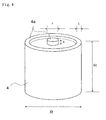
- a predetermined number of charging aluminum hydroxide 4 were prepared as follows: as shown in Fig. 4 , the prepared high-purity aluminum hydroxide is press-molded into cylinder shape (65 mm ⁇ 80 mmH) (in Fig.
- the area where the charging aluminum hydroxide 4 was in contact with each burning vessel is a total of the surface areas of the cylindrical legs 4a, which corresponds to 8% of the surface area of the charging aluminum hydroxide 4.
- charging was carried out so that a space having a distance of 5 mm or more was provided between the charging aluminum hydroxide 4 and the burning vessel (burning vessel body and lid).
- the burning vessels A to G contained charging aluminum hydroxide were put in electric furnaces and each vessel was burned at a burning temperature shown in Table 2 in an atmosphere of the air for 10 hours (retaining time).
- the average diameter of the aluminum hydroxide used in each test number and the amount of each metal as impurity are as shown in Table 2.
- the average particle diameter of the aluminum hydroxide was measured by using a laser scattering method, Microtrac 9320HRA (X100) manufactured by NIKKISO CO., LTD.
- the amount of the metal as impurity contained in the aluminum hydroxide as a raw material was a value determined by an atomic absorption method and an ICP emission spectroscopic analysis method. The Na content was defined as follows: 1% ⁇ 10,000ppm.
- the amounts of the metals as impurity contained in the ⁇ -alumina after the burning treatment and wash treatment were measured similarly. Note that the amounts of the impurities contained in the aluminum hydroxide as a raw material are values in terms of alumina.
- the obtained ⁇ -alumina was left to stand at room temperature and each amount of the metal as impurity contained in the ⁇ -alumina was measured. Table 2 shows the results.
- the ⁇ -alumina was slurried with 2 L of pure water (repulp water) with respect to 1 kg of the ⁇ -alumina, followed by stir washing for 1 hour. After the stir washing, the slurry was injected in a filter and the repulp water was sucked and filtered, whereby the eluted metals as impurity were removed.
- the prepared three kinds of aluminum hydroxides were a high-purity aluminum hydroxide powder (product name: BHP39, manufactured by Nippon Light Metal Co., Ltd.), a trial aluminum hydroxide powder (manufactured by Nippon Light Metal Co., Ltd. see Table 3), and a normal particle aluminum hydroxide (product name: B53, Nippon Light Metal Co., Ltd.).
- the amounts of the metals as impurity contained in the ⁇ -alumina obtained by wash treatment exceeded any one of the following standards: "40 ppm or less of Na contents", “2 ppm or less of Ca content”, “20 ppm or less of Si content", and "10 ppm or less of Fe content”.
- the burning temperature was 1,000°C (Test Nos. 28 and 30)
- the Na content of the ⁇ -alumina obtained by wash treatment exceeded 40 ppm.
- the Si content of the ⁇ -alumina obtained by wash treatment exceeded 20 ppm.
- the charging aluminum hydroxide 4 has such a dimension that the length is 250 mm, the depth is 200 mm, and the height is 80 mm.
- the face corresponding to the bottom part of the inner wall of the burning vessel has five legs 4a each having a length of 15 mm and a height of 5 mm.
- the contact surface area between the charging aluminum hydroxide 4 and the burning vessel is 10% of the surface area of the charging aluminum hydroxide 4.
- the burning was carried out in the same way as in the burning tests with different burning vessels except that the burning temperature was set to 1,450°C and the retaining time was set to 10 to 12 hours.
- the ⁇ -alumina after the burning was subjected to wash treatment in the same way as in the above burning tests with different burning vessels, and the amounts of metals as impurity were measured in the same way as in the above burning tests with different burning vessels (Test Nos. 35 and 36).
- the amounts of impurities contained in the surface layer part having a thickness of 5 mm which is in contact with the burning vessel body (site I), the surface layer part having a thickness of 5 mm and excluding the site I at the lid side (site IV), and the remaining part except for those parts (site III) were each examined. That is, in any cases, the site I is a part in contact with the burning vessel and sites II to IV are noncontact parts. Table 4 shows the results. As is clear from the results, it was confirmed that the ⁇ -alumina at the part in contact with the burning vessel was contaminated with a large amount of the Si content.
- the Si content of the ⁇ -alumina to be obtained finally can be reduced.
- the distance of the space between the charging aluminum hydroxide and the burning vessel was adjusted to 1 to 10 mm, followed by burning. Then, the amounts of the metals as impurity contained in the ⁇ -alumina were measured. Specifically, for the case where the space d (space d illustrated in Fig. 1 ) between the charging aluminum hydroxide 4 press-molded into a wooden clog form and the burning vessel 1 (burning vessel C) was set to 5 mm or more (Test Nos. 39 to 41) and for the case where the space was less than 5 mm (Test Nos.
- the burning was carried out in the same way as in the tests with different burning vessels except that the burning temperature was 1,350 to 1,400°C and the retaining time was 10 to 12 hours. Then, the amounts of metals as impurity contained in the ⁇ -alumina after the burning were measured. Note that the site where the amounts of metals as impurity were measured is site II illustrated in Fig. 5 (A) .
- a high-purity aluminum hydroxide having an average particle diameter of 27 ⁇ m and an Na content of 0.077 mass% (in terms of alumina) was used, and a charging aluminum hydroxide was burned at the burning temperature of 1,400°C for retaining time of 10 hours by using the burning vessel C in the same way as in the section [Burning tests by different charging methods].
- the ⁇ -alumina obtained above was subjected to stir washing and flow washing in the same way as in the section [Tests with different burning vessels] under the washing conditions shown in Table 6.
- the resultant was dried, whereby an ⁇ -alumina in which metals as impurity were removed was obtained.
- Table 6 shows the results of Na removal ratio, which is derived from the Na content contained in the ⁇ -alumina before the wash treatment and the Na content contained in the ⁇ -alumina after the wash treatment.
- Example of Test No. 45 The stir washing and the flow washing by the method as shown in Test No. 45 of the section [Removal effect test of Na content] and ⁇ -alumina to be finally obtained (hereinafter referred to as "sample of Test No. 45") was subjected to heat treatment again at 800 °C for 1 hour and the resultant was slurried with 2L of pure water per kg of alumina again, followed by stir washing for 1 hour. Further, the resultant was subjected to flow washing with 5 L of pure water per kg of alumina (Test No. 56).
- Test No. 57 the same treatments were performed as in Test No. 56 except that the sample of Test No. 45 was heated again at 1,000°C for 1 hour.
- Test No. 58 a series of treatments carried out in Test No. 57 were carried out twice in total.
- Test No. 59 the sample of Test No. 45 was pulverized to have an average particle diameter of 5 ⁇ m or less and the resultant was slurried and brought into contact with an cation exchange resin (DIAION SK1B manufactured by Mitsubishi Chemical Corporation) to thereby remove the Na content.
- an cation exchange resin (DIAION SK1B manufactured by Mitsubishi Chemical Corporation) to thereby remove the Na content.
- the sample of Test No. 45 used in this test was obtained by the same test method as in Test No. 45 and is not the ⁇ -alumina itself obtained in Test No. 45 of the section [Removal effect test of Nacontent]. Therefore, there were two kinds of ⁇ -aluminas having different Na contents used in this test.
- Test No. 60 the same treatments were carried out as in Test No. 56 except that the sample of Test No. 45 was reheated at 500°C for 1 hour.
- Test No. 61 the same treatments were carried out as in Test No. 56 except that the sample of Test No. 45 was reheated at 700°C for 1 hour.
- Test No. 62 the same treatments were carried out as in Test No. 56 except that the sample of Test No. 45 was reheated at 1,200°C for 1 hour.
- the supplementary test of Na content removal effect was carried out after the BET specific surface area of the sample of Test No. 45 was measured. Then, the BET specific surface area of the ⁇ -alumina obtained in the supplementary test of Na content removal effect was measured and the values before and after the supplementary Na content removal treatment were compared.
- the BET specific surface area is inversely proportional to the primary particle diameter of the ⁇ -alumina and can be used as a judgement index for change in the primary particle diameter of the ⁇ -alumina, e.g.
- BET specific surface area decreased ⁇ primary particle diameter of ⁇ -alumina grew largely" or "no change in BET specific surface area ⁇ no growth in primary particle diameter of ⁇ -alumina.”
- a specific surface area automatic measurement device type: Flowsorb II 2300 manufactured by Micromeritics Instrument Corporation was used for measurement of the BET specific surface area.
- the high-purity ⁇ -alumina obtained in the present invention can be widely used, in addition to general applications of the ⁇ -alumina such as ceramics material, in a refractory, an insulator, an abrasive material, a pharmaceutical, an adsorbent, a filler, a catalyst carrier, a raw material of a special glass, a raw material of a monocrystal, a phosphorescent material, plasma spraying material, and the like.
- the contents of an Si content, an Fe content, a Ca content, and an Na content are small in the high-purity ⁇ -alumina, and hence, the high-purity ⁇ -alumina is suitable for applications such as fine ceramics, an electronic part, raw material of a monocrystal, a phosphorescent material, and the like.
Landscapes
- Chemical & Material Sciences (AREA)
- Organic Chemistry (AREA)
- Life Sciences & Earth Sciences (AREA)
- Geology (AREA)
- Inorganic Chemistry (AREA)
- Compounds Of Alkaline-Earth Elements, Aluminum Or Rare-Earth Metals (AREA)
- Compositions Of Oxide Ceramics (AREA)
Applications Claiming Priority (2)
| Application Number | Priority Date | Filing Date | Title |
|---|---|---|---|
| JP2006339032A JP4997953B2 (ja) | 2006-12-15 | 2006-12-15 | 高純度α−アルミナの製造方法 |
| PCT/JP2007/073366 WO2008072501A1 (fr) | 2006-12-15 | 2007-12-04 | Procédé de fabrication d'α-alumine de pureté élevée |
Publications (3)
| Publication Number | Publication Date |
|---|---|
| EP2119672A1 true EP2119672A1 (fr) | 2009-11-18 |
| EP2119672A4 EP2119672A4 (fr) | 2013-08-14 |
| EP2119672B1 EP2119672B1 (fr) | 2018-03-14 |
Family
ID=39511523
Family Applications (1)
| Application Number | Title | Priority Date | Filing Date |
|---|---|---|---|
| EP07850016.2A Active EP2119672B1 (fr) | 2006-12-15 | 2007-12-04 | Procédé de fabrication d'alpha-alumine de pureté élevée |
Country Status (8)
| Country | Link |
|---|---|
| US (1) | US8124048B2 (fr) |
| EP (1) | EP2119672B1 (fr) |
| JP (1) | JP4997953B2 (fr) |
| KR (1) | KR101403820B1 (fr) |
| CN (1) | CN101588993B (fr) |
| PT (1) | PT2119672T (fr) |
| RU (1) | RU2438978C2 (fr) |
| WO (1) | WO2008072501A1 (fr) |
Cited By (3)
| Publication number | Priority date | Publication date | Assignee | Title |
|---|---|---|---|---|
| FR2956111A1 (fr) * | 2010-02-11 | 2011-08-12 | Baikowski | Alumine alpha, utilisation, procede de synthese et dispositif associes |
| WO2016069743A1 (fr) * | 2014-10-28 | 2016-05-06 | Shanghai Phichem Material Co. Ltd. | Procédés de préparation d'hydroxyde d'aluminium de haute pureté et oxyde d'aluminium de haute pureté |
| US10315927B2 (en) | 2014-01-17 | 2019-06-11 | Shanghai Phichem Material Co. Ltd. | Methods and processes of preparing aluminum hydroxide and aluminum oxide |
Families Citing this family (25)
| Publication number | Priority date | Publication date | Assignee | Title |
|---|---|---|---|---|
| JP5053206B2 (ja) * | 2008-08-22 | 2012-10-17 | 東ソー・クォーツ株式会社 | 型材を用いた石英ガラス材料の成形方法 |
| EP2412849B1 (fr) | 2009-03-25 | 2016-03-23 | SUMCO Corporation | Plaquette de silicium et procédé de fabrication de cette dernière |
| US8524191B2 (en) * | 2011-08-08 | 2013-09-03 | Basf Se | Process for preparing high-purity aluminum oxide by purification of alumina |
| JP2013122028A (ja) * | 2011-12-12 | 2013-06-20 | Sumitomo Bakelite Co Ltd | 絶縁層形成用組成物の製造方法、絶縁層形成用フィルムの製造方法および基板の製造方法 |
| JP5857736B2 (ja) * | 2011-12-27 | 2016-02-10 | 住友ベークライト株式会社 | 絶縁層形成用組成物、絶縁層形成用フィルムおよび基板 |
| CN102718243A (zh) * | 2012-01-13 | 2012-10-10 | 上海赢奔晶体科技有限公司 | 蓝宝石晶体废弃晶料的纯化方法 |
| US8944003B2 (en) * | 2012-11-16 | 2015-02-03 | Taiwan Semiconductor Manufacturing Company, Ltd. | Remote plasma system and method |
| KR101975458B1 (ko) * | 2013-07-16 | 2019-05-07 | 삼성전기주식회사 | 인쇄회로기판 필러용 알루미나 파우더 제조 방법 및 이를 포함하는 인쇄회로기판용 수지 조성물 |
| CN104340999B (zh) * | 2013-09-05 | 2016-01-13 | 安庆飞凯高分子材料有限公司 | 一种氧化铝的提纯方法 |
| CN103643290B (zh) * | 2013-12-02 | 2016-03-30 | 昆明理工大学 | 一种蓝宝石晶体用高纯氧化铝的提纯方法 |
| CN103754909A (zh) * | 2013-12-12 | 2014-04-30 | 中国铝业股份有限公司 | 一种柱状氢氧化铝的制备方法 |
| KR101643361B1 (ko) | 2013-12-26 | 2016-07-28 | 주식회사 씨아이에스 | 저점도 특성을 갖는 초미립 이소결성 알루미나의 제조 방법 |
| CN105983401B (zh) * | 2015-03-06 | 2018-05-04 | 中国石油天然气股份有限公司 | 制备α-氧化铝的方法、α-氧化铝、复合氧化物及制法 |
| KR102344231B1 (ko) | 2016-07-29 | 2021-12-28 | 스미또모 가가꾸 가부시끼가이샤 | 알루미나 및 그것을 사용한 자동차 촉매의 제조 방법 |
| US20180351147A1 (en) * | 2016-11-14 | 2018-12-06 | Sumitomo Chemical Company, Limited | Alumina and slurry containing the same, and alumina porous film using the same, laminated separator, nonaqueous electrolyte secondary battery and method for manufacturing nonaqueous electrolyte secondary battery |
| PL3401282T3 (pl) | 2016-11-14 | 2023-05-29 | Sumitomo Chemical Company, Limited | Tlenek glinu i gęsta zawiesina go zawierająca oraz porowata folia z tego tlenku glinu, laminowany separator, bateria wtórna z niewodnym elektrolitem i sposób wytwarzania baterii wtórnej z niewodnym elektrolitem |
| FR3067617B1 (fr) * | 2017-06-20 | 2019-07-19 | Arkema France | Catalyseur a base d'alumine alpha et procede d'hydrogenation d'une olefine en presence de celui-ci. |
| JP6977666B2 (ja) * | 2018-05-31 | 2021-12-08 | 日本軽金属株式会社 | 低ソーダα−アルミナ粉体及びその製造方法 |
| KR102408088B1 (ko) * | 2019-12-18 | 2022-06-13 | 한국세라믹기술원 | 고방열 산화알루미늄-엘라스토머 복합소재 및 이의 제조 방법 |
| CN118159493A (zh) * | 2021-10-27 | 2024-06-07 | 日本轻金属株式会社 | 高纯度微粒氧化铝粉末 |
| CN118946528A (zh) * | 2022-03-30 | 2024-11-12 | 日本轻金属株式会社 | α-氧化铝粉体的制造方法 |
| CN115448343A (zh) * | 2022-10-25 | 2022-12-09 | 河北铭万精细化工有限公司 | 一种电子级纳米氧化铝的生产工艺 |
| KR102497278B1 (ko) | 2022-11-02 | 2023-02-08 | 주식회사 씨아이에스케미칼 | 슈도-뵈마이트와 염화물계 첨가제를 이용한 고순도 알루미나의 제조방법 |
| KR102497275B1 (ko) | 2022-11-02 | 2023-02-08 | 주식회사 씨아이에스케미칼 | 나트륨 제거제를 이용한 알루미나의 고순도화 및 초미립 알루미나 입자의 제조방법 |
| KR20260049615A (ko) * | 2023-08-09 | 2026-04-14 | 쿠어스 테크, 인코포레이티드 | 개선된 알파 알루미나 조성물 |
Family Cites Families (22)
| Publication number | Priority date | Publication date | Assignee | Title |
|---|---|---|---|---|
| US2405275A (en) * | 1944-02-19 | 1946-08-06 | Aluminum Co Of America | Purification of aluminum hydrate |
| DE1071566B (fr) * | 1953-10-10 | |||
| US3106452A (en) * | 1960-05-18 | 1963-10-08 | Reynolds Metals Co | Method for reducing the soda content of alumina |
| JPS4834680B1 (fr) | 1968-11-15 | 1973-10-23 | ||
| US3655339A (en) * | 1969-07-18 | 1972-04-11 | Aluminum Co Of America | Production of low-soda alumina |
| SU440051A1 (ru) * | 1972-10-27 | 1999-09-27 | Л.Г. Хомякова | Способ очистки окиси алюминия |
| DE2658124C3 (de) * | 1976-12-22 | 1982-05-06 | Dynamit Nobel Ag, 5210 Troisdorf | Verfahren zur Herstellung von Elektroschmelzkorund |
| JPS5416398A (en) | 1977-07-07 | 1979-02-06 | Showa Denko Kk | Production of low soda alumina |
| DD147185A3 (de) * | 1978-04-24 | 1981-03-25 | Siegfried Ziegenbalg | Verfahren zur herstellung von reinem aluminiumoxid |
| JPS557532A (en) | 1978-06-30 | 1980-01-19 | Taiheiyo Kinzoku Kk | Production of high purity alumina fine powder |
| JPS55140719A (en) | 1979-04-23 | 1980-11-04 | Showa Alum Ind Kk | Manufacture of starting material alumina for porcelain |
| PL233351A1 (fr) * | 1980-10-09 | 1982-06-07 | Vasipari Kutato Intezet | |
| JPS6246922A (ja) | 1985-08-21 | 1987-02-28 | Riyouka Keikinzoku Kogyo Kk | 高純度アルミナの製造方法 |
| JPH0637293B2 (ja) * | 1988-05-25 | 1994-05-18 | 日本軽金属株式会社 | 高純度アルミナの製造方法 |
| JP4263253B2 (ja) * | 1993-12-01 | 2009-05-13 | 住友化学株式会社 | 焼結体用α−アルミナ粉末およびその焼結体 |
| JP3972380B2 (ja) * | 1995-02-21 | 2007-09-05 | 住友化学株式会社 | α−アルミナの製造方法 |
| AU699077B2 (en) * | 1995-02-21 | 1998-11-19 | Sumitomo Chemical Company, Limited | Alpha-alumina and method for producing the same |
| ID16934A (id) | 1996-05-22 | 1997-11-20 | Samsung Electronics Co Ltd | Alat kontrol arah dan kecepatan alir udara yang dikeluarkan oleh mesin penyejuk udara dan metoda kerjanya |
| CN1085620C (zh) * | 1997-04-09 | 2002-05-29 | 大连铁道学院精细陶瓷工程研究中心 | 超高纯超细氧化铝粉体制备方法 |
| JPH10324519A (ja) | 1997-05-20 | 1998-12-08 | Chichibu Onoda Cement Corp | 易焼結性高純度アルミナ粉末の製造方法 |
| US6242854B1 (en) * | 1998-01-20 | 2001-06-05 | Matsushita Electronics Corporation | Indirectly heated cathode for a CRT having high purity alumina insulating layer with limited amounts of Na OR Si |
| RU2135412C1 (ru) * | 1998-04-15 | 1999-08-27 | Соловецкий Юрий Иванович | Способ получения особо чистого альфа-оксида алюминия |
-
2006
- 2006-12-15 JP JP2006339032A patent/JP4997953B2/ja active Active
-
2007
- 2007-12-04 KR KR1020097014025A patent/KR101403820B1/ko active Active
- 2007-12-04 PT PT78500162T patent/PT2119672T/pt unknown
- 2007-12-04 WO PCT/JP2007/073366 patent/WO2008072501A1/fr not_active Ceased
- 2007-12-04 CN CN2007800464733A patent/CN101588993B/zh active Active
- 2007-12-04 US US12/518,169 patent/US8124048B2/en active Active
- 2007-12-04 EP EP07850016.2A patent/EP2119672B1/fr active Active
- 2007-12-04 RU RU2009127110/05A patent/RU2438978C2/ru not_active IP Right Cessation
Cited By (4)
| Publication number | Priority date | Publication date | Assignee | Title |
|---|---|---|---|---|
| FR2956111A1 (fr) * | 2010-02-11 | 2011-08-12 | Baikowski | Alumine alpha, utilisation, procede de synthese et dispositif associes |
| WO2011098511A3 (fr) * | 2010-02-11 | 2012-02-23 | Baikowski | Alumine alpha, utilisation, procédé de synthèse et dispositif associés. |
| US10315927B2 (en) | 2014-01-17 | 2019-06-11 | Shanghai Phichem Material Co. Ltd. | Methods and processes of preparing aluminum hydroxide and aluminum oxide |
| WO2016069743A1 (fr) * | 2014-10-28 | 2016-05-06 | Shanghai Phichem Material Co. Ltd. | Procédés de préparation d'hydroxyde d'aluminium de haute pureté et oxyde d'aluminium de haute pureté |
Also Published As
| Publication number | Publication date |
|---|---|
| RU2009127110A (ru) | 2011-01-20 |
| KR101403820B1 (ko) | 2014-06-03 |
| CN101588993B (zh) | 2012-07-18 |
| EP2119672B1 (fr) | 2018-03-14 |
| JP2008150238A (ja) | 2008-07-03 |
| PT2119672T (pt) | 2018-05-16 |
| US8124048B2 (en) | 2012-02-28 |
| CN101588993A (zh) | 2009-11-25 |
| EP2119672A4 (fr) | 2013-08-14 |
| WO2008072501A1 (fr) | 2008-06-19 |
| RU2438978C2 (ru) | 2012-01-10 |
| US20100021374A1 (en) | 2010-01-28 |
| JP4997953B2 (ja) | 2012-08-15 |
| KR20090094128A (ko) | 2009-09-03 |
Similar Documents
| Publication | Publication Date | Title |
|---|---|---|
| EP2119672B1 (fr) | Procédé de fabrication d'alpha-alumine de pureté élevée | |
| Sglavo et al. | Bauxite ‘red mud’in the ceramic industry. Part 1: thermal behaviour | |
| EP0384603B1 (fr) | Procédé de production d'oxyde de magnésium | |
| KR101502592B1 (ko) | 실리카 및 마그네시아 추출을 위한 슬래그의 처리방법 | |
| EP0435513A1 (fr) | Particules de silice et procédé de leur préparation | |
| US4746638A (en) | Alumina-titania composite powder and process for preparing the same | |
| AU5012799A (en) | Niobium powder and a process for the production of niobium and/or tantalum powders | |
| KR20180095615A (ko) | 낮은 OH, Cl, 및 Al 함량을 갖는 발열성 이산화규소 과립으로 제조된 석영 유리 | |
| GB1560503A (en) | Process for working up waste fly dusts | |
| US6960336B2 (en) | Method of producing low soda alumina, low soda alumina produced by the method and method of producing porcelain | |
| CA1217030A (fr) | Fabrication d'alumine cristalline grossiere | |
| WO2020195721A1 (fr) | Poudre de spinelle | |
| JPH08290914A (ja) | α−アルミナおよびその製造方法 | |
| JPH03500284A (ja) | 水酸化アルミニウムの製造方法および焼結品の形成方法 | |
| JP3975513B2 (ja) | αアルミナの連続的製造法 | |
| US5221527A (en) | Process for producing aluminum nitride | |
| JPH0637293B2 (ja) | 高純度アルミナの製造方法 | |
| KR102742479B1 (ko) | 고순도 알루미늄 일수화물 및 알파 알루미나의 제조 방법 | |
| KR101663717B1 (ko) | 폴리염화알루미늄을 활용한 고순도 알루미나의 제조방법 | |
| KR102655040B1 (ko) | 이소결 산화알루미늄의 제조방법 | |
| KR102706283B1 (ko) | 뵈마이트 입자의 제조 방법 | |
| Ayala et al. | Production of zirconia powders from the basic disintegration of zircon, and their characterization | |
| KR102497278B1 (ko) | 슈도-뵈마이트와 염화물계 첨가제를 이용한 고순도 알루미나의 제조방법 | |
| KR102738320B1 (ko) | 백운석으로부터 고순도 산화마그네슘을 제조하는 방법 | |
| EP4299510A1 (fr) | Poudre d'oxyde métallique et procédé de production associé |
Legal Events
| Date | Code | Title | Description |
|---|---|---|---|
| PUAI | Public reference made under article 153(3) epc to a published international application that has entered the european phase |
Free format text: ORIGINAL CODE: 0009012 |
|
| 17P | Request for examination filed |
Effective date: 20090713 |
|
| AK | Designated contracting states |
Kind code of ref document: A1 Designated state(s): AT BE BG CH CY CZ DE DK EE ES FI FR GB GR HU IE IS IT LI LT LU LV MC MT NL PL PT RO SE SI SK TR |
|
| DAX | Request for extension of the european patent (deleted) | ||
| A4 | Supplementary search report drawn up and despatched |
Effective date: 20130716 |
|
| RIC1 | Information provided on ipc code assigned before grant |
Ipc: C01F 7/46 20060101AFI20130710BHEP Ipc: C01F 7/02 20060101ALI20130710BHEP Ipc: C01F 7/44 20060101ALI20130710BHEP |
|
| 17Q | First examination report despatched |
Effective date: 20160414 |
|
| GRAP | Despatch of communication of intention to grant a patent |
Free format text: ORIGINAL CODE: EPIDOSNIGR1 |
|
| INTG | Intention to grant announced |
Effective date: 20170303 |
|
| GRAS | Grant fee paid |
Free format text: ORIGINAL CODE: EPIDOSNIGR3 |
|
| GRAA | (expected) grant |
Free format text: ORIGINAL CODE: 0009210 |
|
| AK | Designated contracting states |
Kind code of ref document: B1 Designated state(s): AT BE BG CH CY CZ DE DK EE ES FI FR GB GR HU IE IS IT LI LT LU LV MC MT NL PL PT RO SE SI SK TR |
|
| REG | Reference to a national code |
Ref country code: GB Ref legal event code: FG4D |
|
| REG | Reference to a national code |
Ref country code: CH Ref legal event code: EP |
|
| REG | Reference to a national code |
Ref country code: AT Ref legal event code: REF Ref document number: 921130 Country of ref document: AT Kind code of ref document: T Effective date: 20170915 |
|
| REG | Reference to a national code |
Ref country code: IE Ref legal event code: FG4D |
|
| APBM | Appeal reference recorded |
Free format text: ORIGINAL CODE: EPIDOSNREFNO |
|
| APBW | Interlocutory revision of appeal recorded |
Free format text: ORIGINAL CODE: EPIDOSNIRAPO |
|
| APAP | Information on interlocutory revision modified |
Free format text: ORIGINAL CODE: EPIDOSCIRAPO |
|
| REG | Reference to a national code |
Ref country code: DE Ref legal event code: R096 Ref document number: 602007052124 Country of ref document: DE |
|
| PUAC | Information related to the publication of a b1 document modified or deleted |
Free format text: ORIGINAL CODE: 0009299EPPU |
|
| REG | Reference to a national code |
Ref country code: CH Ref legal event code: PK Free format text: DIE ERTEILUNG WURDE VOM EPA WIDERRUFEN. |
|
| GRAJ | Information related to disapproval of communication of intention to grant by the applicant or resumption of examination proceedings by the epo deleted |
Free format text: ORIGINAL CODE: EPIDOSDIGR1 |
|
| GRAL | Information related to payment of fee for publishing/printing deleted |
Free format text: ORIGINAL CODE: EPIDOSDIGR3 |
|
| GRAP | Despatch of communication of intention to grant a patent |
Free format text: ORIGINAL CODE: EPIDOSNIGR1 |
|
| DB1 | Publication of patent cancelled |
Effective date: 20171006 |
|
| INTG | Intention to grant announced |
Effective date: 20171027 |
|
| REG | Reference to a national code |
Ref country code: DE Ref legal event code: R107 Ref document number: 602007052124 Country of ref document: DE |
|
| GRAJ | Information related to disapproval of communication of intention to grant by the applicant or resumption of examination proceedings by the epo deleted |
Free format text: ORIGINAL CODE: EPIDOSDIGR1 |
|
| GRAL | Information related to payment of fee for publishing/printing deleted |
Free format text: ORIGINAL CODE: EPIDOSDIGR3 |
|
| REG | Reference to a national code |
Ref country code: AT Ref legal event code: REZ Ref document number: 921130 Country of ref document: AT Kind code of ref document: T Effective date: 20170823 |
|
| INTC | Intention to grant announced (deleted) | ||
| REG | Reference to a national code |
Ref country code: LU Ref legal event code: HK Effective date: 20171101 |
|
| GRAP | Despatch of communication of intention to grant a patent |
Free format text: ORIGINAL CODE: EPIDOSNIGR1 |
|
| GRAA | (expected) grant |
Free format text: ORIGINAL CODE: 0009210 |
|
| INTG | Intention to grant announced |
Effective date: 20180119 |
|
| INTG | Intention to grant announced |
Effective date: 20180119 |
|
| AK | Designated contracting states |
Kind code of ref document: B1 Designated state(s): AT BE BG CH CY CZ DE DK EE ES FI FR GB GR HU IE IS IT LI LT LU LV MC MT NL PL PT RO SE SI SK TR |
|
| REG | Reference to a national code |
Ref country code: CH Ref legal event code: EP Ref country code: CH Ref legal event code: PK Free format text: DIE ERTEILUNG VOM 23.08.2017 WURDE VOM EPA WIDERRUFEN Ref country code: AT Ref legal event code: REF Ref document number: 921130 Country of ref document: AT Kind code of ref document: T Effective date: 20180315 |
|
| REG | Reference to a national code |
Ref country code: DE Ref legal event code: R096 Ref document number: 602007052124 Country of ref document: DE |
|
| REG | Reference to a national code |
Ref country code: PT Ref legal event code: SC4A Ref document number: 2119672 Country of ref document: PT Date of ref document: 20180516 Kind code of ref document: T Free format text: AVAILABILITY OF NATIONAL TRANSLATION Effective date: 20180510 |
|
| REG | Reference to a national code |
Ref country code: NL Ref legal event code: MP Effective date: 20180314 |
|
| REG | Reference to a national code |
Ref country code: LT Ref legal event code: MG4D |
|
| PG25 | Lapsed in a contracting state [announced via postgrant information from national office to epo] |
Ref country code: FI Free format text: LAPSE BECAUSE OF FAILURE TO SUBMIT A TRANSLATION OF THE DESCRIPTION OR TO PAY THE FEE WITHIN THE PRESCRIBED TIME-LIMIT Effective date: 20180314 Ref country code: CY Free format text: LAPSE BECAUSE OF FAILURE TO SUBMIT A TRANSLATION OF THE DESCRIPTION OR TO PAY THE FEE WITHIN THE PRESCRIBED TIME-LIMIT Effective date: 20180314 Ref country code: LT Free format text: LAPSE BECAUSE OF FAILURE TO SUBMIT A TRANSLATION OF THE DESCRIPTION OR TO PAY THE FEE WITHIN THE PRESCRIBED TIME-LIMIT Effective date: 20180314 Ref country code: ES Free format text: LAPSE BECAUSE OF FAILURE TO SUBMIT A TRANSLATION OF THE DESCRIPTION OR TO PAY THE FEE WITHIN THE PRESCRIBED TIME-LIMIT Effective date: 20180314 |
|
| REG | Reference to a national code |
Ref country code: AT Ref legal event code: MK05 Ref document number: 921130 Country of ref document: AT Kind code of ref document: T Effective date: 20180314 |
|
| PG25 | Lapsed in a contracting state [announced via postgrant information from national office to epo] |
Ref country code: BG Free format text: LAPSE BECAUSE OF FAILURE TO SUBMIT A TRANSLATION OF THE DESCRIPTION OR TO PAY THE FEE WITHIN THE PRESCRIBED TIME-LIMIT Effective date: 20180614 |
|
| PG25 | Lapsed in a contracting state [announced via postgrant information from national office to epo] |
Ref country code: EE Free format text: LAPSE BECAUSE OF FAILURE TO SUBMIT A TRANSLATION OF THE DESCRIPTION OR TO PAY THE FEE WITHIN THE PRESCRIBED TIME-LIMIT Effective date: 20180314 Ref country code: PL Free format text: LAPSE BECAUSE OF FAILURE TO SUBMIT A TRANSLATION OF THE DESCRIPTION OR TO PAY THE FEE WITHIN THE PRESCRIBED TIME-LIMIT Effective date: 20180314 Ref country code: RO Free format text: LAPSE BECAUSE OF FAILURE TO SUBMIT A TRANSLATION OF THE DESCRIPTION OR TO PAY THE FEE WITHIN THE PRESCRIBED TIME-LIMIT Effective date: 20180314 Ref country code: NL Free format text: LAPSE BECAUSE OF FAILURE TO SUBMIT A TRANSLATION OF THE DESCRIPTION OR TO PAY THE FEE WITHIN THE PRESCRIBED TIME-LIMIT Effective date: 20180314 Ref country code: IT Free format text: LAPSE BECAUSE OF FAILURE TO SUBMIT A TRANSLATION OF THE DESCRIPTION OR TO PAY THE FEE WITHIN THE PRESCRIBED TIME-LIMIT Effective date: 20180314 |
|
| PG25 | Lapsed in a contracting state [announced via postgrant information from national office to epo] |
Ref country code: AT Free format text: LAPSE BECAUSE OF FAILURE TO SUBMIT A TRANSLATION OF THE DESCRIPTION OR TO PAY THE FEE WITHIN THE PRESCRIBED TIME-LIMIT Effective date: 20180314 Ref country code: CZ Free format text: LAPSE BECAUSE OF FAILURE TO SUBMIT A TRANSLATION OF THE DESCRIPTION OR TO PAY THE FEE WITHIN THE PRESCRIBED TIME-LIMIT Effective date: 20180314 |
|
| REG | Reference to a national code |
Ref country code: DE Ref legal event code: R097 Ref document number: 602007052124 Country of ref document: DE |
|
| PLBE | No opposition filed within time limit |
Free format text: ORIGINAL CODE: 0009261 |
|
| STAA | Information on the status of an ep patent application or granted ep patent |
Free format text: STATUS: NO OPPOSITION FILED WITHIN TIME LIMIT |
|
| PG25 | Lapsed in a contracting state [announced via postgrant information from national office to epo] |
Ref country code: DK Free format text: LAPSE BECAUSE OF FAILURE TO SUBMIT A TRANSLATION OF THE DESCRIPTION OR TO PAY THE FEE WITHIN THE PRESCRIBED TIME-LIMIT Effective date: 20180314 Ref country code: MC Free format text: LAPSE BECAUSE OF FAILURE TO SUBMIT A TRANSLATION OF THE DESCRIPTION OR TO PAY THE FEE WITHIN THE PRESCRIBED TIME-LIMIT Effective date: 20180314 |
|
| 26N | No opposition filed |
Effective date: 20181217 |
|
| PG25 | Lapsed in a contracting state [announced via postgrant information from national office to epo] |
Ref country code: SI Free format text: LAPSE BECAUSE OF FAILURE TO SUBMIT A TRANSLATION OF THE DESCRIPTION OR TO PAY THE FEE WITHIN THE PRESCRIBED TIME-LIMIT Effective date: 20180314 |
|
| REG | Reference to a national code |
Ref country code: CH Ref legal event code: PL |
|
| GBPC | Gb: european patent ceased through non-payment of renewal fee |
Effective date: 20181204 |
|
| PG25 | Lapsed in a contracting state [announced via postgrant information from national office to epo] |
Ref country code: LU Free format text: LAPSE BECAUSE OF NON-PAYMENT OF DUE FEES Effective date: 20181204 |
|
| REG | Reference to a national code |
Ref country code: IE Ref legal event code: MM4A |
|
| REG | Reference to a national code |
Ref country code: BE Ref legal event code: MM Effective date: 20181231 |
|
| PG25 | Lapsed in a contracting state [announced via postgrant information from national office to epo] |
Ref country code: IE Free format text: LAPSE BECAUSE OF NON-PAYMENT OF DUE FEES Effective date: 20181204 |
|
| PG25 | Lapsed in a contracting state [announced via postgrant information from national office to epo] |
Ref country code: BE Free format text: LAPSE BECAUSE OF NON-PAYMENT OF DUE FEES Effective date: 20181231 |
|
| PG25 | Lapsed in a contracting state [announced via postgrant information from national office to epo] |
Ref country code: GB Free format text: LAPSE BECAUSE OF NON-PAYMENT OF DUE FEES Effective date: 20181204 Ref country code: LI Free format text: LAPSE BECAUSE OF NON-PAYMENT OF DUE FEES Effective date: 20181231 Ref country code: CH Free format text: LAPSE BECAUSE OF NON-PAYMENT OF DUE FEES Effective date: 20181231 |
|
| PG25 | Lapsed in a contracting state [announced via postgrant information from national office to epo] |
Ref country code: MT Free format text: LAPSE BECAUSE OF NON-PAYMENT OF DUE FEES Effective date: 20181204 |
|
| PGFP | Annual fee paid to national office [announced via postgrant information from national office to epo] |
Ref country code: DE Payment date: 20191210 Year of fee payment: 13 Ref country code: PT Payment date: 20191202 Year of fee payment: 13 |
|
| PG25 | Lapsed in a contracting state [announced via postgrant information from national office to epo] |
Ref country code: TR Free format text: LAPSE BECAUSE OF FAILURE TO SUBMIT A TRANSLATION OF THE DESCRIPTION OR TO PAY THE FEE WITHIN THE PRESCRIBED TIME-LIMIT Effective date: 20180314 |
|
| PG25 | Lapsed in a contracting state [announced via postgrant information from national office to epo] |
Ref country code: SE Free format text: LAPSE BECAUSE OF FAILURE TO SUBMIT A TRANSLATION OF THE DESCRIPTION OR TO PAY THE FEE WITHIN THE PRESCRIBED TIME-LIMIT Effective date: 20180314 Ref country code: LV Free format text: LAPSE BECAUSE OF NON-PAYMENT OF DUE FEES Effective date: 20180314 Ref country code: GR Free format text: LAPSE BECAUSE OF FAILURE TO SUBMIT A TRANSLATION OF THE DESCRIPTION OR TO PAY THE FEE WITHIN THE PRESCRIBED TIME-LIMIT Effective date: 20180314 Ref country code: HU Free format text: LAPSE BECAUSE OF FAILURE TO SUBMIT A TRANSLATION OF THE DESCRIPTION OR TO PAY THE FEE WITHIN THE PRESCRIBED TIME-LIMIT; INVALID AB INITIO Effective date: 20071204 |
|
| PG25 | Lapsed in a contracting state [announced via postgrant information from national office to epo] |
Ref country code: SK Free format text: LAPSE BECAUSE OF NON-PAYMENT OF DUE FEES Effective date: 20180314 Ref country code: IS Free format text: LAPSE BECAUSE OF FAILURE TO SUBMIT A TRANSLATION OF THE DESCRIPTION OR TO PAY THE FEE WITHIN THE PRESCRIBED TIME-LIMIT Effective date: 20180714 |
|
| REG | Reference to a national code |
Ref country code: DE Ref legal event code: R119 Ref document number: 602007052124 Country of ref document: DE |
|
| PG25 | Lapsed in a contracting state [announced via postgrant information from national office to epo] |
Ref country code: PT Free format text: LAPSE BECAUSE OF NON-PAYMENT OF DUE FEES Effective date: 20210604 |
|
| PG25 | Lapsed in a contracting state [announced via postgrant information from national office to epo] |
Ref country code: DE Free format text: LAPSE BECAUSE OF NON-PAYMENT OF DUE FEES Effective date: 20210701 |
|
| PGFP | Annual fee paid to national office [announced via postgrant information from national office to epo] |
Ref country code: FR Payment date: 20251222 Year of fee payment: 19 |