EP2123185A2 - Pièce de formage en céramique à deux couleurs - Google Patents
Pièce de formage en céramique à deux couleurs Download PDFInfo
- Publication number
- EP2123185A2 EP2123185A2 EP09006449A EP09006449A EP2123185A2 EP 2123185 A2 EP2123185 A2 EP 2123185A2 EP 09006449 A EP09006449 A EP 09006449A EP 09006449 A EP09006449 A EP 09006449A EP 2123185 A2 EP2123185 A2 EP 2123185A2
- Authority
- EP
- European Patent Office
- Prior art keywords
- raw material
- ceramic raw
- ceramic
- granules
- color pigment
- Prior art date
- Legal status (The legal status is an assumption and is not a legal conclusion. Google has not performed a legal analysis and makes no representation as to the accuracy of the status listed.)
- Withdrawn
Links
- 239000000919 ceramic Substances 0.000 title claims abstract description 185
- 239000008187 granular material Substances 0.000 claims abstract description 122
- 238000000034 method Methods 0.000 claims abstract description 69
- 239000000049 pigment Substances 0.000 claims abstract description 57
- 238000000576 coating method Methods 0.000 claims abstract description 22
- 239000011248 coating agent Substances 0.000 claims abstract description 19
- 239000003086 colorant Substances 0.000 claims abstract description 18
- 239000007787 solid Substances 0.000 claims abstract description 3
- 239000002994 raw material Substances 0.000 claims description 123
- 238000000465 moulding Methods 0.000 claims description 43
- 238000003825 pressing Methods 0.000 claims description 20
- 239000011230 binding agent Substances 0.000 claims description 10
- 238000002156 mixing Methods 0.000 claims description 10
- 238000000227 grinding Methods 0.000 claims description 9
- 239000007788 liquid Substances 0.000 claims description 9
- 238000004519 manufacturing process Methods 0.000 claims description 8
- 239000000843 powder Substances 0.000 claims description 8
- 238000001035 drying Methods 0.000 claims description 6
- XLYOFNOQVPJJNP-UHFFFAOYSA-N water Substances O XLYOFNOQVPJJNP-UHFFFAOYSA-N 0.000 claims description 6
- 238000005507 spraying Methods 0.000 claims description 4
- 241000237858 Gastropoda Species 0.000 claims description 3
- 239000000463 material Substances 0.000 claims description 3
- 238000005498 polishing Methods 0.000 claims description 3
- 238000005520 cutting process Methods 0.000 claims description 2
- 206010039509 Scab Diseases 0.000 claims 1
- 238000001125 extrusion Methods 0.000 claims 1
- 239000012634 fragment Substances 0.000 claims 1
- 238000013467 fragmentation Methods 0.000 claims 1
- 238000006062 fragmentation reaction Methods 0.000 claims 1
- 238000012216 screening Methods 0.000 claims 1
- 238000002360 preparation method Methods 0.000 abstract 1
- 230000001788 irregular Effects 0.000 description 13
- 238000005245 sintering Methods 0.000 description 10
- 238000005469 granulation Methods 0.000 description 9
- 230000003179 granulation Effects 0.000 description 9
- 230000000694 effects Effects 0.000 description 8
- 239000000203 mixture Substances 0.000 description 7
- 239000010433 feldspar Substances 0.000 description 6
- 238000005201 scrubbing Methods 0.000 description 6
- 239000000975 dye Substances 0.000 description 3
- 239000010437 gem Substances 0.000 description 3
- 229910001751 gemstone Inorganic materials 0.000 description 3
- 239000002245 particle Substances 0.000 description 3
- 239000000126 substance Substances 0.000 description 3
- 229910018072 Al 2 O 3 Inorganic materials 0.000 description 2
- 229910004298 SiO 2 Inorganic materials 0.000 description 2
- 239000007900 aqueous suspension Substances 0.000 description 2
- 239000002585 base Substances 0.000 description 2
- 239000004927 clay Substances 0.000 description 2
- 238000004040 coloring Methods 0.000 description 2
- 238000007906 compression Methods 0.000 description 2
- 230000006835 compression Effects 0.000 description 2
- 239000000945 filler Substances 0.000 description 2
- 239000003973 paint Substances 0.000 description 2
- 239000010453 quartz Substances 0.000 description 2
- VYPSYNLAJGMNEJ-UHFFFAOYSA-N silicon dioxide Inorganic materials O=[Si]=O VYPSYNLAJGMNEJ-UHFFFAOYSA-N 0.000 description 2
- 239000007858 starting material Substances 0.000 description 2
- 239000005995 Aluminium silicate Substances 0.000 description 1
- 229910019142 PO4 Inorganic materials 0.000 description 1
- 229910052777 Praseodymium Inorganic materials 0.000 description 1
- 229910010413 TiO 2 Inorganic materials 0.000 description 1
- 229910000272 alkali metal oxide Inorganic materials 0.000 description 1
- 235000012211 aluminium silicate Nutrition 0.000 description 1
- 239000007931 coated granule Substances 0.000 description 1
- 238000010586 diagram Methods 0.000 description 1
- 229910052500 inorganic mineral Inorganic materials 0.000 description 1
- NLYAJNPCOHFWQQ-UHFFFAOYSA-N kaolin Chemical compound O.O.O=[Al]O[Si](=O)O[Si](=O)O[Al]=O NLYAJNPCOHFWQQ-UHFFFAOYSA-N 0.000 description 1
- 229910052747 lanthanoid Inorganic materials 0.000 description 1
- 150000002602 lanthanoids Chemical class 0.000 description 1
- 239000011159 matrix material Substances 0.000 description 1
- 239000011707 mineral Substances 0.000 description 1
- 235000021317 phosphate Nutrition 0.000 description 1
- 150000003013 phosphoric acid derivatives Chemical class 0.000 description 1
- 229910052615 phyllosilicate Inorganic materials 0.000 description 1
- 229920006324 polyoxymethylene Polymers 0.000 description 1
- PUDIUYLPXJFUGB-UHFFFAOYSA-N praseodymium atom Chemical compound [Pr] PUDIUYLPXJFUGB-UHFFFAOYSA-N 0.000 description 1
- 230000000717 retained effect Effects 0.000 description 1
- 239000004576 sand Substances 0.000 description 1
- 238000009991 scouring Methods 0.000 description 1
- 229910052723 transition metal Inorganic materials 0.000 description 1
- 150000003624 transition metals Chemical class 0.000 description 1
- QORWJWZARLRLPR-UHFFFAOYSA-H tricalcium bis(phosphate) Chemical compound [Ca+2].[Ca+2].[Ca+2].[O-]P([O-])([O-])=O.[O-]P([O-])([O-])=O QORWJWZARLRLPR-UHFFFAOYSA-H 0.000 description 1
Images



Classifications
-
- A—HUMAN NECESSITIES
- A44—HABERDASHERY; JEWELLERY
- A44C—PERSONAL ADORNMENTS, e.g. JEWELLERY; COINS
- A44C17/00—Gems or the like
- A44C17/007—Special types of gems
-
- B—PERFORMING OPERATIONS; TRANSPORTING
- B28—WORKING CEMENT, CLAY, OR STONE
- B28B—SHAPING CLAY OR OTHER CERAMIC COMPOSITIONS; SHAPING SLAG; SHAPING MIXTURES CONTAINING CEMENTITIOUS MATERIAL, e.g. PLASTER
- B28B1/00—Producing shaped prefabricated articles from the material
- B28B1/005—Devices or processes for obtaining articles having a marble appearance
-
- B—PERFORMING OPERATIONS; TRANSPORTING
- B44—DECORATIVE ARTS
- B44C—PRODUCING DECORATIVE EFFECTS; MOSAICS; TARSIA WORK; PAPERHANGING
- B44C1/00—Processes, not specifically provided for elsewhere, for producing decorative surface effects
- B44C1/22—Removing surface-material, e.g. by engraving, by etching
-
- B—PERFORMING OPERATIONS; TRANSPORTING
- B44—DECORATIVE ARTS
- B44C—PRODUCING DECORATIVE EFFECTS; MOSAICS; TARSIA WORK; PAPERHANGING
- B44C1/00—Processes, not specifically provided for elsewhere, for producing decorative surface effects
- B44C1/26—Inlaying with ornamental structures, e.g. niello work, tarsia work
-
- B—PERFORMING OPERATIONS; TRANSPORTING
- B44—DECORATIVE ARTS
- B44F—SPECIAL DESIGNS OR PICTURES
- B44F5/00—Designs characterised by irregular areas, e.g. mottled patterns
-
- C—CHEMISTRY; METALLURGY
- C04—CEMENTS; CONCRETE; ARTIFICIAL STONE; CERAMICS; REFRACTORIES
- C04B—LIME, MAGNESIA; SLAG; CEMENTS; COMPOSITIONS THEREOF, e.g. MORTARS, CONCRETE OR LIKE BUILDING MATERIALS; ARTIFICIAL STONE; CERAMICS; REFRACTORIES; TREATMENT OF NATURAL STONE
- C04B33/00—Clay-wares
- C04B33/02—Preparing or treating the raw materials individually or as batches
- C04B33/13—Compounding ingredients
- C04B33/14—Colouring matters
-
- C—CHEMISTRY; METALLURGY
- C04—CEMENTS; CONCRETE; ARTIFICIAL STONE; CERAMICS; REFRACTORIES
- C04B—LIME, MAGNESIA; SLAG; CEMENTS; COMPOSITIONS THEREOF, e.g. MORTARS, CONCRETE OR LIKE BUILDING MATERIALS; ARTIFICIAL STONE; CERAMICS; REFRACTORIES; TREATMENT OF NATURAL STONE
- C04B35/00—Shaped ceramic products characterised by their composition; Ceramics compositions; Processing powders of inorganic compounds preparatory to the manufacturing of ceramic products
- C04B35/01—Shaped ceramic products characterised by their composition; Ceramics compositions; Processing powders of inorganic compounds preparatory to the manufacturing of ceramic products based on oxide ceramics
- C04B35/16—Shaped ceramic products characterised by their composition; Ceramics compositions; Processing powders of inorganic compounds preparatory to the manufacturing of ceramic products based on oxide ceramics based on silicates other than clay
- C04B35/18—Shaped ceramic products characterised by their composition; Ceramics compositions; Processing powders of inorganic compounds preparatory to the manufacturing of ceramic products based on oxide ceramics based on silicates other than clay rich in aluminium oxide
-
- C—CHEMISTRY; METALLURGY
- C04—CEMENTS; CONCRETE; ARTIFICIAL STONE; CERAMICS; REFRACTORIES
- C04B—LIME, MAGNESIA; SLAG; CEMENTS; COMPOSITIONS THEREOF, e.g. MORTARS, CONCRETE OR LIKE BUILDING MATERIALS; ARTIFICIAL STONE; CERAMICS; REFRACTORIES; TREATMENT OF NATURAL STONE
- C04B35/00—Shaped ceramic products characterised by their composition; Ceramics compositions; Processing powders of inorganic compounds preparatory to the manufacturing of ceramic products
- C04B35/622—Forming processes; Processing powders of inorganic compounds preparatory to the manufacturing of ceramic products
- C04B35/626—Preparing or treating the powders individually or as batches ; preparing or treating macroscopic reinforcing agents for ceramic products, e.g. fibres; mechanical aspects section B
- C04B35/62605—Treating the starting powders individually or as mixtures
- C04B35/62695—Granulation or pelletising
-
- C—CHEMISTRY; METALLURGY
- C04—CEMENTS; CONCRETE; ARTIFICIAL STONE; CERAMICS; REFRACTORIES
- C04B—LIME, MAGNESIA; SLAG; CEMENTS; COMPOSITIONS THEREOF, e.g. MORTARS, CONCRETE OR LIKE BUILDING MATERIALS; ARTIFICIAL STONE; CERAMICS; REFRACTORIES; TREATMENT OF NATURAL STONE
- C04B35/00—Shaped ceramic products characterised by their composition; Ceramics compositions; Processing powders of inorganic compounds preparatory to the manufacturing of ceramic products
- C04B35/622—Forming processes; Processing powders of inorganic compounds preparatory to the manufacturing of ceramic products
- C04B35/626—Preparing or treating the powders individually or as batches ; preparing or treating macroscopic reinforcing agents for ceramic products, e.g. fibres; mechanical aspects section B
- C04B35/628—Coating the powders or the macroscopic reinforcing agents
- C04B35/62802—Powder coating materials
-
- C—CHEMISTRY; METALLURGY
- C04—CEMENTS; CONCRETE; ARTIFICIAL STONE; CERAMICS; REFRACTORIES
- C04B—LIME, MAGNESIA; SLAG; CEMENTS; COMPOSITIONS THEREOF, e.g. MORTARS, CONCRETE OR LIKE BUILDING MATERIALS; ARTIFICIAL STONE; CERAMICS; REFRACTORIES; TREATMENT OF NATURAL STONE
- C04B2235/00—Aspects relating to ceramic starting mixtures or sintered ceramic products
- C04B2235/02—Composition of constituents of the starting material or of secondary phases of the final product
- C04B2235/30—Constituents and secondary phases not being of a fibrous nature
- C04B2235/34—Non-metal oxides, non-metal mixed oxides, or salts thereof that form the non-metal oxides upon heating, e.g. carbonates, nitrates, (oxy)hydroxides, chlorides
- C04B2235/3418—Silicon oxide, silicic acids or oxide forming salts thereof, e.g. silica sol, fused silica, silica fume, cristobalite, quartz or flint
-
- C—CHEMISTRY; METALLURGY
- C04—CEMENTS; CONCRETE; ARTIFICIAL STONE; CERAMICS; REFRACTORIES
- C04B—LIME, MAGNESIA; SLAG; CEMENTS; COMPOSITIONS THEREOF, e.g. MORTARS, CONCRETE OR LIKE BUILDING MATERIALS; ARTIFICIAL STONE; CERAMICS; REFRACTORIES; TREATMENT OF NATURAL STONE
- C04B2235/00—Aspects relating to ceramic starting mixtures or sintered ceramic products
- C04B2235/02—Composition of constituents of the starting material or of secondary phases of the final product
- C04B2235/30—Constituents and secondary phases not being of a fibrous nature
- C04B2235/34—Non-metal oxides, non-metal mixed oxides, or salts thereof that form the non-metal oxides upon heating, e.g. carbonates, nitrates, (oxy)hydroxides, chlorides
- C04B2235/3427—Silicates other than clay, e.g. water glass
- C04B2235/3463—Alumino-silicates other than clay, e.g. mullite
-
- C—CHEMISTRY; METALLURGY
- C04—CEMENTS; CONCRETE; ARTIFICIAL STONE; CERAMICS; REFRACTORIES
- C04B—LIME, MAGNESIA; SLAG; CEMENTS; COMPOSITIONS THEREOF, e.g. MORTARS, CONCRETE OR LIKE BUILDING MATERIALS; ARTIFICIAL STONE; CERAMICS; REFRACTORIES; TREATMENT OF NATURAL STONE
- C04B2235/00—Aspects relating to ceramic starting mixtures or sintered ceramic products
- C04B2235/60—Aspects relating to the preparation, properties or mechanical treatment of green bodies or pre-forms
- C04B2235/604—Pressing at temperatures other than sintering temperatures
-
- C—CHEMISTRY; METALLURGY
- C04—CEMENTS; CONCRETE; ARTIFICIAL STONE; CERAMICS; REFRACTORIES
- C04B—LIME, MAGNESIA; SLAG; CEMENTS; COMPOSITIONS THEREOF, e.g. MORTARS, CONCRETE OR LIKE BUILDING MATERIALS; ARTIFICIAL STONE; CERAMICS; REFRACTORIES; TREATMENT OF NATURAL STONE
- C04B2235/00—Aspects relating to ceramic starting mixtures or sintered ceramic products
- C04B2235/70—Aspects relating to sintered or melt-casted ceramic products
- C04B2235/94—Products characterised by their shape
-
- C—CHEMISTRY; METALLURGY
- C04—CEMENTS; CONCRETE; ARTIFICIAL STONE; CERAMICS; REFRACTORIES
- C04B—LIME, MAGNESIA; SLAG; CEMENTS; COMPOSITIONS THEREOF, e.g. MORTARS, CONCRETE OR LIKE BUILDING MATERIALS; ARTIFICIAL STONE; CERAMICS; REFRACTORIES; TREATMENT OF NATURAL STONE
- C04B2235/00—Aspects relating to ceramic starting mixtures or sintered ceramic products
- C04B2235/70—Aspects relating to sintered or melt-casted ceramic products
- C04B2235/96—Properties of ceramic products, e.g. mechanical properties such as strength, toughness, wear resistance
- C04B2235/9646—Optical properties
- C04B2235/9661—Colour
Definitions
- the invention relates to a method for producing at least two-colored ceramic moldings from a ceramic raw material granules having a first of the at least two colors.
- the object of the invention is to provide a method which avoids the disadvantages mentioned above, and enables easier production of at least two-colored ceramic molding, wherein the second of the at least two colors occurs in a band-like structure on the finished ceramic molding.
- This band-like structure can be regular or irregular in shape and size with flowing or sharply defined color boundaries.
- this is achieved by adding the second of the at least two colors as natural and / or synthetic color pigment and additionally or alternatively color pigment composition and at least partially coating the surface of the ceramic raw material granulate, wherein the coated ceramic raw material granulate is then pressed into a solid form ,
- the dye present as a color pigment or color pigment mass it can at least partially be distributed on the surface of the granules of the ceramic raw material granules and get stuck there, resulting in the inventive coatings of the ceramic raw material granulate and subsequently the ribbon-shaped color regions of the ceramic mold part.
- the surface of the granules of the ceramic raw material granules may be coated only partially or even only parts of the ceramic raw material granules and the coating and thus also the strip-like structure may be irregular.
- more than 50 percent of the surface of the ceramic raw material granules is coated.
- the color pigments which are contained in pure or in a color pigment mass, may be commercially available ceramic color pigments, as offered by different manufacturers. Often these are thermally and chemically stable mixed oxides, such as praseodymium yellow CAS 68187-15-5 or black CAS 68555-06-6. Also coloring substances containing the elements from the group of transition metals or lanthanides can be used as a color pigment or color pigment paste in pulpy or liquid form. The excess color pigments or the excess color pigment mass is screened off.
- the color pigment composition is a liquid or pulpy substance which can be coated on the ceramic raw material granulate, for example a color pigment-water suspension.
- a simple application of the dyes for example by spraying allows and the dyes can already coat the surface of the ceramic raw material granules already during application.
- a liquid or pulpy color pigment mass enables flowing rather than sharp color gradients.
- the surface of the ceramic raw material granules is partially coated with a powdered colored pigment mass.
- the powdered colored pigment mass has a proportion of the ceramic raw material and is a fine, non-free-flowing powder. This proportion is preferably less than 65% by weight, for example about 50% by weight. This proportion of ceramic base material makes it possible to facilitate a subsequent sintering process and to reduce the porosity.
- the surface of the ceramic raw material granules is partially coated by mixing the ceramic raw material granules with the colored pigment or the colored pigment mass.
- the coating of the granules can take place irregularly and thus color areas with randomly distributed shape and size can be accompanied by the ceramic shaped parts according to the invention.
- the decorative effect of the at least two-colored ceramic molding given by the band-like structure depends mainly on the shape, size and color of the granules.
- the granules themselves consist of free-flowing grains of the ceramic raw material, wherein the grains can in principle have any shape and size.
- the granular ceramic granules consist of granules with a crown size of less than 5 mm, preferably less than 3 mm.
- the ceramic raw material present as powder or fine starting granulate, to which a natural and / or synthetic color pigment can be added is pressed into parts having a predetermined shape. Preferably, these are spherical and / or cuboidal shapes.
- the ceramic raw material present as powder or very fine starting granules is compacted in slugs. These pressed slugs are then broken, whereupon the gutkom can be screened out. Such a granulation process results in edged granules.
- a binder is added to the ceramic raw material for granulation.
- This may be water, wherein the proportion of the binder may be between 5% and 25%, preferably between 10% and 20%.
- the resulting cohesive lumps are mechanically crushed by mixing tools and / or knife.
- the resulting equilibrium between clumping and smashing causes the drying to produce a relatively uniform granular round granule.
- the ceramic raw material present as a dry powder or fine starting granules is mechanically agitated and at the same time sprayed with liquid until lumps of a desired size are formed. After a drying process, this produces relatively round granules.
- the ceramic raw material is admixed with a binder, for example water, wherein the proportion of the binder may be between 5% and 25%, preferably between 15% and 20%.
- a binder for example water
- the proportion of the binder may be between 5% and 25%, preferably between 15% and 20%.
- the resulting moist mass is extruded through a sieve, whereupon, after drying, depending on the sieve different forms of granules. These shapes may be cylindrical, quadrangular, cubic, star-shaped or the like. It can also be provided be that the mass extruded through the sieve is rounded. This results in well-rounded granules.
- the ceramic raw material before the granules to be coated is prepared, as a powder or fine starting granules, preferably consisting of minerals with particle sizes smaller than 100 microns before.
- the ceramic raw material itself consists of a mixture of clays, feldspar, feldspar, feldspar and quartz.
- a typical mixture may consist of, for example, about 40% clay, 8% kaolin, 16% feldspar and 35% feldspar sand, so that a coarse chemical composition of about 70% SiO 2 , 18.5% Al 2 O 3 , 4.5% Na 2 O, 1.8% K 2 O, 0.5% CaO, 0.3% MgO, less than 1% Fe 2 O 3 , less than 1% TiO 2 , and about 3% product moisture , It can also be provided to generally select the ceramic raw material from a region of a triangular diagram with SiO 2 , Al 2 O 3 and alkali oxides which describes more than 90% by weight of the mass of the ceramic raw material. Furthermore, it may be advantageous to add phosphates, for example in the form of bone ash, to the clay-containing raw material matrix.
- the ceramic raw material may itself be single-colored or multi-colored and the first of the at least two colors of the ceramic molded part may be one of the starting colors of the ceramic raw material to be granulated and to be coated with the second of the at least two colors. But it may also be that the first of the at least two colors of the ceramic molding, the ceramic raw material, before it is granulated, mixed in the form of natural and / or synthetic color pigment or color pigment mass and mixed with the ceramic raw material, preferably if this powder or fine Starting granulate is present.
- the granulation method used in each case determines the shape of the band-like structure and thus the effects which result overall from the granules due to the at least partial coating and the compression.
- the shape of the effects ie the band-like structure substantially rectangular, irregular, round, regular, od.
- the shape of the effects ie the band-like structure substantially rectangular, irregular, round, regular, od.
- the ceramic raw material granules are moved, for example, in a preferably inclined drum and sprayed with a liquid color pigment mass, for example in the form of a color pigment water suspension, which mixes the color pigment mass and the ceramic raw material granules by the movement of the drum and the color pigment mass the surface of the ceramic raw material granules attaches and these are at least partially coated. In a preferred embodiment, more than 50% of the surface of the ceramic raw material granulate is coated.
- the coating process may also be advantageous for the coating process to be carried out at least twice, in each case with differently colored color pigments or color pigment compositions and additionally or alternatively with color pigments or color pigment masses of essentially the same color but different concentration in order to produce a wide variety of decorative effects. It may also be provided that, preferably after a coating process, the process of granulation is repeated according to one of the abovementioned methods.
- it may further be provided to compress and pre-sinter parts of the ceramic raw material granulate into special shapes prior to the actual pressing operation of the ceramic raw material granules, so that these forms are essentially retained during the actual pressing process.
- These special forms may include balls or cuboids, but also special motifs such as hearts or the like. This sintering process may for example take place at a temperature of less than 1000 ° C.
- the ceramic raw material After the ceramic raw material has been granulated and at least partially coated, the ceramic raw material is pressed, resulting in a relatively porous body. During this pressing process, the granulated and at least partially coated ceramic raw material is exposed to pressures, preferably between 100 and 500 bar. It can also be provided to work with pressures of several thousand bar. In one embodiment, this pressing process results in bodies with dimensions preferably between 3 mm and 100 mm.
- this further ceramic raw material granulate is added to the at least partially coated ceramic raw material granulate according to the invention.
- This further ceramic raw material granules can likewise be at least partially coated, it being possible for this coating to have been carried out by a method as described above. It may be advantageous that this further ceramic raw material granules themselves and additionally or alternatively their coating has a different color than the ceramic raw material granules and / or its coating.
- Such an addition makes it possible to produce a ceramic molding having more than two colors and, additionally or alternatively, two differently colored ribbon-like structures.
- a device for attachment to a carrier is arranged on the pressed Koramikformteil. It may be a hole, which is arranged in the ceramic molding so that it can be threaded, for example, as a gem on a chain.
- the compressed ceramic raw material granules preferably after it has been at least partially coated, sintered, whereby large parts of the trapped air disappear and the porosity is significantly reduced. It may be provided that the pressed ceramic raw material is sintered at a temperature between 500 ° C and 1300 ° C, preferably at about 1,200 ° C for about 30 minutes.
- the color pigment or the color pigment mass accumulates on the edge of the ceramic molded part and this is undesirable monotonously einfärbig sections.
- a particularly preferred embodiment of the invention is therefore intended to shy the ceramic molding according to the invention, for example by one or more ceramic moldings are moved in a drum.
- the surface is treated abrasive and abraded at least parts of the paint on the surface, whereby the color ranges of the individual granules are visible on the surface.
- this scrubbing process can take place before or after an optional sintering of the ceramic molding according to the invention.
- the pressed ceramic raw material granulate preferably after it has been sintered, is subjected to further mechanical processing in order to achieve further desired decorative effects. It can be provided that at least portions of the surface are ground and additionally or alternatively polished, for example, to obtain a faceted surface. Furthermore, it can be provided that the compressed ceramic raw material granules are cut and / or split and additionally or alternatively ground and / or polished. Due to the mechanical processing of the compressed ceramic raw material granulate and the at least partial coating, this results in diverse and preferably irregular color effects with at least two colors, the second of the at least two colors occurring in a band-like structure on the ceramic molding.
- the thus obtained ceramic molding may be a decorative gemstone, which may be provided, for example, round or partially with facets depending on the mechanical processing, or at least in sections may have a surface with the shape of a regular or irregular polyhedron. It may also be provided in a further embodiment of the invention that after the pressed ceramic molded part has been scrubbed and sintered, only parts of the surface of the ceramic molded part are subjected to a further mechanical treatment, for example grinding and / or polishing. This may result in a variety of combinations of ground and / or polished surfaces with naturally-left surfaces, with the naturally-left surfaces having some roughness due to the irregular scrubbing process while the ground and / or polished surfaces are smooth.
- Fig. 1 the starting materials for the process according to the invention are shown schematically.
- the ceramic raw material 1 which may consist of a mixture of quartz, feldspar and phyllosilicates
- a color pigment mass 2 is required, with which the surface of the granulated ceramic raw material is at least partially coated. It can also be provided to color the ceramic raw material 1 with a colored pigment 2 'or at least partially coat the granulated ceramic raw material 5 with a further color.
- Fig. 2 is shown schematically how the ceramic raw material 1 is mixed in a mixing device 3. It may be provided to color the ceramic raw material 1 with a color having a first color 2 '.
- Fig. 3 shows a schematic representation of a granulation process, wherein the ceramic raw material 1 in a roller press 4, consisting of two counter-rotating rollers, which are arranged at a small distance from each other, is pressed into a ceramic raw material granules 5.
- a roller press 4 consisting of two counter-rotating rollers, which are arranged at a small distance from each other, is pressed into a ceramic raw material granules 5.
- Such granulation processes are known per se in the prior art and besides this pressing process, which produces rather round granules, various other granulation processes can be used to produce a ceramic raw material granulate 5, as used in the method according to the invention.
- Fig. 4 shows a schematic representation of where the color pigment mass 2 with a device 7 to the ceramic raw material granules 5, which is located in a rotating mixer 6, is added.
- the ceramic raw material granules 5 may have previously been sprayed with water or else the colored pigment mass 2 a represent liquid color pigment-water Susperision and the device 7 may be formed as a spraying device.
- Fig. 5 is schematically shown a pressing process, which - as in Fig. 4 shown - at least partially coated ceramic raw material granules 8 are pressed in a pressing device 9 in a certain shape, wherein the mold in this embodiment by the two halves 10 ', 10 "of a tool are shown.
- FIG. 6 schematically shows how the at least partially coated and compressed ceramic raw material granules 11 is sintered in a sintering furnace 13.
- This sintering process can take place, for example, for 30 minutes at approx. 1,200 ° C.
- the porosity of the at least partially coated and compressed ceramic raw material granules 11 is reduced, which is also accompanied by a certain shrinking process.
- a plurality of at least partially coated, pressed and sintered ceramic raw material granules 19 are moved in a rotating mixing drum 12.
- the surface of the at least partially coated, compressed and sintered ceramic raw material granules 19 is abraded, this surface having a certain roughness after this irregular scrubbing process.
- Such a scrubbing process can be carried out before the sintering process, instead of after the sintering process.
- FIG. 8 schematically a further embodiment of the invention is shown.
- an at least partially coated, pressed, sintered and scrubbed ceramic raw material granules 22 are guided with a holder 14 to an abrasive 15, whereby at least parts of the surface are ground facetted to obtain a ceramic molding 16 according to the invention.
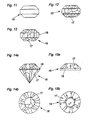
- Fig. 9 to 13 show the products that belong to many stages of the process outlined above.
- Fig. 9 schematically the ceramic raw material granules 5 is shown as it after a granulation process, as in Fig. 3 represented, is produced.
- the ceramic raw material granules are substantially angular.
- Fig. 10 it can be seen how the color pigment mass 2 attaches to the ceramic raw material granules 5 and thus an at least partially coated ceramic raw material granules 8, as in FIG Fig. 4 represented, is produced.
- this coating can be regular or irregular by the surface of the individual granules of the ceramic raw material granules 5 is only partially coated and additionally or alternatively individual granules of the ceramic raw material granules 5 are not coated.
- Fig. 11 For example, at least partially coated, pressed and sintered ceramic raw material granules 19 are shown.
- the surface is at least partly monochromatic since the coated ceramic raw material granulate 5 has been arranged in such a way that the coating with colored pigment mass 2 can be found over a large area on the outside of the pressed and sintered ceramic raw material granulate 19.
- a ceramic molding 22 is shown as it is characterized by a scouring process Fig. 7 From the ceramic molding 19 emerges.
- the band-like structure 17 which represents the second of the at least two colors of the ceramic molding according to the invention.
- these individual bands of the band-like structure 17 are formed by the coating and formed by the interface of several granules of the ceramic raw material granules 5 pressed onto one another. The areas between the bands in this case have the color of the ceramic raw material granules 5.
- Fig. 13 is a ceramic molding 16 to see how it turns out from a grinding process, as in Fig. 8 shown, results.
- the top and bottom of the ceramic molded part 16 is ground facetted, while a central part as a natural left edge 18, as it emerges from the scrubbing process, is left.
- the band-like structure 17 with the second of the at least two colors of the ceramic molding 16 according to the invention.
- Fig. 14a is a side view of another embodiment of a ceramic molding 16 according to the invention with a band-like structure 17 and narrow, natural left edge 18 to see.
- the corresponding plan view is in Fig. 14b shown.
- any shapes of the ceramic molding 16 according to the invention are possible.
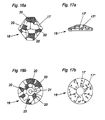
- Fig. 15a the side view of another embodiment of a ceramic molding 16 is shown.
- the bottom and the top is ground planar with facets and naturally left edge 18 in between.
- a round ceramic raw material granules 5 was used, whereby the ribbon-like structure 17 is substantially circular.
- the corresponding plan view is in Fig. 15b shown. Since the size of the ceramic raw material grain 5 is irregular in this embodiment, the sizes of the circular ribbon-like structure 17 are also irregular.
- FIG Fig. 16a Another embodiment of a ceramic molding 16 is shown in FIG Fig. 16a to be seen in a side view.
- the coated ceramic raw material granulate 8 which causes the band-like structure 17, before the pressing process, another ceramic raw material granules having a different color was added.
- These areas are represented in this case by the hatched areas 20.
- ceramic moldings 16 can be made with more than two colors.
- a hole 21 is shown, which serves as a device for attachment to a chain or a thread.
- the irregular ribbon-like structure 17 shows, the ceramic raw material granules 5 used in this embodiment have irregular shapes and sizes.
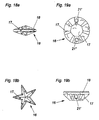
- the band-like structure 17 consists of regular rectangles 17 'and circles 17 ". These are formed by coating the used ceramic raw material granules 5, consisting of regular cylinders and regular balls of the same size, and then grinding them after pressing and sintering . The Coating of the cylindrical ceramic raw material granules 5 is then seen as a rectangular band 17 'and the coating of the spherical ceramic raw material granules 5 as a circular band 17 ".
- FIG Figs. 18a and 18b Another embodiment of a ceramic molding 16 according to the invention is shown in FIG Figs. 18a and 18b shown.
- a star-shaped ceramic molding 16 was produced in the grinding process. Due to the prism-shaped granules of the ceramic raw material granules 5 used, the band-like structure 17 in this embodiment consists of triangles. The individual coated granules of the ceramic raw material granulate 5 were completely encased with colored pigment mass 2, which can be seen in the continuous triangles of the band-like structure 17.
- a further embodiment of a ceramic molding 16 is shown in a plan view.
- the granules of the ceramic raw material granules 5 used here were only partly coated, as can be seen on the shorter-line band-like structure 17.
- the ceramic molding 16 also has a hole 21 is arranged, which serves as a device for fastening, for example, on a chain. But it can also be provided to attach two brackets in the two openings 21 'and 21 ".
- Fig. 20a to 20h are the individual production steps to produce a ceramic molding 16, summarized again. Due to the compact representation of the individual process steps, reference numerals have been omitted. The individual pictures, however, correspond to the Fig. 1 to 8 and are shown there in an enlargement with reference numerals.
Landscapes
- Chemical & Material Sciences (AREA)
- Engineering & Computer Science (AREA)
- Ceramic Engineering (AREA)
- Manufacturing & Machinery (AREA)
- Structural Engineering (AREA)
- Materials Engineering (AREA)
- Organic Chemistry (AREA)
- Inorganic Chemistry (AREA)
- Mechanical Engineering (AREA)
- Dispersion Chemistry (AREA)
- Press-Shaping Or Shaping Using Conveyers (AREA)
- Glanulating (AREA)
- Compositions Of Oxide Ceramics (AREA)
Applications Claiming Priority (1)
| Application Number | Priority Date | Filing Date | Title |
|---|---|---|---|
| AT0081108A AT506893B1 (de) | 2008-05-21 | 2008-05-21 | Zweifärbiges keramikformteil |
Publications (1)
| Publication Number | Publication Date |
|---|---|
| EP2123185A2 true EP2123185A2 (fr) | 2009-11-25 |
Family
ID=41075146
Family Applications (1)
| Application Number | Title | Priority Date | Filing Date |
|---|---|---|---|
| EP09006449A Withdrawn EP2123185A2 (fr) | 2008-05-21 | 2009-05-13 | Pièce de formage en céramique à deux couleurs |
Country Status (4)
| Country | Link |
|---|---|
| US (1) | US20090291316A1 (fr) |
| EP (1) | EP2123185A2 (fr) |
| CN (1) | CN101633202A (fr) |
| AT (1) | AT506893B1 (fr) |
Cited By (2)
| Publication number | Priority date | Publication date | Assignee | Title |
|---|---|---|---|---|
| WO2012156325A1 (fr) * | 2011-05-13 | 2012-11-22 | Wieland Dental + Technik Gmbh & Co. Kg | Procédé de dopage ou de coloration de céramique, de vitrocéramique ou de verre |
| CN115042340A (zh) * | 2022-06-29 | 2022-09-13 | 安徽理工大学环境友好材料与职业健康研究院(芜湖) | 一种改性胶凝材料制备装置及其制备方法 |
Families Citing this family (3)
| Publication number | Priority date | Publication date | Assignee | Title |
|---|---|---|---|---|
| ES2442465B1 (es) * | 2012-07-11 | 2014-08-11 | Cosentino Research And Development, S.L. | Procedimiento para la fabricación de superficies sólidas para construcción |
| CN105130504B (zh) * | 2015-09-02 | 2017-03-08 | 德化县宏顺陶瓷有限公司 | 一种双色云纹图案陶瓷的成型方法 |
| WO2021066768A1 (fr) * | 2019-10-02 | 2021-04-08 | Kutahya Porselen Sanayi Anonim Sirketi | Procédé de production de porcelaine |
Citations (2)
| Publication number | Priority date | Publication date | Assignee | Title |
|---|---|---|---|---|
| DE3445189C2 (de) | 1983-12-28 | 1986-05-15 | Victor Alexander Wil Milles | Verfahren zur Herstellung einer halbedelsteinähnlichen, schneid-, spalt-, schleif- und polierbaren Hartmasse, Verwendung dieser Hartmasse als Ersatz von Halbedelsteinen und aus dieser Hartmasse hergestellte Schmucksteine |
| EP0700796B1 (fr) | 1994-09-12 | 1999-12-29 | Basf Aktiengesellschaft | Procédé de préparation de corps céramiques formés multicolores |
Family Cites Families (19)
| Publication number | Priority date | Publication date | Assignee | Title |
|---|---|---|---|---|
| US4089920A (en) * | 1970-12-14 | 1978-05-16 | Stephens John A | High-strength, light-weight, fired clay body and method of producing same |
| US3760049A (en) * | 1971-03-01 | 1973-09-18 | Minnesota Mining & Mfg | Method of firing dry spun refractory oxide fibers |
| ZA731336B (en) * | 1972-03-15 | 1973-11-28 | Ici Ltd | Alumina |
| US4166147A (en) * | 1973-04-16 | 1979-08-28 | Minnesota Mining And Manufacturing Company | Shaped and fired articles of tio2 |
| US4271109A (en) * | 1973-04-25 | 1981-06-02 | Westinghouse Electric Corp. | Method of manufacturing a ceramic article |
| US4824623A (en) * | 1985-12-13 | 1989-04-25 | Minnesota Mining And Manufacturing Company | A method of making bicomponent green and ceramic fibers |
| US5118457A (en) * | 1988-04-14 | 1992-06-02 | Kyocera Corporation | Colored zirconia ceramics and process for preparation thereof |
| JP2972929B2 (ja) * | 1989-08-08 | 1999-11-08 | 不二見セラミック株式会社 | 二層構造からなる下水処理汚泥焼却灰を用いての道路舗装材の製法 |
| US5443615A (en) * | 1991-02-08 | 1995-08-22 | Honda Giken Kogyo Kabushiki Kaisha | Molded ceramic articles |
| DE69117230T2 (de) * | 1990-08-27 | 1996-08-22 | Cca Inc | Verfahren zur Herstellung von gemusterten geformten Gegenständen |
| CA2052301A1 (fr) * | 1990-10-01 | 1992-04-02 | Hiroshi Uchida | Methode de production d'articles profiles a motif |
| US5401695A (en) * | 1994-01-24 | 1995-03-28 | Rohm And Haas Company | Process for preparing ceramic products |
| CH687680A5 (fr) * | 1994-04-19 | 1997-01-31 | Asulab Sa | Procédé de fabrication d'un article en zircone noire et article décoratif noir obtenu selon ce procédé. |
| US5695712A (en) * | 1995-09-29 | 1997-12-09 | Council Of Scientific And Industrial Research | Method of producing tiles from beach sand garnet |
| US6793873B2 (en) * | 1997-03-21 | 2004-09-21 | Daimlerchrysler Ag | Melted-infiltrated fiber-reinforced composite ceramic |
| US6274080B1 (en) * | 1998-08-21 | 2001-08-14 | Rohm And Haas Company | Method for preparing ceramic compositions |
| ES2215574T3 (es) * | 1999-10-05 | 2004-10-16 | Rohm & Haas | Procedimiento para preparar composiciones ceramicas. |
| EP1326940B1 (fr) * | 2000-10-16 | 2010-03-31 | 3M Innovative Properties Company | Procede de fabrication de particules d'agregat de ceramique |
| DE10310882A1 (de) * | 2003-03-11 | 2004-09-23 | Basf Ag | Verwendung von wäßrigen Bindemitteln bei der Herstellung von Filtermaterialien |
-
2008
- 2008-05-21 AT AT0081108A patent/AT506893B1/de not_active IP Right Cessation
-
2009
- 2009-05-13 EP EP09006449A patent/EP2123185A2/fr not_active Withdrawn
- 2009-05-19 US US12/468,213 patent/US20090291316A1/en not_active Abandoned
- 2009-05-20 CN CN200910163956A patent/CN101633202A/zh active Pending
Patent Citations (2)
| Publication number | Priority date | Publication date | Assignee | Title |
|---|---|---|---|---|
| DE3445189C2 (de) | 1983-12-28 | 1986-05-15 | Victor Alexander Wil Milles | Verfahren zur Herstellung einer halbedelsteinähnlichen, schneid-, spalt-, schleif- und polierbaren Hartmasse, Verwendung dieser Hartmasse als Ersatz von Halbedelsteinen und aus dieser Hartmasse hergestellte Schmucksteine |
| EP0700796B1 (fr) | 1994-09-12 | 1999-12-29 | Basf Aktiengesellschaft | Procédé de préparation de corps céramiques formés multicolores |
Cited By (3)
| Publication number | Priority date | Publication date | Assignee | Title |
|---|---|---|---|---|
| WO2012156325A1 (fr) * | 2011-05-13 | 2012-11-22 | Wieland Dental + Technik Gmbh & Co. Kg | Procédé de dopage ou de coloration de céramique, de vitrocéramique ou de verre |
| US9186227B2 (en) | 2011-05-13 | 2015-11-17 | Ivoclar Vivadent Ag | Method for doping or coloring ceramics, glass ceramics, or glass |
| CN115042340A (zh) * | 2022-06-29 | 2022-09-13 | 安徽理工大学环境友好材料与职业健康研究院(芜湖) | 一种改性胶凝材料制备装置及其制备方法 |
Also Published As
| Publication number | Publication date |
|---|---|
| US20090291316A1 (en) | 2009-11-26 |
| AT506893B1 (de) | 2010-04-15 |
| AT506893A1 (de) | 2009-12-15 |
| CN101633202A (zh) | 2010-01-27 |
Similar Documents
| Publication | Publication Date | Title |
|---|---|---|
| AT515258B1 (de) | Verfahren zur Herstellung von Schleifkörpern | |
| EP1274665B1 (fr) | CORPS MOULES MICROCRISTALLINS A BASE DE ALPHA Al2O3, PROCEDE PERMETTANT DE LES PRODUIRE ET LEUR UTILISATION | |
| EP3645653B1 (fr) | Grain abrasif céramique moulé | |
| DE2147530C3 (de) | Schleifmittel und dessen Herstellung | |
| EP3122835B1 (fr) | Agglomérat de particules abrasives | |
| DE2602477C2 (de) | Verfahren und Vorrichtung zur Herstellung mehrfarbiger Seifenriegel | |
| AT506893B1 (de) | Zweifärbiges keramikformteil | |
| EP3166904B1 (fr) | Procédé de fabrication d'éléments en béton | |
| DE102013212644A1 (de) | Verfahren zur Herstellung eines Schleifmittels | |
| CH638473A5 (de) | Verfahren zur herstellung von diamantschleifkoerpern. | |
| EP0826758B1 (fr) | Elément de coupe composite contenant des particules de diamant et son procédé de préparation | |
| DE3445189C2 (de) | Verfahren zur Herstellung einer halbedelsteinähnlichen, schneid-, spalt-, schleif- und polierbaren Hartmasse, Verwendung dieser Hartmasse als Ersatz von Halbedelsteinen und aus dieser Hartmasse hergestellte Schmucksteine | |
| DE69805869T2 (de) | Verfahren zur Herstellung eines Gegenstandes aus Edelmetall | |
| DE2952666A1 (de) | Verfahren zur herstellung eines als adsorbens brauchbaren kugelfoermigen gamma -aluminiumoxydes mit hoher mechanischer festigkeit | |
| DE60220647T2 (de) | Abriebfestes granulat aus agglomeriertem mineralischem material, dieses granulat enthaltendes pulver und verfahren zu dessen herstellung | |
| DE2758949A1 (de) | Verfahren zur herstellung von pilliertem, granuliertem, inkrustiertem saatgut | |
| DD300288A7 (de) | Abriebfeste keramische mahlkugeln und verfahren zu ihrer herstellung | |
| CH164914A (de) | Schleifkörper. | |
| EP3360944A2 (fr) | Matière abrasive | |
| DE1181244B (de) | Verfahren zur Herstellung von trockenen Druckbestaeubungsmitteln zur Verhuetung des Abfaerbens frisch bedruckter Gegenstaende | |
| EP3698921B1 (fr) | Outil pourvu de corps de base et de revêtement en matériau dur agencé sur ledit corps ainsi que procédé de fabrication d'un outil | |
| DE581994C (de) | Verfahren zur Herstellung von Formkoerpern mit gemaserter Oberflaeche | |
| HK1139896A (en) | Two-colour ceramic moulded part | |
| DE1442739A1 (de) | Mit Oxydationsmittel impraegnierte aktive Tonerde und Verfahren zu deren Herstellung | |
| DE2036782A1 (en) | Light weight ceramic sand - of controlled particle size from homogeneous clay plaste |
Legal Events
| Date | Code | Title | Description |
|---|---|---|---|
| PUAI | Public reference made under article 153(3) epc to a published international application that has entered the european phase |
Free format text: ORIGINAL CODE: 0009012 |
|
| AK | Designated contracting states |
Kind code of ref document: A2 Designated state(s): AT BE BG CH CY CZ DE DK EE ES FI FR GB GR HR HU IE IS IT LI LT LU LV MC MK MT NL NO PL PT RO SE SI SK TR |
|
| RAP1 | Party data changed (applicant data changed or rights of an application transferred) |
Owner name: D. SWAROVSKI KG |
|
| STAA | Information on the status of an ep patent application or granted ep patent |
Free format text: STATUS: THE APPLICATION IS DEEMED TO BE WITHDRAWN |
|
| 18D | Application deemed to be withdrawn |
Effective date: 20131203 |