EP2124455A1 - Verfahren und vorrichtung zur bewegungsvektorsuche, programm dafür sowie aufzeichnungsmedium mit diesem programm - Google Patents
Verfahren und vorrichtung zur bewegungsvektorsuche, programm dafür sowie aufzeichnungsmedium mit diesem programm Download PDFInfo
- Publication number
- EP2124455A1 EP2124455A1 EP08721357A EP08721357A EP2124455A1 EP 2124455 A1 EP2124455 A1 EP 2124455A1 EP 08721357 A EP08721357 A EP 08721357A EP 08721357 A EP08721357 A EP 08721357A EP 2124455 A1 EP2124455 A1 EP 2124455A1
- Authority
- EP
- European Patent Office
- Prior art keywords
- motion vector
- search
- area
- search area
- overhead cost
- Prior art date
- Legal status (The legal status is an assumption and is not a legal conclusion. Google has not performed a legal analysis and makes no representation as to the accuracy of the status listed.)
- Ceased
Links
Images




Classifications
-
- H—ELECTRICITY
- H04—ELECTRIC COMMUNICATION TECHNIQUE
- H04N—PICTORIAL COMMUNICATION, e.g. TELEVISION
- H04N19/00—Methods or arrangements for coding, decoding, compressing or decompressing digital video signals
- H04N19/10—Methods or arrangements for coding, decoding, compressing or decompressing digital video signals using adaptive coding
- H04N19/134—Methods or arrangements for coding, decoding, compressing or decompressing digital video signals using adaptive coding characterised by the element, parameter or criterion affecting or controlling the adaptive coding
- H04N19/136—Incoming video signal characteristics or properties
- H04N19/137—Motion inside a coding unit, e.g. average field, frame or block difference
- H04N19/139—Analysis of motion vectors, e.g. their magnitude, direction, variance or reliability
-
- H—ELECTRICITY
- H04—ELECTRIC COMMUNICATION TECHNIQUE
- H04N—PICTORIAL COMMUNICATION, e.g. TELEVISION
- H04N19/00—Methods or arrangements for coding, decoding, compressing or decompressing digital video signals
- H04N19/10—Methods or arrangements for coding, decoding, compressing or decompressing digital video signals using adaptive coding
- H04N19/134—Methods or arrangements for coding, decoding, compressing or decompressing digital video signals using adaptive coding characterised by the element, parameter or criterion affecting or controlling the adaptive coding
- H04N19/146—Data rate or code amount at the encoder output
-
- H—ELECTRICITY
- H04—ELECTRIC COMMUNICATION TECHNIQUE
- H04N—PICTORIAL COMMUNICATION, e.g. TELEVISION
- H04N19/00—Methods or arrangements for coding, decoding, compressing or decompressing digital video signals
- H04N19/40—Methods or arrangements for coding, decoding, compressing or decompressing digital video signals using video transcoding, i.e. partial or full decoding of a coded input stream followed by re-encoding of the decoded output stream
-
- H—ELECTRICITY
- H04—ELECTRIC COMMUNICATION TECHNIQUE
- H04N—PICTORIAL COMMUNICATION, e.g. TELEVISION
- H04N19/00—Methods or arrangements for coding, decoding, compressing or decompressing digital video signals
- H04N19/50—Methods or arrangements for coding, decoding, compressing or decompressing digital video signals using predictive coding
- H04N19/503—Methods or arrangements for coding, decoding, compressing or decompressing digital video signals using predictive coding involving temporal prediction
- H04N19/51—Motion estimation or motion compensation
-
- H—ELECTRICITY
- H04—ELECTRIC COMMUNICATION TECHNIQUE
- H04N—PICTORIAL COMMUNICATION, e.g. TELEVISION
- H04N19/00—Methods or arrangements for coding, decoding, compressing or decompressing digital video signals
- H04N19/50—Methods or arrangements for coding, decoding, compressing or decompressing digital video signals using predictive coding
- H04N19/503—Methods or arrangements for coding, decoding, compressing or decompressing digital video signals using predictive coding involving temporal prediction
- H04N19/51—Motion estimation or motion compensation
- H04N19/56—Motion estimation with initialisation of the vector search, e.g. estimating a good candidate to initiate a search
-
- H—ELECTRICITY
- H04—ELECTRIC COMMUNICATION TECHNIQUE
- H04N—PICTORIAL COMMUNICATION, e.g. TELEVISION
- H04N19/00—Methods or arrangements for coding, decoding, compressing or decompressing digital video signals
- H04N19/50—Methods or arrangements for coding, decoding, compressing or decompressing digital video signals using predictive coding
- H04N19/503—Methods or arrangements for coding, decoding, compressing or decompressing digital video signals using predictive coding involving temporal prediction
- H04N19/51—Motion estimation or motion compensation
- H04N19/567—Motion estimation based on rate distortion criteria
-
- H—ELECTRICITY
- H04—ELECTRIC COMMUNICATION TECHNIQUE
- H04N—PICTORIAL COMMUNICATION, e.g. TELEVISION
- H04N19/00—Methods or arrangements for coding, decoding, compressing or decompressing digital video signals
- H04N19/50—Methods or arrangements for coding, decoding, compressing or decompressing digital video signals using predictive coding
- H04N19/503—Methods or arrangements for coding, decoding, compressing or decompressing digital video signals using predictive coding involving temporal prediction
- H04N19/51—Motion estimation or motion compensation
- H04N19/57—Motion estimation characterised by a search window with variable size or shape
-
- H—ELECTRICITY
- H04—ELECTRIC COMMUNICATION TECHNIQUE
- H04N—PICTORIAL COMMUNICATION, e.g. TELEVISION
- H04N19/00—Methods or arrangements for coding, decoding, compressing or decompressing digital video signals
- H04N19/60—Methods or arrangements for coding, decoding, compressing or decompressing digital video signals using transform coding
- H04N19/61—Methods or arrangements for coding, decoding, compressing or decompressing digital video signals using transform coding in combination with predictive coding
Definitions
- the present invention relates to a motion vector search method used in video encoding which performs motion-compensated prediction and a corresponding apparatus, and a motion vector search program for implementing the motion vector search method and a computer-readable storage medium which stores the program.
- a motion vector search method used in video encoding which performs motion-compensated prediction and a corresponding apparatus
- a motion vector search program for implementing the motion vector search method and a computer-readable storage medium which stores the program.
- a motion vector In a video encoding method which performs motion-compensated prediction, a motion vector should be searched for. In the motion vector search, the encoding efficiency is not always maximum at the position which produces the minimum power for prediction error. This is because transmitted actual encoding information includes, not only a prediction error signal, but also vector information or the like.
- a motion vector search is performed in consideration of the amount of generated code for the motion vector as an overhead cost.
- D indicates power for prediction error
- R indicates the amount of generated code for data except for orthogonal transformation coefficients
- ⁇ is a constant determined by the quantization step size.
- the amount of code generated for the motion vector varies depending on the video encoding method. For example, in a general rule of MPEG-2, difference between a motion vector of a target block and a motion vector (as a predicted vector) of a block on the left side of the target block is encoded (see Non-Patent Document 2). Additionally, in H.264, such a difference is encoded using a predicted vector which is a median of motion vectors of three blocks around the target block (see Non-Patent Document 3).
- the motion vector which has been searched for in a first video encoding system does not always provide a minimum cost in a second video encoding system.
- Figs. 8A and 8B show a video encoding processing using another motion search method
- Figs. 9A and 9B show a re-encoding processing.
- an encoding apparatus is formed using a motion search part or the like of another video encoding system.
- an already-encoded bit stream is re-encoded so as to change the video encoding method, the bit rate, and the like.
- a motion vector used in the original bit stream can be used again so as to reduce the computation cost required for motion search in the re-encoding.
- re-search is performed using the original motion vector which defines the search starting point.
- the cost is not guaranteed to be minimum in the second stage only when the original motion vector is directly used. Therefore, the encoding efficiency is degraded in comparison with a case of performing re-search for a wide area.
- a decoded signal of the original bit stream is input into the second stage, that is, the target video signal is different between the first and second stages, so that the encoding efficiency probably degrades.
- Fig. 10 is a flowchart of the above-described re-search.
- the amount of code generated for the motion vector is considered as an overhead cost
- a predicted vector is computed before the re-search.
- only a peripheral area around the original motion vector is searched regardless of the predicted vector.
- Fig. 11 shows an example of the above.
- the example shows a motion vector having a minimum cost in the re-search area (in the vicinity of the original motion vector) on the second stage, and another motion vector which is present outside the re-search area and has a cost lower than the above minimum cost.
- Such a situation is caused by a condition in that no predicted vector on the second stage is considered when the first stage performs a motion search.
- an offset between the relevant motion vectors may increase.
- the relevant cost function or video signal is different between a first stager for searching for an original motion vector and a second stage for re-searching a motion vector, the encoding efficiency may degrade.
- the re-search area must be extended.
- another problem such as an increase in the computation cost on the second stage occurs.
- an object of the present invention is to provide a novel vector search technique by which when an original motion vector obtained in a first video encoding system is used for searching for a motion vector in a second video encoding system, degradation in the encoding efficiency can be suppressed, and the computation cost can be reduced.
- the present invention provides a motion vector search apparatus used in video encoding which performs motion-compensated prediction, the apparatus comprising: (1) an input device that inputs a motion vector which has been searched for with respect to an encoding target block; (2) a computation device that computes a motion vector having a minimum overhead cost which minimizes the amount of code generated for the motion vector of the encoding target block; (3) a limiting device that limits a search area based on the motion vector input by the input device and the motion vector which is computed by the computation device and has the minimum overhead cost; and (4) a search device that searches for a motion vector by searching only the search area limited by the limiting device.
- the motion vector search method of the present invention implemented by operating the above-described devices can also be implemented by a computer program.
- a computer program may be provided by storing it in an appropriate computer-readable storage medium, or by means of a network, and can be installed and operate on a control device such as a CPU so as to implement the present invention.
- a motion vector (the above-described original motion vector) searched for in a previous video encoding system is input into the apparatus.
- a predicted vector of the encoding target block is computed based on a motion vector of an already-encoded block in the vicinity of the encoding target block, and the computed predicted vector is set as the motion vector having a minimum overhead cost.
- an area interposed between the input motion vector and the computed motion vector having the minimum overhead cost is specified, and the specified area is determined to be the limited search area.
- a circular area having a radius which corresponds to a line segment between the input motion vector and the computed motion vector having the minimum overhead cost is specified, and the specified area is determined to be the limited search area.
- an area corresponding to a line segment between the input motion vector and the computed motion vector having the minimum overhead cost is specified, and the specified area is determined to be the limited search area.
- a rectangular area having a side which corresponds to a line segment between the input motion vector and the computed motion vector having the minimum overhead cost is specified, where another side of the rectangular area has a predetermined length and perpendicularly intersects the line segment at the midpoint of said other side. The specified area is then determined to be the limited search area.
- an elliptic area having focal points which correspond to the input motion vector and the computed motion vector having the minimum overhead cost is specified, where the sum of distances from the focal points are predetermined as a constant.
- the specified area is then determined to be the limited search area.
- a motion vector is searched for by extracting search points within the limited search area, and searching only the extracted search points.
- the relevant cost function or video signal may be different between the first and second video encoding systems, and thus an optimum motion vector is not always present in the vicinity of the original motion vector.
- the present invention considering the above does not employ a method of re-searching only a peripheral area around the original motion vector, but limits the search area in a manner such that the search area includes the original motion vector and another point having a minimum overhead cost in the second video encoding system.
- a predicted vector for an encoding target block is computed based on a motion vector of an already-encoded block in the vicinity of the target block, and a difference between the relevant motion vector and the predicted vector is encoded. Therefore, if the difference is zero, the motion vector has the minimum amount of code. That is, the predicted vector in the above case is the motion vector which produces the minimum overhead cost.
- the present invention employs a structure for limiting a re-search area (or range) in the second encoding system by using an original motion vector and a predicted vector which produces a minimum amount of code (i.e., overhead cost) generated for a motion vector in the second video encoding system.
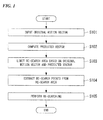
- Fig. 1 is a flowchart showing an example operation in accordance with the present invention.
- an original motion vector which was obtained in a first video encoding system, is input into the present system.
- a predicted vector of an encoding target block is computed using a motion vector of an already-encoded block in the vicinity of the target block.
- the method for computing the predicted vector is determined depending on the video encoding system.
- a process performed when the already-encoded block has no motion vector due to an intraframe encoding mode or the like is also determined depending on the predicted vector generating method of each video encoding system.
- the re-search area is limited based on the original motion vector and the predicted vector.
- search points included in a figure which represents the re-search area are extracted.
- the re-search area has a circular form
- all search points included in the relevant circle are extracted so as to determine the re-search area.
- the computation cost in the second motion search unit is equal between the present and conventional methods. If the number of search points is reduced in comparison with the conventional method, the computation cost can be reduced.
- a motion vector is determined by performing re-searching with respect to the extracted re-search points.
- a predicted vector which is a motion vector for providing a minimum overhead cost, is included in the area.
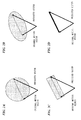
- Figs. 2A to 2D show examples of the set re-search area.
- circular, elliptic, rectangular, and line-segment re-search areas are shown. The method of limiting each re-search area will be explained below.
- a circle having a radius which corresponds to a line segment between the original motion vector and the predicted vector may be drawn, so that search points included in the circle are extracted to determine the re-search area.
- an ellipse having focal points which correspond to the original motion vector and the predicted vector may be drawn, where the sum of distances from the focal points are predetermined as a constant, and search points included in the ellipse are extracted to determine the re-search area.
- a rectangle having longer sides which correspond to the distance between the original motion vector and the predicted vector may be drawn, where the length of the shorter sides is predetermined as a constant, and search points included in the rectangle are extracted to determine the re-search area.
- a line segment which connects the original motion vector and the predicted vector to each other may be drawn, so that search points on the line segment are extracted to determine the re-search area.
- the above methods for limiting the re-search area are examples, and the re-search area is limited mainly based on the original motion vector and the predicted vector.
- the number of motion vectors is determined depending on the block size, and thus the maximum block size may always provide a minimum overhead cost.
- a motion vector for a minimum overhead cost may be computed for each block size. For example, if there are two block sizes such as 16 ⁇ 16 and 8x8, a motion vector corresponding to a minimum overhead cost is computed and the re-search area is determined for each size.
- an area in the vicinity of the predicted vector can also be searched without increasing the number of re-search points. Therefore, it is possible to prevent the encoding efficiency from degrading, and also to reduce the computation cost.
- Fig. 3 shows a structure of a video encoding apparatus to which the present invention is applied.
- the video encoding apparatus 1 performs an operation of generating a predicted signal of a target video signal, computing a difference between the video signal and the predicted signal, and generating and outputting an encoded bit stream by quantizing and encoding the difference.
- the apparatus has a function of computing a predicted vector of an encoding target block based on a motion vector of an already-encoded block in the vicinity of the target block, and has a motion search unit 10 for searching for a motion vector.
- the apparatus also has a re-search area limiter 20, into which an original motion vector obtained in a previous video encoding system and a predicted vector computed by the motion search unit 10 are input.
- the research area limiter 20 instructs a re-search area (region) of a target motion vector to the motion search unit 10.
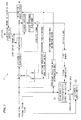
- Fig. 4 shows an example structure of the re-search area limiter 20 in the video encoding apparatus 1, so as to implement the motion vector search process of the present embodiment.
- the re-search area limiter 20 has a predicted vector input unit 200, an original motion vector input unit 201, a figure type information input unit 202, a re-search area setting unit 203, and a figure parameter storage unit 204.
- a predicted vector computed by the motion search unit 10 is input by the predicted vector input unit 200 into the re-search area limiter 20.
- An original motion vector obtained in the previous video encoding system is input by the original motion vector input unit 201 into the research area limiter 20.
- Figure type information which indicates a predetermined circular, elliptic, rectangular, or line-segment form of the re-search area is input by the figure type information input unit 202 into the re-search area limiter 20.
- the re-search area setting unit 203 sets a re-search area for a motion vector based on the predicted vector input by the predicted vector input unit 200, the original motion vector input by the original motion vector input unit 201, and the figure type information input by the figure type information input unit 202, and communicates the set re-search area to the motion search unit 10.
- the figure parameter storage unit 204 has a data structure as shown in Fig. 5 , and stores information of figure parameters which are used when the re-search area setting unit 203 sets the re-search area.
- an ellipse figure type needs a set value for the sum of the distances from two focal points so as to set the re-search area, and thus information of the set value is stored.
- a rectangle figure type needs a set value for the length of the other sides so as to set the re-search area, and thus information of the set value is stored.
- re-encoding of a bit stream encoded in another video encoding system is a precondition, and a motion vector extracted from an original bit stream is used as the input original motion vector.
- the predicted vector is computed using three blocks in the vicinity of the target block.
- the original bit stream has already been decoded before the encoding on the second (present) stage, and the relevant motion vector has been stored.
- Fig. 6 shows an example flowchart performed by the video encoding apparatus 1 having the structure of Fig. 4 .
- step S201 to S202 should be executed only once for the video sequence.
- a motion vector is extracted from the original bit stream, so as to perform inputting of the original motion vector required for the encoding target block.
- a predicted vector of the encoding target block is computed based on the motion vector of an already-encoded block in the vicinity of the target block.
- the re-search area for the relevant motion vector is limited as shown in Figs. 2A to 2D , based on the input figure type information, the input original motion vector, the computed predicted vector, and the parameters retrieved from the figure parameter storage unit 204.
- the search points are extracted within the limited re-search area, so as to search for the relevant motion vector.
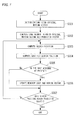
- step S205 in the flowchart of Fig. 6 will be explained in detail for a specific example in which "line segment" is suggested as the figure type for the re-search area.
- the search points are set with an integer pixel accuracy, and that searching starts from the original motion vector, proceeds horizontally or vertically on the line segment by each pixel, and ends at the position of the predicted vector.
- step S205 in the process of step S205 (see the flowchart of Fig. 7 ), initialization using the original motion vector is performed (see the first step S301), so that the input original motion vector ⁇ MVO> is set as an initial motion vector, and the cost required for the original motion vector ⁇ MVO> is set as a minimum cost.
- the vertical component is varied by 1. If the absolute value
- next step S304 the cost required for the search position is computed.
- the computed cost is compared with the presently-determined minimum cost.
- step S306 when it is determined that the computed cost is lower than the presently-determined minimum cost, the operation proceeds to step S306, where the minimum cost and the motion vector are updated based on the currently-computed cost and motion vector.
- step S307 it is determined whether or not the search position coincides with the predicted vector. If it is determined that they do not coincide with each other, the operation returns to step S303, and if it is determined that they coincide with each other, the operation is completed.
- the start and end points of searching are respectively assigned to the original motion vector and the predicted vector.
- the order of searching is not limited. For example, cost comparison may be performed at three points such as the center and both ends of the re-search area, so as to reduce the number of search points.
- FIG. 7 shows the process executed in step S205 in the flowchart of Fig. 6 , where it is assumed that "line segment" is designated as the figure type of the re-search area. However, a similar operation is performed when a figure type (of re-search area) other than "line segment" is designated.
- each search position is sequentially selected within the re-search area limited as shown in Figs. 2A to 2C , and the cost required for the position is computed. If it is determined that the computed cost is lower than the presently-determined minimum cost, the minimum cost and motion vector are updated based on the currently-computed cost and motion vector. The motion vector which provides the minimum cost is searched for by repeating such an operation.
- the re-search area for motion search on the second encoding stage can be limited based on the motion vector of the original bit stream and the relevant predicted vector.
- the present invention has been explained in accordance with the specific embodiment together with the drawings, the present invention is not limited thereto.
- the figure type information input unit 202 may be omitted and the figure type for the re-search area may be predetermined.
- a decoding process may be performed on the present stage. Furthermore, the specific embodiment performs a re-encoding process. However, encoding on the second stage is possible when the original motion vector and a video signal can be input into the second stage. Therefore, encoding using the video signal may be performed while the first stage may function as a motion search unit.
Landscapes
- Engineering & Computer Science (AREA)
- Multimedia (AREA)
- Signal Processing (AREA)
- Compression Or Coding Systems Of Tv Signals (AREA)
Applications Claiming Priority (2)
| Application Number | Priority Date | Filing Date | Title |
|---|---|---|---|
| JP2007064286 | 2007-03-14 | ||
| PCT/JP2008/053937 WO2008111451A1 (ja) | 2007-03-14 | 2008-03-05 | 動きベクトル探索方法及び装置、そのプログラム並びにプログラムを記録した記録媒体 |
Publications (2)
| Publication Number | Publication Date |
|---|---|
| EP2124455A1 true EP2124455A1 (de) | 2009-11-25 |
| EP2124455A4 EP2124455A4 (de) | 2010-08-11 |
Family
ID=39759394
Family Applications (1)
| Application Number | Title | Priority Date | Filing Date |
|---|---|---|---|
| EP08721357A Ceased EP2124455A4 (de) | 2007-03-14 | 2008-03-05 | Verfahren und vorrichtung zur bewegungsvektorsuche, programm dafür sowie aufzeichnungsmedium mit diesem programm |
Country Status (10)
| Country | Link |
|---|---|
| US (1) | US8396130B2 (de) |
| EP (1) | EP2124455A4 (de) |
| JP (2) | JPWO2008111451A1 (de) |
| KR (1) | KR101083379B1 (de) |
| CN (1) | CN101682775B (de) |
| BR (1) | BRPI0808567A2 (de) |
| CA (1) | CA2678574C (de) |
| RU (1) | RU2420913C1 (de) |
| TW (1) | TWI429292B (de) |
| WO (1) | WO2008111451A1 (de) |
Cited By (2)
| Publication number | Priority date | Publication date | Assignee | Title |
|---|---|---|---|---|
| RU2551473C2 (ru) * | 2011-03-09 | 2015-05-27 | Ниппон Телеграф Энд Телефон Корпорейшн | Устройство кодирования видео, способ кодирования видео и программа кодирования видео |
| US9509995B2 (en) | 2010-12-21 | 2016-11-29 | Intel Corporation | System and method for enhanced DMVD processing |
Families Citing this family (11)
| Publication number | Priority date | Publication date | Assignee | Title |
|---|---|---|---|---|
| KR20120120280A (ko) * | 2010-02-09 | 2012-11-01 | 니폰덴신뎅와 가부시키가이샤 | 움직임 벡터 예측 부호화 방법, 움직임 벡터 예측 복호 방법, 동화상 부호화 장치, 동화상 복호 장치 및 그들의 프로그램 |
| US9497481B2 (en) | 2010-02-09 | 2016-11-15 | Nippon Telegraph And Telephone Corporation | Motion vector predictive encoding method, motion vector predictive decoding method, moving picture encoding apparatus, moving picture decoding apparatus, and programs thereof |
| BR112012019680A2 (pt) | 2010-02-09 | 2016-05-03 | Nippon Telegraph & Telephone | método de codificação preditiva de vetor de movimento, método de decodificação preditiva de vetor de movimento, aparelho de codificação de imagem em movimento, aparelho de decodificação de imagem em movimento e programas destes. |
| KR101443701B1 (ko) | 2010-11-22 | 2014-09-29 | 한국전자통신연구원 | 적응형 움직임 탐색 범위 결정 장치 및 방법 |
| JP5911517B2 (ja) * | 2011-03-15 | 2016-04-27 | インテル・コーポレーション | 低メモリアクセス動きベクトル導出 |
| JP2012209706A (ja) * | 2011-03-29 | 2012-10-25 | Jvc Kenwood Corp | 画像復号装置、画像復号方法及び画像復号プログラム |
| JP2012209705A (ja) * | 2011-03-29 | 2012-10-25 | Jvc Kenwood Corp | 画像符号化装置、画像符号化方法及び画像符号化プログラム |
| SG11201502126RA (en) * | 2012-09-28 | 2015-05-28 | Sony Corp | Image processing device and method |
| RU2719327C2 (ru) | 2014-12-18 | 2020-04-17 | Инналэбс Лимитед | Гироскоп |
| US10972788B1 (en) * | 2018-08-30 | 2021-04-06 | Amazon Technologies, Inc. | Distortion-based video re-encoding |
| CN115630191B (zh) * | 2022-12-22 | 2023-03-28 | 成都纵横自动化技术股份有限公司 | 基于全动态视频的时空数据集检索方法、装置及存储介质 |
Family Cites Families (100)
| Publication number | Priority date | Publication date | Assignee | Title |
|---|---|---|---|---|
| SU1649674A1 (ru) | 1988-10-10 | 1991-05-15 | Предприятие П/Я А-1772 | Устройство дл кодировани и декодировани телевизионного сигнала |
| US5086488A (en) * | 1989-08-19 | 1992-02-04 | Mitsubishi Denki Kabushiki Kaisha | Transform coding apparatus |
| JPH03129987A (ja) | 1989-10-14 | 1991-06-03 | Sony Corp | 映像信号符号化装置及び映像信号符号化方法 |
| JPH04150284A (ja) * | 1990-10-09 | 1992-05-22 | Olympus Optical Co Ltd | 動ベクトル検出方法およびその装置 |
| JP2950633B2 (ja) | 1991-03-27 | 1999-09-20 | 沖電気工業株式会社 | 動きベクトル検出装置 |
| JPH06113271A (ja) | 1991-05-02 | 1994-04-22 | Graphics Commun Technol:Kk | 画像信号符号化装置 |
| US5398078A (en) * | 1991-10-31 | 1995-03-14 | Kabushiki Kaisha Toshiba | Method of detecting a motion vector in an image coding apparatus |
| US5283646A (en) * | 1992-04-09 | 1994-02-01 | Picturetel Corporation | Quantizer control method and apparatus |
| JPH05328333A (ja) * | 1992-05-15 | 1993-12-10 | Toshiba Corp | 動きベクトル検出装置 |
| JPH06237448A (ja) | 1993-02-12 | 1994-08-23 | Toshiba Corp | 可変長符号化及び復号化装置 |
| DE69430877T2 (de) | 1993-04-09 | 2003-02-06 | Sony Corp., Tokio/Tokyo | Bildkodierungsverfahren und -vorrichtung |
| US5398068A (en) * | 1993-09-02 | 1995-03-14 | Trustees Of Princeton University | Method and apparatus for determining motion vectors for image sequences |
| EP0660619A1 (de) * | 1993-12-22 | 1995-06-28 | Laboratoires D'electronique Philips S.A.S. | Verfahren zur variablen Längenkodierung von Bildern und Vorrichtung zur Ausführung eines solchen Verfahrens |
| JPH07203430A (ja) | 1993-12-28 | 1995-08-04 | Sharp Corp | 画像符号化装置 |
| KR0183688B1 (ko) | 1994-01-12 | 1999-05-01 | 김광호 | 영상부호화방법 및 장치 |
| US5781237A (en) * | 1994-03-25 | 1998-07-14 | Matsushita Electric Industrial Co., Ltd. | Video coding apparatus and video coding method |
| JP3149672B2 (ja) | 1994-03-25 | 2001-03-26 | 松下電器産業株式会社 | 映像符号化装置 |
| JPH089379A (ja) | 1994-06-15 | 1996-01-12 | Sanyo Electric Co Ltd | 動きベクトル検出方法 |
| JPH089397A (ja) | 1994-06-17 | 1996-01-12 | Dainippon Printing Co Ltd | カラー情報記録再生装置 |
| JPH08116448A (ja) | 1994-10-13 | 1996-05-07 | Fuji Xerox Co Ltd | 画像信号の符号化装置及び復号装置 |
| US6275532B1 (en) | 1995-03-18 | 2001-08-14 | Sharp Kabushiki Kaisha | Video coding device and video decoding device with a motion compensated interframe prediction |
| EP1357758A3 (de) | 1995-08-02 | 2004-10-27 | Matsushita Electric Industrial Co., Ltd. | Videokodierungsgerät und -system mit Quantizierungskontrollverfahren und Durchschnittsdurchsatzberechnungsverfahren |
| JPH0998427A (ja) | 1995-09-29 | 1997-04-08 | Toshiba Corp | 動画像符号化装置 |
| US5682209A (en) | 1995-11-13 | 1997-10-28 | Tektronix, Inc. | Motion estimation using limited-time early exit with prequalification matrices and a predicted search center |
| US5835145A (en) * | 1996-01-19 | 1998-11-10 | Lsi Logic Corporation | Conversion system using programmable tables for compressing transform coefficients |
| JP3218994B2 (ja) | 1996-10-23 | 2001-10-15 | 松下電器産業株式会社 | 画像符号化方法および装置 |
| DE69713549T2 (de) | 1996-04-25 | 2003-01-16 | Matsushita Electric Industrial Co., Ltd. | Gerät und Verfahren zur Bewegtbildkodierung |
| US5760836A (en) * | 1996-08-22 | 1998-06-02 | International Business Machines Corporation | FIFO feedback and control for digital video encoder |
| US6366614B1 (en) * | 1996-10-11 | 2002-04-02 | Qualcomm Inc. | Adaptive rate control for digital video compression |
| JPH10290461A (ja) | 1997-04-16 | 1998-10-27 | Sony Corp | レート制御装置及びレート制御方法 |
| JPH1115429A (ja) | 1997-06-20 | 1999-01-22 | Fujitsu General Ltd | 動きベクトル時間軸処理方式 |
| JPH1155671A (ja) | 1997-08-05 | 1999-02-26 | Matsushita Electric Ind Co Ltd | 画像圧縮符号化装置 |
| KR100249223B1 (ko) * | 1997-09-12 | 2000-03-15 | 구자홍 | 엠팩(mpeg)-4의움직임벡터코딩방법 |
| JP3884172B2 (ja) * | 1997-10-02 | 2007-02-21 | 株式会社東芝 | 可変長復号化装置および復号化方法 |
| JP4171934B2 (ja) | 1997-12-26 | 2008-10-29 | ソニー株式会社 | 画像処理装置および方法、並びに記録媒体 |
| JPH11239354A (ja) | 1998-02-23 | 1999-08-31 | Mitsubishi Electric Corp | 動きベクトル検出器 |
| JPH11252572A (ja) | 1998-03-03 | 1999-09-17 | Nippon Hoso Kyokai <Nhk> | 符号量配分装置 |
| US6704361B2 (en) * | 1998-05-18 | 2004-03-09 | Sony Corporation | Variable length decoder for decoding digitally encoded video signals |
| US6859496B1 (en) * | 1998-05-29 | 2005-02-22 | International Business Machines Corporation | Adaptively encoding multiple streams of video data in parallel for multiplexing onto a constant bit rate channel |
| JP2000023162A (ja) * | 1998-06-29 | 2000-01-21 | Sony Corp | 符号化装置及び符号化方法 |
| RU2137194C1 (ru) | 1998-07-15 | 1999-09-10 | Дворкович Александр Викторович | Способ анализа векторов движения деталей в динамических изображениях |
| US6963608B1 (en) * | 1998-10-02 | 2005-11-08 | General Instrument Corporation | Method and apparatus for providing rate control in a video encoder |
| JP2000138938A (ja) | 1998-10-30 | 2000-05-16 | Sony Corp | 画像圧縮符号化方法及び装置 |
| JP2000201328A (ja) | 1999-01-08 | 2000-07-18 | Hitachi Ltd | 動きベクトルの検出方法および回路 |
| JP2000244921A (ja) * | 1999-02-24 | 2000-09-08 | Matsushita Electric Ind Co Ltd | 映像符号化方法および装置 |
| JP2000261799A (ja) | 1999-03-10 | 2000-09-22 | Fujitsu Ltd | 可変レート動画像符号化装置 |
| US6567554B1 (en) * | 1999-03-12 | 2003-05-20 | Victor Company Of Japan, Limited | Data coding method and apparatus therefor |
| EP1120976A4 (de) | 1999-07-29 | 2006-03-29 | Mitsubishi Electric Corp | Verfahren zur bewegungsvektordetektion |
| US6480539B1 (en) * | 1999-09-10 | 2002-11-12 | Thomson Licensing S.A. | Video encoding method and apparatus |
| JP2002010260A (ja) | 2000-06-27 | 2002-01-11 | Mitsubishi Electric Corp | 動きベクトル検出方法及び動画像符号化装置 |
| US20020122482A1 (en) * | 2001-01-03 | 2002-09-05 | Kim Hyun Mun | Method of performing video encoding rate control using bit budget |
| JP2002247587A (ja) * | 2001-02-19 | 2002-08-30 | Nippon Telegr & Teleph Corp <Ntt> | 画像符号化データの再符号化装置、再符号化方法、再符号化プログラム及び再符号化プログラムを記録した記録媒体 |
| KR100446235B1 (ko) * | 2001-05-07 | 2004-08-30 | 엘지전자 주식회사 | 다중 후보를 이용한 움직임 벡터 병합 탐색 방법 |
| US6950463B2 (en) * | 2001-06-13 | 2005-09-27 | Microsoft Corporation | Non-compensated transcoding of a video stream |
| FR2829657B1 (fr) * | 2001-09-13 | 2004-02-06 | Cit Alcatel | Procede et dispositif pour la compression de donnees devant etre transmises avec un debit constant |
| US7356079B2 (en) * | 2001-11-21 | 2008-04-08 | Vixs Systems Inc. | Method and system for rate control during video transcoding |
| US7027982B2 (en) * | 2001-12-14 | 2006-04-11 | Microsoft Corporation | Quality and rate control strategy for digital audio |
| KR100450746B1 (ko) * | 2001-12-15 | 2004-10-01 | 한국전자통신연구원 | 계층탐색 기반의 혼합형 움직임 추정 장치 및 방법 |
| WO2003063501A1 (en) | 2002-01-22 | 2003-07-31 | Nokia Corporation | Coding transform coefficients in image/video encoders and/or decoders |
| KR100455119B1 (ko) | 2002-01-26 | 2004-11-06 | 엘지전자 주식회사 | 움직임 벡터 영역의 적응적 결정 방법 |
| US7099387B2 (en) | 2002-03-22 | 2006-08-29 | Realnetorks, Inc. | Context-adaptive VLC video transform coefficients encoding/decoding methods and apparatuses |
| JP4130780B2 (ja) | 2002-04-15 | 2008-08-06 | 松下電器産業株式会社 | 画像符号化方法および画像復号化方法 |
| US7197072B1 (en) * | 2002-05-30 | 2007-03-27 | Intervideo, Inc. | Systems and methods for resetting rate control state variables upon the detection of a scene change within a group of pictures |
| JP4230188B2 (ja) | 2002-06-06 | 2009-02-25 | パナソニック株式会社 | 可変長符号化方法および可変長復号化方法 |
| US20040252758A1 (en) | 2002-08-14 | 2004-12-16 | Ioannis Katsavounidis | Systems and methods for adaptively filtering discrete cosine transform (DCT) coefficients in a video encoder |
| US6944224B2 (en) | 2002-08-14 | 2005-09-13 | Intervideo, Inc. | Systems and methods for selecting a macroblock mode in a video encoder |
| JP3679083B2 (ja) * | 2002-10-08 | 2005-08-03 | 株式会社エヌ・ティ・ティ・ドコモ | 画像符号化方法、画像復号方法、画像符号化装置、画像復号装置、画像符号化プログラム、画像復号プログラム |
| US7042943B2 (en) | 2002-11-08 | 2006-05-09 | Apple Computer, Inc. | Method and apparatus for control of rate-distortion tradeoff by mode selection in video encoders |
| JP4282974B2 (ja) | 2002-11-14 | 2009-06-24 | パナソニック株式会社 | 符号量制御装置、プログラム及び記録媒体 |
| US20040120404A1 (en) * | 2002-11-27 | 2004-06-24 | Takayuki Sugahara | Variable length data encoding method, variable length data encoding apparatus, variable length encoded data decoding method, and variable length encoded data decoding apparatus |
| JP4221655B2 (ja) * | 2003-03-06 | 2009-02-12 | ソニー株式会社 | 符号化装置および符号化方法、プログラム、並びに記録媒体 |
| JP2005045736A (ja) | 2003-07-25 | 2005-02-17 | Sony Corp | 画像信号符号化方法及び装置、符号化制御装置並びにプログラム |
| KR100505699B1 (ko) * | 2003-08-12 | 2005-08-03 | 삼성전자주식회사 | 실시간 가변 비트율 제어로 화질을 개선시키는 비디오인코더의 인코딩율 제어기, 이를 구비한 비디오 데이터전송 시스템 및 그 방법 |
| JP4179548B2 (ja) * | 2003-09-24 | 2008-11-12 | Kddi株式会社 | 動きベクトル検出装置 |
| US7453938B2 (en) * | 2004-02-06 | 2008-11-18 | Apple Inc. | Target bitrate estimator, picture activity and buffer management in rate control for video coder |
| JP4577048B2 (ja) * | 2004-03-11 | 2010-11-10 | パナソニック株式会社 | 画像符号化方法、画像符号化装置および画像符号化プログラム |
| JP4252916B2 (ja) * | 2004-03-18 | 2009-04-08 | 富士通マイクロエレクトロニクス株式会社 | 動きベクトルの探索範囲を決定する方法 |
| JP4227067B2 (ja) | 2004-04-28 | 2009-02-18 | 株式会社東芝 | 動画像符号化方法と装置及びプログラム |
| JP4383240B2 (ja) | 2004-04-30 | 2009-12-16 | 日本放送協会 | 画面内予測符号化装置、その方法及びそのプログラム |
| JP4253276B2 (ja) | 2004-06-15 | 2009-04-08 | 株式会社東芝 | 画像符号化方法 |
| CN100373952C (zh) * | 2004-06-15 | 2008-03-05 | 中兴通讯股份有限公司 | 一种基于mpeg-4的视频对象快速运动估值方法 |
| JP2006054846A (ja) | 2004-07-12 | 2006-02-23 | Sony Corp | 符号化方法、符号化装置、復号方法、復号装置およびそれらのプログラム |
| KR100681258B1 (ko) * | 2004-10-02 | 2007-02-09 | 삼성전자주식회사 | 트랜스코딩을 위한 움직임벡터 정밀화 기반 출력움직임벡터 추정방법 및 이를 이용한 트랜스코더 |
| US20060153293A1 (en) * | 2005-01-12 | 2006-07-13 | Ulead Systems, Inc. | Method for transcoding compressed data |
| JP4687116B2 (ja) | 2005-01-19 | 2011-05-25 | カシオ計算機株式会社 | カメラ装置 |
| JP4489605B2 (ja) * | 2005-01-19 | 2010-06-23 | 株式会社メガチップス | 圧縮符号化装置、圧縮符号化方法およびプログラム |
| US7933328B2 (en) * | 2005-02-02 | 2011-04-26 | Broadcom Corporation | Rate control for digital video compression processing |
| US20060176953A1 (en) * | 2005-02-04 | 2006-08-10 | Nader Mohsenian | Method and system for video encoding with rate control |
| JP4346573B2 (ja) * | 2005-03-25 | 2009-10-21 | 三洋電機株式会社 | 符号化装置と方法 |
| US7403562B2 (en) | 2005-03-09 | 2008-07-22 | Eg Technology, Inc. | Model based rate control for predictive video encoder |
| US20060209965A1 (en) * | 2005-03-17 | 2006-09-21 | Hsien-Chih Tseng | Method and system for fast run-level encoding |
| US20060222074A1 (en) * | 2005-04-01 | 2006-10-05 | Bo Zhang | Method and system for motion estimation in a video encoder |
| JP2006295535A (ja) | 2005-04-11 | 2006-10-26 | Toshiba Corp | 動画像符号化装置および方法 |
| JP2006313950A (ja) * | 2005-05-06 | 2006-11-16 | Hitachi Ltd | 画像符号化装置、及び画像符号化方法 |
| US8107540B2 (en) * | 2005-07-11 | 2012-01-31 | Cheetah Technologies, L.P. | Image complexity computation in packet based video broadcast systems |
| JP2007064286A (ja) | 2005-08-30 | 2007-03-15 | Hitachi Plant Technologies Ltd | 駆動索条の異常検出機構 |
| JP2007089035A (ja) * | 2005-09-26 | 2007-04-05 | Toshiba Corp | 動画像符号化方法、装置及びプログラム |
| US8634469B2 (en) * | 2006-02-06 | 2014-01-21 | Thomson Licensing | Method and apparatus for reusing available motion information as a motion estimation predictor for video encoding |
| US7626521B2 (en) * | 2006-06-08 | 2009-12-01 | Via Technologies, Inc. | Decoding control of computational core of programmable graphics processing unit |
| CN101637025B (zh) * | 2007-03-14 | 2016-03-23 | 日本电信电话株式会社 | 量化控制方法和量化控制装置 |
-
2008
- 2008-03-05 BR BRPI0808567-6A2A patent/BRPI0808567A2/pt not_active Application Discontinuation
- 2008-03-05 RU RU2009132394/09A patent/RU2420913C1/ru active
- 2008-03-05 JP JP2009503990A patent/JPWO2008111451A1/ja active Pending
- 2008-03-05 US US12/527,374 patent/US8396130B2/en active Active
- 2008-03-05 KR KR1020097018313A patent/KR101083379B1/ko active Active
- 2008-03-05 CN CN200880007031.2A patent/CN101682775B/zh active Active
- 2008-03-05 EP EP08721357A patent/EP2124455A4/de not_active Ceased
- 2008-03-05 WO PCT/JP2008/053937 patent/WO2008111451A1/ja not_active Ceased
- 2008-03-05 CA CA2678574A patent/CA2678574C/en active Active
- 2008-03-12 TW TW097108620A patent/TWI429292B/zh active
-
2013
- 2013-04-25 JP JP2013092446A patent/JP5467701B2/ja active Active
Cited By (3)
| Publication number | Priority date | Publication date | Assignee | Title |
|---|---|---|---|---|
| US9509995B2 (en) | 2010-12-21 | 2016-11-29 | Intel Corporation | System and method for enhanced DMVD processing |
| RU2551473C2 (ru) * | 2011-03-09 | 2015-05-27 | Ниппон Телеграф Энд Телефон Корпорейшн | Устройство кодирования видео, способ кодирования видео и программа кодирования видео |
| US9445089B2 (en) | 2011-03-09 | 2016-09-13 | Nippon Telegraph And Telephone Corporation | Video encoding device, video encoding method and video encoding program |
Also Published As
| Publication number | Publication date |
|---|---|
| RU2420913C1 (ru) | 2011-06-10 |
| JPWO2008111451A1 (ja) | 2010-06-24 |
| JP2013179655A (ja) | 2013-09-09 |
| WO2008111451A1 (ja) | 2008-09-18 |
| TW200843518A (en) | 2008-11-01 |
| KR20090115193A (ko) | 2009-11-04 |
| KR101083379B1 (ko) | 2011-11-14 |
| CN101682775B (zh) | 2015-04-01 |
| JP5467701B2 (ja) | 2014-04-09 |
| BRPI0808567A2 (pt) | 2014-09-02 |
| CA2678574A1 (en) | 2008-09-18 |
| CN101682775A (zh) | 2010-03-24 |
| US8396130B2 (en) | 2013-03-12 |
| TWI429292B (zh) | 2014-03-01 |
| EP2124455A4 (de) | 2010-08-11 |
| US20100111184A1 (en) | 2010-05-06 |
| RU2009132394A (ru) | 2011-03-10 |
| CA2678574C (en) | 2015-06-16 |
Similar Documents
| Publication | Publication Date | Title |
|---|---|---|
| EP2124455A1 (de) | Verfahren und vorrichtung zur bewegungsvektorsuche, programm dafür sowie aufzeichnungsmedium mit diesem programm | |
| JP3183155B2 (ja) | 画像復号化装置、及び、画像復号化方法 | |
| CN100459658C (zh) | 视频编码/解码方法和设备 | |
| EP2094017B1 (de) | Verfahren zur Direktmodusverschlüsselung und -entschlüsselung | |
| KR101528361B1 (ko) | 움직임 벡터 예측 부호화 방법, 움직임 벡터 예측 복호 방법, 동화상 부호화 장치, 동화상 복호 장치 및 그들의 프로그램 | |
| JP2010081465A (ja) | 動画像符号化方法および動画像復号化方法 | |
| EP2536148B1 (de) | Prädiktives kodierverfahren für bewegungsvektoren, prädiktives dekodierverfahren für bewegungsvektoren, videokodierungsvorrichtung, videodekodierungsvorrichtung und programme dafür | |
| US20090252218A1 (en) | Moving image coding apparatus, moving image decoding apparatus, moving image coding method and moving image decoding method | |
| US9998752B2 (en) | Video encoding method, video encoding device, and video encoding program | |
| US20110135006A1 (en) | Moving image encoding device and moving image decoding device | |
| TW202015405A (zh) | 用於視訊編解碼的幀間預測方法以及裝置 | |
| EP4325847A1 (de) | Videoprädiktionscodierungsvorrichtung, videoprädiktionscodierungsverfahren, videoprädiktionscodierungsprogramm, videoprädiktionsdecodierungsvorrichtung, videoprädiktionsdecodierungsverfahren und videoprädiktionsdecodierungsprogramm | |
| JP5706291B2 (ja) | 映像符号化方法,映像復号方法,映像符号化装置,映像復号装置およびそれらのプログラム | |
| JP2016158282A (ja) | 動画像予測復号方法及び動画像予測復号装置 | |
| JP4032049B2 (ja) | 動きベクトル検出方法及びその装置 | |
| KR20110061273A (ko) | 인터 예측 프레임 생성장치 및 그 생성방법, 및 거기에 이용되는 참조 프레임 보간장치 및 그 방법 | |
| JP2016136741A (ja) | 動画像復号化方法 | |
| JP2014068368A (ja) | 動画像復号化方法 | |
| Wei et al. | A hardware-oriented high precision motion vector prediction scheme for MPEG-2 to H. 264 transcoding | |
| HK1155880A (en) | Dynamic image encoding device and dynamic image decoding device | |
| JP2015228686A (ja) | 動画像復号化方法 |
Legal Events
| Date | Code | Title | Description |
|---|---|---|---|
| PUAI | Public reference made under article 153(3) epc to a published international application that has entered the european phase |
Free format text: ORIGINAL CODE: 0009012 |
|
| 17P | Request for examination filed |
Effective date: 20090817 |
|
| AK | Designated contracting states |
Kind code of ref document: A1 Designated state(s): AT BE BG CH CY CZ DE DK EE ES FI FR GB GR HR HU IE IS IT LI LT LU LV MC MT NL NO PL PT RO SE SI SK TR |
|
| DAX | Request for extension of the european patent (deleted) | ||
| A4 | Supplementary search report drawn up and despatched |
Effective date: 20100709 |
|
| RIC1 | Information provided on ipc code assigned before grant |
Ipc: H04N 7/32 20060101AFI20081001BHEP Ipc: H04N 7/50 20060101ALI20100705BHEP Ipc: H04N 7/26 20060101ALI20100705BHEP |
|
| 17Q | First examination report despatched |
Effective date: 20110323 |
|
| APBK | Appeal reference recorded |
Free format text: ORIGINAL CODE: EPIDOSNREFNE |
|
| APBN | Date of receipt of notice of appeal recorded |
Free format text: ORIGINAL CODE: EPIDOSNNOA2E |
|
| APBR | Date of receipt of statement of grounds of appeal recorded |
Free format text: ORIGINAL CODE: EPIDOSNNOA3E |
|
| APAF | Appeal reference modified |
Free format text: ORIGINAL CODE: EPIDOSCREFNE |
|
| REG | Reference to a national code |
Ref country code: DE Ref legal event code: R003 |
|
| APBT | Appeal procedure closed |
Free format text: ORIGINAL CODE: EPIDOSNNOA9E |
|
| STAA | Information on the status of an ep patent application or granted ep patent |
Free format text: STATUS: THE APPLICATION HAS BEEN REFUSED |
|
| 18R | Application refused |
Effective date: 20171026 |