EP2141941A2 - Procédé d'élimination de bruits parasites et appareil auditif correspondant - Google Patents
Procédé d'élimination de bruits parasites et appareil auditif correspondant Download PDFInfo
- Publication number
- EP2141941A2 EP2141941A2 EP09159848A EP09159848A EP2141941A2 EP 2141941 A2 EP2141941 A2 EP 2141941A2 EP 09159848 A EP09159848 A EP 09159848A EP 09159848 A EP09159848 A EP 09159848A EP 2141941 A2 EP2141941 A2 EP 2141941A2
- Authority
- EP
- European Patent Office
- Prior art keywords
- noise
- input signal
- signal
- cepstrum
- modified
- Prior art date
- Legal status (The legal status is an assumption and is not a legal conclusion. Google has not performed a legal analysis and makes no representation as to the accuracy of the status listed.)
- Withdrawn
Links
Images
Classifications
-
- H—ELECTRICITY
- H04—ELECTRIC COMMUNICATION TECHNIQUE
- H04R—LOUDSPEAKERS, MICROPHONES, GRAMOPHONE PICK-UPS OR LIKE ACOUSTIC ELECTROMECHANICAL TRANSDUCERS; ELECTRIC HEARING AIDS; PUBLIC ADDRESS SYSTEMS
- H04R25/00—Electric hearing aids
-
- G—PHYSICS
- G10—MUSICAL INSTRUMENTS; ACOUSTICS
- G10L—SPEECH ANALYSIS TECHNIQUES OR SPEECH SYNTHESIS; SPEECH RECOGNITION; SPEECH OR VOICE PROCESSING TECHNIQUES; SPEECH OR AUDIO CODING OR DECODING
- G10L21/00—Speech or voice signal processing techniques to produce another audible or non-audible signal, e.g. visual or tactile, in order to modify its quality or its intelligibility
- G10L21/02—Speech enhancement, e.g. noise reduction or echo cancellation
- G10L21/0208—Noise filtering
- G10L21/0216—Noise filtering characterised by the method used for estimating noise
- G10L21/0232—Processing in the frequency domain
Definitions
- the invention relates to a specified in claim 1 method for noise reduction and a specified in claim 6 hearing aid with noise reduction.
- Hearing aids are portable hearing aids that are used to care for the hearing impaired.
- different types of hearing aids such as behind-the-ear hearing aids, hearing aids with external earphones and in-the-ear hearing aids, e.g. also provided Concha hearing aids or channel hearing aids.
- the hearing aids listed by way of example are worn on the outer ear or in the ear canal.
- bone conduction hearing aids, implantable or vibrotactile hearing aids are also available on the market. The stimulation of the damaged hearing takes place either mechanically or electrically.
- Hearing aids have in principle as essential components an input transducer, an amplifier and an output transducer.
- the input transducer is usually a sound receiver, z. As a microphone, and / or an electromagnetic receiver, for. B. an induction coil.
- the output transducer is usually used as an electroacoustic transducer, z. As miniature speaker, or as an electromechanical transducer, z. B. bone conduction, realized.
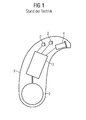
- the amplifier is usually integrated in a signal processing unit. This basic structure is in FIG. 1 shown using the example of a behind-the-ear hearing aid. In a hearing aid housing 1 for carrying behind the ear, one or more microphones 2 for receiving the sound from the environment are installed.
- a signal processing unit 3 which is also integrated in the hearing aid housing 1, processes the microphone signals and amplifies them.
- the output signal of the signal processing unit 3 is transmitted to a loudspeaker or listener 4, the one emits acoustic signal.
- the sound is optionally transmitted via a sound tube, which is fixed with an earmold in the ear canal, to the eardrum of the device carrier.
- the power supply of the hearing device and in particular the signal processing unit 3 is effected by a likewise integrated into the hearing aid housing 1 battery. 5
- the noise power can be estimated in principle by two approaches. Both methods can take place either broadband or preferably in a frequency domain decomposition by means of filter bank or short-time Fourier transformation:
- the complete (time-varying) input signal power is regarded as noise. If speech activity is detected, the noise estimate is kept constant at the value estimated prior to the onset of speech activity.
- the voice signal power in individual frequency ranges is almost always close to zero in the short term. If a mixture of speech and comparatively slowly time-varying noise is now the basis, the minima of the time-considered spectral signal power correspond to the noise power at these times.
- the interference signal power must lie between the detected minimums ("minimum tracking"). Such minimum tracking can be carried out, for example, with the aid of a smoothing filter, which can be used, for example, in R. Martin, "Noise power spectral density estimation based on optimal smoothing and minimum statistics", IEEE Trans. Speech Audio Processing, Vol. 9, No. 5, July 2001, pages 504-512 is described.
- the determination of the noise power is typically done separately for different frequency ranges of the input signal. For this purpose, the input signal is first split into individual frequency components by means of a filter bank or a Fourier transformation. These components are then processed separately.
- the object of the present invention is now to provide a further method and a hearing aid for improved noise suppression, in particular speech is less attacked and disturbing artifacts are effectively avoided.
- the stated object is achieved by the method of independent claim 1 and the hearing aid of independent claim 6.
- the input signal can be obtained from an acoustic signal recorded by a hearing aid.
- the advantage of processing in the cepstral range is that coefficients that are predominantly dominated by speech can be robustly determined. This allows the other coefficients to be assigned to the noise / noise.
- speech can be decomposed into the transfer function of the vocal tract and the excitation function.
- the information about the transfer function of the vocal tract is based on the lower cepstral coefficients.
- the information about the excitation function will essentially be found in a cepstral maximum in the upper cepstral area.
- the knowledge of the cepstral coefficients dominated by speech can be used as a priori knowledge for a robust noise reduction or for the reconstruction of a natural sounding residual noise. In particular, in the case of transient noises, an improved estimation and thus an improved auditory quality is possible.
- the invention also provides a hearing aid with noise suppression according to a method according to the invention. It comprises a signal processing unit with a noise power estimator, a voice power estimator and a first and / or second replacement unit for modifying cepstral coefficients.
- the invention also claims a computer program product with a computer program which has software means for carrying out a method according to the invention when the computer program is executed in a hearing device according to the invention.
- the lower cepstral coefficients contain the information about the envelope of the speech signal, and thus also about the formants important for the intelligibility. Formants are maxima of the spectral envelopes resulting from resonances of the vocal tract. In voiced sounds, maxima are found in the spectrum at multiples of the basic speech frequency. These maxima are essentially mapped to a strong maximum in the cepstrum.
- the lower cepstral coefficients and a maximum in the upper cepstral range contain the information about speech, while the remaining cepstral coefficients are most likely not from speech.
- the output signals of spectral noise reduction algorithms contain partly unnatural artifacts, for example, peaks in the spectral range which lead to the so-called "musical noise". These local spectral maxima change the fine structure of the spectrum, which is reflected in the upper cepstral bins. Since it is known in the cepstral area which coefficients are not likely to originate from the language, this information can be used to avoid spectral outliers in the output signal. For this purpose, the cepstral coefficients of certain parameters of the noise reduction algorithm are modified. For example, the modification can be done by replacing the cepstral coefficients that are most likely non-speech by the corresponding coefficients of the noisy signal.
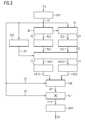
- FIG. 2 illustrated flowchart of the method according to the invention for noise suppression could be implemented for example in a signal processing unit of a hearing aid.
- an electrical signal S which has been obtained, for example, from an acoustic ambient signal, enters the signal processing unit.
- the input signal S is first subjected to a discrete Fourier transformation DFT, which decomposes the input signal S into its spectral components with the spectral coefficients LS.
- DFT discrete Fourier transformation
- the cepstrings of the estimated noise power and voice power are formed by means of inverse Fourier transformation SCR, SCS of the logarithmic magnitude spectrum.
- SCR inverse Fourier transformation
- SCS inverse Fourier transformation
- the cepstral coefficients RLC, SLC are determined.
- the cepstrum with the cepstral coefficients LSC is likewise determined from the spectrum of the input signal LS.
- cepstres RLC, SLC, LSC are evaluated in the context of a first replacement strategy ES1 and used for a modification of the cepstral coefficients RLC, SLC noise power or the voice performance such that the best possible noise suppression of the input signal S and high naturalness of the output signal SR or aSR can be achieved.
- the first replacement strategy ES1 the modified cepstral coefficients mRLS, mSLS of the noise power and the voice power are determined.
- the weighting factors GF for the weighting of the spectral coefficients LS of the input signal are determined from the modified spectra mRLS, mSLS of the noise power and the voice power taking into account the spectrum LS of the input signal.
- the spectrum LS of the input signal is multiplied by the weighting factors.
- the modified spectral coefficients mLS formed thereby are subsequently converted into an interference-reduced output signal SR by an inverse discrete Fourier transformation.
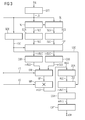
- FIG. 3 the sequence of a further embodiment of the method according to the invention is shown. Until the generation of modified spectral coefficients mLS from an input signal S, the method is identical to that in FIG. 2 described.
- the cepstrum with the cepstral coefficients ALS is formed from the noise-reduced spectrum mLS by means of inverse Fourier transformation SCA of the logarithmic magnitude spectrum.
- SCA inverse Fourier transformation
- modified cepstral coefficients mALC of the noise-reduced output signal mLS are generated.
- a spectrum formation CSA is used to determine modified spectral coefficients mALS, which are then converted by an inverse discrete Fourier transformation IDFT into an artefact-reduced output signal aSR.
- the illustrated method steps can be implemented according to the invention in a digital signal processor of a hearing aid.
- This allows a high naturalness of an amplified sound signal with simultaneous noise suppression be achieved.
- the cepstral modification translates the fine structures present in the original, noisy signal into the enhanced output signal and / or voice power estimate and / or noise power estimation so that increased naturalness is achieved and / or non-stationary sounds are better mapped , Being able to appreciate rapidly changing sounds makes this process extremely interesting.
- Previously known methods only achieve a reduction of the spectral fluctuations, but at the same time reduce the temporal fine structure.
Landscapes
- Engineering & Computer Science (AREA)
- Health & Medical Sciences (AREA)
- Signal Processing (AREA)
- Acoustics & Sound (AREA)
- Physics & Mathematics (AREA)
- Computational Linguistics (AREA)
- Otolaryngology (AREA)
- Neurosurgery (AREA)
- General Health & Medical Sciences (AREA)
- Quality & Reliability (AREA)
- Audiology, Speech & Language Pathology (AREA)
- Human Computer Interaction (AREA)
- Multimedia (AREA)
- Soundproofing, Sound Blocking, And Sound Damping (AREA)
- Noise Elimination (AREA)
- Compression, Expansion, Code Conversion, And Decoders (AREA)
- Circuit For Audible Band Transducer (AREA)
Applications Claiming Priority (1)
| Application Number | Priority Date | Filing Date | Title |
|---|---|---|---|
| DE102008031150A DE102008031150B3 (de) | 2008-07-01 | 2008-07-01 | Verfahren zur Störgeräuschunterdrückung und zugehöriges Hörgerät |
Publications (2)
| Publication Number | Publication Date |
|---|---|
| EP2141941A2 true EP2141941A2 (fr) | 2010-01-06 |
| EP2141941A3 EP2141941A3 (fr) | 2014-01-01 |
Family
ID=41164008
Family Applications (1)
| Application Number | Title | Priority Date | Filing Date |
|---|---|---|---|
| EP09159848.2A Withdrawn EP2141941A3 (fr) | 2008-07-01 | 2009-05-11 | Procédé d'élimination de bruits parasites et appareil auditif correspondant |
Country Status (3)
| Country | Link |
|---|---|
| US (1) | US20090257609A1 (fr) |
| EP (1) | EP2141941A3 (fr) |
| DE (1) | DE102008031150B3 (fr) |
Cited By (1)
| Publication number | Priority date | Publication date | Assignee | Title |
|---|---|---|---|---|
| CN102930870A (zh) * | 2012-09-27 | 2013-02-13 | 福州大学 | 利用抗噪幂归一化倒谱系数的鸟类声音识别方法 |
Families Citing this family (10)
| Publication number | Priority date | Publication date | Assignee | Title |
|---|---|---|---|---|
| KR100661313B1 (ko) * | 2003-12-03 | 2006-12-27 | 한국전자통신연구원 | 평생 번호를 사용한 이동성 제공이 가능한 sip 기반의멀티미디어 통신 시스템 및 이동성 제공 방법 |
| US9838784B2 (en) | 2009-12-02 | 2017-12-05 | Knowles Electronics, Llc | Directional audio capture |
| US8880396B1 (en) * | 2010-04-28 | 2014-11-04 | Audience, Inc. | Spectrum reconstruction for automatic speech recognition |
| US9536540B2 (en) | 2013-07-19 | 2017-01-03 | Knowles Electronics, Llc | Speech signal separation and synthesis based on auditory scene analysis and speech modeling |
| WO2016040885A1 (fr) | 2014-09-12 | 2016-03-17 | Audience, Inc. | Systèmes et procédés pour la restauration de composants vocaux |
| US9820042B1 (en) | 2016-05-02 | 2017-11-14 | Knowles Electronics, Llc | Stereo separation and directional suppression with omni-directional microphones |
| EP3582514B1 (fr) * | 2018-06-14 | 2023-01-11 | Oticon A/s | Appareil de traitement de sons |
| US20220417677A1 (en) * | 2021-06-24 | 2022-12-29 | Orcam Technologies Ltd. | Audio feedback for correcting sound degradation |
| CN115134731A (zh) * | 2022-04-18 | 2022-09-30 | 蒲琳琳 | 基于频率特征的智能助听器及算法 |
| CN116741201A (zh) * | 2023-06-27 | 2023-09-12 | 百瑞互联集成电路(上海)有限公司 | 音频接收端的啸叫检测方法、系统、解码方法及解码器 |
Family Cites Families (5)
| Publication number | Priority date | Publication date | Assignee | Title |
|---|---|---|---|---|
| US6990447B2 (en) * | 2001-11-15 | 2006-01-24 | Microsoft Corportion | Method and apparatus for denoising and deverberation using variational inference and strong speech models |
| US20030187637A1 (en) * | 2002-03-29 | 2003-10-02 | At&T | Automatic feature compensation based on decomposition of speech and noise |
| US7013272B2 (en) * | 2002-08-14 | 2006-03-14 | Motorola, Inc. | Amplitude masking of spectra for speech recognition method and apparatus |
| DE602004008973T2 (de) * | 2004-05-14 | 2008-05-15 | Loquendo-Società per Azioni | Rauschminderung für die automatische spracherkennung |
| WO2008083315A2 (fr) * | 2006-12-31 | 2008-07-10 | Personics Holdings Inc. | Procédé et dispositif configuré pour la détection de signature sonore |
-
2008
- 2008-07-01 DE DE102008031150A patent/DE102008031150B3/de not_active Expired - Fee Related
-
2009
- 2009-05-11 EP EP09159848.2A patent/EP2141941A3/fr not_active Withdrawn
- 2009-06-23 US US12/489,910 patent/US20090257609A1/en not_active Abandoned
Non-Patent Citations (2)
| Title |
|---|
| C. BREITHAUPT ET AL.: "Cepstral Smooting of Spectral Filter Gains for Speech Enhancement Without Musical Noise", IEEE SIGNAL PROCESSING LETTERS, vol. 14, no. 12, December 2007 (2007-12-01), pages 1036 - 1039 |
| R. MARTIN: "Noise power spectral density estimation based on optimal smoothing and minimum statistics", IEEE TRANS. SPEECH AUDIO PROCESSING, vol. 9, no. 5, July 2001 (2001-07-01), pages 504 - 512 |
Cited By (2)
| Publication number | Priority date | Publication date | Assignee | Title |
|---|---|---|---|---|
| CN102930870A (zh) * | 2012-09-27 | 2013-02-13 | 福州大学 | 利用抗噪幂归一化倒谱系数的鸟类声音识别方法 |
| CN102930870B (zh) * | 2012-09-27 | 2014-04-09 | 福州大学 | 利用抗噪幂归一化倒谱系数的鸟类声音识别方法 |
Also Published As
| Publication number | Publication date |
|---|---|
| EP2141941A3 (fr) | 2014-01-01 |
| DE102008031150B3 (de) | 2009-11-19 |
| US20090257609A1 (en) | 2009-10-15 |
Similar Documents
| Publication | Publication Date | Title |
|---|---|---|
| DE102008031150B3 (de) | Verfahren zur Störgeräuschunterdrückung und zugehöriges Hörgerät | |
| DE602004004242T2 (de) | System und Verfahren zur Verbesserung eines Audiosignals | |
| DE10041512B4 (de) | Verfahren und Vorrichtung zur künstlichen Erweiterung der Bandbreite von Sprachsignalen | |
| EP2249587A2 (fr) | Transposition en fréquence par réajustement à haute fréquence de l'enveloppe spectrale pour prothèses auditives | |
| EP2405673B1 (fr) | Procédé de localisation d'un source audio et système auditif à plusieurs canaux | |
| EP2109329A2 (fr) | Procédé d'évaluation en plusieurs étapes destiné à la réduction des bruits parasites et dispositif auditif | |
| WO2011110239A1 (fr) | Suppression de la réverbération de signaux d'un dispositif auditif biauriculaire | |
| DE60033039T2 (de) | Vorrichtung und verfahren zur unterdrückung von zischlauten unter verwendung von adaptiven filteralgorithmen | |
| EP2495724B1 (fr) | Procédé et dispositif destinés à l'évaluation d'un bruit parasite | |
| EP2584795B1 (fr) | Procédé de détermination d'une ligne caractéristique de compression | |
| EP2675191A2 (fr) | Translation de fréquence dans des dispositifs d'assistance auditive par synthèse spectrale additive | |
| WO2001047335A2 (fr) | Procede pour eliminer des composantes de signaux parasites dans un signal d'entree d'un systeme auditif, mise en oeuvre dudit procede et appareil auditif | |
| EP1912470A2 (fr) | Procédé pour la compression dynamique d'un signal audio et appareil auditif correspondant | |
| EP1926087A1 (fr) | Adaptation d'un dispositif auditif à un signal vocal | |
| EP2394271B1 (fr) | Procédé de séparation de cheminements de signaux et application de ce procédé pour améliorer la qualité de la voix d'un larynx électronique | |
| EP2219389B1 (fr) | Dispositif et procédé d'estimation des bruits parasites dans l'arrivée d'un appareil auditif binauréal | |
| CN111009259A (zh) | 一种音频处理方法和装置 | |
| DE102011006472B4 (de) | Verfahren zur Verbesserung der Sprachverständlichkeit mit einem Hörhilfegerät sowie Hörhilfegerät | |
| DE102024205064B4 (de) | Verfahren zum Betreiben eines Hörgeräts | |
| EP3961624B1 (fr) | Procédé de fonctionnement d'un dispositif auditif en fonction d'un signal vocal | |
| EP3962115B1 (fr) | Procédé d'évaluation de la qualité de parole d'un signal vocal au moyen d'un dispositif auditif | |
| EP3048813B1 (fr) | Procédé et dispositif de suppression du bruit basée sur l'inter-corrélation de bandes secondaires | |
| EP2622879B1 (fr) | Procédé et dispositif de compression de fréquence | |
| Li et al. | Integrating Spectrotemporal Context into Features Based on Auditory Perception for Classification-based Speech Separation | |
| DE102020210918A1 (de) | Verfahren zum Betrieb einer Hörvorrichtung in Abhängigkeit eines Sprachsignals |
Legal Events
| Date | Code | Title | Description |
|---|---|---|---|
| PUAI | Public reference made under article 153(3) epc to a published international application that has entered the european phase |
Free format text: ORIGINAL CODE: 0009012 |
|
| AK | Designated contracting states |
Kind code of ref document: A2 Designated state(s): AT BE BG CH CY CZ DE DK EE ES FI FR GB GR HR HU IE IS IT LI LT LU LV MC MK MT NL NO PL PT RO SE SI SK TR |
|
| PUAL | Search report despatched |
Free format text: ORIGINAL CODE: 0009013 |
|
| AK | Designated contracting states |
Kind code of ref document: A3 Designated state(s): AT BE BG CH CY CZ DE DK EE ES FI FR GB GR HR HU IE IS IT LI LT LU LV MC MK MT NL NO PL PT RO SE SI SK TR |
|
| AX | Request for extension of the european patent |
Extension state: AL BA RS |
|
| STAA | Information on the status of an ep patent application or granted ep patent |
Free format text: STATUS: THE APPLICATION IS DEEMED TO BE WITHDRAWN |
|
| 18D | Application deemed to be withdrawn |
Effective date: 20131203 |