EP2144277A2 - Transistor de SiC doté d'une grille isolée - Google Patents
Transistor de SiC doté d'une grille isolée Download PDFInfo
- Publication number
- EP2144277A2 EP2144277A2 EP09174562A EP09174562A EP2144277A2 EP 2144277 A2 EP2144277 A2 EP 2144277A2 EP 09174562 A EP09174562 A EP 09174562A EP 09174562 A EP09174562 A EP 09174562A EP 2144277 A2 EP2144277 A2 EP 2144277A2
- Authority
- EP
- European Patent Office
- Prior art keywords
- layer
- transistor
- type
- buried
- regions
- Prior art date
- Legal status (The legal status is an assumption and is not a legal conclusion. Google has not performed a legal analysis and makes no representation as to the accuracy of the status listed.)
- Withdrawn
Links
Images



Classifications
-
- H—ELECTRICITY
- H10—SEMICONDUCTOR DEVICES; ELECTRIC SOLID-STATE DEVICES NOT OTHERWISE PROVIDED FOR
- H10D—INORGANIC ELECTRIC SEMICONDUCTOR DEVICES
- H10D30/00—Field-effect transistors [FET]
- H10D30/60—Insulated-gate field-effect transistors [IGFET]
- H10D30/64—Double-diffused metal-oxide semiconductor [DMOS] FETs
- H10D30/66—Vertical DMOS [VDMOS] FETs
-
- H—ELECTRICITY
- H10—SEMICONDUCTOR DEVICES; ELECTRIC SOLID-STATE DEVICES NOT OTHERWISE PROVIDED FOR
- H10D—INORGANIC ELECTRIC SEMICONDUCTOR DEVICES
- H10D12/00—Bipolar devices controlled by the field effect, e.g. insulated-gate bipolar transistors [IGBT]
- H10D12/01—Manufacture or treatment
- H10D12/031—Manufacture or treatment of IGBTs
-
- H—ELECTRICITY
- H10—SEMICONDUCTOR DEVICES; ELECTRIC SOLID-STATE DEVICES NOT OTHERWISE PROVIDED FOR
- H10D—INORGANIC ELECTRIC SEMICONDUCTOR DEVICES
- H10D12/00—Bipolar devices controlled by the field effect, e.g. insulated-gate bipolar transistors [IGBT]
- H10D12/411—Insulated-gate bipolar transistors [IGBT]
- H10D12/441—Vertical IGBTs
-
- H—ELECTRICITY
- H10—SEMICONDUCTOR DEVICES; ELECTRIC SOLID-STATE DEVICES NOT OTHERWISE PROVIDED FOR
- H10D—INORGANIC ELECTRIC SEMICONDUCTOR DEVICES
- H10D30/00—Field-effect transistors [FET]
- H10D30/01—Manufacture or treatment
- H10D30/021—Manufacture or treatment of FETs having insulated gates [IGFET]
- H10D30/028—Manufacture or treatment of FETs having insulated gates [IGFET] of double-diffused metal oxide semiconductor [DMOS] FETs
- H10D30/0291—Manufacture or treatment of FETs having insulated gates [IGFET] of double-diffused metal oxide semiconductor [DMOS] FETs of vertical DMOS [VDMOS] FETs
-
- H—ELECTRICITY
- H10—SEMICONDUCTOR DEVICES; ELECTRIC SOLID-STATE DEVICES NOT OTHERWISE PROVIDED FOR
- H10D—INORGANIC ELECTRIC SEMICONDUCTOR DEVICES
- H10D30/00—Field-effect transistors [FET]
- H10D30/60—Insulated-gate field-effect transistors [IGFET]
- H10D30/64—Double-diffused metal-oxide semiconductor [DMOS] FETs
- H10D30/66—Vertical DMOS [VDMOS] FETs
- H10D30/668—Vertical DMOS [VDMOS] FETs having trench gate electrodes, e.g. UMOS transistors
-
- H—ELECTRICITY
- H10—SEMICONDUCTOR DEVICES; ELECTRIC SOLID-STATE DEVICES NOT OTHERWISE PROVIDED FOR
- H10D—INORGANIC ELECTRIC SEMICONDUCTOR DEVICES
- H10D62/00—Semiconductor bodies, or regions thereof, of devices having potential barriers
- H10D62/10—Shapes, relative sizes or dispositions of the regions of the semiconductor bodies; Shapes of the semiconductor bodies
- H10D62/102—Constructional design considerations for preventing surface leakage or controlling electric field concentration
- H10D62/103—Constructional design considerations for preventing surface leakage or controlling electric field concentration for increasing or controlling the breakdown voltage of reverse-biased devices
- H10D62/105—Constructional design considerations for preventing surface leakage or controlling electric field concentration for increasing or controlling the breakdown voltage of reverse-biased devices by having particular doping profiles, shapes or arrangements of PN junctions; by having supplementary regions, e.g. junction termination extension [JTE]
- H10D62/106—Constructional design considerations for preventing surface leakage or controlling electric field concentration for increasing or controlling the breakdown voltage of reverse-biased devices by having particular doping profiles, shapes or arrangements of PN junctions; by having supplementary regions, e.g. junction termination extension [JTE] having supplementary regions doped oppositely to or in rectifying contact with regions of the semiconductor bodies, e.g. guard rings with PN or Schottky junctions
- H10D62/107—Buried supplementary regions, e.g. buried guard rings
-
- H—ELECTRICITY
- H10—SEMICONDUCTOR DEVICES; ELECTRIC SOLID-STATE DEVICES NOT OTHERWISE PROVIDED FOR
- H10D—INORGANIC ELECTRIC SEMICONDUCTOR DEVICES
- H10D62/00—Semiconductor bodies, or regions thereof, of devices having potential barriers
- H10D62/10—Shapes, relative sizes or dispositions of the regions of the semiconductor bodies; Shapes of the semiconductor bodies
- H10D62/102—Constructional design considerations for preventing surface leakage or controlling electric field concentration
- H10D62/103—Constructional design considerations for preventing surface leakage or controlling electric field concentration for increasing or controlling the breakdown voltage of reverse-biased devices
- H10D62/105—Constructional design considerations for preventing surface leakage or controlling electric field concentration for increasing or controlling the breakdown voltage of reverse-biased devices by having particular doping profiles, shapes or arrangements of PN junctions; by having supplementary regions, e.g. junction termination extension [JTE]
- H10D62/109—Reduced surface field [RESURF] PN junction structures
- H10D62/111—Multiple RESURF structures, e.g. double RESURF or 3D-RESURF structures
-
- H—ELECTRICITY
- H10—SEMICONDUCTOR DEVICES; ELECTRIC SOLID-STATE DEVICES NOT OTHERWISE PROVIDED FOR
- H10D—INORGANIC ELECTRIC SEMICONDUCTOR DEVICES
- H10D62/00—Semiconductor bodies, or regions thereof, of devices having potential barriers
- H10D62/80—Semiconductor bodies, or regions thereof, of devices having potential barriers characterised by the materials
- H10D62/83—Semiconductor bodies, or regions thereof, of devices having potential barriers characterised by the materials being Group IV materials, e.g. B-doped Si or undoped Ge
- H10D62/832—Semiconductor bodies, or regions thereof, of devices having potential barriers characterised by the materials being Group IV materials, e.g. B-doped Si or undoped Ge being Group IV materials comprising two or more elements, e.g. SiGe
- H10D62/8325—Silicon carbide
Definitions
- the present invention relates to a semiconductor device of SiC comprising three terminals such that a high voltage can be maintained between two of said terminals in a blocking state of the device, said third terminal being used as a controlling electrode such that the device has a transistor action and being of the insulated gate type as well as a transistor of SiC having an insulated gate according to the preamble of the appended independent claim directed thereto.
- the dielectric constant in SiO 2 is lower than in SiC, which means that the electric field will be higher in SiO 2 according to the inverse ratio of the dielectric constant.
- a low field in the SiO 2 layer is, however, beneficial to the long term stability and reliability of the insulating layer.
- the corresponding field in SiO 2 would be >5MV/cm which is generally accepted as too high for stable device operation. Accordingly, it is necessary for protecting the insulating layer to restrict the maximum electric field in the SiC layers close to the insulating layers to a much lower level than SiC allows according to the dielectric strength of the oxide.
- the object of the present invention is to provide a semiconductor device of SiC and a transistor of SiC having an insulated gate defined in the introduction, which make it possible to better benefit from the superior property of SiC with respect to Si to withstand high electric fields in a blocking state of the device than such devices already known.
- This object is according to the present invention obtained by providing a semiconductor device of SiC comprising two parts each comprising one or more semiconductor layers of SiC and connected in series between said connections, namely a sub-semiconductor device able to withstand only low voltages in the blocking state thereof and a voltage-limiting part able to withstand high voltages in the blocking state of the device and adapted to protect said sub-semiconductor device by taking a major part of the voltage over the device in the blocking state thereof.
- a semiconductor device being able to withstand high voltages in the blocking state thereof is in this way obtained, but the electric field is in the blocking state of the device kept at a low level in said sub-semiconductor device, so that insulating layers for passivation and especially possibly such ones for insulating a gate are protected.
- said voltage-limiting part of the device comprises at least one region of a first conductivity type buried in a layer of an opposite second conductivity type at a distance below said sub-semiconductor device.
- a buried region will result in a reduced electric field in said sub-semiconductor device, which means that insulating layers located therein may be better protected and that also channel region layers, when such exist, which normally will see the maximum field may now be given a lower doping concentration and/or be made thinner for reducing the on-state resistance of such a device.
- the device comprises more than one said buried region laterally spaced and forming a grid adapted to form a continuous layer of said first conductivity type in the blocking state of the device and by that a pn-junction at a distance from said sub-semiconductor device taking a major part of the voltage over the device in a blocking state thereof.
- a buried grid structure will act as a potential divider and thereby allows the field in the region above the grid to be controlled. Accordingly, the major voltage over such a device in the blocking state thereof and by that the high electric field will be taken away from said sub-semiconductor device and insulating layers thereof will by that be protected.
- the object of the present invention is also obtained by providing a transistor of SiC having an insulated gate defined in the introduction with at least one p-type additional region buried in the drift layer at a distance below said p-type channel region layer and adapted to reduce the electric field to be taken by the channel region layer in the blocking state of the transistor. Thanks to the fact that such a buried region will reduce the electric field to be taken by the channel region layer this may be given a lower doping concentration and/or be made thinner, which will result in a higher mobility due to a lower threshold voltage for forming said inversion channel and a lower on-state resistance of a channel region layer. The reduced electric field at the channel region layer will also result in a lower electric field in the gate insulating layer, so that a higher total voltage may be held by the device before this insulating layer is destroyed.
- said transistor comprises more than one said buried regions laterally spaced and forming a grid adapted to form a continuous p-type layer in the blocking state of the transistor and by that a pn-junction at a distance below said p-type channel region layer taking a major part of the voltage drop over the transistor in a blocking state thereof.
- the highest electric field of the device in the blocking state thereof will be at said pn-junction deep in the drift layer and the electric field will be much lower close to the channel region layer, which in a conventional design of a MISFET or and IGBT would see the maximum field.
- the gate insulating layer will only experience a low electric field in spite of a high voltage drop over the entire device. This also means that less charge will be needed in the channel region layer for holding a voltage applied thereon, which results in a lower threshold voltage and a higher mobility in the inversion channel.
- the transistor comprises more than one said active region laterally spaced with respect to each other and arranged with a fixed pitch, and said pitch and the spacing between said additional regions of the buried grid are selected for obtaining a desired on-state resistance and breakdown voltage, respectively, of the transistor.
- This design of a transistor makes it possible to obtain a device having exactly the properties desired in a particular case with respect to on-state resistance and breakdown voltage.
- the pitch By changing the pitch the on-state resistance and the saturation current density of the device will be varied.
- the dimension of the grid will be optimized so as to form a trade-off between voltage blocking capability and parasitic contribution of a grid to on-state losses.
- the transistor has the insulating layer arranged on top of the channel region layer and the gate electrode on top thereof for forming a lateral conducting inversion channel between the source region layer and the drift layer.
- a transistor having such an active region has turned out to be very advantageous and the channel region layer may especially be made as thin as possible thanks to the low electric field there in the blocking state of the device resulting in a low on-state resistance of the transistor.
- said buried region is highly doped. This will result in a concentration of the electric field in the blocking state of the device to this buried region, and especially in the case of a buried grid this means that the pn-junction formed thereby in the blocking state of the device will take the major part of the voltage over the device.
- the channel region layer is low doped, and it has preferably a doping concentration between 10 16 and 5 x 10 17 cm -3 , which means a comparatively low threshold voltage for forming a conducting inversion channel therein and by that a high mobility in said channel and a reduction of the electric field over the gate dielectric.
- the channel region layer is thin as seen in the direction of said channel resulting in a short inversion channel therein, and the length of said channel is preferably less than 1 ⁇ m.
- a short channel is made possible by the reduction of the electric field in this part of the transistor in the blocking state thereof, which means a reduction of the on-state resistance of the transistor.
- MISFET made of SiC according to a first preferred embodiment of the invention is illustrated in Fig 1 .
- MISFET structure 1 Metal-Insulating layer Semiconductor Field Effect Transistor
- JFET Junction Field Effect Transistor
- the lower part 2 may be produced by utilizing a method described in the US patent application 08/636 969 , and the upper part is subsequently produced on top of the lower part by utilizing a method described in the US patent application 08/678 548 of the assignee of the present application.
- the present invention describes how here two concepts may be combined in a new device that can be optimised using the independent parameters defined by the aforementioned applications. How the production of the preferred device illustrated in Fig 1 will be accomplished will now be explained while referring to Fig 2-10 . It is emphasized that the method for producing the transistor shown in Fig 1 also comprises several masking and demasking steps as well as annealing steps after implantation, which, however, have nothing to do with the invention, and they will not be further described here.
- n-type substrate 3 First of all a highly doped n-type substrate 3 is taken and a low-doped n-type drift layer 4 of SiC is epitaxially grown thereon, preferably by Chemical Vapour Deposition. Any suitable donor, such as nitrogen or phosphorus, may be used for obtaining the doping of these layers. Typical doping concentrations may be 10 15 - 10 16 cm -3 and 10 18 - 10 20 cm -3 for the drift layer and the substrate layer, respectively. After masking and patterning the mask impurity dopants of p-type are implanted into the drift layer 4 by using a high acceleration energy, so that a grid 5 formed by a number of laterally spaced regions 6 is produced.
- a high acceleration energy After masking and patterning the mask impurity dopants of p-type are implanted into the drift layer 4 by using a high acceleration energy, so that a grid 5 formed by a number of laterally spaced regions 6 is produced.
- These p-type regions 6 have a high doping concentration, typically 10 19 - 10 20 cm -3 .
- the dopants of the regions 6 are then made electrically active by annealing these regions at a high temperature.
- a n-type low doped layer 7 of SiC is epitaxially grown on top of the layer 4 by Chemical Vapour Deposition.
- the layers 4 and 7 form in practice together a drift layer of a transistor being manufactured in this way, and a grid 5 buried deep into the drift layer may in this way easily be achieved by this regrowth technique.
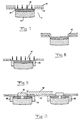
- Fig 4-6 illustrates another way of obtaining the structure shown in Fig. 3 .
- a low doped n-type drift layer part 4 is epitaxially grown on the substrate 3, and a highly doped p-type layer 6' is after that epitaxially grown onto the layer 4.
- the layer 6' is after that patterned, for instance by reactive ion etching, for forming n-type regions 6 with a certain spacing therebetween.
- a regrowth of a low doped n-type drift layer 7 on top of the patterned structure is after that carried out.
- the MOSFET- or MISFET-part of the device is produced according to Fig 7-10 .
- a layer 8 of silicon being polycrystalline or amorphous is applied on top of the drift layer part 7.
- a further layer 9 of a masking material, such as a metal is applied.
- n-dopants are implanted into a surface-near layer 11, so that this will get a high doping concentration.
- p-dopants are also implanted, but while using higher acceleration energies, so as to form a deep base layer 12 with a high concentration of acceptors.
- a surface layer 13 of a certain thickness of the silicon layer 8 is then oxidized at high temperature, so that a layer 13 of oxide (SiO 2 ) is formed.
- the oxidized surface layer 13 is then removed by wet etching, and after that dopants of p-type are implanted into an area of the SiC layer defined by the aperture 14 formed by the removal of the oxidized layer 13 to such a degree that the doping type of said surface-near layer 11 previously created is maintained but the doping type of a second surface-near layer 15 exposed through said removal is changed for forming a p-doped channel region layer with a lateral extension determined by the thickness of the oxidized silicon layer 13.
- a channel region layer with a very short channel, well in the sub-micron region, may in this way be exactly produced in a very simple and reliable manner.
- This channel region layer 15 has preferably a low doping concentration of 10 16 - 5 x 10 17 cm -3 , which will be possible but still obtain a transistor being able to block comparatively high voltages when reversed biased thanks to the potential dividing property of the buried grid structure 5 described more in detail below.
- a source contact 16 is applied on top of the source region layer 11.
- An insulating layer 17, for example of SiO 2 is applied on top of the device for passivation thereof and for insulating a gate contact 18 applied on top thereof and extending laterally at least over the entire lateral extension of each channel region layer 15.
- Fig 7 as well as Fig 1 has been simplified in the sense that no gate contact has been shown for the outermost channel region layers 15', although a gate electrode will in practice also be arranged there.
- the device may also be provided with a much thicker insulating passivation layer on top of the structure shown in Fig 10 .
- the buried regions 6 have a fixed potential, which is normally obtained by shorting them to for instance the source.
- the function of the grid will namely be as follows. In the forward conducting state of the transistor the regions 19 of the drift layer located between adjacent grid regions 6 will be of n-type and enable an electron transport therethrough and by that between the drain 20 and the source 16 of the transistor through a conducting inversion channel formed in the channel region layer by applying a positive voltage on the gate contact 18 between the drift layer and the source region layer 11.
- the spacing s of the grid is defined as the distance between two adjacent buried regions 6 as shown in Fig 1 , and this spacing as well as the doping concentration of the buried regions 6 may be optimized so as to form a trade-off between voltage blocking capability and parasitic contribution of the grid to on-state losses. This will be further discussed with reference to Fig 11 and 12 .
- the transistor has several active regions being arranged with a certain pitch p, and this pitch is defined as the centre-to-centre distance between two adjacent active region structures as shown in Fig 1 .
- the pitch is increasing with the density at which such active regions are arranged.
- the current density J d of a transistor according to Fig 1 is varying by the voltage V DS between the drain and the source of the transistor for two different pitches, namely a small pitch a and a large pitch b.
- the gate voltage and the spacing s are the same for both cases.
- the horizontally dashed lines 22, 23 correspond to the respective saturation current density
- the vertically dashed line 24 indicates a breakdown voltage of the transistor. It is noticed that the saturation current density may be varied by changing the pitch without influencing the value of the breakdown voltage of the transistor. The smaller pitch the higher saturation current density. A smaller pitch also results in a lower on-state resistance of the device defined through the lower part 25 of the curves.
- Fig 12 is a graph similar to that of Fig 11 , but here the pitch and the gate voltage are constant, and the relationship between J d and V DS is shown for a small spacing c and a larger spacing d.
- the pitch is in this case the same as for the curve b in Fig 11 , i.e. large. It is shown that the level of the breakdown voltage may be changed by changing the spacing between the buried regions of the grid without changing the saturation current density of the transistor. It also appears from Fig 12 that the on-state resistance of the transistor will be influenced by the spacing and be higher at smaller spacings (c).
- a transistor of this type it will be possible to independently determine the saturation current density by varying the pitch p and the breakdown voltage by varying the spacing of the grid.
- These properties may of course also be influenced by the doping concentration and the thickness of the different layers of the device, but when these are constant the saturation current density and the breakdown voltage are depending on the pitch and the spacing as shown in Fig 11 and 12 . It is emphasized that it is not always a wish to have a saturation current density being as high as possible, since one may want to limit the current in case of a failure, such as a short-circuit, and it is important to stay within the SOA (Safe Operation Area) of the device. Typical dimensions for the pitch and spacing are 10-100 ⁇ m and 1-10 ⁇ m, respectively.
- a device in the form of a MOSFET according to a second preferred embodiment of the invention is shown in Fig 13 .
- Layers corresponding to layers present in the device according to Fig 1 are given the same reference numerals and will not be discussed further here.
- the gate electrode 18 is here arranged in a trench and the insulating layer 17 separating it from the channel region layer 15 is arranged on the trench wall, so that a substantially vertical conducting inversion channel may be formed in the channel region layer at the interface between the insulating layer 17 and the channel region layer 15.
- a further trench 26 is provided laterally to the trench having the gate 18, and a highly doped p-type region 27 is buried in the drift layer below this trench and connected to the source contact 16.
- This buried layer 27 will in the blocking state of the device bend the electric field lines to this and by that away from the insulating layer 17 and the channel region layer 15, so that this insulating layer 17 will be protected and the channel region layer may have a lower doping concentration and still not be totally depleted in said blocking state, so that the on-state resistance of the inversion channel will be lower.
- the buried layer 27 is connected to a highly doped p-type region 28 located in the bottom and the walls of the trench and obtained by ion implantation.
- the buried region 27 is preferably obtained in the same way as the buried regions 6 in the structure according to Fig 1 by a combination of implantation and regrowth.
- the embodiment according to Fig 14 differs from that according to Fig 13 by the fact that the buried region 27 extends all the way to the trench 26, so that no implantation into the bottom of the trench was necessary for making a contact to the buried region. Accordingly, the comparatively deep location of the lower limit of the buried region is here obtained by implantation, regrowth and then implantation again and then regrowth for forming the layer out of which the channel region layer and source region layer may be formed.
- the base layer in a transistor according to Fig 1 has not to be highly doped, but it may be moderately doped, for instance having a doping concentration of 10 18 - 10 19 cm -3 .
- the substrate layer of p-type for obtaining a bipolar device, such as an IGBT. It will then be preferred to have a highly doped n-type buffer layer between the substrate layer and the drift layer.
- the number of layers mentioned in the claims is a minimum number, and it is within the scope of the invention to arrange further layers in the devices or dividing any layer into several layers by selective doping of different regions thereof.
- Substrate layer is in this disclosure to be interpreted as the layer closest to the drain of the layers mentioned and it has not to be a substrate layer in the strict sense of the word within this field, i.e. the layer from which the growth is started.
- the real substrate layer may be any of the layers and is mostly the thickest one, which may be the drift layer.
- Device of SiC or "transistor of SiC” do not exclude that some parts of the device or transistor are made of another material, such as contacts and insulating layers.
- Transistor refers actually to the entire semiconductor device, which in the case of the invention comprises a low voltage transistor part and a high voltage grid (JFET).
- JFET high voltage grid
Landscapes
- Insulated Gate Type Field-Effect Transistor (AREA)
- Bipolar Transistors (AREA)
Applications Claiming Priority (2)
| Application Number | Priority Date | Filing Date | Title |
|---|---|---|---|
| SE9704149A SE9704149D0 (sv) | 1997-11-13 | 1997-11-13 | A semiconductor device of SiC and a transistor of SiC having an insulated gate |
| EP98956064A EP1029363A2 (fr) | 1997-11-13 | 1998-11-13 | DISPOSITIF SEMICONDUCTEUR AU SiC ET TRANSISTOR SiC A GRILLE ISOLEE |
Related Parent Applications (2)
| Application Number | Title | Priority Date | Filing Date |
|---|---|---|---|
| EP98956064.4 Division | 1998-11-13 | ||
| EP98956064A Division EP1029363A2 (fr) | 1997-11-13 | 1998-11-13 | DISPOSITIF SEMICONDUCTEUR AU SiC ET TRANSISTOR SiC A GRILLE ISOLEE |
Publications (2)
| Publication Number | Publication Date |
|---|---|
| EP2144277A2 true EP2144277A2 (fr) | 2010-01-13 |
| EP2144277A3 EP2144277A3 (fr) | 2010-03-17 |
Family
ID=20408960
Family Applications (2)
| Application Number | Title | Priority Date | Filing Date |
|---|---|---|---|
| EP09174562A Withdrawn EP2144277A3 (fr) | 1997-11-13 | 1998-11-13 | Transistor de SiC doté d'une grille isolée |
| EP98956064A Ceased EP1029363A2 (fr) | 1997-11-13 | 1998-11-13 | DISPOSITIF SEMICONDUCTEUR AU SiC ET TRANSISTOR SiC A GRILLE ISOLEE |
Family Applications After (1)
| Application Number | Title | Priority Date | Filing Date |
|---|---|---|---|
| EP98956064A Ceased EP1029363A2 (fr) | 1997-11-13 | 1998-11-13 | DISPOSITIF SEMICONDUCTEUR AU SiC ET TRANSISTOR SiC A GRILLE ISOLEE |
Country Status (5)
| Country | Link |
|---|---|
| US (1) | US6091108A (fr) |
| EP (2) | EP2144277A3 (fr) |
| JP (2) | JP2001523895A (fr) |
| SE (1) | SE9704149D0 (fr) |
| WO (1) | WO1999026296A2 (fr) |
Cited By (2)
| Publication number | Priority date | Publication date | Assignee | Title |
|---|---|---|---|---|
| CN103247680A (zh) * | 2012-02-13 | 2013-08-14 | 住友电气工业株式会社 | 碳化硅半导体器件和制造碳化硅半导体器件的方法 |
| CN103400860A (zh) * | 2013-08-21 | 2013-11-20 | 东南大学 | 一种高击穿电压的n型纵向碳化硅金属氧化物半导体管 |
Families Citing this family (76)
| Publication number | Priority date | Publication date | Assignee | Title |
|---|---|---|---|---|
| DE19832327A1 (de) * | 1997-07-31 | 1999-02-04 | Siemens Ag | Halbleiterstruktur auf Basis von Silizium-Carbid-Material mit mehreren elektrisch unterschiedlichen Teilgebieten |
| DE19823944A1 (de) * | 1998-05-28 | 1999-12-02 | Siemens Ag | Leistungsdioden-Struktur |
| DE19830332C2 (de) * | 1998-07-07 | 2003-04-17 | Infineon Technologies Ag | Vertikales Halbleiterbauelement mit reduziertem elektrischem Oberflächenfeld |
| US6621121B2 (en) * | 1998-10-26 | 2003-09-16 | Silicon Semiconductor Corporation | Vertical MOSFETs having trench-based gate electrodes within deeper trench-based source electrodes |
| WO2000030177A1 (fr) * | 1998-11-18 | 2000-05-25 | Infineon Technologies Ag | Composant semi-conducteur dote de structures de blindage dielectriques ou semi-isolantes |
| DE19961297A1 (de) | 1999-12-18 | 2001-06-21 | Bosch Gmbh Robert | Schaltungsanordnung zur Verpolsicherung eines DMOS-Transistors |
| FR2803094B1 (fr) * | 1999-12-22 | 2003-07-25 | St Microelectronics Sa | Fabrication de composants unipolaires |
| DE10026925C2 (de) * | 2000-05-30 | 2002-04-18 | Infineon Technologies Ag | Feldeffektgesteuertes, vertikales Halbleiterbauelement |
| FR2816113A1 (fr) * | 2000-10-31 | 2002-05-03 | St Microelectronics Sa | Procede de realisation d'une zone dopee dans du carbure de silicium et application a une diode schottky |
| JP3506676B2 (ja) * | 2001-01-25 | 2004-03-15 | Necエレクトロニクス株式会社 | 半導体装置 |
| US6855998B2 (en) | 2002-03-26 | 2005-02-15 | Kabushiki Kaisha Toshiba | Semiconductor device |
| DE10214176B4 (de) * | 2002-03-28 | 2010-09-02 | Infineon Technologies Ag | Halbleiterbauelement mit einer vergrabenen Stoppzone und Verfahren zur Herstellung einer Stoppzone in einem Halbleiterbauelement |
| DE10243758A1 (de) * | 2002-09-20 | 2004-04-01 | eupec Europäische Gesellschaft für Leistungshalbleiter mbH | Verfahren zur Herstellung einer vergrabenen Stoppzone in einem Halbleiterbauelement und Halbleiterbauelement mit einer vergrabenen Stoppzone |
| US7074643B2 (en) * | 2003-04-24 | 2006-07-11 | Cree, Inc. | Silicon carbide power devices with self-aligned source and well regions and methods of fabricating same |
| JP4204895B2 (ja) * | 2003-05-12 | 2009-01-07 | 三菱電機株式会社 | 半導体装置 |
| EP1790013A1 (fr) * | 2004-08-31 | 2007-05-30 | Freescale Semiconductor, Inc. | Dispositif de puissance a semi-conducteurs |
| FR2876497B1 (fr) * | 2004-10-13 | 2007-03-23 | Commissariat Energie Atomique | Revetement a base de mgo pour l'isolation electrique de substrats semi-conducteurs et procede de fabrication |
| JP4604241B2 (ja) * | 2004-11-18 | 2011-01-05 | 独立行政法人産業技術総合研究所 | 炭化ケイ素mos電界効果トランジスタおよびその製造方法 |
| US7687841B2 (en) * | 2005-08-02 | 2010-03-30 | Micron Technology, Inc. | Scalable high performance carbon nanotube field effect transistor |
| US20070228505A1 (en) | 2006-04-04 | 2007-10-04 | Mazzola Michael S | Junction barrier schottky rectifiers having epitaxially grown p+-n junctions and methods of making |
| JP2008177335A (ja) * | 2007-01-18 | 2008-07-31 | Fuji Electric Device Technology Co Ltd | 炭化珪素絶縁ゲート型半導体装置。 |
| JP5303839B2 (ja) * | 2007-01-29 | 2013-10-02 | 富士電機株式会社 | 絶縁ゲート炭化珪素半導体装置とその製造方法 |
| JP2009064970A (ja) * | 2007-09-06 | 2009-03-26 | Toshiba Corp | 半導体装置 |
| US8421148B2 (en) | 2007-09-14 | 2013-04-16 | Cree, Inc. | Grid-UMOSFET with electric field shielding of gate oxide |
| EP2058854B1 (fr) | 2007-11-07 | 2014-12-03 | Acreo Swedish ICT AB | Dispositif semi-conducteur |
| US7582922B2 (en) * | 2007-11-26 | 2009-09-01 | Infineon Technologies Austria Ag | Semiconductor device |
| US8084813B2 (en) * | 2007-12-03 | 2011-12-27 | Cree, Inc. | Short gate high power MOSFET and method of manufacture |
| JP2009194164A (ja) * | 2008-02-14 | 2009-08-27 | Sumitomo Electric Ind Ltd | 絶縁ゲート型電界効果トランジスタおよびその製造方法 |
| JP5271022B2 (ja) * | 2008-10-01 | 2013-08-21 | 株式会社豊田中央研究所 | 半導体装置 |
| US8476733B2 (en) * | 2009-11-17 | 2013-07-02 | Panasonic Corporation | Semiconductor element and manufacturing method therefor |
| TWI399859B (zh) * | 2009-11-30 | 2013-06-21 | Vanguard Int Semiconduct Corp | 半導體結構及其製造方法 |
| CN102097469B (zh) * | 2009-12-10 | 2013-01-16 | 世界先进积体电路股份有限公司 | 半导体结构及其制造方法 |
| US8154078B2 (en) * | 2010-02-17 | 2012-04-10 | Vanguard International Semiconductor Corporation | Semiconductor structure and fabrication method thereof |
| US8525254B2 (en) * | 2010-08-12 | 2013-09-03 | Infineon Technologies Austria Ag | Silicone carbide trench semiconductor device |
| JP2012069797A (ja) * | 2010-09-24 | 2012-04-05 | Toyota Motor Corp | 絶縁ゲート型トランジスタ |
| US9142662B2 (en) * | 2011-05-06 | 2015-09-22 | Cree, Inc. | Field effect transistor devices with low source resistance |
| US9029945B2 (en) | 2011-05-06 | 2015-05-12 | Cree, Inc. | Field effect transistor devices with low source resistance |
| JP5997426B2 (ja) | 2011-08-19 | 2016-09-28 | 株式会社日立製作所 | 半導体装置および半導体装置の製造方法 |
| WO2013036370A1 (fr) | 2011-09-11 | 2013-03-14 | Cree, Inc. | Module d'alimentation à haute densité de courant comprenant des transistors à topologie améliorée |
| US9373617B2 (en) | 2011-09-11 | 2016-06-21 | Cree, Inc. | High current, low switching loss SiC power module |
| US9640617B2 (en) | 2011-09-11 | 2017-05-02 | Cree, Inc. | High performance power module |
| JP6111673B2 (ja) * | 2012-07-25 | 2017-04-12 | 住友電気工業株式会社 | 炭化珪素半導体装置 |
| DE102013018789B4 (de) * | 2012-11-29 | 2025-03-06 | Infineon Technologies Ag | Steuern lichterzeugter Ladungsträger |
| KR20140085141A (ko) * | 2012-12-27 | 2014-07-07 | 현대자동차주식회사 | 반도체 소자 및 그 제조 방법 |
| KR101360070B1 (ko) | 2012-12-27 | 2014-02-12 | 현대자동차 주식회사 | 반도체 소자 및 그 제조 방법 |
| JP5958352B2 (ja) | 2013-01-15 | 2016-07-27 | 住友電気工業株式会社 | 炭化珪素半導体装置およびその製造方法 |
| JP5983415B2 (ja) * | 2013-01-15 | 2016-08-31 | 住友電気工業株式会社 | 炭化珪素半導体装置 |
| JP6064614B2 (ja) * | 2013-01-21 | 2017-01-25 | 住友電気工業株式会社 | 炭化珪素半導体装置およびその製造方法 |
| JP2014175518A (ja) | 2013-03-11 | 2014-09-22 | Sumitomo Electric Ind Ltd | 炭化珪素半導体装置 |
| US9159799B2 (en) * | 2013-04-19 | 2015-10-13 | Avogy, Inc. | Method of fabricating a merged P-N junction and schottky diode with regrown gallium nitride layer |
| JP2014241368A (ja) * | 2013-06-12 | 2014-12-25 | 住友電気工業株式会社 | 炭化珪素半導体装置 |
| JP6171678B2 (ja) * | 2013-07-26 | 2017-08-02 | 住友電気工業株式会社 | 炭化珪素半導体装置およびその製造方法 |
| US9768259B2 (en) | 2013-07-26 | 2017-09-19 | Cree, Inc. | Controlled ion implantation into silicon carbide using channeling and devices fabricated using controlled ion implantation into silicon carbide using channeling |
| JP6135364B2 (ja) * | 2013-07-26 | 2017-05-31 | 住友電気工業株式会社 | 炭化珪素半導体装置およびその製造方法 |
| JP6178181B2 (ja) * | 2013-09-12 | 2017-08-09 | 株式会社東芝 | 半導体装置及びその製造方法 |
| JP2015060859A (ja) | 2013-09-17 | 2015-03-30 | 住友電気工業株式会社 | 炭化珪素半導体装置および炭化珪素半導体装置の製造方法 |
| EP2889915A1 (fr) * | 2013-12-30 | 2015-07-01 | ABB Technology AG | Dispositif de semi-conducteur de puissance |
| EP2889914A1 (fr) * | 2013-12-30 | 2015-07-01 | ABB Technology AG | Dispositif semi-conducteur bipolaire |
| DE102014200613A1 (de) | 2014-01-15 | 2015-07-16 | Robert Bosch Gmbh | SiC-Trench-Transistor und Verfahren zu dessen Herstellung |
| WO2015111177A1 (fr) * | 2014-01-24 | 2015-07-30 | 株式会社日立製作所 | Dispositif à semi-conducteur, module de puissance, dispositif de conversion de puissance et véhicule de chemin de fer |
| JP6229541B2 (ja) * | 2014-02-27 | 2017-11-15 | 住友電気工業株式会社 | ワイドバンドギャップ半導体装置およびその製造方法 |
| US10199465B2 (en) * | 2014-06-24 | 2019-02-05 | General Electric Company | Cellular layout for semiconductor devices |
| CN105390536A (zh) * | 2015-09-30 | 2016-03-09 | 深圳市可易亚半导体科技有限公司 | 绝缘栅双极型晶体管及其制备方法 |
| JP7092129B2 (ja) * | 2017-07-04 | 2022-06-28 | 住友電気工業株式会社 | 炭化珪素半導体装置 |
| SE541402C2 (en) | 2017-09-15 | 2019-09-17 | Ascatron Ab | Integration of a schottky diode with a mosfet |
| SE541466C2 (en) | 2017-09-15 | 2019-10-08 | Ascatron Ab | A concept for silicon carbide power devices |
| SE541290C2 (en) | 2017-09-15 | 2019-06-11 | Ascatron Ab | A method for manufacturing a grid |
| SE541291C2 (en) | 2017-09-15 | 2019-06-11 | Ascatron Ab | Feeder design with high current capability |
| DE102018112109B4 (de) * | 2018-05-18 | 2025-04-30 | Infineon Technologies Ag | Siliziumcarbid halbleiterbauelement |
| SE542607C2 (en) | 2018-06-29 | 2020-06-16 | Ascatron Ab | MOSFET in SiC with self-aligned lateral MOS channel |
| US12206028B2 (en) | 2020-08-21 | 2025-01-21 | Monolithic Power Systems, Inc. | Single sided channel mesa power junction field effect transistor |
| US11545585B2 (en) | 2020-08-21 | 2023-01-03 | Monolithic Power Systems, Inc. | Single sided channel mesa power junction field effect transistor |
| EP4009375B1 (fr) * | 2020-12-03 | 2024-03-06 | Hitachi Energy Ltd | Dispositif à semi-conducteurs de puissance et procédé pour la fabrication de dispositif à semi-conducteurs de puissance |
| JP7531446B2 (ja) * | 2021-04-15 | 2024-08-09 | 三菱電機株式会社 | 炭化珪素半導体装置の製造方法 |
| JP7187620B1 (ja) * | 2021-07-13 | 2022-12-12 | 昭和電工株式会社 | SiCエピタキシャルウェハ及びSiCエピタキシャルウェハの製造方法 |
| US12317559B2 (en) * | 2022-02-01 | 2025-05-27 | Wolfspeed, Inc. | Wide bandgap unipolar/bipolar transistor |
Citations (1)
| Publication number | Priority date | Publication date | Assignee | Title |
|---|---|---|---|---|
| US6037632A (en) * | 1995-11-06 | 2000-03-14 | Kabushiki Kaisha Toshiba | Semiconductor device |
Family Cites Families (27)
| Publication number | Priority date | Publication date | Assignee | Title |
|---|---|---|---|---|
| CH436492A (de) * | 1965-10-21 | 1967-05-31 | Bbc Brown Boveri & Cie | Steuerbare Halbleitervorrichtung mit mehreren Schichten |
| US4003072A (en) * | 1972-04-20 | 1977-01-11 | Sony Corporation | Semiconductor device with high voltage breakdown resistance |
| US4060821A (en) * | 1976-06-21 | 1977-11-29 | General Electric Co. | Field controlled thyristor with buried grid |
| US4132996A (en) * | 1976-11-08 | 1979-01-02 | General Electric Company | Electric field-controlled semiconductor device |
| US4151540A (en) * | 1977-12-08 | 1979-04-24 | Fairchild Camera And Instrument Corporation | High beta, high frequency transistor structure |
| US5191396B1 (en) * | 1978-10-13 | 1995-12-26 | Int Rectifier Corp | High power mosfet with low on-resistance and high breakdown voltage |
| JPS55153365A (en) * | 1979-05-17 | 1980-11-29 | Toshiba Corp | Manufacturing method of semiconductor device |
| JPS5788771A (en) * | 1980-11-21 | 1982-06-02 | Semiconductor Res Found | Electrostatic induction thyristor |
| JPS6113667A (ja) * | 1984-06-28 | 1986-01-21 | Toshiba Corp | 絶縁ゲ−ト形電界効果トランジスタ |
| US4821095A (en) * | 1987-03-12 | 1989-04-11 | General Electric Company | Insulated gate semiconductor device with extra short grid and method of fabrication |
| JPS6489465A (en) * | 1987-09-30 | 1989-04-03 | Toshiba Corp | Double-diffusion type mos field effect transistor |
| US5218226A (en) * | 1989-11-01 | 1993-06-08 | U.S. Philips Corp. | Semiconductor device having high breakdown voltage |
| JPH03261179A (ja) * | 1990-03-09 | 1991-11-21 | Fuji Electric Co Ltd | 絶縁ゲート型バイポーラトランジスタ |
| DE69029271T2 (de) * | 1990-12-21 | 1997-04-17 | Sgs Thomson Microelectronics | Schutzvorrichtung gegen elektrostatische Entladung für einen IC-Anschluss und deren integrierte Struktur |
| US5386136A (en) * | 1991-05-06 | 1995-01-31 | Siliconix Incorporated | Lightly-doped drain MOSFET with improved breakdown characteristics |
| JP3471823B2 (ja) * | 1992-01-16 | 2003-12-02 | 富士電機株式会社 | 絶縁ゲート型半導体装置およびその製造方法 |
| JPH06196723A (ja) * | 1992-04-28 | 1994-07-15 | Mitsubishi Electric Corp | 半導体装置及びその製造方法 |
| JP3081739B2 (ja) * | 1992-10-20 | 2000-08-28 | 三菱電機株式会社 | 絶縁ゲート型半導体装置及びその製造方法 |
| DE4309764C2 (de) * | 1993-03-25 | 1997-01-30 | Siemens Ag | Leistungs-MOSFET |
| CN1035294C (zh) * | 1993-10-29 | 1997-06-25 | 电子科技大学 | 具有异形掺杂岛的半导体器件耐压层 |
| JP3259485B2 (ja) * | 1993-12-03 | 2002-02-25 | 富士電機株式会社 | 炭化けい素たて型mosfet |
| JP2656740B2 (ja) * | 1994-10-28 | 1997-09-24 | 山形日本電気株式会社 | 縦型電界効果トランジスタの製造方法 |
| US5543637A (en) * | 1994-11-14 | 1996-08-06 | North Carolina State University | Silicon carbide semiconductor devices having buried silicon carbide conduction barrier layers therein |
| JP3158973B2 (ja) * | 1995-07-20 | 2001-04-23 | 富士電機株式会社 | 炭化けい素縦型fet |
| JP3415340B2 (ja) * | 1995-09-06 | 2003-06-09 | 株式会社デンソー | 炭化珪素半導体装置 |
| JP3392665B2 (ja) * | 1995-11-06 | 2003-03-31 | 株式会社東芝 | 半導体装置 |
| US5742076A (en) * | 1996-06-05 | 1998-04-21 | North Carolina State University | Silicon carbide switching devices having near ideal breakdown voltage capability and ultralow on-state resistance |
-
1997
- 1997-11-13 SE SE9704149A patent/SE9704149D0/xx unknown
- 1997-11-17 US US08/971,682 patent/US6091108A/en not_active Expired - Lifetime
-
1998
- 1998-11-13 EP EP09174562A patent/EP2144277A3/fr not_active Withdrawn
- 1998-11-13 WO PCT/SE1998/002048 patent/WO1999026296A2/fr not_active Ceased
- 1998-11-13 EP EP98956064A patent/EP1029363A2/fr not_active Ceased
- 1998-11-13 JP JP2000521555A patent/JP2001523895A/ja active Pending
-
2012
- 2012-05-28 JP JP2012120452A patent/JP5829975B2/ja not_active Expired - Lifetime
Patent Citations (1)
| Publication number | Priority date | Publication date | Assignee | Title |
|---|---|---|---|---|
| US6037632A (en) * | 1995-11-06 | 2000-03-14 | Kabushiki Kaisha Toshiba | Semiconductor device |
Cited By (4)
| Publication number | Priority date | Publication date | Assignee | Title |
|---|---|---|---|---|
| CN103247680A (zh) * | 2012-02-13 | 2013-08-14 | 住友电气工业株式会社 | 碳化硅半导体器件和制造碳化硅半导体器件的方法 |
| EP2626905A3 (fr) * | 2012-02-13 | 2015-01-21 | Sumitomo Electric Industries, Ltd. | Dispositif semi-conducteur au carbure de silicium et procédé de fabrication d'un dispositif semi-conducteur au carbure de silicium |
| CN103400860A (zh) * | 2013-08-21 | 2013-11-20 | 东南大学 | 一种高击穿电压的n型纵向碳化硅金属氧化物半导体管 |
| CN103400860B (zh) * | 2013-08-21 | 2017-04-19 | 东南大学 | 一种高击穿电压的n型纵向碳化硅金属氧化物半导体管 |
Also Published As
| Publication number | Publication date |
|---|---|
| SE9704149D0 (sv) | 1997-11-13 |
| EP2144277A3 (fr) | 2010-03-17 |
| WO1999026296A3 (fr) | 1999-07-29 |
| JP2012191229A (ja) | 2012-10-04 |
| US6091108A (en) | 2000-07-18 |
| EP1029363A2 (fr) | 2000-08-23 |
| JP5829975B2 (ja) | 2015-12-09 |
| JP2001523895A (ja) | 2001-11-27 |
| WO1999026296A2 (fr) | 1999-05-27 |
Similar Documents
| Publication | Publication Date | Title |
|---|---|---|
| US6091108A (en) | Semiconductor device of SiC having an insulated gate and buried grid region for high breakdown voltage | |
| US12295156B2 (en) | Semiconductor device including trench gate structure and buried shielding region and method of manufacturing | |
| US10319808B2 (en) | Semiconductor device | |
| KR100773380B1 (ko) | 전력 mosfet, 이를 형성하는 방법, 및 이 방법에 의해 형성되는 다른 전력 mosfet | |
| US6429041B1 (en) | Methods of fabricating silicon carbide inversion channel devices without the need to utilize P-type implantation | |
| US5689128A (en) | High density trenched DMOS transistor | |
| US6825105B2 (en) | Manufacture of semiconductor devices with Schottky barriers | |
| TWI390637B (zh) | 具混合井區之碳化矽裝置及用以製造該等碳化矽裝置之方法 | |
| JP4210110B2 (ja) | 半導体装置 | |
| KR100816253B1 (ko) | 트렌치 게이트 전계 효과 트랜지스터 및 그의 제조 방법 | |
| US7855413B2 (en) | Diode with low resistance and high breakdown voltage | |
| US8536641B1 (en) | Semiconductor device | |
| US20060043480A1 (en) | Semiconductor device and fabrication method of the same | |
| WO2001059847A2 (fr) | Dispositif a effet de champ a grille isolee | |
| WO2001059846A1 (fr) | Dispositif a semi-conducteurs dote d'un diviseur de tension permettant d'augmenter une tension de blocage en inverse | |
| US20010040273A1 (en) | Semiconductor device | |
| CN100442537C (zh) | 半导体器件的端子结构及其制造方法 | |
| US6445036B1 (en) | Semiconductor device having trench-structured rectangular unit cells | |
| US5773849A (en) | Field of the invention | |
| WO1997049124A1 (fr) | Procede de production d'une couche d'une region canal dans un dispositif a semi-conducteur commande par tension | |
| EP0890183B1 (fr) | TRANSISTOR A EFFET DE CHAMP EN SiC ET SON PROCEDE DE PRODUCTION | |
| US20250015148A1 (en) | Transistor device | |
| CN104183642B (zh) | 用于垂直mosfet的终端布置 | |
| EP0958601A1 (fr) | Procede de production d'une couche d'une region canal dans un dispositif a semi-conducteur commande par tension |
Legal Events
| Date | Code | Title | Description |
|---|---|---|---|
| PUAI | Public reference made under article 153(3) epc to a published international application that has entered the european phase |
Free format text: ORIGINAL CODE: 0009012 |
|
| 17P | Request for examination filed |
Effective date: 20091030 |
|
| AC | Divisional application: reference to earlier application |
Ref document number: 1029363 Country of ref document: EP Kind code of ref document: P |
|
| AK | Designated contracting states |
Kind code of ref document: A2 Designated state(s): CH DE FR GB IT LI SE |
|
| PUAL | Search report despatched |
Free format text: ORIGINAL CODE: 0009013 |
|
| AK | Designated contracting states |
Kind code of ref document: A3 Designated state(s): CH DE FR GB IT LI SE |
|
| RIC1 | Information provided on ipc code assigned before grant |
Ipc: H01L 29/739 20060101ALI20100209BHEP Ipc: H01L 29/78 20060101ALI20100209BHEP Ipc: H01L 21/04 20060101AFI20091207BHEP Ipc: H01L 29/24 20060101ALN20091207BHEP Ipc: H01L 29/06 20060101ALI20100209BHEP |
|
| 17Q | First examination report despatched |
Effective date: 20100503 |
|
| GRAP | Despatch of communication of intention to grant a patent |
Free format text: ORIGINAL CODE: EPIDOSNIGR1 |
|
| RIC1 | Information provided on ipc code assigned before grant |
Ipc: H01L 21/04 20060101AFI20121213BHEP Ipc: H01L 29/06 20060101ALI20121213BHEP Ipc: H01L 29/739 20060101ALI20121213BHEP Ipc: H01L 29/24 20060101ALN20121213BHEP Ipc: H01L 29/78 20060101ALI20121213BHEP |
|
| RIC1 | Information provided on ipc code assigned before grant |
Ipc: H01L 29/16 20060101ALN20121220BHEP Ipc: H01L 29/739 20060101ALI20121220BHEP Ipc: H01L 21/04 20060101ALI20121220BHEP Ipc: H01L 29/06 20060101ALI20121220BHEP Ipc: H01L 21/336 20060101ALI20121220BHEP Ipc: H01L 29/78 20060101AFI20121220BHEP |
|
| STAA | Information on the status of an ep patent application or granted ep patent |
Free format text: STATUS: THE APPLICATION IS DEEMED TO BE WITHDRAWN |
|
| 18D | Application deemed to be withdrawn |
Effective date: 20130525 |