EP2144848B1 - Verwendung einer wässrigen wasserstoffperoxidlösung - Google Patents
Verwendung einer wässrigen wasserstoffperoxidlösung Download PDFInfo
- Publication number
- EP2144848B1 EP2144848B1 EP08718129.3A EP08718129A EP2144848B1 EP 2144848 B1 EP2144848 B1 EP 2144848B1 EP 08718129 A EP08718129 A EP 08718129A EP 2144848 B1 EP2144848 B1 EP 2144848B1
- Authority
- EP
- European Patent Office
- Prior art keywords
- hydrogen peroxide
- solution
- ppm
- peroxide solution
- process according
- Prior art date
- Legal status (The legal status is an assumption and is not a legal conclusion. Google has not performed a legal analysis and makes no representation as to the accuracy of the status listed.)
- Active
Links
Images
Classifications
-
- C—CHEMISTRY; METALLURGY
- C01—INORGANIC CHEMISTRY
- C01B—NON-METALLIC ELEMENTS; COMPOUNDS THEREOF; METALLOIDS OR COMPOUNDS THEREOF NOT COVERED BY SUBCLASS C01C
- C01B15/00—Peroxides; Peroxyhydrates; Peroxyacids or salts thereof; Superoxides; Ozonides
- C01B15/01—Hydrogen peroxide
-
- C—CHEMISTRY; METALLURGY
- C01—INORGANIC CHEMISTRY
- C01B—NON-METALLIC ELEMENTS; COMPOUNDS THEREOF; METALLOIDS OR COMPOUNDS THEREOF NOT COVERED BY SUBCLASS C01C
- C01B15/00—Peroxides; Peroxyhydrates; Peroxyacids or salts thereof; Superoxides; Ozonides
- C01B15/01—Hydrogen peroxide
- C01B15/013—Separation; Purification; Concentration
- C01B15/017—Anhydrous hydrogen peroxide; Anhydrous solutions or gaseous mixtures containing hydrogen peroxide
-
- C—CHEMISTRY; METALLURGY
- C01—INORGANIC CHEMISTRY
- C01B—NON-METALLIC ELEMENTS; COMPOUNDS THEREOF; METALLOIDS OR COMPOUNDS THEREOF NOT COVERED BY SUBCLASS C01C
- C01B15/00—Peroxides; Peroxyhydrates; Peroxyacids or salts thereof; Superoxides; Ozonides
- C01B15/01—Hydrogen peroxide
- C01B15/022—Preparation from organic compounds
- C01B15/023—Preparation from organic compounds by the alkyl-anthraquinone process
-
- C—CHEMISTRY; METALLURGY
- C07—ORGANIC CHEMISTRY
- C07D—HETEROCYCLIC COMPOUNDS
- C07D301/00—Preparation of oxiranes
- C07D301/02—Synthesis of the oxirane ring
- C07D301/03—Synthesis of the oxirane ring by oxidation of unsaturated compounds, or of mixtures of unsaturated and saturated compounds
- C07D301/12—Synthesis of the oxirane ring by oxidation of unsaturated compounds, or of mixtures of unsaturated and saturated compounds with hydrogen peroxide or inorganic peroxides or peracids
Definitions
- the present invention relates to the use of a specific hydrogen peroxide solution in a process for the epoxidation of olefins.
- the international patent application WO 2004/028962 discloses an aqueous hydrogen peroxide solution characterized by a maximum amount of alkali metals, alkaline earth metals, and amines having a pK B of less than 4.5 that is particularly suitable for the epoxidation of olefins in the presence of a heterogeneous catalyst. According to this international patent application, there is still a need for new hydrogen peroxide solutions and/or reaction parameters in order to improve the long term activity and selectivity of the catalyst.
- the purpose of the present invention is to provide an aqueous hydrogen peroxide solution that can be safely handled, stored, and shipped, that is used for the epoxidation of olefin in the presence of a heterogeneous catalyst and that ensures improved selectivity of the catalyst towards oxiranes (such as propylene oxide and epichlorohydrin) without impairing the hydrogen peroxide conversion rate or even while improving it.
- oxiranes such as propylene oxide and epichlorohydrin
- the apparent pH according to the invention should be of from 1.94 to 2.24.
- the apparent pH of the hydrogen peroxide solution has an impact on the selectivity when this solution is used for the epoxidation of olefins (such as propylene or allyl chloride) into oxiranes (such as propylene oxide or epichlorohydrin). It has further been found that the apparent pH of the solution depends on the hydrogen peroxide concentration [H 2 O 2 ] expressed as % by weight of the solution.
- the use of a hydrogen peroxide solution having a pH lower than the optimal pH range leads to a lower selectivity.
- the use of a hydrogen peroxide solution having a pH higher than the optimal pH range leads to a lower selectivity and a lower conversion rate of the hydrogen peroxide.
- the expression "apparent pH” is the pH measured according to a method based on the CEFIC PEROXYGENS H 2 O 2 AM-7160 standard (March 2003), describing a potentiometric method for the determination of the apparent pH of a hydrogen peroxide solution. The measurement method is described in detail in the examples.
- the aqueous hydrogen peroxide solution can be obtained according to any method known to those skilled in the art.
- the hydrogen peroxide solution is obtained according to the well-known alkylanthraquinone(s), or AO processes (see, for example, " Ullmann's Encyclopedia of Industrial Chemistry, Fifth Edition, 1989, Volume 3, pages 447-457 ").
- alkylanthraquinone process is intended to denote a process for producing an aqueous hydrogen peroxide solution which consists in subjecting a working solution of at least one alkylanthraquinone and/or of at least one tetrahydroalkylanthraquinone to a hydrogenation step, in a diluent, to produce one or more alkylanthrahydroquinones and/or alkyltetrahydroanthraquinones.
- the working solution leaving the hydrogenation step is then subjected to an oxidation with oxygen, air or oxygen-enriched air to give hydrogen peroxide and to reform the alkylanthraquinones and/or alkyltetrahydroanthraquinones.
- the hydrogen peroxide formed is then separated from the working solution by means of an extraction step, for example using water, the hydrogen peroxide being recovered in the form of a crude aqueous hydrogen peroxide solution.
- the working solution leaving the extraction step is then recycled into the hydrogenation step in order to recommence the hydrogen peroxide production cycle.
- alkylanthraquinones is intended to denote, for example, 9,10-anthraquinones substituted in position 1, 2 or 3 with at least one alkyl side chain of linear or branched aliphatic type comprising at least one carbon atom. These alkyl chains usually comprise less than 9 carbon atoms and preferably less than 6 carbon atoms.
- alkylanthraquinones examples include 2-ethylanthraquinone, 2-isopropylanthraquinone, 2-sec- and 2-tert-butylanthraquinone, 1,3-, 2,3-, 1,4- and 2,7-dimethylanthraquinone, and 2-iso- and 2-tert-amylanthraquinone, and mixtures of theses quinones.
- alkyanthrahydroquinones is intended to denote the 9,10-hydroquinones corresponding to the 9,10-alkyanthraquinones specified above.
- the crude aqueous hydrogen peroxide solution obtained further to the alkylanthraquinone process can be used in the epoxidation reaction without undergoing any subsequent washing and/or purification treatment.
- the crude aqueous hydrogen peroxide solution obtained from the alkylanthraquinone process can be further subjected to at least one subsequent purification step.
- the subsequent purification step can consist of any method which is well known to those skilled in the art for reducing the impurity content of an aqueous hydrogen peroxide solution.
- a distillation step is for example suitable for use.
- Another type of purification step which can be employed is a washing operation with at least one organic solvent, as the one described in European patent application EP 0965562 .
- the crude aqueous hydrogen peroxide solution obtained further to the alkylanthraquinone process can be used in the epoxidation reaction without any additional purification step, therefore avoiding cost- and labor-intensive purification steps.
- the aqueous hydrogen peroxide solution used in the invention generally has a hydrogen peroxide concentration [H 2 O 2 ] expressed as % by weight of the solution of less than 80 %, preferably of less than 75 %, more preferably of less than 60 %.
- the hydrogen peroxide concentration [H 2 O 2 ] is in general more than 5 %, in particular more than 10 %, in many cases more than 20 %, or even more than 30 %. Concentrations of at least 32 %, at least 35 %, at least 38 %, are usual. For example, hydrogen peroxide concentrations of around 40 % or 50 % are common.
- the apparent pH of the aqueous hydrogen peroxide solution used in the invention may be adjusted to the sought value by the addition of a strong mineral acid, preferably of nitric acid and/or phosphoric acid.
- the apparent pH of the aqueous hydrogen peroxide solution used in the invention is in many cases lower than 2,60 ; often lower than or equal to 2,55; commonly lower than or equal to 2,50 ; for instance lower than or equal to 2,45.
- the apparent acidity (or apparent pH) of hydrogen peroxide solutions is determined according to the CEFIC PEROXYGENS H 2 O 2 AM-7159 standard (March 2003), describing the titration of a diluted sample of hydrogen peroxide (max. 4.5 % w/w) with a sodium hydroxide solution, using an indicator or a pH electrode.
- the acid concentration of the aqueous hydrogen peroxide solutions according to the invention is determined after dissolution of 10 ml of the hydrogen peroxide sample with 200 ml of water and by using sodium hydroxide solution having a concentration of 0.01 mol/l and a combined glass pH electrode, the titration being conducted to pH 5.3.
- the apparent acidity is expressed in millimol of sodium hydroxide/l.
- the aqueous hydrogen peroxide solution used in the invention usually has an apparent acid concentration measured by titration of from 0.1 to 5 mmol/l, preferably of from 0.15 to 2.5 mmol/l, more preferably of from 0.25 to 1.5 mmol/l, especially of from 0.3 to 0.8 mmol/l.
- the apparent acidity can also be expressed calculated in equivalents of mg/l HNO 3 .
- the aqueous hydrogen peroxide solution used in the invention usually has an apparent acid concentration measured by titration of from 5 to 300 mg/l HNO 3 , preferably of from 10 to 150 mg/l HNO 3 , more preferably of from 15 to 100 mg/l HNO 3 , especially of from 20 to 50 mg/l HNO 3 .
- the aqueous hydrogen peroxide solution used in the invention also usually contains organic impurities (products of degradation of the quinone shuttle, traces of diluent) and inorganic impurities (cations and anions introduced by the extraction water, as well as those already present in the mixture derived from the oxidation of the alkylanthraquinone(s)).
- the aqueous hydrogen peroxide solution may thus comprise organic impurities expressed as TOC (total organic carbon concentration), defined according to ISO standard 8245.
- TOC total organic carbon concentration
- Such TOC is in general at least 0.01 ppm, preferably at least 10 ppm, in particular at least 50 ppm, values of at least 100 ppm giving good results.
- the TOC is usually at most 500 ppm, in many cases at most 300 ppm, values of at most 250 ppm being common. Suitable ranges for the TOC content are from 0.01 to 500 ppm, preferably from 50 to 300 ppm, especially from 100 to 250 ppm.
- the TOC usually contains organic compounds such as, for example, dimethyheptanol (DMH), diisobutylcarbinol (DiBC), 2,6-dimethyl-1,4-heptanediol (C 9 H 20 O 2 ), methyl cyclohexyl acetate, methyl cyclo hexanol, tetrabutyl urea (TBU), trioctyophosphate (TOP), and/or degradation products of alkylated aromatic solvents such as Solvesso 150, i.e. corresponding to the product compounds oxidized on their alkyl chain.
- DMH dimethyheptanol
- DIBC diisobutylcarbinol
- 2,6-dimethyl-1,4-heptanediol C 9 H 20 O 2
- methyl cyclohexyl acetate methyl cyclo hexanol
- TBU tetrabutyl urea
- the TOC contains at least diisobutycarbinol (DiBC), methyl cyclohexyl acetate, tetrabutyl urea (TBU), and/or trioctyophosphate (TOP) as organic compound.
- the hydrogen peroxide solution according to the invention may be doped with DiBC, methyl cyclohexyl acetate, TBU and/or TOP in an amount of from 30 to 200 ppm by weight of solution, preferably of from 50 to 150 ppm, an amount of about 100 ppm being common.
- the aqueous hydrogen peroxide solution may also contain metal cations such as alkali metals or alkaline earth metals, for instance sodium, and/or anions such as phosphates, nitrates, etc. in low contents.
- the alkaline and alkaline earth metals are usually present in an amount of from 1 to 200 ppm, preferably of from 20 to 30 ppm, based on the weight of the solution.
- the anions are generally present in an amount of from 50 to 500 ppm, of preferably of from 100 to 300 ppm based on the weight of the solution.
- an aqueous hydrogen peroxide solution used in the invention is an aqueous hydrogen peroxide solution having a hydrogen peroxide concentration [H 2 O 2 ] of from 38 to 42 % by weight, an apparent pH comprised in the range of from pH min to pH max defined according to the invention, namely respectively of from 2.02 to 1.87 and of from 2.31 to 2.17, a TOC content of from 150 to 220 ppm, a content of alkaline and alkaline earth metals of from 20 to 30 ppm, and an anion content of from 100 to 300 ppm.
- a hydrogen peroxide concentration [H 2 O 2 ] of from 38 to 42 % by weight
- an apparent pH comprised in the range of from pH min to pH max defined according to the invention, namely respectively of from 2.02 to 1.87 and of from 2.31 to 2.17
- a TOC content of from 150 to 220 ppm
- a content of alkaline and alkaline earth metals of from 20 to 30 ppm
- an anion content
- the aqueous hydrogen peroxide solution used in the invention may also contain additives, amongst which stabilizers.
- stabilizers may be chosen from nitric acid, phosphoric acid, benzoic acid, dipicolinic acid (DPA), from salts chosen from nitrate, phosphate, pyrophosphate, stannate, benzoate, salicylate, diethylene triamine penta (methylene phosphonate), and mixtures thereof.
- the salts may be ammonium or alkaline metal salts, especially ammonium or sodium salts.
- the stabilizer is preferably chosen from nitric acid, phosphoric acid, di-sodium pyrophosphate, ammonium nitrate, sodium nitrate, sodium stannate, and mixtures thereof.
- the stabilizer is more preferably chosen from nitric acid, phosphoric acid, di-sodium pyrophosphate, and mixtures thereof.
- the stabilizer is usually added in amount of from 10 to 200 ppm, preferably of from 50 to 150 ppm, values of 100 ppm being common. Those amounts are those based on the weight of the solution.
- the present application also describes to a process for the preparation of the aqueous hydrogen peroxide solution used in the invention according to the anthraquinone loop process.
- the process comprises the following steps :
- the hydrogen peroxide concentration of the solution obtained from the process of the present invention can be adapted, by concentration or dilution operation, before to be used for the epoxidation of olefins.
- the pH of the solution obtained from the process can be adapted, if necessary, by adding thereto the required amount of acid or base.
- Typical acids are strong mineral acids such as phosphoric acid and /or nitric acid.
- a typical base is sodium hydroxide.
- the hydrogen peroxide solution of the present invention is used in a process for the epoxidation of olefins in the presence of a heterogeneous catalyst.
- a process for the epoxidation of olefins is preferably conducted in the presence of a water-miscible solvent.
- the solvent is methanol.
- the heterogeneous catalyst is a zeolite based catalyst, more preferably a titanium silicalite based catalyst known as TS-1.
- the reaction between the olefin and the hydrogen peroxide may be performed in continuous or batchwise mode. It is preferably performed continuously.
- the oxirane produced is removed from the reaction medium by depressurization and/or by stripping using a gaseous compound.
- a gaseous compound e.g., a gaseous compound that is advantageously recirculated, preferably using a loop reactor.
- a typical method for the epoxidation of olefins (especially of propylene into propylene oxide) in the presence of hydrogen peroxide and a heterogeneous catalyst is disclosed in the International patent application WO 99/48882 of SOLVAY SA.
- This patent application relates to a process for manufacturing 1,2-epoxypropane by reaction between propylene and a peroxide compound in the presence of a zeolite-based catalyst and a solvent, in which the pH of the reaction medium comprising propylene, the peroxide compound, the catalyst, the 1,2-epoxypropane formed and the solvent is from 4.8 to 6.5.
- the hydrogen peroxide solution used the present invention is especially useful for the manufacture of propylene oxide (or 1,2-epoxypropane) by reaction between propylene and hydrogen peroxide. It can also be used for the manufacture of epichlorohydrin by reaction between allyl chloride and hydrogen peroxide. It has indeed surprisingly been found that the apparent pH of the hydrogen peroxide solution has an impact on the selectivity when this solution is used for the epoxidation of these olefins (especially propylene into propylene oxide). It has further been found that the apparent pH of the solution depends on the hydrogen peroxide concentration [H 2 O 2 ] expressed as % by weight of the solution.
- the use of a hydrogen peroxide solution having a pH lower than the optimal pH range leads to a lower selectivity.
- the use of a hydrogen peroxide solution having a pH higher than the optimal pH range leads to a lower selectivity and a lower conversion rate of the hydrogen peroxide.
- the use of a hydrogen peroxide solution having an optimal pH according to the present invention therefore leads to an optimal selectivity.
- the fact of using a hydrogen peroxide solution having such an optimal apparent pH does not impair the hydrogen peroxide conversion rate and can even improve it.
- the present invention also relates to a process for the manufacture of propylene oxide by reaction between propylene and hydrogen peroxide, wherein an aqueous hydrogen peroxide solution according to the invention is used.
- the pH measurements were done according to a method based on the CEFIC PEROXYGENS H 2 O 2 AM-7160 standard (March 2003).
- the solutions were thermostatised at 20.0°C ⁇ 0.1°C using a measurement cell with a double envelope and a recirculating water bath.
- the measurement cell is composed of borosilicate glass, has a volume of 150 mL and is fitted with a multi-necked cover (for the insertion of the electrode, the temperature probe and the nitrogen flow).
- the pH meter was a model 827 from METROHM.
- the combined glass electrode which was used is an Aquatrode Plus from METROHM (6.02057.000), particularly suited for fast pH measurements in poorly conducting solutions.
- the electrode is equipped with a Pt 1000 temperature sensor and has a fixed ground-joint diaphragm, avoiding contamination of the reference compartment.
- the glass electrode was calibrated with respectively 75 mL of the two following buffer solutions :
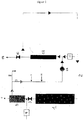
- a liquid flow called the "shuttle" was introduced via a pipe (2) into the bottom of a reactor (1) containing TS-1 in the form of beads consisting of 35 % titanium silicalite dispersed in a silica matrix (65 % by weight) and obtained by a process of sol-gel type.
- This flow comprised propylene, hydrogen peroxide, water, propylene oxide and its byproducts and methanol.
- the liquid flow circulated in the reactor in the direction of the arrows.
- the reaction medium was depressurized by means of a valve (3). This depressurization was followed by the sparging of a gaseous compound using a flow meter (4) in a stripping column (5).
- the liquid phase leaving the top of the column was partly recycled into the reactor via the pipe (7) and partly removed via the overflow pipe (8).
- the H 2 O 2 solution was added to the recycled fraction via the pipe (9), and methanol was added via the pipe (10).
- the mixture thus obtained then passed into a saturator (12) via a pump (11).
- This saturator was fed with propylene under pressure via a flow meter (13), and at its outlet were collected, on the one hand, a gaseous phase of undissolved propylene that left through the pipe (14) via a depressurization valve (15), and on the other hand, the shuttle that was fed into the reactor (1) via the pipe (2).
- the methanol flow rate and the flow rate of nitrogen used for the stripping were adjusted to maintain a constant residence time in the plant.
- the flow rate of the overflow liquid was about 106-120 g/h.
- the shuttle circulation speed was 51/h.
- the H 2 O 2 degree of conversion and the PO/C 3 f selectivity were estimated as follows :
- the degree of conversion of the H 2 O 2 was calculated from the H 2 O 2 inlet and outlet flow rates.
- Example 1 (comparative) Example 2 (according to inv.) TS-1 used (g) 1.58 1.58 T° reactor (°C) 67 55 Conc. of fed H 2 O 2 solution (% by weight) 39 39 pH of fed H 2 O 2 solution 1.68 1.99 Flow rate of H 2 O 2 solution (g/h) 15.5 15.2 H 2 O 2 feed rate (mol/h) 0.178 0.174 CH 3 OH feed rate (ml/h) 275 251 Pe feed rate at the saturator (LN/h) 86 95 Saturator T° (°C) 77 71 Saturator pressure (bar) 8 6.5 Pe conc. at the reactor inlet (mol/kg) 1.36 1.57 Plant residence time (h) 4 4 Residence time on catalyst (min) 5.5 5.5 5.5
- Examples 3 and 4 have been performed in a bubble siphon reactor as disclosed in patent application WO 99/48883 , by reaction between propylene and hydrogen peroxide in the presence of methanol and of catalyst TS-1 used in the form of beads 0.5 mm in diameter.
- the optimal apparent pH of the hydrogen peroxide solution should be of from 1.99 to 2.19.
- Example 5 is conducted according to the invention and leads to a selectivity of 87.6 % after 24 hours.
- Comparative example 1 (apparent pH lower than pH min defined according to the present invention) shows a lower selectivity after 24 hours, namely 85.5 %.
- Example 6 (comp.)
- Example 7 (acc. to inv.)
- Example 8 Example 9 TS-1 used (g) 1.58 1.58 1.58 1.58 T° reactor (°C) 56 55 55 55 Conc.
- the 10 wt % H 2 O 2 solution used in the example 6 has been prepared by dilution from a 39 wt % solution having an apparent pH equal to 3.80.
- example 10 As examples 6 and 7 were conducted at two different methanol feed rates, respectively 130 and 251 ml/h, a further example (example 10) was calculated on the basis of example 7 and of the results obtained for examples 8 and 9, for which the pH was not measured.
- the optimal apparent pH of the hydrogen peroxide solution should be of from 1.99 to 2.19.
- the optimal apparent pH of the hydrogen peroxide solution should be between 3.09 and 3.29.
Landscapes
- Chemical & Material Sciences (AREA)
- Organic Chemistry (AREA)
- Inorganic Chemistry (AREA)
- Epoxy Compounds (AREA)
- Organic Low-Molecular-Weight Compounds And Preparation Thereof (AREA)
- Cosmetics (AREA)
- Detergent Compositions (AREA)
Claims (10)
- Verwendung einer wässrigen Wasserstoffperoxidlösung mit einer solchen Wasserstoffperoxidkonzentration [H2O2], ausgedrückt als Gew.-% der Lösung, und einem solchen scheinbaren pH-Wert von pHmin bis pHmax, dass


- Verfahren zur Herstellung von Propylenoxid oder Epichlorhydrin durch Umsetzung zwischen Propylen bzw. Allylchlorid und Wasserstoffperoxid, bei dem eine wässrige Wasserstoffperoxidlösung mit einer solchen Wasserstoffperoxidkonzentration [H2O2], ausgedrückt als Gew.-% der Lösung, und einem solchen scheinbaren pH-Wert von pHmin bis pHmax, dass


- Verfahren nach Anspruch 2, bei dem die Wasserstoffperoxidlösung einen TOC-Gehalt von 0,01 bis 500 ppm, vorzugsweise von 100 bis 250 ppm, bezogen auf das Gewicht der Lösung, aufweist.
- Verfahren nach Anspruch 2 oder 3, bei dem die Wasserstoffperoxidlösung eine durch Titration gemessene Säurekonzentration von 0,1 bis 5 mmol/l aufweist.
- Verfahren nach einem der Ansprüche 2 bis 4, bei dem der TOC mindestens eine organische Verbindung, die aus Dimethylheptanol, Düsobutylcarbinol, 2,6-Dimethyl-1,4-heptandiol, Methylcyclohexylacetat, Methylcyclohexanol, Tetrabutylharnstoff, Trioctylphosphat und/oder Abbauprodukten von alkylierten aromatischen Lösungsmitteln ausgewählt ist, enthält.
- Verfahren nach einem der Ansprüche 2 bis 5, bei dem die Wasserstoffperoxidlösung Alkali- und Erdalkalimetalle in einer Menge von 1 bis 200 ppm, vorzugsweise von 20 bis 30 ppm, bezogen auf das Gewicht der Lösung, enthält.
- Verfahren nach einem der Ansprüche 2 bis 6, bei dem die Wasserstoffperoxidlösung Anionen in einer Menge von 50 bis 200 ppm, vorzugsweise 100 bis 150 ppm, bezogen auf das Gewicht der Lösung, enthält.
- Verfahren nach einem der Ansprüche 2 bis 7, bei dem die Wasserstoffperoxidlösung mindestens einen Stabilisator, der aus der Gruppe bestehend aus Salpetersäure, Phosphorsäure, Benzoesäure, Dipicolinsäure (DPA), aus Salzen, die aus Nitrat, Phosphat, Pyrophosphat, Stannat, Benzoat, Salicylat, Diethylentriaminpenta(methylenphosphonat) und Mischungen davon ausgewählt sind, vorzugsweise aus Salpetersäure, Phosphorsäure, Dinatriumpyrophosphat, Ammoniumnitrat, Natriumnitrat, Natriumsstannat und Mischungen davon, ausgewählt ist, enthält.
- Verfahren nach einem der Ansprüche 2 bis 8, bei dem der scheinbare pH-Wert der Wasserstoffperoxidlösung durch die Zugabe einer starken Mineralsäure, vorzugsweise Salpetersäure und/oder Phosphorsäure, eingestellt wird.
- Verfahren nach einem der Ansprüche 2 bis 9, bei dem die Wasserstoffperoxidlösung eine Wasserstoffperoxid konzentration von 38 bis 42 Gew.-%, einen scheinbaren pH-Wert in dem gemäß der Erfindung definierten Bereich von pHmin bis pHmax, nämlich von 2,02 bis 1,87 bzw. von 2,31 bis 2,17, einen TOC-Gehalt von 150 bis 220 ppm, einen Gehalt an Alkali- und Erdalkalimetallen von 20 bis 30 ppm und einen Anionengehalt von 100 bis 300 ppm aufweist.
Priority Applications (2)
| Application Number | Priority Date | Filing Date | Title |
|---|---|---|---|
| PL08718129T PL2144848T3 (pl) | 2007-04-05 | 2008-03-20 | Zastosowanie wodnego roztworu nadtlenku wodoru |
| EP08718129.3A EP2144848B1 (de) | 2007-04-05 | 2008-03-20 | Verwendung einer wässrigen wasserstoffperoxidlösung |
Applications Claiming Priority (3)
| Application Number | Priority Date | Filing Date | Title |
|---|---|---|---|
| EP07105712 | 2007-04-05 | ||
| PCT/EP2008/053423 WO2008122503A1 (en) | 2007-04-05 | 2008-03-20 | Aqueous hydrogen peroxide solution, process for its preparation and use thereof |
| EP08718129.3A EP2144848B1 (de) | 2007-04-05 | 2008-03-20 | Verwendung einer wässrigen wasserstoffperoxidlösung |
Publications (2)
| Publication Number | Publication Date |
|---|---|
| EP2144848A1 EP2144848A1 (de) | 2010-01-20 |
| EP2144848B1 true EP2144848B1 (de) | 2017-01-25 |
Family
ID=38472850
Family Applications (1)
| Application Number | Title | Priority Date | Filing Date |
|---|---|---|---|
| EP08718129.3A Active EP2144848B1 (de) | 2007-04-05 | 2008-03-20 | Verwendung einer wässrigen wasserstoffperoxidlösung |
Country Status (13)
| Country | Link |
|---|---|
| US (1) | US8558020B2 (de) |
| EP (1) | EP2144848B1 (de) |
| JP (1) | JP5397368B2 (de) |
| KR (1) | KR101484781B1 (de) |
| CN (1) | CN101687639B (de) |
| AR (1) | AR065963A1 (de) |
| BR (1) | BRPI0809672B1 (de) |
| CA (1) | CA2681510C (de) |
| ES (1) | ES2621892T3 (de) |
| PL (1) | PL2144848T3 (de) |
| RU (1) | RU2468990C2 (de) |
| WO (1) | WO2008122503A1 (de) |
| ZA (1) | ZA200906853B (de) |
Families Citing this family (18)
| Publication number | Priority date | Publication date | Assignee | Title |
|---|---|---|---|---|
| KR101513754B1 (ko) | 2007-08-30 | 2015-04-21 | 솔베이(소시에떼아노님) | 촉매지지체 및 그 제조방법 |
| EP2149570A1 (de) * | 2008-08-01 | 2010-02-03 | Hexion Specialty Chemicals Research Belgium S.A. | Verfahren zur Herstellung von Epichlorhydrin mit Wasserstoffperoxid und einem Mangankomplex |
| EP2149569A1 (de) | 2008-08-01 | 2010-02-03 | Hexion Specialty Chemicals Research Belgium S.A. | Verfahren zur Herstellung eines 1,2-Epoxid |
| EP2411323A1 (de) * | 2009-03-27 | 2012-02-01 | Solvay SA | Verfahren zur herstellung von wasserstoffperoxid |
| CN103347868A (zh) | 2011-01-27 | 2013-10-09 | 索尔维公司 | 用于制造1,2-环氧-3-氯丙烷的方法 |
| WO2012101176A1 (en) | 2011-01-27 | 2012-08-02 | Solvay Sa | Process for the manufacture of 1,2-epoxy-3-chloropropane |
| RU2483019C2 (ru) * | 2011-07-22 | 2013-05-27 | Открытое акционерное общество "Химпром" | Способ выделения стабилизированных водных растворов пероксида водорода |
| US9149550B2 (en) * | 2012-10-02 | 2015-10-06 | Innovasource, Llc | Air and fabric freshener |
| CN102910589A (zh) * | 2012-10-17 | 2013-02-06 | 黎明化工研究设计院有限责任公司 | 一种提高蒽醌法制过氧化氢氢化液氧化收率的方法 |
| CN105073634B (zh) * | 2012-12-20 | 2017-03-29 | 索尔维公司 | 一种用于制造纯化的过氧化氢水溶液的方法 |
| BR112016007350B1 (pt) * | 2013-10-02 | 2022-09-27 | Solvay Sa | Processo para fabricar uma solução aquosa de peróxido de hidrogênio purificada; e processo para fabricar óxido de propileno (1,2-epoxipropano) |
| RU2558118C1 (ru) * | 2014-03-21 | 2015-07-27 | Александр Олегович Терентьев | Стабилизатор растворов пероксида водорода |
| CN105600755A (zh) * | 2016-03-17 | 2016-05-25 | 中国天辰工程有限公司 | 一种蒽醌法生产过氧化氢用工作液 |
| JP2017186232A (ja) * | 2016-03-30 | 2017-10-12 | 株式会社日本触媒 | 水硬性材料用減水剤の製造方法 |
| JP2018135230A (ja) * | 2017-02-21 | 2018-08-30 | 三菱瓦斯化学株式会社 | アントラキノン法による過酸化水素製造方法及び製造システム |
| US20210363008A1 (en) * | 2018-08-02 | 2021-11-25 | Evonik Corporation | Process for preparing a stabilized aqueous hydrogen peroxide solution |
| CN111099562A (zh) * | 2019-12-25 | 2020-05-05 | 山东新龙集团有限公司 | 一种双氧水精馏工艺 |
| CN115397817B (zh) * | 2020-03-23 | 2025-11-11 | 巴斯夫欧洲公司 | 用于生产环氧丙烷的不含dibc的h2o2 |
Citations (3)
| Publication number | Priority date | Publication date | Assignee | Title |
|---|---|---|---|---|
| DE19936547A1 (de) | 1999-08-04 | 2001-02-15 | Basf Ag | Verfahren zur Umsetzung einer organischen Verbindung mit einem Hydroperoxid |
| EP1085017A1 (de) | 1999-09-18 | 2001-03-21 | Degussa-Hüls Aktiengesellschaft | Verfahren zur Herstellung von Epoxiden aus Olefinen |
| WO2004028962A1 (en) | 2002-09-30 | 2004-04-08 | Degussa Ag | Novel aqueous hydrogen peroxide solutions |
Family Cites Families (27)
| Publication number | Priority date | Publication date | Assignee | Title |
|---|---|---|---|---|
| GB432915A (en) | 1933-02-06 | 1935-08-06 | Du Pont | Improvements in and relating to the purification of aqueous solutions of hydrogen peroxide |
| US2017440A (en) * | 1933-04-19 | 1935-10-15 | Du Pont | Purification of hydrogen peroxide |
| GB438886A (en) | 1934-05-14 | 1935-11-14 | Du Pont | Purification of hydrogen peroxide solutions |
| US2676923A (en) | 1950-06-24 | 1954-04-27 | Du Pont | Purification of hydrogen peroxide |
| US4320102A (en) | 1980-10-10 | 1982-03-16 | Air Products And Chemicals, Inc. | Method of stabilizing hydrogen peroxide solutions |
| US4483997A (en) * | 1983-01-31 | 1984-11-20 | Texaco Inc. | Olefin epoxidation with inorganic metal phosphate enhanced catalyst |
| JP2976776B2 (ja) * | 1993-10-12 | 1999-11-10 | 住友化学工業株式会社 | 過酸化水素水の精製方法 |
| JPH10231234A (ja) * | 1997-02-21 | 1998-09-02 | Ogawa Koryo Kk | 芳香性毛髪処理剤組成物 |
| BE1011577A3 (fr) | 1997-11-27 | 1999-11-09 | Solvay | Catalyseur d'epoxydation, son utilisation et procede d'epoxydation en presence de catalyseur. |
| JPH11180704A (ja) | 1997-12-19 | 1999-07-06 | Ube Ind Ltd | 高純度過酸化水素水溶液の製造方法 |
| GB2334028A (en) | 1998-02-04 | 1999-08-11 | Solvay | Making hydrogen peroxide by the anthraquinone process |
| BE1011851A3 (fr) | 1998-03-24 | 2000-02-01 | Solvay | Procede de fabrication d'un oxiranne. |
| BE1011852A3 (fr) | 1998-03-24 | 2000-02-01 | Solvay | Procede de fabrication d'un oxiranne. |
| BE1012044A6 (fr) | 1998-06-18 | 2000-04-04 | Solvay | Procede et installation pour la fabrication d'une solution aqueuse de peroxyde d'hydrogene et solution aqueuse de peroxyde d'hydrogene. |
| BE1012267A3 (fr) | 1998-11-05 | 2000-08-01 | Solvay | Procede de fabrication de peroxyde d'hydrogene. |
| JP4062569B2 (ja) * | 1999-01-12 | 2008-03-19 | 中部キレスト株式会社 | 過酸化水素含有水性液および過酸化水素の安定化法 |
| EP1122249A1 (de) | 2000-02-02 | 2001-08-08 | SOLVAY (Société Anonyme) | Verfahren zur Herstellung von Oxyranen |
| FR2806084A1 (fr) | 2000-03-10 | 2001-09-14 | Solvay | Procede de fabrication d'un oxiranne |
| FR2810982B1 (fr) | 2000-06-28 | 2002-09-27 | Solvay | Procede de fabrication d'oxiranne comprenant la separation de l'oxiranne du milieu reactionnel |
| FR2810981B1 (fr) | 2000-06-28 | 2002-12-20 | Solvay | Procede continu de fabrication d'oxiranne comprenant des etapes de purification |
| FR2824558B1 (fr) | 2001-05-14 | 2005-05-06 | Solvay | Procede de fabrication d'un oxiranne |
| US6960671B2 (en) * | 2002-09-20 | 2005-11-01 | Arco Chemical Technology, L.P. | Process for direct oxidation of propylene to propylene oxide and large particle size titanium silicalite catalysts for use therein |
| US7722847B2 (en) * | 2002-09-30 | 2010-05-25 | Evonik Degussa Gmbh | Aqueous hydrogen peroxide solutions and method of making same |
| FR2846964B1 (fr) | 2002-11-12 | 2006-07-21 | Procede de fabrication de 1,2-epoxy-3-chloropropane | |
| FR2846965B1 (fr) | 2002-11-12 | 2006-10-13 | Procede de fabrication de 1,2-epoxy-3-chloropropane | |
| EP1951625B1 (de) | 2005-10-25 | 2011-04-06 | Aseptix Technologies B.V | Aktivierte peroxidlösungen und zugehöriges herstellungsverfahren |
| KR101513754B1 (ko) | 2007-08-30 | 2015-04-21 | 솔베이(소시에떼아노님) | 촉매지지체 및 그 제조방법 |
-
2008
- 2008-03-20 US US12/593,958 patent/US8558020B2/en active Active
- 2008-03-20 CN CN200880015633.2A patent/CN101687639B/zh active Active
- 2008-03-20 JP JP2010501473A patent/JP5397368B2/ja active Active
- 2008-03-20 EP EP08718129.3A patent/EP2144848B1/de active Active
- 2008-03-20 BR BRPI0809672A patent/BRPI0809672B1/pt active IP Right Grant
- 2008-03-20 RU RU2009140765/05A patent/RU2468990C2/ru active
- 2008-03-20 CA CA2681510A patent/CA2681510C/en active Active
- 2008-03-20 PL PL08718129T patent/PL2144848T3/pl unknown
- 2008-03-20 WO PCT/EP2008/053423 patent/WO2008122503A1/en not_active Ceased
- 2008-03-20 ES ES08718129.3T patent/ES2621892T3/es active Active
- 2008-04-04 AR ARP080101427A patent/AR065963A1/es active IP Right Grant
- 2008-04-04 KR KR20080031743A patent/KR101484781B1/ko active Active
-
2009
- 2009-10-01 ZA ZA2009/06853A patent/ZA200906853B/en unknown
Patent Citations (3)
| Publication number | Priority date | Publication date | Assignee | Title |
|---|---|---|---|---|
| DE19936547A1 (de) | 1999-08-04 | 2001-02-15 | Basf Ag | Verfahren zur Umsetzung einer organischen Verbindung mit einem Hydroperoxid |
| EP1085017A1 (de) | 1999-09-18 | 2001-03-21 | Degussa-Hüls Aktiengesellschaft | Verfahren zur Herstellung von Epoxiden aus Olefinen |
| WO2004028962A1 (en) | 2002-09-30 | 2004-04-08 | Degussa Ag | Novel aqueous hydrogen peroxide solutions |
Non-Patent Citations (6)
| Title |
|---|
| "Hydrogen Peroxide Data Manual", INTEROX, 1985, XP055427901 |
| FALBE JURGEN, RÖMPP CHEMIE LEXIKON, 1985, pages 3329 - 3331, XP055427797 |
| GUSTAAF GOOR ET AL.: "Hydrogen Peroxide", ULLMANN'S ENCYCLOPEDIA OF INDUSTRIAL CHEMISTRY, vol. 18, 2012, pages 393 - 427, XP055038254 |
| J. R. KOLCZYNSKI ET AL.: "The Behavior of the Glass Electrode in Hydrogen Peroxide Solutions", J. AMER. CHEM. SOC., vol. 79, 1957, pages 531 - 533, XP055428001 |
| MUSSINI T. ET AL.: "CRITERIA FOR STANDARDIZATION OF pH MEASUREMENTS in Organic Solvents and Water + Organic Solvent Mixtures of Moderate to HighPermittivities", PURE & APPL. CHEM., vol. 57, no. 6, 1985, pages 865 - 876, XP055427894 |
| TRANS. FARADAY SOC., vol. 51, 1955, pages 1690 - 1697, XP055428000 |
Also Published As
| Publication number | Publication date |
|---|---|
| RU2468990C2 (ru) | 2012-12-10 |
| KR101484781B1 (ko) | 2015-01-20 |
| EP2144848A1 (de) | 2010-01-20 |
| KR20080091029A (ko) | 2008-10-09 |
| ZA200906853B (en) | 2012-03-28 |
| BRPI0809672B1 (pt) | 2019-01-29 |
| CA2681510A1 (en) | 2008-10-16 |
| CN101687639A (zh) | 2010-03-31 |
| AR065963A1 (es) | 2009-07-15 |
| JP5397368B2 (ja) | 2014-01-22 |
| BRPI0809672A2 (pt) | 2014-10-07 |
| CN101687639B (zh) | 2015-04-29 |
| RU2009140765A (ru) | 2011-05-10 |
| ES2621892T3 (es) | 2017-07-05 |
| JP2010523447A (ja) | 2010-07-15 |
| US20100113808A1 (en) | 2010-05-06 |
| CA2681510C (en) | 2017-03-07 |
| US8558020B2 (en) | 2013-10-15 |
| WO2008122503A1 (en) | 2008-10-16 |
| PL2144848T3 (pl) | 2017-07-31 |
Similar Documents
| Publication | Publication Date | Title |
|---|---|---|
| EP2144848B1 (de) | Verwendung einer wässrigen wasserstoffperoxidlösung | |
| RU2247118C2 (ru) | Способ получения оксирана, установка для осуществления способа и объединенный способ получения пероксида водорода и оксирана | |
| EP0049806B1 (de) | Synthese von Wasserstoffperoxid | |
| US20040054200A1 (en) | Integrated process for the preparation of olefin oxides | |
| US20060122409A1 (en) | Process for manufacturing an oxirane | |
| KR20010080724A (ko) | 올레핀으로부터 에폭시드를 제조하기 위한 통합 방법 | |
| EP1307434B1 (de) | Integriertes verfahren zur herstellung von epoxiden | |
| RU2320650C2 (ru) | Способ эпоксидирования олефинов | |
| EP0812836A1 (de) | Verfahren zur Herstellung von epoxidierten Olefineprodukten | |
| EP4128403B1 (de) | Lösung von tempo-derivaten zur verwendung als elektrolyt in redox-flow-zellen | |
| US20040068127A1 (en) | Method for making an oxirane | |
| US20230150939A1 (en) | A solution of tempo-derivatives for use as electrolyte in redox-flow cells | |
| JPH1072455A (ja) | オレフィン類のエポキシ化物の製造方法 | |
| US20040127730A1 (en) | Process for the epoxidation of olefins | |
| WO2023237729A1 (en) | Process for making a substantially nitrosamine-free, substantially peroxide-free, substantially colorless amine oxide |
Legal Events
| Date | Code | Title | Description |
|---|---|---|---|
| PUAI | Public reference made under article 153(3) epc to a published international application that has entered the european phase |
Free format text: ORIGINAL CODE: 0009012 |
|
| 17P | Request for examination filed |
Effective date: 20091105 |
|
| AK | Designated contracting states |
Kind code of ref document: A1 Designated state(s): AT BE BG CH CY CZ DE DK EE ES FI FR GB GR HR HU IE IS IT LI LT LU LV MC MT NL NO PL PT RO SE SI SK TR |
|
| AX | Request for extension of the european patent |
Extension state: AL BA MK RS |
|
| 17Q | First examination report despatched |
Effective date: 20100423 |
|
| DAX | Request for extension of the european patent (deleted) | ||
| REG | Reference to a national code |
Ref country code: HK Ref legal event code: DE Ref document number: 1139642 Country of ref document: HK |
|
| RAP1 | Party data changed (applicant data changed or rights of an application transferred) |
Owner name: SOLVAY SA |
|
| GRAP | Despatch of communication of intention to grant a patent |
Free format text: ORIGINAL CODE: EPIDOSNIGR1 |
|
| INTG | Intention to grant announced |
Effective date: 20160921 |
|
| STAA | Information on the status of an ep patent application or granted ep patent |
Free format text: STATUS: GRANT OF PATENT IS INTENDED |
|
| GRAS | Grant fee paid |
Free format text: ORIGINAL CODE: EPIDOSNIGR3 |
|
| GRAA | (expected) grant |
Free format text: ORIGINAL CODE: 0009210 |
|
| STAA | Information on the status of an ep patent application or granted ep patent |
Free format text: STATUS: THE PATENT HAS BEEN GRANTED |
|
| AK | Designated contracting states |
Kind code of ref document: B1 Designated state(s): AT BE BG CH CY CZ DE DK EE ES FI FR GB GR HR HU IE IS IT LI LT LU LV MC MT NL NO PL PT RO SE SI SK TR |
|
| REG | Reference to a national code |
Ref country code: GB Ref legal event code: FG4D |
|
| REG | Reference to a national code |
Ref country code: CH Ref legal event code: EP |
|
| REG | Reference to a national code |
Ref country code: AT Ref legal event code: REF Ref document number: 863986 Country of ref document: AT Kind code of ref document: T Effective date: 20170215 |
|
| REG | Reference to a national code |
Ref country code: IE Ref legal event code: FG4D |
|
| REG | Reference to a national code |
Ref country code: FR Ref legal event code: PLFP Year of fee payment: 10 |
|
| REG | Reference to a national code |
Ref country code: DE Ref legal event code: R096 Ref document number: 602008048543 Country of ref document: DE |
|
| REG | Reference to a national code |
Ref country code: NL Ref legal event code: FP |
|
| REG | Reference to a national code |
Ref country code: LT Ref legal event code: MG4D |
|
| REG | Reference to a national code |
Ref country code: ES Ref legal event code: FG2A Ref document number: 2621892 Country of ref document: ES Kind code of ref document: T3 Effective date: 20170705 |
|
| PG25 | Lapsed in a contracting state [announced via postgrant information from national office to epo] |
Ref country code: FI Free format text: LAPSE BECAUSE OF FAILURE TO SUBMIT A TRANSLATION OF THE DESCRIPTION OR TO PAY THE FEE WITHIN THE PRESCRIBED TIME-LIMIT Effective date: 20170125 Ref country code: NO Free format text: LAPSE BECAUSE OF FAILURE TO SUBMIT A TRANSLATION OF THE DESCRIPTION OR TO PAY THE FEE WITHIN THE PRESCRIBED TIME-LIMIT Effective date: 20170425 Ref country code: GR Free format text: LAPSE BECAUSE OF FAILURE TO SUBMIT A TRANSLATION OF THE DESCRIPTION OR TO PAY THE FEE WITHIN THE PRESCRIBED TIME-LIMIT Effective date: 20170426 Ref country code: HR Free format text: LAPSE BECAUSE OF FAILURE TO SUBMIT A TRANSLATION OF THE DESCRIPTION OR TO PAY THE FEE WITHIN THE PRESCRIBED TIME-LIMIT Effective date: 20170125 Ref country code: IS Free format text: LAPSE BECAUSE OF FAILURE TO SUBMIT A TRANSLATION OF THE DESCRIPTION OR TO PAY THE FEE WITHIN THE PRESCRIBED TIME-LIMIT Effective date: 20170525 Ref country code: LT Free format text: LAPSE BECAUSE OF FAILURE TO SUBMIT A TRANSLATION OF THE DESCRIPTION OR TO PAY THE FEE WITHIN THE PRESCRIBED TIME-LIMIT Effective date: 20170125 |
|
| PG25 | Lapsed in a contracting state [announced via postgrant information from national office to epo] |
Ref country code: SE Free format text: LAPSE BECAUSE OF FAILURE TO SUBMIT A TRANSLATION OF THE DESCRIPTION OR TO PAY THE FEE WITHIN THE PRESCRIBED TIME-LIMIT Effective date: 20170125 Ref country code: BG Free format text: LAPSE BECAUSE OF FAILURE TO SUBMIT A TRANSLATION OF THE DESCRIPTION OR TO PAY THE FEE WITHIN THE PRESCRIBED TIME-LIMIT Effective date: 20170425 Ref country code: PT Free format text: LAPSE BECAUSE OF FAILURE TO SUBMIT A TRANSLATION OF THE DESCRIPTION OR TO PAY THE FEE WITHIN THE PRESCRIBED TIME-LIMIT Effective date: 20170525 Ref country code: LV Free format text: LAPSE BECAUSE OF FAILURE TO SUBMIT A TRANSLATION OF THE DESCRIPTION OR TO PAY THE FEE WITHIN THE PRESCRIBED TIME-LIMIT Effective date: 20170125 |
|
| REG | Reference to a national code |
Ref country code: DE Ref legal event code: R026 Ref document number: 602008048543 Country of ref document: DE |
|
| PLBI | Opposition filed |
Free format text: ORIGINAL CODE: 0009260 |
|
| PG25 | Lapsed in a contracting state [announced via postgrant information from national office to epo] |
Ref country code: CZ Free format text: LAPSE BECAUSE OF FAILURE TO SUBMIT A TRANSLATION OF THE DESCRIPTION OR TO PAY THE FEE WITHIN THE PRESCRIBED TIME-LIMIT Effective date: 20170125 Ref country code: RO Free format text: LAPSE BECAUSE OF FAILURE TO SUBMIT A TRANSLATION OF THE DESCRIPTION OR TO PAY THE FEE WITHIN THE PRESCRIBED TIME-LIMIT Effective date: 20170125 Ref country code: EE Free format text: LAPSE BECAUSE OF FAILURE TO SUBMIT A TRANSLATION OF THE DESCRIPTION OR TO PAY THE FEE WITHIN THE PRESCRIBED TIME-LIMIT Effective date: 20170125 Ref country code: SK Free format text: LAPSE BECAUSE OF FAILURE TO SUBMIT A TRANSLATION OF THE DESCRIPTION OR TO PAY THE FEE WITHIN THE PRESCRIBED TIME-LIMIT Effective date: 20170125 |
|
| REG | Reference to a national code |
Ref country code: CH Ref legal event code: PL |
|
| 26 | Opposition filed |
Opponent name: EVONIK DEGUSSA GMBH Effective date: 20171005 |
|
| PG25 | Lapsed in a contracting state [announced via postgrant information from national office to epo] |
Ref country code: DK Free format text: LAPSE BECAUSE OF FAILURE TO SUBMIT A TRANSLATION OF THE DESCRIPTION OR TO PAY THE FEE WITHIN THE PRESCRIBED TIME-LIMIT Effective date: 20170125 Ref country code: MC Free format text: LAPSE BECAUSE OF FAILURE TO SUBMIT A TRANSLATION OF THE DESCRIPTION OR TO PAY THE FEE WITHIN THE PRESCRIBED TIME-LIMIT Effective date: 20170125 |
|
| PLAX | Notice of opposition and request to file observation + time limit sent |
Free format text: ORIGINAL CODE: EPIDOSNOBS2 |
|
| REG | Reference to a national code |
Ref country code: IE Ref legal event code: MM4A |
|
| PG25 | Lapsed in a contracting state [announced via postgrant information from national office to epo] |
Ref country code: LU Free format text: LAPSE BECAUSE OF NON-PAYMENT OF DUE FEES Effective date: 20170320 |
|
| REG | Reference to a national code |
Ref country code: FR Ref legal event code: PLFP Year of fee payment: 11 |
|
| PG25 | Lapsed in a contracting state [announced via postgrant information from national office to epo] |
Ref country code: CH Free format text: LAPSE BECAUSE OF NON-PAYMENT OF DUE FEES Effective date: 20170331 Ref country code: IE Free format text: LAPSE BECAUSE OF NON-PAYMENT OF DUE FEES Effective date: 20170320 Ref country code: LI Free format text: LAPSE BECAUSE OF NON-PAYMENT OF DUE FEES Effective date: 20170331 Ref country code: SI Free format text: LAPSE BECAUSE OF FAILURE TO SUBMIT A TRANSLATION OF THE DESCRIPTION OR TO PAY THE FEE WITHIN THE PRESCRIBED TIME-LIMIT Effective date: 20170125 |
|
| PLBB | Reply of patent proprietor to notice(s) of opposition received |
Free format text: ORIGINAL CODE: EPIDOSNOBS3 |
|
| PG25 | Lapsed in a contracting state [announced via postgrant information from national office to epo] |
Ref country code: MT Free format text: LAPSE BECAUSE OF NON-PAYMENT OF DUE FEES Effective date: 20170320 |
|
| RDAF | Communication despatched that patent is revoked |
Free format text: ORIGINAL CODE: EPIDOSNREV1 |
|
| APAH | Appeal reference modified |
Free format text: ORIGINAL CODE: EPIDOSCREFNO |
|
| APBM | Appeal reference recorded |
Free format text: ORIGINAL CODE: EPIDOSNREFNO |
|
| APBP | Date of receipt of notice of appeal recorded |
Free format text: ORIGINAL CODE: EPIDOSNNOA2O |
|
| PG25 | Lapsed in a contracting state [announced via postgrant information from national office to epo] |
Ref country code: HU Free format text: LAPSE BECAUSE OF FAILURE TO SUBMIT A TRANSLATION OF THE DESCRIPTION OR TO PAY THE FEE WITHIN THE PRESCRIBED TIME-LIMIT; INVALID AB INITIO Effective date: 20080320 |
|
| APBQ | Date of receipt of statement of grounds of appeal recorded |
Free format text: ORIGINAL CODE: EPIDOSNNOA3O |
|
| PG25 | Lapsed in a contracting state [announced via postgrant information from national office to epo] |
Ref country code: CY Free format text: LAPSE BECAUSE OF NON-PAYMENT OF DUE FEES Effective date: 20170125 |
|
| PG25 | Lapsed in a contracting state [announced via postgrant information from national office to epo] |
Ref country code: TR Free format text: LAPSE BECAUSE OF FAILURE TO SUBMIT A TRANSLATION OF THE DESCRIPTION OR TO PAY THE FEE WITHIN THE PRESCRIBED TIME-LIMIT Effective date: 20170125 |
|
| REG | Reference to a national code |
Ref country code: AT Ref legal event code: UEP Ref document number: 863986 Country of ref document: AT Kind code of ref document: T Effective date: 20170125 |
|
| PLAB | Opposition data, opponent's data or that of the opponent's representative modified |
Free format text: ORIGINAL CODE: 0009299OPPO |
|
| R26 | Opposition filed (corrected) |
Opponent name: EVONIK OPERATIONS GMBH Effective date: 20171005 |
|
| APBU | Appeal procedure closed |
Free format text: ORIGINAL CODE: EPIDOSNNOA9O |
|
| REG | Reference to a national code |
Ref country code: DE Ref legal event code: R100 Ref document number: 602008048543 Country of ref document: DE |
|
| PLBN | Opposition rejected |
Free format text: ORIGINAL CODE: 0009273 |
|
| PLCK | Communication despatched that opposition was rejected |
Free format text: ORIGINAL CODE: EPIDOSNREJ1 |
|
| STAA | Information on the status of an ep patent application or granted ep patent |
Free format text: STATUS: OPPOSITION REJECTED |
|
| 27O | Opposition rejected |
Effective date: 20220628 |
|
| P01 | Opt-out of the competence of the unified patent court (upc) registered |
Effective date: 20230624 |
|
| REG | Reference to a national code |
Ref country code: HK Ref legal event code: WD Ref document number: 1139642 Country of ref document: HK |
|
| PGFP | Annual fee paid to national office [announced via postgrant information from national office to epo] |
Ref country code: ES Payment date: 20250416 Year of fee payment: 18 |
|
| PGFP | Annual fee paid to national office [announced via postgrant information from national office to epo] |
Ref country code: IT Payment date: 20250331 Year of fee payment: 18 |
|
| PGFP | Annual fee paid to national office [announced via postgrant information from national office to epo] |
Ref country code: GB Payment date: 20260324 Year of fee payment: 19 |
|
| PGFP | Annual fee paid to national office [announced via postgrant information from national office to epo] |
Ref country code: DE Payment date: 20260311 Year of fee payment: 19 |
|
| PGFP | Annual fee paid to national office [announced via postgrant information from national office to epo] |
Ref country code: AT Payment date: 20260319 Year of fee payment: 19 |
|
| PGFP | Annual fee paid to national office [announced via postgrant information from national office to epo] |
Ref country code: BE Payment date: 20260323 Year of fee payment: 19 |
|
| PGFP | Annual fee paid to national office [announced via postgrant information from national office to epo] |
Ref country code: NL Payment date: 20260323 Year of fee payment: 19 |
|
| PGFP | Annual fee paid to national office [announced via postgrant information from national office to epo] |
Ref country code: FR Payment date: 20260325 Year of fee payment: 19 |
|
| PGFP | Annual fee paid to national office [announced via postgrant information from national office to epo] |
Ref country code: PL Payment date: 20260306 Year of fee payment: 19 |