EP2145146B1 - Behälter mit einer unterteilungsvorrichtung - Google Patents
Behälter mit einer unterteilungsvorrichtung Download PDFInfo
- Publication number
- EP2145146B1 EP2145146B1 EP08736512A EP08736512A EP2145146B1 EP 2145146 B1 EP2145146 B1 EP 2145146B1 EP 08736512 A EP08736512 A EP 08736512A EP 08736512 A EP08736512 A EP 08736512A EP 2145146 B1 EP2145146 B1 EP 2145146B1
- Authority
- EP
- European Patent Office
- Prior art keywords
- shackle
- partition wall
- container according
- container
- crossbar
- Prior art date
- Legal status (The legal status is an assumption and is not a legal conclusion. Google has not performed a legal analysis and makes no representation as to the accuracy of the status listed.)
- Active
Links
Images


Classifications
-
- F—MECHANICAL ENGINEERING; LIGHTING; HEATING; WEAPONS; BLASTING
- F25—REFRIGERATION OR COOLING; COMBINED HEATING AND REFRIGERATION SYSTEMS; HEAT PUMP SYSTEMS; MANUFACTURE OR STORAGE OF ICE; LIQUEFACTION SOLIDIFICATION OF GASES
- F25D—REFRIGERATORS; COLD ROOMS; ICE-BOXES; COOLING OR FREEZING APPARATUS NOT OTHERWISE PROVIDED FOR
- F25D25/00—Charging, supporting, and discharging the articles to be cooled
- F25D25/02—Charging, supporting, and discharging the articles to be cooled by shelves
- F25D25/022—Baskets
-
- B—PERFORMING OPERATIONS; TRANSPORTING
- B65—CONVEYING; PACKING; STORING; HANDLING THIN OR FILAMENTARY MATERIAL
- B65D—CONTAINERS FOR STORAGE OR TRANSPORT OF ARTICLES OR MATERIALS, e.g. BAGS, BARRELS, BOTTLES, BOXES, CANS, CARTONS, CRATES, DRUMS, JARS, TANKS, HOPPERS, FORWARDING CONTAINERS; ACCESSORIES, CLOSURES, OR FITTINGS THEREFOR; PACKAGING ELEMENTS; PACKAGES
- B65D1/00—Rigid or semi-rigid containers having bodies formed in one piece, e.g. by casting metallic material, by moulding plastics, by blowing vitreous material, by throwing ceramic material, by moulding pulped fibrous material or by deep-drawing operations performed on sheet material
- B65D1/22—Boxes or like containers with side walls of substantial depth for enclosing contents
-
- B—PERFORMING OPERATIONS; TRANSPORTING
- B65—CONVEYING; PACKING; STORING; HANDLING THIN OR FILAMENTARY MATERIAL
- B65D—CONTAINERS FOR STORAGE OR TRANSPORT OF ARTICLES OR MATERIALS, e.g. BAGS, BARRELS, BOTTLES, BOXES, CANS, CARTONS, CRATES, DRUMS, JARS, TANKS, HOPPERS, FORWARDING CONTAINERS; ACCESSORIES, CLOSURES, OR FITTINGS THEREFOR; PACKAGING ELEMENTS; PACKAGES
- B65D11/00—Containers having bodies formed by interconnecting or uniting two or more rigid, or substantially rigid, components made wholly or mainly of plastics material
- B65D11/14—Containers having bodies formed by interconnecting or uniting two or more rigid, or substantially rigid, components made wholly or mainly of plastics material of skeleton or apertured construction, e.g. baskets or carriers made up of interconnected spaced bands, rods, or strips
-
- B—PERFORMING OPERATIONS; TRANSPORTING
- B65—CONVEYING; PACKING; STORING; HANDLING THIN OR FILAMENTARY MATERIAL
- B65D—CONTAINERS FOR STORAGE OR TRANSPORT OF ARTICLES OR MATERIALS, e.g. BAGS, BARRELS, BOTTLES, BOXES, CANS, CARTONS, CRATES, DRUMS, JARS, TANKS, HOPPERS, FORWARDING CONTAINERS; ACCESSORIES, CLOSURES, OR FITTINGS THEREFOR; PACKAGING ELEMENTS; PACKAGES
- B65D25/00—Details of other kinds or types of rigid or semi-rigid containers
- B65D25/02—Internal fittings
- B65D25/04—Partitions
- B65D25/06—Partitions adapted to be fitted in two or more alternative positions
-
- B—PERFORMING OPERATIONS; TRANSPORTING
- B65—CONVEYING; PACKING; STORING; HANDLING THIN OR FILAMENTARY MATERIAL
- B65D—CONTAINERS FOR STORAGE OR TRANSPORT OF ARTICLES OR MATERIALS, e.g. BAGS, BARRELS, BOTTLES, BOXES, CANS, CARTONS, CRATES, DRUMS, JARS, TANKS, HOPPERS, FORWARDING CONTAINERS; ACCESSORIES, CLOSURES, OR FITTINGS THEREFOR; PACKAGING ELEMENTS; PACKAGES
- B65D7/00—Containers having bodies formed by interconnecting or uniting two or more rigid, or substantially rigid, components made wholly or mainly of metal
- B65D7/12—Containers having bodies formed by interconnecting or uniting two or more rigid, or substantially rigid, components made wholly or mainly of metal characterised by wall construction or by connections between walls
- B65D7/14—Containers having bodies formed by interconnecting or uniting two or more rigid, or substantially rigid, components made wholly or mainly of metal characterised by wall construction or by connections between walls of skeleton or like apertured construction, e.g. baskets or carriers formed of wire mesh, of interconnected bands, bars, or rods, or of perforated sheet metal
- B65D7/20—Containers having bodies formed by interconnecting or uniting two or more rigid, or substantially rigid, components made wholly or mainly of metal characterised by wall construction or by connections between walls of skeleton or like apertured construction, e.g. baskets or carriers formed of wire mesh, of interconnected bands, bars, or rods, or of perforated sheet metal made of wire
-
- F—MECHANICAL ENGINEERING; LIGHTING; HEATING; WEAPONS; BLASTING
- F25—REFRIGERATION OR COOLING; COMBINED HEATING AND REFRIGERATION SYSTEMS; HEAT PUMP SYSTEMS; MANUFACTURE OR STORAGE OF ICE; LIQUEFACTION SOLIDIFICATION OF GASES
- F25D—REFRIGERATORS; COLD ROOMS; ICE-BOXES; COOLING OR FREEZING APPARATUS NOT OTHERWISE PROVIDED FOR
- F25D23/00—General constructional features
- F25D23/06—Walls
- F25D23/069—Cooling space dividing partitions
Definitions
- the present invention relates to a container with a partitioning device, as it is used in particular as a container for refrigerated goods in freezers and a refrigerator with such a container.
- a partitioning device is useful to provide a large number of separate compartments, in which different types of frozen food can be sorted.
- Such a device should be easy to assemble and disassemble to allow for a change in the interior layout of the freezer as needed. Since the door of the device must be open during the assembly or disassembly of a subdivision device, the assembly or disassembly should be carried out as quickly as possible in order to avoid an unnecessary influx of heat and moisture into the interior of the device.
- a container according to the preamble of claim 1 is for example from the EP-A-0 236 648 known.
- Object of the present invention is to provide a container with a partitioning device and a refrigeration device, which meets the above requirements.
- the bracket also has a projection extending from the partition wall, e.g. engages the wire of a wire basket, the dividing device is fixed to the container or wire basket.
- the bolt prevents subsequent loosening of the bracket of the partition.
- the projections may be formed on the bottom and / or on the sidewalls of the container e.g. Be provided as a bow-like holding elements, which are formed in the case of plastic containers with.
- the problem is solved by the features of claim 15.
- this preferably has a structure with a head piece, a cross bar and a the shank with the crossbar connecting shaft, wherein the latch in the state placed in the openings between a through orientation in which the crossbar is able to pass through the openings, and a Sperrorienttechnik is rotatable in the crossbar over an edge of the openings reaches out.
- the cross bar carries a locking contour, which cooperates inhibiting the rotation of the bolt in the barrier orientation with a complementary locking contour of the bracket or the partition.
- the latching contour of the crossbar is one of the partition facing the tip, and the complementary locking contour in the partition is a recess.
- a recess is provided at the head of the bolt into which a tool such as a screwdriver or a coin for rotating the bolt is insertable.
- a tool such as a screwdriver or a coin for rotating the bolt is insertable.
- the head piece and the crossbar hold the legs of the bracket pressed against each other.
- the friction between the yoke and the latch resulting from this pressure helps to secure both in position with respect to each other.
- the two legs of the bracket are symmetrical to each other, because then the bolt can be inserted from each side into the openings of the bracket and the partition.
- the partition wall has a bead. This is preferably thicker than the distance between the legs of the bracket corresponds. To still be able to postpone the bracket on the partition wall, the bead is expediently each adjacent to an opening of the partition, which can accommodate the bolt interrupted.
- the partition wall carries a rib, wherein the opening between the rib and the edge of the partition wall is arranged, and that in a position in which the openings of the partition and the bracket are aligned, a leg of the Stirrups touched the rib.
- the rib serves as a stop, to which the bracket can be pushed onto the partition, and it is easy to place the bracket on the partition so that its opening and that of the partition overlap.
- Fig. 1 is a perspective view of a wire basket 1, which is useful as a container or pull-out box in a refrigerator or freezer, and a partitioning device 2 mounted in the wire basket 1.
- the wire basket 1 has a flat, rectangular bottom 3 and four vertical walls 4, respectively are angled outwardly in an upper edge region, to form a support shoulder for supporting the wire basket 1, for example on slide rails of a freezer or at an upper edge of the inner container of a freezer.
- An upper frame of the wire basket 1 is formed of a plurality of profile pieces 5, in each of which the upper edges of the walls 4 engage, and the profile pieces 5 connecting corner pieces 6 are formed.
- the corner pieces 6 are attached to the profile pieces 5 respectively by means of inserted into chambers of the profile pieces 5, not visible in the Fig pin.
- the dividing device 2 here comprises two at right angles to each other meeting dividing walls 7, 8, which divide the wire basket 1 into three compartments.
- the T-shaped floor plan of the partitions 7, 8 makes it possible to provide fastening elements 9 for fastening the partitioning device 2 to the wire basket 1 exclusively at its bottom 3;
- the fastening elements 9 shown here and described in more detail below could readily be provided on a vertical edge of one of the partitions 7, 8 in order to connect them to a wall 4 of the wire basket 1.
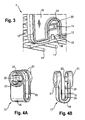
- Fig. 3 shows in an enlarged view of the lower front corner of the partition 7 from Fig. 2 in a not yet fixed to the wire basket bottom 3, prior to attachment of the fastener 9.
- the partition 7 is a plastic molding with a wall plate 10 whose thickness corresponds approximately to the diameter of the wire basket 1 forming wires 11, and along the edge extends on both sides of a peripheral edge bead 12.
- position of the lower edge of the partition wall 7 of the edge bead 12 is interrupted, and instead a circular arc-shaped rib 13 extends into the interior of the plate 10 and around a slot-shaped opening 14 around.
- a flat web 15 is formed with a latching projection 16.
- the latching projection 16 is used for temporary fixing of a bracket 17, which constitutes a part of the fastening element 9.
- This bracket 17 is in FIGS. 4A and 4B shown in two perspective views.
- the bracket 17 comprises two mutually mirror-symmetrical, connected by a semicircular arc 18 flat leg 19, each having a slot-shaped opening 20, surrounded by a torus 21, wear at their free ends.
- a semicircular arc 18 flat leg 19 In two of the annular ring 21 and the opening 20 limited, circular segment-shaped fields each have a detent recess 22 is formed.
- the mutually facing surfaces of the legs 19 each carry a triangular locking projection 23 and of the semicircular arc 18 projects a narrow rib 24 in the space between the legs 19 before.
- the bracket 17 is provided to be slipped from below on one of the wires 11 and a partition wall placed above 7 or 8 of the partitioning device 2. In the attached state, the ribs 24 clamp the wire 11 between them, and the legs 19 completely cover the region of the dividing wall 7 or 8 bounded by the semicircular arcs 18.
- the latch 25 is a one-piece plastic molded part with a head 26 in the form of a circular disk, a cylindrical shaft 27 and a crossbar 28.
- the crossbar 28 carries at its ends the head 26 facing locking lugs 29th
- Fig. 6 shows a perspective view of the front lower corner of the partition 7 with mounted bracket 17 and inserted latch 25.
- the head 26 is at most slightly above the annular bead 21, so that for rotating the bolt 25, a tool such as a Coin or a wrench is needed, which can be inserted into a slot 30 of the head 26.
- Fig. 7 shows in a section along the axis of rotation of the bolt 25, the configuration resulting from that of Fig. 6 by turning the bolt 25 by 90 degrees.
- the ends of the crossbar 28 now extend to the limited by the annular bead 21 fields above and below the opening 20, and the locking lugs 29 are engaged in the locking recesses 22 of the fields.
- the latch 25 is fixed in its orientation; in order to release the locking lugs 29 from the recesses 22, the crossbar 28 and the bracket 17 must be elastically deformed, and the force required for this purpose can again be applied only with the aid of an inserted into the slot 30 tool.
- Fig. 8 shows a section through the mounted on a partition bracket 17 according to a variant Fig. 7 ,
- the bottom 3 comprises two layers of intersecting wires 11. While at Fig. 7 the length of the bracket 17 is dimensioned so that the bracket embrace only a wire 11 of the upper layer and at the same time its openings 20 with the Can overlap opening 14 of the partition wall, the legs of the bracket 17 and in particular the inner ribs 24 are extended so that the bracket is selectively attachable to a wire 11 of the upper or the lower layer. Therefore, one type of bracket suffices to selectively fix a partition wall parallel to the wires 11 of the upper layer or the lower layer.
- one of the legs of the bracket 17 could be shortened and only the other have an opening 20;
- either the head 26 or the cross bar 28 of the (then shortened) bolt 25 would be applied directly to the partition wall 7, 8.
- a latching of the bolt in the blocking position would result in this case in that the latching lugs 25 must pass through the bead surrounding the opening 14, or that a depression corresponding to the recess 22 is formed on the wall plate 11, preferably on both sides.
Landscapes
- Engineering & Computer Science (AREA)
- Mechanical Engineering (AREA)
- General Engineering & Computer Science (AREA)
- Physics & Mathematics (AREA)
- Combustion & Propulsion (AREA)
- Thermal Sciences (AREA)
- Chemical & Material Sciences (AREA)
- Ceramic Engineering (AREA)
- Details Of Rigid Or Semi-Rigid Containers (AREA)
- Refrigerator Housings (AREA)
- Supports For Pipes And Cables (AREA)
- Rigid Containers With Two Or More Constituent Elements (AREA)
- Furniture Connections (AREA)
- Control And Other Processes For Unpacking Of Materials (AREA)
- Crushing And Pulverization Processes (AREA)
Description
- Die vorliegende Erfindung betrifft einen Behälter mit einer Unterteilungsvorrichtung, wie er insbesondere als Behälter für Kühlgut in Gefrierschränken eingesetzt wird sowie ein Kältegerät mit einem solchem Behälter. Eine solche Unterteilungsvorrichtung ist zweckmäßig, um eine große Zahl getrennter Fächer zu schaffen, in die unterschiedliche Sorten von Gefriergut einsortiert werden können. Eine solche Vorrichtung sollte leicht montierbar und demontierbar sein, um eine Änderung der Innenaufteilung des Gefriergeräts nach Bedarf zu ermöglichen. Da bei der Montage beziehungsweise Demontage einer Unterteilungsvorrichtung die Tür des Geräts offen stehen muss, sollte die Montage beziehungsweise Demontage möglichst schnell durchführbar sein, um einen unnötigen Zustrom von Wärme und Feuchtigkeit in den Innenraum des Geräts zu vermeiden.
- Ein Behälter gemäß dem Oberbegriff des Anspruchs 1 ist z.B. aus der
EP-A-0 236 648 bekannt. - Aufgabe der vorliegenden Erfindung ist, einen Behälter mit einer Unterteilungsvorrichtung und ein Kältegerät anzugeben, die die oben genannten Anforderungen erfüllt.
- Die Aufgabe wird einerseits durch einen Behälter gemäß Anspruch 1 gelöst. Indem der Bügel auch einen sich von der Trennwand erstreckenden Vorsprung, z.B. dem Draht eines Drahtkorbs umgreift, wird die Unterteilungsvorrichtung an dem Behälter bzw. Drahtkorb fixiert. Der Riegel verhindert ein nachträgliches Lösen des Bügels von der Trennwand. Die Vorsprünge können am Boden und/oder an den Seitenwänden des Behälters z.B. als bügelartige Halteelemente vorgesehen sein, die im Falle von Kunststoffbehältern mit angeformt sind. Anderseits wird die Aufgabe gelöst durch die Merkmale des Anspruches 15.
- Um den Riegel in den Öffnungen der Trennwand und des Bügels sichern zu können, hat dieser vorzugsweise einen Aufbau mit einem Kopfstück, einem Querbalken und einem das Kopfstück mit dem Querbalken verbindenden Schaft, wobei der Riegel im in den Öffnungen platzierten Zustand zwischen einer Durchgangsorientierung, in der der Querbalken in der Lage ist, die Öffnungen zu passieren, und einer Sperrorientierung drehbar ist, in der der Querbalken über einen Rand der Öffnungen hinausgreift.
- Zur Sicherung des Riegels ist ferner vorteilhaft, dass der Querbalken eine Rastkontur trägt, die in der Sperrorientierung mit einer komplementären Rastkontur des Bügels oder der Trennwand die Drehung des Riegels hemmend zusammenwirkt.
- Im einfachsten Fall ist die Rastkontur des Querbalkens eine der Trennwand zugewandte Spitze, und die komplementäre Rastkontur in der Trennwand ist eine Vertiefung.
- Vorzugsweise ist am Kopf des Riegels eine Vertiefung vorgesehen, in die ein Werkzeug wie etwa ein Schraubenzieher oder eine Münze zum Drehen des Riegels einführbar ist. So kann der Überstand des Kopfes über die Trennwand gering gehalten werden, und der Kopf behindert nicht die Unterbringung von Kühlgut in dem Korb. Außerdem wird die Unterteilungsvorrichtung durch die Notwendigkeit, Werkzeug zum Drehen des Riegels zu nutzen, weitgehend kindersicher gemacht.
- Ferner ist bevorzugt, dass in der Sperrorientierung das Kopfstück und der Querbalken die Schenkel des Bügels gegeneinander gedrückt halten. Die aus diesem Druck resultierende Reibung zwischen Bügel und Riegel trägt dazu bei, beide in ihrer Position in Bezug aufeinander zu sichern.
- Vorteilhaft ist auch, wenn die zwei Schenkel des Bügels zueinander symmetrisch sind, denn dann kann der Riegel von jeder Seite her in die Öffnungen des Bügels und der Trennwand eingeführt werden.
- Um einerseits das Gewicht der Trennwand gering zu halten, ihr andererseits aber eine hohe Steifigkeit zu verleihen, ist es zweckmäßig, dass die Trennwand einen Randwulst aufweist. Dieser ist vorzugsweise dicker, als dem Abstand zwischen den Schenkeln des Bügels entspricht. Um den Bügel dennoch auf die Trennwand aufschieben zu können, ist der Randwulst zweckmäßigerweise jeweils benachbart zu einer Öffnung der Trennwand, die den Riegel aufnehmen kann, unterbrochen.
- Für die Montage der Unterteilungsvorrichtung ist ferner vorteilhaft, dass die Trennwand eine Rippe trägt, wobei die Öffnung zwischen der Rippe und dem Rand der Trennwand angeordnet ist, und dass in einer Stellung, in der die Öffnungen von Trennwand und Bügel miteinander fluchten, ein Schenkel des Bügels die Rippe berührt. So dient die Rippe als Anschlag, bis zu dem der Bügel auf die Trennwand aufgeschoben werden kann, und es ist einfach, den Bügel so auf der Trennwand zu platzieren, dass dessen Öffnung und diejenige der Trennwand überlappen.
- Für die Stabilität der Trennwand ist es vorteilhaft, wenn die Rippe und der Randwulst kontinuierlich verbunden sind.
- Wenn der Bügel in aufgesteckter Stellung an der Trennwand einrastet, kann ein Benutzer beim Montieren des Bügels anhand des Einrastens fühlen, dass der Bügel eine korrekte Stellung an der Trennwand erreicht hat. Dadurch wird es dem Benutzer sehr einfach gemacht, die Öffnungen der Trennwand und des Bügels zur Überlappung zu bringen, selbst wenn er aufgrund ungünstiger Platzverhältnisse bei der Montage nicht in die Öffnungen hineinschauen kann.
- Weitere Vorteile der Erfindung ergeben sich aus der nachfolgenden Beschreibung von Ausführungsbeispielen unter Bezugnahme auf die beigefügten Figuren. Es zeigen:
- Fig. 1
- eine perspektivische Ansicht eines Drahtkorbs mit einer erfindungs- gemäßen Unterteilungsvorrichtung darin;
- Fig. 2
- die Unterteilungsvorrichtung sowie den Boden des Drahtkorbs, auf dem diese montiert ist;
- Fig. 3
- ein Detail der Trennwand der Unterteilungsvorrichtung, platziert am Boden eines Drahtkorbes, aber noch nicht mit diesem verbunden;
- Fig. 4A und 4B
- zwei perspektivische Ansichten eines Bügels zum Verbinden der Trennwand mit dem Drahtkorb;
- Fig. 5
- eine perspektivische Ansicht eines Riegels;
- Fig. 6
- das Detail der
Fig. 3 mit platziertem Bügel und eingesetztem, aber noch nicht gesichertem Riegel; - Fig. 7
- einen Schnitt durch Trennwand, Riegel und Bügel, wobei sich der Riegel in einer gesicherten Orientierung befindet; und
- Fig. 8
- eine Variante von
Fig. 7 . -
Fig. 1 ist eine perspektivische Ansicht eines Drahtkorbs 1, der als Behälter oder Auszugskasten in einem Kühl- oder Gefriergerät verwendbar ist, und einer in dem Drahtkorb 1 montierten Unterteilungsvorrichtung 2. Der Drahtkorb 1 hat einen ebenen, rechteckigen Boden 3 und vier vertikale Wände 4, die jeweils in einem oberen Randbereich nach außen abgewinkelt sind, um eine Auflageschulter zum Abstützen des Drahtkorbs 1 beispielsweise an Auszugschienen einen Gefrierschranks oder an einem oberen Rand des Innenbehälters einer Kühltruhe zu bilden. Ein oberer Rahmen des Drahtkorbes 1 ist aus mehreren Profilstücken 5, in die jeweils die oberen Ränder der Wände 4 eingreifen, und die Profilstücke 5 verbindenden Eckstücken 6 gebildet. Die Eckstücke 6 sind an den Profilstücken 5 jeweils mittels in Kammern der Profilstücke 5 eingeschobener, in der Fig. nicht sichtbarer Zapfen befestigt. - Die Unterteilungsvorrichtung 2 umfasst hier zwei in rechtem Winkel aufeinander treffende Trennwände 7, 8, die den Drahtkorb 1 in drei Fächer unterteilen. Der T-förmige Grundriss der Trennwände 7, 8 erlaubt es, Befestigungselemente 9 zur Befestigung der Unterteilungsvorrichtung 2 am Drahtkorb 1 ausschließlich an dessen Boden 3 vorzusehen; die hier gezeigten und im folgenden genauer beschriebenen Befestigungselemente 9 könnten jedoch ohne weiteres auch an einem vertikalen Rand einer der Trennwände 7, 8 vorgesehen sein, um diese mit einer Wand 4 des Drahtkorbs 1 zu verbinden.
- Ein Vorteil der in
Fig. 2 gezeigten Anordnung liegt allerdings darin, dass die Befestigungselemente 9 stets eng und formschlüssig an den Drähten des Bodens 3 fixiert werden können und eventuell streuende Abstände der Wände 4 nicht zu berücksichtigen brauchen. -
Fig. 3 zeigt in einer vergrößerten Ansicht die untere vordere Ecke der Trennwand 7 ausFig. 2 in einem noch nicht an dem Drahtkorbboden 3 fixierten Zustand, vor Anbringung des Befestigungselements 9. Die Trennwand 7 ist ein Kunststoff-Formteil mit einer Wandplatte 10, deren Stärke in etwa dem Durchmesser der den Drahtkorb 1 bildenden Drähte 11 entspricht, und an deren Rand entlang sich auf beiden Seiten ein umlaufender Randwulst 12 erstreckt. An einer zur Anbringung des Befestigungselements 9 vorgesehenen Stelle des unteren Randes der Trennwand 7 ist der Randwulst 12 unterbrochen, und statt dessen erstreckt sich eine rundbogenförmige Rippe 13 ins Innere der Platte 10 hinein und um eine schlitzförmige Öffnung 14 herum. Zwischen der Öffnung 14 und dem unteren Rand der Trennwand 7 ist ein flacher Steg 15 mit einem Rastvorsprung 16 gebildet. Der Rastvorsprung 16 dient zur zeitweiligen Fixierung eines Bügels 17, der ein Teil des Befestigungselements 9 darstellt. - Dieser Bügel 17 ist in
Fig. 4A und 4B in zwei perspektivischen Ansichten gezeigt. Der Bügel 17 umfasst zwei zueinander spiegelsymmetrische, durch einen Halbkreisbogen 18 verbundene flache Schenkel 19, die an ihren freien Enden jeweils eine schlitzförmige Öffnung 20, umgeben von einem Ringwulst 21, tragen. In zwei von dem Ringwulst 21 und der Öffnung 20 begrenzten, kreissegmentförmigen Feldern ist jeweils eine Rastvertiefung 22 gebildet. Die einander zugewandten Oberflächen der Schenkel 19 tragen jeweils einen dreieckigen Rastvorsprung 23 und von dem Halbkreisbogen 18 springt eine schmale Rippe 24 in den Zwischenraum zwischen den Schenkeln 19 vor. - Der Bügel 17 ist vorgesehen, um von unten auf einen der Drähte 11 und eine darüber platzierte Trennwand 7 oder 8 der Unterteilungsvorrichtung 2 aufgesteckt zu werden. Im aufgesteckten Zustand klemmen die Rippen 24 den Draht 11 zwischen sich ein, und die Schenkel 19 überdecken vollständig den von den Halbkreisbögen 18 begrenzten Bereich der Trennwand 7 oder 8.
- Wenn die Schenkel 19 bis zum Anschlag auf die Wandplatte 7 oder 8 aufgeschoben sind und ihre Spitzen die Bögen 18 berühren, überlappen die Öffnungen 14, 20 der Trennwand 7, 8 und des Bügels 17. Die Rastvorsprünge 23 der Schenkel 19 haben die Rastvorsprünge 16 der Trennwand passiert und liegen an deren oberen Rand an. So ist der Bügel 17 bereits durch das Aufstecken provisorisch an der Trennwand gesichert, ohne dass es weiterer Hilfsmittel bedarf. Er kann daher, obwohl er von unten her aufgesteckt ist, nicht herabfallen und verloren gehen.
- Um den Bügel 17 definitiv zu sichern, ist der in
Fig. 5 gezeigte Riegel 25 vorgesehen. Der Riegel 25 ist ein einstückiges Kunststoffformteil mit einem Kopf 26 in Form einer Kreisscheibe, einem zylindrischen Schaft 27 und einem Querbalken 28. Der Querbalken 28 trägt an seinen Enden dem Kopf 26 zugewandte Rastnasen 29. - In horizontaler Orientierung kann der Querbalken 28 durch die fluchtenden Öffnungen 20 der Schenkel 19 und 14 der Trennwand 7, 8 hindurch gesteckt werden.
Fig. 6 zeigt eine perspektivische Ansicht der vorderen unteren Ecke der Trennwand 7 mit montiertem Bügel 17 und eingestecktem Riegel 25. An der vom Betrachter abgewandten Seite steht der Kopf 26 allenfalls geringfügig über den Ringwulst 21 vor, so dass zum Drehen des Riegels 25 ein Werkzeug wie etwa eine Münze oder ein Schraubenschlüssel benötigt wird, das in einen Schlitz 30 des Kopfs 26 eingesteckt werden kann. -
Fig. 7 zeigt in einem Schnitt entlang der Drehachse des Riegels 25 die Konfiguration, die sich aus derjenigen derFig. 6 durch Drehen des Riegels 25 um 90 Grad ergibt. Die Enden des Querbalkens 28 erstrecken sich nun auf die von dem Ringwulst 21 begrenzten Felder oberhalb und unterhalb der Öffnung 20, und die Rastnasen 29 sind in die Rastvertiefungen 22 der Felder eingerückt. Der Riegel 25 ist in seiner Orientierung fixiert; um die Rastnasen 29 aus den Vertiefungen 22 zu lösen, muss der Querbalken 28 und der Bügel 17 elastisch verformt werden, und die hierfür erforderliche Kraft kann wiederum nur mit Hilfe eines in den Schlitz 30 eingeführten Werkzeugs aufgebracht werden. -
Fig. 8 zeigt einen Schnitt durch den an einer Trennwand montierten Bügel 17 gemäß einer Variante zuFig. 7 . Der Boden 3 umfasst zwei Lagen von sich kreuzenden Drähten 11. Während beiFig. 7 die Länge des Bügels 17 so bemessen ist, dass der Bügel nur einen Draht 11 der oberen Lage umgreifen und gleichzeitig seine Öffnungen 20 mit der Öffnung 14 der Trennwand überlappen können, sind die Schenkel des Bügels 17 und insbesondere deren innere Rippen 24 so verlängert, dass der Bügel wahlweise auf einen Draht 11 der oberen oder der unteren Lage aufsteckbar ist. Es genügt daher ein Typ von Bügel, um eine Trennwand wahlweise parallel zu den Drähten 11 der oberen Lage oder der unteren Lage zu fixieren. - Einer alternativen Ausgestaltung zufolge könnte auch einer der Schenkel des Bügels 17 verkürzt sein und nur der andere eine Öffnung 20 aufweisen; in diesem Fall müsste entweder der Kopf 26 oder der Querbalken 28 des (dann verkürzten) Riegels 25 direkt an der Trennwand 7, 8 anliegen. Eine Verrastung des Riegels in Sperrstellung ergäbe sich in diesem Fall dadurch, dass die Rastnasen 25 den die Öffnung 14 umgebenden Wulst 31 passieren müssen, oder dass eine der Vertiefung 22 entsprechende Vertiefung an der Wandplatte 11, vorzugsweise auf beiden Seiten, gebildet ist.
Claims (15)
- Behälter (1) mit einer zur Unterteilung seines Innenraums dienenden Unterteilungsvorrichtung, die eine Trennwand (7, 8) umfasst und die wenigstens einen Bügel (17) mit zwei Schenkeln (19) aufweist, der mit einer Wand des Behälters verbindbar ist, dadurch gekennzeichnet, dass der Bügel (17) auf einem Rand der Trennwand (7, 8) mit seinen sich auf gegenüberliegenden Seiten der Trennwand (7, 8) erstreckenden Schenkeln (19) aufsteckbar ist und dass der Behälter (1) einen Riegel (25) aufweist, der in miteinander fluchtenden Öffnungen (14, 20) der Trennwand (7, 8) und des Bügels (17) platzierbar ist.
- Behälter nach Anspruch 1, dadurch gekennzeichnet, dass die Wand (3) des Behälters (1) wenigstens ein Halteelement (11) aufweist, dass von dem Bügel (17) umgriffen ist.
- Behälter nach Anspruch 1 oder Anspruch 2, dadurch gekennzeichnet, dass die Wand als Boden (3) des Behälters ausgebildet ist.
- Behälter nach einer der Ansprüche 1 bis 3, dadurch gekennzeichnet, dass der Behälter als Drahtkorb (1) ausgebildet ist und als Halteelement für den wenigstens einen Bügel (17) ein Drahtstab (11) des Drahtkorbes (1) dient.
- Behälter nach einem der Ansprüche 1 bis 4, dadurch gekennzeichnet, dass der Riegel (25) ein Kopfstück (26), einen Querholm (28) und einen das Kopfstück (26) mit dem Querholm (28) verbindenden Schaft (27) umfasst, und dass der Riegel (25) im in den Öffnungen (14, 20) platzierten Zustand zwischen einer Durchgangsorientierung, in der der Querholm (28) in der Lage ist, die Öffnungen (14, 20) zu passieren, und einer Sperrorientierung drehbar ist, in der der Querholm (28) über einen Rand der Öffnungen (14, 20) hinausgreift.
- Behälter nach Anspruch 5, dadurch gekennzeichnet, dass der Querholm (28) eine Rastkontur (29) trägt, die in der Sperrorientierung mit einer komplementären Rastkontur (22) des Bügels (17) oder der Trennwand die Drehung des Riegels hemmend zusammenwirkt.
- Behälter nach Anspruch 6, dadurch gekennzeichnet, dass die Rastkontur (29) des Querholms (28) eine der Trennwand (7, 8) zugewandte Spitze (29) und die komplementäre Rastkontur (22) eine Vertiefung ist.
- Behälter nach einem der Ansprüche 5 bis 7, dadurch gekennzeichnet, dass das Kopfstück (26) des Riegels (25) eine Vertiefung (30) aufweist, in die ein Werkzeug zum Drehen des Riegels (25) einführbar ist.
- Behälter nach einem der Ansprüche 5 bis 8, dadurch gekennzeichnet, dass in der Sperrorientierung das Kopfstück (30) und der Querholm die Schenkel des Bügels (17) gegeneinander gedrückt halten.
- Behälter nach einem der Ansprüche 5 bis 8, dadurch gekennzeichnet, dass die zwei Schenkel (19) des Bügels (17) zueinander symmetrisch sind.
- Behälter nach einem der vorhergehenden Ansprüche, dadurch gekennzeichnet, dass die Trennwand (7, 8) einen Randwulst (12) aufweist, der dicker ist als der Abstand zwischen den Schenkeln (19) des Bügels (17) und dass der Randwulst (12) jeweils benachbart zu einer Öffnung (14) der Trennwand (7, 8) unterbrochen ist.
- Behälter nach einem der vorhergehenden Ansprüche, dadurch gekennzeichnet, dass die Trennwand (7, 8) eine Rippe (13) trägt, wobei die Öffnung (14) zwischen der Rippe (13) und dem Rand der Trennwand (7, 8) angeordnet ist, und dass in einer Stellung, in der die Öffnungen (14, 20) von Trennwand (7, 8) und Bügel (17) miteinander fluchten, ein Schenkel (19) des Bügels (17) die Rippe (13) berührt.
- Behälter nach Anspruch 10 und Anspruch 11, dadurch gekennzeichnet, dass die Rippe (13) und der Randwulst (12) kontinuierlich verbunden sind.
- Behälter nach einem der vorhergehenden Ansprüche, dadurch gekennzeichnet, dass der Bügel (17) in aufgesteckter Stellung an der Trennwand (7, 8) einrastet.
- Kältegerät mit einem Behälter nach einem der Ansprüche 1 bis 14.
Applications Claiming Priority (2)
| Application Number | Priority Date | Filing Date | Title |
|---|---|---|---|
| DE102007021555A DE102007021555A1 (de) | 2007-05-08 | 2007-05-08 | Behälter mit einer Unterteilungsvorrichtung |
| PCT/EP2008/054941 WO2008135391A1 (de) | 2007-05-08 | 2008-04-23 | Behälter mit einer unterteilungsvorrichtung |
Publications (2)
| Publication Number | Publication Date |
|---|---|
| EP2145146A1 EP2145146A1 (de) | 2010-01-20 |
| EP2145146B1 true EP2145146B1 (de) | 2010-11-03 |
Family
ID=39564607
Family Applications (1)
| Application Number | Title | Priority Date | Filing Date |
|---|---|---|---|
| EP08736512A Active EP2145146B1 (de) | 2007-05-08 | 2008-04-23 | Behälter mit einer unterteilungsvorrichtung |
Country Status (7)
| Country | Link |
|---|---|
| EP (1) | EP2145146B1 (de) |
| CN (1) | CN101688749B (de) |
| AT (1) | ATE487102T1 (de) |
| DE (2) | DE102007021555A1 (de) |
| ES (1) | ES2353573T3 (de) |
| RU (1) | RU2464508C2 (de) |
| WO (1) | WO2008135391A1 (de) |
Families Citing this family (13)
| Publication number | Priority date | Publication date | Assignee | Title |
|---|---|---|---|---|
| US20100219147A1 (en) * | 2009-02-27 | 2010-09-02 | Electrolux Home Products, Inc. | Adjustable partition for bottom mount freezer |
| CN102116554A (zh) | 2010-01-04 | 2011-07-06 | Lg电子株式会社 | 电冰箱 |
| US9057555B2 (en) | 2010-02-26 | 2015-06-16 | Electrolux Home Products, Inc. | Tool removable adjustable divider |
| TR201002658A2 (tr) | 2010-04-06 | 2010-12-21 | Vestel Beyaz Eşya Sanayi̇ Ve Ti̇caret Anoni̇m Şi̇rketi̇@ | Bir soğutucu haznesi. |
| CN102530357A (zh) * | 2011-12-31 | 2012-07-04 | 江南大学 | 多组合可变容积的包装箱 |
| GB201404344D0 (en) | 2014-03-12 | 2014-04-23 | Billingham & Co Ltd M | A container assembly |
| EP3277589B1 (de) * | 2015-04-01 | 2019-05-08 | Ponti, Lorenzo | System und verfahren zum formen eines massgefertigten paket |
| PL3163229T3 (pl) * | 2015-11-02 | 2021-01-11 | BSH Hausgeräte GmbH | Urządzenie chłodzące gospodarstwa domowego z indywidualnie wytwarzaną dodatkową przegrodą i sposób wytwarzania dodatkowej przegrody |
| US10948230B2 (en) * | 2015-11-02 | 2021-03-16 | Bsh Hausgeraete Gmbh | Refrigeration appliance having a divided storage space |
| DE102016225086A1 (de) | 2016-12-15 | 2018-06-21 | BSH Hausgeräte GmbH | Anordnung für ein Haushaltskältegerät mit einem Drahtkorb sowie Haushaltskältegerät mit einer derartigen Anordnung |
| DE102017203612A1 (de) * | 2017-03-06 | 2018-09-06 | BSH Hausgeräte GmbH | Kühlgutbehälter |
| CN108266957A (zh) * | 2018-01-05 | 2018-07-10 | 青岛乙顺铁塑制品有限公司 | 一种冰箱搁架及其制造方法 |
| RU207178U1 (ru) * | 2021-07-09 | 2021-10-15 | Публичное акционерное общество «Татнефть» имени В.Д. Шашина | Корзина для переноски манометров |
Family Cites Families (9)
| Publication number | Priority date | Publication date | Assignee | Title |
|---|---|---|---|---|
| US2811277A (en) * | 1956-06-29 | 1957-10-29 | Edward R Gaines | Partitioned receptacle |
| FR2593140B1 (fr) * | 1986-01-23 | 1990-09-14 | Caddie Atel Reunis | Element amovible de separation destine a etre adapte a l'interieur d'une corbeille ou d'un panier en fil metallique. |
| CN2158848Y (zh) * | 1993-05-05 | 1994-03-16 | 尚恺有限公司 | 组合式网架结构 |
| RU2290576C2 (ru) * | 2001-03-13 | 2006-12-27 | Эпплайд Дизайн Энд Инжиниринг Лимитед | Холодильная камера (варианты) |
| CN2603362Y (zh) * | 2003-01-22 | 2004-02-11 | 青岛市家用电器研究所 | 一种新型冷柜 |
| CN2612619Y (zh) * | 2003-03-12 | 2004-04-21 | 李立雄 | 组合式金属框编织产品 |
| KR100679652B1 (ko) * | 2005-08-11 | 2007-02-08 | 엘지전자 주식회사 | 냉장고용 서랍식 도어장치 |
| CN2881480Y (zh) * | 2006-01-18 | 2007-03-21 | 海尔集团公司 | 带有隔板的冰箱抽屉 |
| DE202007013033U1 (de) * | 2007-09-17 | 2008-02-14 | BSH Bosch und Siemens Hausgeräte GmbH | Befestigungsclip (Hakenclip) für Drahtkorbteil |
-
2007
- 2007-05-08 DE DE102007021555A patent/DE102007021555A1/de not_active Withdrawn
-
2008
- 2008-04-23 AT AT08736512T patent/ATE487102T1/de active
- 2008-04-23 WO PCT/EP2008/054941 patent/WO2008135391A1/de not_active Ceased
- 2008-04-23 ES ES08736512T patent/ES2353573T3/es active Active
- 2008-04-23 EP EP08736512A patent/EP2145146B1/de active Active
- 2008-04-23 DE DE502008001726T patent/DE502008001726D1/de active Active
- 2008-04-23 CN CN2008800149536A patent/CN101688749B/zh not_active Expired - Fee Related
- 2008-04-23 RU RU2009143630/13A patent/RU2464508C2/ru active
Also Published As
| Publication number | Publication date |
|---|---|
| CN101688749A (zh) | 2010-03-31 |
| DE102007021555A1 (de) | 2008-11-13 |
| RU2009143630A (ru) | 2011-06-20 |
| CN101688749B (zh) | 2012-08-29 |
| WO2008135391A1 (de) | 2008-11-13 |
| ES2353573T3 (es) | 2011-03-03 |
| DE502008001726D1 (de) | 2010-12-16 |
| EP2145146A1 (de) | 2010-01-20 |
| RU2464508C2 (ru) | 2012-10-20 |
| ATE487102T1 (de) | 2010-11-15 |
Similar Documents
| Publication | Publication Date | Title |
|---|---|---|
| EP2145146B1 (de) | Behälter mit einer unterteilungsvorrichtung | |
| DE2652138A1 (de) | Einstueckige kunststoffesthaltemutter | |
| WO2006120090A1 (de) | Mehrteiliges haushaltsgerät | |
| EP2685111A1 (de) | Klemmvorrichtung zum lösbaren Verbinden zweier Profilstücke | |
| DE10233217A1 (de) | Befestigungselement und -anordnung | |
| EP2852768B1 (de) | Befestigungsvorrichtung | |
| EP1845024B1 (de) | Fachteilereinrichtung zur Unterteilung des Innenraums eines Behälters | |
| EP1528878B1 (de) | Aufbewahrungsanordnung | |
| WO2009037126A1 (de) | Unterteilsvorrichtung und damit ausgestatteter drahtkorb | |
| DE102018101944A1 (de) | Unlösbare Befestigungsvorrichtung | |
| DE3905843C2 (de) | Kassette zum Aufbau von Schubladenschränken | |
| EP0773615A1 (de) | Schaltschrank für elektrische Anlagen | |
| EP0116013A2 (de) | Vorrichtung zum variablen Unterteilen von Schubladen | |
| EP1661491B1 (de) | Tragrahmen | |
| EP0413396B1 (de) | Haushaltgerät, z.B. Geschirrspülmaschine | |
| DE102006059750A1 (de) | Möbelverkettungselement, Möbel und Montageverfahren | |
| DE202014100557U1 (de) | Möbelauszug und Frontblende für einen Möbelauszug | |
| DE19809879C2 (de) | Computergehäuse | |
| DE102006052449A1 (de) | Gehäuse für ein Haushaltsgerät | |
| DE60308631T2 (de) | Verpackung für Fenster- oder Türgriff | |
| DE202018105849U1 (de) | Schnallenaufbau zum Montieren einer Speicher-Leiterplatte | |
| EP1526619A1 (de) | Verteilerschrank mit einer plombierbaren Abdeckplatte | |
| EP2276985A2 (de) | Kältegerät mit türabsteller | |
| DE2308121A1 (de) | System zum montieren einer decke | |
| DE202015100519U1 (de) | Objekthalterungssystem |
Legal Events
| Date | Code | Title | Description |
|---|---|---|---|
| PUAI | Public reference made under article 153(3) epc to a published international application that has entered the european phase |
Free format text: ORIGINAL CODE: 0009012 |
|
| 17P | Request for examination filed |
Effective date: 20091208 |
|
| AK | Designated contracting states |
Kind code of ref document: A1 Designated state(s): AT BE BG CH CY CZ DE DK EE ES FI FR GB GR HR HU IE IS IT LI LT LU LV MC MT NL NO PL PT RO SE SI SK TR |
|
| AX | Request for extension of the european patent |
Extension state: AL BA MK RS |
|
| GRAP | Despatch of communication of intention to grant a patent |
Free format text: ORIGINAL CODE: EPIDOSNIGR1 |
|
| DAX | Request for extension of the european patent (deleted) | ||
| GRAS | Grant fee paid |
Free format text: ORIGINAL CODE: EPIDOSNIGR3 |
|
| GRAA | (expected) grant |
Free format text: ORIGINAL CODE: 0009210 |
|
| AK | Designated contracting states |
Kind code of ref document: B1 Designated state(s): AT BE BG CH CY CZ DE DK EE ES FI FR GB GR HR HU IE IS IT LI LT LU LV MC MT NL NO PL PT RO SE SI SK TR |
|
| REG | Reference to a national code |
Ref country code: GB Ref legal event code: FG4D Free format text: NOT ENGLISH |
|
| REG | Reference to a national code |
Ref country code: CH Ref legal event code: EP |
|
| REG | Reference to a national code |
Ref country code: IE Ref legal event code: FG4D Free format text: LANGUAGE OF EP DOCUMENT: GERMAN |
|
| REF | Corresponds to: |
Ref document number: 502008001726 Country of ref document: DE Date of ref document: 20101216 Kind code of ref document: P |
|
| REG | Reference to a national code |
Ref country code: ES Ref legal event code: FG2A Effective date: 20110221 |
|
| REG | Reference to a national code |
Ref country code: NL Ref legal event code: VDEP Effective date: 20101103 |
|
| LTIE | Lt: invalidation of european patent or patent extension |
Effective date: 20101103 |
|
| PG25 | Lapsed in a contracting state [announced via postgrant information from national office to epo] |
Ref country code: NO Free format text: LAPSE BECAUSE OF FAILURE TO SUBMIT A TRANSLATION OF THE DESCRIPTION OR TO PAY THE FEE WITHIN THE PRESCRIBED TIME-LIMIT Effective date: 20110203 Ref country code: LT Free format text: LAPSE BECAUSE OF FAILURE TO SUBMIT A TRANSLATION OF THE DESCRIPTION OR TO PAY THE FEE WITHIN THE PRESCRIBED TIME-LIMIT Effective date: 20101103 |
|
| REG | Reference to a national code |
Ref country code: IE Ref legal event code: FD4D |
|
| PG25 | Lapsed in a contracting state [announced via postgrant information from national office to epo] |
Ref country code: PT Free format text: LAPSE BECAUSE OF FAILURE TO SUBMIT A TRANSLATION OF THE DESCRIPTION OR TO PAY THE FEE WITHIN THE PRESCRIBED TIME-LIMIT Effective date: 20110303 Ref country code: SE Free format text: LAPSE BECAUSE OF FAILURE TO SUBMIT A TRANSLATION OF THE DESCRIPTION OR TO PAY THE FEE WITHIN THE PRESCRIBED TIME-LIMIT Effective date: 20101103 Ref country code: LV Free format text: LAPSE BECAUSE OF FAILURE TO SUBMIT A TRANSLATION OF THE DESCRIPTION OR TO PAY THE FEE WITHIN THE PRESCRIBED TIME-LIMIT Effective date: 20101103 Ref country code: BG Free format text: LAPSE BECAUSE OF FAILURE TO SUBMIT A TRANSLATION OF THE DESCRIPTION OR TO PAY THE FEE WITHIN THE PRESCRIBED TIME-LIMIT Effective date: 20110203 Ref country code: NL Free format text: LAPSE BECAUSE OF FAILURE TO SUBMIT A TRANSLATION OF THE DESCRIPTION OR TO PAY THE FEE WITHIN THE PRESCRIBED TIME-LIMIT Effective date: 20101103 Ref country code: SI Free format text: LAPSE BECAUSE OF FAILURE TO SUBMIT A TRANSLATION OF THE DESCRIPTION OR TO PAY THE FEE WITHIN THE PRESCRIBED TIME-LIMIT Effective date: 20101103 Ref country code: HR Free format text: LAPSE BECAUSE OF FAILURE TO SUBMIT A TRANSLATION OF THE DESCRIPTION OR TO PAY THE FEE WITHIN THE PRESCRIBED TIME-LIMIT Effective date: 20101103 Ref country code: FI Free format text: LAPSE BECAUSE OF FAILURE TO SUBMIT A TRANSLATION OF THE DESCRIPTION OR TO PAY THE FEE WITHIN THE PRESCRIBED TIME-LIMIT Effective date: 20101103 Ref country code: IS Free format text: LAPSE BECAUSE OF FAILURE TO SUBMIT A TRANSLATION OF THE DESCRIPTION OR TO PAY THE FEE WITHIN THE PRESCRIBED TIME-LIMIT Effective date: 20110303 |
|
| PG25 | Lapsed in a contracting state [announced via postgrant information from national office to epo] |
Ref country code: GR Free format text: LAPSE BECAUSE OF FAILURE TO SUBMIT A TRANSLATION OF THE DESCRIPTION OR TO PAY THE FEE WITHIN THE PRESCRIBED TIME-LIMIT Effective date: 20110204 |
|
| PG25 | Lapsed in a contracting state [announced via postgrant information from national office to epo] |
Ref country code: CZ Free format text: LAPSE BECAUSE OF FAILURE TO SUBMIT A TRANSLATION OF THE DESCRIPTION OR TO PAY THE FEE WITHIN THE PRESCRIBED TIME-LIMIT Effective date: 20101103 Ref country code: EE Free format text: LAPSE BECAUSE OF FAILURE TO SUBMIT A TRANSLATION OF THE DESCRIPTION OR TO PAY THE FEE WITHIN THE PRESCRIBED TIME-LIMIT Effective date: 20101103 Ref country code: IE Free format text: LAPSE BECAUSE OF FAILURE TO SUBMIT A TRANSLATION OF THE DESCRIPTION OR TO PAY THE FEE WITHIN THE PRESCRIBED TIME-LIMIT Effective date: 20101103 |
|
| PG25 | Lapsed in a contracting state [announced via postgrant information from national office to epo] |
Ref country code: DK Free format text: LAPSE BECAUSE OF FAILURE TO SUBMIT A TRANSLATION OF THE DESCRIPTION OR TO PAY THE FEE WITHIN THE PRESCRIBED TIME-LIMIT Effective date: 20101103 Ref country code: SK Free format text: LAPSE BECAUSE OF FAILURE TO SUBMIT A TRANSLATION OF THE DESCRIPTION OR TO PAY THE FEE WITHIN THE PRESCRIBED TIME-LIMIT Effective date: 20101103 Ref country code: RO Free format text: LAPSE BECAUSE OF FAILURE TO SUBMIT A TRANSLATION OF THE DESCRIPTION OR TO PAY THE FEE WITHIN THE PRESCRIBED TIME-LIMIT Effective date: 20101103 Ref country code: PL Free format text: LAPSE BECAUSE OF FAILURE TO SUBMIT A TRANSLATION OF THE DESCRIPTION OR TO PAY THE FEE WITHIN THE PRESCRIBED TIME-LIMIT Effective date: 20101103 |
|
| PLBE | No opposition filed within time limit |
Free format text: ORIGINAL CODE: 0009261 |
|
| STAA | Information on the status of an ep patent application or granted ep patent |
Free format text: STATUS: NO OPPOSITION FILED WITHIN TIME LIMIT |
|
| 26N | No opposition filed |
Effective date: 20110804 |
|
| BERE | Be: lapsed |
Owner name: BSH BOSCH UND SIEMENS HAUSGERATE G.M.B.H. Effective date: 20110430 Owner name: MIELE & CIE. K.G. Effective date: 20110430 |
|
| PG25 | Lapsed in a contracting state [announced via postgrant information from national office to epo] |
Ref country code: MC Free format text: LAPSE BECAUSE OF NON-PAYMENT OF DUE FEES Effective date: 20110430 |
|
| REG | Reference to a national code |
Ref country code: DE Ref legal event code: R097 Ref document number: 502008001726 Country of ref document: DE Effective date: 20110804 |
|
| PG25 | Lapsed in a contracting state [announced via postgrant information from national office to epo] |
Ref country code: MT Free format text: LAPSE BECAUSE OF FAILURE TO SUBMIT A TRANSLATION OF THE DESCRIPTION OR TO PAY THE FEE WITHIN THE PRESCRIBED TIME-LIMIT Effective date: 20101103 |
|
| PG25 | Lapsed in a contracting state [announced via postgrant information from national office to epo] |
Ref country code: BE Free format text: LAPSE BECAUSE OF NON-PAYMENT OF DUE FEES Effective date: 20110430 |
|
| REG | Reference to a national code |
Ref country code: CH Ref legal event code: PL |
|
| PG25 | Lapsed in a contracting state [announced via postgrant information from national office to epo] |
Ref country code: LI Free format text: LAPSE BECAUSE OF NON-PAYMENT OF DUE FEES Effective date: 20120430 Ref country code: CH Free format text: LAPSE BECAUSE OF NON-PAYMENT OF DUE FEES Effective date: 20120430 |
|
| PG25 | Lapsed in a contracting state [announced via postgrant information from national office to epo] |
Ref country code: CY Free format text: LAPSE BECAUSE OF EXPIRATION OF PROTECTION Effective date: 20101103 Ref country code: LU Free format text: LAPSE BECAUSE OF NON-PAYMENT OF DUE FEES Effective date: 20110423 |
|
| PG25 | Lapsed in a contracting state [announced via postgrant information from national office to epo] |
Ref country code: HU Free format text: LAPSE BECAUSE OF FAILURE TO SUBMIT A TRANSLATION OF THE DESCRIPTION OR TO PAY THE FEE WITHIN THE PRESCRIBED TIME-LIMIT Effective date: 20101103 |
|
| REG | Reference to a national code |
Ref country code: AT Ref legal event code: MM01 Ref document number: 487102 Country of ref document: AT Kind code of ref document: T Effective date: 20130423 |
|
| PG25 | Lapsed in a contracting state [announced via postgrant information from national office to epo] |
Ref country code: AT Free format text: LAPSE BECAUSE OF NON-PAYMENT OF DUE FEES Effective date: 20130423 |
|
| REG | Reference to a national code |
Ref country code: FR Ref legal event code: PLFP Year of fee payment: 8 |
|
| REG | Reference to a national code |
Ref country code: DE Ref legal event code: R081 Ref document number: 502008001726 Country of ref document: DE Owner name: BSH HAUSGERAETE GMBH, DE Free format text: FORMER OWNER: BSH BOSCH UND SIEMENS HAUSGERAET, MIELE & CIE. KG, , DE Effective date: 20150414 Ref country code: DE Ref legal event code: R081 Ref document number: 502008001726 Country of ref document: DE Owner name: MIELE & CIE. KG, DE Free format text: FORMER OWNER: BSH BOSCH UND SIEMENS HAUSGERAET, MIELE & CIE. KG, , DE Effective date: 20150414 Ref country code: DE Ref legal event code: R081 Ref document number: 502008001726 Country of ref document: DE Owner name: MIELE & CIE. KG, DE Free format text: FORMER OWNERS: BSH BOSCH UND SIEMENS HAUSGERAETE GMBH, 81739 MUENCHEN, DE; MIELE & CIE. KG, 33332 GUETERSLOH, DE Effective date: 20150414 Ref country code: DE Ref legal event code: R081 Ref document number: 502008001726 Country of ref document: DE Owner name: BSH HAUSGERAETE GMBH, DE Free format text: FORMER OWNERS: BSH BOSCH UND SIEMENS HAUSGERAETE GMBH, 81739 MUENCHEN, DE; MIELE & CIE. KG, 33332 GUETERSLOH, DE Effective date: 20150414 |
|
| REG | Reference to a national code |
Ref country code: ES Ref legal event code: PC2A Owner name: BSH HAUSGERATE GMBH Effective date: 20150529 |
|
| REG | Reference to a national code |
Ref country code: FR Ref legal event code: CD Owner name: MIELE & CIE. KG, DE Effective date: 20151022 Ref country code: FR Ref legal event code: CD Owner name: BSH HAUSGERATE GMBH, DE Effective date: 20151022 |
|
| REG | Reference to a national code |
Ref country code: FR Ref legal event code: PLFP Year of fee payment: 9 |
|
| REG | Reference to a national code |
Ref country code: FR Ref legal event code: PLFP Year of fee payment: 10 |
|
| PGFP | Annual fee paid to national office [announced via postgrant information from national office to epo] |
Ref country code: GB Payment date: 20170425 Year of fee payment: 10 Ref country code: FR Payment date: 20170424 Year of fee payment: 10 |
|
| PGFP | Annual fee paid to national office [announced via postgrant information from national office to epo] |
Ref country code: ES Payment date: 20170503 Year of fee payment: 10 |
|
| GBPC | Gb: european patent ceased through non-payment of renewal fee |
Effective date: 20180423 |
|
| PG25 | Lapsed in a contracting state [announced via postgrant information from national office to epo] |
Ref country code: GB Free format text: LAPSE BECAUSE OF NON-PAYMENT OF DUE FEES Effective date: 20180423 |
|
| PG25 | Lapsed in a contracting state [announced via postgrant information from national office to epo] |
Ref country code: FR Free format text: LAPSE BECAUSE OF NON-PAYMENT OF DUE FEES Effective date: 20180430 |
|
| REG | Reference to a national code |
Ref country code: ES Ref legal event code: FD2A Effective date: 20190912 |
|
| PG25 | Lapsed in a contracting state [announced via postgrant information from national office to epo] |
Ref country code: ES Free format text: LAPSE BECAUSE OF NON-PAYMENT OF DUE FEES Effective date: 20180424 |
|
| PGFP | Annual fee paid to national office [announced via postgrant information from national office to epo] |
Ref country code: IT Payment date: 20220429 Year of fee payment: 15 |
|
| PGFP | Annual fee paid to national office [announced via postgrant information from national office to epo] |
Ref country code: DE Payment date: 20230430 Year of fee payment: 16 |
|
| PGFP | Annual fee paid to national office [announced via postgrant information from national office to epo] |
Ref country code: TR Payment date: 20230418 Year of fee payment: 16 |
|
| PG25 | Lapsed in a contracting state [announced via postgrant information from national office to epo] |
Ref country code: IT Free format text: LAPSE BECAUSE OF NON-PAYMENT OF DUE FEES Effective date: 20230423 |
|
| REG | Reference to a national code |
Ref country code: DE Ref legal event code: R119 Ref document number: 502008001726 Country of ref document: DE |
|
| PG25 | Lapsed in a contracting state [announced via postgrant information from national office to epo] |
Ref country code: DE Free format text: LAPSE BECAUSE OF NON-PAYMENT OF DUE FEES Effective date: 20241105 |
|
| PG25 | Lapsed in a contracting state [announced via postgrant information from national office to epo] |
Ref country code: DE Free format text: LAPSE BECAUSE OF NON-PAYMENT OF DUE FEES Effective date: 20241105 |