EP2685111A1 - Klemmvorrichtung zum lösbaren Verbinden zweier Profilstücke - Google Patents
Klemmvorrichtung zum lösbaren Verbinden zweier Profilstücke Download PDFInfo
- Publication number
- EP2685111A1 EP2685111A1 EP12176195.1A EP12176195A EP2685111A1 EP 2685111 A1 EP2685111 A1 EP 2685111A1 EP 12176195 A EP12176195 A EP 12176195A EP 2685111 A1 EP2685111 A1 EP 2685111A1
- Authority
- EP
- European Patent Office
- Prior art keywords
- clamping device
- plate
- profile
- profile piece
- hook
- Prior art date
- Legal status (The legal status is an assumption and is not a legal conclusion. Google has not performed a legal analysis and makes no representation as to the accuracy of the status listed.)
- Granted
Links
Images



Classifications
-
- F—MECHANICAL ENGINEERING; LIGHTING; HEATING; WEAPONS; BLASTING
- F16—ENGINEERING ELEMENTS AND UNITS; GENERAL MEASURES FOR PRODUCING AND MAINTAINING EFFECTIVE FUNCTIONING OF MACHINES OR INSTALLATIONS; THERMAL INSULATION IN GENERAL
- F16B—DEVICES FOR FASTENING OR SECURING CONSTRUCTIONAL ELEMENTS OR MACHINE PARTS TOGETHER, e.g. NAILS, BOLTS, CIRCLIPS, CLAMPS, CLIPS OR WEDGES; JOINTS OR JOINTING
- F16B12/00—Jointing of furniture or the like, e.g. hidden from exterior
- F16B12/10—Jointing of furniture or the like, e.g. hidden from exterior using pegs, bolts, tenons, clamps, clips, or the like
-
- F—MECHANICAL ENGINEERING; LIGHTING; HEATING; WEAPONS; BLASTING
- F16—ENGINEERING ELEMENTS AND UNITS; GENERAL MEASURES FOR PRODUCING AND MAINTAINING EFFECTIVE FUNCTIONING OF MACHINES OR INSTALLATIONS; THERMAL INSULATION IN GENERAL
- F16B—DEVICES FOR FASTENING OR SECURING CONSTRUCTIONAL ELEMENTS OR MACHINE PARTS TOGETHER, e.g. NAILS, BOLTS, CIRCLIPS, CLAMPS, CLIPS OR WEDGES; JOINTS OR JOINTING
- F16B7/00—Connections of rods or tubes, e.g. of non-circular section, mutually, including resilient connections
- F16B7/04—Clamping or clipping connections
- F16B7/044—Clamping or clipping connections for rods or tubes being in angled relationship
- F16B7/0446—Clamping or clipping connections for rods or tubes being in angled relationship for tubes using the innerside thereof
-
- F—MECHANICAL ENGINEERING; LIGHTING; HEATING; WEAPONS; BLASTING
- F16—ENGINEERING ELEMENTS AND UNITS; GENERAL MEASURES FOR PRODUCING AND MAINTAINING EFFECTIVE FUNCTIONING OF MACHINES OR INSTALLATIONS; THERMAL INSULATION IN GENERAL
- F16B—DEVICES FOR FASTENING OR SECURING CONSTRUCTIONAL ELEMENTS OR MACHINE PARTS TOGETHER, e.g. NAILS, BOLTS, CIRCLIPS, CLAMPS, CLIPS OR WEDGES; JOINTS OR JOINTING
- F16B7/00—Connections of rods or tubes, e.g. of non-circular section, mutually, including resilient connections
- F16B7/04—Clamping or clipping connections
-
- F—MECHANICAL ENGINEERING; LIGHTING; HEATING; WEAPONS; BLASTING
- F16—ENGINEERING ELEMENTS AND UNITS; GENERAL MEASURES FOR PRODUCING AND MAINTAINING EFFECTIVE FUNCTIONING OF MACHINES OR INSTALLATIONS; THERMAL INSULATION IN GENERAL
- F16B—DEVICES FOR FASTENING OR SECURING CONSTRUCTIONAL ELEMENTS OR MACHINE PARTS TOGETHER, e.g. NAILS, BOLTS, CIRCLIPS, CLAMPS, CLIPS OR WEDGES; JOINTS OR JOINTING
- F16B7/00—Connections of rods or tubes, e.g. of non-circular section, mutually, including resilient connections
- F16B7/04—Clamping or clipping connections
- F16B7/044—Clamping or clipping connections for rods or tubes being in angled relationship
- F16B7/0446—Clamping or clipping connections for rods or tubes being in angled relationship for tubes using the innerside thereof
- F16B7/0473—Clamping or clipping connections for rods or tubes being in angled relationship for tubes using the innerside thereof with hook-like parts gripping, e.g. by expanding, behind the flanges of a profile
Definitions
- the present invention relates to a clamping device for releasably connecting two profile pieces, in particular a first with a second profile piece, wherein the clamping device is inserted into a recess provided in the first profile piece, with at least one hook element for engaging in the first profile piece and with a Verspannnelement, with in which the at least one hook element can be brought into at least one complementary locking element of the first profile piece in the releasable engagement.
- a clamping device of the above type is for example from the WO 99/09326 the applicant known.
- the known clamping device comprises a closure sleeve inserted into a first profile piece, which can be locked with corresponding elements in the second profile piece.
- Such clamping devices are intended to connect two profile pieces together. It is in the one profile piece usually a profiled rod to which a wall profile is attached.
- the wall profile can also be a cross strut and usually has a greater transverse extent than a profiled bar mostly aligned along the longitudinal axis.
- an internal cutout is laterally provided for each clamping device, in which the clamping device can be inserted up to the protruding hook elements.
- Such a clamping device is also from the WO 97/25536 known, where on one side of the wall surface, a round bore is provided, through which the locking head extends therethrough, after being sunk against the action of a spring force in the clamping device through the cutout to the bore. in which he locks.
- this VorInstituthülse is thus advanced in a cutout of the wall plate and a control knob protrudes at least on one side of the wall plate from this - in particular flush - out.
- the said control knob also absorbs tensile forces acting on the wall plate and trying to separate them from the profile strip.
- a clamping device for releasably connecting a first with a second profile piece, wherein the clamping device is insertable into a recess provided in the first profile piece and is provided with at least one hook element for engaging in the first profile piece and with a Verspannnelement.
- the clamping device comprises for this purpose a plate, wherein the at least one hook element is aligned in the plane of the plate on the first profile piece, and the clamping element is provided on the opposite side of the plate relative to the hook member to clamp the plate against the second profile piece.
- the bracing member may then comprise a screw connected to the plate or a bolt, which or which projects into a space provided behind the plate cavity to be clamped with securing elements against the second profile piece.
- the bracing element may be a screw and then the securing element is for example a nut. Then, in particular, a retaining clip can be arranged under the screw, which engage with longitudinal grooves in the two receiving the plate receiving cavity side walls, to transmit the force over a larger area on the rather thin wall elements against rotation.
- the bracing element can also be a bolt, in which case the securing element comprises a lever lock, that is to say a pivotable lever with which a closing force is transmitted to the bolt via a discharge curve, advantageously over a dead center.
- the securing element comprises a lever lock, that is to say a pivotable lever with which a closing force is transmitted to the bolt via a discharge curve, advantageously over a dead center.
- the locking elements may be bolts which project transversely through the recess to be gripped by the hook element (s) during assembly and to be tightened against the plate for locking by the clamping element.
- these may have a transverse bore for receiving a Sich ceremoniesssplints when the other end has a flange.
- the bolts are provided in transverse holes.
- the wall behind the recess in the region of the bolts can be broken in order to allow the bolts to engage behind the slide plate.
- the breakthrough of the wall behind the recess for example, a slot.
- the lower edge of the opening of the wall behind the recess can be used as an abutment for the Lower edge of the slide plate) serve.
- the plate can be clamped with its upper side in leading and load-bearing contact in the second profile piece and the underside of the plate can be supported load-bearing on a surface of the first profile piece.
- the underside of the hook recess (s) can be supported on the load-bearingly connected to the plate element (s).
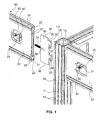
- the Fig. 1 shows a perspective view of an insert of an embodiment of a clamping device according to the invention on a vertical profile post 10.
- the profile post 10 is a first profile piece, which post is usually placed vertically. It is for example an aluminum profile with an inner cavity 13 and with at least on each of its four sides a central groove 11 as a fastening groove.
- it is a post 10 with still two laterally further provided grooves 12 on both sides of the central groove 11.
- wall elements in these grooves 11, 12 and 13 are fixed and held by transversely engaging in the undercuts of the grooves closures.
- the goal is a second transverse oriented To attach profile piece 20 to the first profile piece 10, which can derive on the top 90 acting loads on the post 10.
- two second profile pieces 20 are already attached as cross struts on the right side of the picture.
- the attachment can be seen in particular because, as will be apparent from the further description that a nut 50 is placed on a locking screw 31 and thereby presses a retaining clip 40 on an inner wall of this cross member 20.
- Fig. 1 In an exploded view of the Fig. 1 is another second profile piece 20 shown on the left side of the image before it is attached to the profile post 10.
- the second profile piece 20 has an upper rail 22 with three mounting grooves 24, which are aligned upwards and to the two sides and advantageously but not necessarily have undercuts. At the bottom of a lower rail 23 is also provided with three cultivation grooves. In between, there extends a connecting wall which is hollow at least in this end region of the transverse strut 20 and which comprises two side walls 27 between which there is a receiving cavity 21.
- the receiving cavity 21 terminates in the region of the upper or lower profile rail 22 and 23 in a stepped guide groove 26 in which the slide plate 30 is guided.
- the slide plate 30 is a generally rectangular element with flat opposite side walls, in the rear in the middle of a locking screw 31 is fixed, which is integrally connected via the connecting element 39 with the slide plate. It may be simply a metal plate 30, which has a recess in the region of the connecting element 39, in which a flattened end without thread of the locking screw 31 is inserted.
- the dimensions of the receiving cavity 21 and the slide plate 30 are such that the upper edge 34 and the lower edge 36 respectively in the opposite guide grooves 26 fit and when pushing the slide plate into the recess 21, the locking screw 31 protrudes into the locking recess 25 while on the other side, the two hooks 32 and 33 over the edges of the front walls 27 of the second profile piece 20th protrude.
- the locking screw 31 passes through a retaining clip 40 in its central opening 42 and is locked by a nut 50.
- the two hooks 32 and 33 project beyond a front abutment edge 49.
- the upper side surface 34 is offset by a stepped step 35 down.
- the Fig. 2 shows a perspective view of an insert of an embodiment of a clamping device on another embodiment of a profile piece.
- various first profile pieces 10, 110 are called or described as extension profile 210; and also different cross struts 20, 120, 220, 320 as Anschraubprofil in any combination possible.
- Each similar features are denoted by similar reference numerals.
- the second profile piece 120 has an upper and lower profile rail 122 or 123, which has three mounting grooves to the top or bottom and thus comprises a structure such as the post 10 with three grooves.
- mounting grooves 124 which are also aligned in the opposite direction. Otherwise, the two side walls 127 which form with the guide grooves 26, the cavity for receiving the slightly modified slide plate member 130, the same design.
- the locking screw 31 passes through the passage opening 42 of the retaining clip 40, which have two alignment grooves 41 extending transversely thereto.
- the alignment grooves 41 are intended to engage the side walls 129 of the recess and thus prevent twisting of this element 40.
- the Retaining clip 40 is also provided with a recessed step 128 depression in the side walls 129, so that when tightening the nut 50 on the screw 31, the retaining clip 40 fits into the step 128 and in this end position, the screw 31 and thus attracts the hook 32nd and 33 moves in their direction.
- the front surface of the support post 10 is brought into contact with the front side wall 29 of the profile piece 20.
- This wall 29 is formed both by areas of the two side walls 27 and the front ends of the upper and lower profiles 22 and 23.
- the slide plate 130 has as the slide plate 30 from the Fig. 1 an upper edge 34 and a lower edge 36, in which case the hooks 32 and 33 are arranged within the front edge or contact edge 149 of the slide plate 130.
- the hook cavities 137 form L-shaped recesses, for safe hooking here additionally the hooks 32 and 33 are provided with corresponding projecting hook nose 38, which supports a different attachment to a support post 10, as follows with a description of Fig. 5 and 6 will be provided.
- the Fig. 3 shows a perspective view of an insert of an embodiment of a clamping device with another embodiment of a Verspannements.
- the tensioning element in the Fig. 1 and 2 was a retaining clip 40 with vertical grooves 41 for oriented support on the side walls 27 of the second profile piece 20.
- this bracing element may also be simply a washer 140 through which the screw 31 is guided along the screw axis 51.
- the side wall 20 here corresponds to the cross member of the Fig. 1 with only one groove 24 having top 90th
- the Fig. 4 shows a perspective view of an insert of an embodiment of a clamping device with a crossbar 220 as a second profile piece with a coupling element 320 for another second profile piece 120 in this figure.
- the coupling element is the second attachment profile 320, which pass through four fixing screws 328, which are guided through openings in the solticiansflanschen 329 of Aufschraubprofils 320 through corresponding attachment holes 327 in the cross brace 220, then on the other side of the local wall over a nut 325 and washer 326 combination to be securely fastened.
- a second transverse strut 220 which may also be the struts 120 or 20, to arrange an intermediate profile between the posts to the patch on the top 92 load on the cross strut 220 here on a support post 10 (in the figure not shown).
- the Aufschraubprofil 320 has a vertically oriented receiving cavity 321, in which an undercut groove is provided in the front region. As with the receiving cavity 11, it is not necessarily necessary that this groove is undercut.
- Fig. 1 is provided in the depth of the receiving cavity 11 a longitudinally aligned along the post combination of slots for the passage of the lugs 32, 33;
- bolt holes 345 are provided transversely to this receiving cavity into which, as will be described later, bolts 146 are performed, which will then engage in the hook cavities 37 of the slide plate.
- the attachment and fixation in the horizontal direction also happens here again on the combination of retaining clip 40 and nut 50.
- the front side wall 29 of the second profile piece 120 in this situation is drawn onto the surfaces 29 of the mounting profile piece 320 and the cross brace 220 and locked horizontally ,
- the Fig. 5 shows a support head 110, which is used in conjunction with the post 10.
- This support head 110 is essentially an adapter piece, which, like the attachment profile piece 320, is provided exactly for the purpose of fastening the transverse struts 20, 120, etc.
- the support head 110 has a top 113 and a corresponding opposite bottom, both of which are planar and in each of which in the longitudinal direction of the support head 110 in the corners through holes 114 are provided for attachment to the corresponding continuing profiles. These corners have a flat corner surface 119
- the insertion groove 111 is milled out in the molding material and undercut in the central region, as can be seen from the bent gate region at the ends of the groove of the figure.
- Eckaus traditions 112 have a substantial length between the bottom portion 116 and cover portion 115 of the support head 110.
- two bolt holes 145 are provided by each wall 117 of the grooves 111, through which a bolt 146 is inserted.
- This bolt 146 then forms the possibility for the slide plate 30, 130 to reach over and hook into it.
- the front wall 118 is then pulled in horizontally frictional contact with the opposite front wall 29 of the cross member 20, brought and held.
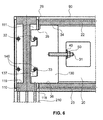
- the Fig. 6 now shows in a sectional view through such a support head 110, the lateral attachment of a slide plate 130.
- the stub head 110 rests on an extension profile 210 and is for example by (not shown) screws and bolts through the openings 114 connected thereto.
- the upper step portion 35 is necessary to use the necessary clearance in the insertion groove 111 so that the upper hook 32 can grip over the bolt 146.
- the upper surface 34 of the slide plate 30 rests against the underside of the insertion groove 26 and thus absorbs the weight which rests on the element, for example on the upper side 90. This gives (in the Fig. 6 ) at an oblique angle from top right to bottom left the load on the lower side edge 36 on and on the area which is supported on the underside of the insertion 111 on the corner surfaces 119.
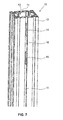
- the Fig. 7 shows a perspective view of the vertical profile post 10 from Fig. 1 , In the middle groove 11, the two slots 14 and 16 can be seen between which the full area of the bottom 16 of the groove 11 can be seen.
- the slots 14 and 16 have a length such that they can receive the hooks 32 and 33.
- the height of the upper slot 14 is such that the second profile 20 is flush with the top 91 when the slide 30 is inserted. For example, this may be a distance of 2.5 centimeters; wherein the two hooks 32 and 33 protrude into slots 14 and 15 with a length of 5 centimeters, between which there is a distance of 6 centimeters.
- the two slots 14 and 15 may also be located farther away from the upper edge. When inserting the slider 30 protrudes its front edge 49 of the groove bottom 16 and thus abuts against this. It would also be possible to use an insert not shown in the drawings in a third slot on which then the front portion of the bottom 36 could be discontinued.
- Fig. 8 shows a perspective view of an insert of an embodiment of a clamping device according to the invention on a variant of a vertical profile post 310th Die
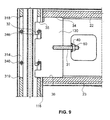
- Fig. 9 shows a partially sectioned view of the profile 210 to Fig. 8 with attached cross-section 20 with clamping device according to an embodiment of the invention.
- the use of the same and similar reference numbers shows that the individual features of a post 310 can be connected to suitable transverse profiles 130.
- a single front undercut groove 111 is provided, which is closed with a rear wall 311 to a cavity in the profile 310.
- the Applicant has found that it is statically advantageous not to provide the load without support of the lower edge 36 on a corresponding impact, but as in the Fig. 8 and 9 shown to provide this lower edge 36 on the bottom 319 of a receiving slot 314.
- the upper portion of the slide plate 30 can be inserted between the upper edge 318 and the upper pin 346, and then with the nose to include the hook 32.
- the bolt 346 can be inserted in a captive interference fit in the corresponding transverse holes in the wall of the profile 310.
- the load then rests on the one hand through-side walls with the only scratched side grooves 312 as well as on the lower edge 319 of the slot 314.
- a slot 314 is provided at the appropriate intervals along the profile 310.
- the slide plate 130 is retracted horizontally by tightening the nut as in the other embodiments, until the leading edge 118 touches the front edge of the profile 310 and is braced there.
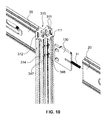
- the Fig. 10 shows a perspective view of an insert of an embodiment of a clamping device according to the invention to another variant of the attachment of a vertical profile post 310.
- no bolts 346 are pressed, but these include a flange formed as a bolt head 347 and on the opposite Page a snap ring 348, or if necessary a sapwood.
- the bolts 346 are releasably secured according to this embodiment against falling out, while according to the embodiment of the Fig. 8 and 9 are provided in a press fit as a safeguard against losing.
- two bolts are provided in each case; it could also be three or four bolts with corresponding, more lugs 32, 33 having slide plates 130.
Landscapes
- Engineering & Computer Science (AREA)
- General Engineering & Computer Science (AREA)
- Mechanical Engineering (AREA)
- Connection Of Plates (AREA)
- Mutual Connection Of Rods And Tubes (AREA)
- Clamps And Clips (AREA)
- Joining Of Building Structures In Genera (AREA)
Abstract
Description
- Die vorliegende Erfindung betrifft eine Klemmvorrichtung zum lösbaren Verbinden zweier Profilstücke, insbesondere eines ersten mit einem zweiten Profilstücks, wobei die Klemmvorrichtung in eine in dem ersten Profilstück vorgesehene Ausnehmung einführbar ist, mit mindestens einem Hakenelement zum Eingreifen in das erste Profilstück und mit einem Verspannnelement, mit dem das mindestens eine Hakenelement in mindestens ein dazu komplementäres Verriegelungselement des ersten Profilstücks in den lösbaren Eingriff bringbar ist.
- Eine Klemmvorrichtung der oben genannten Art ist beispielsweise aus der
WO 99/09326 - Eine solche Klemmeinrichtung ist auch aus der
WO 97/25536 - Diese Vorrichtungen weisen jeweils eine Verschlusshülse auf, in der die Hakenelemente und Verspannelemente integriert sind. Somit sind zur Übertragung von grösseren Kräften entsprechend grössere Hülsen vorzusehen, was die Anordnung solcher Elemente komplexer und aufwendiger macht, insbesondere wenn die zu tragenden Lasten nicht nur Wandelemente oder Verschalungen sind, sondern wenn ein solches Profilstück eine horizontale Strebe eines Gerüstes ist, auf dem beispielsweise eine Bodenfläche eines weiteren oberen Stockwerk vorgesehen ist, so dass dessen Lasten abzustützen sind.
- Es ist daher eine Aufgabe der vorliegenden Erfindung, eine Klemmvorrichtung anzugeben, die diese Lastabstützung in möglichst einfacher Weise gewährleistet.
- Eine Klemmvorrichtung zum lösbaren Verbinden eines ersten mit einem zweiten Profilstücks, die in eine in dem ersten Profilstück vorgesehene Ausnehmung einführbar ist, und die die Merkmale des Oberbegriffs des Anspruchs 1 aufweist, ist dann über die kennzeichnenden Merkmale dieses Anspruchs verfügt.
- Eine Klemmvorrichtung ist zum lösbaren Verbinden eines ersten mit einem zweiten Profilstück vorgesehen, wobei die Klemmvorrichtung in eine in dem ersten Profilstück vorgesehene Ausnehmung einführbar ist und mit mindestens einem Hakenelement zum Eingreifen in das erste Profilstück und mit einem Verspannnelement versehen ist. Damit ist das mindestens eine Hakenelement in mindestens ein dazu komplementäres Verriegelungselement des ersten Profilstücks in einen lösbaren haltenden Eingriff bringbar. Die Klemmvorrichtung umfasst dafür eine Platte, wobei das mindestens eine Hakenelement in der Ebene der Platte auf das erste Profilstück ausgerichtet ist, und das Verspannelement ist auf der entgegengesetzten Seite der Platte gegenüber dem Hakenelement vorgesehen ist, um die Platte gegen das zweite Profilstück zu verspannen.
- Das Verspannelement kann dann eine mit der Platte verbundene Schraube oder einen Bolzen umfassen, welche oder welcher in einen hinter der Platte vorgesehenen Hohlraum ragt, um mit Sicherungselementen gegen das zweite Profilstück verspannbar zu sein.
- Das Verspannelement kann eine Schraube sein und dann ist das Sicherungselement beispielsweise eine Mutter. Dann kann insbesondere unter der Schraube eine Halteklammer angeordnet sein, die mit Längsnuten in die beiden den die Platte aufnehmenden Hohlraum bildende Seitenwände eingreifen, um verdrehsicher die Kraft über eine grössere Fläche auf die recht dünnen Wandelemente zu übertragen.
- Das Verspannelement kann auch ein Bolzen sein, wobei dann das Sicherungselement eine Hebelverriegelung umfasst, also einen umschwenkbaren Hebel, mit dem über eine Ablaufkurve eine Schliesskraft auf den Bolzen übertragen wird, vorteilhafterweise über einen Totpunkt hinweg.
- Die Verriegelungselemente können Bolzen sein, die quer durch die Ausnehmung ragen, um beim Zusammenbau von dem oder den Hakenelementen umgriffen zu werden und um zur Verriegelung durch das Verspannelement gegenüber der Platte angezogen zu werden. Bei solchen Bolzen können diese eine Querbohrung zur Aufnahme eines Sicherungssplints aufweisen, wenn das andere Ende einen Flansch aufweist. Die Bolzen sind dabei in quer verlaufenden Löchern vorgesehen sind.
- Die Wand hinter der Ausnehmung im Bereich der Bolzen kann dabei durchbrochen sein, um ein Hintergreifen der Bolzen durch die Schieberplatte zu gestatten. Dabei ist der Durchbruch der Wand hinter der Ausnehmung zum Beispiel ein Schlitz. Die Unterkante des Durchbruchs der Wand hinter der Ausnehmung kann dabei als Widerlager für die Unterkante der Schieberplatte) dienen.
- Die Platte kann mit ihrer Oberseite in führendem und lasttragendem Kontakt in dem zweiten Profilstück verspannbar sein und die Unterseite der Platte ist auf einer Fläche des ersten Profilstücks lasttragend abstützbar. Alternativ ist die Unterseite der Hakenausnehmung(en) auf mit der Platte lasttragend verbundenen Element(en) abstützbar ist.
- In Aluminiumprofile als Pfosten eingesetzte Stahlbolzen, insbesondere mit etwas vergrössertem Durchmesser wie 10 bis 15 Millimeter gegenüber der Wandstärke eines Schlitzes für das Hintergreifen durch die Nasen, weisen Vorteile beim Tragen der Last auf. Sie können in einem Presssitz vorgesehen sein und damit unverlierbar mit dem Aluminiumprofil verbunden sein. Die Unterstützungsfläche ist dann in den seitlichen Flanken der Wände und damit stabiler als in der Höhe über vielleicht mehrere Schlitze in der rückwärtigen Wand.
- Weitere Ausführungsformen sind in den abhängigen Ansprüchen angegeben.
- Bevorzugte Ausführungsformen der Erfindung werden im Folgenden anhand der Zeichnungen beschrieben, die lediglich zur Erläuterung dienen und nicht einschränkend auszulegen sind. In den Zeichnungen zeigen:
- Fig. 1
- eine perspektivische Ansicht eines Einsatzes eines Ausführungsbeispiels einer Klemmvorrichtung gemäss der Erfindung an einem vertikalen Profilpfosten;
- Fig. 2
- eine perspektivische Ansicht eines Einsatzes eines Ausführungsbeispiels einer Klemmvorrichtung an einem anderen Ausführungsbeispiel eines Profilstücks;
- Fig. 3
- eine perspektivische Ansicht eines Einsatzes eines Ausführungsbeispiels einer Klemmvorrichtung mit einem anderen Ausführungsbeispiel eines Verspannelements;
- Fig. 4
- eine perspektivische Ansicht eines Einsatzes eines Ausführungsbeispiels einer Klemmvorrichtung mit einer Querstrebe als zweites Profilstück mit einem Kupplungselement für das zweite Profilstück;
- Fig. 5
- eine perspektivische Ansicht eines Stützkopfes für ein Ausführungsbeispiel einer Klemmvorrichtung mit einem Profilpfosten;
- Fig. 6
- eine teilweise geschnittene Ansicht eines Stützkopfes nach
Fig. 5 mit angesetztem Querprofil mit Klemmvorrichtung gemäss einem Ausführungsbeispiel der Erfindung; - Fig. 7
- eine perspektivische Ansicht des vertikalen Profilpfostens aus
Fig. 1 ; - Fig. 8
- eine perspektivische Ansicht eines Einsatzes eines Ausführungsbeispiels einer Klemmvorrichtung gemäss der Erfindung an einer Variante eines vertikalen Profilpfostens;
- Fig. 9
- eine teilweise geschnittene Ansicht eines Profils nach
Fig. 8 mit angesetztem Querprofil mit Klemmvorrichtung gemäss einem Ausführungsbeispiel der Erfindung; und - Fig. 10
- eine perspektivische Ansicht eines Einsatzes eines Ausführungsbeispiels einer Klemmvorrichtung gemäss der Erfindung an einer weiteren Variante der Befestigung eines vertikalen Profilpfostens.
- Die
Fig. 1 zeigt eine perspektivische Ansicht eines Einsatzes eines Ausführungsbeispiels einer Klemmvorrichtung gemäss der Erfindung an einem vertikalen Profilpfosten 10. Der Profilpfosten 10 ist ein erstes Profilstück, welcher Pfosten üblicherweise vertikal aufgestellt wird. Er ist beispielsweise ein Aluminiumprofil mit einem inneren Hohlraum 13 und mit mindestens an jeder seiner vier Seiten einer mittleren Nut 11 als Befestigungsnut. Hier handelt es sich um einen Pfosten 10 mit noch jeweils zwei seitlich weiter vorgesehenen Nuten 12 beidseitig zur mittleren Nut 11. Üblicherweise werden hier nicht dargestellte Wandelemente in diesen Nuten 11, 12 und 13 befestigt und durch quer in die Hinterschneidungen der Nuten eingreifende Verschlüsse gehalten. - Bei der vorliegenden Erfindung ist dagegen das Ziel, ein zweites quer orientiertes Profilstück 20 an dem ersten Profilstück 10 zu befestigen, das auf dessen Oberseite 90 wirkende Lasten auf den Pfosten 10 ableiten kann.
- An den zentralen Pfosten 10 sind auf der rechten Bildseite bereits zwei zweite Profilstücke 20 als Querstreben befestigt. Die Befestigung sieht man insbesondere daran, wie sich aus der weiteren Beschreibung ergeben wird, dass eine Mutter 50 auf eine Verriegelungsschraube 31 aufgesetzt ist und dabei eine Halteklammer 40 auf eine Innenwand dieser Querstrebe 20 drückt.
- In einer Explosionsdarstellung der
Fig. 1 ist ein weiteres zweites Profilstück 20 auf der linken Bildseite dargestellt, bevor es an dem Profilpfosten 10 befestigt wird. - Das zweite Profilstück 20 verfügt über eine obere Profilschiene 22 mit drei Anbaunuten 24, die nach oben und zu den beiden Seiten ausgerichtet sind und vorteilhafterweise aber nicht notwendigerweise Hinterschneidungen aufweisen. Am unteren Ende ist eine untere Profilschiene 23 mit ebenfalls drei Anbaunuten vorgesehen. Dazwischen erstreckt sich eine zumindest in diesem Endbereich der Querstrebe 20 hohle Verbindungswand, die aus zwei Seitenwänden 27 besteht, zwischen denen ein Aufnahmehohlraum 21 besteht.
- Der Aufnahmehohlraum 21 endet im Bereich der oberen bzw. unteren Profilschiene 22 und 23 in einer abgestuften Führungsnut 26, in welcher die Schieberplatte 30 geführt wird. Die Schieberplatte 30 ist ein im grossen und ganzen rechtwinkliges Element mit flachen gegenüberliegenden Seitenwänden, in dem rückwärtig in der Mitte eine Verriegelungsschraube 31 befestigt ist, wobei diese über das Verbindungselement 39 einstückig mit der Schieberplatte verbunden ist. Es kann sich dabei in einfacherweise um eine Metallplatte 30 handeln, die im Bereich des Verbindungselementes 39 eine Ausnehmung aufweist, in die ein abgeflachtes Ende ohne Gewinde der Verriegelungsschraube 31 eingesetzt ist. Die Dimensionen des Aufnahmehohlraums 21 und der Schieberplatte 30 sind dergestalt, dass die obere Kante 34 und die untere Kante 36 jeweils in die gegenüberliegenden Führungsnuten 26 einpassen und bei einem Hineinschieben der Schieberplatte in die Ausnehmung 21 die Verriegelungsschraube 31 in die Verriegelungsausnehmung 25 hineinragt, während auf der anderen Seite die beiden Haken 32 und 33 über die Kanten der Vorderwände 27 des zweiten Profilstückes 20 hinausstehen. Die Verriegelungsschraube 31 durchtritt eine Halteklammer 40 in deren zentralen Öffnung 42 und wird durch eine Mutter 50 gekontert.
- Die beiden Haken 32 und 33 stehen über eine vordere Anlagekante 49 hinaus. Im oberen Bereich ist die obere Seitenfläche 34 durch eine abgesetzte Stufe 35 nach unten versetzt.
- In der mittleren Nut 11 des Profilpfostens 10 sind verschiedene durch die Wand des Profilpfostens 10 hindurchführende und somit in den Innenhohlraum 13 gelangende (und in der
Fig. 1 nicht dargestellte) Ausnehmungen (Schlitze 14 und 15 inFig, 7 ) vorgesehen, in welche die Haken 32 und 33 eingesetzt werden können. Die Ausnehmungen 14 und 15 sind dabei so angeordnet, dass bei einem Einhaken der Haken 32 und 33 durch den Hakenhohlraum 37 die Oberkante 91 der oberen Profilschiene 22 vorteilhafterweise bündig mit einem vordefinierten Position bzw. Ende des Profilpfostens 10 einnimmt. Dies ist bei den beiden bereits rechts eingezeichneten zweiten Profilstücken 20 genauso der Fall. - Die
Fig. 2 zeigt eine perspektivische Ansicht eines Einsatzes eines Ausführungsbeispiels einer Klemmvorrichtung an einem anderen Ausführungsbeispiel eines Profilstücks. In der vorliegenden Beschreibung werden verschiedene erste Profilstücke 10, 110 genannt oder als Verlängerungsprofil 210 beschrieben; und gleichfalls sind verschiedene Querstreben 20, 120, 220, 320 als Anschraubprofil in jeder Kombination möglich. Es sind jeweils ähnliche Merkmale mit ähnlichen Bezugszeichen bezeichnet. In dieserFig. 2 weist das zweite Profilstück 120 eine obere und untere Profilschiene 122 bzw. 123 auf, welche drei Anbaunuten zur Oberseite bzw. Unterseite aufweist und somit eine Struktur wie der Pfosten 10 mit drei Nuten umfasst. - Damit wird zudem ermöglicht, Anbaunuten 124 vorzusehen, die auch in die entgegengesetzte Richtung ausgerichtet sind. Ansonsten sind die beiden Seitenwände 127, die mit den Führungsnuten 26 den Hohlraum zur Aufnahme des hier leicht veränderten Schieberplattenelementes 130 bilden, gleich ausgestaltet. Die Verriegelungsschraube 31 tritt durch die Durchführungsöffnung 42 der Halteklammer 40 hindurch, die zwei dazu quer verlaufende Ausrichtungsnuten 41 aufweisen. Die Ausrichtungsnuten 41 sind dafür vorgesehen, in die Seitenwände 129 der Ausnehmung einzugreifen und somit ein Verdrehen dieses Elementes 40 zu vermeiden. Für eine bessere Ausrichtung der Halteklammer 40 ist zudem eine mit der Stufe 128 abgesetzte Vertiefung in den Seitenwänden 129 vorgesehen, so dass beim Anziehen der Mutter 50 auf der Schraube 31 die Halteklammer 40 sich in die Stufe 128 einpasst und in dieser Endlage die Schraube 31 anzieht und somit die Haken 32 und 33 in ihre Richtung bewegt. Dabei wird die Vorderfläche des Stützpfostens 10 in Kontakt gebracht mit der Vorderseitenwand 29 des Profilstücks 20. Diese Wand 29 wird sowohl von Bereichen der beiden Seitenwänden 27 als auch von den vorderen Enden der oberen und unteren Profile 22 und 23 gebildet.
- Die Schieberplatte 130 weist wie die Schieberplatte 30 aus der
Fig. 1 eine Oberkante 34 und eine Unterkante 36 auf, wobei hier die Haken 32 und 33 innerhalb der Vorderkante oder Anlagekante 149 der Schieberplatte 130 angeordnet sind. Somit bilden die Hakenhohlräume 137 L-förmige Ausnehmungen, wobei zum sicheren Einhängen hier zusätzlich die Haken 32 und 33 mit entsprechenden vorspringenden Hakennasen 38 versehen sind, was eine andere Befestigung an einem Stützpfosten 10 unterstützt, wie es im Folgenden mit einer Beschreibung derFig. 5 und6 vorgesehen sein wird. - Die
Fig. 3 zeigt eine perspektivische Ansicht eines Einsatzes eines Ausführungsbeispiels einer Klemmvorrichtung mit einem anderen Ausführungsbeispiel eines Verspannelementes. Das Verspannelement in denFig. 1 und2 war eine Halteklammer 40 mit Vertikalnuten 41 zur orientierten Halterung an den Seitenwänden 27 des zweiten Profilstückes 20. Bei einem anderen einfacheren Ausführungsbeispiel kann dieses Verspannelement auch einfach eine Unterlegscheibe 140 sein, durch die die Schraube 31 entlang der Schraubenachse 51 geführt ist. Ansonsten entspricht die Seitenwand 20 hier der Querstrebe aus derFig. 1 mit einer nur eine Nut 24 aufweisenden Oberseite 90. - Die
Fig. 4 zeigt eine perspektivische Ansicht eines Einsatzes eines Ausführungsbeispiels einer Klemmvorrichtung mit einer Querstrebe 220 als zweites Profilstück mit einem Kupplungselement 320 für ein weiteres zweite Profilstück 120 in dieser Figur. Das Kupplungselement ist das zweite Anbauprofilstück 320, welches mit Hilfe von hier vier Befestigungsschrauben 328, die durch Öffnungen in den Seitenlängsflanschen 329 des Aufschraubprofils 320 geführt sind, durch entsprechende Befestigungslocher 327 in der Querstrebe 220 hindurchtreten, um dann auf der anderen Seite der dortigen Wand über eine Mutter 325 und Unterlegscheibe 326 Kombination sicher befestigt zu werden. Somit ist es möglich, auf einer zweiten Querstrebe 220, bei der es sich auch um die Streben 120 oder 20 handeln kann, ein Zwischenprofil zwischen den Pfosten anzuordnen, um die auf der Oberseite 92 aufgesetzte Last über die Querstrebe hier 220 auf einen Stützpfosten 10 (in der Figur nicht dargestellt) abzuleiten. - Das Aufschraubprofil 320 verfügt über einen vertikal ausgerichteten Aufnahmehohlraum 321, in welchem im vorderen Bereich eine hinterschnittene Nut vorgesehen ist. Wie auch bei dem Aufnahmehohlraum 11 ist es nicht zwangsweise notwendig, dass diese Nut hinterschnitten ist. Bei der
Fig. 1 ist in der Tiefe des Aufnahmehohlraum 11 eine längs des Pfosten ausgerichtete Kombination von Schlitzen für den Durchgriff der Nasen 32, 33 vorgesehen; hier sind quer zu diesem Aufnahmehohlraum Bolzenlöcher 345 vorgesehen, in die, wie später beschrieben werden wird, Bolzen 146 durchgeführt werden, die dann in die Hakenhohlräume 37 der Schieberplatte eingreifen werden. Die Befestigung und Fixierung in horizontaler Richtung geschieht auch hier wieder über die Kombination von Halteklammer 40 und Mutter 50. Dabei wird die Vorderseitenwand 29 des in dieser Situation zweiten Profilstücks 120 auf die Flächen 29 des Anbau-Profilstücks 320 und der Querstrebe 220 gezogen und horizontal verriegelt. - Die
Fig. 5 zeigt einen Stützkopf 110, welcher im Zusammenspiel mit den Pfosten 10 eingesetzt wird. Dieser Stützkopf 110 ist im Wesentlichen ein Adapterstück, welches, wie das Anbauprofilstück 320, exakt für den Zweck der Befestigung der Querstreben 20, 120 etc. vorgesehen ist. Der Stützkopf 110 weist eine Oberseite 113 und eine entsprechende gegenüberliegende Unterseite auf, die beide eben ausgestaltet sind und in welchen jeweils in Längsrichtung des Stützkopfes 110 in den Ecken durchgehende Löcher 114 zur Befestigung an den entsprechend weiterlaufenden Profilen vorgesehen sind. Diese Ecken haben eine flache Eckoberfläche 119 Hier ist die Einführnut 111 im Formmaterial ausgefräst und im mittleren Bereich hinterschnitten, wie sich aus dem gebogenen Anschnittbereich an den Enden der Nut aus der Figur ersehen lässt. An allen vier Ecken bestehen Eckausnehmungen 112 über eine wesentliche Länge zwischen Bodenabschnitt 116 und Deckelabschnitt 115 des Stützkopfes 110. Quer zu den Nuten 111 sind hier jeweils zwei Bolzenlöcher 145 durch jede Wand 117 des Nuten 111 vorgesehen, durch die jeweils ein Bolzen 146 einsetzbar ist. Dieser Bolzen 146 bildet dann die Möglichkeit für die Schieberplatte 30, 130 aus, über diesen hinwegzugreifen und sich in ihn einzuhaken. Dabei wird dann die Vorderwand 118 in horizontal kraftschlüssigen Kontakt mit der entgegengesetzten Vorderwand 29 der Querstrebe 20 gezogen, gebracht und gehalten. - Die
Fig. 6 zeigt nun in einer geschnittenen Ansicht durch einen solchen Stützkopf 110 die seitliche Befestigung einer Schieberplatte 130. Der Stzützkopf 110 ruht auf einem Verlängerungsprofil 210 und ist beispielsweise durch (nicht dargestellte) Schrauben und Bolzen durch die Öffnungen 114 mit diesem verbunden. Durch die quer verlaufenden Bolzenlöcher 145 sind entsprechende Bolzen 146 eingeführt, bei denen es sich beispielsweise um 12 Millimeter Durchmesser aufweisende Bolzen handeln kann, die im Bereich der Einführungsnut 111 nur eine Dicke von 10 Millimeter aufweisen. Diese Dicke von 10 Millimetern entspricht dann auch - mit Masstoleranzen - dem Durchmesser der Hakenhohlräume 37. - Bei den in der
Fig. 6 dargestellten Einsätzen ist zu erkennen, dass der obere Stufenabschnitt 35 notwendig ist, um den notwendigen Freiraum in der Einführnut 111 zu nutzen, damit der obere Haken 32 über den Bolzen 146 greifen kann. Die Oberseite 34 der Schieberplatte 30 ruht gegen die Unterseite der Einführnut 26 und nimmt somit das Gewicht, welches auf dem Element lastet, beispielsweise auf der Oberseite 90, auf. Dieses gibt (in derFig. 6 ) in einem schrägen Winkel von rechts oben nach links unten die Last auf die untere Seitenkante 36 weiter und zwar auf den Bereich, der sich auf der Unterseite der Einführnut 111 auf den Eckflächen 119 abstützt. Somit ruht nicht das Gewicht die Querstrebe 20 betreffenden Lasten, ausgehend von der Oberseite 90, auf den Verschlusselementen, hier Haken 32 und Bolzen 146, sondern auf dem Stützpfosten 110 selber und somit auf der Verlängerung des Profilpfostens 210. Die Mutter 50 wird somit auch nur noch angezogen, um sicherzustellen, dass die Haken 32 und 33 sich sicher in ihren Aufnahmehohlräumen 137 befinden. Es werden dadurch also im wesentlichen nur längs der Achse 51 aus derFig. 4 wirkende Kräfte aufgenommen. - Somit wird in einfacher Weise eine sehr effiziente Lastübertragung von einer Querstrebe 20, 120, 220, 320 auf einen Pfosten 10, 110, 210 mit einfach aufzubauenden Elementen erreicht, welche grosse auf den Oberseiten 90, 91, 92 wirkende Lasten in sicherer Weise übernehmen können.
- Die
Fig. 7 zeigt eine perspektivische Ansicht des vertikalen Profilpfostens 10 ausFig. 1 . In der mittleren Nut 11 sind die beiden Schlitze 14 und 16 erkennbar zwischen denen der Vollbereich des Bodens 16 der Nut 11 zu sehen ist. Die Schlitze 14 und 16 haben eine Länge, dass sie die Haken 32 und 33 aufnehmen können. Die Höhe des oberen Schlitzes 14 ist so, dass das zweite Profil 20 bei eingesetztem Schieber 30 oben bündig mit der Oberseite 91 ist. Beispielsweise kann dies ein Abstand von 2,5 Zentimeter sein; wobei die beiden Haken 32 und 33 in Schlitze 14 und 15 mit einer Länge von 5 Zentimeter ragen, zwischen denen 6 Zentimeter Abstand besteht. Es können auch drei und mehr Schlitze vorgesehen sein, um die Streben 20 an unterschiedlichen Höhen anbringen zu können. Die zwei Schlitze 14 und 15 können auch weiter entfernt von der oberen Kante angeordnet sein. Bei einem Einsetzen des Schiebers 30 ragt dessen Vorderkante 49 an den Nutboden 16 und stösst somit an diesen an. Es wäre auch möglich einen in den Zeichnungen nicht dargestellten Einsatz in einen dritten Schlitz einzusetzen, auf dem dann der vordere Abschnitt der Unterseite 36 abgesetzt sein könnte. - Die
Fig. 8 zeigt eine perspektivische Ansicht eines Einsatzes eines Ausführungsbeispiels einer Klemmvorrichtung gemäss der Erfindung an einer Variante eines vertikalen Profilpfostens 310. DieFig. 9 zeigt dazu eine teilweise geschnittene Ansicht des Profils 210 nachFig. 8 mit angesetztem Querprofil 20 mit Klemmvorrichtung gemäss einem Ausführungsbeispiel der Erfindung. Die Benutzung gleicher und ähnlicher Bezugszeichen zeigt, dass die einzelnen Merkmale eines Pfostens 310 mit geeigneten Querprofilen 130 verbindbar sind. Hier ist eine einzelne vordere hinterschnittene Nut 111 vorgesehen, die mit einer Rückwand 311 zu einem Hohlraum im Profil 310 abgeschlossen ist. Prinzipiell wäre es möglich, wie bei dem Ausführungsbeispiel nachFig. 7 einen Schlitz in dieser Wand vorzusehen, um dann die Nasen 32, 33 eines Querprofils einzuhängen. Bei Lasttrageversuchen hat die Anmelderin aber festgestellt, dass es statisch vorteilhaft ist, die Last nicht ohne Auflage der Unterkante 36 auf einem entsprechenden Anstoss vorzusehen, sondern wie in denFig. 8 und9 gezeigt, diese Unterkante 36 auf dem Boden 319 eines Aufnahmeschlitzes 314 vorzusehen. Der obere Abschnitt der Schieberplatte 30 kann zwischen der oberen Kante 318 und dem oberen Bolzen 346 eingeschoben werden, um dann mit der Nase den Haken 32 zu umfassen. Der Bolzen 346 kann dabei in einem unverlierbaren Presssitz in die entsprechenden quer verlaufenden Löcher in der Wand des Profils 310 eingeschoben werden. Damit ruht dann die Last einerseits auf den durchgehenden Seitenwänden mit den nur angeritzten Seitennuten 312 als auch auf der unteren Kante 319 des Schlitzes 314. Dies sind gegenüber der Ausführung derFig. 6 vergleichbare und gegenüber derFig. 7 mehr Last tragende Verhältnisse, insbesondere auch weil die Profile 310 üblicherweise aus Aluminium sind, während der . Vorteilhafterweise wird ein Schlitz 314 in den geeigneten Abständen entlang des Profils 310 vorgesehen. Dabei wird durch das Anziehen der Mutter die Schieberplatte 130 wie bei den anderen Ausführungsbeispielen horizontal zurückgezogen, bis die Vorderkante 118 die Vorderkante des Profils 310 berührt und dort verspannt wird. - Die
Fig. 10 zeigt eine perspektivische Ansicht eines Einsatzes eines Ausführungsbeispiels einer Klemmvorrichtung gemäss der Erfindung an einer weiteren Variante der Befestigung eines vertikalen Profilpfostens 310. In dem ansonsten gleichen Pfosten 310 sind hier keine Bolzen 346 eingepresst, sondern diese umfassen einen als Flansch ausgebildeten Bolzenkopf 347 und auf der gegenüberliegenden Seite einen Sprengring 348, oder gegegebenfalls einen Splint. Damit sind die Bolzen 346 gemäss diesem Ausführungsbeispiel gegen Herausfallen lösbar gesichert, während sie nach dem Ausführungsbeispiel derFig. 8 und9 in einem Presssitz als Sicherung gegen das Verlieren vorgesehen sind. In den dargestellten Ausführunsgbeispielen sind jeweils zwei Bolzen vorgesehen; es könnten auch drei oder vier Bolzen mit entsprechenden, mehr Nasen 32, 33 aufweisenden Schieberplatten 130 sein. -
- 10
- Profilpfosten; erstes Profil
- 11
- mittlere Nut
- 12
- Seitennut
- 13
- Innenhohlraum
- 14
- oberer Schlitz
- 15
- unterer Schlitz
- 16
- Anschlagfläche in der Nut
- 20
- Querstrebe; zweites Profilstück
- 21
- Aufnahmehohlraum
- 22
- obere Profilschiene
- 23
- untere Profilschiene
- 24
- Anbaunuten
- 25
- Verriegelungsausnehmung
- 26
- Führungsnut
- 27
- Seitenwand
- 29
- Vorderseitenwand
- 30
- Schieberplatte
- 31
- Verriegelungsbolzen / - schraube
- 32
- oberer Haken
- 33
- unterer Haken
- 34
- obere Seitenfläche
- 35
- abgesetzte Stufe
- 36
- untere Seitenkante
- 37
- Hakenhohlraum
- 38
- Hakennase
- 39
- Verbindungselement
- 40
- Halteklammer
- 41
- Ausrichtungsnut
- 42
- Durchführungsöffnung
- 49
- Anlagekante
- 50
- Mutter
- 51
- Schraubenachse
- 90,91,92
- Oberseite
- 110
- Stützkopf; erstes Profil
- 111
- Einführnut
- 112
- Eckausnehmung
- 113
- Anschlussfläche
- 114
- Loch
- 115
- Deckelabschnitt
- 116
- Bodenabschnitt
- 117
- Nutenwand
- 118
- Vorderseitenwand
- 119
- Eckfläche
- 120
- Querstrebe; zweites Profilstück
- 122
- obere Profilschiene
- 123
- untere Profilschiene
- 124
- Anbaunuten
- 125
- Verriegelungsausnehmung
- 128
- Stufe
- 129
- Seitenwände in Ausnehmung
- 130
- Schieberplatte
- 137
- Hakenhohlraum
- 140
- Unterlegscheibe
- 145
- Bolzenloch
- 146
- Bolzen
- 149
- Anlagekante
- 210
- Verlängerungsprofil
- 220
- Querstrebe; zweites Profilstück
- 225
- Versorgungsleitungsausnehmung
- 310
- Profilpfosten; erstes Profil
- 311
- Rückwand der Einführnut
- 312
- Seitennut
- 314
- Schlitz
- 318
- Unterkante
- 319
- Abstützfläche
- 320
- zweites Anbau-Profilstück; Aufschraubprofil
- 321
- Aufnahmehohlraum
- 325
- Mutter
- 326
- Unterlegscheibe
- 327
- Befestigungsloch
- 328
- Befestigungsschraube
- 329
- Seitenlängsflansch
- 345
- Bolzenloch
- 346
- Bolzen
- 347
- Bolzenkopf
- 348
- Sprengring
Claims (11)
- Klemmvorrichtung zum lösbaren Verbinden eines ersten (10; 110; 310) mit einem zweiten (20, 120; 320) Profilstück, wobei die Klemmvorrichtung in eine in dem ersten Profilstück (10, 110; 310) vorgesehene Ausnehmung (11; 14, 15; 111; 314) einführbar ist und mit mindestens einem Hakenelement (32, 33) zum Eingreifen in das erste Profilstück (10; 110; 310) und mit einem Verspannnelement (31; 40, 140; 50) versehen ist, mit dem das mindestens eine Hakenelement (32, 33) in mindestens ein dazu komplementäres Verriegelungselement (146; 346) des ersten Profilstücks (10; 110) in den lösbaren haltenden Eingriff bringbar ist, dadurch gekennzeichnet, dass die Klemmvorrichtung eine Platte (30; 130) umfasst, dass das mindestens eine Hakenelement (32, 33) in der Ebene der Platte (30; 130) auf das erste Profilstück (10; 110; 310) ausgerichtet ist und dass das Verspannelement (31; 40, 140; 50) auf der entgegengesetzten Seite der Platte (30, 130) gegenüber dem Hakenelement (32, 33) vorgesehen ist, um die Platte (30; 130) gegen das zweite Profilstück (20, 120; 320) zu verspannen.
- Klemmvorrichtung nach Anspruch 1, dadurch gekennzeichnet, dass das Verspannelement eine mit der Platte (30; 130) verbundene Schraube (31) oder Bolzen umfasst, welche oder welcher in einen hinter der Platte (30; 130) vorgesehenen Hohlraum (25) ragt, um mit Sicherungselementen (40, 50) gegen das zweite Profilstück (20, 120, 320) verspannbar zu sein.
- Klemmvorrichtung nach Anspruch 2, dadurch gekennzeichnet, dass das Verspannelement eine Schraube (31) und das Sicherungselement (40, 50) eine Mutter (50) umfasst.
- Klemmvorrichtung nach Anspruch 2, dadurch gekennzeichnet, dass das Verspannelement ein Bolzen und das Sicherungselement eine Hebelverriegelung umfasst.
- Klemmvorrichtung nach einem der Ansprüche 1 bis 4, dadurch gekennzeichnet, dass die Verriegelungselemente Bolzen (146; 346) sind, die quer durch oder nahe an der Ausnehmung (111) in quer verlaufenden Löchern (145) vorgesehen sind, um beim Zusammenbau von dem Hakenelement (32, 33) umgriffen zu werden und um zur Verriegelung durch das Verspannelement gegenüber der Platte (30, 130) angezogen zu werden.
- Klemmvorrichtung nach Anspruch 5, dadurch gekennzeichnet, dass die Wand hinter der Ausnehmung (111) im Bereich der Bolzen (146, 346) durchbrochen (314) ist, um ein Hintergreifen der Bolzen (146, 346) durch die Schieberplatte (146, 346) zu gestatten.
- Klemmvorrichtung nach Anspruch 6, dadurch gekennzeichnet, dass der Durchbruch der Wand hinter der Ausnehmung (111) ein Schlitz (314) ist.
- Klemmvorrichtung nach Anspruch 7, dadurch gekennzeichnet, dass die Unterkante (319) des Durchbruchs (314) der Wand hinter der Ausnehmung (111) ausgestaltet ist, um als Widerlager für die Unterkante (36) der Schieberplatte (130) zu dienen..
- Klemmvorrichtung nach einem der Ansprüche 5 bis 8, dadurch gekennzeichnet, dass die Bolzen (346) an ihrem einen Ende über einen den Lochdurchmesser (145) der Ausnehmungswände (111) überragenden Flansch (347) und an dem anderen Ende über einen Splint, einen Sprengring (348) in einer Nut oder ein anderes das Herausfallen der Bolzen (146) verhinderndes Element verfügen.
- Klemmvorrichtung nach einem der Ansprüche 1 bis 4, dadurch gekennzeichnet, dass die Verriegelungselemente Bodenbereiche (16) der Ausnehmungen (11; 111) umfassen, die durch die Hakenelemente (32, 23) zugewiesenen Aufnahmeschlitze (14, 15) getrennt sind, damit beim Zusammenbau die Hakenelemente (32, 33) durch die Aufnahmeschlitze (14, 15) treten und die Bodenbereiche (16) vom Innenraum (13) her umgreifen und um zur Verriegelung durch das Verspannelement gegenüber der Platte (30, 130) angezogen zu werden.
- Klemmvorrichtung nach einem der Ansprüche 1 bis 10, dadurch gekennzeichnet, dass die Platte (30; 130) mit ihrer Oberseite (34) in führendem und lasttragendem Kontakt in dem zweiten Profilstück (20, 120, 320) verspannbar ist und dass die Unterseite (36) der Platte (30, 130) auf einer Fläche (119) des ersten Profilstücks 10, 110) lasttragend abstützbar ist oder dass die Unterseite der Hakenausnehmung(en) (37; 137) auf mit der Platte lasttragend verbundenen Element(en) (146) abstützbar ist.
Priority Applications (10)
| Application Number | Priority Date | Filing Date | Title |
|---|---|---|---|
| EP12176195.1A EP2685111B1 (de) | 2012-07-09 | 2012-07-12 | Klemmvorrichtung zum lösbaren Verbinden zweier Profilstücke |
| PL12176195T PL2685111T3 (pl) | 2012-07-09 | 2012-07-12 | Mocowanie zaciskowe do rozłącznego łączenia dwóch profili |
| AU2013206115A AU2013206115B2 (en) | 2012-07-09 | 2013-05-31 | Clamping device for the releasable connection of two profile sections |
| US13/920,413 US9476441B2 (en) | 2012-07-09 | 2013-06-18 | Clamping device for the releasable connection of two profile sections |
| CN201310256518.7A CN103541968B (zh) | 2012-07-09 | 2013-06-25 | 用于两个型材部可拆卸连接的夹持装置 |
| KR1020130075285A KR102047771B1 (ko) | 2012-07-09 | 2013-06-28 | 두 프로파일부의 해제가능한 연결을 위한 클램핑 장치 |
| JP2013137776A JP6366163B2 (ja) | 2012-07-09 | 2013-07-01 | 2つのプロファイル部分を取り外し可能に接続するためのクランプ装置 |
| EA201370132A EA029670B1 (ru) | 2012-07-09 | 2013-07-02 | Система для разъемного соединения двух профилированных секций |
| MX2013007772A MX341899B (es) | 2012-07-09 | 2013-07-03 | Dispositivo de sujecion para la conexion liberable de dos secciones de perfil. |
| HRP20191318TT HRP20191318T1 (hr) | 2012-07-09 | 2019-07-22 | Spojni uređaj za razdvojivo povezivanje dva profilna elementa |
Applications Claiming Priority (2)
| Application Number | Priority Date | Filing Date | Title |
|---|---|---|---|
| EP12175588 | 2012-07-09 | ||
| EP12176195.1A EP2685111B1 (de) | 2012-07-09 | 2012-07-12 | Klemmvorrichtung zum lösbaren Verbinden zweier Profilstücke |
Publications (2)
| Publication Number | Publication Date |
|---|---|
| EP2685111A1 true EP2685111A1 (de) | 2014-01-15 |
| EP2685111B1 EP2685111B1 (de) | 2019-05-01 |
Family
ID=46545257
Family Applications (1)
| Application Number | Title | Priority Date | Filing Date |
|---|---|---|---|
| EP12176195.1A Active EP2685111B1 (de) | 2012-07-09 | 2012-07-12 | Klemmvorrichtung zum lösbaren Verbinden zweier Profilstücke |
Country Status (12)
| Country | Link |
|---|---|
| US (1) | US9476441B2 (de) |
| EP (1) | EP2685111B1 (de) |
| JP (1) | JP6366163B2 (de) |
| KR (1) | KR102047771B1 (de) |
| CN (1) | CN103541968B (de) |
| AU (1) | AU2013206115B2 (de) |
| EA (1) | EA029670B1 (de) |
| ES (1) | ES2731439T3 (de) |
| HR (1) | HRP20191318T1 (de) |
| MX (1) | MX341899B (de) |
| PL (1) | PL2685111T3 (de) |
| TR (1) | TR201910441T4 (de) |
Cited By (1)
| Publication number | Priority date | Publication date | Assignee | Title |
|---|---|---|---|---|
| EP3669032A1 (de) * | 2017-08-18 | 2020-06-24 | Knauf Gips KG | Rahmen, grundgerüst, modul, profil und satz von bauelementen für modulare bauweise und gebäude mit modularer bauweise |
Families Citing this family (21)
| Publication number | Priority date | Publication date | Assignee | Title |
|---|---|---|---|---|
| US8689511B2 (en) | 2009-08-31 | 2014-04-08 | Joseph C. Fleming, III | Method and system for interconnecting structural panels |
| US10501929B2 (en) * | 2013-09-30 | 2019-12-10 | Drew P. HENRY | Hollow connector sleeve with interlocking components |
| CN104924959A (zh) * | 2015-05-20 | 2015-09-23 | 成都科创佳思科技有限公司 | 一种自卸汽车后挡板的紧固结构 |
| CN106369019B (zh) | 2015-07-20 | 2020-07-14 | 锁栓公司 | 夹锁紧固件和紧固系统 |
| CN106369028B (zh) * | 2015-07-20 | 2021-06-04 | 锁栓公司 | 通道锁紧固件及紧固系统 |
| CN105240361B (zh) * | 2015-10-29 | 2018-07-31 | 天津星星模界科技有限公司 | 一种模块化家具的通用标准件 |
| US10975898B2 (en) * | 2016-11-14 | 2021-04-13 | Joseph C. Fleming, III | Method and system for interconnecting structural panels |
| WO2019083632A1 (en) | 2017-10-27 | 2019-05-02 | Elfa International Ab | CONFIGURABLE WALL STORAGE SYSTEM |
| DE102017125877B4 (de) * | 2017-11-06 | 2019-06-19 | Festool Gmbh | Verankerungsbeschlag zur Verankerung in einem Werkstück |
| US11375812B2 (en) | 2018-09-12 | 2022-07-05 | Elfa International Ab | Wall-mounted, configurable storage system |
| JP7382136B2 (ja) * | 2018-12-21 | 2023-11-16 | 株式会社イトーキ | ねじ取付部材支持構造 |
| CN109812475A (zh) * | 2019-02-22 | 2019-05-28 | 滁州市超顺装备科技有限公司 | 一种方便连接的钣金件 |
| CN109798289A (zh) * | 2019-03-12 | 2019-05-24 | 江苏能建机电实业集团有限公司 | 一种铝型材组合体及其组装方法 |
| KR102150861B1 (ko) * | 2019-05-13 | 2020-09-04 | (주)아모스아인스가구 | 레버 가압식 조립구조를 갖는 확장형 인테리어 선반 |
| US12203267B2 (en) | 2019-12-23 | 2025-01-21 | Steelcase Inc. | Furniture system |
| SE543835C2 (en) | 2019-12-23 | 2021-08-10 | Elfa Int Ab | Shelf storage system comprising hang standards with screw holes at distances corresponding to desired bracket to bracket distances |
| SE544174C2 (en) | 2020-04-30 | 2022-02-22 | Elfa Int Ab | Hang standard and storage system including the hang standard |
| EP4649863A3 (de) | 2020-04-30 | 2026-01-21 | Elfa International AB | Aufhängungssystem mit einer hinteren schiene mit flanschen, die mindestens teilweise in verschiedene richtungen verlängert und ein daran anordenbarer hängestandard |
| CA3228974A1 (en) * | 2021-08-11 | 2023-02-16 | Cpg International Llc | Outdoor structure design and components |
| CN217001180U (zh) * | 2021-08-11 | 2022-07-19 | 浙江永强集团股份有限公司 | 一种帐篷用梁柱快速组装结构 |
| KR102654127B1 (ko) * | 2023-04-21 | 2024-04-02 | 김병찬 | 알루미늄 프로파일 사출접합방법 |
Citations (4)
| Publication number | Priority date | Publication date | Assignee | Title |
|---|---|---|---|---|
| WO1997025536A1 (de) | 1996-01-09 | 1997-07-17 | Syma Intercontinental Ag | Klemmvorrichtung zum lösbaren verbinden zweier profilstücke |
| WO1999009326A1 (de) | 1997-08-12 | 1999-02-25 | Syma Intercontinental Ag | Verschlusshülse für eine klemmvorrichtung zum lösbaren verbinden zweier profilstücke |
| DE29801042U1 (de) * | 1998-01-22 | 1999-06-17 | Krüger, Günther, 24248 Mönkeberg | Anordnung zum Verbinden des Endes eines mit mindestens einem Haken versehenen Hohlprofils mit einer quer dazu verlaufenden Tragplatte |
| WO2010057324A1 (de) * | 2008-11-21 | 2010-05-27 | Syma Intercontinental Ag | Vorrichtung zum verbinden von zwei profilstücken |
Family Cites Families (26)
| Publication number | Priority date | Publication date | Assignee | Title |
|---|---|---|---|---|
| US1974050A (en) * | 1931-07-21 | 1934-09-18 | Keil Francis & Son Inc | Shelf bracket construction |
| US3559357A (en) * | 1969-07-09 | 1971-02-02 | David A Lowe | Modular building system |
| AT300250B (de) * | 1969-09-25 | 1972-07-25 | Huelsta Werke Huels O H G | Beschlag zur Verbindung einer Möbelwand od.dgl. mit einer U-Profil-Schiene |
| CH531624A (de) * | 1970-08-19 | 1972-12-15 | Syma Intercontinental Sa | Baukonstruktion |
| JPS5111531Y2 (de) * | 1972-07-08 | 1976-03-29 | ||
| SE379087B (de) * | 1973-07-27 | 1975-09-22 | A G Offenbroich | |
| US4124317A (en) * | 1976-09-20 | 1978-11-07 | Metalworks Limited | Coupling means |
| SU599178A1 (ru) * | 1976-12-13 | 1978-03-25 | Московский Технологический Институт Легкой Промышленности | Способ определени дефектности изделий |
| US4133433A (en) * | 1977-03-28 | 1979-01-09 | Wolf Morris A | Merchandising display system |
| JPS5636341Y2 (de) * | 1977-04-22 | 1981-08-27 | ||
| JPS58156807U (ja) * | 1982-04-16 | 1983-10-19 | オクタノルム・ヘルトリ−ブス・ゲ−エムベ−ハ− | 接続具 |
| US4607754A (en) * | 1983-05-19 | 1986-08-26 | Wolf Morris A | Merchandising display system and method |
| US4712286A (en) * | 1983-05-19 | 1987-12-15 | Wolf Morris A | Method for making merchandising display members |
| US4615503A (en) * | 1985-05-02 | 1986-10-07 | Clamp Swing Pricing Co. | Deli pegbar apparatus |
| US4700916A (en) * | 1986-06-05 | 1987-10-20 | Hamilton Industries, Inc. | Cantilever arm assembly for modular furniture |
| US5188326A (en) * | 1991-01-04 | 1993-02-23 | Colony, Incorporated | Adjustable adapter bracket |
| ATE150848T1 (de) | 1992-11-21 | 1997-04-15 | Hestex Systems Bv | Verbindungselement |
| US5403083A (en) * | 1993-03-01 | 1995-04-04 | Whirlpool Corporation | Laterally adjustable cantilever shelf for a refrigerator |
| US5499667A (en) * | 1994-06-21 | 1996-03-19 | Nakanishi Construction Company | Drill/cutting bit, and method of making structural joint |
| DE4328832C2 (de) | 1993-08-27 | 1995-11-23 | F & T Form & Technik | Aus Profilteilen bestehendes Gestell |
| US5636934A (en) * | 1994-06-21 | 1997-06-10 | Kyoto Mokuzou Kenchiku Kenkyuusho | Structural connector, and method of making structural joint |
| US6202965B1 (en) * | 1998-12-21 | 2001-03-20 | The Marvel Group, Inc. | Panel fastening system for modular office furniture |
| JP3418356B2 (ja) * | 1999-05-27 | 2003-06-23 | シモンズ株式会社 | ベッド用連結具 |
| US20050055969A1 (en) * | 2002-03-18 | 2005-03-17 | Simmons Robert J. | Building frame structure |
| US6966267B2 (en) * | 2003-01-31 | 2005-11-22 | Gemtron Corporation | Refrigerator compartment housing vertically adjustable shelves |
| US20070294953A1 (en) * | 2006-06-26 | 2007-12-27 | Ruby Guillen | Cubicle work space organizer |
-
2012
- 2012-07-12 PL PL12176195T patent/PL2685111T3/pl unknown
- 2012-07-12 ES ES12176195T patent/ES2731439T3/es active Active
- 2012-07-12 TR TR2019/10441T patent/TR201910441T4/tr unknown
- 2012-07-12 EP EP12176195.1A patent/EP2685111B1/de active Active
-
2013
- 2013-05-31 AU AU2013206115A patent/AU2013206115B2/en active Active
- 2013-06-18 US US13/920,413 patent/US9476441B2/en active Active
- 2013-06-25 CN CN201310256518.7A patent/CN103541968B/zh active Active
- 2013-06-28 KR KR1020130075285A patent/KR102047771B1/ko active Active
- 2013-07-01 JP JP2013137776A patent/JP6366163B2/ja active Active
- 2013-07-02 EA EA201370132A patent/EA029670B1/ru not_active IP Right Cessation
- 2013-07-03 MX MX2013007772A patent/MX341899B/es active IP Right Grant
-
2019
- 2019-07-22 HR HRP20191318TT patent/HRP20191318T1/hr unknown
Patent Citations (4)
| Publication number | Priority date | Publication date | Assignee | Title |
|---|---|---|---|---|
| WO1997025536A1 (de) | 1996-01-09 | 1997-07-17 | Syma Intercontinental Ag | Klemmvorrichtung zum lösbaren verbinden zweier profilstücke |
| WO1999009326A1 (de) | 1997-08-12 | 1999-02-25 | Syma Intercontinental Ag | Verschlusshülse für eine klemmvorrichtung zum lösbaren verbinden zweier profilstücke |
| DE29801042U1 (de) * | 1998-01-22 | 1999-06-17 | Krüger, Günther, 24248 Mönkeberg | Anordnung zum Verbinden des Endes eines mit mindestens einem Haken versehenen Hohlprofils mit einer quer dazu verlaufenden Tragplatte |
| WO2010057324A1 (de) * | 2008-11-21 | 2010-05-27 | Syma Intercontinental Ag | Vorrichtung zum verbinden von zwei profilstücken |
Cited By (4)
| Publication number | Priority date | Publication date | Assignee | Title |
|---|---|---|---|---|
| EP3669032A1 (de) * | 2017-08-18 | 2020-06-24 | Knauf Gips KG | Rahmen, grundgerüst, modul, profil und satz von bauelementen für modulare bauweise und gebäude mit modularer bauweise |
| CN114607050A (zh) * | 2017-08-18 | 2022-06-10 | 可耐福石膏两合公司 | 框、基本框架、模块、型材、用于模块化建造的结构元件组及模块化建筑 |
| AU2017428251B2 (en) * | 2017-08-18 | 2024-09-19 | Knauf Gips Kg | Frame, basic framework, module, profile and set of structural elements for modular construction and a modular-construction building |
| US12297638B2 (en) | 2017-08-18 | 2025-05-13 | Knauf Gips Kg | Frame, basic framework, module, profile and set of structural elements for modular construction and a modular-construction building |
Also Published As
| Publication number | Publication date |
|---|---|
| US20140010587A1 (en) | 2014-01-09 |
| AU2013206115A1 (en) | 2014-01-23 |
| KR20140007267A (ko) | 2014-01-17 |
| EA029670B1 (ru) | 2018-04-30 |
| ES2731439T3 (es) | 2019-11-15 |
| PL2685111T3 (pl) | 2020-03-31 |
| HRP20191318T1 (hr) | 2019-10-18 |
| MX341899B (es) | 2016-09-07 |
| EA201370132A3 (ru) | 2014-04-30 |
| US9476441B2 (en) | 2016-10-25 |
| JP2014016028A (ja) | 2014-01-30 |
| JP6366163B2 (ja) | 2018-08-01 |
| EP2685111B1 (de) | 2019-05-01 |
| KR102047771B1 (ko) | 2019-12-04 |
| AU2013206115B2 (en) | 2016-12-01 |
| MX2013007772A (es) | 2014-01-17 |
| EA201370132A2 (ru) | 2014-01-30 |
| CN103541968A (zh) | 2014-01-29 |
| CN103541968B (zh) | 2017-03-01 |
| TR201910441T4 (tr) | 2019-08-21 |
Similar Documents
| Publication | Publication Date | Title |
|---|---|---|
| EP2685111B1 (de) | Klemmvorrichtung zum lösbaren Verbinden zweier Profilstücke | |
| AT404219B (de) | Schublade | |
| EP1987213B1 (de) | Deckenschalungssystem | |
| DE2704398C3 (de) | Aus Ständern und Riegeln zusammensetzbares Gerüst | |
| EP2873792B1 (de) | Türband | |
| EP0099972B1 (de) | Verbindungselement für Platten | |
| WO2018024447A1 (de) | Verbinder | |
| EP3440281A1 (de) | Beschlag für ein bordbrett eines gerüsts | |
| EP2852768B1 (de) | Befestigungsvorrichtung | |
| DE3326174A1 (de) | Befestigungsvorrichtung | |
| DE69210796T3 (de) | Klammer, insbesondere zur Befestigung von Heizkörpern | |
| EP0976891B1 (de) | Aufbausystem | |
| EP2407604B1 (de) | Verbindungsvorrichtung | |
| DE10336414B4 (de) | Ankersystem einer Betonwandschalung | |
| WO1990005226A1 (de) | Vorrichtung zum verbinden von zubehörteilen mit schaltafeln | |
| DE102019122106B3 (de) | Zaunerweiterungsvorrichtung | |
| EP0882898A1 (de) | Verankerungseinheit | |
| AT408561B (de) | Schutzzaun | |
| DE9415403U1 (de) | Scharnierbeschlag für ein Fenster, eine Tür o.dgl. | |
| DE20180108U1 (de) | Verschluß zum Verbinden von Schalungsplatten | |
| EP0443111B1 (de) | Verbindungselement zum Verbinden einer Säule mit einer rohrförmigen Strebe, zu verbindende Säule und Gestell mit wenigstens einer Säule und einer Strebe | |
| EP2017483B1 (de) | Profilkonstruktion | |
| EP0846814B1 (de) | Montageschiene | |
| CH482929A (de) | Verankerungsvorrichtung zum lösbaren Befestigen von Gegenständen an einer Hohlprofilschiene | |
| DE202006007455U1 (de) | Zaunelement |
Legal Events
| Date | Code | Title | Description |
|---|---|---|---|
| PUAI | Public reference made under article 153(3) epc to a published international application that has entered the european phase |
Free format text: ORIGINAL CODE: 0009012 |
|
| AK | Designated contracting states |
Kind code of ref document: A1 Designated state(s): AL AT BE BG CH CY CZ DE DK EE ES FI FR GB GR HR HU IE IS IT LI LT LU LV MC MK MT NL NO PL PT RO RS SE SI SK SM TR |
|
| AX | Request for extension of the european patent |
Extension state: BA ME |
|
| 17P | Request for examination filed |
Effective date: 20140327 |
|
| RAX | Requested extension states of the european patent have changed |
Extension state: BA Payment date: 20140327 Extension state: ME Payment date: 20140327 |
|
| RBV | Designated contracting states (corrected) |
Designated state(s): AL AT BE BG CH CY CZ DE DK EE ES FI FR GB GR HR HU IE IS IT LI LT LU LV MC MK MT NL NO PL PT RO RS SE SI SK SM TR |
|
| REG | Reference to a national code |
Ref country code: HK Ref legal event code: DE Ref document number: 1189928 Country of ref document: HK |
|
| 17Q | First examination report despatched |
Effective date: 20160915 |
|
| STAA | Information on the status of an ep patent application or granted ep patent |
Free format text: STATUS: EXAMINATION IS IN PROGRESS |
|
| GRAP | Despatch of communication of intention to grant a patent |
Free format text: ORIGINAL CODE: EPIDOSNIGR1 |
|
| STAA | Information on the status of an ep patent application or granted ep patent |
Free format text: STATUS: GRANT OF PATENT IS INTENDED |
|
| INTG | Intention to grant announced |
Effective date: 20181220 |
|
| GRAS | Grant fee paid |
Free format text: ORIGINAL CODE: EPIDOSNIGR3 |
|
| GRAJ | Information related to disapproval of communication of intention to grant by the applicant or resumption of examination proceedings by the epo deleted |
Free format text: ORIGINAL CODE: EPIDOSDIGR1 |
|
| GRAL | Information related to payment of fee for publishing/printing deleted |
Free format text: ORIGINAL CODE: EPIDOSDIGR3 |
|
| STAA | Information on the status of an ep patent application or granted ep patent |
Free format text: STATUS: EXAMINATION IS IN PROGRESS |
|
| GRAR | Information related to intention to grant a patent recorded |
Free format text: ORIGINAL CODE: EPIDOSNIGR71 |
|
| STAA | Information on the status of an ep patent application or granted ep patent |
Free format text: STATUS: GRANT OF PATENT IS INTENDED |
|
| GRAA | (expected) grant |
Free format text: ORIGINAL CODE: 0009210 |
|
| STAA | Information on the status of an ep patent application or granted ep patent |
Free format text: STATUS: THE PATENT HAS BEEN GRANTED |
|
| INTC | Intention to grant announced (deleted) | ||
| AK | Designated contracting states |
Kind code of ref document: B1 Designated state(s): AL AT BE BG CH CY CZ DE DK EE ES FI FR GB GR HR HU IE IS IT LI LT LU LV MC MK MT NL NO PL PT RO RS SE SI SK SM TR |
|
| AX | Request for extension of the european patent |
Extension state: BA ME |
|
| INTG | Intention to grant announced |
Effective date: 20190326 |
|
| REG | Reference to a national code |
Ref country code: GB Ref legal event code: FG4D Free format text: NOT ENGLISH |
|
| REG | Reference to a national code |
Ref country code: AT Ref legal event code: REF Ref document number: 1127316 Country of ref document: AT Kind code of ref document: T Effective date: 20190515 Ref country code: CH Ref legal event code: EP |
|
| REG | Reference to a national code |
Ref country code: DE Ref legal event code: R096 Ref document number: 502012014682 Country of ref document: DE |
|
| REG | Reference to a national code |
Ref country code: IE Ref legal event code: FG4D Free format text: LANGUAGE OF EP DOCUMENT: GERMAN |
|
| REG | Reference to a national code |
Ref country code: CH Ref legal event code: NV Representative=s name: ISLER AND PEDRAZZINI AG, CH |
|
| REG | Reference to a national code |
Ref country code: NL Ref legal event code: FP |
|
| REG | Reference to a national code |
Ref country code: HR Ref legal event code: TUEP Ref document number: P20191318 Country of ref document: HR |
|
| REG | Reference to a national code |
Ref country code: LT Ref legal event code: MG4D |
|
| REG | Reference to a national code |
Ref country code: HR Ref legal event code: ODRP Ref document number: P20191318 Country of ref document: HR Payment date: 20190726 Year of fee payment: 8 |
|
| REG | Reference to a national code |
Ref country code: NO Ref legal event code: T2 Effective date: 20190501 |
|
| REG | Reference to a national code |
Ref country code: HR Ref legal event code: T1PR Ref document number: P20191318 Country of ref document: HR |
|
| PG25 | Lapsed in a contracting state [announced via postgrant information from national office to epo] |
Ref country code: LT Free format text: LAPSE BECAUSE OF FAILURE TO SUBMIT A TRANSLATION OF THE DESCRIPTION OR TO PAY THE FEE WITHIN THE PRESCRIBED TIME-LIMIT Effective date: 20190501 Ref country code: FI Free format text: LAPSE BECAUSE OF FAILURE TO SUBMIT A TRANSLATION OF THE DESCRIPTION OR TO PAY THE FEE WITHIN THE PRESCRIBED TIME-LIMIT Effective date: 20190501 Ref country code: AL Free format text: LAPSE BECAUSE OF FAILURE TO SUBMIT A TRANSLATION OF THE DESCRIPTION OR TO PAY THE FEE WITHIN THE PRESCRIBED TIME-LIMIT Effective date: 20190501 Ref country code: SE Free format text: LAPSE BECAUSE OF FAILURE TO SUBMIT A TRANSLATION OF THE DESCRIPTION OR TO PAY THE FEE WITHIN THE PRESCRIBED TIME-LIMIT Effective date: 20190501 Ref country code: PT Free format text: LAPSE BECAUSE OF FAILURE TO SUBMIT A TRANSLATION OF THE DESCRIPTION OR TO PAY THE FEE WITHIN THE PRESCRIBED TIME-LIMIT Effective date: 20190901 |
|
| PG25 | Lapsed in a contracting state [announced via postgrant information from national office to epo] |
Ref country code: BG Free format text: LAPSE BECAUSE OF FAILURE TO SUBMIT A TRANSLATION OF THE DESCRIPTION OR TO PAY THE FEE WITHIN THE PRESCRIBED TIME-LIMIT Effective date: 20190801 Ref country code: LV Free format text: LAPSE BECAUSE OF FAILURE TO SUBMIT A TRANSLATION OF THE DESCRIPTION OR TO PAY THE FEE WITHIN THE PRESCRIBED TIME-LIMIT Effective date: 20190501 Ref country code: GR Free format text: LAPSE BECAUSE OF FAILURE TO SUBMIT A TRANSLATION OF THE DESCRIPTION OR TO PAY THE FEE WITHIN THE PRESCRIBED TIME-LIMIT Effective date: 20190802 Ref country code: RS Free format text: LAPSE BECAUSE OF FAILURE TO SUBMIT A TRANSLATION OF THE DESCRIPTION OR TO PAY THE FEE WITHIN THE PRESCRIBED TIME-LIMIT Effective date: 20190501 |
|
| PG25 | Lapsed in a contracting state [announced via postgrant information from national office to epo] |
Ref country code: IS Free format text: LAPSE BECAUSE OF FAILURE TO SUBMIT A TRANSLATION OF THE DESCRIPTION OR TO PAY THE FEE WITHIN THE PRESCRIBED TIME-LIMIT Effective date: 20190901 |
|
| PG25 | Lapsed in a contracting state [announced via postgrant information from national office to epo] |
Ref country code: SK Free format text: LAPSE BECAUSE OF FAILURE TO SUBMIT A TRANSLATION OF THE DESCRIPTION OR TO PAY THE FEE WITHIN THE PRESCRIBED TIME-LIMIT Effective date: 20190501 Ref country code: RO Free format text: LAPSE BECAUSE OF FAILURE TO SUBMIT A TRANSLATION OF THE DESCRIPTION OR TO PAY THE FEE WITHIN THE PRESCRIBED TIME-LIMIT Effective date: 20190501 Ref country code: EE Free format text: LAPSE BECAUSE OF FAILURE TO SUBMIT A TRANSLATION OF THE DESCRIPTION OR TO PAY THE FEE WITHIN THE PRESCRIBED TIME-LIMIT Effective date: 20190501 Ref country code: DK Free format text: LAPSE BECAUSE OF FAILURE TO SUBMIT A TRANSLATION OF THE DESCRIPTION OR TO PAY THE FEE WITHIN THE PRESCRIBED TIME-LIMIT Effective date: 20190501 |
|
| REG | Reference to a national code |
Ref country code: DE Ref legal event code: R097 Ref document number: 502012014682 Country of ref document: DE |
|
| PG25 | Lapsed in a contracting state [announced via postgrant information from national office to epo] |
Ref country code: SM Free format text: LAPSE BECAUSE OF FAILURE TO SUBMIT A TRANSLATION OF THE DESCRIPTION OR TO PAY THE FEE WITHIN THE PRESCRIBED TIME-LIMIT Effective date: 20190501 Ref country code: MC Free format text: LAPSE BECAUSE OF FAILURE TO SUBMIT A TRANSLATION OF THE DESCRIPTION OR TO PAY THE FEE WITHIN THE PRESCRIBED TIME-LIMIT Effective date: 20190501 |
|
| PLBE | No opposition filed within time limit |
Free format text: ORIGINAL CODE: 0009261 |
|
| STAA | Information on the status of an ep patent application or granted ep patent |
Free format text: STATUS: NO OPPOSITION FILED WITHIN TIME LIMIT |
|
| 26N | No opposition filed |
Effective date: 20200204 |
|
| REG | Reference to a national code |
Ref country code: BE Ref legal event code: MM Effective date: 20190731 |
|
| PG25 | Lapsed in a contracting state [announced via postgrant information from national office to epo] |
Ref country code: SI Free format text: LAPSE BECAUSE OF FAILURE TO SUBMIT A TRANSLATION OF THE DESCRIPTION OR TO PAY THE FEE WITHIN THE PRESCRIBED TIME-LIMIT Effective date: 20190501 Ref country code: LU Free format text: LAPSE BECAUSE OF NON-PAYMENT OF DUE FEES Effective date: 20190712 Ref country code: BE Free format text: LAPSE BECAUSE OF NON-PAYMENT OF DUE FEES Effective date: 20190731 |
|
| REG | Reference to a national code |
Ref country code: HR Ref legal event code: ODRP Ref document number: P20191318 Country of ref document: HR Payment date: 20200707 Year of fee payment: 9 |
|
| PG25 | Lapsed in a contracting state [announced via postgrant information from national office to epo] |
Ref country code: IE Free format text: LAPSE BECAUSE OF NON-PAYMENT OF DUE FEES Effective date: 20190712 |
|
| PG25 | Lapsed in a contracting state [announced via postgrant information from national office to epo] |
Ref country code: CY Free format text: LAPSE BECAUSE OF FAILURE TO SUBMIT A TRANSLATION OF THE DESCRIPTION OR TO PAY THE FEE WITHIN THE PRESCRIBED TIME-LIMIT Effective date: 20190501 |
|
| PG25 | Lapsed in a contracting state [announced via postgrant information from national office to epo] |
Ref country code: HU Free format text: LAPSE BECAUSE OF FAILURE TO SUBMIT A TRANSLATION OF THE DESCRIPTION OR TO PAY THE FEE WITHIN THE PRESCRIBED TIME-LIMIT; INVALID AB INITIO Effective date: 20120712 Ref country code: MT Free format text: LAPSE BECAUSE OF FAILURE TO SUBMIT A TRANSLATION OF THE DESCRIPTION OR TO PAY THE FEE WITHIN THE PRESCRIBED TIME-LIMIT Effective date: 20190501 |
|
| REG | Reference to a national code |
Ref country code: HR Ref legal event code: ODRP Ref document number: P20191318 Country of ref document: HR Payment date: 20210707 Year of fee payment: 10 |
|
| PG25 | Lapsed in a contracting state [announced via postgrant information from national office to epo] |
Ref country code: MK Free format text: LAPSE BECAUSE OF FAILURE TO SUBMIT A TRANSLATION OF THE DESCRIPTION OR TO PAY THE FEE WITHIN THE PRESCRIBED TIME-LIMIT Effective date: 20190501 |
|
| REG | Reference to a national code |
Ref country code: HR Ref legal event code: ODRP Ref document number: P20191318 Country of ref document: HR Payment date: 20220706 Year of fee payment: 11 |
|
| REG | Reference to a national code |
Ref country code: HR Ref legal event code: ODRP Ref document number: P20191318 Country of ref document: HR Payment date: 20230704 Year of fee payment: 12 |
|
| REG | Reference to a national code |
Ref country code: HR Ref legal event code: ODRP Ref document number: P20191318 Country of ref document: HR Payment date: 20240708 Year of fee payment: 13 |
|
| REG | Reference to a national code |
Ref country code: HR Ref legal event code: ODRP Ref document number: P20191318 Country of ref document: HR Payment date: 20250703 Year of fee payment: 14 |
|
| PGFP | Annual fee paid to national office [announced via postgrant information from national office to epo] |
Ref country code: NL Payment date: 20250721 Year of fee payment: 14 |
|
| PGFP | Annual fee paid to national office [announced via postgrant information from national office to epo] |
Ref country code: ES Payment date: 20250826 Year of fee payment: 14 |
|
| PGFP | Annual fee paid to national office [announced via postgrant information from national office to epo] |
Ref country code: DE Payment date: 20250722 Year of fee payment: 14 |
|
| PGFP | Annual fee paid to national office [announced via postgrant information from national office to epo] |
Ref country code: NO Payment date: 20250725 Year of fee payment: 14 |
|
| PGFP | Annual fee paid to national office [announced via postgrant information from national office to epo] |
Ref country code: PL Payment date: 20250701 Year of fee payment: 14 Ref country code: IT Payment date: 20250721 Year of fee payment: 14 Ref country code: TR Payment date: 20250707 Year of fee payment: 14 |
|
| PGFP | Annual fee paid to national office [announced via postgrant information from national office to epo] |
Ref country code: GB Payment date: 20250722 Year of fee payment: 14 |
|
| PGFP | Annual fee paid to national office [announced via postgrant information from national office to epo] |
Ref country code: HR Payment date: 20250703 Year of fee payment: 14 |
|
| PGFP | Annual fee paid to national office [announced via postgrant information from national office to epo] |
Ref country code: FR Payment date: 20250725 Year of fee payment: 14 Ref country code: AT Payment date: 20250722 Year of fee payment: 14 |
|
| PGFP | Annual fee paid to national office [announced via postgrant information from national office to epo] |
Ref country code: CH Payment date: 20250801 Year of fee payment: 14 |
|
| PGFP | Annual fee paid to national office [announced via postgrant information from national office to epo] |
Ref country code: CZ Payment date: 20250704 Year of fee payment: 14 |