EP2146194A2 - Unité de capteur de force à compensation de température - Google Patents
Unité de capteur de force à compensation de température Download PDFInfo
- Publication number
- EP2146194A2 EP2146194A2 EP09165795A EP09165795A EP2146194A2 EP 2146194 A2 EP2146194 A2 EP 2146194A2 EP 09165795 A EP09165795 A EP 09165795A EP 09165795 A EP09165795 A EP 09165795A EP 2146194 A2 EP2146194 A2 EP 2146194A2
- Authority
- EP
- European Patent Office
- Prior art keywords
- section
- force
- external force
- force sensor
- unit
- Prior art date
- Legal status (The legal status is an assumption and is not a legal conclusion. Google has not performed a legal analysis and makes no representation as to the accuracy of the status listed.)
- Granted
Links
- 238000001514 detection method Methods 0.000 claims abstract description 48
- 230000005540 biological transmission Effects 0.000 claims description 37
- 230000000694 effects Effects 0.000 description 26
- 230000035945 sensitivity Effects 0.000 description 8
- 102000002067 Protein Subunits Human genes 0.000 description 5
- 108010001267 Protein Subunits Proteins 0.000 description 5
- 230000015572 biosynthetic process Effects 0.000 description 5
- 239000000463 material Substances 0.000 description 4
- 229910045601 alloy Inorganic materials 0.000 description 3
- 239000000956 alloy Substances 0.000 description 3
- 230000006835 compression Effects 0.000 description 3
- 238000007906 compression Methods 0.000 description 3
- 238000006073 displacement reaction Methods 0.000 description 3
- 239000011521 glass Substances 0.000 description 3
- XEEYBQQBJWHFJM-UHFFFAOYSA-N Iron Chemical compound [Fe] XEEYBQQBJWHFJM-UHFFFAOYSA-N 0.000 description 2
- 238000011109 contamination Methods 0.000 description 2
- 230000001419 dependent effect Effects 0.000 description 2
- 229910000942 Elinvar Inorganic materials 0.000 description 1
- 241001481828 Glyptocephalus cynoglossus Species 0.000 description 1
- 229910001374 Invar Inorganic materials 0.000 description 1
- 229910001030 Iron–nickel alloy Inorganic materials 0.000 description 1
- 229910000861 Mg alloy Inorganic materials 0.000 description 1
- 229910017709 Ni Co Inorganic materials 0.000 description 1
- 229910003267 Ni-Co Inorganic materials 0.000 description 1
- 229910003262 Ni‐Co Inorganic materials 0.000 description 1
- 229910052782 aluminium Inorganic materials 0.000 description 1
- XAGFODPZIPBFFR-UHFFFAOYSA-N aluminium Chemical compound [Al] XAGFODPZIPBFFR-UHFFFAOYSA-N 0.000 description 1
- 230000003321 amplification Effects 0.000 description 1
- 238000004364 calculation method Methods 0.000 description 1
- 230000007423 decrease Effects 0.000 description 1
- 238000003780 insertion Methods 0.000 description 1
- 229910052742 iron Inorganic materials 0.000 description 1
- 229910000833 kovar Inorganic materials 0.000 description 1
- 229910052751 metal Inorganic materials 0.000 description 1
- 239000002184 metal Substances 0.000 description 1
- 238000003199 nucleic acid amplification method Methods 0.000 description 1
- 239000004065 semiconductor Substances 0.000 description 1
- 238000004088 simulation Methods 0.000 description 1
- 239000010935 stainless steel Substances 0.000 description 1
- 229910001220 stainless steel Inorganic materials 0.000 description 1
- 239000000758 substrate Substances 0.000 description 1
Images



Classifications
-
- G—PHYSICS
- G01—MEASURING; TESTING
- G01L—MEASURING FORCE, STRESS, TORQUE, WORK, MECHANICAL POWER, MECHANICAL EFFICIENCY, OR FLUID PRESSURE
- G01L1/00—Measuring force or stress, in general
- G01L1/26—Auxiliary measures taken, or devices used, in connection with the measurement of force, e.g. for preventing influence of transverse components of force, for preventing overload
-
- G—PHYSICS
- G01—MEASURING; TESTING
- G01L—MEASURING FORCE, STRESS, TORQUE, WORK, MECHANICAL POWER, MECHANICAL EFFICIENCY, OR FLUID PRESSURE
- G01L1/00—Measuring force or stress, in general
- G01L1/18—Measuring force or stress, in general using properties of piezo-resistive materials, i.e. materials of which the ohmic resistance varies according to changes in magnitude or direction of force applied to the material
Definitions
- the present invention relates to a force sensor unit.
- this invention relates to a force sensor unit in which the elects of temperature changes are excluded when an external force is applied thereto so that the force sensor unit is able to accurately detect the external force.
- a force sensor which is provided with an attenuator which dampens external force which is applied thereto and then imparts the dampened force to a force sensor chip.
- This type of force sensor is disclosed in Japanese Unexamined Patent Application, First Publication No. 2003-254843 .
- This attenuator is provided with a dampening mechanism section which is used to dampen external force which is from an input section where external force is input to the force sensor chip via a transmitting section. Accordingly, external force is not transmitted directly to the force sensor chip.
- the dampening mechanism section of the attenuator is a disc-shaped portion which connects together a shaft-shaped input section and a circular cylinder-shaped sensor fixing section for the force sensor chip.
- a plurality of arc-shaped holes are provided in a toroidal shape this disc-shaped portion and input section, and by adjusting the size, shape, and number of this plurality of arc-shaped holes, it is possible to adjust the load resistance and adjust the sensitivity towards the respective axial forces, and thus ensure a degree of freedom when designing a force sensor.
- a first aspect of the invention provides a force sensor unit including: a detection section constituted of a main unit detecting external force and changes in temperature, and a sub unit detecting the changes in temperature, detecting the external force; and an attenuator dampening the external force and imparting the dampened force to the detection section.
- a second aspect of the invention provides a force sensor unit including: an attenuator and a detection section.
- the attenuator includes: a first housing including an external force input section inputting external force, an external force transmission section transmitting the external force to the detection section, and a dampening mechanism section dampening the external force; and a second housing connected with an external structural body, and supporting the first housing.
- the dampened force dampened by the attenuator is imparted to the detection section
- the detection section includes: a main unit detecting the external force and changes in temperature and having a first end and a second end, the first end of the main unit being fixed to the second housing of the attenuator, and the second end of the main unit being connected with the external force transmission section of the attenuator; and a sub unit only detecting the changes in temperature, the sub unit being fixed to the first housing in a manner intercepting the connection with the external force transmission section.
- each of the main unit and the sub unit include a detection sensor chip.
- the detection sensor chip of the main unit is disposed so as to face the detection sensor chip of the sub unit.
- an axis on which the main unit is placed be the same as an axis on which the sub unit is placed.
- the heat capacity of the main unit be equal to the heat capacity of the sub unit.
- an equal heat distribution can be created in both the main unit and the sub unit, and it is possible to ensure a reliable differential output which is the amount of distortion caused only by the external force and from which the effects of changes in temperature have been excluded.
- the coefficient of thermal conductivity of the main unit be equal to the coefficient of thermal conductivity of the sub unit.
- the speed at which a quantity of heat received from a heat source arrives at the main unit and the sub unit is the same, and it is possible to shorten the length of time until variations in output values which are caused by changes in temperature are cancelled out.
- the heat capacity of the main unit be equal to the heat capacity of the sub unit
- the coefficient of thermal conductivity of the main unit be equal to the coefficient of thermal conductivity of the sub unit
- an equal heat distribution can be created in both the main unit and the sub unit, and the speed at which a quantity of heat received from a heat source arrives at the main unit and the sub unit is the same, so that it is possible to shorten the length of time until variations in output values which are caused by changes in temperature are cancelled out.
- the force sensor unit of the first aspect of the invention further include: an external force input section; and a dampening mechanism section having a plurality of holes formed in a fan shape, the holes being arranged in a toroidal shape centered on the external force input section. It is preferable that, in the force sensor unit of the second aspect of the invention, the dampening mechanism section have a plurality of holes formed in a fan shape, and the holes be arranged in a toroidal shape centered on the external force input section.
- the widths of the beams which are formed between the holes are made uniform, it is possible to prevent localized stress concentration, improve the load-bearing capacity, and make it more difficult for breakages to occur.
- the attenuator include a dampening mechanism section composed of a diaphragm centered on a connection section between the main unit and the attenuator.
- the second housing include a dampening mechanism section composed of a diaphragm centered on a connection section between the main unit and the second housing.
- the first aspect of the invention by excluding any discrepancy in external force detection values which is caused by changes in temperature detected by the main unit based on detection values from the sub unit which detects only changes in temperature, it is possible to obtain a differential output which is the amount of distortion caused only by the external force and from which the effects of changes in temperature have been excluded. As a result of this, the effect is achieved that it is possible to accurately detect applied external force.
- the second aspect of the invention it is possible to obtain a differential output by excluding any discrepancy in external force detection values which is caused by changes in temperature detected by the main unit in the second housing based on detection values from the sub unit which detects only changes in temperature due to the fact that it is in a state in which it is unaffected by external force applied to the first housing. As a result of this, the effect is achieved that it is possible to accurately detect applied external force.
- the effects of changes in temperature can be received equally by both the main unit and the sub unit. As a result of this, the effect is achieved that it is possible to improve the reliability of a differential output.
- the effects of changes in temperature can be received equally by both the main unit and the sub unit. As a result of this, the effect is achieved that it is possible to obtain a more reliable differential output.
- an equal heat distribution can be created in both the main unit and the sub unit, and it is possible to ensure a reliable differential output which is the amount of distortion caused only by the external force and from which the effects of changes in temperature have been excluded. As a result of this, the effect is obtained that external force can be accurately detected.
- the speed at which a quantity of heat received from a heat source arrives at the main unit and the sub unit is the same, and it is possible to shorten the length of time until variations in output values which are caused by changes in temperature are cancelled out. As a result of this, the effect is obtained that external force can be rapidly detected.
- an equal heat distribution can be created in both the main unit and the sub unit, and the speed at which a quantity of heat received from a heat source arrives at the main unit and the sub unit is the same, so that it is possible to shorten the length of time until variations in output values which are caused by changes in temperature are cancelled out.
- the effects are obtained that differential output can be more accurately obtained and that external force can be accurately detected.
- the sensitivity balance of all shafts is ensured, and the absolute value of the output is made uniform. As a result of this, the effect is obtained that it is possible to accurately detect external force irrespective of the direction of a shaft.
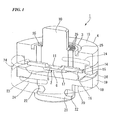
- FIG 1 shows a force sensor 1 which is used in a force sensor unit U of an embodiment of this invention.
- This force sensor 1 has a force sensor chip 2 which serves as a sensor chip for detecting external force, for example, force and moment, and with an attenuator 4 which is provided with a dampening mechanism section 3 which dampens this external force and then imparts it to the force sensor chip 2.
- the force sensor chip 2 is formed in a square shape when seen in plan view and is manufactured using a semiconductor substrate so as to function as a 6-axis sensor.
- the force sensor chip 2 is provided with a supporting section 5 shaped as a square frame which includes the respective sides, and with a square-shaped action section 6 which is formed in the center of the force sensor chip 2. Both ends of T-shaped connecting sections 7 are supported by the respective corner portions of the supporting section 5, and distal end portions of these four connecting sections 7 are joined to the respective sides of the action section 6. Three strain resistance elements 8 are provided on the surface of each boundary portion between the distal end portions of the four connecting sections 7 which support the action section 6 and the action section 6.
- the six axes refer to the force and moment for each one of three mutually orthogonal axes (i.e., the X axis, Y axis, and Z axis).
- the surface direction of the action section 6 is the Z axis
- a direction parallel with the surface of the action section 6 is the X axis
- a direction orthogonal with the X axis is the Y axis.
- a force acting in the X axial direction is taken as Fx
- a force acting in the Y axial direction is taken as Fy
- a force acting in the Z axial direction is taken as Fz.
- a moment acting in a direction around the X axis is taken as Mx
- a moment acting in a direction around the Y axis is taken as My
- a moment acting in a direction around the Z axis is taken as Mz.
- the action section 6 is displaced relatively to the supporting section 5, and the force sensor chip 2 detects the external force via an output from the strain resistance element 8 which receives the distortion resulting from this displacement.
- the attenuator 4 which imparts the external force to the force sensor chip 2 is provided with an input section 10 into which the external force is input.
- This input section 10 is formed in a circular column shape, and the input section 10 is fixed in the circumferential direction, for example, by means of press-insertion or the like.
- a circular column-shaped sensor fixing section 13 is formed around the input section 10.
- the sensor fixing section 13 has the input section 10 protruding from a center portion of the front surface thereof, and a step section 14 which has been cut out towards the front surface side is formed in an outward side portion of a rear surface thereof.
- a protruding ridge 15 is formed in a toroidal shape over the entire circumference of the inward side of the step section 14.
- An inward side of the protruding ridge 15 is formed as a planar surface, and a transmission section 11 which is formed from a glass material is provided in the center of a central portion thereof.
- the transmission section 11 is placed in contact with the action section 6 of the force sensor chip 2, and is positioned at the bottom end of the input potion 10.
- the transmission section 11 is formed in a tapered shape such that the cross-sectional area thereof becomes smaller approaching the distal end thereof.
- a recess section 23 that allows the attitude of the force sensor chip 2 to be changed is formed in a central portion of the rear surface (i.e., top surface) of the bottom wall section 20.
- the dampening mechanism section 3 which dampens external force which is acting on the input section 10 is provided between the input section 10 and the sensor fixing section 13.
- This dampening mechanism section 3 dampens external force so that the external force is applied in a dampened state from the transmission section 11 to the force sensor chirp 2.
- the dampening mechanism section 3 is formed by a plurality of inner diameter side through holes 25 which are arranged in a toroidal shape centered on the input section 10 around the circumference of the input section 10 and extending from the front surface side of the sensor fixing section 13, and an outer diameter side toroidal groove 26 which is formed on the outer side of the plurality of through holes 25.
- the through holes 25 are formed in a fan shape whose wider end faces outwards, and penetrate from the front surface side to the rear surface side of the sensor fixing section 13.
- the through holes 25 open at a position on the inward side of the protruding ridge 15 of the sensor fixing section 13.
- the toroidal groove 26 is formed at a position on the inward side of the protruding ridge 15 in the radial direction, and is formed to a depth which reaches from the front surface side of the sensor fixing section 13 as far as the vicinity of the bottom portion of the step section 14.
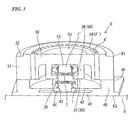
- FIGS. 3 and 4 show a force sensor unit U of the first embodiment of this invention.
- the force sensor unit U is provided with two force sensors 1, and 1' as external force detection sections.
- An attenuator 4' is provided in the force sensor unit U, and external force is dampened by this attenuator 4' so that a dampened force is detected by the force sensor 1.
- the first housing K1 is a flat, circular cylinder-shaped component, and has a substantially level top wall 30 and a circumferential wall 31.
- a step section 32 is formed in a toroidal shape on a circumferential edge of the top wall 30, and a center portion of the top wall 30 is constructed as an external force input section 33 into which external force is input.
- a plurality of fan-shaped through holes 34, 34 ... are arranged in a toroidal shape with the wider ends thereof facing outwards around the circumference of this external force input section 33 so as to penetrate from the front surface side to the rear surface side of the circumferential wall 31 and function as a dampening mechanism section 3'.
- the external force input section 33 is constructed such that when an external force is acting on the external force input section 33, this external force can be transmitted to the force sensor 1 in a dampened state in the area of the plurality of toroidally arranged through holes 34.
- a housing section 35 which houses a force sensor 1' for temperature compensation which is serving as the sub unit on an inner side portion of the circumferential wall 31 is formed in a center portion of the rear surface side of the top wall 30.
- the housing section 35 is formed by a housing section circumferential wall 36 and a housing section bottom wall 37, and a mounting aperture section 38 is provided in the housing section bottom wall 37.
- a bottom surface of the housing section bottom wall 37 extends as far as the vicinity of the bottom surface of the circumferential wall 31 of the first housing K1.
- An external force transmission section is formed mainly by the housing section circumferential wall 36 and the housing section bottom wall 37.
- the force sensor 1' for temperature compensation which is housed in the housing section 35 is housed therein with the bottom fixing section 18 of the force sensor 1, which is serving as the main unit removed, and with the bottom side thereof facing the force sensor chip 2.
- the top surface of the input section 10 is fixed to the rear surface of the top wall 30 of the first housing K1 such that the periphery thereof is not in contact with the housing section bottom wall 37 and housing section circumferential wall 36 of the housing section 35.
- the force sensor 1' for temperature compensation is supported inside the housing section 35 in a state of being suspended in air so that it does not receive any external force.
- the second housing K2 is fixed by bolts (not shown) to the circumferential wall 31 of the first housing K1.
- a bracket 45 which is fixed to an external structural body G is formed on the bottom wall 41.
- the force sensor 1 for detecting external force is inversely mounted such that the force sensor chip 2 faces upwards, and the input section 10 which is positioned on the bottom side is inserted from above into the mounting aperture 43 and is thereby fixed in position therein.
- the force sensor chip 2 is placed as close as possible to and also facing the force sensor chip 2 of the force sensor 1' for temperature compensation.
- the external force input section 33 which is the input axis (i.e., center axis) of the attenuator 4' forming the external housing is on the same axis as the input section 10 which is the input axis (i.e., center axis) of the respective force sensors 1, and 1'.
- the top surface of the sensor fixing section 13 of the force sensor 1 for detecting external force is in contact with a top surface of the circumferential edge section 44 of the fixing bracket 42.
- the bottom wall section 20 of the bottom fixing section 18 which is mounted on the step section 14 of the sensor fixing section 13 is in contact with the bottom surface of the housing section bottom wall 37 of the first housing K1 in which the force sensor 1,' for temperature compensation is housed, and the fixing boss 21 is inserted into a mounting aperture section 38 in the housing section bottom wall 37 of the first housing K1 so as to be fixed therein.
- An edge face of the fixing boss 21 is formed on the same plane as the top surface of the housing section bottom wall 37 of the first housing K1, and an edge face of the fixing boss 21 is separated from the force sensor chip 2 of the force sensor 1' for temperature compensation housed in the housing section 35 of the first housing K1 and is thus not in contact therewith.
- the force sensor 1' for temperature compensation and the force sensor 1 for detecting external force are the same type of component, they are formed from materials having the same specific heat and the same thermal conductivity.
- these portions may also be formed from Fe-Ni based alloys such as invar or elinvar which are alloys having a low coefficient of thermal expansion, or from Fe-Ni-Co based alloys such as kovar, or magnesium alloys.
- Fe-Ni based alloys such as invar or elinvar which are alloys having a low coefficient of thermal expansion
- Fe-Ni-Co based alloys such as kovar, or magnesium alloys.
- the force sensor 1 for detecting external force is provided with the bottom fixing section 18, because a layout structure is employed in which common sensor fixing sections 13 which both have an effect on the force sensor chip 2 as regards heat capacity are positioned facing each other and between them is positioned the bottom fixing section 18 in the force sensor 1 for detecting external force, the factors determining the heat capacities of both the force sensors are equal.
- both the force sensors 1 and 1' are provided with the same heat capacity.
- the dampening mechanism section 3 because the plurality of inner diameter side through holes 25 which are arranged in a toroidal shape centered on the input section 10 around the circumference of the input section 10 and extending from the front surface side of the sensor fixing section 13, and the outer diameter side toroidal, groove 26 which is formed on the outer side of the plurality of through holes 25 are provided as the dampening mechanism section 3, it is possible to reduce differences in detection sensitivity which are caused by discrepancy in characteristics which are dependent on the direction in which external force is applied (such as, for example, the possibility that bias will be generated in the size of the displacement of the transmission section 11 which is generated by external force depending on the direction in which that external force is applied) which are generated when only one of the through holes 25 and the toroidal groove 26 are provided.
- the bottom wall section of the toroidal groove 26 is able to apply force to the action section 6 of the force sensor chip 2 via the transmission section 11 without any bias for the two forces running in the Z axial direction.
- bias is generated in the force which is transmitted to the transmission section 11 both when the X axial direction matches the through hole formation positions for the plurality of inner side through holes 25 and when it is between adjacent through holes 25, however, because of the toroidal groove 26 which is provided on the outer side of the through holes 25, force in the X axial direction can be made to act on the force sensor chips 2 via the transmission section 11 without being dependent on the direction and without any bias.
- the majority portion of the external force which is input into the external force input section 33 of the first housing K1 passes from the circumferential wall 31 of the first housing K1 via the circumferential wall 40 of the second housing K2 and is supported by the bracket 45 without any portion of this force being applied to the force sensor 1' for temperature compensation which is supported by the top wall 30 of the housing section 35.
- the plurality of fan-shaped through holes 34, 34 ... are arranged in a toroidal shape with the wider ends thereof facing outwards in the dampening mechanism 3', it is possible to ensure sensitivity balance towards external force and moment in the X axis, the Y axis, and the Z axis, and uniformize absolute values of outputs.
- the force sensor 1 for detecting external force and the force sensor 1' for temperature compensation have the same heat capacity, it is possible to ensure the reliability of a differential output which is the amount of distortion caused solely by external force and from which the effects of changes in temperature have been removed, and to thus accurately detect an external force.
- the force sensor 1 for detecting external force and the force sensor 1' for temperature compensation having the same coefficient of thermal conductivity and, as described above, the same heat capacity as regards the force sensor chips 2, the force sensor 1 for detecting external force and the force sensor 1' for temperature compensation can be provided with the same heat distribution so that an even more accurate differential output can be obtained.
- the amount of change in the output from the force sensor 1' for temperature compensation in which changes occur in detected values simply because the temperature has risen from room temperature and in which there are no effects from external force is included in the values from the force sensor 1 for detecting external force.
- the output value obtained from the force sensor 1' for temperature compensation is subtracted from the value from the force sensor 1 for detecting external force, then it is possible when an external force has been applied to obtain a detection value for only the external force without there being any contamination from other factors.
- Tables 5 and 6 show output values from the force sensors 1 and 1' at temperatures of 0°C and 60°C and with no load being applied thereto.
- the output value obtained from the force sensor 1' for temperature compensation is subtracted from the value from the force sensor 1 for detecting external force, then it is possible when an external force has been applied to obtain a detection value for only the external force without there being any contamination from other factors.
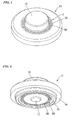
- FIGS. 5 and 6 show a second embodiment of a force sensor unit.
- bias is generated in the force which is transmitted to the transmission section 11 both when the X axial direction matches the through hole formation positions of the plurality of circular through holes 55 on the inner diametrical side and when it is between adjacent circular through holes 55.
- the X axial direction is located between circular through holes 55, because this corresponds to positions where the circular through holes 56 are formed on the outer diametrical side, any bias in the force on the inner diametrical side is dampened on the outer diametrical side so that force can be made to act without any bias on the force sensor chips 2 via the transmission section 11.
- FIGS. 7 and 8 show a third embodiment of a force sensor.
- force can be applied to the force sensor chip 2 via the transmission section 11 without there being any bias in characteristics caused by differences in the rotation direction for the moment Mz, and without there being any bias in characteristics in both the compression direction and tensile direction for the force Fz in both the arc-shaped through holes 55 and the arc-shaped through holes 66 which are provided in a plurality of rows.
- force sensors 1 and 1' are provided with force sensor chips 2, then the structure is not limited to that described above.
Landscapes
- Physics & Mathematics (AREA)
- General Physics & Mathematics (AREA)
- Force Measurement Appropriate To Specific Purposes (AREA)
- Measurement Of Force In General (AREA)
- Measuring Fluid Pressure (AREA)
Applications Claiming Priority (1)
| Application Number | Priority Date | Filing Date | Title |
|---|---|---|---|
| JP2008187038A JP5604035B2 (ja) | 2008-07-18 | 2008-07-18 | 力覚センサユニット |
Publications (3)
| Publication Number | Publication Date |
|---|---|
| EP2146194A2 true EP2146194A2 (fr) | 2010-01-20 |
| EP2146194A3 EP2146194A3 (fr) | 2010-02-17 |
| EP2146194B1 EP2146194B1 (fr) | 2012-01-18 |
Family
ID=41138774
Family Applications (1)
| Application Number | Title | Priority Date | Filing Date |
|---|---|---|---|
| EP09165795A Not-in-force EP2146194B1 (fr) | 2008-07-18 | 2009-07-17 | Unité de capteur de force à compensation de température |
Country Status (4)
| Country | Link |
|---|---|
| US (1) | US8196477B2 (fr) |
| EP (1) | EP2146194B1 (fr) |
| JP (1) | JP5604035B2 (fr) |
| AT (1) | ATE542115T1 (fr) |
Cited By (1)
| Publication number | Priority date | Publication date | Assignee | Title |
|---|---|---|---|---|
| EP2713148B1 (fr) * | 2012-09-27 | 2021-03-03 | Honeywell International Inc. | Capteur de force couplée mécaniquement sur une structure d'ensemble de plateforme flexible |
Families Citing this family (22)
| Publication number | Priority date | Publication date | Assignee | Title |
|---|---|---|---|---|
| JP5243704B2 (ja) * | 2006-08-24 | 2013-07-24 | 本田技研工業株式会社 | 力覚センサ |
| JP5243988B2 (ja) * | 2009-02-10 | 2013-07-24 | 本田技研工業株式会社 | 多軸力覚センサおよび加速度センサ |
| JP5627556B2 (ja) * | 2011-10-31 | 2014-11-19 | アイシン精機株式会社 | 車両用シートの荷重検出装置 |
| WO2014164207A1 (fr) | 2013-03-12 | 2014-10-09 | Stryker Corporation | Ensemble capteur et procédé permettant de mesurer des forces et des couples |
| JP6188231B2 (ja) * | 2014-02-26 | 2017-08-30 | アルプス電気株式会社 | 荷重検出装置及び前記荷重検出装置を用いた電子機器 |
| CN106248272A (zh) * | 2016-07-27 | 2016-12-21 | 同济大学 | 一种兼顾灵敏度的前提下提高力矩传感器量程的方法 |
| CN106124115A (zh) * | 2016-07-27 | 2016-11-16 | 同济大学 | 一种电磁补偿式三维力矩传感器 |
| EP4701393A2 (fr) | 2017-02-09 | 2026-02-25 | Nextinput, Inc. | Capteurs de force numériques intégrés et procédés de fabrication associés |
| US11243125B2 (en) | 2017-02-09 | 2022-02-08 | Nextinput, Inc. | Integrated piezoresistive and piezoelectric fusion force sensor |
| US10634695B2 (en) * | 2017-04-26 | 2020-04-28 | Minebea Mitsumi Inc. | Force sensor |
| US11243126B2 (en) | 2017-07-27 | 2022-02-08 | Nextinput, Inc. | Wafer bonded piezoresistive and piezoelectric force sensor and related methods of manufacture |
| US11579028B2 (en) | 2017-10-17 | 2023-02-14 | Nextinput, Inc. | Temperature coefficient of offset compensation for force sensor and strain gauge |
| WO2019099821A1 (fr) * | 2017-11-16 | 2019-05-23 | Nextinput, Inc. | Atténuateur de force pour capteur de force |
| JP6919964B2 (ja) | 2018-01-29 | 2021-08-18 | ミネベアミツミ株式会社 | センサチップ及び力覚センサ装置 |
| CN113447170B (zh) * | 2020-03-26 | 2023-08-15 | 精量电子公司 | 力检测装置 |
| JP7618916B2 (ja) * | 2020-12-24 | 2025-01-22 | ミネベアミツミ株式会社 | 起歪体、力覚センサ装置 |
| JP2022142118A (ja) * | 2021-03-16 | 2022-09-30 | ミネベアミツミ株式会社 | センサチップ、力覚センサ装置 |
| JP2022142116A (ja) * | 2021-03-16 | 2022-09-30 | ミネベアミツミ株式会社 | 起歪体、力覚センサ装置 |
| JP2022142117A (ja) * | 2021-03-16 | 2022-09-30 | ミネベアミツミ株式会社 | センサチップ、力覚センサ装置 |
| CN115112286A (zh) * | 2021-03-19 | 2022-09-27 | 美蓓亚三美株式会社 | 应变体、力传感器装置 |
| JP2023109029A (ja) * | 2022-01-26 | 2023-08-07 | アルプスアルパイン株式会社 | 荷重センサ装置 |
| CN119045675A (zh) * | 2023-05-29 | 2024-11-29 | 三美电机株式会社 | 输入装置 |
Citations (2)
| Publication number | Priority date | Publication date | Assignee | Title |
|---|---|---|---|---|
| JP2003254843A (ja) | 2002-03-05 | 2003-09-10 | Honda Motor Co Ltd | 6軸力センサ |
| JP2007010379A (ja) | 2005-06-28 | 2007-01-18 | Honda Motor Co Ltd | 力覚センサ |
Family Cites Families (12)
| Publication number | Priority date | Publication date | Assignee | Title |
|---|---|---|---|---|
| US4513831A (en) * | 1981-05-19 | 1985-04-30 | Setra Systems, Inc. | Weighing system |
| JPS6034295A (ja) * | 1983-08-03 | 1985-02-21 | 株式会社日立製作所 | 皮膚感覚センサ |
| JPS6461628A (en) * | 1987-09-02 | 1989-03-08 | Ricoh Kk | Force detecting device |
| DE4111148A1 (de) * | 1991-04-06 | 1992-10-08 | Bosch Gmbh Robert | Sensor |
| JP2001183248A (ja) * | 1999-12-24 | 2001-07-06 | Furukawa Electric Co Ltd:The | 送電線荷重センサ装置およびその設置方法 |
| JP2004239621A (ja) * | 2003-02-03 | 2004-08-26 | Japan Science & Technology Agency | 3次元圧力センサ |
| JP2005169541A (ja) * | 2003-12-10 | 2005-06-30 | Hitachi Metals Ltd | 半導体装置およびその製造方法 |
| JP4107235B2 (ja) * | 2003-12-25 | 2008-06-25 | 株式会社デンソー | 力学量センサ構造 |
| DE102004045188A1 (de) * | 2004-09-17 | 2006-03-30 | Engelbert Mages | Schlagkraftmesseinrichtung |
| JP4680566B2 (ja) * | 2004-10-26 | 2011-05-11 | 本田技研工業株式会社 | 多軸力センサチップとこれを用いた多軸力センサ |
| JP2007113957A (ja) * | 2005-10-18 | 2007-05-10 | Hitachi Ltd | 摩擦力センサおよび摩擦力センサ付きタイヤ |
| JP2008058110A (ja) * | 2006-08-30 | 2008-03-13 | Honda Motor Co Ltd | 力覚センサ用チップおよび力覚センサ |
-
2008
- 2008-07-18 JP JP2008187038A patent/JP5604035B2/ja not_active Expired - Fee Related
-
2009
- 2009-07-17 US US12/504,753 patent/US8196477B2/en not_active Expired - Fee Related
- 2009-07-17 EP EP09165795A patent/EP2146194B1/fr not_active Not-in-force
- 2009-07-17 AT AT09165795T patent/ATE542115T1/de active
Patent Citations (2)
| Publication number | Priority date | Publication date | Assignee | Title |
|---|---|---|---|---|
| JP2003254843A (ja) | 2002-03-05 | 2003-09-10 | Honda Motor Co Ltd | 6軸力センサ |
| JP2007010379A (ja) | 2005-06-28 | 2007-01-18 | Honda Motor Co Ltd | 力覚センサ |
Cited By (1)
| Publication number | Priority date | Publication date | Assignee | Title |
|---|---|---|---|---|
| EP2713148B1 (fr) * | 2012-09-27 | 2021-03-03 | Honeywell International Inc. | Capteur de force couplée mécaniquement sur une structure d'ensemble de plateforme flexible |
Also Published As
| Publication number | Publication date |
|---|---|
| US8196477B2 (en) | 2012-06-12 |
| EP2146194B1 (fr) | 2012-01-18 |
| JP5604035B2 (ja) | 2014-10-08 |
| JP2010025735A (ja) | 2010-02-04 |
| US20100011885A1 (en) | 2010-01-21 |
| ATE542115T1 (de) | 2012-02-15 |
| EP2146194A3 (fr) | 2010-02-17 |
Similar Documents
| Publication | Publication Date | Title |
|---|---|---|
| EP2146194B1 (fr) | Unité de capteur de force à compensation de température | |
| US7707899B2 (en) | Force sensor chip | |
| US8776616B2 (en) | Multiaxial force-torque sensors | |
| EP1852688A2 (fr) | Puce de capteur de force à axes multiples | |
| JP4680566B2 (ja) | 多軸力センサチップとこれを用いた多軸力センサ | |
| US7793551B2 (en) | Load sensor with shock relaxation material to protect semiconductor strain sensor | |
| US20170205296A1 (en) | Force/torque sensor having instrumentation on fewer than four beam surfaces | |
| US9395256B2 (en) | Low profile multi-axis load cell | |
| US6598483B2 (en) | Capacitive vacuum sensor | |
| US5412992A (en) | Differential pressure sensor capable of removing influence of static pressure and a method of assembling the same | |
| JPS5917124A (ja) | ロ−ドセル圧力補正装置 | |
| KR20200108881A (ko) | 토크 전달 샤프트에 인가되는 힘 및/또는 토크를 결정하기 위한 측정 시스템 및 방법 | |
| WO2016056555A1 (fr) | Capteur de pression, capteur de pression différentielle et dispositif de régulation de débit massique l'utilisant | |
| US20120006129A1 (en) | Pressure measuring device | |
| US5295399A (en) | Force moment sensor | |
| JPH0359431A (ja) | 圧力センサ及び圧力センサの校正方法 | |
| US20210108981A1 (en) | Sensor element | |
| JPH02176438A (ja) | 力検出装置 | |
| JP7260095B2 (ja) | 荷重変換器 | |
| JP4933838B2 (ja) | センタホール型荷重変換器 | |
| US10288516B2 (en) | Device for detecting mechanical decoupling pressure | |
| JP5427377B2 (ja) | 力覚センサ | |
| JP2684538B2 (ja) | 荷重変換器 | |
| JP4929256B2 (ja) | 力覚センサ | |
| JP2024013723A (ja) | トルクセンサ |
Legal Events
| Date | Code | Title | Description |
|---|---|---|---|
| PUAI | Public reference made under article 153(3) epc to a published international application that has entered the european phase |
Free format text: ORIGINAL CODE: 0009012 |
|
| PUAL | Search report despatched |
Free format text: ORIGINAL CODE: 0009013 |
|
| 17P | Request for examination filed |
Effective date: 20090717 |
|
| AK | Designated contracting states |
Kind code of ref document: A2 Designated state(s): AT BE BG CH CY CZ DE DK EE ES FI FR GB GR HR HU IE IS IT LI LT LU LV MC MK MT NL NO PL PT RO SE SI SK SM TR |
|
| AK | Designated contracting states |
Kind code of ref document: A3 Designated state(s): AT BE BG CH CY CZ DE DK EE ES FI FR GB GR HR HU IE IS IT LI LT LU LV MC MK MT NL NO PL PT RO SE SI SK SM TR |
|
| 17Q | First examination report despatched |
Effective date: 20100201 |
|
| GRAP | Despatch of communication of intention to grant a patent |
Free format text: ORIGINAL CODE: EPIDOSNIGR1 |
|
| GRAS | Grant fee paid |
Free format text: ORIGINAL CODE: EPIDOSNIGR3 |
|
| GRAA | (expected) grant |
Free format text: ORIGINAL CODE: 0009210 |
|
| RIN1 | Information on inventor provided before grant (corrected) |
Inventor name: JINBU, YASUHIKO Inventor name: OHSATO, TAKESHI |
|
| AK | Designated contracting states |
Kind code of ref document: B1 Designated state(s): AT BE BG CH CY CZ DE DK EE ES FI FR GB GR HR HU IE IS IT LI LT LU LV MC MK MT NL NO PL PT RO SE SI SK SM TR |
|
| REG | Reference to a national code |
Ref country code: GB Ref legal event code: FG4D |
|
| REG | Reference to a national code |
Ref country code: CH Ref legal event code: EP |
|
| REG | Reference to a national code |
Ref country code: AT Ref legal event code: REF Ref document number: 542115 Country of ref document: AT Kind code of ref document: T Effective date: 20120215 Ref country code: IE Ref legal event code: FG4D |
|
| REG | Reference to a national code |
Ref country code: DE Ref legal event code: R096 Ref document number: 602009004699 Country of ref document: DE Effective date: 20120322 |
|
| REG | Reference to a national code |
Ref country code: NL Ref legal event code: VDEP Effective date: 20120118 |
|
| LTIE | Lt: invalidation of european patent or patent extension |
Effective date: 20120118 |
|
| PG25 | Lapsed in a contracting state [announced via postgrant information from national office to epo] |
Ref country code: NO Free format text: LAPSE BECAUSE OF FAILURE TO SUBMIT A TRANSLATION OF THE DESCRIPTION OR TO PAY THE FEE WITHIN THE PRESCRIBED TIME-LIMIT Effective date: 20120418 Ref country code: LT Free format text: LAPSE BECAUSE OF FAILURE TO SUBMIT A TRANSLATION OF THE DESCRIPTION OR TO PAY THE FEE WITHIN THE PRESCRIBED TIME-LIMIT Effective date: 20120118 Ref country code: HR Free format text: LAPSE BECAUSE OF FAILURE TO SUBMIT A TRANSLATION OF THE DESCRIPTION OR TO PAY THE FEE WITHIN THE PRESCRIBED TIME-LIMIT Effective date: 20120118 Ref country code: BE Free format text: LAPSE BECAUSE OF FAILURE TO SUBMIT A TRANSLATION OF THE DESCRIPTION OR TO PAY THE FEE WITHIN THE PRESCRIBED TIME-LIMIT Effective date: 20120118 Ref country code: IS Free format text: LAPSE BECAUSE OF FAILURE TO SUBMIT A TRANSLATION OF THE DESCRIPTION OR TO PAY THE FEE WITHIN THE PRESCRIBED TIME-LIMIT Effective date: 20120518 Ref country code: NL Free format text: LAPSE BECAUSE OF FAILURE TO SUBMIT A TRANSLATION OF THE DESCRIPTION OR TO PAY THE FEE WITHIN THE PRESCRIBED TIME-LIMIT Effective date: 20120118 Ref country code: BG Free format text: LAPSE BECAUSE OF FAILURE TO SUBMIT A TRANSLATION OF THE DESCRIPTION OR TO PAY THE FEE WITHIN THE PRESCRIBED TIME-LIMIT Effective date: 20120418 |
|
| PG25 | Lapsed in a contracting state [announced via postgrant information from national office to epo] |
Ref country code: PL Free format text: LAPSE BECAUSE OF FAILURE TO SUBMIT A TRANSLATION OF THE DESCRIPTION OR TO PAY THE FEE WITHIN THE PRESCRIBED TIME-LIMIT Effective date: 20120118 Ref country code: PT Free format text: LAPSE BECAUSE OF FAILURE TO SUBMIT A TRANSLATION OF THE DESCRIPTION OR TO PAY THE FEE WITHIN THE PRESCRIBED TIME-LIMIT Effective date: 20120518 Ref country code: FI Free format text: LAPSE BECAUSE OF FAILURE TO SUBMIT A TRANSLATION OF THE DESCRIPTION OR TO PAY THE FEE WITHIN THE PRESCRIBED TIME-LIMIT Effective date: 20120118 Ref country code: LV Free format text: LAPSE BECAUSE OF FAILURE TO SUBMIT A TRANSLATION OF THE DESCRIPTION OR TO PAY THE FEE WITHIN THE PRESCRIBED TIME-LIMIT Effective date: 20120118 Ref country code: GR Free format text: LAPSE BECAUSE OF FAILURE TO SUBMIT A TRANSLATION OF THE DESCRIPTION OR TO PAY THE FEE WITHIN THE PRESCRIBED TIME-LIMIT Effective date: 20120419 |
|
| REG | Reference to a national code |
Ref country code: AT Ref legal event code: MK05 Ref document number: 542115 Country of ref document: AT Kind code of ref document: T Effective date: 20120118 |
|
| PG25 | Lapsed in a contracting state [announced via postgrant information from national office to epo] |
Ref country code: CY Free format text: LAPSE BECAUSE OF FAILURE TO SUBMIT A TRANSLATION OF THE DESCRIPTION OR TO PAY THE FEE WITHIN THE PRESCRIBED TIME-LIMIT Effective date: 20120118 |
|
| PG25 | Lapsed in a contracting state [announced via postgrant information from national office to epo] |
Ref country code: CZ Free format text: LAPSE BECAUSE OF FAILURE TO SUBMIT A TRANSLATION OF THE DESCRIPTION OR TO PAY THE FEE WITHIN THE PRESCRIBED TIME-LIMIT Effective date: 20120118 Ref country code: EE Free format text: LAPSE BECAUSE OF FAILURE TO SUBMIT A TRANSLATION OF THE DESCRIPTION OR TO PAY THE FEE WITHIN THE PRESCRIBED TIME-LIMIT Effective date: 20120118 Ref country code: DK Free format text: LAPSE BECAUSE OF FAILURE TO SUBMIT A TRANSLATION OF THE DESCRIPTION OR TO PAY THE FEE WITHIN THE PRESCRIBED TIME-LIMIT Effective date: 20120118 Ref country code: RO Free format text: LAPSE BECAUSE OF FAILURE TO SUBMIT A TRANSLATION OF THE DESCRIPTION OR TO PAY THE FEE WITHIN THE PRESCRIBED TIME-LIMIT Effective date: 20120118 Ref country code: SE Free format text: LAPSE BECAUSE OF FAILURE TO SUBMIT A TRANSLATION OF THE DESCRIPTION OR TO PAY THE FEE WITHIN THE PRESCRIBED TIME-LIMIT Effective date: 20120118 Ref country code: SI Free format text: LAPSE BECAUSE OF FAILURE TO SUBMIT A TRANSLATION OF THE DESCRIPTION OR TO PAY THE FEE WITHIN THE PRESCRIBED TIME-LIMIT Effective date: 20120118 |
|
| PLBE | No opposition filed within time limit |
Free format text: ORIGINAL CODE: 0009261 |
|
| STAA | Information on the status of an ep patent application or granted ep patent |
Free format text: STATUS: NO OPPOSITION FILED WITHIN TIME LIMIT |
|
| PG25 | Lapsed in a contracting state [announced via postgrant information from national office to epo] |
Ref country code: SK Free format text: LAPSE BECAUSE OF FAILURE TO SUBMIT A TRANSLATION OF THE DESCRIPTION OR TO PAY THE FEE WITHIN THE PRESCRIBED TIME-LIMIT Effective date: 20120118 Ref country code: IT Free format text: LAPSE BECAUSE OF FAILURE TO SUBMIT A TRANSLATION OF THE DESCRIPTION OR TO PAY THE FEE WITHIN THE PRESCRIBED TIME-LIMIT Effective date: 20120118 |
|
| 26N | No opposition filed |
Effective date: 20121019 |
|
| PGFP | Annual fee paid to national office [announced via postgrant information from national office to epo] |
Ref country code: FR Payment date: 20120719 Year of fee payment: 4 |
|
| PG25 | Lapsed in a contracting state [announced via postgrant information from national office to epo] |
Ref country code: AT Free format text: LAPSE BECAUSE OF FAILURE TO SUBMIT A TRANSLATION OF THE DESCRIPTION OR TO PAY THE FEE WITHIN THE PRESCRIBED TIME-LIMIT Effective date: 20120118 |
|
| REG | Reference to a national code |
Ref country code: DE Ref legal event code: R097 Ref document number: 602009004699 Country of ref document: DE Effective date: 20121019 |
|
| PG25 | Lapsed in a contracting state [announced via postgrant information from national office to epo] |
Ref country code: MC Free format text: LAPSE BECAUSE OF NON-PAYMENT OF DUE FEES Effective date: 20120731 Ref country code: MK Free format text: LAPSE BECAUSE OF FAILURE TO SUBMIT A TRANSLATION OF THE DESCRIPTION OR TO PAY THE FEE WITHIN THE PRESCRIBED TIME-LIMIT Effective date: 20120118 |
|
| PG25 | Lapsed in a contracting state [announced via postgrant information from national office to epo] |
Ref country code: ES Free format text: LAPSE BECAUSE OF FAILURE TO SUBMIT A TRANSLATION OF THE DESCRIPTION OR TO PAY THE FEE WITHIN THE PRESCRIBED TIME-LIMIT Effective date: 20120429 |
|
| REG | Reference to a national code |
Ref country code: IE Ref legal event code: MM4A |
|
| PG25 | Lapsed in a contracting state [announced via postgrant information from national office to epo] |
Ref country code: MT Free format text: LAPSE BECAUSE OF FAILURE TO SUBMIT A TRANSLATION OF THE DESCRIPTION OR TO PAY THE FEE WITHIN THE PRESCRIBED TIME-LIMIT Effective date: 20120118 Ref country code: IE Free format text: LAPSE BECAUSE OF NON-PAYMENT OF DUE FEES Effective date: 20120717 |
|
| REG | Reference to a national code |
Ref country code: CH Ref legal event code: PL |
|
| GBPC | Gb: european patent ceased through non-payment of renewal fee |
Effective date: 20130717 |
|
| REG | Reference to a national code |
Ref country code: FR Ref legal event code: ST Effective date: 20140331 |
|
| PG25 | Lapsed in a contracting state [announced via postgrant information from national office to epo] |
Ref country code: TR Free format text: LAPSE BECAUSE OF FAILURE TO SUBMIT A TRANSLATION OF THE DESCRIPTION OR TO PAY THE FEE WITHIN THE PRESCRIBED TIME-LIMIT Effective date: 20120118 Ref country code: GB Free format text: LAPSE BECAUSE OF NON-PAYMENT OF DUE FEES Effective date: 20130717 Ref country code: CH Free format text: LAPSE BECAUSE OF NON-PAYMENT OF DUE FEES Effective date: 20130731 Ref country code: LI Free format text: LAPSE BECAUSE OF NON-PAYMENT OF DUE FEES Effective date: 20130731 |
|
| PG25 | Lapsed in a contracting state [announced via postgrant information from national office to epo] |
Ref country code: SM Free format text: LAPSE BECAUSE OF FAILURE TO SUBMIT A TRANSLATION OF THE DESCRIPTION OR TO PAY THE FEE WITHIN THE PRESCRIBED TIME-LIMIT Effective date: 20120118 Ref country code: LU Free format text: LAPSE BECAUSE OF NON-PAYMENT OF DUE FEES Effective date: 20120717 Ref country code: FR Free format text: LAPSE BECAUSE OF NON-PAYMENT OF DUE FEES Effective date: 20130731 |
|
| REG | Reference to a national code |
Ref country code: DE Ref legal event code: R084 Ref document number: 602009004699 Country of ref document: DE Effective date: 20140430 |
|
| PG25 | Lapsed in a contracting state [announced via postgrant information from national office to epo] |
Ref country code: HU Free format text: LAPSE BECAUSE OF FAILURE TO SUBMIT A TRANSLATION OF THE DESCRIPTION OR TO PAY THE FEE WITHIN THE PRESCRIBED TIME-LIMIT Effective date: 20090717 |
|
| PGFP | Annual fee paid to national office [announced via postgrant information from national office to epo] |
Ref country code: DE Payment date: 20210622 Year of fee payment: 13 |
|
| REG | Reference to a national code |
Ref country code: DE Ref legal event code: R119 Ref document number: 602009004699 Country of ref document: DE |
|
| PG25 | Lapsed in a contracting state [announced via postgrant information from national office to epo] |
Ref country code: DE Free format text: LAPSE BECAUSE OF NON-PAYMENT OF DUE FEES Effective date: 20230201 |