EP2149074B1 - Montre à commande électronique - Google Patents
Montre à commande électronique Download PDFInfo
- Publication number
- EP2149074B1 EP2149074B1 EP08747898A EP08747898A EP2149074B1 EP 2149074 B1 EP2149074 B1 EP 2149074B1 EP 08747898 A EP08747898 A EP 08747898A EP 08747898 A EP08747898 A EP 08747898A EP 2149074 B1 EP2149074 B1 EP 2149074B1
- Authority
- EP
- European Patent Office
- Prior art keywords
- watch
- leds
- ring
- watch according
- display
- Prior art date
- Legal status (The legal status is an assumption and is not a legal conclusion. Google has not performed a legal analysis and makes no representation as to the accuracy of the status listed.)
- Not-in-force
Links
- 238000009826 distribution Methods 0.000 claims abstract description 4
- 239000000463 material Substances 0.000 claims description 12
- 239000004033 plastic Substances 0.000 claims description 11
- 229920003023 plastic Polymers 0.000 claims description 11
- 230000003287 optical effect Effects 0.000 claims description 7
- 229910052751 metal Inorganic materials 0.000 claims description 5
- 239000002184 metal Substances 0.000 claims description 5
- 239000012780 transparent material Substances 0.000 claims description 5
- 210000000707 wrist Anatomy 0.000 claims description 5
- 229910000831 Steel Inorganic materials 0.000 claims description 4
- 230000001133 acceleration Effects 0.000 claims description 4
- 239000010959 steel Substances 0.000 claims description 4
- 239000003086 colorant Substances 0.000 claims description 3
- 238000010079 rubber tapping Methods 0.000 claims description 2
- 238000001228 spectrum Methods 0.000 claims description 2
- XMQFTWRPUQYINF-UHFFFAOYSA-N bensulfuron-methyl Chemical compound COC(=O)C1=CC=CC=C1CS(=O)(=O)NC(=O)NC1=NC(OC)=CC(OC)=N1 XMQFTWRPUQYINF-UHFFFAOYSA-N 0.000 claims 1
- 210000004247 hand Anatomy 0.000 description 9
- 238000000034 method Methods 0.000 description 8
- 230000009471 action Effects 0.000 description 6
- 239000011521 glass Substances 0.000 description 6
- 238000004382 potting Methods 0.000 description 6
- 230000008859 change Effects 0.000 description 4
- 229920000642 polymer Polymers 0.000 description 4
- 239000003990 capacitor Substances 0.000 description 3
- 150000001875 compounds Chemical class 0.000 description 3
- 239000013013 elastic material Substances 0.000 description 3
- 239000002096 quantum dot Substances 0.000 description 3
- 239000010453 quartz Substances 0.000 description 3
- 230000002441 reversible effect Effects 0.000 description 3
- VYPSYNLAJGMNEJ-UHFFFAOYSA-N silicon dioxide Inorganic materials O=[Si]=O VYPSYNLAJGMNEJ-UHFFFAOYSA-N 0.000 description 3
- 238000010276 construction Methods 0.000 description 2
- 230000000694 effects Effects 0.000 description 2
- 230000005484 gravity Effects 0.000 description 2
- 238000004519 manufacturing process Methods 0.000 description 2
- 239000002086 nanomaterial Substances 0.000 description 2
- 230000008569 process Effects 0.000 description 2
- 230000002123 temporal effect Effects 0.000 description 2
- WHXSMMKQMYFTQS-UHFFFAOYSA-N Lithium Chemical compound [Li] WHXSMMKQMYFTQS-UHFFFAOYSA-N 0.000 description 1
- 239000013543 active substance Substances 0.000 description 1
- 239000000853 adhesive Substances 0.000 description 1
- 238000004026 adhesive bonding Methods 0.000 description 1
- 230000001070 adhesive effect Effects 0.000 description 1
- 210000003423 ankle Anatomy 0.000 description 1
- 230000004888 barrier function Effects 0.000 description 1
- 238000005452 bending Methods 0.000 description 1
- 230000005540 biological transmission Effects 0.000 description 1
- 230000004397 blinking Effects 0.000 description 1
- 239000012141 concentrate Substances 0.000 description 1
- 239000004020 conductor Substances 0.000 description 1
- 230000003247 decreasing effect Effects 0.000 description 1
- 238000010586 diagram Methods 0.000 description 1
- 239000008393 encapsulating agent Substances 0.000 description 1
- 238000005516 engineering process Methods 0.000 description 1
- 230000003760 hair shine Effects 0.000 description 1
- 238000005286 illumination Methods 0.000 description 1
- 238000007373 indentation Methods 0.000 description 1
- 239000010410 layer Substances 0.000 description 1
- 229910052744 lithium Inorganic materials 0.000 description 1
- 239000003550 marker Substances 0.000 description 1
- 238000005259 measurement Methods 0.000 description 1
- 230000007246 mechanism Effects 0.000 description 1
- 238000002844 melting Methods 0.000 description 1
- 230000008018 melting Effects 0.000 description 1
- 150000002739 metals Chemical class 0.000 description 1
- 229910001172 neodymium magnet Inorganic materials 0.000 description 1
- 239000003973 paint Substances 0.000 description 1
- 239000000049 pigment Substances 0.000 description 1
- BASFCYQUMIYNBI-UHFFFAOYSA-N platinum Chemical compound [Pt] BASFCYQUMIYNBI-UHFFFAOYSA-N 0.000 description 1
- 239000011241 protective layer Substances 0.000 description 1
- 230000009467 reduction Effects 0.000 description 1
- 230000011514 reflex Effects 0.000 description 1
- 230000003763 resistance to breakage Effects 0.000 description 1
- 230000033764 rhythmic process Effects 0.000 description 1
- 230000035939 shock Effects 0.000 description 1
- 238000005476 soldering Methods 0.000 description 1
- 239000004575 stone Substances 0.000 description 1
- 230000007704 transition Effects 0.000 description 1
- 230000001960 triggered effect Effects 0.000 description 1
- 230000000007 visual effect Effects 0.000 description 1
- XLYOFNOQVPJJNP-UHFFFAOYSA-N water Substances O XLYOFNOQVPJJNP-UHFFFAOYSA-N 0.000 description 1
- 239000002023 wood Substances 0.000 description 1
Images



Classifications
-
- G—PHYSICS
- G04—HOROLOGY
- G04G—ELECTRONIC TIME-PIECES
- G04G9/00—Visual time or date indication means
- G04G9/02—Visual time or date indication means by selecting desired characters out of a number of characters or by selecting indicating elements the position of which represent the time, e.g. by using multiplexing techniques
- G04G9/04—Visual time or date indication means by selecting desired characters out of a number of characters or by selecting indicating elements the position of which represent the time, e.g. by using multiplexing techniques by controlling light sources, e.g. electroluminescent diodes
-
- G—PHYSICS
- G04—HOROLOGY
- G04G—ELECTRONIC TIME-PIECES
- G04G17/00—Structural details; Housings
- G04G17/08—Housings
- G04G17/083—Watches distributed over several housings
-
- G—PHYSICS
- G04—HOROLOGY
- G04G—ELECTRONIC TIME-PIECES
- G04G9/00—Visual time or date indication means
- G04G9/0017—Visual time or date indication means in which the light emitting display elements may be activated at will or are controlled in accordance with the ambient light
Definitions
- the invention relates to an electronically controlled clock whose housing and display panel are formed as a ring, wherein the clock displays are formed by circulating on the ring luminous points, and wherein at least one annular row of at least 60 light-emitting diodes (LEDs) is provided, wherein by the luminous state of individual LEDs at least the time parameters "hour” and “minute”, preferably in addition to the time parameter "second" are indexable, and serving as an annular display panel electronic board is arranged on one of the annular end faces.
- LEDs light-emitting diodes
- Portable watches in ring form are from the WO 01/88638 A1 known.
- timer, time display and voltage source are integrated into a bangle, wherein the time display extends over part of the hoop circumference and consists of electronically controllable digits.
- the essential feature of a clock of this kind lies in the artistic combination and structural standardization of bracelet and watch case.
- the CH 613 599 G A3 and the NL C 1012053 show that the analog clock pointers can be replaced by electric bulbs.
- the time indication is there by means of circularly arranged light-emitting diodes (LEDs), which represent the positions of the tips of hour and minute hands.
- LEDs represent the positions of the tips of hour and minute hands.
- the light state of one of these LEDs indicates the position of a defined pointer.
- Both revelations have in common that both the watch case and conventional flat cylinder or discs are formed, wherein the number for the hour-display LEDs with twelve only capable of displaying whole hours. An intermediate position of the hour, as it happens with analog clocks and is also desired for easier time reading is not possible there.
- the GB 2 162 663 A discloses a wristwatch with an annular watch case, in which circularly arranged LEDs replace the position of analog clock hands in the lighted state. It displays minutes and hours in two separate LED circles. This forces a widening of the housing ring and leads to an appearance of the entire clock, which is closer to a conventional watch case than an annular clock. Moreover, in the GB 2 162 663 A provided that the hour LEDs are made larger than the minute LEDs, so that the hour LEDs simultaneously act as permanent hour indices. This is economically disadvantageous because it increases the number of work steps required to make the watch.
- the DE 202 08 330 U1 discloses a conventional disc-shaped watch case that instead of analogous hands on a dial, has a ring of 60 LEDs whose illumination represents the tips of analog hour hands and minute hands.
- 12 fixed hours LEDs are provided which, firstly, are larger than the intermediate ones 48-minute LEDs are performed, resulting in an increased number of steps in the manufacture of the watch case; secondly, a fixed hour LED will flash for a full hour, while the tip of an analog hour hand would move continuously from one of the 12 markers to the next.
- the doctrine of DE 3 806 561 A1 consists in a method to implement a digital timing in an electrically effected and seemingly analog time display.
- circular, square or triangular watch cases are disclosed, the middle parts of which are left free, the time indication being effected by means of the lighting states of three concentric LED rows in replacement of the positions of analog second, minute and hour hands.
- this design shows analog as the GB 2 162 663 A the disadvantage of spending a large number of LEDs to require a wide ring band as a watch case and to produce a clumsy appearance.
- the GB 2 384 063 A adds to the prior art a watch with an annular housing that can be worn as a (finger) ring or bracelet.
- the time is indicated by the position of two hourly and minute-by-round indicators circulating around the circumference of the ring, or by a central ring with printed numerical sequence passing by an immovable indicator.
- the GB 2 409 295 A shows a watch with an annular housing that can be worn as a finger, ankle ring or a bracelet.
- Indicators for the time are either the circulating light of an LED of an LED ring or the circulating light of two LEDs of two LED rings.
- Analogous to the previously mentioned GB 2 384 063 A the LEDs are in the periphery of the ring.
- Analogous to the GB 2 218 895 A of the GB 2,162 663 A as well as the DE 3 806 561 A1
- two separate LED rings are needed.
- the invention is therefore based on the goal to provide a clock of the type mentioned preferably as a wristwatch, the ring thickness in relation to the ring diameter turns out to be as small as possible, the minute, hour and second indication is on a single ring of LEDs. That is, it is only provided an LED formed ring, which is arranged in the ring of the watch case.
- the light emitting diodes have an equal size among each other, wherein the time parameter "hour” can be displayed on all LEDs, and that the displays of hours, minutes and seconds by the light pattern and / or the luminous color and / or the brightness and / or the luminous distribution to a plurality of adjacent LEDs differ from each other.
- the indications of hours, minutes and seconds differ by the luminous pattern and / or the luminous color and / or the brightness and / or the luminous distribution on a plurality of adjacent LEDs from each other.
- the watch case consists of at least one annular piece having a groove in which the inserted and fixed display electronics is sealed with a transparent material.
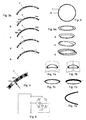
- Fig. 1 and 2 lie in the groove 13 of a thin steel ring 1 embedded electronic boards 2, which are strung together a multiple of 12, in particular of 60 preferably multi-colored light emitting diodes (LEDs) 16, which can display hours, minutes, seconds and more information.
- LEDs light emitting diodes
- Various parameters are displayed here on a single circle of LEDs; the distinction is made by the luminous color, the brightness, the number of luminous LEDs or the graphic light pattern or a temporal change of the above parameters (eg flashing, pulsating, twinkling, Fig. 3a to 3e ).
- the width of the ring thus depends only on the technically feasible thickness of the lighting elements and can thus be less than all previously known solutions.
- the luminous colors and shapes of display parameters are expediently chosen so that overlaps do not mask of parameters.
- These display symbols can overlap with each other and yet be recognized individually. It is also possible to distinguish the parameters by other luminous colors. By using the number of dots, the luminous color and the blinking rhythm for coding, many parameters can be displayed simultaneously on the same circle.
- the hourly position is indicated by a fine scale, which preferably has 60 possible positions.
- the hourlight does not light up like 10 or 11 known clocks, which can lead to confusion, but between 10 and 11, analogous to a clock.
- position between two luminance points can be displayed such that both adjacent points divide the total brightness of a single point in a certain ratio, so that the point closer to the exact position shines brighter (anti-aliasing display technique). For example, if the calculated position of a point lies exactly between two LEDs, these two LEDs are both driven at half brightness. If the position is closer to one LED, this LED becomes brighter and the other LED darker, exactly in proportion to the distance of the exact lighting position to the two LEDs ( Fig. 4 ).
- the hour and minute display points are lit continuously and can be adjusted to the ambient brightness with the aid of a brightness sensor. This can reduce the power consumption of the clock in darker environments.
- light elements are activated during the full hours, which take over the hour markers of the full hours.
- the 3 o'clock, 6 o'clock, 9 o'clock and 12 o'clock positions are displayed brighter or in a different color, the 12 o'clock position being highlighted again, e.g. by lighting up three adjacent points.
- an LED number of 60 is preferable.
- An even higher resolution can be achieved by an LED number, which is preferably an integer multiple of 60. If smaller ring diameters are required, a smaller number of LEDs is used, but preferably an integer multiple of 12.
- By the technique of anti-aliasing can also by an LED number, which is only an integer multiple of 12, a steady impression of the time display be achieved. For orientation and better estimation of the exact time, it makes sense to also 5-minute markings along the ring to install.
- the LEDs are connected to the processor 6 via the leads embedded in the annular board. This has outputs that can be switched either high-impedance, low or high.
- the anode and cathode of each LED are connected to these outputs in such a way that the two terminals of each LED differ in at least one output. In other words, the maximum controllable LED count is achieved when each output is connected to any other output connected via two anti-parallel LEDS.
- the display of the time takes place in that those positions to which the hands would point at a pointer are highlighted by the LEDs, for example by lighting up a color dot. But also the time markings themselves (eg the full hours) can be represented by the LEDs ( Fig. 5 ) or alarm times, stop times, alarm times etc. In order for these different signs to be distinguishable, they must differ in an optical property, eg color, brightness, graphic pattern, movement pattern, temporal change.
- any color variants are possible for distinguishing hours, minutes and seconds, preferably hours are identified by one or more red color points, minutes by a green dot, seconds by a blue dot, and the 12 hour markers by a blue dot.
- the display points can also pulsate or cyclically change their color (both preferably with about 1-4 Hz).
- the angular position of the entire display can be rotated by the processor as desired. If you move e.g. the clock, its position in space is established by means of the integrated positional sensor; the processor will always rotate the entire display so that the 12 o'clock position is always at the gravimetric highest point of the clock.
- the display points can be changed in brightness by the processor. This is preferably achieved by pulse width modulation. Thus both soft brightness transitions (anti-aliasing) and an automatic adjustment to the ambient brightness can be achieved.
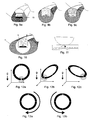
- the ambient brightness is measured either by measuring the reverse bias current of the display LEDs themselves ( Fig. 11 ) or by a separate brightness sensor.
- the built-in position or acceleration sensor can detect when the watch is moved or held in a specific position, increasing or decreasing the brightness of the watch as needed (to save power). For example, if the hand hangs down, it can be assumed that the clock is not being read, and the display is dimmed. If the clock is approximately horizontal, it can be assumed that the time is read and the display is brighter. If you move the clock (deliberately) violently, the display can be particularly bright.
- Such display rings can be arranged in different spatial positions in order, for example, simultaneously to display other time zones or other parameters, also overlapping or in several planes ( Fig. 6a to 6d ).
- the display rings need not necessarily have a circular shape, they can take any shape, for example, oval, three-, four- and polygonal.
- the surface in which the rings lie does not necessarily have to be flat. It can also be curved or have kinks ( Fig. 7a and 7b ).
- the display rings themselves can also be kinked ( Fig. 7c ) or conically curved ( Fig. 7d ).
- the LEDs can also be located on one or more open curves.
- the power source 14 is due to lack of space not in the watch ring, but outside, preferably in the bracelet 12 or in the clasp 29, with which the watch ring is electrically connected, arranged. Compared to arrangements in the watch case allows the external power supply due to the higher volume much longer periods of time between battery recharges and battery changes or a brighter display.
- flexible accumulators 35 e.g. Lithium polymer Schnelladeakkus be used. Charging can take place over the side edges of the bracelet: one side of the watchband forms the plus pole, the other the minus pole - this prevents accidental shorting of the contacts by touching metal objects.
- the charger for the integrated rechargeable batteries can be mains-powered, but is preferably independent of the mains, either battery-operated or self-rechargeable. This allows the clock to be charged while on the move.
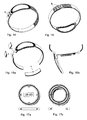
- a battery 30 can also be accommodated in the clasp 29 of the watch. This purpose is a closing design, which includes the battery waterproof and still ensures a secure closure of the watch band ( Fig. 16b ).
- the watch ring is supplied with a constant voltage (preferably 5 V), which is provided by the power supply elements. This ensures a uniform glow the LEDs of the ring clock over the entire life of the battery or the accumulator.
- the clock has a small capacitor 7, which is parallel to the power supply, therefore constantly charged and ensures battery power or module change for a certain time, the power of the clock. If the voltage on the watch drops below a certain value, this is detected by the processor, it goes into a sleep mode and switches off all power consumers that are not directly required for the time signal (LEDs, A / D converter, etc.).
- the watchband module 28 with integrated battery 35 has its own electronic part, which converts the voltage supplied by the battery (typically 3.7 V) with a step-up converter 36a to 5 V ( Fig. 18 ). If the battery supplies a higher voltage (eg by connecting two accumulators in series), the voltage is reduced to 5 V with a step-down converter 36b.
- this also contains its own electronic part, which converts any input voltages between 0.9 and 4 V to a constant 5 V.
- the microprocessor which takes over all the functions of the clock including the control of the LEDs, is located with the quartz watch and other electronic components in lobes 4 and 5 at the top and bottom of the watch ring ( Fig. 1 ). At these bulges and the watch band is attached. All necessary for the operation of the clock components can also lie directly on the underside of the annular board, which also carries the indicator LEDs, or even outside of the watch ring, and be connected to this via flexible tracks 37.
- the microprocessor preferably runs at a clock frequency above 1 MHz in order to operate the display flicker-free and to be able to execute further programs. This frequency does not have to be quartz-stabilized.
- the time base for the clock is given by a clock quartz, which feeds its signal at an input of the processor.
- the watch ring also has mechanical input elements, such as a crown, not more.
- the operation of the clock is done either via external input elements 27 in the bracelet ( Fig. 14 ) or in the clasp ( Fig. 15 ), but preferably via touch-sensitive sensors on the watch ring, ie via the LEDs of the time display itself, which are used as reflex light barriers 25 and 26, as already known, their "reverse bias" current is measured ( Fig. 11 ).
- the input is also possible via the "Simulated Ground Point” technique or by knocking on the housing.
- buttons, sensor elements can be accommodated, which are electrically connected to the watch ring.
- the adjustment and operation of the clock can be done by the LEDs of the display itself: by measuring the leakage current with reverse biased LEDs can be determined whether there is a fingertip 24 above the LED: in this case, the finger acts as a reflector for the light an adjacent LED and illuminates the sense LED 26, the resistance then drops, which, as already known, the microprocessor can recognize and evaluate. Positions for the use of a sense LED are, for example, the 3-, 6-, 9- or 12-position, because at these points an LED must light up, so that the adjacent LED can act as a sense LED. In order to avoid accidental operating errors, for example, two LEDs opposite the ring (eg "3" and "9") must be activated at the same time touched or another switching element (eg in the clasp or in the watch band) are operated.
- the case of the clock is electrically conductive.
- sensor areas that are electrically isolated from the housing.
- these sensor areas are located on the inner ring, and can be divided there again and fill the space between two timestamps.
- the sensor areas as well as the housing are connected to the processor.
- a circular arrangement of the sensor elements 10 on the watch ring makes it possible, for example, to set the time by circular stroking of the finger clockwise or counterclockwise over the display, as if one wanted to turn physical hands forward or backward by hand ( Fig. 13a and 13b ).
- an input operation in the clock can be performed in several stages: for example, by touching a sensor element or the watch case, the actual display sensing can be initiated, which then activates the LEDs for scythe, or by a shaking the clock will be triggered.
- the sensor elements of the watch ring can also detect by resistance measurement, if the watch is under water and in this case turn off the power supply via the sensor elements to avoid short circuits.
- the integrated position and acceleration sensor can also detect short shocks, such as those caused by tapping on the watch ring, it is possible to trigger certain actions by means of different time-varying knock signals.
- the double-click known from the operation of a computer mouse can be used to indicate that an operation should subsequently be made. A double-click brings the clock back from the previously selected mode back to normal.
- other sensors may be 9, which can measure magnetic fields (compass), air pressure, temperature, humidity, etc., can store data (dictation), record and play music (MP3), remote control functions can perform , and communicate with other electronic devices via infrared or radio signals (Bluetooth).
- the LED display is preferably in the groove of a steel support structure inserted and watertight poured and sealed ( Fig. 2 ).
- the support structure can be coated with other materials, such as plastics or paints, or even be surrounded by other materials 21, such as wood, stone, plastic or metals ( Fig. 10 ).
- the support structure may advantageously consist of several parts 1 and 15 ( Fig. 2 . 9a ). These have assembled a cross-section with a groove which receives the electronic boards 2.
- the detailed transverse division of the support structure is made according to the aspects of a simple production in the sense that after inserting the electronic board 2, a final part mechanically fixes the board in the ring.
- the support structure can also be made of a single piece, for example by selective laser melting technique. In this case, the electronic board 2 is inserted into the groove of the watch ring 1 and fixed there by adhesive dots; the subsequent potting of the groove fixes the board mechanically in the ring.
- the cross section may take various forms (e.g., rectangular, circular, elliptical).
- the individual parts can be screwed together, stuck, glued, joined.
- the annular plates which are inserted into the groove, are preferably made of multilayer material. They can be extended in the bulges of the clock and there on its underside processor, quartz, capacitors, sensors, etc. have.
- Light-emitting components preferably LEDs, preferably multi-colored LEDs, preferably RGB LEDs (but also OLEDs, quantum dot LEDs, etc.) are mounted on the upper side of the boards. If UV-emitting LEDs are used, overlying plastics (quantum dot nanomaterials) are applied (embedded in the encapsulant), which convert the UV light into visible light.
- the LEDs are either discretely soldered to the boards or glued and bonded directly to the board.
- a preferred arrangement ( Fig. 22 ) use RGB SMD LEDs 41 having a common cathode or a common anode.
- a special unbundling of the annular multilayer board ensures that the LEDs can be strung together as closely as possible without causing short circuits between the terminals 42 of the LEDS during the soldering process.
- annular plate there may be further annular elements, for example thin metal masks 19, which may be printed or milled, for example, with time symbols or time marks or other patterns ( Fig. 2 ), or plastic lenses, which bundle the light of the LEDs or other optical elements (eg prisms, Fresnel lenses), or color filters which, for example, to increase the contrast only let through the color portion of the spectrum, which emits the underlying underlying LED, or grid.
- thin metal masks 19 may be printed or milled, for example, with time symbols or time marks or other patterns ( Fig. 2 ), or plastic lenses, which bundle the light of the LEDs or other optical elements (eg prisms, Fresnel lenses), or color filters which, for example, to increase the contrast only let through the color portion of the spectrum, which emits the underlying underlying LED, or grid.
- plastic lenses which bundle the light of the LEDs or other optical elements (eg prisms, Fresnel lenses), or color filters which, for example, to increase the contrast only let
- the inside 17 of the groove 13 in the metal ring is widened down and / or provided with grooves and / or roughened in some other way, so that the polymer polymer can anchor stable.
- the inside of the (conical) groove may have time marks or time symbols 18 or be milled or printed with other patterns.
- the potting plastic can be dyed, preferably dark colored or semi-permeable mirrored to increase the contrast, have UV-active substances (or quantum dot nanomaterials), other optical materials (prisms, pigments, mirrors).
- the potting compound can be ground and polished after curing and / or provided with time marks. If the surface is ground curved, it can focus the light of the underlying LEDs.
- the transparent potting compound can thus take over the function of an optical (cylindrical) lens by its curvature on the upper side and optically increase the luminous point or concentrate its light towards the viewer ( Fig. 10 ).
- the annular array is waterproof.
- This glass ring is a toroidal lens, which can focus the light of the underlying LED.
- the inside of the glass ring can be engraved with time markings or be printed, as well as the conical glass surfaces can be engraved or printed with time marks.
- all electronic components of the clock are mounted on the underside of the multilayer board.
- the clock ring has a bulge 4 and 5 at the top and bottom, which can accommodate both other electronic components such as processor 6, capacitor 7, sensors 8, as well as a part of a joint represents, which is connected to upper and lower first links of a watch strap 12 ( Fig. 1 ).
- the construction of the joint can be limited by a built-in stop the maximum rotational movement possible to a certain angle ( Fig. 20 ), so that the maximum bending radius of internally routed flexible conductor tracks 37 and / or lines is not exceeded.
- the watch ring center elements 31 and 33 can be placed, which are rapidly interchangeable and may include in addition to purely optical design functions also own electronics and technical functions, such as stopwatch, compass, thermometer, hyrometer, barometer, MP3 player, camera, Bluetooth.
- the center elements can be cylindrical ( Fig. 17a ) or also have a ring shape ( Fig. 17b ).
- the clock should have no indentations or protuberances for fixing the center elements.
- the center elements have at their edge a plurality of integrated neodymium magnets 32, which thus magnetically hold them in the steel ring of the ring clock and center them automatically ( Fig. 16a ), or have a spring mechanism, or are covered with elastic material.
- the center elements can have their own integrated electronics electronics.
- the power supply can also be done via the ring clock, preferably via the same spring contacts, which center the center element in the ring clock. Also a possible data exchange with the ring clock takes place via these spring contacts.
- the bracelet or the clasp are electrically connected to the watch ring, they in turn may contain sensors and input or output elements ( Fig. 14, 15th ), for example, a date display.
- the watch ring, clasp and watch band can be designed as a modular system.
- the individual elements clock ring, watch band, clasp, modules
- power and data lines Fig. 18, 19a to 19c .
- each of these modules can thus own input and output elements, sensors, processors 34 may be included.
- the clock can be retrofitted with new modules 28, eg with more powerful accumulators or new sensors.
- modules 28 In order for the modules 28 to be waterproof and flexibly interconnected and user replaceable, contacts 38 and 39 and hinges 40 are disconnected: a watertight joint guides the cables to a contact strip that can be opened. This module can be exchanged as desired, the bracelet extended / shortened ( Fig. 20 ).
- Another possibility (preferred) for power transmission between the modules is the use of flexible interconnects 37, which are embedded between two protective layers. So that these tracks can not be kinked, the joints can be moved by a design-related stop only at a limited angle ( Fig. 21 ).
- the support structure can also be made of flexible and elastic material.
- the structure must be cast in this case also with transparent, elastic material.
- the boards must then be made of flexible material.
- the watch ring can also be used in other embodiments in addition to the wrist watch application, for example as a pocket watch 43 (FIG. Fig. 23 ), or as a finger ring 44 ( Fig. 24 ).
- the clock ring can also be built around other items, for example, on the edge of the inside of spectacle lenses, so that the wearer can conveniently read the time, this information is not visible to outsiders. Although the eyeglass wearer can not focus the luminous points because of their extreme proximity, he can still detect the position of the blurred points and thus capture the time ( Fig. 25 ).
Landscapes
- Physics & Mathematics (AREA)
- General Physics & Mathematics (AREA)
- Engineering & Computer Science (AREA)
- Microelectronics & Electronic Packaging (AREA)
- Electric Clocks (AREA)
Abstract
Claims (21)
- Montre, qui est commandée électroniquement et dont le boîtier et le cadran d'affichage sont réalisés en forme anneau (1), les affichages de la montre étant formés par des moyens lumineux commutables placés sur le pourtour de l'anneau (1) et au moins une rangée en forme d'anneau d'au moins 60 diodes électroluminescentes (DEL) (16) étant prévue, au moins les paramètres de temps « heure », « minute » et en plus le paramètre de temps « seconde » étant rangés dans un certain ordre selon l'état illuminé des différentes DEL (16) afin d'être indicés et une platine électronique (2) servant de cadran d'affichage en forme d'anneau étant disposée sur une face des faces frontales de l'anneau, caractérisée en ce que les diodes électroluminescentes (16) présentent entre elles une taille identique, toutes les diodes électroluminescentes étant rangées dans un certain ordre afin de pouvoir afficher le paramètre de temps « heure », et en ce que les affichages des heures, des minutes et secondes se différencient les uns des autres par le motif d'éclairage et/ou la couleur lumineuse et/ou la luminosité et/ou la diffusion de lumière sur plusieurs LED voisines.
- Montre selon la revendication 1, caractérisée en ce que le boîtier de la montre (1, 15) est composé au moins d'une pièce en forme d'anneau, de préférence en acier et de préférence de forme circulaire, le boîtier de la montre (1, 15) comportant une gorge (13) dans laquelle l'électronique d'affichage insérée et fixée est enfermée par un matériau transparent (20).
- Montre selon la revendication 1 ou 2, caractérisée en ce que le boîtier de la montre (1, 15) réalisée sous forme d'anneau est ouvert en un ou plusieurs endroits.
- Montre selon une des revendications 1 à 3, caractérisée en ce qu'un capteur de luminosité servant à adapter la luminosité de l'affichage à la lumière ambiante est disposé dans le boîtier de la montre (1, 15), le contraste lumineux étant indépendant de la luminosité ambiante.
- Montre selon une des revendications 1 à 4, caractérisée en ce qu'un matériau sombre, transparent, renforçant le contraste, ou une couche réfléchissante semi-transparente est disposé au-dessus des diodes électroluminescentes (16).
- Montre selon une des revendications 1 à 5, caractérisée en ce que les diodes électroluminescentes (16) sont formées par des DEL multicolores qui sont des composants montés en surface.
- Montre selon une des revendications 1 à 6, caractérisée en ce que, dans le boîtier de la montre (1, 15) est disposé un dispositif électronique servant à réaliser des positions d'affichage entre deux points d'affichage par anticrénelage.
- Montre selon une des revendications 1 à 7, caractérisée en ce que le matériau transparent (20), avec lequel est enfermée une platine électronique (2) avec les éléments luminescents, est une masse synthétique transparente avec laquelle la platine électronique (2) peut être moulée de manière à être imperméable à l'eau.
- Montre selon une des revendications 1 à 8, caractérisée en ce que des filtres colorés sont enrobés dans la masse synthétique transparente au-dessus des LED, lesquels filtres laissant passer uniquement le spectre lumineux des DEL sous-jacentes respectives.
- Montre selon une des revendications 1 à 9, caractérisée en ce que des éléments optiques, tels que des miroirs, prismes, diffuseurs, lentilles etc., sont enrobés dans la masse synthétique transparente.
- Montre selon une des revendications 1 à 10, caractérisée en ce que la masse synthétique transparente présente une forme bombée sur la face supérieure de l'anneau de la montre afin de focaliser la lumière des DEL sous-jacentes.
- Montre selon une des revendications 1 à 11, caractérisée en ce qu'il y a au-dessus des DEL des masques en métal ou en matière synthétique (19) qui peuvent être imprimés et pourvus de marquages temporels.
- Montre selon une des revendications 1 à 12, caractérisée en ce que les parois latérales (17) de la gorge (13) du boîtier de la montre (1, 15), qui reçoivent la platine électronique (2) avec les DEL, sont pourvues de marquages (18).
- Montre selon une des revendications 1 à 13, caractérisée en ce qu'un capteur de position électronique est placé dans le boîtier de la montre (1, 15) afin de déterminer la direction de la gravitation.
- Montre selon une des revendications 1 à 14, caractérisée en ce que la batterie est intégrée dans le bracelet (12) en tant qu'accumulateur flexible rechargeable (35).
- Montre selon la revendication 15, caractérisée en ce que le boîtier de la montre (1, 15) est relié électriquement au bracelet (12).
- Montre selon la revendication 15, caractérisée en ce que le bracelet (12) est relié électriquement à un fermoir (29).
- Montre selon la revendication 15, caractérisée en ce que d'autres éléments d'entrée et de sortie (27) sont contenus dans le bracelet (12) et/ou dans le fermoir (29).
- Montre selon une des revendications 1 à 18, caractérisée en ce que l'affichage de forme annulaire est réalisé d'une manière optoélectronique en tant que champ sensible au toucher par le biais duquel est effectué le réglage de l'information affichée.
- Montre selon une des revendications 1 à 19, caractérisée en ce qu'un capteur de position/accélération est relié à un processeur (23) et en ce que l'entrée de l'information souhaitée est effectuée en orientant la montre dans le champ gravitationnel.
- Montre selon une des revendications 1 à 20, caractérisée en ce qu'un capteur de position/accélération est relié à un processeur (23) et en ce que l'entrée de l'information souhaitée est effectuée au moyen de tapotements contre le boîtier de la montre.
Applications Claiming Priority (2)
| Application Number | Priority Date | Filing Date | Title |
|---|---|---|---|
| AT0083507A AT505245B1 (de) | 2007-05-25 | 2007-05-25 | Elektronisch gesteuerte uhr |
| PCT/AT2008/000176 WO2008144786A1 (fr) | 2007-05-25 | 2008-05-20 | Montre à commande électronique |
Publications (2)
| Publication Number | Publication Date |
|---|---|
| EP2149074A1 EP2149074A1 (fr) | 2010-02-03 |
| EP2149074B1 true EP2149074B1 (fr) | 2011-11-02 |
Family
ID=39684363
Family Applications (1)
| Application Number | Title | Priority Date | Filing Date |
|---|---|---|---|
| EP08747898A Not-in-force EP2149074B1 (fr) | 2007-05-25 | 2008-05-20 | Montre à commande électronique |
Country Status (6)
| Country | Link |
|---|---|
| US (1) | US8588032B2 (fr) |
| EP (1) | EP2149074B1 (fr) |
| JP (1) | JP2010528269A (fr) |
| AT (2) | AT505245B1 (fr) |
| CA (1) | CA2711341A1 (fr) |
| WO (1) | WO2008144786A1 (fr) |
Families Citing this family (54)
| Publication number | Priority date | Publication date | Assignee | Title |
|---|---|---|---|---|
| AT12968U1 (de) * | 2008-11-25 | 2013-03-15 | Christian Dipl Ing Lackner | Gerät zur darstellung von datum, uhrzeit, alarmen sowie weiteren informationen |
| CH703619A2 (de) * | 2010-08-20 | 2012-02-29 | Markus Ofner | Elektronische uhr mit optoelektronischen anzeigeelementen. |
| BE1019839A3 (nl) * | 2011-01-14 | 2013-01-08 | Diamond Trading Nv | Uurwerk. |
| DE102011085306A1 (de) * | 2011-10-27 | 2013-05-02 | Zumtobel Lighting Gmbh | Leuchte mit Zeitanzeige |
| CN202889407U (zh) * | 2012-03-15 | 2013-04-17 | 中兴通讯股份有限公司 | 一种便携式终端 |
| WO2014145942A2 (fr) | 2013-03-15 | 2014-09-18 | Smart Patents L.L.C. | Dispositifs vêtements et systèmes associés |
| KR102138503B1 (ko) * | 2013-04-09 | 2020-07-28 | 엘지전자 주식회사 | 스마트 워치 |
| KR101486251B1 (ko) * | 2013-09-04 | 2015-01-28 | 주식회사 필룩스 | 시계 |
| JP6329833B2 (ja) * | 2013-10-04 | 2018-05-23 | パナソニック インテレクチュアル プロパティ コーポレーション オブ アメリカPanasonic Intellectual Property Corporation of America | ウェアラブル端末及びウェアラブル端末の制御方法 |
| WO2015079270A1 (fr) * | 2013-11-26 | 2015-06-04 | Somos Sándor | Mouvement d'horlogerie en forme d'anneau et technique d'utilisation de ce mouvement d'horlogerie |
| US8861314B1 (en) * | 2013-11-27 | 2014-10-14 | Luminosity Industries LLC | System, apparatus, and method for displaying the time of day |
| CA2931973A1 (fr) | 2013-11-29 | 2015-06-04 | Motiv Inc. | Dispositif informatique vestimentaire |
| US20150261189A1 (en) * | 2014-03-12 | 2015-09-17 | Google Inc. | Wrist-Worn Device with Removable Head Unit |
| US9152129B2 (en) | 2014-06-25 | 2015-10-06 | Dilshan Thilina Modaragamage | Electronic watch clasp systems and methods |
| JP6565139B2 (ja) * | 2014-06-27 | 2019-08-28 | カシオ計算機株式会社 | 電子時計 |
| DE202014005491U1 (de) * | 2014-07-07 | 2014-11-13 | Christian Stroetmann | Mobiles Computersystem, das eine Vorrichtung zur optischen, mehrfarbigen Signalisierung von veränderlichen Informationen, eine Stromversorgung und ein Computergehäuse besitzt |
| KR102156223B1 (ko) | 2014-08-02 | 2020-09-15 | 애플 인크. | 상황 특정 사용자 인터페이스 |
| US10452253B2 (en) | 2014-08-15 | 2019-10-22 | Apple Inc. | Weather user interface |
| KR102218913B1 (ko) * | 2014-09-04 | 2021-02-23 | 엘지전자 주식회사 | 스마트 팔찌 |
| WO2016144385A1 (fr) | 2015-03-08 | 2016-09-15 | Apple Inc. | Partage de constructions graphiques configurables par l'utilisateur |
| KR101639338B1 (ko) * | 2015-04-30 | 2016-07-13 | 성균관대학교산학협력단 | 태핑 인식을 통한 입력 인터페이스를 제공하는 방법 및 이를 위한 스마트 시계 장치 |
| WO2017030646A1 (fr) | 2015-08-20 | 2017-02-23 | Apple Inc. | Cadran de montre d'exercice et applications |
| DE212015000276U1 (de) * | 2015-09-18 | 2017-07-21 | Kabushiki Kaisha Yaskawa Denki | Zustandsanzeigevorrichtung für die Industriemaschine und Leistungswandlungsvorrichtung |
| US20170199498A1 (en) * | 2016-01-07 | 2017-07-13 | Silverplus, Inc | Led notification watch |
| US12175065B2 (en) | 2016-06-10 | 2024-12-24 | Apple Inc. | Context-specific user interfaces for relocating one or more complications in a watch or clock interface |
| US11307434B2 (en) * | 2016-09-01 | 2022-04-19 | 3D Live, Inc. | Stereoscopic display apparatus employing light emitting diodes with polarizing film/lens materials |
| KR102507252B1 (ko) | 2016-09-23 | 2023-03-07 | 애플 인크. | 워치 극장 모드 |
| CN106527740A (zh) * | 2016-12-19 | 2017-03-22 | 珠海格力电器股份有限公司 | 穿戴式智能设备及与之配合的终端 |
| DK179412B1 (en) | 2017-05-12 | 2018-06-06 | Apple Inc | Context-Specific User Interfaces |
| DK179555B1 (en) | 2017-05-16 | 2019-02-13 | Apple Inc. | USER INTERFACE FOR A FLASHLIGHT MODE ON AN ELECTRONIC DEVICE |
| US10642228B1 (en) * | 2017-09-15 | 2020-05-05 | Apple Inc. | LED-backed housing split of a portable electronic device |
| WO2019060815A1 (fr) | 2017-09-25 | 2019-03-28 | Alexander Wellen | Pièce d'horlogerie numérique en forme de pièce de monnaie servant à déterminer de manière tactile le temps écoulé |
| CN107657679B (zh) * | 2017-10-25 | 2023-12-15 | 大连理工大学 | 游泳练习60秒计时器 |
| US11327650B2 (en) | 2018-05-07 | 2022-05-10 | Apple Inc. | User interfaces having a collection of complications |
| CN108762034A (zh) * | 2018-07-27 | 2018-11-06 | 村哲实业(漳州)有限公司 | 一种改进型发光时钟 |
| US11507027B2 (en) | 2019-02-25 | 2022-11-22 | Daniel Grupp | Illuminated time-passage indicator |
| EP3712719B1 (fr) * | 2019-03-20 | 2021-11-10 | Renata AG | Montre-bracelet avec une batterie intégrée dans le fermoir |
| US11960701B2 (en) | 2019-05-06 | 2024-04-16 | Apple Inc. | Using an illustration to show the passing of time |
| US11131967B2 (en) | 2019-05-06 | 2021-09-28 | Apple Inc. | Clock faces for an electronic device |
| AU2020239670B2 (en) | 2019-05-06 | 2021-07-15 | Apple Inc. | Restricted operation of an electronic device |
| DK180392B1 (en) | 2019-09-09 | 2021-03-12 | Apple Inc | Techniques for managing display usage |
| CN112905282B (zh) * | 2019-09-09 | 2022-05-31 | 苹果公司 | 用于管理显示器使用的技术 |
| CN115904596B (zh) | 2020-05-11 | 2024-02-02 | 苹果公司 | 用于管理用户界面共享的用户界面 |
| US11372659B2 (en) | 2020-05-11 | 2022-06-28 | Apple Inc. | User interfaces for managing user interface sharing |
| DK202070625A1 (en) | 2020-05-11 | 2022-01-04 | Apple Inc | User interfaces related to time |
| US20210389732A1 (en) * | 2020-06-15 | 2021-12-16 | John L. Schooley | Digital Clock with Free Form Path |
| US11694590B2 (en) | 2020-12-21 | 2023-07-04 | Apple Inc. | Dynamic user interface with time indicator |
| US11720239B2 (en) | 2021-01-07 | 2023-08-08 | Apple Inc. | Techniques for user interfaces related to an event |
| US12182373B2 (en) | 2021-04-27 | 2024-12-31 | Apple Inc. | Techniques for managing display usage |
| US11921992B2 (en) | 2021-05-14 | 2024-03-05 | Apple Inc. | User interfaces related to time |
| EP4102307A1 (fr) * | 2021-06-08 | 2022-12-14 | The Swatch Group Research and Development Ltd | Pièce d'horlogerie à illumination localisée |
| US12493267B2 (en) | 2022-01-24 | 2025-12-09 | Apple Inc. | User interfaces for indicating time |
| TWI814477B (zh) * | 2022-07-08 | 2023-09-01 | 友達光電股份有限公司 | 顯示裝置 |
| WO2025148746A1 (fr) * | 2024-01-11 | 2025-07-17 | One Balance Advanced Technology (Hong Kong) Limited | Garde-temps |
Family Cites Families (46)
| Publication number | Priority date | Publication date | Assignee | Title |
|---|---|---|---|---|
| US1096682A (en) * | 1910-04-18 | 1914-05-12 | Edward E Clement | Electrically-illuminated clock. |
| DE2600487A1 (de) * | 1975-02-13 | 1976-08-26 | Timex Corp | Elektronische uhr |
| US3509715A (en) * | 1966-02-01 | 1970-05-05 | Gen Time Corp | Electronic clocks |
| US3633355A (en) * | 1969-07-05 | 1972-01-11 | Sakata Watch Co Ltd | Watch crystal and hands with reflective mirror dial |
| US3757511A (en) * | 1971-05-17 | 1973-09-11 | Motorola Inc | Light emitting diode display for electronic timepiece |
| US3968639A (en) * | 1971-06-03 | 1976-07-13 | American Cyanamid Company | Electrochromic information displays |
| US3955354A (en) * | 1974-02-11 | 1976-05-11 | Jack S. Kilby | Display for electronic clocks and watches |
| US3955356A (en) * | 1974-03-19 | 1976-05-11 | Texas Instruments Incorporated | Watch having positioned controlled display actuator |
| US3922847A (en) * | 1974-05-06 | 1975-12-02 | Texas Instruments Inc | VLED solid state watch |
| US3958409A (en) * | 1974-09-12 | 1976-05-25 | Solomon Manber | Watch display |
| US4007583A (en) | 1975-05-22 | 1977-02-15 | Rca Corporation | Electronic timepiece |
| DE2551542A1 (de) * | 1975-11-17 | 1977-05-26 | Joachim Reich | Elektronische uhr |
| FR2376450A1 (fr) * | 1976-12-29 | 1978-07-28 | Cetehor | Procede et appareil d'affichage de l'heure par diodes electroluminescentes |
| US4525077A (en) * | 1982-01-05 | 1985-06-25 | Ketner Eugene N | Timepiece having central opening |
| US4473304A (en) * | 1982-01-05 | 1984-09-25 | Ketner Eugene N | Toroidal time piece |
| JPS611193U (ja) * | 1984-06-08 | 1986-01-07 | 博康 塩川 | 腕時計 |
| GB2162663B (en) | 1984-08-02 | 1987-10-14 | Hui David | Timepiece |
| JPS6166179A (ja) * | 1984-09-01 | 1986-04-04 | ソーラートロン,インコーポレイティド | 時計 |
| JPS6249334U (fr) * | 1985-09-17 | 1987-03-26 | ||
| JPS62278482A (ja) * | 1986-05-28 | 1987-12-03 | Seiko Epson Corp | 指針表示式時計 |
| US4702615A (en) * | 1986-12-24 | 1987-10-27 | Karel Havel | Analog display timepiece |
| GB8730080D0 (en) | 1987-03-02 | 1988-02-03 | Saito Goro | Method of displaying elapse of time in analog manner of digital timepiece |
| JPH0171693U (fr) * | 1987-11-04 | 1989-05-12 | ||
| IT8805167A0 (it) | 1988-05-25 | 1988-05-25 | Zoli Paolo Gardone V T Brescia | Bracciale luminoso con un orologio, oppure una foto, oppure un amuleto, o un'emblema, illuminabili tramite led, batterie e circuiti contenuti nello stesso. |
| JPH0710319Y2 (ja) * | 1988-08-17 | 1995-03-08 | シチズン時計株式会社 | 腕時計構造 |
| US4920524A (en) * | 1988-08-22 | 1990-04-24 | Kotob Mohammed N | Multimode digital timepiece |
| IL96983A0 (en) * | 1991-01-21 | 1992-03-29 | Mordechai Teicher | Orientation-sensitive display system |
| GB9500668D0 (en) * | 1995-01-13 | 1995-03-08 | Radley Smith Philip J | Bracelet |
| US5694376A (en) * | 1995-09-27 | 1997-12-02 | Niobrara Research And Development Corporation | Method and enhanced clock for displaying time |
| DE19845579A1 (de) * | 1998-10-02 | 2000-04-13 | Mannesmann Vdo Ag | Anzeigevorrichtung |
| JP2000199791A (ja) * | 1998-12-30 | 2000-07-18 | Shigeo Chikui | 指輪時計 |
| JP2000278391A (ja) * | 1999-03-26 | 2000-10-06 | Nec Saitama Ltd | 背面手書き入力機能を有する携帯電話機 |
| NL1012053C2 (nl) | 1999-05-12 | 2000-11-14 | Petrus Johannes Maria Post | Inrichting voor het weergeven van tijd. |
| WO2001035173A1 (fr) * | 1999-11-11 | 2001-05-17 | The Swatch Group Management Services Ag | Montre-bracelet electronique comportant un circuit imprime incorpore dans un bracelet souple |
| AU2001261577A1 (en) | 2000-05-16 | 2001-11-26 | General Scanning, Inc. | Method and subsystem for determining a sequence in which microstructures are to be processed at a laser-processing site |
| GB2384063A (en) | 2001-11-30 | 2003-07-16 | Michael Zinaburg | Revolving watches |
| US6683822B2 (en) | 2001-12-04 | 2004-01-27 | Chin-Shuei Cheng | Time display device |
| JP3090923U (ja) * | 2002-06-10 | 2003-01-10 | 清水 鄭 | 時計の表示板 |
| US6690623B1 (en) * | 2002-11-08 | 2004-02-10 | Arnold K. Maano | Multi-functional time indicating device with a multi-colored fiber optic display |
| GB2409295A (en) | 2003-12-19 | 2005-06-22 | Bruce Lankford | Watch in the form of a band |
| US20050276164A1 (en) * | 2004-06-12 | 2005-12-15 | Scott Amron | Watch adapted to rotate a displayed image so as to appear in a substantially constant upright orientation |
| US20060062089A1 (en) * | 2004-09-17 | 2006-03-23 | Lizzi Ronald S | Timepiece with LCD schedule function |
| US7646678B2 (en) * | 2004-09-24 | 2010-01-12 | Ricoh Elemex Corporation | Analog watch |
| TWM275438U (en) * | 2005-05-17 | 2005-09-11 | Super Nova Optoelectronics Cor | Timer display device having light generating module with circular arrangment |
| JP2007040776A (ja) * | 2005-08-02 | 2007-02-15 | Hitomi Matsuda | 発光ダイオードを用いた時計 |
| JP2007107949A (ja) * | 2005-10-12 | 2007-04-26 | Citizen Electronics Co Ltd | 照光式時計 |
-
2007
- 2007-05-25 AT AT0083507A patent/AT505245B1/de not_active IP Right Cessation
-
2008
- 2008-05-20 EP EP08747898A patent/EP2149074B1/fr not_active Not-in-force
- 2008-05-20 AT AT08747898T patent/ATE532115T1/de active
- 2008-05-20 CA CA2711341A patent/CA2711341A1/fr not_active Abandoned
- 2008-05-20 JP JP2010508665A patent/JP2010528269A/ja active Pending
- 2008-05-20 WO PCT/AT2008/000176 patent/WO2008144786A1/fr not_active Ceased
- 2008-05-25 US US12/602,007 patent/US8588032B2/en not_active Expired - Fee Related
Also Published As
| Publication number | Publication date |
|---|---|
| WO2008144786A1 (fr) | 2008-12-04 |
| EP2149074A1 (fr) | 2010-02-03 |
| AT505245B1 (de) | 2011-02-15 |
| AT505245A1 (de) | 2008-12-15 |
| US20110182151A1 (en) | 2011-07-28 |
| JP2010528269A (ja) | 2010-08-19 |
| ATE532115T1 (de) | 2011-11-15 |
| US8588032B2 (en) | 2013-11-19 |
| CA2711341A1 (fr) | 2008-12-04 |
Similar Documents
| Publication | Publication Date | Title |
|---|---|---|
| EP2149074B1 (fr) | Montre à commande électronique | |
| US4920524A (en) | Multimode digital timepiece | |
| US4041692A (en) | Electronic clock having time indicating light display | |
| US6084828A (en) | Timepiece and chronometer with overlapping, separately driven analog and digital displays | |
| US20060092770A1 (en) | Information displays and methods associated therewith | |
| DE2113350A1 (de) | Elektronischer Zeitmesser,insbesondere Armbanduhr | |
| US4752919A (en) | Clock with digital hour station and line of discrete, binary minute substations | |
| EP1455250A2 (fr) | Pièce d'horlogerie électronique | |
| DE2217666A1 (de) | Elektronische Uhr, insbesondere Armbanduhr | |
| DE2359071B2 (de) | Zeithaltendes geraet | |
| US10048652B1 (en) | Analog timepiece with steps illustrating arrangement | |
| US4030285A (en) | Electronic hour glass clock | |
| DE2742242A1 (de) | Digitale zeiger-zifferblatt-uhr mit analog-anzeigesymbolik | |
| EP3735617B1 (fr) | Horloge avec possibilité de design individuel et professionnel | |
| US20060062089A1 (en) | Timepiece with LCD schedule function | |
| US9891588B1 (en) | Linear clock | |
| WO1994004967A1 (fr) | Horloge | |
| US20120147714A1 (en) | Geometrical-figure time display | |
| EP0786119A2 (fr) | Chronometre pour jeux d'echecs | |
| RU44185U1 (ru) | Часы с заменяемыми электронными изображениями | |
| CN204422982U (zh) | 一种多功能电子表 | |
| KR20010052140A (ko) | 각각 구동되는 아날로그 및 디지털 디스플레이가 겹쳐진시계 및 정밀시계 | |
| CN210721041U (zh) | 一种闹钟 | |
| JP2006275571A (ja) | デジタル時計 | |
| DE9105997U1 (de) | Armbanduhr |
Legal Events
| Date | Code | Title | Description |
|---|---|---|---|
| PUAI | Public reference made under article 153(3) epc to a published international application that has entered the european phase |
Free format text: ORIGINAL CODE: 0009012 |
|
| 17P | Request for examination filed |
Effective date: 20091118 |
|
| AK | Designated contracting states |
Kind code of ref document: A1 Designated state(s): AT BE BG CH CY CZ DE DK EE ES FI FR GB GR HR HU IE IS IT LI LT LU LV MC MT NL NO PL PT RO SE SI SK TR |
|
| AX | Request for extension of the european patent |
Extension state: AL BA MK RS |
|
| 17Q | First examination report despatched |
Effective date: 20100802 |
|
| DAX | Request for extension of the european patent (deleted) | ||
| RAP1 | Party data changed (applicant data changed or rights of an application transferred) |
Owner name: GEYER, MICHAEL Owner name: KRIEGER, SYLVIA Owner name: KRIEGER, MARTIN |
|
| RIN1 | Information on inventor provided before grant (corrected) |
Inventor name: KRIEGER FRANZ |
|
| GRAP | Despatch of communication of intention to grant a patent |
Free format text: ORIGINAL CODE: EPIDOSNIGR1 |
|
| GRAS | Grant fee paid |
Free format text: ORIGINAL CODE: EPIDOSNIGR3 |
|
| GRAA | (expected) grant |
Free format text: ORIGINAL CODE: 0009210 |
|
| AK | Designated contracting states |
Kind code of ref document: B1 Designated state(s): AT BE BG CH CY CZ DE DK EE ES FI FR GB GR HR HU IE IS IT LI LT LU LV MC MT NL NO PL PT RO SE SI SK TR |
|
| REG | Reference to a national code |
Ref country code: GB Ref legal event code: FG4D Free format text: NOT ENGLISH |
|
| REG | Reference to a national code |
Ref country code: CH Ref legal event code: EP |
|
| REG | Reference to a national code |
Ref country code: IE Ref legal event code: FG4D |
|
| REG | Reference to a national code |
Ref country code: DE Ref legal event code: R096 Ref document number: 502008005465 Country of ref document: DE Effective date: 20120202 |
|
| REG | Reference to a national code |
Ref country code: NL Ref legal event code: T3 |
|
| REG | Reference to a national code |
Ref country code: CH Ref legal event code: NV Representative=s name: ISLER & PEDRAZZINI AG |
|
| LTIE | Lt: invalidation of european patent or patent extension |
Effective date: 20111102 |
|
| PG25 | Lapsed in a contracting state [announced via postgrant information from national office to epo] |
Ref country code: NO Free format text: LAPSE BECAUSE OF FAILURE TO SUBMIT A TRANSLATION OF THE DESCRIPTION OR TO PAY THE FEE WITHIN THE PRESCRIBED TIME-LIMIT Effective date: 20120202 Ref country code: LT Free format text: LAPSE BECAUSE OF FAILURE TO SUBMIT A TRANSLATION OF THE DESCRIPTION OR TO PAY THE FEE WITHIN THE PRESCRIBED TIME-LIMIT Effective date: 20111102 Ref country code: IS Free format text: LAPSE BECAUSE OF FAILURE TO SUBMIT A TRANSLATION OF THE DESCRIPTION OR TO PAY THE FEE WITHIN THE PRESCRIBED TIME-LIMIT Effective date: 20120302 |
|
| PG25 | Lapsed in a contracting state [announced via postgrant information from national office to epo] |
Ref country code: GR Free format text: LAPSE BECAUSE OF FAILURE TO SUBMIT A TRANSLATION OF THE DESCRIPTION OR TO PAY THE FEE WITHIN THE PRESCRIBED TIME-LIMIT Effective date: 20120203 Ref country code: PT Free format text: LAPSE BECAUSE OF FAILURE TO SUBMIT A TRANSLATION OF THE DESCRIPTION OR TO PAY THE FEE WITHIN THE PRESCRIBED TIME-LIMIT Effective date: 20120302 Ref country code: PL Free format text: LAPSE BECAUSE OF FAILURE TO SUBMIT A TRANSLATION OF THE DESCRIPTION OR TO PAY THE FEE WITHIN THE PRESCRIBED TIME-LIMIT Effective date: 20111102 Ref country code: SI Free format text: LAPSE BECAUSE OF FAILURE TO SUBMIT A TRANSLATION OF THE DESCRIPTION OR TO PAY THE FEE WITHIN THE PRESCRIBED TIME-LIMIT Effective date: 20111102 Ref country code: SE Free format text: LAPSE BECAUSE OF FAILURE TO SUBMIT A TRANSLATION OF THE DESCRIPTION OR TO PAY THE FEE WITHIN THE PRESCRIBED TIME-LIMIT Effective date: 20111102 Ref country code: LV Free format text: LAPSE BECAUSE OF FAILURE TO SUBMIT A TRANSLATION OF THE DESCRIPTION OR TO PAY THE FEE WITHIN THE PRESCRIBED TIME-LIMIT Effective date: 20111102 Ref country code: HR Free format text: LAPSE BECAUSE OF FAILURE TO SUBMIT A TRANSLATION OF THE DESCRIPTION OR TO PAY THE FEE WITHIN THE PRESCRIBED TIME-LIMIT Effective date: 20111102 |
|
| REG | Reference to a national code |
Ref country code: IE Ref legal event code: FD4D |
|
| PG25 | Lapsed in a contracting state [announced via postgrant information from national office to epo] |
Ref country code: CY Free format text: LAPSE BECAUSE OF FAILURE TO SUBMIT A TRANSLATION OF THE DESCRIPTION OR TO PAY THE FEE WITHIN THE PRESCRIBED TIME-LIMIT Effective date: 20111102 |
|
| PG25 | Lapsed in a contracting state [announced via postgrant information from national office to epo] |
Ref country code: DK Free format text: LAPSE BECAUSE OF FAILURE TO SUBMIT A TRANSLATION OF THE DESCRIPTION OR TO PAY THE FEE WITHIN THE PRESCRIBED TIME-LIMIT Effective date: 20111102 Ref country code: SK Free format text: LAPSE BECAUSE OF FAILURE TO SUBMIT A TRANSLATION OF THE DESCRIPTION OR TO PAY THE FEE WITHIN THE PRESCRIBED TIME-LIMIT Effective date: 20111102 Ref country code: BG Free format text: LAPSE BECAUSE OF FAILURE TO SUBMIT A TRANSLATION OF THE DESCRIPTION OR TO PAY THE FEE WITHIN THE PRESCRIBED TIME-LIMIT Effective date: 20120202 Ref country code: EE Free format text: LAPSE BECAUSE OF FAILURE TO SUBMIT A TRANSLATION OF THE DESCRIPTION OR TO PAY THE FEE WITHIN THE PRESCRIBED TIME-LIMIT Effective date: 20111102 Ref country code: CZ Free format text: LAPSE BECAUSE OF FAILURE TO SUBMIT A TRANSLATION OF THE DESCRIPTION OR TO PAY THE FEE WITHIN THE PRESCRIBED TIME-LIMIT Effective date: 20111102 Ref country code: IE Free format text: LAPSE BECAUSE OF FAILURE TO SUBMIT A TRANSLATION OF THE DESCRIPTION OR TO PAY THE FEE WITHIN THE PRESCRIBED TIME-LIMIT Effective date: 20111102 |
|
| PG25 | Lapsed in a contracting state [announced via postgrant information from national office to epo] |
Ref country code: RO Free format text: LAPSE BECAUSE OF FAILURE TO SUBMIT A TRANSLATION OF THE DESCRIPTION OR TO PAY THE FEE WITHIN THE PRESCRIBED TIME-LIMIT Effective date: 20111102 |
|
| PLBE | No opposition filed within time limit |
Free format text: ORIGINAL CODE: 0009261 |
|
| STAA | Information on the status of an ep patent application or granted ep patent |
Free format text: STATUS: NO OPPOSITION FILED WITHIN TIME LIMIT |
|
| 26N | No opposition filed |
Effective date: 20120803 |
|
| REG | Reference to a national code |
Ref country code: DE Ref legal event code: R097 Ref document number: 502008005465 Country of ref document: DE Effective date: 20120803 |
|
| BERE | Be: lapsed |
Owner name: GEYER, MICHAEL Effective date: 20120531 Owner name: KRIEGER, SYLVIA Effective date: 20120531 Owner name: KRIEGER, MARTIN Effective date: 20120531 |
|
| PG25 | Lapsed in a contracting state [announced via postgrant information from national office to epo] |
Ref country code: MC Free format text: LAPSE BECAUSE OF NON-PAYMENT OF DUE FEES Effective date: 20120531 |
|
| PG25 | Lapsed in a contracting state [announced via postgrant information from national office to epo] |
Ref country code: BE Free format text: LAPSE BECAUSE OF NON-PAYMENT OF DUE FEES Effective date: 20120531 |
|
| PG25 | Lapsed in a contracting state [announced via postgrant information from national office to epo] |
Ref country code: FI Free format text: LAPSE BECAUSE OF FAILURE TO SUBMIT A TRANSLATION OF THE DESCRIPTION OR TO PAY THE FEE WITHIN THE PRESCRIBED TIME-LIMIT Effective date: 20111102 |
|
| PG25 | Lapsed in a contracting state [announced via postgrant information from national office to epo] |
Ref country code: MT Free format text: LAPSE BECAUSE OF FAILURE TO SUBMIT A TRANSLATION OF THE DESCRIPTION OR TO PAY THE FEE WITHIN THE PRESCRIBED TIME-LIMIT Effective date: 20111102 |
|
| PG25 | Lapsed in a contracting state [announced via postgrant information from national office to epo] |
Ref country code: ES Free format text: LAPSE BECAUSE OF FAILURE TO SUBMIT A TRANSLATION OF THE DESCRIPTION OR TO PAY THE FEE WITHIN THE PRESCRIBED TIME-LIMIT Effective date: 20120213 |
|
| PG25 | Lapsed in a contracting state [announced via postgrant information from national office to epo] |
Ref country code: TR Free format text: LAPSE BECAUSE OF FAILURE TO SUBMIT A TRANSLATION OF THE DESCRIPTION OR TO PAY THE FEE WITHIN THE PRESCRIBED TIME-LIMIT Effective date: 20111102 |
|
| PG25 | Lapsed in a contracting state [announced via postgrant information from national office to epo] |
Ref country code: LU Free format text: LAPSE BECAUSE OF NON-PAYMENT OF DUE FEES Effective date: 20120520 |
|
| PG25 | Lapsed in a contracting state [announced via postgrant information from national office to epo] |
Ref country code: HU Free format text: LAPSE BECAUSE OF FAILURE TO SUBMIT A TRANSLATION OF THE DESCRIPTION OR TO PAY THE FEE WITHIN THE PRESCRIBED TIME-LIMIT Effective date: 20080520 |
|
| REG | Reference to a national code |
Ref country code: FR Ref legal event code: PLFP Year of fee payment: 8 |
|
| REG | Reference to a national code |
Ref country code: FR Ref legal event code: PLFP Year of fee payment: 9 |
|
| REG | Reference to a national code |
Ref country code: FR Ref legal event code: PLFP Year of fee payment: 10 |
|
| PGFP | Annual fee paid to national office [announced via postgrant information from national office to epo] |
Ref country code: GB Payment date: 20170614 Year of fee payment: 10 Ref country code: FR Payment date: 20170628 Year of fee payment: 10 Ref country code: CH Payment date: 20170511 Year of fee payment: 10 |
|
| PGFP | Annual fee paid to national office [announced via postgrant information from national office to epo] |
Ref country code: NL Payment date: 20170630 Year of fee payment: 10 |
|
| PGFP | Annual fee paid to national office [announced via postgrant information from national office to epo] |
Ref country code: IT Payment date: 20170918 Year of fee payment: 10 |
|
| REG | Reference to a national code |
Ref country code: CH Ref legal event code: PL |
|
| REG | Reference to a national code |
Ref country code: NL Ref legal event code: MM Effective date: 20180601 |
|
| GBPC | Gb: european patent ceased through non-payment of renewal fee |
Effective date: 20180520 |
|
| PG25 | Lapsed in a contracting state [announced via postgrant information from national office to epo] |
Ref country code: CH Free format text: LAPSE BECAUSE OF NON-PAYMENT OF DUE FEES Effective date: 20180531 Ref country code: LI Free format text: LAPSE BECAUSE OF NON-PAYMENT OF DUE FEES Effective date: 20180531 |
|
| PG25 | Lapsed in a contracting state [announced via postgrant information from national office to epo] |
Ref country code: FR Free format text: LAPSE BECAUSE OF NON-PAYMENT OF DUE FEES Effective date: 20180531 Ref country code: IT Free format text: LAPSE BECAUSE OF NON-PAYMENT OF DUE FEES Effective date: 20180520 Ref country code: GB Free format text: LAPSE BECAUSE OF NON-PAYMENT OF DUE FEES Effective date: 20180520 Ref country code: NL Free format text: LAPSE BECAUSE OF NON-PAYMENT OF DUE FEES Effective date: 20180601 |
|
| PGFP | Annual fee paid to national office [announced via postgrant information from national office to epo] |
Ref country code: AT Payment date: 20190531 Year of fee payment: 12 |
|
| PGFP | Annual fee paid to national office [announced via postgrant information from national office to epo] |
Ref country code: DE Payment date: 20200602 Year of fee payment: 13 |
|
| REG | Reference to a national code |
Ref country code: AT Ref legal event code: MM01 Ref document number: 532115 Country of ref document: AT Kind code of ref document: T Effective date: 20200520 |
|
| PG25 | Lapsed in a contracting state [announced via postgrant information from national office to epo] |
Ref country code: AT Free format text: LAPSE BECAUSE OF NON-PAYMENT OF DUE FEES Effective date: 20200520 |
|
| REG | Reference to a national code |
Ref country code: DE Ref legal event code: R119 Ref document number: 502008005465 Country of ref document: DE |
|
| PG25 | Lapsed in a contracting state [announced via postgrant information from national office to epo] |
Ref country code: DE Free format text: LAPSE BECAUSE OF NON-PAYMENT OF DUE FEES Effective date: 20211201 |