EP2149361A1 - Composition d'émulsion huile-dans-eau et sa méthode de préparation - Google Patents
Composition d'émulsion huile-dans-eau et sa méthode de préparation Download PDFInfo
- Publication number
- EP2149361A1 EP2149361A1 EP08752183A EP08752183A EP2149361A1 EP 2149361 A1 EP2149361 A1 EP 2149361A1 EP 08752183 A EP08752183 A EP 08752183A EP 08752183 A EP08752183 A EP 08752183A EP 2149361 A1 EP2149361 A1 EP 2149361A1
- Authority
- EP
- European Patent Office
- Prior art keywords
- oil
- powder
- water
- phase
- water emulsion
- Prior art date
- Legal status (The legal status is an assumption and is not a legal conclusion. Google has not performed a legal analysis and makes no representation as to the accuracy of the status listed.)
- Granted
Links
Images

Classifications
-
- A—HUMAN NECESSITIES
- A61—MEDICAL OR VETERINARY SCIENCE; HYGIENE
- A61K—PREPARATIONS FOR MEDICAL, DENTAL OR TOILETRY PURPOSES
- A61K8/00—Cosmetics or similar toiletry preparations
- A61K8/18—Cosmetics or similar toiletry preparations characterised by the composition
- A61K8/30—Cosmetics or similar toiletry preparations characterised by the composition containing organic compounds
- A61K8/40—Cosmetics or similar toiletry preparations characterised by the composition containing organic compounds containing nitrogen
- A61K8/41—Amines
- A61K8/416—Quaternary ammonium compounds
-
- A—HUMAN NECESSITIES
- A61—MEDICAL OR VETERINARY SCIENCE; HYGIENE
- A61K—PREPARATIONS FOR MEDICAL, DENTAL OR TOILETRY PURPOSES
- A61K8/00—Cosmetics or similar toiletry preparations
- A61K8/02—Cosmetics or similar toiletry preparations characterised by special physical form
- A61K8/04—Dispersions; Emulsions
-
- A—HUMAN NECESSITIES
- A61—MEDICAL OR VETERINARY SCIENCE; HYGIENE
- A61K—PREPARATIONS FOR MEDICAL, DENTAL OR TOILETRY PURPOSES
- A61K8/00—Cosmetics or similar toiletry preparations
- A61K8/02—Cosmetics or similar toiletry preparations characterised by special physical form
- A61K8/04—Dispersions; Emulsions
- A61K8/06—Emulsions
-
- A—HUMAN NECESSITIES
- A61—MEDICAL OR VETERINARY SCIENCE; HYGIENE
- A61K—PREPARATIONS FOR MEDICAL, DENTAL OR TOILETRY PURPOSES
- A61K8/00—Cosmetics or similar toiletry preparations
- A61K8/02—Cosmetics or similar toiletry preparations characterised by special physical form
- A61K8/04—Dispersions; Emulsions
- A61K8/06—Emulsions
- A61K8/062—Oil-in-water emulsions
-
- A—HUMAN NECESSITIES
- A61—MEDICAL OR VETERINARY SCIENCE; HYGIENE
- A61K—PREPARATIONS FOR MEDICAL, DENTAL OR TOILETRY PURPOSES
- A61K8/00—Cosmetics or similar toiletry preparations
- A61K8/18—Cosmetics or similar toiletry preparations characterised by the composition
- A61K8/19—Cosmetics or similar toiletry preparations characterised by the composition containing inorganic ingredients
- A61K8/27—Zinc; Compounds thereof
-
- A—HUMAN NECESSITIES
- A61—MEDICAL OR VETERINARY SCIENCE; HYGIENE
- A61K—PREPARATIONS FOR MEDICAL, DENTAL OR TOILETRY PURPOSES
- A61K8/00—Cosmetics or similar toiletry preparations
- A61K8/18—Cosmetics or similar toiletry preparations characterised by the composition
- A61K8/72—Cosmetics or similar toiletry preparations characterised by the composition containing organic macromolecular compounds
- A61K8/84—Cosmetics or similar toiletry preparations characterised by the composition containing organic macromolecular compounds obtained by reactions otherwise than those involving only carbon-carbon unsaturated bonds
- A61K8/89—Polysiloxanes
-
- A—HUMAN NECESSITIES
- A61—MEDICAL OR VETERINARY SCIENCE; HYGIENE
- A61Q—SPECIFIC USE OF COSMETICS OR SIMILAR TOILETRY PREPARATIONS
- A61Q1/00—Make-up preparations; Body powders; Preparations for removing make-up
- A61Q1/02—Preparations containing skin colorants, e.g. pigments
-
- A—HUMAN NECESSITIES
- A61—MEDICAL OR VETERINARY SCIENCE; HYGIENE
- A61Q—SPECIFIC USE OF COSMETICS OR SIMILAR TOILETRY PREPARATIONS
- A61Q17/00—Barrier preparations; Preparations brought into direct contact with the skin for affording protection against external influences, e.g. sunlight, X-rays or other harmful rays, corrosive materials, bacteria or insect stings
- A61Q17/04—Topical preparations for affording protection against sunlight or other radiation; Topical sun tanning preparations
-
- A—HUMAN NECESSITIES
- A61—MEDICAL OR VETERINARY SCIENCE; HYGIENE
- A61Q—SPECIFIC USE OF COSMETICS OR SIMILAR TOILETRY PREPARATIONS
- A61Q19/00—Preparations for care of the skin
-
- A—HUMAN NECESSITIES
- A61—MEDICAL OR VETERINARY SCIENCE; HYGIENE
- A61Q—SPECIFIC USE OF COSMETICS OR SIMILAR TOILETRY PREPARATIONS
- A61Q5/00—Preparations for care of the hair
- A61Q5/06—Preparations for styling the hair, e.g. by temporary shaping or colouring
-
- A—HUMAN NECESSITIES
- A61—MEDICAL OR VETERINARY SCIENCE; HYGIENE
- A61K—PREPARATIONS FOR MEDICAL, DENTAL OR TOILETRY PURPOSES
- A61K2800/00—Properties of cosmetic compositions or active ingredients thereof or formulation aids used therein and process related aspects
- A61K2800/74—Biological properties of particular ingredients
- A61K2800/75—Anti-irritant
Definitions
- the present invention relates to an oil-in-water emulsion composition, and in particular, relates to an oil-in-water emulsion composition that is excellent in emulsion stability, and also relates to a method for producing the same.
- an oil-in-water emulsion that is used for cosmetics etc. the aqueous component and the oil component are stably mixed by emulsification with an added surfactant.
- consumers who put more emphasis on safety are increasing.
- the demand is increasing for an oil-in-water emulsion in which even a rarely-irritant surfactant, to only very sensitive users, is not contained, or an oil-in-water emulsion with a surfactant content that does not cause irritation.
- An emulsion that is prepared, without the use of a surfactant, by allowing powder to adsorb on the interface has been known as a Pickering emulsion.
- the present invention was made in view of the above-described circumstances, and an object of the invention is to provide an oil-in-water emulsion composition having excellent emulsion stability, low sticky feeling, and low skin irritation; and to provide a simple method for producing the same.
- the present inventors have diligently studied to achieve the above-described object. As a result, the present inventors have found that an oil-in-water emulsion containing powder, an oil phase component, a water phase component, and a specific amount of a cationic surfactant having two alkyl chains of the length within a certain range, and the components being formed into a specific structure, had excellent emulsion stability, no sticky feeling, and low irritation; thus leading to completion of the present invention. In addition, the present inventors have found that the oil-in-water emulsion composition can easily be obtained by integrating the cationic surfactant treatment of the powder and the production process of emulsion composition without a separate powder treatment in the emulsion production.
- the first embodiment of the present invention is an oil-in-water emulsion composition
- a powder component comprising (a) 1 to 20 mass % of a powder component, (b) 0.001 to 0.5 mass % of a cationic surfactant having two alkyl chains with 12 or more and 22 or less carbon atoms, (c) an oil phase component, and (d) a water phase component, having a structure wherein (a) powder particles are adsorbed on the oil droplets dispersed in the water phase.
- the oil-in-water emulsion composition is characterized in that the (b) cationic surfactant is adsorbed on the (a) powder particles.
- the total amount of the (b) cationic surfactant is 0.001 to 0.1 mass %.
- the (b) cationic surfactant is a dimethyl dialkyl ammonium chloride.
- the (d) water phase component comprises one or more selected from the group consisting of succinoglycan, xanthan gum, and acrylamide.
- 0.001 to 0.5 mass % of hydrophilic surfactant is contained in the water phase.
- the production method of the oil-in-water emulsion composition is characterized by comprising the below-described processes (A) and (B).
- the second embodiment of the present invention is an external skin preparation for sunscreen comprising the oil-in-water emulsion composition and a hydrophobized powder dispersed in the (c) oil phase component.
- the hydrophobized powder comprises hydrophobized titanium dioxide fine particles and/or hydrophobized zinc oxide fine particles.
- the third embodiment of the present invention is a makeup composition comprising the oil-in-water emulsion composition and a hydrophobized powder dispersed in the (c) oil phase component, and 50 mass % or more of the oil phase component being a silicone oil.
- the hydrophobized powder comprises the hydrophobized fine particles of one or more selected from the group consisting of titanium dioxide, red iron oxide, yellow iron oxide, black iron oxide, and aluminum oxide.
- acrylic silicones represented by the below-described general formula (I) are contained.
- R is an alkyl group having 10 to 20 carbon atoms
- a + b + c 1, all a, b, c are 0.2 or higher
- d is an integer of 5 to 100.
- one or more biterminally silicone-modified glycerins represented by the below-described general formula (II) are contained.
- R1 is a linear or branched alkyl group having 1 to 12 carbon atoms or a phenyl group
- R2 is an alkylene group having 2 to 11 carbon atoms
- m is 10 to 120
- n is 1 to 11.
- the fourth embodiment of the present invention is a hair styling cosmetic comprising the oil-in-water emulsion composition, and the (c) oil phase component in the oil-in-water emulsion composition comprising 1 to 30 mass % of solid oil and 1 to 30 mass % of liquid oil.
- the (a) powder component comprises silica.
- an oil-in-water emulsion composition excellent in emulsion stability can be easily obtained.
- a highly functional external skin preparation for sunscreen, makeup composition, and hair styling cosmetic can be obtained by blending the composition.
- the oil-in-water emulsion composition of the present invention comprises a specific amount of a cationic surfactant having two alkyl chains of a certain length in addition to an oil phase, water phase, and a powder component, which are components of the conventional Pickering emulsion.
- the alkyl chains of the two-chain type cationic surfactant in the present invention can be either linear or branched, and they don't need to be identical.
- Examples of the two-chain type cationic surfactant contained in the oil-in-water emulsion of the present invention include dimethyl dilauryl ammonium chloride, diethyl dilauryl ammonium chloride, dipropyl dilauryl ammonium chloride, dimethyl dipalmityl ammonium chloride, diethyl dipalmityl ammonium chloride, dipropyl dipalmityl ammonium chloride, dimethyl dicetyl ammonium chloride, diethyl dicetyl ammonium chloride, dipropyl dicetyl ammonium chloride, dimethyl distearyl ammonium chloride, diethyl distearyl ammonium chloride, dipropyl distearyl ammonium chloride, dimethyl dibehenyl ammonium chloride, diethy
- the chain length of alkyl groups in the two-chain type cationic surfactant is preferably 12 to 22. If the chain length is less than 12, there is a problem in the emulsifying power and emulsion stability. If the chain length exceeds 22, a sticky feeling is increased and there is a problem in usability.
- the chain length of alkyl groups in the two-chain type cationic surfactant is more preferably 16 to 20.
- dimethyl dialkyl ammonium chloride is especially preferable as the two-chain type cationic surfactant.
- the blending quantity of the two-chain type cationic surfactant is 0.001 to 0.5 mass % with respect to the total amount of the emulsion, and preferably it is 0.001 to 0.1 mass %. If the blending quantity of the two-chain type cationic surfactant is too much, the composition forms ⁇ -gel causing stickiness, and the texture in use tends to decrease. Normally, the amount of the surfactant in the vicinity of the above-described blending quantity is too small to function as an emulsifier in an emulsion composition. However, in a Pickering emulsion with the structure of the present invention, an excellent emulsion stabilizing ability can be achieved. In addition, the irritation is extremely low.
- Examples of the powder component contained in the oil-in-water emulsion composition of the present invention include inorganic powders (such as talc, kaolin, mica, sericite, muscovite, phlogopite, synthetic mica, red mica, biotite, vermiculite, magnesium carbonate, calcium carbonate, aluminum silicate, barium silicate, calcium silicate, magnesium silicate, strontium silicate, tungsten acid metal salt, magnesium, silica, zeolite, barium sulfate, calcinated calcium sulfate (calcined gypsum), calcium phosphate, fluorine apatite, hydroxyapatite, and ceramic powder), metal soap (such as zinc myristate, calcium palmitate, aluminium stearate), and boron nitride; organic powders (such as titanium dioxide and zinc oxide); inorganic red series pigments (such as iron titanate); inorganic purple series pigments (such as mangoviolet and cobaltviol
- the powder component may be a composite powder which is prepared by coating powder with metal oxide or a modified powder which is prepared by the surface treatment of the powder with compounds.
- the powder component may be a composite powder which is prepared by coating powder with metal oxide or a modified powder which is prepared by the surface treatment of the powder with compounds.
- silica, titanium dioxide, zinc oxide, or a composite powder thereof it is preferable to use silica, titanium dioxide, zinc oxide, or a composite powder thereof.
- silica-coated zinc oxide and silica-coated titanium oxide are preferable from the standpoint of affinity of skin, usability, UV-shielding effect, and emulsion stability.
- the particle size of the powder is not limited in particular. However, the particle size is preferably 1 to 200 nm from the standpoint of handling easiness and emulsion stability when the powder is blended into cosmetics.
- the blending quantity of the powder component in the oil-in-water emulsion of the present invention is preferably 1 to 20 mass % with respect to the total amount of the oil-in-water emulsion composition, and especially preferably 1 to 10 mass %. If the blending quantity is less than 1 mass %, the emulsification may not proceed satisfactorily. If the blending quantity exceeds 20 mass %, the sticky feeling tends to increase.
- oil phase components contained in the oil-in-water emulsion composition of the present invention are listed in the following.
- liquid oil include avocado oil, camellia oil, turtle oil, macadamia nut oil, corn oil, mink oil, olive oil, rapeseed oil, egg oil, sesame oil, persic oil, wheat germ oil, sasanqua oil, castor oil, linseed oil, safflower oil, cottonseed oil, perilla oil, soybean oil, peanut oil, tea seed oil, kaya oil, rice bran oil, paulownia oil, Japanese tung oil, jojoba oil, germ oil, and triglycerin.
- solid oil examples include cacao butter, coconut oil, horse fat, hardened coconut oil, palm oil, beef tallow, mutton tallow, hardened beef tallow, palm kernel oil, pork tallow, beef bone tallow, Japan wax kernel oil, hardened oil, heatsfoot oil, Japan wax, and hardened castor oil.
- wax examples include beeswax, candelilla wax, cotton wax, carnauba wax, bayberry wax, Chinese wax, spermaceti wax, montan wax, rice bran wax, lanolin, kapok wax, lanolin acetate, liquid lanolin, sugar cane wax, isopropyl lanolate, hexyl laurate, reduced lanolin, jojoba wax, hard lanolin, shellac wax, POE lanoline alcohol ether, POE lanoline alcohol acetate, POE cholesterol ether, lanolin fatty acid polyethylene glycol, and POE hydrogenated lanolin alcohol ether.
- hydrocarbon oil examples include liquid paraffin, ozokerite, squalane, pristane, paraffin, ceresin, squalene, petrolatum, and microcrystalline wax.
- higher fatty acid examples include lauric acid, myristic acid, palmitic acid, stearic acid, behenic acid, oleic acid, undecylenic acid, tolic acid, isostearic acid, linoleic acid, linolenic acid, eicosapentaenoic acid (EPA), and docosahexaenoic acid (DHA).
- higher alcohol examples include linear alcohol (such as lauryl alcohol, cetyl alcohol, stearyl alcohol, behenyl alcohol, myristyl alcohol, oleyl alcohol, and cetostearyl alcohol); branched-chain alcohol (such as monostearyl glycerin ether (batylalcohol), 2-decyltetradecynol, lanolin alcohol, cholesterol, phytosterol, hexyldodecanol, isostearyl alcohol, and octyldodecanol).
- linear alcohol such as lauryl alcohol, cetyl alcohol, stearyl alcohol, behenyl alcohol, myristyl alcohol, oleyl alcohol, and cetostearyl alcohol
- branched-chain alcohol such as monostearyl glycerin ether (batylalcohol), 2-decyltetradecynol, lanolin alcohol, cholesterol, phytosterol, hexyldodecanol, iso
- Examples of synthetic ester oil include isopropyl myristate, cetyl octanoate, octyldodecyl myristate, isopropyl palmitate, butyl stearate, hexyl laurate, myristyl myristate, decyl oleate, hexyldecyl dimethyloctanoate, cetyl lactate, myristyl lactate, lanolin acetate, isocetyl stearate, isocetyl isostearate, cholesteryl 12-hydroxystearate, ethylene glycol di-2-ethylhexanoate, dipentaerythritol fatty acid ester, N-alkyl glycol monoisostearate, neopentylglycol dicaprate, diisostearyl malate, glyceryl di-2-heptylundecanoate, trimethylolpropane tri-2-
- silicone oil examples include linear polysiloxanes (such as dimethylpolysiloxane, methylphenylpolysiloxane, and diphenylpolysiloxane); cyclic polysiloxanes (such as octamethylcyclotetrasiloxane, decamethylcyclopentasiloxane, and dodecamethylcyclohexasiloxane); silicon resin forming three-dimensional network structure; silicone rubber; various kinds of modified polysiloxane (such as amino modified polysiloxane, polyether-modified polysiloxane, alkyl-modified polysiloxane, and fluorine-modified polysiloxane); and acrylic silicones.
- linear polysiloxanes such as dimethylpolysiloxane, methylphenylpolysiloxane, and diphenylpolysiloxane
- cyclic polysiloxanes such as octamethylcyclot
- water phase include, besides water, lower alcohol, polyhydric alcohol, and so on.
- lower alcohol include ethanol, propanol, isopropanol, isobutyl alcohol, and t-butyl alcohol.
- polyhydric alcohol examples include dihydric alcohols (such as ethylene glycol, propylene glycol, trimethylene glycol, 1,2-butylene glycol, 1,3-butylene glycol, tetramethylene glycol, 2,3-butylene glycol, pentamethylene glycol, 2-butene-1,4-diol, hexylene glycol, and octylene glycol); trihydric alcohols (such as glycerin and trimethylolpropane); tetrahydric alcohols (such as pentaerythritol, for example, 1,2,6-hexanetriol); pentahydric alcohols (such as xylitol); hexahydric alcohols (such as sorbitol and mannitol); polyhydric alcohol polymers (such as diethylene glycol, dipropylene glycol, triethylene glycol, polypropylene glycol, tetraethylene glycol, diglycerin, polyethylene glycol, trigly
- a thickener with salt tolerance, in particular succinoglycan, xanthan gum, or acrylamide.
- salt tolerance in particular succinoglycan, xanthan gum, or acrylamide.
- a thickener excellent in salt tolerance such as succinoglycan
- succinoglycan the effect due to leached salts is absent.
- the preferable blending quantity of the thickener is 0.01 to 5 mass % with respect to the total amount of the external skin preparation.
- the oil-in-water emulsion composition of the present invention comprises the above-described components and forms a so-called Pickering emulsion.
- a Pickering emulsion is known to be an O/P/W emulsion wherein the oil phase is uniformly dispersed, in the oil-in-water dispersion system, into the water phase by fine particles (powder).
- the emulsion stability by powder is enhanced by applying a cationic surfactant with a specific structure to such an emulsion.
- the structure of the oil-in-water emulsion composition of the present invention is explained along with the production method.
- a cationic surfactant having two alkyl chains with 12 or more and 22 or less carbon atoms it is necessary to allow a cationic surfactant having two alkyl chains with 12 or more and 22 or less carbon atoms to be a water dispersion with a lamellar liquid crystal structure.
- the powder component is also uniformly dispersed in water before emulsification.
- a powder component and a cationic surfactant are added to water, and a uniform water dispersion containing a lamellar structure and powder can be formed with a homomixer or by ultrasonic wave treatment etc.
- a powder component and a cationic surfactant may be separately dissolved in respective portions of water, dispersed, and then mixed together. In these processes, other water phase components may be added and mixed.
- the cationic surfactant having two alkyl chains with 12 or more and 22 or less carbon atoms used in the present invention forms a lamellar liquid crystal structure in water, wherein lipophilic groups are associated in wide concentration and temperature ranges.
- dialkyl methyl lammonium chloride in the two-component system with water is known to take a liquid crystal structure, as shown in Fig. 1 , at a low concentration.
- the cationic surfactant is in the state that corresponds to the water/liquid crystal stable dispersion in Fig. 1 , namely, the state in which small lamellar structures of the cationic surfactant are dispersed in water.
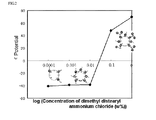
- FIG. 2 shows the measured ⁇ -potential results for the silica-coated titanium oxide powder, which was dispersed in water with dimethyl distearyl ammonium chloride, in the production of an oil-in-water emulsion composition, wherein the blending quantity of dimethyl distearyl ammonium chloride was varied, silica-coated titanium oxide: 3 weight %, oil component: 47 weight %, and water: balance.
- the ⁇ -potential which is the surface potential of powder, shifts to the positive direction with an increase in the cationic surfactant concentration.
- dimethyl distearyl ammonium chloride having a cationic group is adsorbed on the powder surface. From Fig.
- the adsorbed amount increases with an increase in the blended cationic surfactant against powder.
- the blending quantity is too high, the inversion to the water-in-oil may take place during emulsification.
- the blending ratio of a specific cationic surfactant to the powder component is preferably in the vicinity of 5: 0.001 to 5: 1 though it depends upon other formulation components.
- the oil-in-water emulsion composition of the present invention can be obtained by adding an oil phase component to the dispersion of the obtained powder particles, on which a cationic surfactant is adsorbed, and by emulsifying with an emulsifying machine etc.
- the addition of the oil phase component may be carried out under heating as necessary.
- a treatment such as fragmentation may be carried out beforehand.
- the present invention can be thought to be an O/P/W emulsion, wherein an oil phase is uniformly dispersed into the water phase with the help of fine particles on which a specific cationic surfactant is adsorbed.
- the added oil component enters into the association sites of lipophilic groups of a lamellar liquid crystal that is adsorbed on the powder, and the oil droplets, on which powder particles are adsorbed, are formed at the interface with the water phase.
- the powder adsorption on the oil droplets is enhanced by the action of the specific cationic surfactant.
- a composition more excellent in emulsion stability than the conventional O/P/W emulsion, wherein oil droplets are dispersed only by the adsorption power of the powder is presumably obtained.
- the powder particles are adsorbed on the oil droplets that are dispersed in the water phase, and a structure, wherein a cationic surfactant is adsorbed on the powder particles, is formed.
- a specific cationic surfactant of a liquid crystalline state is adsorbed on the powder before the emulsification of the water phase and the oil phase.
- a satisfactory improvement in the emulsion state and emulsion stability cannot be achieved by the addition of the cationic surfactant during or after emulsification.
- hydrophilic surfactant and/or lipophilic surfactant may be blended so far as the aforementioned Pickering emulsion is not deterriorated.
- the hydrophilic surfactant contributes to improvement of affinity of skin by eliminating frictional feeling owing to emulsification with powder.
- the lipophilic surfactant contributes to improvement of emulsion stability over time.
- an O/P/W emulsion is formed from the aforementioned essential components, and then the hydrophilic surfactant is added and mixed to the external aqueous phase of the emulsion.
- the blending quantity of the added hydrophilic surfactant is preferably 0.001 to 0.5 mass % with respect to the composition.
- hydrophilic surfactant examples include glycerol or polyglycerol fatty acid esters, propylene glycol fatty acid esters, POE sorbitan fatty acid esters, POE sorbitol fatty acid esters, POE glycerol fatty acid esters, POE fatty acid esters, POE alkyl ethers, POE alkylphenyl ethers, POE/POP alkyl ethers, POE castor oil or POE hardened castor oil derivatives, POE beeswax/lanolin derivatives, alkanolamides, POE propylene glycol fatty acid esters, POE alkylamine, POE fatty acid amide, polyoxyethylene alkylether sulfate, and alkyl amido amine.
- One of these hydrophilic surfactants can be blended alone, or two or more of them can be blended in combination.
- the lipophilic surfactant can be added as an oil phase component during the preparation of an O/P/W emulsion.
- its blending quantity is in a range that the lipophilic surfactant does not act as emulsifier, namely, about 0.01 to 5 mass % with respect to the composition.
- the structure of the O/P/W emulsion according to the present invention is that highly-stable oil droplets, of which powder particles are absorbed on the surface through the surfactants, can be formed by emulsifying with powders of which lamella liquid crystals of a specific cationic surfactant are absorbed on the surface in advance.
- lipophilic surfactant examples include sorbitan fatty acid esters such as sorbitan monooleate, sorbitan monoisostearate, sorbitan monopalmitate, sorbitan sesquioleate, sorbitan trioleate, and diglycerol sorbitan penta-2 ethylhexylate, glycerins such as glyceryl monoerucate, glyceryl sesquioleate, glyceryl monostearate, diglyceryl monostearate, and mono-stearic acid glycerine malic acid, or polyglycerin fatty acids, lipophilic sucrose fatty acid esters such as sucrose polyerucate, sucrose polyoleate, and sucrose polyisostearate, propylene glycol fatty acid esters such as propylene glycol monostearate, hardened castor oil derivatives, glycerin alkyl ethers, polyether-modified silicones, ali
- the components normally used in cosmetics and quasi-drugs can be blended in addition to the above-described components so far as the effect of the present invention is not undermined, and the production can be carried out according to the normal method.
- moisturizers examples include moisturizers, monosaccharides, oligosaccharides, organic amines, UV absorbers, antioxidants, antiseptics (such as ethyl paraben and butyl paraben), whitening agents (such as saxifraga sarmentosa extract, arbutins, tranexamic acids, and potassium 4-methoxysalicylate), various extracts (such as Zingiber officinale, phellodendron bark, goldthread, lithospermum root, birch, loquat, carrot, aloe, malva sylvestris (mallow), iris, vitis vinifera (grape), luffa cylindrica, lily, saffron, cnidium officinale, ginger, hypericum perforatum, ononis spinosa, allium sativum (gerlic), capsicum frutescen
- moisturizer examples include chondroitin sulfate, hyaluronic acid, mucoitin sulfate, charonin acid, atelocollagen, cholesteryl 12-hydroxystearate, sodium lactate, bile acid salts, dl-pyrrolidonecarboxylic acid salts, short-chain soluble collagen, diglycerol (EO) PO adducts, chestnut rose (R. roxburghii plena) extract, yarrow (Achillea millefolium) extract, and melilot extract in addition to the aforementioned polyhydric alcohols.
- EO diglycerol
- monosaccharide examples include trioses (such as D-glycerylaldehyde and dihydroxyacetone); tetroses (such as D-erythrose, D-erythrulose, D-threose, and erythritol); pentoses (such as L-arabinose, D-xylose, L-lyxose, D-arabinose, D-ribose, D-riburose, D-xylulose, and L-xylulose); hexoses (such as D-glucose, D-talose, D-psicose, D-galactose, D-fructose, L-galactose, L-mannose, and D-tagatose); heptoses (such as aldoheptose and heptulose); octoses (such as octulose); deoxysugars (such as 2-deoxy-D-ribose,
- oligosaccharide examples include sucrose, gentianose, umbelliferose, lactose, planteose, isolychnoses, ⁇ , ⁇ -threhalose, raffinose, lychnoses, umbilicin, and stachyose verbascoses.
- amino acid examples include neutral amino acids (such as threonine and cysteine); basic amino acids (such as hydroxylysine).
- amino acid derivative include sodium acylsarcosinate (sodium lauroylsarcosinate), acylglutamic acid salt, sodium acyl- ⁇ -alanine, glutathione, and pyrrolidonecarboxylic acid.
- organic amine examples include monoethanolamine, diethanolamine, triethanolamine, morpholine, triisopropanolamine, 2-amino-2-methyl-1,3-propanediol, and 2-amino-2-methyl-1-propanol.
- organic UV absorber examples include benzoic acid UV absorbers (such as p-aminobenzoic acid (hereinafter abbreviated as "PABA"), PABA monoglycerin ester, N,N-dipropoxy PABA ethyl ester, N,N-diethoxy PABA ethyl ester, N,N-dimethyl PABA butyl ester, and N,N-dimethyl PABA ethyl ester); anthranilic acid UV absorbers (such as homomenthyl-N-acetyl anthranilate); salicylic acid UV absorbers (such as amyl salicylate, menthyl salicylate, homomenthyl salicylate, octyl salicylate, phenyl salicylate, benzyl salicylate, and p-isopropanol phenyl salicylate); cinnamic acid UV absorbers (such as octyl cinnam
- inorganic UV absorber which is inorganic compound
- examples of antioxidant aid include phosphoric acid, citric acid, ascorbic acid, maleic acid, malonic acid, succinic acid, fumaric acid, cephalin, hexametaphosphates, phytic acid, and ethylenediaminetetraacetic acid.
- the formulation of the oil-in-water emulsion composition of the present invention is not specified, and the formulation can be suitably selected depending upon the formulation components and the intended use, for example, lotion, milky lotion, cream, or gel.
- the external skin preparation for sunscreen which is the second embodiment of the present invention.
- an oily organic UV protection agent and a powderly inorganic UV protection agent are blended in the base.
- a water-in-oil emulsion composition is widely used as the base.
- An external skin preparation of such a configuration has an unpleasant oily feeling, and a powdery feeling is also strong; thus good texture in use may not be achieved.
- an oil-in-water emulsion composition is used as the base, an external skin preparation with a refreshing feeling and light feeling can be obtained because of the composition characteristics.
- the present inventors further investigated the properties of the oil-in-water emulsion composition of the present invention and found that an oil-in-water external skin preparation for sunscreen that is excellent in the emulsion stability and low in the frictional feeling could be obtained by blending the above composition.
- the components in the oil-in-water emulsion composition, which is blended in the external skin preparation for sunscreen of the present invention, are as described above.
- the external skin preparation for sunscreen of the present invention is prepared by dispersing a hydrophobized powder in the oil phase component in the oil-in-water emulsion composition.
- hydrophobized powder to be dispersed in the oil phase component examples include a hydrophobized powder which is prepared by hydrophobizing the surface of inorganic powder particle in a wet method using solvent, a gas phase method, or a mechanochemical method with silicones such as methylhydrogenpolysiloxane and dimethylpolysiloxane; dextrin fatty acid ester; higher fatty acid; higher alcohol; fatty acid ester; metallic soap; alkyl phosphate ether; fluorine compound; or hydrocarbons such as squalane and paraffin; or a hydrophobized powder which is prepared by coating inorganic powder particle with silica and then hydrophobizing it with alkyl-modified silane coupling agent and so on.
- silicones such as methylhydrogenpolysiloxane and dimethylpolysiloxane
- dextrin fatty acid ester higher fatty acid
- higher alcohol higher alcohol
- fatty acid ester metallic soap
- Examples of the inorganic powder particle which is hydrophobized as mentioned above include titanium oxide, zinc oxide, talc, mica, sericite, kaolin, titanated mica, black iron oxide, yellow iron oxide, red iron oxide, ultramarine, Prussian blue, chromium oxide, and chromium hydroxide.
- particularly hydrophobized fine titanium dioxide and/or hydrophobized fine zinc oxide is preferably contained.
- the average particle size is smaller than the size of oil phase emulsified particles.
- the hydrophobized powder is used as a UV scattering agent in the external skin preparation for sunscreen of the present invention, it is preferable to use the powder with the average particle size of 100 nm or less.
- the external skin preparation for sunscreen of the present invention can be produced, with the use of the above-described essential components and other optional components so far as the effect is not undermined, according to the above-described production method of the oil-in-water emulsion composition of the present invention.
- the desired external skin preparation for sunscreen can be obtained by adding a powder component and a specific cationic surfactant to a portion of water, mixing them under heating, adding and mixing the rest of water and water phase components, and adding and mixing, under heating, the oil phase component which has been beforehand dissolved by heating and dispersed hydrophobic powder by stirring.
- the formulation can be suitably selected depending upon the formulation components and the intended use, for example, lotion, milky lotion, cream, or gel.
- the third embodiment of the present invention is a makeup composition.
- various powders have been blended in makeup cosmetics to provide the functions such as coloring of skin and hair, concealment of pigmented spots, freckles, etc., skin protection against UV light, and the absorption of sweat and sebum.
- the emulsion composition wherein such powder is blended the technology that can prevent the coalescence of emulsified particles and the aggregation/precipitation of fine powder particles, they are due to the passage of time or the change of temperature, and can also provide satisfactory powder dispersion stability is sought-after.
- the oil-in-water emulsion composition provides a fresh and light feeling in use; thus it is preferred for cosmetics such as milky lotion, cream, and emulsion-type foundation.
- silicone oil is widely used.
- the oil solution with a high rate of silicone oil which has low compatibility with other oil components such as hydrocarbons
- some ingenuity was necessary in the selection of the best surfactant, and it was difficult to stably emulsify the oil solution.
- a silicone surfactant is used for the emulsification of silicone oil
- a large blending quantity was necessary for stabilization, and there was an issue in that a sticky feeling is generated for the composition because of the surfactant.
- the present inventors further investigated the properties of the above-described oil-in-water emulsion composition of the present invention. As a result, the present inventors found that an oil-in-water makeup composition excellent in emulsion stability and with a low sticky feeling could be obtained by blending the composition of the invention.
- the makeup composition of the present invention is prepared by dispersing a hydrophobized powder into the oil phase component in the oil-in-water emulsion composition.
- hydrophobized powder to be dispersed in the oil phase components examples include a hydrophobized powder which is prepared by hydrophobizing the surface of inorganic powder particle in a wet method using solvent, a gas phase method, or a mechanochemical method with silicones such as methylhydrogenpolysiloxane and dimethylpolysiloxane; dextrin fatty acid ester; higher fatty acid; higher alcohol; fatty acid ester; metallic soap; alkyl phosphate ether; fluorine compound; or hydrocarbons such as squalane or paraffin; or a hydrophobized powder which is prepared by coating inorganic powder particle with silica and then hydrophobizing it with alkyl-modified silane coupling agent and so on.
- silicones such as methylhydrogenpolysiloxane and dimethylpolysiloxane
- dextrin fatty acid ester higher fatty acid; higher alcohol; fatty acid ester
- metallic soap alkyl phosphate ether
- Examples of the inorganic powder particle which is hydrophobized as mentioned above include titanium oxide, zinc oxide, talc, mica, sericite, kaolin, titanated mica, black iron oxide, yellow iron oxide, red iron oxide, ultramarine, Prussian blue, chromium oxide, and chromium hydroxide.
- particularly hydrophobized fine titanium dioxide, red iron oxide, yellow iron oxide, black iron oxide and/or aluminum oxide is preferably contained.
- Such a hydrophobized powder has high water resistance against sebum, sweat, etc. and is long-lasting. Therefore, a composition with a good feeling upon application and excellent characteristics after application can be obtained by dispersing the hydrophobized powder into the oil phase component in the oil-in-water emulsion composition.
- the average particle size is smaller than the size of oil phase emulsified particles.
- the powder in the makeup composition of the present invention, it is preferable to use the powder with an average particle size of 100 nm or less.
- the makeup composition of the present invention contains 50 mass % or more silicone oil, with respect to the oil phase component, in the oil-in-water emulsion composition, which is the essential component.
- silicone oil which can be applied in the present invention include linear polysiloxanes (such as dimethylpolysiloxane, methylphenylpolysiloxane, and diphenylpolysiloxane); cyclic polysiloxanes (such as octamethylcyclotetrasiloxane, decamethylcyclopentasiloxane, and dodecamethylcyclohexasiloxane); silicon resin forming three-dimensional network structure; silicone rubber; various kinds of modified polysiloxane (such as amino-modified polysiloxane, polyether-modified polysiloxane, alkyl-modified polysiloxane, and fluorine-modified polysiloxane), and acrylic silicones.
- One of these silicone oils can be blended alone, or
- an acrylic silicone represented by the below-described general formula (I).
- R is an alkyl group having 10 to 20 carbon atoms.
- a + b + c 1, all a, b, c are 0.2 or higher, and d is an integer of 5 to 100.
- a biterminally silicone-modified glycerin represented by the below-described general formula (II) is blended.
- R1 is a linear or branched alkyl group having 1 to 12 carbon atoms or a phenyl group
- R2 is an alkylene group having 2 to 11 carbon atoms.
- m is 10 to 120 and n is 1 to 11.
- the silicone oils represented by the above-described general formulas (I) and (II) can be blended alone or in combination.
- oils usually used in cosmetics such as liquid oil, waxes, hydrocarbon oil, higher fatty acid, higher alcohol, and synthetic ester oil, may be blended in addition to a specific amount of silicone oil.
- the makeup composition of the present invention can be produced according to the above-described production method of the oil-in-water emulsion composition of the present invention.
- the desired makeup composition can be obtained by adding a powder component and a specific cationic surfactant to a portion of water, mixing them under heating, adding and mixing the rest of water and water phase components, and adding and mixing, under heating, the oil phase component which has been beforehand dissolved by heating and dispersed the hydrophobic powder by stirring.
- the formulation can be suitably selected depending upon the formulation components and the intended use, for example, lotion, milky lotion, cream, or gel.
- the fourth embodiment of the present invention is a hair styling cosmetic.
- the styling preparation used for hair not only the hair styling ability but also non-sticky feeling during use and high moisture resistance have been sought-after.
- the increasing of the product viscosity by the adjustment of the amount of solid oil can be considered.
- the hair styling ability can be improved by this, the sticky feeling often increased at the same time.
- the stickiness can be remedied by using an oil-in-water emulsion in the hair styling preparation.
- the present inventors further investigated the properties of the above-described oil-in-water emulsion composition of the present invention.
- the present inventors found that a hair styling cosmetic excellent in emulsion stability, hair styling power, and moisture resistance, and with a low sticky feeling could be obtained by blending the composition of the invention.
- the present invention comprises 1 to 30 mass % of solid oil and 1 to 30 mass % of liquid oil with respect to the total components that constitute the present invention.
- the solid oil indicates solid oil (at room temperature) components generally used in cosmetics.
- oils such as cacao butter, coconut oil, horse fat, hardened coconut oil, palm oil, beef tallow, mutton tallow, hardened beef tallow, palm kernel oil, pork tallow, beef bone tallow, Japan wax kernel oil, hardened oil, heatsfoot oil, Japan wax, and hardened castor oil; waxes such as beeswax, candelilla wax, cotton wax, carnauba wax, bayberry wax, Chinese wax, spermaceti wax, montan wax, rice bran wax, lanolin, kapok wax, lanolin acetate, sugar cane wax, isopropyl lanolate, hexyl laurate, reduced lanolin, jojoba wax, hard lanolin, shellac wax, POE lanoline alcohol ether, POE lanoline alcohol acetate, POE cholesterol ether, and POE hydrogenated lanolin alcohol ether; hydrocarbon waxes such as polyethylene wax, paraffin wax, ceresin,
- the blending quantity of the solid oil in the hair styling cosmetic of the present invention is preferably 1 to 30 mass % of the total components, and more preferably 2 to 15 mass %. If the blending quantity of the solid oil is less than 1 mass %, the hair styling power may not be satisfactory. If the blending quantity exceeds 30 mass %, the stickiness may be caused.
- the liquid oil used in the present invention indicates liquid oil (at room temperature) components generally used in cosmetics.
- an oil include liquid oils such as avocado oil, evening primrose oil, camellia oil, turtle oil, macadamia nut oil, sunflower oil, almond oil, corn oil, mink oil, olive oil, rapeseed oil, egg oil, sesame oil, persic oil, wheat germ oil, sasanqua oil, castor oil, linseed oil, safflower oil, cottonseed oil, perilla oil, soybean oil, peanut oil, tea seed oil, kaya oil, rice bran oil, paulownia oil, Japanese tung oil, jojoba oil, and germ oil; ester oils such as cetyl octanoate, cetyl 2-ethylhexanoate, hexyldecyl dimethyloctanoate, ethyl laurate, hexyl laurate, isopropyl myristate, 2-hexy
- the blending quantity of the liquid oil in the hair styling cosmetic of the present invention is preferably 1 to 30 mass % with respect to the total components, and more preferably 5 to 20 mass %. If the blending quantity of the liquid oil is less than 1 mass %, the hair styling power may not be satisfactory. If the blending quantity exceeds 30 mass %, the stickiness may be caused.
- the hair styling cosmetic of the present invention it is preferable to blend silica, titanium dioxide, zinc oxide, or a composite powder thereof as the powder component, which is an essential component in the oil-in-water emulsion composition.
- silica is preferable because it has transparency and it does not turn white after application.
- the particle size of the powder is not limited in particular. However, the particle size is preferably 1 to 100 nm from the standpoint of handling easiness and emulsion stability when the powder is blended into cosmetics.
- the hair styling cosmetic of the present invention can be produced, with the use of the above-described essential components and other optional components so far as the effect is not undermined, according to the above-described production method of the oil-in-water emulsion composition of the present invention.
- the desired hair styling cosmetic can be obtained by adding a powder component and a specific cationic surfactant to a portion of water, mixing them under heating, adding and mixing the rest of water and water phase components, and adding and mixing, under heating, the oil phase component containing beforehand-dissolved solid oil and liquid oil.
- the formulation can be suitably selected depending upon the formulation components and the intended use, for example, lotion, milky lotion, cream, or gel.
- the appearance of the emulsion was observed by the naked eye within 1 day of the preparation of the emulsion.
- O The sample was uniform, and the oil floatation or powder aggregation was not observed.
- ⁇ The sample was nearly uniform; however, some oil floatation was observed.
- X The sample was not uniform, or a significant separation of the oil phase or the powder aggregation was observed.
- Emulsified particles were uniform, and the coalescence or aggregation was not observed.
- ⁇ Emulsified particles were nearly uniform; however, slight coalescence or aggregation was observed.
- X Emulsified particles were not uniform, and significant coalescence or aggregation was observed.
- a 24-hour occlusive patch test was performed on the medial side of the upper arm of 10 panelists, and the average value was calculated based on the following criteria. 0... No abnormality was observed. 1... Slight redness was observed. 2... Redness was observed. 3... Redness and papules were observed.
- the evaluation criteria for the "skin irritation test” were as follows. ⁇ : The average value of 10 panelists was 0 or higher and less than 0.15. O: The average value of 10 panelists was 0.15 or higher and less than 0.2. ⁇ : The average value of 10 panelists was 0.2 or higher and less than 0.3. X: The average value of 10 panelists was 0.3 or higher.
- the actual usage test of each sample was performed by 10 professional panelists.
- the evaluation criteria were as follows. ⁇ : 8 or more panelists acknowledged that there was no sticky feeling upon application. O: 6 or more and less than 8 panelists acknowledged that there was no sticky feeling upon application. ⁇ : 3 or more and less than 6 panelists acknowledged that there was no sticky feeling upon application. X: less than 3 panelists acknowledged that there was no sticky feeling upon application.
- Oil-in-water emulsions having the blending compositions listed in Table 1 were produced by the below-described method. The above-described evaluation tests (1) to (4) were performed for each sample.
- Glycerin and succinoglycan which are water phase components
- silica-coated zinc oxide which is a powder component
- trimethyl stearyl ammonium chloride or dimethyl disteary lammonium chloride that had been separately dispersed in purified water was added, and the ultrasonic wave treatment under heating was carried out.
- the powder component was uniformly dispersed, the remaining oil phase component was added and mixed with a mixer until it became uniform, and an oil-in-water emulsion composition was obtained.
- Test Example 1 As seen from Table 1, in Test Example 1, wherein only powder was blended, the emulsification was significantly poor. In Test Example 2, wherein a small amount of single-chain cationic active agent was added, the emulsification was improved. However, the skin irritation was high, and the sticky feeling tended to be high. In contrast, in Test Example 3, wherein a cationic active agent having two long alkyl chains is added, the emulsification, skin irritation, and sticky feeling were all good.
- the oil-in-water emulsions having the blending compositions listed in Table 2 were produced by the conventional method.
- the above-described evaluation tests (1) to (4) were performed for each sample.
- Glycerin and succinoglycan which are water phase components
- silica-coated zinc oxide which is a powder component
- dimethyl distearyl ammonium chloride that had been separately dispersed in purified water was added, and the ultrasonic wave treatment under heating was carried out. After the powder component was uniformly dispersed, the remaining oil phase component was added and mixed with a mixer until it became uniform, and an oil-in-water emulsion composition was obtained.
- the emulsions showed excellent emulsion stability, low sticky feeling, and low skin irritation.
- Test Example 4 wherein 0.1 mass % of powder was blended, the emulsion had slightly inferior emulsion stability.
- Test Example 8 wherein 30 mass % of powder was blended, the sticky feeling was strong. Accordingly, in the oil-in-water emulsion of the present invention, it is preferable that the blending quantity of powder is 1 to 20 mass % with respect to the total amount of the emulsion.
- the oil-in-water emulsions having the blending compositions listed in Table 3 were produced by the conventional method.
- the above-described evaluation tests (1) to (4) were performed for each sample.
- Glycerin and succinoglycan which are water phase components
- silica-coated zinc oxide which is a powder component
- dimethyl distearyl ammonium chloride that had been separately dispersed in purified water was added, and the ultrasonic wave treatment under heating was carried out. After the powder component was uniformly dispersed, the remaining oil phase component was added and mixed with a mixer until it became uniform, and an oil-in-water emulsion composition was obtained.
- the emulsions showed excellent emulsion stability, low sticky feeling, and low skin irritation.
- Test Example 9 wherein 0.0005 mass % of a cationic surfactant was blended, the emulsion had poor emulsification.
- Test Example 13 wherein 1 mass % of cationic surfactant was blended, had somewhat high skin irritation, and the sticky feeling was strong. Accordingly, in the oil-in-water emulsion of the present invention, it is preferable that the blending quantity of the cationic surfactant is 0.001 to 0.5 mass % with respect to the total amount of the emulsion.
- oil-in-water emulsions having the blending compositions listed in Table 4 were produced by the conventional method.
- the above-described evaluation tests (1) to (4) were performed for each sample.
- Glycerin and succinoglycan which are water phase components
- silica-coated zinc oxide which is a powder component
- dimethyl distearyl ammonium chloride that had been separately dispersed in purified water was added, and the ultrasonic wave treatment under heating was carried out. After the powder component was uniformly dispersed, the remaining oil phase component was added and mixed with a mixer until it became uniform, and an oil-in-water emulsion composition was obtained.
- the emulsions showed excellent emulsion stability, low sticky feeling, and low skin irritation.
- Test Example 14 wherein the chain length was 10
- the emulsion had poor emulsification.
- the sticky feeling became higher.
- the length of two alkyl chains of the cationic active agent is 12 to 22.
- the time-dependent change of emulsion stability of the oil-in-water emulsion composition was evaluated by blending succinoglycan, xanthan gum, or acrylamide.
- the evaluation method was as follows.
- the oil-in-water emulsion compositions having the blending compositions listed in Table 5 were produced. One month after the production, the emulsion appearance, of the composition of each test example, was observed by the naked eye. ⁇ : The composition maintained the emulsion appearance of the production time. O: Some settlement of the emulsion was observed; however, the composition nearly maintained the emulsion appearance. ⁇ : Emulsified particles settled, and the coalescence of particles was also observed. X: Emulsified particles in the composition settled and coalescenced, and the oil phase separated completely.
- Glycerin and succinoglycan, xanthan gum, acrylamide, or a polyacrylic acid salt, which are water phase components, and silica-coated zinc oxide, which is a powder component, were added to purified water and mixed.
- dimethyl distearyl ammonium chloride that had been separately dispersed in purified water was added, and the ultrasonic wave treatment under heating was carried out.
- the powder component was uniformly dispersed, the remaining oil phase component was added and mixed with a mixer until it became uniform, and an oil-in-water emulsion composition was obtained.
- the production method of the oil-in-water emulsion composition of the present invention was investigated. According to the below-described respective production methods, the emulsion compositions having formulations shown in Table 6 were produced, and the emulsion state was evaluated. The results are shown in Table 7.
- a water phase component, a powder component that was uniformly dispersed in a portion of purified water, and a surfactant component that was uniformly dispersed in the remaining purified water were mixed, and the ultrasonic wave treatment was carried out under heating at 70 °C.
- an oil phase component that was heated to 70 °C was added, and the composition was obtained by the emulsification with an emulsifying machine.
- a water phase component and a powder component were mixed, and the ultrasonic wave treatment was carried out under heating at 70 °C.
- an oil phase component that was heated to 70 °C and a surfactant component were added, and the composition was obtained by the emulsification with an emulsifying machine.
- a powder and a surfactant component were stirred in a suitable amount of ethanol; then the surfactant treated powder was obtained by evaporating ethanol.
- the surfactant-treated powder and a water phase component were mixed, and the ultrasonic wave treatment was carried out under heating at 70 °C.
- an oil phase component that was heated to 70 °C was added, and the composition was obtained by the emulsification with an emulsifying machine.
- the appearance of the emulsion was observed by the naked eye within 1 day of the preparation of the emulsion.
- O The sample was uniform, and the oil floatation or powder aggregation was not observed.
- ⁇ The sample was nearly uniform; however, some oil floatation was observed.
- X The sample was not uniform, or a significant separation of the oil phase or the powder aggregation was observed.
- Emulsified particles were uniform, and the coalescence or aggregation was not observed.
- ⁇ Emulsified particles were nearly uniform; however, slight coalescence or aggregation was observed.
- X Emulsified particles were not uniform, and significant coalescence or aggregation was observed.
- Test Example 23 wherein a specific cationic surfactant dispersed in water was mixed with a powder component and the emulsification with an oil phase component was subsequently carried out, showed excellent emulsion stability.
- Test Example 24 wherein a cationic surfactant was added, without going through the above process, at the time of emulsification of a water phase and an oil phase, a stable emulsion could not be obtained, and the coalescence or aggregation of oil droplets or powder was observed.
- Test Example 25 wherein a separate treatment was carried out in ethanol instead of the treatment of powder and a cationic surfactant in water, the emulsion stability was poor.
- the emulsion stability was evaluated for the composition obtained by mixing 50 parts by weight of the surface-treated-powder dispersion liquid, which was obtained by each method described below, and 50 parts by weight of the oil phase component (liquid paraffin) under heating at 70 °C.
- glyceryl monostearate Into 100 parts by weight of water, 0.1 parts by weight of glyceryl monostearate was uniformly dispersed, 6 parts by weight of silica-coated zinc oxide was added and dispersed, and ultrasonic wave treatment was carried out under heating.
- an O/P/W emulsion composition excellent in stability could be obtained by treating the powder with dimethyl distearyl ammonium chloride in water and carrying out the powder emulsification of the oil phase component with the use of the obtained dispersion liquid of the treated powder.
- the powder treatment with stearic acid which is a common hydrophobizing agent of powder, was carried out in ethanol because the treatment in water is difficult because of its properties (Test Example 27). Therefore, the emulsification could not be carried out for the dispersion of the treated powder, as it is, and the oil phase component.
- the treated powder was redispersed in water and the emulsification was tried.
- the oil-in-water emulsion composition of the present invention by using a cationic surfactant having two long-chain alkyl groups as the treatment agent of the powder, which is involved in emulsification, treating the powder in water, and mixing the dispersion liquid of the obtained treated powder, as it is, and the oil phase component. That is, in the production of the oil-in-water emulsion composition of the present invention, it is possible to carry out, easily and continuously, the operations starting from the surface treatment of the powder to the emulsification with the powder by using a cationic surfactant having a specific structure as the powder treatment agent, and the emulsion stability is high.
- hydrophilic surfactant PEG-60 hydrogenated castor oil
- hydrophilic surfactant PEG-60 hydrogenated castor oil
- hydrophilic surfactant PEG-60 hydrogenated castor oil
- hydrophilic surfactant PEG-60 hydrogenated castor oil
- the appearance of the emulsion was observed by the naked eye within 1 day of the preparation of the emulsion.
- O The sample was uniform, and the oil floatation or powder aggregation was not observed.
- ⁇ The sample was nearly uniform; however, some oil floatation was observed.
- X The sample was not uniform, or a significant separation of the oil phase or the powder aggregation was observed.
- Emulsified particles were uniform, and the coalescence or aggregation was not observed.
- ⁇ Emulsified particles were nearly uniform; however, slight coalescence or aggregation was observed.
- X Emulsified particles were not uniform, and significant coalescence or aggregation was observed.
- a 24-hour occlusive patch test was performed on the medial side of the upper arm of 10 panelists, and the average value was calculated based on the following criteria. 0... No abnormality was observed. 1... Slight redness was observed. 2... Redness was observed. 3... Redness and papules were observed.
- the evaluation criteria for the "skin irritation test” were as follows. ⁇ : The average value of 10 panelists was 0 or higher and less than 0.15. O: The average value of 10 panelists was 0.15 or higher and less than 0.2. ⁇ : The average value of 10 panelists was 0.2 or higher and less than 0.3. X: The average value of 10 panelists was 0.3 or higher.
- Each sample was evaluated with an actual use test by 10 professional panelists.
- the evaluation criteria are as follows. ⁇ : 8 or more panelists acknowledged that affinity of skin after application is good. O: 6 or more and less than 8 panelists acknowledged that affinity of skin after application is good. ⁇ : 3 or more and less than 6 panelists acknowledged that affinity of skin after application is good. X: Less than 3 panelists acknowledged that affinity of skin after application is good.
- Test Example 29 wherein 0.01 mass % of hydrophilic surfactant was added after the emulsification process, retained the equivalent level of low skin irritation to Test Example 23, wherein no hydrophilic surfactant was added, and showed a highly-improved affinity of skin.
- the skin irritation in Test Example 30, wherein 1 mass % of hydrophilic surfactant was added in the same addition method was inferior to that of Test Example 25.
- the compositions in Test Examples 31 and 32, wherein hydrophilic surfactant was respectively added during treating powder did not show improved affinity of skin. However, they showed deteriorations of the skin irritation owing to the increased additive amount which is to those in Test Examples 29 and 30.
- the range of blending quantity of hydrophilic surfactant which can achieve the aforementioned effects, is 0.001 to 0.5 mass % with respect to the composition, preferably 0.01 to 0.5 mass %.
- oil-in-water emulsion composition of the present invention are listed. However, the present invention is not limited to these examples. All the oil-in-water emulsion compositions obtained in the below-described formulation examples had high emulsion stability, a low sticky feeling, and low skin irritation.
- Formulation example 1 Milky lotion
- a milky lotion was obtained by heating Phase B to 70 °C, dispersing sufficiently with a mixer or by ultrasonic wave, adding phase C, adding phase A and emulsifying with an emulsifying machine, and lastly adding phase D.
- Formulation example 2 UV-protecting milky lotion
- Phase B was heated to 70 °C and dispersed with a mixer or by ultrasonic wave. Subsequently, uniformly dissolved phase C was added to this. Phase A heated to 70 °C was added to phase B heated to 70 °C, and the emulsification was carried out with an emulsifying machine. This was cooled and a milky lotion was obtained.
- Phase B was heated to 70 °C and sufficiently dispersed with an emulsifying machine, subsequently heated phase A was added, and the emulsification was carried out with an emulsifying machine. Lastly Phase C was added, and a foundation was obtained by cooling the emulsion with a heat exchanger.
- Emulsified particles were uniform, and the coalescence or aggregation was not observed.
- ⁇ Emulsified particles were nearly uniform; however, slight coalescence or aggregation was observed.
- X Emulsified particles were not uniform, and significant coalescence or aggregation was observed.
- the actual usage test by 10 professional panelists was performed for the presence or absence of frictional feeling after the use of each sample.
- the evaluation criteria were as follows. ⁇ : 8 or more panelists acknowledged that there was no frictional feeling after use. O: 6 or more and less than 8 panelists acknowledged that there was no frictional feeling after use. ⁇ : 3 or more and less than 6 panelists acknowledged that there was no frictional feeling after use. X: less than 3 panelists acknowledged that there was no frictional feeling after use.
- the actual usage test of each sample was performed by 10 professional panelists.
- the evaluation criteria were as follows. ⁇ : 8 or more panelists acknowledged that there was no sticky feeling upon application. O: 6 or more and less than 8 panelists acknowledged that there was no sticky feeling upon application. ⁇ : 3 or more and less than 6 panelists acknowledged that there was no sticky feeling upon application. X: less than 3 panelists acknowledged that there was no sticky feeling upon application.
- Phase A was heated to 70 °C and was dispersed by ultrasonic wave, and uniformly dissolved phase B was added.
- Phase C heated to 70 °C was added to phase B heated to 70 °C, the emulsification was carried out with an emulsifying machine, and then emulsion was cooled to room temperature.
- Test Example 33 As shown in Table 10, in Test Example 33, wherein the powder was used without blending a cationic surfactant, the emulsification was significantly poor. In Test Example 34, wherein only a single-chain cationic surfactant was added, a decrease in the rotation emulsion stability was observed. In contrast, in Test Example 35, wherein a cationic surfactant having two long alkyl chains was added, excellent results in all items were shown. In Test Example 36, wherein a powder component (silica-coated zinc oxide) was not blended, the emulsion stability was significantly poorer compared with that of Test Example 35.
- Phase A was heated to 70 °C and was dispersed by ultrasonic wave, and uniformly dissolved phase B was added.
- Phase C heated to 70 °C was added to phase B heated to 70 °C, the emulsification was carried out with an emulsifying machine, and then emulsion was cooled to room temperature.
- the compositions of Test Examples 40 to 42 had excellent emulsion stability, and a frictional feeling and sticky feeling were nearly absent.
- Test Example 39 wherein 0.5 mass % of powder was blended, had poor emulsion stability.
- Example 43 wherein 30 mass % of powder was blended, a strong frictional feeling and sticky feeling were present.
- the blending quantity of powder is 1 to 20 mass % with respect to the total amount of an external preparation.
- oil-in-water external skin preparations for sunscreen having the blending compositions listed in Table 12 were produced, and the above-described evaluation tests (1) to (4) were performed for each sample.
- Phase A Ion-exchanged water Balance Balance Balance Balance Balance Dimethyl distearyl ammonium chloride 0.0005 0.001 0.05 0.5 0.1 Silica-coated zinc oxide (30 nm) 3.0 3.0 3.0 3.0 3.0 3.0 (Phase B) Ion-exchanged water Portion Portion Portion Portion Glycerin 3.0 3.0 3.0 3.0 3.0 Succinoglycan 0.35 0.35 0.35 0.35 0.35 0.35 0.35 0.35 0.35 0.35 0.35 0.35 0.35 0.35 0.35 0.35 0.35 0.35 0.35 Antiseptic Q.S. Q.S. Q.S. Q.S. Q.S.S.
- Phase A was heated to 70 °C and was dispersed by ultrasonic wave, and uniformly dissolved phase B was added.
- Phase C heated to 70 °C was added to phase B heated to 70 °C, the emulsification was carried out with an emulsifying machine, and then emulsion was cooled to room temperature.
- the compositions of Test Examples 45 to 47 had excellent emulsion stability, and no frictional feeling and no sticky feeling were present.
- Example 44 wherein 0.0005 mass % of a cationic surfactant was blended
- Test Example 48 wherein 1 mass % of a cationic surfactant was blended
- the emulsion stability was significantly poor.
- the blending quantity of a cationic surfactant having two alkyl chains with 12 or more and 22 or less carbon atoms is 0.001 to 0.5 mass % with respect to the amount of total components.
- Phase A was heated to 70 °C and was dispersed by ultrasonic wave, and uniformly dissolved phase B was added.
- Phase C heated to 70 °C was added to phase B heated to 70 °C, the emulsification was carried out with an emulsifying machine, and then emulsion was cooled to room temperature.
- Example 49 wherein a cationic surfactant with a chain length of 10 was blended, was poor in emulsion stability.
- a cationic surfactant with a chain length of 22 or higher was blended, as in Test Example 52, the emulsion stability during rotation decreased, and the frictional feeling and sticky feeling increased.
- the length of two alkyl chains of the cationic surfactant is preferably 12 to 22.
- formulation examples of the external skin preparation for sunscreen of the present invention are listed. However, the present invention is not limited to these examples. All the oil-in-water external skin preparations for sunscreen obtained in the below-described formulation examples had high emulsion stability and water resistance, a low frictional feeling and sticky feeling, and low skin irritation.
- Formulation example 1 sunscreen milky lotion
- a milky lotion was obtained by heating Phase B to 70 °C, dispersing sufficiently with a mixer or by ultrasonic wave, adding phase C, adding phase A and emulsifying with an emulsifying machine, and lastly adding phase D.
- Formulation example 2 UV-protecting milky lotion
- Phase B was heated to 70 °C and dispersed with a mixer or by ultrasonic wave. Subsequently, uniformly dissolved phase C was added to this. Phase A heated to 70 °C was added to phase B heated to 70 °C, and the emulsification was carried out with an emulsifying machine. This was cooled and a milky lotion was obtained.
- Formulation example 3 sunscreen foundation
- Phase B was heated to 70 °C and sufficiently dispersed with an emulsifying machine, subsequently heated phase A was added, and the emulsification was carried out with an emulsifying machine. Lastly Phase C was added, and a foundation was obtained by cooling the emulsion with a heat exchanger.
- the actual usage test by 10 professional panelists was performed for the presence or absence of a sticky feeling after the use of the sample.
- the evaluation criteria were as follows. ⁇ : 8 or more panelists acknowledged that there was no sticky feeling after use. O: 6 or more and less than 8 panelists acknowledged that there was no sticky feeling after use. ⁇ : 3 or more and less than 6 panelists acknowledged that there was no sticky feeling after use. X: less than 3 panelists acknowledged that there was no sticky feeling after use.
- Evaluation (3) evaluation of refreshing feeling upon application
- the actual usage test of each sample was performed by 10 professional panelists.
- the evaluation criteria were as follows. ⁇ : 8 or more panelists acknowledged a refreshing feeling upon application. O: 6 or more and less than 8 panelists acknowledged a refreshing feeling upon application. ⁇ : 3 or more and less than 6 panelists acknowledged a refreshing feeling upon application. X: less than 3 panelists acknowledged a refreshing feeling upon application.
- Phase A was heated to 70 °C and dispersed by ultrasonic wave treatment.
- Phase B was added to this, the mixture was emulsified with an emulsifying machine, and then it was cooled.
- Test Example 53 wherein a cationic surfactant was not contained and only a hydrophilic powder was blended
- Test Example 54 wherein only a cationic surfactant was blended
- the formulation stability, non-stickiness, and a refreshing feeling were all good.
- the composition of Test Example 56 wherein a hydrocarbon-based surfactant was used for emulsification, had poor formulation stability, a sticky feeling was present, and a refreshing feeling was absent.
- Phase A was heated to 70 °C and dispersed by ultrasonic wave treatment.
- Phase B was added to this, the mixture was emulsified with an emulsifying machine, and then it was cooled.
- the compositions of Test Examples 58 to 61 showed no sticky feeling, and a refreshing texture was present.
- an acrylic silicone with a specific structure (Test Example 58) or a biterminally silicone-modified glycerin (Test Example 59) was blended, or when both of them were blended (Test Example 60), a significant improvement in usability was observed.
- Test Example 62 wherein the blending quantity of a silicone oil is less than 50 mass % with respect to the oil phase component, the sample was extremely sticky, and a refreshing feeling was also absent.
- Phase A was heated to 70 °C and dispersed by ultrasonic wave treatment.
- Phase B was added to this, the mixture was emulsified with an emulsifying machine, and then it was cooled.
- the makeup compositions of Test Examples 64 to 66 had excellent formulation stability, and the non-stickiness and the refreshing feeling were also excellent.
- Test Example 63 wherein the blending quantity of the powder component (silica-coated zinc oxide) involved in emulsification was 0.5 mass %, the formulation stability was poor.
- the composition in Example 67 wherein 30 mass % of the same powder component was blended, had high stickiness, and the refreshing feeling was absent. Accordingly, in the makeup composition of the present invention, it is preferable that the blending quantity of the powder component is 1 to 20 mass % with respect to the composition.
- Phase A was heated to 70 °C and dispersed by ultrasonic wave treatment.
- Phase B was added to this, the mixture was emulsified with an emulsifying machine, and then it was cooled.
- the makeup compositions of Test Examples 69 to 71 had excellent formulation stability, and the non-stickiness and the refreshing feeling were excellent.
- Example 68 wherein the blending quantity of dimethyl distearyl ammonium chloride was 0.0005 mass %
- Test Example 72 wherein the blending quantity was 1 mass %
- the formulation stability was significantly low. Accordingly, in the makeup composition of the present invention, it is preferable to blend 0.001 to 0.5 mass % , with respect to the composition, of the cationic surfactant having two alkyl chains with 12 or more and 22 or less carbon atoms.
- Phase A was heated to 70 °C and dispersed by ultrasonic wave treatment.
- Phase B was added to this, the mixture was emulsified with an emulsifying machine, and then it was cooled.
- the compositions of Test Examples 74 and 75 showed good results in all evaluation items.
- the composition in Example 73 wherein dimethyl distearyl ammonium chloride with an alkyl chain length of 10 was used, had significantly low formulation stability, and it was not usable.
- the composition in Example 76 wherein the alkyl chain length was 22, had excellent formulation stability; however, some stickiness was present, and it was unsatisfactory in the refreshing feeling. Accordingly, in the makeup composition of the present invention, the length of two alkyl chains of the cationic surfactant is preferably 12 to 22.
- formulation examples of the makeup composition of the present invention are listed. However, the present invention is not limited to these examples. All the makeup compositions obtained in the below-described formulation examples had high formulation stability, a low sticky feeling, and a refreshing feeling.
- Formulation example 1 oil-in-water emulsion foundation
- Components (10) to (13) were mixed and heated to 70 °C. The mixture was sufficiently dispersed with a homomixer or by ultrasonic wave. Subsequently, oil phase components (1) to (9), which had been beforehand fragmented by dispersion with a bead mill, were added. After the emulsification was carried out with an emulsifying machine, components (14) to (20) were added. An oil-in-water emulsion foundation was obtained by dispersing them uniformly.
- Formulation example 2 oil-in-water emulsion foundation
- Components (11) to (15) were mixed and heated to 70 °C. The mixture was sufficiently dispersed with a homomixer or by ultrasonic wave. Subsequently, oil phase components (1) to (10), which had been beforehand fragmented by dispersion with a bead mill, were gradually added to this. After the emulsification was carried out with an emulsifying machine, components (16) to (20) were added. An oil-in-water emulsion foundation was obtained by dispersing them uniformly.
- Formulation example 3 oil-in-water gel foundation
- Components (11) to (14) were mixed and heated to 70 °C.
- the mixture was sufficiently dispersed with a homomixer or by ultrasonic wave.
- oil phase components (1) to (10) which had been beforehand fragmented by dispersion with a bead mill, were gradually added to this.
- components (15) to (20) which had been beforehand uniformly dispersed at 90 °C and then cooled, were added to obtain an oil-in-water gel foundation.
- Emulsified particles were uniform, and the coalescence or aggregation was not observed.
- ⁇ Emulsified particles were nearly uniform; however, slight coalescence or aggregation was observed.
- X Emulsified particles were not uniform, and significant coalescence or aggregation was observed.
- the actual usage test by 10 professional panelists was performed for the hair styling power of the samples.
- the evaluation criteria were as follows. ⁇ : 8 or more panelists acknowledged that the natural hair styling with natural hair flow could be maintained. O: 6 or more and less than 8 panelists acknowledged that the natural hair styling with natural hair flow could be maintained. ⁇ : 3 or more and less than 6 panelists acknowledged that the natural hair styling with natural hair flow could be maintained. X: less than 3 panelists acknowledged that the natural hair styling with natural hair flow could be maintained.
- a sample was applied on the hair strand, and the strand was formed into coils, naturally dried, and stored for 24 hours in a container that was adjusted at a relative humidity of 90% and 25 °C.
- the sensory evaluation, for the shape and texture of the removed strand, was performed by 10 panelists. The determination was based on the following criteria. ⁇ : 8 or more panelists determined that there was moisture resistance. O: 6 or more and less than 8 panelists determined that there was moisture resistance. ⁇ : 3 or more and less than 6 panelists determined that there was moisture resistance. X: less than 3 panelists determined that there was moisture resistance.
- the actual usage test of each sample was performed by 10 professional panelists.
- the evaluation criteria were as follows. ⁇ : 8 or more panelists acknowledged that there was no sticky feeling upon application. O: 6 or more and less than 8 panelists acknowledged that there was no sticky feeling upon application. ⁇ : 3 or more and less than 6 panelists acknowledged that there was no sticky feeling upon application. X: less than 3 panelists acknowledged that there was no sticky feeling upon application.
- Hair styling cosmetics having the blending compositions listed in Table 19 were produced, and the above-described evaluation tests (1) to (4) were performed for each sample.
- Test Example 77 wherein the emulsification was carried out with the use of a hydrophilic powder (silica-coated titanium dioxide, silica)
- Test Example 78 wherein the emulsification was carried out with the use of dimethyl distearyl ammonium chloride
- Test Example 79 wherein the emulsification was carried out with the use of both dimethyl distearyl ammonium chloride and a hydrophilic powder, showed high emulsion stability, and the good usability was shown in hair styling power, moisture resistance, and non-stickiness.
- the hair styling cosmetic of the present invention contain an oil-in-water emulsion composition containing (a) a powder component, (b) a cationic surfactant having two alkyl chains with 12 or more and 22 or less carbon atoms, (c) an oil phase component, and (d) a water phase component.
- hair styling cosmetics having the blending compositions listed in Table 20 were produced, and the above-described evaluation tests (1) to (4) were performed for each sample.
- Phase A was heated to 70 °C and dispersed by ultrasonic wave treatment.
- the hair styling cosmetics of Test Examples 82 to 84 showed excellent emulsion stability, and they were also highly evaluated in hair styling power, moisture resistance, and the absence of a sticky feeling.
- Test Example 81 wherein the blending quantity of the powder component (silica-coated zinc oxide, silica) involved in emulsification was 0.5 mass %, had poor emulsion stability.
- the composition of Example 85 wherein 30 mass % of the powder component was blended, severely lacked usability. Accordingly, it is preferable that the blending quantity of the powder component in the hair styling cosmetic of the present invention is 1 to 20 mass % with respect to the composition.
- hair styling cosmetics having the blending compositions listed in Table 21 were produced, and the above-described evaluation tests (1) to (4) were performed for each sample.
- Phase A was heated to 70 °C and dispersed by ultrasonic wave treatment.
- the hair styling cosmetics of Test Examples 87 to 89 showed high emulsion stability, and they were also excellent in hair styling power, moisture resistance, and nonsticky feeling.
- Example 86 wherein the blending quantity of dimethyl distearyl ammonium chloride was 0.0005 mass %, had low emulsion stability.
- Test Example 90 wherein the blending quantity was 1 mass %, had both poor emulsion stability and poor usability. Accordingly, in the hair styling cosmetic of the present invention, it is preferable that 0.001 to 0.5 mass % of the cationic surfactant having two alkyl chains with 12 or more and 22 or less carbon atoms is blended with respect to the composition.
- hair styling cosmetics having the blending compositions listed in Table 22 were produced, and the above-described evaluation tests (1) to (4) were performed for each sample.
- Phase A was heated to 70 °C and dispersed by ultrasonic wave treatment.
- the compositions of Test Examples 92 and 93 showed good results in all evaluation items.
- the composition in Example 91 wherein dimethyl distearyl ammonium chloride with an alkyl chain length of 10 was used, had significantly low emulsion stability, and it was not usable.
- the composition in Example 94 wherein the alkyl chain length was 22, had both unsatisfactory formulation stability and unsatisfactory usability.
- the length of two alkyl chains of the cationic surfactant is preferably 12 to 22.
- hair styling cosmetics having the blending compositions listed in Table 23 were produced, and the above-described evaluation tests (2) to (4) were performed for each sample.
- Phase A was heated to 70 °C and dispersed by ultrasonic wave treatment.
- formulation examples of the hair styling cosmetic of the present invention are listed. However, the present invention is not limited to these examples. All the hair styling cosmetics obtained in the below-described formulations examples had high emulsion stability and a low sticky feeling, and the hair styling power and moisture resistance were excellent.
- Formulation example 1 hair wax
- Phase B was heated to 70 °C and dispersed by ultrasonic wave treatment.
- Phase A heated to 80 °C was added to this, the emulsification was carried out with an emulsifying machine, phase C was added, and then it was cooled.
- Phase A Liquid paraffin 10.0 Microcrystalline wax 10.0 Dimethylpolysiloxane 4.0 Stearyl alcohol 2.0 Carnauba wax 3.0 Pentaerythritol tetra-2-ethylhexanoate 2.0 Perfume Q.S. Phase B Propylene glycol 8.0 Silica-coated zinc oxide (30 nm) 2.0 Diethyl distearyl ammonium chloride 0.07 Silica (10 nm) 2.0 Purified water Q.S. Phase C Succinoglycan 0.2 Glycerin 3.0 L-Arginine L-aspartate 0.01 Edetate 0.05 Antiseptic Q.S. POE(20)behenyl alcohol 0.02 Purified water Balance
- Phase B was heated to 70 °C and dispersed by ultrasonic wave treatment.
- Phase A heated to 80 °C was added to this, the emulsification was carried out with an emulsifying machine, phase C was added, and then it was cooled.
Landscapes
- Health & Medical Sciences (AREA)
- Life Sciences & Earth Sciences (AREA)
- Veterinary Medicine (AREA)
- Animal Behavior & Ethology (AREA)
- General Health & Medical Sciences (AREA)
- Public Health (AREA)
- Birds (AREA)
- Epidemiology (AREA)
- Chemical & Material Sciences (AREA)
- Dispersion Chemistry (AREA)
- Dermatology (AREA)
- Oil, Petroleum & Natural Gas (AREA)
- Inorganic Chemistry (AREA)
- Cosmetics (AREA)
- Colloid Chemistry (AREA)
Applications Claiming Priority (2)
| Application Number | Priority Date | Filing Date | Title |
|---|---|---|---|
| JP2007116809 | 2007-04-26 | ||
| PCT/JP2008/058149 WO2008139908A1 (fr) | 2007-04-26 | 2008-04-25 | Composition d'émulsion huile-dans-eau et sa méthode de préparation |
Publications (3)
| Publication Number | Publication Date |
|---|---|
| EP2149361A1 true EP2149361A1 (fr) | 2010-02-03 |
| EP2149361A4 EP2149361A4 (fr) | 2013-01-30 |
| EP2149361B1 EP2149361B1 (fr) | 2014-07-23 |
Family
ID=40002123
Family Applications (2)
| Application Number | Title | Priority Date | Filing Date |
|---|---|---|---|
| EP08752183.7A Active EP2149361B1 (fr) | 2007-04-26 | 2008-04-25 | Composition d'émulsion huile-dans-eau et sa méthode de préparation |
| EP08752182.9A Not-in-force EP2151230B1 (fr) | 2007-04-26 | 2008-04-25 | Composition d'émulsion huile-dans-eau et sa méthode de préparation |
Family Applications After (1)
| Application Number | Title | Priority Date | Filing Date |
|---|---|---|---|
| EP08752182.9A Not-in-force EP2151230B1 (fr) | 2007-04-26 | 2008-04-25 | Composition d'émulsion huile-dans-eau et sa méthode de préparation |
Country Status (8)
| Country | Link |
|---|---|
| US (2) | US20100297039A1 (fr) |
| EP (2) | EP2149361B1 (fr) |
| JP (2) | JP5352116B2 (fr) |
| KR (2) | KR101590646B1 (fr) |
| CN (2) | CN101674798B (fr) |
| ES (2) | ES2519468T3 (fr) |
| TW (2) | TWI426925B (fr) |
| WO (2) | WO2008139908A1 (fr) |
Cited By (6)
| Publication number | Priority date | Publication date | Assignee | Title |
|---|---|---|---|---|
| WO2014044957A1 (fr) * | 2012-09-21 | 2014-03-27 | L'oreal | Composition cosmétique sous forme d'émulsion et procédé de traitement cosmétique |
| FR2995786A1 (fr) * | 2012-09-21 | 2014-03-28 | Oreal | Composition cosmetique sous forme d'emulsion et procede de traitement cosmetique |
| EP2545903A4 (fr) * | 2010-03-12 | 2015-08-05 | Nisshin Oillio Group Ltd | Composition pour usage externe cutané, produit cosmétique, et agent nettoyant |
| EP2921158A4 (fr) * | 2012-11-13 | 2016-06-15 | Shiseido Co Ltd | Crème solaire de type émulsion eau dans huile |
| WO2016097641A1 (fr) | 2014-12-17 | 2016-06-23 | L'oreal | Émulsions stabilisées par des particules composites amphiphiles |
| EP2452668B1 (fr) | 2009-07-06 | 2018-10-03 | Kao Corporation | Composition émulsifiée |
Families Citing this family (51)
| Publication number | Priority date | Publication date | Assignee | Title |
|---|---|---|---|---|
| EP1958687B1 (fr) * | 2007-02-15 | 2011-11-23 | Unilever PLC | Système émulsifiant |
| JP5352116B2 (ja) * | 2007-04-26 | 2013-11-27 | 株式会社 資生堂 | 水中油型乳化組成物及びその製造方法 |
| JP2010235473A (ja) * | 2009-03-30 | 2010-10-21 | Naris Cosmetics Co Ltd | 皮膚化粧料 |
| JP2012530711A (ja) * | 2009-06-19 | 2012-12-06 | ユー.エス. コスメティックス コーポレイション | 高められた紫外線防御のための化粧用組成物および方法 |
| WO2011040013A1 (fr) | 2009-09-30 | 2011-04-07 | 株式会社ナノエッグ | Nouvelle composition de cristaux liquides |
| KR101605813B1 (ko) | 2010-09-03 | 2016-03-24 | (주)아모레퍼시픽 | 고함량의 실리콘 오일 및 에몰리언트를 함유하는 메이크업 화장료 조성물 |
| JP2012102057A (ja) * | 2010-11-11 | 2012-05-31 | Mandom Corp | 整髪剤用乳化組成物 |
| JP5981161B2 (ja) * | 2011-02-28 | 2016-08-31 | 株式会社コーセー | 整髪料組成物 |
| ES2403544B2 (es) * | 2011-11-11 | 2013-12-13 | Universidade De Santiago De Compostela | Sistemas nanoparticulares elaborados a base de ésteres de sorbitán. |
| JP5207424B1 (ja) | 2011-12-22 | 2013-06-12 | 株式会社 資生堂 | コロナ−コア型ミクロゲル乳化剤及び水中油型乳化組成物 |
| JP6279216B2 (ja) * | 2013-03-04 | 2018-02-14 | 株式会社ミルボン | クリーム状組成物 |
| US10028895B2 (en) * | 2013-05-17 | 2018-07-24 | L'oreal | Emulsion stabilization via silicilic acid complexation |
| US20140356302A1 (en) * | 2013-06-04 | 2014-12-04 | Spatz Laboratories | Buoyant Cosmetic Gel Formulation |
| CN103772925B (zh) * | 2013-12-11 | 2015-10-14 | 浙江南益生物科技有限公司 | 一种用于pla的液态纳米云母改质剂 |
| JP6953476B2 (ja) * | 2013-12-18 | 2021-10-27 | ロレアル | 低量のアルコールを含むピッケリングエマルションの組成物 |
| WO2015089750A1 (fr) * | 2013-12-18 | 2015-06-25 | L'oreal | Composition d'émulsion de pickering comprenant une faible quantité d'alcool |
| JP5913411B2 (ja) | 2014-03-26 | 2016-04-27 | 株式会社 資生堂 | 水中油型乳化化粧料 |
| JP5913475B2 (ja) | 2014-08-06 | 2016-04-27 | 株式会社 資生堂 | 化粧料用原料 |
| JP6113695B2 (ja) * | 2014-10-31 | 2017-04-12 | 株式会社 資生堂 | 弾力ジェル状組成物 |
| KR102418097B1 (ko) * | 2015-06-30 | 2022-07-08 | (주)아모레퍼시픽 | 라멜라 구조체를 포함하는 메이크업 화장료 조성물 |
| WO2017011977A1 (fr) * | 2015-07-20 | 2017-01-26 | L'oreal | Composition pour le traitement de fibres kératiniques |
| HK1257838A1 (zh) | 2015-09-30 | 2019-11-01 | 株式会社资生堂 | 水包油包粉体型组合物 |
| WO2017073758A1 (fr) * | 2015-10-30 | 2017-05-04 | 株式会社 資生堂 | Composition |
| KR102583880B1 (ko) * | 2016-01-21 | 2023-10-05 | 주식회사 엘지생활건강 | 유중수형 화장료 조성물 |
| JP6754038B2 (ja) * | 2016-02-25 | 2020-09-09 | 株式会社トキワ | 水中油型頭髪用組成物 |
| US11576851B2 (en) * | 2016-07-12 | 2023-02-14 | L'oreal | Composition of pickering emulsion |
| US20200069541A1 (en) | 2016-10-20 | 2020-03-05 | Shiseido Company, Ltd. | Oil-in-water type emulsion composition |
| KR102569626B1 (ko) | 2016-12-08 | 2023-08-22 | 미쯔비시 케미컬 주식회사 | 수중유형 유화 조성물, 및 그 수중유형 유화 조성물의 제조 방법 |
| KR102672901B1 (ko) * | 2017-02-27 | 2024-06-10 | (주)아모레퍼시픽 | 유해 광선 차단 화장료 조성물 |
| JP7234107B2 (ja) * | 2017-05-19 | 2023-03-07 | 株式会社 資生堂 | 水中油型乳化組成物 |
| CN110678731B (zh) * | 2017-05-25 | 2022-09-16 | 信越化学工业株式会社 | 粉体的疏水化度的解析方法、高疏水化度处理着色颜料以及含有其的化妆料 |
| CN110151613A (zh) * | 2018-02-13 | 2019-08-23 | 吴明轩 | 清洁剂组合物及其制造方法 |
| JP7237463B2 (ja) * | 2018-05-24 | 2023-03-13 | ポーラ化成工業株式会社 | アクリル系ポリマー含有ピッカリングエマルション |
| WO2019239526A1 (fr) * | 2018-06-13 | 2019-12-19 | 三菱ケミカルフーズ株式会社 | Émulsion de pickering huile dans l'eau |
| JP7673348B2 (ja) | 2018-09-28 | 2025-05-09 | ポーラ化成工業株式会社 | 可視光透過性を有するピッカリングエマルション |
| JP7232605B2 (ja) * | 2018-09-28 | 2023-03-03 | ポーラ化成工業株式会社 | 防腐性乳化組成物及び防腐方法 |
| KR102641156B1 (ko) * | 2018-11-06 | 2024-02-28 | 주식회사 케이씨씨실리콘 | 에멀젼 조성물 |
| WO2020246556A1 (fr) | 2019-06-06 | 2020-12-10 | 花王株式会社 | Procédé pour éliminer la fixation de polluants atmosphériques |
| KR102294557B1 (ko) * | 2019-06-26 | 2021-08-27 | 경희대학교 산학협력단 | 미세먼지를 이용한 피커링 에멀젼의 제조방법 및 이에 사용되는 피커링 에멀젼 안정화제 |
| CN110702258B (zh) * | 2019-11-04 | 2020-10-20 | 长春职业技术学院 | 用于食品冷链安全监测的温敏型乳液指示剂的制备方法 |
| CN111728885A (zh) * | 2020-07-01 | 2020-10-02 | 广州美兮生物科技有限公司 | 具有防水防汗功效的护肤组合物及其制备方法、应用和化妆品 |
| CN112451426A (zh) * | 2020-11-30 | 2021-03-09 | 广东丸美生物技术股份有限公司 | 一种利用d相乳化法制备水包油型乳液的方法及其应用 |
| EP4339157A4 (fr) | 2021-05-11 | 2025-07-02 | Tayca Corp | Poudre inorganique composite traitée en surface |
| CN113616786B (zh) * | 2021-05-20 | 2023-08-25 | 南华大学 | 一种pickering乳液及其制备方法和在制备疫苗免疫佐剂中的应用 |
| CN114010588B (zh) * | 2021-11-18 | 2023-11-03 | 沈阳信康药物研究有限公司 | 一种含有黑豆馏油纳米氧化锌皮克林乳剂的外用温敏型凝胶剂及其制备方法和应用 |
| EP4470629A4 (fr) * | 2022-01-28 | 2026-03-25 | Kao Corp | Préparation pour la peau de type émulsion huile-dans-eau pour usage externe |
| CN114736664B (zh) * | 2022-05-26 | 2023-06-27 | 西南石油大学 | 一种纳米二氧化钛固体颗粒乳化剂及其制备方法 |
| JP2024004073A (ja) * | 2022-06-28 | 2024-01-16 | 株式会社ファンケル | 水中油型乳化化粧料 |
| JP2024036249A (ja) * | 2022-09-05 | 2024-03-15 | 株式会社ファンケル | 水中油型乳化組成物 |
| CN115445253A (zh) * | 2022-10-11 | 2022-12-09 | 齐鲁工业大学 | 一种pickering型高级脂肪醇乳液消泡剂及其制备方法 |
| CN116515297A (zh) * | 2023-04-25 | 2023-08-01 | 航天材料及工艺研究所 | 一种硅橡胶乳液、制备方法及水基涂料 |
Family Cites Families (13)
| Publication number | Priority date | Publication date | Assignee | Title |
|---|---|---|---|---|
| FR2720644B1 (fr) * | 1994-06-06 | 1996-07-05 | Oreal | Emulsion eau-dans-huile sans tensioactif. |
| GB9503594D0 (en) * | 1995-02-23 | 1995-04-12 | Unilever Plc | Cleaning composition comprising dialkyl cationic surfactants |
| US6017548A (en) * | 1995-06-06 | 2000-01-25 | The Andrew Jergens Company | Skin care composition |
| JP3398277B2 (ja) | 1996-03-29 | 2003-04-21 | 株式会社資生堂 | 皮膚外用剤 |
| WO1998042301A1 (fr) | 1997-03-25 | 1998-10-01 | Beiersdorf Ag | Systemes en dispersion fine sans emulsifiants de type eau dans huile |
| DE19834819A1 (de) * | 1998-08-01 | 2000-02-03 | Beiersdorf Ag | Emulgatorfreie feindisperse Systeme vom Typ Öl-in-Wasser und Wasser-in-Öl |
| DE19834820A1 (de) | 1998-08-01 | 2000-02-03 | Beiersdorf Ag | Emulgatorfreie feindisperse Systeme vom Typ Öl-in-Wasser und Wasser-in-Öl |
| DE19834821A1 (de) * | 1998-08-01 | 2000-02-03 | Beiersdorf Ag | Emulgatorfreie feindisperse Systeme vom Typ Öl-in-Wasser und Wasser-in-Öl |
| DE19842730A1 (de) * | 1998-09-18 | 2000-03-23 | Beiersdorf Ag | Emulgatorfreie feindisperse Systeme vom Typ Öl-in-Wasser und Wasser-in-Öl |
| JP4442883B2 (ja) | 2003-11-05 | 2010-03-31 | 株式会社資生堂 | 粉体分散安定剤及びこれを配合した化粧料 |
| JP2006036763A (ja) | 2004-06-25 | 2006-02-09 | Kao Corp | 水中油型乳化組成物 |
| JP5506130B2 (ja) | 2006-06-12 | 2014-05-28 | 株式会社 資生堂 | 水中油型エマルション |
| JP5352116B2 (ja) * | 2007-04-26 | 2013-11-27 | 株式会社 資生堂 | 水中油型乳化組成物及びその製造方法 |
-
2008
- 2008-04-25 JP JP2008116346A patent/JP5352116B2/ja active Active
- 2008-04-25 WO PCT/JP2008/058149 patent/WO2008139908A1/fr not_active Ceased
- 2008-04-25 KR KR1020097024095A patent/KR101590646B1/ko active Active
- 2008-04-25 JP JP2008116347A patent/JP5352117B2/ja active Active
- 2008-04-25 EP EP08752183.7A patent/EP2149361B1/fr active Active
- 2008-04-25 WO PCT/JP2008/058148 patent/WO2008139907A1/fr not_active Ceased
- 2008-04-25 ES ES08752182.9T patent/ES2519468T3/es active Active
- 2008-04-25 CN CN200880013444.1A patent/CN101674798B/zh active Active
- 2008-04-25 CN CN200880013477.6A patent/CN101686907B/zh active Active
- 2008-04-25 EP EP08752182.9A patent/EP2151230B1/fr not_active Not-in-force
- 2008-04-25 ES ES08752183.7T patent/ES2520045T3/es active Active
- 2008-04-25 KR KR1020097024096A patent/KR20100022010A/ko not_active Withdrawn
- 2008-04-25 US US12/597,511 patent/US20100297039A1/en not_active Abandoned
- 2008-04-25 US US12/597,502 patent/US8673326B2/en not_active Expired - Fee Related
- 2008-04-28 TW TW097115523A patent/TWI426925B/zh not_active IP Right Cessation
- 2008-04-28 TW TW097115527A patent/TWI442936B/zh not_active IP Right Cessation
Non-Patent Citations (2)
| Title |
|---|
| No further relevant documents disclosed * |
| See also references of WO2008139908A1 * |
Cited By (7)
| Publication number | Priority date | Publication date | Assignee | Title |
|---|---|---|---|---|
| EP2452668B1 (fr) | 2009-07-06 | 2018-10-03 | Kao Corporation | Composition émulsifiée |
| EP2545903A4 (fr) * | 2010-03-12 | 2015-08-05 | Nisshin Oillio Group Ltd | Composition pour usage externe cutané, produit cosmétique, et agent nettoyant |
| WO2014044957A1 (fr) * | 2012-09-21 | 2014-03-27 | L'oreal | Composition cosmétique sous forme d'émulsion et procédé de traitement cosmétique |
| FR2995786A1 (fr) * | 2012-09-21 | 2014-03-28 | Oreal | Composition cosmetique sous forme d'emulsion et procede de traitement cosmetique |
| FR2995784A1 (fr) * | 2012-09-21 | 2014-03-28 | Oreal | Composition cosmetique sous forme d'emulsion et procede de traitement cosmetique |
| EP2921158A4 (fr) * | 2012-11-13 | 2016-06-15 | Shiseido Co Ltd | Crème solaire de type émulsion eau dans huile |
| WO2016097641A1 (fr) | 2014-12-17 | 2016-06-23 | L'oreal | Émulsions stabilisées par des particules composites amphiphiles |
Also Published As
| Publication number | Publication date |
|---|---|
| JP5352117B2 (ja) | 2013-11-27 |
| EP2149361B1 (fr) | 2014-07-23 |
| US20100135938A1 (en) | 2010-06-03 |
| WO2008139908A1 (fr) | 2008-11-20 |
| CN101674798B (zh) | 2015-03-25 |
| TWI426925B (zh) | 2014-02-21 |
| JP5352116B2 (ja) | 2013-11-27 |
| HK1141712A1 (en) | 2010-11-19 |
| EP2149361A4 (fr) | 2013-01-30 |
| US20100297039A1 (en) | 2010-11-25 |
| CN101686907A (zh) | 2010-03-31 |
| EP2151230A4 (fr) | 2013-01-23 |
| JP2008291026A (ja) | 2008-12-04 |
| HK1141713A1 (en) | 2010-11-19 |
| EP2151230A1 (fr) | 2010-02-10 |
| ES2520045T3 (es) | 2014-11-11 |
| CN101674798A (zh) | 2010-03-17 |
| TWI442936B (zh) | 2014-07-01 |
| CN101686907B (zh) | 2013-09-18 |
| US8673326B2 (en) | 2014-03-18 |
| TW200900088A (en) | 2009-01-01 |
| JP2008291027A (ja) | 2008-12-04 |
| WO2008139907A1 (fr) | 2008-11-20 |
| KR20100022010A (ko) | 2010-02-26 |
| KR101590646B1 (ko) | 2016-02-01 |
| ES2519468T3 (es) | 2014-11-07 |
| TW200906442A (en) | 2009-02-16 |
| KR20100017135A (ko) | 2010-02-16 |
| EP2151230B1 (fr) | 2014-07-23 |
Similar Documents
| Publication | Publication Date | Title |
|---|---|---|
| EP2149361B1 (fr) | Composition d'émulsion huile-dans-eau et sa méthode de préparation | |
| EP2181697B1 (fr) | Produit antisolaire de type émulsion huile dans eau | |
| JP5506130B2 (ja) | 水中油型エマルション | |
| JP2003212747A (ja) | 油中水型乳化皮膚外用剤 | |
| JP2010059076A (ja) | 水中油型乳化組成物 | |
| JP2008208045A (ja) | 油中水型乳化組成物 | |
| KR20090060422A (ko) | 피부 외용제 및 피부 세정료 | |
| KR20040036689A (ko) | 피부 외용제 | |
| KR20040111352A (ko) | 피부 외용제 | |
| WO2019031112A1 (fr) | Composition à base d'eau contenant de la poudre et préparation cutanée externe | |
| KR20210090640A (ko) | 화장료 | |
| KR20180117711A (ko) | 수중유형 조성물 | |
| WO2017073758A1 (fr) | Composition | |
| JP5305574B2 (ja) | 皮膚外用剤 | |
| JPH08310941A (ja) | 日焼け止め用水中油型乳化化粧料 | |
| JP3925961B2 (ja) | 化粧料 | |
| JP2010024161A (ja) | 微細エマルション組成物、およびその製造方法 | |
| JP7430644B2 (ja) | 粉末分散組成物およびその製造方法 | |
| JP6418626B2 (ja) | 油中水型乳化組成物及び該組成物を用いた油中水型乳化化粧料 | |
| JP2004018415A (ja) | 油中水型乳化化粧料 | |
| JPH1059835A (ja) | 化粧料 | |
| HK1141712B (en) | Oil-in-water emulsion composition and method for producing the same | |
| HK1141713B (en) | Oil-in-water emulsion composition and method for producing the same |
Legal Events
| Date | Code | Title | Description |
|---|---|---|---|
| PUAI | Public reference made under article 153(3) epc to a published international application that has entered the european phase |
Free format text: ORIGINAL CODE: 0009012 |
|
| 17P | Request for examination filed |
Effective date: 20091123 |
|
| AK | Designated contracting states |
Kind code of ref document: A1 Designated state(s): AT BE BG CH CY CZ DE DK EE ES FI FR GB GR HR HU IE IS IT LI LT LU LV MC MT NL NO PL PT RO SE SI SK TR |
|
| AX | Request for extension of the european patent |
Extension state: AL BA MK RS |
|
| DAX | Request for extension of the european patent (deleted) | ||
| A4 | Supplementary search report drawn up and despatched |
Effective date: 20130107 |
|
| RIC1 | Information provided on ipc code assigned before grant |
Ipc: A61K 8/41 20060101ALI20121221BHEP Ipc: A61K 8/06 20060101AFI20121221BHEP Ipc: A61Q 19/00 20060101ALI20121221BHEP |
|
| GRAP | Despatch of communication of intention to grant a patent |
Free format text: ORIGINAL CODE: EPIDOSNIGR1 |
|
| INTG | Intention to grant announced |
Effective date: 20140305 |
|
| GRAS | Grant fee paid |
Free format text: ORIGINAL CODE: EPIDOSNIGR3 |
|
| GRAA | (expected) grant |
Free format text: ORIGINAL CODE: 0009210 |
|
| AK | Designated contracting states |
Kind code of ref document: B1 Designated state(s): AT BE BG CH CY CZ DE DK EE ES FI FR GB GR HR HU IE IS IT LI LT LU LV MC MT NL NO PL PT RO SE SI SK TR |
|
| REG | Reference to a national code |
Ref country code: GB Ref legal event code: FG4D |
|
| REG | Reference to a national code |
Ref country code: CH Ref legal event code: EP |
|
| REG | Reference to a national code |
Ref country code: IE Ref legal event code: FG4D |
|
| REG | Reference to a national code |
Ref country code: AT Ref legal event code: REF Ref document number: 678427 Country of ref document: AT Kind code of ref document: T Effective date: 20140815 |
|
| REG | Reference to a national code |
Ref country code: DE Ref legal event code: R096 Ref document number: 602008033455 Country of ref document: DE Effective date: 20140828 |
|
| REG | Reference to a national code |
Ref country code: ES Ref legal event code: FG2A Ref document number: 2520045 Country of ref document: ES Kind code of ref document: T3 Effective date: 20141111 |
|
| REG | Reference to a national code |
Ref country code: AT Ref legal event code: MK05 Ref document number: 678427 Country of ref document: AT Kind code of ref document: T Effective date: 20140723 |
|
| REG | Reference to a national code |
Ref country code: NL Ref legal event code: VDEP Effective date: 20140723 |
|
| REG | Reference to a national code |
Ref country code: LT Ref legal event code: MG4D |
|
| PG25 | Lapsed in a contracting state [announced via postgrant information from national office to epo] |
Ref country code: PT Free format text: LAPSE BECAUSE OF FAILURE TO SUBMIT A TRANSLATION OF THE DESCRIPTION OR TO PAY THE FEE WITHIN THE PRESCRIBED TIME-LIMIT Effective date: 20141124 Ref country code: GR Free format text: LAPSE BECAUSE OF FAILURE TO SUBMIT A TRANSLATION OF THE DESCRIPTION OR TO PAY THE FEE WITHIN THE PRESCRIBED TIME-LIMIT Effective date: 20141024 Ref country code: SE Free format text: LAPSE BECAUSE OF FAILURE TO SUBMIT A TRANSLATION OF THE DESCRIPTION OR TO PAY THE FEE WITHIN THE PRESCRIBED TIME-LIMIT Effective date: 20140723 Ref country code: NO Free format text: LAPSE BECAUSE OF FAILURE TO SUBMIT A TRANSLATION OF THE DESCRIPTION OR TO PAY THE FEE WITHIN THE PRESCRIBED TIME-LIMIT Effective date: 20141023 Ref country code: BG Free format text: LAPSE BECAUSE OF FAILURE TO SUBMIT A TRANSLATION OF THE DESCRIPTION OR TO PAY THE FEE WITHIN THE PRESCRIBED TIME-LIMIT Effective date: 20141023 Ref country code: FI Free format text: LAPSE BECAUSE OF FAILURE TO SUBMIT A TRANSLATION OF THE DESCRIPTION OR TO PAY THE FEE WITHIN THE PRESCRIBED TIME-LIMIT Effective date: 20140723 Ref country code: LT Free format text: LAPSE BECAUSE OF FAILURE TO SUBMIT A TRANSLATION OF THE DESCRIPTION OR TO PAY THE FEE WITHIN THE PRESCRIBED TIME-LIMIT Effective date: 20140723 |
|
| PG25 | Lapsed in a contracting state [announced via postgrant information from national office to epo] |
Ref country code: PL Free format text: LAPSE BECAUSE OF FAILURE TO SUBMIT A TRANSLATION OF THE DESCRIPTION OR TO PAY THE FEE WITHIN THE PRESCRIBED TIME-LIMIT Effective date: 20140723 Ref country code: IS Free format text: LAPSE BECAUSE OF FAILURE TO SUBMIT A TRANSLATION OF THE DESCRIPTION OR TO PAY THE FEE WITHIN THE PRESCRIBED TIME-LIMIT Effective date: 20141123 Ref country code: HR Free format text: LAPSE BECAUSE OF FAILURE TO SUBMIT A TRANSLATION OF THE DESCRIPTION OR TO PAY THE FEE WITHIN THE PRESCRIBED TIME-LIMIT Effective date: 20140723 Ref country code: CY Free format text: LAPSE BECAUSE OF FAILURE TO SUBMIT A TRANSLATION OF THE DESCRIPTION OR TO PAY THE FEE WITHIN THE PRESCRIBED TIME-LIMIT Effective date: 20140723 Ref country code: NL Free format text: LAPSE BECAUSE OF FAILURE TO SUBMIT A TRANSLATION OF THE DESCRIPTION OR TO PAY THE FEE WITHIN THE PRESCRIBED TIME-LIMIT Effective date: 20140723 Ref country code: LV Free format text: LAPSE BECAUSE OF FAILURE TO SUBMIT A TRANSLATION OF THE DESCRIPTION OR TO PAY THE FEE WITHIN THE PRESCRIBED TIME-LIMIT Effective date: 20140723 Ref country code: AT Free format text: LAPSE BECAUSE OF FAILURE TO SUBMIT A TRANSLATION OF THE DESCRIPTION OR TO PAY THE FEE WITHIN THE PRESCRIBED TIME-LIMIT Effective date: 20140723 |
|
| REG | Reference to a national code |
Ref country code: DE Ref legal event code: R097 Ref document number: 602008033455 Country of ref document: DE |
|
| PG25 | Lapsed in a contracting state [announced via postgrant information from national office to epo] |
Ref country code: RO Free format text: LAPSE BECAUSE OF FAILURE TO SUBMIT A TRANSLATION OF THE DESCRIPTION OR TO PAY THE FEE WITHIN THE PRESCRIBED TIME-LIMIT Effective date: 20140723 Ref country code: DK Free format text: LAPSE BECAUSE OF FAILURE TO SUBMIT A TRANSLATION OF THE DESCRIPTION OR TO PAY THE FEE WITHIN THE PRESCRIBED TIME-LIMIT Effective date: 20140723 Ref country code: EE Free format text: LAPSE BECAUSE OF FAILURE TO SUBMIT A TRANSLATION OF THE DESCRIPTION OR TO PAY THE FEE WITHIN THE PRESCRIBED TIME-LIMIT Effective date: 20140723 Ref country code: CZ Free format text: LAPSE BECAUSE OF FAILURE TO SUBMIT A TRANSLATION OF THE DESCRIPTION OR TO PAY THE FEE WITHIN THE PRESCRIBED TIME-LIMIT Effective date: 20140723 Ref country code: SK Free format text: LAPSE BECAUSE OF FAILURE TO SUBMIT A TRANSLATION OF THE DESCRIPTION OR TO PAY THE FEE WITHIN THE PRESCRIBED TIME-LIMIT Effective date: 20140723 |
|
| PLBE | No opposition filed within time limit |
Free format text: ORIGINAL CODE: 0009261 |
|
| STAA | Information on the status of an ep patent application or granted ep patent |
Free format text: STATUS: NO OPPOSITION FILED WITHIN TIME LIMIT |
|
| 26N | No opposition filed |
Effective date: 20150424 |
|
| PG25 | Lapsed in a contracting state [announced via postgrant information from national office to epo] |
Ref country code: LU Free format text: LAPSE BECAUSE OF FAILURE TO SUBMIT A TRANSLATION OF THE DESCRIPTION OR TO PAY THE FEE WITHIN THE PRESCRIBED TIME-LIMIT Effective date: 20150425 Ref country code: SI Free format text: LAPSE BECAUSE OF FAILURE TO SUBMIT A TRANSLATION OF THE DESCRIPTION OR TO PAY THE FEE WITHIN THE PRESCRIBED TIME-LIMIT Effective date: 20140723 Ref country code: MC Free format text: LAPSE BECAUSE OF FAILURE TO SUBMIT A TRANSLATION OF THE DESCRIPTION OR TO PAY THE FEE WITHIN THE PRESCRIBED TIME-LIMIT Effective date: 20140723 |
|
| REG | Reference to a national code |
Ref country code: CH Ref legal event code: PL |
|
| GBPC | Gb: european patent ceased through non-payment of renewal fee |
Effective date: 20150425 |
|
| REG | Reference to a national code |
Ref country code: IE Ref legal event code: MM4A |
|
| PG25 | Lapsed in a contracting state [announced via postgrant information from national office to epo] |
Ref country code: LI Free format text: LAPSE BECAUSE OF NON-PAYMENT OF DUE FEES Effective date: 20150430 Ref country code: CH Free format text: LAPSE BECAUSE OF NON-PAYMENT OF DUE FEES Effective date: 20150430 Ref country code: GB Free format text: LAPSE BECAUSE OF NON-PAYMENT OF DUE FEES Effective date: 20150425 |
|
| REG | Reference to a national code |
Ref country code: FR Ref legal event code: PLFP Year of fee payment: 9 |
|
| PG25 | Lapsed in a contracting state [announced via postgrant information from national office to epo] |
Ref country code: IE Free format text: LAPSE BECAUSE OF NON-PAYMENT OF DUE FEES Effective date: 20150425 |
|
| PG25 | Lapsed in a contracting state [announced via postgrant information from national office to epo] |
Ref country code: BE Free format text: LAPSE BECAUSE OF FAILURE TO SUBMIT A TRANSLATION OF THE DESCRIPTION OR TO PAY THE FEE WITHIN THE PRESCRIBED TIME-LIMIT Effective date: 20140723 |
|
| PG25 | Lapsed in a contracting state [announced via postgrant information from national office to epo] |
Ref country code: MT Free format text: LAPSE BECAUSE OF FAILURE TO SUBMIT A TRANSLATION OF THE DESCRIPTION OR TO PAY THE FEE WITHIN THE PRESCRIBED TIME-LIMIT Effective date: 20140723 |
|
| REG | Reference to a national code |
Ref country code: FR Ref legal event code: PLFP Year of fee payment: 10 |
|
| PG25 | Lapsed in a contracting state [announced via postgrant information from national office to epo] |
Ref country code: HU Free format text: LAPSE BECAUSE OF FAILURE TO SUBMIT A TRANSLATION OF THE DESCRIPTION OR TO PAY THE FEE WITHIN THE PRESCRIBED TIME-LIMIT; INVALID AB INITIO Effective date: 20080425 |
|
| PG25 | Lapsed in a contracting state [announced via postgrant information from national office to epo] |
Ref country code: TR Free format text: LAPSE BECAUSE OF FAILURE TO SUBMIT A TRANSLATION OF THE DESCRIPTION OR TO PAY THE FEE WITHIN THE PRESCRIBED TIME-LIMIT Effective date: 20140723 |
|
| REG | Reference to a national code |
Ref country code: FR Ref legal event code: PLFP Year of fee payment: 11 |
|
| PGFP | Annual fee paid to national office [announced via postgrant information from national office to epo] |
Ref country code: IT Payment date: 20190429 Year of fee payment: 12 Ref country code: ES Payment date: 20190521 Year of fee payment: 12 |
|
| REG | Reference to a national code |
Ref country code: ES Ref legal event code: FD2A Effective date: 20210906 |
|
| PG25 | Lapsed in a contracting state [announced via postgrant information from national office to epo] |
Ref country code: IT Free format text: LAPSE BECAUSE OF NON-PAYMENT OF DUE FEES Effective date: 20200425 |
|
| PG25 | Lapsed in a contracting state [announced via postgrant information from national office to epo] |
Ref country code: ES Free format text: LAPSE BECAUSE OF NON-PAYMENT OF DUE FEES Effective date: 20200426 |
|
| P01 | Opt-out of the competence of the unified patent court (upc) registered |
Effective date: 20230606 |
|
| PGFP | Annual fee paid to national office [announced via postgrant information from national office to epo] |
Ref country code: FR Payment date: 20250319 Year of fee payment: 18 |
|
| PGFP | Annual fee paid to national office [announced via postgrant information from national office to epo] |
Ref country code: DE Payment date: 20250319 Year of fee payment: 18 |