EP2152026A2 - Agencement et procédé de réglage d'une soumission de contre-réaction dans des dispositifs auditifs - Google Patents
Agencement et procédé de réglage d'une soumission de contre-réaction dans des dispositifs auditifs Download PDFInfo
- Publication number
- EP2152026A2 EP2152026A2 EP09163903A EP09163903A EP2152026A2 EP 2152026 A2 EP2152026 A2 EP 2152026A2 EP 09163903 A EP09163903 A EP 09163903A EP 09163903 A EP09163903 A EP 09163903A EP 2152026 A2 EP2152026 A2 EP 2152026A2
- Authority
- EP
- European Patent Office
- Prior art keywords
- unit
- signal
- ultrasonic signal
- ultrasonic
- feedback
- Prior art date
- Legal status (The legal status is an assumption and is not a legal conclusion. Google has not performed a legal analysis and makes no representation as to the accuracy of the status listed.)
- Withdrawn
Links
Images
Classifications
-
- H—ELECTRICITY
- H04—ELECTRIC COMMUNICATION TECHNIQUE
- H04R—LOUDSPEAKERS, MICROPHONES, GRAMOPHONE PICK-UPS OR LIKE ACOUSTIC ELECTROMECHANICAL TRANSDUCERS; ELECTRIC HEARING AIDS; PUBLIC ADDRESS SYSTEMS
- H04R25/00—Electric hearing aids
- H04R25/45—Prevention of acoustic reaction, i.e. acoustic oscillatory feedback
- H04R25/453—Prevention of acoustic reaction, i.e. acoustic oscillatory feedback electronically
-
- H—ELECTRICITY
- H04—ELECTRIC COMMUNICATION TECHNIQUE
- H04R—LOUDSPEAKERS, MICROPHONES, GRAMOPHONE PICK-UPS OR LIKE ACOUSTIC ELECTROMECHANICAL TRANSDUCERS; ELECTRIC HEARING AIDS; PUBLIC ADDRESS SYSTEMS
- H04R25/00—Electric hearing aids
- H04R25/45—Prevention of acoustic reaction, i.e. acoustic oscillatory feedback
Definitions
- the invention relates to a specified in the claims 1 and 2 hearing aid, such as a hearing aid, with a controllable feedback suppression unit for suppressing acoustic feedback and a specified in claim 10 method for suppressing acoustic feedback in hearing devices.
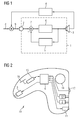
- FIG. 1 schematically reproduced hearing aid.
- the hearing aid can be reproduced as a digital system 1, which is located in an acoustic environment.
- the input forms, for example, a microphone 2.
- the recorded signal 9 is amplified, inter alia, and emitted again via a receiver 3.
- Acoustic coupling from the receiver 3 back to the microphone 2 takes place via a physical feedback path 4.
- the recorded signal 9 thus consists of the sum of an incidental useful signal 8 and the signal via the feedback path 4.
- feedback whistling occurs when both the Amplitude, as well as the phase condition is met. Sound artifacts occur even if the above conditions are only approximately fulfilled.
- the physical feedback path 4 is digitally modeled.
- the reproduction takes place by means of an adaptive filter 5, which is fed by the receiver signal.
- the receiver signal in turn comes from a hearing aid-internal signal processing unit 6, which receives the microphone signal and amplified among others. After filtering in the adaptive Compensation filter, the listener signal is subtracted from the microphone signal in an adder 7.
- step size control An important component in the adaptive algorithm for compensation of the feedback path is its step size control. It indicates the speed with which the adaptive compensation filter 5 adapts to the physical feedback path 4. Since there is no meaningful compromise for a fixed step size, it must be adapted to the current situation in which the system is located. In principle, a large step size for a rapid adaptation of the adaptive compensation filter 5 to the physical feedback path 4 should be aimed for. A disadvantage of the large step size is the generation of perceptible signal artifacts.
- the step size should be vanishingly small. If, on the other hand, a critical feedback situation occurs, the step size should become large. This ensures that the algorithm adapts the adaptive compensation filter 5 only if it differs significantly in its characteristic from the characteristic of the physical feedback path 4, that is, if there is a need for post-adaptation. This requires a feedback detector.
- the hearing device has an analysis device for analyzing the resonance behavior of the overall system as a function of From a modification of a signal processing means and for determining a feedback quantity, which is a measure of the feedback, from the analysis result.
- the feedback quantity controls an adaptive compensation filter to compensate for the feedback in its step size.
- the DE 10 2004 019353 B3 indicates a hearing aid with at least one proximity sensor, through which an operating function is made possible without direct contact of a control element.
- proximity sensors common proximity sensors, such as infrared or ultrasonic sensors, can be used.
- the DE 10 2005 037895 B3 specifies a hearing device with a sound output device for emitting a test sound in the ultrasonic range, so that no audible sound must be used to measure a room acoustics.
- the DE 10 2004 050304 B3 specifies a hearing aid and method for improving the reduction of feedback.
- an output signal is inaudibly modulated by means of a modulation unit for a hearing aid wearer.
- the modulation of the output signal can be done by amplitude or phase modulation as well as by modulation of the signal curve.
- the modulated output signal is fed back to a microphone of the hearing aid.
- a feedback detector detects the signal modulation and controls an adaptive filter accordingly.
- the invention claims a hearing device with at least one microphone and with a controllable feedback suppression unit for suppressing acoustic feedbacks.
- the hearing device also comprises at least one ultrasound-emitting ultrasound transmitting unit, wherein the feedback suppression unit is controllable by the ultrasound signals picked up by the at least one microphone. This has the advantage that the feedback control can be both fast and accurate.
- the invention also claims a hearing apparatus with a controllable feedback suppression unit for suppressing acoustic feedbacks.
- the hearing device also includes at least one ultrasound-emitting ultrasound transmitting unit and at least one ultrasound-receiving ultrasound-receiving unit, wherein the feedback suppression unit is controllable by the ultrasound signals received by the ultrasound-receiving unit.
- the hearing device may comprise a hearing aid device, in particular an in-the-ear hearing device.
- the hearing device may comprise a differentiation unit which detects changes in the recorded ultrasound signal for the regulation of the feedback suppression unit.
- the feedback suppression unit may comprise a regulation of the step size, wherein the step size is controllable by the recorded ultrasonic signal.
- any detected change in the received ultrasound signal may be the feedback suppression unit so that during the change the step size is changed. As a result, only changes in the fed-back ultrasound signals are taken into account.
- each detected change in the received ultrasound signal can regulate the feedback suppression unit such that during and predeterminable after the change, the step size is changed. This offers the advantage of a high flexibility of the scheme.
- the size of the change in the step size can be predefinable.
- the magnitude of the change in step size may be proportional to the change in the power of the received ultrasound signal.
- the ultrasound signal emitted by the ultrasound transmitter unit can be modulated.
- the advantage of this is that the received ultrasound signal can be reliably and easily distinguished from interfering signals and foreign ultrasound signals.
- the changes of the recorded ultrasonic signal for the regulation of the feedback suppression unit can be detected.
- a step size of the feedback suppression unit can be regulated by the recorded ultrasonic signal.
- the step size may be changed during the change.
- the step size can be changed during and predeterminable after the change.
- the step size can be changed in a fixed size.
- the step size may be changed in proportion to the change in the power of the received ultrasound signal.
- the emitted ultrasonic signal can be modulated.
- the invention also claims a computer program product with a computer program which has software means for carrying out a method according to the invention when the computer program is executed in a control unit of a hearing apparatus.
- FIG. 2 shows a hearing aid 10 worn in the ear with its essential components.
- a microphone 2 with a sound inlet opening for receiving an acoustic signal converts the recorded acoustic signal into an electrical signal.
- the electrical signal is fed to a signal processing unit 6 for further processing and frequency-dependent amplification.
- the further processed and amplified signal is converted back by means of a receiver 3 from an electrical signal into an acoustic signal and emitted via a sound channel into the auditory canal of a hearing aid wearer.
- a battery 14 is used to power the electrical components of the hearing aid 10.
- the hearing aid 10 is adaptable in its transmission characteristics to different listening situations (e.g., "quiet environment”, “talk”, “talk in a noisy environment”, “drive in the car”, etc.).
- the selection is made by setting certain parameter sets (hearing programs), which adjust the signal processing 6 to the respective listening situation. Between the individual hearing programs is switched by operation of a push-button 13.
- the hearing aid 10 in the signal processing unit 6 has a feedback circuit.
- the step size of the feedback circuit is controlled by the change of a received ultrasonic signal.
- the hearing device 10 has an ultrasonic transmitting unit 11 which emits an ultrasonic signal which is received as a result of reflections in the environment and feedback from the microphone 2 and / or an ultrasonic receiving unit 12. The thus received ultrasonic signal is passed to the feedback circuit for further evaluation.
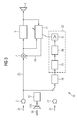
- the functional principle according to the invention is in the block diagram of FIG. 3 described in more detail.
- the hearing aid 10 comprises as a further component a transmitting and receiving unit 15 with an antenna 16 for wireless data exchange with another hearing aid for binaural supply or with a remote control or with an audio transmission unit.
- FIG. 3 shows a block diagram of a hearing aid 10 with a microphone 2, a signal processing unit 6 and a receiver 3.
- a feedback suppression unit 17 which is controllable in its step size, unwanted feedback can be suppressed by the detected from an electrical input signal 23 in the adder 7, the determined inverted, Feedback signal 24 is added.
- the hearing device 10 has an ultrasound transmission unit 12 with a loudspeaker 12A which emits a modulated ultrasound signal 30.
- the reflected from the environment, fed back ultrasonic signal 31 is picked up by the microphone 2 or by a separate ultrasonic receiving unit 11 and passed to an ultrasonic demodulator 18.
- the ultrasound signal 30, 31 is modulated so that it can be easily distinguished from other ultrasound signals, such as those produced by whistle whistles.
- the ultrasonic demodulator 18 the received ultrasonic signal 31 is demodulated and its power is estimated. This is supplied to an input of a low-pass filter 19.
- the low-pass filter 19 suppresses the stochastic noise.
- the low-pass filtered signal is supplied to a differentiator 20.
- a threshold generator 21 which decides whether and how much the step size of the feedback suppression unit 17 is changed.
- Low-pass filter 19, differentiator 20 and Schellwertgeber 21 together form a change detection unit 22nd
- the ultrasound receiving unit 11 is optional and not a "must”. Often already enough the microphone 2 for receiving the ultrasonic signal 31st
- the described embodiment shows a simplest realization of the invention. Further training can be much more complex.
Landscapes
- Health & Medical Sciences (AREA)
- General Health & Medical Sciences (AREA)
- Neurosurgery (AREA)
- Otolaryngology (AREA)
- Physics & Mathematics (AREA)
- Engineering & Computer Science (AREA)
- Acoustics & Sound (AREA)
- Signal Processing (AREA)
- Circuit For Audible Band Transducer (AREA)
- Soundproofing, Sound Blocking, And Sound Damping (AREA)
- Measurement Of Velocity Or Position Using Acoustic Or Ultrasonic Waves (AREA)
Applications Claiming Priority (1)
| Application Number | Priority Date | Filing Date | Title |
|---|---|---|---|
| DE102008036803A DE102008036803B3 (de) | 2008-08-07 | 2008-08-07 | Anordnung und Verfahren zur Regelung einer Rückkopplungsunterdrückung bei Hörvorrichtungen |
Publications (2)
| Publication Number | Publication Date |
|---|---|
| EP2152026A2 true EP2152026A2 (fr) | 2010-02-10 |
| EP2152026A3 EP2152026A3 (fr) | 2014-01-01 |
Family
ID=41318017
Family Applications (1)
| Application Number | Title | Priority Date | Filing Date |
|---|---|---|---|
| EP09163903.9A Withdrawn EP2152026A3 (fr) | 2008-08-07 | 2009-06-26 | Agencement et procédé de réglage d'une soumission de contre-réaction dans des dispositifs auditifs |
Country Status (3)
| Country | Link |
|---|---|
| US (1) | US20100034407A1 (fr) |
| EP (1) | EP2152026A3 (fr) |
| DE (1) | DE102008036803B3 (fr) |
Families Citing this family (3)
| Publication number | Priority date | Publication date | Assignee | Title |
|---|---|---|---|---|
| US20240163599A1 (en) * | 2022-11-14 | 2024-05-16 | Sonicedge Ltd. | Earphone System |
| EP4311262A1 (fr) * | 2023-02-17 | 2024-01-24 | Oticon A/s | Prothèse auditive avec émetteur-récepteur ultrasonore |
| US12609099B1 (en) * | 2024-02-12 | 2026-04-21 | Apple Inc. | Ultrasound mitigation in wearable devices |
Citations (4)
| Publication number | Priority date | Publication date | Assignee | Title |
|---|---|---|---|---|
| DE102004019353B3 (de) | 2004-04-21 | 2005-09-15 | Siemens Audiologische Technik Gmbh | Hörhilfegerät mit einer Bedieneinrichtung |
| DE102004050304B3 (de) | 2004-10-14 | 2006-06-14 | Siemens Audiologische Technik Gmbh | Verfahren zur Reduktion von Rückkopplungen bei einem Akustiksystem und Signalverarbeitungsvorrichtung |
| DE102005037895B3 (de) | 2005-08-10 | 2007-03-29 | Siemens Audiologische Technik Gmbh | Hörvorrichtung und Verfahren zum Bestimmen einer Information über eine Raumakustik |
| DE102006023723A1 (de) | 2006-05-19 | 2007-11-22 | Siemens Audiologische Technik Gmbh | Hörvorrichtung mit Rückkopplungsdetektion und entsprechendes Verfahren |
Family Cites Families (3)
| Publication number | Priority date | Publication date | Assignee | Title |
|---|---|---|---|---|
| DE8816422U1 (de) * | 1988-05-06 | 1989-08-10 | Siemens AG, 1000 Berlin und 8000 München | Hörhilfegerät mit drahtloser Fernsteuerung |
| US20060093173A1 (en) * | 2004-10-14 | 2006-05-04 | Volkmar Hamacher | Method and signal processor for reducing feedback in an audio system |
| JP4622713B2 (ja) * | 2005-07-13 | 2011-02-02 | 沖電気工業株式会社 | エコーキャンセラを備える拡声集音通信装置 |
-
2008
- 2008-08-07 DE DE102008036803A patent/DE102008036803B3/de not_active Expired - Fee Related
-
2009
- 2009-06-26 EP EP09163903.9A patent/EP2152026A3/fr not_active Withdrawn
- 2009-08-06 US US12/536,697 patent/US20100034407A1/en not_active Abandoned
Patent Citations (4)
| Publication number | Priority date | Publication date | Assignee | Title |
|---|---|---|---|---|
| DE102004019353B3 (de) | 2004-04-21 | 2005-09-15 | Siemens Audiologische Technik Gmbh | Hörhilfegerät mit einer Bedieneinrichtung |
| DE102004050304B3 (de) | 2004-10-14 | 2006-06-14 | Siemens Audiologische Technik Gmbh | Verfahren zur Reduktion von Rückkopplungen bei einem Akustiksystem und Signalverarbeitungsvorrichtung |
| DE102005037895B3 (de) | 2005-08-10 | 2007-03-29 | Siemens Audiologische Technik Gmbh | Hörvorrichtung und Verfahren zum Bestimmen einer Information über eine Raumakustik |
| DE102006023723A1 (de) | 2006-05-19 | 2007-11-22 | Siemens Audiologische Technik Gmbh | Hörvorrichtung mit Rückkopplungsdetektion und entsprechendes Verfahren |
Also Published As
| Publication number | Publication date |
|---|---|
| DE102008036803B3 (de) | 2009-12-17 |
| US20100034407A1 (en) | 2010-02-11 |
| EP2152026A3 (fr) | 2014-01-01 |
Similar Documents
| Publication | Publication Date | Title |
|---|---|---|
| EP2180726B2 (fr) | Localisation du son avec des prothèses auditives binauriculaires | |
| EP2357850B1 (fr) | Procédé et appareil auditif de reconnaissance et de soumission de contre-réactions à l'aide d'un microphone de guidage | |
| EP3451705A1 (fr) | Procédé et dispositif de reconnaissance rapide de voix propre | |
| DE102011087984A1 (de) | Hörvorrichtung mit Sprecheraktivitätserkennung und Verfahren zum Betreiben einer Hörvorrichtung | |
| DE102006047965A1 (de) | Hörhilfsgerät mit einer Okklusionsreduktionseinrichtung und Verfahren zur Okklusionsreduktion | |
| EP2104376A2 (fr) | Procédé de réduction d'occlusion active à l'aide d'une vérification de plausibilité et dispositif auditif approprié | |
| EP2595414B1 (fr) | Dispositif auditif avec un système pour réduire un bruit de microphone et procédé de réduction d'un bruit de microphone | |
| EP2988529A1 (fr) | Frequence de division adaptative dans appareils d'aide auditive | |
| DE102011006129B4 (de) | Hörvorrichtung mit Rückkopplungsunterdrückungseinrichtung und Verfahren zum Betreiben der Hörvorrichtung | |
| EP2070384A1 (fr) | Appareil de correction auditive commandé par un modèle perceptif et procédé correspondant | |
| EP3926981A1 (fr) | Système auditif doté d'au moins un instrument auditif porté sur la tête de l'utilisateur, ainsi que mode de fonctionnement d'un tel système auditif | |
| EP2373063B1 (fr) | Dispositif auditif et procédé de réglage de celui-ci pour un fonctionnement sans contre-réaction | |
| DE102008036803B3 (de) | Anordnung und Verfahren zur Regelung einer Rückkopplungsunterdrückung bei Hörvorrichtungen | |
| DE102008046040A1 (de) | Verfahren zum Betrieb einer Hörvorrichtung mit Richtwirkung und zugehörige Hörvorrichtung | |
| DE102014218672B3 (de) | Verfahren und Vorrichtung zur Rückkopplungsunterdrückung | |
| EP2227038A1 (fr) | Procédé de fonctionnement d'un dispositif auditif et dispositif ayant une soumission de contre-réaction | |
| EP2658289B1 (fr) | Procédé de commande d'une caractéristique de guidage et système auditif | |
| EP3985994B1 (fr) | Procédé de fonctionnement d'un appareil d'aide auditive et appareil d'aide auditive | |
| DE102007035173A1 (de) | Verfahren zum Einstellen eines Hörsystems mit einem perzeptiven Modell für binaurales Hören und entsprechendes Hörsystem | |
| EP3926983B1 (fr) | Système auditif doté d'au moins un instrument auditif porté sur la tête de l'utilisateur, ainsi que mode de fonctionnement d'un tel système auditif | |
| EP2590437B1 (fr) | Adaptation périodique d'un dispositif de suppression de l'effet Larsen | |
| DE102006029268B4 (de) | Hörvorrichtung mit Körperschalldetektionseinrichtung und entsprechendes Verfahren | |
| EP2230860A1 (fr) | Procédé de réglage d'une caractéristique de guidage d'un dispositif auditif | |
| EP4311269B1 (fr) | Procédé de fonctionnement d'un appareil auditif binaural, appareil auditif binaural et logiciel | |
| EP3697107A1 (fr) | Procédé de fonctionnement d'un système auditif et système auditif |
Legal Events
| Date | Code | Title | Description |
|---|---|---|---|
| PUAI | Public reference made under article 153(3) epc to a published international application that has entered the european phase |
Free format text: ORIGINAL CODE: 0009012 |
|
| AK | Designated contracting states |
Kind code of ref document: A2 Designated state(s): AT BE BG CH CY CZ DE DK EE ES FI FR GB GR HR HU IE IS IT LI LT LU LV MC MK MT NL NO PL PT RO SE SI SK TR |
|
| AX | Request for extension of the european patent |
Extension state: AL BA RS |
|
| PUAL | Search report despatched |
Free format text: ORIGINAL CODE: 0009013 |
|
| AK | Designated contracting states |
Kind code of ref document: A3 Designated state(s): AT BE BG CH CY CZ DE DK EE ES FI FR GB GR HR HU IE IS IT LI LT LU LV MC MK MT NL NO PL PT RO SE SI SK TR |
|
| AX | Request for extension of the european patent |
Extension state: AL BA RS |
|
| RIC1 | Information provided on ipc code assigned before grant |
Ipc: H04R 25/00 20060101AFI20131126BHEP |
|
| STAA | Information on the status of an ep patent application or granted ep patent |
Free format text: STATUS: THE APPLICATION IS DEEMED TO BE WITHDRAWN |
|
| 18D | Application deemed to be withdrawn |
Effective date: 20140103 |