EP2159131A2 - Dispositif de contrôle pour système de direction assistée électrique - Google Patents
Dispositif de contrôle pour système de direction assistée électrique Download PDFInfo
- Publication number
- EP2159131A2 EP2159131A2 EP09161250A EP09161250A EP2159131A2 EP 2159131 A2 EP2159131 A2 EP 2159131A2 EP 09161250 A EP09161250 A EP 09161250A EP 09161250 A EP09161250 A EP 09161250A EP 2159131 A2 EP2159131 A2 EP 2159131A2
- Authority
- EP
- European Patent Office
- Prior art keywords
- control device
- electrically operated
- steering system
- power steering
- conductor
- Prior art date
- Legal status (The legal status is an assumption and is not a legal conclusion. Google has not performed a legal analysis and makes no representation as to the accuracy of the status listed.)
- Granted
Links
- 239000004020 conductor Substances 0.000 claims abstract description 118
- 239000000758 substrate Substances 0.000 claims abstract description 28
- 239000003990 capacitor Substances 0.000 claims description 83
- 230000017525 heat dissipation Effects 0.000 claims description 35
- 238000009499 grossing Methods 0.000 claims description 7
- 239000004065 semiconductor Substances 0.000 description 32
- 238000010276 construction Methods 0.000 description 21
- 230000010349 pulsation Effects 0.000 description 15
- 238000003466 welding Methods 0.000 description 13
- 230000009467 reduction Effects 0.000 description 12
- 238000010586 diagram Methods 0.000 description 11
- 239000011347 resin Substances 0.000 description 11
- 229920005989 resin Polymers 0.000 description 11
- 230000009286 beneficial effect Effects 0.000 description 9
- 238000000034 method Methods 0.000 description 8
- 239000003985 ceramic capacitor Substances 0.000 description 7
- 230000000694 effects Effects 0.000 description 7
- 238000005476 soldering Methods 0.000 description 6
- 230000035882 stress Effects 0.000 description 6
- RYGMFSIKBFXOCR-UHFFFAOYSA-N Copper Chemical compound [Cu] RYGMFSIKBFXOCR-UHFFFAOYSA-N 0.000 description 4
- 229910052782 aluminium Inorganic materials 0.000 description 4
- XAGFODPZIPBFFR-UHFFFAOYSA-N aluminium Chemical compound [Al] XAGFODPZIPBFFR-UHFFFAOYSA-N 0.000 description 4
- 229910052751 metal Inorganic materials 0.000 description 4
- 239000002184 metal Substances 0.000 description 4
- 238000000465 moulding Methods 0.000 description 4
- 230000008569 process Effects 0.000 description 4
- 230000008901 benefit Effects 0.000 description 3
- 229910052802 copper Inorganic materials 0.000 description 3
- 239000010949 copper Substances 0.000 description 3
- 238000013016 damping Methods 0.000 description 3
- 238000004519 manufacturing process Methods 0.000 description 3
- 229910000679 solder Inorganic materials 0.000 description 3
- 238000001514 detection method Methods 0.000 description 2
- 239000004519 grease Substances 0.000 description 2
- 230000020169 heat generation Effects 0.000 description 2
- 238000009413 insulation Methods 0.000 description 2
- 239000000463 material Substances 0.000 description 2
- 229910000859 α-Fe Inorganic materials 0.000 description 2
- 230000001133 acceleration Effects 0.000 description 1
- 230000004075 alteration Effects 0.000 description 1
- 238000000137 annealing Methods 0.000 description 1
- 230000005540 biological transmission Effects 0.000 description 1
- 230000008859 change Effects 0.000 description 1
- 238000006243 chemical reaction Methods 0.000 description 1
- 238000004891 communication Methods 0.000 description 1
- 239000011889 copper foil Substances 0.000 description 1
- 238000005520 cutting process Methods 0.000 description 1
- 230000006866 deterioration Effects 0.000 description 1
- 239000006185 dispersion Substances 0.000 description 1
- 238000009429 electrical wiring Methods 0.000 description 1
- 230000002708 enhancing effect Effects 0.000 description 1
- 238000005530 etching Methods 0.000 description 1
- 230000012447 hatching Effects 0.000 description 1
- 230000007257 malfunction Effects 0.000 description 1
- 230000000116 mitigating effect Effects 0.000 description 1
- 238000012986 modification Methods 0.000 description 1
- 230000004048 modification Effects 0.000 description 1
- 230000003071 parasitic effect Effects 0.000 description 1
- 230000005855 radiation Effects 0.000 description 1
- 230000004044 response Effects 0.000 description 1
- 230000008646 thermal stress Effects 0.000 description 1
Images






Classifications
-
- B—PERFORMING OPERATIONS; TRANSPORTING
- B62—LAND VEHICLES FOR TRAVELLING OTHERWISE THAN ON RAILS
- B62D—MOTOR VEHICLES; TRAILERS
- B62D5/00—Power-assisted or power-driven steering
- B62D5/04—Power-assisted or power-driven steering electrical, e.g. using an electric servo-motor connected to, or forming part of, the steering gear
- B62D5/0403—Power-assisted or power-driven steering electrical, e.g. using an electric servo-motor connected to, or forming part of, the steering gear characterised by constructional features, e.g. common housing for motor and gear box
- B62D5/0406—Power-assisted or power-driven steering electrical, e.g. using an electric servo-motor connected to, or forming part of, the steering gear characterised by constructional features, e.g. common housing for motor and gear box including housing for electronic control unit
Definitions
- the present invention relates to a control device for an electrically operated power steering system.
- this electrically operated power steering system control device described in Japanese Laid-Open Patent Publication 2007-30652 merely integrates together the motor and the control device for the electrically operated power steering system, it accordingly provides no teaching for making the control device for the electrically operated power steering system, itself, more compact. Therefore no sufficient response is provided to demands for making the control device more compact in order to provide flexibility in the position in which it is mounted in a vehicle, according to the type of vehicle. Moreover, in this proposal, no countermeasures are implemented for sufficiently reducing the amount of noise radiation from this control device for an electrically operated power steering system.
- a control device for an electrically operated power steering system comprises: a power substrate comprising a plurality of switching elements, that converts DC electrical current to AC electrical current by switching operation of the plurality of switching elements; an output terminal for transmitting the AC electrical current to an electric motor that generates steering torque; a conductor for electrically connecting the power substrate to the output terminal; a metallic chassis that holds the power substrate and the conductor, and supports the output terminal; and/or a metallic cover that faces the output terminal, and that is connected to the metallic chassis.
- the output terminal is connected by a screw to a terminal of the electric motor; and the metallic cover is supported so as to face the output terminal and the screw.
- the metallic chassis comprises a metallic support portion, for integrally supporting an electric motor side metallic chassis that houses the electric motor; and the metallic support portion is formed at a side portion of a connection portion between the metallic cover and the metallic chassis.
- the control device further comprises a heat dissipation member that is provided upon a one surface of the power substrate opposite from another surface of the power substrate upon which the switching elements are provided; and the heat dissipation member is provided with heat dissipation fins on an opposite side to a side that contacts the power substrate.
- the control device further comprises a DC current system conductor unit to which DC electrical current is supplied from a power supply, and that supplies the DC electrical current to the switching elements; and the DC current system conductor unit is provided at a side portion of the power substrate.
- the DC current system conductor unit is provided at a side portion of the power substrate and on the heat dissipation member.
- the DC current system conductor unit is provided at a side opposite from the metallic support portion, with the power substrate placing between the DC current system conductor unit and the metallic support portion.
- the DC current system conductor unit comprises a first connector for connecting to a battery power supply on a one surface of the DC current system conductor unit opposite from another surface of the DC current system conductor unit that contacts the heat dissipation member.
- the first connector of the DC current system conductor unit is provided more to an exterior than an end portion of the electric motor in its axial direction.
- the control device further comprises a control boardthat transmits control signals to the switching elements and controls switching of the switching elements; and the control board is provided so as to be positioned between the power substrate and the electric motor supported thereat, and is provided so that at least one portion thereof overlaps the DC current system conductor unit.
- control board comprises, on a surface towards the electric motor, a second connector that inputs and outputs signals from and to the exterior of the control device for an electrically operated power steering system.
- the second connector of the control board is provided more towards the exterior than an end portion of the electric motor in its axial direction.
- the DC current system conductor unit comprises an electrolytic capacitor for smoothing DC electrical current from the power supply, and a plate shaped conductor that is connected to the electrolytic capacitor; and a plate shaped conductor through which electrical current on a positive electrode side of the electrolytic capacitor flows, and a plate shaped conductor through which electrical current on a negative electrode side of the electrolytic capacitor flows, are provided so as to be overlapped over one another.
- the control device for an electrically operated power steering system in the 13th aspect, it is preferred that: when the electrolytic capacitor and the plate shaped conductor are connected together, a terminal of the electrolytic capacitor and a projecting portion of the plate shaped conductor are connected together; and the terminal of the electrolytic capacitor and the projecting portion of the plate shaped conductor are provided so as to be overlapped over one another, and are connected so that directions of electrical currents that flow therein are mutually opposite.
- the DC current system conductor unit further comprises an electrolytic capacitor for smoothing the DC electrical current from the power supply;
- the electrolytic capacitor is formed in a cylindrical shape; and a central cylindrical axis of the electrolytic capacitor and an axial direction of the electric motor agree with one another, and the electrolytic capacitor is provided so that a cylindrical endportion thereof upon which positive and negative terminals are provided is positioned towards the power substrate.
- a control device for an electrically operated power steering system according to an embodiment of the present invention, and an electrically operated power steering device, will be explained using Figs. 1 through 15 .
- Figs. 1 through 10 , 14 , and 15 are figures for explanation of the construction and the operation of this control device for an electrically operated power steering system that controls the driving of a motor;
- Fig. 11 is a figure for explanation of the assembly of this control device for an electrically operated power steering system;
- Fig. 12 is a figure showing the way in which this control device for an electrically operated power steering system is mounted to a motor; and
- Fig. 13 is a figure for explanation of the electrically operated power steering system.
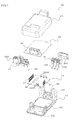
- Fig. 1 is an exploded perspective view showing the construction of this control device for an electrically operated power steering system according to an embodiment of the present invention.
- this control device for an electrically operatedpower steering system (hereinafter also sometimes termed a “motor control device”) includes a DC conductor module 230, an AC conduct or module 231, apowermodule 210, a control module 220, a cover 250, and a metallic chassis 240.
- a power supply connector 230PC via which electrical power is supplied from a battery BA (refer to Fig. 4 ) and a frame for leads 230LF (refer to Fig. 5 ) that constitute signal lines are molded from resin and are integrally fixed together; and this module 230 also includes bus-bars 230B (i.e. a plate-shaped conductors) that constitute electrical power supply lines (230BPP and 230BNN in Figs. 4 and 6 ), with these bus-bars 230B being integrally fixed to the power supply connector 230PC.
- bus-bars 230B i.e. a plate-shaped conductors
- DC conductor module 230 there are fitted filter elements such as a normal filter NF and an electrolytic capacitor C1 or the like, a relay RY1 for circuit protection, and electrolytic capacitors C2 and C3 that provide driving electrical power for a motor 100 (refer to Figs. 5 and 6 ). These elements and the bus-bars 230B are fixed together by TIG welding (arc welding) . Further details of this DC conductor module 230 will be described hereinafter.
- TIG welding arc welding
- bus-bars 231B that constitute electrical power lines are integrally formed with a motor terminal block 231SC that supply electrical power to the motor 100.
- the motor terminal block 231SC is fixed with screws to terminal support portions 240S that are provided upon the metallic chassis 240.
- a wiring pattern is formed upon an insulation layer that is laid upon the metallic base, and inverters that include semiconductor switching elements SSW such as MOSFETs or the like and resistors and so on are fixed upon this wiring pattern.
- terminals for signals terminals for input of DC power, and terminals for output of AC power, to which a plurality of lead frames for signals SLF and power lead frames 230BDC (230BP and 230BN in Fig. 4 ) and 230BAC (230BU, 230BV, and 230BW in Fig. 4 ) are attached by one end of each of these lead frames being fixed thereto with solder.
- the signal lead frames SLF are used for electrically connecting together the power module 210 and the control module 220.
- the power lead frames 230BDC and 230BAC are used for electrically connecting together, respectively, the power module 210 and the bus-bars 230B of the DC conductor module 230, and the power module 210 and the bus-bars 231B of the AC conductor module 231.
- control module 220 a CPU and custom ICs such as ASICs or the like that integrate a plurality of functions, such as voltage elevation circuits and so on, are fitted upon a printed circuit board.
- the CPU and the custom ICs (ASICs) and so on are fitted upon the downward facing side of the board.
- a signal connector 220C is fitted to this control module 220.
- a connector for cables for connection to an external engine control unit ECU or the like, or to a CAN or the like, is inserted into this signal connector 220C.
- the metallic chassis 240 includes a heat dissipation surface 240P for mounting of the power module 210, a module implementation surface 240M whose thickness is somewhat less than that of the heat dissipation surface 240P, and struts 240T.
- the heat that is generated by the power module 210 is conducted to the metallic chassis 240 via the heat dissipation surface 240P that is in contact with the lower surface of the power module 210, and is thereby dissipated.
- the metallic chassis 240 therefore functions as a heat sink.
- the DC conductor module 230 that has large sized elements such as the electrolytic capacitors C2 and C3 and the relay RY1 and the like, is mounted and protected upon the module implementation surface 240M, and this reduces the length of the motor control device 200 in the height direction.
- the struts 240T are fixing portions (support portions) that mechanically and electrically connect together the motor control device 200 and the motor 100 (refer to Fig. 2 ) via screws or the like, and that moreover constitute heat transmission paths for dissipating heat from the metallic chassis 240 via the motor 100 to the vehicle to which this system is mounted.
- the cover 250 and the metallic chassis 240 are made from aluminum. It should be understood that while, from the point of view of noise reduction, it is desirable for the cover 250 to be made from a metal such as aluminum or the like, it could also be made from resin.
- the power module 210 is fitted to the metallic chassis 240 with screws.
- the DC conductor module 230 is put upon the module implementation surface 240M, i.e. beside the power module 210, and is fitted to the metallic chassis 240 with screws.
- the AC conductor module 231 is fitted to the metallic chassis 240 with screws.
- the other ends of the power lead frames 230BDC and 230BAC are TIG welded to the bus-bars of the DC conductor module 230 and the AC conductor module 231.
- control module 220 is arranged above the power module 210, the DC conductor module 230, and the AC conductor module 231, and is fitted to the metallic chassis 240 by screws, in the same manner. And the other ends of the lead frames for signals SLF are fixed with solder to the terminals of the control module 220. Finally, the manufacture of the motor control device is completed by fixing the cover 250 to the metallic chassis 240 by swaging.
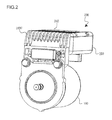
- Fig. 2 is a perspective view showing the motor control device 200 shown in Fig. 1 with its vertical orientation reversed, and showing it as connected to the motor 100.
- Heat dissipation fins 240F (hereinafter simply termed “fins”) are formed upon the opposite surface of the metallic chassis 240 to its surface upon which the power module 210 shown in Fig. 1 is constructed. These fins 240F, along with enhancing the heat dissipation performance of the metallic chassis 240, also serve to lighten the motor control device 200.
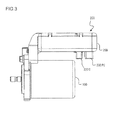
- Fig. 3 is a figure showing the positional relationship of the motor control device 200 and the motor 100 shown in Fig. 2 as seen in the horizontal direction.
- the power supply connector 230PC and the signal connector 220C protrude at positions behind the rear portion of the motor 100 as seen in the figure, and thus it is possibly effectively to utilize the space behind the rear portion of the motor 100 as a wiring space for cabling or the like.
- the power supply connector 230PC and the signal connector 220C are provided more to the exterior than the end portion of the motor 100 in its axial direction.
- the control device 200 being brought close to the motor 100 in this manner, it is possible to utilize this space, that includes not only wiring but also connector portions, in an effective manner.
- the power supply connector 230PC and the signal connector 220C in this manner as seen in the figures, it is possible to utilize the free space at the rear portion of the motor in an efficient manner, and thus it is possible to make this electrically operated power steering device, and the space for installing this electrically operated power steering device, more compact. Moreover, as a whole, no connectors protrude outwards from the motor control device 200, so that it is possible to ensure that it is more compact and its external appearance is neater.
- the power supply connector 230PC and the signal connector 220C are provided more to the exterior than the end portion of the motor 100 in its axial direction, accordingly it is possible to insert connectors for cables from the battery BA, or connectors or the like for cables for control signals from the exterior of the motor control device 200 into these connectors while safeguarding the operability, since these components constitute no impediment to the motor 100.
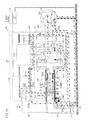
- Fig. 4 is a circuit diagram showing the circuit structure of this control device for an electrically operated power steering system according to an embodiment of the present invention. It should be understood that to portions that are the same as ones shown in Fig. 1 , the same reference symbols are appended.
- This motor control device includes the power module 210, the control module 220, the DC conductor module 230, and the AC conductor module 231.
- the bus-bars 230B that constitute electrical power lines, are formed integrally by resin molding.
- the portions shown by thick solid lines in the figure denote these bus-bars.
- a normal filter (coil) NF the electrolytic capacitors C1, C2, and C3, and the relay RY1 are connected to the battery BA that constitutes the power supply, and moreover are connected, as shown in the figure, via the power lead frames 230BP and 230BN to bus-bars, in other words to plate shaped conductors, that connect to the drain terminals or the source terminals of semiconductor switching elements SSW of the power module 210 such as MOSFETs or the like.
- the relay RY1 is for protecting the system from excessive power supply electrical current, and cuts out in an excessive current situation.
- This relay RY1 is fitted more towards the battery BA than the electrolytic capacitors C1, C2, and C3, and is for preventing sudden surging of current into these electrolytic capacitors.
- the electrolytic capacitors C1, C2, and C3 are fitted to the DC conductor module 230, it is ensured that they do not receive excessive heat from the power module 210, so that they are assured of longer working lives.
- the normal filter NF and the capacitor C1 constitute filters, and suppress the emission and entry of noise, and in particular, the influence of voltage pulsations upon the power supply line due to the operation of the semiconductor switching elements SSW, thus fulfilling the function of reducing the influence of radio noise.
- the arrangements related to structures for reduction of radio noise will be described hereinafter with reference to Fig. 10 .
- ceramic capacitors CC1, CC2, and CC3 fulfill the function of suppressing spike noise from the semiconductor switching elements SSW, and of absorbing surge voltages from the semiconductor switching elements SSW.
- the arrangements relatedto structures for reduction of spike noise will be described hereinafter with reference to Fig. 9 .
- the double-circle marks indicate spots at which connections are made by TIG welding.
- the two terminals of the normal filter NF are connected to the terminals of the bus-bars by TIG welding.
- the two terminals of each of the electrolytic capacitors C1, C2, and C3, the two terminals of the relay RY1, and the terminals of the power lead frames 230BP and 230BN on the DC conductor module 230 side are also connected to the bus-bar terminals by welding.
- the circle-with-Xmarks indicate spots fixed by screw fastenings.
- the bus-bar 230B that is connected to the negative side cable from the battery BA is electrically connected to the metallic chassis 240 of the motor control device 200 by a screw fastener.
- the bus-bars 231B that constitute electrical power lines for supplying electrical current to the motor 100, are formed integrally by resin molding.
- This AC conductor module 231 is connected to the power module 210 via the power lead frames 231BU, 231BV, and 230BW, as shown in the figure.
- the terminals of the power lead frames 231BU, 231BV, and 231BW on the AC conductor module 231 side are also connected to their corresponding bus-bar terminals by welding.
- the circle-with-X marks indicate spots fixed by screw fastenings; thus, the bus-bars 231B are connected to the three phase electrical power lines for the motor 100 by screws.
- a metallic chassis 110 of the motor and the metallic chassis 240 of the motor control device 200 are also connected together by screws.
- the control module 220 includes a CPU 222 and a driver circuit 224.
- the CPU 222 controls the semiconductor switching elements SSW of the power module 210 on the basis of the torque as detected by the torque sensor TS, and of the rotational position of the motor 100 as detected by a resolver 156. In other words, the CPU 222 outputs a control signal to the driver circuit 224 that controls continuity or interception of these switching elements SSW. And the driver circuit 224 controls the semiconductor switching elements SSW of the power module 210 on the basis of this control signal that is supplied from the CPU 222.
- the motor electrical currents that are supplied from the power module 210 to the motor 100 are detected by resistors (shunt resistors) DR1, DR2, and DR3 that constitute motor electrical current detection elements, and the values thereof are inputted to the CPU 222 after having been amplified by respective amplifiers AP1, AP2, and AP3. And the CPU 222 performs feedback control so as to make the motor electrical current attain a target value. Moreover, the total current of all phases supplied to the motor 100 is detected by a resistor (a shunt resistor) DR4 that constitutes a detection element, and the value thereof is inputted to the CPU 222 after having been amplified by an amplifier AP4.
- the CPU 222 is connected to an external engine control unit ECU or the like by a CAN or the like, and these units are adapted to transfer information between them.
- the control module 220 is made more compact by a custom IC (an ASIC) that includes the driver circuit 224 integrating together, in a single IC, the functions of a voltage raising circuit, a microcomputer power supply circuit, an electrical current sense amp, a CAN communication circuit, and so on.
- the ⁇ (triangle) marks indicate spots at which connections are made to the lead frames using solder. With the structure of the present invention, it is arranged to mitigate the stresses that are generated at the soldered portions when using lead frames. The shapes of the lead frames and so on will be described subsequently with reference to Fig. 9 . It should be understood that soldered connections using lead frames are employed at the electrical connection portions between the control module 220, and the power module 210 and the conductor module 230.
- the power module 210 includes the six semiconductor switching elements SSW, such as MOSFETs or the like. For each of the three phases (the U phase, the V phase, and the W phase), the semiconductor switching elements SSW are connected in series as an upper arm and a lower arm.
- the power lead frames 230BP, 230BN, 231BU, 231BV, and 231BW are electrically connected to the power module 210 by soldering.
- this electrical current is a high current such as, for example, 100A.
- the power module 210 includes relays RY2 and RY3.
- the heat capabilities of these relays RY2 and RY3 are high, so that they can carry electrical currents of, for example, 100A.
- the power module 210 uses a substrate that is excellent at heat dissipation, so that, by the heat dissipation capabilities of the relays RY2 and RY3 being enhanced, it is made possible to utilize compact relays.
- the heat dissipation capability of the substrate of the power module 210 is excellent, it might be contemplated, for example, to fit the relay RY1 that is currently fitted to the DC conductor module 230, to the power module 210 or the like. However, if the relay RY1 is fitted to the power module 210, then the electrolytic capacitors C1, C2, and C3 and the normal filter NF also should be fitted to the power module 210. As a result, the power module 210 is subjected to a high temperature environment while fitting these various components by performing reflow soldering.
- the electrolytic capacitors C1, C2, and C3 are subjected to a high temperature environment, then it is considered that their service lives may be considerably deteriorated. Due to this, by fitting the relay RY1 of this embodiment to the DC conductor module 230, and by also fitting the electrolytic capacitors C1, C2, and C3 to this DC conductor module 230, it is possible to prevent the lives of these components being deteriorated due to the reflow soldering.
- Fig. 5 is a perspective view showing the structure of this DC conductor module 230 of the control device for an electrically operated power steering system according to this embodiment of the present invention
- Fig. 6 is a top view showing the bus-bars 230B (230BPP and 230BNN) of this DC conductor module 230, along with various other mounted components. It should be understood that to members that are the same as ones shown in Figs. 1 and 4 , the same reference symbols are appended. Moreover, while the way in which the DC conductor module 230 is drawn in Fig.
- Fig. 1 is the preferred figure for understanding the positional relationship of the DC conductor module 230 in the motor control device 200 as a whole.
- apertures are formed in advance in the DC conductor module 230 for inserting the terminals of various electrical components such as the normal filter NF, the electrolytic capacitors C1, C2, and C3, the relay RY1, and so on. These components are arranged in their respective positions, and then, on the upper side in the figure, their terminals are connected by TIG welding to the terminals of the bus-bars 230B.
- the lead frames for signals 230LF are laminated to the upper surface of the DC conductor module 230 as seen in the figure.
- the bus-bars 230B and the relay RY1 and the lead frames for signals 230LF are separated by resin, so that they are electrically insulated from one another.
- the power supply connector 230PC receives supply of electrical current from the battery BA equipped in the vehicle.
- the electrolytic capacitors C2 and C3 accumulate electric current supplied from the battery BA, and also supply electrical power to the motor 100 according to the operation of the semiconductor switching elements SSW shown in Fig. 1 .
- these electrolytic capacitors C2 and C3 are arranged so that their cylindrical main bodies lie down flat, so that, when the DC conductor module 230 is mounted upon the module implementation surface 240M, their positive (+) electrode terminals and negative (-) electrode terminals (that are provided upon the one ends of their cylindrical shapes) are arranged to come towards the power module 210 that is mounted upon the heat dissipation surface 240P.
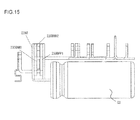
- a portion of the P side bus-bar 230BPP that is connected to the positive electrodes of the electrolytic capacitors C2 and C3, and a portion of the N side bus-bar 230BNN that is connected to their negative electrodes are arranged in a layered state (i.e. in a state of being overlapped over one another) .
- Figs. 14 and 15 are figures that show this situation.
- the above described portion of the P side bus-bar 230BPP is denoted by the reference symbol 230BPP1
- the above describedportion of the N side bus-bar 230BNN is denoted by the reference symbol 230BNN1.
- connection portions 230BNN2 extends so as to project upwards from a portion 230BNN1 of the bus-bar 230BNN.
- bus-bar 230BNN, the portion 230BNN1 of the bus-bar 230BNN, and the electrolytic capacitor C3 and so on are resin molded together, this arrangement is provided in order for the electrolytic capacitor C3 and the bus-bar to be connected together by welding at a spot that has not been covered by resin molding.
- connection portion 230BNN2 and the terminal C3NT being connected together by welding, electrical currents flow in opposite directions in the connection portion 230BNN2 and in the terminal C3NT that opposes this connection portion 230BNN2, and thus the inductances due to the connection portion 230BNN2 and the terminal C3NT mutually cancel one another. As a result, the inductance of the path that connects from the terminal of the electrolytic capacitor C3 to the bus-bar is reduced, and thereby the generation of heat is reduced.
- connection portion 230BNN2 and the terminal C3NT were to be connected together by welding as low (in the figure) thereupon as possible, then, to that extent, the inductance would be reduced.
- this type of lower connection can only be performed by an extremely complicated and troublesome procedure. Accordingly, this is not desirable from the point of view of simplification of the manufacturing process.
- connection portion 230BNN2 and the terminal C3NT are connected together by welding via a simple process, so that these elements are overlapped over one another in the fashion described above, it is possible to reduce the inductance, thus achieving reduction of the amount of heat generation while simultaneously simplifying the manufacturing process. Furthermore, it would also be acceptable to arrange to embed all the portions of the connection portion 230BNN2 and the terminal C3NT, except for their upper portions, in the molded resin.
- connection between the P side bus-bar 230BPP and the power lead frame 230BP shown in Fig. 4 is made at the P side connection portion (the DC output terminal) 230BPT; and, similarly, the connection between the N side bus-bar 230BNN and the power lead frame 230BN shown in Fig. 4 is made at the N side connection portion (the DC output terminal) 230BNT.
- the components are arranged so that the distances from the positive terminals of the two electrolytic capacitors C2 and C3 to the P side connection portion 230BPT, and the distances from the negative terminals of the two electrolytic capacitors C2 and C3 to the N side connection portion 230BNT, become approximately equal for the two electrolytic capacitors C2 and C3.
- the variations of the inductance between the positive and negative terminals of the electrolytic capacitors C2 and C3 become small, and the variations of the current flow rate imposed upon each of the electrolytic capacitors when the semiconductor switching elements SSW operate becomes less between the two electrolytic capacitors.
- the temperature increases of the electrolytic capacitors are nearly equal, and therefore the deterioration of a certain capacitor is prevented.
- the number of the electrolytic capacitors was described as being two, it would also be possible for the number of electrolytic capacitors that are connected in parallel to be one or three or more, provided that their capacitances are substantially equal. In this case as well, provided that the orientations of the electrolytic capacitors and the way in which they are connected to the bus-bars are the same as described with reference to this embodiment, then similar beneficial operational effects will be obtained.
- Fig. 7 is a perspective view showing the structure of this power module 210 of the control device for an electrically operated power steering system according to this embodiment of the present invention
- Fig. 8 is a sectional view showing the connections between the power module 210, and the DC conductor module 230 and the AC conductor module 231. It should be understood that to portions that are the same as portions shown in Fig. 1 , the same reference symbols are appended.
- this power module 210 is provided with the semiconductor switching elements SSW and with shunt resistors DR1, DR2, DR3, DR4 and so on, and uses a metallic base MP (refer to Fig. 8 ) made from aluminum or copper or the like for dissipating heat from these components.
- a metallic base MP (refer to Fig. 8 ) made from aluminum or copper or the like for dissipating heat from these components.
- a certain quantity of heat conduction grease HCG is interposed between the metallic base MP and the metallic chassis 240, and the construction is such that the heat that is generated from heat emitting members such as the semiconductor switching elements SSW and so on is dissipated from the metallic chassis 240, via the metallic base MP and the heat conduction grease HCG.
- Fig. 7 six pin type MOSFETs are used. Five of these pins are the source, while one is the gate. The drain is connected to the wiring pattern.
- a wiring pattern WP is formed upon the metallic base MP, with the intervention of an insulating layer IM.
- This wiring pattern WP is made by etching copper foil of thickness about 105 ⁇ m.
- jumper leads JL are provided that straddle between various points upon the wiring pattern.
- the freedom of arrangement for the wiring pattern WP is enhanced by the use of these jumper leads JL.
- the power module 210 is made more compact, and thereby the motor control device 200 as a whole is made more compact.
- the jumper leads JL are bent into letter-L shapes, and thereby the freedom for arrangement of the wiring pattern is further enhanced.
- Fig. 8 shows a portion of the above described connection, and in particular shows the connection between the power module 210 and the P side bus-bar 230BPP.
- the P side bus-bar 230BPP and the power lead frame 230BP are connected together by TIG welding, and the power module 210 and the power lead frame 230BP are connected together by soldering.
- the power module 210 and the DC conductor module 230 are connected to the metallic chassis 240.
- the components that are mounted to the power module 210 and the DC conductor module 230 are different and the amounts of electrical current flowing in them are also different, accordingly the amounts of heat generated in these two modules and their heat dissipation paths are likewise different. Due to this, a temperature difference builds up between the power module 210 and the DC conductor module 230, and a certain stress builds up in the soldered junction of the power lead frame 230BP due to differential thermal expansion.
- a copper material that has been processed in advance by annealing is employed for the power lead frame 230BP of this embodiment, and the stress that is imposed upon its soldered portion is mitigated by employing a bent construction for its lower portion.
- its cross sectional area is made to be 2 mm 2 or greater.
- Fig. 9 is a plan view showing the structure of the layout of the wiring pattern WP of the power module 210 of this control device for an electrically operated power steering system according to this embodiment of the present invention. It should be understood that to elements that are the same as elements shown in Figs. 7 and 8 , the same reference symbols are affixed.
- the power module 210 includes the six semiconductor switching elements SSW that may be MOSFETs or the like. These semiconductor switching elements SSW are connected in series to an upper arm and to a lower arm, one for each of the three phases (the U phase, the V phase, and the W phase). Ceramic capacitors CC1, CC2, and CC3 are connected in parallel to the semiconductor switching elements SSW that are connected in series as the upper arm and the lower arm.
- These semiconductor switching elements SSW generate spike noise due to their high speed operation for establishing and cutting off continuity, as controlled by control signals. Increase of this spike noise entails increase of the surge voltage of the semiconductor switching elements SSW.
- the ceramic capacitors CC1, CC2, and CC3 absorb the spike noise that is generated in each of the three phases (the U phase, the V phase, and the W phase), and have the beneficial effect of suppressing the surge voltages.
- the surge voltages may be obtained by L(di/dt).
- an inductance L is the inductance of a closed loop from the drain of the upper arm side semiconductor switching element SSWWP via the source of the lower arm side semiconductor switching element SSWWN and via the ceramic capacitor CC3 back to the drain of the upper arm side semiconductor switching element SSWWP again.
- (di/dt) is the rate of change of the electrical current when the semiconductor switching elements SSWWP and SSWWN establish or cut off continuity. In other words, reduction of the surge voltage is performed by reducing this closed loop inductance L.
- the closed loop is formed in the wiring pattern WP of the power module 210, then an eddy current in the direction opposite to that of the closed loop is induced in the metallic base of the power module 210.
- This eddy current that is generated in the metallic base provides the beneficial effect of canceling out the magnetic field of the closed loop, and has the advantage of reducing the inductance L of the closed loop.
- the wiring pattern WP of the power module 210 is formed so as to be closely adhered over the metallic base with the interposition of the thin insulation layer, so that a large eddy current is obtained, and the benefit is obtained of reducing the inductance L.
- some of the electrical wiring of the power module 210 is constituted by jumper leads JL that straddle between different portions of the wiring pattern WP. These jumper leads JL are separated from the metallic base, so as to hover over it. Due to this, in a structure as previously described that includes a jumper lead JL in the closed loop, the eddy current becomes small, and the advantageous effect of reduction of the inductance L becomes lower.
- the dedicated wiring pattern WPWC shown by slanted hatching in Fig. 9 is provided for connection of the ceramic capacitor CC3. While, in the following, descriptions related to the V phase and the W phase are omitted, it should be understood that the same beneficial effects as for the U phase are obtained by employing similar constructions.
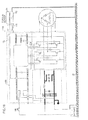
- Fig. 10 is a circuit diagram showing the circuit structure of the control device for an electrically operated power steering system according to this embodiment of the present invention. It should be understood that to elements that are the same as elements shown in Figs. 1 and 4 , the same reference symbols are affixed.
- the length of a harness BAN shown in Fig. 10 is about 1 meter.
- radio noise is emitted from this harness BAN, due to noise current flowing in the harness BAN.
- the harness BAN fulfils the role of an antenna that emits noise.
- various means for reducing the noise current flowing in this harness BAN are resorted to.
- the normal filter NF is inserted into the P side bus-bar 230BPP, and moreover the electrolytic capacitor C1 is connected between the P side bus-bar 230BPP and the N side harness BAN. Since, due to this, it is possible to drain the normal mode noise current (A) from the P side bus-bar 230BPP to the N side bus-bar 230BNN, accordingly it is possible to prevent noise current flowing in the P side harness BAP and the N side harness BAN (refer to (A') in Fig. 10 ).
- the filter is arranged to form a filter with the normal filter (coil) NF and the electrolytic capacitor C1, that ensures that the normal mode noise current (A) does not flow out to the harnesses BAP and BAN of the battery. That is, due to the filter formed in this manner, the normal mode noise is prevented from flowing out to the harnesses BAP and BAN.
- a common mode noise current (B) is generated by the voltage pulsations that are generated due to the switching operation of the semiconductor switching elements SSW.
- This common mode noise current (B) pursues two paths. On the one hand, there is a common mode noise current (B-1) that originates in voltage pulsations at the lower arm side source terminals LS of the semiconductor switching elements SSW; and, on the other hand, there is a common mode noise current (B-2) that originates in voltage pulsations at the upper arm side source terminals HS of the semiconductor switching elements SSW (refer to (B-1) and (B-2) in Fig. 10 ).
- the radio noise described above is created by either or both of these common mode noise currents (B-1) and (B-2) flowing in the N side harness BAN.
- the N side bus-bar 230BNN and the PCB control ground 225GS are electrically connected together by the N side power supply wiring 225N.
- the impedance of this N side power supply wiring 225N is smaller than that of the N side harness BAN. Due to this, the common mode noise current (B-1) flows into the N side power supply wiring 225N.
- the PCB control ground 225GS and the PCB power ground 225GP are electrically connected together via a diode 226D. This diode 226D is connected so that the direction from the PCB control ground 225GS to the PCB power ground 225GP is its forward direction.
- the PCB power ground 225GP and the lower arm side source terminals LS are electrically connected together by a gate return line GP.
- the common mode noise current (B-1) comes to follow the current path (B'-1) shown in Fig. 10 .
- it follows an electrical current path through the N side bus-bar 230BNN, the PCB control ground 225GS, the diode 226D, the PCB power ground 225GP, the lower arm side source terminals LS, and the N side bus-bar 230BNN. Due to this, it is not necessary to provide any large sized electronic component such as a common filter in the position of CF, and it is possible to ensure that the common mode noise current (B-1) flows in the N side harness BAN. In other words, along with making the control device as a whole more compact, it is also possible to reduce the noise by confining the common mode noise current (B-1) within the metallic chassis.
- One of the main voltage pulsations is a voltage pulsation due to the switching operation of the semiconductor switching elements SSW that is transmitted to the PCB control ground 225GS via the PCB power ground 225GP.
- the PCB control ground 225G and the metallic chassis 240 are short circuited together by a short circuiting screw 225GG.
- a second main voltage pulsation is a voltage pulsation due to the switching operation of the semiconductor switching elements SSW that is directly transmitted to the N side bus-bar 230BNN.
- the N side bus-bar 230BNN and the metallic chassis 240 are short circuited together by a short circuiting screw 230BC.
- a normal coil NF2 is provided before the connection between the ignition line IGN and the P side power supply wiring 225P; and (2) the metallic chassis 110 of the motor 100 and the metallic chassis 240 are electrically connected together, for example by a screw 100B or the like. Due to this, the previously described common mode noise current (B-2) flows to the metallic chassis 240 via this electrical connection 100B after having dropped the parasitic capacity 100C of the motor 100, and is discharged via the short circuiting screw 230BC and/or the short circuiting screw 225GG to the PCB control ground 225GS of the control module 220 and the PCB power ground 225GP, or is discharged to the N side bus-bar 230BNN (B'-2).
- the normal coil NF2 is able to suppress the ingress of noise into the control module 220 from the chassis CS via the ignition line IGN.
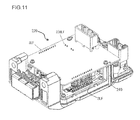
- Fig. 11 is a perspective view showing the assembly construction when connecting together the control module 220 of this control device for an electrically operated power steering system according to this embodiment of the present invention, and the lead frame 230LF and the lead frame SLF. It should be understood that to portions that are the same as in Fig. 1 , the same reference symbols are appended.
- the signal lead frames SLF of the power module 210 and the lead frame 230LF of the DC conductor module are connected to terminals of the control module 220.
- the control module 220 is fixed by screws to the metallic chassis 240.
- the signal lead frames are arranged in rows along both ends of the control module 220. The positional determination when inserting the lead frames into the terminal holes of the control module 220 after having arranged them in these rows is simple and easy, so that it is possible to make the assembly characteristics simple and easy.
- the connection task when connecting together the control module 220 and the lead frames by soldering can be performed in an efficient manner.
- the control module 220 is connected to struts 240T (refer to Fig. 1 ) of the metallic chassis 240 by screws. Moreover, via the signal lead frames SLF that are soldered to the control module 220, that control module 220 is also connected by soldering to the power module 210. Stress due to thermal expansion of the control device as a whole and of the control module 220 is applied to the soldered portions of the signal lead frames SLF. Thus, by utilizing an angled construction (refer to Fig. 8 ) for the signal lead frames SLF, it is possible to mitigate this stress in the soldered portions of the signal lead frames SLF.
- Fig. 12 is a perspective view showing the motor control device 200 and the motor 100 of this control device for an electrically operated power steering system according to this embodiment of the present invention.
- the motor control device 200 is made so as to be held integrally with the motor 100. It should be understood that to portions that are the same as in Fig. 1 , the same reference symbols are appended.
- the metallic chassis 240 of the motor control device 200 is electrically and also mechanically connected to the motor 100 by screws (100B).
- the bus-bars 231B of the AC conductor module 231 of the motor control device 200 are electrically connected by screws 231S to the three phase input units 100T of the motor 100 via the terminals 231T of the motor terminal block 231SC.
- the connection portions of the bus-bars 231B are covered over by a metallic cover 250M.
- the cover 250M is fixed to the metallic chassis 240 by at least one screw, so that the cover 250M and the metallic chassis 240 are securely electrically connected together.
- the motor 100 is connected and supported by the struts 240T that extend from the metallic chassis 240 to past the power module 210 on the motor side.
- These struts 240T are made from aluminum, just like the metallic chassis 240, and accordingly their thermal conductivity is good. Therefore the heat from the metallic chassis 240 can be transmitted to the motor 100 via the struts 240T, and is thus dissipated from the motor 100. Due to this, the heat dissipation performance of this motor control device 200 is improved.
- the rotation shaft of the motor 100 is assembled so as to be approximately parallel to the mounting surface of the switching elements of the power module.
- the cylinder side portion of the motor 100 is arranged so as to be adjacent to the power module.
- the cylinder side portion of the motor 100 need not necessarily be arranged to contact the power module; it is arranged so as to leave a slight gap between them.
- the width of this control device for an electrically operated power steering system is made more compact in the direction that is orthogonal to the direction of the rotation shaft of the motor 100, it becomes possible to reduce this width to be even smaller than the external cylindrical diameter of the motor 100.
- the cover 250M is a shield cover that is made from metal, accordingly it also fulfils the function of an electromagnetic shield and an electrostatic shield that absorbs radiated noise generated by the three phase input unit of the motor 100; for example, it can absorb radiated noise of frequency 1 MHz or lower, and in particular can reduce radiated noise in the smart bandwidth (135 kHz).
- this cover 250M may also be made from resin, provided that it is electrically conductive, in other words that it can fulfill the function of an electromagnetic shield and an electrostatic shield.
- Fig. 13 is a system structural diagram showing the structure of an electrically operated power steering system that employs this control device for an electrically operated power steering system according to an embodiment of the present invention.
- This electrically operated power steering system is mounted in a vehicle.
- This vehicle may be a passenger car, a truck, a working vehicle, or the like, or indeed any vehicle that possesses a steering system.
- the motor 100 is fitted in the neighborhood of the rod RO, and transmits its own drive force to the manual steering gear STG via a gear GE.
- a torque sensor TS is fitted to the rod RO, and detects the rotational drive force (i.e. the torque) that is applied to the steering ST.
- the control device 200 calculates a target torque for the motor 100 on the basis of the output of the torque sensor TS, and on the basis of the output of a vehicle speed sensor of the vehicle, not shown in the figure.
- the target torque for the motor 100 may be calculated while also considering the rotational speed and the rotational acceleration of the motor 100, and, by doing so, it becomes possible to perform optimum control, so as to provide an excellent steering feeling.
- the temperature of the motor 100 and the value of the electrical current passing through it are detected, and the electrical current that is supplied to the motor 100 is controlled so that as to attain an electrical current value that corresponds to the value that will yield the target torque for the output of the motor 100.
- the power supply for the control device 200 and the motor 100 is supplied from the battery BA.
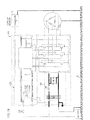
- Fig. 16 takes a torque sensor or the like as an example, and shows a structure for radio noise countermeasures against the occurrence of radio noise created due to this sensor.
- a structure in which an internal sensor circuit of the sensor TS and the metallic chassis of the sensor TS are connected together with a capacitance TCC, so that noise is discharged to the chassis CS.
- this capacitance TCC resonates at a specific frequency due to inductance of the signal lines of the torque sensor TS and its ground line TSL and so on, accordingly a noise current of this resonant frequency is discharged to the chassis CS.
- this noise current that is discharged to the chassis CS emits a strong noise by getting into the other harnesses.
- Fig. 16 shows a structure as a countermeasure against resonant noise of the torque sensor TS, in which a shield cable TSC is used.
- This shield cable TSC is built so as to cover the signal lines of the torque sensor TS and its ground line TSL with a metallic mesh, and, as shown in the figure, this metallic mesh is electrically connected to the metallic chassis of the torque sensor TS and the metallic chassis of the motor control device 200. Since, by the structure described above, the resonant noise that escapes due to the capacity TCC is returned to the motor control device 200 via the metallic mesh of the shield cable TSC that is a lower impedance path than escaping to the chassis CS, accordingly transfer of this noise current to the other harnesses is suppressed.
- a shield cable TSC has been explained by way of example, it would also be acceptable to provide some other type of structure, provided that it constitutes a low impedance path.
- a harness that is electrically connected to the metallic chassis of the torque sensor TS and to the metallic chassis of the motor control device 200.
- a coaxial line could also be used.
- Fig. 17 shows another structure as a countermeasure against resonant noise of the torque sensor TS.
- the signal line and the ground line of the torque sensor TS are wound through a ferrite core FC, so that the inductance of the signal line and the ground line is increased. Since this inductance is greater the higher the frequency becomes, accordingly it becomes harder for the resonant noise itself to flow, so that it becomes possible to reduce the radiated noise.
- a countermeasure other than a ferrite core it would also be acceptable to utilize a magnet or to utilize an inductance element, provided that the result is an increase of the inductance of the torque sensor TS.
- Fig. 18 shows another structure as a countermeasure against resonant noise of the torque sensor TS.
- a damping resistor TCR is inserted in series in the capacitance TCC, that is a resonant source.
- the resonant noise is being extracted via the capacitance TCC, its energy is consumed by this damping resistor TCR, so that the radiated noise is reduced.
- Fig. 19 shows another structure of a filter that can reduce the normal mode noise.
- the filter shown in Fig. 10 includes the normal filter NF and the electrolytic capacitor C1.
- the electrolytic capacitor C1 is omitted, and, instead, a ceramic capacitor 225C is provided between the P side power supply wiring 225P and the N side power supply wiring 225N of the control module 220.
- this ceramic capacitor 225C needs to be of sufficient size, nevertheless, by it being possible to eliminate the electrolytic capacitor C1, it is still possible to make the DC conductor module 230 more compact.
Landscapes
- Engineering & Computer Science (AREA)
- Chemical & Material Sciences (AREA)
- Combustion & Propulsion (AREA)
- Transportation (AREA)
- Mechanical Engineering (AREA)
- Power Steering Mechanism (AREA)
- Inverter Devices (AREA)
Applications Claiming Priority (1)
| Application Number | Priority Date | Filing Date | Title |
|---|---|---|---|
| JP2008225162A JP4909961B2 (ja) | 2008-09-02 | 2008-09-02 | 電動パワーステアリング用制御装置 |
Publications (3)
| Publication Number | Publication Date |
|---|---|
| EP2159131A2 true EP2159131A2 (fr) | 2010-03-03 |
| EP2159131A3 EP2159131A3 (fr) | 2010-12-22 |
| EP2159131B1 EP2159131B1 (fr) | 2013-10-02 |
Family
ID=41413343
Family Applications (1)
| Application Number | Title | Priority Date | Filing Date |
|---|---|---|---|
| EP09161250.7A Not-in-force EP2159131B1 (fr) | 2008-09-02 | 2009-05-27 | Dispositif de contrôle pour système de direction assistée électrique |
Country Status (3)
| Country | Link |
|---|---|
| US (1) | US7989997B2 (fr) |
| EP (1) | EP2159131B1 (fr) |
| JP (1) | JP4909961B2 (fr) |
Cited By (12)
| Publication number | Priority date | Publication date | Assignee | Title |
|---|---|---|---|---|
| FR2975253A1 (fr) * | 2011-05-13 | 2012-11-16 | Valeo Sys Controle Moteur Sas | Assemblage d'un module electronique de puissance et d'une carte pcb a faible encombrement |
| CN104015791A (zh) * | 2014-05-30 | 2014-09-03 | 重庆龙润汽车转向器有限公司 | 一种带安装支架的电动助力转向控制器 |
| CN104015789A (zh) * | 2014-05-30 | 2014-09-03 | 重庆龙润汽车转向器有限公司 | 一种方便安装制造的车用助力转向控制器组件 |
| CN104029719A (zh) * | 2014-05-30 | 2014-09-10 | 重庆龙润汽车转向器有限公司 | 一种汽车电动助力转向控制系统的控制器 |
| CN104029718A (zh) * | 2014-05-30 | 2014-09-10 | 重庆龙润汽车转向器有限公司 | 一种电动助力转向控制器组件 |
| CN104044634A (zh) * | 2014-05-30 | 2014-09-17 | 重庆龙润汽车转向器有限公司 | 一种防装配时线间干扰的汽车助力转向电控器 |
| CN104023491B (zh) * | 2014-05-30 | 2016-07-06 | 重庆龙润汽车转向器有限公司 | 一种防线间干扰的电动助力转向控制器壳体组件 |
| EP2552006A4 (fr) * | 2010-03-23 | 2017-06-21 | Hitachi Automotive Systems, Ltd. | Dispositif de conversion de puissance |
| EP3021358A4 (fr) * | 2013-07-10 | 2017-11-22 | Hitachi Automotive Systems, Ltd. | Module à semi-conducteur de puissance |
| EP3527462A4 (fr) * | 2016-10-13 | 2019-10-30 | Mitsubishi Electric Corporation | Appareil de direction assistée électrique |
| EP3911133A4 (fr) * | 2018-12-20 | 2022-11-09 | Zhejiang Jiecang Linear Motion Technology Co., Ltd | Dispositif de commande pour plate-forme de levage et plate-forme de levage |
| CN117280576A (zh) * | 2021-04-22 | 2023-12-22 | 株式会社电装 | 驱动装置 |
Families Citing this family (44)
| Publication number | Priority date | Publication date | Assignee | Title |
|---|---|---|---|---|
| JP2008244701A (ja) * | 2007-03-27 | 2008-10-09 | Smk Corp | 電力線通信システム |
| DE102007034915B4 (de) * | 2007-07-24 | 2011-01-05 | Sew-Eurodrive Gmbh & Co. Kg | Motoranschlusskasten und Umrichtermotor |
| JP5107133B2 (ja) * | 2008-05-14 | 2012-12-26 | 三菱重工業株式会社 | インバータ一体型電動圧縮機 |
| JP5039171B2 (ja) | 2010-05-11 | 2012-10-03 | 三菱電機株式会社 | 電動式駆動装置およびその電動式駆動装置を搭載した電動式パワーステアリング装置 |
| JP5177711B2 (ja) * | 2010-05-21 | 2013-04-10 | 株式会社デンソー | 電動装置 |
| JP5609289B2 (ja) * | 2010-06-14 | 2014-10-22 | 日産自動車株式会社 | インバータ一体型モータ |
| JP5574172B2 (ja) * | 2010-07-14 | 2014-08-20 | 株式会社ジェイテクト | 制御装置 |
| CN103153754B (zh) | 2010-10-27 | 2016-11-16 | 三菱电机株式会社 | 电动助力转向用电动机驱动控制装置 |
| EP2637285B1 (fr) * | 2010-11-02 | 2020-04-01 | Mitsubishi Electric Corporation | Module de puissance pour direction assistée électrique et dispositif de commande de pilotage d'une direction assistée électrique employant celui-ci |
| JP5692575B2 (ja) * | 2010-12-28 | 2015-04-01 | 株式会社デンソー | 駆動装置 |
| JP5170711B2 (ja) * | 2010-12-28 | 2013-03-27 | 株式会社デンソー | コントローラ |
| JP2012153243A (ja) * | 2011-01-26 | 2012-08-16 | Hitachi Automotive Systems Ltd | 電動パワーステアリングの制御装置 |
| JP2012200088A (ja) * | 2011-03-22 | 2012-10-18 | Denso Corp | モータ駆動装置、及びこれを用いた電動パワーステアリング装置 |
| JP5601272B2 (ja) * | 2011-04-19 | 2014-10-08 | 株式会社デンソー | モータ装置 |
| WO2012153402A1 (fr) * | 2011-05-11 | 2012-11-15 | 三菱電機株式会社 | Dispositif de direction assistée électrique |
| JP2013070028A (ja) | 2011-09-07 | 2013-04-18 | Hitachi Automotive Systems Ltd | 電子制御装置 |
| JP5846824B2 (ja) * | 2011-09-26 | 2016-01-20 | ダイヤモンド電機株式会社 | 電動パワーステアリングコントロールユニット |
| JP2013115904A (ja) * | 2011-11-28 | 2013-06-10 | Hitachi Automotive Systems Ltd | 機電一体型の電動駆動装置 |
| JP2014090030A (ja) * | 2012-10-29 | 2014-05-15 | Jtekt Corp | 制御装置および同装置を備える車両操舵装置 |
| US20160020679A1 (en) * | 2013-02-20 | 2016-01-21 | Nissan Motor Co., Ltd. | Inverter-integrated motor |
| JP5601396B2 (ja) * | 2013-04-10 | 2014-10-08 | 株式会社デンソー | 電動装置 |
| JP6117661B2 (ja) * | 2013-09-19 | 2017-04-19 | 日立オートモティブシステムズ株式会社 | 電子制御装置 |
| CN104753411A (zh) * | 2013-12-26 | 2015-07-01 | 南京德朔实业有限公司 | 无刷电机及其控制方法 |
| JP5700144B2 (ja) * | 2014-02-07 | 2015-04-15 | 株式会社安川電機 | モータ駆動装置および車両 |
| JP6354641B2 (ja) * | 2015-04-06 | 2018-07-11 | 株式会社デンソー | 電子装置 |
| US10315686B2 (en) * | 2015-08-10 | 2019-06-11 | Nsk Ltd. | Brushless motor, and electric power steering apparatus and vehicle equipped with the same |
| EP3346171A4 (fr) * | 2015-08-31 | 2019-09-04 | Hitachi Automotive Systems, Ltd. | Dispositif d'entraînement et actionneur électrique intégré à un dispositif d'entraînement |
| JP6595269B2 (ja) * | 2015-09-07 | 2019-10-23 | 日立オートモティブシステムズ株式会社 | 電動駆動装置及び電動パワーステアリング装置 |
| JP6583027B2 (ja) * | 2016-02-02 | 2019-10-02 | 日本精工株式会社 | 電動モータとその制御装置に収納される基板との接続構造 |
| US10384548B2 (en) * | 2016-04-28 | 2019-08-20 | Ge Global Sourcing Llc | Systems and methods for a vehicle inverter connection bus |
| JP6863875B2 (ja) * | 2017-10-27 | 2021-04-21 | 日立Astemo株式会社 | 電動駆動装置及び電動パワーステアリング装置 |
| US11382264B2 (en) | 2017-11-02 | 2022-07-12 | Kubota Corporation | Mower unit for heat discharge and soundproofing |
| JP6925239B2 (ja) * | 2017-11-02 | 2021-08-25 | 株式会社クボタ | モーアユニット |
| TWI664796B (zh) * | 2017-11-14 | 2019-07-01 | 財團法人工業技術研究院 | 電動機 |
| WO2019146069A1 (fr) * | 2018-01-26 | 2019-08-01 | 新電元工業株式会社 | Module électronique |
| US11515253B2 (en) * | 2018-01-26 | 2022-11-29 | Shindengen Electric Manufacturing Co., Ltd. | Electronic module |
| KR102536589B1 (ko) * | 2018-05-15 | 2023-05-25 | 에이치엘만도 주식회사 | 전동 구동 제어 장치 |
| JP7310263B2 (ja) * | 2019-04-22 | 2023-07-19 | 株式会社デンソー | 電子部品 |
| JP7319397B2 (ja) * | 2020-01-31 | 2023-08-01 | ファナック株式会社 | モータ駆動装置およびその製造方法 |
| JP7509048B2 (ja) * | 2021-02-02 | 2024-07-02 | トヨタ自動車株式会社 | 電動車両 |
| CN113178990A (zh) * | 2021-05-21 | 2021-07-27 | 东莞市凝锐开关有限公司 | 一种具有转向切换功能的串激电机控制开关 |
| JP7620723B2 (ja) * | 2021-09-28 | 2025-01-23 | 日立Astemo株式会社 | 電子制御装置および電子制御装置の診断方法 |
| WO2023143888A1 (fr) * | 2022-01-28 | 2023-08-03 | Robert Bosch Gmbh | Dispositif de commande pour commander le fonctionnement d'au moins un moteur électrique, en particulier d'un système de direction |
| CN120898354A (zh) * | 2023-03-30 | 2025-11-04 | 伊东电机株式会社 | 齿轮传动电机 |
Citations (1)
| Publication number | Priority date | Publication date | Assignee | Title |
|---|---|---|---|---|
| JP2007030652A (ja) | 2005-07-26 | 2007-02-08 | Hitachi Ltd | 電動パワーステアリング装置 |
Family Cites Families (12)
| Publication number | Priority date | Publication date | Assignee | Title |
|---|---|---|---|---|
| GB2295590B (en) * | 1994-11-30 | 1999-01-20 | Nsk Ltd | Electric power steering apparatus |
| US6166464A (en) * | 1998-08-24 | 2000-12-26 | International Rectifier Corp. | Power module |
| JP3593102B2 (ja) * | 2002-01-08 | 2004-11-24 | 三菱電機株式会社 | 電動パワーステアリング装置 |
| JP3638269B2 (ja) * | 2002-03-14 | 2005-04-13 | 三菱電機株式会社 | 電動式パワーステアリング装置 |
| JP2003299366A (ja) * | 2002-04-03 | 2003-10-17 | Denso Corp | 電力変換装置 |
| JP2004023841A (ja) * | 2002-06-13 | 2004-01-22 | Mitsuba Corp | モータ |
| JP4161074B2 (ja) * | 2004-02-02 | 2008-10-08 | 三菱電機株式会社 | 電動式パワーステアリング装置 |
| JP4252486B2 (ja) * | 2004-04-13 | 2009-04-08 | 三菱電機株式会社 | 電動式パワーステアリング装置 |
| JP4471752B2 (ja) * | 2004-07-06 | 2010-06-02 | 日立オートモティブシステムズ株式会社 | 電動パワーステアリング用制御装置および電動パワーステアリングシステム |
| JP4783012B2 (ja) * | 2004-12-28 | 2011-09-28 | 日立オートモティブシステムズ株式会社 | 電動パワーステアリング用モータ及びその製造方法 |
| US20090267430A1 (en) * | 2005-09-01 | 2009-10-29 | Nsk Ltd. | Electric power steering apparatus |
| JP4353951B2 (ja) * | 2006-03-06 | 2009-10-28 | 三菱電機株式会社 | 電動式パワーステアリング装置 |
-
2008
- 2008-09-02 JP JP2008225162A patent/JP4909961B2/ja not_active Expired - Fee Related
-
2009
- 2009-05-27 EP EP09161250.7A patent/EP2159131B1/fr not_active Not-in-force
- 2009-05-28 US US12/473,662 patent/US7989997B2/en not_active Expired - Fee Related
Patent Citations (1)
| Publication number | Priority date | Publication date | Assignee | Title |
|---|---|---|---|---|
| JP2007030652A (ja) | 2005-07-26 | 2007-02-08 | Hitachi Ltd | 電動パワーステアリング装置 |
Cited By (15)
| Publication number | Priority date | Publication date | Assignee | Title |
|---|---|---|---|---|
| EP2552006A4 (fr) * | 2010-03-23 | 2017-06-21 | Hitachi Automotive Systems, Ltd. | Dispositif de conversion de puissance |
| FR2975253A1 (fr) * | 2011-05-13 | 2012-11-16 | Valeo Sys Controle Moteur Sas | Assemblage d'un module electronique de puissance et d'une carte pcb a faible encombrement |
| EP3021358A4 (fr) * | 2013-07-10 | 2017-11-22 | Hitachi Automotive Systems, Ltd. | Module à semi-conducteur de puissance |
| CN104029719A (zh) * | 2014-05-30 | 2014-09-10 | 重庆龙润汽车转向器有限公司 | 一种汽车电动助力转向控制系统的控制器 |
| CN104029718A (zh) * | 2014-05-30 | 2014-09-10 | 重庆龙润汽车转向器有限公司 | 一种电动助力转向控制器组件 |
| CN104044634A (zh) * | 2014-05-30 | 2014-09-17 | 重庆龙润汽车转向器有限公司 | 一种防装配时线间干扰的汽车助力转向电控器 |
| CN104015791B (zh) * | 2014-05-30 | 2016-01-13 | 重庆龙润汽车转向器有限公司 | 一种带安装支架的电动助力转向控制器 |
| CN104029719B (zh) * | 2014-05-30 | 2016-05-04 | 重庆龙润汽车转向器有限公司 | 一种汽车电动助力转向控制系统的控制器 |
| CN104023491B (zh) * | 2014-05-30 | 2016-07-06 | 重庆龙润汽车转向器有限公司 | 一种防线间干扰的电动助力转向控制器壳体组件 |
| CN104015789A (zh) * | 2014-05-30 | 2014-09-03 | 重庆龙润汽车转向器有限公司 | 一种方便安装制造的车用助力转向控制器组件 |
| CN104015791A (zh) * | 2014-05-30 | 2014-09-03 | 重庆龙润汽车转向器有限公司 | 一种带安装支架的电动助力转向控制器 |
| EP3527462A4 (fr) * | 2016-10-13 | 2019-10-30 | Mitsubishi Electric Corporation | Appareil de direction assistée électrique |
| EP3911133A4 (fr) * | 2018-12-20 | 2022-11-09 | Zhejiang Jiecang Linear Motion Technology Co., Ltd | Dispositif de commande pour plate-forme de levage et plate-forme de levage |
| US12630396B2 (en) | 2018-12-20 | 2026-05-19 | Zhejiang Jiecang Linear Motion Technology Co., Ltd. | Controller for lifting platform and lifting platform |
| CN117280576A (zh) * | 2021-04-22 | 2023-12-22 | 株式会社电装 | 驱动装置 |
Also Published As
| Publication number | Publication date |
|---|---|
| US7989997B2 (en) | 2011-08-02 |
| EP2159131A3 (fr) | 2010-12-22 |
| JP2010063242A (ja) | 2010-03-18 |
| EP2159131B1 (fr) | 2013-10-02 |
| US20100052449A1 (en) | 2010-03-04 |
| JP4909961B2 (ja) | 2012-04-04 |
Similar Documents
| Publication | Publication Date | Title |
|---|---|---|
| EP2159131B1 (fr) | Dispositif de contrôle pour système de direction assistée électrique | |
| JP5250329B2 (ja) | 電動パワーステアリング用制御装置および電動パワーステアリング装置 | |
| US7751201B2 (en) | Power converter | |
| JP4285435B2 (ja) | 電力変換装置 | |
| US7542318B2 (en) | Capacitor mounting type inverter unit having a recessed cover | |
| US20220344783A1 (en) | Connection structure between flexible substrate and bus bar, wiring module and electricity storage module | |
| JP6562998B2 (ja) | 電力変換装置 | |
| RU2707087C1 (ru) | Электрическое устройство и способ его производства | |
| CN104742961A (zh) | 电子控制单元和具有电子控制单元的电动助力转向装置 | |
| WO2019026339A1 (fr) | Dispositif de conversion de courant et véhicule équipé du dispositif de conversion de courant | |
| US9456491B2 (en) | High current-carrying printed circuit board and method for producing said printed circuit board | |
| US20240015916A1 (en) | Inverter with current sensor and electromagnetic interference (emi) filter | |
| JPWO2012117694A1 (ja) | 電力変換装置 | |
| US20120071041A1 (en) | Housing, electrical coupling including said housing, and vehicle including such a coupling | |
| JP2018133846A (ja) | 電池監視装置 | |
| US20120307468A1 (en) | Electronic apparatus | |
| US12576906B2 (en) | Electric rotating machine apparatus and electric power steering apparatus | |
| CN108962831A (zh) | 功率电子装置和具有这种装置的电动车辆 | |
| CN112260560B (zh) | 电力变换装置 | |
| JP3716231B2 (ja) | 電動式パワーステアリング回路装置及びその製造方法 | |
| US11523497B2 (en) | Electric power conversion apparatus and electric power steering apparatus using the same | |
| JP2013063712A (ja) | 電動パワーステアリング装置のコントロールユニット | |
| US20260054576A1 (en) | Electrical storage device and method of detecting impact load input to electrical storage device | |
| CN221615172U (zh) | Ptc加热器总成控制器、ptc加热器总成及车辆 | |
| JP3998444B2 (ja) | 電子部品搭載構造 |
Legal Events
| Date | Code | Title | Description |
|---|---|---|---|
| PUAI | Public reference made under article 153(3) epc to a published international application that has entered the european phase |
Free format text: ORIGINAL CODE: 0009012 |
|
| 17P | Request for examination filed |
Effective date: 20091204 |
|
| AK | Designated contracting states |
Kind code of ref document: A2 Designated state(s): AT BE BG CH CY CZ DE DK EE ES FI FR GB GR HR HU IE IS IT LI LT LU LV MC MK MT NL NO PL PT RO SE SI SK TR |
|
| AX | Request for extension of the european patent |
Extension state: AL BA RS |
|
| PUAL | Search report despatched |
Free format text: ORIGINAL CODE: 0009013 |
|
| AK | Designated contracting states |
Kind code of ref document: A3 Designated state(s): AT BE BG CH CY CZ DE DK EE ES FI FR GB GR HR HU IE IS IT LI LT LU LV MC MK MT NL NO PL PT RO SE SI SK TR |
|
| AX | Request for extension of the european patent |
Extension state: AL BA RS |
|
| 17Q | First examination report despatched |
Effective date: 20110728 |
|
| GRAJ | Information related to disapproval of communication of intention to grant by the applicant or resumption of examination proceedings by the epo deleted |
Free format text: ORIGINAL CODE: EPIDOSDIGR1 |
|
| GRAP | Despatch of communication of intention to grant a patent |
Free format text: ORIGINAL CODE: EPIDOSNIGR1 |
|
| INTG | Intention to grant announced |
Effective date: 20130411 |
|
| GRAS | Grant fee paid |
Free format text: ORIGINAL CODE: EPIDOSNIGR3 |
|
| RIN1 | Information on inventor provided before grant (corrected) |
Inventor name: KANAZAWA, TAKURO Inventor name: HASHIMOTO, MANABU Inventor name: OCHI, KENTARO Inventor name: MISHIMA, AKIRA |
|
| GRAA | (expected) grant |
Free format text: ORIGINAL CODE: 0009210 |
|
| AK | Designated contracting states |
Kind code of ref document: B1 Designated state(s): AT BE BG CH CY CZ DE DK EE ES FI FR GB GR HR HU IE IS IT LI LT LU LV MC MK MT NL NO PL PT RO SE SI SK TR |
|
| RAP1 | Party data changed (applicant data changed or rights of an application transferred) |
Owner name: HITACHI, LTD. |
|
| REG | Reference to a national code |
Ref country code: GB Ref legal event code: FG4D |
|
| REG | Reference to a national code |
Ref country code: AT Ref legal event code: REF Ref document number: 634449 Country of ref document: AT Kind code of ref document: T Effective date: 20131015 Ref country code: CH Ref legal event code: EP |
|
| REG | Reference to a national code |
Ref country code: IE Ref legal event code: FG4D |
|
| REG | Reference to a national code |
Ref country code: DE Ref legal event code: R096 Ref document number: 602009019141 Country of ref document: DE Effective date: 20131128 |
|
| REG | Reference to a national code |
Ref country code: AT Ref legal event code: MK05 Ref document number: 634449 Country of ref document: AT Kind code of ref document: T Effective date: 20131002 |
|
| REG | Reference to a national code |
Ref country code: NL Ref legal event code: VDEP Effective date: 20131002 |
|
| PG25 | Lapsed in a contracting state [announced via postgrant information from national office to epo] |
Ref country code: SI Free format text: LAPSE BECAUSE OF FAILURE TO SUBMIT A TRANSLATION OF THE DESCRIPTION OR TO PAY THE FEE WITHIN THE PRESCRIBED TIME-LIMIT Effective date: 20131002 |
|
| REG | Reference to a national code |
Ref country code: LT Ref legal event code: MG4D |
|
| PG25 | Lapsed in a contracting state [announced via postgrant information from national office to epo] |
Ref country code: SE Free format text: LAPSE BECAUSE OF FAILURE TO SUBMIT A TRANSLATION OF THE DESCRIPTION OR TO PAY THE FEE WITHIN THE PRESCRIBED TIME-LIMIT Effective date: 20131002 Ref country code: CZ Free format text: LAPSE BECAUSE OF FAILURE TO SUBMIT A TRANSLATION OF THE DESCRIPTION OR TO PAY THE FEE WITHIN THE PRESCRIBED TIME-LIMIT Effective date: 20131002 Ref country code: FI Free format text: LAPSE BECAUSE OF FAILURE TO SUBMIT A TRANSLATION OF THE DESCRIPTION OR TO PAY THE FEE WITHIN THE PRESCRIBED TIME-LIMIT Effective date: 20131002 Ref country code: LT Free format text: LAPSE BECAUSE OF FAILURE TO SUBMIT A TRANSLATION OF THE DESCRIPTION OR TO PAY THE FEE WITHIN THE PRESCRIBED TIME-LIMIT Effective date: 20131002 Ref country code: BE Free format text: LAPSE BECAUSE OF FAILURE TO SUBMIT A TRANSLATION OF THE DESCRIPTION OR TO PAY THE FEE WITHIN THE PRESCRIBED TIME-LIMIT Effective date: 20131002 Ref country code: IS Free format text: LAPSE BECAUSE OF FAILURE TO SUBMIT A TRANSLATION OF THE DESCRIPTION OR TO PAY THE FEE WITHIN THE PRESCRIBED TIME-LIMIT Effective date: 20140202 Ref country code: NL Free format text: LAPSE BECAUSE OF FAILURE TO SUBMIT A TRANSLATION OF THE DESCRIPTION OR TO PAY THE FEE WITHIN THE PRESCRIBED TIME-LIMIT Effective date: 20131002 Ref country code: NO Free format text: LAPSE BECAUSE OF FAILURE TO SUBMIT A TRANSLATION OF THE DESCRIPTION OR TO PAY THE FEE WITHIN THE PRESCRIBED TIME-LIMIT Effective date: 20140102 Ref country code: HR Free format text: LAPSE BECAUSE OF FAILURE TO SUBMIT A TRANSLATION OF THE DESCRIPTION OR TO PAY THE FEE WITHIN THE PRESCRIBED TIME-LIMIT Effective date: 20131002 |
|
| PG25 | Lapsed in a contracting state [announced via postgrant information from national office to epo] |
Ref country code: ES Free format text: LAPSE BECAUSE OF FAILURE TO SUBMIT A TRANSLATION OF THE DESCRIPTION OR TO PAY THE FEE WITHIN THE PRESCRIBED TIME-LIMIT Effective date: 20131002 Ref country code: PL Free format text: LAPSE BECAUSE OF FAILURE TO SUBMIT A TRANSLATION OF THE DESCRIPTION OR TO PAY THE FEE WITHIN THE PRESCRIBED TIME-LIMIT Effective date: 20131002 Ref country code: AT Free format text: LAPSE BECAUSE OF FAILURE TO SUBMIT A TRANSLATION OF THE DESCRIPTION OR TO PAY THE FEE WITHIN THE PRESCRIBED TIME-LIMIT Effective date: 20131002 Ref country code: LV Free format text: LAPSE BECAUSE OF FAILURE TO SUBMIT A TRANSLATION OF THE DESCRIPTION OR TO PAY THE FEE WITHIN THE PRESCRIBED TIME-LIMIT Effective date: 20131002 Ref country code: CY Free format text: LAPSE BECAUSE OF FAILURE TO SUBMIT A TRANSLATION OF THE DESCRIPTION OR TO PAY THE FEE WITHIN THE PRESCRIBED TIME-LIMIT Effective date: 20131002 |
|
| PG25 | Lapsed in a contracting state [announced via postgrant information from national office to epo] |
Ref country code: PT Free format text: LAPSE BECAUSE OF FAILURE TO SUBMIT A TRANSLATION OF THE DESCRIPTION OR TO PAY THE FEE WITHIN THE PRESCRIBED TIME-LIMIT Effective date: 20140203 |
|
| REG | Reference to a national code |
Ref country code: DE Ref legal event code: R097 Ref document number: 602009019141 Country of ref document: DE |
|
| PG25 | Lapsed in a contracting state [announced via postgrant information from national office to epo] |
Ref country code: EE Free format text: LAPSE BECAUSE OF FAILURE TO SUBMIT A TRANSLATION OF THE DESCRIPTION OR TO PAY THE FEE WITHIN THE PRESCRIBED TIME-LIMIT Effective date: 20131002 |
|
| PLBE | No opposition filed within time limit |
Free format text: ORIGINAL CODE: 0009261 |
|
| STAA | Information on the status of an ep patent application or granted ep patent |
Free format text: STATUS: NO OPPOSITION FILED WITHIN TIME LIMIT |
|
| PG25 | Lapsed in a contracting state [announced via postgrant information from national office to epo] |
Ref country code: RO Free format text: LAPSE BECAUSE OF FAILURE TO SUBMIT A TRANSLATION OF THE DESCRIPTION OR TO PAY THE FEE WITHIN THE PRESCRIBED TIME-LIMIT Effective date: 20131002 Ref country code: SK Free format text: LAPSE BECAUSE OF FAILURE TO SUBMIT A TRANSLATION OF THE DESCRIPTION OR TO PAY THE FEE WITHIN THE PRESCRIBED TIME-LIMIT Effective date: 20131002 Ref country code: IT Free format text: LAPSE BECAUSE OF FAILURE TO SUBMIT A TRANSLATION OF THE DESCRIPTION OR TO PAY THE FEE WITHIN THE PRESCRIBED TIME-LIMIT Effective date: 20131002 |
|
| PGFP | Annual fee paid to national office [announced via postgrant information from national office to epo] |
Ref country code: FR Payment date: 20140516 Year of fee payment: 6 |
|
| 26N | No opposition filed |
Effective date: 20140703 |
|
| PG25 | Lapsed in a contracting state [announced via postgrant information from national office to epo] |
Ref country code: DK Free format text: LAPSE BECAUSE OF FAILURE TO SUBMIT A TRANSLATION OF THE DESCRIPTION OR TO PAY THE FEE WITHIN THE PRESCRIBED TIME-LIMIT Effective date: 20131002 |
|
| REG | Reference to a national code |
Ref country code: DE Ref legal event code: R097 Ref document number: 602009019141 Country of ref document: DE Effective date: 20140703 |
|
| PG25 | Lapsed in a contracting state [announced via postgrant information from national office to epo] |
Ref country code: LU Free format text: LAPSE BECAUSE OF FAILURE TO SUBMIT A TRANSLATION OF THE DESCRIPTION OR TO PAY THE FEE WITHIN THE PRESCRIBED TIME-LIMIT Effective date: 20140527 |
|
| REG | Reference to a national code |
Ref country code: CH Ref legal event code: PL |
|
| GBPC | Gb: european patent ceased through non-payment of renewal fee |
Effective date: 20140527 |
|
| PG25 | Lapsed in a contracting state [announced via postgrant information from national office to epo] |
Ref country code: CH Free format text: LAPSE BECAUSE OF NON-PAYMENT OF DUE FEES Effective date: 20140531 Ref country code: LI Free format text: LAPSE BECAUSE OF NON-PAYMENT OF DUE FEES Effective date: 20140531 Ref country code: MC Free format text: LAPSE BECAUSE OF FAILURE TO SUBMIT A TRANSLATION OF THE DESCRIPTION OR TO PAY THE FEE WITHIN THE PRESCRIBED TIME-LIMIT Effective date: 20131002 |
|
| REG | Reference to a national code |
Ref country code: IE Ref legal event code: MM4A |
|
| PG25 | Lapsed in a contracting state [announced via postgrant information from national office to epo] |
Ref country code: IE Free format text: LAPSE BECAUSE OF NON-PAYMENT OF DUE FEES Effective date: 20140527 |
|
| PG25 | Lapsed in a contracting state [announced via postgrant information from national office to epo] |
Ref country code: GB Free format text: LAPSE BECAUSE OF NON-PAYMENT OF DUE FEES Effective date: 20140527 |
|
| REG | Reference to a national code |
Ref country code: FR Ref legal event code: ST Effective date: 20160129 |
|
| PG25 | Lapsed in a contracting state [announced via postgrant information from national office to epo] |
Ref country code: MT Free format text: LAPSE BECAUSE OF FAILURE TO SUBMIT A TRANSLATION OF THE DESCRIPTION OR TO PAY THE FEE WITHIN THE PRESCRIBED TIME-LIMIT Effective date: 20131002 |
|
| PG25 | Lapsed in a contracting state [announced via postgrant information from national office to epo] |
Ref country code: NO Free format text: LAPSE BECAUSE OF FAILURE TO SUBMIT A TRANSLATION OF THE DESCRIPTION OR TO PAY THE FEE WITHIN THE PRESCRIBED TIME-LIMIT Effective date: 20140101 |
|
| PG25 | Lapsed in a contracting state [announced via postgrant information from national office to epo] |
Ref country code: FR Free format text: LAPSE BECAUSE OF NON-PAYMENT OF DUE FEES Effective date: 20150601 |
|
| PG25 | Lapsed in a contracting state [announced via postgrant information from national office to epo] |
Ref country code: BG Free format text: LAPSE BECAUSE OF FAILURE TO SUBMIT A TRANSLATION OF THE DESCRIPTION OR TO PAY THE FEE WITHIN THE PRESCRIBED TIME-LIMIT Effective date: 20131002 Ref country code: GR Free format text: LAPSE BECAUSE OF FAILURE TO SUBMIT A TRANSLATION OF THE DESCRIPTION OR TO PAY THE FEE WITHIN THE PRESCRIBED TIME-LIMIT Effective date: 20140103 |
|
| PG25 | Lapsed in a contracting state [announced via postgrant information from national office to epo] |
Ref country code: HU Free format text: LAPSE BECAUSE OF FAILURE TO SUBMIT A TRANSLATION OF THE DESCRIPTION OR TO PAY THE FEE WITHIN THE PRESCRIBED TIME-LIMIT; INVALID AB INITIO Effective date: 20090527 Ref country code: TR Free format text: LAPSE BECAUSE OF FAILURE TO SUBMIT A TRANSLATION OF THE DESCRIPTION OR TO PAY THE FEE WITHIN THE PRESCRIBED TIME-LIMIT Effective date: 20131002 |
|
| PG25 | Lapsed in a contracting state [announced via postgrant information from national office to epo] |
Ref country code: MK Free format text: LAPSE BECAUSE OF FAILURE TO SUBMIT A TRANSLATION OF THE DESCRIPTION OR TO PAY THE FEE WITHIN THE PRESCRIBED TIME-LIMIT Effective date: 20131002 |
|
| REG | Reference to a national code |
Ref country code: DE Ref legal event code: R084 Ref document number: 602009019141 Country of ref document: DE |
|
| PGFP | Annual fee paid to national office [announced via postgrant information from national office to epo] |
Ref country code: DE Payment date: 20210427 Year of fee payment: 13 |
|
| REG | Reference to a national code |
Ref country code: DE Ref legal event code: R119 Ref document number: 602009019141 Country of ref document: DE |
|
| PG25 | Lapsed in a contracting state [announced via postgrant information from national office to epo] |
Ref country code: DE Free format text: LAPSE BECAUSE OF NON-PAYMENT OF DUE FEES Effective date: 20221201 |