EP2177467A1 - Rotierende Hebevorrichtung - Google Patents
Rotierende Hebevorrichtung Download PDFInfo
- Publication number
- EP2177467A1 EP2177467A1 EP08105567A EP08105567A EP2177467A1 EP 2177467 A1 EP2177467 A1 EP 2177467A1 EP 08105567 A EP08105567 A EP 08105567A EP 08105567 A EP08105567 A EP 08105567A EP 2177467 A1 EP2177467 A1 EP 2177467A1
- Authority
- EP
- European Patent Office
- Prior art keywords
- elevator
- doors
- elevator car
- door
- housing
- Prior art date
- Legal status (The legal status is an assumption and is not a legal conclusion. Google has not performed a legal analysis and makes no representation as to the accuracy of the status listed.)
- Withdrawn
Links
- 230000007246 mechanism Effects 0.000 description 5
- 238000010276 construction Methods 0.000 description 3
- 238000006073 displacement reaction Methods 0.000 description 1
- 239000011521 glass Substances 0.000 description 1
- 238000012423 maintenance Methods 0.000 description 1
- 238000000034 method Methods 0.000 description 1
- 239000000725 suspension Substances 0.000 description 1
Images









Classifications
-
- B—PERFORMING OPERATIONS; TRANSPORTING
- B66—HOISTING; LIFTING; HAULING
- B66B—ELEVATORS; ESCALATORS OR MOVING WALKWAYS
- B66B9/00—Kinds or types of lifts in, or associated with, buildings or other structures
- B66B9/02—Kinds or types of lifts in, or associated with, buildings or other structures actuated mechanically otherwise than by rope or cable
- B66B9/022—Kinds or types of lifts in, or associated with, buildings or other structures actuated mechanically otherwise than by rope or cable by rack and pinion drives
-
- B—PERFORMING OPERATIONS; TRANSPORTING
- B66—HOISTING; LIFTING; HAULING
- B66B—ELEVATORS; ESCALATORS OR MOVING WALKWAYS
- B66B11/00—Main component parts of lifts in, or associated with, buildings or other structures
- B66B11/02—Cages, i.e. cars
Definitions
- the present invention relates to an elevator for vertical transport between floors, in a building or the like, permitting the passengers to enter and exit from different directions in the horizontal plane.
- Elevators are essential facilities in modern day buildings. More advanced constructions of elevators are continuously needed to meet citizens need. Taking handicapped people, disabled users, senior citizens, and particular wheel chair users into account, elevator designs pose a great challenge for elevator designers.
- the elevator car is typically formed as a box inside an elevator housing with a rectangular horizontal cross section, which limits the movement of the elevator car to a vertical movement.
- the elevator doors in these conventional elevators typically includes several sliding elements, arranged in a relatively complicated mechanism, whereby sliding of the elevator doors is performed by straight movements from their open to close positions.
- Cylindrical shaped elevators including cylindrical shaped elevator car doors, exist as well, as for instance disclosed in EP 1 508 546 A1 .
- a method for opening the cylindrical shaped elevator car doors, using a driving pulley, rollers, and several pivotally coupled arms to drive the elevators doors, is described.
- a cylindrical elevator which can rotate around its vertical axis, is disclosed in JP 2001-206665 .
- the described elevator is lifted or lowered while being rotated in an elevator shaft having a square horizontal cross section.
- the passengers of the elevator gain several benefits, for instance wheel chair users can exit through a door better suited to their needs.
- doors, having different directions in the horizontal plane, at a specific floor can lead into separate compartments, and these compartments can be reached using a rotating elevator car with a single door, this is not possible for a non-rotating elevator car with a single door.
- the elevator car has several doors, there are even more transporting possibilities including different options for entrance and exit directions.
- the invention has potentially uses in both low and tall buildings, such as sky scrapers, where the rotation means allows the elevator to reach more doorways than conventionally non-rotating elevators. Therefore fewer elevators are needed implying reduced construction costs and, at the same time, less space in the building is needed for the elevator.
- an elevator for vertical transport between floors, comprising a rotably supported elevator car, an elevator housing, a plurality of support columns comprising a means for lifting and lowering the elevator car, a means for rotating the elevator car mounted in a basis anchored to the support columns, at least one elevator car door, a means comprising linear actuators for opening and closing at least one elevator car door, at least one elevator housing door, a means comprising linear actuators for opening and closing at least one elevator housing door, and anti-fall equipment, wherein the elevator car and/or the elevator housing have a cylindrical shape, and at least one elevator car door and/or at least one elevator housing door have a cylindrical curved shape, and the door opening and closing means is connected to a set of elevator car doors and elevator housing doors, and the plurality of support columns comprises a rack and gear drive means (rack and pinion) and a power supply to the elevator car.
- rack and gear drive means rack and pinion
- the elevator car and the elevator housing have a cylindrical shape; however other shapes and combination of shapes are possible for the elevator car, the elevator housing or both, including shapes with rectangular, elliptical, triangular or other polygonal horizontal cross sections, such as for instance a hexagonal cross section.
- the elevator car could be formed as a sphere, a cone, a polyhedron, such as a pyramid, or as a combination of three-dimensional objects.
- the elevator has a plurality of elevator cars in serial and parallel.
- the vertical and rotational motion is combined with horizontal motion to form a transportation system which covers horizontal and vertical directions.
- the elevator car follows a non-linear path in a tube-like elevator housing, provided there are no 'kinks' in the path.
- an elevator moving in the direction along a given angle with respect to the vertical direction is a possibility in a preferred embodiment.
- the elevator comprises spiral or helical motion.
- the elevator housing is a single side of a building, for instance a convex or concave side, with several floors and elevator housing doors, for instance more than one door on each floor, i.e. the building is related to the elevator car much like a launch pad is related to a rocket.
- the elevator housing is a plurality of building sides, for instance a sandwich construction with the elevator car in the middle.
- the elevator housing is an elevator shaft.
- the elevator has an elevator car comprising two quarter circle elevator car doorways, located 180 degrees from each other, and an elevator housing comprising up to four quarter circle doorways at each floor.
- the passengers are able to exit to four different directions in the horizontal plane, made possible with either no rotation or a 90 degrees rotation.
- a wheel chair user can enter forwards through one doorway and leave forwards through another doorway, without having to turn the wheel chair.
- a plurality of the elevator car doors and the elevator housing doors are cylindrically shaped and moves along a curved path, such as a circular or elliptical path, which eliminates the need for extra space and complicated movement, which normally is required for elevators with straight moving doors.
- a plurality of the elevator car doors and the elevator housing doors are door panels, such as sliding panels, which optionally meet in the middle of the doorway.
- the elevator has a cylindrical shaped elevator housing comprising cylindrical shaped elevator housing doors and these elevator housing doors are opened and closed by linear actuators also used for opening and closing elevator car doors, or the other way around.
- the elevator car doors and the elevator housing doors are cooperatively moved by linear actuators, in which movement, the linear actuators move the elevator car doors, which in turn move the elevator housing doors.
- the elevator car doors and the elevator housing doors open and close with the same angular velocity.
- the elevator car doors and the elevator housing doors open and close simultaneously.
- the cylindrical shaped elevator car has two doorways opposite each other, which are controlled by two linear actuators that open or close four cylindrical shaped elevator car doors, guided in sliding frames, into the elevator car's wall, which is a double skinned wall.
- the movement of the elevator car doors is relatively simple because the displacement occurs along a curved path, and therefore the elevator car doors are more easily constructed than straight panel doors, which have many parts.
- a door opening means such as actuators are mounted in the ceiling of the elevator car, however, there are numerous other possibilities for mounting the door opening means, such as on the top of the elevator car, underneath the elevator car, as a part of the elevator doors, or as a part of the elevator housing.
- the elevator car doors and the elevator housing doors are cylindrical shaped, however the elevator car doors and the elevator housing doors are likely to have other shapes, even if the shapes are not the same as the shape of the elevator car or the shape of the elevator housing, for instance a cylindrical shaped elevator housing could have straight door panels.
- the elevator is partly constructed of transparent elements, such as glass, to give the passengers a more interesting lifting experience.
- equipment for aiding disabled people, is installed in the elevator, such as loud speakers or LED displays to announce the status for the elevator, for instance the floor number.
- the elevator car is either centrally or non-centrally supported.
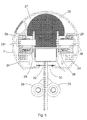
- the elevator car is supported by two columns; the first column contains a rack and a gear drive means (Rack and pinion), the second column contains power supply and support for the elevator car.
- first column contains a rack and a gear drive means (Rack and pinion)
- second column contains power supply and support for the elevator car.
- the elevator has anti-fall equipment installed.
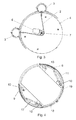
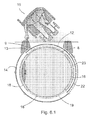
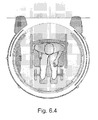
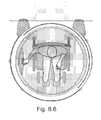
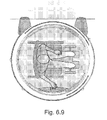
- the elevator 1 comprises an elevator car 4 supported by a basis 2 which is anchored to two support columns 3 with lifting mechanisms 5 comprising racks 24, an electric motor 26, double helical gears 25, 27, rollers for support and guiding 28, 29, and a protection means 30, such as brushes.
- a rotating means 6, such as an electric motor is connected to the elevator car 4 through a supporting anchor point 7 which allows rotation.
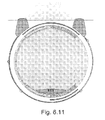
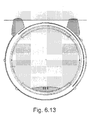
- Cylindrical curved first 8, second 9, third 18, and fourth 19 elevator car doors, slidably mounted in a double skinned wall 16, are opened or closed by first 11 and second 17 linear actuators that act through door locks 10, such as electromagnetic locks.
- the elevator car is inside a cylindrical shaped elevator housing 14, which is stationary constructed or moveable with the elevator car, which elevator housing comprises cylindrical shaped first 12, second 13, third 22, and fourth 23 elevator housing doors.
- the first actuator 11 is connected to the first 8 and fourth 19 elevator car door and the second actuator 17 is connected to the second 9 and third 18 elevator car door.
- the first 12 and second 13 elevator housing door are opened or closed by a connection to, respectively, the first 8 and second 9 elevator car door, in such a way that the first actuator 11 opens or closes both the first elevator car door 8 and the first elevator housing door 12 and, likewise, the second actuator 17 opens or closes both the second elevator car door 9 and second elevator housing door 13.
- the third 22 and fourth 23 elevator housing door are opened by a connected to, respectively, the third 18 and fourth 19 elevator car door.
- first 11 and second 17 actuators secure that the first 8 and second 9 elevator car door are always closed when the third 18 and fourth 19 elevator car door are open and the other way around.
Landscapes
- Engineering & Computer Science (AREA)
- Mechanical Engineering (AREA)
- Structural Engineering (AREA)
- Civil Engineering (AREA)
- Automation & Control Theory (AREA)
- Types And Forms Of Lifts (AREA)
- Elevator Door Apparatuses (AREA)
Priority Applications (2)
| Application Number | Priority Date | Filing Date | Title |
|---|---|---|---|
| EP08105567A EP2177467A1 (de) | 2008-10-14 | 2008-10-14 | Rotierende Hebevorrichtung |
| PCT/EP2009/063421 WO2010043654A2 (en) | 2008-10-14 | 2009-10-14 | Rotating elevator |
Applications Claiming Priority (1)
| Application Number | Priority Date | Filing Date | Title |
|---|---|---|---|
| EP08105567A EP2177467A1 (de) | 2008-10-14 | 2008-10-14 | Rotierende Hebevorrichtung |
Publications (1)
| Publication Number | Publication Date |
|---|---|
| EP2177467A1 true EP2177467A1 (de) | 2010-04-21 |
Family
ID=40386419
Family Applications (1)
| Application Number | Title | Priority Date | Filing Date |
|---|---|---|---|
| EP08105567A Withdrawn EP2177467A1 (de) | 2008-10-14 | 2008-10-14 | Rotierende Hebevorrichtung |
Country Status (2)
| Country | Link |
|---|---|
| EP (1) | EP2177467A1 (de) |
| WO (1) | WO2010043654A2 (de) |
Cited By (2)
| Publication number | Priority date | Publication date | Assignee | Title |
|---|---|---|---|---|
| AU2014259106B2 (en) * | 2013-04-23 | 2018-12-06 | Pedarco International Limited | Vertical and horizontal movement system |
| US20250187877A1 (en) * | 2023-12-12 | 2025-06-12 | Otis Elevator Company | System and method of unlocking and opening multiple panel elevator doors |
Families Citing this family (1)
| Publication number | Priority date | Publication date | Assignee | Title |
|---|---|---|---|---|
| JP6019311B2 (ja) | 2012-04-26 | 2016-11-02 | アーティキュレイテッド ファニキュレイター アーベー | エレベータシステムおよびその使用 |
Citations (5)
| Publication number | Priority date | Publication date | Assignee | Title |
|---|---|---|---|---|
| JPH10139318A (ja) * | 1996-11-11 | 1998-05-26 | Sekisui Chem Co Ltd | 回転式エレベータ |
| WO2000007922A1 (en) | 1998-08-05 | 2000-02-17 | Vertisys International, Inc. | Door operator for elevators having curved doors |
| JP2001206665A (ja) | 2000-01-26 | 2001-07-31 | Shigeta Seisakusho:Kk | カゴ回転式エレベータ |
| EP1508546A1 (de) | 2002-05-29 | 2005-02-23 | Mitsubishi Denki Kabushiki Kaisha | Antriebsvorrichtung für kreisförmige aufzugstür |
| JP2007084238A (ja) * | 2005-09-21 | 2007-04-05 | Toshiba Elevator Co Ltd | エレベータ |
-
2008
- 2008-10-14 EP EP08105567A patent/EP2177467A1/de not_active Withdrawn
-
2009
- 2009-10-14 WO PCT/EP2009/063421 patent/WO2010043654A2/en not_active Ceased
Patent Citations (5)
| Publication number | Priority date | Publication date | Assignee | Title |
|---|---|---|---|---|
| JPH10139318A (ja) * | 1996-11-11 | 1998-05-26 | Sekisui Chem Co Ltd | 回転式エレベータ |
| WO2000007922A1 (en) | 1998-08-05 | 2000-02-17 | Vertisys International, Inc. | Door operator for elevators having curved doors |
| JP2001206665A (ja) | 2000-01-26 | 2001-07-31 | Shigeta Seisakusho:Kk | カゴ回転式エレベータ |
| EP1508546A1 (de) | 2002-05-29 | 2005-02-23 | Mitsubishi Denki Kabushiki Kaisha | Antriebsvorrichtung für kreisförmige aufzugstür |
| JP2007084238A (ja) * | 2005-09-21 | 2007-04-05 | Toshiba Elevator Co Ltd | エレベータ |
Cited By (3)
| Publication number | Priority date | Publication date | Assignee | Title |
|---|---|---|---|---|
| AU2014259106B2 (en) * | 2013-04-23 | 2018-12-06 | Pedarco International Limited | Vertical and horizontal movement system |
| US20250187877A1 (en) * | 2023-12-12 | 2025-06-12 | Otis Elevator Company | System and method of unlocking and opening multiple panel elevator doors |
| US12378095B2 (en) * | 2023-12-12 | 2025-08-05 | Otis Elevator Company | System and method of unlocking and opening multiple panel elevator doors |
Also Published As
| Publication number | Publication date |
|---|---|
| WO2010043654A3 (en) | 2010-07-22 |
| WO2010043654A2 (en) | 2010-04-22 |
Similar Documents
| Publication | Publication Date | Title |
|---|---|---|
| EP2619122B1 (de) | Transportsystem | |
| CN101137813B (zh) | 滑动门结构 | |
| CN101445201B (zh) | 方便出入的垂直升降电梯及其运行控制方法 | |
| EP2390450B1 (de) | Motorbetriebene Türanordnung | |
| WO2014068178A1 (en) | A panel system | |
| EP2177467A1 (de) | Rotierende Hebevorrichtung | |
| KR20090130622A (ko) | 저 피트(pit)형 승강기식 주차장치 | |
| CA2947999C (en) | Locking arrangement and panel system | |
| US4830141A (en) | Deployable rail structure for high-rise building evacuation system | |
| JP2001206665A (ja) | カゴ回転式エレベータ | |
| US20230202803A1 (en) | Elevator access doors | |
| JP2012184610A (ja) | 機械式自転車駐輪設備及び方法 | |
| EP3163008B1 (de) | Automatisches schiebe- und schwenktor | |
| KR20090130618A (ko) | 승강기에 회전판 업다운과 회전기능을 갖는 주차장치 | |
| JP2000226167A (ja) | エレベータ付き建物 | |
| CN217266886U (zh) | 一种隐藏式可滑动配重块的桥梁启闭装置 | |
| CN222159469U (zh) | 一种心形观光电梯 | |
| JP7356538B1 (ja) | 立体駐車装置 | |
| JP3104953U (ja) | 回転ドア装置 | |
| JP4331302B2 (ja) | エレベータ | |
| JP2002155686A (ja) | 建築用シャッター | |
| CN113788388A (zh) | 一种单井道多台电梯可同时运行的多用途电梯系统 | |
| JP3132661U (ja) | 自走式エレベーターの巡航機構 | |
| JP2759247B2 (ja) | 昇降床を設けた駐車装置の乗込場 | |
| JP2004276741A (ja) | プラットホーム用安全柵 |
Legal Events
| Date | Code | Title | Description |
|---|---|---|---|
| PUAI | Public reference made under article 153(3) epc to a published international application that has entered the european phase |
Free format text: ORIGINAL CODE: 0009012 |
|
| AK | Designated contracting states |
Kind code of ref document: A1 Designated state(s): AT BE BG CH CY CZ DE DK EE ES FI FR GB GR HR HU IE IS IT LI LT LU LV MC MT NL NO PL PT RO SE SI SK TR |
|
| AX | Request for extension of the european patent |
Extension state: AL BA MK RS |
|
| AKY | No designation fees paid | ||
| REG | Reference to a national code |
Ref country code: DE Ref legal event code: 8566 |
|
| STAA | Information on the status of an ep patent application or granted ep patent |
Free format text: STATUS: THE APPLICATION IS DEEMED TO BE WITHDRAWN |
|
| 18D | Application deemed to be withdrawn |
Effective date: 20101022 |