EP2180006A2 - Composant étiqueté et procédé de détection l'utilisant - Google Patents
Composant étiqueté et procédé de détection l'utilisant Download PDFInfo
- Publication number
- EP2180006A2 EP2180006A2 EP09010826A EP09010826A EP2180006A2 EP 2180006 A2 EP2180006 A2 EP 2180006A2 EP 09010826 A EP09010826 A EP 09010826A EP 09010826 A EP09010826 A EP 09010826A EP 2180006 A2 EP2180006 A2 EP 2180006A2
- Authority
- EP
- European Patent Office
- Prior art keywords
- group
- bound
- labeled compound
- molecular chain
- compound
- Prior art date
- Legal status (The legal status is an assumption and is not a legal conclusion. Google has not performed a legal analysis and makes no representation as to the accuracy of the status listed.)
- Granted
Links
- 0 C*Cc1c([C@](C)c2c(*)c(*=C)c(*)c(*)c2*)c(C)c(*)c(C)c1* Chemical compound C*Cc1c([C@](C)c2c(*)c(*=C)c(*)c(*)c2*)c(C)c(*)c(C)c1* 0.000 description 2
Images









Classifications
-
- C—CHEMISTRY; METALLURGY
- C07—ORGANIC CHEMISTRY
- C07H—SUGARS; DERIVATIVES THEREOF; NUCLEOSIDES; NUCLEOTIDES; NUCLEIC ACIDS
- C07H21/00—Compounds containing two or more mononucleotide units having separate phosphate or polyphosphate groups linked by saccharide radicals of nucleoside groups, e.g. nucleic acids
Definitions
- This invention relates to a labeled compound used for detection of a sample molecule and more particularly, to a labeled compound designed to permit an aromatic tertiary amine compound to be capable of binding with the sample molecule and also to a detection method using the same.
- the labeled probe obtained by labeling DNA, a DNA base derivative, a DNA oligonucleotide or the like with a fluorescent dye is employed in northern blotting, Southern blotting, in situ hybridization, DNA sequence determination reaction and the like.
- the antibody or antigen labeled with a fluorescent dye is used for immunoassay making use of an antigen-antibody reaction.
- an enzyme immunoassay method to which the avidin (streptoavidin)-biotin linkage is applied and in which avidin modified with a fluorescent dye is used.
- an aromatic dye compound such as FITC (fluorescein isothiocyanate), TRITC (tetramethylrhodamine isothiocyanate), fluorescein, rhodamine, coumarin, cyanine dye or the like is used as the fluorescent labeling reagent.
- Patent Document 1 Japanese Patent Laid-open No. 2005-208026 (at Paragraphs 0004-0011), entitled “Method of detecting biological molecules, and labeling dye and labeling kit used for the same,” (referred to as Patent Document 1) there is the following description.
- the method for detecting a biomolecule in the Patent Document 1 is characterized in that a biomolecule sample and an organic EL (electroluminescence) dye are reacted with each other and the fluorescence of the biomolecule sample labeled with the organic EL dye is measured.
- the organic EL dye used is made of a compound containing a conjugated five-membered ring compound, for which there can be used a compound containing at least one hetero atom, selenium atom or boron atom.
- a condensed polycyclic compound made of a five-membered ring compound and a conjugated six-membered ring compound, wherein the five-membered ring compound used may be an azole derivative or an imidazole derivative.
- the organic EL dye Prior to the reaction with a biomolecule, the organic EL dye may be introduced thereinto with any one of functional groups selected from an isocyanate group, an epoxy group, a halogenated alkyl group, a triazine group, a carbodiimide group and an active-esterified carbonyl group.
- the labeling dye of the Patent Document 1 is one used for detection of a biomolecule based on fluorescent measurement and is characterized in that it consists of an organic EL dye having a reactive group capable of binding to the biomolecule. It is stated that as the reactive group, there can be used any one of functional groups selected from a carboxylic group, an isocyanate group, an epoxy group, a halogenated alkyl group, a triazine group, a carbodiimide group and an active-esterified carbonyl group.
- the organic EL dye is a compound containing a conjugated five-membered ring compound and a compound containing at least one hetero atom, selenium atom or boron atom may be used as this five-membered ring compound.
- a condensed polycyclic compound composed of the five-membered ring compound and a conjugated six-membered ring compound.
- the five-membered ring compound may be an azole derivative or an imidazole derivative.
- organic EL dyes are known aside from those set out in the Patent Document 1.
- organic EL dyes composed of styryl compounds having a diversity of structures for example, in Patent Documents indicated below:
- the sample molecule labeled with a fluorescent dye e.g. a biomolecule
- a fluorescent dye e.g. a biomolecule
- the fluorescence emitted from the fluorescent dye is detected with a photodetector to detect the biomolecule
- the usual practice is to use a filter that is able to cut off light having wavelengths other than a desired wavelength region and pass a fluorescence within a desired wavelength region to a photodetector in order to intercept the incidence of the excitation light and other stray light into the photodetector.
- the excitation light is not effectively cut off or intercepted by means of the filter, the excitation light not cut off with the filter causes stray light ascribed to the refraction and reflection in the light path for measuring fluorescence, thereby causing noises in the fluorescence detection.
- a fluorescent dye that is as weak as possible.
- the intensity of excitation light is increased for irradiation of a fluorescent dye so as to make a high fluorescence intensity and high sensitivity, noises simultaneously increases, resulting in the difficulty in improving the SN ratio. If a fluorescent dye is irradiated under an increased intensity of excitation light, some type of fluorescent dye that is not satisfactory in light resistance may undergo photodegradation.
- the detection sensitivity of a sample molecule labeled with a fluorescent dye depends on the difference between the wavelength (excitation wavelength) of excitation light exciting the fluorescent dye and the wavelength (fluorescence wavelength) of the fluorescence emitted from the fluorescent dye (i.e. the Stokes shift). If the Stokes shift is greater or the difference between the excitation wavelength and the fluorescence wavelength is greater and if a fluorescence to be detected is in a wavelength region that is more distant from that of the excitation light, the rate of elimination of stray light with a filter becomes higher, resulting in more reduction of noises.
- a labeled compound of the type which is so designed that an aromatic tertiary amine compound is enabled to be bound with a sample molecule and the sample molecule can be detected at high sensitivity and at a high SN ratio, and also to a detection method using such a labeled compound as mentioned above.
- a labeled compound designed to enable an aromatic tertiary amine compound represented by the following general formula (1) to be bound with a sample molecule: wherein n is 0 or 1, one of S 1 and S 2 represents a molecular chain-bound group wherein a molecular chain capable of binding with a sample molecule is bound to a divalent spacer having an alkyl chain that may have a divalent group selected from the following Gp1 at a main chain portion thereof, or a reactive group selected from the following Gp3, the other of S 1 and S 2 represents a group selected from the following Gp2, R 1 and R 2 may be the same or different and represent a group selected from a hydro group, an alkyl group and an aryl group that may contain a hetero atom, R 3 represents a group selected from a hydro group, an alkyl group that may have a substituent selected from the following Gp2, an aryl group that may have a substituent group, and a vinyl group that may
- an epoxy group or a glycidyl ether group an epoxy group or a glycidyl ether group), a triazine group, a carbodiimide group, an aziridine group, a halogenated acyl group, a halogenated alkyl group, a halogenated sulfonyl group or a vinyl sulfone group.
- a detection method of a sample molecule using such a labeled compound as set forth above including the steps of binding the above-defined labeled compound to a sample molecule, and detecting a fluorescence emitted from the labeled compound bound to the sample molecule by irradiation of light.
- a labeled compound which has a skeletal structure ensuring a high Stokes shift and a high fluorescence yield and is able to detect a sample molecule at high sensitivity and a high SN ratio.
- This labeled compound is higher in light resistance when compared with existing labeled compounds. When an excitation light intensity is increased for detection of trace molecules by photoexcitation of the labeled compound, there is little data variation as would be caused by photodegradation of the labeled compound.
- a detection method wherein a sample molecule can be detected at high sensitivity and a high SN ratio.
- Ar 1 is a phenyl group
- Ar 2 is any of a phenylene group, a naphthylene group, a phenanthrylene group and an anthrylene group
- R 1 and R 2 are individually a hydro group, by which the afore-indicated general formula (1) can be re-formulated as represented by the following general formula (2): wherein Ar 2 , R 3 , S 1 , S 2 and n, respectively, have the same meanings as defined before.
- the compound of the general formula (2) can be readily prepared according to the Wittig reaction (i.e.
- the compound is preferably so designed that S 2 is the afore-indicated molecular chain-bound group.
- the compound can be readily prepared from commercially available reagents by several steps.
- the compound of the general formula (1) is so re-formulated as to provide a compound of the following general formula (3): wherein S 2 is the afore-indicated molecular chain-bound group and s 1 is a 4-aminostyryl group.
- S 2 is the afore-indicated molecular chain-bound group
- s 1 is a 4-aminostyryl group.
- R 4 and R 5 may be the same or different and represent a group selected from a hydro group, an alkyl group that may has a substituent group and an aryl group that may have a substituent group.
- the compound of the general formula (2) is so re-formulated as to provide a compound of the following general formula (4): wherein Ar 2 , S 1 and n, respectively, have the same meanings as defined before, and S 2 represents the molecular chain-bound group, which contains a phenyl group substituted with R 6 , R 7 , R 8 , R 9 and R 10 provided that the afore-defined spacer is bound through the Gp1 to one of R 6 , R 7 , R 8 , R 9 and R 10 , the molecular chain is bound through the Gp1 to the spacer, and the others of R 6 , R 7 , R 8 , R 9 and R 10 individually represent a hydro group, and R 3 is an aryl group containing a phenyl group substituted with R 11 , R 12 , R 13 , R 14 and R 15 wherein R 11 , R 12 , R 13 , R 14 and R 15 individually represent a group selected from the Gp2 provided that
- the compound of the general formula (3) is re-formulated as to provide a compound represented by the following general formula (5): wherein Ar 2 and n, respectively, have the same meanings as defined before, S 2 represents the molecular chain-bound group, which contains a phenyl group substituted with R 6 , R 7 , R 8 , R 9 and R 10 provided that the spacer is bound through the Gp1 to one of R 6 , R 7 , R 7 , R 9 and R 10 , the molecular chain is bound through the Gp1 to the spacer, and the others of R 6 , R 7 , R 8 , R 9 and R 10 represent a hydro group, R 3 represents an aryl group containing a phenyl group substituted with R 11 , R 12 , R 13 , R 14 and R 15 provided that R 11 , R 12 , R 13 , R 14 and R 15 are individually a group selected from the Gp2 and adjacent ones may join together to form a ring, R 4 represents
- S 1 represents such a molecular chain-bound group as defined before.
- the hydrophobic fluorophore (a component of a molecule which causes a molecule to be fluorescent) can be kept remote from a hydrophilic biomolecule, so that the quenching process and chemical reaction ascribed to the interaction between the dye and the biomolecule can be reduced.
- the compound of the general formula (3) can be so re-formulated or designed as to provide a compound represented by the following general formula (6): wherein Ar 2 and n, respectively, have the same meanings as defined before, S 2 is an aryl group having a phenyl group substituted with R 26 , R 27 , R 28 , R 29 and R 30 , R 3 is an aryl group having a phenyl group substituted with R 31 , R 32 , R 33 , R 34 and R 35 , and R 26 , R 27 , R 28 , R 29 , R 30 , R 31 , R 32 , R 33 , R 34 and R 35 individually represent a group selected from those of Gp2 provided that adjacent groups among the groups may join together to form a ring. In doing so, the bulkiness around the arylamino moiety can be increased and the quenching process ascribed to the interaction with other chemical substances co-existing in use and eventually, there can be provided a compound having a high fluorescence yield
- the alkyl chain should have not smaller than 3 to not larger than 20 carbon atoms. This enables the distance between the hydrophobic fluorophore (fluorescent dye skeleton) and the hydrophilic biomolecule to be kept appropriately. Consequently, the quenching ascribed to the interaction between the dye and the biomolecule and the chemical reaction can be reduced.
- hydrophobicity undesirably increases for use as a labeled compound, with some possibility that interaction with a sample molecule is suppressed.
- the sample molecule should preferably be one derived from a living body.
- the living body-derived molecule can be detected at high sensitivity and a high SN ratio and can be detected by repeated light irradiation or by long-term light irradiation as would be difficult because of the thus far experienced unsatisfactory durability of dyes against light.
- the molecular chain should preferably be made up of an oligonucleotide.
- the sample can be detected at high sensitivity and a high SN ratio as the result of the hybridization which is a double helix formation between the sample oligonucleotide and its complementary oligonucleotide strand bound to the labeled compound in the invention.
- This oligonucleotide should preferably have a length of not smaller than 5 mer to not larger than 40 mer. This permits stable complementary binding between the sample oligonucleotide and its complementary oligonucleotide bound to the compound.
- the oligonucleotide should preferably be so designed as to be used as a probe for detecting a complementary oligonucleotide strand of the living body-derived molecule having a complementary strand sequence thereof. This leads the complementary oligonucleotide strand to be detected at high sensitivity and a high SN ratio.
- the Gp3 is an N-hydroxysuccinimide ester group so as to permit an amino group contained in a sample molecule to be bound.
- the sample molecule containing an amino group can be detected at high sensitivity and a high SN ratio.
- the Gp3 is preferably a maleimide group so as to permit a mercapto group contained in a sample molecule to be bound therewith. This allows the sample molecule containing a mercapto group to be detected at high sensitivity and a high SN ratio.
- R 3 is preferably a phenyl group or a naphthyl group. In doing so, the bulkiness around the arylamino moiety can increase and thus, the quenching process derived from the interaction with other chemical substances co-existing in use can be reduced, with the result that there can be provided a compound having a high fluorescence yield.
- Ar 1 is preferably a phenylene group or a naphthylene group. This permits ready synthesis from commercially available reagents by several steps. The bulkiness around the phenylamino moiety can increase, so that the quenching process ascribed to the interaction with other chemical substances co-existing in use can be reduced, thereby providing a compound having a high fluorescence yield.
- Ar 2 is preferably one of a phenylene group, a naphthylene group, an anthrylene group and a phenanthlene group. In doing so, the resonance structure of a fluorophore (dye skeleton moiety) is stabilized and thus, a high fluorescence yield can be achieved.
- the labeled compound according to an example of the invention is a fluorescently-labeled compound which is able to emit a fluorescence by photoexcitation and is so designed that an aromatic tertiary amine compound (which may be hereinafter called merely aromatic amine in some cases) is bondable with a biomolecule.
- the labeled compound contains either a molecular chain-bound group wherein a molecular chain (e.g. an oligonucleotide) capable of binding with a sample molecule, e.g. a biomolecule, or a reactive group (e.g. an N-hydroxysuccinimide ester or a maleimide group) capable of covalent bonding with a reactive group (e.g. an amino group or a mercapto group) present in a biomolecule.
- This molecular chain-bound group or reactive group is bound directly or indirectly to amino N (nitrogen).
- the above-mentioned molecular chain is made up of an oligonucleotide, by which this oligonucleotide can be used as a probe for detecting a complementary oligonucleotide strand of a biomolecule having a complementary strand sequence, thereby enabling this complementary oligonucleotide strand to be detected at high sensitivity and a high SN ratio.
- a probe may be hereinafter referred to as an aromatic tertiary amine fluorescent probe (or abbreviated as an aromatic amine fluorescent probe or a fluorescent probe), or an oligonucleotide probe.
- the fluorescently-labeled compound according to the embodiment of the invention is made up of an aromatic tertiary amine compound that has a reactive group capable of binding with a sample molecule, e.g. a biomolecule
- this aromatic tertiary amine compound has reactive group A capable of binding with the biomolecule.
- Reactive group B which the biomolecule inherently has or which has been preliminarily imparted to the biomolecule and the reactive group A of the fluorescently-labeled compound form a covalent bond, so that the fluorescently-labeled compound and the biomolecule bind together.
- the detection of a fluorescence emitted by excitation of the fluorescently-labeled compound bound to the biomolecule leads to the detection of the sample biomolecule at high sensitivity and a high SN ratio.
- the labeled compound according to the embodiment of the invention has any of a phenyl group or a naphthyl group bound to amino N, a phenylene group or a naphthylene group bound to amino N, and a phenylene group, a naphthylene group, an anthrylene group or a phenanthrene group bound directly or indirectly to the phenylene or naphthylene group bound to amino N.
- the molecular chain-bound group or the reactive group is bound to any of a phenyl group or a naphthyl group bonded to amino N and a phenylene group, a naphthylene group, an anthrylene group or a phenanthrene group directly or indirectly bound to the phenylene group or naphthylene group bound to amino N.
- the peak wavelength of a fluorescence resulting from the photoexcitation of the labeled compound can be within a desired wavelength region, the Stokes shift can be made great and satisfactory light resistance is ensured.
- the fluorescence emitted by excitation through photoirradiation of the labeled compound bound to the biomolecule is detected, thus enabling the target biomolecule to be detected at high sensitivity and a high SN ratio.
- the sample molecule (or target molecule) to be detected consists of a biomolecule such as a living body-derived molecule, a physiologically active molecule or the like, and such a biomolecule can be detected at high sensitivity and a high SN ratio.
- the biomolecule includes those, for example, of enzymes, proteins, sugars, nucleic acids, oligonucleotides, fats, amino acids and the like.
- the proteins include, for example, antibodies and derivatives thereof, antigens and derivatives thereof, avidins including streptoavidin, serum albumins, hates, hormones and the like.
- the invention is applicable to the detection of chemical substances such as diagnostic medicines, curing medicines and the like, environmental substances causing diseases such as allergies and the like.
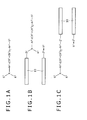
- FIGS. 1A to 1C individually illustrate labeled compounds according to embodiments of the invention.
- FIG. 1A shows the chemical structure of a labeled compound wherein S 1 or S 2 is a molecular chain-bound group in which a molecular chain capable of binding with a biomolecule is bound or is a reactive group capable of covalently bonding with a reactive group of a biomolecule.
- FIG. 1B is the chemical structure of a labeled compound (probe) wherein S 1 is a molecular chain-bound group whose molecular chain 10 capable of binding with a biomolecule is bound to a spacer (linker) Z 1
- FIG. 1C is the chemical structure of a labeled compound (probe) wherein S 2 is a molecular chain-bound group whose molecular chain 10 capable of binding with a biomolecule is bound to a spacer (linker) Z 2 .
- n is 0 or 1
- one of S 1 or S 2 is a molecular chain-bound group which has a molecular chain capable of binding with a biomolecule bound to a divalent spacer containing an alkyl group that may contain a divalent group selected from the following Gp1 at a main chain portion thereof, or which has a reactive group selected from the following Gp3, and the other of S 1 and S 2 is a group selected from the following Gp2.
- R 1 and R 2 may be the same or different and represent a group selected from a hydro group, an alkyl group and aryl group that may contain a hetero atom
- R 3 is a group selected from a hydro group, an alkyl group that may have a substituent group selected from the following Gp2, an aryl group that may has a substituent group, and a vinyl group that may have a substituent group.
- Ar 1 and Ar 2 represent a divalent group and may be the same or different and particularly represent an arylene group or a vinylene group wherein Ar 2 has at least one substituent group selected from an alkyl group, an aryl group, a cyano group (-CN), a tri fluoromethyl group (-CF 3 ) and a halo group, and when n is at 1, Ar 1 and R 1 or/and Ar 2 and R 2 may join together to form a ring.
- R 3 is a phenyl group (-C 6 H 5 ) or a naphthyl group (-C 10 H 7 )
- Ar 1 is a phenylene group (-C 6 H 4 -) or a naphthylene group (-C 10 H 6 -)
- Ar 2 is any of a phenylene group, a naphthylene group, an anthrylene group (-C 14 H 8 -) and a phenanthrene group (-C 14 H 10 -)
- R 1 and R 2 are individually a hydro group (-H).
- Gp1 is an arylene group, a vinylene group or a carbonyl
- Gp2 is a hydro group, an alkyl group or a vinyl group.
- Gp3 is a monovalent group and includes an N-hydroxysuccinimide ester group, a hydroxysulfosuccinimide ester group, an imide ester group, an isothiocyanate group, an isocyanate group, a maleimide group, a carboxyl group, an aldehyde group, a glyoxal group, an imidoester group, an oxirane group (an epoxy group, a glycidyl ether group), a triazine group, a carbodiimide group, an aziridine group, a halogenated acyl group, a halogenated alkyl group, a halogenated sulfonyl group or a vinylsulfone group.
- Gp3 is an N-hydroxysuccinimide ester group or a maleimide group.
- the labeled compound shown in FIG. 1B is a fluorescent probe wherein in the labeled compound of FIG. 1A , -S 1 is replaced by -Z 1 - (a molecular chain 10 capable of binding with a biomolecule).
- Z 1 is a divalent spacer (linker) containing an alkyl chain, which may contain a divalent group selected from the Gp1, at a main chain thereof.
- the labeled compound shown in FIG. 1C is a fluorescent probe wherein -S 2 in the labeled compound of FIG. 1A is replaced by -Z 2 - (a molecular chain 10 capable of binding with a biomolecule).
- Z 2 is a divalent spacer (linker) containing an alkyl chain, which may contain a divalent group selected from the Gp1, at a main chain thereof.
- the fluorescent probes are, respectively, made of an aromatic tertiary amine compound having the molecular chain capable of binding with a biomolecule bonded thereto and the molecular chain 10 capable of binding with the biomolecule is bound to the linker group Z 1 or Z 2 .
- the molecular chain 10 which is bondable with a biomolecule, is made, for example, of a nucleotide having a length of not smaller than 5 mer and larger than 40 mer.
- a biomolecule should inherently have a reactive group B capable of binding with the reactive group A or should be introduced with the reactive group B thereinto.
- the labeled compound has the reactive group A that is necessary for binding with a biomolecule serving as a sample, e.g. a protein or a nucleic acid, for which if the biomolecule is so designed that it inherently has or is preliminarily imparted with the reactive group B capable of reaction with the reactive group A, the biomolecule and the labeled compound form a covalent bond therebetween according to a known technique and bind together.
- Possible combinations of the reactive group A and the reactive group B capable of forming the covalent bond include, for example, amino group/carboxyl group, amino group/halogenated acyl group, amino group/N-hydroxysuccinimide ester group, amino group/aldehyde group, mercapto group/maleimide group, mercapto group/vinyl sulfonate group, hydroxyl group/carboxyl group and the like.
- Preferable combinations of the reactive group B and reactive group A include amino group/N-hydroxysuccinimide ester group and mercapto group/maleimide group.
- FIGS. 2 and 3 show examples of an aromatic amine fluorescent probe (first fluorescent probe) embodying the invention.
- the first fluorescent probes shown at the left side of FIG. 2 correspond to the labeled compound of FIG. 1B .
- n is 1, and S 2 contains a phenyl group to which an oxy group is bound wherein an oligonucleotide (oligo) is indirectly bound to the oxy group
- R 3 is a phenyl group or a naphthyl group
- Ar 1 is a phenylene group
- Ar 2 is a structure of any of a phenylene group, a naphthylene group, an anthrylene group and a phenanthrylene group which is unsubstituted or has a substituent group S 1 wherein S 1 is a methyl group or/and a cyano group.
- R 1 and R 2 are individually a hydro group.
- the first fluorescent probes shown at the right side of FIG. 2 correspond to the labeled compound shown in FIG. 1C .
- n is 1, and S 2 contains a phenyl group to which an oxy group is bound, R 3 is a phenyl group or a naphthyl group, and Ar 1 is a phenylene group.
- Ar 2 is a structure of any of a phenylene group, a naphthylene group, an anthrylene group and a phenanthrylene group, which is unsubstituted or has a cyano group as a substituent group and has a divalent group -CH 2 O- (oxymethylene group) or an oxy group to which an oligonucleotide (depicted as oligo) is indirectly bound.
- R 1 and R 2 are individually a hydro group.
- the first fluorescent probes shown in FIG. 3 correspond to the labeled compound of FIG. 1B .
- n is 1
- S 2 contains a phenyl group to which an oxy group is bound wherein an oligonucleotide (oligo) is bound indirectly to the oxy group.
- R 3 is a phenyl group or a naphthyl group
- Ar 1 is a phenylene group.
- Ar 2 is a structure of any of a phenylene group, a naphthylene group, an anthrylene group and a phenanthrylene group, which is unsubstituted or has a cyano substituent group.
- R 1 and R 2 are individually a hydro group.
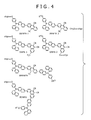
- FIG. 4 shows examples of an aromatic amine fluorescent probe (second fluorescent probe) embodying the invention.
- the two second fluorescent probes indicated at the upper portion of the left side of FIG. 4 correspond to the label compound of FIG. 1B .
- This second fluorescent probe is such that n is 0, S 2 contains a phenyl group to which an oxy group is bound and an oligonucleotide (oligo) is bound indirectly to the oxy group.
- R 3 is a naphtyl group
- Ar 1 is a naphthylene group
- Ar 2 is an anthrylene group or a phenanthrylene group having a substituent group S 1 wherein S 1 is a methyl group or/and a cyano group.
- the two second fluorescent probes indicated at the upper portion of the right side of FIG. 4 correspond to the labeled compound shown in FIG. 1C .
- This second fluorescent probe is such that n is 0, S 2 contains a phenyl group to which an oxy group is bound.
- R 3 is a naphtyl group
- Ar 1 is a naphthylene group
- Ar 2 is an anthrylene group or a phenanthrylene group which has a cyano group as a substituent group and also has a divalent group -CH 2 O- (oxymethylene group whose oxy group is indirectly bound to an oligonucleotide (oligo) or an oxy group.
- the two second fluorescent probes indicated at the lower portion of the left side of FIG. 4 correspond to the labeled compound shown in FIG. 1B .
- This second fluorescent probe is such that n is 0, S 2 contains a phenyl group to which an oxy group is bound wherein an oligonucleotide (oligo) is bound indirectly to the oxy group.
- R 3 is a naphtyl group
- Ar 1 is a naphthylene group
- Ar 2 is an anthrylene group or a phenanthrylene group which has a cyano group as a substituent group and is bound with a naphthyl group of an aromatic tertiary amine compound having a phenyl group and a naphthyl group bound to amino N.
- R 36 to R 51 individually represent a substituent group selected from a hydro group, an alkyl group, an aryl group, a vinyl group that may contain a substituent group, an amino group, a mercapto group (thiole group), a hydroxy group, a carbamoyl group, a sulfino group, a sulfo group, a carboxy group and a halo group.
- Ar 1 in the general formula (1) is a phenylene group
- R 3 is a phenyl group or a naphthyl group
- R 1 and R 2 are individually a hydro group
- Ar 2 is a phenylene group, a naphthylene group, a phenanthrylene group or an anthrylene group.
- Ar 3 in the general formula (2) is a naphthylene group
- R 4 is a naphthyl group
- Ar 4 is a phenanthrylene group or an anthrylene group.
- oligo means an oligonucleotide that is a molecular chain bondable with a biomolecule and this oligo is bound to S 1 or S 2 of the aromatic amine compound at the 5' or 3' terminal thereof.
- the third phenyl group of the triphenylamine moiety may be substituted with a naphthyl group (-C 10 H 7 ), which may be regarded as a triphenylamine derivative and is thus called triphenylamine moiety, like the former cases.
- the fluorescent probes are provided with structures having B, N, A and P explained hereinbelow and bound to the above-mentioned vinylene group.
- N indicates a naphthyl group (-C 10 H 7 ) having a substituent group
- A indicates an anthryl group (-C 14 H 9 ) that may have a substituent group
- P indicates a phenanthryl group (-C 14 H 9 ) having a substituent group.
- the aromatic amine fluorescent probes shown in FIG. 4 are made of tertiary amine compounds, which have such structures that in the triphenylamine moiety ((C 6 H 5 ) 3 N), one hydro group (-H) of the first phenyl group is substituted with an oxy group (-O-), the second phenyl group is substituted with a naphtyl group (-C 10 H 7 ), and the third phenyl group is substituted with a naphthylene group (-C 10 H 6 -) and to which a molecular chain (oligonucleotide, abbreviated as oligo in the figure) capable of binding with a biomolecule is added or (bound).
- oligonucleotide abbreviated as oligo in the figure
- the fluorescent probe having an anthrylene group bound to the naphthylene group of the tertiary amine compound is indicated as ANNPA and the fluorescent probe having a phenanthrylene group bound to the naphthylene group of the tertiary amine compound is indicated as DNPA.
- an alkyl group is bound to the oxy group or oxymethylene group (-CH 2 O-) with which the hydro group of the benzene ring is substituted, or the oxymethylene group (-CH 2 O-) with which the hydro group of the naphthalene ring is substituted, or the oxymethylene group (-CH 2 O-) with which the hydro group of the anthracene ring is substituted, or the oxy group with which the hydro group of the phenanthrene ring is substituted, to which the oligo is bound.
- FIG. 5 is a view showing an example of an aromatic amine fluorescent probe embodying the invention and more specifically, is a view illustrating a 3'-amino-5'-SP-1-oligonucleotide probe.
- the fluorescent probe of FIG. 5 has such a structure as shown in FIG. 1A and corresponds to SP-1 shown in FIG. 2 wherein the molecular chain 10 capable of binding with a biomolecule is bound to an aromatic tertiary amine compound. This probe corresponds to A17 appearing hereinafter in FIG. 10 .
- This molecular chain 10 contains an oligonucleotide made of an n number of nucleotides and this oligonucleotide consists of bonded nucleotides (which may be analogue nucleotides) having a base selected from A, T, G and C.
- N 2, 3, ..., (n-1)
- base N 2, 3, ..., (n-1)
- the oligonucleotide has -(PO 4 -)(CH 2 ) 6 NH- at the 5' terminal and -(PO 4- )(CH 2 ) 12 (PO 4- )(CH 2 )CH(CH 2 OH)(CH 2 ) 4 NH 2 at the 3' terminal.
- the NH- at the 5' terminal side of the oligonucleotide of the molecular chain 10 is bound to the aromatic tertiary amine compound SP-1 and the 3' terminal side is terminated with NH 2 .
- S 1 , Ar 2 , Ar 1 , R 3 and S 2 in the formula of FIG. 1A are, respectively, such that (Ar 2 -S1) is -C 19 H 6 (CN) 2 CH 3 , Ar 1 is -C 6 H 4 -, R 3 is -C 10 H 7 , and S 2 is -C 6 H 4 O(CH 2 ) 4 CO-.
- FIG. 6 shows an aromatic amine fluorescent probe according to an embodiment of the invention, particularly, a 5'-DNPA-oligonucleotide probe.
- the fluorescent probe shown in FIG. 6 has such a structure as shown in FIG. 1D wherein the molecular chain 10 capable of binding with a biomolecule is bound to an aromatic amine compound (DNPA-2, shown in FIG. 4 , provided that -OR 43 is replaced by -H).
- DNPA-2 aromatic amine compound
- This molecular chain 10 contains an oligonucleotide consisting of an n number of nucleotides as with the case of FIG. 5 .
- the oligonucleotide has (PO 4- ) (CH 2 ) 6 NH- at the 5' terminal and -OH at the 3' terminal.
- the NH- at the 5' terminal side of the oligonucleotide of the molecular chain 10 is bound to the DNPA-2 of the aromatic amine compound and the 3' terminal side is terminated with OH.
- S 4 , R 4 , Ar 3 , Ar 4 and S 3 shown in FIG. 1D are such that S 4 is -C 6 H 5 , R 4 is -C 10 H 7 , Ar 3 is -C 10 H 6 -, Ar 4 is -C 14 H 6 (CN) 2 -, and S 3 is -CO(CH 2 ) 4 CO-.
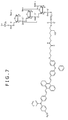
- FIG. 7 shows an example of an aromatic amine fluorescent probe embodying the invention, particularly, a 3'-BSA-2-5'-thio-oligonucleotide probe.
- the aromatic amine compound BSA-2 has a structure wherein -(C 6 H 4 )N(C 6 H 5 ) (C 6 H 4 )- is bound to the anthrylene group (-C 14 H 8 -) at opposite ends thereof.
- This molecular chain 10 contains an oligonucleotide consisting of an n number of oligonucleotides as with the case of FIG. 5 .
- the oligonucleotide has (PO 4- ) (CH 2 ) 12 (PO 4- ) (CH 2 )CH(CH 2 OH) (CH 2 ) 4 NH- at the 3' terminal and -(PO 4- ) (CH 2 ) 6 SH- at the 5' terminal.
- the NH- at the 3' terminal side of the oligonucleotide of the molecular chain 10 is bound to the BSA-2 of the aromatic amine compound and the 5' terminal side is terminated with SH.
- S 1 , Ar 2 , Ar 1 , R 3 and S 2 shown in FIG. 1A are such that S 1 is -CHCHC 6 H 4 N(C 6 H 5 ) (C 6 H 4 OCH 3 ), Ar 2 is -C 14 H 8 -, Ar 1 is -C 6 H 4 -, R 3 is -C 6 H 5 - and S 2 is -C 6 H 4 (CH 2 ) 4 CONH-.
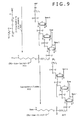
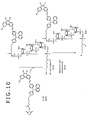
- FIGS. 8 , 9 and 10 are, respectively, a view showing an example of a synthetic scheme of an aromatic amine fluorescent probe embodying the invention and illustrate a synthetic scheme of a 3'-amino-5'-SP-1-oligonucleotide probe.
- FIG. 9 is a view subsequent to the synthetic scheme of FIG. 8 and
- FIG. 10 is a view subsequent to the synthetic scheme of FIG. 9 .
- the following reactions are generally carried out by use of a DNA solid phase synthetic apparatus.
- reaction ⁇ A1+A2 ⁇ A3 ⁇ indicates a 3'-amino-modifier C7 CPG (see FIG. 14A ), and A2 indicates a spacer phosphoramidite (Spacer C12 CE Phosphoramidite, made by Glen Research Corp.).
- reaction ⁇ A3+A4 ⁇ A5 ⁇ is carried out to permit the first nucleotide to be bound to A3.
- reaction ⁇ A5+A6 ⁇ A7 ⁇ is carried out thereby binding the second nucleotide to A5 in the same manner as set out above.
- a similar reaction ⁇ A7+A8 ⁇ A9 ⁇ is repeatedly carried out to permit binding nucleotides up to a desired nth nucleotide on the order of desired base species.
- reaction ⁇ A9+A10 ⁇ A11 ⁇ is carried out.
- A9 is 5'-amino-modifier C6 (see FIG. 14D ).
- reaction ⁇ A11+A12 ⁇ A13 ⁇ is carried out to deprotect the 5'-amino to provide NH 2 at the 5' terminal.
- reaction ⁇ A13+A14 ⁇ A15 ⁇ is carried out to bind A13 with SP-1-OSu (intermediate (activated esterified compound), see FIGS. 14 and 15 ).
- reaction ⁇ A15+A16 ⁇ A17 ⁇ is carried out to deprotect the 3' amino group and separate from CPG, thereby obtaining A17, i.e. a 3'-amino-5'-Sp1-oligoncleotide probe shown in FIG. 5 wherein SP-1 is bound to the 5' terminal and the 3' side is terminated with NH 2 .
- N-hydroxysuccinimide (C 9 H 5 NO 3 ) is represented by HOSu and -C 4 H 4 NO 3 is represented by -OSu herein and whenever they appear hereinafter in the ensuing figures.
- FIGS. 11 and 12 are a view showing an example of a synthetic scheme of an aromatic amine fluorescent probe according to an embodiment of the invention and illustrate a synthetic scheme of 3'-BSA-2-5'-thio-oligonucleotide probe.
- FIG. 12 shows the steps subsequent to the synthetic scheme of FIG. 11 .
- reaction (B1+B2 ⁇ B3) is carried out.
- B1 is same as A9 obtained in FIG. 8
- B2 is 5'-amino-modifier C6 (see FIG. 14C ).
- reaction ⁇ B3+B4 ⁇ B5) is carried out.
- the 3'-amino is deprotected and separated from CPG, thereby obtaining B5 wherein ST (T is a triphenylmethyl group) is bound to the 5' terminal and NH 2 is at the 3' terminal.
- reaction ⁇ B7+B8 ⁇ B9 ⁇ is carried out and the 5'-thiole is subjected to oxidative deprotection to obtain B9, i.e. 3'-BSA-2-5'-thio-oligonucleotide probe shown in FIG. 7 , wherein the 5' terminal group is SH and BSA-2 is bound to the 3' terminal.
- Examples of the solid phase support and reagent useful in FIGS. 8 to 12 are, respectively, those made by Glen Research Corporation and particularly shown in FIGS. 13A to 13D and also in FIGS. 14A to 14D .
- FIGS. 13A to 13D illustrate examples of the solid phase support used in the synthesis of the oligonucleotide probes according to the invention.
- oligonucleotide As shown in FIGS. 13A to 13D , compounds required for the synthesis of an oligonucleotide are available in the form supported on a polystyrene microbead or CPG.
- a nucleotide having an arbitrary one of A, T, G and C can be provided as the first nucleotide of an oligonucleotide.
- a nucleotide having a specified one of A, T, G and C can be provided as the first nucleotide of an oligonucleotide.
- CPG to which Icaa is bound is not shown.
- CPG controlled porous glass indicates a porous glass bead
- Me indicates a methyl group
- protected base means a base protected with a protective group
- DMT indicates a dimethoxytrityl group
- Icaa indicates a long-chain alkylamino group.
- FIGS. 14A to 14D illustrate examples of a solid phase support and a reagent used in the synthesis of oligonucleotide probes.
- FIGS. 14A and 14B show examples of a solid phase support and the supports of FIGS. 14A and 14B are used for amino modification at 3' terminal side.
- FIGS. 14C and 14D show examples of a reagent, and the reagent of FIG. 14C is for thiole modification at the 5' terminal side and FIG. 14D is used for amino modification at the 5' terminal side.
- Fmoc indicates a 9-fluorenylmethoxy group
- DMT indicates a dimethoxytrityl group
- Icaa indicates a long-chain alkylamino group
- CPG indicates a porous glass bead
- Pri indicates an isopropyl group
- ST indicates an S-trityl group
- MMT indicates a monomethoxytrityl group.
- the oligonucleotide probe is synthesized through preparation of an oligonucleotide using a solid phase support, preparation of intermediate compounds such as BSA-2-OSu, SP-1-OSu and the like and binding reaction between the thus prepared two molecules.
- SP-1-OSu is taken as an example of an intermediate compound and the synthetic process and the results thereof are illustrated, and synthesis of 3'-amino-5'-SP-1-oligonuclueotide probe is described.
- FIG. 15 is a view illustrating an intermediate SP-1-OSu used for the synthesis of an oligonucleotide probe (i.e. 3'-amino-5'-SP-1-oligonucleotide probe) in an example of the invention.
- an oligonucleotide probe i.e. 3'-amino-5'-SP-1-oligonucleotide probe
- a 10% sodium hydroxide aqueous solution (4.16 mmols) was added to 20 ml of a THF solution of 0.98 g (1.39 mmols) of compound 9 and stirred for 1 hour at 50°C. Further, 20 ml of THF, 4 ml of ethanol and a 10% sodium hydroxide aqueous solution (11.1 mmols) were added to the solution and stirred for 3 hours at 60°C. Precipitated crystals were separated by filtration and washed with THF. THF and hydrochloric acid were added to the resulting solid for dissolution, followed by removal of an insoluble material by filtration. The filtrate was concentrated under reduced pressure to obtain 0.69 g (yield of 73%) of dark brown crystalline compound 10.
- This compound 10 is a tertiary amine compound SP-1 (more accurately, an aromatic tertiary amine compound prior to binding with the molecular chain oligo (oligonucleotide) in the fluorescent probe SP-1 shown in FIG. 2 ).
- the intermediate SP-1-OSu can be synthesized according to reaction ⁇ (tertiary amine compound SP-1) + HOSu ⁇ SP-1-OSu + H 2 O ⁇ . More accurately, in the fluorescent probe SP-1 shown in FIG. 2 , when the tertiary amine compound prior to binding with the molecular chain oligo (oligonucleotide) is taken as Dy-OH, the intermediate compound Dy-OSu can be synthesized according to reaction ⁇ (Dy-OH) + HOSu ⁇ Dy-OSu + H 2 O ⁇ .
- B6 used in FIG. 12 i.e. BSA-2-OSu
- the aromatic tertiary amine compound prior to binding with the molecular chain oligo is indicated as Dy-OR and R is -H or an alkyl group, e.g. -CH 3
- the intermediate compound Dy-OSu can be synthesized according to reaction ⁇ (Dy-OR)+HOSu ⁇ Dy-OSu+ROH ⁇ .
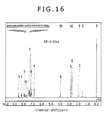
- FIG. 16 is a 1 H-NMR (nuclear magnetic resonance) spectral chart of the intermediate SP-1-OSu prepared in the example of the invention.
- the horizontal axis indicates a chemical shift (ppm) and the vertical axis indicates a nuclear magnetic resonance signal intensity.
- the chemical shift values at the respective signal peaks are indicated above the peaks, and signal integration is indicated in the vicinity of the signal peaks. It will be noted that NMR spectra were measured by use of NMR instrument, Model Number JNM-AL400 FT, made by JEOL Ltd.
- FIG. 17 is an MS spectral chart of intermediate SP-1-OSu prepared in the example of the invention.
- the MS spectra shown in FIG.17 are ones that are measured by use of MALDI-TOF-MS (matrix assisted laser desorption ionization-time of flight-mass spectrometer) and the instrument used for the measurement was Model KRATOS AXIMA-CFR, made by Shimadzu Corporation.
- the absorption and emission characteristics of the synthesized intermediate compound SP-1-OSu are illustrated.
- the absorption spectra and emission spectra were, respectively, measured by use of spectrophotometer Model U-3310 and fluorophotometer Model FL-4500, both made by Hitachi Ltd.
- FIGS. 18A and 18B are absorption and fluorescence spectral charts of intermediate SP-1-OSu under different measuring conditions, respectively, wherein FIG. 18A is a spectral chart in the state of a solution and FIG. 18B is a spectral chart in a dried state.
- the horizontal axis indicates a wavelength(nm) and the vertical axis indicates a relative intensity in case where maximal values of absorption and fluorescence spectra are normalized, taken as 1.0.
- the absorption maximum of a solution of the intermediate SP-1-OSu in a 10% EtOH:5xSSC buffer used as a solvent was at 474 nm with a molar absorption coefficient being at 120,000 M -1 cm -1 .
- the fluorescent maximum was at 650 nm and the fluorescence yield was at 0.0081.
- the Stokes shift obtained from the peaks of the absorption and fluorescence spectra was at 176 nm.
- An epoxy resin SU-8 (SU-8-3035-N-02, made by Kayaku Microchem Co., Ltd.) was diluted to 50% by use of cyclopentanone and spin coated (first at 500 rpm for 15 second and second at 1500 rpm for 30 seconds) onto an ozone-treated glass substrate, followed by drying at 100°C for 2 minutes.
- the epoxy resin was photocured by UV irradiation with a 50 mW/cm 2 xenon lamp for 6 seconds and annealed at 150°C for 10 minutes.
- the epoxy resin-bearing substrate was heated along with 3-aminopropyltriethoxysilane in an oven of 120°C and the amino group was introduced into the substrate.
- SP-1-OSu was dissolved in DMF at a concentration of 10 mM, in which the amino group-bearing substrate was immersed for 2 hours to cause the SP-1-OSu to be supported on the substrate.
- the excitation peak of the SP-1-OSu layer on the substrate in dry state was at 484 nm.
- the emission peak was at 556 nm.
- the Stokes shift calculated from the peaks of the absorption and fluorescence spectra was 72 nm.
- the intermediate SP-1-OSu exhibited large Stokes shifts in either a solution or a dry state.
- a dye enables us to design an excitation filter, which has an optically-transparent wavelength region fitting an absorption peak of the dye but not overlapping with the fluorescent spectrum of it. And thus, it maximizes the excitation efficiency.
- the dye enables us to design an emission filter, which has an optically-transparent wavelength region fitting a fluorescent peak of the dye but not overlapping with the absorption spectrum of it. And thus, it maximizes the fluorescent intensity. More particularly, the optically-transparent wavelength region of the excitation filter and the optically-transparent wavelength region of the fluorescent filter can be significantly separated from each other, and thus, it becomes easy to cut off stray light from emission of sample.
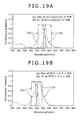
- FIGS. 19A and 19B are individually an absorption and fluorescence spectral chart for comparison wherein FIG. 19A is a spectral chart relating to IC3-OSu (Cy3) measured in a 5xSSC buffer and FIG. 19B is a spectral chart relating to FITC-I measured in a THF solution.
- FIG. 19A is a spectral chart relating to IC3-OSu (Cy3) measured in a 5xSSC buffer
- FIG. 19B is a spectral chart relating to FITC-I measured in a THF solution.
- FIGS. 19A and 19B (a) indicates an excitation spectrum and an excitation filter and (b) indicates a fluorescence spectrum and a fluorescence filter.
- the excitation filter and fluorescence filter have such wavelength transmission regions that are so close to each other.
- the transmittance data of the excitation filter and fluorescence filter are those laid open by Semrock Co., Ltd.
- IC3-OSu (Cy3) is a labeling agent of Dojindo Laboratories and is similar to Cy3, made by GE Healthcare Bioscience KK.
- FITC-I is one wherein an isothiocyanate group is bound to fluorescein.
- IC3-OSu has a Stokes shift of about 10 nm and as shown in FIG. 19B , FITC-I has a Stokes shift of about 25 nm.
- the intermediate SP-1-OSu has a Stokes shift much greater than those of IC3-OSu and FITC-I either in dry state or in solution.
- Cy3 and derivatives of fluorescein readily suffer degradation, for example, by application of a laser or a high-power light source, making reproducible repeated measurements difficult.
- SP-1 does not undergo such degradation and is usable in reproducible, repeated measurements.
- the dye Cy3 having two olefinic (ethylenic) double bonds and represented by the molecular formula C 25 H 26 N 2 Cl i.e. a dye of the above-mentioned formula (a) wherein the N + -C 10 H 14 O 4 N portion is changed to N-CH 3 and the NC 2 H 5 portion is changed to N-CH 3
- the dye SP represented by the molecular formula C 42 H 29 N 3 i.e. a dye of the chemical formula 8 indicated in FIG. 15 having a structure wherein -OH is changed to -CH 3
- the dye Cy3 and dye SP were, respectively, according to the molecular orbital calculation, subjected to structural optimization of the ground state and energy levels of HOMO (highest occupied molecular orbital) and LUMO (lowest occupied molecular orbital) in the ground state were determined. Next, one electron was removed from HOMO of the ground state, then it was put onto LUMO with spin-flipping. After the structural re-optimization in which modified LUMO was regarded as the initial excited state, the energy levels of HOMO and LUMO were calculated. In addition, structural changes in the ground and excited states were checked.
- the energy levels of HOMO in the ground state and LUMO in the excited state calculated according to the molecular orbital calculation were, respectively, at 6.26 eV and 2.56 eV, and the Stokes shift which is a gap between those levels was at 3.7 eV.
- the energy levels of HOMO in the ground state and LUMO in the excited state calculated according to the molecular orbital calculation were, respectively, at 7.22 eV and 2.39 eV, and the Stokes shift was at 4.83 eV.
- the Stokes shift of the dye SP is greater than the Stokes shift of the dye Cy3.
- the structural change of the dye SP associated with excitation, or the structural change in the ground and excited states, is observed: (1) in the difference of a twisted angle around the olefinic (ethylenic) double bond connecting the phenanthrene ring and the phenyl ring as viewed from the upper face of the phenanthrene ring, (2) in the difference of an angle around the amine nitrogen (N) as viewed from the axial direction of the above-mentioned olefinic double bond, (3) in the difference of an angle between the planes, respectively, made by the phenanthrene ring and the phenyl ring (a ring located between the amine nitrogen(N) and the olefinic double bond) and the difference in planarity of the phenanthrene ring, i.e. a difference in positional relation of the plane made by the phenanthrene relative to the plane made by the phenyl ring.
- the labeled compound according to the invention has one or two amine moiety (e.g. an amine moiety where a phenyl ring or a naphthyl ring is bound to amine nitrogen, or an electro-donating site) bound to a cyano-arene (e.g. an phenanthrene ring substituted with cyano group(s), or an electro-withdrawing site) through the olefinic (ethylenic) double bond of the styryl moiety.
- a cyano-arene e.g. an phenanthrene ring substituted with cyano group(s), or an electro-withdrawing site
- red shift occurs both in the absorption and the fluorescence.
- PMT photomultiplier tube
- the labeled compound of the invention is larger in Stokes shift and higher in light resistance than existing labeled compounds. Accordingly, the optically-transparent wavelength region of an excitation filter and an optically-transparent wavelength region of a fluorescence filter can be satisfactorily separated from each other. Therefore, a fluorescence emitted from a sample can be separated from other unnecessary stray light and the like. A sample molecule can be detected at high sensitivity and at a high SN ratio.
- the compound is excellent in light resistance, for which if an intensity of excitation light is increased for detection of trace amounts of molecules, a data variation due to photodegradation of a labeled compound is scarcely experienced. Thus, stable repetitions of measurement are possible and reproducibility of repeated measurements can be improved.
- the intermediate SP-1-OSu is the compound used in the synthetic scheme (see FIGS. 8 to 10 ) of the 3'-amino-5'-SP-1-oligonucleotide probe.
- This intermediate SP-1-O-Su may be used as a compound capable of covalent bonding with a biomolecule, i.e. a fluorescently-labeled compound.
- the intermediate SP-1-OSu is an ester having an active-esterified carbonyl group (an N-hydroxysuccinimide ester group (called an NHS group or an OSu group)), which covalently binds with an amino group of an amino acid or protein. Accordingly, the intermediate SP-1-OSu can be used as a fluorescently-labeled compound.
- SP-1-OSu is bound to a biomolecule having an amino group such as of an amino acid or a protein and is thus labeled, and allows a fluorescence to be generated through photoexcitation.
- a biomolecule can be detected and the intermediate can be used as a fluorescent labeling compound for biomolecules.
- the labeled compound of the invention can be bound to an antigen molecule, a ligand molecule and a sugar protein, respectively, and an antibody molecule, a receptor molecule and a lectin molecule bound to the former molecules, respectively, can be detected.
- the invention provides a labeled compound capable of detecting a living body-derived molecule at high sensitivity at a high SN ratio.
Landscapes
- Chemical & Material Sciences (AREA)
- Organic Chemistry (AREA)
- Life Sciences & Earth Sciences (AREA)
- Biochemistry (AREA)
- Molecular Biology (AREA)
- Health & Medical Sciences (AREA)
- Engineering & Computer Science (AREA)
- Biotechnology (AREA)
- General Health & Medical Sciences (AREA)
- Genetics & Genomics (AREA)
- Investigating Or Analysing Materials By The Use Of Chemical Reactions (AREA)
- Measuring Or Testing Involving Enzymes Or Micro-Organisms (AREA)
- Pyrrole Compounds (AREA)
- Plural Heterocyclic Compounds (AREA)
Applications Claiming Priority (1)
| Application Number | Priority Date | Filing Date | Title |
|---|---|---|---|
| JP2008214868A JP4623166B2 (ja) | 2008-08-25 | 2008-08-25 | 標識化合物及びこれを用いた検出方法 |
Publications (3)
| Publication Number | Publication Date |
|---|---|
| EP2180006A2 true EP2180006A2 (fr) | 2010-04-28 |
| EP2180006A3 EP2180006A3 (fr) | 2010-08-11 |
| EP2180006B1 EP2180006B1 (fr) | 2016-03-23 |
Family
ID=41503767
Family Applications (1)
| Application Number | Title | Priority Date | Filing Date |
|---|---|---|---|
| EP09010826.7A Not-in-force EP2180006B1 (fr) | 2008-08-25 | 2009-08-24 | Composé larqué et procédé de détection l'utilisant |
Country Status (4)
| Country | Link |
|---|---|
| US (1) | US8063200B2 (fr) |
| EP (1) | EP2180006B1 (fr) |
| JP (1) | JP4623166B2 (fr) |
| CN (1) | CN101712637B (fr) |
Families Citing this family (6)
| Publication number | Priority date | Publication date | Assignee | Title |
|---|---|---|---|---|
| JP6052708B2 (ja) * | 2012-10-31 | 2016-12-27 | 住友ベークライト株式会社 | 糖鎖アレイ及びその製造方法 |
| CN105482808B (zh) * | 2015-11-27 | 2017-05-31 | 中南林业科技大学 | 检测食源性水中s2‑的荧光探针的制备方法和应用 |
| CN105331358B (zh) * | 2015-12-07 | 2017-04-05 | 河南省农业科学院 | 一种基于双罗丹明的Sn4+荧光探针分子及其制备方法与应用 |
| CN105505376B (zh) * | 2015-12-07 | 2017-05-31 | 河南省农业科学院 | 一种含双碳硫键结构罗丹明的Hg2+荧光探针及其制备方法与应用 |
| CN112557158B (zh) * | 2021-02-28 | 2021-05-28 | 中国工程物理研究院核物理与化学研究所 | 一种用于空气样品中氙的分离纯化收集装置 |
| CN115161260B (zh) * | 2022-07-01 | 2023-07-14 | 中国人民解放军空军军医大学 | Mal-PEG6-NHS-ester在外泌体示踪修饰中的应用和外泌体修饰的方法 |
Citations (21)
| Publication number | Priority date | Publication date | Assignee | Title |
|---|---|---|---|---|
| JPH041118B2 (fr) | 1982-03-04 | 1992-01-09 | Sumitomo Chemical Co | |
| JP2000230132A (ja) | 1998-12-07 | 2000-08-22 | Sony Corp | ビス(アミノスチリル)ベンゼン化合物及びその合成中間体、並びにこれらの製造方法 |
| JP2001106658A (ja) | 1999-10-06 | 2001-04-17 | Sony Corp | ビス(アミノスチリル)ナフタレン化合物及びその合成中間体、並びにこれらの製造方法 |
| JP2001106657A (ja) | 1999-10-06 | 2001-04-17 | Sony Corp | ビス(アミノスチリル)アントラセン化合物及びその合成中間体、並びにこれらの製造方法 |
| JP2001131128A (ja) | 1999-11-09 | 2001-05-15 | Sony Corp | ビス(アミノスチリル)スチルベン系化合物及びその合成中間体、これらの製造方法、並びに有機電界発光素子 |
| JP2001288377A (ja) | 2000-04-06 | 2001-10-16 | Sony Corp | アミノスチリルアントラセン化合物及びその合成中間体、並びにこれらの製造方法 |
| JP2002226722A (ja) | 2001-01-30 | 2002-08-14 | Sony Corp | アミノスチリルフェナントレン化合物及びその合成中間体並びにこれらの製造方法 |
| JP2004087463A (ja) | 2002-06-26 | 2004-03-18 | Sony Corp | 有機電界発光素子、及びそれを用いた発光装置又は表示装置 |
| JP3555736B2 (ja) | 1998-06-26 | 2004-08-18 | ソニー株式会社 | 有機電界発光素子 |
| JP2005005226A (ja) | 2003-06-16 | 2005-01-06 | Sony Corp | 有機電界発光素子 |
| JP2005035927A (ja) | 2003-07-14 | 2005-02-10 | Sony Corp | ビス(アミノスチリル)フェナントレン化合物及びその合成中間体、並びにこれらの製造方法 |
| JP2005208026A (ja) | 2003-12-24 | 2005-08-04 | Shinichiro Isobe | 生体分子の検出方法及びそれに用いる標識色素並びに標識キット |
| JP2006128437A (ja) | 2004-10-29 | 2006-05-18 | Sony Corp | 有機電界発光素子および表示装置 |
| JP2006124333A (ja) | 2004-10-29 | 2006-05-18 | Sony Corp | スチリルアミン誘導体、およびスチリルアミン誘導体の合成方法 |
| JP3820752B2 (ja) | 1998-06-26 | 2006-09-13 | ソニー株式会社 | 有機電界発光素子 |
| JP2006273737A (ja) | 2005-03-29 | 2006-10-12 | Sony Corp | アミノスチリル化合物、有機電界発光素子、および表示装置 |
| JP3852517B2 (ja) | 1998-05-18 | 2006-11-29 | ソニー株式会社 | 有機電界発光素子 |
| JP3852520B2 (ja) | 1998-06-26 | 2006-11-29 | ソニー株式会社 | 有機電界発光素子 |
| JP3852552B2 (ja) | 1999-07-30 | 2006-11-29 | ソニー株式会社 | 有機電界発光素子 |
| JP3852518B2 (ja) | 1998-05-18 | 2006-11-29 | ソニー株式会社 | 有機電界発光素子 |
| JP2008214868A (ja) | 2007-02-28 | 2008-09-18 | Nippon Sheet Glass Co Ltd | ガラスパネル支持構造 |
Family Cites Families (5)
| Publication number | Priority date | Publication date | Assignee | Title |
|---|---|---|---|---|
| JP2891262B2 (ja) | 1990-01-10 | 1999-05-17 | 松本油脂製薬株式会社 | 化粧料 |
| JP4436928B2 (ja) * | 2001-08-27 | 2010-03-24 | ザ トラスティーズ オブ ザ ユニバーシティ オブ ペンシルバニア | スチルベン誘導体、およびアミロイド斑の結合および画像化のためのその使用 |
| JP4001118B2 (ja) | 2003-03-24 | 2007-10-31 | ソニー株式会社 | 有機電界発光素子及びアミノモノスチリルナフタレン化合物 |
| US20050009109A1 (en) * | 2003-07-08 | 2005-01-13 | Stanford University | Fluorophore compounds and their use in biological systems |
| FR2908408B1 (fr) | 2006-11-10 | 2009-01-30 | Commissariat Energie Atomique | Nouveaux derives de la triphenylamine utilies comme fluorophores en biologie, notamment pour la microscopie biphotonique |
-
2008
- 2008-08-25 JP JP2008214868A patent/JP4623166B2/ja not_active Expired - Fee Related
-
2009
- 2009-08-21 US US12/545,654 patent/US8063200B2/en active Active
- 2009-08-24 EP EP09010826.7A patent/EP2180006B1/fr not_active Not-in-force
- 2009-08-24 CN CN200910167556.9A patent/CN101712637B/zh not_active Expired - Fee Related
Patent Citations (21)
| Publication number | Priority date | Publication date | Assignee | Title |
|---|---|---|---|---|
| JPH041118B2 (fr) | 1982-03-04 | 1992-01-09 | Sumitomo Chemical Co | |
| JP3852517B2 (ja) | 1998-05-18 | 2006-11-29 | ソニー株式会社 | 有機電界発光素子 |
| JP3852518B2 (ja) | 1998-05-18 | 2006-11-29 | ソニー株式会社 | 有機電界発光素子 |
| JP3820752B2 (ja) | 1998-06-26 | 2006-09-13 | ソニー株式会社 | 有機電界発光素子 |
| JP3555736B2 (ja) | 1998-06-26 | 2004-08-18 | ソニー株式会社 | 有機電界発光素子 |
| JP3852520B2 (ja) | 1998-06-26 | 2006-11-29 | ソニー株式会社 | 有機電界発光素子 |
| JP2000230132A (ja) | 1998-12-07 | 2000-08-22 | Sony Corp | ビス(アミノスチリル)ベンゼン化合物及びその合成中間体、並びにこれらの製造方法 |
| JP3852552B2 (ja) | 1999-07-30 | 2006-11-29 | ソニー株式会社 | 有機電界発光素子 |
| JP2001106658A (ja) | 1999-10-06 | 2001-04-17 | Sony Corp | ビス(アミノスチリル)ナフタレン化合物及びその合成中間体、並びにこれらの製造方法 |
| JP2001106657A (ja) | 1999-10-06 | 2001-04-17 | Sony Corp | ビス(アミノスチリル)アントラセン化合物及びその合成中間体、並びにこれらの製造方法 |
| JP2001131128A (ja) | 1999-11-09 | 2001-05-15 | Sony Corp | ビス(アミノスチリル)スチルベン系化合物及びその合成中間体、これらの製造方法、並びに有機電界発光素子 |
| JP2001288377A (ja) | 2000-04-06 | 2001-10-16 | Sony Corp | アミノスチリルアントラセン化合物及びその合成中間体、並びにこれらの製造方法 |
| JP2002226722A (ja) | 2001-01-30 | 2002-08-14 | Sony Corp | アミノスチリルフェナントレン化合物及びその合成中間体並びにこれらの製造方法 |
| JP2004087463A (ja) | 2002-06-26 | 2004-03-18 | Sony Corp | 有機電界発光素子、及びそれを用いた発光装置又は表示装置 |
| JP2005005226A (ja) | 2003-06-16 | 2005-01-06 | Sony Corp | 有機電界発光素子 |
| JP2005035927A (ja) | 2003-07-14 | 2005-02-10 | Sony Corp | ビス(アミノスチリル)フェナントレン化合物及びその合成中間体、並びにこれらの製造方法 |
| JP2005208026A (ja) | 2003-12-24 | 2005-08-04 | Shinichiro Isobe | 生体分子の検出方法及びそれに用いる標識色素並びに標識キット |
| JP2006124333A (ja) | 2004-10-29 | 2006-05-18 | Sony Corp | スチリルアミン誘導体、およびスチリルアミン誘導体の合成方法 |
| JP2006128437A (ja) | 2004-10-29 | 2006-05-18 | Sony Corp | 有機電界発光素子および表示装置 |
| JP2006273737A (ja) | 2005-03-29 | 2006-10-12 | Sony Corp | アミノスチリル化合物、有機電界発光素子、および表示装置 |
| JP2008214868A (ja) | 2007-02-28 | 2008-09-18 | Nippon Sheet Glass Co Ltd | ガラスパネル支持構造 |
Also Published As
| Publication number | Publication date |
|---|---|
| CN101712637A (zh) | 2010-05-26 |
| EP2180006A3 (fr) | 2010-08-11 |
| US8063200B2 (en) | 2011-11-22 |
| CN101712637B (zh) | 2014-03-12 |
| JP4623166B2 (ja) | 2011-02-02 |
| EP2180006B1 (fr) | 2016-03-23 |
| US20100075321A1 (en) | 2010-03-25 |
| JP2010048735A (ja) | 2010-03-04 |
Similar Documents
| Publication | Publication Date | Title |
|---|---|---|
| EP1078023B1 (fr) | Composes luminescents | |
| US6342326B1 (en) | Synthesis and use of acyl fluorides of cyanine dyes | |
| EP2180006B1 (fr) | Composé larqué et procédé de détection l'utilisant | |
| US10676489B2 (en) | Highly fluorescent pyrrole-BF2 chromophores | |
| US7250517B2 (en) | Luminescent compounds | |
| WO1998049176A1 (fr) | Reactifs de marquage fluorescents glycoconjugues | |
| JP2883824B2 (ja) | ボロン酸基を有する発蛍光性化合物 | |
| JP2009008673A (ja) | シアニン色素フォスフォアミダイト | |
| JP4193055B2 (ja) | 発光性高分子化合物、及びそのバイオアッセイにおける利用 | |
| US6538129B1 (en) | Luminescent compounds | |
| EP1401962B1 (fr) | Procede permettant d'ameliorer l'hydrophilicite de composes marqueurs fluorescents | |
| US7351829B2 (en) | Compounds on the basis of 2- and 4-chromenylidene-merocyanines respectively, and their use | |
| EP2157088A1 (fr) | Colorants d'indocyanine fluorescents et leurs dérivés destinés à l'analyse de macromolécules biologiques | |
| US6384237B1 (en) | Pyrylium compound, process for making the same, nucleic acid stain, and labeled nucleic acid | |
| JP5310702B2 (ja) | 標識化合物及びこれを用いた検出方法 | |
| US6335450B1 (en) | Efficient cyclic-bridged cyanine dyes | |
| EP1163372A1 (fr) | Colorants a base de cyanine rigidifies dans un plan et chimiquement reactifs, et derives de ces derniers | |
| US20030235846A1 (en) | Luminescent compounds | |
| US20140200333A1 (en) | Dendron reporter molecules | |
| ES2357989T3 (es) | Compuestos luminiscentes. | |
| EP1849837A2 (fr) | Composés luminescents |
Legal Events
| Date | Code | Title | Description |
|---|---|---|---|
| PUAI | Public reference made under article 153(3) epc to a published international application that has entered the european phase |
Free format text: ORIGINAL CODE: 0009012 |
|
| 17P | Request for examination filed |
Effective date: 20090824 |
|
| AK | Designated contracting states |
Kind code of ref document: A2 Designated state(s): AT BE BG CH CY CZ DE DK EE ES FI FR GB GR HR HU IE IS IT LI LT LU LV MC MK MT NL NO PL PT RO SE SI SK SM TR |
|
| AX | Request for extension of the european patent |
Extension state: AL BA RS |
|
| PUAL | Search report despatched |
Free format text: ORIGINAL CODE: 0009013 |
|
| RIC1 | Information provided on ipc code assigned before grant |
Ipc: C07H 21/00 20060101AFI20100118BHEP Ipc: G01N 33/533 20060101ALI20100629BHEP |
|
| AK | Designated contracting states |
Kind code of ref document: A3 Designated state(s): AT BE BG CH CY CZ DE DK EE ES FI FR GB GR HR HU IE IS IT LI LT LU LV MC MK MT NL NO PL PT RO SE SI SK SM TR |
|
| AX | Request for extension of the european patent |
Extension state: AL BA RS |
|
| 17Q | First examination report despatched |
Effective date: 20130723 |
|
| GRAP | Despatch of communication of intention to grant a patent |
Free format text: ORIGINAL CODE: EPIDOSNIGR1 |
|
| INTG | Intention to grant announced |
Effective date: 20151008 |
|
| GRAS | Grant fee paid |
Free format text: ORIGINAL CODE: EPIDOSNIGR3 |
|
| GRAA | (expected) grant |
Free format text: ORIGINAL CODE: 0009210 |
|
| AK | Designated contracting states |
Kind code of ref document: B1 Designated state(s): AT BE BG CH CY CZ DE DK EE ES FI FR GB GR HR HU IE IS IT LI LT LU LV MC MK MT NL NO PL PT RO SE SI SK SM TR |
|
| REG | Reference to a national code |
Ref country code: GB Ref legal event code: FG4D |
|
| REG | Reference to a national code |
Ref country code: CH Ref legal event code: EP |
|
| REG | Reference to a national code |
Ref country code: AT Ref legal event code: REF Ref document number: 783034 Country of ref document: AT Kind code of ref document: T Effective date: 20160415 |
|
| REG | Reference to a national code |
Ref country code: IE Ref legal event code: FG4D |
|
| REG | Reference to a national code |
Ref country code: DE Ref legal event code: R096 Ref document number: 602009036919 Country of ref document: DE |
|
| REG | Reference to a national code |
Ref country code: LT Ref legal event code: MG4D |
|
| REG | Reference to a national code |
Ref country code: NL Ref legal event code: MP Effective date: 20160323 |
|
| PG25 | Lapsed in a contracting state [announced via postgrant information from national office to epo] |
Ref country code: GR Free format text: LAPSE BECAUSE OF FAILURE TO SUBMIT A TRANSLATION OF THE DESCRIPTION OR TO PAY THE FEE WITHIN THE PRESCRIBED TIME-LIMIT Effective date: 20160624 Ref country code: FI Free format text: LAPSE BECAUSE OF FAILURE TO SUBMIT A TRANSLATION OF THE DESCRIPTION OR TO PAY THE FEE WITHIN THE PRESCRIBED TIME-LIMIT Effective date: 20160323 Ref country code: NO Free format text: LAPSE BECAUSE OF FAILURE TO SUBMIT A TRANSLATION OF THE DESCRIPTION OR TO PAY THE FEE WITHIN THE PRESCRIBED TIME-LIMIT Effective date: 20160623 |
|
| REG | Reference to a national code |
Ref country code: AT Ref legal event code: MK05 Ref document number: 783034 Country of ref document: AT Kind code of ref document: T Effective date: 20160323 |
|
| REG | Reference to a national code |
Ref country code: FR Ref legal event code: PLFP Year of fee payment: 8 |
|
| PG25 | Lapsed in a contracting state [announced via postgrant information from national office to epo] |
Ref country code: NL Free format text: LAPSE BECAUSE OF FAILURE TO SUBMIT A TRANSLATION OF THE DESCRIPTION OR TO PAY THE FEE WITHIN THE PRESCRIBED TIME-LIMIT Effective date: 20160323 Ref country code: LV Free format text: LAPSE BECAUSE OF FAILURE TO SUBMIT A TRANSLATION OF THE DESCRIPTION OR TO PAY THE FEE WITHIN THE PRESCRIBED TIME-LIMIT Effective date: 20160323 Ref country code: SE Free format text: LAPSE BECAUSE OF FAILURE TO SUBMIT A TRANSLATION OF THE DESCRIPTION OR TO PAY THE FEE WITHIN THE PRESCRIBED TIME-LIMIT Effective date: 20160323 Ref country code: LT Free format text: LAPSE BECAUSE OF FAILURE TO SUBMIT A TRANSLATION OF THE DESCRIPTION OR TO PAY THE FEE WITHIN THE PRESCRIBED TIME-LIMIT Effective date: 20160323 |
|
| PG25 | Lapsed in a contracting state [announced via postgrant information from national office to epo] |
Ref country code: PL Free format text: LAPSE BECAUSE OF FAILURE TO SUBMIT A TRANSLATION OF THE DESCRIPTION OR TO PAY THE FEE WITHIN THE PRESCRIBED TIME-LIMIT Effective date: 20160323 Ref country code: IS Free format text: LAPSE BECAUSE OF FAILURE TO SUBMIT A TRANSLATION OF THE DESCRIPTION OR TO PAY THE FEE WITHIN THE PRESCRIBED TIME-LIMIT Effective date: 20160723 Ref country code: EE Free format text: LAPSE BECAUSE OF FAILURE TO SUBMIT A TRANSLATION OF THE DESCRIPTION OR TO PAY THE FEE WITHIN THE PRESCRIBED TIME-LIMIT Effective date: 20160323 |
|
| PG25 | Lapsed in a contracting state [announced via postgrant information from national office to epo] |
Ref country code: CZ Free format text: LAPSE BECAUSE OF FAILURE TO SUBMIT A TRANSLATION OF THE DESCRIPTION OR TO PAY THE FEE WITHIN THE PRESCRIBED TIME-LIMIT Effective date: 20160323 Ref country code: ES Free format text: LAPSE BECAUSE OF FAILURE TO SUBMIT A TRANSLATION OF THE DESCRIPTION OR TO PAY THE FEE WITHIN THE PRESCRIBED TIME-LIMIT Effective date: 20160323 Ref country code: AT Free format text: LAPSE BECAUSE OF FAILURE TO SUBMIT A TRANSLATION OF THE DESCRIPTION OR TO PAY THE FEE WITHIN THE PRESCRIBED TIME-LIMIT Effective date: 20160323 Ref country code: SM Free format text: LAPSE BECAUSE OF FAILURE TO SUBMIT A TRANSLATION OF THE DESCRIPTION OR TO PAY THE FEE WITHIN THE PRESCRIBED TIME-LIMIT Effective date: 20160323 Ref country code: SK Free format text: LAPSE BECAUSE OF FAILURE TO SUBMIT A TRANSLATION OF THE DESCRIPTION OR TO PAY THE FEE WITHIN THE PRESCRIBED TIME-LIMIT Effective date: 20160323 Ref country code: PT Free format text: LAPSE BECAUSE OF FAILURE TO SUBMIT A TRANSLATION OF THE DESCRIPTION OR TO PAY THE FEE WITHIN THE PRESCRIBED TIME-LIMIT Effective date: 20160725 Ref country code: RO Free format text: LAPSE BECAUSE OF FAILURE TO SUBMIT A TRANSLATION OF THE DESCRIPTION OR TO PAY THE FEE WITHIN THE PRESCRIBED TIME-LIMIT Effective date: 20160323 |
|
| PG25 | Lapsed in a contracting state [announced via postgrant information from national office to epo] |
Ref country code: IT Free format text: LAPSE BECAUSE OF FAILURE TO SUBMIT A TRANSLATION OF THE DESCRIPTION OR TO PAY THE FEE WITHIN THE PRESCRIBED TIME-LIMIT Effective date: 20160323 Ref country code: BE Free format text: LAPSE BECAUSE OF FAILURE TO SUBMIT A TRANSLATION OF THE DESCRIPTION OR TO PAY THE FEE WITHIN THE PRESCRIBED TIME-LIMIT Effective date: 20160323 |
|
| REG | Reference to a national code |
Ref country code: DE Ref legal event code: R097 Ref document number: 602009036919 Country of ref document: DE |
|
| PLBE | No opposition filed within time limit |
Free format text: ORIGINAL CODE: 0009261 |
|
| STAA | Information on the status of an ep patent application or granted ep patent |
Free format text: STATUS: NO OPPOSITION FILED WITHIN TIME LIMIT |
|
| PG25 | Lapsed in a contracting state [announced via postgrant information from national office to epo] |
Ref country code: DK Free format text: LAPSE BECAUSE OF FAILURE TO SUBMIT A TRANSLATION OF THE DESCRIPTION OR TO PAY THE FEE WITHIN THE PRESCRIBED TIME-LIMIT Effective date: 20160323 |
|
| PG25 | Lapsed in a contracting state [announced via postgrant information from national office to epo] |
Ref country code: BG Free format text: LAPSE BECAUSE OF FAILURE TO SUBMIT A TRANSLATION OF THE DESCRIPTION OR TO PAY THE FEE WITHIN THE PRESCRIBED TIME-LIMIT Effective date: 20160623 |
|
| 26N | No opposition filed |
Effective date: 20170102 |
|
| PG25 | Lapsed in a contracting state [announced via postgrant information from national office to epo] |
Ref country code: MC Free format text: LAPSE BECAUSE OF FAILURE TO SUBMIT A TRANSLATION OF THE DESCRIPTION OR TO PAY THE FEE WITHIN THE PRESCRIBED TIME-LIMIT Effective date: 20160323 |
|
| REG | Reference to a national code |
Ref country code: CH Ref legal event code: PL |
|
| PG25 | Lapsed in a contracting state [announced via postgrant information from national office to epo] |
Ref country code: LI Free format text: LAPSE BECAUSE OF NON-PAYMENT OF DUE FEES Effective date: 20160831 Ref country code: CH Free format text: LAPSE BECAUSE OF NON-PAYMENT OF DUE FEES Effective date: 20160831 |
|
| PG25 | Lapsed in a contracting state [announced via postgrant information from national office to epo] |
Ref country code: SI Free format text: LAPSE BECAUSE OF FAILURE TO SUBMIT A TRANSLATION OF THE DESCRIPTION OR TO PAY THE FEE WITHIN THE PRESCRIBED TIME-LIMIT Effective date: 20160323 |
|
| REG | Reference to a national code |
Ref country code: IE Ref legal event code: MM4A |
|
| PG25 | Lapsed in a contracting state [announced via postgrant information from national office to epo] |
Ref country code: IE Free format text: LAPSE BECAUSE OF NON-PAYMENT OF DUE FEES Effective date: 20160824 |
|
| REG | Reference to a national code |
Ref country code: FR Ref legal event code: PLFP Year of fee payment: 9 |
|
| PG25 | Lapsed in a contracting state [announced via postgrant information from national office to epo] |
Ref country code: LU Free format text: LAPSE BECAUSE OF NON-PAYMENT OF DUE FEES Effective date: 20160824 |
|
| PG25 | Lapsed in a contracting state [announced via postgrant information from national office to epo] |
Ref country code: HU Free format text: LAPSE BECAUSE OF FAILURE TO SUBMIT A TRANSLATION OF THE DESCRIPTION OR TO PAY THE FEE WITHIN THE PRESCRIBED TIME-LIMIT; INVALID AB INITIO Effective date: 20090824 Ref country code: CY Free format text: LAPSE BECAUSE OF FAILURE TO SUBMIT A TRANSLATION OF THE DESCRIPTION OR TO PAY THE FEE WITHIN THE PRESCRIBED TIME-LIMIT Effective date: 20160323 |
|
| PG25 | Lapsed in a contracting state [announced via postgrant information from national office to epo] |
Ref country code: HR Free format text: LAPSE BECAUSE OF FAILURE TO SUBMIT A TRANSLATION OF THE DESCRIPTION OR TO PAY THE FEE WITHIN THE PRESCRIBED TIME-LIMIT Effective date: 20160323 Ref country code: MT Free format text: LAPSE BECAUSE OF NON-PAYMENT OF DUE FEES Effective date: 20160831 Ref country code: MK Free format text: LAPSE BECAUSE OF FAILURE TO SUBMIT A TRANSLATION OF THE DESCRIPTION OR TO PAY THE FEE WITHIN THE PRESCRIBED TIME-LIMIT Effective date: 20160323 Ref country code: TR Free format text: LAPSE BECAUSE OF FAILURE TO SUBMIT A TRANSLATION OF THE DESCRIPTION OR TO PAY THE FEE WITHIN THE PRESCRIBED TIME-LIMIT Effective date: 20160323 |
|
| REG | Reference to a national code |
Ref country code: FR Ref legal event code: PLFP Year of fee payment: 10 |
|
| PGFP | Annual fee paid to national office [announced via postgrant information from national office to epo] |
Ref country code: DE Payment date: 20200819 Year of fee payment: 12 Ref country code: FR Payment date: 20200821 Year of fee payment: 12 Ref country code: GB Payment date: 20200826 Year of fee payment: 12 |
|
| REG | Reference to a national code |
Ref country code: DE Ref legal event code: R119 Ref document number: 602009036919 Country of ref document: DE |
|
| GBPC | Gb: european patent ceased through non-payment of renewal fee |
Effective date: 20210824 |
|
| PG25 | Lapsed in a contracting state [announced via postgrant information from national office to epo] |
Ref country code: GB Free format text: LAPSE BECAUSE OF NON-PAYMENT OF DUE FEES Effective date: 20210824 Ref country code: FR Free format text: LAPSE BECAUSE OF NON-PAYMENT OF DUE FEES Effective date: 20210831 Ref country code: DE Free format text: LAPSE BECAUSE OF NON-PAYMENT OF DUE FEES Effective date: 20220301 |