EP2180279A2 - Kontrolle des Gefrierzustands einer Fracht - Google Patents
Kontrolle des Gefrierzustands einer Fracht Download PDFInfo
- Publication number
- EP2180279A2 EP2180279A2 EP09252464A EP09252464A EP2180279A2 EP 2180279 A2 EP2180279 A2 EP 2180279A2 EP 09252464 A EP09252464 A EP 09252464A EP 09252464 A EP09252464 A EP 09252464A EP 2180279 A2 EP2180279 A2 EP 2180279A2
- Authority
- EP
- European Patent Office
- Prior art keywords
- compressor
- sleep mode
- evaporator fan
- temperature
- return air
- Prior art date
- Legal status (The legal status is an assumption and is not a legal conclusion. Google has not performed a legal analysis and makes no representation as to the accuracy of the status listed.)
- Withdrawn
Links
Images

Classifications
-
- F—MECHANICAL ENGINEERING; LIGHTING; HEATING; WEAPONS; BLASTING
- F25—REFRIGERATION OR COOLING; COMBINED HEATING AND REFRIGERATION SYSTEMS; HEAT PUMP SYSTEMS; MANUFACTURE OR STORAGE OF ICE; LIQUEFACTION SOLIDIFICATION OF GASES
- F25D—REFRIGERATORS; COLD ROOMS; ICE-BOXES; COOLING OR FREEZING APPARATUS NOT OTHERWISE PROVIDED FOR
- F25D29/00—Arrangement or mounting of control or safety devices
- F25D29/003—Arrangement or mounting of control or safety devices for movable devices
-
- F—MECHANICAL ENGINEERING; LIGHTING; HEATING; WEAPONS; BLASTING
- F25—REFRIGERATION OR COOLING; COMBINED HEATING AND REFRIGERATION SYSTEMS; HEAT PUMP SYSTEMS; MANUFACTURE OR STORAGE OF ICE; LIQUEFACTION SOLIDIFICATION OF GASES
- F25D—REFRIGERATORS; COLD ROOMS; ICE-BOXES; COOLING OR FREEZING APPARATUS NOT OTHERWISE PROVIDED FOR
- F25D17/00—Arrangements for circulating cooling fluids; Arrangements for circulating gas, e.g. air, within refrigerated spaces
- F25D17/005—Arrangements for circulating cooling fluids; Arrangements for circulating gas, e.g. air, within refrigerated spaces in cold rooms
-
- F—MECHANICAL ENGINEERING; LIGHTING; HEATING; WEAPONS; BLASTING
- F25—REFRIGERATION OR COOLING; COMBINED HEATING AND REFRIGERATION SYSTEMS; HEAT PUMP SYSTEMS; MANUFACTURE OR STORAGE OF ICE; LIQUEFACTION SOLIDIFICATION OF GASES
- F25B—REFRIGERATION MACHINES, PLANTS OR SYSTEMS; COMBINED HEATING AND REFRIGERATION SYSTEMS; HEAT PUMP SYSTEMS
- F25B2400/00—Component parts or details not otherwise provided for in this subclass
- F25B2400/01—Heaters
-
- F—MECHANICAL ENGINEERING; LIGHTING; HEATING; WEAPONS; BLASTING
- F25—REFRIGERATION OR COOLING; COMBINED HEATING AND REFRIGERATION SYSTEMS; HEAT PUMP SYSTEMS; MANUFACTURE OR STORAGE OF ICE; LIQUEFACTION SOLIDIFICATION OF GASES
- F25B—REFRIGERATION MACHINES, PLANTS OR SYSTEMS; COMBINED HEATING AND REFRIGERATION SYSTEMS; HEAT PUMP SYSTEMS
- F25B2600/00—Control issues
- F25B2600/01—Timing
-
- F—MECHANICAL ENGINEERING; LIGHTING; HEATING; WEAPONS; BLASTING
- F25—REFRIGERATION OR COOLING; COMBINED HEATING AND REFRIGERATION SYSTEMS; HEAT PUMP SYSTEMS; MANUFACTURE OR STORAGE OF ICE; LIQUEFACTION SOLIDIFICATION OF GASES
- F25B—REFRIGERATION MACHINES, PLANTS OR SYSTEMS; COMBINED HEATING AND REFRIGERATION SYSTEMS; HEAT PUMP SYSTEMS
- F25B2600/00—Control issues
- F25B2600/02—Compressor control
- F25B2600/025—Compressor control by controlling speed
- F25B2600/0251—Compressor control by controlling speed with on-off operation
-
- F—MECHANICAL ENGINEERING; LIGHTING; HEATING; WEAPONS; BLASTING
- F25—REFRIGERATION OR COOLING; COMBINED HEATING AND REFRIGERATION SYSTEMS; HEAT PUMP SYSTEMS; MANUFACTURE OR STORAGE OF ICE; LIQUEFACTION SOLIDIFICATION OF GASES
- F25B—REFRIGERATION MACHINES, PLANTS OR SYSTEMS; COMBINED HEATING AND REFRIGERATION SYSTEMS; HEAT PUMP SYSTEMS
- F25B2600/00—Control issues
- F25B2600/11—Fan speed control
- F25B2600/112—Fan speed control of evaporator fans
-
- Y—GENERAL TAGGING OF NEW TECHNOLOGICAL DEVELOPMENTS; GENERAL TAGGING OF CROSS-SECTIONAL TECHNOLOGIES SPANNING OVER SEVERAL SECTIONS OF THE IPC; TECHNICAL SUBJECTS COVERED BY FORMER USPC CROSS-REFERENCE ART COLLECTIONS [XRACs] AND DIGESTS
- Y02—TECHNOLOGIES OR APPLICATIONS FOR MITIGATION OR ADAPTATION AGAINST CLIMATE CHANGE
- Y02B—CLIMATE CHANGE MITIGATION TECHNOLOGIES RELATED TO BUILDINGS, e.g. HOUSING, HOUSE APPLIANCES OR RELATED END-USER APPLICATIONS
- Y02B30/00—Energy efficient heating, ventilation or air conditioning [HVAC]
- Y02B30/70—Efficient control or regulation technologies, e.g. for control of refrigerant flow, motor or heating
Definitions
- This invention relates to climate control in cargo containers and to devices for controlling the climate in cargo containers.
- the invention relates to refrigeration systems for use in cargo containers and methods for operating such systems.
- the present invention relates to transporting and storing temperature sensitive cargo over long periods of time using a controlled climate in the space where the cargo is loaded.
- climate control includes controlling the temperature of the cargo within a certain acceptable range. Controlling the temperature includes bringing the temperature of the cargo into the acceptable range (by refrigerating or heating) and maintaining the temperature within that range. climate control may also include controlling other parameters such as humidity and composition of the atmosphere.
- Refrigeration is the process of removing heat from an enclosed space, or from a substance, and moving it to a place where it is unobjectionable.
- the primary purpose of refrigeration is lowering the temperature of the enclosed space or substance and then maintaining that lower temperature.
- the vapor-compression cycle is used in most household refrigerators as well as in many large commercial and industrial refrigeration systems.
- a refrigerated container or reefer is a shipping container used in intermodal freight transport, including rail, ship and truck, where the cargo is refrigerated (chilled or frozen) for the transportation of temperature sensitive cargo.
- a reefer will usually have an integral refrigeration unit.
- the reliability of the refrigeration unit is of paramount importance.
- the temperature of temperature sensitive cargo should be kept within predefined limits. Some cargo must be maintained frozen, and the temperature of any part of the frozen cargo must be kept below a predefined freezing temperature which depends on the cargo, e.g. below -18 degrees C or lower, while other cargo, in particular commodities such as fresh meat, fresh fruit and vegetables, should be kept chilled to stay fresh, but not frozen. For chilled fruit and vegetables there is a lowest acceptable temperature below which the commodity will begin degrading and loose its freshness. Such temperature is dependent upon the type of fruit.
- the invention provides a method for operating a refrigeration system for a container for refrigerating frozen cargo.
- the method includes providing a compressor, a condenser, and an evaporator connected in series, and providing an evaporator fan.
- the method also includes alternating operation of the compressor and the evaporator fan, in combination, between an active mode where the compressor compresses a refrigerant and directs the refrigerant through the condenser and the evaporator, and where the evaporator fan rotates to supply refrigerated supply air from the evaporator to the cargo within the container, and a sleep mode in which the compressor and the evaporator fan are deactivated, and operating the compressor and the evaporator fan in the sleep mode for a duration that is based on a measured duration of a prior sleep mode.
- the system includes a compressor, a condenser, and an evaporator connected in series.
- the system also includes an evaporator fan and a controller.
- the controller is programmed to alternate operation of the compressor and the evaporator fan, in combination, between an active mode where the compressor compresses a refrigerant and directs the refrigerant through the condenser and the evaporator, and where the evaporator fan rotates to supply refrigerated supply air from the evaporator to the cargo within the container, and a sleep mode in which the compressor and the evaporator fan are deactivated.
- the controller is further programmed to operate the compressor and the evaporator fan in the sleep mode for a duration that is based on a measured duration of a prior sleep mode.
- Figure 1 shows schematically a refrigeration system according to the invention.
- Figure 2 shows a refrigerated container with the refrigeration system in Figure 1 installed.
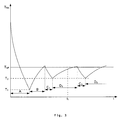
- Figure 3 is a diagram illustrating the return air temperature when using the invention.
- FIG. 1 is a simplified diagram of the basic components of a typical one-stage vapor-compression refrigeration system 100 according to the invention.
- a circulating refrigerant enters the compressor 110 as a vapor.
- the vapor is compressed and exits the compressor superheated.
- the superheated vapor travels through the condenser 120 which first cools and removes the superheat and then condenses the vapor into a liquid by removing additional heat at constant pressure and temperature.
- the liquid refrigerant goes through an expansion valve 130 (also called a throttle valve) where its pressure abruptly decreases, causing flash evaporation and auto-refrigeration of, typically, less than half of the liquid.
- an expansion valve 130 also called a throttle valve
- the cold liquid-vapor mixture then travels through the evaporator 140 coil or tubes and is completely vaporized by cooling the warm return air RA returning from the refrigerated space being blown by an evaporator fan 150 across the evaporator coil or tubes.
- the cool supply air SA is blown into the refrigerated space.
- the resulting refrigerant vapor returns to the compressor inlet to complete the thermodynamic cycle.
- a condenser fan 160 removes condensation heat from the condenser 120.
- a controller 170 controls the operation of the refrigeration system and its individual components.
- water vapor will condensate on the evaporator 140 and form a layer of ice which will degrade the efficiency of the evaporator.
- the ice is removed in defrosting cycles where the compressor 110 and the evaporator fan 150 are inactivated, and a heater 180 is activated which will heat the evaporator 140.
- a temperature sensor 190 senses the temperature of the evaporator 140 and when it has been determined, based on the sensed evaporator temperature, that the ice is melted, the compressor 110 is again activated. When the temperature of the evaporator is sufficiently low the evaporator fan 150 is activated and the refrigeration system operates again.
- the refrigeration system 100 can have one or more evaporator fans 150.
- the power of the evaporator fan motors can be controlled in two or more steps or continuously by the controller 170. For simplicity, only high speed operation and low speed operation are described, but the person having ordinary skill in the art will understand that the described method applies in general to motors with controllable speed.
- Figure 2 shows schematically a portion of a refrigerated container 200 loaded with cargo 210 to be refrigerated, in this case the cargo is to be frozen and kept frozen.
- the container 200 has a refrigeration system 100 installed in one end, and the container has doors (not shown) in the opposite end for loading and unloading the cargo 210.
- the evaporator fan or fans 150 of the refrigeration system 100 blow refrigerated supply air SA into the container where it circulates around the cargo 210 and returns as return air RA to the refrigeration system 100.
- the energy required for circulating the air in the container is ultimately dissipated as heat in the container due to friction.
- the evaporator fan 150 When the evaporator fan 150 is operated in a low speed mode or in a high speed mode it delivers from a few hundred watts or up to a few kilowatts (kW) which is dissipated as heat in the container.
- This energy adds to the energy that enters the container from the ambient and the heat that is generated by the cargo itself, all of which must be removed by the refrigeration system. Assuming efficiencies of 100 % of both the evaporator fan and the refrigeration system, for each kW consumed by the evaporator fan another kW will be consumed by the refrigeration system.
- FIG 3 shows the temperature T RA of the return air as a function of time t during the operation of the refrigeration system of the invention.
- the return air RA is drawn from the container, and the temperature T RA of the return air therefore represents the temperature of the cargo.
- a first phase A the cargo is refrigerated to a temperature T1 below the set-point temperature T SP .
- the compressor is operated at or near its full capacity to bring down the temperature of the cargo, and the evaporator fan is operated at low speed, the temperature T RA of the return air is monitored.
- Phase A is terminated when the temperature T RA of the return air reaches a first low temperature T 1 .
- phase B the compressor is inactivated and the evaporator fan is still operated at low speed to circulate air in the container.
- the temperature T RA of the return air will increase due to heat leakage from the ambient into the container and to the friction energy dissipated due to the air flow through the container.
- the temperature T RA of the return air is constantly monitored, and when the temperature of the return air reaches a predetermined upper limit temperature value related to the set-point temperature T SP , phase B is terminated. The duration of phase B is observed.
- phase C 1 the compressor and the evaporator fan are operated at the same conditions as in phase A, i.e. the compressor is operated at or near its full capacity, the evaporator fan is operated at low speed and the temperature T RA of the return air is monitored.
- Phase C 1 is terminated when the temperature T RA of the return air reaches a second low temperature T 2 which is higher than the first low temperature T 1 .
- phase D 1 the compressor is made inoperative and the evaporator fan is turned off. These two components thus consume no power, and the refrigeration system is in "sleep mode". When the evaporator fan is not operating there will be no air flow and thus no friction energy dissipated in the container, and the temperature curve in phase D 1 can therefore be expected to be less steep than in phase B. However, the starting temperature T 2 of phase D 1 is higher than the starting temperature T 1 of phase B. The target end temperature for phase D 1 is the same as for phase B. With the refrigeration system in "sleep mode" it will be necessary to determine a time for resuming refrigeration since there is no continuous monitoring of the return air temperature. In accordance with the invention this time is estimated based on the observed duration of a previous phase without refrigeration. As a first estimate, or seed estimate, the observed duration of phase B is taken.
- phase D 1 after the estimated duration of phase D 1 , which here is chosen equal to the observed duration of phase B, i.e. at the time t 1 , the evaporator fan is turned on for a period allowing measurement of the temperature T RA of the return air, thus ending the sleep mode for phase D 1 .
- the system enter a new sleep period (i.e., a period after the sleep mode for phase D 1 , in which the compressor and evaporator fan are again deactivated), and an estimated duration of the new sleep period is calculated by extrapolation of observed temperatures and durations.
- a new sleep period i.e., a period after the sleep mode for phase D 1 , in which the compressor and evaporator fan are again deactivated
- phase D 1 is terminated and phase C 2 is initiated where the system enters refrigeration mode with the compressor activated and evaporator fan operating at low speed.
- phase C 2 is similar to phase C 1 and the system is operated under the same conditions as in phase C 1 and phase C 2 is terminated when the temperature T RA of the return air reaches the second low temperature T 2 .
- the duration of the next sleep mode phase, phase D 2 is estimated based on the observed duration of the preceding sleep mode phase, phase D 1 , and the observed temperature at which it was terminated. In particular, if phase D1 was terminated at a temperature higher than the target end temperature, then the duration of phase D 2 , is estimated correspondingly shorter, and if phase D1 was terminated at a temperature lower than the target end temperature, then the duration of phase D 2 , is estimated correspondingly longer.
Landscapes
- Engineering & Computer Science (AREA)
- Chemical & Material Sciences (AREA)
- Combustion & Propulsion (AREA)
- Physics & Mathematics (AREA)
- Mechanical Engineering (AREA)
- Thermal Sciences (AREA)
- General Engineering & Computer Science (AREA)
- Devices That Are Associated With Refrigeration Equipment (AREA)
Applications Claiming Priority (1)
| Application Number | Priority Date | Filing Date | Title |
|---|---|---|---|
| US10808208P | 2008-10-24 | 2008-10-24 |
Publications (2)
| Publication Number | Publication Date |
|---|---|
| EP2180279A2 true EP2180279A2 (de) | 2010-04-28 |
| EP2180279A3 EP2180279A3 (de) | 2013-02-27 |
Family
ID=41630883
Family Applications (1)
| Application Number | Title | Priority Date | Filing Date |
|---|---|---|---|
| EP09252464A Withdrawn EP2180279A3 (de) | 2008-10-24 | 2009-10-22 | Kontrolle des Gefrierzustands einer Fracht |
Country Status (3)
| Country | Link |
|---|---|
| US (1) | US20100106302A1 (de) |
| EP (1) | EP2180279A3 (de) |
| JP (1) | JP5483995B2 (de) |
Cited By (3)
| Publication number | Priority date | Publication date | Assignee | Title |
|---|---|---|---|---|
| EP2535672A3 (de) * | 2011-06-16 | 2013-05-22 | A.P. Møller - Mærsk A/S | Steuerung für die innere Luftzirkulation in einem Kühlfrachtcontainer |
| US20140311171A1 (en) * | 2008-10-24 | 2014-10-23 | Thermo King Corporation | Controlling chilled state of a cargo |
| EP2831513A4 (de) * | 2012-03-29 | 2016-01-13 | Nest Labs Inc | Gehäusekühlung mit früher verdichterabschaltung und verlängertem gebläsebetrieb |
Families Citing this family (7)
| Publication number | Priority date | Publication date | Assignee | Title |
|---|---|---|---|---|
| US8776796B2 (en) * | 2011-12-09 | 2014-07-15 | Colabs, Inc. | Apparatus and method for improved assisted ventilation |
| JP5984784B2 (ja) * | 2013-11-19 | 2016-09-06 | 三菱電機株式会社 | 温冷水空調システム |
| US10254027B2 (en) * | 2014-05-02 | 2019-04-09 | Thermo King Corporation | Method and system for controlling operation of evaporator fans in a transport refrigeration system |
| US10247460B2 (en) * | 2014-05-15 | 2019-04-02 | Lennox Industries Inc. | Accommodating CSSH for tandem compressor transitions |
| US10703174B2 (en) | 2015-11-30 | 2020-07-07 | Thermo King Corporation | Device and method for controlling operation of transport refrigeration unit |
| EP3483528B1 (de) * | 2016-07-06 | 2021-05-05 | Mitsubishi Electric Corporation | Kältekreislaufsystem |
| WO2018178405A1 (es) * | 2017-03-28 | 2018-10-04 | Universitat De Lleida | Procedimiento de control adaptativo para sistemas de refrigeración |
Family Cites Families (49)
| Publication number | Priority date | Publication date | Assignee | Title |
|---|---|---|---|---|
| US4292813A (en) * | 1979-03-08 | 1981-10-06 | Whirlpool Corporation | Adaptive temperature control system |
| US4663725A (en) * | 1985-02-15 | 1987-05-05 | Thermo King Corporation | Microprocessor based control system and method providing better performance and better operation of a shipping container refrigeration system |
| US4725001A (en) * | 1986-10-17 | 1988-02-16 | Arnold D. Berkeley | Electronic thermostat employing adaptive cycling |
| US4790143A (en) * | 1987-10-23 | 1988-12-13 | Thermo King Corporation | Method and apparatus for monitoring a transport refrigeration system and its conditioned load |
| US4787214A (en) * | 1987-11-23 | 1988-11-29 | Thermo King Corporation | Transport refrigeration system |
| US4899549A (en) * | 1989-01-31 | 1990-02-13 | Thermo King Corporation | Transport refrigeration system with improved temperature and humidity control |
| US4850198A (en) * | 1989-01-17 | 1989-07-25 | American Standard Inc. | Time based cooling below set point temperature |
| US4949550A (en) * | 1989-10-04 | 1990-08-21 | Thermo King Corporation | Method and apparatus for monitoring a transport refrigeration system and its conditioned load |
| US4977752A (en) * | 1989-12-28 | 1990-12-18 | Thermo King Corporation | Transport refrigeration including methods and apparatus for optmizing same |
| US5295364A (en) * | 1991-01-15 | 1994-03-22 | Thermo King Corporation | Refrigeration pull-down technique |
| US5161383A (en) * | 1991-07-11 | 1992-11-10 | Thermo King Corporation | Method of operating a transport refrigeration unit |
| US5140825A (en) * | 1991-07-11 | 1992-08-25 | Thermo King Corporation | Method of operating a transport refrigeration unit |
| US5140826A (en) * | 1991-07-11 | 1992-08-25 | Thermo King Corporation | Method of operating a transport refrigeration unit |
| US5123253A (en) * | 1991-07-11 | 1992-06-23 | Thermo King Corporation | Method of operating a transport refrigeration unit |
| US5222368A (en) * | 1991-07-11 | 1993-06-29 | Thermo King Corporation | Method of operating a transport refigeration unit |
| US5123251A (en) * | 1991-07-11 | 1992-06-23 | Thermo King Corporation | Method of operating a transport refrigeration unit |
| US5201185A (en) * | 1991-07-11 | 1993-04-13 | Thermo King Corporation | Method of operating a transport refrigeration unit |
| US5123252A (en) * | 1991-07-11 | 1992-06-23 | Thermo King Corporation | Method of operating a transport refrigeration unit |
| US5201186A (en) * | 1991-07-11 | 1993-04-13 | Thermo King Corporation | Method of operating a transport refrigeration unit |
| US5197670A (en) * | 1991-10-24 | 1993-03-30 | Thermo King Corporation | Method of operating a transport refrigeration unit |
| US5161384A (en) * | 1992-02-10 | 1992-11-10 | Thermo King Corporation | Method of operating a transport refrigeration system |
| US5186015A (en) * | 1992-02-27 | 1993-02-16 | Thermo King Corporation | Transport refrigeration unit and method of operating same |
| US5168713A (en) * | 1992-03-12 | 1992-12-08 | Thermo King Corporation | Method of operating a compartmentalized transport refrigeration system |
| US5181389A (en) * | 1992-04-26 | 1993-01-26 | Thermo King Corporation | Methods and apparatus for monitoring the operation of a transport refrigeration system |
| US5228301A (en) * | 1992-07-27 | 1993-07-20 | Thermo King Corporation | Methods and apparatus for operating a refrigeration system |
| JPH06109352A (ja) * | 1992-09-25 | 1994-04-19 | Mitsubishi Heavy Ind Ltd | コンテナ用冷凍ユニット |
| US5249429A (en) * | 1993-02-08 | 1993-10-05 | Thermo King Corporation | Methods of operating a refrigeration system |
| US5303560A (en) * | 1993-04-15 | 1994-04-19 | Thermo King Corporation | Method and apparatus for monitoring and controlling the operation of a refrigeration unit |
| JPH0812030B2 (ja) * | 1993-06-08 | 1996-02-07 | 中野冷機株式会社 | ショーケースの運転方法 |
| US5456088A (en) * | 1993-11-12 | 1995-10-10 | Thermo King Corporation | Refrigeration unit and method of operating same |
| JPH07270027A (ja) * | 1994-03-29 | 1995-10-20 | Toshiba Corp | 冷蔵庫の冷凍制御装置 |
| US5557938A (en) * | 1995-02-27 | 1996-09-24 | Thermo King Corporation | Transport refrigeration unit and method of operating same |
| US5579648A (en) * | 1995-04-19 | 1996-12-03 | Thermo King Corporation | Method of monitoring a transport refrigeration unit and an associated conditioned load |
| US5572879A (en) * | 1995-05-25 | 1996-11-12 | Thermo King Corporation | Methods of operating a refrigeration unit in predetermined high and low ambient temperatures |
| US5596878A (en) * | 1995-06-26 | 1997-01-28 | Thermo King Corporation | Methods and apparatus for operating a refrigeration unit |
| US5634347A (en) * | 1996-04-10 | 1997-06-03 | Thermo King Corporation | Method of controlling a transport refrigeration system without refrigerant modulation |
| DE19736818A1 (de) * | 1997-08-23 | 1999-02-25 | Behr Gmbh & Co | Verfahren und Vorrichtung zur verdampfervereisungsgeschützten Klimaanlagensteuerung |
| US6095427A (en) * | 1999-04-22 | 2000-08-01 | Thermo King Corporation | Temperature control system and method for efficiently obtaining and maintaining the temperature in a conditioned space |
| JP4229555B2 (ja) * | 1999-12-17 | 2009-02-25 | 福島工業株式会社 | 温度調節機能付き保管庫 |
| US6862499B1 (en) * | 2000-07-14 | 2005-03-01 | Thermo King Corporation | Environment-controlled transport unit |
| US6679074B2 (en) * | 2001-07-31 | 2004-01-20 | Thermo King Corporation | Automatic switching refrigeration system |
| US6708510B2 (en) * | 2001-08-10 | 2004-03-23 | Thermo King Corporation | Advanced refrigeration system |
| JP2003083658A (ja) * | 2001-09-10 | 2003-03-19 | Sanyo Electric Co Ltd | 冷却貯蔵庫 |
| US6829523B2 (en) * | 2002-02-26 | 2004-12-07 | Thermo King Corporation | Method and apparatus for controlling a transport temperature control unit having selectively programmable temperature ranges |
| US6895764B2 (en) * | 2003-05-02 | 2005-05-24 | Thermo King Corporation | Environmentally friendly method and apparatus for cooling a temperature controlled space |
| US6910341B2 (en) * | 2003-09-26 | 2005-06-28 | Thermo King Corporation | Temperature control apparatus and method of operating the same |
| KR100569891B1 (ko) * | 2003-12-18 | 2006-04-10 | 엘지전자 주식회사 | 냉장고의 송풍팬 운전 제어방법 |
| US7080521B2 (en) * | 2004-08-31 | 2006-07-25 | Thermo King Corporation | Mobile refrigeration system and control |
| US8136363B2 (en) * | 2005-04-15 | 2012-03-20 | Thermo King Corporation | Temperature control system and method of operating the same |
-
2009
- 2009-10-22 US US12/604,022 patent/US20100106302A1/en not_active Abandoned
- 2009-10-22 EP EP09252464A patent/EP2180279A3/de not_active Withdrawn
- 2009-10-23 JP JP2009244384A patent/JP5483995B2/ja active Active
Non-Patent Citations (1)
| Title |
|---|
| None |
Cited By (7)
| Publication number | Priority date | Publication date | Assignee | Title |
|---|---|---|---|---|
| US20140311171A1 (en) * | 2008-10-24 | 2014-10-23 | Thermo King Corporation | Controlling chilled state of a cargo |
| US9857114B2 (en) * | 2008-10-24 | 2018-01-02 | Thermo King Corporation | Controlling chilled state of a cargo |
| US10619902B2 (en) | 2008-10-24 | 2020-04-14 | Thermo King Corporation | Controlling chilled state of a cargo |
| EP2535672A3 (de) * | 2011-06-16 | 2013-05-22 | A.P. Møller - Mærsk A/S | Steuerung für die innere Luftzirkulation in einem Kühlfrachtcontainer |
| EP2831513A4 (de) * | 2012-03-29 | 2016-01-13 | Nest Labs Inc | Gehäusekühlung mit früher verdichterabschaltung und verlängertem gebläsebetrieb |
| US9534805B2 (en) | 2012-03-29 | 2017-01-03 | Google Inc. | Enclosure cooling using early compressor turn-off with extended fan operation |
| EP3734181A1 (de) * | 2012-03-29 | 2020-11-04 | Google LLC | Gehäusekühlung unter verwendung der frühen verdichterabschaltung mit verlängertem gebläsebetrieb |
Also Published As
| Publication number | Publication date |
|---|---|
| US20100106302A1 (en) | 2010-04-29 |
| JP2010101618A (ja) | 2010-05-06 |
| EP2180279A3 (de) | 2013-02-27 |
| JP5483995B2 (ja) | 2014-05-07 |
Similar Documents
| Publication | Publication Date | Title |
|---|---|---|
| US10619902B2 (en) | Controlling chilled state of a cargo | |
| US20100106302A1 (en) | Controlling frozen state of a cargo | |
| EP2180278B1 (de) | Steuerung des pull-down-betriebs in kühlsystemen | |
| EP2588819B1 (de) | Abtauvorgang bei bedarf nach kühlmittelsättigung bei einem verdunster | |
| US8640470B2 (en) | Control method of refrigerator | |
| US9557084B2 (en) | Apparatus for controlling relative humidity in a container | |
| US9140489B2 (en) | Power savings apparatus for transport refrigeration system, transport refrigeration unit, and methods for same | |
| JPH029269B2 (de) | ||
| NL2009581C2 (en) | A method for operating a refrigeration system for a cargo container. | |
| KR20110086345A (ko) | 2개의 증발기를 구비하는 냉장고의 운전 제어방법 | |
| KR20150111408A (ko) | 제상 기능 동작시 온도를 유지하는 냉장고의 제어 방법 | |
| JPH04194564A (ja) | 冷凍冷蔵庫 | |
| WO2018067095A2 (en) | Refrigeration appliance with zero degree compartment having improved temperature control | |
| JPH0444179B2 (de) |
Legal Events
| Date | Code | Title | Description |
|---|---|---|---|
| PUAI | Public reference made under article 153(3) epc to a published international application that has entered the european phase |
Free format text: ORIGINAL CODE: 0009012 |
|
| AK | Designated contracting states |
Kind code of ref document: A2 Designated state(s): AT BE BG CH CY CZ DE DK EE ES FI FR GB GR HR HU IE IS IT LI LT LU LV MC MK MT NL NO PL PT RO SE SI SK SM TR |
|
| AX | Request for extension of the european patent |
Extension state: AL BA RS |
|
| RAP1 | Party data changed (applicant data changed or rights of an application transferred) |
Owner name: JOHNSON CONTROLS TECHNOLOGY COMPANY |
|
| RAP1 | Party data changed (applicant data changed or rights of an application transferred) |
Owner name: JOHNSON CONTROLS TECHNOLOGY COMPANY Owner name: THERMO KING CORPORATION |
|
| PUAL | Search report despatched |
Free format text: ORIGINAL CODE: 0009013 |
|
| AK | Designated contracting states |
Kind code of ref document: A3 Designated state(s): AT BE BG CH CY CZ DE DK EE ES FI FR GB GR HR HU IE IS IT LI LT LU LV MC MK MT NL NO PL PT RO SE SI SK SM TR |
|
| AX | Request for extension of the european patent |
Extension state: AL BA RS |
|
| RIC1 | Information provided on ipc code assigned before grant |
Ipc: F25D 29/00 20060101AFI20130122BHEP |
|
| STAA | Information on the status of an ep patent application or granted ep patent |
Free format text: STATUS: THE APPLICATION IS DEEMED TO BE WITHDRAWN |
|
| 18D | Application deemed to be withdrawn |
Effective date: 20130828 |