EP2189339A1 - Rétracteur de ceinture de sécurité et son appareil de ceinture de sécurité - Google Patents
Rétracteur de ceinture de sécurité et son appareil de ceinture de sécurité Download PDFInfo
- Publication number
- EP2189339A1 EP2189339A1 EP09172218A EP09172218A EP2189339A1 EP 2189339 A1 EP2189339 A1 EP 2189339A1 EP 09172218 A EP09172218 A EP 09172218A EP 09172218 A EP09172218 A EP 09172218A EP 2189339 A1 EP2189339 A1 EP 2189339A1
- Authority
- EP
- European Patent Office
- Prior art keywords
- seat belt
- retracting
- speed
- spool
- lock
- Prior art date
- Legal status (The legal status is an assumption and is not a legal conclusion. Google has not performed a legal analysis and makes no representation as to the accuracy of the status listed.)
- Granted
Links
- 239000000463 material Substances 0.000 claims description 8
- 230000000694 effects Effects 0.000 abstract description 10
- 238000010586 diagram Methods 0.000 description 15
- 238000004804 winding Methods 0.000 description 7
- 230000002349 favourable effect Effects 0.000 description 6
- 230000003245 working effect Effects 0.000 description 6
- 238000000034 method Methods 0.000 description 4
- 230000002093 peripheral effect Effects 0.000 description 4
- 230000005489 elastic deformation Effects 0.000 description 3
- 239000000470 constituent Substances 0.000 description 2
- 239000013013 elastic material Substances 0.000 description 2
- 239000002783 friction material Substances 0.000 description 2
- 238000005452 bending Methods 0.000 description 1
- 230000002265 prevention Effects 0.000 description 1
Images





Classifications
-
- B—PERFORMING OPERATIONS; TRANSPORTING
- B60—VEHICLES IN GENERAL
- B60R—VEHICLES, VEHICLE FITTINGS, OR VEHICLE PARTS, NOT OTHERWISE PROVIDED FOR
- B60R22/00—Safety belts or body harnesses in vehicles
- B60R22/34—Belt retractors, e.g. reels
-
- B—PERFORMING OPERATIONS; TRANSPORTING
- B60—VEHICLES IN GENERAL
- B60R—VEHICLES, VEHICLE FITTINGS, OR VEHICLE PARTS, NOT OTHERWISE PROVIDED FOR
- B60R22/00—Safety belts or body harnesses in vehicles
- B60R22/34—Belt retractors, e.g. reels
- B60R2022/3419—Belt retractors, e.g. reels with end lock preventing means
Definitions
- the present invention relates to a technical field of a seat belt retractor used for a seat belt device equipped in a vehicle such as an automobile and using a gear mechanism for transmitting rotation of a spool for retracting a seat belt to other members or for transmitting rotation of other members to the spool and a seat belt device.
- a seat belt device attached to a vehicle seat of an automobile or the like has been provided with a seat belt retractor in general.
- the seat belt retractor locks rotation in a belt withdrawing direction of a spool for retracting a seat belt by means of an operation of a lock gear of a lock mechanism in emergency such as a case in which a large deceleration acts on a vehicle at a collision or the like.
- the spool is urged by spring means in a seat belt retracting direction all the time.
- end lock might occur that rotation of the spool in the seat belt withdrawing direction is prevented by the operation of the inertia body and the seat belt cannot be withdrawn any more.
- the inertia body of the lock mechanism rotates to the lock position during rapid withdrawal faster than a normal withdrawing speed of the seat belt and locks rotation of the spool in the seat belt withdrawing direction.
- the inertia body brought to the lock position returns to a non-lock position by a self restoring force or rotation of the spool in the seat belt retracting direction or the like.
- a seat belt retractor is proposed that is provided with an end-lock preventing mechanism for preventing occurrence of end lock by preventing rotation of the inertia body to the lock position by a stopper member when the full amount of the seat belt has been retracted by the spool and by controlling the stopper member by a cam operated on the basis of a rotation amount of the spool in the seat belt retracting direction of the spool (see e.g. JP-A-9-58410 (Patent Document 1)).
- a seat belt device provided with an end-lock preventing mechanism for preventing occurrence of end lock by another method is proposed (see e.g. JP-A-2004-106561 (Patent Document 2)).
- the end-lock preventing mechanism of the seat belt device disclosed in Patent Document 2 the seat belt withdrawn from the seat belt retractor is wound around a movable pulley, and the seat belt is urged all the time by a spring through the movable pulley.
- an urging force of the spring means for urging the spool is applied all the time, and at the same time, an urging force of the spring means for urging the movable pulley is also applied all the time. Therefore, a large seat belt withdrawing force is required when an occupant operates to withdraw the seat belt, and not only that handling performance by the occupant of the seat belt is not favorable but also that a sense of pressure on the occupant when the seat belt is worn is large. Particularly, since the seat belt is urged by the movable pulley in the seat belt withdrawing direction all the time, the urging force of the spring means urging the spool also needs to be made large. Thus, the sense of pressure on the occupant when the seat belt is worn is further made large and adjustment of the sense of pressure on the occupant is difficult.
- the present invention was made in view of the above circumstances and has an object to provide a seat belt retractor which can simplify the structure, further facilitate assembling, improve handling performance of a seat belt by an occupant and more effectively prevent end lock and a seat belt device using the same.
- a seat belt retractor is, in a seat belt retractor provided at least with a spool for retracting a seat belt, a lock mechanism which can lock rotation of the spool, and an end-lock preventing mechanism, characterized in that the end-lock preventing mechanism has a large speed-reduction portion for largely reducing a seat belt retracting speed of the spool when seat belt retracting by the spool reaches the vicinity of a full amount or the vicinity of a substantially full amount of the seat belt and a low speed portion for setting the seat belt retracting speed reduced by the large speed-reduction portion to a low speed for giving a delay for the lock mechanism to be brought to a non-lock position at least when retracting of the seat belt is finished.
- the seat detractor according to the present invention is, in a seat belt retractor provided at least with a spool for retracting a seat belt, a lock mechanism which can lock rotation of the spool, and an end-lock preventing mechanism, characterized in that the end-lock preventing mechanism has a braking member with which a surface of a seat belt wound around the spool is brought into contact directly or indirectly when seat belt retracting by the spool reaches the vicinity of a full amount or the vicinity of a substantially full amount of the seat belt, the braking member largely reducing a seat belt retracting speed of the spool, allowing the seat belt retracting of the spool at the largely-reduced seat belt retracting speed, and setting the largely reduced seat belt retracting speed in the seat belt retracting to a low speed for giving a delay for the lock mechanism to be brought to a non-lock position at least when the retracting of the seat belt is finished.
- the seat belt retractor according to the present invention is characterized in that the braking member has a large speed-reduction portion for largely reducing a seat belt retracting speed of the spool when the surface of the seat belt wound around the spool is brought into contact directly or indirectly in a wedge state and a low speed portion for setting the seat belt retracting speed reduced by the large speed-reduction portion to a low speed for giving a delay for the lock mechanism to be brought to the non-lock position at least when the retracting of the seat belt is finished, and in the retracting of the seat belt, the retracting speed of the seat belt is largely reduced by the large speed-reduction portion and the spool retracts the seat belt at the low retracting speed of the seat belt by the low speed portion.
- the seat belt retractor according to the present invention is characterized in that the low speed portion is a small speed-reduction portion for setting the seat belt retracting speed of the spool to deceleration lower than deceleration reduced by the large speed-reduction portion, and the small speed-reduction portion reduces the seat belt retracting speed of the spool by a small amount.
- the seat belt retractor according to the present invention is characterized in that the large speed-reduction portion and the low speed portion are formed by elastic plate materials. Moreover, the seat belt retractor according to the present invention is characterized in that the braking member is provided with two arms connected to each other at a predetermined opened angle smaller than 180 degrees and that the large speed-reduction portion largely reduces the seat belt retracting speed when the surface of the seat belt wound around the spool is brought into contact with the two arms directly or indirectly in a wedge state.
- the seat belt device is, in a seat belt device provided at least with a seat belt worn by an occupant, a seat belt retractor for retracting the seat belt capable of withdrawal and operated in the emergency for preventing withdrawal of the seat belt, a tongue slidably supported by the seat belt withdrawn from the seat belt retractor, and a buckle provided at a car body or a vehicle seat and by which the tongue is releasably locked, characterized by that the seat belt retractor of the present invention is used for the seat belt retractor.
- the large speed-reduction portion of the end-lock preventing mechanism largely reduces the seat belt retracting speed of the spool.
- the low speed portion of the end-lock preventing mechanism sets the seat belt retracting speed reduced by the large speed-reduction portion to a low speed for giving a delay for the lock mechanism to be brought to a non-lock position, which is not more than the speed reduced by the large speed-reduction portion and at least when the retracting of the seat belt is finished.
- the seat belt retracting speed of the spool is largely reduced, and the seat belt is retracted at the low seat belt retracting speed largely reduced after that. Therefore, even if the lock mechanism is brought to a lock position once, when the retracting of the seat belt by the spool is finished, the lock mechanism can be brought to the non-lock position. As a result, occurrence of end lock when the seat belt retracting by the spool is finished can be effectively prevented.
- the seat belt retractor when the seat belt retracting reaches the vicinity of a full amount or the vicinity of a substantially full amount of the seat belt, the surface of the seat belt wound around the spool is brought into contact with the braking member of the end-lock preventing mechanism directly or indirectly in a wedge state. As a result, the seat belt retracting speed of the spool is largely reduced. Particularly, when the surface of the seat belt wound around the spool is brought into contact with the braking member directly or indirectly in a wedge state, the seat belt retracting speed of the spool is reduced more effectively.
- the braking member allows the seat belt retracting of the spool at the largely reduced seat belt retracting speed, the seat belt is retracted at a low speed, and when the retracting of the seat belt is finished, the lock mechanism can be brought to a non-lock position. Therefore, occurrence of end lock when the seat belt retracting by the spool is finished can be effectively prevented.
- the braking member of the end-lock preventing mechanism is integrally provided in the seat belt retractor, the braking member can be positioned to the surface of the seat belt wound around the spool with higher accuracy. Therefore, stable deceleration of the seat belt retracting speed can be obtained, and end lock can be prevented more effectively when the seat belt retracting by the spool is finished.
- the large speed-reduction portion for largely reducing the seat belt retracting speed of the spool when the surface of the seat belt wound around the spool is brought into contact with the braking member directly or indirectly in a wedge state and a low speed portion for setting the seat belt retracting speed reduced by the large speed-reduction portion to a low speed for giving a delay for the lock mechanism to be brought to a non-lock position at least when the seat belt retracting is finished are provided.
- a seat belt winding diameter of the spool reaches a predetermined winding diameter in the vicinity of a full amount or in the vicinity of a substantially full amount of the seat belt
- the surface of the seat belt wound around the spool is brought into the large speed-reduction portion of the braking member directly or indirectly in a wedge state. Therefore, the seat belt retracting speed of the spool can be largely reduced by the large speed-reduction portion.
- the seat belt retracting speed of the spool is set by the low speed portion to a speed when the seat belt retracting speed of the spool is reduced by the large speed-reduction portion or less.
- the lock mechanism having been brought to the lock position in large speed reduction is brought to the non-lock position when the seat belt retracting by the spool is finished.
- the braking member of the end-lock preventing mechanism by forming the braking member of the end-lock preventing mechanism by an elastic plate material, after the spool rotation speed is largely reduced, the spool rotation speed can be smoothly lowered and at least when the seat belt retracting is finished, the lock mechanism can be brought to the non-lock position. In this way, while increase in the number of components is suppressed and the structure of the end-lock preventing mechanism is simplified, end lock can be prevented from occurring.
- the seat belt retracting speed can be largely reduced more effectively.
- the spool is rotated in a direction to release the wedge effect of the end-lock preventing mechanism, and a large seat belt withdrawing force is not required for seat belt withdrawal by an occupant, and seat belt handling performance by the occupant is made favorable.
- the end-lock preventing mechanism no longer acts on the seat belt, the seat belt withdrawing force can be made further smaller, and the handling performance of the seat belt by the occupant is made more favorable.
- the end-lock preventing mechanism does not act on the seat belt, and the sense of pressure of the seat belt by the end-lock preventing mechanism to the occupant can be prevented.
- the seat belt retractor of this example while the structure is further simplified, assembling is further facilitated, and handling performance of the seat belt by the occupant is improved, a seat belt retractor which can prevent end lock more effectively can be realized.
- the seat belt device since an assembling work of the end-lock preventing mechanism is no longer needed when the seat belt device is to be assembled a vehicle, the number of assembling processes of the seat belt device can be reduced, and an assembling work of the seat belt device to the vehicle is simplified. Also, since end lock in the seat belt retractor can be prevented more effectively and handling performance of the seat belt by the occupant can be improved, operability of the seat belt is improved and the wearing operation of the seat belt by the occupant can be performed smoothly and stably.
- a seat belt device 1 of this first example is, similarly to a known three-point seat belt device using a seat belt retractor, provided with a seat belt retractor 3 fixed to a car body in the vicinity of a vehicle seat 2, a seat belt 4 withdrawn from the seat belt retractor 3 and having a belt anchor 4a at a distal end thereof fixed to a floor of the car body or the vehicle seat 2, a guide anchor 5 for guiding the seat belt 4 withdrawn from the seat belt retractor 3 toward a shoulder of an occupant, a tongue 6 slidably supported by the seat belt 4 guided by the guide anchor 5, and a buckle 7 fixed to the floor of the car body or the vehicle seat 2 and to which the tongue 6 is inserted and detachably engaged.
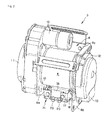
- Fig. 2 is a perspective view of the seat belt retractor of the first example
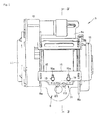
- Fig. 3 is a front view of the seat belt retractor of the first example
- Fig. 4 is a sectional view along IV-IV line in Fig. 3 .
- the seat belt retractor 3 in the first example basically has the same configuration as a prior-art emergency locking seat belt retractor (ELR) provided with a pre-tensioner. That is, similar to the prior-art ELR, the seat belt retractor 3 is provided with a U-shaped frame 8, a spool 9 for retracting the seat belt 4, a pre-tensioner 10 mounted on one side wall 9a of the frame 8, a spring mechanism 11 mounted on the one side wall 8a of the frame 8 for urging the spool 9 in a seat belt retracting direction all the time, a lock mechanism 12 mounted on the other side wall 8b of the frame 8 and operated in the above-mentioned emergency or in sudden withdrawal of the seat belt 4 at a withdrawing speed faster than a normal withdrawing speed for preventing rotation of the spool 9 in a seat belt withdrawing direction, and each constituent element of a deceleration sensing mechanism 13 mounted on the other side wall 8b of the frame 8 for sensing a vehicle deceleration
- ELR emergency locking seat belt retractor
- the seat belt retractor 3 of the first example is provided with an end-lock preventing mechanism 14 provided at the center between both side walls 8a and 8b on a connection portion 8c for connecting the both side walls 8a, 8b of the frame 8.
- the end-lock preventing mechanism 14 has a support plate 15 detachably mounted on the connection portion 8c of the frame 8, an end-lock preventing frame 16 detachably mounted on the support plate 15, a braking roller 17 provided rotatably and capable of axial movement on the end-lock preventing frame 16, and a braking member 18 mounted on the end-lock preventing frame 16 and made of an elastic plate material such as an elastic plate spring or the like.
- the end-lock preventing frame 16 has a center portion 16a and right and left side walls 16b and 16c installed upward from right and left end edges of the center portion 16a.
- guide holes 16d and 16e curved in the same direction and having the same size are drilled.
- a rotation shaft 17a of the braking roller 17 is inserted rotatably and movably along the guide holes 16d and 16e. That is, the braking roller 17 is guided rotatably by the both side walls 16b and 16c of the end-lock preventing frame 16 and by the guide holes 16d and 16e capable of axial movement.
- one end sides of the right and left side walls 16b and 16c are bent inward substantially orthogonally, and bent portions 16f and 16g are detachably mounted on the support plate 15 by a bolt / nut 19, respectively.
- a pair of vertical position adjustment long hole 15a is drilled, and the bolt / nuts 19 penetrates the position adjustment long holes 15a capable of vertical movement. Therefore, positions of the end-lock preventing frame 16 and the braking roller 17 can be adjusted in the vertical direction with respect to the frame 8.
- the braking roller 17 in the first example is a roller made of a friction material such as a rubber roller and configured so that a surface of the seat belt 4 retracted by the spool by a predetermined amount is brought into contact with an outer peripheral face thereof.
- the braking roller 17 is not limited to the friction material but may be constructed by any roller material as long as the braking roller can be constructed.
- the braking member 18 is detachably mounted on the center portion 16a of the end-lock preventing frame 16. As shown in Figs. 6A to 6C , the braking member 18 is formed by a vertical portion 18a and an inclined portion 18b to have a section in a direction orthogonal to the right and left width direction bent substantially in the V-shape. A lower end portion of the vertical portion 18a is bent substantially at a right angle to become a mounting portion 18c. The mounting portion 18c is detachably mounted on the center portion 16a of the end-lock preventing frame 16 with the bolt / nut 20.
- the braking roller 17 can be brought into contact with the inclined portion 18b.
- an interval between a surface 4b of the seat belt 4 retracted by the spool 9 and the inclined portion 18b is set as a V-shaped wedge state interval so as to become smaller toward a seat belt retracting direction ⁇ and larger toward a seat belt withdrawing direction ⁇ .
- the inclined portion 18b is elastically deformed so as to rotate and bend around a boundary portion between the vertical portion 18a and the inclined portion 18b when being pressed by the surface 4b of the seat belt 4 retracted by the spool 9 through the braking roller 17.
- the braking member 18 constitutes a large speed-reduction portion for largely reducing the seat belt retracting speed as will be described later and a small speed-reduction portion for setting the seat belt retracting speed reduced by the large speed-reduction portion at a low speed lower than the speed reduced by the large speed-reduction portion and for giving a delay for an inertia body of the lock mechanism 12 to be brought to a non-lock position at least when retracting of the seat belt is finished.
- the large speed-reduction portion of the braking member 18 largely reduces the seat belt retracting speed when the braking roller 17 is elastically brought into contact with the inclined portion 18b after the seat belt retracting by the spool 9 reaches the vicinity of full-amount retracting or the vicinity of substantially full-amount retracting of the seat belt 4.
- the small speed-reduction portion of the braking member 18 reduces the seat belt retracting speed by a small amount to a low speed lower than the speed largely reduced by the large speed-reduction portion and for giving a delay for the inertial body of the lock mechanism 12 to be brought to the non-lock position at least when the retracting of the seat belt 4 is finished by means of increase of the seat belt retracting diameter after large speed reduction by the large speed-reduction portion and elastic deformation of the inclined portion 18b as mentioned above.
- the seat belt retracting speed by the spool 9 is largely reduced when the braking roller 17 is brought into contact with the inclined portion 18b after the seat belt retracting reaches the vicinity of full-amount retracting or the vicinity of substantially full-amount retracting of the seat belt 4 and then reduced by a small amount by means of elastic deformation of the inclined portion 18 by the braking roller 17. Then, at the full-amount retracting or substantially full-amount retracting of the seat belt, rotation of the spool 9 is stopped in a state in which the seat belt retracting speed has been lowered. Since the other configurations of the seat belt retractor 3 of the first example are substantially the same as the configuration of the seat belt retractor described in Patent Document 1, the explanation will be omitted.
- the spool 9 and the seat belt 4 are rotated in the seat belt withdrawing direction ⁇ , and the seat belt 4 is withdrawn from the seat belt retractor 3.
- the spool winding diameter of the seat belt 4 is getting smaller.
- the braking roller 17 is rotated in a direction opposite to that of the spool 9 and the seat belt 4 while being guided by the guide holes 16d and 16e and moved in the seat belt withdrawing direction ⁇ . Since this movement of the braking roller 17 is made in a direction to release the V-shaped wedge effect, the braking roller 17 is moved relatively easily. Therefore, the withdrawal of the seat belt 4 by the occupant is performed relatively easily, and the occupant does not have a sense of discomfort.
- the braking roller 17 is further moved in the same direction and as shown in Fig. 6C , the braking roller 17 is separated from the inclined portion 18b of the braking member 18 and then, the rotating shaft 17a of the braking roller 17 is brought into contact with ends of the guide holes 16d and 16e and the axial movement of the braking roller 17 is stopped. At this time, the inclined portion 18b is elastically restored to a free state. Also, at this time, the surface 4b of the seat belt 4 retracted by the spool 9 is in contact with the braking roller 17.
- the spool winding diameter of the seat belt 4 is made small, and the surface 4b of the seat belt 4 is separated from the braking roller 17, though not shown. After that, the seat belt 4 is not subjected to influence of the braking roller 17 and withdrawn more smoothly.
- the spool 9 starts retracting rotation of the seat belt 4 by an urging force of the spring mechanism 11 and retracts the seat belt 4 at a normal and relatively fast seat belt retracting speed similarly to the known seat belt retractor 3 as shown by a solid line in Fig. 7 .
- the seat belt retracting diameter of the seat belt 4 wound around the spool 9 gets gradually large.
- the surface 4b of the seat belt 4 wound around the spool 9 is brought into contact with the braking roller 17.
- the braking roller 17 Since the seat belt 4 is retracted more rapidly, the braking roller 17 is rotated by retracting rotation of the seat belt 4 and axially moved rapidly along the guide holes 16d and 16e.
- the surface 17b of the braking roller 17 When the seat belt 4 has been wound to the vicinity of a full amount or the vicinity of a substantially full amount, the surface 17b of the braking roller 17 is brought into contact with the inclined portion 18b of the braking member 18 and then, the braking roller 17 is brought to a position shown in Fig. 6B all at once.
- the braking roller 17 is brought into contact in a wedge state with the surface 4b of the seat belt 4 wound around the spool 9 and the inclined portion 18b, and the braking member 18 largely reduces the speed of the braking roller 17 by the large speed-reduction portion on the basis of the wedge effect of the surface 4b of the seat belt 4 and the inclined portion 18b.
- the seat belt retracting speed is largely reduced (retracing with large speed reduction).
- the inertia body slidably supported by the lock gear of the lock mechanism 12 is rotated backward (moved) to the lock position by the inertia due to the large speed reduction.
- the braking roller 17 elastically deforms (rotates and bends) the inclined portion 18b while the roller moves toward the distal end of the inclined portion 18b by a slight amount.
- the small speed-reduction portion on the basis of the elastic deformation of the inclined portion 18b of the braking member 18, while the seat belt retracting speed is reduced by a small amount as shown by a solid line in Fig. 7 , the spool 9 retracts the seat belt 4 at a relatively low seat belt retracting speed.
- the seat belt retracting speed by the small speed-reduction portion is set at a low speed lower than the speed largely reduced by the large speed-reduction portion and for giving a delay for the inertia body of the lock mechanism 12 to be brought to the non-lock position at least when the retracting of the seat belt 4 is finished (rotation delay period for the inertia body of the lock mechanism 12 to the non-lock position).
- the full-amount retracting or substantially full-amount retracting of the seat belt 4 has not been finished, and the spool 9 is further rotated in the seat belt retracting direction and the retracting of the seat belt 4 at a low seat belt retracting speed is continued.
- the seat belt retracting speed of the spool 9 has become considerably low and is brought into a state in which large deceleration does not occur in the seat belt retracting speed.
- the inertia body of the lock mechanism 12 is returned to the non-lock position by the restoring force and the rotation of the lock gear of the lock mechanism 12 in the seat belt retracting direction, and the lock gear of the lock mechanism 12 is made rotatable (forward rotation) in the seat belt retracting direction.
- the belt anchor 4a of the seat belt 4 is fixed to the floor of the car body as shown in Fig. 8 , when the seat belt 4 has been retracted by the seat belt retractor 3 by its full amount or substantially full amount, the seat belt 4 is rarely loose. As a result, the retracting of the seat belt 4 by the seat belt retractor 3 is finished, and rotation of the spool 9 in the seat belt retracting direction is stopped. At this time, when the retracting of the seat belt 4 is finished and the rotation of the spool 9 in the seat belt retracting direction is stopped, the inertia body of the lock mechanism 12 has been already at the non-lock position as described above. As a result, occurrence of end lock when the retracting of the seat belt 4 is finished can be prevented.
- the seat belt 4 is brought to a fully-retracted state shown in Fig. 8 , and the retracting of the seat belt 4 is finished.
- the inertia body of the lock mechanism 12 having moved to the lock position might not have been returned to the non-lock position yet, and there is a possibility that end lock has occurred.
- the operations other than the end-lock preventing operation of the seat belt retractor 3 in the first example are substantially the same as the operation of the seat belt retractor described in Patent Document 1, and the explanation will be omitted.
- the seat belt 4 may be retracted at a constant or substantially constant low speed (that is, a speed substantially not to be decelerated) after the large speed reduction as shown by two dot chain line in Fig. 7 .
- the seat belt retractor 3 in the first example when the seat belt winding diameter of the spool 9 reaches a predetermined winding diameter in the vicinity of a full amount or the vicinity of a substantially full amount of the seat belt, the surface 4b of the seat belt 4 wound around the spool 9 is first indirectly brought into contact with the inclined portion 18b of the braking member 18 made of an elastic plate material in the end-lock preventing mechanism 14 through the braking roller 17. Therefore, by means of the large speed-reduction portion of the braking member 18 on the basis of the indirect contact of the surface 4b of the seat belt 4 with the inclined portion 18b, the seat belt retracting speed of the spool 9 can be largely reduced. Particularly, by realizing the large reduction of the retracting speed of the seat belt 4 by the wedge effect of the end-lock preventing mechanism 14, the retracting speed of the seat belt 4 can be largely reduced more effectively.
- the braking member 18 allows the seat belt retracting by the spool 9 at the largely-reduced low seat belt retracting speed, when the seat belt 4 is retracted at a low speed and the retracting of the seat belt 4 is finished, it becomes possible to bring the lock mechanism 12 to the non-lock position.
- the seat belt retracting speed even if the inertia body of the lock mechanism 12 has been moved to the lock position once, occurrence of end lock at rotation stop of the spool 9 when the seat belt retracting by the spool 9 is finished can be prevented effectively.
- the braking member 18 of the end-lock preventing mechanism 14 by forming the braking member 18 of the end-lock preventing mechanism 14 by an elastic plate material, it can be configured that when rotation speed of the spool 9 is smoothly lowered and at least retracting of the seat belt 4 is finished after the rotation speed of the spool 9 is largely reduced, the inertia body of the lock mechanism 12 has been brought to the non-lock position.
- end lock can be prevented.
- the braking member 18 of the end-lock preventing mechanism 14 is integrally provided on the seat belt retractor 3, the braking member 18 can be positioned with higher accuracy with respect to the surface of the seat belt 4 wound around the spool 9. Therefore, stable deceleration can be obtained in the seat belt retracting speed, and end lock can be prevented further effectively when the retracting of the seat belt 4 by the spool 9 is finished.
- the spool is rotated in a direction to release the wedge effect of the end-lock preventing mechanism 14, and a large seat belt withdrawing force is not required in the seat belt withdrawing operation by the occupant, and handling performance of the seat belt 4 by the occupant becomes favorable.
- the end-lock preventing mechanism 14 no longer acts on the seat belt 4, and the withdrawing force of the seat belt 4 can be made further small, and handling performance of the seat belt 4 by the occupant is made further favorable.
- the end-lock preventing mechanism 14 does not act on the seat belt 4 when the seat belt 4 is worn, a sense of pressure of the seat belt 4 on the occupant by the end-lock preventing mechanism 14 can be prevented.
- the seat belt retractor 3 of this example such seat belt retractor 3 can be realized that the structure is further simplified, assembling can be further facilitated, and handling performance of the seat belt 4 by the occupant can be improved, while end lock can be prevented more effectively.
- the inclined portion 18b of the braking member 18 may be inclined in two stages, that is, a steep inclined portion 18d and a gentle inclined portion 18e as shown in Fig. 6D .
- a steep inclined portion 18d and a gentle inclined portion 18e as shown in Fig. 6D .
- a braking roller support portion 18f may be provided continuously to the distal end of the inclined portion 18b of the braking member 18. This braking roller support portion 18f elastically and lightly supports the braking roller 17 in a state in which the seat belt 4 is withdrawn by a predetermined amount and the surface 4b of the seat belt 4 wound around the spool 9 is separated from the braking roller 17. In a state of the braking roller 17 shown in Fig.
- the rotation shaft 17a is separated from lower end edges 16d 1 and 16e 1 of the guide holes 16d and 16e by the braking roller support portion 18f and is elastically and lightly brought into contact with upper end edges 16d 2 and 16e 2 of the guide holes 16d and 16e.
- Each operation of large speed reduction and small speed reduction of this variation is the same as shown in Figs. 6B and 6A .
- a behavior of the braking roller 17 can be made stable.
- the other configurations and the other working effects of this variation are substantially the same as the above-mentioned example.
- the seat belt device 1 provided with the seat belt retractor 3 of this example an assembling work of the end-lock preventing mechanism 14 is no longer needed when the seat belt device 1 is assembled to a vehicle, and the number of assembling processes of the seat belt device 1 can be reduced, and the assembling work of the seat belt device 1 to the vehicle is simplified. Also, since end lock in the seat belt retractor 3 can be prevented more effectively and handling performance of the seat belt 4 by the occupant can be improved, operability of the seat belt 4 is improved and a wearing operation of the seat belt 4 by the occupant can be performed smoothly and stably.
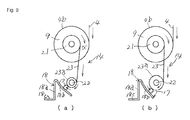
- Figs. 9 are diagrams schematically and partially illustrating a second example of an embodiment of the seat belt retractor according to the present invention.
- the surface 4b of the seat belt 4 wound around the spool 9 is indirectly brought into contact with the inclined portion 18b of the braking member 18 through the braking roller 17.
- a surface of a flat spiral spring whose winding diameter is changed according to a retracted amount of the seat belt 4 is brought into contact with the inclined portion 18b of the braking member 18 through the braking roller 17.
- the end-lock preventing mechanism 14 of the seat belt retractor 3 of the second example is provided with a spool-side retracting roller 21 coaxially with the spool 9 and capable of integral rotation with the spool 9, a frame-side retracting roller 22 rotatably provided on the end-lock preventing frame 16, and a flat spiral spring 23 extended between the spool-side retracting roller 21 and the frame-side retracting roller 22.
- the flat spiral spring 23 is provided so as to urge the frame-side retracting roller 22 in a direction that the flat spiral spring 23 is retracted by the frame-side retracting roller 22, that is, a direction of retracting the seat belt 4 by the spool 9.
- the flat spiral spring 23 in a state in which the seat belt 4 is withdrawn from the seat belt retractor 3 by a predetermined amount for wearing of the seat belt 4, the flat spiral spring 23 is retracted on the side of the spool-side retracting roller 21, and a retracting diameter of the flat spiral spring 23 at the frame-side retracting roller 22 is small. Therefore, a surface 23a of the flat spiral spring 23 wound around the frame-side retracting roller 22 is not brought into contact with the inclined portion 18b of the braking member 18 through the braking roller 17.
- the spool-side retracting roller 21 is also rotated in the seat belt retracting direction ⁇ . Then, the retracting diameter of the flat spiral spring 23 retracted by the frame-side retracting roller 22 is increased.
- the surface 23a of the flat spiral spring 23 is brought into contact with the inclined portion 18b of the braking member 18 through the braking roller 17 similarly to the above-mentioned first example.
- the braking roller 17 is effectively braked by the wedge effect between the surface 23a of the flat spiral spring 23 and the inclined portion 18b, and rotation speed of the frame-side retracting roller 22 is largely reduced. Therefore, the spool 9 has its rotation speed largely reduced and retracts the seat belt 4 (retracting with large speed reduction).
- Figs. 10 are diagrams schematically and partially illustrating a third example of an embodiment of a seat belt retractor according to the present invention.
- the braking member 18 to which the surface 4b of the seat belt 4 wound around the spool 9 is constructed by an elastic material.
- the braking member 18 is not constructed by an elastic material.
- the braking member 18 of the end-lock preventing mechanism 14 in the seat belt retractor 3 of the third example has a guide member 24 guided not capable of rotation but vertically movably by vertically linear guide holes 16d and 16e drilled in the right and left side walls 16b and 16c of the end-lock preventing frame 16, first arm 25 and second arm 26 connected to the guide member 24 in the V-shape state with a predetermined opened angle smaller than 180 degrees, and a guide-member urging spring 27 for urging the guide member 24 upward, that is, in a direction of the spool 9, all the time.
- the surface 4b of the seat belt 4 retracted by the spool 4 is separated from either of the first arm 25 and the second arm 26. Therefore, the guide member 24, the first arm 25, and the second arm 26 are set at the highest position.
- the surface 4b of the seat belt 4 wound around the spool 9 is brought into contact in the wedge state with the first and second arms 25 and 26. Then, the spool 9 has its seat belt retracting speed largely reduced by the wedge effect of the first and second arms 25 and 26 and retracts the seat belt 4 (retracting with large speed reduction).
- the guide member 24 is slowly moved downward against the urging force of the guide-member urging spring 27.
- the spool 9 retracts the seat belt 4 while its largely-reduced seat belt retracting speed is reduced by a small amount (retracting with small speed reduction).
- the spool 9 retracts the full amount of the seat belt 4 and stops rotation. Therefore, similarly to the above-mentioned first example, when the seat belt 4 is retracted by a full amount or a substantially full amount and rotation of the spool 9 is stopped, end lock is prevented.
- the other configurations and the other working effects of the seat belt retractor 3 of the third example are the same as the above-mentioned first example.
- Figs. 11 are diagrams schematically and partially illustrating a fourth example of an embodiment of a seat belt retractor according to the present invention.
- the braking roller 17 is in a single structure.
- the braking roller 17 is in a double structure.
- the end-lock preventing mechanism 14 of the seat belt retractor 3 in the fourth example has a relatively hard small-diameter first roller 28, a second roller 29 made of a rubber roller, externally fitted to the first roller 28 and having relatively softer elasticity, and the same braking member 18 as that of the first example.
- a micro gap 30 is formed between an outer peripheral face of the first roller 28 and an outer peripheral face of the second roller 29.
- the surface 4b of the seat belt 4 wound around the spool 9 is not brought into contact with the second roller 29.
- the spool 9 Upon release of the seat belt 4, the spool 9 is rotated in the seat belt retracting direction ⁇ and retracts the seat belt 4. Then, the retracting diameter of the seat belt 4 retracted by the spool 9 is increased. If the retracting diameter of the seat belt 4 retracted by the spool 9 is further increased, the surface 4b of the seat belt 4 is brought into contact with the second roller 29. Moreover, as the seat belt 4 is retracted by the spool 9 and the retracting diameter of the seat belt 4 is increased, the second roller 29 is elastically deformed and brought into contact with the first roller 28, and the first and second rollers 28 and 29 are guided by the guide holes 16d and 16e and axially moved.
- the spool 9 retracts the seat belt 4 while its largely reduced seat belt retracting speed reduced by a small amount (retracting with small speed reduction). After that, the spool 9 retracts the full amount of the seat belt 4 and stops rotation.
- Figs. 12A to 12C are diagrams schematically and partially illustrating a braking member of fifth to seventh examples of an embodiment of a seat belt retractor according to the present invention
- Fig. 12D is a diagram illustrating seat belt retracting speeds of these examples.
- the braking member 18 of the fifth example shown in Fig. 12A has a holding portion 18g provided at the inclined portion 18b and holding the braking roller 17.
- the holding portion 18g is formed in an arc state with substantially the same diameter as the outer diameter of the braking roller 17. It is needless to say that the holding portion 18g is not necessarily limited to an arc.
- the braking roller 17 is held by the holding portion 18g, large speed reduction and small speed reduction can be obtained more effectively. That is, large speed reduction and small speed reduction characteristics of the seat belt retracting speed can be obtained as indicated by a one-dot chain line in Fig. 12D .
- the braking member 18 of the sixth example shown in Fig. 12B has an opening 18h provided in the inclined portion 18b. By varying size setting of this opening 18h, a spring characteristic of the braking member 18 can be changed. As a result, braking performance of the braking member 18 can be set to more desirable performance. In this sixth example, large speed reduction and small speed reduction characteristics of the seat belt retracting speed as shown by a dot line in Fig. 12D can be obtained.
- the braking member 18 in the seventh example shown in Fig. 12C does not have the vertical portion 18a, and the inclined portion 18b is directly provided on the mounting portion 18c.
- This inclined portion 18b has a narrow width portion 18i in which a width on the distal end side of the inclined portion 18b is set narrower than the width on the mounting portion 18c side of the inclined portion 18b.
- spring characteristic of the braking member 18 can be changed.
- braking performance of the braking member 18 can be set to more desirable performance.
- large speed reduction and small speed reduction characteristics of the seat belt retracting speed as shown by a solid line in Fig. 12D can be obtained.
- the other configurations and the other working effects of the seat belt retractor 3 of the fifth to seventh examples are the same as the above example.
- the spring characteristic of the braking member 18 can be changed, and similarly, the braking performance of the braking member 18 can be set to more desirable performance.
- the seat belt retractor of the present invention is not limited to the above-mentioned examples but can be changed in various ways.
- the surface 4b of the seat belt 4 retracted by the spool 9 or the surface 23a of the flat spiral spring 23 wound around the frame-side retracting roller 22 is indirectly brought into contact with the braking member 18 through the rollers 17, 28, 29 and the like, but similarly to the seat belt retractor 3 in the third example, the surface 4b of the seat belt 4 retracted by the spool 9 or the surface 23a of the flat spiral spring 23 wound around the frame-side retracting roller 22 can be directly brought into contact with the braking member 18.
- the seat belt retractor of the present invention can be also applied to a seat belt retractor having a possibility that end lock might occur due to members of the lock mechanism other than the inertia body in addition to the end lock by the inertia body of the lock mechanism as in the above-mentioned example when the seat belt 4 has been retracted by a full amount or a substantially full amount and rotation of the spool 9 is stopped.
- the seat belt retractor of the present invention is not limited to a seat belt retractor having an ELR function in the above-mentioned examples but can be also applied to a seat belt retractor having an ALR function.
- the present invention can be designed in various ways in a range of matters described in claims.
- the seat belt retractor and the seat belt device of the present invention can be suitably used in a seat belt retractor having a possibility of occurrence of end lock and a seat belt device using this seat belt retractor.
Landscapes
- Engineering & Computer Science (AREA)
- Mechanical Engineering (AREA)
- Automotive Seat Belt Assembly (AREA)
Applications Claiming Priority (1)
| Application Number | Priority Date | Filing Date | Title |
|---|---|---|---|
| JP2008296323A JP5214413B2 (ja) | 2008-11-20 | 2008-11-20 | シートベルトリトラクタおよびこれを用いたシートベルト装置 |
Publications (2)
| Publication Number | Publication Date |
|---|---|
| EP2189339A1 true EP2189339A1 (fr) | 2010-05-26 |
| EP2189339B1 EP2189339B1 (fr) | 2012-01-25 |
Family
ID=41402597
Family Applications (1)
| Application Number | Title | Priority Date | Filing Date |
|---|---|---|---|
| EP09172218A Not-in-force EP2189339B1 (fr) | 2008-11-20 | 2009-10-05 | Rétracteur de ceinture de sécurité et son appareil de ceinture de sécurité |
Country Status (4)
| Country | Link |
|---|---|
| US (1) | US8052219B2 (fr) |
| EP (1) | EP2189339B1 (fr) |
| JP (1) | JP5214413B2 (fr) |
| AT (1) | ATE542714T1 (fr) |
Cited By (1)
| Publication number | Priority date | Publication date | Assignee | Title |
|---|---|---|---|---|
| WO2013107618A1 (fr) * | 2012-01-18 | 2013-07-25 | Trw Automotive Gmbh | Enrouleur de ceinture pourvu d'un frein de retour |
Families Citing this family (5)
| Publication number | Priority date | Publication date | Assignee | Title |
|---|---|---|---|---|
| JP5685059B2 (ja) * | 2010-11-17 | 2015-03-18 | 天龍工業株式会社 | シートベルト装置体 |
| EP2492159B1 (fr) * | 2011-02-28 | 2013-12-25 | Volvo Car Corporation | Procédé et système pour contrôle de vitesse de rétraction de ceinture de sécurité |
| JP5623993B2 (ja) * | 2011-07-26 | 2014-11-12 | 株式会社東海理化電機製作所 | ウェビング巻取装置 |
| JP6765391B2 (ja) * | 2018-01-30 | 2020-10-07 | オートリブ ディベロップメント エービー | シートベルト用リトラクタ |
| CN215850873U (zh) * | 2021-04-09 | 2022-02-18 | 宝钜瑞士股份有限公司 | 汽车安全座椅及其安全带自动调整装置 |
Citations (6)
| Publication number | Priority date | Publication date | Assignee | Title |
|---|---|---|---|---|
| JPS61160338A (ja) * | 1985-01-08 | 1986-07-21 | Nissan Motor Co Ltd | シ−トベルト装置 |
| US4722495A (en) * | 1986-02-21 | 1988-02-02 | Rainsfords Metal Products Pty Limited | Retractor webbing brake |
| JPH07144606A (ja) | 1993-11-24 | 1995-06-06 | Takata Kk | シートベルトリトラクタ |
| JPH0958410A (ja) | 1995-08-23 | 1997-03-04 | Takata Kk | シートベルトリトラクタ |
| JPH09323618A (ja) | 1996-06-04 | 1997-12-16 | Nippon Seiko Kk | シートベルト用リトラクター |
| JP2004106561A (ja) | 2002-09-13 | 2004-04-08 | Tokai Rika Co Ltd | エンドロック低減機構 |
Family Cites Families (11)
| Publication number | Priority date | Publication date | Assignee | Title |
|---|---|---|---|---|
| US4293105A (en) * | 1976-12-23 | 1981-10-06 | Allied Chemical Corporation | Bi-level web sensitive retractor |
| US4446884A (en) * | 1981-06-08 | 1984-05-08 | Rader Jr Homer J | Take-up reel with controlled rewind velocity |
| US4772495A (en) * | 1987-07-23 | 1988-09-20 | United Technologies Corporation | Trowelable ablative coating composition and method of use |
| US4771854A (en) * | 1987-10-07 | 1988-09-20 | General Motors Corporation | Belt winding brake for passive belt retractor |
| DE3838175C1 (fr) * | 1988-11-10 | 1990-05-23 | Trw Repa Gmbh, 7077 Alfdorf, De | |
| US4940193A (en) * | 1989-01-26 | 1990-07-10 | Gateway Industries, Inc. | Safety belt retractor with improved dampening |
| JP3204911B2 (ja) | 1996-11-06 | 2001-09-04 | 株式会社東海理化電機製作所 | ウエビング巻取装置 |
| US5794878A (en) * | 1997-05-20 | 1998-08-18 | Am-Safe, Inc. | Device for prevention of slap-back lock of inertia reel |
| JP2006182326A (ja) | 2004-12-28 | 2006-07-13 | Toyota Motor Corp | シートベルト装置 |
| JP2008049939A (ja) | 2006-08-28 | 2008-03-06 | Takata Corp | エンドロック抑制・解除装置およびこれを用いたシートベルト装置 |
| JP2008100639A (ja) * | 2006-10-20 | 2008-05-01 | Takata Corp | シートベルトリトラクタおよびこれを備えたシートベルト装置 |
-
2008
- 2008-11-20 JP JP2008296323A patent/JP5214413B2/ja not_active Expired - Fee Related
-
2009
- 2009-10-05 AT AT09172218T patent/ATE542714T1/de active
- 2009-10-05 EP EP09172218A patent/EP2189339B1/fr not_active Not-in-force
- 2009-10-15 US US12/588,426 patent/US8052219B2/en not_active Expired - Fee Related
Patent Citations (6)
| Publication number | Priority date | Publication date | Assignee | Title |
|---|---|---|---|---|
| JPS61160338A (ja) * | 1985-01-08 | 1986-07-21 | Nissan Motor Co Ltd | シ−トベルト装置 |
| US4722495A (en) * | 1986-02-21 | 1988-02-02 | Rainsfords Metal Products Pty Limited | Retractor webbing brake |
| JPH07144606A (ja) | 1993-11-24 | 1995-06-06 | Takata Kk | シートベルトリトラクタ |
| JPH0958410A (ja) | 1995-08-23 | 1997-03-04 | Takata Kk | シートベルトリトラクタ |
| JPH09323618A (ja) | 1996-06-04 | 1997-12-16 | Nippon Seiko Kk | シートベルト用リトラクター |
| JP2004106561A (ja) | 2002-09-13 | 2004-04-08 | Tokai Rika Co Ltd | エンドロック低減機構 |
Cited By (2)
| Publication number | Priority date | Publication date | Assignee | Title |
|---|---|---|---|---|
| WO2013107618A1 (fr) * | 2012-01-18 | 2013-07-25 | Trw Automotive Gmbh | Enrouleur de ceinture pourvu d'un frein de retour |
| US9834173B2 (en) | 2012-01-18 | 2017-12-05 | Trw Automotive Gmbh | Belt retractor with a recoil brake |
Also Published As
| Publication number | Publication date |
|---|---|
| US8052219B2 (en) | 2011-11-08 |
| JP5214413B2 (ja) | 2013-06-19 |
| JP2010120527A (ja) | 2010-06-03 |
| EP2189339B1 (fr) | 2012-01-25 |
| ATE542714T1 (de) | 2012-02-15 |
| US20100123349A1 (en) | 2010-05-20 |
Similar Documents
| Publication | Publication Date | Title |
|---|---|---|
| EP2189339B1 (fr) | Rétracteur de ceinture de sécurité et son appareil de ceinture de sécurité | |
| US9821760B2 (en) | Locking device, vehicle seat belt adjusting device, and vehicle seat belt | |
| EP2489558B1 (fr) | Prétendeur, rétracteur de ceinture de sécurité avec prétendeur et unité de ceinture de sécurité incluant le rétracteur de ceinture de sécurité | |
| EP1918165B1 (fr) | Rétracteur de ceinture de sécurité et son appareil de ceinture de sécurité | |
| JP2006182103A (ja) | タングおよびこれを用いたシートベルト装置 | |
| DE10058932B4 (de) | Fahrgastzurückhaltendes Schutzsystem | |
| CN102795196B (zh) | 座椅安全带卷收器及使用其的座椅安全带装置 | |
| CN111231886B (zh) | 安全带卷绕装置 | |
| JP5224827B2 (ja) | タングおよびこれを用いたシートベルト装置 | |
| EP2186692B1 (fr) | Rétracteur de ceinture de sécurité et son appareil de ceinture de sécurité | |
| JP4981614B2 (ja) | プリテンショナ及びシートベルト装置 | |
| CN1118392C (zh) | 用于车辆的安全带卷绕装置 | |
| EP0618112B1 (fr) | Retracteur de ceinture de securite | |
| JPH04283150A (ja) | シートベルトリトラクタ | |
| EP1717115A2 (fr) | Enrouleur de ceinture de sécurité et dispositif de ceinture de sécurité comprenant celui-ci | |
| WO2011007614A1 (fr) | Rétracteur de ceinture de siège et procédé pour assembler l'axe de rétracteur de ceinture de siège | |
| KR100801603B1 (ko) | 안전벨트 리트랙터의 회전 구조체 | |
| EP3339108B1 (fr) | Dispositif de tension de sangle | |
| JP5603680B2 (ja) | シートベルトリトラクタおよびこれを備えたシートベルト装置 | |
| CN105667449B (zh) | 包括预紧器和松弛消除器的座椅安全带卷收器 | |
| JP4696910B2 (ja) | シートベルト装置 | |
| EP3254908B1 (fr) | Enrouleur de ceinture pour un système de ceinture de sécurité de véhicule et procédé d'utilisation d'un tel enrouleur de ceinture de sécurité | |
| CN111148664B (zh) | 安全带卷收器的力限制装置 | |
| JP2004106561A (ja) | エンドロック低減機構 | |
| JP4123020B2 (ja) | 動力巻取装置付きシートベルト |
Legal Events
| Date | Code | Title | Description |
|---|---|---|---|
| PUAI | Public reference made under article 153(3) epc to a published international application that has entered the european phase |
Free format text: ORIGINAL CODE: 0009012 |
|
| AK | Designated contracting states |
Kind code of ref document: A1 Designated state(s): AT BE BG CH CY CZ DE DK EE ES FI FR GB GR HR HU IE IS IT LI LT LU LV MC MK MT NL NO PL PT RO SE SI SK SM TR |
|
| AX | Request for extension of the european patent |
Extension state: AL BA RS |
|
| 17P | Request for examination filed |
Effective date: 20101118 |
|
| 17Q | First examination report despatched |
Effective date: 20110104 |
|
| GRAP | Despatch of communication of intention to grant a patent |
Free format text: ORIGINAL CODE: EPIDOSNIGR1 |
|
| RIN1 | Information on inventor provided before grant (corrected) |
Inventor name: MURAKAMI, YOSHIKIC/O TAKATA CORPORATION |
|
| GRAS | Grant fee paid |
Free format text: ORIGINAL CODE: EPIDOSNIGR3 |
|
| GRAA | (expected) grant |
Free format text: ORIGINAL CODE: 0009210 |
|
| AK | Designated contracting states |
Kind code of ref document: B1 Designated state(s): AT BE BG CH CY CZ DE DK EE ES FI FR GB GR HR HU IE IS IT LI LT LU LV MC MK MT NL NO PL PT RO SE SI SK SM TR |
|
| REG | Reference to a national code |
Ref country code: GB Ref legal event code: FG4D |
|
| REG | Reference to a national code |
Ref country code: CH Ref legal event code: EP |
|
| REG | Reference to a national code |
Ref country code: AT Ref legal event code: REF Ref document number: 542714 Country of ref document: AT Kind code of ref document: T Effective date: 20120215 |
|
| REG | Reference to a national code |
Ref country code: IE Ref legal event code: FG4D |
|
| REG | Reference to a national code |
Ref country code: DE Ref legal event code: R096 Ref document number: 602009004881 Country of ref document: DE Effective date: 20120322 |
|
| REG | Reference to a national code |
Ref country code: NL Ref legal event code: VDEP Effective date: 20120125 |
|
| LTIE | Lt: invalidation of european patent or patent extension |
Effective date: 20120125 |
|
| PG25 | Lapsed in a contracting state [announced via postgrant information from national office to epo] |
Ref country code: HR Free format text: LAPSE BECAUSE OF FAILURE TO SUBMIT A TRANSLATION OF THE DESCRIPTION OR TO PAY THE FEE WITHIN THE PRESCRIBED TIME-LIMIT Effective date: 20120125 Ref country code: BG Free format text: LAPSE BECAUSE OF FAILURE TO SUBMIT A TRANSLATION OF THE DESCRIPTION OR TO PAY THE FEE WITHIN THE PRESCRIBED TIME-LIMIT Effective date: 20120425 Ref country code: LT Free format text: LAPSE BECAUSE OF FAILURE TO SUBMIT A TRANSLATION OF THE DESCRIPTION OR TO PAY THE FEE WITHIN THE PRESCRIBED TIME-LIMIT Effective date: 20120125 Ref country code: NL Free format text: LAPSE BECAUSE OF FAILURE TO SUBMIT A TRANSLATION OF THE DESCRIPTION OR TO PAY THE FEE WITHIN THE PRESCRIBED TIME-LIMIT Effective date: 20120125 Ref country code: NO Free format text: LAPSE BECAUSE OF FAILURE TO SUBMIT A TRANSLATION OF THE DESCRIPTION OR TO PAY THE FEE WITHIN THE PRESCRIBED TIME-LIMIT Effective date: 20120425 Ref country code: IS Free format text: LAPSE BECAUSE OF FAILURE TO SUBMIT A TRANSLATION OF THE DESCRIPTION OR TO PAY THE FEE WITHIN THE PRESCRIBED TIME-LIMIT Effective date: 20120525 Ref country code: BE Free format text: LAPSE BECAUSE OF FAILURE TO SUBMIT A TRANSLATION OF THE DESCRIPTION OR TO PAY THE FEE WITHIN THE PRESCRIBED TIME-LIMIT Effective date: 20120125 |
|
| PG25 | Lapsed in a contracting state [announced via postgrant information from national office to epo] |
Ref country code: GR Free format text: LAPSE BECAUSE OF FAILURE TO SUBMIT A TRANSLATION OF THE DESCRIPTION OR TO PAY THE FEE WITHIN THE PRESCRIBED TIME-LIMIT Effective date: 20120426 Ref country code: FI Free format text: LAPSE BECAUSE OF FAILURE TO SUBMIT A TRANSLATION OF THE DESCRIPTION OR TO PAY THE FEE WITHIN THE PRESCRIBED TIME-LIMIT Effective date: 20120125 Ref country code: PL Free format text: LAPSE BECAUSE OF FAILURE TO SUBMIT A TRANSLATION OF THE DESCRIPTION OR TO PAY THE FEE WITHIN THE PRESCRIBED TIME-LIMIT Effective date: 20120125 Ref country code: PT Free format text: LAPSE BECAUSE OF FAILURE TO SUBMIT A TRANSLATION OF THE DESCRIPTION OR TO PAY THE FEE WITHIN THE PRESCRIBED TIME-LIMIT Effective date: 20120525 Ref country code: LV Free format text: LAPSE BECAUSE OF FAILURE TO SUBMIT A TRANSLATION OF THE DESCRIPTION OR TO PAY THE FEE WITHIN THE PRESCRIBED TIME-LIMIT Effective date: 20120125 |
|
| REG | Reference to a national code |
Ref country code: AT Ref legal event code: MK05 Ref document number: 542714 Country of ref document: AT Kind code of ref document: T Effective date: 20120125 |
|
| PG25 | Lapsed in a contracting state [announced via postgrant information from national office to epo] |
Ref country code: CY Free format text: LAPSE BECAUSE OF FAILURE TO SUBMIT A TRANSLATION OF THE DESCRIPTION OR TO PAY THE FEE WITHIN THE PRESCRIBED TIME-LIMIT Effective date: 20120125 |
|
| PG25 | Lapsed in a contracting state [announced via postgrant information from national office to epo] |
Ref country code: RO Free format text: LAPSE BECAUSE OF FAILURE TO SUBMIT A TRANSLATION OF THE DESCRIPTION OR TO PAY THE FEE WITHIN THE PRESCRIBED TIME-LIMIT Effective date: 20120125 Ref country code: EE Free format text: LAPSE BECAUSE OF FAILURE TO SUBMIT A TRANSLATION OF THE DESCRIPTION OR TO PAY THE FEE WITHIN THE PRESCRIBED TIME-LIMIT Effective date: 20120125 Ref country code: DK Free format text: LAPSE BECAUSE OF FAILURE TO SUBMIT A TRANSLATION OF THE DESCRIPTION OR TO PAY THE FEE WITHIN THE PRESCRIBED TIME-LIMIT Effective date: 20120125 Ref country code: CZ Free format text: LAPSE BECAUSE OF FAILURE TO SUBMIT A TRANSLATION OF THE DESCRIPTION OR TO PAY THE FEE WITHIN THE PRESCRIBED TIME-LIMIT Effective date: 20120125 Ref country code: SE Free format text: LAPSE BECAUSE OF FAILURE TO SUBMIT A TRANSLATION OF THE DESCRIPTION OR TO PAY THE FEE WITHIN THE PRESCRIBED TIME-LIMIT Effective date: 20120125 Ref country code: SI Free format text: LAPSE BECAUSE OF FAILURE TO SUBMIT A TRANSLATION OF THE DESCRIPTION OR TO PAY THE FEE WITHIN THE PRESCRIBED TIME-LIMIT Effective date: 20120125 |
|
| PG25 | Lapsed in a contracting state [announced via postgrant information from national office to epo] |
Ref country code: IT Free format text: LAPSE BECAUSE OF FAILURE TO SUBMIT A TRANSLATION OF THE DESCRIPTION OR TO PAY THE FEE WITHIN THE PRESCRIBED TIME-LIMIT Effective date: 20120125 Ref country code: SK Free format text: LAPSE BECAUSE OF FAILURE TO SUBMIT A TRANSLATION OF THE DESCRIPTION OR TO PAY THE FEE WITHIN THE PRESCRIBED TIME-LIMIT Effective date: 20120125 |
|
| PLBE | No opposition filed within time limit |
Free format text: ORIGINAL CODE: 0009261 |
|
| STAA | Information on the status of an ep patent application or granted ep patent |
Free format text: STATUS: NO OPPOSITION FILED WITHIN TIME LIMIT |
|
| 26N | No opposition filed |
Effective date: 20121026 |
|
| PG25 | Lapsed in a contracting state [announced via postgrant information from national office to epo] |
Ref country code: AT Free format text: LAPSE BECAUSE OF FAILURE TO SUBMIT A TRANSLATION OF THE DESCRIPTION OR TO PAY THE FEE WITHIN THE PRESCRIBED TIME-LIMIT Effective date: 20120125 |
|
| REG | Reference to a national code |
Ref country code: DE Ref legal event code: R097 Ref document number: 602009004881 Country of ref document: DE Effective date: 20121026 |
|
| PG25 | Lapsed in a contracting state [announced via postgrant information from national office to epo] |
Ref country code: ES Free format text: LAPSE BECAUSE OF FAILURE TO SUBMIT A TRANSLATION OF THE DESCRIPTION OR TO PAY THE FEE WITHIN THE PRESCRIBED TIME-LIMIT Effective date: 20120506 |
|
| PG25 | Lapsed in a contracting state [announced via postgrant information from national office to epo] |
Ref country code: MC Free format text: LAPSE BECAUSE OF NON-PAYMENT OF DUE FEES Effective date: 20121031 |
|
| REG | Reference to a national code |
Ref country code: IE Ref legal event code: MM4A |
|
| REG | Reference to a national code |
Ref country code: FR Ref legal event code: ST Effective date: 20130628 |
|
| PG25 | Lapsed in a contracting state [announced via postgrant information from national office to epo] |
Ref country code: IE Free format text: LAPSE BECAUSE OF NON-PAYMENT OF DUE FEES Effective date: 20121005 |
|
| PG25 | Lapsed in a contracting state [announced via postgrant information from national office to epo] |
Ref country code: FR Free format text: LAPSE BECAUSE OF NON-PAYMENT OF DUE FEES Effective date: 20121031 |
|
| PG25 | Lapsed in a contracting state [announced via postgrant information from national office to epo] |
Ref country code: MT Free format text: LAPSE BECAUSE OF FAILURE TO SUBMIT A TRANSLATION OF THE DESCRIPTION OR TO PAY THE FEE WITHIN THE PRESCRIBED TIME-LIMIT Effective date: 20120125 |
|
| PG25 | Lapsed in a contracting state [announced via postgrant information from national office to epo] |
Ref country code: TR Free format text: LAPSE BECAUSE OF FAILURE TO SUBMIT A TRANSLATION OF THE DESCRIPTION OR TO PAY THE FEE WITHIN THE PRESCRIBED TIME-LIMIT Effective date: 20120125 |
|
| PG25 | Lapsed in a contracting state [announced via postgrant information from national office to epo] |
Ref country code: LU Free format text: LAPSE BECAUSE OF NON-PAYMENT OF DUE FEES Effective date: 20121005 Ref country code: SM Free format text: LAPSE BECAUSE OF FAILURE TO SUBMIT A TRANSLATION OF THE DESCRIPTION OR TO PAY THE FEE WITHIN THE PRESCRIBED TIME-LIMIT Effective date: 20120125 |
|
| REG | Reference to a national code |
Ref country code: CH Ref legal event code: PL |
|
| GBPC | Gb: european patent ceased through non-payment of renewal fee |
Effective date: 20131005 |
|
| PG25 | Lapsed in a contracting state [announced via postgrant information from national office to epo] |
Ref country code: GB Free format text: LAPSE BECAUSE OF NON-PAYMENT OF DUE FEES Effective date: 20131005 Ref country code: HU Free format text: LAPSE BECAUSE OF FAILURE TO SUBMIT A TRANSLATION OF THE DESCRIPTION OR TO PAY THE FEE WITHIN THE PRESCRIBED TIME-LIMIT Effective date: 20091005 Ref country code: CH Free format text: LAPSE BECAUSE OF NON-PAYMENT OF DUE FEES Effective date: 20131031 Ref country code: LI Free format text: LAPSE BECAUSE OF NON-PAYMENT OF DUE FEES Effective date: 20131031 |
|
| PG25 | Lapsed in a contracting state [announced via postgrant information from national office to epo] |
Ref country code: MK Free format text: LAPSE BECAUSE OF FAILURE TO SUBMIT A TRANSLATION OF THE DESCRIPTION OR TO PAY THE FEE WITHIN THE PRESCRIBED TIME-LIMIT Effective date: 20120125 |
|
| REG | Reference to a national code |
Ref country code: DE Ref legal event code: R082 Ref document number: 602009004881 Country of ref document: DE Representative=s name: VOSSIUS & PARTNER PATENTANWAELTE RECHTSANWAELT, DE Ref country code: DE Ref legal event code: R081 Ref document number: 602009004881 Country of ref document: DE Owner name: JOYSON SAFETY SYSTEMS JAPAN K.K., JP Free format text: FORMER OWNER: TAKATA CORP., TOKIO/TOKYO, JP |
|
| PGFP | Annual fee paid to national office [announced via postgrant information from national office to epo] |
Ref country code: DE Payment date: 20201022 Year of fee payment: 12 |
|
| REG | Reference to a national code |
Ref country code: DE Ref legal event code: R119 Ref document number: 602009004881 Country of ref document: DE |
|
| PG25 | Lapsed in a contracting state [announced via postgrant information from national office to epo] |
Ref country code: DE Free format text: LAPSE BECAUSE OF NON-PAYMENT OF DUE FEES Effective date: 20220503 |