EP2192103A1 - Verfahren zur Umwandlung von Ethanol in Essigsäure - Google Patents
Verfahren zur Umwandlung von Ethanol in Essigsäure Download PDFInfo
- Publication number
- EP2192103A1 EP2192103A1 EP09013880A EP09013880A EP2192103A1 EP 2192103 A1 EP2192103 A1 EP 2192103A1 EP 09013880 A EP09013880 A EP 09013880A EP 09013880 A EP09013880 A EP 09013880A EP 2192103 A1 EP2192103 A1 EP 2192103A1
- Authority
- EP
- European Patent Office
- Prior art keywords
- ethanol
- water
- stream
- acetic acid
- effluent
- Prior art date
- Legal status (The legal status is an assumption and is not a legal conclusion. Google has not performed a legal analysis and makes no representation as to the accuracy of the status listed.)
- Withdrawn
Links
Images
Classifications
-
- C—CHEMISTRY; METALLURGY
- C07—ORGANIC CHEMISTRY
- C07C—ACYCLIC OR CARBOCYCLIC COMPOUNDS
- C07C51/00—Preparation of carboxylic acids or their salts, halides or anhydrides
-
- C—CHEMISTRY; METALLURGY
- C07—ORGANIC CHEMISTRY
- C07C—ACYCLIC OR CARBOCYCLIC COMPOUNDS
- C07C51/00—Preparation of carboxylic acids or their salts, halides or anhydrides
- C07C51/42—Separation; Purification; Stabilisation; Use of additives
- C07C51/43—Separation; Purification; Stabilisation; Use of additives by change of the physical state, e.g. crystallisation
- C07C51/44—Separation; Purification; Stabilisation; Use of additives by change of the physical state, e.g. crystallisation by distillation
Definitions
- the present invention relates to an improved process of converting a stream comprising ethanol and water to obtain a product rich in acetic acid. More particularly, the invention concerns the non-oxidative dehydrogenation of ethanol and water to obtain a product stream of acetic acid essentially free of water.
- Ethanol can be produced from ethylene by hydrolysis and it may be produced by fermentation of sugars.
- hydrolysis of ethylene to produce ethanol has been performed to meet the technical use of ethanol, while fermentation of sugar containing matter is an ancient process the product of which is primarily used for household purposes.
- the ethanol produced is obtained in an aqueous solution in a concentration of 5-15% by weight along with fermentation by products and solids, the so-called broth.
- the ethanol is then distilled in two columns to obtain 96% ethanol and may finally be dried in a bed of zeolites to obtain anhydrous ethanol useful as an additive to gasoline.
- copper is an active catalyst for the non-oxidative dehydrogenation of ethanol to acetic acid.
- Other catalysts like coal are capable to convert ethanol in the non-oxidative route to acetic acid.
- catalysts active in the oxidative conversion of ethanol to acetic acid are vanadium oxide, gold nanoparticles and supported palladium.
- GB 287064 discloses an acetic acid process, where an alcohol such as ethyl alcohol is passed upward in a reactor column containing in a first bed with Ag doped Cu catalyst in its reduced state and in its oxidised state at the top of the reactor.
- the reduced catalyst is active in dehydrogenation of ethanol to acetaldehyde, which is oxidized by contact with the Cu oxide via acetaldehyde to acetic acid being withdrawn from the top of the reactor.
- Cu oxide is thereby reduced to copper.
- the Cu catalyst recovered from the bottom of the reactor may be reoxidized and recycled to the top of the reactor.
- This process employs a moving bed with Cu/CuO as catalyst and an oxygen carrier for the oxidation of ethanol to acetic acid via acetaldehyde.
- Kanichiro Inui et al (Effective formation of ethyl acetate from ethanol over Cu-Zn-Zr-Al-O catalyst', Journal of Molecular Catalysis A: Chemical 216 (2004), page 147-156 ) describes Cu-Zn-Zr-Al-O as catalysts being active in the conversion of ethanol to ethyl acetate and to acetic acid in presence of water by non-oxidative route. It is mentioned that the selectivity to propanone decreases with increasing selectivity to acetic acid. Up to 15 wt% water in the feed is described, which corresponds to 31% on a mole basis. It is proposed that the reaction proceeds via acetaldehyde, hemiacetal and ethyl acetate to acetic acid through a final hydration.
- JP 57102835 discloses a non-oxidative process for the production of acetic acid from ethanol in a first ethanol dehydrogenation reaction over a CuO and other oxidic catalysts and a hydrogen separation step.
- acetic acid together with water is separated and acetaldehyde is separated from unconverted ethanol.
- This process may further comprise a second acetaldehyde dehydrogenation step to acetic acid with addition of additional water, wherein the product of this step is recycled to the hydrogen separation step and unconverted ethanol is recycled to the first ethanol dehydrogenation step.
- the oxidative route does not offer the possibility of recovering essentially water-free acetic acid without the removal of water by-product.
- acetic acid being essentially free of water can be produced by the non-oxidative route from an ethanol/water feed by adjusting the water content in the ethanol feed and adding water to the acetic acid preparation process exclusively together with the ethanol feed.
- acetic acid from ethanol may involve production of by-products.
- by-products or derivatives form azeotropes with the product mixture during the separation process, it may be beneficial to remove water along with the by-product. This is not considered extraction of water but parasitic loss of water.
- the separation unit may be a conventional distillation column, where the hydrogen rich stream is retrieved from the gas phase in the reflux drum, the optional acetaldehyde containing stream is withdrawn from the top section of the distillation column and the stream containing the unconverted ethanol is withdrawn from an intermediate section of the column.
- the acetic acid rich stream is collected from the bottom of the distillation column.
- n-butanol may be formed as a by-product. N-butanol is difficult to separate from acetic acid.
- a catalyst being active in the reaction of butanol with acetic acid to butyl acetate in the separation step, it is possible to convert n-butanol to n-butyl acetate and at the same time removing product water generated by the esterification of these.
- Zeolites are active in the conversion of n-butanol and acetic acid to n-butyl acetate, thus a bed of zeolite catalyst may advantageously be installed in the distillation column. N-butyl acetate may in turn be removed from the acetic acid product by other means if desired.
- temperatures from 118 up to about 150°C will be found in the bottom part of the distillation column corresponding to a temperature close to the boiling point of pure acetic acid.
- the content of water in the recycle stream of the inventive process depends on the degree of conversion of the intermediate acetaldehyde (reaction 3) to acetic acid, the potential further conversion of the acetic acid with unconverted ethanol to ethyl acetate (reaction 4), the parasitic loss of water in a by-product removal and generated water from by-product or derivatives reactions.
- An advantage of the present process is that the separation step results in an acetic acid product being essentially free of water during periods, where in principle the water content of the ethanol/water feed is too high as compared to above criterion. If the separation takes place in a distillation column an increase of the water content in the system may be counteracted by increasing e.g. the distillation column reflux ratio.
- Further typical operation conditions comprise temperatures for the catalytic conversion of ethanol to acetic acid of 250-450°C, preferably about 250-350°C and an operation pressure of 0-10 bar, preferably 0-3 bar.
- the adjustment of the amount of water in the ethanol feed stream may be managed by establishing a mass balance of the process giving a start target value of water content in the recycle stream, while increasing the water content in the feed after measuring the decrease of water content in the recycle stream and vice versa.
- the water content in the recycle stream may be determined by e.g. an online dew point transmitter. Other principles of control may be applied as well.
- An equimolar feed of ethanol and water corresponds to a 71.9 wt% ethanol and 28.1 wt% water mixture.
- the equimolar feed may be obtained in a side stream from an ethanol plant producing bio-ethanol or fuel-ethanol, de-bottlenecking the process.
- a side stream may be obtained as a vapour stream from a distillation section of an ethanol plant, whereby evaporation of the ethanol/water feed is avoided. It may be advantageous therefore to integrate the inventive process into an ethanol plant, where ethanol and water are present in suitable amounts and especially where the feed is vaporised.
- the amount of water in the feed can be adjusted by adding small amounts of steam/water to an un-adjusted feed of ethanol being lean in water.
- Suitable ethanol conversion catalysts are any catalyst being active in the conversion of ethanol to acetic acid via acetaldehyde dehydrogenation at the above conditions.
- Preferred catalysts include those which further catalyse the reaction of ethanol with acetic acid to obtain ethyl acetate.
- Examples of catalysts active in the dehydrogenation of ethanol to acetic acid are copper based, optionally in combination with zinc oxide, chromium oxide, manganese oxide, zirconium oxide and/or aluminium oxide or a catalyst comprising the above oxides supported on an inert carrier.
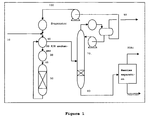
- FIG. 1 is a simplified flow sheet of an embodiment of the invention, where a stream of evaporated ethanol and water is used as fed to the process.
- the feed stream is mixed with an evaporated recycle stream primarily comprising unconverted ethanol, acetaldehyde, water and ethyl acetate.
- Example condensation products are higher boiling alcohols, subject to esterification in the distillation column provided by the active catalyst bed (e.g. HZSM-5) arranged within a distillation column.
- the active catalyst bed e.g. HZSM-5
- Example 1 demonstrates that an adjusted feed stream of ethanol and water results in no extra additions or extractions of water for the production of acetic acid essentially free of water.
- a feed 10(1 kmol/h as per example) consisting of adjusted amounts of ethanol and water is added to an evaporated recycle stream 100.
- the admixture is preheated in feed-effluent heat exchanger 20 and further in preheater 30 in order to reach a proper reaction temperature of the reactor feed 40.
- the conversion of reactor feed 40 is carried out in acetic acid reactor 50 in presence of a copper aluminate catalyst.
- the reactor effluent 60 leaving at 320°C is cooled in the F/E exchanger 20 before being passed to distillation column 70.
- acetic acid product and higher alcohols are withdrawn from the bottom of the column in line 80 while hydrogen rich co-product 90 is withdrawn from the overhead of the column.
- An intermediate boiling fraction comprising acetaldehyde, ethyl acetate, ethanol, water which forms recycle stream 100 is withdrawn as a liquid either from the column overhead together with hydrogen and separated from hydrogen in separator 85.
- Recycle stream 100 may preferable be withdrawn from column 70 at a lower tray, as shown by the dotted line.
- Table 1 summarizes the numbers of a mass balance in the above process being operated with an adjusted ethanol/water feed.
- Table 1 Stream no. 10 40 60 80 90 100 Weight % Water 26.0 28.0 20.4 28.8 Ethanol 74.0 30.3 9.1 12.7 Acetaldehyde 38.4 38.8 18.0 53.9 Ethyl acetate 3.2 3.2 4.5 Acetic acid 26.1 95.9 Hydrogen 1.8 82.0 Condensation 0.7 4.1 products Flow rate 32.8 119.0 114.0 30.6 2.5 81.2 Kg/h
Landscapes
- Chemical & Material Sciences (AREA)
- Organic Chemistry (AREA)
- Engineering & Computer Science (AREA)
- Oil, Petroleum & Natural Gas (AREA)
- Crystallography & Structural Chemistry (AREA)
- Organic Low-Molecular-Weight Compounds And Preparation Thereof (AREA)
Applications Claiming Priority (1)
| Application Number | Priority Date | Filing Date | Title |
|---|---|---|---|
| DKPA200801673 | 2008-11-27 |
Publications (1)
| Publication Number | Publication Date |
|---|---|
| EP2192103A1 true EP2192103A1 (de) | 2010-06-02 |
Family
ID=41818743
Family Applications (1)
| Application Number | Title | Priority Date | Filing Date |
|---|---|---|---|
| EP09013880A Withdrawn EP2192103A1 (de) | 2008-11-27 | 2009-11-05 | Verfahren zur Umwandlung von Ethanol in Essigsäure |
Country Status (4)
| Country | Link |
|---|---|
| US (1) | US20100130775A1 (de) |
| EP (1) | EP2192103A1 (de) |
| CN (1) | CN101898950A (de) |
| BR (1) | BRPI0904636A2 (de) |
Families Citing this family (12)
| Publication number | Priority date | Publication date | Assignee | Title |
|---|---|---|---|---|
| US8680342B2 (en) | 2010-05-07 | 2014-03-25 | Celanese International Corporation | Process for recovering alcohol produced by hydrogenating an acetic acid feed stream comprising water |
| US8846988B2 (en) | 2010-07-09 | 2014-09-30 | Celanese International Corporation | Liquid esterification for the production of alcohols |
| US9150474B2 (en) | 2010-07-09 | 2015-10-06 | Celanese International Corporation | Reduction of acid within column through esterification during the production of alcohols |
| US8846986B2 (en) | 2011-04-26 | 2014-09-30 | Celanese International Corporation | Water separation from crude alcohol product |
| US8686199B2 (en) | 2011-04-26 | 2014-04-01 | Celanese International Corporation | Process for reducing the concentration of acetic acid in a crude alcohol product |
| US8907141B2 (en) | 2011-04-26 | 2014-12-09 | Celanese International Corporation | Process to recover alcohol with secondary reactors for esterification of acid |
| US8884081B2 (en) | 2011-04-26 | 2014-11-11 | Celanese International Corporation | Integrated process for producing acetic acid and alcohol |
| US9000233B2 (en) | 2011-04-26 | 2015-04-07 | Celanese International Corporation | Process to recover alcohol with secondary reactors for hydrolysis of acetal |
| US8933278B2 (en) | 2011-04-26 | 2015-01-13 | Celanese International Corporation | Process for producing ethanol and reducing acetic acid concentration |
| US9079851B2 (en) * | 2012-02-01 | 2015-07-14 | Greenyug, Llc | Ethyl acetate production |
| WO2025058665A1 (en) * | 2023-09-13 | 2025-03-20 | Viridis Chemical, Llc | Process for dehydrogenating an alkanol to produce acetic acid |
| WO2025072073A1 (en) * | 2023-09-26 | 2025-04-03 | Kx2 Development, Llc | Process for production of ethyl acetate |
Citations (6)
| Publication number | Priority date | Publication date | Assignee | Title |
|---|---|---|---|---|
| GB287064A (en) | 1927-03-12 | 1929-05-23 | William Jay Hale | Method of producing organic acids |
| US1951280A (en) * | 1931-10-03 | 1934-03-13 | William J Hale | Cyclic oxidation of alcohols to form aliphatic acids |
| US2184555A (en) * | 1936-09-22 | 1939-12-26 | Eastman Kodak Co | Manufacture of aliphatic acids |
| US2690993A (en) * | 1948-10-28 | 1954-10-05 | Kellogg M W Co | Separation of organic acids from oxygenated organic compounds by azeotropic distillation with water |
| JPS57102835A (en) | 1980-12-16 | 1982-06-26 | Jgc Corp | Preparation of acetic acid from ethanol or acetaldehyde |
| US6730806B2 (en) * | 2001-12-05 | 2004-05-04 | Industrial Technology Research Institute | Process for preparing a carboxylic ester |
Family Cites Families (1)
| Publication number | Priority date | Publication date | Assignee | Title |
|---|---|---|---|---|
| EP1185495B1 (de) * | 1999-04-14 | 2005-06-15 | Showa Denko K K | Katalysator für die herstellung von essigsäure oder essigsäure und ethylacetat, verfahren für seine herstellung und verfahren für die herstellung von essigsäure oder essigsäure und ethylacetat unter verwendung derselben |
-
2009
- 2009-11-05 EP EP09013880A patent/EP2192103A1/de not_active Withdrawn
- 2009-11-11 BR BRPI0904636-4A patent/BRPI0904636A2/pt not_active Application Discontinuation
- 2009-11-20 US US12/622,820 patent/US20100130775A1/en not_active Abandoned
- 2009-11-27 CN CN200910258436XA patent/CN101898950A/zh active Pending
Patent Citations (6)
| Publication number | Priority date | Publication date | Assignee | Title |
|---|---|---|---|---|
| GB287064A (en) | 1927-03-12 | 1929-05-23 | William Jay Hale | Method of producing organic acids |
| US1951280A (en) * | 1931-10-03 | 1934-03-13 | William J Hale | Cyclic oxidation of alcohols to form aliphatic acids |
| US2184555A (en) * | 1936-09-22 | 1939-12-26 | Eastman Kodak Co | Manufacture of aliphatic acids |
| US2690993A (en) * | 1948-10-28 | 1954-10-05 | Kellogg M W Co | Separation of organic acids from oxygenated organic compounds by azeotropic distillation with water |
| JPS57102835A (en) | 1980-12-16 | 1982-06-26 | Jgc Corp | Preparation of acetic acid from ethanol or acetaldehyde |
| US6730806B2 (en) * | 2001-12-05 | 2004-05-04 | Industrial Technology Research Institute | Process for preparing a carboxylic ester |
Non-Patent Citations (1)
| Title |
|---|
| KANICHIRO INUI ET AL.: "Effective formation of ethyl acetate from ethanol over Cu-Zn-Zr-Al-0 catalyst", JOURNAL OF MOLECULAR CATALYSIS A: CHEMICAL, vol. 216, 2004, pages 147 - 156 |
Also Published As
| Publication number | Publication date |
|---|---|
| US20100130775A1 (en) | 2010-05-27 |
| CN101898950A (zh) | 2010-12-01 |
| BRPI0904636A2 (pt) | 2010-09-21 |
Similar Documents
| Publication | Publication Date | Title |
|---|---|---|
| US20100130775A1 (en) | Process for the conversion of ethanol to acetic acid | |
| EP2809643B1 (de) | Herstellung von ethylacetat | |
| US8212070B2 (en) | Method for preparing acrylic acid from glycerol | |
| US9018427B2 (en) | Production of higher alcohols | |
| EP2935184B1 (de) | Integriertes verfahren für die herstellung von essigsäure aus syngas | |
| CN107074677B (zh) | 用于从1,3-丁二醇产生1,3-丁二烯的工艺 | |
| EP2766337B1 (de) | Herstellung von ethylacetat | |
| US20120178962A1 (en) | Ethyl Acetate Production | |
| JPH0635404B2 (ja) | 粗1,4−ブタンジオ−ルの精製方法 | |
| KR20170022984A (ko) | 일산화탄소, 수소 및 메틸 아세테이트의 기체성 혼합물로부터 디메틸 에테르를 제조하는 공정 | |
| US8853469B2 (en) | Combined column for separating products of different hydrogenation reactors | |
| CN106687432B (zh) | 生产乙醇的方法 | |
| US8471060B2 (en) | Process and reactor for the thermoneutral conversion of ethanol to acetic acid | |
| EP2763952B1 (de) | Prozesse zur herstellung von acrylsäuren and arcylaten | |
| US4353783A (en) | Process for separating water from mixtures thereof with vinyl acetate and acetic acid | |
| JP2557099B2 (ja) | ジメチルカーボネートの分離方法 | |
| JPS6212745A (ja) | 第一アルカノ−ルを対応するエステルに転化する方法 | |
| US10464871B2 (en) | Process for the production of ethanol by hydrogenation of methyl acetate | |
| US4644078A (en) | Process for the coproduction of dialkyl carbonate and tertiary butanol | |
| JPH0529017B2 (de) | ||
| JP2000212179A (ja) | テトラヒドロフランの製造法 | |
| TW201302683A (zh) | 在醇類生產製程中藉由酯化在蒸餾塔內減少酸之製程 | |
| TW201242936A (en) | Process for producing ethanol and reducing acetic acid concentration |
Legal Events
| Date | Code | Title | Description |
|---|---|---|---|
| PUAI | Public reference made under article 153(3) epc to a published international application that has entered the european phase |
Free format text: ORIGINAL CODE: 0009012 |
|
| AK | Designated contracting states |
Kind code of ref document: A1 Designated state(s): AT BE BG CH CY CZ DE DK EE ES FI FR GB GR HR HU IE IS IT LI LT LU LV MC MK MT NL NO PL PT RO SE SI SK SM TR |
|
| AX | Request for extension of the european patent |
Extension state: AL BA RS |
|
| 17P | Request for examination filed |
Effective date: 20101202 |
|
| 17Q | First examination report despatched |
Effective date: 20110119 |
|
| STAA | Information on the status of an ep patent application or granted ep patent |
Free format text: STATUS: THE APPLICATION IS DEEMED TO BE WITHDRAWN |
|
| 18D | Application deemed to be withdrawn |
Effective date: 20110531 |