EP2192302A1 - Verdichtungsmechanismus und kompressor der spiralbauart - Google Patents
Verdichtungsmechanismus und kompressor der spiralbauart Download PDFInfo
- Publication number
- EP2192302A1 EP2192302A1 EP08792185A EP08792185A EP2192302A1 EP 2192302 A1 EP2192302 A1 EP 2192302A1 EP 08792185 A EP08792185 A EP 08792185A EP 08792185 A EP08792185 A EP 08792185A EP 2192302 A1 EP2192302 A1 EP 2192302A1
- Authority
- EP
- European Patent Office
- Prior art keywords
- scroll
- compression mechanism
- mechanism according
- thickness
- movable
- Prior art date
- Legal status (The legal status is an assumption and is not a legal conclusion. Google has not performed a legal analysis and makes no representation as to the accuracy of the status listed.)
- Withdrawn
Links
- 230000006835 compression Effects 0.000 title claims abstract description 158
- 238000007906 compression Methods 0.000 title claims abstract description 158
- 238000000465 moulding Methods 0.000 claims abstract description 79
- 238000005266 casting Methods 0.000 claims abstract description 44
- 229910001060 Gray iron Inorganic materials 0.000 claims abstract description 40
- 239000003507 refrigerant Substances 0.000 claims abstract description 30
- 229910001018 Cast iron Inorganic materials 0.000 claims abstract description 29
- 238000004512 die casting Methods 0.000 claims abstract description 14
- OKTJSMMVPCPJKN-UHFFFAOYSA-N Carbon Chemical compound [C] OKTJSMMVPCPJKN-UHFFFAOYSA-N 0.000 claims description 30
- 229910002804 graphite Inorganic materials 0.000 claims description 30
- 239000010439 graphite Substances 0.000 claims description 30
- CURLTUGMZLYLDI-UHFFFAOYSA-N Carbon dioxide Chemical compound O=C=O CURLTUGMZLYLDI-UHFFFAOYSA-N 0.000 claims description 8
- 229910002092 carbon dioxide Inorganic materials 0.000 claims description 4
- 239000001569 carbon dioxide Substances 0.000 claims description 4
- 239000000463 material Substances 0.000 abstract description 11
- 230000007423 decrease Effects 0.000 description 16
- 238000005452 bending Methods 0.000 description 12
- 238000000034 method Methods 0.000 description 10
- 238000007730 finishing process Methods 0.000 description 7
- 238000007789 sealing Methods 0.000 description 4
- 230000000694 effects Effects 0.000 description 3
- 238000004519 manufacturing process Methods 0.000 description 3
- 238000009966 trimming Methods 0.000 description 3
- 230000003247 decreasing effect Effects 0.000 description 2
- 238000007788 roughening Methods 0.000 description 2
- 230000015556 catabolic process Effects 0.000 description 1
- 239000000203 mixture Substances 0.000 description 1
- 230000004048 modification Effects 0.000 description 1
- 238000012986 modification Methods 0.000 description 1
- 239000000341 volatile oil Substances 0.000 description 1
- 238000003466 welding Methods 0.000 description 1
Images







Classifications
-
- F—MECHANICAL ENGINEERING; LIGHTING; HEATING; WEAPONS; BLASTING
- F04—POSITIVE - DISPLACEMENT MACHINES FOR LIQUIDS; PUMPS FOR LIQUIDS OR ELASTIC FLUIDS
- F04C—ROTARY-PISTON, OR OSCILLATING-PISTON, POSITIVE-DISPLACEMENT MACHINES FOR LIQUIDS; ROTARY-PISTON, OR OSCILLATING-PISTON, POSITIVE-DISPLACEMENT PUMPS
- F04C18/00—Rotary-piston pumps specially adapted for elastic fluids
- F04C18/02—Rotary-piston pumps specially adapted for elastic fluids of arcuate-engagement type, i.e. with circular translatory movement of co-operating members, each member having the same number of teeth or tooth-equivalents
- F04C18/0207—Rotary-piston pumps specially adapted for elastic fluids of arcuate-engagement type, i.e. with circular translatory movement of co-operating members, each member having the same number of teeth or tooth-equivalents both members having co-operating elements in spiral form
- F04C18/0246—Details concerning the involute wraps or their base, e.g. geometry
- F04C18/0269—Details concerning the involute wraps
-
- B—PERFORMING OPERATIONS; TRANSPORTING
- B22—CASTING; POWDER METALLURGY
- B22D—CASTING OF METALS; CASTING OF OTHER SUBSTANCES BY THE SAME PROCESSES OR DEVICES
- B22D17/00—Pressure die casting or injection die casting, i.e. casting in which the metal is forced into a mould under high pressure
- B22D17/007—Semi-solid pressure die casting
-
- C—CHEMISTRY; METALLURGY
- C22—METALLURGY; FERROUS OR NON-FERROUS ALLOYS; TREATMENT OF ALLOYS OR NON-FERROUS METALS
- C22C—ALLOYS
- C22C1/00—Making non-ferrous alloys
- C22C1/02—Making non-ferrous alloys by melting
-
- F—MECHANICAL ENGINEERING; LIGHTING; HEATING; WEAPONS; BLASTING
- F04—POSITIVE - DISPLACEMENT MACHINES FOR LIQUIDS; PUMPS FOR LIQUIDS OR ELASTIC FLUIDS
- F04C—ROTARY-PISTON, OR OSCILLATING-PISTON, POSITIVE-DISPLACEMENT MACHINES FOR LIQUIDS; ROTARY-PISTON, OR OSCILLATING-PISTON, POSITIVE-DISPLACEMENT PUMPS
- F04C18/00—Rotary-piston pumps specially adapted for elastic fluids
- F04C18/02—Rotary-piston pumps specially adapted for elastic fluids of arcuate-engagement type, i.e. with circular translatory movement of co-operating members, each member having the same number of teeth or tooth-equivalents
- F04C18/0207—Rotary-piston pumps specially adapted for elastic fluids of arcuate-engagement type, i.e. with circular translatory movement of co-operating members, each member having the same number of teeth or tooth-equivalents both members having co-operating elements in spiral form
- F04C18/0246—Details concerning the involute wraps or their base, e.g. geometry
- F04C18/0253—Details concerning the base
- F04C18/0261—Details of the ports, e.g. location, number, geometry
-
- F—MECHANICAL ENGINEERING; LIGHTING; HEATING; WEAPONS; BLASTING
- F04—POSITIVE - DISPLACEMENT MACHINES FOR LIQUIDS; PUMPS FOR LIQUIDS OR ELASTIC FLUIDS
- F04C—ROTARY-PISTON, OR OSCILLATING-PISTON, POSITIVE-DISPLACEMENT MACHINES FOR LIQUIDS; ROTARY-PISTON, OR OSCILLATING-PISTON, POSITIVE-DISPLACEMENT PUMPS
- F04C23/00—Combinations of two or more pumps, each being of rotary-piston or oscillating-piston type, specially adapted for elastic fluids; Pumping installations specially adapted for elastic fluids; Multi-stage pumps specially adapted for elastic fluids
- F04C23/008—Hermetic pumps
-
- F—MECHANICAL ENGINEERING; LIGHTING; HEATING; WEAPONS; BLASTING
- F04—POSITIVE - DISPLACEMENT MACHINES FOR LIQUIDS; PUMPS FOR LIQUIDS OR ELASTIC FLUIDS
- F04C—ROTARY-PISTON, OR OSCILLATING-PISTON, POSITIVE-DISPLACEMENT MACHINES FOR LIQUIDS; ROTARY-PISTON, OR OSCILLATING-PISTON, POSITIVE-DISPLACEMENT PUMPS
- F04C2210/00—Fluid
- F04C2210/10—Fluid working
- F04C2210/1027—CO2
-
- F—MECHANICAL ENGINEERING; LIGHTING; HEATING; WEAPONS; BLASTING
- F04—POSITIVE - DISPLACEMENT MACHINES FOR LIQUIDS; PUMPS FOR LIQUIDS OR ELASTIC FLUIDS
- F04C—ROTARY-PISTON, OR OSCILLATING-PISTON, POSITIVE-DISPLACEMENT MACHINES FOR LIQUIDS; ROTARY-PISTON, OR OSCILLATING-PISTON, POSITIVE-DISPLACEMENT PUMPS
- F04C2210/00—Fluid
- F04C2210/10—Fluid working
- F04C2210/1072—Oxygen (O2)
-
- F—MECHANICAL ENGINEERING; LIGHTING; HEATING; WEAPONS; BLASTING
- F04—POSITIVE - DISPLACEMENT MACHINES FOR LIQUIDS; PUMPS FOR LIQUIDS OR ELASTIC FLUIDS
- F04C—ROTARY-PISTON, OR OSCILLATING-PISTON, POSITIVE-DISPLACEMENT MACHINES FOR LIQUIDS; ROTARY-PISTON, OR OSCILLATING-PISTON, POSITIVE-DISPLACEMENT PUMPS
- F04C2230/00—Manufacture
- F04C2230/20—Manufacture essentially without removing material
- F04C2230/21—Manufacture essentially without removing material by casting
-
- F—MECHANICAL ENGINEERING; LIGHTING; HEATING; WEAPONS; BLASTING
- F05—INDEXING SCHEMES RELATING TO ENGINES OR PUMPS IN VARIOUS SUBCLASSES OF CLASSES F01-F04
- F05C—INDEXING SCHEME RELATING TO MATERIALS, MATERIAL PROPERTIES OR MATERIAL CHARACTERISTICS FOR MACHINES, ENGINES OR PUMPS OTHER THAN NON-POSITIVE-DISPLACEMENT MACHINES OR ENGINES
- F05C2201/00—Metals
- F05C2201/04—Heavy metals
- F05C2201/0433—Iron group; Ferrous alloys, e.g. steel
- F05C2201/0436—Iron
- F05C2201/0439—Cast iron
Definitions
- the present invention relates to a compression mechanism and a scroll compressor including the compression mechanism. Particularly, the present invention relates to materials used in the compression mechanism.
- a scroll compressor includes a compression mechanism to compress refrigerant.
- the compression mechanism includes a fixed scroll and a movable scroll.
- Each of the two scrolls has a scroll portion which extends in an involute shape. The two scroll portions engage with each other.
- the fixed scroll has been formed of the same material as the movable scroll.
- Some examples of the materials are a grey iron casting, a cast iron molding fabricated through semi-molten die casting, and so forth.
- Patent Document 1 discloses the related art to the present invention.
- the compression mechanism will have low strength and low stiffness.
- the scrolls need to have their involute scroll portions thinner and longer in height.
- low strength and low stiffness of the compression mechanism can cause deformation or rupture of the involute scroll portions during operation. This problem will become significant when the scrolls are grey iron castings.
- the present invention solves the above problems.
- the present invention has an object to increase strength and stiffness of a compression mechanism and to prevent seizing thereof simultaneously.
- a compression mechanism is used in a scroll compressor, and includes a fixed scroll and a movable scroll.
- One of the two scrolls is a cast iron molding fabricated through semi-molten die casting, and the other is a grey iron casting.
- a compression mechanism according to a second aspect of the present invention is the compression mechanism according to the first aspect of the present invention, wherein the sum of a graphite area ratio on the surface of the cast iron molding and a graphite area ratio on the surface of the grey iron casting is greater than or equal to 10% and less than or equal to 20%.
- a compression mechanism according to a third aspect of the present invention is the compression mechanism according to the second aspect of the present invention, wherein the graphite area ratio on the surface of the cast iron molding is greater than or equal to 2% and less than or equal to 6%.
- a compression mechanism according to a fourth aspect of the present invention is the compression mechanism according to any one of the first to third aspects of the present invention, wherein a tensile strength of the grey iron casting is greater than or equal to 250N/mm 2 and less than 300N/mm 2 .
- a compression mechanism according to a fifth aspect of the present invention is the compression mechanism according to any one of the first to forth aspects of the present invention, wherein the fixed scroll is the grey iron casting, and the movable scroll is the cast iron molding.
- a compression mechanism according to a sixth aspect of the present invention is the compression mechanism according to the fifth aspect of the present invention, wherein the movable scroll is placed and pushed against the fixed scroll.
- a compression mechanism is the compression mechanism according to the fifth or sixth aspect of the present invention, wherein the fixed scroll has a first scroll portion and a first plate portion, and the movable scroll has a second scroll portion and a second plate portion.
- the first and second scroll portions extend in involute shapes.
- the first scroll portion engages with the second scroll portion.
- the first and second plate portions hold the first and second scroll portions respectively.
- the first plate portion has a through hole which connects a first space and a second space.
- the first space has an involute shape defined by the first scroll portion.
- the second space is located on the opposite side of the movable scroll.
- the second scroll portion is arranged to cover an opening of the through hole. The opening is located on the side of the first space.
- a compression mechanism according to an eighth aspect of the present invention is the compression mechanism according to the seventh aspect of the present invention, wherein the first scroll portion covers a portion of the opening of the through hole, as viewed from the side of the movable scroll.
- a compression mechanism is the compression mechanism according to any one of the fifth to eighth aspects of the present invention, wherein the fixed scroll has a first scroll portion, and the movable scroll has a second scroll portion.
- the first and second scroll portions extend in involute shapes.
- the first scroll portion engages with the second scroll portion.
- the movable scroll has an extended portion which extends from the end of the outmost wall of the second scroll portion. The extended portion does not engage with the first scroll portion.
- a compression mechanism is the compression mechanism according to any one of the first to ninth aspects of the present invention, wherein the fixed scroll has a first scroll portion, and the movable scroll has a second scroll portion.
- the first and second scroll portions extend in involute shapes.
- the first scroll portion engages with the second scroll portion.
- a thickness ratio of a first thickness to a second thickness is equal to a value calculated based on a Young's modulus ratio of the Young's modulus of the cast iron molding to the Young's modulus of the grey iron casting.
- the first thickness is the thickness of the first or second scroll portion of the cast iron molding
- the second thickness is the thickness of the first or second scroll portion of the grey iron casting.
- a compression mechanism according to an eleventh aspect of the present invention is the compression mechanism according to the tenth aspect of the present invention, wherein the thickness ratio is less than or equal to the reciprocal of the Young's modulus ratio.
- a compression mechanism according to a twelfth aspect of the present invention is the compression mechanism according to the tenth or eleventh aspect of the present invention, wherein the Young's modulus of the cast iron molding is 175GPa or more and 190GPa or less.
- a scroll compressor according to a thirteenth aspect of the present invention includes the compression mechanism according to any one of the first to twelfth aspects of the present invention.
- a scroll compressor according to a fourteenth aspect of the present invention is the scroll compressor according to the thirteenth aspect of the present invention, wherein the scroll compressor compresses refrigerant composed mostly of carbon dioxide
- the compression mechanism according to the first aspect has a fixed scroll and a movable scroll.
- One of the two scrolls is a cast iron molding fabricated through semi-molten die casting, while the other is a grey iron casting. Therefore, in this compression mechanism, seizing does not occur frequently between the fixed scroll and the movable scroll, unlike in a compression mechanism which includes a fixed scroll and a movable scroll, both of which are cast iron moldings fabricated through semi-molten die casting.
- the compression mechanism of the present invention can have thinner scroll portions, unlike a compression mechanism which includes a fixed scroll and a movable scroll, both of which are grey iron castings. This is because a cast iron molding fabricated through semi-molten die casting has higher strength and higher stiffness than a grey iron casting. Therefore, this compression mechanism can be downsized and maintain its intake capacity simultaneously. This compression mechanism can also keep its size unchanged and achieve higher intake capacity simultaneously.
- this compression mechanism can prevent deformation thereof caused by compression pressure. This is because a cast iron molding fabricated through semi-molten die casting has higher stiffness than a grey iron casting. Therefore, compressed refrigerant hardly leaks out of this compression mechanism, which prevents a decrease of the compression efficiency.
- the compression mechanism according to the second aspect has a large sum of the graphite area ratios, which can easily prevent seizing between the fixed scroll and the movable scroll.
- the compression mechanism according to the third aspect can secure the graphite area ratio on the surface of the cast iron molding, which is sufficient to prevent seizing.
- This compression mechanism can easily prevent seizing between the fixed scroll and the movable scroll.
- the compression mechanism according to the fourth aspect can have the strength and the stiffness sufficient to prevent deformation or rupture of this compression mechanism.
- the compression mechanism according to the fifth aspect can have thinner scroll portions, unlike a compression mechanism which includes a fixed scroll and a movable scroll, both of which are grey iron castings. This is because a cast iron molding fabricated through semi-molten die casting has higher strength and higher stiffness than a grey iron casting. Therefore, this compression mechanism can be downsized and maintain its intake capacity simultaneously. This compression mechanism can also keep its size unchanged and achieve higher intake capacity simultaneously.
- the movable scroll can be lightweight, which reduces torque required to operate the movable scroll.
- the cast iron molding fabricated through semi-molten die casting can reduce the cost of this compression mechanism.
- the compression mechanism according to the sixth aspect can prevent a gap between the scroll portion of the fixed scroll and that of the movable scroll, whereby prevents the decrease of the compression efficiency.
- the movable scroll is unlikely to deform when pushed against the fixed scroll. This is because the movable scroll is the cast iron molding fabricated through semi-molten die casting which has high strength and high stiffness.
- the compression mechanism according to the seventh aspect can prevent the decrease of the compression efficiency. This is because the through hole does not connect the first spaces on two sides of the scroll portion of the movable scroll, when the scroll portion of the movable scroll passes by an opening of the through hole. More specifically, in this case, the first spaces defined by the scroll portion do not connect to each other via the through hole.
- the compression mechanism according to the eighth aspect has an opening of the through hole on the side of the second space, and this opening can be bigger than an opening on the side of the first space. Therefore, compressed refrigerant can pass through the through hole more efficiently.
- the compression mechanism according to the ninth aspect has the movable scroll with the extended portion, which increases strength and stiffness of the end of the outmost wall of the movable scroll. Therefore, the extended portion prevents deformation of the outmost wall of the movable scroll during fabrication.
- the compression mechanism according to the tenth aspect can have substantially equal amounts of bending between the two scroll portions, wherein one of the scroll portions is a cast iron molding fabricated through semi-molten die casting, while the other is a grey iron casting. This is because the thickness ratio of the scroll portions is calculated based on the Young's modulus ratio of the scroll portions.
- the compression mechanism can prevent the decrease of the compression efficiency due to the bending of the scroll portions.
- the compression mechanism according to the eleventh aspect can be downsized. This is because a scroll portion of the cast iron molding can be made thinner.
- the compression mechanism according to the twelfth aspect can prevent the decrease of the compression efficiency due to the bending of the cast iron molding.
- the scroll compressor according to the thirteenth aspect can prevent seizing between the fixed scroll and the movable scroll of the compression mechanism. Therefore, the scroll compressor is less prone to breakdown.
- the scroll compressor according to the fourteenth aspect can improve the compression efficiency, even when carbon dioxide is used as refrigerant.
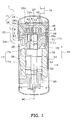
- FIG 1 shows a schematic view of a scroll compressor 1 according to an embodiment of the present invention.
- the upper side is defined as a side pointed by an arrow 91 shown in FIG 1
- the lower side is defined as the opposite side to the upper side.
- the scroll compressor 1 includes a casing 11 and a compression mechanism 15.
- the casing 11 is a cylindrical body elongated along the arrow 91.
- the compression mechanism 15 is disposed inside the casing 11.
- FIG 2 shows a cross-sectional view of the compression mechanism 15 along the line II-II shown in FIG 1 .
- the compression mechanism 15 includes a fixed scroll 24 and a movable scroll 26 (See FIG 1 and FIG 2 ).
- the compression mechanism 15 compresses refrigerant.
- An example of the refrigerant is composed mostly of carbon dioxide.
- the fixed scroll 24 includes a first plate portion 24a and a first scroll portion 24b.
- the first plate portion 24a is secured to an inner wall 11 a of the casing 11.
- the first scroll portion 24b is attached to the lower side of the first plate portion 24a (See FIG 1 ).
- the first scroll portion 24b extends in an involute shape, and forms a spiral channel 24c between its involuted walls (See FIG 2 ).
- the first plate portion 24a is a fixing member which holds the first scroll portion 24b.
- the movable scroll 26 includes a second plate portion 26a and a second scroll portion 26b.
- the second scroll portion 26b is attached to the upper side of the second plate portion 26a (See FIG 1 ).
- the second scroll portion 26b extends in an involute shape (See FIG 2 ).
- the second plate portion 26a is another fixing member which holds the second scroll portion 26b.
- the second scroll portion 26b fits in the spiral channel 24c of the fixed scroll 24 (See FIG 2 ).
- the compression mechanism 15 has a compression space 40 between the first scroll portion 24b and the second scroll portion 26b.
- the compression space 40 is confined by the first plate portion 24a and the second plate portion 26a, and is used as a compression chamber which compresses refrigerant (See FIG. 1 ).
- first to third embodiments of the present invention describe respectively materials used for the fixed scroll 24 and the movable scroll 26, configurations of the first scroll portion 24b and the second scroll portion 26b, and a relief hole in the fixed scroll 24.
- a material used for the fixed scroll 24 is different from that for the movable scroll 26.
- one of the fixed scroll 24 and the movable scroll 26 is a cast iron molding fabricated through semi-molten die casting (hereinafter, this molding is called "semi-molten die cast molding").
- the semi-molten die cast molding has a tensile strength of greater than or equal to 600N/mm 2 and less than or equal to 900N/mm 2 .
- the other one of the fixed scroll 24 and the movable scroll 26 is a grey iron casting.
- the grey iron casting has a tensile strength of greater than or equal to 250N/mm 2 and less than 300N/mm 2 .
- the tensile strength can ensure sufficient strength and stiffness of the grey iron casting to prevent deformation or rupture thereof.
- JIS Japanese Industrial Standards
- a grey iron casting that has a tensile strength of greater than or equal to 250N/mm 2 and less than 300N/mm 2 is a FC250.
- FIG 3 is a table showing surface pressure for seizing to occur (MPa), graphite area ratio (%), and hardness (HRB) of the compression mechanism 15.
- the surface pressure for seizing to occur represents the pressure which causes seizing to occur during a seizing test.
- the seizing test is implemented by sliding a pin-shaped molding (hereinafter, this molding is called “pin”) on the surface of a disk-shaped molding (hereinafter, this molding is called “disk”) based on a predetermined method.
- the predetermined method is as follows: soak a disk and a pin in a mixture of refrigerant R410A and ethereal oil (at 100 degrees centigrade); slide the pin at an average speed of 2.0m/s; change a surface pressure between the pin and the disk; observe whether or not seizing occurs between the pin and the disk to measure the surface pressure which causes seizing to occur between the pin and the disk.
- the graphite area ratio represents an area occupied by graphite per unit area of the compression mechanism 15.
- “slider A” is one of the fixed scroll 24 and the movable scroll 26, while “slider B” is the other.
- the graphite area ratio (%) and the hardness (HRB) of each of the slider A and B are shown respectively in FIG 3 .
- HRB hardness
- a sum of the graphite area ratio of each of the slider A and B is called “total graphite area ratio” which is shown in the table of FIG 3 (See the column “slider A + slider B").
- FIG 3 shows a seizing test result between a pin-shaped semi-molten die cast molding and a disk-shaped grey iron casting (See the row “semi-molten die cast molding/FC250").
- FIG. 3 also shows seizing test results for pins and disks made of the same materials. More specifically, FIG 3 shows a seizing test result between a pin-shaped grey iron casting (FC250) and a disk-shaped grey iron casting (FC250) (See the row "FC250s”), and a seizing test result between a pin-shaped semi-molten die cast molding and a disk-shaped semi-molten die cast molding (See the row "semi-molten die cast moldings").
- the "semi-molten die cast molding/FC250" test result is as follows: the surface pressure for seizing to occur is 152MPa; the total graphite area ratio is 10% to 20%; the graphite area ratio of the slider A is 2% to 6%; the graphite area ratio of the slider B is 8% to 14%; the hardness of the slider A is HRB90 to HRB100; and the hardness of the slider B is HRB90 to HRB100.
- the slider A is the semi-molten die cast molding
- the slider B is the grey iron casting (FC250).
- the "FC250s" test result is as follows: the surface pressure for seizing to occur is 169MPa; the total graphite area ratio is 28%; the graphite area ratios of the slider A and slider B are both 14%; the hardness of the slider A and slider B are both HRB93.
- the "semi-molten die cast moldings" test result is as follows: the surface pressure for seizing to occur is 140MPa; the total graphite area ratio is 8%; the graphite area ratios of the slider A and slider B are both 4.0%; the hardness of the slider A and slider B are both HRB98.
- FIG 3 shows that the surface pressure for seizing to occur in the "semi-molten die cast molding/FC250" test is higher than that in the "semi-molten die cast moldings” test. The reason is presented as follows.
- FIG 4 is a graph showing the relationship between the total graphite area ratio and the surface pressure for seizing to occur.
- FIG 4 suggests that a higher total graphite area ratio results in a higher surface pressure for seizing to occur. Accordingly, because the total graphite area ratio in the "semi-molten die cast molding/FC250" test is higher than that in the "semi-molten die cast moldings" test, their surface pressures for seizing to occur also show a similar trend.
- the "semi-molten die cast molding/FC250" test shows that the graphite area ratio of the grey iron casting (FC250) is 8% to 14% which is notably higher than that of the semi-molten die cast molding, 2% to 6%.
- the remarkable difference of the graphite area ratio between the pin and the disk will be one of the factors that result in the increase of the surface pressure for seizing.
- the semi-molten die cast molding needs to have a graphite area ratio of at least 2% in order to prevent seizing.
- the compression mechanism 15 can easily prevent seizing between the fixed scroll 24 and the movable scroll 26, compared to a compression mechanism which includes a fixed scroll and a movable scroll, both of which are semi-molten die cast moldings.
- the compression mechanism 15 has a higher hardness, higher strength, and higher stiffness than a compression mechanism which includes a fixed scroll and a movable scroll, both of which are grey iron castings (FC250). Therefore, either the fixed scroll 24 or the movable scroll 26, whichever is the semi-molten die cast molding, can have the smaller thickness d2 (or d1) of the scroll portion 26b (or 24b) (See FIG.2 ), and have the scroll portion 26b (or 24b) longer in height.
- This scroll results in downsizing the compression mechanism 15 without decreasing the compression efficiency.
- This scroll also results in increasing the intake capacity without changing the size of the compression mechanism 15.
- the graphite area ratio of the semi-molten die cast molding is preferably 4% to 6%. This is because the material workability of the semi-molten die cast molding will improve, due to the hardness thereof which can get near to HRB90 (more specifically, HRB90 to HRB95).
- the fixed scroll 24 is preferably the grey iron casting (FC250) and the movable scroll 26 is preferably the semi-molten die cast molding.
- the movable scroll 26 of the semi-molten die cast molding can have the thinner second scroll portion 26b and the thinner second plate portion 26a.
- the compression mechanism 15 can be downsized without changing the intake capacity.
- the compression mechanism 15 can also increase the intake capacity without changing its size.
- the movable scroll 26 can be lightweight, which reduces torque required to operate the movable scroll 26.
- the semi-molten die cast molding can reduce the cost of the compression mechanism 15.
- the movable scroll 26 is placed and pushed against the fixed scroll 24. This prevents a gap between the fixed scroll 24 and the second scroll portion 26b of the movable scroll 26, whereby prevents a decrease of the compression efficiency.
- the movable scroll 26 pushed against the fixed scroll 24 is the semi-molten die cast molding. This is because the movable scroll 26 has a high strength and high stiffness. That is, even if the movable scroll 26 is pushed against the fixed scroll 24, the second scroll portion 26b will not deform easily.
- the second embodiment describes the configuration of the compression mechanism 15 described in the first embodiment. Thickness of scroll portions
- any one of the fixed scroll 24 and the movable scroll 26 is the semi-molten die cast molding, that scroll 26 (or 24) has a high strength and high stiffness. In this case, the scroll 26 (or 24) becomes less prone to rupture and bending.
- the scroll 26 (or 24) with high strength and high stiffness can have the scroll portion 26b (or 24b) with a small thickness d2 (or d1).
- a semi-molten die cast molding has 2.4 to 3.6 times more strength than a FC250 casting does (based on "600MPa/250MPa to 900MPa/250MPa", where "600MPa” and "900MPa” are experimental values of strength for a semi-molten die cast molding)
- a semi-molten die cast molding has no more than 1.6 to 1.7 times more stiffness than a FC250 casting does (based on "175GPa/110GPa to 190GPa/110GPa", where "175GPa” and "190GPa” are experimental values of stiffness for a semi-molten die cast molding). Therefore, when the thickness d2 (or d1) is determined based on the strength so as to prevent rupture, the scroll portion 26b (or 24b) can be bent easily.
- a thickness ratio d2/d1 (or d1/d2) is calculated based on a Young's modulus ratio ⁇ .
- the thickness ratio d2/d1 (or d1/d2) is a ratio of the thickness d2 (or d1) of the scroll portion 26b (or 24b) of the semi-molten die cast molding to the thickness d1 (or d2) of the scroll portion 24b (or 26b) of the grey iron casting.
- the Young's modulus ratio ⁇ is a ratio of the Young's modulus of the semi-molten die cast molding to the Young's modulus of the grey iron casting.
- the thickness ratio d2/d1 is given a value calculated based on the Young's modulus ratio ⁇ , where d1 is the thickness of the first scroll portion 24b and d2 is the thickness of the second scroll portion 26b.
- the Young's modulus ratio ⁇ can be about 1.6.
- the Young's modulus of the semi-molten die cast molding is preferably greater than or equal to 175GPa and less than or equal to 190GPa, so as to prevent a decrease of the compression efficiency caused by bending of the semi-molten die cast molding.
- the amount of bending of the first scroll portion 24b can be almost equal to that of the second scroll portion 26b. Therefore, in the compression mechanism 15, the decrease of the compression efficiency caused by bending of the scroll portions 24b and 26b can be prevented.
- the thickness ratio d2/d1 (or d1/d2) needs to be less than or equal to the reciprocal of the Young's modulus ratio ⁇ (that is, 1/ ⁇ ).
- the thickness ratio d1/d2 needs to be calculated based on the Young's modulus ratio ⁇ , where d1 is the thickness of the first scroll portion 24b and d2 is the thickness of the second scroll portion 26b. In this case, as described above, the amount of bending of the first scroll portion 24b can become almost equal to that of the second scroll portion 26b.
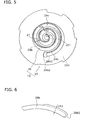
- FIG 5 shows another configuration of the compression mechanism 15 which is different from that shown in FIG 2 .
- FIG 5 is a cross-sectional view along the line II-II in FIG. 1 .
- a ratio h2/d2 (or h1/d1) is preferably greater than or equal to 13 and less than or equal to 19, where h2 (or h1) is the height of the scroll portion 26b (or 24b) from the plate portion 26a (or 24a), and d2 (or d1) is the thickness of the scroll portion 26b (or 24b).
- an end portion 24b2 of the outmost wall of the first scroll portion 24b is supported by another portion 24d of the fixed scroll 24. Therefore, even if the fixed scroll 24 is a semi-molten die cast molding and has the small thickness d1, the material workability of the first scroll portion 24b would not worsen easily.
- an end portion 26b2 of the outmost wall of the second scroll portion 26b is, unlike the end portion 24b2 of the fixed scroll 24, not supported. Therefore, when the second scroll portion 26b, especially the end portion 26b2, is fabricated, its material workability can worsen easily due to the bending thereof.
- a semi-molten die cast molding has 2.4 to 3.6 times more strength than a FC250 casting does (based on "600MPa/250MPa to 900MPa/250MPa")
- the semi-molten die cast molding has no more than 1.6 to 1.7 times more stiffness than a FC250 casting does (based on "175GPa/110GPa to 190GPa/110GPa”). Therefore, when the thickness d2 (or d1) is determined based on the strength so as to prevent rupture, the scroll portion 26b (or 24b) can be bent easily.
- the movable scroll 26 is the semi-molten die cast molding
- a portion near the end portion 26b2 of the outmost wall of the second scroll portion 26b needs to be thicker than the other portions before fabrication.
- the second scroll portion 26b can be fabricated with great precision.
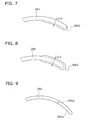
- FIG. 6 , FIG. 7 and FIG 8 shows a configuration of a pre-fabricated second scroll portion 26b.
- FIG. 6 , FIG 7 and FIG. 8 shows only a portion in the proximity of the end portion 26b2 of the outmost wall of the second scroll portion 26b of the movable scroll 26.
- the portion in the proximity of the end portion 26b2 gets thicker on the outer surface than the other portions of the second scroll portion 26b (See thickness d12).
- the portion in the proximity of the end portion 26b2 is fabricated as follows.
- a finishing process is performed to the inner surface of the second scroll portion 26b.
- the second scroll portion 26b does not bent easily, because the portion in the proximity of the end portion 26b2 gets thicker on the outer surface. Therefore, the finishing process can be performed easily.
- the thick portion is trimmed to finish the process for the portion in the proximity of the end portion 26b2.
- the dashed line indicates the shape of the second scroll portion 26b after trimming.
- the portion in the proximity of the end portion 26b2 gets thicker on the inner surface than the other portions of the second scroll portion 26b (See thickness d13).
- the portion in the proximity of the end portion 26b2 is fabricated as follows.
- a finishing process is performed to the outer surface of the second scroll portion 26b.
- the second scroll portion 26b does not bent easily, because the portion near the end portion 26b2 gets thicker on the inner surface. Therefore, the finishing process can be done easily.
- the thick portion is trimmed to finish the process for the portion near the end portion 26b2.
- the dashed line indicates the shape of the second scroll portion 26b after trimming.
- the portion in the proximity of the end portion 26b2 gets thicker on both the outer and inner surfaces than the other portions of the second scroll portion 26b (See thickness d14).
- the portion in the proximity of the end portion 26b2 is fabricated as follows.
- a roughening process and a finishing process are performed to the outer or inner surface of the second scroll portion 26b in this order.
- the second scroll portion 26b does not bent easily due to these processes, because the portion in the proximity of the end portion 26b2 gets thicker on the outer surface. Therefore, the inner surface can be processed easily.
- the thick portion on the outside is trimmed to finish the process.
- the similar process can be performed when the roughening process and the finishing process are performed to the outer surface.
- the dashed line indicates the shape of the second scroll portion 26b after trimming.
- the end portion 26b2 may be formed longer than the above end portions. More specifically, the movable scroll 26 may include further an extended portion 26b4. The extended portion 26b4 extends from the end portion 26b2 of the outmost wall of the second scroll portion 26b, and does not engage with the first scroll portion 24b of the fixed scroll 24.
- the end portion 26b2 of the outmost wall of the second scroll portion 26b has a high strength and high stiffness due to the extended portion 26b4. Therefore, the second scroll portion 26b can be free from deformation during fabrication.
- the extended portion 26b4 may be left unprocessed, or may be cut out. However, when the extended portion 26b4 is left unprocessed, the following problem can occur.
- the first plate portion 24a of the fixed scroll 24 has a through hole 41b through which refrigerant is drawn (hereinafter, the through hole is called "drawing hole"). Therefore, when the extended portion 26b4 covers the drawing hole 41b during the operation of the compression mechanism 15, a loss of the suction pressure will occur, which decreases the compression efficiency.
- the extended portion 26b4 is designed to be placed not to cover the drawing hole 41b during the operation of the compression mechanism 15. As shown in FIG. 10 and FIG 11 , when a side surface of the extended portion 26b4 has a shape of an arc with a radius of r, the extended portion 26b4 is designed as follows.
- a distance d3 between the extended portion 26b4 and the drawing hole 41b needs to be greater than or equal to the radius r (See FIG 10 ).
- the arc-shaped side surface of the extended portion 26b4 is placed away from a sealing point SP by a distance d4 which is greater than or equal to the radius r (See FIG 11 ), where the sealing point SP is an extreme point at which the fixed scroll 24 is in contact with the second scroll portion 26b of the movable scroll 26.
- FIG. 12 is a graph showing the relationship between the ratio of ⁇ S to d2 ( ⁇ S/d2) and the ratio of L2 to d2 (L2/d2), where ⁇ S is the amount of bending of the second scroll portion 26b at the sealing point SP, d2 is the thickness of the second scroll portion 26b, and L2 is the length of the extended portion 26b4.
- the ratio ⁇ S/d2 is preferably less than or equal to 10. This allows a gap to be made between the first scroll portion 24b of the fixed scroll 24 and the second scroll portion 26b of the movable scroll 26, so as not to decrease the compression efficiency. The gap can reduce the interference between the first scroll portion 24b and the second scroll portion 26b, whereby decreases the noise and the chance of rupture.
- the ratio L2/d2 is preferably greater than or equal to 0.3. This case is especially preferable when the above ratio h2/d2 is 13, which is the lower limit of the preferable range of 13 to 19 (See FIG. 12 ). On the other hand, the ratio L2/d2 is preferably greater than or equal to 2.6 when the ratio h2/d2 is 19, which is the upper limit of the preferable range (See FIG 12 ).
- the height of the extended portion 26b4 may be shorter than the height h2 of the second scroll portion 26b.
- the third embodiment describes a relief hole cut in the fixed scroll 24, with regard to the compression mechanism 15 which has the fixed scroll 24 of the grey iron casting (FC250) and the movable scroll 26 of the semi-molten die cast molding.
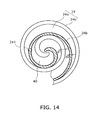
- a relief hole 242 is formed in the fixed scroll 24. More specifically, the relief hole 242 is formed in the first plate portion 24a, and is open between the involuted walls of the first scroll portion 24b.
- the relief hole 242 connects the compression space 40 to a discharge space 45 (See FIG 1 ) which will be described later in "Embodiment of scroll compressor".
- the discharge space 45 is located on the opposite side of the movable scroll 26 across the first plate portion 24a of the fixed scroll 24 (See FIG. 1 ).
- both the fixed scroll 24 and the movable scroll 26 have been formed of the grey iron casting (FC250), where the thickness d1 of the first scroll portion 24b is substantially equal to the thickness d2 of the second scroll portion 26b.
- the thickness d1 and d2 need to be sufficiently large to improve strength and stiffness of the scroll portions 24b and 26b.
- the diameter of the relief hole 242 conventionally needs to be smaller than or equal to the thickness d2 of the second scroll portion 26b so as not to connect the compression spaces 40 on two sides of the second scroll portion 26b to each other via the relief hole 242.
- the thickness d2 has been large
- the diameter of the relief hole 242 has also been large. Therefore, refrigerant passes through the relief hole 242 easily.
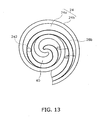
- the thickness d2 of the second scroll portion 26b is small, and the cross-sectional area of the relief hole 241 is equal to that of the conventional relief hole 242 (See FIG. 13 ), the two spaces separated by the second scroll portion 26b in the compression spaces 40 in the compression mechanism 15 will connect to each other, which decreases the compression efficiency.
- FIG 16 is a schematic view of the relief hole 241 applicable in the compression mechanism 15 described in the first and second embodiments.
- FIG 16 is a longitudinal cross-sectional view of the compression mechanism 15 along the arrow 91 shown in FIG 1 .
- the diameter r1 of the opening on the side of the compression space 40 is less than or equal to the thickness d2 of the second scroll portion 26b of the movable scroll 26 (See FIG 16 ).
- the cross-sectional area S2 of the opening on the side of the discharge space 45 is larger than the cross-sectional area S1 of the opening on the side of the compression spaces 40 (See FIG. 16 ).
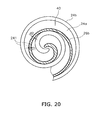
- the relief hole 241 shown in FIG. 16 is a combination of two holes of different cross-sectional areas. However, the relief hole 241 may be one of the relief holes 241 shown in FIG 17 to 21 .
- FIG 17 is a longitudinal cross-sectional view of the compression mechanism 15 along the arrow 91 shown in FIG 1 .
- the cross-sectional area of the relief hole 241 grows gradually from the compression space 40 to the discharge space 45.
- the relief hole 241 shown in FIG 17 has similar effects as the relief hole 241 shown in FIG 16 .
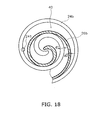
- FIG 18 is a cross-sectional view of the compression mechanism 15 along the line II-II in FIG 1 .
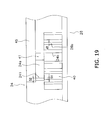
- FIG 19 is a longitudinal cross-sectional view of the compression mechanism 15 shown in FIG. 18 along the arrow 91.
- the relief holes 241 have substantially the same size as the conventional relief hole 242 (See FIG. 13 ).
- the first scroll portion 24b of the fixed scroll 24 covers a portion of the relief hole 241 (See FIG. 18 ).
- the relief hole 241 is covered partly by the first scroll portion 24b of the fixed scroll 24.
- the relief hole 241 shown in FIG. 19 has similar effects as the relief hole 241 shown in FIG 16 .
- a plurality of relief holes 241 are formed in the first plate portion 24a.
- Each of the relief holes 241 has a diameter r1 smaller than the thickness d2 of the second scroll portion 26b.
- the first plate portion 24a may have the relief holes which have the shape of ellipsis.
- a discharge hole 41 in the present embodiment is drawn in solid lines, and a conventional discharge hole 41a is drawn in dashed lines.
- the cross-sectional area of the discharge hole 41 is smaller than that of the conventional discharge hole 41a. This is a design modification which is resulted from the small thickness d2 of the second scroll portion 26b.
- the cross-sectional area of the discharge hole 41 decreases, the amount of refrigerant discharged through the discharge hole 41 decreases.
- the plurality of relief holes 241 formed in the first plate portion 24a can be used as auxiliary discharge holes. Therefore, a decrease of discharged refrigerant can be prevented.
- both the refrigerant discharged from the relief holes 241 and that from the discharge hole 41 flow into the same space.
- both the refrigerant discharged from the relief holes 241 and that from the discharge hole 41 are guided into the discharge space 45 (See FIG.1 and FIG. 19 ). Therefore, the refrigerant discharged from the relief holes 241 can also be used as the refrigerant compressed by the compression mechanism 15.
- the scroll compressor 1 includes the casing 11, the compression mechanism 15, an Oldham's ring 2, a fixed member 12, a motor 16, a crankshaft 17, a suction tube 19, a discharge tube 20, and a bearing 60.
- the casing 11 is a cylindrical body elongated along the arrow 91.
- the Oldham's ring 2, the fixed member 12, the motor 16, the crankshaft 17, and the bearing 60 are disposed inside the casing 11.
- the motor 16 includes a stator 51 and a rotor 52.
- the stator 51 is an annular stator secured to the inner wall 11a of the casing 11.
- the rotor 52 is accommodated inside the stator 51.
- the rotor 52 faces to the stator 51 across an air gap.
- the crankshaft 17 is elongated along the arrow 91, and includes a main shaft portion 17a and an eccentric shaft portion 17b.
- the main shaft portion 17a rotates about a rotational axis 90, and is linked to the rotor 52.
- the eccentric shaft portion 17b is disposed at a position not centered at the rotational axis 90, and is linked to the upper side of the main shaft portion 17a.
- the end of the lower side of the crankshaft 17 is supported slidably by the bearing 60.
- the fixed member 12 is a housing shown in FIG. 1 , and is secured hermetically to the inner wall 11 a of the casing 11.
- the fixed member 12 is secured to the inner wall 11 a through press-fitting, welding, and so forth.
- the fixed member 12 may be secured to the inner wall 11a through sealing.
- the fixed member 12 is secured hermetically to the inner wall 11a. That is, the fixed member 12 separates air-tightly the interior space of the casing 11 into a lower space 28 on the lower side of the fixed member 12 and an upper space 29 on the upper side of the fixed member 12. Therefore, the fixed member 12 can resist the pressure difference between the lower space 28 and the upper space 29.
- the pressure in the upper space 28 is higher than that in the upper space 29.
- the fixed member 12 includes a concaved portion 31 which is opened toward the upper side and is cut around the rotational axis 90.
- the eccentric shaft portion 17b of the crankshaft 17 fits in the concaved portion 31.
- the fixed member 12 also includes a bearing 32 and a through hole 33.
- the main shaft portion 17a of the crankshaft 17 passes through the through hole 33, and is supported by the bearing 32.
- the fixed scroll 24 has a concave surface 42 on its upper side.
- the discharge space 45 is defined by the concaved surface 42 and a lid 44.
- the lid 44 separates two spaces of different pressures. One of the two spaces is the discharge space 45, while the other is the upper space 29.
- the movable scroll 26 includes further a bearing 26c.
- the bearing 26c is linked to the lower side of the second plate portion 26a.
- the bearing 26c supports slidably the eccentric shaft portion 17b of the crankshaft 17.
- the refrigerant flow inside the scroll compressor 1 will now be described with reference to FIG 1 .
- the arrows in FIG.1 indicate the refrigerant flow.
- Refrigerant is drawn via the suction tube 19 to be guided into the compression space 40 in the compression mechanism 15.
- the refrigerant compressed in the compression space 40 is discharged into the discharge space 45 via the discharge hole 41 formed in the proximity of the center of the fixed scroll 24. Therefore; the pressure in the discharge space 45 is high.
- the pressure in the upper space 29 separated from the discharge space 45 by the lid 44 stays low.
- the refrigerant in the discharge space 45 flows into the lower space 28 below the fixed member 12, via a through hole 46 formed in the fixed scroll 24 and a through hole 48 formed in the fixed member 12 in this order.
- the refrigerant is guided into a gap 55 by a guide 58.
- the gap 55 is formed between a portion of a side of the stator 51 and the casing 11.
- the refrigerant flows into the lower side of the motor 16 via the gap 55, and flows into the discharge tube 20 via an air gap in the motor 16 or a gap 56.
- the gap 56 is formed between a portion of a side of the stator 51 and the casing 11.
Landscapes
- Engineering & Computer Science (AREA)
- Mechanical Engineering (AREA)
- General Engineering & Computer Science (AREA)
- Chemical & Material Sciences (AREA)
- Materials Engineering (AREA)
- Metallurgy (AREA)
- Organic Chemistry (AREA)
- Rotary Pumps (AREA)
- Applications Or Details Of Rotary Compressors (AREA)
Applications Claiming Priority (2)
| Application Number | Priority Date | Filing Date | Title |
|---|---|---|---|
| JP2007204780A JP4241862B2 (ja) | 2007-08-06 | 2007-08-06 | 圧縮機構及びスクロール圧縮機 |
| PCT/JP2008/063988 WO2009020106A1 (ja) | 2007-08-06 | 2008-08-05 | 圧縮機構及びスクロール圧縮機 |
Publications (2)
| Publication Number | Publication Date |
|---|---|
| EP2192302A1 true EP2192302A1 (de) | 2010-06-02 |
| EP2192302A4 EP2192302A4 (de) | 2015-04-08 |
Family
ID=40341338
Family Applications (1)
| Application Number | Title | Priority Date | Filing Date |
|---|---|---|---|
| EP08792185.4A Withdrawn EP2192302A4 (de) | 2007-08-06 | 2008-08-05 | Verdichtungsmechanismus und kompressor der spiralbauart |
Country Status (9)
| Country | Link |
|---|---|
| US (1) | US8512017B2 (de) |
| EP (1) | EP2192302A4 (de) |
| JP (1) | JP4241862B2 (de) |
| KR (1) | KR101155511B1 (de) |
| CN (1) | CN101772647B (de) |
| AU (1) | AU2008284809B2 (de) |
| BR (1) | BRPI0815113B1 (de) |
| RU (1) | RU2434161C1 (de) |
| WO (1) | WO2009020106A1 (de) |
Cited By (2)
| Publication number | Priority date | Publication date | Assignee | Title |
|---|---|---|---|---|
| EP3235581A1 (de) | 2016-04-21 | 2017-10-25 | HILTI Aktiengesellschaft | Bohrer |
| EP3309398A4 (de) * | 2015-06-10 | 2018-04-18 | Mitsubishi Electric Corporation | Spiralverdichter |
Families Citing this family (13)
| Publication number | Priority date | Publication date | Assignee | Title |
|---|---|---|---|---|
| US8425211B2 (en) * | 2007-08-22 | 2013-04-23 | Spinnler Engineering | Positive displacement machine according to the spiral principle |
| EP3301303B1 (de) * | 2010-01-22 | 2018-12-05 | Daikin Industries, Ltd. | Spiralverdichter |
| US8944790B2 (en) * | 2010-10-20 | 2015-02-03 | Thermo King Corporation | Compressor with cyclone and internal oil reservoir |
| JP2016003645A (ja) * | 2014-06-19 | 2016-01-12 | 日立アプライアンス株式会社 | スクロール圧縮機および空気調和機 |
| KR102245438B1 (ko) | 2014-08-19 | 2021-04-29 | 엘지전자 주식회사 | 스크롤 압축기 |
| US9890784B2 (en) * | 2015-06-30 | 2018-02-13 | Bitzer Kuehlmaschinenbau Gmbh | Cast-in offset fixed scroll intake opening |
| US10982672B2 (en) * | 2015-12-23 | 2021-04-20 | Emerson Climate Technologies, Inc. | High-strength light-weight lattice-cored additive manufactured compressor components |
| US10557464B2 (en) * | 2015-12-23 | 2020-02-11 | Emerson Climate Technologies, Inc. | Lattice-cored additive manufactured compressor components with fluid delivery features |
| US10634143B2 (en) | 2015-12-23 | 2020-04-28 | Emerson Climate Technologies, Inc. | Thermal and sound optimized lattice-cored additive manufactured compressor components |
| KR102002125B1 (ko) | 2018-03-02 | 2019-07-19 | 엘지전자 주식회사 | 스크롤 압축기 |
| CN109209867B (zh) * | 2018-09-18 | 2024-10-08 | 珠海凌达压缩机有限公司 | 压缩机 |
| RU2763334C1 (ru) * | 2021-05-18 | 2021-12-28 | Леонид Михайлович Курин | Спираль механизма сжатия спирального компрессора |
| CN114962261A (zh) * | 2022-06-20 | 2022-08-30 | 珠海格力电器股份有限公司 | 泵体组件、压缩机以及具有其的空调器 |
Family Cites Families (21)
| Publication number | Priority date | Publication date | Assignee | Title |
|---|---|---|---|---|
| JPS6079189A (ja) * | 1983-10-05 | 1985-05-04 | Hitachi Ltd | スクロ−ル流体機械 |
| US4726100A (en) * | 1986-12-17 | 1988-02-23 | Carrier Corporation | Method of manufacturing a rotary scroll machine with radial clearance control |
| DE3800931A1 (de) * | 1987-01-24 | 1988-08-04 | Volkswagen Ag | Verdraengermaschine fuer kompressible medien |
| US5395222A (en) * | 1989-11-02 | 1995-03-07 | Matsushita Electric Industrial Co., Ltd. | Scroll compressor having recesses on the scroll wraps |
| JPH06317269A (ja) * | 1993-05-10 | 1994-11-15 | Hitachi Ltd | 密閉形スクロール圧縮機 |
| MY119499A (en) * | 1995-12-05 | 2005-06-30 | Matsushita Electric Industrial Co Ltd | Scroll compressor having bypass valves |
| JPH09206908A (ja) * | 1996-01-29 | 1997-08-12 | Kobe Steel Ltd | ダイカスト用鋳鉄素材の加熱方法 |
| US6136101A (en) * | 1996-09-02 | 2000-10-24 | Honda Giken Kogyo Kabushiki Kaisha | Casting material for thixocasting, method for preparing partially solidified casting material for thixocasting, thixo-casting method, iron-base cast, and method for heat-treating iron-base cast |
| US5984653A (en) * | 1997-07-07 | 1999-11-16 | Tecumseh Products Company | Mechanism and method for aligning a fixed scroll in a scroll compressor |
| JPH11210649A (ja) * | 1998-01-22 | 1999-08-03 | Zexel:Kk | スクロール型圧縮機 |
| JP2000257569A (ja) * | 1999-03-04 | 2000-09-19 | Sanden Corp | スクロール圧縮機 |
| JP4440565B2 (ja) * | 2003-06-24 | 2010-03-24 | パナソニック株式会社 | スクロール圧縮機 |
| US20040261970A1 (en) * | 2003-06-27 | 2004-12-30 | Cyco Systems Corporation Pty Ltd. | Method and apparatus for producing components from metal and/or metal matrix composite materials |
| JP2005036693A (ja) | 2003-07-18 | 2005-02-10 | Hitachi Home & Life Solutions Inc | 冷媒圧縮機の製造方法 |
| CN100371598C (zh) * | 2003-08-11 | 2008-02-27 | 三菱重工业株式会社 | 涡旋式压缩机 |
| KR100875049B1 (ko) * | 2004-12-21 | 2008-12-19 | 다이킨 고교 가부시키가이샤 | 스크롤형 유체기계 |
| JP2006207529A (ja) * | 2005-01-31 | 2006-08-10 | Daikin Ind Ltd | 固定スクロールの位置決め装置 |
| JP2007127093A (ja) * | 2005-11-07 | 2007-05-24 | Matsushita Electric Ind Co Ltd | 圧縮機 |
| JP4864426B2 (ja) | 2005-11-15 | 2012-02-01 | 新日本製鐵株式会社 | 鉄系合金の半溶融・半凝固鋳造用の金型 |
| RU63001U1 (ru) | 2006-12-27 | 2007-05-10 | Закрытое акционерное общество "Научно-исследовательский и конструкторский институт центробежных и роторных компрессоров им. В.Б. Шнеппа" | Спиральная машина |
| US7963753B2 (en) * | 2008-01-17 | 2011-06-21 | Bitzer Kuhlmaschinenbau Gmbh | Scroll compressor bodies with scroll tip seals and extended thrust region |
-
2007
- 2007-08-06 JP JP2007204780A patent/JP4241862B2/ja not_active Expired - Fee Related
-
2008
- 2008-08-05 EP EP08792185.4A patent/EP2192302A4/de not_active Withdrawn
- 2008-08-05 BR BRPI0815113-0A patent/BRPI0815113B1/pt not_active IP Right Cessation
- 2008-08-05 AU AU2008284809A patent/AU2008284809B2/en not_active Ceased
- 2008-08-05 RU RU2010108271/06A patent/RU2434161C1/ru active
- 2008-08-05 WO PCT/JP2008/063988 patent/WO2009020106A1/ja not_active Ceased
- 2008-08-05 KR KR1020107004645A patent/KR101155511B1/ko not_active Expired - Fee Related
- 2008-08-05 CN CN2008801021544A patent/CN101772647B/zh active Active
- 2008-08-05 US US12/671,282 patent/US8512017B2/en active Active
Non-Patent Citations (1)
| Title |
|---|
| See references of WO2009020106A1 * |
Cited By (6)
| Publication number | Priority date | Publication date | Assignee | Title |
|---|---|---|---|---|
| EP3309398A4 (de) * | 2015-06-10 | 2018-04-18 | Mitsubishi Electric Corporation | Spiralverdichter |
| US20180142687A1 (en) * | 2015-06-10 | 2018-05-24 | Mitsubishi Electric Corporation | Scroll compressor |
| US10634139B2 (en) | 2015-06-10 | 2020-04-28 | Mitsubishi Electric Corporation | Scroll compressor with different materials and thickness of scroll laps |
| EP3235581A1 (de) | 2016-04-21 | 2017-10-25 | HILTI Aktiengesellschaft | Bohrer |
| WO2017182487A1 (de) | 2016-04-21 | 2017-10-26 | Hilti Aktiengesellschaft | Bohrer |
| US10947788B2 (en) | 2016-04-21 | 2021-03-16 | Hilti Aktiengesellschaft | Drill bit |
Also Published As
| Publication number | Publication date |
|---|---|
| JP2009041378A (ja) | 2009-02-26 |
| KR101155511B1 (ko) | 2012-06-18 |
| JP4241862B2 (ja) | 2009-03-18 |
| BRPI0815113A2 (pt) | 2020-08-04 |
| US20100202910A1 (en) | 2010-08-12 |
| KR20100049097A (ko) | 2010-05-11 |
| AU2008284809A1 (en) | 2009-02-12 |
| WO2009020106A1 (ja) | 2009-02-12 |
| EP2192302A4 (de) | 2015-04-08 |
| CN101772647B (zh) | 2012-06-13 |
| AU2008284809B2 (en) | 2011-02-17 |
| CN101772647A (zh) | 2010-07-07 |
| US8512017B2 (en) | 2013-08-20 |
| BRPI0815113B1 (pt) | 2021-02-02 |
| RU2010108271A (ru) | 2011-09-20 |
| RU2434161C1 (ru) | 2011-11-20 |
Similar Documents
| Publication | Publication Date | Title |
|---|---|---|
| AU2008284809B2 (en) | Compression mechanism and scroll compressor including the same | |
| US8366425B2 (en) | Compressor slider, slider preform, scroll part, and compressor | |
| EP2479435B1 (de) | Spiralverdichter | |
| EP2143950B1 (de) | Spiralglied, verfahren zur herstellung des spiralglieds, verdichtungsmechanismus und spiralverdichter | |
| JP2011017292A (ja) | スクロール圧縮機 | |
| JP2018141427A (ja) | 密閉型スクロール圧縮機 | |
| US11460025B2 (en) | Scroll compressor | |
| JP4760895B2 (ja) | 圧縮機構及びスクロール圧縮機 | |
| JP5109351B2 (ja) | スクロール部材およびそれを備えたスクロール圧縮機 | |
| US12209583B2 (en) | Scroll compressor | |
| EP2141362B1 (de) | Spiralglied, verfahren zu dessen herstellung, verdichtungsmechanismus und spiralverdichter | |
| JP2009270568A (ja) | 軸受ハウジング | |
| JP5329744B2 (ja) | スクロール圧縮機のスクロール部材 | |
| JP2007278271A (ja) | スクロール部材およびそれを備えたスクロール圧縮機 | |
| JP2011111903A (ja) | スクロール圧縮機 | |
| JP4821526B2 (ja) | 圧縮機のスクロール部材およびそれを用いた圧縮機 | |
| JP2009250105A (ja) | スクロール部品 | |
| JP2008240709A (ja) | 圧縮機 | |
| JP2007263107A (ja) | 圧縮機の摺動部品 | |
| JP2010053696A (ja) | 従動スクロール及びその製造方法 |
Legal Events
| Date | Code | Title | Description |
|---|---|---|---|
| PUAI | Public reference made under article 153(3) epc to a published international application that has entered the european phase |
Free format text: ORIGINAL CODE: 0009012 |
|
| 17P | Request for examination filed |
Effective date: 20100226 |
|
| AK | Designated contracting states |
Kind code of ref document: A1 Designated state(s): AT BE BG CH CY CZ DE DK EE ES FI FR GB GR HR HU IE IS IT LI LT LU LV MC MT NL NO PL PT RO SE SI SK TR |
|
| AX | Request for extension of the european patent |
Extension state: AL BA MK RS |
|
| DAX | Request for extension of the european patent (deleted) | ||
| RIC1 | Information provided on ipc code assigned before grant |
Ipc: B22D 17/00 20060101ALI20141216BHEP Ipc: F04C 23/00 20060101ALI20141216BHEP Ipc: C22C 37/00 20060101ALI20141216BHEP Ipc: F04C 18/02 20060101AFI20141216BHEP Ipc: F04C 29/00 20060101ALI20141216BHEP |
|
| RA4 | Supplementary search report drawn up and despatched (corrected) |
Effective date: 20150309 |
|
| RIC1 | Information provided on ipc code assigned before grant |
Ipc: F04C 18/02 20060101AFI20150302BHEP Ipc: F04C 29/00 20060101ALI20150302BHEP Ipc: F04C 23/00 20060101ALI20150302BHEP Ipc: B22D 17/00 20060101ALI20150302BHEP Ipc: C22C 37/00 20060101ALI20150302BHEP |
|
| STAA | Information on the status of an ep patent application or granted ep patent |
Free format text: STATUS: EXAMINATION IS IN PROGRESS |
|
| 17Q | First examination report despatched |
Effective date: 20180222 |
|
| STAA | Information on the status of an ep patent application or granted ep patent |
Free format text: STATUS: THE APPLICATION IS DEEMED TO BE WITHDRAWN |
|
| 18D | Application deemed to be withdrawn |
Effective date: 20200717 |