EP2196480A1 - Geträgerter Katalysator - Google Patents
Geträgerter Katalysator Download PDFInfo
- Publication number
- EP2196480A1 EP2196480A1 EP08021757A EP08021757A EP2196480A1 EP 2196480 A1 EP2196480 A1 EP 2196480A1 EP 08021757 A EP08021757 A EP 08021757A EP 08021757 A EP08021757 A EP 08021757A EP 2196480 A1 EP2196480 A1 EP 2196480A1
- Authority
- EP
- European Patent Office
- Prior art keywords
- catalyst
- carrier material
- particle
- particles
- catalyst particle
- Prior art date
- Legal status (The legal status is an assumption and is not a legal conclusion. Google has not performed a legal analysis and makes no representation as to the accuracy of the status listed.)
- Withdrawn
Links
Images


Classifications
-
- C—CHEMISTRY; METALLURGY
- C08—ORGANIC MACROMOLECULAR COMPOUNDS; THEIR PREPARATION OR CHEMICAL WORKING-UP; COMPOSITIONS BASED THEREON
- C08F—MACROMOLECULAR COMPOUNDS OBTAINED BY REACTIONS ONLY INVOLVING CARBON-TO-CARBON UNSATURATED BONDS
- C08F10/00—Homopolymers and copolymers of unsaturated aliphatic hydrocarbons having only one carbon-to-carbon double bond
-
- C—CHEMISTRY; METALLURGY
- C08—ORGANIC MACROMOLECULAR COMPOUNDS; THEIR PREPARATION OR CHEMICAL WORKING-UP; COMPOSITIONS BASED THEREON
- C08F—MACROMOLECULAR COMPOUNDS OBTAINED BY REACTIONS ONLY INVOLVING CARBON-TO-CARBON UNSATURATED BONDS
- C08F4/00—Polymerisation catalysts
- C08F4/42—Metals; Metal hydrides; Metallo-organic compounds; Use thereof as catalyst precursors
- C08F4/44—Metals; Metal hydrides; Metallo-organic compounds; Use thereof as catalyst precursors selected from light metals, zinc, cadmium, mercury, copper, silver, gold, boron, gallium, indium, thallium, rare earths or actinides
- C08F4/60—Metals; Metal hydrides; Metallo-organic compounds; Use thereof as catalyst precursors selected from light metals, zinc, cadmium, mercury, copper, silver, gold, boron, gallium, indium, thallium, rare earths or actinides together with refractory metals, iron group metals, platinum group metals, manganese, rhenium technetium or compounds thereof
- C08F4/62—Refractory metals or compounds thereof
- C08F4/64—Titanium, zirconium, hafnium or compounds thereof
- C08F4/659—Component covered by group C08F4/64 containing a transition metal-carbon bond
- C08F4/6592—Component covered by group C08F4/64 containing a transition metal-carbon bond containing at least one cyclopentadienyl ring, condensed or not, e.g. an indenyl or a fluorenyl ring
- C08F4/65922—Component covered by group C08F4/64 containing a transition metal-carbon bond containing at least one cyclopentadienyl ring, condensed or not, e.g. an indenyl or a fluorenyl ring containing at least two cyclopentadienyl rings, fused or not
- C08F4/65927—Component covered by group C08F4/64 containing a transition metal-carbon bond containing at least one cyclopentadienyl ring, condensed or not, e.g. an indenyl or a fluorenyl ring containing at least two cyclopentadienyl rings, fused or not two cyclopentadienyl rings being mutually bridged
Definitions
- the present invention relates to particles comprising supported catalysts in a spatially resolved form.
- the catalysts employed in the production of polymers have an essential effect on the properties of the polymers formed such as mechanical properties or rheological properties.
- polymers having a narrow molecular weight distribution (MWD) can be obtained which exhibit great strength.
- a combination of properties is desirable. This can be achieved, for example, by using mixed catalysts, whereby either particles statistically supporting two or more catalysts or a mixture of catalyst particles carrying different catalysts can be employed (cf. Cho et al., J. Mol. Cat. A: Chem. 159 (2000) 203-213 ; Park et al., J. Mol. Cat. A: Chem. 255 (2006) 69-73 ; US 2005/0003950 A1 ). By these procedures, random polymer mixtures are obtained.
- a core-shell polymer structure can be obtained by cascade reaction in two or more reactors, wherein different supported catalysts are present in each reactor (cf., for example, L. Böhm, Angew. Chem. Int. Ed. 2003, 42, 5010-5030 ; Galli et al., Prog. Polym. Sci. 26 (2001) 1287-1336 ).
- the procedures described therein, however, are laborious and, for example, require transfer of process materials into another reactor or use of different monomers. Further, carry-over of the various catalysts cannot be ruled out in these methods.
- the invention relates to a catalyst particle comprising (i) a first area comprising a first carrier material and a first catalyst or catalyst mixture, and (ii) a second area comprising a second carrier material and a second catalyst or catalyst mixture.
- the inventors have been successful in fixing catalysts on a support in spatially resolved form.
- spatially resolved means that the catalysts are in a defined area of the support material and not statistically distributed.
- the invention relates to a spatially resolved, non-statistical distribution of supported catalysts on particles.
- the inventive catalyst particles comprise at least two distinct areas. However, it is also possible to provide catalyst particles having several distinct areas, e.g. at least three, at least five or at least ten distinct areas.
- the respective areas preferably have a dimension of at least 5 nm, preferably of at least 10 nm, more preferably of at least 50 nm.
- Dimension means the characteristic value of an area, e.g. the diameter in case of a spherical area, the layer thickness in case of a layered area, etc.
- the respective provided catalyst is present almost only in the intended area, especially in an amount of > 90 mole%, more preferably ⁇ 95 mole%, even more preferred ⁇ 98 mole%, related to total catalyst species present in that area.
- the catalyst particle has a core-shell structure.
- the core constitutes the first area and the shell constitutes the second area. Spatial resolution thereby can be achieved by applying a second carrier or matrix material onto an existing catalyst particle and immobilizing the second carrier material.
- the catalysts contained in the inventive catalyst particle are supported catalysts.
- the first and second catalyst are supported within the first and second carrier material in a spatially resolved form. That means that the space between the catalyst domains is significantly bigger than the average size distance of two statistically distributed catalyst units.
- the first and second carrier material are made from the same material.
- the carrier materials differ in their structure, e.g. in the particle size of the carrier material.
- the first and second carrier material are provided from different materials.
- the first and second carrier material can be selected from inorganic and/or organic materials, in particular, SiO 2 , MgCl 2 , polystyrene.
- the first carrier material is selected from inorganic materials and the second carrier material is selected from organic materials.
- the use of SiO 2 material as core material and polystyrene particles as second carrier material has turned out to be an especially suitable combination.
- the first carrier material consists of single particles having a diameter from at least 0.5 ⁇ m, preferably 1 ⁇ m, in particular, 5 ⁇ m, more preferably 10 ⁇ m, especially 30 ⁇ m and most preferably 40 ⁇ m and up to 1000 ⁇ m, preferably 500 ⁇ m, in particular, 200 ⁇ m, more preferably 100 ⁇ m and most preferably 80 ⁇ m.
- Said first carrier material being the core material is then preferably covered completely by the second carrier material which is comprised of nanoparticles having a diameter from 10 to 500 nm, preferably from 40 to 200 nm, in particular, from 30 to 100 nm.
- the entire layer of the second carrier material preferably has a thickness of 30 nm to 5 ⁇ m, preferably 80 nm to 2 ⁇ m.
- the structure of the catalyst particle is basically preserved during the polymerization to be carried out and is reflected by the polymer particle formed.
- the inventive catalyst particles contain at least two different catalysts which are applied in spatially resolved form.
- the catalyst basically can be selected from any materials suitable for catalysis, in particular, for the catalysis of polymerization reactions.
- the catalyst systems are olefin catalysts, in particular, (post-)metallocene or Ziegler-Natta catalysts.
- the first catalyst is a (post-)metallocene catalyst and the second catalyst a second (post-)metallocene catalyst as well.
- the first catalyst catalyzes the formation of a hard polymer and/or the second catalyst catalyzes the formation of a soft polymer.
- methylalumoxane (MAO) is preferably used as co-catalyst.
- the catalyst particle is a spherical particle.
- a single particle of SiO 2 in particular, having a diameter of 5 to 200 ⁇ m, preferably from 40 to 100 ⁇ m, is used as a first carrier material.
- SiO 2 as core matrix offers the advantage that uniform break-up takes place upon polymerization and the structure itself is preserved.
- polystyrene is preferred, since it has good application properties.
- polystyrene layer is preferably formed from polystyrene nanoparticles having a diameter of 10 to 200 nm, in particular, 40 to 100 nm, whereby the entire layer preferably has a thickness of 30 nm to 5 ⁇ m.
- the core thus consists of a single particle, whereas the shell consists of many small particles.
- the use of a single core particle enables uniform polymerization while maintaining the structure during the fragmentation process.
- the core particle preferably is porous in order that, first, the catalyst and later on, during polymerization, the monomer can diffuse into it.
- the shell preferably consists of many small particles in order to achieve ordered fragmentation. Upon using a shell of an organic polymer alone, the fragmentation process is adjustable, mostly it is faster than with inorganic carriers. This may lead to an airy product and may low bulk density of the polymer spheres are obtained.
- the invention further relates to a process for producing a catalyst particle as described herein, comprising the steps: (a) providing a first carrier material, (b) applying a first catalyst to the first carrier material, (c) adding a second carrier material, and (d) applying a second catalyst to the second carrier material.
- steps (a) to (d) can be carried out in any order.
- steps (a) to (d) are carried out one after the other.
- the first carrier material e.g. a core particle
- a first catalyst is applied onto said first carrier material, as a result of which a first catalyst particle having the first catalyst supported on the first carrier material is formed.
- a second matrix material e.g. a shell material
- a second catalyst is applied onto the second carrier material.
- the application conditions are adjusted to the respective catalysts and carrier materials.
- first carrier material including a first catalyst and adding thereto a second carrier material already including a second catalyst.
- inventive catalyst particles for example, by charging a first catalyst particle with a second carrier material already containing catalyst.
- the catalyst particles of the invention are especially suitable for the production of polymer particles.
- the invention therefore also relates to a process for the production of polymer particles, wherein at least one monomer species is contacted with at least one catalyst particle as described herein.
- inventive structured catalyst particles leads to the formation of structured polymer particles, wherein, for example, different polymers are present in different areas of the polymer particle.
- polymer particles can be formed which have a hard core formed by polymerization of monomers catalyzed by a first catalyst promoting the formation of hard polymer and a soft shell formed from monomers by catalysis with a second catalyst promoting the formation of soft polymers.
- Such structured polymer particles, in particular, core shell particles can combine desired properties, e.g. mechanical strength in the core and softness for processability in the shell.
- composite materials or films can be formed therefrom.
- the inventive catalyst particles allow to carry out reactions, in particular, polymerization reactions simultaneously or successively on a single catalyst particle. Stepwise build-up or transfer of particles into different reaction areas or different reactors as required in the prior art is thus no longer necessary. Rather, a desired two- or three-dimensional structure of the polymer particle can be produced, starting out from the catalyst particle. This is accomplished by a predetermined particle structure prejudiced by catalyst distribution. According to the invention the reaction, thus, can be carried out in a single reactor.
- polyolefins are formed, so the at least one monomer species is selected from olefins, in particular, ethylene and/or propylene.
- the at least one monomer species is selected from olefins, in particular, ethylene and/or propylene.
- the invention it is possible to form a structured polymer particle by means of different catalysts, starting out from a single monomer species.
- the different polymers which are different especially with regard to their properties, are thereby formed on the respective different first and second catalysts, starting out from the same monomer.
- the polymer particles formed according to the invention in particular, have macroscopic areas from different polymers.
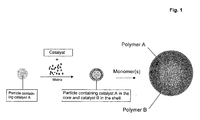
- Fig. 1 schematically shows the production of the inventive catalyst particles as well as their use in the polymerization of a polymer particle.
- a first catalyst particle comprising a first carrier material and catalyst A
- this particle is coated with a second carrier material and a second catalyst B, forming an inventive catalyst particle having catalyst A within the core and catalyst B within the shell.
- Applying monomer(s) to this catalyst particle results in the formation of a structured polymer particle comprising polymer A in the core and polymer B in the shell.
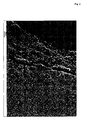
- Fig. 2 shows a cross-section through an inventive catalyst particle (named K81) clearly showing a polystyrene shell (top) covering the silica core (bottom).
- the polystyrene nanoparticles can be distinguished via their spherical shape and typical size range.
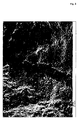
- Fig. 3 shows a core-shell system having only a catalyst, namely a (post)metallocene catalyst, within the shell which has been polymerized for 30 sec. Breaking up of the shell carrier material and formation of polymer threads can be clearly observed.
- Fig. 4 and 5 show a core-shell system having a catalyst, namely a (post)metallocene catalyst, within the shell.
- a catalyst namely a (post)metallocene catalyst
- second carrier material fluorescent labelled polystyrene particles were used.
- Fig. 4 shows the catalyst particle before performing polymerization, showing that no mixing between core and shell matrix materials takes place. Further, Fig. 4 shows complete coating of the core by the second carrier material, indicated by the fluorescent corona.
- Fig. 5 shows the same particle after polymerization of ethylene. Due to the formation of polyethylene within the shell the carrier material is cracked.
- the first catalyst particle was provided in 15 ml toluene and stirred. Thereafter, solution 1 was added dropwise for 2 h. Solution 2 was added dropwise 20 min later for 1.5 h (termination of addition 10 min before termination of addition of solution 1).
- the product (named K81) was dried. Elemental analysis: 11.5% C and 2.4% H.
Landscapes
- Chemical & Material Sciences (AREA)
- Health & Medical Sciences (AREA)
- Chemical Kinetics & Catalysis (AREA)
- Medicinal Chemistry (AREA)
- Polymers & Plastics (AREA)
- Organic Chemistry (AREA)
- Transition And Organic Metals Composition Catalysts For Addition Polymerization (AREA)
Priority Applications (1)
| Application Number | Priority Date | Filing Date | Title |
|---|---|---|---|
| EP08021757A EP2196480A1 (de) | 2008-12-15 | 2008-12-15 | Geträgerter Katalysator |
Applications Claiming Priority (1)
| Application Number | Priority Date | Filing Date | Title |
|---|---|---|---|
| EP08021757A EP2196480A1 (de) | 2008-12-15 | 2008-12-15 | Geträgerter Katalysator |
Publications (1)
| Publication Number | Publication Date |
|---|---|
| EP2196480A1 true EP2196480A1 (de) | 2010-06-16 |
Family
ID=40627698
Family Applications (1)
| Application Number | Title | Priority Date | Filing Date |
|---|---|---|---|
| EP08021757A Withdrawn EP2196480A1 (de) | 2008-12-15 | 2008-12-15 | Geträgerter Katalysator |
Country Status (1)
| Country | Link |
|---|---|
| EP (1) | EP2196480A1 (de) |
Cited By (1)
| Publication number | Priority date | Publication date | Assignee | Title |
|---|---|---|---|---|
| WO2022268953A1 (en) * | 2021-06-24 | 2022-12-29 | Borealis Ag | Process for producing polyethylene polymers |
Citations (7)
| Publication number | Priority date | Publication date | Assignee | Title |
|---|---|---|---|---|
| WO1995026369A1 (en) * | 1994-03-29 | 1995-10-05 | Montell Technology Company Bv | Components and catalysts for the polymerization of olefins |
| US5783645A (en) * | 1994-09-29 | 1998-07-21 | Union Carbide Chemicals & Plastics Technology Corporation | Non-sticky prepolymerized catalyst, and use thereof in production of non-sticky resin |
| US6538080B1 (en) * | 1990-07-03 | 2003-03-25 | Bp Chemicals Limited | Gas phase polymerization of olefins |
| US20030207762A9 (en) * | 2000-12-04 | 2003-11-06 | Wenzel Timothy T. | Catalyst preparation method |
| US20050003950A1 (en) | 2001-11-30 | 2005-01-06 | Mink Robert I. | Method of making mixed ziegler-natta/metallocece catalysts |
| US7015175B2 (en) * | 2001-08-29 | 2006-03-21 | Uop Llc | High-activity isomerization catalyst and process |
| WO2008132059A1 (en) * | 2007-04-30 | 2008-11-06 | Basell Polyolefine Gmbh | Polyethylene, process and catalyst composition for the preparation thereof |
-
2008
- 2008-12-15 EP EP08021757A patent/EP2196480A1/de not_active Withdrawn
Patent Citations (7)
| Publication number | Priority date | Publication date | Assignee | Title |
|---|---|---|---|---|
| US6538080B1 (en) * | 1990-07-03 | 2003-03-25 | Bp Chemicals Limited | Gas phase polymerization of olefins |
| WO1995026369A1 (en) * | 1994-03-29 | 1995-10-05 | Montell Technology Company Bv | Components and catalysts for the polymerization of olefins |
| US5783645A (en) * | 1994-09-29 | 1998-07-21 | Union Carbide Chemicals & Plastics Technology Corporation | Non-sticky prepolymerized catalyst, and use thereof in production of non-sticky resin |
| US20030207762A9 (en) * | 2000-12-04 | 2003-11-06 | Wenzel Timothy T. | Catalyst preparation method |
| US7015175B2 (en) * | 2001-08-29 | 2006-03-21 | Uop Llc | High-activity isomerization catalyst and process |
| US20050003950A1 (en) | 2001-11-30 | 2005-01-06 | Mink Robert I. | Method of making mixed ziegler-natta/metallocece catalysts |
| WO2008132059A1 (en) * | 2007-04-30 | 2008-11-06 | Basell Polyolefine Gmbh | Polyethylene, process and catalyst composition for the preparation thereof |
Non-Patent Citations (8)
| Title |
|---|
| CHO ET AL., J. MOL. CAT. A: CHEM., vol. 159, 2000, pages 203 - 213 |
| G. G. HLATKY, CHEM. REV., vol. 100, 2000, pages 1347 - 1376 |
| GALLI ET AL., PROG. POLYM. SCI., vol. 26, 2001, pages 1287 - 1336 |
| J. R. SEVERN ET AL., CHEM. REV., vol. 105, 2005, pages 4073 - 4147 |
| L. BOHM, ANGEW. CHEM. INT. ED., vol. 42, 2003, pages 5010 - 5030 |
| MÜLLEN, J. OF POL. SCI.: A: POL. CHEM., vol. 44, 2006, pages 3103 - 3113 |
| PARK ET AL., J. MOL. CAT. A: CHEM., vol. 255, 2006, pages 69 - 73 |
| ZHANG J ET AL: "Polymerized metallocene catalysts and late transition metal catalysts for ethylene polymerization", 1 January 2006, COORDINATION CHEMISTRY REVIEWS, ELSEVIER SCIENCE, AMSTERDAM, NL, PAGE(S) 95 - 109, ISSN: 0010-8545, XP025166074 * |
Cited By (3)
| Publication number | Priority date | Publication date | Assignee | Title |
|---|---|---|---|---|
| WO2022268953A1 (en) * | 2021-06-24 | 2022-12-29 | Borealis Ag | Process for producing polyethylene polymers |
| CN117881707A (zh) * | 2021-06-24 | 2024-04-12 | 博里利斯股份公司 | 生产聚乙烯聚合物的方法 |
| JP2024525009A (ja) * | 2021-06-24 | 2024-07-09 | ボレアリス エージー | ポリエチレンポリマーを製造する方法 |
Similar Documents
| Publication | Publication Date | Title |
|---|---|---|
| AU738650B2 (en) | Multistage polymerization process using a catalyst having different catalytically active sites | |
| ES2201821T3 (es) | Procedimiento en varias etapas para preparar poliolefinas con resistencia elevada en estado fundido. | |
| Choi et al. | Supported single‐site catalysts for slurry and gas‐phase olefin polymerisation | |
| CN1290274A (zh) | 利用双中心催化剂得到的聚乙烯 | |
| CA2288265C (en) | Premium pipe resins | |
| TW200932770A (en) | Metallocene catalysts and their use in polymerization processes | |
| JP2003535930A (ja) | 多層クロム触媒によって得られる多峰性分子量分布をもつポリエチレン | |
| US5032651A (en) | Method for producing olefin polymer blends utilizing a chromium-zirconium dual catalyst system | |
| JP2001510865A (ja) | 高活性ポリエチレン触媒 | |
| Hejazi-Dehaghani et al. | Organic versus inorganic supports for metallocenes: the influence of rigidity on the homogeneity of the polyolefin microstructure and properties | |
| Tisse et al. | Role of silica properties in the polymerisation of ethylene using supported metallocene catalysts | |
| KR20240025007A (ko) | 다-단계 폴리올레핀 제조에서의 팽윤제의 용도 | |
| Jiang et al. | Advanced catalyst technology for broad/bimodal polyethylene, achieved by polymer-coated particles supporting hybrid catalyst | |
| EP2196480A1 (de) | Geträgerter Katalysator | |
| EP4438636A1 (de) | Polyolefin mit ausgezeichneter verarbeitbarkeit und verfahren zu seiner herstellung | |
| US5104839A (en) | Method for producing olefin polymer blends utilizing a chromium-zirconium dual catalyst system | |
| Kim et al. | Morphological study of HDPE prepared with the highly active silica supported TiCl4/MgCl2 catalyst | |
| US20050020437A1 (en) | Microparticulate material | |
| WO2002034386A1 (de) | Katalysatorträger, dessen herstellung und verwendung zur olefinpolymerisation | |
| JP7453801B2 (ja) | プロピレン重合体の製造方法 | |
| EP2382248B1 (de) | Verfahren zur herstellung eines bimodalen polyethylenprodukts in einem einzelzirkelreaktor | |
| JP2002241424A (ja) | エチレン系重合体の製造方法 | |
| CN116693729A (zh) | 茂金属催化剂环戊二烯三氯化钛的合成方法 | |
| TWI239265B (en) | A catalyst for the (co)polymerisation of ethylene and a method for the preparation thereof | |
| SA00200970B1 (ar) | عملية لبلمرة الاوليفينات باستخدام انظمة حفاز من نوع Ziegler-Nata |
Legal Events
| Date | Code | Title | Description |
|---|---|---|---|
| PUAI | Public reference made under article 153(3) epc to a published international application that has entered the european phase |
Free format text: ORIGINAL CODE: 0009012 |
|
| AK | Designated contracting states |
Kind code of ref document: A1 Designated state(s): AT BE BG CH CY CZ DE DK EE ES FI FR GB GR HR HU IE IS IT LI LT LU LV MC MT NL NO PL PT RO SE SI SK TR |
|
| AX | Request for extension of the european patent |
Extension state: AL BA MK RS |
|
| AKY | No designation fees paid | ||
| STAA | Information on the status of an ep patent application or granted ep patent |
Free format text: STATUS: THE APPLICATION IS DEEMED TO BE WITHDRAWN |
|
| 18D | Application deemed to be withdrawn |
Effective date: 20101217 |