EP2196690A2 - Drehmomentübertragungsvorrichtung - Google Patents
Drehmomentübertragungsvorrichtung Download PDFInfo
- Publication number
- EP2196690A2 EP2196690A2 EP09015047A EP09015047A EP2196690A2 EP 2196690 A2 EP2196690 A2 EP 2196690A2 EP 09015047 A EP09015047 A EP 09015047A EP 09015047 A EP09015047 A EP 09015047A EP 2196690 A2 EP2196690 A2 EP 2196690A2
- Authority
- EP
- European Patent Office
- Prior art keywords
- shaft
- torque transmission
- transmission device
- bearing
- torque
- Prior art date
- Legal status (The legal status is an assumption and is not a legal conclusion. Google has not performed a legal analysis and makes no representation as to the accuracy of the status listed.)
- Granted
Links
Images

Classifications
-
- F—MECHANICAL ENGINEERING; LIGHTING; HEATING; WEAPONS; BLASTING
- F16—ENGINEERING ELEMENTS AND UNITS; GENERAL MEASURES FOR PRODUCING AND MAINTAINING EFFECTIVE FUNCTIONING OF MACHINES OR INSTALLATIONS; THERMAL INSULATION IN GENERAL
- F16D—COUPLINGS FOR TRANSMITTING ROTATION; CLUTCHES; BRAKES
- F16D25/00—Fluid-actuated clutches
- F16D25/06—Fluid-actuated clutches in which the fluid actuates a piston incorporated in, i.e. rotating with the clutch
- F16D25/062—Fluid-actuated clutches in which the fluid actuates a piston incorporated in, i.e. rotating with the clutch the clutch having friction surfaces
-
- F—MECHANICAL ENGINEERING; LIGHTING; HEATING; WEAPONS; BLASTING
- F02—COMBUSTION ENGINES; HOT-GAS OR COMBUSTION-PRODUCT ENGINE PLANTS
- F02B—INTERNAL-COMBUSTION PISTON ENGINES; COMBUSTION ENGINES IN GENERAL
- F02B41/00—Engines characterised by special means for improving conversion of heat or pressure energy into mechanical power
- F02B41/02—Engines with prolonged expansion
- F02B41/10—Engines with prolonged expansion in exhaust turbines
-
- F—MECHANICAL ENGINEERING; LIGHTING; HEATING; WEAPONS; BLASTING
- F16—ENGINEERING ELEMENTS AND UNITS; GENERAL MEASURES FOR PRODUCING AND MAINTAINING EFFECTIVE FUNCTIONING OF MACHINES OR INSTALLATIONS; THERMAL INSULATION IN GENERAL
- F16D—COUPLINGS FOR TRANSMITTING ROTATION; CLUTCHES; BRAKES
- F16D15/00—Clutches with wedging balls or rollers or with other wedgeable separate clutching members
-
- F—MECHANICAL ENGINEERING; LIGHTING; HEATING; WEAPONS; BLASTING
- F16—ENGINEERING ELEMENTS AND UNITS; GENERAL MEASURES FOR PRODUCING AND MAINTAINING EFFECTIVE FUNCTIONING OF MACHINES OR INSTALLATIONS; THERMAL INSULATION IN GENERAL
- F16D—COUPLINGS FOR TRANSMITTING ROTATION; CLUTCHES; BRAKES
- F16D48/00—External control of clutches
- F16D48/06—Control by electric or electronic means, e.g. of fluid pressure
- F16D48/066—Control of fluid pressure, e.g. using an accumulator
-
- F—MECHANICAL ENGINEERING; LIGHTING; HEATING; WEAPONS; BLASTING
- F16—ENGINEERING ELEMENTS AND UNITS; GENERAL MEASURES FOR PRODUCING AND MAINTAINING EFFECTIVE FUNCTIONING OF MACHINES OR INSTALLATIONS; THERMAL INSULATION IN GENERAL
- F16D—COUPLINGS FOR TRANSMITTING ROTATION; CLUTCHES; BRAKES
- F16D2500/00—External control of clutches by electric or electronic means
- F16D2500/10—System to be controlled
- F16D2500/102—Actuator
- F16D2500/1026—Hydraulic
-
- F—MECHANICAL ENGINEERING; LIGHTING; HEATING; WEAPONS; BLASTING
- F16—ENGINEERING ELEMENTS AND UNITS; GENERAL MEASURES FOR PRODUCING AND MAINTAINING EFFECTIVE FUNCTIONING OF MACHINES OR INSTALLATIONS; THERMAL INSULATION IN GENERAL
- F16D—COUPLINGS FOR TRANSMITTING ROTATION; CLUTCHES; BRAKES
- F16D2500/00—External control of clutches by electric or electronic means
- F16D2500/10—System to be controlled
- F16D2500/106—Engine
- F16D2500/1068—Engine supercharger or turbocharger
-
- F—MECHANICAL ENGINEERING; LIGHTING; HEATING; WEAPONS; BLASTING
- F16—ENGINEERING ELEMENTS AND UNITS; GENERAL MEASURES FOR PRODUCING AND MAINTAINING EFFECTIVE FUNCTIONING OF MACHINES OR INSTALLATIONS; THERMAL INSULATION IN GENERAL
- F16D—COUPLINGS FOR TRANSMITTING ROTATION; CLUTCHES; BRAKES
- F16D2500/00—External control of clutches by electric or electronic means
- F16D2500/30—Signal inputs
- F16D2500/304—Signal inputs from the clutch
- F16D2500/30406—Clutch slip
-
- Y—GENERAL TAGGING OF NEW TECHNOLOGICAL DEVELOPMENTS; GENERAL TAGGING OF CROSS-SECTIONAL TECHNOLOGIES SPANNING OVER SEVERAL SECTIONS OF THE IPC; TECHNICAL SUBJECTS COVERED BY FORMER USPC CROSS-REFERENCE ART COLLECTIONS [XRACs] AND DIGESTS
- Y02—TECHNOLOGIES OR APPLICATIONS FOR MITIGATION OR ADAPTATION AGAINST CLIMATE CHANGE
- Y02T—CLIMATE CHANGE MITIGATION TECHNOLOGIES RELATED TO TRANSPORTATION
- Y02T10/00—Road transport of goods or passengers
- Y02T10/10—Internal combustion engine [ICE] based vehicles
- Y02T10/12—Improving ICE efficiencies
Definitions
- the invention is based on a torque transmission device according to the preamble of claim 1.
- the torque transmitting device may be, for example, a fixed or releasable coupling. If, for structural reasons, a rigid coupling of the two shafts is to be avoided, it is possible, for example, to use a hydrodynamic converter or a friction clutch. In particular, in friction clutches, a friction torque and thus a torque transmission from the first shaft to the second shaft via an adjusting means for adjusting the torque transmission can be adjustable.
- turbocharger turbine to place an exhaust gas turbine for generating useful energy in the exhaust tract of an internal combustion engine and to transmit the torque of the exhaust gas turbine to a second shaft, either the crankshaft of the internal combustion engine or a shaft of a consumer, such as the alternator or the air conditioning compressor, can be.
- the exhaust gas turbine is provided in addition to the turbocharger turbine, the internal combustion engine is also referred to as a turbo-compound engine.
- the problem is that the rotational movement of the second shaft is not synchronized with the rotational movement of the exhaust gas turbine.
- the two waves have different torsional vibrations, i. Periodic fluctuations in the rotational speed, a rigid coupling of the first, connected to the exhaust turbine shaft with the crankshaft in this case is not possible.
- the object of the invention is in particular to provide a robust torque transmission device of the type described above, which allows the coupling of two shafts with different torsional vibrations at low operating costs.
- Another object of the invention is to provide such a torque transmitting device which operates effectively over a wide range of operating conditions.
- the invention is based on a torque transmission device for transmitting a drive torque from a first shaft to a second shaft, comprising at least one roller bearing for coaxially supporting the first shaft relative to the second shaft and an adjusting means for adjusting a torque transmission from the first shaft to the second shaft.
- the adjusting means is formed as a means for varying an axial load of the rolling bearing.
- a rolling bearing for torque transmission, a very low oil consumption can be achieved compared to the obvious solution, which consists in the use of a hydraulic or hydrodynamic torque transmission device.
- hydraulic or hydrodynamic torque converters are very sensitive to contamination in the oil, robustness can be improved and life can be extended. Since rolling bearing assemblies are generally used just to avoid torque transmission, the usability of the rolling bearing as a clutch or as a mechanical torque converter is surprising.
- the torque transmitting device of the present invention can achieve effective, low-loss deployment in a wide range of operating conditions.
- a generic torque transmission device in particular also interesting in such internal combustion engines, which are designed to be operated in a wide speed or load range.
- the adjusting means comprise at least one pressure piston acting on a ring of the roller bearing.
- the axial force can be set structurally simple and precise.
- the pressure force can act either on the outer ring or on the inner ring of the bearing.
- the inner ring may, for example, be connected to a piston fixedly movable in the pressure piston.
- the rolling bearing has oblique raceways, that is, that the rolling bearing is designed as an angular contact bearing, for example as angular contact ball bearings or angular roller bearings.
- a roller bearing has an oblique track in the above-mentioned sense, when a direction perpendicular to the longitudinal direction of the track tangent to a crest line of the track relative to the rotational axis of the bearing is inclined.
- the track may for example have a logarithmic profile. Due to the design of the rolling bearing as an angular contact bearing, a strong dependence of the resultant by a slippage of the rolling bearing friction can be ensured by the force acting on the rolling bearing axial force.
- a particularly low-wear torque transmission device can be achieved if the rolling bearing is designed as a toroidal bearing, d. H. when the treads and / or the rolling elements have a profile that corresponds to a surface section of a toroid.
- a control unit for actuating the actuating means By a control unit for actuating the actuating means, an automatic control of the torque transmission via the torque transmission device can be achieved.
- control unit is designed to evaluate the signals from at least one speed sensor for measuring a speed of one of the shafts and to actuate the actuating means in dependence on the speed, a feedback is possible, whereby a closed-loop control can be implemented.
- control unit is adapted to evaluate the signals from at least two speed sensors for measuring a speed of the first shaft and the speed of the second shaft.
- control unit may comprise, for example, a comparator circuit or a circuit for forming the speed difference between the two shafts.
- the torque transmission device comprises a pressure sensor for measuring the pressure in the pressure chamber.
- the pressure controlled by the control unit can be monitored and regulated in a secure manner to a desired value via a control circuit integrated or implemented in the control unit.
- one of the shafts is designed as a hollow shaft and receives the other shaft in an interior, a compact, space-saving design is possible.
- the first, driven shaft is designed as a hollow shaft and the second shaft is arranged in the interior of the hollow shaft and on the other hand embodiments of the invention with a reverse arrangement are conceivable.
- the torque transmission device with a bearing device for axially fixed bearings designed as a hollow shaft in a housing. Due to the axial fixing of the hollow shaft, the axial force acting on the roller bearing can be exerted in a structurally simple manner via the shaft arranged in the interior of the hollow shaft.
- the second rolling bearing for radially supporting the hollow shaft on the shaft received in its interior, a radial clearance at low axial force on the first, designed for torque transmission bearings can be avoided and tilting of the two waves can be avoided, so that the axes of rotation of the two waves always stay colinear.
- the second rolling bearing may be formed in a favorable and robust embodiment of the invention as a cylindrical roller bearing.
- the advantages of the invention are particularly important, in which case the exhaust gas turbine drives the first shaft of the torque transmission device.
- the torque transmission device according to the invention can be used flexibly in a wide range of operating situations, the thermal energy in the exhaust gas can be effectively utilized, in particular even when the internal combustion engine is operated at a wide range of speeds with a wide variety of loads.
- the torque transmission device according to the invention can surprisingly be used with great profit in internal combustion engines for trucks, whereby fuel savings, improved emission values and a higher torque can be achieved while the engine size remains the same.
- the invention relates to a method for transmitting a drive torque from a first shaft to a second shaft, which are mounted coaxially via a rolling bearing.
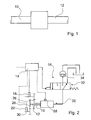
- FIG. 1 shows a torque transmission device or clutch for transmitting a drive torque from a first shaft 10 to a second shaft 12.
- the torque transmission device allows the coupling of two waves 10, 12, even if the speeds of the two shafts 10, 12 are subject to different torsional vibrations or periodic speed fluctuations.
- FIG. 2 shows the torque transmission device FIG. 1 with a control unit 14 and a pressure generating arrangement 16.
- the torque transmission device comprises two speed sensors 18, 20, the signals of which can each be read out via a signal line from the control unit 14.
- the control unit 14 is adapted to evaluate the signals of the two speed sensors 18, 20 for measuring a speed of the first shaft 10 and the speed of the second shaft 12 by an appropriate software that reads out and processes the signals of the speed sensors 18, 20.
- a characteristic curve or a characteristic map is stored in a memory unit, not shown here, of the control unit 14, which at a given pressure in a in FIG. 3 illustrated pressure chamber 22 of an actuating means 24 for adjusting a torque transmission from the first shaft 10 to the second shaft 12 prevailing pressure and depending on the speeds and / or the speed difference indicates the transmitted torque.
- the Drehmomentübernagungshim is part of an internal combustion engine of a truck and the first shaft 10 is connected via a gear 26 to an exhaust turbine, not shown here in an exhaust tract of the engine.
- the second shaft 12 is connected via a further gear 28 with a crankshaft 30 of the internal combustion engine.
- the mediated by the first gear 26 and the second gear 28 translations are chosen such that even at maximum speed of the engine or the crankshaft 30, the speed of the first shaft 10 is higher than the speed of the second shaft 12th
- the control unit 14 is part of an engine control of the internal combustion engine and determines the pressure in the pressure chamber 22 depending on the rotational speeds of the first shaft 10 and the second shaft 12 and depending on the load torque of the internal combustion engine and other engine characteristics such as the amount of air, the injected fuel quantity, different temperatures etc., which are available via a CAN bus.
- the pressure chamber 22 is filled with hydraulic oil, which is fed via an electromagnetic control valve 32 by a pump 34.
- the control unit 14 controls an actuator of the control valve 32 via a control line.
- FIG. 3 shows the torque transmission device from the Figures 1 and 2 in a sectional view.
- the torque transmitting device comprises two rolling bearings 36, 38 for coaxially supporting the first shaft 10 opposite to the second shaft 12 and the adjusting means 24 for adjusting torque transmission from the first shaft 10 to the second shaft 12.
- a first rolling bearing 36 for transmitting torque between the first and the second shaft 12 designed and a second rolling bearing 38 is used for radial mounting of the first shaft 10 on the second shaft 12 is provided.
- the second rolling bearing 38 is formed as a radial cylindrical roller bearing and axially movably attached to the inner ring on the second shaft 12, while the outer ring of the second roller bearing 38 via a collar 40 and a holding member 42 axially and radially fixed in the cavity of the hollow shaft formed second Wave 12 is included.
- the adjusting means 24 is formed as a means for varying an axial load of the first rolling bearing 36.
- the adjusting means 24 comprises, in particular, the pressure chamber 22, the pressure generating arrangement 16 with the pump 34 and the control valve 32, and one arranged in the pressure chamber 22 Spring 44, which is supported on the one hand on a housing 52 of the torque transmitting device and on the other hand rests on an end face 48 of the second shaft 12 via an axial ball bearing 46.
- the front side 48 of the second shaft 12 forms a displaceable wall of the pressure chamber 22 and the second shaft 12 itself is axially displaceably mounted in a bore of the housing 52, the walls of which form the remaining walls of the pressure chamber 22.
- the second shaft 12 acts as an axially displaceable piston or pressure piston 54 in the pressure chamber 22.
- the first shaft 10 is formed as a hollow shaft and receives the second shaft 12 in an interior space.
- the torque transmission device comprises a bearing device 56 composed of two oblique toroidal roller bearings with an opposite bevel for axially and radially fixedly supporting the hollow shaft second shaft 12 in the housing 52.
- the inner ring 58 of the first rolling bearing 36 bears against a step 60 in the profile of the second shaft 12, so that the pressure force acting on the end face 48 of the second shaft 12 in the axial direction is supported via the step 60 on the inner ring 58.
- the adjusting means 24 accordingly comprises a pressure piston 54 acting on the inner ring 58 of the rolling bearing 36.
- the outer ring 62 of the first rolling bearing 36 is supported on a further step 64 in the inner profile of the first shaft 10 designed as a hollow shaft, so that the roller bearings 66 of the first rolling bearing 36 from the inner ring 58 on the outer ring 62 transmitted compressive forces via the further stage 64 are supported on the first shaft 10.
- the rolling bearing 36 is in the in FIG. 3 illustrated embodiment designed as a toroidal bearing oblique raceways, so that a diameter of the slightly curved, conical raceways in the direction of the common axis of rotation of the two shafts 10, 12 tapers.
- the rolling elements 66 slip on the raceways of the inner ring 58 and the outer ring 62.
- the torque transmitting device includes a pressure sensor 68 for measuring the pressure in the pressure chamber 22.
- the control unit 14 detects the pressure in the pressure chamber 22 and compares it with a setpoint. Based on the difference between the detected pressure and the desired value of the pressure in the pressure chamber 22, the control unit 14 regulates the pressure to the desired value.
- the torque transmission device shown is part of an internal combustion engine with an exhaust gas turbine, wherein the exhaust gas turbine via its turbine shaft, the first shaft 10 of the torque transmitting device and wherein the second shaft 12 is connected via the gear 28 with a crankshaft 30 of the internal combustion engine in connection and transmits the torque thereto ( FIG. 2 ).
- the above-described torque transmission device realizes a method of transmitting a drive torque from a first shaft 10 to a second shaft 12 coaxially supported by a rolling bearing 36.
- an axial load of the rolling bearing 36 is varied for adjusting the torque transmission.
- inventive concept is not limited to the embodiment described above.
- the toroidal bearing for example, one or two angular contact ball bearings or tapered roller bearings or tapered bearings could be used.
Landscapes
- Engineering & Computer Science (AREA)
- General Engineering & Computer Science (AREA)
- Mechanical Engineering (AREA)
- Physics & Mathematics (AREA)
- Fluid Mechanics (AREA)
- Chemical & Material Sciences (AREA)
- Combustion & Propulsion (AREA)
- Support Of The Bearing (AREA)
- Friction Gearing (AREA)
- Rolling Contact Bearings (AREA)
- Gear Transmission (AREA)
- General Details Of Gearings (AREA)
Abstract
Description
- Die Erfindung geht aus von Drehmomentübertragungsvorrichtung nach dem Oberbegriff des Anspruchs 1.
- Es sind Kupplungen zum Übertragen eines Antriebsmoments von einer ersten Welle auf eine zweite Welle bekannt, wobei die der ersten Welle gegenüber der zweiten Welle mittels eines Wälzlagers gelagert ist. Die Drehmomentübertragungsvorrichtung kann beispielsweise eine feste oder lösbare Kupplung sein. Wenn aus konstruktiven gründen eine starre Kopplung der beiden Wellen vermeiden werden soll, kann beispielsweise ein hydrodynamischer Wandler oder eine Reibkupplung eingesetzt werden. Insbesondere bei Reibkupplungen können ein Reibmoment und damit eine Drehmomentübertragung von der ersten Welle auf die zweite Welle über ein Stellmittel zum Einstellen der Drehmomentübertragung einstellbar sein.
- Ferner ist es bekannt, zur Steigerung der Effektivität und zur Reduktion der Verluste eines Verbrennungsmotors wenigstens einen Teil der thermischen Verluste im Abgas in Bewegungsenergie umzuwandeln, die beispielsweise in einem Abgasturbolader zur Kompression von Ladungsluft genutzt werden kann.
- Ferner ist es bekannt, zusätzlich oder alternativ zu einer Turboladerturbine eine Abgasturbine zum Erzeugen von Nutzenergie im Abgastrakt eines Verbrennungsmotors zu platzieren und das Drehmoment der Abgasturbine auf eine zweite Welle zu übertragen, die entweder die Kurbelwelle des Verbrennungsmotors oder eine Welle eines Verbrauchers, beispielsweise der Lichtmaschine oder des Klimakompressors, sein kann. Wenn die Abgasturbine zusätzlich zur Turboladerturbine vorgesehen ist, wird der Verbrennungsmotor auch als Turbo-Compound-Motor bezeichnet.
- Problematisch ist, dass die Drehbewegung der zweiten Welle nicht mit der Drehbewegung der Abgasturbine synchron ist. Bei der Übertragung des Antriebsmoments der Abgasturbine auf die Kurbelwelle sind sinusoidale Schwankungen der Drehzahl der Kurbelwelle mit einer Frequenz, die der Frequenz Zündtakts entspricht, vorhanden, während die Drehzahl der Abgasturbine keine oder allenfalls sehr viel geringere Schwankungen mit dieser Frequenz zeigt. Da die beiden Wellen unterschiedliche Drehschwingungen, d.h. periodische Schwankungen in der Rotationsgeschwindigkeit, aufweisen, ist eine starre Kopplung der ersten, mit der Abgasturbine verbundenen Welle mit der Kurbelwelle in diesem Fall nicht möglich.
- Die Aufgabe der Erfindung besteht insbesondere darin, eine robuste Drehmomentübertragungsvorrichtung der oben beschriebenen Art zu schaffen, die die Kopplung zweier Wellen mit unterschiedlichen Drehschwingungen bei geringen Betriebskosten erlaubt. Eine weitere Aufgabe der Erfindung besteht darin, eine solche Drehmomentübertragungsvorrichtung zu schaffen, die über ein breites Spektrum von Betriebszuständen effektiv arbeitet.
- Die Aufgabe wird erfindungsgemäß durch die Merkmale des unabhängigen Patentanspruchs 1 gelöst, während vorteilhafte Ausgestaltungen und Weiterbildungen der Erfindung den Unteransprüchen entnommen werden können.
- Die Erfindung geht aus von einer Drehmomentübertragungsvorrichtung zum Übertragen eines Antriebsmoments von einer ersten Welle auf eine zweite Welle, umfassend wenigstens ein Wälzlager zum koaxialen Lagern der ersten Welle gegenüber der zweiten Welle und ein Stellmittel zum Einstellen einer Drehmomentübertragung von der ersten Welle auf die zweite Welle.
- Es wird vorgeschlagen, dass das Stellmittel als ein Mittel zum Variieren einer axialen Last des Wälzlagers ausgebildet ist. Durch die Verwendung eines Wälzlagers zur Drehmomentübertragung kann im Vergleich zu der nahe liegenden Lösung, die in der Verwendung einer hydraulischen bzw. hydrodynamischen Drehmomentübertragungsvorrichtung besteht, ein sehr geringer Ölverbrauch erzielt werden. Da hydraulische bzw. hydrodynamische Drehmomentwandler sehr empfindlich gegenüber Verschmutzungen im Öl sind, kann zudem die Robustheit verbessert werden und die Lebensdauer kann verlängert werden. Da Wälzlageranordnungen im Allgemeinen gerade zur Vermeidung einer Drehmomentübertragung genutzt werden, ist die Verwendbarkeit des Wälzlagers als Kupplung bzw. als mechanischer Drehmomentwandler überraschend.
- Während bekannte, hydraulische Drehmomentübertragungsvorrichtungen für einen Betriebspunkt optimiert sind, kann durch die erfindungsgemäße Drehmomentübertragungsvorrichtung ein effektiver, verlustarmer Einsatz in einem breiten Spektrum von Betriebszuständen erreicht werden. Dadurch wird der Einsatz einer gattungsgemäßen Drehmomentübertragungsvorrichtung insbesondere auch in solchen Verbrennungsmotoren interessant, die dazu ausgelegt sind, in einem breiten Drehzahl- bzw. Lastbereich betrieben zu werden.
- Durch die erfindungsgemäße Drehmomentübertragungsvorrichtung sind damit Einsparungspotenziale sowohl in der Herstellung als auch in den Betriebskosten realisierbar und eine effektive Nutzung der über die Drehmomentübertragungsvorrichtung verlustarm übertragenen Energie kann in einem breiten Spektrum von Betriebsbedingungen ermöglicht werden.
- In einer Weiterbildung der Erfindung wird vorgeschlagen, dass das Stellmittel wenigstens einen auf einen Ring des Wälzlagers wirkenden Druckkolben umfasst. Dadurch kann die Axialkraft konstruktiv einfach und präzise eingestellt werden. Je nach der Bauart der Drehmomentübertragungsvorrichtung kann die Druckkraft entweder auf den Außenring oder auf den Innenring des Wälzlagers wirken. Der Innenring kann beispielsweise auf ein fest mit einem in dem Druckkolben beweglichen Kolben verbunden sein.
- Ferner wird vorgeschlagen, dass das Wälzlager schräge Laufbahnen aufweist, d.h. dass das Wälzlager als Schräglager, beispielsweise als Schrägkugellager oder Schrägwalzenlager ausgebildet ist. Ein Wälzlager hat eine schräge Laufbahn im dem oben genannten Sinne, wenn eine senkrecht zur Längsrichtung der Laufbahn gerichtete Tangente an eine Scheitellinie der Laufbahn gegenüber der Rotationsachse des Wälzlagers geneigt ist. Die Laufbahn kann beispielsweise ein logarithmisches Profil haben. Durch die Ausbildung des Wälzlagers als Schräglager kann eine starke Abhängigkeit der durch einen Schlupf der Wälzkörper entstehenden Lagerreibung von der auf das Wälzlager wirkenden Axialkraft gewährleistet werden. Durch die Lagerreibung wird ein Drehmoment vom antriebsseitigen Ring des Lagers auf einen abtriebsseitigen Ring des Lagers übertragen, was schließlich in einer Drehmomentübertragung über das Wälzlager resultiert. Durch die Ausbildung des Wälzlagers als Schräglager kann eine eindeutige Abhängigkeit des übertragenen Drehmoments von der Axialkraft erreicht werden.
- Eine besonders verschleißarme Drehmomentübertragungsvorrichtung kann erreicht werden, wenn das Wälzlager als Toroidallager ausgebildet ist, d. h. wenn die Laufflächen und/oder die Wälzkörper ein Profil haben, das einem Oberflächenausschnitt eins Toroids entspricht.
- Durch eine Steuereinheit zum Betätigen des Stellmittels, kann eine automatische Steuerung der Drehmomentübertragung über die Drehmomentübertragungsvorrichtung erreicht werden.
- Wenn die Steuereinheit dazu ausgelegt ist, die Signale von wenigstens einem Drehzahlsensor zum Messen einer Drehzahl einer der Wellen auszuwerten und das Stellmittel abhängig von der Drehzahl zu betätigen, ist eine Rückkopplung möglich, wodurch ein geschlossener Regelkreis implementiert werden kann.
- Die Drehmomentübertragung kann beispielsweise durch die Überwachung einer Drehzahldifferenz verifiziert werden, wenn in einer weiteren vorteilhaften Ausgestaltung der Erfindung die Steuereinheit dazu ausgelegt ist, die Signale von wenigstens zwei Drehzahlsensoren zum Messen einer Drehzahl der ersten Welle und der Drehzahl der zweiten Welle auszuwerten. Dazu kann die Steuereinheit beispielsweise eine Komparatorschaltung oder eine Schaltung zum Bilden der Drehzahldifferenz zwischen den beiden Wellen umfassen.
- Ferner wird vorgeschlagen, dass die Drehmomentübertragungsvorrichtung einen Drucksensor zum Messen des Drucks in der Druckkammer umfasst. Dadurch kann der von der Steuereinheit angesteuerte Druck überwacht werden und über einen in der Steuereinheit integrierten bzw. implementierten Regelkreis in einer sicheren Weise auf einen Sollwert geregelt werden.
- Wenn eine der Wellen als Hohlwelle ausgebildet ist und die andere Welle in einem Innenraum aufnimmt, ist eine kompakte, Bauraum sparende Bauweise möglich. Dabei sind einerseits Ausgestaltungen der Erfindung denkbar, in denen die erste, angetriebene Welle als Hohlwelle ausgebildet ist und die zweite Welle in Innenraum der Hohlwelle angeordnet ist und andererseits wären Ausgestaltungen der Erfindung mit einer umgekehrten Anordnung denkbar.
- Ferner wird vorgeschlagen, die Drehmomentübertragungsvorrichtung mit einer Lagervorrichtung zum axial festen Lagern der als Hohlwelle ausgebildeten Welle in einem Gehäuse auszustatten. Durch die axiale Festlegung der Hohlwelle kann die auf das Wälzlager wirkende Axialkraft in einer konstruktiv einfachen Weise über die im Innenraum der Hohlwelle angeordnete Welle ausgeübt werden.
- Wenn der Druck in der Druckkammer auf eine axiale Stirnseite der in dem Innenraum der Hohlwelle angeordneten Welle wirkt, ist eine ungezwungene Kraftübertragung von der Druckkammer auf das Wälzlager erreichbar.
- Durch ein zweites Wälzlager zum radialen Lagern der Hohlwelle auf der in ihrem Innenraum aufgenommenen Welle kann ein Radialspiel bei geringer Axialkraft auf das erste, zur Drehmomentübertragung ausgelegte Wälzlager vermieden werden und ein Verkippen der beiden Wellen kann vermieden werden, so dass die Rotationsachsen der beiden Wellen stets kolinear bleiben. Das zweite Wälzlager kann in einer vorteilhaften und robusten Ausgestaltung der Erfindung als Zylinderrollenlager ausgebildet sein.
- In einem Verbrennungsmotor mit einer Abgasturbine und einer Drehmomentübertragungsvorrichtung der oben beschriebenen Art kommen die Vorteile der Erfindung besonders zum Tragen, wobei in diesem Fall die Abgasturbine die erste Welle der Drehmomentübertragungseinrichtung antreibt. Da die erfindungsgemäße Drehmomentübertragungsvorrichtung flexibel in einem breiten Bereich von Betriebssituationen einsetzbar ist, kann die thermische Energie im Abgas effektiv ausgenutzt werden, und zwar insbesondere auch dann, wenn der Verbrennungsmotor in einem breiten Bereich von Drehzahlen mit den verschiedensten Lasten betrieben wird. Dadurch kann die erfindungsgemäße Drehmomentübertragungsvorrichtung überraschenderweise mit großem Gewinn in Verbrennungsmotoren für Lastkraftwagen eingesetzt werden, wodurch Kraftstoffeinsparungen, verbesserte Emissionswerte und ein höheres Drehmoment bei gleich bleibender Motorgröße erreicht werden können.
- Der letztgenannte Vorteil des höheren Drehmoments bei gleich bleibender Motorgröße kann insbesondere dann erreicht werden, wenn zweite Welle der Drehmomentübertragungseinrichtung eine Kurbelwelle des Verbrennungsmotors ist oder zumindest über ein Getriebe mit der Kurbelwelle verbunden ist.
- Zudem betrifft die Erfindung ein Verfahren zum Übertragen eines Antriebsmoments von einer ersten Welle auf eine zweite Welle, die über ein Wälzlager koaxialen gelagert sind.
- Es wird vorgeschlagen, dass zum Einstellen der Drehmomentübertragung eine axiale Last des Wälzlagers variiert wird. Wie bereits im Zusammenhang mit der erfindungsgemäßen Drehmomentübertragungsvorrichtung erläutert, kann durch die Verwendung eines Wälzlagers zur Drehmomentübertragung im Vergleich zu der nahe liegenden Lösung, die in der Verwendung einer hydraulischen bzw. hydrodynamischen Drehmomentübertragungsvorrichtung besteht, ein sehr geringer Ölverbrauch erzielt werden. Da hydraulische bzw. hydrodynamische Drehmomentwandler sehr empfindlich gegenüber Verschmutzungen im Öl sind, kann zudem die Robustheit verbessert werden und die Lebensdauer kann verlängert werden. Letztlich sind dadurch Kosteneinsparungspotenziale realisierbar.
- Weitere Vorteile ergeben sich aus der folgenden Zeichnungsbeschreibung. In der Zeichnung ist ein Ausführungsbeispiel der Erfindung dargestellt. Die Zeichnung, die Beschreibung und die Ansprüche enthalten zahlreiche Merkmale in Kombination. Der Fachmann wird die Merkmale zweckmäßigerweise auch einzeln betrachten und zu sinnvollen weiteren Kombinationen zusammenfassen.
- Es zeigen:
- Figur 1
- eine schematische Darstellung einer Drehmomentübertragungsvorrichtung zum Übertragen eines Antriebsmoments von einer ersten Welle auf eine zweite Welle,
- Figur 2
- die Drehmomentübertragungsvorrichtung aus
Figur 1 mit einer Steuereinheit und einer Druckerzeugungsanordnung und - Figur 3
- die Drehmomentübertragungsvorrichtung aus den
Figuren 1 und 2 in einer Schnittdarstellung. -
Figur 1 zeigt eine Drehmomentübertragungsvorrichtung bzw. Kupplung zum Übertragen eines Antriebsmoments von einer ersten Welle 10 auf eine zweite Welle 12. Die Drehmomentübertragungseinrichtung erlaubt die Kopplung der beiden Wellen 10, 12 auch dann, wenn die Drehzahlen der beiden Wellen 10, 12 unterschiedlichen Drehschwingungen bzw. periodischen Drehzahlschwankungen unterliegen. -
Figur 2 zeigt die Drehmomentübertragungsvorrichtung ausFigur 1 mit einer Steuereinheit 14 und einer Druckerzeugungsanordnung 16. Die Drehmomentübertragungsvorrichtung umfasst zwei Drehzahlsensoren 18, 20, deren Signale jeweils über eine Signalleitung von der Steuereinheit 14 ausgelesen werden können. Die Steuereinheit 14 ist durch eine entsprechende Software, die die Signale der Drehzahlsensoren 18, 20 ausliest und verarbeitet, dazu ausgelegt, die Signale der beiden Drehzahlsensoren 18, 20 zum Messen einer Drehzahl der ersten Welle 10 und der Drehzahl der zweiten Welle 12 auszuwerten. Dazu ist in einer hier nicht dargestellten Speichereinheit der Steuereinheit 14 eine Kennlinie bzw. ein Kennfeld gespeichert, welches bei vorgegebenem Druck in einer inFigur 3 dargestellten Druckkammer 22 eines Stellmittels 24 zum Einstellen einer Drehmomentübertragung von der ersten Welle 10 auf die zweite Welle 12 herrschendem Druck und abhängig von den Drehzahlen und/oder der Drehzahldifferenz das übertragene Drehmoment angibt. - Die Drehmomentübernagungseinheit ist Teil eines Verbrennungsmotors eines Lastkraftwagens und die erste Welle 10 ist über ein Zahnrad 26 mit einer hier nicht dargestellten Abgasturbine in einem Abgastrakt des Verbrennungsmotors verbunden. Die zweite Welle 12 ist über ein weiteres Zahnrad 28 mit einer Kurbelwelle 30 des Verbrennungsmotors verbunden. Die durch das erste Zahnrad 26 und das zweite Zahnrad 28 vermittelten Übersetzungen sind derart gewählt, dass auch bei maximaler Drehzahl des Verbrennungsmotors bzw. der Kurbelwelle 30 die Drehzahl der ersten Welle 10 höher ist als die Drehzahl der zweiten Welle 12.
- Die Steuereinheit 14 ist Teil einer Motorsteuerung des Verbrennungsmotors und bestimmt den Druck in der Druckkammer 22 abhängig von den Drehzahlen der ersten Welle 10 und der zweiten Welle 12 und abhängig vom Lastmoment des Verbrennungsmotors und von anderen Motorkenngrößen wie der Luftmenge, der eingespritzten Kraftstoffmenge, verschiedenen Temperaturen etc., die über einen CAN-Bus verfügbar sind.
- Die Druckkammer 22 ist mit Hydrauliköl gefüllt, das über ein elektromagnetisches Regelventil 32 von einer Pumpe 34 eingespeist wird. Die Steuereinheit 14 steuert einen Aktor des Regelventils 32 über eine Steuerleitung.
-
Figur 3 zeigt die Drehmomentübertragungsvorrichtung aus denFiguren 1 und 2 in einer Schnittdarstellung. Die Drehmomentübertragungsvorrichtung umfasst zwei Wälzlager 36, 38 zum koaxialen Lagern der ersten Welle 10 gegenüber der zweiten Welle 12 und das Stellmittel 24 zum Einstellen einer Drehmomentübertragung von der ersten Welle 10 auf die zweite Welle 12. Dabei ist ein erstes Wälzlager 36 zur Drehmomentübertragung zwischen der ersten und der zweiten Welle 12 ausgelegt und ein zweites Wälzlager 38 dient zur radialen Lagerung der ersten Welle 10 auf der zweiten Welle 12 vorgesehen. Das zweite Wälzlager 38 ist als Radial - Zylinderrollenlager ausgebildet und mit dem Innenring axial beweglich auf die zweite Welle 12 aufgesteckt, während der Außenring des zweiten Wälzlagers 38 über einen Bund 40 und ein Halteelement 42 axial und radial fest in dem Hohlraum der aus Hohlwelle ausgebildeten zweiten Welle 12 aufgenommen ist. - Erfindungsgemäß ist das Stellmittel 24 als ein Mittel zum Variieren einer axialen Last des ersten Wälzlagers 36 ausgebildet. Das Stellmittel 24 umfasst insbesondere die Druckkammer 22, die Druckerzeugungsanordnung 16 mit der Pumpe 34 und dem Regelventil 32 und eine in der Druckkammer 22 angeordnete Feder 44, die sich einerseits an einem Gehäuse 52 der Drehmomentübertragungsvorrichtung abstützt und andererseits über ein Axialkugellager 46 an einer Stirnseite 48 der zweiten Welle 12 anliegt. Die Stirnseite 48 der zweiten Welle 12 bildet eine verschiebbare Wand der Druckkammer 22 und die zweite Welle 12 selbst ist axial verschiebbar in einer Bohrung des Gehäuses 52 gelagert, deren Wände die übrigen Wände der Druckkammer 22 bilden. Dadurch wirkt die zweite Welle 12 als axial verschiebbarer Kolben bzw. Druckkolben 54 in der Druckkammer 22.
- Die erste Welle 10 ist als Hohlwelle ausgebildet und nimmt die zweite Welle 12 in einem Innenraum auf. Außerdem weist die Drehmomentübertragungsvorrichtung eine aus zwei schrägen Toroidal - Rollenlagern mit entgegen gesetzter Schräge zusammengesetzte Lagervorrichtung 56 zum axial und radial festen Lagern der als Hohlwelle ausgebildeten zweiten Welle 12 in dem Gehäuse 52 auf.
- Der Innenring 58 des ersten Wälzlagers 36 liegt an einer Stufe 60 im Profil der zweiten Welle 12 an, so dass die auf die Stirnseite 48 der zweiten Welle 12 in der axialen Richtung wirkende Druckkraft über die Stufe 60 am Innenring 58 abgestützt wird. Das Stellmittel 24 umfasst demnach einen auf den Innenring 58 des Wälzlagers 36 wirkenden Druckkolben 54.
- Der Außenring 62 des ersten Wälzlagers 36 ist andererseits in der Richtung, in welcher der Druck in der Druckkammer 22 wirkt, an einer weiteren Stufe 64 im Innenprofil der als Hohlwelle ausgebildeten ersten Welle 10 abgestützt, so dass die über die Wälzkörper 66 des ersten Wälzlagers 36 vom Innenring 58 auf den Außenring 62 übertragenen Druckkräfte über die weitere Stufe 64 an der ersten Welle 10 abgestützt werden.
- Das Wälzlager 36 ist in dem in
Figur 3 dargestellten Ausführungsbeispiel als Toroidallager schrägen Laufbahnen ausgebildet, so dass ein Durchmesser der leicht gewölbten, kegelartigen Laufbahnen sich in der Richtung der gemeinsamen Rotationsachse der beiden Wellen 10, 12 verjüngt. Die auf den Innenring 58 ausgeübte axiale Kraft, die über die Wälzkörper 66 übertragen wird erzeugt wegen der Neigung der Laufbahnen in der axialen Richtung daher eine starke radiale Kraftkomponente, mit welcher die Wälzkörper 66 fest an die Laufbahnen angepresst werden. - Ferner laufen die Wälzkörper 66 aufgrund des in der axialen Richtung sich verringernden Durchmessers der Laufbahnen und der walzenartigen, beinahe zylindrischen Form der Wälzkörper 66 mit einem Schlupf auf den Laufbahnen des Innenrings 58 und des Außenrings 62. Je größer die Kraft ist, mit welcher die Wälzkörper 66 auf die Laufbahnen gepresst werden, desto größer ist das durch den Schlupf erzeugten Reibmoment. Daher kann durch eine geeignete Wahl des Drucks in der Druckkammer 22 das Reibmoment des ersten Wälzlagers 36 und damit das über das Wälzlager 36 von der ersten Welle 10 auf die zweite Welle 12 übertragene Drehmoment eingestellt werden.
- Ferner umfasst die Drehmomentübertragungsvorrichtung einen Drucksensor 68 zum Messen des Drucks in der Druckkammer 22. Die Steuereinheit 14 erfasst den Druck in der Druckkammer 22 und vergleicht ihn mit einem Sollwert. Ausgehend von der Differenz zwischen dem erfassten Druck und dem Sollwert des Drucks in der Druckkammer 22 regelt die Steuereinheit 14 den Druck auf den Sollwert.
- Die in den
Figuren 1 - 3 dargestellte Drehmomentübertragungsvorrichtung ist Teil eines Verbrennungsmotors mit einer Abgasturbine, wobei die Abgasturbine über ihre Turbinenwelle die erste Welle 10 der Drehmomentübertragungseinrichtung antreibt und wobei die zweite Welle 12 über das Zahnrad 28 mit einer Kurbelwelle 30 des Verbrennungsmotors in Verbindung steht und das Drehmoment auf diese überträgt (Figur 2 ). - Die oben beschriebene Drehmomentübertragungsvorrichtung realisiert ein Verfahren zum Übertragen eines Antriebsmoments von einer ersten Welle 10 auf eine zweite Welle 12, die über ein Wälzlager 36 koaxial gelagert sind. Nach dem erfindungsgemäßen Verfahren wird zum Einstellen der Drehmomentübertragung eine axiale Last des Wälzlagers 36 variiert.
- Der Erfindungsgedanke ist nicht auf das oben beschriebene Ausführungsbeispiel beschränkt. Statt des Toroidallagers könnten beispielsweise auch ein oder zwei Schrägkugellager oder Schrägrollen- bzw. Kegellager verwendet werden.
-
- 10
- Welle
- 12
- Welle
- 14
- Steuereinheit
- 16
- Druckerzeugungsanordnung
- 18
- Drehzahlsensor
- 20
- Drehzahlsensor
- 22
- Druckkammer
- 24
- Stellmittel
- 26
- Zahnrad
- 28
- Zahnrad
- 30
- Kurbelwelle
- 32
- Regelventil
- 34
- Pumpe
- 36
- Wälzlager
- 38
- Wälzlager
- 40
- Bund
- 42
- Halteelement
- 44
- Feder
- 46
- Axialkugellager
- 48
- Stirnseite
- 52
- Gehäuse
- 54
- Druckkolben
- 56
- Lagervorrichtung
- 58
- Innenring
- 60
- Stufe
- 62
- Außenring
Claims (14)
- Drehmomentübertragungsvorrichtung zum Übertragen eines Antriebsmoments von einer ersten Welle (10) auf eine zweite Welle (12), umfassend wenigstens ein Wälzlager (36) zum koaxialen Lagern der ersten Welle (10) gegenüber der zweiten Welle (12) und ein Stellmittel (24) zum Einstellen einer Drehmomentübertragung von der ersten Welle (10) auf die zweite Welle (12), dadurch gekennzeichnet, dass das Stellmittel (24) als ein Mittel zum Variieren einer axialen Last des Wälzlagers (36) ausgebildet ist.
- Drehmomentübertragungsvorrichtung nach Anspruch 1, dadurch gekennzeichnet, dass das Stellmittel (24) wenigstens einen auf einen Ring des Wälzlagers (36) wirkenden Druckkolben (54) in einer Druckkammer (22) umfasst.
- Drehmomentübertragungsvorrichtung nach einem der vorhergehenden Ansprüche, dadurch gekennzeichnet, dass das Wälzlager (36) schräge Laufbahnen aufweist.
- Drehmomentübertragungsvorrichtung nach einem der vorhergehenden Ansprüche, dadurch gekennzeichnet, dass Wälzlager (36) als Toroidallager ausgebildet ist.
- Drehmomentübertragungsvorrichtung nach einem der vorhergehenden Ansprüche, gekennzeichnet durch eine Steuereinheit (14) zum Betätigen des Stellmittels (24).
- Drehmomentübertragungsvorrichtung nach Anspruch 5, dadurch gekennzeichnet, dass die Steuereinheit (14) dazu ausgelegt ist, die Signale von wenigstens einem Drehzahlsensor (18, 20) zum Messen einer Drehzahl einer der Wellen (10, 12) auszuwerten und das Stellmittel (24) abhängig von der Drehzahl zu betätigen.
- Drehmomentübertragungsvorrichtung nach Anspruch 6, dadurch gekennzeichnet, dass die Steuereinheit (14) dazu ausgelegt ist, die Signale von wenigstens zwei Drehzahlsensoren (18, 20) zum Messen einer Drehzahl der ersten Welle (10) und der Drehzahl der zweiten Welle (12) auszuwerten.
- Drehmomentübertragungsvorrichtung nach einem der vorhergehenden Ansprüche, gekennzeichnet durch einen Drucksensor (68) zum Messen des Drucks in einer Druckkammer (22) zum Erzeugen einer auf das Wälzlager (36) wirkenden Druckkraft.
- Drehmomentübertragungsvorrichtung nach einem der vorhergehenden Ansprüche, dadurch gekennzeichnet, dass eine der Wellen (10) als Hohlwelle ausgebildet ist und die andere Welle (12) in einem Innenraum aufnimmt.
- Drehmomentübertragungsvorrichtung nach Anspruch 9, gekennzeichnet durch eine Lagervorrichtung (56) zum axial festen Lagern der als Hohlwelle ausgebildeten Welle in einem Gehäuse (52).
- Drehmomentübertragungsvorrichtung nach Anspruch 2 und Anspruch 9 oder 10, dadurch gekennzeichnet, dass der Druck in der Druckkammer (22) auf eine axiale Stirnseite (48) der in dem Innenraum der Hohlwelle angeordneten Welle (10) wirkt.
- Drehmomentübertragungseinrichtung nach einem der Ansprüche 9 - 11, gekennzeichnet durch ein zweites Wälzlager (36) zum radialen Lagern der Hohlwelle (10) auf der in ihrem Innenraum aufgenommenen Welle (12).
- Verbrennungsmotor mit einer Abgasturbine und einer Drehmomentübertragungseinrichtung nach einem der vorhergehenden Ansprüche, wobei die Abgasturbine die erste Welle (10) der Drehmomentübertragungseinrichtung antreibt.
- Verbrennungsmotor nach Anspruch 13, dadurch gekennzeichnet, dass die zweite Welle (12) der Drehmomentübertragungseinrichtung zumindest mit einer Kurbelwelle (30) des Verbrennungsmotors verbunden ist.
Applications Claiming Priority (1)
| Application Number | Priority Date | Filing Date | Title |
|---|---|---|---|
| DE202008016385U DE202008016385U1 (de) | 2008-12-11 | 2008-12-11 | Drehmomentübertragungsvorrichtung |
Publications (3)
| Publication Number | Publication Date |
|---|---|
| EP2196690A2 true EP2196690A2 (de) | 2010-06-16 |
| EP2196690A3 EP2196690A3 (de) | 2013-07-03 |
| EP2196690B1 EP2196690B1 (de) | 2016-03-09 |
Family
ID=41728114
Family Applications (1)
| Application Number | Title | Priority Date | Filing Date |
|---|---|---|---|
| EP09015047.5A Not-in-force EP2196690B1 (de) | 2008-12-11 | 2009-12-04 | Drehmomentübertragungsvorrichtung |
Country Status (4)
| Country | Link |
|---|---|
| US (1) | US8793998B2 (de) |
| EP (1) | EP2196690B1 (de) |
| CN (1) | CN101818683B (de) |
| DE (1) | DE202008016385U1 (de) |
Families Citing this family (2)
| Publication number | Priority date | Publication date | Assignee | Title |
|---|---|---|---|---|
| US9835123B2 (en) | 2015-01-13 | 2017-12-05 | Roller Bearing Company Of America, Inc. | Roller for a fuel pump actuator |
| CN108020358B (zh) * | 2017-12-29 | 2024-02-02 | 深圳市奥酷曼智能技术有限公司 | 周面接触力矩传感器及电动助力车 |
Family Cites Families (24)
| Publication number | Priority date | Publication date | Assignee | Title |
|---|---|---|---|---|
| US1929782A (en) * | 1931-12-09 | 1933-10-10 | New Departure Mfg Co | Clutch |
| GB950728A (en) * | 1959-10-09 | 1964-02-26 | Charles Robson | Mechanical clutch |
| DE2210679A1 (de) * | 1972-03-06 | 1973-09-20 | Walter Schiffer | Lagerkupplung mit begrenzter, vorzugsweise temperaturgesteuerter drehmomentuebertragung |
| DE2403450A1 (de) * | 1974-01-25 | 1975-08-07 | Gerhard Jesse | Reibradgetriebe mit stufenlos veraenderbarem uebersetzungsverhaeltnis |
| FR2413580A1 (fr) * | 1977-12-29 | 1979-07-27 | Vernier Sa G | Systeme d'embrayage |
| JPS5551129A (en) * | 1978-10-05 | 1980-04-14 | Honda Motor Co Ltd | Clutch operation controller for unidirectional clutch |
| DE2948728C2 (de) * | 1979-12-04 | 1982-04-01 | Zahnradfabrik Friedrichshafen Ag, 7990 Friedrichshafen | Elektromagnetisch schaltbare Einflächen-Reibungs-Kupplungs- und -Brems-Kombination |
| JPS61201940A (ja) * | 1985-03-04 | 1986-09-06 | Masao Fukumoto | トルクレリ−サ− |
| GB2241755B (en) * | 1990-03-08 | 1994-01-12 | Kubota Kk | Conical roller type clutch apparatus |
| US5509517A (en) * | 1994-07-15 | 1996-04-23 | Rockwell International Corporation | Flying wedge (centripetal retractor) assembly |
| DE4429855C1 (de) * | 1994-08-23 | 1995-08-17 | Daimler Benz Ag | Aufgeladene Brennkraftmaschine mit mechanischer Hochtriebsmöglichkeit eines Abgasturboladers |
| JPH08277896A (ja) * | 1995-04-06 | 1996-10-22 | Mitsubishi Heavy Ind Ltd | トラクションドライブ装置 |
| DE10008278A1 (de) * | 1999-02-24 | 2000-09-14 | Ntn Toyo Bearing Co Ltd | Vorrichtung zur Leistungsübertragung/-unterbrechung |
| US6464061B1 (en) * | 1999-10-14 | 2002-10-15 | Koyo Seiko Co., Ltd. | Clutch device |
| SE516921C2 (sv) * | 2000-05-31 | 2002-03-19 | Volvo Lastvagnar Ab | Reglerförfarande för tilluftsflödet till en förbränningsmotor samt reglerkrets för utförande av reglerförfarandet |
| DE10058199A1 (de) * | 2000-11-23 | 2002-07-11 | Zahnradfabrik Friedrichshafen | Vorrichtung zum Führen eines Antriebsmoments |
| JP4103539B2 (ja) * | 2002-10-23 | 2008-06-18 | トヨタ自動車株式会社 | 発電機付ターボチャージャを備える内燃機関の制御装置 |
| US7441634B2 (en) * | 2003-12-26 | 2008-10-28 | Nissan Motor Co., Ltd. | Friction drive device |
| EP1718881A1 (de) * | 2004-02-23 | 2006-11-08 | Timken US Corporation | Mehrmodenkupplung mit geringem widerstand |
| US7490594B2 (en) * | 2004-08-16 | 2009-02-17 | Woodward Governor Company | Super-turbocharger |
| DE102005014347B4 (de) * | 2005-03-24 | 2009-06-18 | Linnig Trucktec Gmbh | Reibschaltkupplung |
| CN101021236A (zh) * | 2006-02-16 | 2007-08-22 | 张恩 | 摩擦滚子式可控滑行节油离合器 |
| DE102006049283B4 (de) * | 2006-10-19 | 2019-03-14 | Zf Friedrichshafen Ag | Vorrichtung zum drehfesten Verbinden einer Welle mit wenigstens einem drehbar auf der Welle gelagerten Losrad |
| JP2008232368A (ja) * | 2007-03-23 | 2008-10-02 | Univance Corp | 駆動力配分装置 |
-
2008
- 2008-12-11 DE DE202008016385U patent/DE202008016385U1/de not_active Expired - Lifetime
-
2009
- 2009-12-04 EP EP09015047.5A patent/EP2196690B1/de not_active Not-in-force
- 2009-12-10 US US12/653,258 patent/US8793998B2/en not_active Expired - Fee Related
- 2009-12-11 CN CN2009110002943A patent/CN101818683B/zh not_active Expired - Fee Related
Also Published As
| Publication number | Publication date |
|---|---|
| US20100146964A1 (en) | 2010-06-17 |
| CN101818683B (zh) | 2013-09-04 |
| EP2196690A3 (de) | 2013-07-03 |
| DE202008016385U1 (de) | 2010-04-22 |
| EP2196690B1 (de) | 2016-03-09 |
| CN101818683A (zh) | 2010-09-01 |
| US8793998B2 (en) | 2014-08-05 |
Similar Documents
| Publication | Publication Date | Title |
|---|---|---|
| EP0377643B1 (de) | Mechanischer antrieb für ein ladegebläse einer brennkraftmaschine | |
| DE102014112689B4 (de) | Koaxialgetriebe und Anordnung zum Antreiben einer Verstellwelle zum Verstellen des Expansionshubes und/oder des Verdichtungsverhältnisses eines Verbrennungsmotors | |
| DE3130871A1 (de) | Drehmoment-uebertragungssystem | |
| WO2011023282A1 (de) | Abgasnutzturbine für ein turbo-compound-system | |
| EP2283251A1 (de) | Getriebe, insbesondere doppelkupplungsgetriebe | |
| EP2381129B1 (de) | Getriebe, insbesondere Verdichtergetriebe und Verfahren zur Verbesserung des Anfahrverhaltens eines solchen | |
| DE102005047203A1 (de) | Brennkraftmaschine mit variablem Verdichtungsverhältnis | |
| DE102011015268A1 (de) | Kegelscheibenumschlingungsgetriebe | |
| EP2677162B1 (de) | Startvorrichtung zum Starten von Brennkraftmaschinen | |
| EP1816368B1 (de) | Schlingfederkupplung | |
| EP2196690B1 (de) | Drehmomentübertragungsvorrichtung | |
| DE102014210588A1 (de) | Anordnung zum Antreiben einer Verstellwelle zum Verstellen des Expansionshubes und/oder des Verdichtungsverhältnisses eines Verbrennungsmotors | |
| EP0985855B1 (de) | Stufenlos verstellbares Kegelscheibenumschlingungsgetriebe, insbesondere für Kraftfahrzeuge | |
| DE102015204420A1 (de) | Baugruppe für ein Wellgetriebe, Wellgetriebe und Antriebseinheit | |
| EP2318670B1 (de) | Hybridantriebseinrichtung | |
| DE112006002465B4 (de) | Pumpe | |
| DE102012220719A1 (de) | Kupplungseinrichtung | |
| DE2707791A1 (de) | Fliehkraftreibkupplung | |
| EP1784591B1 (de) | Kegelscheibenumschlingungsgetriebe, verfahren zu dessen herstellung sowie fahrzeug mit einem derartigen getriebe | |
| DE112008002352T5 (de) | Lageraufbau | |
| DE102014224946A1 (de) | Umschlingungsgetriebe für ein Kraftfahrzeug | |
| DE10131331A1 (de) | Einrichtung zur Drehmomentübertragung | |
| DE102015208637A1 (de) | Antriebsvorrichtung | |
| EP2491260B1 (de) | Axiallager mit versatzausgleich und antriebsstrang mit diesem | |
| DE102010046316B4 (de) | Pumpenantrieb mit Viskokupplung und mechanischer Drehzahlregelung |
Legal Events
| Date | Code | Title | Description |
|---|---|---|---|
| PUAI | Public reference made under article 153(3) epc to a published international application that has entered the european phase |
Free format text: ORIGINAL CODE: 0009012 |
|
| AK | Designated contracting states |
Kind code of ref document: A2 Designated state(s): AT BE BG CH CY CZ DE DK EE ES FI FR GB GR HR HU IE IS IT LI LT LU LV MC MK MT NL NO PL PT RO SE SI SK SM TR |
|
| AX | Request for extension of the european patent |
Extension state: AL BA RS |
|
| PUAL | Search report despatched |
Free format text: ORIGINAL CODE: 0009013 |
|
| AK | Designated contracting states |
Kind code of ref document: A3 Designated state(s): AT BE BG CH CY CZ DE DK EE ES FI FR GB GR HR HU IE IS IT LI LT LU LV MC MK MT NL NO PL PT RO SE SI SK SM TR |
|
| AX | Request for extension of the european patent |
Extension state: AL BA RS |
|
| RIC1 | Information provided on ipc code assigned before grant |
Ipc: F16D 15/00 20060101AFI20130524BHEP |
|
| RBV | Designated contracting states (corrected) |
Designated state(s): AT BE BG CH CY CZ DE DK EE ES FI FR GB GR HR HU IE IS IT LI LT LU LV MC MK MT NL NO PL PT RO SE SI SK SM TR |
|
| 17P | Request for examination filed |
Effective date: 20131219 |
|
| REG | Reference to a national code |
Ref country code: DE Ref legal event code: R079 Ref document number: 502009012206 Country of ref document: DE Free format text: PREVIOUS MAIN CLASS: F16D0015000000 Ipc: F02B0041100000 |
|
| RIC1 | Information provided on ipc code assigned before grant |
Ipc: F02B 41/10 20060101AFI20150421BHEP Ipc: F16D 25/062 20060101ALI20150421BHEP Ipc: F16D 48/06 20060101ALI20150421BHEP Ipc: F16D 15/00 20060101ALI20150421BHEP |
|
| GRAP | Despatch of communication of intention to grant a patent |
Free format text: ORIGINAL CODE: EPIDOSNIGR1 |
|
| INTG | Intention to grant announced |
Effective date: 20150609 |
|
| GRAS | Grant fee paid |
Free format text: ORIGINAL CODE: EPIDOSNIGR3 |
|
| GRAA | (expected) grant |
Free format text: ORIGINAL CODE: 0009210 |
|
| AK | Designated contracting states |
Kind code of ref document: B1 Designated state(s): AT BE BG CH CY CZ DE DK EE ES FI FR GB GR HR HU IE IS IT LI LT LU LV MC MK MT NL NO PL PT RO SE SI SK SM TR |
|
| REG | Reference to a national code |
Ref country code: GB Ref legal event code: FG4D Free format text: NOT ENGLISH |
|
| REG | Reference to a national code |
Ref country code: AT Ref legal event code: REF Ref document number: 779714 Country of ref document: AT Kind code of ref document: T Effective date: 20160315 Ref country code: CH Ref legal event code: EP |
|
| REG | Reference to a national code |
Ref country code: IE Ref legal event code: FG4D Free format text: LANGUAGE OF EP DOCUMENT: GERMAN |
|
| REG | Reference to a national code |
Ref country code: DE Ref legal event code: R096 Ref document number: 502009012206 Country of ref document: DE |
|
| REG | Reference to a national code |
Ref country code: LT Ref legal event code: MG4D |
|
| REG | Reference to a national code |
Ref country code: NL Ref legal event code: MP Effective date: 20160309 |
|
| PG25 | Lapsed in a contracting state [announced via postgrant information from national office to epo] |
Ref country code: HR Free format text: LAPSE BECAUSE OF FAILURE TO SUBMIT A TRANSLATION OF THE DESCRIPTION OR TO PAY THE FEE WITHIN THE PRESCRIBED TIME-LIMIT Effective date: 20160309 Ref country code: GR Free format text: LAPSE BECAUSE OF FAILURE TO SUBMIT A TRANSLATION OF THE DESCRIPTION OR TO PAY THE FEE WITHIN THE PRESCRIBED TIME-LIMIT Effective date: 20160610 Ref country code: NO Free format text: LAPSE BECAUSE OF FAILURE TO SUBMIT A TRANSLATION OF THE DESCRIPTION OR TO PAY THE FEE WITHIN THE PRESCRIBED TIME-LIMIT Effective date: 20160609 Ref country code: ES Free format text: LAPSE BECAUSE OF FAILURE TO SUBMIT A TRANSLATION OF THE DESCRIPTION OR TO PAY THE FEE WITHIN THE PRESCRIBED TIME-LIMIT Effective date: 20160309 Ref country code: FI Free format text: LAPSE BECAUSE OF FAILURE TO SUBMIT A TRANSLATION OF THE DESCRIPTION OR TO PAY THE FEE WITHIN THE PRESCRIBED TIME-LIMIT Effective date: 20160309 |
|
| PG25 | Lapsed in a contracting state [announced via postgrant information from national office to epo] |
Ref country code: LV Free format text: LAPSE BECAUSE OF FAILURE TO SUBMIT A TRANSLATION OF THE DESCRIPTION OR TO PAY THE FEE WITHIN THE PRESCRIBED TIME-LIMIT Effective date: 20160309 Ref country code: SE Free format text: LAPSE BECAUSE OF FAILURE TO SUBMIT A TRANSLATION OF THE DESCRIPTION OR TO PAY THE FEE WITHIN THE PRESCRIBED TIME-LIMIT Effective date: 20160309 Ref country code: PL Free format text: LAPSE BECAUSE OF FAILURE TO SUBMIT A TRANSLATION OF THE DESCRIPTION OR TO PAY THE FEE WITHIN THE PRESCRIBED TIME-LIMIT Effective date: 20160309 Ref country code: LT Free format text: LAPSE BECAUSE OF FAILURE TO SUBMIT A TRANSLATION OF THE DESCRIPTION OR TO PAY THE FEE WITHIN THE PRESCRIBED TIME-LIMIT Effective date: 20160309 Ref country code: NL Free format text: LAPSE BECAUSE OF FAILURE TO SUBMIT A TRANSLATION OF THE DESCRIPTION OR TO PAY THE FEE WITHIN THE PRESCRIBED TIME-LIMIT Effective date: 20160309 |
|
| PG25 | Lapsed in a contracting state [announced via postgrant information from national office to epo] |
Ref country code: EE Free format text: LAPSE BECAUSE OF FAILURE TO SUBMIT A TRANSLATION OF THE DESCRIPTION OR TO PAY THE FEE WITHIN THE PRESCRIBED TIME-LIMIT Effective date: 20160309 Ref country code: IS Free format text: LAPSE BECAUSE OF FAILURE TO SUBMIT A TRANSLATION OF THE DESCRIPTION OR TO PAY THE FEE WITHIN THE PRESCRIBED TIME-LIMIT Effective date: 20160709 |
|
| PG25 | Lapsed in a contracting state [announced via postgrant information from national office to epo] |
Ref country code: PT Free format text: LAPSE BECAUSE OF FAILURE TO SUBMIT A TRANSLATION OF THE DESCRIPTION OR TO PAY THE FEE WITHIN THE PRESCRIBED TIME-LIMIT Effective date: 20160711 Ref country code: CZ Free format text: LAPSE BECAUSE OF FAILURE TO SUBMIT A TRANSLATION OF THE DESCRIPTION OR TO PAY THE FEE WITHIN THE PRESCRIBED TIME-LIMIT Effective date: 20160309 Ref country code: SM Free format text: LAPSE BECAUSE OF FAILURE TO SUBMIT A TRANSLATION OF THE DESCRIPTION OR TO PAY THE FEE WITHIN THE PRESCRIBED TIME-LIMIT Effective date: 20160309 Ref country code: SK Free format text: LAPSE BECAUSE OF FAILURE TO SUBMIT A TRANSLATION OF THE DESCRIPTION OR TO PAY THE FEE WITHIN THE PRESCRIBED TIME-LIMIT Effective date: 20160309 Ref country code: RO Free format text: LAPSE BECAUSE OF FAILURE TO SUBMIT A TRANSLATION OF THE DESCRIPTION OR TO PAY THE FEE WITHIN THE PRESCRIBED TIME-LIMIT Effective date: 20160309 |
|
| REG | Reference to a national code |
Ref country code: DE Ref legal event code: R097 Ref document number: 502009012206 Country of ref document: DE |
|
| PG25 | Lapsed in a contracting state [announced via postgrant information from national office to epo] |
Ref country code: IT Free format text: LAPSE BECAUSE OF FAILURE TO SUBMIT A TRANSLATION OF THE DESCRIPTION OR TO PAY THE FEE WITHIN THE PRESCRIBED TIME-LIMIT Effective date: 20160309 |
|
| PLBE | No opposition filed within time limit |
Free format text: ORIGINAL CODE: 0009261 |
|
| STAA | Information on the status of an ep patent application or granted ep patent |
Free format text: STATUS: NO OPPOSITION FILED WITHIN TIME LIMIT |
|
| PG25 | Lapsed in a contracting state [announced via postgrant information from national office to epo] |
Ref country code: DK Free format text: LAPSE BECAUSE OF FAILURE TO SUBMIT A TRANSLATION OF THE DESCRIPTION OR TO PAY THE FEE WITHIN THE PRESCRIBED TIME-LIMIT Effective date: 20160309 |
|
| 26N | No opposition filed |
Effective date: 20161212 |
|
| PG25 | Lapsed in a contracting state [announced via postgrant information from national office to epo] |
Ref country code: BG Free format text: LAPSE BECAUSE OF FAILURE TO SUBMIT A TRANSLATION OF THE DESCRIPTION OR TO PAY THE FEE WITHIN THE PRESCRIBED TIME-LIMIT Effective date: 20160609 |
|
| PG25 | Lapsed in a contracting state [announced via postgrant information from national office to epo] |
Ref country code: BE Free format text: LAPSE BECAUSE OF NON-PAYMENT OF DUE FEES Effective date: 20161231 Ref country code: SI Free format text: LAPSE BECAUSE OF FAILURE TO SUBMIT A TRANSLATION OF THE DESCRIPTION OR TO PAY THE FEE WITHIN THE PRESCRIBED TIME-LIMIT Effective date: 20160309 |
|
| REG | Reference to a national code |
Ref country code: DE Ref legal event code: R119 Ref document number: 502009012206 Country of ref document: DE |
|
| REG | Reference to a national code |
Ref country code: CH Ref legal event code: PL |
|
| GBPC | Gb: european patent ceased through non-payment of renewal fee |
Effective date: 20161204 |
|
| PG25 | Lapsed in a contracting state [announced via postgrant information from national office to epo] |
Ref country code: MC Free format text: LAPSE BECAUSE OF FAILURE TO SUBMIT A TRANSLATION OF THE DESCRIPTION OR TO PAY THE FEE WITHIN THE PRESCRIBED TIME-LIMIT Effective date: 20160309 |
|
| REG | Reference to a national code |
Ref country code: FR Ref legal event code: ST Effective date: 20170831 |
|
| REG | Reference to a national code |
Ref country code: IE Ref legal event code: MM4A |
|
| PG25 | Lapsed in a contracting state [announced via postgrant information from national office to epo] |
Ref country code: FR Free format text: LAPSE BECAUSE OF NON-PAYMENT OF DUE FEES Effective date: 20170102 Ref country code: LI Free format text: LAPSE BECAUSE OF NON-PAYMENT OF DUE FEES Effective date: 20161231 Ref country code: CH Free format text: LAPSE BECAUSE OF NON-PAYMENT OF DUE FEES Effective date: 20161231 Ref country code: LU Free format text: LAPSE BECAUSE OF NON-PAYMENT OF DUE FEES Effective date: 20161204 |
|
| PG25 | Lapsed in a contracting state [announced via postgrant information from national office to epo] |
Ref country code: GB Free format text: LAPSE BECAUSE OF NON-PAYMENT OF DUE FEES Effective date: 20161204 Ref country code: DE Free format text: LAPSE BECAUSE OF NON-PAYMENT OF DUE FEES Effective date: 20170701 Ref country code: IE Free format text: LAPSE BECAUSE OF NON-PAYMENT OF DUE FEES Effective date: 20161204 |
|
| REG | Reference to a national code |
Ref country code: BE Ref legal event code: MM Effective date: 20161231 |
|
| REG | Reference to a national code |
Ref country code: AT Ref legal event code: MM01 Ref document number: 779714 Country of ref document: AT Kind code of ref document: T Effective date: 20161204 |
|
| PG25 | Lapsed in a contracting state [announced via postgrant information from national office to epo] |
Ref country code: CY Free format text: LAPSE BECAUSE OF FAILURE TO SUBMIT A TRANSLATION OF THE DESCRIPTION OR TO PAY THE FEE WITHIN THE PRESCRIBED TIME-LIMIT Effective date: 20160309 Ref country code: AT Free format text: LAPSE BECAUSE OF NON-PAYMENT OF DUE FEES Effective date: 20161204 Ref country code: HU Free format text: LAPSE BECAUSE OF FAILURE TO SUBMIT A TRANSLATION OF THE DESCRIPTION OR TO PAY THE FEE WITHIN THE PRESCRIBED TIME-LIMIT; INVALID AB INITIO Effective date: 20091204 |
|
| PG25 | Lapsed in a contracting state [announced via postgrant information from national office to epo] |
Ref country code: MK Free format text: LAPSE BECAUSE OF FAILURE TO SUBMIT A TRANSLATION OF THE DESCRIPTION OR TO PAY THE FEE WITHIN THE PRESCRIBED TIME-LIMIT Effective date: 20160309 Ref country code: TR Free format text: LAPSE BECAUSE OF FAILURE TO SUBMIT A TRANSLATION OF THE DESCRIPTION OR TO PAY THE FEE WITHIN THE PRESCRIBED TIME-LIMIT Effective date: 20160309 |
|
| PG25 | Lapsed in a contracting state [announced via postgrant information from national office to epo] |
Ref country code: MT Free format text: LAPSE BECAUSE OF FAILURE TO SUBMIT A TRANSLATION OF THE DESCRIPTION OR TO PAY THE FEE WITHIN THE PRESCRIBED TIME-LIMIT Effective date: 20160309 |