EP2204096B1 - Verfahren zur Herstellung von Brotlaiben durch Kochen mittels dielektrischer Erwärmung - Google Patents
Verfahren zur Herstellung von Brotlaiben durch Kochen mittels dielektrischer Erwärmung Download PDFInfo
- Publication number
- EP2204096B1 EP2204096B1 EP09380198A EP09380198A EP2204096B1 EP 2204096 B1 EP2204096 B1 EP 2204096B1 EP 09380198 A EP09380198 A EP 09380198A EP 09380198 A EP09380198 A EP 09380198A EP 2204096 B1 EP2204096 B1 EP 2204096B1
- Authority
- EP
- European Patent Office
- Prior art keywords
- mould
- electrodes
- radio frequency
- dough
- oven
- Prior art date
- Legal status (The legal status is an assumption and is not a legal conclusion. Google has not performed a legal analysis and makes no representation as to the accuracy of the status listed.)
- Revoked
Links
- 238000010411 cooking Methods 0.000 title claims abstract description 59
- 235000012787 bread loaves Nutrition 0.000 title claims abstract description 44
- 238000010438 heat treatment Methods 0.000 title claims abstract description 30
- 238000004519 manufacturing process Methods 0.000 title claims abstract description 9
- 235000008429 bread Nutrition 0.000 claims description 52
- 238000000034 method Methods 0.000 claims description 43
- 230000005855 radiation Effects 0.000 claims description 37
- 230000005684 electric field Effects 0.000 claims description 22
- 238000001816 cooling Methods 0.000 claims description 15
- 238000001035 drying Methods 0.000 claims description 10
- 230000000694 effects Effects 0.000 claims description 10
- 238000011109 contamination Methods 0.000 claims description 7
- 230000000813 microbial effect Effects 0.000 claims description 7
- 230000001580 bacterial effect Effects 0.000 claims description 5
- 230000003750 conditioning effect Effects 0.000 claims description 5
- 238000002955 isolation Methods 0.000 claims description 5
- 230000005484 gravity Effects 0.000 claims description 4
- XLYOFNOQVPJJNP-UHFFFAOYSA-N water Substances O XLYOFNOQVPJJNP-UHFFFAOYSA-N 0.000 claims description 3
- 230000008859 change Effects 0.000 claims description 2
- 238000004806 packaging method and process Methods 0.000 claims description 2
- 230000000284 resting effect Effects 0.000 claims description 2
- 238000007664 blowing Methods 0.000 claims 1
- 239000007769 metal material Substances 0.000 claims 1
- 238000010586 diagram Methods 0.000 description 15
- 235000015173 baked goods and baking mixes Nutrition 0.000 description 7
- 235000013305 food Nutrition 0.000 description 6
- 239000000463 material Substances 0.000 description 6
- 239000000047 product Substances 0.000 description 6
- 230000008569 process Effects 0.000 description 5
- 238000001228 spectrum Methods 0.000 description 5
- 230000002093 peripheral effect Effects 0.000 description 4
- 238000012360 testing method Methods 0.000 description 4
- 238000006243 chemical reaction Methods 0.000 description 3
- 238000005516 engineering process Methods 0.000 description 3
- 238000000855 fermentation Methods 0.000 description 3
- 230000004151 fermentation Effects 0.000 description 3
- 238000002044 microwave spectrum Methods 0.000 description 3
- 238000009825 accumulation Methods 0.000 description 2
- 230000008901 benefit Effects 0.000 description 2
- 238000009826 distribution Methods 0.000 description 2
- 238000009776 industrial production Methods 0.000 description 2
- 230000007246 mechanism Effects 0.000 description 2
- 229920001169 thermoplastic Polymers 0.000 description 2
- 241000251468 Actinopterygii Species 0.000 description 1
- 240000004808 Saccharomyces cerevisiae Species 0.000 description 1
- 229920002472 Starch Polymers 0.000 description 1
- 238000003556 assay Methods 0.000 description 1
- 230000015572 biosynthetic process Effects 0.000 description 1
- 239000007795 chemical reaction product Substances 0.000 description 1
- 230000009849 deactivation Effects 0.000 description 1
- 230000001419 dependent effect Effects 0.000 description 1
- 238000011161 development Methods 0.000 description 1
- 239000003814 drug Substances 0.000 description 1
- 230000005611 electricity Effects 0.000 description 1
- 230000005672 electromagnetic field Effects 0.000 description 1
- 238000001704 evaporation Methods 0.000 description 1
- 230000008020 evaporation Effects 0.000 description 1
- 230000002070 germicidal effect Effects 0.000 description 1
- 239000011810 insulating material Substances 0.000 description 1
- 230000002045 lasting effect Effects 0.000 description 1
- 235000013372 meat Nutrition 0.000 description 1
- 235000021485 packed food Nutrition 0.000 description 1
- 230000035515 penetration Effects 0.000 description 1
- 238000012545 processing Methods 0.000 description 1
- 239000002994 raw material Substances 0.000 description 1
- 239000000523 sample Substances 0.000 description 1
- 238000000926 separation method Methods 0.000 description 1
- 235000019698 starch Nutrition 0.000 description 1
- 239000008107 starch Substances 0.000 description 1
- 238000012546 transfer Methods 0.000 description 1
Images


Classifications
-
- A—HUMAN NECESSITIES
- A21—BAKING; EDIBLE DOUGHS
- A21D—TREATMENT OF FLOUR OR DOUGH FOR BAKING, e.g. BY ADDITION OF MATERIALS; BAKING; BAKERY PRODUCTS
- A21D8/00—Methods for preparing or baking dough
- A21D8/06—Baking processes
-
- A—HUMAN NECESSITIES
- A21—BAKING; EDIBLE DOUGHS
- A21B—BAKERS' OVENS; MACHINES OR EQUIPMENT FOR BAKING
- A21B2/00—Baking apparatus employing high-frequency or infrared heating
-
- H—ELECTRICITY
- H05—ELECTRIC TECHNIQUES NOT OTHERWISE PROVIDED FOR
- H05B—ELECTRIC HEATING; ELECTRIC LIGHT SOURCES NOT OTHERWISE PROVIDED FOR; CIRCUIT ARRANGEMENTS FOR ELECTRIC LIGHT SOURCES, IN GENERAL
- H05B6/00—Heating by electric, magnetic or electromagnetic fields
- H05B6/64—Heating using microwaves
- H05B6/78—Arrangements for continuous movement of material
- H05B6/782—Arrangements for continuous movement of material wherein the material moved is food
Definitions
- the invention relates to industrial bakery field, particularly to the field of producing crustless bread loaves.
- the invention relates to a method for producing bread loaves wherein the cooking is performed by dielectric heating of bread dough.
- the methods usually used for the industrial production of crustless bread loaves are traditionally based on obtaining a bread loaf with a crust in a conventional oven, wherein the heat is transmitted by convection and thermal radiation, and then separating the crust from the bread loaf by mechanical means.
- the bread loaf with the crust has a parallelepiped shape.
- the crust is separated by making a cut on each of the six faces of the bread loaf using a blade system. Normally it is cooled at a low temperature to make it easier to cut the crust .
- Document ES2289900A1 (BIMBO S.A.) describes a method for cooking bread loaves at a low temperature wherein the cooking is achieved by dielectric heating of bread dough, in particular, via cooking in a microwave oven.
- This document describes an experimental test conducted on a laboratory scale, wherein bread loaf dough is exposed to microwave radiation in a conventional microwave oven and is then cooked conventionally to give the product consistency and facilitate the mould release, whereby a bread loaf is obtained that does not have any toasted crust.
- the practical application on an industrial scale of a similar microwave cooking method suffers from significant drawbacks.
- a first drawback consists in that, in an industrial scale microwave oven, in other words an oven that is large enough for the mass production of bread loaves, it is difficult to achieve a suitable distribution of the microwave radiation intensity inside the oven, whereby it is difficult to make the radiation affect in a homogeneous manner all the bread loaves in the oven.
- a conventional microwave oven like the one used in said document ES2289900A1 , this problem is resolved by the known rotary plate on which the product to be heated is placed, and by wave stirrers with which the oven is usually equipped.
- these solutions are not directly applicable to an oven that is suitably sized to produce bread loaves on an industrial scale.
- microwave radiation does not penetrate very far into the bread loaf dough, and so it is difficult to obtain an appropriate cooking point in the centre of the dough, without the peripheral areas being cooking too much.
- microwave radiation mainly affects the peripheral parts of the bread dough, heating them much more quickly than the centre, and so most of the heat that reaches the centre is transmitted by conduction from the peripheral parts.
- the heating mechanism for the bread dough is similar to that produced in a conventional convection and thermal radiation oven, the difference being that in the latter case, the oven temperature must be high in order to transmit enough heat to the surface of the dough, whereas in a microwave oven the heat is produced directly via dielectric heating mainly in the peripheral areas of the bread dough.
- the applicant intends, as the essential principle of this invention, to carry out a method for cooking bread loaves at a low temperature wherein the cooking is achieved by dielectric heating of bread dough using radio frequency radiation within a frequency range below the microwave spectrum.
- This way it is possible to considerably reduce the cited drawbacks of the microwave cooking method, that is, the difficulty of suitably distributing the microwave radiation intensity inside the oven and the low microwave radiation penetration power in bread dough. In fact, both problems are considerably reduced if the radiation frequency is reduced to below the microwave radiation spectrum.
- Document US6914226B2 discloses a method for dielectric heating food products in a radio frequency oven that uses frequencies within the range of 3 MHz to 300 MHz, and more particularly a frequency corresponding to some of the three values of ISM reserved bands mentioned above.
- the food products continually pass through the radio frequency oven, transported by conveyor belts.
- the method is applied to cook food products, such as meats and fish, and also for pasteurising pre-packaged food products.
- a similar radio frequency oven, in this case applied to pasteurising pre-cooked for products, is disclosed in document US4974503 (HERMANN BERSTORFF MASCHINENBAU GmbH).
- Document WO9320699 discloses a method for producing bakery products on an industrial scale, which is characterised in that the dough fermentation step, before the cooking step in a conventional oven, is divided into two parts: a first conventional treatment part, wherein the dough is kept in a damp atmosphere at a temperature of 32 °C for several hours, and a second part wherein the dough is exposed to radio frequency radiation, at a frequency in the range of 12 to 41 MHz, for a few minutes. At the end of this second stage the dough reaches a temperature of 70 °C, whereby said dough is in a pre-cooked state when it enters the cooking stage in a conventional oven. By virtue of this, the time needed to produce the bakery products is considerably reduced.
- Document GB902412A (ATELIERS DE CONSTRUCCION GUILLAUME OOMS SA) also discloses a method of cooking bakery products, which includes a stage of precooking the dough via dielectric heating with high frequency (HF) radiation, after which an actual convection or thermal radiation cooking stage is conducted in a conventional oven.
- HF high frequency
- Document BE1016365A3 (CLEAN BAKING PRODUCTS BV MET B) discloses a method of cooking food products, including bakery products, which consists in simultaneously combining radio frequency cooking and convection or thermal radiation cooking so as to obtain an end product having a soft, homogeneously cooked core and a golden, crunchy crust.
- document GB2191670 discloses a method of cooking a bakery loaf product, wherein the bakery product to be cooked is placed in a metallic mould that has an open top face, and it is exposed to radio frequency radiation af 27.12 MHz. More particularly, the metallic mould is connected to a bottom electrode connected to earth, and a top electrode is placed on the open surface of the metallic mould, to which a high oscillating electric voltage is applied within said frequency. A radio frequency electromagnetic field is created between the electrodes. The air temperature reaches 220 °C to 250 °C. and a cooked bakery product is obtained that has a golden crust. The thermal radiation emitted by the electrodes at a high temperature contributes to the cooking.
- Document GB985442A (RADYNE LTD) describes a dielectric heating arrangement for baking bread or cakes.
- the bread or cakes are heated by radio-frequency heating in a container of insulating material which is conveyed between two fixed electrodes placed on each side of the conveying path and supplied with radio-frequency energy form a radio-frequency generator.
- the bread or cakes so baked are browned by a heat transfer process.
- Document GB904371A (ATELIERS DE CONSTRUCCION GUILLAUME OOMS SA) describes a method for carrying out a complete operation bread-making cycle capable of being applied in a continuous manner.
- the cycle comprises a baking process by direct contact of the dough with the electrodes of a high frequency electric generator or with an electrically conducting member in direct contact with said electrodes, and finally, exposing the surface o the article to heat for the purpose of forming a crust.
- the aim of the invention is to provide a method for producing bread loaves on an industrial scale by cooking via dielectric heating, whereby it is possible to obtain a bread loaf with a very fine crust which is substantially the same colour as the crumb of the bread, without the drawbacks of the method of cooking via microwaves mentioned above.
- the frequency range used in the radio frequency oven comprises the High Frequency or HF spectrum (between 3 and 30 Mhz), and the Very High Frequency or VHF spectrum (between 30 and 300 MHz).
- the radio frequency oven works in a narrow frequency band that corresponds to a reserved ISM frequency, preferably one of the following : 13.56 MHz; 27.12 MHz; 40.68 MHz.
- the essence of the invention lies in applying the radio frequency cooking technology to produce a bread loaf with a very fine outer layer which is substantially the same colour as the crumb of the bread.
- the cooking stage is conducted under the conditions described in claim 1 as characteristics of the invention, whereby the dough is uniformly cooked via dielectric heating and not by transmitting heat from the mould, and it is also achieved that the temperature on the outer surface of the dough is low enough to prevent the Maillard reactions from occurring, which are responsible for giving the crust its colour in conventional cooking methods.
- the invention also covers some improvements that are not described in Spanish patent application No. 200803738 , from which priority is claimed, but which have been added to this application. These added improvements are described in claims 9 to 13, as well as in Figures 9 to 14 and at the end of the detailed description of some embodiments of the invention. Therefore the effective date of claims 9 to 13 is the filing date of this application.
- the method described below is applied to producing bread loaves on an industrial scale, with the peculiarity that they have a very fine outer layer which is substantially the same colour as the crumb in the core of the bread.
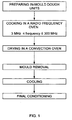
- the first stage which consists in preparing in-mould dough units, is not essentially different from the one applied in known bread loaf industrial production methods, except for that is related to the constitution of the moulds, which will be discussed later. To facilitate comprehension of the method considered as a whole, the various phases of this first step are explained briefly below, with reference to the diagram in Figs. 2a - 2h .
- a dispenser 13 containing kneaded bread dough ( Fig. 2a ) provides a regular amount of dough 17 ( Fig. 2b ) corresponding to a bread loaf unit and which in this example is 650 grams. This dough 17 is left to rest ( Fig. 2c ) and then it is rolled to obtain a laminar shape ( Fig.
- Moulds 3 are not of the conventional type, and instead they are designed specifically for cooking in the radio frequency oven 4.
- Said moulds 3 consist of a parallelepiped trough with the following internal dimensions: 125 mm wide on the base, 270 mm long on the base and 130 mm high. Both the width and the length increase slightly from the base towards the top surface, to make it easier to release the bread loaves from the mould.
- the material of moulds 3 must fulfil the following requirements:
- lid 7 must fulfil the same requirements as the material of mould 3, and in addition, it is also advisable that it has a high density since lid 7 must be heavy enough to remain in position by virtue of gravity, closing mould 3, during the cooking stage in the radio frequency oven.
- the choice of materials used to make mould 3 and lid 7 is within the scope of a person skilled in the art.
- the material used to make mould 3 is a thermoplastic polymer
- the material used to make lid 7 is another thermoplastic polymer that is denser than the former.
- the in-mould dough units 1 prepared in the first stage are placed on a conveyor belt and pass through a radio frequency oven 4 wherein they are exposed to radio frequency radiation.
- Radio frequency oven 4 is of the same type as the one described in said document US4974503 (HERMANN BERSTORFF MASCHINENBAU GmbH).
- In-mould dough units 1 travel inside oven 4 between a series of lower electrodes 14 connected to earth, and placed under the conveyor belt, and a series of top electrodes 15 connected to a generator that provides cyclical high voltage with high frequency.
- the voltage applied to top electrodes 15 is of the order of 4 kV with a cycle frequency of 27.12 MHz.
- a radio frequency radiation is produced, with a frequency of 27.12 MHz, which causes dielectric heating in fermented dough 2 that is contained in moulds 3.
- Oven 4 in this example is provided with a system that enables a different voltage to be applied to the various top electrodes 15, so that it is possible to adjust the intensity of the radio frequency radiation along the lineal trajectory of units 1 inside oven 4. Due to the fact that the transparency of mould 3 and lid 7 to radio frequency radiation is high, the dielectric heating is much more important in fermented dough 2 than in moulds 3 and lid 7, whereby fermented dough 2 reaches a higher temperature than mould 3 and lid 7.
- the intensity of the radio frequency radiation in oven 4, as well as the time that units 1 remain in said oven 4, have been adjusted using experimental calculations and assays, so that on exit from oven 4 the bread loaves are cooked and the temperature in the core of the fermented dough has not risen noticeably above a saturation level corresponding substantially to the saturation temperature of water at the pressure prevalent in said core. More particularly, when units 1 enter oven 4 the temperature in the core of fermented dough 2 is lower or equal to 40 °C, and during the time it stays in oven 4 said temperature increases until it reaches a saturation level within a range of 95 °C to 105 °C, with said saturation level being maintained for at least 2 minutes. Fig.
- FIG. 8 shows the evolution of the temperature in the core of fermented dough 2 throughout the time that units 1 remain inside oven 4.
- the data in Fig. 8 was obtained through experimental means using a fibre-optic thermometrical probe inserted into fermented dough 2.
- the evolution of the temperature shows a first stage between minutes 0 and 8.5 where the temperature increases progressively because the heat accumulation mechanism is due to sensible heat, followed by a second stage between minutes 8.5 and 12, where the temperature is maintained at a saturation value because heat accumulation is due to latent heat.
- This saturation value increases slightly (in comparison with the temperature increase in the first stage ), from 98 °C to 101 °C, mainly because a pressure increase occurs inside the mould, caused by water evaporation.
- the total time that units 1 remain in oven 4 is 12 minutes, with the second stage lasting 3.5 minutes.
- units 1 Upon exiting oven 4, units 1 exit in the form of in-mould cooked bread loaves 5, consisting of a cooked bread loaf 6 contained in its mould 3. Then, lid 7 is removed from moulds 3, as shown diagrammatically in Fig. 4 .
- the mould removal stage takes place, which is illustrated diagrammatically in Figs. 6a - 6c .
- the mould is removed by gravity, turning over mould 3. So that cooked bread loaf 6 is released more easily from mould 3 without being damaged, before turning over mould 3, air is blown between cooked bread loaf 6 and said mould 3.
- cooked bread load 6 falls down by gravity and lies on a cooling tray 9, on its face corresponding to the top open face of mould 3 during the drying stage.
- This face of cooked bread loaf 6 has greater mechanical strength than the others, because it was exposed to air during the drying process. Cooked bread loaf 6 maintains this resting position, on said surface with greater mechanical strength, during the subsequent cooling stage.
- the cooling and final conditioning stages are shown diagrammatically in Fig. 7 .
- Cooling stage takes place in a cooling chamber 10 through which there travel cooked bread loaves 6.
- Cooling chamber 10 is equipped with isolation means against outside microbial contamination, which in this example consist of a system that constantly injects into chamber 10 a flow of filtered air, so that excess pressure is maintained inside chamber 10 with respect to the outside atmosphere.
- Chamber 10 is maintained at a temperature of 25 °C, with cooked bread loaves 6 remaining in said chamber 10 for 65 minutes.
- the temperature in the core of cooked bread loaves 6 is approximately 30 °C.
- the bread loaf produced has a fine layer that is substantially the same colour as the crumb in the core of the loaf.
- Clean area 11 is equipped with protection means against outside microbial contamination and active protection means against bacterial growth. If it is necessary to increase the bacterial growth control even further, between cooling chamber 10 and clean area 11 cooked bread loaves 6 released from the mould travel inside of a tunnel 12, which is also provided with isolation means against outside microbial contamination.
- the isolation means against outside microbial contamination in tunnel 12 and in clean area 11 are similar to those fitted to chamber 10: a system that constantly injects a flow of filtered air so that a excess pressure is maintained with respect to the outside atmosphere. Also, the compressed air used by the various processes in clean area 11 is filtered air.
- the active protection means against bacterial growth in clean area 11 comprise germicide fluorescents.
- in-mould dough units 1 travel inside the radio frequency oven, arranged on a conveyor belt 18 in rows of eight units, lying longitudinally in the feeding direction of said belt 18, as illustrated diagrammatically in Figs. 9 and 10 .
- Each group of eight moulds is closed at the top by two lids 7', with each of said lids 7' covering a subgroup of four moulds.
- Lids 7' are placed so that they simply lie on the moulds, whereby due to their own weight these lids 7' are maintained on the moulds and close them in non-hermetic fashion, allowing steam to exit from said moulds during the cooking stage.
- These lids 7' have essentially the same characteristics as lids 7 for one single mould as described above, with the difference that they are large enough to cover four moulds at a time.
- bottom 14 and top 15 electrodes are shaped as parallel bars arranged in two planes: a top plane where the bars or top electrodes 15 lie, and a bottom plane, below belt 18, where the bottom bars or electrodes 14 lie, so that in-mould dough units 1 placed on conveyor belt 18 travel between these two planes of top 15 and bottom 14 electrodes.
- Electrodes 14 and 15 were arranged in pairs with opposite sign and aligned vertically, as illustrated in Fig. 10 .
- This is the usual electrode arrangement in known, state-of-the-art radio frequency ovens.
- the electric field between the electrodes is represented diagrammatically by dotted lines.
- a vertical electric field 19 is produced between every pair of electrodes 14, 15.
- top electrodes 15 are arranged alternatively with opposite signs, and bottom electrodes 14 are arranged in pairs only with the top electrodes 15 having the same sign.
- the electrodes are connected to a first level oscillating voltage (positive electrodes, with a “+ “ sign in the figures) or to a second level of oscillating voltage (negative electrodes, with a “- “ sign in the figures), with the difference between these two levels of oscillating voltage creating the oscillating electric field between the electrodes.
- bottom electrodes 14 have the same sign and each of said bottom electrodes 14 is arranged under a top electrode 15 with the same sign and aligned vertically therewith.
- the number of top electrodes is greater than the number of bottom electrodes, since for each pair of top electrodes 15 with opposite signs, there is only one bottom electrode 14, as can be seen in Fig. 11 .
- a horizontal electric field is created 20
- an oblique electric field 21 is created, because electrodes 14, 15 with opposite signs are arranged in an offset manner with respect to the vertical. Consequently, when in-mould dough units 1 travel between top electrodes 15 and bottom electrodes 14, the top of each unit 1 passes through an area with a greater electric field than the bottom part.
- a second problem observed in said industrial-scale plant which is different from the problem of homogeneously cooking the bread dough that has just been discussed, consists of the difficulty in reaching a proper cooking if the in-mould dough units 1 travelling through the central area of electrodes 14, 15; in other words, in the central area according to the front view in Fig. 9 .
- the two central units 1 are not cooked to the same quality as the other six.
- the bread loaves obtained from these two central units are cooked too quickly in comparison with the bread lying at the level of the ends of the electrodes.
- electrodes 15, which were straight bars, have been replaced by electrodes 15' in the shape of a slightly curved bar, so that the central area of electrode 15' is further away from the in-mould dough units 1 than the areas at the ends.
- Fig. 12 shows a diagram of the plant with these curved top electrodes 15'. This curvature in top electrodes 15' has the effect of reducing the electric field in the central area with respect to the areas lying at the ends of the electrodes, whereby the bread loaves are cooked homogeneously in the transverse direction.
- the curvature of electrodes 15' is such that the centre of electrode 15' is separated from the horizontal that passes by the ends of said electrode 15' by a distance d of between 0.5 % and 3.0 % of the length L of said electrode 15'. More preferably, the distance d is between 0.5 % and 1.5 % of the length L of electrode 15'.
- Fig. 13 illustrates these parameters d and L . In the plant used, length L of electrodes 15' is 1.8 metres and the separation distance d of the central area of the electrode is 1 centimetre. Obviously, in Figs. 12 and 13 the curvature of top electrodes 15' has been exaggerated, with the sole purpose of facilitating the description.
- the curved top electrodes 15' are only placed in an intermediate area of the radio frequency oven, with respect to the feeding direction of the in-mould dough units 1, with the top electrodes in the other areas being straight electrodes 15, as shown in a diagram in Fig. 14 .
- the curved top electrodes 15' are only placed in an intermediate area where the temperature in the core of fermented dough 2 reaches the value of 70° C.
- the effect of the curvature in top electrodes 15' is particularly noticeable in said intermediate area, because at this temperature level of 70 °C the fermentation process is interrupted, due to deactivation of the yeast, and the starch gelatinising process begins which leads to the actual cooking of the dough.
- this description also comprises an application of the improvements described in claims 9 to 13 to a method for producing bread loaves by cooking via dielectric cooking, which comprises a cooking stage wherein in-mould dough units, consisting of a fermented dough to be cooked contained in a mould, pass through a radio frequency oven where they are exposed to radio frequency radiation, within a frequency range of 3 MHz to 300 MHz, which causes the dielectric heating of said fermented dough, where the top surface of said mould is closed in non-hermetic fashion by a lid, with said lid and said mould being configured so as not to be subjected, by the effect of said radio frequency radiation, to dielectric heating greater than that of said fermented dough contained in said mould.
Landscapes
- Life Sciences & Earth Sciences (AREA)
- Engineering & Computer Science (AREA)
- Food Science & Technology (AREA)
- Physics & Mathematics (AREA)
- Electromagnetism (AREA)
- Bakery Products And Manufacturing Methods Therefor (AREA)
- Baking, Grill, Roasting (AREA)
Claims (13)
- Verfahren zur Herstellung von Brotlaiben durch Backen mittels dielektrischer Heizung, eine Backstufe umfassend, wobei Formeinheiten mit Teig (1), bestehend aus einem zu backenden, in einer Form (3) befindlichen fermentierten Teig (2) einen Hochfrequenzofen durchfahren, wobei sie einer Hochfrequenzstrahlung in einem Frequenzbereich von 3 MHz bis 300 MHz ausgesetzt sind, die eine dielektrische Erhitzung des fermentierten Teigs (2) bewirkt, gekennzeichnet dadurch, dass- die obere Fläche der Form (3) durch einen Deckel (7) nicht hermetisch verschlossen ist und die Form (3) aus einem nicht metallischen Material hergestellt ist, wobei der Deckel (7) und die Form (3) so gestaltet sind, dass sie durch die Effekte der Hochfrequenzstrahlung keinem dielektrischen Erhitzen ausgesetzt sind, dass größer ist als das des fermentierten Teigs (2), der sich in der Form (3) befindet;- während die Laibteigeinheiten (1) in dem Hochfrequenzofen (4) verweilen, wird die Intensität der Hochfrequenzstrahlung justiert, so dass die Temperatur im Kern des fermentierten Teigs (2), die auf Grund des dielektrischen Erhitzens durch die Hochfrequenzstrahlung in dem fermentierten Teig (2) ansteigt, einen Sättigungsgrad erreicht, der im Wesentlichen der Sättigungstemperatur von Wasser bei dem vorherrschenden Druck im Kern entspricht, und im Wesentlichen die Temperatur im Kern bei dem Sättigungsgrad oder darunter aufrechterhalten wird; und- jede der Formeinheiten mit Teig (1) im Hochfrequenzofen (4) unter diesen Bedingungen verbleien, bis der darin enthaltene fermentierte Teig (2), auf Grund des im fermentierten Teig (2) erzeugten dielektrischen Erhitzens durch die Hochfrequenzstrahlung, vollständig gebacken ist; so dass die Formeinheiten mit Teig (1) den Hochfrequenzofen (4) im Zustand von Formen mit gebackenen Brotlaiben (5), bestehend aus einem gebackenen Brotlaib (6) in seiner Form (3) enthalten, und mit einer sehr feinen Außenschicht von im Wesentlichen derselben Farbe wie die Brotkrume, verlassen.
- Verfahren gemäß Anspruch 1, gekennzeichnet dadurch, dass vor dem Eintritt in den Hochfrequenzofen (4) die Temperatur der Formeinheiten mit Teig (1) im Kern des fermentierten Teigs (2) kleiner oder gleich 40°C beträgt; der Sättigungsgrad in einem Temperaturbereich von 95°C bis 105°C ist, und die Temperatur im Kern für mindestens 2 Minuten in diesem Temperaturbereich aufrechterhalten wird.
- Verfahren gemäß einem der Ansprüche 1 und 2, gekennzeichnet dadurch, dass nach der Backstufe im Hochfrequenzofen (4) und vor der Stufe der Formentnahme, eine Trocknungsstufe durchgeführt wird, wobei die Formen mit gebackenen Brotlaiben (6) durch Konvektion erhitzt werden, um die Feuchtigkeit in den Formen mit gebackenen Brotlaiben (6) zu eliminieren, ohne die Farbe der Aussenfläche der Brotlaibe zu verändern.
- Verfahren gemäß Anspruch 3, dadurch gekennzeichnet, dass die Trocknungsstufe in einem Konvektionsofen (8) durchgeführt wird.
- Verfahren gemäß einem der Ansprüche 1 bis 4, dadurch gekennzeichnet, dass der Deckel (7) so gestaltet ist, dass er durch den Effekt der Hochfrequenzstrahlung keinem dielektrischen Erhitzen ausgesetzt ist, das größer ist als das des fermentierten Teigs (2) der in der Form (3) enthalten ist.
- Verfahren gemäß Anspruch 3, dadurch gekennzeichnet, dass die Trocknungsstufe nach dem vorherigen Entfernen des Deckels (7) von der Form (3) ausgeführt wird, so dass die Formen(3) eine offene obere Fläche aufweisen und nach der Trocknungsstufe, eine Formentfernungsstufe ausgeführt wird, die einen Arbeitsschritt Wendens der Form (3) und einen Arbeitsschritt des Lufteinblasens zwischen den gebackenen Brotlaib (6) und der Form (3) ,die den Brotlaib enthält, umfasst, so dass der in der Form befindliche gebackene Brotlaib (6) durch die Schwerkraft heraus fällt und auf eine Fläche (9) mit der Seite liegt, die vorher auf der oberen Fläche der Form (3) war, wobei der gebackenen Brotlaib (6) in dieser Ruheposition während einer nachfolgenden Kühlstufe verbleibt.
- Verfahren gemäß Anspruch 1, wobei nach der Backstufe in dem Hochfrequenzofen (4), eine Formentnahmestufe durchgeführt wird, in der die gebackenen Brotlaibe (6) aus den Formen (3) entfernt werden und eine Kühlstufe der gebackenen Brotlaibe (6) durchgeführt wird, dadurch gekennzeichnet, dass
die Kühlstufe in einer mit Isolationsmitteln gegen äußere mikrobiologische Kontamination ausgestattete Kühlkammer (10) durchgeführt wird, und nach der Kühlstufe einige letzte Aufbereitungsschritte durchgeführt werden, die eine Schneidstufe, in der die aus ihrer Form entfernten gebackenen Brotlaibe (6) in Scheiben geschnitten werden, und eine Verpackungsstufe, in der die Scheiben in Pakete verpackt werden, wobei die letzten Aufbereitungsschritte in einem mit Schutzmitteln gegen äußere mikrobiologische Kontamination und aktiven Schutzmitteln gegen Bakterienwachstum ausgerüsteten Reinraum (11) ausgeführt werden. - Verfahren gemäß Anspruch 7, dadurch gekennzeichnet, dass die aus ihrer Form entnommenen gebackenen Brotlaibe (6) zwischen der Kühlkammer (10) und dem Reinraum (11) einen ebenfalls mit Isolationsmitteln gegen äußere mikrobiologische Kontamination ausgestatteten Tunnel (12) durchfahren.
- Verfahren gemäß einem der Ansprüche 1 bis 8 in dem Backen der Formeinheiten mit Teig (1) mittels dielektrischem Erhitzen in einem Hochfrequenzofen (4) durch Fahren der Formeinheiten mit Teig (1) zwischen unteren Elektroden (14) und oberen Elektroden (15, 15') die mit einer oszillierenden Spannungsquelle verbunden sind, so dass die Elektroden (14, 15, 15') ein oszillierendes elektrisches Feld erzeugen, das die Hochfrequenzstrahlung erzeugt, dadurch gekennzeichnet, dass der obere Bereich der Formeinheiten mit Teig (1) ein durch das zwischen den oberen Elektroden(15, 15') erzeugtes horizontales Feld (20) durchfährt, das horizontale elektrische Feld (20) ein elektrisches Feld (21) überlagert, das zwischen den Elektrodenpaaren gebildet wird, die jeweils durch eine obere Elektrode (15,15') und eine untere Elektrode (14) erzeugt werden.
- Verfahren gemäß Anspruch 9, dadurch gekennzeichnet, dass die oberen Elektroden (15, 15') abwechselnd mit entgegengesetzter Polung angeordnet sind und die unteren Elektroden (14) passend zu den oberen Elektroden (15, 15') mit der gleichen Polung angeordnet sind.
- Verfahren gemäß Anspruch 10, dadurch gekennzeichnet, dass die unteren Elektroden (14) die gleiche Polung haben und jede untere Elektrode (14) unter einer oberen Elektrode (15, 15') mit der gleichen Polung angeordnet ist und mit dieser vertikal ausgerichtet ist, so dass zwischen jeden zwei oberen Elektroden (15, 15') mit entgegengesetzter Polung ein horizontales elektrisches Feld (20) erzeugt wird, während zwischen jedem Paar der oberen (15, 15') und unteren Elektroden (14) mit entgegengesetzter Polung ein diagonales elektrisches Feld (21) erzeugt wird.
- Verfahren gemäß einem der Ansprüche 1 bis 11, wobei Backen der Formeinheiten mit Teig (1) mittels dielektrischem Erhitzen in einem Hochfrequenzofen (4) durch Durchfahren der Formeinheiten mit Teig (1) zwischen mit einer oszillierenden Spannungsquelle verbundenen unteren Elektroden (14) und oberen Elektroden (15, 15') durchgeführt wird, so dass die Elektroden (14, 15, 15') ein oszillierendes elektrisches Feld erzeugen,das eine Hochfrequenzstrahlung erzeugt, wobei die unteren Elektroden (14) und die oberen Elektroden (15, 15') in Form von Stäben ausgestaltet sind, die sich bezüglich der Zufuhrrichtung der Formeinheiten mit Teig (1) transversal erstrecken, dadurch gekennzeichnet, dass wenigstens einige der oberen Elektroden(15') eine leichte Krümmung haben, die ausgerichtet ist, um den zentralen Bereich (1) der oberen gekrümmten Elektroden (15) weiter weg von den Formeinheiten mit Teig (1) zu platzieren.
- Verfahren gemäß Anspruch 12, dadurch gekennzeichnet, dass die oberen gekrümmten Elektroden (15') bezüglich der Zufuhrrichtung der, Formeinheiten mit Teig (1) nur in einem Zwischenbereich des Hochfrequenzofens (4) angeordnet sind, wobei die oberen Elektroden in den anderen Bereichen Elektroden (15) ohne Krümmung sind, wobei der Zwischenbereich einem Bereich entspricht, in dem die Temperatur im Kern des in Formeinheiten mit Teig (1) befindlichen fermentierten Teigs (2) einen Wert von 70°C erreicht.
Applications Claiming Priority (1)
| Application Number | Priority Date | Filing Date | Title |
|---|---|---|---|
| ES200803738 | 2008-12-30 |
Publications (3)
| Publication Number | Publication Date |
|---|---|
| EP2204096A1 EP2204096A1 (de) | 2010-07-07 |
| EP2204096B1 true EP2204096B1 (de) | 2011-10-26 |
| EP2204096B8 EP2204096B8 (de) | 2012-03-21 |
Family
ID=42062513
Family Applications (1)
| Application Number | Title | Priority Date | Filing Date |
|---|---|---|---|
| EP09380198A Revoked EP2204096B8 (de) | 2008-12-30 | 2009-12-28 | Verfahren zur Herstellung von Brotlaiben durch Kochen mittels dielektrischer Erwärmung |
Country Status (4)
| Country | Link |
|---|---|
| EP (1) | EP2204096B8 (de) |
| AT (1) | ATE530067T1 (de) |
| ES (1) | ES2373270T3 (de) |
| PT (1) | PT2204096E (de) |
Families Citing this family (2)
| Publication number | Priority date | Publication date | Assignee | Title |
|---|---|---|---|---|
| US20130168386A1 (en) * | 2010-08-11 | 2013-07-04 | Fraunhofer-Gesellschaft Zur Foerderung Der Angewandten Forschung E.V. | Method for uniformly heating products by means of a high-frequency electromagnetic alternating field |
| NL2019534B1 (nl) * | 2017-09-13 | 2019-03-27 | Better Future Factory B V | Werkwijze voor het verwerken van een thermoplast tot een monolithisch element zoals een tegel, en houder |
Family Cites Families (6)
| Publication number | Priority date | Publication date | Assignee | Title |
|---|---|---|---|---|
| GB904371A (en) | 1958-04-02 | 1962-08-29 | Guillaume Ooms S A Atel Const | Improvements in the manufacture of bakery products |
| GB985442A (en) | 1960-08-31 | 1965-03-10 | Radyne Ltd | Improvements in or relating to dielectric heating apparatus |
| BE594976A (fr) * | 1960-09-13 | 1961-01-02 | Guillaume Ooms Atel Const | Procédé et installation pour la fabrication de produits de boulangerie. |
| GB8614236D0 (en) | 1986-06-11 | 1986-07-16 | Electricity Council | Baking bread |
| GB2359003B (en) * | 2000-01-12 | 2003-11-26 | Sasib Uk Ltd | Method of and line for breadcrumb production |
| US6852957B2 (en) * | 2002-06-28 | 2005-02-08 | Kerry Group Services International, Ltd. | Breadcrumb processing line and method |
-
2009
- 2009-12-28 AT AT09380198T patent/ATE530067T1/de not_active IP Right Cessation
- 2009-12-28 EP EP09380198A patent/EP2204096B8/de not_active Revoked
- 2009-12-28 PT PT09380198T patent/PT2204096E/pt unknown
- 2009-12-28 ES ES09380198T patent/ES2373270T3/es active Active
Also Published As
| Publication number | Publication date |
|---|---|
| PT2204096E (pt) | 2012-01-06 |
| EP2204096B8 (de) | 2012-03-21 |
| ES2373270T3 (es) | 2012-02-01 |
| ATE530067T1 (de) | 2011-11-15 |
| EP2204096A1 (de) | 2010-07-07 |
Similar Documents
| Publication | Publication Date | Title |
|---|---|---|
| US4974503A (en) | Apparatus for irradiating food products | |
| EP0250159B1 (de) | Verfahren zum Backen | |
| EP0399269B1 (de) | Verfahren und Vorrichtung zur Pasteurisierung und Vorkochen von rohen Pizzaböden | |
| CN100586288C (zh) | 在模子中烘烤的基于谷物的食品的生产方法 | |
| Sale | A review of microwaves for food processing | |
| CA1201020A (en) | Method of baking bread | |
| EP2204096A1 (de) | Verfahren zur Herstellung von Brotlaiben durch Kochen mittels dielektrischer Erwärmung | |
| US5277924A (en) | Radio frequency proofing and convection baking apparatus and method for making pizza | |
| EP1065943B1 (de) | Verfahren sowie apparat zur herstellung von lebensmittelprodukten fuer die weiterverarbeitung | |
| CA1061630A (en) | Commercial bakery system including process for reconstitution of frozen bakery foods | |
| Schiffmann | Microwave technology in baking | |
| ES2289900B1 (es) | "pan de molde y procedimiento para su obtencion.". | |
| EP1597971A1 (de) | Herstellung von Nahrungsmitteln | |
| NZ777577A (en) | Pizza product, packaging for a pizza product, and method of cooking and distribution for a pizza product | |
| PT104097B (pt) | Processo para a fabricação industrial de pão de forma com uma côdea de intensidade de cor não superior á do miolo, e dispositivo correspondente | |
| US20070122527A1 (en) | Method for the industrialized baking in two steps of dual-component bakery products, dual-component bakery product obtained by such a method, and installation for carrying out such a method | |
| BE1028759B1 (nl) | Verbeterde werkwijze voor het bereiden van koekjes en inrichting voor gebruik in de werkwijze | |
| AU2014223167B2 (en) | Shelf-stable baked crisps and method for making same | |
| NL1020470C2 (nl) | Werkwijze voor het afbakken van zacht kleinbrood, alsmede verpakking voor toepassing in een dergelijke werkwijze. | |
| ES2875397T3 (es) | Método para la fabricación de galletas de queso | |
| GB190405906A (en) | Improved Process for Preserving Bread, Biscuits, Cakes, Pastry, and the like | |
| CA2184520C (en) | Method & apparatus for preparation & packaging of commercial unfrozen baked waffles | |
| WO2010049459A1 (fr) | Procede de fabrication de pain de mie sans moule et installation associee | |
| JPH05137493A (ja) | パン類の連続焼成方法 | |
| GB2210768A (en) | The baking of bread and the like dough products |
Legal Events
| Date | Code | Title | Description |
|---|---|---|---|
| PUAI | Public reference made under article 153(3) epc to a published international application that has entered the european phase |
Free format text: ORIGINAL CODE: 0009012 |
|
| AK | Designated contracting states |
Kind code of ref document: A1 Designated state(s): AT BE BG CH CY CZ DE DK EE ES FI FR GB GR HR HU IE IS IT LI LT LU LV MC MK MT NL NO PL PT RO SE SI SK SM TR |
|
| AX | Request for extension of the european patent |
Extension state: AL BA RS |
|
| 17P | Request for examination filed |
Effective date: 20101223 |
|
| GRAJ | Information related to disapproval of communication of intention to grant by the applicant or resumption of examination proceedings by the epo deleted |
Free format text: ORIGINAL CODE: EPIDOSDIGR1 |
|
| GRAP | Despatch of communication of intention to grant a patent |
Free format text: ORIGINAL CODE: EPIDOSNIGR1 |
|
| RIC1 | Information provided on ipc code assigned before grant |
Ipc: A21D 8/06 20060101AFI20110307BHEP Ipc: H05B 6/46 20060101ALI20110307BHEP Ipc: A21B 2/00 20060101ALI20110307BHEP |
|
| GRAP | Despatch of communication of intention to grant a patent |
Free format text: ORIGINAL CODE: EPIDOSNIGR1 |
|
| RIN1 | Information on inventor provided before grant (corrected) |
Inventor name: NIN TARRAGA, CARLES Inventor name: MINGUEZ PABLOS, IRENE |
|
| GRAS | Grant fee paid |
Free format text: ORIGINAL CODE: EPIDOSNIGR3 |
|
| GRAA | (expected) grant |
Free format text: ORIGINAL CODE: 0009210 |
|
| AK | Designated contracting states |
Kind code of ref document: B1 Designated state(s): AT BE BG CH CY CZ DE DK EE ES FI FR GB GR HR HU IE IS IT LI LT LU LV MC MK MT NL NO PL PT RO SE SI SK SM TR |
|
| REG | Reference to a national code |
Ref country code: GB Ref legal event code: FG4D |
|
| RIN1 | Information on inventor provided before grant (corrected) |
Inventor name: MINGUEZ PABLOS, IRENE Inventor name: NIN TARRAGA, CARLES |
|
| REG | Reference to a national code |
Ref country code: CH Ref legal event code: EP |
|
| RAP2 | Party data changed (patent owner data changed or rights of a patent transferred) |
Owner name: PANRICO S.A. |
|
| REG | Reference to a national code |
Ref country code: IE Ref legal event code: FG4D |
|
| REG | Reference to a national code |
Ref country code: DE Ref legal event code: R096 Ref document number: 602009003315 Country of ref document: DE Effective date: 20111229 |
|
| REG | Reference to a national code |
Ref country code: PT Ref legal event code: SC4A Free format text: AVAILABILITY OF NATIONAL TRANSLATION Effective date: 20111226 |
|
| REG | Reference to a national code |
Ref country code: ES Ref legal event code: FG2A Ref document number: 2373270 Country of ref document: ES Kind code of ref document: T3 Effective date: 20120201 |
|
| REG | Reference to a national code |
Ref country code: NL Ref legal event code: VDEP Effective date: 20111026 |
|
| LTIE | Lt: invalidation of european patent or patent extension |
Effective date: 20111026 |
|
| REG | Reference to a national code |
Ref country code: AT Ref legal event code: MK05 Ref document number: 530067 Country of ref document: AT Kind code of ref document: T Effective date: 20111026 |
|
| PG25 | Lapsed in a contracting state [announced via postgrant information from national office to epo] |
Ref country code: NO Free format text: LAPSE BECAUSE OF FAILURE TO SUBMIT A TRANSLATION OF THE DESCRIPTION OR TO PAY THE FEE WITHIN THE PRESCRIBED TIME-LIMIT Effective date: 20120126 Ref country code: LT Free format text: LAPSE BECAUSE OF FAILURE TO SUBMIT A TRANSLATION OF THE DESCRIPTION OR TO PAY THE FEE WITHIN THE PRESCRIBED TIME-LIMIT Effective date: 20111026 Ref country code: BE Free format text: LAPSE BECAUSE OF FAILURE TO SUBMIT A TRANSLATION OF THE DESCRIPTION OR TO PAY THE FEE WITHIN THE PRESCRIBED TIME-LIMIT Effective date: 20111026 Ref country code: IS Free format text: LAPSE BECAUSE OF FAILURE TO SUBMIT A TRANSLATION OF THE DESCRIPTION OR TO PAY THE FEE WITHIN THE PRESCRIBED TIME-LIMIT Effective date: 20120226 |
|
| PG25 | Lapsed in a contracting state [announced via postgrant information from national office to epo] |
Ref country code: SE Free format text: LAPSE BECAUSE OF FAILURE TO SUBMIT A TRANSLATION OF THE DESCRIPTION OR TO PAY THE FEE WITHIN THE PRESCRIBED TIME-LIMIT Effective date: 20111026 Ref country code: SI Free format text: LAPSE BECAUSE OF FAILURE TO SUBMIT A TRANSLATION OF THE DESCRIPTION OR TO PAY THE FEE WITHIN THE PRESCRIBED TIME-LIMIT Effective date: 20111026 Ref country code: GR Free format text: LAPSE BECAUSE OF FAILURE TO SUBMIT A TRANSLATION OF THE DESCRIPTION OR TO PAY THE FEE WITHIN THE PRESCRIBED TIME-LIMIT Effective date: 20120127 Ref country code: NL Free format text: LAPSE BECAUSE OF FAILURE TO SUBMIT A TRANSLATION OF THE DESCRIPTION OR TO PAY THE FEE WITHIN THE PRESCRIBED TIME-LIMIT Effective date: 20111026 Ref country code: PL Free format text: LAPSE BECAUSE OF FAILURE TO SUBMIT A TRANSLATION OF THE DESCRIPTION OR TO PAY THE FEE WITHIN THE PRESCRIBED TIME-LIMIT Effective date: 20111026 Ref country code: LV Free format text: LAPSE BECAUSE OF FAILURE TO SUBMIT A TRANSLATION OF THE DESCRIPTION OR TO PAY THE FEE WITHIN THE PRESCRIBED TIME-LIMIT Effective date: 20111026 Ref country code: HR Free format text: LAPSE BECAUSE OF FAILURE TO SUBMIT A TRANSLATION OF THE DESCRIPTION OR TO PAY THE FEE WITHIN THE PRESCRIBED TIME-LIMIT Effective date: 20111026 |
|
| PG25 | Lapsed in a contracting state [announced via postgrant information from national office to epo] |
Ref country code: CY Free format text: LAPSE BECAUSE OF FAILURE TO SUBMIT A TRANSLATION OF THE DESCRIPTION OR TO PAY THE FEE WITHIN THE PRESCRIBED TIME-LIMIT Effective date: 20111026 |
|
| PG25 | Lapsed in a contracting state [announced via postgrant information from national office to epo] |
Ref country code: BG Free format text: LAPSE BECAUSE OF FAILURE TO SUBMIT A TRANSLATION OF THE DESCRIPTION OR TO PAY THE FEE WITHIN THE PRESCRIBED TIME-LIMIT Effective date: 20120126 Ref country code: MC Free format text: LAPSE BECAUSE OF NON-PAYMENT OF DUE FEES Effective date: 20111231 Ref country code: EE Free format text: LAPSE BECAUSE OF FAILURE TO SUBMIT A TRANSLATION OF THE DESCRIPTION OR TO PAY THE FEE WITHIN THE PRESCRIBED TIME-LIMIT Effective date: 20111026 Ref country code: CZ Free format text: LAPSE BECAUSE OF FAILURE TO SUBMIT A TRANSLATION OF THE DESCRIPTION OR TO PAY THE FEE WITHIN THE PRESCRIBED TIME-LIMIT Effective date: 20111026 Ref country code: SK Free format text: LAPSE BECAUSE OF FAILURE TO SUBMIT A TRANSLATION OF THE DESCRIPTION OR TO PAY THE FEE WITHIN THE PRESCRIBED TIME-LIMIT Effective date: 20111026 Ref country code: DK Free format text: LAPSE BECAUSE OF FAILURE TO SUBMIT A TRANSLATION OF THE DESCRIPTION OR TO PAY THE FEE WITHIN THE PRESCRIBED TIME-LIMIT Effective date: 20111026 |
|
| PLBI | Opposition filed |
Free format text: ORIGINAL CODE: 0009260 |
|
| PLAX | Notice of opposition and request to file observation + time limit sent |
Free format text: ORIGINAL CODE: EPIDOSNOBS2 |
|
| PG25 | Lapsed in a contracting state [announced via postgrant information from national office to epo] |
Ref country code: RO Free format text: LAPSE BECAUSE OF FAILURE TO SUBMIT A TRANSLATION OF THE DESCRIPTION OR TO PAY THE FEE WITHIN THE PRESCRIBED TIME-LIMIT Effective date: 20111026 Ref country code: IT Free format text: LAPSE BECAUSE OF FAILURE TO SUBMIT A TRANSLATION OF THE DESCRIPTION OR TO PAY THE FEE WITHIN THE PRESCRIBED TIME-LIMIT Effective date: 20111026 |
|
| 26 | Opposition filed |
Opponent name: STALAM S.P.A. Effective date: 20120726 |
|
| REG | Reference to a national code |
Ref country code: FR Ref legal event code: ST Effective date: 20120831 |
|
| REG | Reference to a national code |
Ref country code: IE Ref legal event code: MM4A |
|
| REG | Reference to a national code |
Ref country code: DE Ref legal event code: R119 Ref document number: 602009003315 Country of ref document: DE Effective date: 20120703 |
|
| PG25 | Lapsed in a contracting state [announced via postgrant information from national office to epo] |
Ref country code: DE Free format text: LAPSE BECAUSE OF NON-PAYMENT OF DUE FEES Effective date: 20120703 Ref country code: IE Free format text: LAPSE BECAUSE OF NON-PAYMENT OF DUE FEES Effective date: 20111228 |
|
| PLBB | Reply of patent proprietor to notice(s) of opposition received |
Free format text: ORIGINAL CODE: EPIDOSNOBS3 |
|
| PG25 | Lapsed in a contracting state [announced via postgrant information from national office to epo] |
Ref country code: AT Free format text: LAPSE BECAUSE OF FAILURE TO SUBMIT A TRANSLATION OF THE DESCRIPTION OR TO PAY THE FEE WITHIN THE PRESCRIBED TIME-LIMIT Effective date: 20111026 |
|
| PG25 | Lapsed in a contracting state [announced via postgrant information from national office to epo] |
Ref country code: MK Free format text: LAPSE BECAUSE OF FAILURE TO SUBMIT A TRANSLATION OF THE DESCRIPTION OR TO PAY THE FEE WITHIN THE PRESCRIBED TIME-LIMIT Effective date: 20111026 Ref country code: MT Free format text: LAPSE BECAUSE OF FAILURE TO SUBMIT A TRANSLATION OF THE DESCRIPTION OR TO PAY THE FEE WITHIN THE PRESCRIBED TIME-LIMIT Effective date: 20111026 |
|
| PGFP | Annual fee paid to national office [announced via postgrant information from national office to epo] |
Ref country code: PT Payment date: 20111226 Year of fee payment: 4 |
|
| PG25 | Lapsed in a contracting state [announced via postgrant information from national office to epo] |
Ref country code: SM Free format text: LAPSE BECAUSE OF FAILURE TO SUBMIT A TRANSLATION OF THE DESCRIPTION OR TO PAY THE FEE WITHIN THE PRESCRIBED TIME-LIMIT Effective date: 20111026 Ref country code: FR Free format text: LAPSE BECAUSE OF NON-PAYMENT OF DUE FEES Effective date: 20120102 |
|
| PG25 | Lapsed in a contracting state [announced via postgrant information from national office to epo] |
Ref country code: LU Free format text: LAPSE BECAUSE OF NON-PAYMENT OF DUE FEES Effective date: 20111228 |
|
| PG25 | Lapsed in a contracting state [announced via postgrant information from national office to epo] |
Ref country code: FI Free format text: LAPSE BECAUSE OF FAILURE TO SUBMIT A TRANSLATION OF THE DESCRIPTION OR TO PAY THE FEE WITHIN THE PRESCRIBED TIME-LIMIT Effective date: 20111026 |
|
| PG25 | Lapsed in a contracting state [announced via postgrant information from national office to epo] |
Ref country code: TR Free format text: LAPSE BECAUSE OF FAILURE TO SUBMIT A TRANSLATION OF THE DESCRIPTION OR TO PAY THE FEE WITHIN THE PRESCRIBED TIME-LIMIT Effective date: 20111026 |
|
| PLAY | Examination report in opposition despatched + time limit |
Free format text: ORIGINAL CODE: EPIDOSNORE2 |
|
| PG25 | Lapsed in a contracting state [announced via postgrant information from national office to epo] |
Ref country code: HU Free format text: LAPSE BECAUSE OF FAILURE TO SUBMIT A TRANSLATION OF THE DESCRIPTION OR TO PAY THE FEE WITHIN THE PRESCRIBED TIME-LIMIT Effective date: 20111026 |
|
| PLBC | Reply to examination report in opposition received |
Free format text: ORIGINAL CODE: EPIDOSNORE3 |
|
| RDAE | Information deleted related to despatch of communication that patent is revoked |
Free format text: ORIGINAL CODE: EPIDOSDREV1 |
|
| RDAF | Communication despatched that patent is revoked |
Free format text: ORIGINAL CODE: EPIDOSNREV1 |
|
| RDAF | Communication despatched that patent is revoked |
Free format text: ORIGINAL CODE: EPIDOSNREV1 |
|
| PGFP | Annual fee paid to national office [announced via postgrant information from national office to epo] |
Ref country code: ES Payment date: 20131129 Year of fee payment: 5 |
|
| RDAG | Patent revoked |
Free format text: ORIGINAL CODE: 0009271 |
|
| STAA | Information on the status of an ep patent application or granted ep patent |
Free format text: STATUS: PATENT REVOKED |
|
| REG | Reference to a national code |
Ref country code: CH Ref legal event code: PLX |
|
| REG | Reference to a national code |
Ref country code: PT Ref legal event code: MM4A Free format text: LAPSE DUE TO NON-PAYMENT OF FEES Effective date: 20140630 |
|
| 27W | Patent revoked |
Effective date: 20140616 |
|
| GBPR | Gb: patent revoked under art. 102 of the ep convention designating the uk as contracting state |
Effective date: 20140616 |
|
| REG | Reference to a national code |
Ref country code: PT Ref legal event code: MP4A Effective date: 20140723 |
|
| PG25 | Lapsed in a contracting state [announced via postgrant information from national office to epo] |
Ref country code: LI Free format text: LAPSE BECAUSE OF THE APPLICANT RENOUNCES Effective date: 20111026 Ref country code: CH Free format text: LAPSE BECAUSE OF THE APPLICANT RENOUNCES Effective date: 20111026 |
|
| REG | Reference to a national code |
Ref country code: CH Ref legal event code: PK Free format text: DAS DATUM DES WIDERRUFS DURCH EPA IST NICHT KORREKT |