EP2208157B1 - Berechnungsverfahren für das design synthetischer gene - Google Patents
Berechnungsverfahren für das design synthetischer gene Download PDFInfo
- Publication number
- EP2208157B1 EP2208157B1 EP08837046A EP08837046A EP2208157B1 EP 2208157 B1 EP2208157 B1 EP 2208157B1 EP 08837046 A EP08837046 A EP 08837046A EP 08837046 A EP08837046 A EP 08837046A EP 2208157 B1 EP2208157 B1 EP 2208157B1
- Authority
- EP
- European Patent Office
- Prior art keywords
- sequence
- sequences
- nls
- target
- content
- Prior art date
- Legal status (The legal status is an assumption and is not a legal conclusion. Google has not performed a legal analysis and makes no representation as to the accuracy of the status listed.)
- Active
Links
Images

Classifications
-
- G—PHYSICS
- G16—INFORMATION AND COMMUNICATION TECHNOLOGY [ICT] SPECIALLY ADAPTED FOR SPECIFIC APPLICATION FIELDS
- G16B—BIOINFORMATICS, i.e. INFORMATION AND COMMUNICATION TECHNOLOGY [ICT] SPECIALLY ADAPTED FOR GENETIC OR PROTEIN-RELATED DATA PROCESSING IN COMPUTATIONAL MOLECULAR BIOLOGY
- G16B30/00—ICT specially adapted for sequence analysis involving nucleotides or amino acids
-
- G—PHYSICS
- G16—INFORMATION AND COMMUNICATION TECHNOLOGY [ICT] SPECIALLY ADAPTED FOR SPECIFIC APPLICATION FIELDS
- G16B—BIOINFORMATICS, i.e. INFORMATION AND COMMUNICATION TECHNOLOGY [ICT] SPECIALLY ADAPTED FOR GENETIC OR PROTEIN-RELATED DATA PROCESSING IN COMPUTATIONAL MOLECULAR BIOLOGY
- G16B40/00—ICT specially adapted for biostatistics; ICT specially adapted for bioinformatics-related machine learning or data mining, e.g. knowledge discovery or pattern finding
Definitions
- This invention relates to methods for designing synthetic genes for expression in a heterologous organism, such as a plant.
- Computer-implemented methods are encompassed, as well as computer systems used to perform the methods of the invention.
- adenine A
- T thymidine
- G guanosine
- C cytidine
- A adenine
- T thymidine
- G guanosine
- C cytidine
- AT base pair an "AT base pair”
- guanosine forms base pairs only with cytidine (a "GC base pair”).
- the ratio of such AT base pairs to GC base pairs is often referred to as 'GC content', and is a percentage of the total base pairs that are comprised of GC base pairs, as opposed to AT base pairs.
- 'AT content' refers to the percentage of base pairs that are comprised of AT base pairs.
- GC content varies not only between different organisms, but can vary within different regions of the DNA of a genome, and even within the different regions of a gene, such as a plant gene.
- Plant introns have about 70% AT (30% GC) content, whereas exons have about 50% AT (50% GC) content ( Wiebauer et al. (1988) Mol. Cell Biol. 8:2042-2051 ).
- Adang et a / . U.S. Patent Nos. 5,380,831 , 6,015,891 . describe designing synthetic Bt insecticidal proteins to have enhanced expression in plants by modifying the gene to contain codons preferred by highly expressed plant genes. The codons used are selected with regard to the distribution frequency of codon usage employed in highly expressed plant genes. Adang et al. (U.S. Patent No.
- Fischhoff et al. U.S. Patent No. 5,500,365
- modified Bt genes that have plant polyadenylation sequences and ATTTA (SEQ ID NO:2) sequences removed.
- Koziel et al. U.S. Patent No. 6,320,100 disclose synthetic Bt insecticidal proteins selected for optimized expression in a plant, produced using codons that most frequently encode each amino acid in maize, and having 60% GC content.
- Methods for generating a synthetic nucleotide sequence encoding a polypeptide of interest are provided. These methods produce optimized synthetic gene sequences by calculating the probability of occurrence of contiguous short segments of nucleotides in a DNA sequence database, and then using these probabilities to generate synthetic sequences by replacing low-probability nucleotide sequences in a candidate transgene with high-probability sequences. This is preferably accomplished without altering the amino acid sequence of the encoded protein. Importantly, this statistical method enables generation of a transgene that is optimized for expression in a target organism without the need to possess specific knowledge of processing sites or other expression determinants in the target organism.
- These methods comprise (1) developing a database of sequences; (2) selecting a length ("N-length") of contiguous nucleotides as a basis for optimization ("N-length oligonucleotides”); (3) organizing the database of sequences as a set of N-length oligomer sequences; (4) selecting an input sequence; (5) developing a set of silent NLSs ("SNLS”) for the input sequence; and, (6) optimizing among the choices of SNLS to yield an optimized gene sequence.
- These methods may, alternatively or in addition, comprise removing unwanted open reading frames, and/or modifying the nucleotide sequence of interest to remove unwanted short consensus nucleotide sequences, and/or achieve a desired GC content for the resulting optimized gene, without consideration of codon usage.
- the methods of the invention are useful for the production of nucleotide sequences optimal for expression in an organism, particularly plants and bacteria, to provide pesticidal or herbicide resistance activity. Such organisms are desirable for agricultural purposes.
- the methods of the invention are also useful for generating altered or improved proteins that have pesticidal or herbicide resistance activity, or for detecting the presence of pesticidal or herbicide resistant proteins or nucleic acids in products or organisms.
- Previous methods for synthetic gene design fall generally into two categories.
- the first uses specific knowledge of processing signals, such as polyadenylation signals, to design transgenes with a higher probability of expression in a target organism (e.g. Fischhoff et al).
- This strategy is applicable only in situations where specific experimental knowledge of such processing signals is available.
- incomplete knowledge of processing determinants in expressed genes could result in improper modification of a transgene, resulting in little or no expression in the target organism.
- the second category of methods depends entirely on codon bias and/or GC content correction to improve expression of transgenes (e.g. Koziel et al, Adang et al), in spite of ample evidence for the significant role of higher-order DNA sequence determinants (e.g. ATTTA, AATGAA).
- the present invention is drawn to methods for designing synthetic nucleotide sequences encoding polypeptides of interest.
- the methods involve (1) organizing a database of sequences as a set of N-length oligomer sequences("NLSs"); (2) generating an NLS Stats Table by determining and compiling the observed probability for each NLS among the population of all possible NLSs; (3) developing a set of NLRs for the sequence of interest; (4) determining the set of NLSs that do not disrupt the open reading frame ("silent NLSs", or "SNLS”); and, (5) optimizing the choices among SNLS assemblies to yield an optimized nucleotide sequence.
- the nucleotide sequence of interest is analyzed and adjusted to remove either or both of (1) unintended open reading frames or (2) undesired short DNA elements.
- An "unintended ORF” is an ORF that is different from the ORF of the parent sequence and arises through modification of the sequence using the methods of the invention.
- Undesired short DNA elements include stretches of DNA that introduce structures not optimal for expression in a target organism. Exemplary short DNA elements are discussed elsewhere herein.
- the method may be used for optimizing expression of heterologous genes in any organism, particularly in plants.
- the method generates synthetic sequences with a composition similar to that of a target database.
- These synthetic sequences may be used, for example, for regulating pesticidal activity or herbicide resistance in organisms, particularly plants or plant cells.
- a synthetic sequence is not intended to encompass sequences arising from naturally-occurring mutations, or from mutations that are induced by chemical or biological mechanisms, such as site-directed mutagenesis, and the like.
- a synthetic nucleotide sequence is or is intended to be chemically synthesized in its entirety or for the greater part of the coding region. Methods to chemically synthesize nucleotide sequences are well known in the art (see, for example, Ausubel et al., eds. Current Protocols in Molecular Biology (2000) Chapter 8.2B, Vol.
- a synthetic sequence includes a nucleotide sequence that varies from a naturally-occurring parent sequence in at least about 1%, at least about 5%, at least about 10%, at least about 15%, at least about 20%, at least about 25%, at least about 30%, at least about 35%, at least about 40%, at least about 45%, at least about 50%, at least about 55%, at least about 60%, at least about 65%, at least about 70%, at least about 75%, at least about 80%, at least about 85%, at least about 90%, at least about 95%, or about 100% of the nucleotide positions corresponding to the parent. It will be appreciated that nucleotide sequences can be optimized within certain regions of the sequence, where the remainder of the sequence remains unchanged relative to the parent sequence. For the purposes of the present invention, the terms "synthetic nucleotide sequence" and "optimized nucleotide sequence” are used interchangeably.
- N-length region is intended a contiguous nucleotide sequence of length N that corresponds to a region of the nucleotide sequence of interest.
- an NLR can be from about 1 to about 100 nucleotides in length, or from about 2 to about 50, or from about 3 to about 40, or from about 4 to about 30, or from about 5 to about 20, or from about 6 to about 15, or about 10 nucleotides in length. In some embodiments, the NLR is greater than or less than 3 nucleotides in length.
- N-length sequence or “NLS” is intended any contiguous nucleotide sequence of length N.
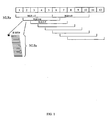
- the length of each NLS is equal to the length of each NLR See, for example, Figure 1 .
- the nucleotide sequence of interest is represented by 12 nucleotides, and each NLR is 5 nucleotides in length.
- each NLS for each NLR is also 5 nucleotides in length.
- the methods described herein can be employed to generate a single optimized sequence from a single nucleotide sequence of interest, as well as multiple different optimized sequences from a single nucleotide sequence of interest. Where multiple different optimized sequences are generated, one or more of the optimization parameters is changed in each optimization run such that a different optimized sequence is generated from that run.
- One such parameter that can be varied is the value represented by "N" in the NLS and the NLR.
- the method of the invention requires a target database of nucleotide sequences.
- the "target database” can be any database of one or more nucleotide sequences, for example the GENBANK® nucleotide database, a database of sequences specific to a certain genus or species (e.g., a maize-specific database, a soybean-specific database, an animal-specific database such as a human, laboratory, or agricultural animal-specific database, etc.), or a custom database of nucleotide sequences that would be relevant for the particular user.
- the target database comprises a collection of coding sequences for an organism of interest.
- the database of sequences may be organized in any number of formats or file types, for example as a file of files in FASTA format, or as a folder of sequence files in a computer readable format.
- Module B Organize database as set of N-length oligomer sequences
- NLS Statistics Table (or an "NLS Stats Table").
- the NLS Stats Table is generated by setting the length "N” and determining the frequency of every possible N-length segment represented in that database.
- the value of N can be arbitrarily selected based on the size of the target database (i.e., across all sequences in that database). Generally, longer NLR sequences capture more information than shorter NLR sequences, but the number of NLS Stats Table entries is governed by sequence length, and overly-large tables slow algorithm execution and decrease statistical precision.
- An NLS Stats Table can be compiled by counting the number of times each NLS is represented in the database, for example through the use of a "sliding window" algorithm that scans every sequence in the database.
- an NLS Stats Table could be compiled by using any other statistically reasonable strategy, for example by random sampling of short sequences from a database. Sliding window algorithms are known in the art.
- the algorithm moves along each sequence in the target database by sliding one or more nucleotide(s) at a time to compile the list of NLSs.
- a target database comprising a nucleotide sequence represented by AGTGCAAGTACGTAA (SEQ ID NO:7), where N is set to 5, the first NLS is AGTGC, the second NLS is GTGCA, the third NLS is TGCAA, and so forth.
- a set of NLSs is compiled for every sequence in the target database.
- the sliding window algorithm counts the number of times each NLS from the empty NLS stats table is represented in the database. For example, the algorithm scans all sequences and counts the number of times the NLS "AAAAA" appears in the database, the number of times the NLS "AAAAC” appears in the database, the number of times the NLS "AAAAG” appears, etc. This raw count is then divided by the total number ofNLSs observed in the database to give an observed frequency value.
- a probability score is calculated, which represents the observed frequency of each NLS relative to its expected frequency of occurrence within the target database.
- the probability score is converted to a log probability score and is equal to the log 10 [observed frequency of the NLS in the database/expected frequency of the NLS in the database].
- each nucleotide is considered equally probable.
- the expected frequency would be 0.25 N , where N is the length designated for the NLR/NLS above.
- N is the length designated for the NLR/NLS above.
- a frequency that is based on the relative frequency of each nucleotide in the target database is used.
- the relative frequency of each nucleotide is calculated as the fractional representation of nucleotides G, C, T, and A across the entirety of all of the sequences (collectively) in the target database (the 'database frequency' for that nucleotide).
- the expected frequency for the NLS is calculated for each N-length sequence by, (1) for each position in the NLS, recording the database frequency of the nucleotide represented at that position (A, G, C, or T); and then (2) calculating the product of those database frequencies to generate an expected frequency for the entire NLS.
- the ratio of observed/expected is greater than one and the log probability score is a positive number. In cases where the observed frequency is lower than the expected frequency, the ratio is less than one and the log probability score is a negative number.
- a positive log probability means that the NLS is observed more often than would be expected statistically
- a negative log probability means the NLS is observed less often than would be expected statistically.
- the observed frequency is set to [1/1 + the total number of NLSs observed in the database].
- an arbitrary value lower than the lowest observed frequency in the NLS Stats table is selected. Consequently, unobserved NLSs typically have very low probability scores relative to observed NLSs.
- Module B can be used to assess the fit of a particular sequence (or sequences) to an NLS Stats Table. For example, the sequence of interest can be scanned to look for low scoring regions, or an aggregate score for the entire sequence can be calculated. This aggregate score can be used, for example, to compare two different nucleotide sequences encoding the same amino acid to determine which sequence would be a better fit for expression in a target organism. While not bound by any particular theory or mechanism, it is proposed that sequences having a preponderance of low scoring regions (or sequences having a lower aggregate score) will have lower levels of expression in the target organism than sequences having a preponderance of higher scoring regions (or sequences with a higher aggregate score).
- One method to evaluate the fit of a sequence to an NLS Stats table comprises:
- Another method for evaluating the fit of a sequence to an NLS Stats Table involves looking for low-scoring segments within a larger sequence of interest. Such low-scoring segments may represent significant barriers to transgene expression, or may be sufficient to disrupt expression. This method comprises:
- nucleotide sequence of interest is a coding sequence for a protein of interest
- the sets of such NLSs are herein referred to as lists of silent NLSs or "SNLS.”
- the SNLS lists are developed by using the entire sequence of interest as a basis for translation and evaluation. This method comprises:
- the SNLS list is developed by performing only limited translation and comparison in the immediate vicinity of the NLR being examined.
- This method is computationally preferred versus the method described above. This method comprises:
- the SNLS list is generated by first creating a translated peptide for each NLR, and then selecting SNLS members from the set of all degenerate nucleotide sequences that could encode the translated peptide. This method comprises:
- each SNLS is assigned using the NLS Stats Table, and a delta score is calculated for each SNLS.
- the list of SNLSs is sorted by delta score from highest to lowest.
- the list of SNLSs that is generated for an individual NLR is referred to herein as the "corresponding SNLS list" for that particular NLR.
- each NLR will have its own corresponding SNLS list.
- the general strategy is to replace the original NLS at each NLR with a SNLS having the largest delta score.
- the net effect of these substitutions is to drive the overall composition of the original sequence closer to the composition of the sequences in the target database.
- low-scoring subsegments of the original sequence are replaced with higher-scoring segments while preserving the original translation of the entire sequence.
- An exemplary algorithm to perform the steps of this module may include the following steps:
- a preliminary round of optimization is performed directly from the amino acid sequence of the translated parent sequence. This method comprises:
- the optimized sequence from Module C is further analyzed and adjusted to remove any unintended open reading frames or undesirable short DNA sequences.
- certain short DNA sequences representing or believed to be capable of representing undesirable features are removed from the optimized sequence.
- Such short DNA sequences can include certain restriction enzyme recognition sequences, polyadenylation sequences, 5' and or 3' splice recognition sites, and the like. These elements may be defined by the particular user.
- such short DNA sequences are removed from the nucleotide sequence by scanning the sequence for undesired elements and replacing NLSs from NLRs overlapping these short sequences with different NLSs, thereby disrupting the short nucleotide sequence.
- the NLS having the lowest impact on the total score is substituted for an NLS overlapping the undesired element.
- Methods for calculating total score are discussed elsewhere herein.
- only SNLS substitutions are allowed, and substitutions that introduce spurious (i.e., unintended) ORFs are disallowed. This cycle is typically repeated until no undesirable sites remain, although it may not be necessary to remove every undesirable sequence. Removal of short DNA sequences is typically performed during or after optimization according to Modules A, B and C herein, or can be performed in the absence of either of these modules.
- polyadenylation sites include, but are not limited to, AATAAA, , AATATT, AACCAA, ATACTA, AATGAA, GATAAA, ATATAA, ATAAAA, ATTAAT, AATAAT, AATAAG, AATCAA, ATGAAA, AAGCAT, ATACAT, AAAATA, ATTAAA, AATTAA, AATACA, and CATAAA (SEQ ID N0:8-11, 1, and 12-26, respectively) (see, for example, Zhao et al. (1999) Microbiol. Mol.
- Polymerase termination signals include, but are not limited to, (CAN) 7-9 AGTNNAA (see, for example, Vankan and Filipowicz (1988) EMBO J. 7:791-799 ).
- Consensus splice sites include, but are not limited to, 5'-AAG:GTAAGT and 3'-TTTT(Pu)TTT(Pu)T(Pu)T(Pu)TGCAG:C (see, for example, Brown et al. (1986) EMBO J. 5:2749-2758 ; Hanley and Schuler (1988) Nucleic Acids Res. 16:7159-7176 ).
- the most invariant residues of splice sites are the 5'-GT and 3'-AG.
- the optimized nucleotide sequence may also be further modified by substitution with NLSs having a lower probability of generating a stable RNA secondary structure.
- secondary structures include, but are not limited to, hairpin loops (snapback structures).
- Sequences capable of forming hairpin loops include, but are not limited to, CUUCGG (SEQ ID NO:27.) and UCUUCGG (SEQ ID NO:28) (see, for example, Tuerk et al. (1988) Proc. Natl. Acad. Sci. U.S.A. 85:1364-1368 ).
- the optimized sequence may be further optimized by eliminating the occurrence of unwanted short nucleotide consensus sequences, such as recognition sites for restriction endonucleases, polyadenylation sequences, 5' and 3' splice recognition sequences, and the like.
- open reading frames that do not encode the protein of interest are removed from the optimized sequence.
- This removal of undesired or “spurious" ORFs is accomplished by replacing NLSs at NLR positions internal to the spurious ORF with NLSs that disrupt the spurious ORF.
- An "internal NLR” is an NLR that falls within the boundaries of the spurious ORF as identified by all-frame translations of the sequence of interest.
- the sequence is scanned for the presence or spurious ORFs.
- NLR positions that are internal to the spurious ORFs are identified. SNLS substitutions at these NLR positions are evaluated, and those that disrupt the spurious ORF are selected based on delta scores as described above.
- the SNLS having the lowest impact on the total score is selected. Because only SNLSs are considered, substitutions are selected that disrupt any spurious ORF while not interrupting the primary ORF.
- This cycle may be iterated to generate increasingly polished optimized sequences, or until spurious ORFs having a length of greater than about 1000, about 900, about 800, about 700, about 600, about 500, about 400, about 300, about 200, about 100, or greater than about 75 nucleotides are removed.
- the optimized nucleotide sequences can be further altered to adjust the GC content of the optimized sequence.
- This alteration can be accomplished by substituting NLSs at NLRs with NLSs having different GC contents. Substitutions that introduce spurious ORFs or undesirable short DNA sequences should be disallowed.
- all possible SNLSs at all NLRs are examined, and those having the least impact on the total score while altering net GC content are identified.
- Substitutions are made iteratively with locking as described above until the total GC content of the gene reaches a target threshold; for example a GC content of about 40 to about 60%, for example about 60%, about 59%, about 58%, about 57%, about 56%, about 55%, about 54%, about 53%, about 52%, about 51%, about 50%, about 49%, about 48%, about 47%, about 46%, about 45%, about 44%, about 43%, about 42%, about 41%, about 40%, about 39% or about 38%.
- a target threshold for example a GC content of about 40 to about 60%, for example about 60%, about 59%, about 58%, about 57%, about 56%, about 55%, about 54%, about 53%, about 52%, about 51%, about 50%, about 49%, about 48%, about 47%, about 46%, about 45%, about 44%, about 43%, about 42%, about 41%, about 40%, about 39% or about 38%.
- the GC content of the optimized nucleotide sequence is uniform across the entire nucleotide sequence.
- uniform across the nucleotide sequence is intended that the GC content of any defined subsegment of the full-length optimized sequence has a GC content that is similar to the GC content of any other defined subsegment of the full-length optimized sequence.
- the GC content of a reference subsegment is within about 20%, within about 19%, within about 15%, within about 10%, within about 9%, within about 8%, within about 7%, within about 6%, within about 5%, within about 4%, within about 3%, within about 2%, within about 1%,or less of the GC content of the subsection to which the reference section is being compared.
- the methods described above for generating a synthetic nucleotide sequence may be performed, wholly or in part, with the use of a computer program or computer-implemented method.
- Computer programs and computer program products of the present invention comprise a computer usable medium having control logic stored therein for causing a computer to generate a synthetic nucleotide sequence encoding a polypeptide of interest.
- the computer program comprises a computer usable medium having control logic stored therein for causing a computer to generate an NLS Stats Table, the control logic comprising a first code for causing the computer to accept external information entered by an input device, wherein the external information comprises a database of DNA sequences and a designation of the n-length.
- Control logic is also referred to as computer-readable and/or computer-executable code.
- the computer program comprises a computer usable medium having control logic stored therein for causing a computer to generate an optimized nucleotide sequence encoding a polypeptide of interest, the control logic comprising a first code for causing the computer to accept external information entered by an input device, wherein the external information comprises an NLS Stats Table, and a nucleotide sequence to be optimized.
- Control logic is also referred to as computer-readable and/or computer-executable code.
- the computer program comprises a computer usable medium having control logic stored therein for causing a computer to generate an optimized nucleotide sequence encoding a polypeptide of interest, the control logic comprising a first code for causing the computer to accept external information entered by an input device, wherein the external information comprises the DNA sequence of an optimized nucleotide sequence, and a set of DNA and protein sequences that are less desired (e.g., short undesirable DNA sequences as disclosed elsewhere herein).
- Control logic is also referred to as computer-readable and/or computer-executable code.
- the computer program comprises a computer usable medium having control logic stored therein for causing a computer to generate a synthetic ("optimized") nucleotide sequence encoding a polypeptide of interest, the control logic comprising a first code for causing the computer to accept external information entered by an input device, wherein the external information comprises a database of DNA sequences, a designation of the n-length, and an amino acid sequence for which to develop optimized gene(s); a second code for causing the computer to generate an NLS Stats Table from the input; a third code for developing a set of NLRs, a fourth code for determining the set ofNLSs that do not disrupt the open reading frame ("silent NLSs", or "SNLS”), and a fifth code for optimizing the choices among SNLS assemblies to yield an optimized gene sequence.
- the control logic comprising a first code for causing the computer to accept external information entered by an input device, wherein the external information comprises a database of DNA sequences, a designation of the n-length, and
- Computer systems of the present invention used to generate a synthetic nucleotide sequence encoding a polypeptide of interest comprise a processor, operative to determine, accept, check, and display data, a memory for storing data coupled to said processor, a display device coupled to said processor for displaying data, an input device coupled to said processor for entering external data; and a computer-readable script with at least two modes of operation executable by said processor.
- a computer-readable script may be a computer program or control logic of a computer program product of an embodiment of the present invention.
- the computer program be written in any particular computer language or to operate on any particular type of computer system or operating system.
- the computer program may be written, for example, in C++, Java, Perl, Python, Ruby, Pascal, or Basic programming language. It is understood that one may create such a program in one of many different programming languages.
- this program is written to operate on a computer utilizing a Linux operating system.
- the program is written to operate on a computer utilizing a MS Windows or MacOS operating system.
- the computer program has an input space for the user to insert the desired amino acid sequence and an output space where the generated nucleotide sequence is displayed.
- the computer program has an editing mode, where the probability for selecting each NLS for each NLR may be modified as desired by the user.
- a synthetic (or "optimized") nucleotide sequence may be generated for any nucleotide sequence encoding a polypeptide of interest, including but not limited to, sequences encoding pesticidal proteins, herbicide resistance proteins, fungal resistance proteins, hydrolytic enzymes, including enzymes altering the amount and/or nature of carbohydrate, protein, or lipid/oil in a plant grain, quality traits, or any other protein of interest.
- Pesticidal proteins include delta-endotoxin proteins, such as those from Bacillus thuringiensis.
- an “insecticidal” compound is one that has this activity against a pest in the insect order.
- An “herbicide resistance protein” or a protein resulting from expression of an “herbicide resistance-encoding nucleic acid molecule” includes proteins that confer upon a cell the ability to tolerate a higher concentration of an herbicide than cells that do not express the protein, or to tolerate a certain concentration of an herbicide for a longer time than cells that do not express the protein.
- Example 1 Optimization of a bacterial delta endotoxin gene for expression in Zea mays using an order 5 statistical model
- Step 1 Identification and collection of Z. mays cDNA sequences (Module A). Sequences of coding regions known in the art to be expressed in Zea mays were collected from public resources (e.g. GENBANK®). These sequences consisted of mRNAs, cDNAs, or genomic fragments representing coding sequences. As needed, the sequences were edited to remove non-coding regions (by preferentially identifying open reading frame (ORF) regions within the sequence population).
- ORF open reading frame
- Step 2 Generation of an N LS slats Table for the Zea mays cDNA sequences using an N of 5. Sequences from Z. mays were analyzed using a 5-base sliding sequence window as described in module B. A table consisting of all possible 5-base sequences was generated, and counts recorded for each 5-base sequence observed in the Z. mays sequence set from Step 1. Observed counts were divided by the total number of observed 5-base sequences to generate raw frequency values. Observed raw frequency values were divided by expected frequency values to generate observed expected ratios for all 5-base sequences (NLSs) in the Z. mays sequence set.
- Expected frequencies in this example were defined using a flat distribution model (that is, cach NLS (5-base sequence) was considered equally likely within the 1,024 possible NLSs (5-base DNA sequences)).
- the resulting table is referred to as theNLS Stats Table. Observed:expected ratios were considered to approximate the probability of occurrence for each of the 5-base sequences observed.
- Step 3 Replacement of low-probability 5-base sequences (NLSs) within the bacterial delta endotoxin gene with high-probability sequences.
- Step 4 Removal of spurious ORFs from the preliminary optimized gone. ORF's not encoding the gene of interest were removed from the preliminary optimized gene by replacing MLSs in the preliminary optimized gene (5-base sequences) with SNLSs (5-base sequences) as described in module D, above. Substitutions were selected that disrupted any identified spurious open reading frame while not interrupting the primary open reading frame (in this case, the Axmi004 protein). This cycle was iterated until no spurious open reading frames larger than 75 amino acids remained in the optimized gene producing an "ORF-scrubbed optimized gene.”
- Step 5 Removal of undesirable short DNA sequences from the ORF-scrubbed preliminary optimized gene.
- Short DNA sequences encoding undesirable features, including restriction enzyme recognition sequences, were removed from the preliminary optimized gene by replacing NLSs in the preliminary optimized gene with SNLSs (5-base sequences) as described in module E, above. Substitutions that introduced spurious ORFs were disallowed. This cycle was repeated until no undesirable sites remained, resulting in a fully-optimized gene.
- Step 6 Generation of a variant fully-optimized gene having reduced GC content.
- a variant of the fully optimized gene was generated by substituting NLSs in the fully optimized gene with SNLSs (5-base sequences) as described in module F, above. Substitutions that introduced spurious open reading frames or undesirable short DNA sequences were disallowed. All possible silent substitutions were evaluated, and those that had the least impact on observed:expected ratio while still decreasing net GC content were identified. Substitutions were made in this fashion iteratively until the total GC content of the gene was driven below a target threshold of 50.0%. This sequence was considered the sub-50% GC optimized gene.
- Example 3 Generation of an optimized gene sequence using a preliminary optimization step based on the amino acid sequence
- Example 2 shows an abbreviated log file generated by use of the algorithms of Example 2 to create an optimized gene sequence by performing a preliminary optimization step using the translated amino acid sequence. Many log entries have been deleted and replaced with "DATA NOT SHOWN,” which simply indicates that similar steps were performed but not listed in this example. Sequences shown in this example are listed in Table 1.
Landscapes
- Life Sciences & Earth Sciences (AREA)
- Physics & Mathematics (AREA)
- Health & Medical Sciences (AREA)
- Medical Informatics (AREA)
- Engineering & Computer Science (AREA)
- Spectroscopy & Molecular Physics (AREA)
- Theoretical Computer Science (AREA)
- Biophysics (AREA)
- Bioinformatics & Cheminformatics (AREA)
- Bioinformatics & Computational Biology (AREA)
- Biotechnology (AREA)
- Evolutionary Biology (AREA)
- General Health & Medical Sciences (AREA)
- Computer Vision & Pattern Recognition (AREA)
- Evolutionary Computation (AREA)
- Analytical Chemistry (AREA)
- Artificial Intelligence (AREA)
- Bioethics (AREA)
- Proteomics, Peptides & Aminoacids (AREA)
- Data Mining & Analysis (AREA)
- Databases & Information Systems (AREA)
- Epidemiology (AREA)
- Chemical & Material Sciences (AREA)
- Public Health (AREA)
- Software Systems (AREA)
- Measuring Or Testing Involving Enzymes Or Micro-Organisms (AREA)
- Breeding Of Plants And Reproduction By Means Of Culturing (AREA)
- Saccharide Compounds (AREA)
- Agricultural Chemicals And Associated Chemicals (AREA)
- Micro-Organisms Or Cultivation Processes Thereof (AREA)
- Enzymes And Modification Thereof (AREA)
Claims (9)
- Computerimplementiertes Verfahren zum Optimieren einer Nukleotidsequenz für Expression in einem Zielorganismus, umfassend:a) Bereitstellen einer Nukleotidsequenz von Interesse;b) Bereitstellen einer Zieldatenbank von Nukleotidsequenzen, wobei die Datenbank spezifisch für eine Gattung des Zielorganismus ist;c) Erstellen einer Liste aller möglichen Nukleotidsequenzen der Länge N, NLS, für eine gegebene Länge N, wobei N kürzer als die Länge der kürzesten Nukleotidsequenz in der Datenbank ist, und wobei N konstant für jede NLS ist;d) Erhalten eines beobachteten Frequenzwerts für jede NLS durch Zählen, wie oft jede NLS in der Datenbank dargestellt wird, und Dividieren durch die Gesamtzahl von in der Datenbank beobachteten NLS;e) Berechnen des Wahrscheinlichkeitsscores für jede im Schritt c) ermittelten NLS, bezogen auf die in Schritt b) bereitgestellte Datenbank, um eine NLS Statistiktabelle zu erzeugen, wobei der Wahrscheinlichkeitsscore die beobachtete Frequenz jeder NLS darstellt, bezogen auf ihre zu erwartende Frequenz des Vorkommens innerhalb der Zieldatenbank;f) Identifizieren für jeden Bereich der Länge N, NLR, der Nukleotidsequenz von Interesse einer entsprechenden Gruppe von NLS, die die für die Nukleotidsequenz von Interesse kodierende Aminosäurensequenz nicht verändert, wobei eine NLS, die für die Nukleotidsequenz von Interesse kodierende Aminosäuresequenz nicht verändert, als eine stumme NLS, SNLS, angesehen wird;g) Berechnen eines Deltascores für jede SNLS, wobei der Deltascore die Differenz zwischen dem Wahrscheinlichkeitsscore des NLR der Nukleotidsequenz von Interesse und jeder entsprechenden SNLS darstellt; undh) Substituieren eines oder mehrerer NLR in der Nukleotidsequenz von Interesse mit der entsprechenden SNLS mit dem größten Deltascore, um eine optimierte Sequenz zu erzeugen.
- Verfahren nach Anspruch 1, wobei das genannte Verfahren ferner einen Schritt zum Erzeugen einer voroptimierten Sequenz nach dem Schritt e) umfasst, wobei die genannte voroptimierte Sequenz erzeugt wird durch:i) Erstellen eines translatierbaren im gleichen Leserahmen liegenden Bereichs um jeden Bereich der Länge N, NLR, der Nukleotidsequenz von Interesse herum durch Verlaufen jedes NLR in die 5'- oder 3'- oder beide Richtungen auf solche Weise, dass:a) die Länge jedes Bereichs ein Vielfaches von drei erreicht; undb) die Startposition jedes verlaufenden Bereichs im gleichen Leserahmen wie der Translationsrahmen der Nukleotidsequenz von Interesse liegt;
wobei die Länge des NLR mit der Länge der NLS identisch ist;ii) Translation jedes in Schritt i) erstellten Bereichs in ein Peptidsegment;iii) Erstellen einer Kombination aller Nukleotidsequenzen, die für jedes Segment kodieren, um eine Kombination von degenerierten Sequenzen für jedes Segment zu erzeugen, und Identifizieren des Bereichs jeder degenerierten Sequenz, der dem NLR entspricht;iv) Bewerten jeder degenerierten Nulkeotidsequenz unter Verwendung der in Schritt e) erstellten NLS-Statistiktabelle, wobei die Bewertung auf den Bereich der degenerierten Sequenz basiert, der dem NLR entspricht;v) Auswahl der Nukleotidsequenz mit höchster Ähnlichkeit mit jedem Peptidsegment;vi) Zusammenstellen der in Schritt v) ausgewählten Sequenzen, um eine voroptimierte Sequenz zu erzeugen; undwobei Schritt f) nach Anspruch 1 an der voroptimierten Sequenz erfolgt. - Verfahren nach Anspruch 1 oder 2, wobei das genannte Verfahren ferner umfasst:i) Durchlesen der in Schritt h) erzeugten optimierten Sequenz, um jegliche falschen offenen Leserahmen, ORF, zu identifizieren;j) Substituieren eines oder mehrerer NLR in der optimierten Sequenz mit einer entsprechenden SNLS, die die falschen ORF unterbricht; undk) gegebenenfalls Wiederholen der Schritte i) und j), bis alle falschen ORF aus der Sequenz entfernt werden.
- Verfahren nach Anspruch 3, wobei das genannte Verfahren ferner umfasst:l) Einstellen eines Zielwertes von G:C-Gehalt für die optimierte Sequenz;m) Substituieren eines oder mehrerer NLR in der in Schritt j) oder k) erzeugten optimierten Sequenz mit einer entsprechenden SNLS, die den G:C-Gehalt dem Zielwert von G:C-Gehalt näher bringt; undn) gegebenenfalls Wiederholen der Schritte I) und m), bis der Zielwert von G:C-Gehalt erreicht wird.
- Verfahren nach Anspruch 1 oder 2, wobei das genannte Verfahren ferner umfasst:i) Durchlesen der in Schritt h) erzeugten optimierten Sequenz, um jegliche unerwünschten kurzen DNA-Elemente zu identifizieren;j) Substituieren eines oder mehrerer NLR in der optimierten Sequenz mit einer entsprechenden SNLS, die die unerwünschten kurzen DNA-Elemente entfernt; und,k) gegebenenfalls Wiederholen der Schritte i) und j), bis alle unerwünschten DNA-Elemente aus der Sequenz entfernt werden.
- Verfahren nach Anspruch 5, wobei das genannte Verfahren ferner umfasst:l) Einstellen eines Zielwertes von G:C-Gehalt für die optimierte Sequenz;m) Substituieren einer oder mehrerer NLR in der optimierten Sequenz mit einer entsprechenden SNLS, die den G:C-Gehalt dem Zielwert von G:C-Gehalt näher bringt; und,n) gegebenenfalls Wiederholen der Schritte l) und m), bis der Zielwert von G:C-Gehalt erreicht wird.
- Verfahren nach Anspruch 3, wobei das genannte Verfahren ferner umfasst:l) Durchlesen der in Schritten j) oder k) erzeugten optimierten Sequenz, um jegliche unerwünschten kurzen DNA-Elemente zu identifizieren;m) Substituieren einer oder mehrerer NLR in der optimierten Sequenz mit einer entsprechenden SNLS, die die unerwünschten kurzen DNA-Elemente entfernt; und,n) gegebenenfalls Wiederholen der Schritte l) und m), bis alle unerwünschten DNA-Elemente aus der Sequenz entfernt werden.
- Verfahren nach Anspruch 1 oder 2, wobei das genannte Verfahren ferner umfasst:i) Einstellen eines Zielwertes von G:C-Gehalt für die optimierte Sequenz;j) Subsituieren eines oder mehrerer NLR in der optimierten Sequenz mit einer entsprechenden SNLS, die den G:C-Gehalt dem Zielwert von G:C-Gehalt näher bringt; und,k) gegebenenfalls Wiederholen der Schritte i) und j), bis der Zielwert von G:C-Gehalt erreicht wird.
- Verfahren nach Anspruch 7, wobei das genannte Verfahren ferner umfasst:o) Einstellen eines Zielwertes von G:C-Gehalt für die optimierte Sequenz;p) Substituieren eines oder mehrerer NLR in der in Schritt m) oder n) erzeugten optimierten Sequenz mit einer entsprechenden SNLS, die den G:C-Gehalt dem Zielwert von G:C-Gehalt näher bringt: undq) gegebenenfalls Wiederholen der Schritte o) und p), bis der Zielwert von G:C-Gehalt erreicht wird.
Applications Claiming Priority (2)
| Application Number | Priority Date | Filing Date | Title |
|---|---|---|---|
| US97872907P | 2007-10-09 | 2007-10-09 | |
| PCT/US2008/079343 WO2009049045A1 (en) | 2007-10-09 | 2008-10-09 | Computational methods for synthetic gene design |
Publications (2)
| Publication Number | Publication Date |
|---|---|
| EP2208157A1 EP2208157A1 (de) | 2010-07-21 |
| EP2208157B1 true EP2208157B1 (de) | 2011-03-30 |
Family
ID=40193507
Family Applications (1)
| Application Number | Title | Priority Date | Filing Date |
|---|---|---|---|
| EP08837046A Active EP2208157B1 (de) | 2007-10-09 | 2008-10-09 | Berechnungsverfahren für das design synthetischer gene |
Country Status (11)
| Country | Link |
|---|---|
| US (1) | US8175813B2 (de) |
| EP (1) | EP2208157B1 (de) |
| CN (1) | CN101821744B (de) |
| AT (1) | ATE504045T1 (de) |
| AU (1) | AU2008310806A1 (de) |
| BR (1) | BRPI0818507B8 (de) |
| CA (1) | CA2702084C (de) |
| DE (1) | DE602008005920D1 (de) |
| MX (1) | MX2010003878A (de) |
| WO (1) | WO2009049045A1 (de) |
| ZA (1) | ZA201002472B (de) |
Families Citing this family (31)
| Publication number | Priority date | Publication date | Assignee | Title |
|---|---|---|---|---|
| WO2011088463A2 (en) * | 2010-01-15 | 2011-07-21 | University Of Delaware | Systems and methods for identifying structurally or functionally significant nucleotide sequences |
| WO2012135501A2 (en) | 2011-03-30 | 2012-10-04 | Athenix Corp. | Axmi232, axmi233, and axmi249 toxin genes and methods for their use |
| WO2012135436A1 (en) | 2011-03-30 | 2012-10-04 | Athenix Corp. | Axmi238 toxin gene and methods for its use |
| UA120584C2 (uk) | 2011-04-05 | 2020-01-10 | Атенікс Корп. | Варіантний інсектицидний ген axmi115 та способи його застосування |
| BR112014001909A2 (pt) | 2011-07-28 | 2017-02-21 | Athenix Corp | gene da toxina axmi270 e métodos para a sua utilização |
| BR112014002027A8 (pt) | 2011-07-29 | 2022-07-05 | Athenix Corp | Gene pesticida axmi279 e métodos para a sua utilização |
| EP2822962A1 (de) | 2012-03-08 | 2015-01-14 | Athenix Corp. | Axmi-345-delta-endotoxingen und verfahren zu dessen verwendung |
| US9790258B2 (en) | 2012-03-08 | 2017-10-17 | Athenix Corp. | AXMI335 toxin gene and methods for its use |
| UA117731C2 (uk) | 2012-06-29 | 2018-09-25 | Атенікс Корп. | Токсин axmi277 проти нематод та його застосування |
| WO2014036238A1 (en) | 2012-08-30 | 2014-03-06 | Athenix Corp. | Axmi-234 and axmi-235 toxin genes and methods for their use |
| EP2956547B1 (de) | 2013-02-13 | 2018-05-02 | Athenix Corp. | Verwendung von axmi184 zur bekämpfung von maiswurzelbohrern |
| BR112015021651B1 (pt) | 2013-03-07 | 2021-12-28 | Bayer Cropscience Lp | Molécula de ácido nucleico recombinante, cassete de expressão, célula hospedeira de bactéria, polipeptídeo recombinante, composição e métodos para aplicação dos mesmos |
| UY35696A (es) | 2013-08-09 | 2015-03-27 | Athenix Corp | ?molécula de adn recombinante que comprende al gen de toxina axmi440, vector, célula huésped, plantas, composiciones y métodos relacionados?. |
| WO2015038262A2 (en) | 2013-08-09 | 2015-03-19 | Athenix Corp. | Axmi281 toxin gene and methods for its use |
| WO2015077525A1 (en) | 2013-11-25 | 2015-05-28 | Bayer Cropscience Lp | Use of axmi-011 for the control of hemipteran insects |
| WO2015088937A2 (en) | 2013-12-09 | 2015-06-18 | Athenix Corp. | Axmi477, axmi482, axmi486 and axmi525 toxin genes and methods for their use |
| WO2016106184A1 (en) | 2014-12-22 | 2016-06-30 | AgBiome, Inc. | Methods for making a synthetic gene |
| EP3329037B1 (de) * | 2015-07-28 | 2023-10-18 | Yeda Research and Development Co. Ltd. | Stabile proteine und verfahren zum design davon |
| US11151497B2 (en) * | 2016-04-27 | 2021-10-19 | Zymergen Inc. | Microbial strain design system and methods for improved large-scale production of engineered nucleotide sequences |
| BR112019010476A2 (pt) | 2016-11-23 | 2019-09-10 | BASF Agricultural Solutions Seed US LLC | molécula de ácido nucleico recombinante, vetor, célula hospedeira, planta transgênica, semente transgênica, polipeptídeo recombinante, composição, método para controlar uma população de pragas, para matar pragas, para produzir um polipeptídeo, planta ou célula vegetal, método para proteger uma planta contra uma praga, para aumentar o rendimento em uma planta, uso e produto primário |
| EA201991547A1 (ru) | 2016-12-22 | 2020-01-17 | БАСФ АГРИКУЛЬЧУРАЛ СОЛЮШНС СИД УС ЛЛСи | Применение cry14 для борьбы с вредителями нематодами |
| WO2018136604A1 (en) | 2017-01-18 | 2018-07-26 | Bayer Cropscience Lp | Bp005 toxin gene and methods for its use |
| US11286498B2 (en) | 2017-01-18 | 2022-03-29 | BASF Agricultural Solutions Seed US LLC | Use of BP005 for the control of plant pathogens |
| CN114555628A (zh) | 2019-10-14 | 2022-05-27 | 巴斯夫农业种子解决方案美国有限责任公司 | 新颖抗虫基因和使用方法 |
| AU2020367523A1 (en) | 2019-10-14 | 2022-04-28 | BASF Agricultural Solutions Seed US LLC | Novel insect resistant genes and methods of use |
| US11049590B1 (en) | 2020-02-12 | 2021-06-29 | Peptilogics, Inc. | Artificial intelligence engine architecture for generating candidate drugs |
| CN113793639B (zh) * | 2021-08-03 | 2024-01-05 | 杭州瑞丰生物科技有限公司 | 一种管理玉米螟对Bt毒素抗性的方法 |
| EP4638759A2 (de) | 2022-12-19 | 2025-10-29 | BASF Agricultural Solutions US LLC | Insektentoxingene und verfahren zu deren verwendung |
| CN121548646A (zh) | 2023-07-07 | 2026-02-17 | 巴斯夫农业解决方案美国有限责任公司 | Cry基因用于控制线虫有害生物的用途 |
| AU2024366942A1 (en) | 2023-10-27 | 2026-05-07 | Basf Agricultural Solutions Us Llc | Use of novel genes for the control of nematode pests |
| WO2026010930A1 (en) | 2024-07-05 | 2026-01-08 | BASF Agricultural Solutions Seed US LLC | Use of axmi277 for the control of rotylenchulus reniformis nematode pests |
Family Cites Families (12)
| Publication number | Priority date | Publication date | Assignee | Title |
|---|---|---|---|---|
| US6114138A (en) | 1984-06-04 | 2000-09-05 | Mycogen Plant Science, Inc. | Insecticidal protein fragments |
| US5567600A (en) * | 1983-09-26 | 1996-10-22 | Mycogen Plant Sciences, Inc. | Synthetic insecticidal crystal protein gene |
| US5380831A (en) * | 1986-04-04 | 1995-01-10 | Mycogen Plant Science, Inc. | Synthetic insecticidal crystal protein gene |
| TR27832A (tr) | 1987-04-29 | 1995-08-31 | Monsanto Co | Zararli ucucu hasarata mukavim bitkiler. |
| US6015891A (en) * | 1988-09-09 | 2000-01-18 | Mycogen Plant Science, Inc. | Synthetic insecticidal crystal protein gene having a modified frequency of codon usage |
| NZ230375A (en) | 1988-09-09 | 1991-07-26 | Lubrizol Genetics Inc | Synthetic gene encoding b. thuringiensis insecticidal protein |
| EP1103616A3 (de) | 1989-02-24 | 2001-06-27 | Monsanto Company | Synthetische Pflanzengene und Verfahren zu ihrer Herstellung |
| US20010003849A1 (en) | 1989-08-07 | 2001-06-14 | Kenneth A. Barton | Expression of genes in plants |
| US6403865B1 (en) | 1990-08-24 | 2002-06-11 | Syngenta Investment Corp. | Method of producing transgenic maize using direct transformation of commercially important genotypes |
| UA48104C2 (uk) | 1991-10-04 | 2002-08-15 | Новартіс Аг | Фрагмент днк, який містить послідовність,що кодує інсектицидний протеїн, оптимізовану для кукурудзи,фрагмент днк, який забезпечує направлену бажану для серцевини стебла експресію зв'язаного з нею структурного гена в рослині, фрагмент днк, який забезпечує специфічну для пилку експресію зв`язаного з нею структурного гена в рослині, рекомбінантна молекула днк, спосіб одержання оптимізованої для кукурудзи кодуючої послідовності інсектицидного протеїну, спосіб захисту рослин кукурудзи щонайменше від однієї комахи-шкідника |
| AT405624B (de) * | 1996-09-25 | 1999-10-25 | Stempfer Ferdinand Ing | Schweissgerät und schweissverfahren, insbesondere widerstandsschweissverfahren |
| US8434105B2 (en) * | 2007-11-13 | 2013-04-30 | Tp Lab, Inc. | Television scripting language |
-
2008
- 2008-10-09 WO PCT/US2008/079343 patent/WO2009049045A1/en not_active Ceased
- 2008-10-09 MX MX2010003878A patent/MX2010003878A/es active IP Right Grant
- 2008-10-09 US US12/248,750 patent/US8175813B2/en active Active
- 2008-10-09 EP EP08837046A patent/EP2208157B1/de active Active
- 2008-10-09 CN CN2008801107865A patent/CN101821744B/zh active Active
- 2008-10-09 CA CA2702084A patent/CA2702084C/en active Active
- 2008-10-09 BR BRPI0818507A patent/BRPI0818507B8/pt active IP Right Grant
- 2008-10-09 AU AU2008310806A patent/AU2008310806A1/en not_active Abandoned
- 2008-10-09 AT AT08837046T patent/ATE504045T1/de not_active IP Right Cessation
- 2008-10-09 DE DE602008005920T patent/DE602008005920D1/de active Active
-
2010
- 2010-04-08 ZA ZA2010/02472A patent/ZA201002472B/en unknown
Also Published As
| Publication number | Publication date |
|---|---|
| CN101821744A (zh) | 2010-09-01 |
| BRPI0818507B1 (pt) | 2019-09-17 |
| ATE504045T1 (de) | 2011-04-15 |
| AU2008310806A1 (en) | 2009-04-16 |
| CN101821744B (zh) | 2013-05-22 |
| US20090137409A1 (en) | 2009-05-28 |
| BRPI0818507A2 (pt) | 2015-06-16 |
| CA2702084C (en) | 2017-07-25 |
| US8175813B2 (en) | 2012-05-08 |
| MX2010003878A (es) | 2010-10-15 |
| ZA201002472B (en) | 2011-06-29 |
| BRPI0818507B8 (pt) | 2022-07-05 |
| DE602008005920D1 (en) | 2011-05-12 |
| WO2009049045A1 (en) | 2009-04-16 |
| EP2208157A1 (de) | 2010-07-21 |
| CA2702084A1 (en) | 2009-04-16 |
Similar Documents
| Publication | Publication Date | Title |
|---|---|---|
| US8175813B2 (en) | Computational methods for synthetic gene design | |
| Baril et al. | Earl Grey: a fully automated user-friendly transposable element annotation and analysis pipeline | |
| Grundy et al. | Meta-MEME: motif-based hidden Markov models of protein families | |
| Kent et al. | Conservation, regulation, synteny, and introns in a large-scale C. briggsae–C. elegans genomic alignment | |
| Clauwaert et al. | Novel transformer networks for improved sequence labeling in genomics | |
| US7613572B2 (en) | Stochastic modeling of spatial distributed sequences | |
| Price et al. | De novo identification of repeat families in large genomes | |
| Bejerano et al. | Variations on probabilistic suffix trees: statistical modeling and prediction of protein families | |
| US20110295858A1 (en) | Method and apparatus for searching nucleic acid sequence | |
| US8725422B2 (en) | Methods for estimating genome-wide copy number variations | |
| US11347810B2 (en) | Methods of automatically and self-consistently correcting genome databases | |
| US20070275399A1 (en) | Methods for calculating codon pair-based translational kinetics values, and methods for generating polypeptide-encoding nucleotide sequences from such values | |
| Thareau et al. | Automatic design of gene-specific sequence tags for genome-wide functional studies | |
| Riley et al. | Identifying cognate binding pairs among a large set of paralogs: the case of PE/PPE proteins of Mycobacterium tuberculosis | |
| EP1512749A2 (de) | DNA zur Insertion in biogenische Gene, Vektor zur Einführung eines Gens, Zelle, und Methoden zur Einführung von Informationen in ein biogenisches Gen | |
| US20030200033A1 (en) | High-throughput alignment methods for extension and discovery | |
| JP2003157267A (ja) | 核酸塩基配列のアセンブル方法及びアセンブル装置 | |
| Nasser et al. | Multiple sequence alignment using fuzzy logic | |
| EP3360068B1 (de) | Vorrichtung zur erzeugung von genomikdaten und verfahren und softwareprodukt zur verwendung darin | |
| Shkolikov et al. | Deciphering the 3D genome organization across species from Hi-C data | |
| US12165744B2 (en) | Functional sequence selection method and functional sequence selection system | |
| US20020072862A1 (en) | Creation of a unique sequence file | |
| WO2004068398A1 (ja) | Dnaコンピュータ及びそれを用いた計算方法 | |
| Wang et al. | Recognizing translation initiation sites of eukaryotic genes based on the cooperatively scanning model | |
| Naghibzadeh et al. | A Novel Multi-head Algorithm to Discover all Tandem Repeats in One Scan of DNA Sequences |
Legal Events
| Date | Code | Title | Description |
|---|---|---|---|
| PUAI | Public reference made under article 153(3) epc to a published international application that has entered the european phase |
Free format text: ORIGINAL CODE: 0009012 |
|
| 17P | Request for examination filed |
Effective date: 20100408 |
|
| AK | Designated contracting states |
Kind code of ref document: A1 Designated state(s): AT BE BG CH CY CZ DE DK EE ES FI FR GB GR HR HU IE IS IT LI LT LU LV MC MT NL NO PL PT RO SE SI SK TR |
|
| AX | Request for extension of the european patent |
Extension state: AL BA MK RS |
|
| GRAP | Despatch of communication of intention to grant a patent |
Free format text: ORIGINAL CODE: EPIDOSNIGR1 |
|
| GRAS | Grant fee paid |
Free format text: ORIGINAL CODE: EPIDOSNIGR3 |
|
| GRAA | (expected) grant |
Free format text: ORIGINAL CODE: 0009210 |
|
| AK | Designated contracting states |
Kind code of ref document: B1 Designated state(s): AT BE BG CH CY CZ DE DK EE ES FI FR GB GR HR HU IE IS IT LI LT LU LV MC MT NL NO PL PT RO SE SI SK TR |
|
| AX | Request for extension of the european patent |
Extension state: AL BA MK RS |
|
| REG | Reference to a national code |
Ref country code: GB Ref legal event code: FG4D |
|
| REG | Reference to a national code |
Ref country code: CH Ref legal event code: EP |
|
| REG | Reference to a national code |
Ref country code: IE Ref legal event code: FG4D |
|
| REF | Corresponds to: |
Ref document number: 602008005920 Country of ref document: DE Date of ref document: 20110512 Kind code of ref document: P |
|
| REG | Reference to a national code |
Ref country code: DE Ref legal event code: R096 Ref document number: 602008005920 Country of ref document: DE Effective date: 20110512 |
|
| REG | Reference to a national code |
Ref country code: NL Ref legal event code: VDEP Effective date: 20110330 |
|
| PG25 | Lapsed in a contracting state [announced via postgrant information from national office to epo] |
Ref country code: LT Free format text: LAPSE BECAUSE OF FAILURE TO SUBMIT A TRANSLATION OF THE DESCRIPTION OR TO PAY THE FEE WITHIN THE PRESCRIBED TIME-LIMIT Effective date: 20110330 Ref country code: SE Free format text: LAPSE BECAUSE OF FAILURE TO SUBMIT A TRANSLATION OF THE DESCRIPTION OR TO PAY THE FEE WITHIN THE PRESCRIBED TIME-LIMIT Effective date: 20110330 Ref country code: HR Free format text: LAPSE BECAUSE OF FAILURE TO SUBMIT A TRANSLATION OF THE DESCRIPTION OR TO PAY THE FEE WITHIN THE PRESCRIBED TIME-LIMIT Effective date: 20110330 Ref country code: GR Free format text: LAPSE BECAUSE OF FAILURE TO SUBMIT A TRANSLATION OF THE DESCRIPTION OR TO PAY THE FEE WITHIN THE PRESCRIBED TIME-LIMIT Effective date: 20110701 Ref country code: LV Free format text: LAPSE BECAUSE OF FAILURE TO SUBMIT A TRANSLATION OF THE DESCRIPTION OR TO PAY THE FEE WITHIN THE PRESCRIBED TIME-LIMIT Effective date: 20110330 |
|
| LTIE | Lt: invalidation of european patent or patent extension |
Effective date: 20110330 |
|
| PG25 | Lapsed in a contracting state [announced via postgrant information from national office to epo] |
Ref country code: NO Free format text: LAPSE BECAUSE OF FAILURE TO SUBMIT A TRANSLATION OF THE DESCRIPTION OR TO PAY THE FEE WITHIN THE PRESCRIBED TIME-LIMIT Effective date: 20110630 Ref country code: SI Free format text: LAPSE BECAUSE OF FAILURE TO SUBMIT A TRANSLATION OF THE DESCRIPTION OR TO PAY THE FEE WITHIN THE PRESCRIBED TIME-LIMIT Effective date: 20110330 Ref country code: CY Free format text: LAPSE BECAUSE OF FAILURE TO SUBMIT A TRANSLATION OF THE DESCRIPTION OR TO PAY THE FEE WITHIN THE PRESCRIBED TIME-LIMIT Effective date: 20110330 Ref country code: AT Free format text: LAPSE BECAUSE OF FAILURE TO SUBMIT A TRANSLATION OF THE DESCRIPTION OR TO PAY THE FEE WITHIN THE PRESCRIBED TIME-LIMIT Effective date: 20110330 Ref country code: FI Free format text: LAPSE BECAUSE OF FAILURE TO SUBMIT A TRANSLATION OF THE DESCRIPTION OR TO PAY THE FEE WITHIN THE PRESCRIBED TIME-LIMIT Effective date: 20110330 |
|
| PG25 | Lapsed in a contracting state [announced via postgrant information from national office to epo] |
Ref country code: BE Free format text: LAPSE BECAUSE OF FAILURE TO SUBMIT A TRANSLATION OF THE DESCRIPTION OR TO PAY THE FEE WITHIN THE PRESCRIBED TIME-LIMIT Effective date: 20110330 |
|
| PG25 | Lapsed in a contracting state [announced via postgrant information from national office to epo] |
Ref country code: EE Free format text: LAPSE BECAUSE OF FAILURE TO SUBMIT A TRANSLATION OF THE DESCRIPTION OR TO PAY THE FEE WITHIN THE PRESCRIBED TIME-LIMIT Effective date: 20110330 Ref country code: PT Free format text: LAPSE BECAUSE OF FAILURE TO SUBMIT A TRANSLATION OF THE DESCRIPTION OR TO PAY THE FEE WITHIN THE PRESCRIBED TIME-LIMIT Effective date: 20110801 |
|
| PG25 | Lapsed in a contracting state [announced via postgrant information from national office to epo] |
Ref country code: SK Free format text: LAPSE BECAUSE OF FAILURE TO SUBMIT A TRANSLATION OF THE DESCRIPTION OR TO PAY THE FEE WITHIN THE PRESCRIBED TIME-LIMIT Effective date: 20110330 Ref country code: RO Free format text: LAPSE BECAUSE OF FAILURE TO SUBMIT A TRANSLATION OF THE DESCRIPTION OR TO PAY THE FEE WITHIN THE PRESCRIBED TIME-LIMIT Effective date: 20110330 Ref country code: CZ Free format text: LAPSE BECAUSE OF FAILURE TO SUBMIT A TRANSLATION OF THE DESCRIPTION OR TO PAY THE FEE WITHIN THE PRESCRIBED TIME-LIMIT Effective date: 20110330 Ref country code: ES Free format text: LAPSE BECAUSE OF FAILURE TO SUBMIT A TRANSLATION OF THE DESCRIPTION OR TO PAY THE FEE WITHIN THE PRESCRIBED TIME-LIMIT Effective date: 20110711 Ref country code: IS Free format text: LAPSE BECAUSE OF FAILURE TO SUBMIT A TRANSLATION OF THE DESCRIPTION OR TO PAY THE FEE WITHIN THE PRESCRIBED TIME-LIMIT Effective date: 20110730 |
|
| PG25 | Lapsed in a contracting state [announced via postgrant information from national office to epo] |
Ref country code: NL Free format text: LAPSE BECAUSE OF FAILURE TO SUBMIT A TRANSLATION OF THE DESCRIPTION OR TO PAY THE FEE WITHIN THE PRESCRIBED TIME-LIMIT Effective date: 20110330 |
|
| PLBE | No opposition filed within time limit |
Free format text: ORIGINAL CODE: 0009261 |
|
| STAA | Information on the status of an ep patent application or granted ep patent |
Free format text: STATUS: NO OPPOSITION FILED WITHIN TIME LIMIT |
|
| PG25 | Lapsed in a contracting state [announced via postgrant information from national office to epo] |
Ref country code: PL Free format text: LAPSE BECAUSE OF FAILURE TO SUBMIT A TRANSLATION OF THE DESCRIPTION OR TO PAY THE FEE WITHIN THE PRESCRIBED TIME-LIMIT Effective date: 20110330 Ref country code: DK Free format text: LAPSE BECAUSE OF FAILURE TO SUBMIT A TRANSLATION OF THE DESCRIPTION OR TO PAY THE FEE WITHIN THE PRESCRIBED TIME-LIMIT Effective date: 20110330 |
|
| 26N | No opposition filed |
Effective date: 20120102 |
|
| REG | Reference to a national code |
Ref country code: DE Ref legal event code: R097 Ref document number: 602008005920 Country of ref document: DE Effective date: 20120102 |
|
| PG25 | Lapsed in a contracting state [announced via postgrant information from national office to epo] |
Ref country code: IT Free format text: LAPSE BECAUSE OF FAILURE TO SUBMIT A TRANSLATION OF THE DESCRIPTION OR TO PAY THE FEE WITHIN THE PRESCRIBED TIME-LIMIT Effective date: 20110330 Ref country code: MC Free format text: LAPSE BECAUSE OF NON-PAYMENT OF DUE FEES Effective date: 20111031 |
|
| REG | Reference to a national code |
Ref country code: IE Ref legal event code: MM4A |
|
| PG25 | Lapsed in a contracting state [announced via postgrant information from national office to epo] |
Ref country code: IE Free format text: LAPSE BECAUSE OF NON-PAYMENT OF DUE FEES Effective date: 20111009 |
|
| PG25 | Lapsed in a contracting state [announced via postgrant information from national office to epo] |
Ref country code: MT Free format text: LAPSE BECAUSE OF FAILURE TO SUBMIT A TRANSLATION OF THE DESCRIPTION OR TO PAY THE FEE WITHIN THE PRESCRIBED TIME-LIMIT Effective date: 20110330 |
|
| PG25 | Lapsed in a contracting state [announced via postgrant information from national office to epo] |
Ref country code: LU Free format text: LAPSE BECAUSE OF NON-PAYMENT OF DUE FEES Effective date: 20111009 |
|
| REG | Reference to a national code |
Ref country code: CH Ref legal event code: PL |
|
| PG25 | Lapsed in a contracting state [announced via postgrant information from national office to epo] |
Ref country code: BG Free format text: LAPSE BECAUSE OF FAILURE TO SUBMIT A TRANSLATION OF THE DESCRIPTION OR TO PAY THE FEE WITHIN THE PRESCRIBED TIME-LIMIT Effective date: 20110630 |
|
| PG25 | Lapsed in a contracting state [announced via postgrant information from national office to epo] |
Ref country code: LI Free format text: LAPSE BECAUSE OF NON-PAYMENT OF DUE FEES Effective date: 20121031 Ref country code: CH Free format text: LAPSE BECAUSE OF NON-PAYMENT OF DUE FEES Effective date: 20121031 |
|
| PG25 | Lapsed in a contracting state [announced via postgrant information from national office to epo] |
Ref country code: TR Free format text: LAPSE BECAUSE OF FAILURE TO SUBMIT A TRANSLATION OF THE DESCRIPTION OR TO PAY THE FEE WITHIN THE PRESCRIBED TIME-LIMIT Effective date: 20110330 |
|
| PG25 | Lapsed in a contracting state [announced via postgrant information from national office to epo] |
Ref country code: HU Free format text: LAPSE BECAUSE OF FAILURE TO SUBMIT A TRANSLATION OF THE DESCRIPTION OR TO PAY THE FEE WITHIN THE PRESCRIBED TIME-LIMIT Effective date: 20110330 |
|
| REG | Reference to a national code |
Ref country code: FR Ref legal event code: PLFP Year of fee payment: 9 |
|
| REG | Reference to a national code |
Ref country code: FR Ref legal event code: PLFP Year of fee payment: 10 |
|
| REG | Reference to a national code |
Ref country code: FR Ref legal event code: PLFP Year of fee payment: 11 |
|
| REG | Reference to a national code |
Ref country code: DE Ref legal event code: R079 Ref document number: 602008005920 Country of ref document: DE Free format text: PREVIOUS MAIN CLASS: G06F0019000000 Ipc: G16Z0099000000 |
|
| REG | Reference to a national code |
Ref country code: GB Ref legal event code: 732E Free format text: REGISTERED BETWEEN 20200102 AND 20200108 |
|
| REG | Reference to a national code |
Ref country code: DE Ref legal event code: R081 Ref document number: 602008005920 Country of ref document: DE Owner name: BASF AGRICULTURAL SOLUTIONS SEED US LLC, FLORH, US Free format text: FORMER OWNER: ATHENIX CORP., RESEARCH TRIANGLE PARK, N.C., US Ref country code: DE Ref legal event code: R082 Ref document number: 602008005920 Country of ref document: DE |
|
| P01 | Opt-out of the competence of the unified patent court (upc) registered |
Effective date: 20230517 |
|
| PGFP | Annual fee paid to national office [announced via postgrant information from national office to epo] |
Ref country code: DE Payment date: 20251028 Year of fee payment: 18 |
|
| PGFP | Annual fee paid to national office [announced via postgrant information from national office to epo] |
Ref country code: GB Payment date: 20251023 Year of fee payment: 18 |
|
| PGFP | Annual fee paid to national office [announced via postgrant information from national office to epo] |
Ref country code: FR Payment date: 20251027 Year of fee payment: 18 |