EP2209152A1 - Beschichtetes aktives positives elektrodenmaterial, positive elektrode für eine wasserfreie sekundärbatterie, wasserfreie sekundärbatterie und verfahren zu deren herstellung - Google Patents
Beschichtetes aktives positives elektrodenmaterial, positive elektrode für eine wasserfreie sekundärbatterie, wasserfreie sekundärbatterie und verfahren zu deren herstellung Download PDFInfo
- Publication number
- EP2209152A1 EP2209152A1 EP08839508A EP08839508A EP2209152A1 EP 2209152 A1 EP2209152 A1 EP 2209152A1 EP 08839508 A EP08839508 A EP 08839508A EP 08839508 A EP08839508 A EP 08839508A EP 2209152 A1 EP2209152 A1 EP 2209152A1
- Authority
- EP
- European Patent Office
- Prior art keywords
- positive electrode
- active material
- electrode active
- secondary battery
- nonaqueous secondary
- Prior art date
- Legal status (The legal status is an assumption and is not a legal conclusion. Google has not performed a legal analysis and makes no representation as to the accuracy of the status listed.)
- Granted
Links
Images



Classifications
-
- H—ELECTRICITY
- H01—ELECTRIC ELEMENTS
- H01M—PROCESSES OR MEANS, e.g. BATTERIES, FOR THE DIRECT CONVERSION OF CHEMICAL ENERGY INTO ELECTRICAL ENERGY
- H01M4/00—Electrodes
- H01M4/02—Electrodes composed of, or comprising, active material
- H01M4/04—Processes of manufacture in general
- H01M4/0402—Methods of deposition of the material
- H01M4/0404—Methods of deposition of the material by coating on electrode collectors
-
- H—ELECTRICITY
- H01—ELECTRIC ELEMENTS
- H01M—PROCESSES OR MEANS, e.g. BATTERIES, FOR THE DIRECT CONVERSION OF CHEMICAL ENERGY INTO ELECTRICAL ENERGY
- H01M4/00—Electrodes
- H01M4/02—Electrodes composed of, or comprising, active material
- H01M4/04—Processes of manufacture in general
- H01M4/0471—Processes of manufacture in general involving thermal treatment, e.g. firing, sintering, backing particulate active material, thermal decomposition, pyrolysis
-
- H—ELECTRICITY
- H01—ELECTRIC ELEMENTS
- H01M—PROCESSES OR MEANS, e.g. BATTERIES, FOR THE DIRECT CONVERSION OF CHEMICAL ENERGY INTO ELECTRICAL ENERGY
- H01M4/00—Electrodes
- H01M4/02—Electrodes composed of, or comprising, active material
- H01M4/13—Electrodes for accumulators with non-aqueous electrolyte, e.g. for lithium-accumulators; Processes of manufacture thereof
- H01M4/131—Electrodes based on mixed oxides or hydroxides, or on mixtures of oxides or hydroxides, e.g. LiCoOx
-
- H—ELECTRICITY
- H01—ELECTRIC ELEMENTS
- H01M—PROCESSES OR MEANS, e.g. BATTERIES, FOR THE DIRECT CONVERSION OF CHEMICAL ENERGY INTO ELECTRICAL ENERGY
- H01M4/00—Electrodes
- H01M4/02—Electrodes composed of, or comprising, active material
- H01M4/13—Electrodes for accumulators with non-aqueous electrolyte, e.g. for lithium-accumulators; Processes of manufacture thereof
- H01M4/139—Processes of manufacture
- H01M4/1391—Processes of manufacture of electrodes based on mixed oxides or hydroxides, or on mixtures of oxides or hydroxides, e.g. LiCoOx
-
- H—ELECTRICITY
- H01—ELECTRIC ELEMENTS
- H01M—PROCESSES OR MEANS, e.g. BATTERIES, FOR THE DIRECT CONVERSION OF CHEMICAL ENERGY INTO ELECTRICAL ENERGY
- H01M4/00—Electrodes
- H01M4/02—Electrodes composed of, or comprising, active material
- H01M4/36—Selection of substances as active materials, active masses, active liquids
- H01M4/362—Composites
- H01M4/366—Composites as layered products
-
- H—ELECTRICITY
- H01—ELECTRIC ELEMENTS
- H01M—PROCESSES OR MEANS, e.g. BATTERIES, FOR THE DIRECT CONVERSION OF CHEMICAL ENERGY INTO ELECTRICAL ENERGY
- H01M4/00—Electrodes
- H01M4/02—Electrodes composed of, or comprising, active material
- H01M4/62—Selection of inactive substances as ingredients for active masses, e.g. binders, fillers
-
- H—ELECTRICITY
- H01—ELECTRIC ELEMENTS
- H01M—PROCESSES OR MEANS, e.g. BATTERIES, FOR THE DIRECT CONVERSION OF CHEMICAL ENERGY INTO ELECTRICAL ENERGY
- H01M4/00—Electrodes
- H01M4/02—Electrodes composed of, or comprising, active material
- H01M4/64—Carriers or collectors
- H01M4/66—Selection of materials
- H01M4/661—Metal or alloys, e.g. alloy coatings
-
- H—ELECTRICITY
- H01—ELECTRIC ELEMENTS
- H01M—PROCESSES OR MEANS, e.g. BATTERIES, FOR THE DIRECT CONVERSION OF CHEMICAL ENERGY INTO ELECTRICAL ENERGY
- H01M10/00—Secondary cells; Manufacture thereof
- H01M10/05—Accumulators with non-aqueous electrolyte
- H01M10/052—Li-accumulators
- H01M10/0525—Rocking-chair batteries, i.e. batteries with lithium insertion or intercalation in both electrodes; Lithium-ion batteries
-
- H—ELECTRICITY
- H01—ELECTRIC ELEMENTS
- H01M—PROCESSES OR MEANS, e.g. BATTERIES, FOR THE DIRECT CONVERSION OF CHEMICAL ENERGY INTO ELECTRICAL ENERGY
- H01M4/00—Electrodes
- H01M4/02—Electrodes composed of, or comprising, active material
- H01M2004/021—Physical characteristics, e.g. porosity, surface area
-
- Y—GENERAL TAGGING OF NEW TECHNOLOGICAL DEVELOPMENTS; GENERAL TAGGING OF CROSS-SECTIONAL TECHNOLOGIES SPANNING OVER SEVERAL SECTIONS OF THE IPC; TECHNICAL SUBJECTS COVERED BY FORMER USPC CROSS-REFERENCE ART COLLECTIONS [XRACs] AND DIGESTS
- Y02—TECHNOLOGIES OR APPLICATIONS FOR MITIGATION OR ADAPTATION AGAINST CLIMATE CHANGE
- Y02E—REDUCTION OF GREENHOUSE GAS [GHG] EMISSIONS, RELATED TO ENERGY GENERATION, TRANSMISSION OR DISTRIBUTION
- Y02E60/00—Enabling technologies; Technologies with a potential or indirect contribution to GHG emissions mitigation
- Y02E60/10—Energy storage using batteries
-
- Y—GENERAL TAGGING OF NEW TECHNOLOGICAL DEVELOPMENTS; GENERAL TAGGING OF CROSS-SECTIONAL TECHNOLOGIES SPANNING OVER SEVERAL SECTIONS OF THE IPC; TECHNICAL SUBJECTS COVERED BY FORMER USPC CROSS-REFERENCE ART COLLECTIONS [XRACs] AND DIGESTS
- Y02—TECHNOLOGIES OR APPLICATIONS FOR MITIGATION OR ADAPTATION AGAINST CLIMATE CHANGE
- Y02P—CLIMATE CHANGE MITIGATION TECHNOLOGIES IN THE PRODUCTION OR PROCESSING OF GOODS
- Y02P70/00—Climate change mitigation technologies in the production process for final industrial or consumer products
- Y02P70/50—Manufacturing or production processes characterised by the final manufactured product
-
- Y—GENERAL TAGGING OF NEW TECHNOLOGICAL DEVELOPMENTS; GENERAL TAGGING OF CROSS-SECTIONAL TECHNOLOGIES SPANNING OVER SEVERAL SECTIONS OF THE IPC; TECHNICAL SUBJECTS COVERED BY FORMER USPC CROSS-REFERENCE ART COLLECTIONS [XRACs] AND DIGESTS
- Y02—TECHNOLOGIES OR APPLICATIONS FOR MITIGATION OR ADAPTATION AGAINST CLIMATE CHANGE
- Y02T—CLIMATE CHANGE MITIGATION TECHNOLOGIES RELATED TO TRANSPORTATION
- Y02T10/00—Road transport of goods or passengers
- Y02T10/60—Other road transportation technologies with climate change mitigation effect
- Y02T10/70—Energy storage systems for electromobility, e.g. batteries
Definitions
- the present invention relates to coated positive electrode active material, positive electrode for nonaqueous secondary battery, nonaqueous secondary battery, and their production methods.
- a nonaqueous secondary battery such as a lithium ion secondary battery has received attention as a power source for a portable device or the like and also a power source for an electric vehicle, a hybrid electric vehicle, etc.
- various positive electrode active materials have been proposed to improve the characteristics of the lithium ion secondary battery (e.g., see Patent Literatures 1 and 2).
- Patent Literature 1 proposes an positive electrode active material in which the surface of each lithium nickel composite oxide particle is coated with a weak acid salt of lithium, the ion concentration of weak acid on the surface of the lithium nickel composite oxide particle is in a range of 0.012 to 0.018 g 2 /Lm 2 . It is described that the use of such positive electrode active material can improve output of the lithium ion secondary battery at low temperature.
- Patent Literature 2 proposes a positive electrode active material made of lithium-metal complex oxide expressed by a general formula of Li X (Ni 1-Y Co Y ) 1-Z M Z O 2 but has an amount of adhering C measured by a high-frequency burning-infrared absorption method is determined to 0.14 weight% or less. It is described that the use of such positive electrode active material can provide a secondary battery with large capacity and excellent output characteristics at low temperature.
- a method of producing a positive electrode of a nonaqueous secondary battery there is a method conducted by coating the surface of a positive current collector (such as aluminum foil) made of metal with positive paste prepared by mixing raw powder materials for positive electrode containing a positive electrode active material with binder resin and water, and then drying the mixture or the like.
- a positive current collector such as aluminum foil
- the positive current collector may corrode. This is because mixing the positive electrode active material made of lithium-metal complex oxide and others with water produces LiOH, so that the positive paste becomes strong alkali.
- the present invention has been made in view of the circumstances and has a purpose to provide a coated positive electrode active material with large capacity and excellent output characteristics, an electrode for nonaqueous secondary battery, a nonaqueous secondary battery, and their production methods.
- the invention provides a nonaqueous secondary battery comprising: a positive electrode including: a positive current collector made of metal; and a positive electrode active material made of lithium-metal complex oxide, wherein the positive electrode active material has a surface coated with a lithium salt having an average thickness of 20 to 50 nm.
- the positive electrode of the nonaqueous secondary battery of the invention includes the positive current collector made of metal and the positive electrode active material made of lithium-metal complex oxide.
- Such positive electrode is produced, as mentioned above, for example in a manner that a positive paste is prepared by mixing raw powder materials for positive electrode containing the positive electrode active material, binder resin, and water, and the paste is applied on the surface of the metal positive current collector (e.g., aluminum foil) and then dried or the like.
- the positive current collector corrodes and the current collecting property greatly deteriorates.
- the Li ions are eluted from the positive electrode active material, causing a decrease in capacity of positive electrode active material and collapse of the crystal structure of the positive electrode active material, the battery capacity and the output characteristics greatly deteriorate.
- the surface of the positive electrode active material is coated with the lithium salt having the average thickness of 20 to 50 nm. Since the surface of the positive electrode active material is coated with the lithium salt having the average thickness of 20 nm or more, Li ions are prevented from being eluted from the positive electrode active material during production of the positive electrode as above. This makes it possible to prevent a decrease in capacity of positive electrode active material and collapse of the crystal structure of the positive electrode active material.
- Li ions may be eluted from the lithium salt. However, an elution amount of Li ions can be reduced as compared with the case using the positive electrode active material uncoated with lithium salt. Accordingly, an increase in pH of the positive paste is restrained, thereby preventing corrosion of the positive current collector.
- the nonaqueous secondary battery of the invention is therefore provided as a nonaqueous secondary battery having a superior current collecting property.
- the thickness of the lithium salt coating the surface of the positive electrode active material is too thick, it interferes with desorption and insertion of Li ions from and to the positive electrode active material during use of the battery. Conversely, this may cause a decrease in battery capacity and output characteristics.
- the average thickness of the lithium salt coating the surface of the positive electrode active material is reduced to 50 nm or less. Thus, during the use of the battery, Li ions are allowed to appropriately desorb from and absorb to the positive electrode active material.
- the above nonaqueous secondary battery of the invention can be provided as a nonaqueous secondary battery with large battery capacity and improved output characteristics.
- Examples of the positive electrode active material made of lithium-metal complex oxide are lithium nickel composite oxide (LiNi 1-X-Y Co X Al Y O 2 and others) and lithium cobalt composite oxide.
- the present inventors researched the thicknesses of coatings or films of lithium carbonate formed on the surfaces of the positive electrode active materials disclosed in Patent Literatures 1 and 2 and confirmed that all of them were less than 20 nm.
- the positive electrode active material includes a spherical or oval-spherical secondary particle made of primary particles flocculated or sintered, and the secondary particle has a surface coated with the lithium salt having the average thickness of 20 to 50 nm.
- the nonaqueous secondary battery of the invention includes, as the positive electrode active material, a positive electrode active material made of spherical or oval-spherical secondary particle obtained by flocculation or sintering of primary particles.
- This positive electrode active material can improve the output characteristics and the battery capacity.
- the surface of the secondary particle is coated with the lithium salt having the average thickness of 20 to 50 nm.
- the lithium salt is at least one of lithium carbonate and lithium sulfate.
- the surface of the positive electrode active material is coated with at least one of lithium carbonate and lithium sulfate. Accordingly, even when the positive electrode is produced as above, Li ions are prevented from being eluted from the positive electrode active material.
- the nonaqueous secondary battery can be provided capable of appropriately preventing corrosion of the positive current collector and collapse of the crystal structure of the positive electrode active material.
- the positive current collector is made of aluminum.
- the positive electrode active material made of lithium-metal complex oxide it is preferable in view of electrochemical safety to use a positive current collector made of aluminum (aluminium). If the positive current collector made of aluminum is used for production of the positive electrode, however, the corrosion reaction between alkali (LiOH) in the positive paste and the aluminum causes the generation of insulating Al(OH) 3 and, as the reaction advances, highly insulating Al 2 O 3 is apt to be generated. This would greatly decrease electron conductivity of the positive electrode and hence decrease the battery output characteristics.
- a positive current collector made of aluminum aluminum
- the corrosion reaction between alkali (LiOH) in the positive paste and the aluminum causes the generation of insulating Al(OH) 3 and, as the reaction advances, highly insulating Al 2 O 3 is apt to be generated. This would greatly decrease electron conductivity of the positive electrode and hence decrease the battery output characteristics.
- the surface of the positive electrode active material is coated with the lithium salt having the average thickness of 20 to 50 nm. Even when the positive electrode is produced as above, accordingly, Li ions are prevented from being eluted from the positive electrode active material.
- the nonaqueous secondary battery can prevent corrosion of the positive current collector made of aluminum and also can avoid generation of insulating Al(OH) 3 and Al 2 O 3 .
- the nonaqueous secondary battery of the invention can be provided with the positive electrode having good electron conductivity and with excellent battery output characteristics.
- Another aspect of the invention provides a coated positive electrode active material wherein a positive electrode active material made of lithium-metal complex oxide has a surface coated with a coating of lithium salt having an average thickness of 20 to 50 nm.
- coated positive electrode active material of the invention for production of a positive electrode can prevent corrosion of a positive current collector as above and also enables appropriate desorption/insertion of Li ions from/into the positive electrode active material during use of the battery.
- This coated positive electrode active material makes it possible to provide a nonaqueous secondary battery with large capacity and excellent output characteristics.
- the above coated positive electrode active material is preferably configured such that the positive electrode active material is made of a spherical or oval-spherical secondary particle obtained by flocculation or sintering of the primary particles and the surface of the secondary particle is coated with the lithium salt having the average thickness of 20 to 50 nm.
- the positive electrode active material constituting the coated positive electrode active material is made of the spherical or oval-spherical secondary particle obtained by flocculation or sintering of the primary particles.
- the use of such coated positive electrode active material including the positive electrode active material can provide improved output characteristics and battery capacity.
- the surface of the secondary particle is coated with the lithium salt having of the average thickness of 20 to 50 nm. Accordingly, while the positive electrode is produced as above, Li ions are prevented from being eluted from the positive electrode active material. This can prevent a decrease in capacity of the positive electrode active material and collapse of the crystal structure of the positive electrode active material. Consequently, with the use of this coated positive electrode active material, the nonaqueous secondary battery can be provided with large capacity and excellent output characteristics.
- Another aspect of the invention provides a positive electrode for nonaqueous secondary battery, the positive electrode comprising: the aforementioned coated positive electrode active material; and a positive current collector made of metal.
- the positive electrode for nonaqueous secondary battery of the invention includes the coated positive electrode active material in which the surface of the positive electrode active material made of lithium-metal complex oxide is coated with the coating of lithium salt having the average thickness 20 to 50 nm. Accordingly, as described above, it is possible to prevent corrosion of the positive current collector during production of the positive electrode and also appropriately enables desorption/insertion of Li ions from/into the positive electrode active material during use of the battery.
- the use of the positive electrode for nonaqueous secondary battery can provide the nonaqueous secondary battery with large capacity and excellent output characteristics.
- Another aspect of the invention provides a method of producing a coated positive electrode active material in which a positive electrode active material made of lithium-metal complex oxide has a surface coated with a coating of lithium salt having an average thickness of 20 to 50 nm, the method comprising: a first firing step of firing a raw material for the positive electrode active material in an oxygen atmosphere; and a second firing step, following the first firing step, of firing the raw material in an oxygen atmosphere containing CO 2 gas at higher concentrations than in the first firing step.
- the coated positive electrode active material in which the surface of the positive electrode active material made of lithium-metal complex oxide is coated with the coat of lithium salt (mostly, lithium carbonate) having the average thickness of 20 to 50 nm can be produced easily and appropriately.
- the raw material for the positive electrode active material is fired or burned in an oxygen atmosphere in the first firing step, and then in the second firing step the raw material is fired in the oxygen atmosphere containing CO 2 gas at higher concentrations than in the first firing step. Consequently, the lithium-metal complex oxide can be more appropriately fired from beginning to end as compared with a technique of firing in an oxygen atmosphere containing CO 2 gas (disclosed in Patent Literature 1), and also the surface thereof can be reliably coated with the lithium salt.
- the second firing step includes firing the raw material in an oxygen atmosphere with the CO 2 gas at concentrations of 300 to 400 ppm for 4 to 8 hours.
- the production method of the invention it is possible to more appropriately produce the coated positive electrode active material in which the surface of the positive electrode active material made of lithium-metal complex oxide is coated with the coating of lithium salt (mainly, lithium carbonate) having the average thickness of 20 to 50 nm.
- lithium salt mainly, lithium carbonate
- Another aspect of the invention provides a method of producing a coated positive electrode active material in which a positive electrode active material made of lithium-metal complex oxide has a surface coated with a coating of lithium salt having an average thickness of 20 to 50 nm, the method comprising: exposing the positive electrode active material to an atmosphere of constant temperature and constant humidity containing CO 2 gas to form the coating of lithium salt on the surface of the positive electrode active material.
- the production method of the invention it is possible to easily and appropriately produce the coated positive electrode active material in which the surface of the positive electrode active material made of lithium-metal complex oxide is coated with the coating of lithium salt (mainly, lithium carbonate) having the average thickness of 20 to 50 nm. Furthermore, in the production method of the invention, separately from the production (firing) of the positive electrode active material (i.e., after the production of the positive electrode active material), the positive electrode active material is exposed to the atmosphere of constant temperature and constant humidity containing CO 2 gas to form the coating of lithium salt on the surface of the positive electrode active material. Consequently, the lithium-metal complex oxide can be more appropriately fired from beginning to end as compared with the technique of firing in the oxygen atmosphere containing CO 2 gas (disclosed in Patent Literature 1), and also the surface thereof can be reliably coated with the lithium salt.
- the lithium salt mainly, lithium carbonate
- the positive electrode active material is exposed for 8 to 24 hours to the atmosphere of constant temperature and constant humidity with a CO 2 gas concentration of 300 to 400 ppm, a temperature of 30 to 80°C, and a relative humidity of 40 to 100%RH.
- the production method of the invention it is possible to more appropriately produce the coated positive electrode active material in which the surface of the positive electrode active material made of lithium-metal complex oxide is coated with the coating of lithium salt (mainly, lithium carbonate) having the average thickness of 20 to 50 nm.
- lithium salt mainly, lithium carbonate
- Another aspect of the invention provides a method of producing a positive electrode for nonaqueous secondary battery, comprising: an application step of applying a positive paste on a positive current collector made of metal, the positive paste being prepared by mixing at least binder resin, water, and a coated positive electrode active material in which a positive electrode active material made of lithium-metal complex oxide has a surface coated with a coating of lithium salt having an average thickness of 20 to 50 nm.
- the production method of the invention uses the positive paste prepared by mixing at least the binder resin, water, and the coated positive electrode active material in which the surface of the positive electrode active material made of lithium-metal complex oxide is coated with the coating of lithium salt having the average thickness of 20 to 50 nm.
- the positive paste containing the positive electrode active material coated with the lithium salt having the average thickness of 20 nm or more as above can prevent Li ions from being eluted from the positive electrode active material, thus restraining an increase in pH. Therefore, the use of this positive paste in the application step makes it possible to prevent corrosion of the positive current collector due to the positive paste. Consequently, this method can produce a positive electrode for nonaqueous secondary battery with a good current collecting property.
- the positive electrode for nonaqueous secondary battery with high capacity density can be produced capable of preventing a decrease in capacity of the positive electrode active material and collapse of crystal structure of the positive electrode active material.
- the coated positive electrode active material in which the lithium salt coating the surface of the positive electrode active material is reduced to 50 nm or less is used. Accordingly, it is possible to produce the positive electrode for nonaqueous secondary battery enabling appropriate desorption/insertion of Li ions from/into the positive electrode active material during use of the nonaqueous secondary battery.
- the coated positive electrode active material is a coated positive electrode active material produced by one of the aforementioned coated positive electrode active material producing methods, the positive electrode active material having a surface coated with a coating of lithium salt having an average thickness of 20 to 50 nm.
- the positive electrode for nonaqueous secondary battery is produced in such a manner that the raw material for the positive electrode active material is fired in the oxygen atmosphere and consecutively fired in the oxygen atmosphere with CO 2 gas at higher concentrations.
- the positive electrode for nonaqueous secondary battery is produced of the positive electrode active material made in such a manner that the positive electrode active material is exposed to the atmosphere of constant temperature and constant humidity containing CO 2 gas to coat the surface of the positive electrode active material with the coating of lithium salt.
- the thus produced coated positive electrode active material is a coated positive electrode active material obtained by more appropriately firing the lithium-metal complex oxide from beginning to end as compared with the positive electrode active material made by firing in the oxygen atmosphere containing CO 2 gas as mentioned above (the technique disclosed in Patent Literature 1). According to the production method of the invention, consequently, the positive electrode for nonaqueous secondary battery with high capacity density and excellent output characteristics can be produced.
- Another aspect of the invention provides a method of producing a nonaqueous secondary battery including a positive electrode for nonaqueous secondary battery, wherein the positive electrode for nonaqueous secondary battery is a positive electrode for nonaqueous secondary battery produced by one of the aforementioned producing methods of positive electrode for nonaqueous secondary battery.
- the nonaqueous secondary battery is produced by use of the positive electrode for nonaqueous secondary battery in which the positive paste is applied on the positive current collector made of metal, the positive paste being made by mixing at least the binder resin, water, and the coated positive electrode active material in which the surface of the positive electrode active material made of lithium-metal complex oxide is coated with the coating of lithium salt having the average thickness of 20 to 50 nm.
- the thus produced positive electrode for nonaqueous secondary battery is a positive electrode for nonaqueous secondary battery with an excellent current collecting property and high capacity density as described above. According to the production method of the invention, the nonaqueous secondary battery with high capacity and excellent output characteristics can be produced.
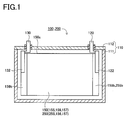
- the nonaqueous secondary battery 100 is a rectangular sealed lithium ion secondary battery including a rectangular-parallelepiped battery case 110, a positive terminal 120, and a negative terminal 130.
- the battery case 110 is made of metal and includes a rectangular housing part 111 defining a rectangular-parallelepiped housing space and a metal lid part 112.
- a wound body 150 In the battery case 110 (the rectangular housing part 111), there are stored a wound body 150, a positive electrode connecting member 122, a negative electrode connecting member 132, and others.
- the positive electrode connecting member 122 and the negative electrode connecting member 132 are made of a metal member formed in a long narrow plate-like shape and connected to the positive terminal 120 and the negative terminal 130 respectively.
- the wound body 150 is a flat-shaped wound body being elliptic in section made by winding sheet-like positive electrode 155, negative electrode 156, and separator 157.
- This wound body 150 includes a positive electrode wound part 155b located at one end (a right end in FIG. 1 ) in an axis direction of the wound body 150 (a lateral direction in FIG. 1 ) and formed in a spiral form of only a part of the positive electrode 155 and a negative electrode wound part 156b located at the other end (a left end in FIG. 1 ) and formed in a spiral form of only a part of the negative electrode 156.
- the positive electrode 155 is coated, on a portion excepting the positive electrode wound part 155b, with a positive electrode mixture including a positive electrode active material.
- the negative electrode 156 is coated, on a portion excepting the negative electrode wound part 156b, with a negative electrode mixture including a negative electrode active material.
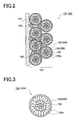
- the positive electrode 155 includes, as shown in FIG. 2 , a positive current collector 151 made of aluminum foil and a positive electrode mixture 152 coating the surface of the positive current collector 151.
- the positive electrode mixture 152 includes coated positive electrode active materials 154, conductive materials 159 (in example 1, acetylene black, ketchen black, etc.) and binder resin not shown (in example 1, CMC, PTFE, etc.).
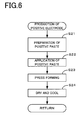
- each coated positive electrode active material 154 includes, as shown in FIG. 3 , a positive electrode active material 153 as a spherical secondary particle made of a number of primary particles 153b sintered and lithium salt 158 (indicated by hatching in FIG. 3 ) coating the surface of the positive electrode active material 153.
- the lithium salt 158 coating the surface of the positive electrode active material 153 (the secondary particle) has an average thickness of 50 nm.
- the lithium salt 158 also exists in gaps between the primary particles 153b as indicated by the hatching in FIG. 3 .
- the lithium salt 158 is constituted of lithium carbonate (primary constituent) and lithium sulfate (accessory constituent).
- the positive electrode active material 153 is constituted of lithium nickel composite oxide (LiNi 1-X-Y Co X Al Y O 2 ).
- a method of producing the nonaqueous secondary battery 100 in example 1 will be explained below.
- step S1 firstly, the coated positive electrode active material 154 is produced as shown in FIG. 4 .
- step S11 nickel hydroxide containing cobalt and aluminum made of the spherical secondary particles each including the primary particles flocculated is produced by a well-known reaction crystallization method (see e.g., JP 2006-127955 A ).
- step S12 successively, the nickel hydroxide containing cobalt and aluminum is roasted at about 1000°C into an oxide, and then this oxide is mixed with lithium hydroxide-hydrate.
- step S 13 this mixture is placed in an electric furnace and calcined in an oxygen atmosphere at about 500°C for about 3 hours.
- step S14 (a first firing step) the mixture is fired in an oxygen atmosphere at about 730°C for about 12 to 20 hours.
- step S15 CO 2 gas is supplied into the electric furnace without decreasing the temperature in the electric furnace, and the mixture is fired in an oxygen atmosphere at a CO 2 gas concentration of about 300 to 400 ppm for 8 hours.
- a disintegrating treatment is then conducted to produce a number of spherical fine particles.
- the fine particle is the coated positive electrode active material 154 constituted of the positive electrode active material 153 including a number of the primary particles 153b made of lithium nickel composite oxide and sintered together and the lithium salt 158 (indicated by the hatching in FIG. 3 ) coating the surface of the positive electrode active material 153 (the secondary particle). Furthermore, when the thickness of the lithium salt 158 coating the surface of the positive electrode active material 153 (the secondary particle) is investigated, its average thickness is 50 nm.
- the lithium salt 158 contains lithium carbonate and lithium sulfate. It is conceivable that the lithium carbonate is produced in step 15 (the first firing step) by reaction of the CO 2 gas supplied into the electric furnace and lithium in the positive electrode active material. It is further conceivable that the lithium sulfate is produced in step S 14 (the first firing step) and step 15 (the second firing step) by reaction of sulfate ion and lithium present in the positive electrode active material.
- step S2 subsequently, the positive electrode 155 is produced as shown in FIG. 4 .
- step S21 (a positive paste preparation step), as shown in FIG. 6 , a positive paste is prepared by mixing the coated positive electrode active material 154 obtained as above, the conductive material 159 (acetylene black, ketchen black), water-based binder resin (CMC, PTFE), and water.
- the conductive material 159 acetylene black, ketchen black
- CMC water-based binder resin
- step S22 the application step
- this positive paste is applied on the surface of the positive current collector 151 (aluminum foil).
- step S23 the positive current collector 151 applied with the paste is subjected to a press work to press it into a positive electrode sheet.
- step S24 this positive electrode sheet is dried under vacuum at 120°C for 8 hours and then cooled, producing the positive electrode 155.
- the positive paste is prepared by use of the coated positive electrode active materials 154 in each of which the surface of the positive electrode active material 153 (the secondary particle) is coated with the lithium salt 158 having the average thickness of 50 nm (see FIG. 3 ).
- the positive paste using the positive electrode active materials 153 each coated with the lithium salt 158 having the average thickness of 20 nm or more can prevent Li ions from being eluted from the positive electrode active material 153, thereby restraining an increase in its pH.
- the use of this positive paste in the application step enables to prevent corrosion of the positive current collector 151 by the positive paste.
- the positive electrode 155 can provide an excellent current collecting property.
- step S3 a paste prepared by mixing a negative electrode active material (carbon powder) and binder resin is applied on the surface of a negative electrode base material (copper foil), and this base material is subjected to a press work to form the negative electrode 156.
- a negative electrode active material carbon powder
- binder resin binder resin
- step S4 the positive electrode 155, the negative electrode 156, and the separator 157 are laminated and wound to form the flat wound body 150 being elliptic in section.
- step S5 assembling of the nonaqueous secondary battery 100 is performed.
- the flat wound body 150 is connected to external terminals (the positive terminal 120 and the negative terminal 130) and also housed in the rectangular housing part 111.
- the rectangular housing part 111 and the lid part 112 are welded to seal the battery case 110 (see FIG. 1 ).
- An electrolyte is poured through a liquid inlet (not shown) provided in the lid member 112 and then the liquid inlet is sealed.
- the nonaqueous secondary battery 100 in example 1 is completed.
- the firing time in step S15 (the second firing step) is set at 4 hours in an oxygen atmosphere at a CO 2 gas concentration of about 300 to 400 ppm.
- a coated positive electrode active material 254 is produced in which the surface of a positive electrode active material 153 (a secondary particle) is coated with lithium salt 258 having an average thickness of 20 nm.
- a nonaqueous secondary battery 200 is produced as with example 1 under the same conditions as those in example 1.
- each positive electrode active material 153 As comparative examples, five positive electrodes having different average thicknesses of lithium salt coating the surface of each positive electrode active material 153 were produced of coated positive electrode active materials having average thicknesses of 0, 5, 80, 100, and 120 nm coating the surfaces of the positive electrode active materials 153 (secondary particles). By use of those positive electrodes, five kinds of nonaqueous secondary batteries (referred to as Comparative examples 1 to 5 in ascending order of average thickness of lithium salt) were produced.
- each nonaqueous secondary battery was charged into a full charged state and then respective outputs (watt) were measured per 10 seconds during discharge. Assuming that the output of the nonaqueous secondary battery (the lithium salt coating the surface of the positive electrode active material has an average thickness of 5 nm) in comparative example 2 is a reference output (100%), an output ratio (%) of each nonaqueous secondary battery was calculated.
- the output ratios in the nonaqueous secondary batteries 100 and 200 in examples 1 and 2 were 118% and 112% respectively.
- the output ratios were 90%, 114%, 105%, and 95% respectively.
- a graph created based on those output ratios is shown in FIG. 7 .
- FIG. 7 it is proved that the nonaqueous secondary batteries (in examples 1 and 2 and the comparative example 3) produced such that the average thickness of lithium salt coating the surface of the positive electrode active material was 20 to 80 nm could provide excellent output characteristics.
- the nonaqueous secondary batteries (in comparative examples 1 and 2) produced such that the average thickness of lithium salt coating the surface of the positive electrode active material was less than 20 nm were inferior in output characteristics to the nonaqueous secondary batteries (in examples 1 and 2 and comparative example 3) produced such that the average thickness of lithium salt coating the lithium salt was 20 to 80 nm.
- step S2 This is conceivable that during production of the positive electrode (in step S2) a large amount of Li ions are eluted from the positive electrode active material (the lithium nickel composite oxide) because of a thin coat or layer of lithium salt, and the positive paste becomes strong alkali, thereby advancing the corrosion of the positive current collector and greatly deteriorating the current collecting property of the positive electrode, resulting in the large deterioration of battery output characteristics.
- the positive electrode active material the lithium nickel composite oxide
- the nonaqueous secondary batteries (comparative examples 4 and 5) produced such that the average thickness of lithium salt coating the surface of the positive electrode active material was more than 80 nm were also greatly inferior in output characteristics to the nonaqueous secondary batteries (examples 1 and 2 and comparative example 3) produced such that the average thickness of the coating of lithium salt were 20 to 80 nm.
- the lithium salt coating the surface of the positive electrode active material was made thick, it was possible to prevent corrosion of the positive current collector during production (in step S2) of the positive electrode.
- the coating of lithium salt is too thick, it interferes with desorption/insertion of Li ions from/into the positive electrode active material (lithium nickel composite oxide) during use of the battery, hence deteriorating the output characteristics.
- each nonaqueous secondary battery was subjected to predetermined initial charge and discharge, and then charged at constant current - constant voltage for 1.5 hours until the battery voltage reached 4.1 V. Thereafter, under a temperature environment of 25°C, each battery was discharged at a current value of 1/3C until the battery voltage was decreased to 3V. A discharge capacity of each nonaqueous secondary battery at that time was obtained as the CCCV capacity.
- CCCV capacity of the nonaqueous secondary battery in comparative example 2 (the lithium salt coating the surface of the positive electrode active material has an average thickness of 5 nm) is a reference capacity (100%), a CCCV capacity ratio (%) of each nonaqueous secondary battery was calculated.
- the nonaqueous secondary batteries (comparative examples 1 and 2) produced such that the average thickness of lithium salt coating the surface of the positive electrode active material was less than 20 nm could provide a smaller battery capacity than the nonaqueous secondary batteries (examples 1 and 2) produced such that the lithium salt coating had an average thickness of 20 to 50 nm.
- the positive electrode active material lithium nickel composite oxide
- the nonaqueous secondary batteries (comparative examples 3 to 5) produced such that the average thickness of lithium salt coating the surface of the positive electrode active material was more than 50 nm were also greatly inferior in battery capacity to the nonaqueous secondary batteries (examples 1 and 2) produced such that the lithium salt coating had an average thickness of 20 to 50 nm.
- the lithium salt coating is too thick, it interferes with desorption/insertion of Li ions with respect to the positive electrode active material during use of the battery as described above, causing the decrease in battery capacity.
- the use of the coated positive electrode active material in which the surface of the positive electrode active material is coated with the lithium salt having an average thickness of 20 to 50 nm can produce the nonaqueous secondary battery with high capacity and excellent output characteristics.
- step S 15 (the second firing step) CO 2 gas is supplied into the electric furnace and the mixture is fired in an oxygen atmosphere at a CO 2 gas concentration of 300 to 400 ppm for 4 to 8 hours. Accordingly, as shown in FIG. 3 , the positive electrode active materials 154 and 254 in which the surfaces of the positive electrode active materials 153 (secondary particles) are coated with the lithium salts 158 and 258 each having an average thickness of 20 to 50 nm are produced.
- the positive electrode active material in the oxygen atmosphere is completely fired in step S 14 (the first firing step) and then, without being subjected to the process in step S15 (the second firing step), this positive electrode active material is subjected to an atmosphere of constant temperature and constant humidity, at a CO 2 gas concentration of 300 to 400 ppm, a temperature of 30 to 80°C, and relative humidity of 40 to 100%, for 8 to 24 hours.
- the coated positive electrode active materials 154 and 254 are obtained in which the surfaces of the positive electrode active materials 153 (secondary particles) are coated with the lithium salts 158 and 258 respectively, each having an average thickness of 20 to 50 nm.
- the nonaqueous secondary battery in example 3 produced by using the thus produced coated positive electrode active materials 154 and 254 in similar manner to the examples 1 and 2 also can provide similar output characteristics and battery capacity to those of the nonaqueous secondary batteries in examples 1 and 2.
Landscapes
- Chemical & Material Sciences (AREA)
- Chemical Kinetics & Catalysis (AREA)
- Electrochemistry (AREA)
- General Chemical & Material Sciences (AREA)
- Engineering & Computer Science (AREA)
- Materials Engineering (AREA)
- Manufacturing & Machinery (AREA)
- Composite Materials (AREA)
- Battery Electrode And Active Subsutance (AREA)
- Cell Electrode Carriers And Collectors (AREA)
- Secondary Cells (AREA)
Applications Claiming Priority (2)
| Application Number | Priority Date | Filing Date | Title |
|---|---|---|---|
| JP2007271499A JP4404928B2 (ja) | 2007-10-18 | 2007-10-18 | 被覆正極活物質の製造方法、非水系二次電池用正極の製造方法、及び、非水系二次電池の製造方法 |
| PCT/JP2008/068825 WO2009051212A1 (ja) | 2007-10-18 | 2008-10-17 | 被覆正極活物質、非水系二次電池用正極、及び、非水系二次電池、並びに、これらの製造方法 |
Publications (3)
| Publication Number | Publication Date |
|---|---|
| EP2209152A1 true EP2209152A1 (de) | 2010-07-21 |
| EP2209152A4 EP2209152A4 (de) | 2012-07-11 |
| EP2209152B1 EP2209152B1 (de) | 2022-09-14 |
Family
ID=40567473
Family Applications (1)
| Application Number | Title | Priority Date | Filing Date |
|---|---|---|---|
| EP08839508.2A Active EP2209152B1 (de) | 2007-10-18 | 2008-10-17 | Beschichtetes aktives positives elektrodenmaterial, positive elektrode für eine wasserfreie sekundärbatterie, wasserfreie sekundärbatterie und verfahren zu deren herstellung |
Country Status (6)
| Country | Link |
|---|---|
| US (1) | US9023531B2 (de) |
| EP (1) | EP2209152B1 (de) |
| JP (1) | JP4404928B2 (de) |
| KR (1) | KR101322954B1 (de) |
| CN (1) | CN101828286B (de) |
| WO (1) | WO2009051212A1 (de) |
Cited By (1)
| Publication number | Priority date | Publication date | Assignee | Title |
|---|---|---|---|---|
| EP3916849A4 (de) * | 2020-01-03 | 2022-07-20 | LG Energy Solution, Ltd. | Kathode mit erhöhter härte für verbesserte sicherheit, herstellungsverfahren dafür und sekundärbatterie damit |
Families Citing this family (37)
| Publication number | Priority date | Publication date | Assignee | Title |
|---|---|---|---|---|
| US8399116B2 (en) * | 2007-12-25 | 2013-03-19 | Byd Co. Ltd. | Optimized dimensional relationships for an electrochemical cell having a coiled core |
| US8741256B1 (en) | 2009-04-24 | 2014-06-03 | Simbol Inc. | Preparation of lithium carbonate from lithium chloride containing brines |
| US10190030B2 (en) | 2009-04-24 | 2019-01-29 | Alger Alternative Energy, Llc | Treated geothermal brine compositions with reduced concentrations of silica, iron and lithium |
| US12168748B2 (en) | 2009-04-24 | 2024-12-17 | Terralithium Llc | Treated geothermal brine compositions with reduced concentration of silica, iron and lithium |
| US9034294B1 (en) | 2009-04-24 | 2015-05-19 | Simbol, Inc. | Preparation of lithium carbonate from lithium chloride containing brines |
| US8637428B1 (en) | 2009-12-18 | 2014-01-28 | Simbol Inc. | Lithium extraction composition and method of preparation thereof |
| FR2947283B1 (fr) * | 2009-06-24 | 2011-07-01 | Commissariat Energie Atomique | Procede d'elimination de lithium metallique |
| JP5738563B2 (ja) * | 2009-09-30 | 2015-06-24 | トヨタ自動車株式会社 | 正極活物質及び該活物質を用いたリチウム二次電池 |
| US8586247B2 (en) | 2009-12-11 | 2013-11-19 | Samsung Sdi Co., Ltd. | Positive electrode active material comprising an agglomeration of at least two primary particles for lithium battery and lithium battery using the same |
| JP2011146152A (ja) * | 2010-01-12 | 2011-07-28 | Toyota Motor Corp | 正極ペースト及び正極ペーストの製造方法 |
| CA2985579C (en) | 2010-02-17 | 2022-11-29 | Alger Alternative Energy, Llc | Method of producing lithium carbonate from lithium chloride with gas-liquid-solid separator |
| WO2012160698A1 (ja) * | 2011-05-26 | 2012-11-29 | トヨタ自動車株式会社 | 被覆活物質およびリチウム固体電池 |
| JP5862928B2 (ja) * | 2011-08-03 | 2016-02-16 | トヨタ自動車株式会社 | リチウムイオン二次電池用正極の製造方法 |
| US9543567B2 (en) * | 2011-09-16 | 2017-01-10 | Ngk Insulators, Ltd. | Method for manufacturing cathode active material for lithium secondary battery |
| US20130108781A1 (en) * | 2011-10-31 | 2013-05-02 | Simbol Inc. | Methods for the Production of Cathode and Anode Powder Precursors |
| KR20130049517A (ko) * | 2011-11-04 | 2013-05-14 | 제이에이치화학공업(주) | 리튬 이차전지용 양극 활물질의 제조 방법 |
| JP5807749B2 (ja) * | 2011-12-08 | 2015-11-10 | ソニー株式会社 | 非水電解液二次電池用正極、非水電解液二次電池、電池パック、電動車両、電力貯蔵システム、電動工具および電子機器 |
| US8920925B2 (en) * | 2012-11-09 | 2014-12-30 | Corning Incorporated | Stabilized lithium composite particles |
| US9129756B2 (en) * | 2013-03-28 | 2015-09-08 | Corning Incorporated | Composite electrode for lithium ion capacitor |
| US10050258B2 (en) | 2013-11-29 | 2018-08-14 | Iucf-Hyu (Industry-University Cooperation Foundation Hanyang University) | Active material for all-solid lithium secondary battery, method for manufacturing same, and all-solid lithium secondary battery comprising same |
| US10840510B2 (en) | 2014-07-31 | 2020-11-17 | Sumitomo Metal Mining Co., Ltd. | Positive electrode active material for non-aqueous electrolyte secondary battery and method for producing same |
| US10141566B2 (en) * | 2014-08-15 | 2018-11-27 | Samsung Electronics Co., Ltd. | Lithium secondary battery including a coated cathode material and solid electrolyte, and method of preparing the same |
| JP2017073281A (ja) * | 2015-10-07 | 2017-04-13 | 日産自動車株式会社 | 非水電解質二次電池用正極材料、並びにこれを用いた非水電解質二次電池用正極および非水電解質二次電池 |
| KR102199714B1 (ko) | 2016-12-02 | 2021-01-07 | 삼성에스디아이 주식회사 | 리튬이차전지용 니켈계 활물질, 그 제조방법 및 이를 포함하는 양극을 함유한 리튬이차전지 |
| JP7008262B2 (ja) * | 2017-10-13 | 2022-01-25 | トヨタ自動車株式会社 | リチウムイオン二次電池用電極およびリチウムイオン二次電池 |
| US20220271272A1 (en) * | 2019-06-25 | 2022-08-25 | Sumitomo Metal Mining Co., Ltd. | Positive electrode active material for lithium-ion secondary batteries, method for producing same, and lithium-ion secondary battery |
| WO2020261757A1 (ja) * | 2019-06-26 | 2020-12-30 | パナソニックIpマネジメント株式会社 | 正極材料、および、電池 |
| KR20220116144A (ko) | 2019-10-08 | 2022-08-22 | 알박 테크놀로지스, 인크 | 이차 배터리를 위한 다기능의 가공된 입자 및 이를 제조하는 방법 |
| JP7531588B2 (ja) * | 2019-12-06 | 2024-08-09 | エルジー エナジー ソリューション リミテッド | 二次電池用正極材の製造方法 |
| JP2022063447A (ja) * | 2020-10-12 | 2022-04-22 | 本田技研工業株式会社 | 正極活物質 |
| JP7455045B2 (ja) * | 2020-10-22 | 2024-03-25 | 本田技研工業株式会社 | 正極活物質 |
| CN113839092B (zh) * | 2021-08-30 | 2024-06-18 | 上海大学 | 一种可掺杂正极金属盐-锂盐复合添加剂及其应用 |
| JP2024001397A (ja) | 2022-06-22 | 2024-01-10 | 住友化学株式会社 | リチウム二次電池用正極活物質、リチウム二次電池用正極、リチウム二次電池、およびリチウム二次電池用正極活物質の製造方法 |
| EP4376126B1 (de) | 2022-11-22 | 2025-06-11 | SK On Co., Ltd. | Elektrode für lithiumsekundärbatterie und lithiumsekundärbatterie damit |
| CN115954479A (zh) * | 2023-03-10 | 2023-04-11 | 四川新能源汽车创新中心有限公司 | 一种正极材料及其制备方法和固态电池 |
| WO2025034742A1 (en) * | 2023-08-08 | 2025-02-13 | Applied Materials, Inc. | Uv enhanced c02 passivation of lithium anode |
| CN117977044B (zh) * | 2024-04-01 | 2024-07-16 | 四川新能源汽车创新中心有限公司 | 一种硫化物基全固态电池物料的回收方法 |
Family Cites Families (15)
| Publication number | Priority date | Publication date | Assignee | Title |
|---|---|---|---|---|
| JPH0817092B2 (ja) * | 1989-11-21 | 1996-02-21 | 株式会社リコー | 電極用基材及びその製造方法 |
| US5618640A (en) * | 1993-10-22 | 1997-04-08 | Fuji Photo Film Co., Ltd. | Nonaqueous secondary battery |
| JPH07245105A (ja) * | 1994-03-04 | 1995-09-19 | Matsushita Electric Ind Co Ltd | 非水電解液二次電池とその正極活物質 |
| JP3110728B1 (ja) | 1999-05-06 | 2000-11-20 | 同和鉱業株式会社 | 非水系二次電池用正極活物質および正極 |
| JP2001060459A (ja) | 1999-08-23 | 2001-03-06 | Sumitomo Metal Mining Co Ltd | リチウム二次電池用コバルト酸リチウムおよびその製造方法 |
| JP2002158010A (ja) | 2000-11-17 | 2002-05-31 | Sumitomo Metal Mining Co Ltd | 非水系電解質二次電池用正極活物質およびそれを用いた非水系電解質二次電池 |
| US6558844B2 (en) | 2001-01-31 | 2003-05-06 | Wilmont F. Howard, Jr. | Stabilized spinel battery cathode material and methods |
| JP4050123B2 (ja) * | 2002-09-25 | 2008-02-20 | トヨタ自動車株式会社 | リチウムイオン二次電池用正極活物質及びその製造方法 |
| JP4427314B2 (ja) | 2002-12-20 | 2010-03-03 | 住友金属鉱山株式会社 | 非水系電解質二次電池用正極活物質及びその製造方法、それを用いた非水系電解質二次電池およびその製造方法 |
| JP4368119B2 (ja) | 2003-02-27 | 2009-11-18 | 三洋電機株式会社 | 非水電解質二次電池の製造方法 |
| JP4217710B2 (ja) * | 2003-04-17 | 2009-02-04 | Agcセイミケミカル株式会社 | リチウム−ニッケル−コバルト−マンガン含有複合酸化物の製造方法 |
| JP4794866B2 (ja) * | 2004-04-08 | 2011-10-19 | パナソニック株式会社 | 非水電解質二次電池用正極活物質およびその製造方法ならびにそれを用いた非水電解質二次電池 |
| JP5470669B2 (ja) * | 2005-05-13 | 2014-04-16 | 日産自動車株式会社 | 非水電解リチウムイオン電池用正極材料、これを用いた電池および非水電解リチウムイオン電池用正極材料の製造方法 |
| JP2007103134A (ja) * | 2005-10-03 | 2007-04-19 | Toyota Motor Corp | リチウムイオン二次電池、及びその製造方法 |
| JP2007227310A (ja) * | 2006-02-27 | 2007-09-06 | Toyota Motor Corp | リチウムイオン二次電池、及びその製造方法 |
-
2007
- 2007-10-18 JP JP2007271499A patent/JP4404928B2/ja active Active
-
2008
- 2008-10-17 WO PCT/JP2008/068825 patent/WO2009051212A1/ja not_active Ceased
- 2008-10-17 CN CN200880112023.4A patent/CN101828286B/zh active Active
- 2008-10-17 US US12/682,788 patent/US9023531B2/en active Active
- 2008-10-17 EP EP08839508.2A patent/EP2209152B1/de active Active
- 2008-10-17 KR KR1020107008339A patent/KR101322954B1/ko active Active
Cited By (1)
| Publication number | Priority date | Publication date | Assignee | Title |
|---|---|---|---|---|
| EP3916849A4 (de) * | 2020-01-03 | 2022-07-20 | LG Energy Solution, Ltd. | Kathode mit erhöhter härte für verbesserte sicherheit, herstellungsverfahren dafür und sekundärbatterie damit |
Also Published As
| Publication number | Publication date |
|---|---|
| CN101828286A (zh) | 2010-09-08 |
| KR20100056563A (ko) | 2010-05-27 |
| JP4404928B2 (ja) | 2010-01-27 |
| KR101322954B1 (ko) | 2013-10-29 |
| US9023531B2 (en) | 2015-05-05 |
| EP2209152B1 (de) | 2022-09-14 |
| WO2009051212A1 (ja) | 2009-04-23 |
| EP2209152A4 (de) | 2012-07-11 |
| CN101828286B (zh) | 2014-03-12 |
| JP2009099462A (ja) | 2009-05-07 |
| US20100221613A1 (en) | 2010-09-02 |
Similar Documents
| Publication | Publication Date | Title |
|---|---|---|
| EP2209152B1 (de) | Beschichtetes aktives positives elektrodenmaterial, positive elektrode für eine wasserfreie sekundärbatterie, wasserfreie sekundärbatterie und verfahren zu deren herstellung | |
| JP6560917B2 (ja) | 正極材料、および正極材料を用いた非水電解質二次電池 | |
| CN101821878B (zh) | 正极活性材料、其制造方法以及电化学装置 | |
| CN104703921B (zh) | Li‑Ni复合氧化物颗粒粉末和非水电解质二次电池 | |
| JP6101583B2 (ja) | 非水電解質二次電池 | |
| JP4197225B2 (ja) | 非水電解質二次電池用正極活物質およびその製造方法 | |
| JP2019108264A (ja) | Li−Ni複合酸化物粒子粉末、並びに非水電解質二次電池 | |
| US20120231343A1 (en) | Positive Electrode Active Material For A Lithium-Ion Battery, Positive Electrode For A Lithium-Ion Battery, Lithium-Ion Battery Using Same, And Precursor To A Positive Electrode Active Material For A Lithium-Ion Battery | |
| KR20110094023A (ko) | 리튬 복합 화합물 입자 분말 및 그의 제조 방법, 비수전해질 이차 전지 | |
| JP2009099461A (ja) | 正極活物質の製造方法、非水系二次電池用正極板、及び、非水系二次電池 | |
| CN101595581A (zh) | 非水电解质二次电池用Li-Ni复合氧化物颗粒粉末及其制造方法、非水电解质二次电池 | |
| WO2012101948A1 (ja) | 非水電解液二次電池用正極活物質、その製造方法、当該正極活物質を用いた非水電解液二次電池用正極、及び、当該正極を用いた非水電解液二次電池 | |
| Wang et al. | Superior electrochemical and kinetics performance of LiNi0. 8Co0. 15Al0. 05O2 cathode by neodymium synergistic modifying for lithium ion batteries | |
| EP3627611A1 (de) | Als flüssigelektrolyt einer zink-ionen-batterie verwendbare zinksalze | |
| JP2008251480A (ja) | 非水電解質二次電池用正極活物質およびそれを用いた非水電解質二次電池 | |
| JP5516463B2 (ja) | リチウムイオン二次電池用正極活物質の製造方法 | |
| JP6068247B2 (ja) | 非水電解質リチウムイオン二次電池用正極材料およびその正極材料を用いた非水電解質リチウムイオン二次電池 | |
| JP2007103298A (ja) | 正極活物質及びその製造方法、並びに水系リチウム二次電池 | |
| JP2006040748A (ja) | 電気化学デバイス | |
| JP7096085B2 (ja) | 正極活物質、リチウムイオン二次電池用正極、リチウムイオン二次電池、および正極活物質の製造方法 | |
| JP5607322B2 (ja) | 被覆正極活物質、非水系二次電池用正極、及び、非水系二次電池 | |
| CN112242509B (zh) | 非水电解质二次电池 | |
| JP4925690B2 (ja) | 非水電解質二次電池 | |
| JP2007103134A (ja) | リチウムイオン二次電池、及びその製造方法 | |
| JP4168609B2 (ja) | リチウムイオン二次電池用正極活物質 |
Legal Events
| Date | Code | Title | Description |
|---|---|---|---|
| PUAI | Public reference made under article 153(3) epc to a published international application that has entered the european phase |
Free format text: ORIGINAL CODE: 0009012 |
|
| 17P | Request for examination filed |
Effective date: 20100413 |
|
| AK | Designated contracting states |
Kind code of ref document: A1 Designated state(s): AT BE BG CH CY CZ DE DK EE ES FI FR GB GR HR HU IE IS IT LI LT LU LV MC MT NL NO PL PT RO SE SI SK TR |
|
| AX | Request for extension of the european patent |
Extension state: AL BA MK RS |
|
| DAX | Request for extension of the european patent (deleted) | ||
| A4 | Supplementary search report drawn up and despatched |
Effective date: 20120611 |
|
| RIC1 | Information provided on ipc code assigned before grant |
Ipc: H01M 4/36 20060101ALI20120620BHEP Ipc: H01M 4/02 20060101ALI20120620BHEP Ipc: H01M 4/04 20060101ALI20120620BHEP Ipc: H01M 4/66 20060101ALI20120620BHEP Ipc: H01M 4/48 20100101AFI20120620BHEP |
|
| RAP1 | Party data changed (applicant data changed or rights of an application transferred) |
Owner name: TOYOTA JIDOSHA KABUSHIKI KAISHA Owner name: SUMITOMO METAL MINING CO., LTD. |
|
| 17Q | First examination report despatched |
Effective date: 20130524 |
|
| STAA | Information on the status of an ep patent application or granted ep patent |
Free format text: STATUS: EXAMINATION IS IN PROGRESS |
|
| GRAP | Despatch of communication of intention to grant a patent |
Free format text: ORIGINAL CODE: EPIDOSNIGR1 |
|
| STAA | Information on the status of an ep patent application or granted ep patent |
Free format text: STATUS: GRANT OF PATENT IS INTENDED |
|
| INTG | Intention to grant announced |
Effective date: 20220211 |
|
| RIC1 | Information provided on ipc code assigned before grant |
Ipc: H01M 4/1391 20100101ALI20220131BHEP Ipc: H01M 10/058 20100101ALI20220131BHEP Ipc: H01M 4/131 20100101ALI20220131BHEP Ipc: H01M 10/0525 20100101ALI20220131BHEP Ipc: H01M 4/62 20060101ALI20220131BHEP Ipc: H01M 4/66 20060101ALI20220131BHEP Ipc: H01M 4/36 20060101ALI20220131BHEP Ipc: H01M 4/04 20060101ALI20220131BHEP Ipc: H01M 4/02 20060101ALI20220131BHEP Ipc: H01M 4/48 20100101AFI20220131BHEP |
|
| GRAJ | Information related to disapproval of communication of intention to grant by the applicant or resumption of examination proceedings by the epo deleted |
Free format text: ORIGINAL CODE: EPIDOSDIGR1 |
|
| STAA | Information on the status of an ep patent application or granted ep patent |
Free format text: STATUS: EXAMINATION IS IN PROGRESS |
|
| GRAP | Despatch of communication of intention to grant a patent |
Free format text: ORIGINAL CODE: EPIDOSNIGR1 |
|
| STAA | Information on the status of an ep patent application or granted ep patent |
Free format text: STATUS: GRANT OF PATENT IS INTENDED |
|
| INTC | Intention to grant announced (deleted) | ||
| INTG | Intention to grant announced |
Effective date: 20220517 |
|
| GRAS | Grant fee paid |
Free format text: ORIGINAL CODE: EPIDOSNIGR3 |
|
| GRAA | (expected) grant |
Free format text: ORIGINAL CODE: 0009210 |
|
| STAA | Information on the status of an ep patent application or granted ep patent |
Free format text: STATUS: THE PATENT HAS BEEN GRANTED |
|
| AK | Designated contracting states |
Kind code of ref document: B1 Designated state(s): AT BE BG CH CY CZ DE DK EE ES FI FR GB GR HR HU IE IS IT LI LT LU LV MC MT NL NO PL PT RO SE SI SK TR |
|
| REG | Reference to a national code |
Ref country code: GB Ref legal event code: FG4D |
|
| REG | Reference to a national code |
Ref country code: CH Ref legal event code: EP |
|
| REG | Reference to a national code |
Ref country code: DE Ref legal event code: R096 Ref document number: 602008064608 Country of ref document: DE |
|
| REG | Reference to a national code |
Ref country code: IE Ref legal event code: FG4D |
|
| REG | Reference to a national code |
Ref country code: AT Ref legal event code: REF Ref document number: 1519250 Country of ref document: AT Kind code of ref document: T Effective date: 20221015 |
|
| REG | Reference to a national code |
Ref country code: LT Ref legal event code: MG9D |
|
| PG25 | Lapsed in a contracting state [announced via postgrant information from national office to epo] |
Ref country code: SE Free format text: LAPSE BECAUSE OF FAILURE TO SUBMIT A TRANSLATION OF THE DESCRIPTION OR TO PAY THE FEE WITHIN THE PRESCRIBED TIME-LIMIT Effective date: 20220914 Ref country code: NO Free format text: LAPSE BECAUSE OF FAILURE TO SUBMIT A TRANSLATION OF THE DESCRIPTION OR TO PAY THE FEE WITHIN THE PRESCRIBED TIME-LIMIT Effective date: 20221214 Ref country code: LV Free format text: LAPSE BECAUSE OF FAILURE TO SUBMIT A TRANSLATION OF THE DESCRIPTION OR TO PAY THE FEE WITHIN THE PRESCRIBED TIME-LIMIT Effective date: 20220914 Ref country code: LT Free format text: LAPSE BECAUSE OF FAILURE TO SUBMIT A TRANSLATION OF THE DESCRIPTION OR TO PAY THE FEE WITHIN THE PRESCRIBED TIME-LIMIT Effective date: 20220914 Ref country code: FI Free format text: LAPSE BECAUSE OF FAILURE TO SUBMIT A TRANSLATION OF THE DESCRIPTION OR TO PAY THE FEE WITHIN THE PRESCRIBED TIME-LIMIT Effective date: 20220914 |
|
| REG | Reference to a national code |
Ref country code: AT Ref legal event code: MK05 Ref document number: 1519250 Country of ref document: AT Kind code of ref document: T Effective date: 20220914 |
|
| PG25 | Lapsed in a contracting state [announced via postgrant information from national office to epo] |
Ref country code: HR Free format text: LAPSE BECAUSE OF FAILURE TO SUBMIT A TRANSLATION OF THE DESCRIPTION OR TO PAY THE FEE WITHIN THE PRESCRIBED TIME-LIMIT Effective date: 20220914 Ref country code: GR Free format text: LAPSE BECAUSE OF FAILURE TO SUBMIT A TRANSLATION OF THE DESCRIPTION OR TO PAY THE FEE WITHIN THE PRESCRIBED TIME-LIMIT Effective date: 20221215 |
|
| PG25 | Lapsed in a contracting state [announced via postgrant information from national office to epo] |
Ref country code: RO Free format text: LAPSE BECAUSE OF FAILURE TO SUBMIT A TRANSLATION OF THE DESCRIPTION OR TO PAY THE FEE WITHIN THE PRESCRIBED TIME-LIMIT Effective date: 20220914 Ref country code: PT Free format text: LAPSE BECAUSE OF FAILURE TO SUBMIT A TRANSLATION OF THE DESCRIPTION OR TO PAY THE FEE WITHIN THE PRESCRIBED TIME-LIMIT Effective date: 20230116 Ref country code: ES Free format text: LAPSE BECAUSE OF FAILURE TO SUBMIT A TRANSLATION OF THE DESCRIPTION OR TO PAY THE FEE WITHIN THE PRESCRIBED TIME-LIMIT Effective date: 20220914 Ref country code: CZ Free format text: LAPSE BECAUSE OF FAILURE TO SUBMIT A TRANSLATION OF THE DESCRIPTION OR TO PAY THE FEE WITHIN THE PRESCRIBED TIME-LIMIT Effective date: 20220914 Ref country code: AT Free format text: LAPSE BECAUSE OF FAILURE TO SUBMIT A TRANSLATION OF THE DESCRIPTION OR TO PAY THE FEE WITHIN THE PRESCRIBED TIME-LIMIT Effective date: 20220914 |
|
| PG25 | Lapsed in a contracting state [announced via postgrant information from national office to epo] |
Ref country code: SK Free format text: LAPSE BECAUSE OF FAILURE TO SUBMIT A TRANSLATION OF THE DESCRIPTION OR TO PAY THE FEE WITHIN THE PRESCRIBED TIME-LIMIT Effective date: 20220914 Ref country code: PL Free format text: LAPSE BECAUSE OF FAILURE TO SUBMIT A TRANSLATION OF THE DESCRIPTION OR TO PAY THE FEE WITHIN THE PRESCRIBED TIME-LIMIT Effective date: 20220914 Ref country code: IS Free format text: LAPSE BECAUSE OF FAILURE TO SUBMIT A TRANSLATION OF THE DESCRIPTION OR TO PAY THE FEE WITHIN THE PRESCRIBED TIME-LIMIT Effective date: 20230114 Ref country code: EE Free format text: LAPSE BECAUSE OF FAILURE TO SUBMIT A TRANSLATION OF THE DESCRIPTION OR TO PAY THE FEE WITHIN THE PRESCRIBED TIME-LIMIT Effective date: 20220914 |
|
| REG | Reference to a national code |
Ref country code: CH Ref legal event code: PL |
|
| REG | Reference to a national code |
Ref country code: DE Ref legal event code: R097 Ref document number: 602008064608 Country of ref document: DE |
|
| REG | Reference to a national code |
Ref country code: BE Ref legal event code: MM Effective date: 20221031 |
|
| PG25 | Lapsed in a contracting state [announced via postgrant information from national office to epo] |
Ref country code: NL Free format text: LAPSE BECAUSE OF FAILURE TO SUBMIT A TRANSLATION OF THE DESCRIPTION OR TO PAY THE FEE WITHIN THE PRESCRIBED TIME-LIMIT Effective date: 20220914 Ref country code: MC Free format text: LAPSE BECAUSE OF FAILURE TO SUBMIT A TRANSLATION OF THE DESCRIPTION OR TO PAY THE FEE WITHIN THE PRESCRIBED TIME-LIMIT Effective date: 20220914 Ref country code: LU Free format text: LAPSE BECAUSE OF NON-PAYMENT OF DUE FEES Effective date: 20221017 |
|
| PLBE | No opposition filed within time limit |
Free format text: ORIGINAL CODE: 0009261 |
|
| STAA | Information on the status of an ep patent application or granted ep patent |
Free format text: STATUS: NO OPPOSITION FILED WITHIN TIME LIMIT |
|
| PG25 | Lapsed in a contracting state [announced via postgrant information from national office to epo] |
Ref country code: LI Free format text: LAPSE BECAUSE OF NON-PAYMENT OF DUE FEES Effective date: 20221031 Ref country code: DK Free format text: LAPSE BECAUSE OF FAILURE TO SUBMIT A TRANSLATION OF THE DESCRIPTION OR TO PAY THE FEE WITHIN THE PRESCRIBED TIME-LIMIT Effective date: 20220914 Ref country code: CH Free format text: LAPSE BECAUSE OF NON-PAYMENT OF DUE FEES Effective date: 20221031 |
|
| 26N | No opposition filed |
Effective date: 20230615 |
|
| GBPC | Gb: european patent ceased through non-payment of renewal fee |
Effective date: 20221214 |
|
| PG25 | Lapsed in a contracting state [announced via postgrant information from national office to epo] |
Ref country code: SI Free format text: LAPSE BECAUSE OF FAILURE TO SUBMIT A TRANSLATION OF THE DESCRIPTION OR TO PAY THE FEE WITHIN THE PRESCRIBED TIME-LIMIT Effective date: 20220914 |
|
| PG25 | Lapsed in a contracting state [announced via postgrant information from national office to epo] |
Ref country code: BE Free format text: LAPSE BECAUSE OF NON-PAYMENT OF DUE FEES Effective date: 20221031 |
|
| PG25 | Lapsed in a contracting state [announced via postgrant information from national office to epo] |
Ref country code: IE Free format text: LAPSE BECAUSE OF NON-PAYMENT OF DUE FEES Effective date: 20221017 Ref country code: GB Free format text: LAPSE BECAUSE OF NON-PAYMENT OF DUE FEES Effective date: 20221214 |
|
| PG25 | Lapsed in a contracting state [announced via postgrant information from national office to epo] |
Ref country code: FR Free format text: LAPSE BECAUSE OF NON-PAYMENT OF DUE FEES Effective date: 20221114 |
|
| PG25 | Lapsed in a contracting state [announced via postgrant information from national office to epo] |
Ref country code: HU Free format text: LAPSE BECAUSE OF FAILURE TO SUBMIT A TRANSLATION OF THE DESCRIPTION OR TO PAY THE FEE WITHIN THE PRESCRIBED TIME-LIMIT; INVALID AB INITIO Effective date: 20081017 |
|
| PG25 | Lapsed in a contracting state [announced via postgrant information from national office to epo] |
Ref country code: CY Free format text: LAPSE BECAUSE OF FAILURE TO SUBMIT A TRANSLATION OF THE DESCRIPTION OR TO PAY THE FEE WITHIN THE PRESCRIBED TIME-LIMIT Effective date: 20220914 |
|
| PG25 | Lapsed in a contracting state [announced via postgrant information from national office to epo] |
Ref country code: IT Free format text: LAPSE BECAUSE OF FAILURE TO SUBMIT A TRANSLATION OF THE DESCRIPTION OR TO PAY THE FEE WITHIN THE PRESCRIBED TIME-LIMIT Effective date: 20220914 |
|
| PG25 | Lapsed in a contracting state [announced via postgrant information from national office to epo] |
Ref country code: TR Free format text: LAPSE BECAUSE OF FAILURE TO SUBMIT A TRANSLATION OF THE DESCRIPTION OR TO PAY THE FEE WITHIN THE PRESCRIBED TIME-LIMIT Effective date: 20220914 |
|
| PG25 | Lapsed in a contracting state [announced via postgrant information from national office to epo] |
Ref country code: BG Free format text: LAPSE BECAUSE OF FAILURE TO SUBMIT A TRANSLATION OF THE DESCRIPTION OR TO PAY THE FEE WITHIN THE PRESCRIBED TIME-LIMIT Effective date: 20220914 |
|
| PG25 | Lapsed in a contracting state [announced via postgrant information from national office to epo] |
Ref country code: MT Free format text: LAPSE BECAUSE OF FAILURE TO SUBMIT A TRANSLATION OF THE DESCRIPTION OR TO PAY THE FEE WITHIN THE PRESCRIBED TIME-LIMIT Effective date: 20220914 |
|
| REG | Reference to a national code |
Ref country code: DE Ref legal event code: R084 Ref document number: 602008064608 Country of ref document: DE |
|
| PGFP | Annual fee paid to national office [announced via postgrant information from national office to epo] |
Ref country code: DE Payment date: 20250902 Year of fee payment: 18 |