EP2243661A2 - Dispositif de commande de l'éclairage de lampe de véhicule - Google Patents
Dispositif de commande de l'éclairage de lampe de véhicule Download PDFInfo
- Publication number
- EP2243661A2 EP2243661A2 EP10159314A EP10159314A EP2243661A2 EP 2243661 A2 EP2243661 A2 EP 2243661A2 EP 10159314 A EP10159314 A EP 10159314A EP 10159314 A EP10159314 A EP 10159314A EP 2243661 A2 EP2243661 A2 EP 2243661A2
- Authority
- EP
- European Patent Office
- Prior art keywords
- detecting unit
- resistor
- current
- abnormality
- control device
- Prior art date
- Legal status (The legal status is an assumption and is not a legal conclusion. Google has not performed a legal analysis and makes no representation as to the accuracy of the status listed.)
- Withdrawn
Links
- 230000005856 abnormality Effects 0.000 claims abstract description 34
- 239000004065 semiconductor Substances 0.000 claims abstract description 25
- 238000009413 insulation Methods 0.000 claims abstract description 3
- 230000007423 decrease Effects 0.000 claims description 6
- 230000002159 abnormal effect Effects 0.000 description 2
- 238000010586 diagram Methods 0.000 description 1
Images



Classifications
-
- B—PERFORMING OPERATIONS; TRANSPORTING
- B60—VEHICLES IN GENERAL
- B60Q—ARRANGEMENT OF SIGNALLING OR LIGHTING DEVICES, THE MOUNTING OR SUPPORTING THEREOF OR CIRCUITS THEREFOR, FOR VEHICLES IN GENERAL
- B60Q11/00—Arrangement of monitoring devices for devices provided for in groups B60Q1/00 - B60Q9/00
- B60Q11/005—Arrangement of monitoring devices for devices provided for in groups B60Q1/00 - B60Q9/00 for lighting devices, e.g. indicating if lamps are burning or not
-
- H—ELECTRICITY
- H05—ELECTRIC TECHNIQUES NOT OTHERWISE PROVIDED FOR
- H05B—ELECTRIC HEATING; ELECTRIC LIGHT SOURCES NOT OTHERWISE PROVIDED FOR; CIRCUIT ARRANGEMENTS FOR ELECTRIC LIGHT SOURCES, IN GENERAL
- H05B45/00—Circuit arrangements for operating light-emitting diodes [LED]
- H05B45/30—Driver circuits
- H05B45/37—Converter circuits
- H05B45/3725—Switched mode power supply [SMPS]
- H05B45/38—Switched mode power supply [SMPS] using boost topology
-
- H—ELECTRICITY
- H05—ELECTRIC TECHNIQUES NOT OTHERWISE PROVIDED FOR
- H05B—ELECTRIC HEATING; ELECTRIC LIGHT SOURCES NOT OTHERWISE PROVIDED FOR; CIRCUIT ARRANGEMENTS FOR ELECTRIC LIGHT SOURCES, IN GENERAL
- H05B45/00—Circuit arrangements for operating light-emitting diodes [LED]
- H05B45/50—Circuit arrangements for operating light-emitting diodes [LED] responsive to malfunctions or undesirable behaviour of LEDs; responsive to LED life; Protective circuits
-
- Y—GENERAL TAGGING OF NEW TECHNOLOGICAL DEVELOPMENTS; GENERAL TAGGING OF CROSS-SECTIONAL TECHNOLOGIES SPANNING OVER SEVERAL SECTIONS OF THE IPC; TECHNICAL SUBJECTS COVERED BY FORMER USPC CROSS-REFERENCE ART COLLECTIONS [XRACs] AND DIGESTS
- Y02—TECHNOLOGIES OR APPLICATIONS FOR MITIGATION OR ADAPTATION AGAINST CLIMATE CHANGE
- Y02B—CLIMATE CHANGE MITIGATION TECHNOLOGIES RELATED TO BUILDINGS, e.g. HOUSING, HOUSE APPLIANCES OR RELATED END-USER APPLICATIONS
- Y02B20/00—Energy efficient lighting technologies, e.g. halogen lamps or gas discharge lamps
- Y02B20/30—Semiconductor lamps, e.g. solid state lamps [SSL] light emitting diodes [LED] or organic LED [OLED]
Definitions
- the present disclosure relates to a vehicle lamp lighting control device and particularly to a vehicle lamp lighting control device that controls a lighting operation of a semiconductor light source including a semiconductor light emitting element.
- a known vehicle lamp incorporates a semiconductor light emitting element such as an LED (Light Emitting Diode) as a semiconductor light source.
- This kind of vehicle lamp is equipped with a lighting control device that controls a lighting operation of the LED.
- This kind of lighting control device has a current limiting circuit to protect the semiconductor light source when a large current pulse (load dump) flows from an in-vehicle battery to the semiconductor light source upon starting the vehicle (see, e.g., JP-A-2004-122912 ).
- the current limiting circuit decreases a current flowing to the resistor. Accordingly, when an overvoltage caused by a dump surge or the like is applied to the lighting control device, the current flowing from the positive electrode of the power supply to the resistor decreases, to prevent damage to the semiconductor light source.
- the lighting control device may be damaged.
- Exemplary embodiments of the present invention address the foregoing disadvantages as well as other disadvantages not described above.
- the present invention is not required to overcome the disadvantages described above and, thus, some implementations of the present invention may not overcome any disadvantages described above.
- Some implementations of the invention improve the safety of a vehicle in a traveling mode by preventing the large ground fault current from flowing from the positive electrode to the ground when the positive electrode of the power supply is in the ground fault condition.
- a vehicle lamp lighting control device includes: a current control unit of a non-insulation type that supplies a supply current to a semiconductor light source; an abnormality detecting unit which detects abnormality of a positive-electrode-side output (based on at least one of a power supply voltage and a supply voltage supplied to the semiconductor light source), and outputs signal indicating an abnormality; and a bypass unit which bypasses the supply current supplied from the current control unit in accordance with the signal indicating the abnormality.
- the current value of the driving current at the output side of the bypass unit becomes small.
- the supply current is bypassed when an abnormality of the positive-electrode-side output of the current control unit is detected, it is possible to prevent a large current from flowing from the positive electrode. It is, thus, possible to improve the safety of the vehicle in a traveling mode.
- the bypass unit comprises: a first resistor connected in series to the semiconductor light source, and a switch connected in parallel to the first resistor.
- the abnormality detecting unit comprises: a first switch element which turns off the switch when the abnormality is detected. Accordingly, it is possible to turn off the switch reliably so that the supply current flows to the first resistor in the event of the abnormality.
- the abnormality detecting unit includes an overvoltage detecting unit which detects an overvoltage of the power supply voltage, and the abnormality detecting unit turns off the switch when the overvoltage detecting unit detects the overvoltage. Accordingly, it is possible to prevent an overvoltage from being applied to the semiconductor light source when the switch is turned on in the case of the normal operation.
- the abnormality detecting unit includes a supply voltage detecting unit which detects a decrease in the supply voltage, and the abnormality detecting unit turns off the switch when the supply voltage detecting unit detects a decrease in the supply voltage. Accordingly, it is possible to detect the ground fault of the positive-electrode-side output of the current control unit and the short-circuit abnormality of the negative-electrode-side output thereof. Accordingly, since it is possible to prevent a large current from flowing from the positive electrode to ground when the supply voltage to the semiconductor light source becomes abnormal, it is possible to improve the safety of the vehicle in a vehicle traveling mode.
- the abnormality detecting unit includes a second switch element which stops a voltage supply to the semiconductor light source at the same time when the switch is turned off. Accordingly, since the current control unit starts to be driven at the same time when the abnormal condition returns to the normal condition or the switch is turned on, it is possible to prevent a large current from flowing to the semiconductor light source when the switch is turned on.
- a vehicle lamp lighting control device according to a first embodiment of the invention is described in the following paragraphs.
- a lighting control device I includes: a boost chopper circuit (e.g., non-insulated converter) 2 as a non-insulated current control unit which supplies a supply current (also referred to as a "driving current") to LEDs 20-1 to 20-N (N is an integer equal to or more than two) as semiconductor light sources; a current detecting unit 3; a bypass unit 4; an abnormality detecting unit 5; and a PWM signal generating unit 6 which generates a PWM signal S PWM for controlling a driving operation of the boost chopper circuit 2.
- the lighting control device 1 includes a positive-electrode-side input terminal 10, a ground-side input terminal 11, a positive-electrode-side output terminal 12, and a ground-side output terminal 13.
- the boost chopper circuit 2 includes an NMOS transistor Tr1, condensers C1 and C2, a coil L, and a diode D1.
- the NMOS transistor Tr1 receives the PWM signal S PWM from the PWM signal generating unit 6 and supplies a positive electrode output to the LEDs 20-1 to 20-N.
- the current detecting unit 3 includes a shunt resistor R1, PNP transistors Tr2 and Tr3, and resistors R2 to R4, and detects the driving current supplied to the LEDs 20-1 to 20-N.
- the emitter and the collector of the PNP transistor Tr2 are connected, respectively, to the resistors R2 and R3, and the collector of the PNP transistor Tr3 is connected to the resistor R4.
- the bypass unit 4 includes: a resistor R5; a resistor R6 (a first resistor) one end of which is connected to the shunt resistor R1 and the other end of which is connected to the anodes of the LEDs 20-1 to 20-N; and a PMOS transistor Tr4 ( i . e ., a switch) connected in parallel to the resistor R6.
- the resistance value of the resistor R6 is much larger than that of the resistor R1.
- the abnormality detecting unit 5 includes: NPN transistors Tr5, Tr6, and Tr7 which are provided as first switch elements; NPN transistors Tr8 and Tr9 which are provided as second switch elements; resistors R7 to R18; and a zener diode ZD1.
- the NPN transistor Tr7 and the zener diode ZD1 serve as an overvoltage detecting unit.
- the NPN transistor Tr5 and the resistors R7 to R10 serve as a supply voltage detecting unit.
- the collector of the NPN transistor Tr5 is connected to the gate of the PMOS transistor Tr4 via the resistor R7.
- the base of the NPN transistor Tr5 is connected to the drain of the PMOS transistor Tr4 and the resistor R6 via the resistor R9, and is connected to the base of the NPN transistor Tr6 via the resistors R9 and R10.
- the emitter of the NPN transistor Tr5 is electrically grounded.
- the collector of the NPN transistor Tr6 is connected to the base of the NPN transistor Tr8 via the resistor R15, and the emitter thereof is electrically grounded.
- the base of the NPN transistor Tr7 is connected to the positive-electrode-side input terminal 10 of a battery (not shown) as a power supply unit via the resistor R12 and the zener diode ZD1, the collector thereof is connected to the resistor R6 via the resistor R9, and the emitter thereof is electrically grounded.
- the collector of the NPN transistor Tr8 is connected to the collector of the NPN transistor Tr9.
- the base of the NPN transistor Tr9 is connected to the positive-electrode-side input terminal 10 of the battery via the resistor R17 and the zener diode ZD1, and the emitter thereof is electrically grounded.
- the PWM signal generating unit 6 includes an error amplifier 8 and a PWM signal generating circuit (not shown).
- the comparison output of the error amplifier 8 is connected to the collectors of the NPN transistors Tr8 and Tr9.
- the PWM signal output terminal of the PWM signal generating unit 6 is connected to the gate of the NMOS transistor Tr1.
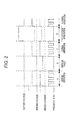
- Fig. 2 is a diagram illustrating timing charts of a battery voltage, a driving voltage (a voltage at the output terminal 12), a driving current, and a PWM signal P PWM in cases where the boost chopper circuit 2 is normally operated (also referred to as a "normal operation"), the positive-electrode-side output of the battery is in a ground fault condition (also referred to as a "ground fault"), and an overvoltage equal to or more than a rated forward voltage (Vf) of the LEDs 20-1 to 20-N is applied to the positive electrode of the battery (also referred to as an "overvoltage application").
- Sections A and C indicate an example of normal operation
- section B indicates an example of the ground fault
- section D indicates an example of the overvoltage application.
- the driving voltage is supplied to the bases of the NPN transistors Tr5 and Tr6 via the boost chopper circuit 2. Since the NPN transistor Tr5 is turned on, the PMOS transistor Tr4 is also turned on. In addition, since the NPN transistor Tr6 is turned on, the NPN transistor Tr8 is turned off, and the comparison output of the error amplifier 8 is sent to the PWM signal generating circuit. Accordingly, the PWM signal generating circuit receives the comparison output, and sends the PWM signal PWM to the gate of the NMOS transistor Tr1.
- the boost chopper circuit 2 generates a predetermined driving voltage by turning on or off the NMOS transistor Tr1 receiving the PWM signal P PWM , and the driving current is supplied to the LEDs 20-1 to 20-N via the PMOS transistor Tr4 (refer to section A).
- the driving voltage becomes almost zero volts, and a voltage capable of turning on the NPN transistors Tr5 and Tr6 is not generated in the bases of the NPN transistors Tr5 and Tr6. Then, since the NPN transistor Tr5 is turned off, the PMOS transistor Tr4 is also turned off, and the driving current is in the ground fault condition via the resistor R6. Since the driving current at this time passes through the resistor R6 having a large resistor value, the current value of the driving current becomes small (refer to section B).
- the comparison output of the error amplifier 8 becomes low, so that the comparison output is not provided to the PWM signal generating circuit, and the PWM signal P PWM is not provided therefrom (refer to section B). Since there is no operation of turning on or off the NMOS transistor Tr1, the driving operation of the boost chopper circuit 2 stops (refer to section B). In addition, in order to turn off the NPN transistors Tr5 and Tr6 at the same time, the resistor values of the resistors R9 and R1 0 are set to be identical, and the resistor values of the resistor R8 and R11 are set to be identical.
- the NPN transistor Tr9 since the NPN transistor Tr9 is turned on, the comparison output of the error amplifier 8 becomes low, so that the comparison output is not provided to the PWM signal generating circuit, and the PWM signal P PWM is not provided therefrom (refer to section D). Since there is no operation of turning on or off the NMOS transistor Tr1, the driving operation of the boost chopper circuit 2 stops (refer to section D). In addition, in the case of the overvoltage, the driving operation of the boost chopper circuit 2 stops, but a current flows to the LEDs 20-1 to 20-N via the resistor R6, so that the driving current and the output terminal voltage 12 do not completely become zero (refer to section D).
- Fig. 3 illustrates the setting range (the b region of Fig. 3 ) of the ON voltages of the NPN transistors Tr5 and Tr6.
- the ON voltages of the NPN transistors Tr5 and Tr6 are set to be larger than a voltage (Va) of the positive-electrode-side output terminal 12 in the case of the ground fault.
- the ON voltages of the NPN transistors are also set to be equal to or less than a voltage (Vb) of the positive-electrode-side output terminal 12 where the driving current starts to flow in the case of the normal operation.
- Vc indicates a voltage of the positive-electrode-side output terminal 12 in the case of the normal operation.
- the voltage ( ⁇ Va in the region a of Fig. 3 ) of the positive-electrode-side output terminal 12 is lower than the ON voltages of the NPN transistors Tr5 and Tr6, so that the NPN transistors Tr5 and Tr6 are turned off,
- the PMOS transistor Tr4 is also turned off, so that the driving current flows to the resistor R6 via the shunt resistor R1.
- the driving current in the case of the ground fault is set to the ground fault current
- the current value of the ground fault current becomes smaller as the value of the resistor R6 becomes larger. Accordingly, it is possible to control the current value of the ground fault current by controlling the value of the resistor R6, and to allow the ground fault current to be smaller than the driving current in the case of the normal operation in accordance with the setting value of the resistor 6.
- the ON voltages of the NPN transistors Tr5 and Tr6 are set to be larger than the voltage (Va) of the positive-electrode-side output terminal 12 in the case of the ground fault and are also set to be equal to or less than the voltage (Vb) of the positive-electrode-side output terminal 12 where the driving current starts to be supplied, the driving voltage of the boost chopper circuit 2 reliably becomes lower than the ON voltages of the NPN transistors Tr5 and Tr6 in the case of the ground fault. Accordingly, in the case of the ground fault, it is possible to turn off the NPN transistors Tr5 and Tr6 reliably, and thus to turn off the PMOS transistor Tr4.
- the positive electrode side of the boost chopper circuit 2 when the positive electrode side of the boost chopper circuit 2 is in the ground fault condition, it is possible to allow the ground fault current to be in the ground fault condition via the resistor R6 having a large resistor value by turning off the PMOS transistor Tr4, and to stop the driving operation of the boost chopper circuit 2 by controlling an operation of turning on or off the NMOS transistor Tr1. Accordingly, it is possible to prevent the large ground fault current from flowing from the positive electrode to the ground, and thus to improve the safety of the vehicle in a traveling mode.
- a vehicle lamp lighting control device according to a second embodiment of the invention is now described.
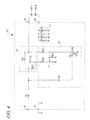
- a lighting control device 30 includes a reverse connection protecting diode D2, a bypass unit 31, an abnormality detecting unit 32, and a driving current setting unit 33.
- the bypass unit 31 includes: a resistor R20 connected in series to a battery (not shown) as a power supply unit for supplying a driving voltage to LEDs 50-1 to 50-N (N is an integer equal to or more than two) as semiconductor light sources; and a PMOS transistor Tr10 as a switch connected in parallel to the resistor R20.
- the resistor value of the resistor R20 is larger than the resistor values of other resistors.
- the abnormality detecting unit 32 includes: an NPN transistor Tr11 as a first switching element; an NPN transistor Tr12; resistors R22 to R26; and a zener diode ZD2.
- the NPN transistor Tr12 and the zener diode ZD2 serve as an overvoltage detecting unit.
- the NPN transistor Tr11 and the resistors R22 to R24 serve as a supply voltage detecting unit.
- the collector of the NPN transistor Tr11 is connected to the gate of the PMOS transistor Tr10 via the resistor R23.
- the base of the NPN transistor Tr11 is connected to the drain of the PMOS transistor Tr10 and the resistor R20 via the resistor R22.
- the emitter of the NPN transistor Tr11 is electrically grounded.
- the base of the NPN transistor Tr12 is connected to a positive-electrode-side input terminal 40 of the battery via the resistor R25, the zener diode ZD2, and the diode D2, the collector thereof is connected to the drain of the PMOS transistor Tr10 and the resistor R20 via the resistor R22, and the emitter thereof is electrically grounded.
- the driving current setting unit 33 includes resistors R27 to R30, and sets the values of the driving currents supplied to the LEDs 50-1 to 50-N.
- Fig. 5 illustrates timing charts of a battery voltage, a driving voltage (a voltage at the output terminal 42), and a driving current in the cases where the positive-electrode-side output of the battery is normal (i.e., a "normal operation"), the positive-electrode-side output of the battery is in a ground fault condition (also referred to as a "ground fault"), and an overvoltage equal to or more than a rated forward voltage (Vf) of the LEDs 50-1 to 50-N is applied to the positive electrode of the battery (also referred to as an "overvoltage application").
- Sections A and C indicate the case of the normal operation
- section B indicates the case of the ground fault
- section D indicates the case of the overvoltage application.
- the driving voltage is supplied to the base of the NPN transistor Trl1. Since the NPN transistor Tr11 is turned on, the PMOS transistor Tr10 is also turned on, so that the driving current is supplied to the LEDs 50-1 to 50-N via the PMOS transistor Tr10 (refer to section A).
- the driving voltage becomes almost zero volts, and a voltage capable of turning on the NPN transistor Tr11 is not generated in the base of the NPN transistor Tr11. Then, since the NPN transistor Tr11 is turned off, the PMOS transistor Tr10 is also turned off, and the driving current is in the ground fault condition via the resistor R20. Since the driving current at this time passes through the resistor R20 having a large resistor value, the current value of the driving current becomes small (refer to section B).
- the NPN transistor Tr12 is turned off, and the PMOS transistor Tr10 is turned on, so that the driving voltage in the case of the normal operation is applied to the LEDs 50-1 to 50-N.
- the subsequent operation is the same as that of section C.
- the ground fault current passes through the resistor R20 having a large resistor value by turning off the PMOS transistor Tr10. Accordingly, it is possible to prevent the large ground fault current from flowing from the positive electrode to the ground, and thus to improve the safety of the vehicle in a traveling mode.
Landscapes
- Engineering & Computer Science (AREA)
- Mechanical Engineering (AREA)
- Circuit Arrangement For Electric Light Sources In General (AREA)
- Lighting Device Outwards From Vehicle And Optical Signal (AREA)
- Led Devices (AREA)
Applications Claiming Priority (1)
| Application Number | Priority Date | Filing Date | Title |
|---|---|---|---|
| JP2009105545A JP5449842B2 (ja) | 2009-04-23 | 2009-04-23 | 車両用灯具の点灯制御装置 |
Publications (2)
| Publication Number | Publication Date |
|---|---|
| EP2243661A2 true EP2243661A2 (fr) | 2010-10-27 |
| EP2243661A3 EP2243661A3 (fr) | 2016-01-06 |
Family
ID=42335203
Family Applications (1)
| Application Number | Title | Priority Date | Filing Date |
|---|---|---|---|
| EP10159314.3A Withdrawn EP2243661A3 (fr) | 2009-04-23 | 2010-04-08 | Dispositif de commande de l'éclairage de lampe de véhicule |
Country Status (4)
| Country | Link |
|---|---|
| US (1) | US8330375B2 (fr) |
| EP (1) | EP2243661A3 (fr) |
| JP (1) | JP5449842B2 (fr) |
| CN (1) | CN101873745B (fr) |
Cited By (2)
| Publication number | Priority date | Publication date | Assignee | Title |
|---|---|---|---|---|
| EP3240368A4 (fr) * | 2014-12-24 | 2018-10-24 | Koito Manufacturing Co., Ltd. | Circuit d'éclairage de source de lumière et clignotant |
| EP3471252A4 (fr) * | 2016-06-13 | 2020-06-17 | Koito Manufacturing Co., Ltd. | Dispositif de commande de charge et appareil d'éclairage de véhicule |
Families Citing this family (11)
| Publication number | Priority date | Publication date | Assignee | Title |
|---|---|---|---|---|
| WO2013001831A1 (fr) * | 2011-06-30 | 2013-01-03 | 川崎重工業株式会社 | Dispositif de commande d'unité d'alimentation pour véhicule entraîné par moteur à combustion interne et véhicule entraîné par moteur à combustion interne équipé d'un dispositif de commande d'unité d'alimentation |
| JP5903633B2 (ja) * | 2012-10-31 | 2016-04-13 | パナソニックIpマネジメント株式会社 | 電源装置及び該電源装置を用いた車両用照明装置 |
| JP6051909B2 (ja) | 2013-02-12 | 2016-12-27 | 株式会社デンソー | 電力供給装置 |
| JP5958407B2 (ja) | 2013-04-12 | 2016-08-02 | 株式会社デンソー | Led駆動装置 |
| DE102014203007A1 (de) * | 2014-02-19 | 2015-08-20 | Zumtobel Lighting Gmbh | Schaltungsanordnung und Verfahren zum Überwachen des Stromflusses durch LEDs |
| DE102015217712B4 (de) * | 2014-09-16 | 2017-01-19 | Koito Manufacturing Co., Ltd. | Beleuchtungsschaltkreis und Fahrzeugleuchte, die einen solchen aufweist |
| CN105813273B (zh) * | 2016-05-12 | 2019-06-18 | 重庆四联光电科技有限公司 | 一种防灯组过压和欠压工作的方法、装置和照明设备 |
| JP6849342B2 (ja) * | 2016-08-16 | 2021-03-24 | 株式会社小糸製作所 | 点灯回路および車両用灯具 |
| CN106304569B (zh) * | 2016-10-09 | 2023-10-10 | 华域视觉科技(武汉)有限公司 | 一种汽车单边两后灯之间的供电电路 |
| CN108944653B (zh) * | 2018-09-14 | 2024-05-14 | 常州瑞阳电装有限公司 | 一种全域式闪光器驱动电路 |
| US11921531B2 (en) * | 2020-12-17 | 2024-03-05 | Hamilton Sundstrand Corporation | Zener diode power path control for extended operation range of linear power supplies |
Citations (1)
| Publication number | Priority date | Publication date | Assignee | Title |
|---|---|---|---|---|
| JP2004122912A (ja) | 2002-10-01 | 2004-04-22 | Koito Mfg Co Ltd | 車両用灯具 |
Family Cites Families (12)
| Publication number | Priority date | Publication date | Assignee | Title |
|---|---|---|---|---|
| JPH09247854A (ja) * | 1996-03-08 | 1997-09-19 | Zexel Corp | 直流電源回路 |
| JP4236894B2 (ja) * | 2002-10-08 | 2009-03-11 | 株式会社小糸製作所 | 点灯回路 |
| JP4148908B2 (ja) * | 2004-02-16 | 2008-09-10 | 株式会社小糸製作所 | 車両用灯具 |
| KR100616613B1 (ko) * | 2004-08-27 | 2006-08-28 | 삼성전기주식회사 | U자형 램프용 백라이트 인버터 |
| US7542257B2 (en) * | 2004-09-10 | 2009-06-02 | Philips Solid-State Lighting Solutions, Inc. | Power control methods and apparatus for variable loads |
| US7535180B2 (en) * | 2005-04-04 | 2009-05-19 | Cree, Inc. | Semiconductor light emitting circuits including light emitting diodes and four layer semiconductor shunt devices |
| JP4451376B2 (ja) * | 2005-11-04 | 2010-04-14 | 株式会社小糸製作所 | 車両用灯具の点灯制御装置 |
| JP4926784B2 (ja) * | 2007-03-29 | 2012-05-09 | 株式会社小糸製作所 | 発光装置 |
| JP4730791B2 (ja) * | 2007-04-18 | 2011-07-20 | 株式会社小糸製作所 | 車両用前照灯装置 |
| US8405321B2 (en) * | 2007-07-26 | 2013-03-26 | Rohm Co., Ltd. | Drive unit, smoothing circuit, DC/DC converter |
| JP2010111213A (ja) * | 2008-11-05 | 2010-05-20 | Stanley Electric Co Ltd | 車両用灯具の過電圧保護回路 |
| JP5396075B2 (ja) * | 2008-12-18 | 2014-01-22 | 株式会社小糸製作所 | 車両用灯具の制御装置 |
-
2009
- 2009-04-23 JP JP2009105545A patent/JP5449842B2/ja not_active Expired - Fee Related
-
2010
- 2010-04-08 EP EP10159314.3A patent/EP2243661A3/fr not_active Withdrawn
- 2010-04-13 US US12/758,885 patent/US8330375B2/en not_active Expired - Fee Related
- 2010-04-23 CN CN201010156892.6A patent/CN101873745B/zh active Active
Patent Citations (1)
| Publication number | Priority date | Publication date | Assignee | Title |
|---|---|---|---|---|
| JP2004122912A (ja) | 2002-10-01 | 2004-04-22 | Koito Mfg Co Ltd | 車両用灯具 |
Cited By (6)
| Publication number | Priority date | Publication date | Assignee | Title |
|---|---|---|---|---|
| EP3240368A4 (fr) * | 2014-12-24 | 2018-10-24 | Koito Manufacturing Co., Ltd. | Circuit d'éclairage de source de lumière et clignotant |
| CN109688666A (zh) * | 2014-12-24 | 2019-04-26 | 株式会社小糸制作所 | 光源点灯电路、转向信号灯 |
| EP3528599A3 (fr) * | 2014-12-24 | 2019-10-16 | Koito Manufacturing Co., Ltd. | Circuit d'éclairage à source lumineuse et clignotant |
| CN109688666B (zh) * | 2014-12-24 | 2021-04-20 | 株式会社小糸制作所 | 光源点灯电路、转向信号灯 |
| EP3471252A4 (fr) * | 2016-06-13 | 2020-06-17 | Koito Manufacturing Co., Ltd. | Dispositif de commande de charge et appareil d'éclairage de véhicule |
| US10874009B2 (en) | 2016-06-13 | 2020-12-22 | Koito Manufacturing Co., Ltd. | Load driving apparatus |
Also Published As
| Publication number | Publication date |
|---|---|
| CN101873745A (zh) | 2010-10-27 |
| JP5449842B2 (ja) | 2014-03-19 |
| JP2010258164A (ja) | 2010-11-11 |
| CN101873745B (zh) | 2014-01-29 |
| EP2243661A3 (fr) | 2016-01-06 |
| US8330375B2 (en) | 2012-12-11 |
| US20100270926A1 (en) | 2010-10-28 |
Similar Documents
| Publication | Publication Date | Title |
|---|---|---|
| EP2243661A2 (fr) | Dispositif de commande de l'éclairage de lampe de véhicule | |
| JP4483751B2 (ja) | 電源逆接続保護回路 | |
| JP4589966B2 (ja) | 電力供給制御装置及び半導体装置 | |
| US20130193754A1 (en) | Electronic control unit for automobile | |
| US8379360B2 (en) | Overcurrent protection circuit and in-vehicle display device | |
| JP5301976B2 (ja) | 車両用灯具の制御装置 | |
| JP2007200610A (ja) | 車両用灯具の点灯制御装置 | |
| JP4714701B2 (ja) | Led車両用灯具の点灯制御回路 | |
| JP7443679B2 (ja) | 半導体装置 | |
| JP2006103404A (ja) | 車両用灯具の点灯制御回路 | |
| US20170027038A1 (en) | Illumination device | |
| US7978453B2 (en) | Low side driver with short to battery protection | |
| EP2200406B1 (fr) | Contrôleur pour lampe véhiculaire | |
| JP7512910B2 (ja) | 逆接続保護回路 | |
| US6970338B2 (en) | Power supply device having overcurrent protection function and method for controlling the same | |
| JP4732191B2 (ja) | 過熱保護機能付き半導体装置の制御回路 | |
| JP2005295753A (ja) | 端子保護回路および同期整流型のスイッチング電源 | |
| JP2014241202A (ja) | 車両用灯具におけるled点灯装置 | |
| JP2005027380A (ja) | インテリジェントパワーデバイス及びその負荷短絡保護方法 | |
| JP2014151717A (ja) | 車両用灯具用の過電圧保護装置 | |
| JP3676168B2 (ja) | 電源供給制御装置 | |
| JP2006333595A (ja) | 端子保護回路 | |
| JP4793081B2 (ja) | サージ保護装置 | |
| JP2008061339A (ja) | インバータ回路 | |
| JP7568492B2 (ja) | 保護回路 |
Legal Events
| Date | Code | Title | Description |
|---|---|---|---|
| PUAI | Public reference made under article 153(3) epc to a published international application that has entered the european phase |
Free format text: ORIGINAL CODE: 0009012 |
|
| 17P | Request for examination filed |
Effective date: 20100408 |
|
| AK | Designated contracting states |
Kind code of ref document: A2 Designated state(s): AT BE BG CH CY CZ DE DK EE ES FI FR GB GR HR HU IE IS IT LI LT LU LV MC MK MT NL NO PL PT RO SE SI SK SM TR |
|
| PUAL | Search report despatched |
Free format text: ORIGINAL CODE: 0009013 |
|
| AK | Designated contracting states |
Kind code of ref document: A3 Designated state(s): AT BE BG CH CY CZ DE DK EE ES FI FR GB GR HR HU IE IS IT LI LT LU LV MC MK MT NL NO PL PT RO SE SI SK SM TR |
|
| RIC1 | Information provided on ipc code assigned before grant |
Ipc: H05B 33/08 20060101ALI20151202BHEP Ipc: B60Q 1/04 20060101AFI20151202BHEP |
|
| STAA | Information on the status of an ep patent application or granted ep patent |
Free format text: STATUS: EXAMINATION IS IN PROGRESS |
|
| 17Q | First examination report despatched |
Effective date: 20171221 |
|
| STAA | Information on the status of an ep patent application or granted ep patent |
Free format text: STATUS: THE APPLICATION IS DEEMED TO BE WITHDRAWN |
|
| 18D | Application deemed to be withdrawn |
Effective date: 20191101 |