EP2243917A2 - Système et module d'isolation - Google Patents
Système et module d'isolation Download PDFInfo
- Publication number
- EP2243917A2 EP2243917A2 EP10405084A EP10405084A EP2243917A2 EP 2243917 A2 EP2243917 A2 EP 2243917A2 EP 10405084 A EP10405084 A EP 10405084A EP 10405084 A EP10405084 A EP 10405084A EP 2243917 A2 EP2243917 A2 EP 2243917A2
- Authority
- EP
- European Patent Office
- Prior art keywords
- insulation
- opening
- insulation system
- facade
- insulating
- Prior art date
- Legal status (The legal status is an assumption and is not a legal conclusion. Google has not performed a legal analysis and makes no representation as to the accuracy of the status listed.)
- Withdrawn
Links
- 238000009413 insulation Methods 0.000 title claims abstract description 304
- 238000002955 isolation Methods 0.000 claims description 29
- 239000011521 glass Substances 0.000 description 28
- 239000010410 layer Substances 0.000 description 26
- 230000000694 effects Effects 0.000 description 12
- 238000010276 construction Methods 0.000 description 7
- 238000006073 displacement reaction Methods 0.000 description 6
- 238000005253 cladding Methods 0.000 description 5
- 239000000463 material Substances 0.000 description 5
- 238000004378 air conditioning Methods 0.000 description 4
- 230000005855 radiation Effects 0.000 description 4
- 238000009434 installation Methods 0.000 description 3
- 239000004033 plastic Substances 0.000 description 3
- 229920003023 plastic Polymers 0.000 description 3
- 239000002023 wood Substances 0.000 description 3
- 239000004793 Polystyrene Substances 0.000 description 2
- 229920002522 Wood fibre Polymers 0.000 description 2
- 230000005540 biological transmission Effects 0.000 description 2
- 229920002678 cellulose Polymers 0.000 description 2
- 239000001913 cellulose Substances 0.000 description 2
- 238000010438 heat treatment Methods 0.000 description 2
- 238000000034 method Methods 0.000 description 2
- 239000011490 mineral wool Substances 0.000 description 2
- 239000004570 mortar (masonry) Substances 0.000 description 2
- -1 polyethylene Polymers 0.000 description 2
- 229920002223 polystyrene Polymers 0.000 description 2
- 229920002635 polyurethane Polymers 0.000 description 2
- 239000004814 polyurethane Substances 0.000 description 2
- 230000007704 transition Effects 0.000 description 2
- 239000002025 wood fiber Substances 0.000 description 2
- 210000002268 wool Anatomy 0.000 description 2
- 244000025254 Cannabis sativa Species 0.000 description 1
- 235000012766 Cannabis sativa ssp. sativa var. sativa Nutrition 0.000 description 1
- 235000012765 Cannabis sativa ssp. sativa var. spontanea Nutrition 0.000 description 1
- 240000006240 Linum usitatissimum Species 0.000 description 1
- 235000004431 Linum usitatissimum Nutrition 0.000 description 1
- 235000014676 Phragmites communis Nutrition 0.000 description 1
- 239000004698 Polyethylene Substances 0.000 description 1
- 229910000831 Steel Inorganic materials 0.000 description 1
- 230000015572 biosynthetic process Effects 0.000 description 1
- 239000000378 calcium silicate Substances 0.000 description 1
- 229910052918 calcium silicate Inorganic materials 0.000 description 1
- OYACROKNLOSFPA-UHFFFAOYSA-N calcium;dioxido(oxo)silane Chemical compound [Ca+2].[O-][Si]([O-])=O OYACROKNLOSFPA-UHFFFAOYSA-N 0.000 description 1
- 235000009120 camo Nutrition 0.000 description 1
- 235000010980 cellulose Nutrition 0.000 description 1
- 235000005607 chanvre indien Nutrition 0.000 description 1
- 239000004927 clay Substances 0.000 description 1
- 239000002131 composite material Substances 0.000 description 1
- 239000004567 concrete Substances 0.000 description 1
- 239000004020 conductor Substances 0.000 description 1
- 238000011109 contamination Methods 0.000 description 1
- 238000001816 cooling Methods 0.000 description 1
- 230000002996 emotional effect Effects 0.000 description 1
- 230000007613 environmental effect Effects 0.000 description 1
- 239000006260 foam Substances 0.000 description 1
- 229920001821 foam rubber Polymers 0.000 description 1
- 239000005338 frosted glass Substances 0.000 description 1
- 239000011491 glass wool Substances 0.000 description 1
- 239000011487 hemp Substances 0.000 description 1
- 230000001771 impaired effect Effects 0.000 description 1
- 239000012774 insulation material Substances 0.000 description 1
- 230000010354 integration Effects 0.000 description 1
- 238000012423 maintenance Methods 0.000 description 1
- 230000007257 malfunction Effects 0.000 description 1
- 238000004519 manufacturing process Methods 0.000 description 1
- 229910052751 metal Inorganic materials 0.000 description 1
- 239000002184 metal Substances 0.000 description 1
- 150000002739 metals Chemical class 0.000 description 1
- 239000010445 mica Substances 0.000 description 1
- 229910052618 mica group Inorganic materials 0.000 description 1
- 239000010451 perlite Substances 0.000 description 1
- 235000019362 perlite Nutrition 0.000 description 1
- 229920000573 polyethylene Polymers 0.000 description 1
- 229920006327 polystyrene foam Polymers 0.000 description 1
- 239000008262 pumice Substances 0.000 description 1
- 230000001105 regulatory effect Effects 0.000 description 1
- 239000011150 reinforced concrete Substances 0.000 description 1
- 230000003014 reinforcing effect Effects 0.000 description 1
- 230000000284 resting effect Effects 0.000 description 1
- 238000009420 retrofitting Methods 0.000 description 1
- 238000007789 sealing Methods 0.000 description 1
- 238000000926 separation method Methods 0.000 description 1
- 239000002356 single layer Substances 0.000 description 1
- 239000010959 steel Substances 0.000 description 1
- 239000004575 stone Substances 0.000 description 1
- 239000000126 substance Substances 0.000 description 1
- 239000000725 suspension Substances 0.000 description 1
- 230000000007 visual effect Effects 0.000 description 1
Images






Classifications
-
- E—FIXED CONSTRUCTIONS
- E06—DOORS, WINDOWS, SHUTTERS, OR ROLLER BLINDS IN GENERAL; LADDERS
- E06B—FIXED OR MOVABLE CLOSURES FOR OPENINGS IN BUILDINGS, VEHICLES, FENCES OR LIKE ENCLOSURES IN GENERAL, e.g. DOORS, WINDOWS, BLINDS, GATES
- E06B9/00—Screening or protective devices for wall or similar openings, with or without operating or securing mechanisms; Closures of similar construction
- E06B9/02—Shutters, movable grilles, or other safety closing devices, e.g. against burglary
- E06B9/04—Shutters, movable grilles, or other safety closing devices, e.g. against burglary of wing type, e.g. revolving or sliding
-
- E—FIXED CONSTRUCTIONS
- E06—DOORS, WINDOWS, SHUTTERS, OR ROLLER BLINDS IN GENERAL; LADDERS
- E06B—FIXED OR MOVABLE CLOSURES FOR OPENINGS IN BUILDINGS, VEHICLES, FENCES OR LIKE ENCLOSURES IN GENERAL, e.g. DOORS, WINDOWS, BLINDS, GATES
- E06B9/00—Screening or protective devices for wall or similar openings, with or without operating or securing mechanisms; Closures of similar construction
- E06B9/24—Screens or other constructions affording protection against light, especially against sunshine; Similar screens for privacy or appearance; Slat blinds
- E06B9/26—Lamellar or like blinds, e.g. venetian blinds
- E06B9/36—Lamellar or like blinds, e.g. venetian blinds with vertical lamellae ; Supporting rails therefor
-
- E—FIXED CONSTRUCTIONS
- E06—DOORS, WINDOWS, SHUTTERS, OR ROLLER BLINDS IN GENERAL; LADDERS
- E06B—FIXED OR MOVABLE CLOSURES FOR OPENINGS IN BUILDINGS, VEHICLES, FENCES OR LIKE ENCLOSURES IN GENERAL, e.g. DOORS, WINDOWS, BLINDS, GATES
- E06B7/00—Special arrangements or measures in connection with doors or windows
- E06B7/02—Special arrangements or measures in connection with doors or windows for providing ventilation, e.g. through double windows; Arrangement of ventilation roses
- E06B7/08—Louvre doors, windows or grilles
- E06B7/084—Louvre doors, windows or grilles with rotatable lamellae
Definitions
- the invention relates to an insulation system comprising at least one insulation element with a planar extension, wherein the at least one insulation element is rigid.
- the German utility model DE29913386 discloses a shutter construction for covering a facade opening, such as windows, doors and other openings of a building facade, wherein the shutter can be brought from an open position to a closed position. Between the shutter and the building facade, a distance is arranged, whereby a linearly movable shutter, smoothly spaced from the building facade is approximately parallel to the window surface linearly displaceable.
- the disclosed invention includes only shutters, which are arranged outside the building interior movable. By placing them outside a building, the shutters must be protected against weather conditions and environmental problems.
- the European patent EP0500120 describes a venetian-like arrangement of individual insulation components in front of a facade opening of a building facade, for example arranged in front of a glass front, the insulation components each comprising a glass pane and a pivotable about a horizontal axis insulating element.
- the heat radiation is variable in the interior.
- the device also has a reflection effect, by targeted reflection of light on the insulation elements.
- the individual insulation components are suitable for forming a facade.
- a disadvantage of these insulation components which are integrated in an outer wall or can be fixed in front of a building front opening, is the complicated structure and the mobility of the items, whereby they are prone to failure.
- These insulation components can be used for thermal insulation of building facades outside a building.
- the German patent application DE 2735654 discloses an insulation device in the building interior spaced from a window in the form of a roller blind.
- the thermal bridge sometimes called cold bridge
- the insulation device comprises a plurality of films, which are mounted vertically displaceable approximately parallel to the facade opening in the form of the window surface and can cover the window surface, whereby the passage of heat by convection, heat conduction and radiation is prevented.
- the insulation device is arranged in the interior, an insert for heat insulation of a large facade opening, such as a glass facade is not disclosed and seems to be unusable to prevent heat loss through a complete glass facade. It had huge film webs or a corresponding plurality of parallel film webs in appropriate dimensions parallel to the glass facade with corresponding take-up devices are arranged.
- the object of the invention is to provide an insulation system belonging to the technical field mentioned above, which allows a simple and efficient thermal regulation, in particular in a building, and also has a simple design and is inexpensive to produce.
- the present invention further provides an interior insulation system, with which an undesired passage of heat through convection, heat conduction and radiation through a building facade in the region of large-scale facade openings, such as a glass facade, a window front, a door or a large-area window, can be avoided.
- the at least one insulation element is movably mounted relative to the facade opening, so that the positioning of the at least one insulation element for completely or partially covering a facade opening is made possible.
- the present invention describes an insulation system and an interior insulation system, comprising at least one insulation element with a planar extension, which as a component, in particular as a modular outer skin is used for a building, respectively within a building interior and allows the positioning of the at least one insulating element for completely or partially covering a facade opening.
- the inventive interior insulation system is a simple effect on the building air conditioning possible, with simple means energy for the air conditioning of buildings can be saved.
- the present invention further enables a total or partial insulation of the facade opening against heat loss, as well as all or part of the darkening of the interior in sunlight.
- the insulation effect for the building interior is controllable.
- the windows can be covered by means of insulation elements, so as to save heating or cooling power both in ecological and in economic terms.
- the facade opening can be partially or completely covered by means of the movably mounted insulation element.
- a temperature gradient between the building interior and the adjacent room outside the building interior to be reduced or if the sun is to be used to heat the building interior, this can be supported by moving away the insulation element of the facade opening.
- the insulating element can be, for example, calcium silicate boards, aerated concrete, pumice stone, perlite, expanded clay, expanded mica, polyethylene, polystyrene, neopor, polyurethane, wood fiber material, wood fiber insulation board, vacuum insulation boards, lightweight building boards, but also insulation boards in the general sense, cellulose composite elements, wood wool, cellulose, hemp, Flax, wool, reed plates, rock wool, glass wool, etc., and combinations thereof.
- a plate-shaped design of the insulating element so that a flawless movable mounting of the insulation element can be ensured.
- the term "facade opening" is hereinafter equally used for window fronts, or all-glass facades, windows, especially large windows that form parts of the building facade with higher heat transfer coefficient, but also for areas between structure of a skeleton structure, respectively Mauerlichtötechnische.
- the insulation system is thus directed to all-glass facades and partial surfaces, windows and walls, which can be translucent, and comprises a movably mounted insulation element.
- the insulating element is movably mounted so that by means of a position of the insulating element, a heat transfer between the two defined by the facade opening spaces, in particular a heat radiation and / or heat conduction only heat transfer can be influenced.
- the movement, or the method, pivoting or the like of the insulating elements can be done by means of a motor, for example a stepper motor or by hand.
- the power transmission can be done by means of cables, threaded rods, racks, levers, pneumatics, hydraulics and the like.
- the insulation system is designed as a component, in particular as a modular outer skin for a building.
- a component in particular, in skeleton construction, for example using wood, steel or reinforced concrete, it is advantageous to form the insulation system as a component.
- the components can be prefabricated, which means that they only need to be mounted on the construction site.
- the components can also be designed so that they are suitable for the so-called prefabricated construction, in which the building is largely prefabricated delivered to the site. This can save a considerable amount of time and thus costs in the construction of corresponding buildings.
- the components thus preferably comprise facade parts and parts of the interior trim. The production of these components can particularly cost-effective, especially if a modular concept is pursued.
- the component can be designed such that the movably mounted insulation element best possible to the other components of the device, for. B. is adapted to the outer skin, so that the device z. B. in the closed state can develop the best possible insulation effect.
- the insulation system can also be designed as an interior insulation system, with the disadvantage that installation in a building takes more time. (see below).
- the insulation system is designed as a sandwich element, which comprises an outer layer, an insulation layer and an inner layer, wherein the at least one insulation element is part of the insulation layer.
- the movably mounted insulation element can be moved within the outer and inner layer, which malfunctions caused by contamination, improper handling, etc., can be largely avoided.
- the insulating element can be virtually hermetically sealed between the outer and inner layers.
- the intermediate space between the outer and inner layer, in which the insulating element is movably mounted can also be subjected to negative pressure.
- the inner layer can also serve to cover the movable insulation element for aesthetic reasons to achieve a homogeneous interior view.
- the outer layer may comprise facade elements.
- the outer layer and the inner layer are preferably at least partially translucent, in particular formed as a window.
- modern windows include two or three layers of glass (double glazing or triple glazing) to achieve a desired thermal insulation.
- plastic can be used instead of glass.
- an insulating element can now be movably mounted between the two panes of the double glazing or between two of the three panes of a triple glazing. This has the advantage that not, respectively, only slightly more space for the window is claimed, while the insulation effect can be significantly improved.
- the Gap between the two panes may also be fully or partially evacuated.
- the outer layer (and possibly also the inner layer) is formed by a window (with double or triple glazing) and the movable insulation element is arranged in a parallel plane.
- the movably mounted insulation element is movably mounted from a closed position to an open position, so that a covering surface of the at least one insulating element of the facade opening can be turned on and turned off.
- This can be used to regulate the insulation and thus the internal temperature of the room.
- a heat exchange is reduced and in the opposite state, a heat exchange is favored.
- the insulating element can also be positioned in intermediate positions between the open position and the closed position, whereby a heat exchange performance can be regulated.
- the insulation element is preferably movable substantially parallel to the facade opening. This achieves a particularly compact design of the insulation system. Typically, an insulating element at right angles to the main surface of a facade opening on the smallest dimension, whereby a parallel displacement of the insulating element to the facade opening claimed a correspondingly small volume. This in turn allows a correspondingly large freedom of design for the interior.
- the isolation element may also be otherwise moved away from the facade opening, for example, similar to a garage door or shutters. However, this eliminates the above-mentioned advantages.
- the insulation element is linearly, at least approximately parallel, slidably mounted to the facade opening.
- the use of a linear guide has the advantage that it is particularly cost-effective and structurally easy to implement.
- the insulating element can also be guided in a non-linear manner, but typically an increased design effort is accepted.
- the isolation element is preferably guided linearly movably guided by rails.
- a rail guide a particularly simple form of a linear guide is realized, which is inexpensive and low maintenance.
- the rail guide can be designed as a profile rail, telescopic rail, Käfigschienen-, Gleitschienen-, roller guide and the like.
- the insulation element may comprise rollers which are guided in or on a rail parallel to the facade opening. Conversely, the rollers could also be mounted in the support of the insulation element, which can be dispensed with roles for the insulation element.
- the linear guide can be designed to be suspended and / or resting. Next rails or rollers may also be laterally connected to the insulation element. The skilled person is further a variety of ways known how such a linear guide can be realized.
- the guide may be formed without rails.
- the insulation element could be guided exclusively by the two panes of double glazing.
- the isolation elements could also be guided only laterally, which can be dispensed with a rail guide. In this case, however, the running property of the insulating element can be impaired, since typically higher frictional forces act.
- the insulation system comprises two insulation elements which are mutually displaceable in the opposite direction, in particular linearly movable.
- the two insulation elements are preferably mounted either horizontally or vertically against each other. This ensures that, in intermediate positions between an open position and a closed position, the opening is in each case in the form of a rectangle with a stationary mid-perpendicular, which the viewer considers to be particularly aesthetic. Furthermore, in the intermediate positions, at best, the incidence of light in the room can be optimized.
- the movement of the two insulation elements can be so be coupled that moves by means of a movement of the one insulating element, the other automatically in the opposite direction.
- the insulation elements can also be driven separately.
- the isolation elements can also be mounted so movable that they can be moved independently, in particular in the same direction at the same time. This is possible in particular by means of a separate control. In a preferred embodiment, however, the movements of the two insulation elements are coupled.
- the two insulation elements are linearly movable, whereby a structurally simple and inexpensive embodiment is provided.
- the insulation elements can also be moved relative to one another in a non-linear manner relative to one another and away from one another.
- the two insulation elements can be moved, for example, on a V-shaped path, wherein the insulation elements when closing in a movement component to each other and proceed in a further component of movement down.
- each two insulation elements in an open position in each case lie one above the other, wherein during the closing process in each case one of the two insulation elements moves twice as fast as the other insulation element.
- the insulation elements can also be mounted so as to be movable in a non-linear manner, for example in waveform or the like. It is also conceivable to form a plurality of isolation elements movable in a linear or non-linear manner.
- the insulation system comprises at least one further insulation element, which is movably mounted with respect to the facade opening fixed or relative to the facade opening, wherein the insulation element and the further insulation element partially overlap in a closed position.
- the overlap can be accomplished so that one insulation element in the closed position at the front, and the other at the back.
- the overlap may also be formed in the form of a groove in one and in the form of a bung in the other insulation element.
- other positive connection forms can be selected. This ensures that the insulation effect is also present in the transition region of two insulation elements.
- the first-mentioned embodiment is selected at least on one side, wherein two plate-shaped insulation elements are guided parallel to one another. This allows easy opening and closing of the façade opening, since one guide direction is sufficient.
- this can also be dispensed with, especially if the insulation can be otherwise ensured in the transition.
- the edges of the two insulation elements could be provided with a flexible seal, which are pressed together in the closed position.
- the person skilled in the art also knows of other ways in which two insulation elements can be brought together tightly and detachably.
- the isolation element is rotatably mounted about a rotation axis.
- the axis of rotation may be provided, for example, parallel to the main surface of the facade opening and horizontally, preferably near the ceiling.
- the insulation element can be pivoted from a vertical closure position to a horizontal open position, wherein in the open position, the insulation element is parallel and close to the ceiling.
- the axis of rotation can also be oriented vertically and parallel to the facade opening, so that the insulating element can be opened and closed similarly to a window sash or a shutter.
- the insulating element can therefore also be mounted on the outside, in particular outside a window, over the axis of rotation, so that no space is required in the interior space during pivoting.
- the axis of rotation is oriented at right angles to the facade opening. This ensures that a small volume is claimed by the pivoting of the insulating element, whereby an increased freedom of design for the interior of the room is achieved.
- the axis of rotation can also be oriented parallel to the facade opening (see above).
- a plurality of insulating elements are mounted pivotably about a respective segment bearing and thus form a lens closure, in particular for opening and closing a viewing opening.
- a circular or polygonal lockable opening can be created, which can leave a particularly aesthetic impression even in the intermediate position between "open” and "closed” by the star-shaped figure.
- the lens shutter is formed similar to an iris diaphragm.
- the moving elements i. the lens elements to be sealed in the closed position in the contact areas via a groove / comb connection.
- the plurality of isolation elements are each formed as triangles with two convex and one concave side, wherein the axes of rotation are arranged at regular intervals on a circle and the insulation elements are each mounted on a triangular corner, in which a concave and a convex side come together.
- the insulation system may be formed as an indoor insulation system, which is used within a building interior.
- the insulation system does not perceive the function of the outer skin in the corresponding embodiments, but this is ensured by other (eg pre-existing) components.
- the interior insulation system can be provided, for example, as an inner facade cladding or in the interior of the room as an intermediate wall, in particular between two different rooms to be tempered. This has the advantage, among other things, that existing buildings can be retrofitted in a simple manner. In addition, constructive separation of the outer skin and the insulation system results in further constructive possibilities.
- the at least one insulating element is spaced from the facade opening, directly or indirectly in the bottom of a room relative to Facade opening stored. This provides a simple retrofitting in a building interior with movable insulation elements.
- insulation elements of the embodiments described above can of course also be used in the context of an interior insulation system.
- an interior insulation system comprises at least one insulation element with a planar extension, which is used within a building interior and wherein the positioning of the at least one insulation element for wholly or partially covering a facade opening allows, wherein the at least one insulating element is rigid and spaced from the facade opening, directly or indirectly stored in the bottom of a room relative to the facade opening.
- the at least one insulation element is movably supported by a closure position in an open position, so that a covering surface of the at least one insulation element of the facade opening can be turned on and turned off.
- the at least one insulation element preferably has one or more viewing openings.
- the at least one insulation element is mounted linearly displaceable at least approximately parallel to the facade opening.
- the at least one isolation element preferably has displacement means and is guided linearly movably guided in floor rails.
- the at least one isolation element preferably has displacement means and can be moved linearly as smoothly as possible without a rail track.
- the at least one isolation element is designed in one piece and rotatably mounted about a vertical axis of rotation.
- the at least one insulating element preferably has a parallelogram-shaped base area.
- the at least one insulating element is designed in several parts and comprises a first wing and a second wing, which are mounted pivotably about each other independently of one another about a vertical axis.
- the at least one viewing opening is preferably arranged in the first wing and / or in the second wing.
- the at least one insulation element is preferably mounted stationary in the building interior.
- the at least one isolation element is designed in one or more layers.
- the interior insulation system preferably has a plurality of independently movable isolation elements.
- the plurality of insulation elements is arranged such that edge regions of adjacent insulation elements partially overlap in the closed position.
- the plurality of insulation elements are arranged at least approximately parallel to the facade opening lined up.
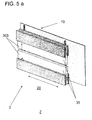
- the insulation element is preferably multi-layered and the at least one viewing opening is preferably openable and closable by means of a parallel closure, comprising two insulating bodies that can be moved in the vertical direction.
- the insulation element is preferably designed in several layers and the at least one viewing opening is preferably openable and closable by a lens closure, comprising a plurality of segments, which are mounted pivotably in a respective segment bearing.
- the insulation element is designed to be multi-layered and the at least one viewing opening is preferably openable and closable by a horizontal closure, comprising at least one segment which is linearly displaceably mounted in at least one horizontal rail.
- the individual insulation elements are preferably stored in a bottom well below the bottom at least approximately parallel to the facade opening on at least one vertical rail held linearly retractable.
- An interior insulation system 3 comprising at least one insulation element 30 which is used inside a building interior 2 is disclosed. That at least an insulation element 30 has a planar extension and is positioned in front of a facade opening 10 of a building facade in the building interior such that a cold bridge, or referred to as a thermal bridge, is covered and the heat flow through the facade opening 10 is severely limited.
- Coverable façade openings 10 can be, for example, window fronts or all-glass façades or large windows which form parts of the building façade with higher heat transfer coefficients. With the interior insulation system 3 presented here, these facade openings 10 can be partially or completely covered from the inside by corresponding alignment of the at least one insulation element, wherein the at least one insulation element 30 has a planar extension and is arranged at a distance from the facade opening 10. A plurality of insulation elements 30 is arranged in a row, preferably at least approximately parallel to the facade opening 10, wherein edge regions of adjacent insulation elements 30 partially overlap, sealingly arranged.
- the at least one insulating element 30 is rigid and mounted relative to the facade opening 10 to be covered in the building interior 2 movable.
- Each insulation element 30 is directly or indirectly on the floor 20 and possibly also the ceiling 21 (FIG. Fig. 3b ) Of a space movable in corresponding bearings stored from an open position to a closed position can be brought. Due to the movement of the insulation elements 30 in the closed position, a loss of heat from the building interior 2 to the outside is avoided in cold outside temperatures, while in the summer with warm outside temperatures an excessive heating of the building interior 2 can be prevented.
- a covering surface 305 of the release element 30 should be alignable in the closed position at least approximately parallel to the spaced façade opening.
- FIGS. 1a to 1d is a first embodiment of the 10 interior insulation system 3 with linear at least approximately parallel to the facade opening 10 sliding insulation elements 30 shown.
- the three insulation elements 30 are located in Fig. 1d completely in the closed position, whereby unwanted escape of heat from the building interior 2 through the facade opening 10 is avoided to the outside.
- the insulation elements 30 are guided in the bottom 20 guided in a not shown bottom rails linearly movable.
- corresponding means are provided in the insulation elements 30, so that a low-friction as possible linear displacement is possible.
- a ball-bearing mounting of the individual insulation elements 30 may be performed.
- a viewing opening 303 is provided in an insulating element 30, whereby the passage of light through the insulating element 30 is possible, so that the building interior 2 is not darkened too much.
- the individual insulation elements 30 are individually displaceable independently of each other, whereby different strong insulation effects can be achieved.
- the insulating effect is also influenced by the thickness of the insulating elements 30 and the choice of materials. Due to the individual arrangement of the insulation elements 30, the visual impression of the insulation elements 30 in the building interior 2 can also be varied.
- seals such as soft rubber foam
- the interior insulation system 3 comprises at least one insulation element 30, which is configured in one piece and is rotatably mounted in a stationary manner about a vertical axis of rotation 31.
- FIG. 2a shows a facade opening 10, in front of which interior side Each insulation element 30 is rotatable about the vertical axis of rotation independently of the adjacently arranged insulation elements 30, wherein a rotation surface 304 is swept over.
- the base 300 is chosen parallelogram-shaped, with no right angles between the sides.
- Such Grundfl3che 300 is advantageous because adjacent insulation elements 30 partially overlap in their edge regions and additionally seal and the independent insulation elements 30 may be arranged closer together, whereby an increased insulation effect and associated building air conditioning can be achieved. If two adjacent insulation elements 30 are aligned in the open position and thus approximately perpendicular relative to the facade opening 10, sufficient light can enter the building interior 2 as desired.
- FIG. 2f For example, an interior insulation system 3 with two adjacent insulation elements 30, each with a viewing opening 303, is shown, which allows sufficient light to be incident in the closed position.
- a further embodiment of the interior insulation system 3 has integral insulation elements 30, which are mounted so that they can be folded away from the facade opening 10 in the building interior 2.
- fastening means 32 are provided on the insulation elements 30.
- the insulation element 30 In the closed position of an insulating element 30 according to Fig. 3a the insulation element 30 is mounted at least approximately parallel to the facade opening 10.
- fasteners 32 In the side view according to Fig. 3b are located in the vertical rail 33 fasteners 32 clearly visible.
- a further embodiment according to FIG. 4a has an interior insulation system 3 comprising at least one multi-part insulation element 30 '.
- the multi-part insulation element 30 ' comprises a first wing 301 and a second wing 302, which are mounted pivotably about a vertical axis 31'.
- the first and second wings 301, 302 of the multi-part insulation elements 30 ' are oriented at least approximately parallel to the facade opening 10, as in FIG FIG. 4b shown.
- a surface of revolution 304 is shown, which sweeps over the first and second wings 301, 302 of the insulating element 30 '.
- Sight openings 303 may be disposed in the first wing 301 and / or the second wing 302.
- the vertical axis 31 ' can optionally be fixed in the floor 20 as in the figures and / or, not shown, be fixed in the ceiling 21 of the room.
- the pivoting of the first and second wings 301, 302 is as in FIG Figure 4c shown independently executable, whereby the facade opening 10 can be covered to different degrees and heat loss can be avoided.
- the first wing 301 and / or the second wing 302 of an insulating element 30 can be provided with a viewing port 303.
- a parallel closure is provided for closing the at least one viewing opening 303 within the insulating element 30 ", whereby the insulating element 30" can itself be designed to be linearly movable or fixedly mounted.
- the parallel closure comprises two in the vertical direction movable insulating body 35, which release the viewing opening 303 in an open position and allow light transmission.
- the insulation bodies 35 are movably arranged in the multi-layer insulation element 30 ", the parallel closure allowing either a movement of each insulation body 35 individually or both insulation bodies 35.
- the insulation bodies 35 can be arranged in rails in the space between two layers of the insulation element 30" and optionally manually or be electromechanically movable. When the insulation bodies 35, as in FIG. 5c recognizable, are completely linearly displaced, the viewing port 303 is completely exposed, with an insulating glass 37 provides additional thermal insulation with open parallel closure.
- a lens closure is provided FIGS. 6a to 6e and includes a plurality of segments 36 which are pivotally mounted in segment bearings 360. The segments 36 are either individually or collectively manually or electromechanically movable from an open position to a closed position. In the open position, individual or all segments 36 release the viewing opening 303. Due to the selected embodiment of the segments 36, the viewing port 303 is through all
- Segments 36 completely closable so that optimum thermal insulation can be achieved.
- an insulating glass 37 in the region of the covering surface 305 of the insulation elements 30, 30 ', 30 ", 30".
- This advantageous embodiment is exemplary in the FIGS. 6c to 6e recognizable.
- the segments 36 guided by rods pivotally mounted on bolts 360 which pivot bearings 360 form.
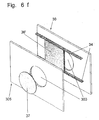
- FIG FIG. 6f shows in the form of a horizontal closure.
- two horizontal rails 34 are shown, in which the segment 36 'is linearly openable and closable movable.
- an insulating glass 37 ensures a certain degree of thermal insulation when the viewing opening 303 is completely open.
- the insulation bodies 35 and For example, the segments 36 may be coupled for movement by cables or chain devices, so that a collective movement of the insulation bodies 35 or of the segments 36 can be achieved.
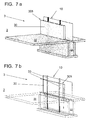
- Another way to arrange the insulation elements 30, is in the FIGS. 7a and 7b shown, wherein the insulation elements 30 are mounted lowered in a bottom shaft 22, below the bottom 20 at least approximately parallel to the facade opening 10.
- the at least one vertical rail 33 is correspondingly arranged projecting into the bottom shaft 22, so that the
- Insulation element 30 is connected at all times with the vertical rail 33 and the thermal insulation linear at least approximately perpendicular to the bottom 20 of the building interior 2 is movable When sinking the insulation element 30 in the bottom shaft 22, the facade opening 10 is exposed and no thermal insulation available. By a linear movement of the insulation element 30 vertically upward in the direction of the ceiling 21, a heat-insulating effect can be achieved.
- the interior insulation system 3 presented here can already be planned in the planning of new buildings and can be provided in the building by integration of the necessary bearings and installation of the at least one insulation element 30 in the building interior 2. It is also possible to subsequently integrate the insulation elements 30 and the necessary bearings in an old building for thermal insulation. After installation of the bearings in which the insulation elements 30 are movable, the insulation elements, for example, a glass facade 10 can be mounted completely or partially covering.
- the insulation elements 30, 30 ', 30 ", 30'” are designed in one or more layers, wherein different materials can be used.
- the goal is to produce insulation elements 30 with a low heat transfer coefficient and thus with a high heat transfer resistance. Therefore, materials with poor thermal conductivity, for example, wood, rock wool or plastics such as polystyrene or polyurethane in single-layer embodiments of the insulation elements 30 are preferred. If the insulation elements 30 are configured in multiple layers, individual layers can also be produced from good heat conductors, such as metals or a mortar layer.
- the insulation elements 30 may, for example, vacuum insulation panels, multilayer Lightweight panels, comprising a hard foam layer (polystyrene foam) and a reinforcing layer or mortar layer exist, which are easily rotatable by hand, hinged, swivel or linearly displaceable storable.
- a hard foam layer polystyrene foam
- a reinforcing layer or mortar layer which are easily rotatable by hand, hinged, swivel or linearly displaceable storable.
- electromechanical movement device is to be executed.
- a simultaneous collective actuation of a plurality of isolation elements 30 by means of a mechanical device, such as a chain link, or an electromechanical device may be performed.
- the presented here interior insulation system 3 allows in the closed position of the insulation elements 30 a thermal insulation, which prevents heat loss, especially at night or in winter.
- partial open position of the insulation elements 30 is an air conditioning of the building interior reachable, with a certain darkening is adjustable.
- a complete open position of the insulation elements 30 allows a nearly undisturbed light incidence in the building interior.
- FIGS. 8a to 8c each show a perspective view of an embodiment of an insulation system 1 with lens shutter with an open, half-open or closed viewing port 303.
- the construction of the lens shutter corresponds to that of FIGS. 6a to 6d .
- an insulation system which can be used as a component, in particular as the outer skin of a building.
- the insulation system 1 of the present embodiment includes the cladding, windows and insulation and can be delivered as a finished module to the site. Of course, the insulation system can also be sold in semi-finished condition, without facade cladding.
- FIG. 8d shows an exploded view of the insulation system 1 with lens closure, substantially according to the interior insulation system 3 according to the FIGS. 6a to 6e ,
- the main difference is as mentioned the formation of the insulation system 1 as a component, which the window, the cladding and includes the insulation.
- the insulation system 1 is designed as a sandwich element. It comprises an outer insulating glass 37, a surface insulation 305 with a viewing port 303, in which either an insulating glass 37 is inserted, movable insulation segments 36, another surface insulation 305 with a viewing port 303, in which either an insulating glass 37 is inserted and finally an insulating glass 37th (from outside to inside in this order).
- the surface insulation 305 is provided here fixed, but can also be movably mounted, in particular as a whole, together with the movable insulation segments 36th Die
- FIG. 8d 1 shows only a typical example of an embodiment of an insulation system 1. It is clear to those skilled in the art that additional layers may be added or that, for example, the insulating glass 37 can also be dispensed with, in particular if the surface insulation 305 inside the building space is in the viewing opening 303 already comprises an insulating glass 37.
- FIGS. 9a to 9c each show a perspective view of an insulation system 1 with vertically displaceably mounted insulation elements, designed as movable insulation body 35, with open, half-open, or closed viewing port 303.
- This embodiment corresponds essentially to the interior insulation system according to the FIGS. 5a to 5c .
- the insulation system 1 according to this embodiment is again designed as a sandwich element and modular, wherein it also includes the window, the cladding and the insulation.
- the insulation system 1 comprises an insulating glass 37, surface insulation 305 fixedly provided, movable insulation bodies 35, surface insulation 305 and another insulating glass 37 (in this order).
- FIGS. 10a to 10c each show a perspective view of an insulation system with two mutually horizontally displaceably mounted isolation elements with closed viewing port. This embodiment substantially corresponds to that in the FIGS. 9a to 9c about an axis oriented perpendicular to the viewing aperture axis rotated by 90 ° embodiment.
- Insulating glass can be used both inside and outside any component which is not necessarily completely translucent and transparent, but for example only limited (eg, frosted glass) or only in places (eg wooden facade with glass inserts) translucent or transparent is.
- the term insulating glass in the following also glass, especially simple glass, plastic, partially translucent substances and the like meant.
- an isolation system is provided by the invention, which is used as a particularly energy-efficient outer skin, interior insulation, respectively modular wall for a building.
Landscapes
- Engineering & Computer Science (AREA)
- Structural Engineering (AREA)
- Architecture (AREA)
- Civil Engineering (AREA)
- Building Environments (AREA)
- Specific Sealing Or Ventilating Devices For Doors And Windows (AREA)
Applications Claiming Priority (1)
| Application Number | Priority Date | Filing Date | Title |
|---|---|---|---|
| CH6502009A CH700882A2 (de) | 2009-04-24 | 2009-04-24 | Innenraumisolationssystem. |
Publications (2)
| Publication Number | Publication Date |
|---|---|
| EP2243917A2 true EP2243917A2 (fr) | 2010-10-27 |
| EP2243917A3 EP2243917A3 (fr) | 2012-08-01 |
Family
ID=40923179
Family Applications (2)
| Application Number | Title | Priority Date | Filing Date |
|---|---|---|---|
| EP20090162159 Withdrawn EP2243918A2 (fr) | 2009-04-24 | 2009-06-08 | Système d'isolation d'intérieur |
| EP10405084A Withdrawn EP2243917A3 (fr) | 2009-04-24 | 2010-04-21 | Système et module d'isolation |
Family Applications Before (1)
| Application Number | Title | Priority Date | Filing Date |
|---|---|---|---|
| EP20090162159 Withdrawn EP2243918A2 (fr) | 2009-04-24 | 2009-06-08 | Système d'isolation d'intérieur |
Country Status (2)
| Country | Link |
|---|---|
| EP (2) | EP2243918A2 (fr) |
| CH (1) | CH700882A2 (fr) |
Cited By (2)
| Publication number | Priority date | Publication date | Assignee | Title |
|---|---|---|---|---|
| DE202010003879U1 (de) * | 2010-03-19 | 2011-07-29 | Alexander Ernst Rüggeberg | Irisblendenartige Verschlussvorrichtung bzw. Mobiliar mit einer darin eingesetzten Verschlussvorrichtung |
| DE102011117033A1 (de) * | 2011-10-27 | 2013-05-02 | Troodon Torsysteme Gmbh | Hubtor für eine Toröffnung in einer Wand |
Citations (3)
| Publication number | Priority date | Publication date | Assignee | Title |
|---|---|---|---|---|
| DE2735654A1 (de) | 1977-07-19 | 1979-02-01 | Insulating Shade Co | Vorrichtung zur waermedaemmung |
| EP0500120A2 (fr) | 1991-02-21 | 1992-08-26 | Thomas Prof. Dr. Herzog | Elément de construction pour murs de bâtiment, en particulier pour murs extérieurs de bâtiment |
| DE29913386U1 (de) | 1999-07-31 | 1999-09-23 | Schneider, Frank, 75173 Pforzheim | Vorrichtung zur Abdeckung von Fenstern, Türen u.dgl. |
Family Cites Families (7)
| Publication number | Priority date | Publication date | Assignee | Title |
|---|---|---|---|---|
| FR13516E (fr) * | 1911-04-29 | Joseph Louis Finot | Volets de fermeture pour fenetres et portes-fenetres se manoeuvrant de l'intérieur des locaux | |
| DE19826420A1 (de) * | 1998-06-16 | 1999-12-23 | Dieter Knauer | Verschlußeinrichtung für Fenster, Türen o. dgl. Öffnungen |
| US5934020A (en) * | 1998-07-29 | 1999-08-10 | Mccracken; Robert | Window lock and guard |
| CA2291921C (fr) * | 1999-12-31 | 2002-03-19 | Michelle C. Van Hee | Volets decoratifs pour fenetres |
| US20040140062A1 (en) * | 2003-01-17 | 2004-07-22 | Han-Sen Lee | Quantitative shutter construction system and installation method |
| DE102004052091B4 (de) * | 2004-10-26 | 2007-02-22 | Maier, Simon | Schiebeladen |
| FR2907714B1 (fr) * | 2006-10-27 | 2008-12-19 | Peugeot Citroen Automobiles Sa | Pavillon de vehicule automobile comprenant un toit transparent |
-
2009
- 2009-04-24 CH CH6502009A patent/CH700882A2/de not_active Application Discontinuation
- 2009-06-08 EP EP20090162159 patent/EP2243918A2/fr not_active Withdrawn
-
2010
- 2010-04-21 EP EP10405084A patent/EP2243917A3/fr not_active Withdrawn
Patent Citations (3)
| Publication number | Priority date | Publication date | Assignee | Title |
|---|---|---|---|---|
| DE2735654A1 (de) | 1977-07-19 | 1979-02-01 | Insulating Shade Co | Vorrichtung zur waermedaemmung |
| EP0500120A2 (fr) | 1991-02-21 | 1992-08-26 | Thomas Prof. Dr. Herzog | Elément de construction pour murs de bâtiment, en particulier pour murs extérieurs de bâtiment |
| DE29913386U1 (de) | 1999-07-31 | 1999-09-23 | Schneider, Frank, 75173 Pforzheim | Vorrichtung zur Abdeckung von Fenstern, Türen u.dgl. |
Cited By (3)
| Publication number | Priority date | Publication date | Assignee | Title |
|---|---|---|---|---|
| DE202010003879U1 (de) * | 2010-03-19 | 2011-07-29 | Alexander Ernst Rüggeberg | Irisblendenartige Verschlussvorrichtung bzw. Mobiliar mit einer darin eingesetzten Verschlussvorrichtung |
| DE102011117033A1 (de) * | 2011-10-27 | 2013-05-02 | Troodon Torsysteme Gmbh | Hubtor für eine Toröffnung in einer Wand |
| DE102011117033B4 (de) * | 2011-10-27 | 2021-07-08 | Troodon Torsysteme Gmbh | Hubtor für eine Toröffnung in einer Wand |
Also Published As
| Publication number | Publication date |
|---|---|
| CH700882A2 (de) | 2010-10-29 |
| EP2243918A2 (fr) | 2010-10-27 |
| EP2243917A3 (fr) | 2012-08-01 |
Similar Documents
| Publication | Publication Date | Title |
|---|---|---|
| EP3589812B1 (fr) | Fenêtre coulissante verticale pour un bâtiment | |
| DE4302883A1 (de) | Beschattungsvorrichtung für mit einer Verglasung versehene Fassaden- oder Dachelemente | |
| DE4125834A1 (de) | Fenster mit aufklappbarem fensterfluegel | |
| DE102009009504B3 (de) | Mehrscheiben-Isolierglas | |
| EP2780640B1 (fr) | Clapet d'aération | |
| EP3214250B1 (fr) | Fenêtre coulissante verticale pour un bâtiment | |
| EP2435639B1 (fr) | Système de paroi extérieure coulissante et son procédé de montage dans un bâtiment existant | |
| EP3821099A1 (fr) | Couverture de bâtiment comportant un élément en verre multifonctionnel | |
| EP0500120B1 (fr) | Elément de construction pour murs de bâtiment, en particulier pour murs extérieurs de bâtiment | |
| EP0943071B1 (fr) | Fa ade de batiment | |
| WO1988001004A1 (fr) | Element de construction en verre | |
| EP2243918A2 (fr) | Système d'isolation d'intérieur | |
| DE69004825T2 (de) | Mobiles Verschlussmittel für Wandöffnung. | |
| DE102012221860B4 (de) | Markise | |
| DE202015106143U1 (de) | Rolladenelement für die Abdeckung einer Gebäudeöffnung | |
| DE102016008467A1 (de) | Schiebe-Dachfenster | |
| EP0132779A2 (fr) | Dormant de fenêtre | |
| DE102007033962A1 (de) | Solaranlage und Verfahren zum Betreiben einer Solaranlage | |
| US2923037A (en) | Rotatable louvered window wall | |
| EP1172514A2 (fr) | Protection solaire située à l'extérieur | |
| DE19709938A1 (de) | Fensteranordnung | |
| DE2924362A1 (de) | Vorrichtung zur steuerung der energiezufuhr und energieabgabe ueber gebaeudewandoeffnungen | |
| EP0231423B1 (fr) | Elément de construction ou de paroi transparente, en particulier fenêtre | |
| AT513293B1 (de) | Tür oder Fenster, insbesondere Schiebetür oder Schiebefenster | |
| DE102009004352A1 (de) | Wärmegedämmte Wandelementeinheit für Gebäudefassaden |
Legal Events
| Date | Code | Title | Description |
|---|---|---|---|
| PUAI | Public reference made under article 153(3) epc to a published international application that has entered the european phase |
Free format text: ORIGINAL CODE: 0009012 |
|
| AK | Designated contracting states |
Kind code of ref document: A2 Designated state(s): AT BE BG CH CY CZ DE DK EE ES FI FR GB GR HR HU IE IS IT LI LT LU LV MC MK MT NL NO PL PT RO SE SI SK SM TR |
|
| AX | Request for extension of the european patent |
Extension state: AL BA ME RS |
|
| PUAL | Search report despatched |
Free format text: ORIGINAL CODE: 0009013 |
|
| AK | Designated contracting states |
Kind code of ref document: A3 Designated state(s): AT BE BG CH CY CZ DE DK EE ES FI FR GB GR HR HU IE IS IT LI LT LU LV MC MK MT NL NO PL PT RO SE SI SK SM TR |
|
| AX | Request for extension of the european patent |
Extension state: AL BA ME RS |
|
| RIC1 | Information provided on ipc code assigned before grant |
Ipc: E06B 9/36 20060101ALI20120628BHEP Ipc: E06B 9/04 20060101AFI20120628BHEP |
|
| 17P | Request for examination filed |
Effective date: 20130122 |
|
| GRAP | Despatch of communication of intention to grant a patent |
Free format text: ORIGINAL CODE: EPIDOSNIGR1 |
|
| STAA | Information on the status of an ep patent application or granted ep patent |
Free format text: STATUS: THE APPLICATION HAS BEEN WITHDRAWN |
|
| INTG | Intention to grant announced |
Effective date: 20140310 |
|
| 18W | Application withdrawn |
Effective date: 20140402 |