EP2244077A1 - Ensemble source d'étalonnage pour détecteur infrarouge - Google Patents
Ensemble source d'étalonnage pour détecteur infrarouge Download PDFInfo
- Publication number
- EP2244077A1 EP2244077A1 EP10169746A EP10169746A EP2244077A1 EP 2244077 A1 EP2244077 A1 EP 2244077A1 EP 10169746 A EP10169746 A EP 10169746A EP 10169746 A EP10169746 A EP 10169746A EP 2244077 A1 EP2244077 A1 EP 2244077A1
- Authority
- EP
- European Patent Office
- Prior art keywords
- light
- calibration
- detector
- source
- focal plane
- Prior art date
- Legal status (The legal status is an assumption and is not a legal conclusion. Google has not performed a legal analysis and makes no representation as to the accuracy of the status listed.)
- Granted
Links
Images



Classifications
-
- G—PHYSICS
- G02—OPTICS
- G02B—OPTICAL ELEMENTS, SYSTEMS OR APPARATUS
- G02B26/00—Optical devices or arrangements for the control of light using movable or deformable optical elements
- G02B26/007—Optical devices or arrangements for the control of light using movable or deformable optical elements the movable or deformable optical element controlling the colour, i.e. a spectral characteristic, of the light
-
- G—PHYSICS
- G01—MEASURING; TESTING
- G01J—MEASUREMENT OF INTENSITY, VELOCITY, SPECTRAL CONTENT, POLARISATION, PHASE OR PULSE CHARACTERISTICS OF INFRARED, VISIBLE OR ULTRAVIOLET LIGHT; COLORIMETRY; RADIATION PYROMETRY
- G01J5/00—Radiation pyrometry, e.g. infrared or optical thermometry
- G01J5/52—Radiation pyrometry, e.g. infrared or optical thermometry using comparison with reference sources, e.g. disappearing-filament pyrometer
- G01J5/53—Reference sources, e.g. standard lamps; Black bodies
-
- G—PHYSICS
- G02—OPTICS
- G02B—OPTICAL ELEMENTS, SYSTEMS OR APPARATUS
- G02B19/00—Condensers, e.g. light collectors or similar non-imaging optics
- G02B19/0004—Condensers, e.g. light collectors or similar non-imaging optics characterised by the optical means employed
- G02B19/0028—Condensers, e.g. light collectors or similar non-imaging optics characterised by the optical means employed refractive and reflective surfaces, e.g. non-imaging catadioptric systems
-
- G—PHYSICS
- G02—OPTICS
- G02B—OPTICAL ELEMENTS, SYSTEMS OR APPARATUS
- G02B19/00—Condensers, e.g. light collectors or similar non-imaging optics
- G02B19/0033—Condensers, e.g. light collectors or similar non-imaging optics characterised by the use
- G02B19/0047—Condensers, e.g. light collectors or similar non-imaging optics characterised by the use for use with a light source
- G02B19/0061—Condensers, e.g. light collectors or similar non-imaging optics characterised by the use for use with a light source the light source comprising a LED
-
- G—PHYSICS
- G02—OPTICS
- G02B—OPTICAL ELEMENTS, SYSTEMS OR APPARATUS
- G02B19/00—Condensers, e.g. light collectors or similar non-imaging optics
- G02B19/0033—Condensers, e.g. light collectors or similar non-imaging optics characterised by the use
- G02B19/0085—Condensers, e.g. light collectors or similar non-imaging optics characterised by the use for use with both a detector and a source
-
- G—PHYSICS
- G02—OPTICS
- G02B—OPTICAL ELEMENTS, SYSTEMS OR APPARATUS
- G02B19/00—Condensers, e.g. light collectors or similar non-imaging optics
- G02B19/0033—Condensers, e.g. light collectors or similar non-imaging optics characterised by the use
- G02B19/009—Condensers, e.g. light collectors or similar non-imaging optics characterised by the use for use with infrared radiation
-
- G—PHYSICS
- G02—OPTICS
- G02B—OPTICAL ELEMENTS, SYSTEMS OR APPARATUS
- G02B27/00—Optical systems or apparatus not provided for by any of the groups G02B1/00 - G02B26/00, G02B30/00
- G02B27/09—Beam shaping, e.g. changing the cross-sectional area, not otherwise provided for
- G02B27/0927—Systems for changing the beam intensity distribution, e.g. Gaussian to top-hat
-
- G—PHYSICS
- G02—OPTICS
- G02B—OPTICAL ELEMENTS, SYSTEMS OR APPARATUS
- G02B27/00—Optical systems or apparatus not provided for by any of the groups G02B1/00 - G02B26/00, G02B30/00
- G02B27/09—Beam shaping, e.g. changing the cross-sectional area, not otherwise provided for
- G02B27/0933—Systems for active beam shaping by rapid movement of an element
-
- G—PHYSICS
- G02—OPTICS
- G02B—OPTICAL ELEMENTS, SYSTEMS OR APPARATUS
- G02B27/00—Optical systems or apparatus not provided for by any of the groups G02B1/00 - G02B26/00, G02B30/00
- G02B27/09—Beam shaping, e.g. changing the cross-sectional area, not otherwise provided for
- G02B27/0938—Using specific optical elements
-
- G—PHYSICS
- G02—OPTICS
- G02B—OPTICAL ELEMENTS, SYSTEMS OR APPARATUS
- G02B27/00—Optical systems or apparatus not provided for by any of the groups G02B1/00 - G02B26/00, G02B30/00
- G02B27/09—Beam shaping, e.g. changing the cross-sectional area, not otherwise provided for
- G02B27/0938—Using specific optical elements
- G02B27/0977—Reflective elements
-
- G—PHYSICS
- G02—OPTICS
- G02B—OPTICAL ELEMENTS, SYSTEMS OR APPARATUS
- G02B23/00—Telescopes, e.g. binoculars; Periscopes; Instruments for viewing the inside of hollow bodies; Viewfinders; Optical aiming or sighting devices
- G02B23/12—Telescopes, e.g. binoculars; Periscopes; Instruments for viewing the inside of hollow bodies; Viewfinders; Optical aiming or sighting devices with means for image conversion or intensification
Definitions
- Infrared detectors (such as Dewar detector assemblies) contained within a sealed cryo-vacuum assembly have been known for a number of years. In general, these types of infrared detector assemblies have a modular metal and glass construction and are vacuum sealed. A cold cavity assembly penetrates the vacuum housing in order to extract heat generated from the FPA to maintain a specific temperature. The cold cavity assembly typically provides a transparent glass window at one end and, opposite from the window and exposed to the internal vacuum, an infrared focal plane.
- the focal plane is typically an array of tiny pixels, each pixel being operable to generate or pass a current in response to infrared radiation being incident upon the pixel. In most cases the generated or passed current is proportional to the incident infrared energy.
- the calibration is accomplished by placing a large source at or near the infrared detector aperture.
- the source injects illumination into the assembly and ideally illuminates the entire focal plane at the same time.
- the calibration flood source is therefore typically provided by a mechanical method of switching between looking at the calibration source or the outside world. Frequently this is accomplished by moving a flood source over the entire aperture, which being a large aperture in some detectors requires a large mechanical system and a large illumination source.
- At least two issues quickly arise when the illumination source is placed within the cold cavity assembly.
- the system must also be designed to withstand the forces incurred during launch and deployment and then repeated operation requests without being easily serviceable.
- detector functionality such as spectral filter wheels and guidance systems.
- Options to provide calibration without compromising existing systems has proven challenging as well.
- This disclosure provides a filter injected calibration flood source for an infrared detector.
- a calibration source IR assembly for an IR detector including an IR focal plane, comprising: a rotatable spectral filter wheel optically coupled to an IR focal plane of the detector, the filter wheel having a plurality of areas each of at least a minimum size; at least one area being a calibration area, the calibration area including: a substrate having a first side facing the IR focal plane and a second side opposite from the first side; a light transmitting edge section disposed between the first side and the second side; and at least one light redirector disposed at least partially within the substrate and adjacent to the first side, the light redirector structured and arranged to receive light from the edge and to redirect the light out the first side; and a light source optically coupled to the edge section.
- an IR detector with a calibration source assembly comprising: a cold cavity assembly tube providing an internal vacuum, the tube having a first end providing a cold stop and a second end providing an IR focal plane oriented towards the first end; a rotatable spectral filter wheel optically coupled to an IR focal plane of the detector but located outside the cryo-vacuum Dewar or cold cavity assembly, the spectral filter wheel having a plurality of areas each of at least a minimum size; at least one such area being a calibration area, the calibration area including: a substrate having a first side facing the IR focal plane and a second side opposite the first side; a light transmitting edge section disposed between the first side and the second side; at least one light redirector disposed at least partially within the substrate, the light redirector structured and arranged to receive light from the edge and to redirect the light out the first side; and a light source optically coupled to the edge section.
- a cryo-vacuum Dewar IR detector assembly providing a focal plane optically coupled to a spectral filter wheel including a plurality of areas each of at least a minimum size
- the improvement comprising: at least one area being a calibration area, the calibration area including: a substrate having a first side facing the IR focal plane and a second side opposite from the first side; a light transmitting edge section disposed between the first side and the second side; at least one light redirector disposed at least partially within the substrate and adjacent to the first side, the light redirector structured and arranged to receive light from the edge and to redirect the light out the first side; and a light source optically coupled to the edge section.
- FIG. 1 illustrates an infrared calibration source assembly in connection with an infrared detector, which in accordance with at least one embodiment, provide an infrared detector with calibration source assembly;
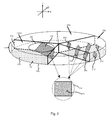
- FIG. 2 is a perspective view of the filter wheel shown in FIG. 1 in accordance with at least one embodiment
- FIG. 3 is a top view of the filter wheel shown in FIG. 2 in accordance with at least one embodiment
- FIG. 4 is an enlarged cross section view portion of FIG. 1 in accordance with at least one embodiment.
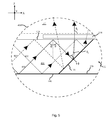
- FIG. 5 is an enlarged section of FIG. 4 further illustrating the total internal reflection properties of the infrared calibration source assembly in accordance with at least one embodiment.
- FIG. 1 there is shown an infrared calibration source assembly 100 in connection with an infrared detector 102, in accordance with at least one embodiment.
- the assembly is an infrared detector with calibration source assembly or "IRDCSA" 104.
- IRDCSA infrared detector with calibration source assembly
- the orientations are referenced to the coordinate system with three axes orthogonal to one another, as shown in FIG. 1 .
- the axes intersect mutually at the origin of the coordinate system which is intended to be the center of the IRDCSA 104.
- the axes shown in all figures are offset from their actual locations for clarity of illustration.
- FIG. 1 is an IRDCSA 104 as against the XZ-plane.
- the IR detector 102 in at least one embodiment consists generally of a cold cavity assembly tube 106 providing an internal vacuum environment 108.
- the cold cavity assembly tube 106 has a first end 110 providing a cold stop 112 and a second end 114 providing an IR focal plane 116 oriented towards the first end 110.
- the cold stop to include, in general, a transparent glass sealed aperture that serves to seal the assembly tube 106 while providing for the passage of light energy for incidence upon the IR focal plane 116. It is also appreciated that the cold stop and the glass seal aperture are not in direct physical contact, as the cold stop serves as a thermal barrier to isolate the internal vacuum environment 108 whereas the glass window is ambient and part of the external vacuum housing.
- the infrared calibration source assembly 100 includes a rotatable spectral filter wheel 118, optically coupled to an IR focal plane 116 of the detector 102.
- the filter wheel 118 has a plurality of areas 120 each of at least a minimum size. In a typical spectral filter wheel, the areas are light transmitting, though in some configurations not all possible areas are used and/or an area may be larger than actually necessary given a limited number of filter areas desired.
- area 120A is a calibration area and area 120B is a spectral band pass filter area.
- the calibration area 120A includes a substrate 122 having a first side 124 facing the IR focal plane 116 and a second side 126 opposite from the first side 124. A light transmitting edge 128 is disposed between the first side 124 and the second side 126.
- At least one light redirector 130 is disposed at least partially within the substrate 122 of calibration area 120A.
- the light redirector 130 is structured and arranged to receive light from the edge 128 and to redirect the light out the first side 124.
- a light source 132 is optically coupled to the edge section 128.
- calibration light rays 134 enter the substrate 122 through edge 128 and are redirected by light redirector 130 towards the focal plane 116.
- a diffuser is disposed between the light source 132 and the focal plane 116.
- a diffuser 136 is disposed between the light source 132 and the edge section 128. Moreover, in at least one embodiment the diffuser is coupled upon the edge section 128. In at least one alternative embodiment, the edge section 128 is buffed or otherwise treated so as to impart a diffusing quality as an integral part of the edge section 128.
- a diffuser 138 is disposed between the first side 124 and the cold stop 112, and specifically adjacent to the first side 124. Moreover, in at least one embodiment the diffuser is disposed upon the first side 124. In at least one alternative embodiment, the first side 124 is buffed or otherwise treated so as to impart a diffusing quality as an integral part of the first side 124. Further still, in at least one embodiment, regardless of the presence of diffuser 136 or diffuser 138, the light source 132 is an LED light source.
- the second side 126 of the substrate 122 is coated with material 140 so as to be non-light tranmissive.
- Motor 142 is operational under the direction of a control system (not shown) to rotate the spectral filter wheel 118 so as to move the calibration area 120 into alignment for calibration purposes or provide another area of the filter wheel for spectral band pass filtering or no filtering if desired.
- IRDCSA 104 includes a cold cavity assembly tube with an internal vacuum environment 108, a focal plane 116 at a first end 110 oriented towards a cold stop 112 providing a light transmissive aperture into the vacuum environment 108 and optically coupled to the focal plane 116.
- a rotatable spectral filter wheel 118 is disposed adjacent but external to the cold stop 112 and can be rotated to align areas to the cold stop 112.
- At least one area of the filter wheel is a calibration area 120A.
- the calibration area includes a substrate 122 having a first side 124 and opposite thereto a second side 126 and an edge section 128 there between.
- the second side is treated with a material 140, which in at least one embodiment is black material.
- At least one light redirector is disposed at least partially within the substrate.
- the light redirector 130 is oriented so as to receive calibration light rays 134 provided from a light source 132 optically coupled to the edge section 128 and redirect the calibration light through the first side 124 so as to be incident upon the focal plane 116.
- FIG. 2 provides a perspective view of the rotatable filter wheel 118 further illustrating calibration area 120A, and alternative calibration area 200. It is understood and appreciated that most configurations of IRDCSA 104 will provide only one calibration area, however two alternative versions are provided in FIG. 2 for the sake of comparison and discussion.
- calibration area 120A or calibration area 200 advantageously provides reliable calibration while capitalizing on existing, known and proven mechanical systems.
- a spectral filter wheel 118 has multiple positions, each with a band pass filter or no filter. As is shown in FIG. 2 , in general each area of the filter wheel has at least a minimum size so that it covers the entire aperture of the cold stop, represented by dotted line 202. With the present disclosure, a band pass filter area or unused area is replaced with the calibration area, e.g., calibration area 120A.
- the second side 126 is coated with a material 140 such that second side 126 is non-light transmissive, and specifically not transmissive to IR light. In at least one embodiment this is accomplished by coating second side 126 with a black material 140.
- a black material 140 By rendering second side 126 non-light transmissive, stray IR light which might otherwise be incident upon second side 126 from opposite the cold stop 112 is eliminated. As such, IR light provided for calibration purposes is advantageously limited to the light source 132 (see FIGs. 1 and 4 ).
- IRDCSA 104 permits calibration to be performed at any time and when the detector is in any orientation.
- the IR detector can be oriented towards an IR source from which a measurement is desired. Whether actually oriented at that source, while in motion towards those coordinates, or oriented towards any other IR source, any and all incident IR light is blocked and therefore will not interfere with the calibration operation.
- the blocking for calibration can indeed be performed when actually oriented towards the desired source, the time delay between calibration and actual measurement is minimal, therefore permitting greater confidence in the desired source IR measurement.
- At least one light redirector 130 Disposed within substrate 122 of calibration area 120A is at least one light redirector 130. As illustrated, light redirector 130 extends from the first side 124 to the second side 126, and appears generally flat. Light redirector is sized and appropriately positioned to receive calibration light provided through the edge 128 and redirect the calibration light through the first side 124 such that it is incident upon the focal plane 116.
- a plurality of light redirectors of which light redirectors 204, 206, 208, 210 and 212 are exemplary.
- the use of a plurality of light redirectors may be desired in some embodiments, such as for example where the diffuser 138 proximate to the first side 124 is not provided, so as to provide a uniform scattering of the calibration light rays 134 across the focal plane 116.
- Light redirectors 204 and 206 are both generally flat, whereas light redirectors 208, 210 and 212 are shaped, as in curved.
- each light redirector is light reflective in that each is either coated with a light-reflective material or established from a light-reflective material, such as, but not limited to, gold, silver or aluminum.
- the light-reflective material is sufficiently thick so as to not be light transmissive.
- the thickness of the silver material may be about one-thousand angstroms thick.
- each light redirector e.g., light redirector 130 has a textured surface 216.
- Such texturing may be achieved by scuffing, sanding, buffing, machining or such other process as may be employed to impart a texture upon the surface of the light redirector.
- Such texturing may be described as fine, in that the surface appears generally flat to the eye, or rough in that the surface is visually perceived to be uneven, consisting of, for example, bumps and dimples.
- bumps, dimples or other surface features may be considered part of a textured surface as well, it is to be appreciated that there are differences in scale such that the features of the texture surface 216 clearly define the overall shape of the light redirector on a larger scale.
- bumps, dimples or other surface features whether of a fine scale or rough scale may be randomly distributed across the light redirector, or specifically patterned.
- the features of the textured surface may be of varying size and orientation, and may in certain embodiments overlap.
- the size of the bumps, dimples and or other surface features is generally between about one and one hundred microns.
- the intention of the texture of the surface of the light redirector is to further scatter, and therefore diffuse the calibration light so as to further insure uniform and consistent calibration of the focal plane 116.
- the light redirector(s), such as 208, 210 and 212 are elliptical mirror segments having curved cross sections with respect to both Z and Y axis. In at least one alternative embodiment, the light redirectors(s) are cylindrical mirror segments, having curved cross sections with respect to the Y axis, and straight sides.
- the light redirectors within the calibration area 200 are substantially identical.
- the light redirectors within the calibration area 200 are different from one to another, such as for example a mixture of elliptical and cylindrical mirror segments, and or even a mixture of different sized elliptical and/or cylindrical mirror segments.
- FIG. 3 is a plane view of the example spectral filter wheel 118 shown in FIG. 2 , now against the YX plane.
- superimposed on calibration area 120A is the outline of the cold stop 112 aperture 202. As illustrated, when the calibration area 120A is positioned for a calibration operation, the calibration section 120 occupies all of the field of view provided by cold stop 112 aperture 202.
- the calibration light source 132 is disposed proximate to the edge of the spectral filter wheel 118, such that when the wheel is rotated to align the calibration area 120A to the cold stop, the calibration light source 132 is optically coupled to the edge section.
- the calibration light source is fitted with a light shield 300 that insures that only light provided from the calibration source is provided to the edge section 128. Shield 300 is omitted in FIG. 1 and FIG. 4 as the side view orientation would obscure the calibration light source 132, calibration light 134 and optional diffuser 136 if shown.
- calibration area 120A provides both a "hot” calibration - when the calibration light source is activated, and a reference “cold” calibration - when the calibration light source is not activated.
- the calibration source is not located within the cold cavity, there is no heat contamination which must otherwise dissipate between hot and cold states. Further, as there is no active movement required to switch between the hot and cold states, the calibration process may flip rapidly from hot to cold and vis-a-versa so as to also test and calibrate the response time of the pixels comprising the focal plane.
- FIG. 4 is an enlarged partial cross section of the IRDCSA 104 as shown in FIG. 1 .
- the substrate 122 is formed of a material so as to provide total internal reflection, or TIR, for light injected through edge section 128. More specifically, light illustrated as light rays 400, 402 and 404 received at the edge section 128 is propagated through the core 406 of the substantially and delivered to the light redirector 130 with minimal loss.
- Total internal reflection is the reflection of all incident light off a boundary between the core 406 and the first side 124 and the second side 126.
- the first and second sides 124, 126 may be treated with a cladding material (such as black material 140 as applied to the second side 126) so as to have an index of refraction lower then that of the core 406.
- TIR occurs when a light ray is both in a medium of higher index of refraction and approaches a medium of lower index of refraction, and the angle of incidence for the light ray is greater than the "critical angle.”
- the critical angle is defined as a the angle of incidence measured with respect to a line normal to the boundary between the two optical media for which light is refracted at an exit angle of 90 degrees - that is, the light propagates along the boundary - when the light impinges on the boundary from the side of the medium of higher index of refraction. For any angle of incidence greater than the critical angle, the light traveling through the medium with a higher index of refraction) will undergo total internal refraction.
- the value of the critical angle depends upon the combination of materials present on each side of the boundary.
- light ray 400 is traveling through successive TIR bounces.
- the angle of incidence and refraction remains unchanged at angle ⁇ until the light redirector 130 is encountered.
- FIG. 5 is an enlarged portion of calibration area 120A, indicated by dotted line 408, provided to further illustrate the possible propagation of a light rays and specifically light ray 400.
- Light ray 400 travels in core 406 through successive TIR, as shown in FIGs.4 and 5 .
- the angle of incidence and reflection remains unchanged at angle ⁇ .
- the TIR properties of substrate 122 act to diffuse the calibration light rays by intermixing them so as to provide a greater homogeneity to the calibration light rays as a whole.
- the radiant power of the calibration source is not of significance. Rather, it is the uniformity of the calibration IR illumination upon the focal plane and the comparison of a current calibration operation to a past operation that is significant.
- the source is the calibration light source, which is the same source in all tests for the IRDCSA 104, it is the relative change, if any, from one test to the next for each pixel that is of paramount concern.
- the substrate 122 is substantially thin, and serves primarily as a base anchor point for light redirector 130.
- the calibration light rays 134 are provided over the small edge 128 and therefore the majority of calibration light rays 134 reach light redirector 130 without experiencing TIR within the substrate 122.
- Such an alternative embodiment may have the advantage of less weight then the embodiment as illustrated which in certain embodiments may be a desirable tradeoff for the lack of TIR to at least partially homogenize the calibration light rays 134.
- a Dewar IR detector having a focal plane 116 optically coupled to a spectral filter wheel 118 having a plurality of areas 120 each of at least a minimum size.
- the Dewar IR detector further includes the improvement of an infrared calibration source assembly 100 as shown and described above.
Landscapes
- Physics & Mathematics (AREA)
- General Physics & Mathematics (AREA)
- Optics & Photonics (AREA)
- Spectroscopy & Molecular Physics (AREA)
- Astronomy & Astrophysics (AREA)
- Health & Medical Sciences (AREA)
- Toxicology (AREA)
- Photometry And Measurement Of Optical Pulse Characteristics (AREA)
- Investigating Or Analysing Materials By Optical Means (AREA)
Applications Claiming Priority (2)
| Application Number | Priority Date | Filing Date | Title |
|---|---|---|---|
| US11/978,738 US7592588B2 (en) | 2007-10-30 | 2007-10-30 | Calibration source infrared assembly for an infrared detector |
| EP08853931A EP2205951B1 (fr) | 2007-10-30 | 2008-10-29 | Ensemble source d'étalonnage pour détecteur infrarouge |
Related Parent Applications (1)
| Application Number | Title | Priority Date | Filing Date |
|---|---|---|---|
| EP08853931.7 Division | 2008-10-29 |
Publications (2)
| Publication Number | Publication Date |
|---|---|
| EP2244077A1 true EP2244077A1 (fr) | 2010-10-27 |
| EP2244077B1 EP2244077B1 (fr) | 2011-12-07 |
Family
ID=40365363
Family Applications (3)
| Application Number | Title | Priority Date | Filing Date |
|---|---|---|---|
| EP08853931A Active EP2205951B1 (fr) | 2007-10-30 | 2008-10-29 | Ensemble source d'étalonnage pour détecteur infrarouge |
| EP10169745A Active EP2244076B1 (fr) | 2007-10-30 | 2008-10-29 | Détecteur infrarouge avec ensemble source d'étonnage |
| EP10169746A Active EP2244077B1 (fr) | 2007-10-30 | 2008-10-29 | Détecteur infrarouge Dewar |
Family Applications Before (2)
| Application Number | Title | Priority Date | Filing Date |
|---|---|---|---|
| EP08853931A Active EP2205951B1 (fr) | 2007-10-30 | 2008-10-29 | Ensemble source d'étalonnage pour détecteur infrarouge |
| EP10169745A Active EP2244076B1 (fr) | 2007-10-30 | 2008-10-29 | Détecteur infrarouge avec ensemble source d'étonnage |
Country Status (4)
| Country | Link |
|---|---|
| US (1) | US7592588B2 (fr) |
| EP (3) | EP2205951B1 (fr) |
| AT (3) | ATE536536T1 (fr) |
| WO (1) | WO2009070408A1 (fr) |
Families Citing this family (9)
| Publication number | Priority date | Publication date | Assignee | Title |
|---|---|---|---|---|
| US8716651B2 (en) | 2011-08-18 | 2014-05-06 | Raytheon Company | Calibration system for detector |
| US8861106B2 (en) | 2011-12-02 | 2014-10-14 | Raytheon Company | Variable monochromatic uniform calibration source |
| JP2014020817A (ja) * | 2012-07-13 | 2014-02-03 | Nippon Steel & Sumitomo Metal | 放射温度計用校正装置及び放射温度計の校正方法 |
| US9024253B2 (en) | 2012-08-21 | 2015-05-05 | Raytheon Company | Calibration system for detector |
| EP3093637B1 (fr) | 2015-05-01 | 2021-11-10 | ABB Schweiz AG | Systèmes et procédés de source d'étalonnage à infrarouge à haute émissivité de petit volume |
| US11268860B2 (en) | 2020-07-24 | 2022-03-08 | Raytheon Company | Radiometric calibration of detector |
| US11800051B2 (en) * | 2021-12-17 | 2023-10-24 | Raytheon Company | Device and method for optical sensor calibration |
| KR20250011160A (ko) * | 2022-05-13 | 2025-01-21 | 유니버시티 오브 시카고 | 광학 공동 어레이 |
| DE102023002291A1 (de) * | 2023-06-06 | 2024-12-12 | Diehl Defence Gmbh & Co. Kg | Suchkopfmesssystem und Messverfahren zur optischen Vermessung eines Suchkopfs |
Citations (4)
| Publication number | Priority date | Publication date | Assignee | Title |
|---|---|---|---|---|
| US4876453A (en) * | 1986-02-19 | 1989-10-24 | Hughes Aircraft Company | Method and apparatus for calibrating an imaging sensor |
| US20030174315A1 (en) * | 2002-03-14 | 2003-09-18 | Byren Robert W. | Efficient multiple emitter boresight reference source |
| EP1632762A2 (fr) * | 2004-09-07 | 2006-03-08 | Samsung Electronics Co.,Ltd. | Appareil de détection optique pour mesure multi-canaux et multi-couleurs ainsi qu'un analyseur d'échantillons multi-canaux utilisant celui-ci |
| US7119337B1 (en) * | 1997-08-04 | 2006-10-10 | Ion Optics, Inc. | Infrared radiation sources, sensors and source combinations, and methods of manufacture |
Family Cites Families (6)
| Publication number | Priority date | Publication date | Assignee | Title |
|---|---|---|---|---|
| US5404016A (en) * | 1984-08-31 | 1995-04-04 | Santa Barbara Research Center | Dewar detector assembly |
| GB8607356D0 (en) * | 1986-03-25 | 1986-05-21 | Ortec Inc | Modular cryogenic detector head assembly |
| US4727255A (en) * | 1986-06-03 | 1988-02-23 | Hughes Aircraft Company | Silicone dielectric gel cryogenic detector interface |
| US5587784A (en) * | 1995-06-16 | 1996-12-24 | Hughes Electronics | Multispectral-staring sensor |
| US7238942B2 (en) * | 2001-05-02 | 2007-07-03 | Csir | Spectrometric using broadband filters with overlapping spectral ranges |
| SE524086C2 (sv) * | 2001-10-30 | 2004-06-22 | Phase In Ab | Mäthuvud för gasanalysator |
-
2007
- 2007-10-30 US US11/978,738 patent/US7592588B2/en active Active
-
2008
- 2008-10-29 WO PCT/US2008/081589 patent/WO2009070408A1/fr not_active Ceased
- 2008-10-29 AT AT10169745T patent/ATE536536T1/de active
- 2008-10-29 EP EP08853931A patent/EP2205951B1/fr active Active
- 2008-10-29 EP EP10169745A patent/EP2244076B1/fr active Active
- 2008-10-29 AT AT10169746T patent/ATE536537T1/de active
- 2008-10-29 AT AT08853931T patent/ATE534889T1/de active
- 2008-10-29 EP EP10169746A patent/EP2244077B1/fr active Active
Patent Citations (4)
| Publication number | Priority date | Publication date | Assignee | Title |
|---|---|---|---|---|
| US4876453A (en) * | 1986-02-19 | 1989-10-24 | Hughes Aircraft Company | Method and apparatus for calibrating an imaging sensor |
| US7119337B1 (en) * | 1997-08-04 | 2006-10-10 | Ion Optics, Inc. | Infrared radiation sources, sensors and source combinations, and methods of manufacture |
| US20030174315A1 (en) * | 2002-03-14 | 2003-09-18 | Byren Robert W. | Efficient multiple emitter boresight reference source |
| EP1632762A2 (fr) * | 2004-09-07 | 2006-03-08 | Samsung Electronics Co.,Ltd. | Appareil de détection optique pour mesure multi-canaux et multi-couleurs ainsi qu'un analyseur d'échantillons multi-canaux utilisant celui-ci |
Also Published As
| Publication number | Publication date |
|---|---|
| US7592588B2 (en) | 2009-09-22 |
| WO2009070408A1 (fr) | 2009-06-04 |
| EP2244076B1 (fr) | 2011-12-07 |
| EP2205951B1 (fr) | 2011-11-23 |
| US20090108201A1 (en) | 2009-04-30 |
| ATE536537T1 (de) | 2011-12-15 |
| EP2244077B1 (fr) | 2011-12-07 |
| EP2205951A1 (fr) | 2010-07-14 |
| ATE536536T1 (de) | 2011-12-15 |
| EP2244076A1 (fr) | 2010-10-27 |
| ATE534889T1 (de) | 2011-12-15 |
Similar Documents
| Publication | Publication Date | Title |
|---|---|---|
| EP2244076B1 (fr) | Détecteur infrarouge avec ensemble source d'étonnage | |
| CN101876641B (zh) | 用于检测玻璃板中的缺陷的方法和装置 | |
| KR920005443B1 (ko) | 광학센서 | |
| US9996724B2 (en) | Optical fingerprint detection apparatus and display device | |
| US20210255033A1 (en) | Light Detection using an Aperture | |
| US5745234A (en) | Variable angle reflectometer employing an integrating sphere and a light concentrator | |
| US10073029B2 (en) | Sample measurement pool | |
| JPH10185688A (ja) | 空間内で変化する分散光源のスペクトルサインを検出するファブリ−ペロ分光計 | |
| CN101484867A (zh) | 用于非接触型坐标输入系统的导光板、包括该导光板的系统和使用该导光板的非接触型坐标输入方法 | |
| CN103149016A (zh) | 待测光学系统杂散光检测方法及杂散光检测系统 | |
| WO2012036075A1 (fr) | Dispositif de mesure d'indice de réfraction, et procédé de mesure d'indice de réfraction | |
| AU2007216782A1 (en) | Optical elements for waveguide-based optical touch input devices | |
| US20050146719A1 (en) | Method and apparatus for illuminating a substrate during inspection | |
| US20160231439A1 (en) | Device and method for detection of radioactive radiation | |
| US20190186988A1 (en) | Pyranometer and photometric device | |
| JP6635849B2 (ja) | 光学測定装置及び測定方法 | |
| JP2024538738A (ja) | 赤外線画像化デバイス | |
| US20190331526A1 (en) | A Photometric Test System for Light Emitting Devices | |
| KR100727507B1 (ko) | 반사식 표시 장치 | |
| KR100749829B1 (ko) | 3차원 광측정장치 | |
| CN103175608B (zh) | 一种紫外光源均光装置 | |
| CN203083699U (zh) | 一种紫外光源均光装置 | |
| US12590903B2 (en) | Inspection device and inspection method with infrared light for scratch detection on inspection target | |
| Brown | Internal thermal emission analysis of an IR seeker | |
| WO2024041835A1 (fr) | Élément optique pour redistribution d'éclairement énergétique, capteur et appareil d'affichage |
Legal Events
| Date | Code | Title | Description |
|---|---|---|---|
| PUAI | Public reference made under article 153(3) epc to a published international application that has entered the european phase |
Free format text: ORIGINAL CODE: 0009012 |
|
| AC | Divisional application: reference to earlier application |
Ref document number: 2205951 Country of ref document: EP Kind code of ref document: P |
|
| AK | Designated contracting states |
Kind code of ref document: A1 Designated state(s): AT BE BG CH CY CZ DE DK EE ES FI FR GB GR HR HU IE IS IT LI LT LU LV MC MT NL NO PL PT RO SE SI SK TR |
|
| AX | Request for extension of the european patent |
Extension state: AL BA MK RS |
|
| 17P | Request for examination filed |
Effective date: 20110408 |
|
| GRAP | Despatch of communication of intention to grant a patent |
Free format text: ORIGINAL CODE: EPIDOSNIGR1 |
|
| RIC1 | Information provided on ipc code assigned before grant |
Ipc: G02B 13/14 20060101ALI20110506BHEP Ipc: G01J 5/52 20060101AFI20110506BHEP |
|
| GRAS | Grant fee paid |
Free format text: ORIGINAL CODE: EPIDOSNIGR3 |
|
| GRAA | (expected) grant |
Free format text: ORIGINAL CODE: 0009210 |
|
| RTI1 | Title (correction) |
Free format text: DEWAR INFRARED DETECTOR |
|
| AC | Divisional application: reference to earlier application |
Ref document number: 2205951 Country of ref document: EP Kind code of ref document: P |
|
| AK | Designated contracting states |
Kind code of ref document: B1 Designated state(s): AT BE BG CH CY CZ DE DK EE ES FI FR GB GR HR HU IE IS IT LI LT LU LV MC MT NL NO PL PT RO SE SI SK TR |
|
| REG | Reference to a national code |
Ref country code: GB Ref legal event code: FG4D |
|
| REG | Reference to a national code |
Ref country code: CH Ref legal event code: EP |
|
| REG | Reference to a national code |
Ref country code: IE Ref legal event code: FG4D |
|
| REG | Reference to a national code |
Ref country code: DE Ref legal event code: R096 Ref document number: 602008011892 Country of ref document: DE Effective date: 20120209 |
|
| REG | Reference to a national code |
Ref country code: NL Ref legal event code: VDEP Effective date: 20111207 |
|
| PG25 | Lapsed in a contracting state [announced via postgrant information from national office to epo] |
Ref country code: NO Free format text: LAPSE BECAUSE OF FAILURE TO SUBMIT A TRANSLATION OF THE DESCRIPTION OR TO PAY THE FEE WITHIN THE PRESCRIBED TIME-LIMIT Effective date: 20120307 Ref country code: LT Free format text: LAPSE BECAUSE OF FAILURE TO SUBMIT A TRANSLATION OF THE DESCRIPTION OR TO PAY THE FEE WITHIN THE PRESCRIBED TIME-LIMIT Effective date: 20111207 |
|
| LTIE | Lt: invalidation of european patent or patent extension |
Effective date: 20111207 |
|
| PG25 | Lapsed in a contracting state [announced via postgrant information from national office to epo] |
Ref country code: HR Free format text: LAPSE BECAUSE OF FAILURE TO SUBMIT A TRANSLATION OF THE DESCRIPTION OR TO PAY THE FEE WITHIN THE PRESCRIBED TIME-LIMIT Effective date: 20111207 Ref country code: SI Free format text: LAPSE BECAUSE OF FAILURE TO SUBMIT A TRANSLATION OF THE DESCRIPTION OR TO PAY THE FEE WITHIN THE PRESCRIBED TIME-LIMIT Effective date: 20111207 Ref country code: SE Free format text: LAPSE BECAUSE OF FAILURE TO SUBMIT A TRANSLATION OF THE DESCRIPTION OR TO PAY THE FEE WITHIN THE PRESCRIBED TIME-LIMIT Effective date: 20111207 Ref country code: LV Free format text: LAPSE BECAUSE OF FAILURE TO SUBMIT A TRANSLATION OF THE DESCRIPTION OR TO PAY THE FEE WITHIN THE PRESCRIBED TIME-LIMIT Effective date: 20111207 Ref country code: NL Free format text: LAPSE BECAUSE OF FAILURE TO SUBMIT A TRANSLATION OF THE DESCRIPTION OR TO PAY THE FEE WITHIN THE PRESCRIBED TIME-LIMIT Effective date: 20111207 Ref country code: GR Free format text: LAPSE BECAUSE OF FAILURE TO SUBMIT A TRANSLATION OF THE DESCRIPTION OR TO PAY THE FEE WITHIN THE PRESCRIBED TIME-LIMIT Effective date: 20120308 |
|
| PG25 | Lapsed in a contracting state [announced via postgrant information from national office to epo] |
Ref country code: BE Free format text: LAPSE BECAUSE OF FAILURE TO SUBMIT A TRANSLATION OF THE DESCRIPTION OR TO PAY THE FEE WITHIN THE PRESCRIBED TIME-LIMIT Effective date: 20111207 Ref country code: CY Free format text: LAPSE BECAUSE OF FAILURE TO SUBMIT A TRANSLATION OF THE DESCRIPTION OR TO PAY THE FEE WITHIN THE PRESCRIBED TIME-LIMIT Effective date: 20111207 |
|
| PG25 | Lapsed in a contracting state [announced via postgrant information from national office to epo] |
Ref country code: EE Free format text: LAPSE BECAUSE OF FAILURE TO SUBMIT A TRANSLATION OF THE DESCRIPTION OR TO PAY THE FEE WITHIN THE PRESCRIBED TIME-LIMIT Effective date: 20111207 Ref country code: BG Free format text: LAPSE BECAUSE OF FAILURE TO SUBMIT A TRANSLATION OF THE DESCRIPTION OR TO PAY THE FEE WITHIN THE PRESCRIBED TIME-LIMIT Effective date: 20120307 Ref country code: SK Free format text: LAPSE BECAUSE OF FAILURE TO SUBMIT A TRANSLATION OF THE DESCRIPTION OR TO PAY THE FEE WITHIN THE PRESCRIBED TIME-LIMIT Effective date: 20111207 Ref country code: CZ Free format text: LAPSE BECAUSE OF FAILURE TO SUBMIT A TRANSLATION OF THE DESCRIPTION OR TO PAY THE FEE WITHIN THE PRESCRIBED TIME-LIMIT Effective date: 20111207 Ref country code: IS Free format text: LAPSE BECAUSE OF FAILURE TO SUBMIT A TRANSLATION OF THE DESCRIPTION OR TO PAY THE FEE WITHIN THE PRESCRIBED TIME-LIMIT Effective date: 20120407 |
|
| PG25 | Lapsed in a contracting state [announced via postgrant information from national office to epo] |
Ref country code: PT Free format text: LAPSE BECAUSE OF FAILURE TO SUBMIT A TRANSLATION OF THE DESCRIPTION OR TO PAY THE FEE WITHIN THE PRESCRIBED TIME-LIMIT Effective date: 20120409 Ref country code: PL Free format text: LAPSE BECAUSE OF FAILURE TO SUBMIT A TRANSLATION OF THE DESCRIPTION OR TO PAY THE FEE WITHIN THE PRESCRIBED TIME-LIMIT Effective date: 20111207 Ref country code: RO Free format text: LAPSE BECAUSE OF FAILURE TO SUBMIT A TRANSLATION OF THE DESCRIPTION OR TO PAY THE FEE WITHIN THE PRESCRIBED TIME-LIMIT Effective date: 20111207 |
|
| REG | Reference to a national code |
Ref country code: AT Ref legal event code: MK05 Ref document number: 536537 Country of ref document: AT Kind code of ref document: T Effective date: 20111207 |
|
| PLBE | No opposition filed within time limit |
Free format text: ORIGINAL CODE: 0009261 |
|
| STAA | Information on the status of an ep patent application or granted ep patent |
Free format text: STATUS: NO OPPOSITION FILED WITHIN TIME LIMIT |
|
| PG25 | Lapsed in a contracting state [announced via postgrant information from national office to epo] |
Ref country code: DK Free format text: LAPSE BECAUSE OF FAILURE TO SUBMIT A TRANSLATION OF THE DESCRIPTION OR TO PAY THE FEE WITHIN THE PRESCRIBED TIME-LIMIT Effective date: 20111207 |
|
| 26N | No opposition filed |
Effective date: 20120910 |
|
| PG25 | Lapsed in a contracting state [announced via postgrant information from national office to epo] |
Ref country code: IT Free format text: LAPSE BECAUSE OF FAILURE TO SUBMIT A TRANSLATION OF THE DESCRIPTION OR TO PAY THE FEE WITHIN THE PRESCRIBED TIME-LIMIT Effective date: 20111207 |
|
| REG | Reference to a national code |
Ref country code: DE Ref legal event code: R097 Ref document number: 602008011892 Country of ref document: DE Effective date: 20120910 |
|
| PG25 | Lapsed in a contracting state [announced via postgrant information from national office to epo] |
Ref country code: AT Free format text: LAPSE BECAUSE OF FAILURE TO SUBMIT A TRANSLATION OF THE DESCRIPTION OR TO PAY THE FEE WITHIN THE PRESCRIBED TIME-LIMIT Effective date: 20111207 |
|
| PG25 | Lapsed in a contracting state [announced via postgrant information from national office to epo] |
Ref country code: ES Free format text: LAPSE BECAUSE OF FAILURE TO SUBMIT A TRANSLATION OF THE DESCRIPTION OR TO PAY THE FEE WITHIN THE PRESCRIBED TIME-LIMIT Effective date: 20120318 |
|
| PG25 | Lapsed in a contracting state [announced via postgrant information from national office to epo] |
Ref country code: MC Free format text: LAPSE BECAUSE OF NON-PAYMENT OF DUE FEES Effective date: 20121031 |
|
| REG | Reference to a national code |
Ref country code: CH Ref legal event code: PL |
|
| PG25 | Lapsed in a contracting state [announced via postgrant information from national office to epo] |
Ref country code: FI Free format text: LAPSE BECAUSE OF FAILURE TO SUBMIT A TRANSLATION OF THE DESCRIPTION OR TO PAY THE FEE WITHIN THE PRESCRIBED TIME-LIMIT Effective date: 20111207 |
|
| PG25 | Lapsed in a contracting state [announced via postgrant information from national office to epo] |
Ref country code: CH Free format text: LAPSE BECAUSE OF NON-PAYMENT OF DUE FEES Effective date: 20121031 Ref country code: LI Free format text: LAPSE BECAUSE OF NON-PAYMENT OF DUE FEES Effective date: 20121031 |
|
| REG | Reference to a national code |
Ref country code: IE Ref legal event code: MM4A |
|
| PG25 | Lapsed in a contracting state [announced via postgrant information from national office to epo] |
Ref country code: IE Free format text: LAPSE BECAUSE OF NON-PAYMENT OF DUE FEES Effective date: 20121029 |
|
| PG25 | Lapsed in a contracting state [announced via postgrant information from national office to epo] |
Ref country code: MT Free format text: LAPSE BECAUSE OF FAILURE TO SUBMIT A TRANSLATION OF THE DESCRIPTION OR TO PAY THE FEE WITHIN THE PRESCRIBED TIME-LIMIT Effective date: 20111207 |
|
| PG25 | Lapsed in a contracting state [announced via postgrant information from national office to epo] |
Ref country code: TR Free format text: LAPSE BECAUSE OF FAILURE TO SUBMIT A TRANSLATION OF THE DESCRIPTION OR TO PAY THE FEE WITHIN THE PRESCRIBED TIME-LIMIT Effective date: 20111207 |
|
| PG25 | Lapsed in a contracting state [announced via postgrant information from national office to epo] |
Ref country code: LU Free format text: LAPSE BECAUSE OF NON-PAYMENT OF DUE FEES Effective date: 20121029 |
|
| PG25 | Lapsed in a contracting state [announced via postgrant information from national office to epo] |
Ref country code: HU Free format text: LAPSE BECAUSE OF FAILURE TO SUBMIT A TRANSLATION OF THE DESCRIPTION OR TO PAY THE FEE WITHIN THE PRESCRIBED TIME-LIMIT Effective date: 20081029 |
|
| REG | Reference to a national code |
Ref country code: FR Ref legal event code: PLFP Year of fee payment: 9 |
|
| REG | Reference to a national code |
Ref country code: FR Ref legal event code: PLFP Year of fee payment: 10 |
|
| REG | Reference to a national code |
Ref country code: FR Ref legal event code: PLFP Year of fee payment: 11 |
|
| P01 | Opt-out of the competence of the unified patent court (upc) registered |
Effective date: 20230530 |
|
| PGFP | Annual fee paid to national office [announced via postgrant information from national office to epo] |
Ref country code: GB Payment date: 20250923 Year of fee payment: 18 |
|
| PGFP | Annual fee paid to national office [announced via postgrant information from national office to epo] |
Ref country code: FR Payment date: 20250924 Year of fee payment: 18 |
|
| PGFP | Annual fee paid to national office [announced via postgrant information from national office to epo] |
Ref country code: DE Payment date: 20250923 Year of fee payment: 18 |