EP2244448A2 - Informationsverarbeitungssystem, Vorrichtung , Verfahren und Programm zur Informationsverarbeitung und Fernsteuerungsgerät - Google Patents
Informationsverarbeitungssystem, Vorrichtung , Verfahren und Programm zur Informationsverarbeitung und Fernsteuerungsgerät Download PDFInfo
- Publication number
- EP2244448A2 EP2244448A2 EP10172633A EP10172633A EP2244448A2 EP 2244448 A2 EP2244448 A2 EP 2244448A2 EP 10172633 A EP10172633 A EP 10172633A EP 10172633 A EP10172633 A EP 10172633A EP 2244448 A2 EP2244448 A2 EP 2244448A2
- Authority
- EP
- European Patent Office
- Prior art keywords
- information processing
- processing device
- item
- data
- remote terminal
- Prior art date
- Legal status (The legal status is an assumption and is not a legal conclusion. Google has not performed a legal analysis and makes no representation as to the accuracy of the status listed.)
- Granted
Links
Images



Classifications
-
- G—PHYSICS
- G06—COMPUTING OR CALCULATING; COUNTING
- G06F—ELECTRIC DIGITAL DATA PROCESSING
- G06F3/00—Input arrangements for transferring data to be processed into a form capable of being handled by the computer; Output arrangements for transferring data from processing unit to output unit, e.g. interface arrangements
- G06F3/01—Input arrangements or combined input and output arrangements for interaction between user and computer
- G06F3/048—Interaction techniques based on graphical user interfaces [GUI]
- G06F3/0481—Interaction techniques based on graphical user interfaces [GUI] based on specific properties of the displayed interaction object or a metaphor-based environment, e.g. interaction with desktop elements like windows or icons, or assisted by a cursor's changing behaviour or appearance
- G06F3/0482—Interaction with lists of selectable items, e.g. menus
-
- H—ELECTRICITY
- H04—ELECTRIC COMMUNICATION TECHNIQUE
- H04Q—SELECTING
- H04Q9/00—Arrangements in telecontrol or telemetry systems for selectively calling a substation from a main station, in which substation desired apparatus is selected for applying a control signal thereto or for obtaining measured values therefrom
-
- H—ELECTRICITY
- H04—ELECTRIC COMMUNICATION TECHNIQUE
- H04M—TELEPHONIC COMMUNICATION
- H04M1/00—Substation equipment, e.g. for use by subscribers
- H04M1/72—Mobile telephones; Cordless telephones, i.e. devices for establishing wireless links to base stations without route selection
- H04M1/724—User interfaces specially adapted for cordless or mobile telephones
- H04M1/72403—User interfaces specially adapted for cordless or mobile telephones with means for local support of applications that increase the functionality
- H04M1/72409—User interfaces specially adapted for cordless or mobile telephones with means for local support of applications that increase the functionality by interfacing with external accessories
- H04M1/72412—User interfaces specially adapted for cordless or mobile telephones with means for local support of applications that increase the functionality by interfacing with external accessories using two-way short-range wireless interfaces
-
- H—ELECTRICITY
- H04—ELECTRIC COMMUNICATION TECHNIQUE
- H04M—TELEPHONIC COMMUNICATION
- H04M1/00—Substation equipment, e.g. for use by subscribers
- H04M1/72—Mobile telephones; Cordless telephones, i.e. devices for establishing wireless links to base stations without route selection
- H04M1/724—User interfaces specially adapted for cordless or mobile telephones
- H04M1/72403—User interfaces specially adapted for cordless or mobile telephones with means for local support of applications that increase the functionality
- H04M1/72409—User interfaces specially adapted for cordless or mobile telephones with means for local support of applications that increase the functionality by interfacing with external accessories
- H04M1/72415—User interfaces specially adapted for cordless or mobile telephones with means for local support of applications that increase the functionality by interfacing with external accessories for remote control of appliances
-
- G—PHYSICS
- G06—COMPUTING OR CALCULATING; COUNTING
- G06F—ELECTRIC DIGITAL DATA PROCESSING
- G06F2203/00—Indexing scheme relating to G06F3/00 - G06F3/048
- G06F2203/048—Indexing scheme relating to G06F3/048
- G06F2203/04802—3D-info-object: information is displayed on the internal or external surface of a three dimensional manipulable object, e.g. on the faces of a cube that can be rotated by the user
-
- H—ELECTRICITY
- H04—ELECTRIC COMMUNICATION TECHNIQUE
- H04M—TELEPHONIC COMMUNICATION
- H04M2250/00—Details of telephonic subscriber devices
- H04M2250/02—Details of telephonic subscriber devices including a Bluetooth® interface
Definitions
- the present invention relates to an information processing system, an information processing device, an information processing method, an information processing program, and a remote controller terminal, and more particularly, is suitably applied to an information processing system comprising a digital portable telephone and a notebook personal computer.
- a serial interface is installed in each of a digital portable telephone and a notebook personal computer, and a serial cable is used to connect these serial interfaces so that the digital portable telephone and the notebook personal computer can communicate various data with each other.
- the serial cable connects the digital portable telephone and the notebook personal computer, therefore the digital portable telephone and the notebook personal computer can not communicate various data with each other if the serial cable does not connect them, which causes a usability problem for a user.
- an object of this invention is to provide an information processing system, an information processing device, and information processing method, an information processing program and a remote controller terminal which offer further excellent operability.
- an information processing system comprising a remote controller terminal and an information processing device.
- the remote controller terminal comprises a function item information receiving means for receiving function item information corresponding to each function had by the information processing device which is operated, from the information processing device by radio, and a processing command transmitting means for transmitting a processing command corresponding to the function item information to the information processing device by radio in accordance with user's input operation.
- the information processing device comprises a processing command receiving means for receiving the processing command transmitted from the remote controller terminal, and a control means for controlling the function corresponding to the processing command to execute predetermined processing corresponding to the user's input operation to the remote controller terminal.
- the information processing device comprises a function item information transmitting means for transmitting function item information corresponding to own functions to a remote controller terminal by radio, a processing command receiving means for receiving a processing command corresponding to the function item information transmitted from the remote controller terminal by radio, and a control means for controlling the function corresponding to the processing command to execute predetermined processing in accordance with instructions from the remote controller terminal.
- the present invention provides an information processing method comprising a function item information transmitting step of transmitting function item information corresponding to own functions to a remote controller terminal by radio, a processing command receiving step of receiving a processing command corresponding to the function item information transmitted from the remote controller terminal, and a control step of controlling the function corresponding to the processing command to execute predetermined processing in accordance with instructions from the remote controller terminal.
- the present invention provides an information processing program to be executed by an information processing device, which comprises a function item information transmitting step of transmitting function item information corresponding to own functions to a remote controller terminal by radio, a processing command receiving step of receiving a processing command corresponding to the function item information transmitted from the remote controller terminal, and a control step of controlling the function corresponding to the processing command to execute predetermined processing in accordance with instructions from the remote controller terminal.
- the remote controller terminal comprises a function item information receiving means for receiving function item information corresponding to functions had by an information processing device to be operated, from the information processing device by radio, and a processing command transmitting means for transmitting a processing command corresponding to the function item information to the information processing device by radio in accordance with user's input operation.
- the remote controller terminal uses the function item information receiving means to receive function item information representing functions of the information processing device to be operated, which is directly transmitted from the information processing device, and uses the processing command transmitting means to directly transmit a processing command corresponding to the received function item information to the information processing device in accordance with user's input operation.
- the information processing device uses the processing command receiving means to receive the processing command directly transmitted from the remote controller terminal, and uses the control means to control the function corresponding to the processing command in order to execute predetermined processing in accordance with instructions from the remote controller terminal.
- the information processing device can be remotely operated with the remote controller terminal without having a wired connection, thus making it possible to significantly improve the operability.
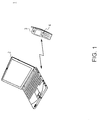
- a reference numeral 1 shows an information processing system which comprises a notebook personal computer and a digital portable telephone 3. And the notebook personal computer 2 and the digital portable telephone 3 can perform communication with each other by a radio communication method based on a radio communication standard called the Bluetooth (trademark).
- a radio communication method based on a radio communication standard called the Bluetooth (trademark).
- the Bluetooth is the radio data communication standard for short distance standardized by the Bluetooth special interest group (SIG) which is a standardizing group, in which 79 channels each having a bandwidth of 1MHz are set within the industrial scientific medical (ISM) of 2.4GHz bandwidth, a spread spectrum communication method utilizing a frequency hopping method which switches channels 1600 times per one second is used to perform data communication within 10m at data transmission rate of 1Mbit/sec (actual rate of 721kbit/sec).
- SIG Bluetooth special interest group
- ISM industrial scientific medical
- the notebook personal computer 2 has such a structure that a random access memory (RAM) 11, a display 12 that is a liquid crystal display, a keyboard 13, a hard disk drive (HDD) 14, a power control unit 15, a radio interface for short distance 16 based on the Bluetooth standard, a touch pad 17 and a jog dial 18 are connected to each other with a data bus BUS, so as to communicate various data between these units through the data bus BUS.
- RAM random access memory
- a display 12 that is a liquid crystal display
- a keyboard 13 a hard disk drive (HDD) 14
- HDD hard disk drive
- a power control unit 15 a radio interface for short distance 16 based on the Bluetooth standard
- a touch pad 17 and a jog dial 18 are connected to each other with a data bus BUS, so as to communicate various data between these units through the data bus BUS.
- the jog dial 18 is formed on the side surface of the notebook personal computer 2 as an operation means which is capable of easily carrying out system setting and various functions of various application software through rotation operation and pushing operation.
- the HDD 14 stores various kinds of programs including an operating system program such as the Windows 98 (trademark of Microsoft corp.) and a jog dial utility program, and various kinds of personal information databases.
- an operating system program such as the Windows 98 (trademark of Microsoft corp.) and a jog dial utility program
- personal information databases various kinds of personal information databases.
- the CPU 10 takes out various programs stored in the HDD 14 when necessary, opens and executes them on the RAM 11 to control each unit, thereby performing various processing, and it displays the processing results on the display 12.
- the CPU 10 opens the jog dial utility program as well as an operating system program, on the RAM 11.
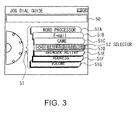
- the CPU 10 displays, for example, a jog dial window 50 shown in Fig. 3 on the display 12, and at the same time virtually displays the contents of the rotation operation and the pushing operation of the jog dial 18 on the jog dial window 50, to show a user an operated situation.
- the CPU 10 rotatably displays main menu items 51 in accordance with the rotation operation on the jog dial window 50, and on the other hand when the jog dial 18 is pushed the CPU 10 determines the item being selected by a selector (inverse color part) 52 and executes the processing corresponding to the item.
- the power control unit 15 controls the power supply to each unit of the notebook personal computer 2, and always supplies power to only the radio interface for short distance 16 even when the notebook personal computer 2 is in an inactive mode (that is, in a sleep mode), so it is always active even the notebook personal computer 2 is in an inactive mode.
- the notebook personal computer 2 When the notebook personal computer 2 receives a driving signal from the digital portable telephone 3 via the radio interface for short distance 16, it outputs a driving command to the power control unit 15 even in an inactive mode, to reactive.
- Such a notebook personal computer 2 previously stores an identification ID used for judging whether a digital portable telephone 3 is owned by a proper user of the notebook personal computer 2, in order to prevent the remote control by a digital portable telephone 3 owned by a third party.
- the notebook personal computer 2 previously sets items which can be remotely operated with the digital portable telephone 3 out of the main menu items 51 of the jog dial window 50 displayed on the display 12, so as to perform processing corresponding to the set items.
- the user rotates the jog dial 18 so as to place the selector 52 on a detailed setting item 51D out of the main menu items 51 on the jog dial window 50 ( Fig. 3 ), and then pushes the jog dial 18.
- the notebook personal computer 2 displays on the display 12 an item setting screen 40 in which main menu items 71 corresponding to the main menu item 51 of the jog dial window 50 ( Fig. 3 ) is shown in a setting item display area AR1, as shown in Fig. 4A , and allows the user to set items to be transmitted to the digital portable telephone 3 using the determined item display area AR2.
- the user performs setting using the jog dial 18 or a mouse pad 17 this time, and selects and then determines an E-mail item 71B and an address item 71F as items which can be remotely operated with the digital portable telephone 3, out of the main menu items 71 including a word processing unit item 71A, the E-mail item 71B, a game item 71C, a detailed setting item 71D, a browser activating item 71E, the address item 71F and a volume item 71G, displayed in the setting item display area AR1.
- the notebook personal computer 2 copies and displays the E-mail item 71B and the address item 71F in the determined item display area AR2 on the item setting screen 40 as shown in Fig. 4B , and operation of an end button 43 by the user terminates the setting processing for items to be transmitted to the digital portable telephone 3. Thereby the notebook personal computer 2 stores the setting contents of the set items in the HDD 14.
- the notebook personal computer 2 previously stores the identification ID and the setting contents for items which can be remotely operated with the digital portable telephone 3, in the HDD 14, and performs radio data communication with a close digital portable telephone 3 ( Fig. 1 ) which can be used in the Bluetooth, via the radio interface for short distance 16 and the antenna 18.
- an electronic erasable program read-only memory (EEEPROM) 21, a jog dial 4, a plurality of operation keys 22, a display 23 which is a liquid crystal display, a signal processing unit 24, and radio interface for short distance 25 based on the Bluetooth standard are connected to a CPU 20 for controlling the whole performance of the digital portable telephone 3, and a microphone 26, a speaker 27, a transmitter section 28 and a receiver section 29 are connected to the signal processing unit 24.
- EEEPROM electronic erasable program read-only memory
- the jog dial 4 of the digital portable telephone 3 is an operation means for easily carrying out system setting and various functions in various application software by rotation operation and pushing operation.
- the EEPROM 21 stores various programs such as a jog dial state managing program, and personal information including an identification ID which is used to realize communication of various kinds of information with a notebook personal computer 2.
- the CPU 20 takes out various programs stored in the EEPROM 21, when necessary, to control each unit, and thereby performs various processing, and then displays the processing results on the display 23 according to the processing.
- the CPU 20 takes out the jog dial state managing program from the EEPROM 21 to detect an amount of change in rotation of the jog dial 4 by polling which is performed every 5 minutes and to always detect whether the jog dial 4 has been pushed.
- the CPU 20 displays various kinds of information (entered telephone numbers or menu items, or a calling history or a telephone directory, for example) corresponding to the command information entered through the jog dial 4 or the operation keys 22, on the display 23. Further, the CPU 20 controls the signal processing unit 24 in accordance with the command information entered through the jog dial 4 or the operation keys 22, to perform various kinds of processing according to the command information such as call processing and call ending processing.
- the digital portable telephone 3 is a code division multiple access (CDMA) scheme cellular portable telephone under the direct sequence (DS) system based on the IS95 standards
- CDMA code division multiple access
- DS direct sequence
- the signal processing unit 24 performs error correction and then convolutional coding on an audio signal inputted vial the microphone 26, and then performs frequency diffusion by multiplying a pseude noise (PN) code, and modulates the resultant, in order to generate a transmission symbol stream which is then inputted to the transmitter section 28.
- the transmitter section 28 performs the digital/analog conversion on the transmission symbol stream to generate a transmission signal, then performs the frequency conversion processing and amplification processing on the transmission signal, then the resultant is outputted via the antenna 30.
- CDMA code division multiple access
- DS direct sequence
- PN pseude noise
- the receiver section 29 performs the amplification processing and then the frequency conversion processing on the received signal received via the antenna 30, then performs the analog/digital conversion to generate a reception symbol stream which is then inputted to the signal processing unit 24.
- the signal processing unit 24 demodulates the reception symbol stream, then performs the back-diffusion by multiplying a PN code and furthermore, performs the maximum likelihood estimation processing using the convolutional code and then error detection processing in order to generate an audio signal which is then outputted to the speaker 27.
- the signal processing unit 24 transmits a control signal to the base station (not shown) via the transmitter section 28 and the antenna 30 to perform call processing and on the other hand, receives the call-arrival signal via the antenna 30 and the receiver section 29 and informs the CPU 20 of the call arrival.
- the CPU 20 controls the signal processing unit 24, to perform radio data communication with another communication terminal connected to the public circuit via the transmitter section 28, the receiver section 29 and the antenna 30.
- the digital portable telephone 3 may utilize the global system for mobile communication (GSM) system, or the time division multiple access (TDMA) scheme, in addition to the CDMA system and also may utilize the international mobile telecommunication system (IMT)-2000 system which is the next-generation cellular phone system.
- GSM global system for mobile communication
- TDMA time division multiple access
- IMT international mobile telecommunication system
- the digital portable telephone 3 has a remote control start key which is included in the plurality of operation keys 22, and when the remote control start key is pressed, the signal processing unit 24 and the radio interface for short distance 25 exchange various kinds of communication data under the control of the CPU 20.
- the digital portable telephone 3 can perform radio data communication with a close notebook personal computer 2 ( Fig. 1 ) which can be used in the Bluetooth, via the antenna 31.
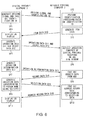
- Fig. 6 shows a sequence of remotely operating the notebook personal computer 2 with the digital portable telephone 3 in the information processing system 1.
- the CPU 20 of the digital portable telephone 3 As shown in Fig. 6 , at step SP1 when the "remote control start key" is pressed, the CPU 20 of the digital portable telephone 3 generates a driving signal and also takes out an identification ID inherent to the digital portable telephone 3 from the EEPROM 21 and transmits them to the notebook personal computer 2 via the radio interface for short distance 24.
- step SP2 when the CPU 10 of the notebook personal computer 2 receives the driving signal from the digital portable telephone 3 via the radio interface for short distance 16, it starts in the case where it has been in an inactive mode, then takes out the identification ID (ID inherent to the previously registered digital portable telephone 3) stored in the HDD 14, and then judges whether it is identical to the identification ID received from the digital portable telephone 3.
- ID ID inherent to the previously registered digital portable telephone 3
- the CPU 10 of the notebook personal computer 2 compares the identification ID previously stored in the HDD 14 to the identification ID received from the digital portable telephone 3, and if the comparison result shows that they are not identical, it judges that the access has been improperly made by a third party which can not treat the various kinds of personal information stored in the HDD 14, and informs the digital portable telephone 3 which is a sender of the identification ID that the radio communication for short distance can not be accepted.
- the CPU 10 of the notebook personal computer 2 compares the identification ID previously stored in the HDD 14 to the identification ID received from the digital portable telephone 3, and if the comparison result shows that they are identical, then it judges that the access has been properly made by a person which can treat various kinds of personal information stored in the HDD 14.
- step SP3 the CPU 10 of the notebook personal computer 2 generates item data D10 based on the setting contents (the E-mail item 71B and the address item 71E) set on the item setting screen 40 already described in Fig. 4 , and then transmits it to the digital portable telephone 3 via the radio interface for short distance 16.
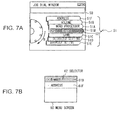
- the CPU 10 of the notebook personal computer 2 shifts the main menu items 51 so that the selector 52 is located on the E-mail item 51B out of the main menu items 51 on the jog dial window 50 as shown in Fig. 7A .
- step SP4 when the CPU 20 of the digital portable telephone 3 receives the item data D10 via the radio interface for short distance 25, it displays a menu screen 60 showing the E-mail item 61B and the address item 61F on the display 23 based on the received item data D10 as shown in Fig. 7B .
- the CPU 20 of the digital portable telephone 3 places and displays the selector 62 shown by slant lines on the menu screen 60, on the E-mail item 61B, like the E-mail item 51B selected by the selector 52 on the jog dial window 50 of the notebook personal computer 2.
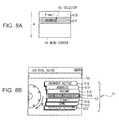
- step SP5 when the user rotates the jog dial 4 ( Fig. 1 ), for example, by one click in the downward direction of the main case, the CPU 20 of the digital portable telephone 3 shifts and displays the selector 62 on the menu screen 60 by one item in the direction shown by the arrow A, as shown in Fig. 8A , and generates operation data D11 representing the operation contents (one-item shift in the direction shown by the arrow A) as well as generating select data D12 corresponding to the item name (address) being selected, and then transmits them to the notebook personal computer 2 via the radio interface for short distance 25.
- operation data D11 representing the operation contents (one-item shift in the direction shown by the arrow A)
- select data D12 corresponding to the item name (address) being selected
- step SP6 when the CPU 10 of the notebook personal computer 2 receives the operation data D11 and the select data D12 via the radio interface for short distance 16, it shifts, based on the received operation data D11, the menu items 51 on the jog dial window 50 by one item in the direction shown by the arrow B, as shown in Fig. 8B .
- the CPU 10 of the notebook personal computer 2 judges whether one-item shift in the direction shown by the arrow B makes the menu item name ("word processing unit” in this case) being selected by the selector 52 identical to the item name (that is, "address") of the select data D12. At this time, when it is not identical to the item name (that is, "address") of the select data D12, then the CPU 10 of the notebook personal computer 2 shifts the main menu items 51 on the jog dial window 50 in the direction shown by the arrow B until it is identical to the item name (that is, "address") of the select data D12.
- the digital portable telephone 3 transmits the operation contents in the form of the operation data D11 and select data D12 every time when the jog dial 4 ( Fig. 1 ) is operated, and the notebook personal computer 2 can execute the rotation display on the jog dial window 50, associated with operations of the digital potable telephone 3.
- step SP7 when the user pushes the jog dial 4 ( Fig. 1 ) while the address item 51F is being selected ( Fig. 9B ), the CPU 20 of the digital portable telephone 3 generates operation determination data D13 corresponding to the operation contents (pushing operation) and transmits it to the notebook personal computer 2 via the radio interface for short distance 25.
- step SP8 when the CPU 10 of the notebook personal computer 2 receives the operation determination data D13 via the radio interface for short distance 16, it takes out the address data which is personal information, from the HDD 14, in accordance with the received operation determination data D13, opens the taken address data on the RAM 11 to display the address database on the HDD 14.
- the CPU 10 of the notebook personal computer 2 extracts only a record of the person names, from the taken address data, and transmits it as record data D14 to the digital portable telephone 3 via the radio interface for short distance 16.
- step SP9 when the CPU 20 of the digital portable telephone 3 receives the record data D14 via the radio interface for short distance 25, it marshals and displays the person names on the display 23 based on the received record data D14.
- the CPU 20 of the digital portable telephone 3 scrolls the marshaled person names in accordance with the rotation operation of the jog dial 4 ( Fig. 1 ) with the person names marshaled and displayed on the display 23.
- the CPU 20 of the digital portable telephone 3 When the user selects a desired person name of which the address he/her wants to know, with the selector 62 by the pushing operation, the CPU 20 of the digital portable telephone 3 generates selection data D15 corresponding to the person name being selected and transmits this to the notebook personal computer 2 via the radio interface for short distance 25.
- step SP10 when the CPU 10 of the notebook personal computer 2 receives the selection data D15 via the radio interface for short distance 16, it takes out address record data D16 corresponding to the received selection data D15 from the address database in the HDD 14, and then transmits it to the digital portable telephone 3 via the radio interface for short distance 16.
- step SP11 when the CPU 20 of the digital portable telephone 3 receives the address record data D16 via the radio interface for short distance 25, it displays the address based on the received address record data D16 on the display 23.
- the digital portable telephone 3 receives the address record data D16, which is desired by the user, taken out from the HDD 14 of the notebook personal computer 2, via the radio interface for short distance 25, and visually displays this as an address on the display 23, thereby informing the user of the address of the desired person, without directly operating the notebook personal computer 2.
- the digital portable telephone 3 can function as a remote controller for remotely operating the notebook personal computer 2, by only pressing the remote control start key by the user.
- the digital portable telephone 3 receives function item information representing various functions of the notebook personal computer 2 which is to be operated, from the notebook personal computer 2, and displays a menu screen 60 based on the received function item information, thereby informing a user of the function item names representing the various functions of the notebook personal computer 2.
- the user who operates the digital portable telephone 3 sees the menu screen 60 (the E-mail item 61B and the address item 61F) being displayed on the display 23 of the digital portable telephone 3, thus easily recognizing the functions of the notebook personal computer 2 which can be remotely operated.
- the digital portable telephone 3 generates a processing command (operation data D11, select data D12, operation determination data D13, selection data D15) corresponding to a function item name determined according to user's input operation using the operation means (the jog dial 4), and directly transmits it to the notebook personal computer 2 via the radio interface for short distance 16.
- the notebook personal computer 2 receives the processing command (the operation data D11, the select data D12, the operation determination data D13, the selection data D15), which is transmitted from the digital portable telephone 3, and executes predetermined processing (step SP6, step SP8, step SP10) corresponding to the processing command.
- the digital telephone 3 can be used for remotely operating the notebook personal computer 2 while making the user recognize the operation state of the notebook personal computer 2, thus it can function as a remote controller of the notebook personal computer 2.
- the notebook personal computer 2 can be remotely operated with the digital portable telephone 3 without having a wired connection to each other, thus making it possible to significantly improve operability for users.
- each item displayed on the menu screen 60 is operated with the jog dial 4 serving as an operation means.
- the present invention is not limited to this and other various operation means, such as a compass key provided in a portable telephone to shift items in a right-left or an up-down direction, can be utilized, for example. In this case, the similar effects to the aforementioned embodiment can be obtained.
- the notebook personal computer 2 executes processing based on operation data D11 and selection data D12, associated with operation of the digital portable telephone 3, every time when receiving the operation data D11 and the selection data D12 transmitted from the digital portable telephone 3.
- the present invention is not limited to this and the notebook personal computer 2 can store the operation data D11 and the select data D12 transmitted from the digital portable telephone 3 in the HDD 14 once, and can execute processing in the reception order based on the operation data D11 and the select data D12, which are stored in the HDD 14, when receiving operation determination data D13 of which the operation contents indicates the pushing operation (that is, the operation determination data D13 as an execution command).
- the notebook personal computer 2 performs the same processing as the contents indicating the operation of the digital portable telephone 3, without performing processing associated with the contents representing the operation of the digital portable telephone 3. Therefore, the notebook personal computer 2 can prevent consumption power occurred when the associated processing is performed one by one.
- the digital portable telephone 3 uses the CPU 20, the radio interface for short distance 25, and the antenna 31 as function item information receiving means to receive function item information (item data D10) representing functions of the notebook personal computer 2 to be operated, which is directly transmitted from the notebook personal computer 2.
- function item information item data D10 representing functions of the notebook personal computer 2 to be operated, which is directly transmitted from the notebook personal computer 2.
- the present invention is not limited to this and the digital portable telephone 3 can use other various units to receive the function item information from the notebook personal computer 2.
- the digital portable telephone 3 uses the CPU 20, the radio interface for short distance 25, the antenna 31 as a processing command transmitting means to directly transmit a processing command (operation data D11, select data D12, operation determination data D13, selection data D15) corresponding to function item information (item data D10), to the notebook personal computer 2 in accordance with the user's input operation.
- a processing command operation data D11, select data D12, operation determination data D13, selection data D15
- function item information item data D10
- the notebook personal computer 2 uses the CPU 10, the radio interface for short distance 16, the antenna 19 as a function item information transmitting means to directly transmit function item information (item data D10) representing the own functions to the digital portable telephone 3.
- function item information item data D10 representing the own functions to the digital portable telephone 3.
- the present invention is not limited to this and the notebook personal computer 2 can use other various units to directly transmit function item information to the digital portable telephone 3.
- the notebook personal computer 2 uses the CPU 10, the radio interface for short distance 16, the antenna 19 as a processing command receiving means to receive a processing command (operation data D11, select data D12, operation determination data D13, selection data D15) corresponding to the function item information (item data D10) directly transmitted from the digital portable telephone 3.
- a processing command operation data D11, select data D12, operation determination data D13, selection data D15
- the present invention is not limited to this and other various units can be used to receive the processing command corresponding to the function item information directly transmitted from the digital portable telephone 3.
- the CPU 10 is used as a control means to control a function corresponding to a processing command (operation data D11, select data D12, operation determination data D13, selection data D15).
- operation data D11, select data D12, operation determination data D13, selection data D15 operation data D11, select data D12, operation determination data D13, selection data D15.
- present invention is not limited to this and other various units can be used to control the function corresponding to the processing command.
- the digital portable telephone 3 and the notebook personal computer 2 are connected by the radio communications system for short distance based on the Bluetooth.
- the present invention is not limited to this and the digital portable telephone 3 and the notebook personal computer can be connected by another kind of radio communication means, such as a radio communication for short distance, like the wireless local area network (LAN) standardized by the Institute of Electrical and Electronics Engineers (IEEE) 802'11B, or an infrared ray communication standardized by the Infrared Data Association (IrDA).
- LAN wireless local area network
- IEEE 802'11B Institute of Electrical and Electronics Engineers
- IrDA Infrared Data Association
- the notebook personal computer 2 as an information processing device is remotely operated with the digital portable telephone 3 as a remote controller terminal.
- the present invention is not limited to this and another kind of information processing device such as a desktop personal computer or a compact disk (CD) player can be remotely operated with another kind of remote controller terminal such as a personal digital assistant (PDA).
- PDA personal digital assistant
- the CPU 10 of the notebook personal computer 2 executes the same processing as the contents of operation of the digital portable telephone 3 following the jog dial utility program previously stored in the HDD 14.
- the present invention is not limited to this and a jog dial utility program can be stored in another kind of program storage medium (for example, a floppy disk) and the jog dial utility program can be installed in the notebook personal computer 2 via the program storage medium, in order to execute the same processing as the contents of operation of the digital portable telephone 3.
- a semiconductor memory and a magnetic disc for temporarily or permanently storing a program in addition to a package medium such as a floppy disk, and a digital video disc-read only memory (DVD-ROM) can be used as a program storage medium which is used for installing the jog dial utility program in the notebook personal computer 2 so that the digital portable telephone 3 execute the program.
- a wired or radio communication medium such as a local area network, the Internet, or a digital satellite broadcasting can be utilized as a means for storing the jog dial utility program in the program storage medium and furthermore, storing can be performed via another kind of interface such as a router or a modem.
Landscapes
- Engineering & Computer Science (AREA)
- Computer Networks & Wireless Communication (AREA)
- Human Computer Interaction (AREA)
- Signal Processing (AREA)
- General Engineering & Computer Science (AREA)
- Theoretical Computer Science (AREA)
- General Physics & Mathematics (AREA)
- Physics & Mathematics (AREA)
- Mobile Radio Communication Systems (AREA)
- Input From Keyboards Or The Like (AREA)
- User Interface Of Digital Computer (AREA)
- Selective Calling Equipment (AREA)
- Telephone Function (AREA)
- Small-Scale Networks (AREA)
Applications Claiming Priority (2)
| Application Number | Priority Date | Filing Date | Title |
|---|---|---|---|
| JP2000250142A JP4362748B2 (ja) | 2000-08-21 | 2000-08-21 | 情報処理システム、情報処理装置及びその方法、記録媒体並びに通信端末装置 |
| EP01120032.6A EP1182853B1 (de) | 2000-08-21 | 2001-08-20 | Informationsverarbeitungssystem und Fernsteuerungsgerät |
Related Parent Applications (3)
| Application Number | Title | Priority Date | Filing Date |
|---|---|---|---|
| EP01120032.6 Division | 2001-08-20 | ||
| EP01120032.6A Division EP1182853B1 (de) | 2000-08-21 | 2001-08-20 | Informationsverarbeitungssystem und Fernsteuerungsgerät |
| EP01120032.6A Division-Into EP1182853B1 (de) | 2000-08-21 | 2001-08-20 | Informationsverarbeitungssystem und Fernsteuerungsgerät |
Publications (3)
| Publication Number | Publication Date |
|---|---|
| EP2244448A2 true EP2244448A2 (de) | 2010-10-27 |
| EP2244448A3 EP2244448A3 (de) | 2011-01-05 |
| EP2244448B1 EP2244448B1 (de) | 2017-05-31 |
Family
ID=18739769
Family Applications (2)
| Application Number | Title | Priority Date | Filing Date |
|---|---|---|---|
| EP01120032.6A Expired - Lifetime EP1182853B1 (de) | 2000-08-21 | 2001-08-20 | Informationsverarbeitungssystem und Fernsteuerungsgerät |
| EP10172633.9A Expired - Lifetime EP2244448B1 (de) | 2000-08-21 | 2001-08-20 | Informationsverarbeitungsvorrichtung und computerlesbares Speichermedium |
Family Applications Before (1)
| Application Number | Title | Priority Date | Filing Date |
|---|---|---|---|
| EP01120032.6A Expired - Lifetime EP1182853B1 (de) | 2000-08-21 | 2001-08-20 | Informationsverarbeitungssystem und Fernsteuerungsgerät |
Country Status (4)
| Country | Link |
|---|---|
| US (2) | US7558836B2 (de) |
| EP (2) | EP1182853B1 (de) |
| JP (1) | JP4362748B2 (de) |
| KR (1) | KR100850371B1 (de) |
Families Citing this family (15)
| Publication number | Priority date | Publication date | Assignee | Title |
|---|---|---|---|---|
| KR100449651B1 (ko) * | 2002-01-07 | 2004-09-22 | 박용한 | 모바일 단말기를 이용한 피씨 키신호 제어방법 |
| FI20020847A7 (fi) | 2002-05-03 | 2003-11-04 | Nokia Corp | Menetelmä ja laite valikkotoimintojen käyttämiseksi |
| KR20030088148A (ko) * | 2002-05-11 | 2003-11-19 | 이현정 | 휴대통신 단말기와 초단거리 무선통신장치를 이용한자동화시스템 |
| EP1369770A1 (de) * | 2002-06-06 | 2003-12-10 | Sony Ericsson Mobile Communications AB | Graphische Benutzeroberfläche für expandierbare Menüs |
| US20040132445A1 (en) * | 2003-01-03 | 2004-07-08 | Gary Rogalski | Methods and systems of sharing mutual resources between an external device and a cordless telephone via a communications medium |
| US7271997B2 (en) * | 2003-09-18 | 2007-09-18 | Vulcan Portals, Inc. | Processor module packaging for a portable electronic device display |
| US7222206B2 (en) * | 2003-09-18 | 2007-05-22 | Vulcan Portals, Inc. | Removable module for a portable electronic device having stand-alone and system functionality |
| US20050066209A1 (en) * | 2003-09-18 | 2005-03-24 | Kee Martin J. | Portable electronic device having high and low power processors operable in a low power mode |
| JP2007013228A (ja) * | 2003-10-08 | 2007-01-18 | Mevael Corp | リモコン |
| KR101582084B1 (ko) * | 2008-01-25 | 2016-01-05 | 삼성전자주식회사 | 홈 네트워크에서 이벤트를 처리하는 방법 및 이를 위한장치 |
| KR101591552B1 (ko) * | 2008-09-04 | 2016-02-03 | 사반트 시스템즈 엘엘씨 | 시스템을 원격으로 제어하기 위한 터치 감지형 무선 장치 및 온 스크린 디스플레이 |
| CN103430519B (zh) * | 2011-01-18 | 2015-12-02 | 萨万特系统有限责任公司 | 提供抬头操作和视觉反馈的远程控制接口 |
| JP5796789B2 (ja) * | 2012-12-20 | 2015-10-21 | カシオ計算機株式会社 | 情報処理システムにおける無線端末、無線端末による携帯情報端末の起動方法 |
| JP6115293B2 (ja) * | 2013-05-02 | 2017-04-19 | 株式会社リコー | 機器、情報処理端末、情報処理システム、表示制御方法、及びプログラム |
| JP5859485B2 (ja) * | 2013-06-05 | 2016-02-10 | 寶トク科技股フン有限公司 | 有線と無線を切り替える機能を有する電子装置 |
Family Cites Families (30)
| Publication number | Priority date | Publication date | Assignee | Title |
|---|---|---|---|---|
| JPH05502130A (ja) * | 1989-11-22 | 1993-04-15 | ラッセル、デヴィッド、シー | コンピューター制御システム |
| JP3284135B2 (ja) * | 1992-02-25 | 2002-05-20 | シャープ株式会社 | 遠隔制御システム |
| FI102868B1 (fi) * | 1996-02-26 | 1999-02-26 | Nokia Mobile Phones Ltd | Päätelaite tietoliikennepalvelun käyttämiseksi |
| JPH09261759A (ja) * | 1996-03-19 | 1997-10-03 | Sony Corp | 通信端末装置 |
| FI102867B (fi) | 1996-03-20 | 1999-02-26 | Helsingin Puhelin Oyj | Menetelmä ja laitteisto virtuaalitodellisuuden ja reaalimaailman kytke miseksi toisiinsa reaaliaikaisen tietoliikenneyhteyden, kuten esimerki ksi puhelinyhteyden muodostamiseksi |
| KR100216726B1 (ko) * | 1996-09-25 | 1999-09-01 | 구자홍 | 위성방송 수신단말기의 화면표시기기 원격제어장치 및 그 제어방법 |
| KR0177711B1 (ko) * | 1996-11-12 | 1999-05-15 | 구자홍 | 브랜치 프로세서(bp)의 원격제어방법 |
| KR100198531B1 (ko) * | 1996-12-16 | 1999-06-15 | 구자홍 | 통합 리모콘 |
| JPH10200972A (ja) | 1997-01-14 | 1998-07-31 | Oki Electric Ind Co Ltd | Pc用コントロール装置及びその制御方式 |
| US6130726A (en) | 1997-03-24 | 2000-10-10 | Evolve Products, Inc. | Program guide on a remote control display |
| JPH10290488A (ja) | 1997-04-14 | 1998-10-27 | Sharp Corp | 双方向無線コントローラ |
| JP3210603B2 (ja) * | 1997-07-04 | 2001-09-17 | インターナショナル・ビジネス・マシーンズ・コーポレーション | イメージの処理方法、サーバ及び記録媒体 |
| KR19990011182A (ko) * | 1997-07-22 | 1999-02-18 | 구자홍 | 터치스크린을 이용한 통합리모콘 키이출력 방법 및 장치 |
| US6405049B2 (en) * | 1997-08-05 | 2002-06-11 | Symbol Technologies, Inc. | Portable data terminal and cradle |
| US6263319B1 (en) * | 1997-09-26 | 2001-07-17 | Masconi Commerce Systems Inc. | Fuel dispensing and retail system for providing a shadow ledger |
| JP4089013B2 (ja) | 1998-06-18 | 2008-05-21 | ソニー株式会社 | 電子機器 |
| GB2341753A (en) | 1998-09-17 | 2000-03-22 | Nokia Mobile Phones Ltd | RF interface for portable communication terminal |
| JP3717313B2 (ja) | 1998-09-21 | 2005-11-16 | シャープ株式会社 | 入力デバイス、情報機器および情報システム |
| KR100499048B1 (ko) * | 1998-12-09 | 2005-09-30 | 주식회사 팬택앤큐리텔 | 원격제어기능을 구비한 이동전화 단말기 |
| KR20000043933A (ko) * | 1998-12-29 | 2000-07-15 | 강병호 | 리모콘 기능을 갖춘 이동통신단말기 |
| US6377798B1 (en) * | 1999-01-22 | 2002-04-23 | Siemens Information And Communication Networks, Inc. | System and method for improved wireless telephone call reception notification |
| US6216158B1 (en) * | 1999-01-25 | 2001-04-10 | 3Com Corporation | System and method using a palm sized computer to control network devices |
| US6563912B1 (en) * | 1999-03-02 | 2003-05-13 | Toshiba America Information Systems, Inc. | System and method for providing integrated messaging |
| US6351523B1 (en) * | 1999-03-22 | 2002-02-26 | Sharp Laboratories Of America, Inc. | Method and apparatus for management of EMail originated by thin client devices |
| JP2001045124A (ja) * | 1999-07-30 | 2001-02-16 | Sony Corp | 情報端末 |
| JP4269203B2 (ja) * | 2000-02-04 | 2009-05-27 | ソニー株式会社 | データ処理システム、データ処理装置、データ処理方法、プログラム及び再生装置 |
| US6744528B2 (en) * | 2000-11-30 | 2004-06-01 | Pitney Bowes Inc. | Method and system for remote printing of documents |
| US6654601B2 (en) * | 2000-11-30 | 2003-11-25 | Pitney Bowes Inc. | Method and system for remote retrieval of messages using spontaneous networking technology |
| US6779047B1 (en) * | 2001-02-20 | 2004-08-17 | 3Com Corporation | Serial communication port arbitration between a hotsync manager and a wireless connection manager |
| US6757543B2 (en) * | 2001-03-20 | 2004-06-29 | Keynote Systems, Inc. | System and method for wireless data performance monitoring |
-
2000
- 2000-08-21 JP JP2000250142A patent/JP4362748B2/ja not_active Expired - Fee Related
-
2001
- 2001-08-11 KR KR1020010048472A patent/KR100850371B1/ko not_active Expired - Fee Related
- 2001-08-14 US US09/928,353 patent/US7558836B2/en not_active Expired - Fee Related
- 2001-08-20 EP EP01120032.6A patent/EP1182853B1/de not_active Expired - Lifetime
- 2001-08-20 EP EP10172633.9A patent/EP2244448B1/de not_active Expired - Lifetime
-
2009
- 2009-05-15 US US12/466,531 patent/US8019833B2/en not_active Expired - Fee Related
Non-Patent Citations (1)
| Title |
|---|
| None |
Also Published As
| Publication number | Publication date |
|---|---|
| EP2244448B1 (de) | 2017-05-31 |
| EP1182853B1 (de) | 2017-06-07 |
| EP1182853A3 (de) | 2005-03-16 |
| EP1182853A2 (de) | 2002-02-27 |
| US20020026494A1 (en) | 2002-02-28 |
| JP2002062961A (ja) | 2002-02-28 |
| JP4362748B2 (ja) | 2009-11-11 |
| US8019833B2 (en) | 2011-09-13 |
| US7558836B2 (en) | 2009-07-07 |
| KR100850371B1 (ko) | 2008-08-04 |
| EP2244448A3 (de) | 2011-01-05 |
| US20090228571A1 (en) | 2009-09-10 |
| KR20020015273A (ko) | 2002-02-27 |
Similar Documents
| Publication | Publication Date | Title |
|---|---|---|
| US8019833B2 (en) | Information processing device, information processing method, information processing program, and remote controller terminal | |
| EP1462921B1 (de) | Tragbares Endgerät zum Aufrufen eines Programs aufgrund von Gesten und ein Verfahren um Programme auszuführen dazu | |
| US8160649B2 (en) | Initiating a call from a mobile device to a number that is not hyperlinked | |
| US6825830B1 (en) | Information processing system, information processing method, and computer-readable recording medium for executing information processing method on a computer | |
| US7206612B2 (en) | Information processing system, information processing apparatus and method, program storage medium, and telephone set | |
| US7406308B2 (en) | Wireless communication terminal for identifying and indicating short message types using indicator icons and method thereof | |
| EP1164770A2 (de) | Tragbares Telefon | |
| US20070082710A1 (en) | Method and apparatus for batch-processing of commands through pattern recognition of panel input in a mobile communication terminal | |
| US20030211865A1 (en) | Controlling mobile telephone by operating information processing apparatus | |
| US20040204029A1 (en) | Identifying remote, external devices and facilitating communication therewith | |
| JP2004503007A (ja) | 第1のコンピュータ・システムの入力デバイスを使用して第2のコンピュータ・システムに無線でデータを入力するための方法および装置 | |
| US20060015822A1 (en) | Method and apparatus for updating a user interface display of a portable communication device | |
| US20100222086A1 (en) | Cellular Phone and other Devices/Hands Free Text Messaging | |
| KR100413234B1 (ko) | 휴대용 단말기에서 키패드 배열형의 아이콘을 이용한 메뉴선택 방법 및 이를 이용한 휴대용 단말기 | |
| JP3834253B2 (ja) | 通信端末装置 | |
| KR100451141B1 (ko) | 이동통신 단말기를 이용한 메뉴 구현방법 | |
| JP2002185600A (ja) | 携帯電話機 | |
| US20020078156A1 (en) | Display data transmitting method for mobile terminal | |
| US20060031408A1 (en) | Push to activate and connect client/server applications | |
| JP2002135840A (ja) | 携帯電話 | |
| CA2541549C (en) | Initiating a call from a mobile device to a number that is not hyperlinked | |
| JP2003152835A (ja) | 情報処理端末 | |
| JP2001268271A (ja) | 電話器 |
Legal Events
| Date | Code | Title | Description |
|---|---|---|---|
| PUAI | Public reference made under article 153(3) epc to a published international application that has entered the european phase |
Free format text: ORIGINAL CODE: 0009012 |
|
| 17P | Request for examination filed |
Effective date: 20100812 |
|
| AC | Divisional application: reference to earlier application |
Ref document number: 1182853 Country of ref document: EP Kind code of ref document: P |
|
| AK | Designated contracting states |
Kind code of ref document: A2 Designated state(s): DE FR GB |
|
| PUAL | Search report despatched |
Free format text: ORIGINAL CODE: 0009013 |
|
| AK | Designated contracting states |
Kind code of ref document: A3 Designated state(s): DE FR GB |
|
| REG | Reference to a national code |
Ref country code: DE Ref legal event code: R079 Ref document number: 60150472 Country of ref document: DE Free format text: PREVIOUS MAIN CLASS: H04M0001725000 Ipc: G06F0003048200 |
|
| GRAJ | Information related to disapproval of communication of intention to grant by the applicant or resumption of examination proceedings by the epo deleted |
Free format text: ORIGINAL CODE: EPIDOSDIGR1 |
|
| GRAP | Despatch of communication of intention to grant a patent |
Free format text: ORIGINAL CODE: EPIDOSNIGR1 |
|
| RIC1 | Information provided on ipc code assigned before grant |
Ipc: H04M 1/725 20060101ALI20161202BHEP Ipc: G06F 3/0482 20130101AFI20161202BHEP |
|
| INTG | Intention to grant announced |
Effective date: 20161220 |
|
| GRAS | Grant fee paid |
Free format text: ORIGINAL CODE: EPIDOSNIGR3 |
|
| GRAA | (expected) grant |
Free format text: ORIGINAL CODE: 0009210 |
|
| AC | Divisional application: reference to earlier application |
Ref document number: 1182853 Country of ref document: EP Kind code of ref document: P |
|
| AK | Designated contracting states |
Kind code of ref document: B1 Designated state(s): DE FR GB |
|
| REG | Reference to a national code |
Ref country code: GB Ref legal event code: FG4D |
|
| REG | Reference to a national code |
Ref country code: DE Ref legal event code: R096 Ref document number: 60150472 Country of ref document: DE |
|
| REG | Reference to a national code |
Ref country code: DE Ref legal event code: R097 Ref document number: 60150472 Country of ref document: DE |
|
| PLBE | No opposition filed within time limit |
Free format text: ORIGINAL CODE: 0009261 |
|
| STAA | Information on the status of an ep patent application or granted ep patent |
Free format text: STATUS: NO OPPOSITION FILED WITHIN TIME LIMIT |
|
| GBPC | Gb: european patent ceased through non-payment of renewal fee |
Effective date: 20170831 |
|
| 26N | No opposition filed |
Effective date: 20180301 |
|
| REG | Reference to a national code |
Ref country code: FR Ref legal event code: ST Effective date: 20180430 |
|
| PG25 | Lapsed in a contracting state [announced via postgrant information from national office to epo] |
Ref country code: GB Free format text: LAPSE BECAUSE OF NON-PAYMENT OF DUE FEES Effective date: 20170831 |
|
| PG25 | Lapsed in a contracting state [announced via postgrant information from national office to epo] |
Ref country code: FR Free format text: LAPSE BECAUSE OF NON-PAYMENT OF DUE FEES Effective date: 20170831 |
|
| PGFP | Annual fee paid to national office [announced via postgrant information from national office to epo] |
Ref country code: DE Payment date: 20200819 Year of fee payment: 20 |
|
| REG | Reference to a national code |
Ref country code: DE Ref legal event code: R071 Ref document number: 60150472 Country of ref document: DE |