EP2247381B1 - Umwandlung von stickstoffdioxid (no2) in stickstoffmonoxid (no) - Google Patents
Umwandlung von stickstoffdioxid (no2) in stickstoffmonoxid (no) Download PDFInfo
- Publication number
- EP2247381B1 EP2247381B1 EP09705246.8A EP09705246A EP2247381B1 EP 2247381 B1 EP2247381 B1 EP 2247381B1 EP 09705246 A EP09705246 A EP 09705246A EP 2247381 B1 EP2247381 B1 EP 2247381B1
- Authority
- EP
- European Patent Office
- Prior art keywords
- recuperator
- gas
- nitric oxide
- nitrogen dioxide
- outlet
- Prior art date
- Legal status (The legal status is an assumption and is not a legal conclusion. Google has not performed a legal analysis and makes no representation as to the accuracy of the status listed.)
- Active
Links
Images




Classifications
-
- C—CHEMISTRY; METALLURGY
- C01—INORGANIC CHEMISTRY
- C01B—NON-METALLIC ELEMENTS; COMPOUNDS THEREOF; METALLOIDS OR COMPOUNDS THEREOF NOT COVERED BY SUBCLASS C01C
- C01B21/00—Nitrogen; Compounds thereof
- C01B21/20—Nitrogen oxides; Oxyacids of nitrogen; Salts thereof
- C01B21/24—Nitric oxide (NO)
- C01B21/30—Preparation by oxidation of nitrogen
- C01B21/32—Apparatus
-
- A—HUMAN NECESSITIES
- A61—MEDICAL OR VETERINARY SCIENCE; HYGIENE
- A61D—VETERINARY INSTRUMENTS, IMPLEMENTS, TOOLS, OR METHODS
- A61D7/00—Devices or methods for introducing solid, liquid, or gaseous remedies or other materials into or onto the bodies of animals
- A61D7/04—Devices for anaesthetising animals by gases or vapours; Inhaling devices
-
- A—HUMAN NECESSITIES
- A61—MEDICAL OR VETERINARY SCIENCE; HYGIENE
- A61K—PREPARATIONS FOR MEDICAL, DENTAL OR TOILETRY PURPOSES
- A61K33/00—Medicinal preparations containing inorganic active ingredients
-
- A—HUMAN NECESSITIES
- A61—MEDICAL OR VETERINARY SCIENCE; HYGIENE
- A61M—DEVICES FOR INTRODUCING MEDIA INTO, OR ONTO, THE BODY; DEVICES FOR TRANSDUCING BODY MEDIA OR FOR TAKING MEDIA FROM THE BODY; DEVICES FOR PRODUCING OR ENDING SLEEP OR STUPOR
- A61M16/00—Devices for influencing the respiratory system of patients by gas treatment, e.g. ventilators; Tracheal tubes
- A61M16/0051—Devices for influencing the respiratory system of patients by gas treatment, e.g. ventilators; Tracheal tubes with alarm devices
-
- A—HUMAN NECESSITIES
- A61—MEDICAL OR VETERINARY SCIENCE; HYGIENE
- A61M—DEVICES FOR INTRODUCING MEDIA INTO, OR ONTO, THE BODY; DEVICES FOR TRANSDUCING BODY MEDIA OR FOR TAKING MEDIA FROM THE BODY; DEVICES FOR PRODUCING OR ENDING SLEEP OR STUPOR
- A61M16/00—Devices for influencing the respiratory system of patients by gas treatment, e.g. ventilators; Tracheal tubes
- A61M16/0057—Pumps therefor
-
- A—HUMAN NECESSITIES
- A61—MEDICAL OR VETERINARY SCIENCE; HYGIENE
- A61M—DEVICES FOR INTRODUCING MEDIA INTO, OR ONTO, THE BODY; DEVICES FOR TRANSDUCING BODY MEDIA OR FOR TAKING MEDIA FROM THE BODY; DEVICES FOR PRODUCING OR ENDING SLEEP OR STUPOR
- A61M16/00—Devices for influencing the respiratory system of patients by gas treatment, e.g. ventilators; Tracheal tubes
- A61M16/0087—Environmental safety or protection means, e.g. preventing explosion
- A61M16/009—Removing used or expired gases or anaesthetic vapours
-
- A—HUMAN NECESSITIES
- A61—MEDICAL OR VETERINARY SCIENCE; HYGIENE
- A61M—DEVICES FOR INTRODUCING MEDIA INTO, OR ONTO, THE BODY; DEVICES FOR TRANSDUCING BODY MEDIA OR FOR TAKING MEDIA FROM THE BODY; DEVICES FOR PRODUCING OR ENDING SLEEP OR STUPOR
- A61M16/00—Devices for influencing the respiratory system of patients by gas treatment, e.g. ventilators; Tracheal tubes
- A61M16/10—Preparation of respiratory gases or vapours
- A61M16/104—Preparation of respiratory gases or vapours specially adapted for anaesthetics
-
- A—HUMAN NECESSITIES
- A61—MEDICAL OR VETERINARY SCIENCE; HYGIENE
- A61M—DEVICES FOR INTRODUCING MEDIA INTO, OR ONTO, THE BODY; DEVICES FOR TRANSDUCING BODY MEDIA OR FOR TAKING MEDIA FROM THE BODY; DEVICES FOR PRODUCING OR ENDING SLEEP OR STUPOR
- A61M16/00—Devices for influencing the respiratory system of patients by gas treatment, e.g. ventilators; Tracheal tubes
- A61M16/10—Preparation of respiratory gases or vapours
- A61M16/1075—Preparation of respiratory gases or vapours by influencing the temperature
-
- A—HUMAN NECESSITIES
- A61—MEDICAL OR VETERINARY SCIENCE; HYGIENE
- A61M—DEVICES FOR INTRODUCING MEDIA INTO, OR ONTO, THE BODY; DEVICES FOR TRANSDUCING BODY MEDIA OR FOR TAKING MEDIA FROM THE BODY; DEVICES FOR PRODUCING OR ENDING SLEEP OR STUPOR
- A61M16/00—Devices for influencing the respiratory system of patients by gas treatment, e.g. ventilators; Tracheal tubes
- A61M16/10—Preparation of respiratory gases or vapours
- A61M16/12—Preparation of respiratory gases or vapours by mixing different gases
-
- A—HUMAN NECESSITIES
- A61—MEDICAL OR VETERINARY SCIENCE; HYGIENE
- A61M—DEVICES FOR INTRODUCING MEDIA INTO, OR ONTO, THE BODY; DEVICES FOR TRANSDUCING BODY MEDIA OR FOR TAKING MEDIA FROM THE BODY; DEVICES FOR PRODUCING OR ENDING SLEEP OR STUPOR
- A61M16/00—Devices for influencing the respiratory system of patients by gas treatment, e.g. ventilators; Tracheal tubes
- A61M16/10—Preparation of respiratory gases or vapours
- A61M16/14—Preparation of respiratory gases or vapours by mixing different fluids, one of them being in a liquid phase
- A61M16/16—Devices to humidify the respiration air
-
- A—HUMAN NECESSITIES
- A61—MEDICAL OR VETERINARY SCIENCE; HYGIENE
- A61P—SPECIFIC THERAPEUTIC ACTIVITY OF CHEMICAL COMPOUNDS OR MEDICINAL PREPARATIONS
- A61P11/00—Drugs for disorders of the respiratory system
-
- A—HUMAN NECESSITIES
- A61—MEDICAL OR VETERINARY SCIENCE; HYGIENE
- A61P—SPECIFIC THERAPEUTIC ACTIVITY OF CHEMICAL COMPOUNDS OR MEDICINAL PREPARATIONS
- A61P11/00—Drugs for disorders of the respiratory system
- A61P11/06—Antiasthmatics
-
- A—HUMAN NECESSITIES
- A61—MEDICAL OR VETERINARY SCIENCE; HYGIENE
- A61P—SPECIFIC THERAPEUTIC ACTIVITY OF CHEMICAL COMPOUNDS OR MEDICINAL PREPARATIONS
- A61P9/00—Drugs for disorders of the cardiovascular system
- A61P9/08—Vasodilators for multiple indications
-
- A—HUMAN NECESSITIES
- A61—MEDICAL OR VETERINARY SCIENCE; HYGIENE
- A61P—SPECIFIC THERAPEUTIC ACTIVITY OF CHEMICAL COMPOUNDS OR MEDICINAL PREPARATIONS
- A61P9/00—Drugs for disorders of the cardiovascular system
- A61P9/12—Antihypertensives
-
- C—CHEMISTRY; METALLURGY
- C01—INORGANIC CHEMISTRY
- C01B—NON-METALLIC ELEMENTS; COMPOUNDS THEREOF; METALLOIDS OR COMPOUNDS THEREOF NOT COVERED BY SUBCLASS C01C
- C01B21/00—Nitrogen; Compounds thereof
- C01B21/20—Nitrogen oxides; Oxyacids of nitrogen; Salts thereof
- C01B21/24—Nitric oxide (NO)
-
- G—PHYSICS
- G01—MEASURING; TESTING
- G01N—INVESTIGATING OR ANALYSING MATERIALS BY DETERMINING THEIR CHEMICAL OR PHYSICAL PROPERTIES
- G01N27/00—Investigating or analysing materials by the use of electric, electrochemical, or magnetic means
- G01N27/26—Investigating or analysing materials by the use of electric, electrochemical, or magnetic means by investigating electrochemical variables; by using electrolysis or electrophoresis
- G01N27/416—Systems
-
- A—HUMAN NECESSITIES
- A61—MEDICAL OR VETERINARY SCIENCE; HYGIENE
- A61M—DEVICES FOR INTRODUCING MEDIA INTO, OR ONTO, THE BODY; DEVICES FOR TRANSDUCING BODY MEDIA OR FOR TAKING MEDIA FROM THE BODY; DEVICES FOR PRODUCING OR ENDING SLEEP OR STUPOR
- A61M16/00—Devices for influencing the respiratory system of patients by gas treatment, e.g. ventilators; Tracheal tubes
- A61M16/10—Preparation of respiratory gases or vapours
- A61M16/105—Filters
- A61M16/1055—Filters bacterial
-
- A—HUMAN NECESSITIES
- A61—MEDICAL OR VETERINARY SCIENCE; HYGIENE
- A61M—DEVICES FOR INTRODUCING MEDIA INTO, OR ONTO, THE BODY; DEVICES FOR TRANSDUCING BODY MEDIA OR FOR TAKING MEDIA FROM THE BODY; DEVICES FOR PRODUCING OR ENDING SLEEP OR STUPOR
- A61M16/00—Devices for influencing the respiratory system of patients by gas treatment, e.g. ventilators; Tracheal tubes
- A61M16/10—Preparation of respiratory gases or vapours
- A61M16/105—Filters
- A61M16/106—Filters in a path
- A61M16/107—Filters in a path in the inspiratory path
-
- A—HUMAN NECESSITIES
- A61—MEDICAL OR VETERINARY SCIENCE; HYGIENE
- A61M—DEVICES FOR INTRODUCING MEDIA INTO, OR ONTO, THE BODY; DEVICES FOR TRANSDUCING BODY MEDIA OR FOR TAKING MEDIA FROM THE BODY; DEVICES FOR PRODUCING OR ENDING SLEEP OR STUPOR
- A61M16/00—Devices for influencing the respiratory system of patients by gas treatment, e.g. ventilators; Tracheal tubes
- A61M16/10—Preparation of respiratory gases or vapours
- A61M16/1005—Preparation of respiratory gases or vapours with O2 features or with parameter measurement
- A61M2016/102—Measuring a parameter of the content of the delivered gas
-
- A—HUMAN NECESSITIES
- A61—MEDICAL OR VETERINARY SCIENCE; HYGIENE
- A61M—DEVICES FOR INTRODUCING MEDIA INTO, OR ONTO, THE BODY; DEVICES FOR TRANSDUCING BODY MEDIA OR FOR TAKING MEDIA FROM THE BODY; DEVICES FOR PRODUCING OR ENDING SLEEP OR STUPOR
- A61M2202/00—Special media to be introduced, removed or treated
- A61M2202/02—Gases
- A61M2202/0266—Nitrogen (N)
- A61M2202/0275—Nitric oxide [NO]
-
- Y—GENERAL TAGGING OF NEW TECHNOLOGICAL DEVELOPMENTS; GENERAL TAGGING OF CROSS-SECTIONAL TECHNOLOGIES SPANNING OVER SEVERAL SECTIONS OF THE IPC; TECHNICAL SUBJECTS COVERED BY FORMER USPC CROSS-REFERENCE ART COLLECTIONS [XRACs] AND DIGESTS
- Y10—TECHNICAL SUBJECTS COVERED BY FORMER USPC
- Y10T—TECHNICAL SUBJECTS COVERED BY FORMER US CLASSIFICATION
- Y10T436/00—Chemistry: analytical and immunological testing
- Y10T436/17—Nitrogen containing
- Y10T436/177692—Oxides of nitrogen
- Y10T436/179228—Both nitrogen oxide and dioxide
Definitions
- This description relates to controlled generation of nitric oxide.
- Nitric oxide (NO) also known as nitrosyl radical
- Nitric oxide (NO) can moderate pulmonary hypertension caused by elevation of the pulmonary arterial pressure.
- Inhaling low concentrations of nitric oxide (NO), for example, in the range of 2-100 ppm can rapidly and safely decrease pulmonary hypertension in a mammal by vasodilation of pulmonary vessels.
- nitric oxide nitric oxide
- nitric oxide nitric oxide
- the use of low concentrations of inhaled nitric oxide (NO) can prevent, reverse, or limit the progression of disorders which can include, but are not limited to, acute pulmonary vasoconstriction, traumatic injury, aspiration or inhalation injury, fat embolism in the lung, acidosis, inflammation of the lung, adult respiratory distress syndrome, acute pulmonary edema, acute mountain sickness, post cardiac surgery acute pulmonary hypertension, persistent pulmonary hypertension of a newborn, perinatal aspiration syndrome, haline membrane disease, acute pulmonary thromboembolism, heparin-protamine reactions, sepsis, asthma and status asthmaticus or hypoxia.
- disorders can include, but are not limited to, acute pulmonary vasoconstriction, traumatic injury, aspiration or inhalation injury, fat embolism in the lung, acidosis, inflammation of the lung, adult respiratory distress syndrome, acute pulmonary edema,
- Nitric oxide can also be used to treat chronic pulmonary hypertension, bronchopulmonary dysplasia, chronic pulmonary thromboembolism and idiopathic or primary pulmonary hypertension or chronic hypoxia.
- the NO gas is supplied in a bottled gaseous form diluted in nitrogen gas (N 2 ).
- N 2 nitrogen gas
- O 2 oxygen
- the NO, in the presence of O 2 is oxidized to nitrogen dioxide (NO 2 ).
- NO 2 nitrogen dioxide
- the part per million levels of NO 2 gas is highly toxic if inhaled and can form nitric and nitrous acid in the lungs.
- US2006/0180147 discloses a nitric oxide delivery system.
- the absorbent can be silica gel or activated alumina.
- a recuperator for converting nitrogen dioxide into nitric oxide includes an exit shell including an outlet, an inside shell wherein the inside shell includes perforated inner and outer tubes with fixed annulus, a surface-active material coated with an aqueous solution of ascorbic acid, an absorbent and a top cap including an inlet wherein the inlet is configured to receive a gas flow and fluidly communicate the gas flow to the outlet through the surface-active material such that nitrogen dioxide in the gas flow is converted to nitric oxide.
- the recuperator further includes an annular ring around the top cap.
- the recuperator can have a flow resistance of less than 3 cm of water pressure at a flow of 60 L/minute.
- the recuperator can have a flow resistance of less than 1 cm water at 15L/min.
- the recuperator can operate at atmospheric pressure.
- the recuperator can have an oxygen concentration of in the range of 21 to 100%.
- the recuperator can have a humidity of dry to 99 % (non condensing).
- the recuperator can be thermally insulated.
- the recuperator can be coupled to the outlet of a first device through a humidified line.
- the humidified line can be heated.
- the humidified line can be heated to about 35°C.
- the recuperator can be coupled to a NO/NO 2 gas analyzer.
- the recuperator can further include a particle filter.
- a method of sampling NO and NO 2 gas in a NO delivery system includes obtaining a sample of gas, diluting the sample of gas with air, and measuring the amount of NO and NO 2 gas with a gas analyzer.
- the sample of gas can be diluted by 50%.
- the sample of gas can be diluted by 33%.
- the sample of gas can be diluted with air from the hospital room.
- the sample of gas can be diluted with air from the wall.
- the sample of gas can be diluted with oxygen.
- Nitric Oxide is very well known and well-studied gas. NO is normally present in the atmosphere (as a pollutant from automobiles and power plants) at concentrations between 0.010 and 0.500 parts per million (ppm), and NO concentrations may reach 1.5 ppm in heavy traffic. NO is also present in tobacco smoke at levels as high as 500 ppm to 2000 ppm.
- NO gas like oxygen has been studied and used to treat patients for many years.
- NO is a molecule that is naturally produced in the human body.
- NO is one of the few gaseous signaling molecules known.
- NO is a key vertebrate biological messenger, playing a role in a variety of biological processes.
- NO is highly reactive (having a lifetime of a few seconds), yet diffuses freely across membranes. These attributes make NO ideal for a transient signal molecule between adjacent cells and within cells.
- NO and endothelium-derived relaxing factor were considered the same entity.
- inhaled NO emerged as a potential therapy for the acute respiratory distress syndrome (ARDS), sickle cell anemia, COPD and other conditions.
- ARDS acute respiratory distress syndrome
- COPD chronic myelolism
- NO has been shown to reduce persistent pulmonary hypertension and also to reduce pulmonary hypertension without any undesired drop in systemic blood pressure, which is valuable when treating heart and lung transplant patients and other patients having undergone interventional cardiovascular procedures.
- the gas was readily available for many years from several suppliers as were several competing CE marked delivery systems.
- the medical use of the gas was patented and the cost has increased substantially. Even with this restriction, NO is currently routinely and safely used under institutional or countywide protocols for many uses outside of the approved indications for neonates.
- NO 2 can be formed by the oxidation of NO with oxygen (O 2 ).
- a NO delivery system that converts NO 2 to NO.
- the system employs a surface-active material coated with an aqueous solution of antioxidant as a simple and effective mechanism for making the conversion.
- a surface-active material is silica gel.
- Another example of a surface-active material that could be used is cotton.
- the surface-active material may be or may include a substrate capable of retaining water.
- Another type of surface-active material that has a large surface area that is capable of absorbing moisture also may be used.
- NO 2 can be converted to NO by passing the dilute gaseous NO 2 over a surface-active material coated with an aqueous solution of antioxidant.
- the aqueous antioxidant is ascorbic acid (that is, vitamin C)
- the reaction is quantitative at ambient temperatures.
- Figure 1 illustrates an example of a cartridge 100 for generating NO by converting NO 2 to NO.
- the cartridge 100 which may be referred to as a NO generation cartridge, a cartridge, or a cylinder, includes an inlet 105 and an outlet 110.
- Screen and glass wool 115 are located at both the inlet 105 and the outlet 110, and the remainder of the cartridge 100 is filled with a surface-active material 120 that is soaked with a saturated solution of antioxidant in water to coat the surface-active material.
- the surface-active material can be silica gel.
- the screen and glass wool 115 also is soaked with the saturated solution of antioxidant in water before being inserted into the cartridge 100.
- the antioxidant can include ascorbic acid.
- the antioxidant can include alpha tocopherol or gamma tocopherol.
- the moist silica gel of the cartridge can adsorb and bind up the vast majority of the products of the side reactions.
- N 2 O 3 , N 2 O 4 and the nitrite ion In the presence of moisture, oxygen and NO, NO 2 forms N 2 O 3 , N 2 O 4 and the nitrite ion.
- these reactants can combine with an NO 2 scavenger which can include the common amino acid, proline, to form N-nitroso proline.
- N-nitrosproline is non carcinogenic. This reaction has been used in vivo by Tannenbaum The American Journal of Clinical Nutrition, Vol. 53 (1 Suppl.) pages 247S-250S (January 1990 ), and Ohshima and Bartsch (Cancer Res. Vol. 41, p. 3658-3662 (1981 ), to measure the nitrosation capacity of the body, and to show that the addition of Vitamin C can reduce this capacity.
- Such a reaction can be used to trap out NO 2 in the gas phase from an air stream containing moist NO 2 in the presence of oxygen and NO.
- the proline can be in the form of a crystalline powder. Proline can be placed in a tube and gas can be allowed to flow over it. The NO 2 that is present can bind irreversibly with the proline to form N-nitroso proline.
- the application of this reaction is to use this reaction as a scavenger to remove the last minute traces of NO 2 from an air stream containing NO and oxygen and air.
- such a NO 2 scavenger can be used in a NO delivery system to allow any NO 2 that is present to bind irreversibly with the proline to form N-nitroso proline.
- the proline can be in the form of a powder, or as a solution that has been deposited onto a substrate such as silica gel, activated alumina and charcoal. Other appropriate substrates can be used as long as proline is available to react with NO 2 gas.
- aqueous solution of proline in water can be used.
- diphenylamine or any secondary or tertiary amine can be used to react with NO 2 gas.
- secondary amines can include dimethylamine, methylethanolamine or 2-(methylamino)ethanol, cyclic amines such as aziridine, azetidine, pyrrolidine and piperidine.
- tertiary amine can include trimethylamine, dimethylethanolamine (DMEA), 2-(dimethylamino)ethanol or bis-tris.
- any material can be used where the Nitroso product will not be carcinogenic or toxic.
- any compounds that bind with the NO 2 to form organic compounds can be used. Products include but are not limited to: nitro, nitroso, or azo as long as the NO 2 is chemically bound up so as to remove it from the system.
- an NO 2 scavenger can be included in a NO delivery system.
- the purpose of the NO 2 scavenger is to remove any NO 2 gas that may have been formed in the ventilator and during storage in a gas bag or other temporary gas storage device.
- the NO 2 scavenger can remove NO 2 that is formed in the gas plumbing lines from the exit of the NO generation cartridge.
- the NO 2 scavenger can serve as a safety device to reduce the NO 2 levels to below 0.1 ppm, at any flow and at any NO concentration, prior to delivery to a patient.
- a recuperator is included in the NO delivery system.
- the purpose of the recuperator is to convert any NO 2 gas that may have been formed in the ventilator and during storage in a gas bag or other temporary gas storage device to NO.
- the recuperator is a device that is immediately adjacent to the patient. It serves the same purpose as the main NO generation cartridge, namely to convert NO 2 to NO.
- the recuperator coverts NO 2 that is formed in the gas plumbing lines from the exit of the cylinder NO generation cartridge to NO.
- the recuperator can be a cartridge that is needed to recover any NO 2 that was formed in the ventilator and in the gas lines from the reaction of NO and Oxygen.
- the recuperator can serve as a safety device to reduce the NO 2 levels to below 0.1 ppm, at any flow and at any NO concentration, prior to delivery to a patient.
- the flow resistance for the recuperator can be as low as possible, for example, less than 3 cm of water pressure at a flow of 60 L/minute, and/or ⁇ 1 cm water at 15L/min.
- the recuperator can operate at atmospheric pressure.
- the oxygen concentration at the recuperator can be in the range of 21% to 100%.
- the humidity at the recuperator can be 0 % to 99%.
- the recuperator can be thermally insulated to prevent water condensation.
- the inlet to the recuperator can be from the humidified (and heated) line that is delivering gas to the patient. This line can be typically heated to about 35°C to prevent water condensation in the lines.
- the exit side of the recuperator can be a sample probe that goes to the NO/ NO 2 gas analyzer.
- the sample line can be diluted with an equal volume of air so as to reduce the relative humidity and to minimize the rate of formation of NO 2 from Oxygen in the sample line to the analyzer.
- the weight of the recuperator can be kept as low as possible, so that it is not unwieldy, under 2 pounds but preferably under 1 pound or under 0.5 pounds.
- the exit from the recuperator can go directly to the patient by means of a short (approximately 6 inch) length of roughly 1 inch diameter ventilator tubing.
- the recuperator can be disposable and can be for a single use only.
- the recuperator can incorporate a particle filter to prevent any possibility that trace amounts of dust from the recuperator being delivered to a patient, for example, fine silica gel or ascorbic acid for the recuperator, or fine proline for the scavenger.
- a particle filter to prevent any possibility that trace amounts of dust from the recuperator being delivered to a patient, for example, fine silica gel or ascorbic acid for the recuperator, or fine proline for the scavenger.
- the same filter material will also prevent bacteria and other particles from being delivered to the patient.
- the recuperator is provided as a disc as exemplified in Figure 2A and B .
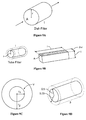
- the recuperator can include a common filter design that is widely used in industry which is a tubular design with co-axial tubes. This type of design is especially common in water filters and for use in compressed in air lines.
- the recuperator is provided as a tubular filter as exemplified in Figure 3A and B . As depicted in Figure 3A and B , the tubular filter can be constructed from three concentric tubes, with the filter medium being held tightly in place in a perforated section of the interior. The tubular filter can hold the silica gel or ascorbic acid dust in place in the annulus between the two perforated tubes.
- a filter medium can be placed on both contact sides of the silica gel or ascorbic acid dust.
- the powder or dust can be compressed during filing without the compression material coming into contact with the flowing air stream.
- the aspect ratio will be easier to handle adjacent to the patient, where a small diameter shape can be used.
- the tubular filter can include an exit shell as depicted in Figure 3B , an inside shell that includes perforated inner and outer tubes with fixed annulus and an annulus filled with silica gel or ascorbic acid dust.
- the inner and outer annulus can be lined with filter material.
- the final assembly of the tubular filter is depicted in Figure 3B .
- the final assembly can include a top cap and an annular ring at the top can keep pressure on the silica gel or ascorbic acid dust.
- a method of NO and NO 2 gas sampling is provided.
- 1.70 ppm of NO 2 can be formed in the gas sampling lines from the reaction of NO with oxygen.
- the problem is how to sample for NO 2 in a gas stream that has the reaction of NO and oxygen going on at the same time. This is made worse at high NO concentrations.
- the rate of formation of NO 2 in the sample line is 4 times the rate as compared to 100 ppm.
- the rate is 5 times the rate in air.
- the sample tube from the patient to the detector can be diluted up to 66%, or up to 50% or up to 33%.
- the sample can be diluted at the sample point.
- the sample can be diluted with air.
- dilution of one part sample and one part with air can reduce the water concentration in the sample.
- the sample can also be diluted as follows: one part sample and two parts with air from the room (e.g. hospital room).
- the sample can also be diluted using bone dry air from the wall.
- sample tube can be spliced in two or three, adjacent to the sampling point on the recuperator. This can be done for 50 or 66% dilution.
- the gas cylinder and appropriate amount of NO 2 for clinical use is provided.
- the OSHA NO 2 level is 5ppm. All the three gas cylinders described herein are approximately equivalent in the amount of gas that they can deliver.
- Size AS of the cylinder is pressurized to 2000 psi.
- the sudden release of the entire contents of 3600 L of 124 ppm would lead to a NO 2 level of 5.0 ppm in the room, if there was no air exchange.
- the highest concentration in a gas cylinder of this size and type should be 100 ppm of NO 2 (with a built in safety factor).
- the key advantage is that the cylinder is small and light enough to be stocked in a pharmacy and picked up by a nurse with one hand.
- the ideal oxygen level in a cylinder of this size would be about 60%.
- the 3000 PSI Luxfer Cylinder offers the best performance and is the preferred package. Table 1 shows the specifications of the cylinders described herein.
- the physical layout of the recuperator is able to accommodate the 4.5 inch diameter cylinder, and an output tube that contains activated charcoal powder.
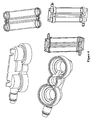
- a tube design is exemplified in Figure 4 .
- the revised design depicted in Figure 5 has the two main tubes as close together as possible, with the small vertical tubes tucked in close.
- the entire package has to fit inside a 4.5 inch or less gas cylinder top. This is shown schematically in Figure 5 .
- Each main tube that holds the ascorbic acid/silica gel dust has an inside diameter of about 1 inch.
- the inlet and outlet tubes need to be on the same side.
- the short tube can contain a small amount of activated charcoal to remove traces of acetaldehyde.
- the gas bottle contains a mixture of 60% oxygen with the balance being N 2 .
- the gas also contains about 400 ppm of NO 2 . This gas leaves the gas cylinder through a built in regulator where the pressure is reduced to the 20 to 100 psi level.
- the gas is attached to a separate blending box by means of a unique quick disconnect.
- the gas containing 400ppm NO 2 is then blended with an air/oxygen mixture to reduce the NO 2 concentration to the therapeutic concentration. In current use, this is 0.1 to 80 ppm. In one aspect of the system, this could be extended upwards to >200 ppm.
- the blender dial is calibrated in ppm equivalents of NO.
- the gas leaving the blender flows onto the NO generation cartridge by means of a quick disconnect attachment.
- the air oxygen blender is a conventional design and is available commercially. The air and oxygen are typically supplied from the hospital wall supply as a utility. Alternatively, the gas can flow through the ventilator first before the cartridge to reduce the gas pressure from 50 to 20 psa.
- the cartridge converts the NO 2 to NO.
- the gas now has NO at the proper therapeutic concentration in an air oxygen blend of the appropriate oxygen concentration.
- the gas leaving the cartridge is connected back to the blending box by means of a quick disconnect fitting, where the oxygen concentration can be sampled and displayed.
- an oxygen sensor can be used to precisely set the appropriate oxygen concentration.
- the reason for the three connections to the blender box is to allow quick replacement of the gas cylinder.
- a second cylinder will be plumbed to an identical set of three quick disconnect fittings on the blender box.
- a single three stack valve is used to switch from one gas cylinder to another, allowing for the empty cylinder to be replaced. This is not shown on the Figure 6A .
- the gas mixture from the blender box becomes replaces the oxygen feed on a conventional medical ventilator.
- the ventilator is then used in its conventional mode and can perform whatever ventilatory cycles that the therapist desires for a particular patient.
- the device is intended to provide the physician a mechanism for delivering a low concentration (dose) of pure NO gas in a mixture of oxygen and air.
- the gas passes through a mechanical or manual ventilator and travels through respiratory tubing and a mask or tube to the patient's lungs.
- the gas flow can be regulated by a mechanical ventilator or manual ventilation or by delivery directly to the patient from the pressurized gas tank (for spontaneously breathing patients).
- the device allows the physician to independently adjust the NO concentration and the oxygen concentration of the delivered gas.
- the device is indicated to provide pure NO gas at different concentrations in an oxygen/air mixture.
- the Nitric Oxide (NO) Generator and Delivery System include five components that work together to create, deliver and monitor pure Nitric Oxide (NO) gas in an oxygen/air mixture.
- the gas travels through standard anesthesia and respiratory breathing devices for inhalation by the patient.
- the anesthesia part is only needed to provide variable flow rates and/or to assist patients who are not breathing on their own.
- the gas bottle stands alone and the gas is converted to NO as it leaves the gas bottle. With this approach the gas is then fed into a mask or a cannula.
- the gas flow is provided by mechanical or manual ventilation or by the pressurization of the tank (for spontaneously breathing patients).
- the concentration of NO and Oxygen are determined and adjusted by the physician based on each patient's condition and needs.
- the first component is a pressurized aluminum gas tank with a small quantity of Nitrogen Dioxide (NO 2 ) gas in an Oxygen/Air mixture. This mixture cannot be inhaled without processing by the other components as it would be toxic.
- the tanks will come with a standard regulator to limit the pressure of the gas to the mixer. Tanks will have concentrated level of NO 2 gas and in a fixed Oxygen/Air ratio. These concentrations will be adjusted using the mixing system below. Tanks used or transport will be at set concentrations of NO 2 gas and Oxygen/Air and will not require mixing.
- the mixing system includes two standard gas blenders that are connected and an oxygen sensor.
- the first mixing chamber takes medical oxygen and air, which can be provided from pressurized tanks or the hospital's gas system.
- a knob allows selection of the desired FiO 2 (fraction of inspired oxygen) of the gas to be delivered to the patient which adjusts the oxygen/air mixture in the mixing chamber as measured by the oxygen sensor..
- the output of this mixture is fed into a second mixing chamber where it is mixed with the NO 2 gas from the gas tank described above.
- the knob to this mixing chamber allows the physician to select the concentration of NO gas to be delivered to the patient.
- the output of this mixing chamber is the passed though the gas converter and purification cartridge described below. This allows variable NO and oxygen concentration levels which are independent of each other.
- the gas mixture from the last mixer will flow through the Gas Converter and Purification cartridge.
- This cartridge will convert all NO 2 gas into NO gas and remove any impurities in the entire gas mixture.
- the concentration of NO gas will be the same as the concentration of the NO 2 gas as the conversion is essentially 100%.
- the concentration of the oxygen (oxygen/air ratio) will not be changed.
- the output of the cartridge will be delivered to the mechanical or manual ventilation system and appropriate pressures. Tanks used for transport will also be fitted with a flow meter to regulate the flow of the gas to the patient.
- the Recuperator cartridge will be placed at the patient end of the inspiratory limb of the patient's breathing tubing.
- This cartridge will contain he same technology as the Gas Converter The purpose of this cartridge is twofold. First, it will reconvert any NO 2 gas back into NO that may have formed through the reaction of the NO gas with oxygen. Second it provides bacterial and viral filtration of the delivered gas.
- recuperator The obvious format for the recuperator is to make it much like the gas cylinder device, but with the diameter of the order of 3 to 4 inches, and the cartridge depth reduced from 5.5 inches to less than 0.3 inches.
- a cartridge like this has a pancake shape and would look similar to the particle filters that are used with some respiratory equipment.
- the calculations of pressure drop for various diameters are shown in Table 2.
- a pressure drop of 0.2 - 0.3 cm water at 5L/min is needed to attain the design goal of 3.0 cm H 2 O at 60 L/min.
- the diameter of the flat disc would need to be 4.0 to 4.5 inches. If it were to have the same amount of material as the current cylinder cartridge, the depth would need to be 0.56 cm at 4.00 inches and 0.44 inches at 4.5 inches.
- FIG. 7 A flat disc of 3 inches diameter and a 1.0 cm thickness, has been tested in the laboratory and has been shown to perform as well as the cylinder cartridge.
- Various concepts have been evaluated on how to build such a device. The difficulty is how to encapsulate the silica gel or ascorbic acid dust between two very thin filter cloths, and have not only uniform thickness everywhere, but also no settling of the silica gel or ascorbic acid dust. Settling would be catastrophic and could lead to channeling and failure.
- An example of one such design is shown in Figure 2B .
- V 2 ⁇ r 21 2 l
- V 1 ⁇ r 1 2 l
- V Volume of silica gel or ascorbic acid Dust
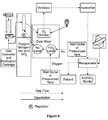
- the system may require gas sensors to monitor and display the concentration of NO and NO 2 that is delivered to the patient. These can be commercially available monitors and should be equipped with alarm capability. A figurative representation of the system is shown on Figure 8 .
- NO readings are reduced at all concentrations by 50%. This means 20 ppm reads as 10, and 2 ppm reads as 1ppm. This is corrected for by calibration, but the precision will be reduced by 50%.
- NO 2 formation in the lines is effectively reduced to zero at normal concentrations.
- the NO 2 formed in the lines would be 1.09 ppm without dilution and ⁇ 0.16 ppm with dilution.
- NO readings are reduced at all concentrations by 1/3rd. This means 20 ppm reads as 6.67, and 2 ppm reads as 0.67ppm. This is corrected for by calibration, but the precision will be reduced by 1/3 rd .
- NO 2 formation in the lines is effectively reduced to zero at normal concentrations.
- the NO 2 formed in the lines would be 1.09 ppm without dilution and ⁇ 0.05 ppm with dilution.
- the amount of water at 100% relative humidity is 44 g/M 3 .
- the air in a hospital is typically at 50% relative humidity and a temperature of 22° C. Air at this temperature contains 10g/M 3 .
- the detectors are required to run at constant temperature so as to ensure stability. Thus the inside of the detection module would be warm. A 50:50 dilution would work as long as the sample lines were insulated by a thick wall or by having one tube run inside another.
- the sample tube could be spliced in two (or three), adjacent to the sampling point on the recuperator.
- the second sampling orifice could be molded into a special adaptor. It would be best not to have a flapping air sample port, since it would raise too many questions from users. This would allow for taking half the sample from the patient inspiratory line and half the sample from the room. Calibration would also have to be at this point. Technically, this would be a perfectly valid way to operate and would meet all regulatory approval guidelines. Naturally, the approach be described in regulatory submissions which would also reference the EPA standard procedures.
- Dilution at the sample point is a perfectly viable approach. There would also probably be no need to have the large dead volume water condensation trap on the detector. This would reduce the NO 2 formation level even further, by as much as a factor of 5. The life of detector cells would increase from days to about 12 months, even during in house testing. Dilution is the preferred method of sampling the reactive gas stream.
- the gas bottle alone can be used for all applications of NO. It is available to deliver the gas without any electronics whatsoever.
- the advantages of the system are simplicity, no mixing, no electronics and no software. Just connect the regulator and open the valve.
- the gas bottle system can also be used with a dilutor.
- the gas would be shipped as say 1000ppm of NO 2 in oxygen.
- the user's equipment would then dilute this concentration down to say 20 ppm NO 2 .
- the second stage would be to insert the cartridge and convert to NO. this format would be similar to what is currently marketed, but would not require the user to worry about any NO 2 that was formed in the gas lines since it would be removed by the recuperator.
- the recuperator cartridge could be used with existing system to convert all of the residual NO 2 gas being inhaled into the therapeutic form, namely NO. The recuperator also ensures that no NO gas is lost from the system and that the patient is receiving the full prescribed dose.
- Table 1 Name Height Inches Diameter Inches Internal Volume L Weight Pounds Pressure Volume L Max Conc PPM LAB AS 48 8 29.45 48 2000 3600 100(124) INCURRENT USE AQ/BL/88 33 7.25 15.57 30 2000 1918 200(233) LUXFER ME36 25.3 4.4 4.5 8.3 3000 992 400(450) Table 2.
Landscapes
- Health & Medical Sciences (AREA)
- Life Sciences & Earth Sciences (AREA)
- Veterinary Medicine (AREA)
- General Health & Medical Sciences (AREA)
- Chemical & Material Sciences (AREA)
- Public Health (AREA)
- Animal Behavior & Ethology (AREA)
- Engineering & Computer Science (AREA)
- Pulmonology (AREA)
- Organic Chemistry (AREA)
- Anesthesiology (AREA)
- Heart & Thoracic Surgery (AREA)
- Emergency Medicine (AREA)
- Hematology (AREA)
- Biomedical Technology (AREA)
- Inorganic Chemistry (AREA)
- Pharmacology & Pharmacy (AREA)
- Medicinal Chemistry (AREA)
- Chemical Kinetics & Catalysis (AREA)
- General Chemical & Material Sciences (AREA)
- Bioinformatics & Cheminformatics (AREA)
- Nuclear Medicine, Radiotherapy & Molecular Imaging (AREA)
- Epidemiology (AREA)
- Cardiology (AREA)
- Biodiversity & Conservation Biology (AREA)
- Ecology (AREA)
- Environmental & Geological Engineering (AREA)
- Environmental Sciences (AREA)
- Molecular Biology (AREA)
- Electrochemistry (AREA)
- Physics & Mathematics (AREA)
- Analytical Chemistry (AREA)
- Biochemistry (AREA)
- General Physics & Mathematics (AREA)
- Immunology (AREA)
- Pathology (AREA)
- Wood Science & Technology (AREA)
- Zoology (AREA)
- Pharmaceuticals Containing Other Organic And Inorganic Compounds (AREA)
- Catalysts (AREA)
Claims (12)
- Vorrichtung zur Umwandlung von Stickstoffdioxid in Stickstoffmonoxid, umfassend
ein Gefäß, das einen Einlass, einen Auslass, ein oberflächenaktives Material, beschichtet mit einer wässrigen Lösung von Antioxidans, und ein Absorbens einschließt,
wobei der Einlass zum Empfangen eines Gasstroms und zum fluidtechnischen Kommunizieren des Gasflusses zu dem Auslass durch das oberflächenaktive Material und das Absorbens hindurch konfiguriert ist, so dass Stickstoffdioxid in dem Gasfluss in Stickstoffmonoxid umgewandelt wird;
wobei die Vorrichtung ferner ein Abfangmittel für NO2 ausgewählt aus der Gruppe bestehend aus Prolin und Diphenylamin umfasst; und
einen Rekuperator, der an den Auslass gekoppelt ist, wobei der Rekuperator vor der Abgabe an einen Patienten Stickstoffdioxid in Stickstoffmonoxid umwandelt, wobei der Rekuperator eine Austrittshülse einschließt, die einen Auslass einschließt;
eine Innenhülse, wobei die Innenhülse perforierte innere und äußere Schläuche mit fixiertem Ringraum einschließt;
ein oberflächenaktive Material, beschichtet mit einer wässrigen Lösung von Ascorbinsäure, ein Absorbens und
eine obere Kappe, die einen Ringraumring um die obere Kappe herum einschließt, und einen Einlass, wobei der Einlass zum Empfangen eines Gasstroms und zum fluidtechnischen Kommunizieren des Gasflusses durch das oberflächenaktive Material hindurch zu dem Auslass konfiguriert ist, so dass Stickstoffdioxid in dem Gasfluss in Stickstoffmonoxid umgewandelt wird. - Vorrichtung nach Anspruch 1, wobei das Absorbens Silikagel oder aktiviertes Aluminiumoxid ist.
- Vorrichtung nach Anspruch 1, wobei das Antioxidans Ascorbinsäure, alpha-Tocopherol oder gamma-Tocopherol umfasst.
- Vorrichtung nach Anspruch 1, wobei der Rekuperator einen Strömungswiderstand von weniger als 3 cm Wasserdruck bei einem Fluss von 60 L/Minute aufweist.
- Vorrichtung nach Anspruch 1, wobei der Rekuperator bei atmosphärischem Druck betrieben wird.
- Vorrichtung nach Anspruch 1, wobei der Rekuperator eine Sauerstoffkonzentration im Bereich von 21 bis 100% aufweist.
- Vorrichtung nach Anspruch 1, wobei der Rekuperator eine Feuchtigkeit von trocken bis 99% (nicht kondensierend) aufweist, wobei der Rekuperator gegebenenfalls durch eine befeuchtete Leitung an den Auslass eines ersten Geräts gekoppelt ist.
- Vorrichtung nach Anspruch 1, wobei der Rekuperator thermisch isoliert ist.
- Vorrichtung nach Anspruch 1, wobei der Rekuperator an einen NO/NO2-Gasanalysator gekoppelt ist.
- Vorrichtung nach Anspruch 1, wobei der Rekuperator ferner einen Partikelfilter umfasst.
- Verfahren zum Bereitstellen einer therapeutischen Menge an Stickstoffmonoxid an einen Säuger, umfassend:Diffundieren von Stickstoffdioxid in einen Gasfluss;Umwandeln von Stickstoffdioxid in Stickstoffmonoxid, indem das Stickstoffdioxid der Vorrichtung gemäß einem der Ansprüche 1-10 ausgesetzt wird; undTransportieren des Stickstoffmonoxids in einer therapeutischen Menge zu einem Säuger.
- System zum Abgeben von Stickstoffmonoxid an einen Patienten, umfassend:eine Gasquelle für Stickstoffdioxid, Distickstofftetraoxid oder Stickstoffmonoxid;ein erstes Gerät mit einem Einlass, einem Auslass und einer porösen festen Matrix, die zwischen dem Einlass und dem Auslass positioniert ist, wobei die poröse feste Matrix mit einer wässrigen Lösung eines Antioxidans beschichtet ist, und wobei der Einlass zum Empfangen eines Gasflusses von der Quelle und zum fluidtechnischen Kommunizieren des Gasflusses durch die poröse feste Matrix hindurch zu dem Auslass konfiguriert ist, um Stickstoffdioxid in dem Gasfluss in Stickstoffmonoxid umzuwandeln; undeinen Rekuperator gemäß einem der Ansprüche 1-10, der an den Auslass des ersten Geräts gekoppelt ist, wobei der Rekuperator vor der Abgabe an den Patienten Stickstoffdioxid in Stickstoffmonoxid umwandelt.
Applications Claiming Priority (2)
| Application Number | Priority Date | Filing Date | Title |
|---|---|---|---|
| US2417808P | 2008-01-28 | 2008-01-28 | |
| PCT/US2009/032254 WO2009097343A1 (en) | 2008-01-28 | 2009-01-28 | Conversion of nitrogen dioxide (no2) to nitric oxide (no) |
Publications (3)
| Publication Number | Publication Date |
|---|---|
| EP2247381A1 EP2247381A1 (de) | 2010-11-10 |
| EP2247381A4 EP2247381A4 (de) | 2014-06-04 |
| EP2247381B1 true EP2247381B1 (de) | 2016-11-30 |
Family
ID=40913206
Family Applications (1)
| Application Number | Title | Priority Date | Filing Date |
|---|---|---|---|
| EP09705246.8A Active EP2247381B1 (de) | 2008-01-28 | 2009-01-28 | Umwandlung von stickstoffdioxid (no2) in stickstoffmonoxid (no) |
Country Status (6)
| Country | Link |
|---|---|
| US (10) | US7914743B2 (de) |
| EP (1) | EP2247381B1 (de) |
| JP (2) | JP5554723B2 (de) |
| AU (1) | AU2009209181B2 (de) |
| CA (1) | CA2713049C (de) |
| WO (1) | WO2009097343A1 (de) |
Families Citing this family (39)
| Publication number | Priority date | Publication date | Assignee | Title |
|---|---|---|---|---|
| WO2006023616A2 (en) * | 2004-08-18 | 2006-03-02 | Geno Llc | Conversion of nitrogen dioxide (no2) to nitric oxide (no) |
| US7618594B2 (en) | 2004-08-18 | 2009-11-17 | Geno Llc | Conversion of nitrogen dioxide (NO2) to nitric oxide (NO) |
| EP2131903B1 (de) * | 2007-03-23 | 2018-01-24 | Geno LLC | Umwandlung von stickstoffdioxid (no2) in stickoxid (no) |
| EP2247381B1 (de) | 2008-01-28 | 2016-11-30 | Geno LLC | Umwandlung von stickstoffdioxid (no2) in stickstoffmonoxid (no) |
| US8434475B2 (en) * | 2008-01-31 | 2013-05-07 | Genosys, Inc. | Nitric oxide reactor and distributor apparatus and method |
| US8607785B2 (en) | 2008-08-21 | 2013-12-17 | Geno Llc | Systems and devices for generating nitric oxide |
| US8613958B2 (en) | 2009-06-22 | 2013-12-24 | Geno Llc | Nitric oxide therapies |
| CA2781295C (en) * | 2009-11-20 | 2018-02-13 | Geno Llc | Nitric oxide delivery system |
| ES2873089T3 (es) * | 2010-02-01 | 2021-11-03 | Vero Biotech LLC | Sistema de administración de óxido nítrico |
| CA2706495A1 (en) * | 2010-06-08 | 2011-12-08 | Alan B. Morison | Particulate scavenger medium canister |
| WO2012075420A1 (en) | 2010-12-03 | 2012-06-07 | Geno Llc | Nitric oxide treatments |
| EP2688625A4 (de) * | 2011-03-24 | 2016-02-17 | Medclair AB | Vorrichtung zur zersetzung von stickoxid in einem gasstrom |
| CA2837341C (en) | 2011-05-27 | 2021-10-19 | Geno Llc | Method of determining vasoreactivity using inhaled nitric oxide |
| US10449321B2 (en) | 2012-03-30 | 2019-10-22 | The Regents Of The University Of Michigan | Gas delivery devices |
| FR2991025B1 (fr) * | 2012-05-24 | 2014-07-04 | Air Liquide Sante Int | Conditionnement d'un melange gazeux no/azote a haute concentration en no |
| WO2014071350A1 (en) * | 2012-11-05 | 2014-05-08 | Geno Llc | Dual platform system for the delivery of nitric oxide |
| US10517817B2 (en) | 2013-05-09 | 2019-12-31 | Syk Technologies, Llc | Deep topical systemic nitric oxide therapy apparatus and method |
| PT4316555T (pt) | 2014-05-09 | 2025-10-07 | Mallinckrodt Pharmaceuticals Ireland Ltd | Sistemas para administração de gás terapêutico |
| US10525226B2 (en) * | 2014-05-14 | 2020-01-07 | Mallinckrodt Hospital Products IP Limited | Systems and methods for indicating lifetime of an NO2-to-NO reactor cartridge used to deliver NO for inhalation therapy to a patient |
| JP2017534422A (ja) * | 2014-10-20 | 2017-11-24 | ゲノ エルエルシー | 二酸化窒素貯蔵カセット |
| EP3020438A1 (de) * | 2014-11-13 | 2016-05-18 | Linde AG | Vorrichtung zur Beatmung eines Patienten und Verfahren zum Betreiben einer Vorrichtung zur Beatmung eines Patienten |
| WO2017132275A1 (en) | 2016-01-27 | 2017-08-03 | Syk Technologies, Llc | Nitric oxide topical application apparatus and methods |
| US20180071467A1 (en) * | 2016-09-10 | 2018-03-15 | Geno Llc | System and method for portable nitric oxide delivery |
| MX2020010523A (es) | 2017-02-27 | 2021-02-09 | Third Pole Inc | Sistemas y metodos para generar oxido nitrico. |
| CN110770163B (zh) | 2017-02-27 | 2021-08-31 | 第三极股份有限公司 | 用于移动生成一氧化氮的系统和方法 |
| CA3054656A1 (en) | 2017-02-27 | 2018-08-30 | Third Pole, Inc. | Systems and methods for generating nitric oxide |
| WO2019175674A2 (en) * | 2018-03-13 | 2019-09-19 | Regev Gilly | Nitric oxide releasing compositions |
| US11672938B1 (en) * | 2018-07-18 | 2023-06-13 | Vero Biotech LLC | Start-up protocols for nitric oxide delivery device |
| US11754538B1 (en) * | 2018-07-18 | 2023-09-12 | Vero Biotech Inc. | Method and apparatus for automatic calibration |
| JP2022532654A (ja) | 2019-05-15 | 2022-07-15 | サード ポール,インコーポレイテッド | 一酸化窒素を生成するシステム及び方法 |
| JP2022533628A (ja) | 2019-05-15 | 2022-07-25 | サード ポール,インコーポレイテッド | 一酸化窒素生成用電極 |
| EP3969016A4 (de) | 2019-05-15 | 2023-08-16 | Third Pole, Inc. | Architekturen zur herstellung von stickoxid |
| EP4069069A4 (de) | 2020-01-11 | 2024-07-03 | Third Pole, Inc. | Systeme und verfahren zur stickoxid-erzeugung mit feuchtigkeitsregelung |
| US20210395905A1 (en) | 2020-06-18 | 2021-12-23 | Third Pole, Inc. | Systems and methods for preventing and treating infections with nitric oxide |
| US12509349B2 (en) | 2020-10-16 | 2025-12-30 | Third Pole, Inc. | Nitric oxide generation process controls |
| EP4405019A4 (de) | 2021-09-23 | 2025-07-16 | Third Pole Inc | Systeme und verfahren zur abgabe von stickoxid |
| CN114538392B (zh) * | 2021-12-22 | 2023-07-21 | 合肥雅美娜环境医疗设备有限公司 | 一种治疗仪治疗气再利用结构 |
| WO2023201363A2 (en) | 2022-04-14 | 2023-10-19 | Third Pole, Inc. | Delivery of medicinal gas in a liquid medium |
| CN115290698B (zh) * | 2022-07-19 | 2026-02-06 | 杭州朋谱科技有限公司 | 一种氧化锆湿度传感器低压补偿方法 |
Family Cites Families (136)
| Publication number | Priority date | Publication date | Assignee | Title |
|---|---|---|---|---|
| US1021234A (en) | 1911-05-10 | 1912-03-26 | Hoechst Ag | Process of manufacturing pure nitric oxid. |
| US2083520A (en) * | 1933-01-04 | 1937-06-08 | Power Patents Co | Gas analyzing process and apparatus |
| US2272810A (en) | 1937-03-10 | 1942-02-10 | Ici Ltd | Printing cellulosic textile materials |
| US2696430A (en) * | 1950-05-03 | 1954-12-07 | John A Gallaghan | Stabilizers for nitro-cellulose mixtures |
| US3106458A (en) | 1960-12-14 | 1963-10-08 | Drager Otto H | Process for detecting nitrogen dioxide in gases |
| GB1241858A (en) | 1968-12-30 | 1971-08-04 | Ici Ltd | Sorption of nitrogen dioxide by polyamides |
| US3620685A (en) * | 1969-07-30 | 1971-11-16 | Phillips Petroleum Co | Radial flow catalyst reactor |
| US3958580A (en) | 1974-02-15 | 1976-05-25 | Hoffmann-La Roche Inc. | Treatment of tobacco with ascorbic acid |
| NL7413636A (nl) | 1974-10-17 | 1976-04-21 | Shell Int Research | Werkwijze voor het vullen van een reactor met vaste deeltjes. |
| US3930813A (en) | 1974-11-27 | 1976-01-06 | General Electric Company | Process for producing nitrogen dioxide-free oxygen-enriched gas |
| US3979501A (en) * | 1975-03-28 | 1976-09-07 | Meloy Laboratories, Inc. | Method and apparatus for converting nitrogen dioxide to nitric oxide |
| US4004882A (en) * | 1975-08-14 | 1977-01-25 | Monitor Labs, Incorporated | Gas analysis diluter |
| US4010897A (en) | 1976-03-31 | 1977-03-08 | Charles F. Kettering Foundation | Method and apparatus for home production and application of nitrogen fertilizer |
| NL7707839A (nl) | 1977-07-14 | 1979-01-16 | Philips Nv | Inrichting voor het kwantitatief reduceren van stikstofdioxyde in gasmengsels. |
| IL57239A (en) | 1979-05-08 | 1982-04-30 | Alamaro Moshe | Production of nitric oxides |
| US4778450A (en) | 1979-07-12 | 1988-10-18 | Baxter Travenol Laboratories, Inc. | Fluid flow control system |
| US4270933A (en) | 1980-03-19 | 1981-06-02 | Meny Allan H | Regenerative, fluid filter |
| US4433707A (en) | 1981-09-25 | 1984-02-28 | Chevron Research Company | Method and apparatus for level loading of vessels using catalyst oriented packing |
| US4399942A (en) | 1981-11-09 | 1983-08-23 | Gc Industries | Gas emitting device |
| FR2541588B1 (fr) * | 1983-02-28 | 1985-07-05 | Air Liquide | Recipient et installation d'epuration par adsorption |
| JPH0416198Y2 (de) * | 1984-11-02 | 1992-04-10 | ||
| GB8516333D0 (en) | 1985-06-28 | 1985-07-31 | Johnson Matthey Plc | Nitric oxide |
| US4657744A (en) * | 1985-07-02 | 1987-04-14 | Sensors, Inc. | Chemiluminescent gas analyzer for measuring the oxides of nitrogen |
| US4822564A (en) * | 1985-07-02 | 1989-04-18 | Sensors, Inc. | Chemiluminescent gas analyzer for measuring the oxides of nitrogen |
| JPS6247371A (ja) * | 1985-08-26 | 1987-03-02 | 帝人株式会社 | 酸素富化気体供給装置 |
| DE3823381A1 (de) | 1987-11-03 | 1989-05-24 | Draegerwerk Ag | Kreislaufatemschutzgeraet |
| US4963327A (en) | 1988-03-23 | 1990-10-16 | Z-Gard, Inc. | Oxygen generating module |
| US4993436A (en) | 1989-12-21 | 1991-02-19 | Bloom Jr Walter L | Aspirating and volatilizing liquid dispenser |
| US5683668A (en) | 1990-09-20 | 1997-11-04 | The United States Of America As Represented By The Department Of Health And Human Services | Method of generating nitric oxide gas using nitric oxide complexes |
| DE122007000103I1 (de) | 1990-12-05 | 2008-04-03 | Gen Hospital Corp | Verwendung von NO zur Behandlung der persistenten pulmonalen Hypertonie des Neugeborenen |
| US5396882A (en) | 1992-03-11 | 1995-03-14 | The General Hospital Corporation | Generation of nitric oxide from air for medical uses |
| US5570683A (en) | 1990-12-05 | 1996-11-05 | The General Hospital Corporation | Methods and devices for treating pulmonary vasoconstriction and asthma |
| US5206230A (en) | 1991-06-05 | 1993-04-27 | Daikin Industries, Ltd. | Fluorine-containing vitamin D3 analogues and pharmaceutical composition containing the same |
| US5228434A (en) | 1991-07-16 | 1993-07-20 | Praxair Technology, Inc. | Mixture for anesthesia |
| GB9120013D0 (en) | 1991-09-19 | 1991-11-06 | Wellcome Found | Method and apparatus for administering respirable pharmaceutical particles |
| US5405919A (en) | 1992-08-24 | 1995-04-11 | The United States Of America As Represented By The Secretary Of Health And Human Services | Polymer-bound nitric oxide/nucleophile adduct compositions, pharmaceutical compositions and methods of treating biological disorders |
| US5525357A (en) | 1992-08-24 | 1996-06-11 | The United States Of America As Represented By The Department Of Health And Human Services | Polymer-bound nitric oxide/nucleophile adduct compositions, pharmaceutical compositions incorporating same and methods of treating biological disorders using same |
| FR2695831B1 (fr) | 1992-09-24 | 1994-11-10 | Air Liquide | Installation et procédé de fourniture d'un mélange gazeux aux voies respiratoires d'un utilisateur. |
| AU6232794A (en) | 1993-01-29 | 1994-08-15 | Brigham And Women's Hospital | The use of nitric oxide-delivering compounds for the treatment or prevention of alcoholic liver injury |
| CA2169859A1 (en) | 1993-09-13 | 1995-03-23 | Niels Jacobsen | Method and means for generating nitric oxide |
| US5670125A (en) | 1993-09-30 | 1997-09-23 | The Boc Group, Inc. | Process for the purification of nitric oxide |
| GB9320978D0 (en) | 1993-10-12 | 1993-12-01 | Higenbottam Timohy W | Nitric oxide treatment |
| US5558083A (en) | 1993-11-22 | 1996-09-24 | Ohmeda Inc. | Nitric oxide delivery system |
| JPH07187622A (ja) | 1993-12-22 | 1995-07-25 | Osaka Gas Co Ltd | 低濃度noの製造方法及びno2の測定方法 |
| US6709681B2 (en) | 1995-02-17 | 2004-03-23 | Aberdeen University | Acidified nitrite as an antimicrobial agent |
| DE4419860A1 (de) | 1994-06-07 | 1995-12-14 | Hoechst Ag | Verfahren und Filter zur Herstellung von NO¶2¶-freiem Stickstoffmonoxid mit schwefelhaltigen Polymeren |
| US5540077A (en) * | 1994-06-10 | 1996-07-30 | Scott Specialty Gases, Inc. | Method and gas mixture for calibrating an analyzer |
| US5514204A (en) | 1994-07-07 | 1996-05-07 | The Boc Group, Inc. | Process for the purification of nitric oxide |
| US5417950A (en) | 1994-07-07 | 1995-05-23 | The Boc Group, Inc. | Process for the purification of nitric oxide |
| US5583101A (en) | 1994-07-15 | 1996-12-10 | Harvard College | Use of nitrogen oxide species and adducts to inhibit skeletal muscle contraction |
| US5615669A (en) | 1994-07-22 | 1997-04-01 | Siemens Elema Ab | Gas mixture and device for delivering the gas mixture to the lungs of a respiratory subject |
| JPH0847534A (ja) | 1994-08-05 | 1996-02-20 | Naoki Yahagi | No吸入装置 |
| US6190704B1 (en) | 1994-09-23 | 2001-02-20 | New York Society For The Ruptured And Crippled Maintaining The Hospital For Special Surgery | Regulation of wound healing by nitric oxide |
| DE4437895C1 (de) | 1994-10-22 | 1996-05-09 | Draegerwerk Ag | Vorrichtung zur Erzeugung von Sauerstoff |
| WO1996012551A1 (de) | 1994-10-25 | 1996-05-02 | Hoechst Aktiengesellschaft | Filtermaterial und verfahren zur herstellung von no2-freien gasen oder flüssigkeiten |
| US5823180A (en) | 1995-04-03 | 1998-10-20 | The General Hospital Corporation | Methods for treating pulmonary vasoconstriction and asthma |
| DE19517857C1 (de) | 1995-05-16 | 1996-05-09 | Ruesch Willy Ag | Beatmungsbeutel |
| US5722392A (en) | 1995-05-19 | 1998-03-03 | University Of Florida | Breathable gas mixing devices, breathing systems and methods |
| US6046383A (en) | 1995-09-11 | 2000-04-04 | Seminis Vegetable Seeds, Inc. | Cytoplasmic male sterile Brassica oleracea plants which contain the polima CMS cytoplasm and are male sterile at high and low temperatures |
| US6158432A (en) * | 1995-12-08 | 2000-12-12 | Cardiopulmonary Corporation | Ventilator control system and method |
| ES2190467T3 (es) | 1996-02-27 | 2003-08-01 | Koster Henk W | Sistema de respiracion con un modulo de administracion de gas adicional. |
| DE19612289A1 (de) | 1996-03-28 | 1997-10-02 | Messer Griesheim Gmbh | Verfahren und Vorrichtung zur Minderung von Risiken bei der inhalativen NO-Therapie |
| US5692495A (en) | 1996-04-02 | 1997-12-02 | The Boc Group, Inc. | Method and apparatus for the production of nitric oxide gas mixture |
| US5829428A (en) | 1996-05-29 | 1998-11-03 | Alliance Pharmaceutical Corp. | Methods and apparatus for reducing the loss of respiratory promoters |
| IN192791B (de) | 1996-06-28 | 2004-05-22 | Johnson & Johnson Medical | |
| SE9602959L (sv) | 1996-08-12 | 1998-02-09 | Siemens Elema Ab | Förfarande vid blandning av gaser och en anordning för blandning av gaser |
| US6039783A (en) * | 1996-12-03 | 2000-03-21 | The United States Of America As Represented By The Administrator Of The National Aeronautics And Space Administration | Process and equipment for nitrogen oxide waste conversion to fertilizer |
| JPH10179742A (ja) * | 1996-12-25 | 1998-07-07 | Sumitomo Seika Chem Co Ltd | 携帯用一酸化窒素−酸素ガス供給装置およびその操作方法 |
| US6896899B2 (en) | 1996-12-31 | 2005-05-24 | Antioxidant Pharmaceuticals Corp. | Pharmaceutical preparations of glutathione and methods of administration thereof |
| US6086582A (en) | 1997-03-13 | 2000-07-11 | Altman; Peter A. | Cardiac drug delivery system |
| US5814129A (en) * | 1997-04-11 | 1998-09-29 | Air Products And Chemical, Inc. | Radial flow adsorption vessel |
| US6164276A (en) | 1997-05-16 | 2000-12-26 | Datex-Ohmeda, Inc. | Accurate dose nitric oxide pulse delivery device with monitoring and alarms |
| CA2617287C (en) | 1997-06-17 | 2011-11-15 | Fisher & Paykel Healthcare Limited | Respiratory humidification system |
| US5836362A (en) * | 1997-07-15 | 1998-11-17 | Praxair Technology, Inc. | Multiple adsorbent loading method and apparatus for a radial flow vessel |
| US5827420A (en) | 1997-07-29 | 1998-10-27 | World Precision Instruments, Inc. | Method and apparatus for the generation of nitric oxide |
| US5994444A (en) | 1997-10-16 | 1999-11-30 | Medtronic, Inc. | Polymeric material that releases nitric oxide |
| US6187937B1 (en) | 1998-01-16 | 2001-02-13 | Flexsys America L.P. | Preparation of N-phenyl-benzoquinoneimine from hydroxydiphenylamines |
| US6109260A (en) | 1998-02-18 | 2000-08-29 | Datex-Ohmeda, Inc. | Nitric oxide administration device with timed pulse |
| GB9812344D0 (en) | 1998-06-08 | 1998-08-05 | Euroflow Uk Ltd | Methods and apparatus for packing chromatography columns |
| US6103275A (en) | 1998-06-10 | 2000-08-15 | Nitric Oxide Solutions | Systems and methods for topical treatment with nitric oxide |
| WO2000011953A1 (en) | 1998-09-01 | 2000-03-09 | Penn State Research Foundation | Method and apparatus for aseptic growth or processing of biomass |
| US20070086954A1 (en) | 1998-11-23 | 2007-04-19 | Miller Christopher C | Method and apparatus for treatment of respiratory infections by nitric oxide inhalation |
| US6261594B1 (en) | 1998-11-25 | 2001-07-17 | The University Of Akron | Chitosan-based nitric oxide donor compositions |
| US6086659A (en) * | 1999-01-29 | 2000-07-11 | Air Products And Chemicals, Inc. | Radial flow adsorption vessel |
| US6576044B1 (en) | 1999-02-25 | 2003-06-10 | The Boc Group, Inc. | Process for the purification of nitric oxide |
| GB9905425D0 (en) | 1999-03-09 | 1999-05-05 | Queen Mary & Westfield College | Pharmaceutical composition |
| US20050142218A1 (en) | 2000-03-09 | 2005-06-30 | Queen Mary & Westfield College | Pharmaceutical composition containing nitrate source and an acidifying agent for treating skin ischaemia |
| WO2001008684A1 (en) | 1999-07-28 | 2001-02-08 | The Board Of Trustees Of The Leland Stanford Junior University | Nicotine in therapeutic angiogenesis and vasculogenesis |
| US20010012851A1 (en) | 1999-07-29 | 2001-08-09 | Kristin M. Lundy | Nitric oxide releasing oxindole prodrugs for anagesic, anti-inflammatory and disease-modifying use |
| US6231824B1 (en) | 1999-08-10 | 2001-05-15 | The Boc Group, Inc. | Removal of nitric oxide from gas streams |
| US6370911B1 (en) | 1999-08-13 | 2002-04-16 | Air Liquide America Corporation | Nitrous oxide purification system and process |
| IL143305A0 (en) | 1999-09-02 | 2002-04-21 | Rice University | Nitric oxide-producing hydrogel materials |
| EP1244455B1 (de) | 1999-10-29 | 2009-07-22 | Nitromed, Inc. | Verfahren zur behandlung von gefässerkrankungen, die sich durch eine insuffizienz von stickstoffmonoxid auszeichnen |
| US6758214B2 (en) | 2000-01-28 | 2004-07-06 | Cyterra Corporation | Simple nitric oxide generator for ambulatory and/or bedside inhaled no treatment |
| US6270779B1 (en) | 2000-05-10 | 2001-08-07 | United States Of America | Nitric oxide-releasing metallic medical devices |
| GB0022084D0 (en) | 2000-09-08 | 2000-10-25 | Univ Aberdeen | Treatment of multiply antibiotic-resistant organisms |
| US7335181B2 (en) | 2000-12-26 | 2008-02-26 | Pulmonox Technologies Corporation | Nitric oxide decontamination of the upper respiratory tract |
| EP1380538A4 (de) | 2001-04-17 | 2006-10-04 | Tokuyama Corp | Verfahren zur herstellung von porösem anorganischem material |
| DE10119083C1 (de) | 2001-04-19 | 2002-11-28 | Joachim Alfred Wuenning | Kompakt-Dampf-Reformer |
| US6749834B2 (en) | 2001-06-19 | 2004-06-15 | World Precision Instruments, Inc. | Methods and apparatus for therapeutic treatment of respiratory, cardiac and other pathologies |
| US8066904B2 (en) * | 2001-09-05 | 2011-11-29 | Geno Llc | Controlled generation of nitric oxide |
| EP1323468A1 (de) | 2001-12-31 | 2003-07-02 | Grace GmbH & Co. KG | Adsorptionsmittel aus porösem funktionellem Feststoff eingelagert in einer Polymermatrix |
| US7258118B2 (en) | 2002-01-24 | 2007-08-21 | Sofotec Gmbh & Co, Kg | Pharmaceutical powder cartridge, and inhaler equipped with same |
| JP2003275583A (ja) * | 2002-03-20 | 2003-09-30 | Hitachi Zosen Corp | 二酸化窒素吸収剤 |
| JP2004065636A (ja) | 2002-08-07 | 2004-03-04 | Osaka Industrial Promotion Organization | 可搬型医療用一酸化窒素発生装置及び可搬型医療用一酸化窒素吸入装置 |
| US8381729B2 (en) | 2003-06-18 | 2013-02-26 | Breathe Technologies, Inc. | Methods and devices for minimally invasive respiratory support |
| JP2007504136A (ja) | 2003-08-28 | 2007-03-01 | ニトロメッド インコーポレーティッド | ニトロソ化およびニトロシル化利尿化合物、組成物、ならびに使用方法 |
| JP3994079B2 (ja) | 2003-10-06 | 2007-10-17 | 株式会社タバタ | ダイビング用レギュレータ |
| US20050217668A1 (en) * | 2003-10-24 | 2005-10-06 | Pulmonox Technologies Corporation | System and elements for managing therapeutic gas administration to a spontaneously breathing non-ventilated patient |
| US8017074B2 (en) | 2004-01-07 | 2011-09-13 | Noxilizer, Inc. | Sterilization system and device |
| JP2005205320A (ja) | 2004-01-22 | 2005-08-04 | Mitsubishi Chemicals Corp | 固体触媒の充填方法 |
| US7288664B2 (en) | 2004-03-30 | 2007-10-30 | Bela Kleiner | Reverse Kleiner method for manufacturing nitrogen dioxide, nitric oxide, nitric acid, metallic ascorbates and alkyl ascorbates of vitamin C |
| US7407632B2 (en) | 2004-05-28 | 2008-08-05 | Oxysure Systems, Inc. | Apparatus and delivery of medically pure oxygen |
| US7618594B2 (en) | 2004-08-18 | 2009-11-17 | Geno Llc | Conversion of nitrogen dioxide (NO2) to nitric oxide (NO) |
| WO2006023616A2 (en) | 2004-08-18 | 2006-03-02 | Geno Llc | Conversion of nitrogen dioxide (no2) to nitric oxide (no) |
| WO2006063056A1 (en) * | 2004-12-07 | 2006-06-15 | Access Business Group International Llc | Methods for scavenging oxidizing nitrogen and oxygen species with fragrances having antioxidative properties |
| US20070062532A1 (en) * | 2005-09-21 | 2007-03-22 | Choncholas Gary J | Apparatus and method for identifying optimal PEEP |
| EP1968584A2 (de) | 2005-12-20 | 2008-09-17 | Nitromed, Inc. | Stickoxid-verstärkende glutaminsäure-verbindungen, zusammensetzungen und anwendungsverfahren |
| US8028692B2 (en) | 2006-03-09 | 2011-10-04 | Ric Investments, Llc | Multi-sectioned conduit assembly |
| US8079998B2 (en) | 2006-10-20 | 2011-12-20 | Pulmonox Technologies Corporation | Methods and devices for the delivery of therapeutic gases including nitric oxide |
| EP2131903B1 (de) * | 2007-03-23 | 2018-01-24 | Geno LLC | Umwandlung von stickstoffdioxid (no2) in stickoxid (no) |
| US20090120212A1 (en) * | 2007-11-13 | 2009-05-14 | James Hargrove | NOy and Components of NOy by Gas Phase Titration and NO2 Analysis with Background Correction |
| EP2247381B1 (de) | 2008-01-28 | 2016-11-30 | Geno LLC | Umwandlung von stickstoffdioxid (no2) in stickstoffmonoxid (no) |
| US8607785B2 (en) | 2008-08-21 | 2013-12-17 | Geno Llc | Systems and devices for generating nitric oxide |
| US8701657B2 (en) | 2008-08-21 | 2014-04-22 | Geno Llc | Systems for generating nitric oxide |
| WO2010033916A1 (en) | 2008-09-22 | 2010-03-25 | Geno Llc | Conversion of nitrogen dioxide (no2) to nitric oxide (no) |
| US8613958B2 (en) | 2009-06-22 | 2013-12-24 | Geno Llc | Nitric oxide therapies |
| CA2781295C (en) | 2009-11-20 | 2018-02-13 | Geno Llc | Nitric oxide delivery system |
| ES2873089T3 (es) | 2010-02-01 | 2021-11-03 | Vero Biotech LLC | Sistema de administración de óxido nítrico |
| WO2011137122A1 (en) | 2010-04-26 | 2011-11-03 | Geno Llc | Nitrosyl special connector |
| AU2011245476B2 (en) | 2010-04-26 | 2016-05-12 | VERO Biotech LLC. | Delivery of ultra pure nitric oxide (NO) |
| US8313561B2 (en) * | 2010-10-05 | 2012-11-20 | Praxair Technology, Inc. | Radial bed vessels having uniform flow distribution |
| US9776161B2 (en) | 2010-12-03 | 2017-10-03 | Koninklijke Philips N.V. | Method and arrangement for generating nitric oxide |
| PT2661300T (pt) | 2011-01-06 | 2017-12-26 | Ino Therapeutics Llc | Dispositivo e sistema de distribuição de gás |
| CA2837341C (en) | 2011-05-27 | 2021-10-19 | Geno Llc | Method of determining vasoreactivity using inhaled nitric oxide |
| AU2014203438B2 (en) | 2013-06-25 | 2019-06-20 | Mallinckrodt Hospital Products IP Limited | Methods of reducing the risk of mortality associated with a medical treatment |
-
2009
- 2009-01-28 EP EP09705246.8A patent/EP2247381B1/de active Active
- 2009-01-28 CA CA2713049A patent/CA2713049C/en active Active
- 2009-01-28 JP JP2010544478A patent/JP5554723B2/ja active Active
- 2009-01-28 WO PCT/US2009/032254 patent/WO2009097343A1/en not_active Ceased
- 2009-01-28 US US12/361,274 patent/US7914743B2/en active Active
- 2009-01-28 AU AU2009209181A patent/AU2009209181B2/en active Active
-
2011
- 2011-03-25 US US13/072,466 patent/US8187544B2/en active Active
-
2012
- 2012-05-24 US US13/480,376 patent/US8609026B2/en active Active
-
2013
- 2013-12-16 US US14/107,535 patent/US8741222B2/en active Active
-
2014
- 2014-05-29 JP JP2014111284A patent/JP5952341B2/ja active Active
- 2014-06-02 US US14/294,070 patent/US9701538B2/en active Active
-
2017
- 2017-07-10 US US15/645,197 patent/US10081544B2/en active Active
-
2018
- 2018-09-24 US US16/140,497 patent/US20190092639A1/en not_active Abandoned
-
2019
- 2019-07-15 US US16/512,021 patent/US11312626B2/en active Active
-
2022
- 2022-04-22 US US17/727,489 patent/US11884541B2/en active Active
-
2023
- 2023-12-07 US US18/532,511 patent/US20240367975A1/en active Pending
Non-Patent Citations (1)
| Title |
|---|
| None * |
Also Published As
| Publication number | Publication date |
|---|---|
| CA2713049A1 (en) | 2009-08-06 |
| US7914743B2 (en) | 2011-03-29 |
| AU2009209181B2 (en) | 2014-01-16 |
| JP2014221204A (ja) | 2014-11-27 |
| US20110168174A1 (en) | 2011-07-14 |
| US20140102446A1 (en) | 2014-04-17 |
| US11312626B2 (en) | 2022-04-26 |
| US8187544B2 (en) | 2012-05-29 |
| JP5554723B2 (ja) | 2014-07-23 |
| US20190092639A1 (en) | 2019-03-28 |
| US11884541B2 (en) | 2024-01-30 |
| US20200180958A1 (en) | 2020-06-11 |
| US8609026B2 (en) | 2013-12-17 |
| JP5952341B2 (ja) | 2016-07-13 |
| CA2713049C (en) | 2017-02-28 |
| US20140271939A1 (en) | 2014-09-18 |
| EP2247381A1 (de) | 2010-11-10 |
| AU2009209181A1 (en) | 2009-08-06 |
| US10081544B2 (en) | 2018-09-25 |
| US20170369316A1 (en) | 2017-12-28 |
| US20120238031A1 (en) | 2012-09-20 |
| EP2247381A4 (de) | 2014-06-04 |
| US9701538B2 (en) | 2017-07-11 |
| US20090314289A1 (en) | 2009-12-24 |
| WO2009097343A1 (en) | 2009-08-06 |
| JP2011510712A (ja) | 2011-04-07 |
| US8741222B2 (en) | 2014-06-03 |
| US20230077727A1 (en) | 2023-03-16 |
| US20240367975A1 (en) | 2024-11-07 |
Similar Documents
| Publication | Publication Date | Title |
|---|---|---|
| US11884541B2 (en) | Conversion of nitrogen dioxide (NO2) to nitric oxide (NO) | |
| US7947227B2 (en) | Kit for the conversion of nitrogen dioxide (NO2) to nitric oxide (NO) | |
| US20190209993A1 (en) | Conversion of nitrogen dioxide (no2) to nitric oxide (no) | |
| JP5995724B2 (ja) | 一酸化窒素送達システム | |
| AU2014202106B2 (en) | Conversion of Nitrogen Dioxide (NO2) to Nitric Oxide (NO) | |
| JP3880103B2 (ja) | 医療用一酸化窒素混合ガスおよびその製造方法 | |
| AU2013267074B2 (en) | Conversion of Nitrogen Dioxide (NO2) to Nitric Oxide (NO) | |
| AU2015258294A1 (en) | Conversion of Nitrogen Dioxide (NO2) to Nitric Oxide (NO) |
Legal Events
| Date | Code | Title | Description |
|---|---|---|---|
| PUAI | Public reference made under article 153(3) epc to a published international application that has entered the european phase |
Free format text: ORIGINAL CODE: 0009012 |
|
| 17P | Request for examination filed |
Effective date: 20100826 |
|
| AK | Designated contracting states |
Kind code of ref document: A1 Designated state(s): AT BE BG CH CY CZ DE DK EE ES FI FR GB GR HR HU IE IS IT LI LT LU LV MC MK MT NL NO PL PT RO SE SI SK TR |
|
| AX | Request for extension of the european patent |
Extension state: AL BA RS |
|
| DAX | Request for extension of the european patent (deleted) | ||
| RIC1 | Information provided on ipc code assigned before grant |
Ipc: C01B 21/24 20060101AFI20140423BHEP Ipc: A61K 33/00 20060101ALI20140423BHEP Ipc: B01J 29/06 20060101ALI20140423BHEP Ipc: A61M 15/00 20060101ALI20140423BHEP Ipc: A61M 16/10 20060101ALI20140423BHEP |
|
| A4 | Supplementary search report drawn up and despatched |
Effective date: 20140508 |
|
| 17Q | First examination report despatched |
Effective date: 20150413 |
|
| REG | Reference to a national code |
Ref country code: DE Ref legal event code: R079 Ref document number: 602009042751 Country of ref document: DE Free format text: PREVIOUS MAIN CLASS: B01J0029060000 Ipc: C01B0021240000 |
|
| GRAP | Despatch of communication of intention to grant a patent |
Free format text: ORIGINAL CODE: EPIDOSNIGR1 |
|
| RIC1 | Information provided on ipc code assigned before grant |
Ipc: A61M 16/10 20060101ALI20160608BHEP Ipc: A61M 16/12 20060101ALI20160608BHEP Ipc: A61K 33/00 20060101ALI20160608BHEP Ipc: A61M 15/00 20060101ALI20160608BHEP Ipc: B01J 29/06 20060101ALI20160608BHEP Ipc: A61D 7/04 20060101ALI20160608BHEP Ipc: C01B 21/32 20060101ALI20160608BHEP Ipc: C01B 21/24 20060101AFI20160608BHEP |
|
| INTG | Intention to grant announced |
Effective date: 20160624 |
|
| GRAS | Grant fee paid |
Free format text: ORIGINAL CODE: EPIDOSNIGR3 |
|
| GRAA | (expected) grant |
Free format text: ORIGINAL CODE: 0009210 |
|
| AK | Designated contracting states |
Kind code of ref document: B1 Designated state(s): AT BE BG CH CY CZ DE DK EE ES FI FR GB GR HR HU IE IS IT LI LT LU LV MC MK MT NL NO PL PT RO SE SI SK TR |
|
| REG | Reference to a national code |
Ref country code: CH Ref legal event code: EP Ref country code: GB Ref legal event code: FG4D |
|
| REG | Reference to a national code |
Ref country code: AT Ref legal event code: REF Ref document number: 849602 Country of ref document: AT Kind code of ref document: T Effective date: 20161215 |
|
| REG | Reference to a national code |
Ref country code: IE Ref legal event code: FG4D |
|
| REG | Reference to a national code |
Ref country code: DE Ref legal event code: R096 Ref document number: 602009042751 Country of ref document: DE |
|
| PG25 | Lapsed in a contracting state [announced via postgrant information from national office to epo] |
Ref country code: LV Free format text: LAPSE BECAUSE OF FAILURE TO SUBMIT A TRANSLATION OF THE DESCRIPTION OR TO PAY THE FEE WITHIN THE PRESCRIBED TIME-LIMIT Effective date: 20161130 |
|
| REG | Reference to a national code |
Ref country code: NL Ref legal event code: FP |
|
| REG | Reference to a national code |
Ref country code: LT Ref legal event code: MG4D |
|
| REG | Reference to a national code |
Ref country code: AT Ref legal event code: MK05 Ref document number: 849602 Country of ref document: AT Kind code of ref document: T Effective date: 20161130 |
|
| PG25 | Lapsed in a contracting state [announced via postgrant information from national office to epo] |
Ref country code: GR Free format text: LAPSE BECAUSE OF FAILURE TO SUBMIT A TRANSLATION OF THE DESCRIPTION OR TO PAY THE FEE WITHIN THE PRESCRIBED TIME-LIMIT Effective date: 20170301 Ref country code: LT Free format text: LAPSE BECAUSE OF FAILURE TO SUBMIT A TRANSLATION OF THE DESCRIPTION OR TO PAY THE FEE WITHIN THE PRESCRIBED TIME-LIMIT Effective date: 20161130 Ref country code: NO Free format text: LAPSE BECAUSE OF FAILURE TO SUBMIT A TRANSLATION OF THE DESCRIPTION OR TO PAY THE FEE WITHIN THE PRESCRIBED TIME-LIMIT Effective date: 20170228 Ref country code: SE Free format text: LAPSE BECAUSE OF FAILURE TO SUBMIT A TRANSLATION OF THE DESCRIPTION OR TO PAY THE FEE WITHIN THE PRESCRIBED TIME-LIMIT Effective date: 20161130 |
|
| PG25 | Lapsed in a contracting state [announced via postgrant information from national office to epo] |
Ref country code: BE Free format text: LAPSE BECAUSE OF NON-PAYMENT OF DUE FEES Effective date: 20170131 Ref country code: FI Free format text: LAPSE BECAUSE OF FAILURE TO SUBMIT A TRANSLATION OF THE DESCRIPTION OR TO PAY THE FEE WITHIN THE PRESCRIBED TIME-LIMIT Effective date: 20161130 Ref country code: PL Free format text: LAPSE BECAUSE OF FAILURE TO SUBMIT A TRANSLATION OF THE DESCRIPTION OR TO PAY THE FEE WITHIN THE PRESCRIBED TIME-LIMIT Effective date: 20161130 Ref country code: AT Free format text: LAPSE BECAUSE OF FAILURE TO SUBMIT A TRANSLATION OF THE DESCRIPTION OR TO PAY THE FEE WITHIN THE PRESCRIBED TIME-LIMIT Effective date: 20161130 Ref country code: HR Free format text: LAPSE BECAUSE OF FAILURE TO SUBMIT A TRANSLATION OF THE DESCRIPTION OR TO PAY THE FEE WITHIN THE PRESCRIBED TIME-LIMIT Effective date: 20161130 Ref country code: PT Free format text: LAPSE BECAUSE OF FAILURE TO SUBMIT A TRANSLATION OF THE DESCRIPTION OR TO PAY THE FEE WITHIN THE PRESCRIBED TIME-LIMIT Effective date: 20170330 Ref country code: ES Free format text: LAPSE BECAUSE OF FAILURE TO SUBMIT A TRANSLATION OF THE DESCRIPTION OR TO PAY THE FEE WITHIN THE PRESCRIBED TIME-LIMIT Effective date: 20161130 |
|
| REG | Reference to a national code |
Ref country code: FR Ref legal event code: PLFP Year of fee payment: 9 |
|
| PG25 | Lapsed in a contracting state [announced via postgrant information from national office to epo] |
Ref country code: EE Free format text: LAPSE BECAUSE OF FAILURE TO SUBMIT A TRANSLATION OF THE DESCRIPTION OR TO PAY THE FEE WITHIN THE PRESCRIBED TIME-LIMIT Effective date: 20161130 Ref country code: CZ Free format text: LAPSE BECAUSE OF FAILURE TO SUBMIT A TRANSLATION OF THE DESCRIPTION OR TO PAY THE FEE WITHIN THE PRESCRIBED TIME-LIMIT Effective date: 20161130 Ref country code: DK Free format text: LAPSE BECAUSE OF FAILURE TO SUBMIT A TRANSLATION OF THE DESCRIPTION OR TO PAY THE FEE WITHIN THE PRESCRIBED TIME-LIMIT Effective date: 20161130 Ref country code: RO Free format text: LAPSE BECAUSE OF FAILURE TO SUBMIT A TRANSLATION OF THE DESCRIPTION OR TO PAY THE FEE WITHIN THE PRESCRIBED TIME-LIMIT Effective date: 20161130 Ref country code: SK Free format text: LAPSE BECAUSE OF FAILURE TO SUBMIT A TRANSLATION OF THE DESCRIPTION OR TO PAY THE FEE WITHIN THE PRESCRIBED TIME-LIMIT Effective date: 20161130 |
|
| PG25 | Lapsed in a contracting state [announced via postgrant information from national office to epo] |
Ref country code: BE Free format text: LAPSE BECAUSE OF FAILURE TO SUBMIT A TRANSLATION OF THE DESCRIPTION OR TO PAY THE FEE WITHIN THE PRESCRIBED TIME-LIMIT Effective date: 20161130 Ref country code: BG Free format text: LAPSE BECAUSE OF FAILURE TO SUBMIT A TRANSLATION OF THE DESCRIPTION OR TO PAY THE FEE WITHIN THE PRESCRIBED TIME-LIMIT Effective date: 20170228 Ref country code: IT Free format text: LAPSE BECAUSE OF FAILURE TO SUBMIT A TRANSLATION OF THE DESCRIPTION OR TO PAY THE FEE WITHIN THE PRESCRIBED TIME-LIMIT Effective date: 20161130 |
|
| REG | Reference to a national code |
Ref country code: CH Ref legal event code: PL Ref country code: DE Ref legal event code: R097 Ref document number: 602009042751 Country of ref document: DE |
|
| PG25 | Lapsed in a contracting state [announced via postgrant information from national office to epo] |
Ref country code: MC Free format text: LAPSE BECAUSE OF FAILURE TO SUBMIT A TRANSLATION OF THE DESCRIPTION OR TO PAY THE FEE WITHIN THE PRESCRIBED TIME-LIMIT Effective date: 20161130 |
|
| PLBE | No opposition filed within time limit |
Free format text: ORIGINAL CODE: 0009261 |
|
| STAA | Information on the status of an ep patent application or granted ep patent |
Free format text: STATUS: NO OPPOSITION FILED WITHIN TIME LIMIT |
|
| PG25 | Lapsed in a contracting state [announced via postgrant information from national office to epo] |
Ref country code: CH Free format text: LAPSE BECAUSE OF NON-PAYMENT OF DUE FEES Effective date: 20170131 Ref country code: LI Free format text: LAPSE BECAUSE OF NON-PAYMENT OF DUE FEES Effective date: 20170131 |
|
| REG | Reference to a national code |
Ref country code: IE Ref legal event code: MM4A |
|
| 26N | No opposition filed |
Effective date: 20170831 |
|
| PG25 | Lapsed in a contracting state [announced via postgrant information from national office to epo] |
Ref country code: SI Free format text: LAPSE BECAUSE OF FAILURE TO SUBMIT A TRANSLATION OF THE DESCRIPTION OR TO PAY THE FEE WITHIN THE PRESCRIBED TIME-LIMIT Effective date: 20161130 Ref country code: LU Free format text: LAPSE BECAUSE OF NON-PAYMENT OF DUE FEES Effective date: 20170128 |
|
| REG | Reference to a national code |
Ref country code: FR Ref legal event code: PLFP Year of fee payment: 10 |
|
| PG25 | Lapsed in a contracting state [announced via postgrant information from national office to epo] |
Ref country code: IE Free format text: LAPSE BECAUSE OF NON-PAYMENT OF DUE FEES Effective date: 20170128 |
|
| PG25 | Lapsed in a contracting state [announced via postgrant information from national office to epo] |
Ref country code: MT Free format text: LAPSE BECAUSE OF NON-PAYMENT OF DUE FEES Effective date: 20170128 |
|
| PGFP | Annual fee paid to national office [announced via postgrant information from national office to epo] |
Ref country code: IT Payment date: 20190521 Year of fee payment: 9 |
|
| REG | Reference to a national code |
Ref country code: DE Ref legal event code: R082 Ref document number: 602009042751 Country of ref document: DE Representative=s name: D YOUNG & CO LLP, GB Ref country code: DE Ref legal event code: R081 Ref document number: 602009042751 Country of ref document: DE Owner name: VERO BIOTECH LLC, COCOA, US Free format text: FORMER OWNER: GENO LLC, COCOA, FLA., US Ref country code: DE Ref legal event code: R082 Ref document number: 602009042751 Country of ref document: DE Representative=s name: D YOUNG & CO LLP, DE |
|
| PG25 | Lapsed in a contracting state [announced via postgrant information from national office to epo] |
Ref country code: HU Free format text: LAPSE BECAUSE OF FAILURE TO SUBMIT A TRANSLATION OF THE DESCRIPTION OR TO PAY THE FEE WITHIN THE PRESCRIBED TIME-LIMIT; INVALID AB INITIO Effective date: 20090128 |
|
| PG25 | Lapsed in a contracting state [announced via postgrant information from national office to epo] |
Ref country code: CY Free format text: LAPSE BECAUSE OF NON-PAYMENT OF DUE FEES Effective date: 20161130 |
|
| PG25 | Lapsed in a contracting state [announced via postgrant information from national office to epo] |
Ref country code: MK Free format text: LAPSE BECAUSE OF FAILURE TO SUBMIT A TRANSLATION OF THE DESCRIPTION OR TO PAY THE FEE WITHIN THE PRESCRIBED TIME-LIMIT Effective date: 20161130 |
|
| PG25 | Lapsed in a contracting state [announced via postgrant information from national office to epo] |
Ref country code: TR Free format text: LAPSE BECAUSE OF FAILURE TO SUBMIT A TRANSLATION OF THE DESCRIPTION OR TO PAY THE FEE WITHIN THE PRESCRIBED TIME-LIMIT Effective date: 20161130 |
|
| PG25 | Lapsed in a contracting state [announced via postgrant information from national office to epo] |
Ref country code: IS Free format text: LAPSE BECAUSE OF FAILURE TO SUBMIT A TRANSLATION OF THE DESCRIPTION OR TO PAY THE FEE WITHIN THE PRESCRIBED TIME-LIMIT Effective date: 20170330 |
|
| REG | Reference to a national code |
Ref country code: NL Ref legal event code: MM Effective date: 20200201 |
|
| REG | Reference to a national code |
Ref country code: DE Ref legal event code: R082 Ref document number: 602009042751 Country of ref document: DE Representative=s name: D YOUNG & CO LLP, DE |
|
| PG25 | Lapsed in a contracting state [announced via postgrant information from national office to epo] |
Ref country code: NL Free format text: LAPSE BECAUSE OF NON-PAYMENT OF DUE FEES Effective date: 20200201 |
|
| P01 | Opt-out of the competence of the unified patent court (upc) registered |
Effective date: 20230525 |
|
| PGFP | Annual fee paid to national office [announced via postgrant information from national office to epo] |
Ref country code: GB Payment date: 20260202 Year of fee payment: 18 |
|
| PGFP | Annual fee paid to national office [announced via postgrant information from national office to epo] |
Ref country code: DE Payment date: 20260128 Year of fee payment: 18 |
|
| PGFP | Annual fee paid to national office [announced via postgrant information from national office to epo] |
Ref country code: FR Payment date: 20260126 Year of fee payment: 18 |